
Look at this. Look! It’s just over ten minutes. It’s time lapse.
It is magic.
(It’s my wife.)
Tag magic
Book Review (Graphic Novel) Mr. Punch by Neil Gaiman and Dave McKean
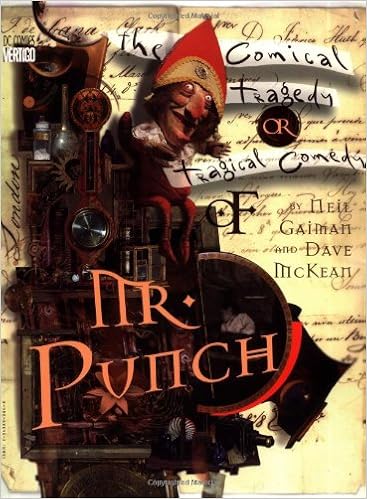
The Comical Tragedy or The Tragical Comedy of Mr. Punch
by Neil Gaiman and Dave McKean
This is the second book I’ve read (Riddley Walker by Russell Hoban was the first) that focused on the traditional Punch and Judy show. That one was disturbing because it’s post-apocalyptic, and written in a language that is not quite English and is very difficult; this one is disturbing because it’s Neil Gaiman and Dave McKean. Both are disturbing because Punch and Judy? That’s one messed up story.
So the basic plotline, if you can call it that, of the traditional Punch and Judy puppet show follows the story of Punch. Punch is a sinner: a violent, horny, drunken lout who is clever enough and evil enough to get the better of everyone else in the show – if by “get the better” we mean “beat to death with a stick,” which is basically what Punch ends up doing to everyone, including Judy, who attacks Punch after he throws their baby off the stage to its presumed puppety death. Punch also murders a doctor, a police officer, a crocodile, and the Devil himself; I assume there are variations performed by different people, but both novels tell the same basic story about the murderous Mr. Punch.
Both also describe the traditional puppeteers who tell the story. They are strange people, with an unhealthy and almost religious, even zealous, respect and devotion to the show, especially to Mr. Punch himself. In Russell Hoban’s book, the Punch puppeteer is still doing the same story from medieval England, even though the book is set hundreds of years after the nuclear holocaust that wiped out our civilization; all that remains are some broken fragments of language (the book is written in a very strange invented patois), some relics and buildings and such, and the Punch and Judy show, which is retained in exactly the same form.
In this one, the puppeteer seems to be mystical, in that he talks about an old man, one of the other characters, as having been his apprentice long ago, which would make the puppeteer unnaturally long-lived, it seems. Though it’s hard to say, because the story is told from the point of view of a young boy with a strong imagination, and there are other elements of almost magic realism: the main setting is in a carnival at the seashore in England, and the narrator’s grandfather (the one who used to be the puppeteer’s apprentice) has employed a woman to perform as a mermaid, sitting in a costume on a rock in an indoor pond, brushing her hair and singing. The boy takes her as a real mermaid, so maybe the longevity of the puppeteer is imagined, too.
But there’s also the puppets. The puppeteer talks to the boy and tells him about the Punch show, and he seems to imply that once you put the puppets on your hand, then you gain secret knowledge – and lose something, as well, mainly the ability to take the puppets off again, metaphorically, at least. The boy puts on the crocodile puppet and comments on how magical it is that a puppet can come to life once your hand is inside it; the puppeteer offers him the Punch puppet – the one that is the key to the show, and the only puppet that never comes off the hand, as the Punch and Judy show is a one-man act, so there are never more than two puppets on stage at a time (And the narrator points out that this helps to explain all the murders, as the puppeteer has to keep getting rid of the left-hand characters so he can introduce a new one), and one of them is always Mr. Punch. Who, after he kills another puppet, says, “That’s the way you do it!” Freaking weird. And this is a children’s entertainment. I think knowing that he grew up watching Punch shows helps to explain Neil Gaiman, and maybe a lot of other English authors and creatives.
To add to the weirdness, the book is not only about the Punch puppet show; the boy’s grandfather is losing the last vestiges of his sanity, and also about to lose his carnival house, since nobody goes to the seashore to go inside and see a sad mermaid or a weirdass Punch show. The boy is shy and awkward, and not treated well by his maddening grandfather; there is also some tension between the grandfather and his brother, who helps out with the show and who has a hunchback, though the reason for his deformity is a bit of a mystery commented on by the narrator. There is also an unfortunate love affair involving the mermaid girl, though the boy doesn’t understand it and so neither do we, since the story is told from his point of view.
Overall, it is strange and depressing, but also utterly fascinating, like most Neil Gaiman books. And if there were no other reason to read this graphic novel, it would be worth it just for the art: because Dave McKean is a freaking genius, and the way he mixes painting and drawing and collage and photography in the images of this book make the entire experience twice as fascinating as it would be without him; and it’s fascinating enough already.
Highly recommend, though with a warning about the creepiness and the sadness, which is not resolved neatly at the end. Like life.
That’s the way you do it.
Book Review: The Alchemist of Souls

The Alchemist of Souls
by Anne Lyle
First, the things about this book that I appreciate.
I appreciate, first and foremost, that Lyle was inspired (as she describes in her author’s note) by a name she came across in her research; she said that as soon as she saw the name Maliverny Catlyn, a minor but genuine historical personage, she had to use that name in her book. She’s completely right; the name belongs on the hero she created for this book; and since my own book was also inspired partly by a name, I approve of this wholeheartedly.
I appreciate that the book is exhaustively researched and detailed; that it covers quite a number of aspects of Elizabethan English life; I appreciate that it focuses on the theatre of the time but barely mentions Shakespeare. I appreciate that she made subtle changes, such as making Elizabeth I marry and bear two sons to succeed her, while keeping so many other things historically accurate (As far as I know, that is): that’s a fine line to walk, and she does it well. I really appreciated the religious and political tension she was able to capture; the intrigues were excellent.
I appreciate the skraylings as a theme: this is the major change that turns this into fantasy instead of a historical novel, that when the European explorers traveled to the New World, they discovered not merely the Native American populations, but also a humanoid race with an advanced civilization and apparent control over magic. So now Europe has a new ally to woo and also plot against in their wars between Catholic France and Spain, and Protestant England. It’s a good theme, and it’s done well.
I appreciated that there are strong gay characters and nobody really thinks too much about it. They get some grief for being all sinful and stuff, even from one of the other characters, which Lyle takes advantage of to create a great scene where the bigot gets called out for her hypocrisy. It’s extremely well done, and the most romantic aspect of the book, which does have a variety of romantic entanglements between the several characters.
What I did not appreciate about the book:
It’s too long. I don’t like to say that, since I’m a wordy writer myself, and I love 1000-page epic fantasies like the work of Robert Jordan and GRRM and the like. But this one dragged. There were a few too many characters and a few too many plotlines, and those plotlines went on for too long. While the two main gay characters were interesting in and of themselves, they could have been removed from the story entirely without any real loss to the plot, and the same goes for the weeks of buildup to the theatrical competition. There’s a lot of life in the book, which also has its own attraction, but isn’t necessary for this story. It’s a bit bothersome because this is the first in a series, and it’s like Lyle couldn’t stand to hold back and put some of the interesting things into later books, so she packed it all into this one – and it’s too much.
Though I liked them thematically, I didn’t really care for the skraylings. There were some really interesting tidbits that showed excellent thought and planning from Lyle – like the linguistic nugget that has the skrayling/English pidgin avoiding the letters p, b, and m, because skraylings find them effeminate; and the reason for this is that the skraylings show their canines as a gesture of assertiveness and dominance, and those three letters are the only sounds that require you to close your mouth entirely. That is cool as hell. (Though in the actual writing of the pidgin, Lyle uses normal English, essentially leaving the pidgin implied; so what the hell? I mean, that’s just lazy. There was a guy wrote an entire novel without the letter E, and you can’t write a few lines of dialogue without those three letters? THAT LAST SENTENCE DID IT AND IT WASN’T EVEN HARD! THERE, I DID IT AGAIN!) But the ambassador is a weak character, and none of the other skraylings are given a chance to stand out; I don’t understand the ambassador’s particular personal situation, nor the connection to Mal Catlyn; I don’t like the way Mal just keeps running away, and the ambassador passively lets him go. I just didn’t think much of them.
I hate the ending. At the end of this longish slowish book is a rapid-fire explosion of events that suddenly introduce a new bad guy, have a surprise twist regarding the main character and his family, grant magical powers where they haven’t been before, throw the characters into a search-and-rescue and also a duel to the death, and then end with the bad guys sort of winning. It’s clearly a set-up for the next book(s), and I doubt the bad guys will win in the end; but it made this particular book freaking annoying. Which makes me not want to read the next books.
It’s too bad about this book, because it does have some good elements; but the plotting and pace make it not worth the time. Don’t recommend.
Book Review: Three Dark Crowns
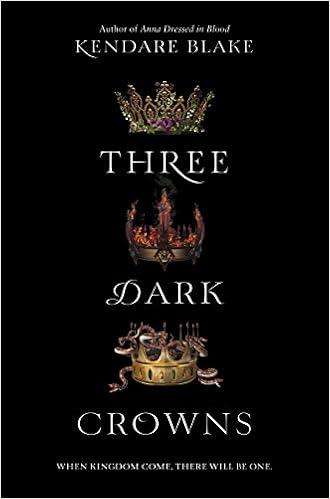
Three Dark Crowns
by Kendare Blake
This book got me. Got me good. If we had been fighting a duel, I would have bowed my head, said, “Touche,” and apologized for however I had given offense. And then probably applauded my honorable opponent for the impressive victory.
And then the next thing I knew, I’d be flat on my back, completely stunned, looking up at the book smirking over me, hearing the onlookers making shocked noises at how badly I had been slammed. Because just when I thought the book was done – it wasn’t done. It was just setting me up for the knockout.
All right, enough metaphor: let’s just get into it, shall we?
This is a young adult fantasy novel, one with young female protagonists and a fair amount of romance and social drama – friendships being made and broken, trusted advisors turning traitor, and so on – and so it would most likely appeal to young female fantasy fans. But I am only one of those things, and I enjoyed reading the book, so don’t let me pigeonhole it: it’s a good fantasy novel. It’s the first in a series, so it’s setting up the world and the long-haul plot; both are interesting. The world is based around a magical island, hidden by mists and guarded, so the people believe, by a goddess. This goddess creates a new group of potential rulers for the island once a generation, and that group is always the same: a set of triplets, all girls, born to the previous queen.
The difficulty is that only one of the girls can become queen.
The other two have to die.
The other key factor here – and honestly, the part of this book I had the most trouble with (Other than the portrayal of a couple of the teenaged boys, who were idiots or cads, but I’m not going to complain about that because Lord knows there have been more than enough fantasy novels where the female characters are the crappy ones, and it’s certainly not all the guys in this book who are twits; just two, one idiot and one cad. I’ll just shut up and take my lumps.), because it doesn’t work terribly well – is that each of these triplets has a magical power. There are three main magical powers on the island, grouped into houses; whichever house has the triplet who wins the crown becomes the ruling council for the length of her reign. The three powers are: elemental control, animal telepathy, and – poison.
Look, I don’t mean to be one of those comic book guy, gaming fantasy nerds who complain about a fantasy world being not as good as, say, Tolkien; but this honestly felt off to me. The animal telepathy I’ve got no problem with; there’s not an epic fantasy story in the world that hasn’t made me want to pull a Doctor Doolittle. I want to speak to the Eagles like Gandalf, and run with the wolves like Perrin Aybara, and communicate with dragons like Daenerys Targaryen. So that power was great. The elemental power seemed overbroad, because that queen can do everything: she can bring storms, she can bring earthquakes, she can dance wreathed in fire. And on the other hand, the poison-powered queen can, umm, eat poison. And not die. That’s it. Seems lame in comparison. Also not terribly useful in a magical duel to the death. So I admit, that bugged me a little, particularly because the story is about these three girls approaching the age when they are supposed to start fighting over the throne, meaning they have to kill each other; and really, what are the odds here? The animal telepath can control animals and send them to kill her sisters, and the elemental sister can bring fiery wrath from the skies; the poison sister can – not die while she eats poison. I really couldn’t make that work well in my head, and so it was a bit of a stumbling block.
But here’s the thing: apart from that, the story is great. The girls have different power levels, which means some of them expect to die and others expect to kill their own sisters; and neither is a good place to be. That tension is very well done. The desperation of the weaker sisters to find some way to make their powers sufficient to survive and even kill, that’s also well done. And all of the intrigue, the social interactions, the boys hovering around them trying to become the consort of the next queen (which also means they have to bet on who’s going to win this fight), that was very well done. I liked all of that. I liked all three of the sisters’ characters, even though they’re all entirely different. I was trying to think of a way out of the conundrum they were in, and regretting that I couldn’t; that’s a sign of a good piece of writing, when it leaves the reader looking for a solution to the conflict.
But then: then it got me. At the very end (and no spoilers), an event happened that I pretty much expected, though the means of it was a surprise. But it turned out to have a twist, which I really didn’t expect; Blake set this plot up so well that I was genuinely thrown when the twist happened.
BUT THEN THERE WAS ANOTHER TWIST! Completely unexpected, totally out of left field. And that one, hooooooo BOY – that was the one that knocked me on my ass. But it was great, because it also changed the way I saw the book I had just read: I went from thinking it was okay, to finding it much more interesting once I had this new piece of information. And the best part about it was that it set up a whole different expectation for what would happen in the second book, which means that, of course I have to read that one, now.
So this was a good one. I will want to read the sequels before I recommend it entirely, because I’m not going to recommend a fantasy series that doesn’t end as well as it starts; but this was definitely a promising beginning.
Book Review: Sleeping Beauties
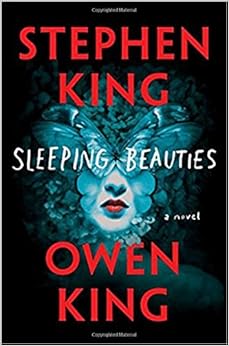
Sleeping Beauties
by Stephen King and Owen King
To start with, I love Stephen King. I always have. I’ve read pretty much every one of his books, most of them more than once; I’ve been reading his work faithfully since I was 13, and my friend loaned me a copy of It to take with me to summer camp. (The Summer of Blood-Soaked Nightmares, I called that one. Subtitle, We all float down here. Sub-sub-title, Don’t ever use the bathroom in the middle of the night when you’re reading It.) I am a great admirer of his remarkable ability to create characters, to build suspense, and to squeeze a thousand details, all of which are both real and also unexpected, into the framework of a story.
So going into this one, I was already going to like it: there have only been two or three Stephen King books I haven’t liked – mostly the ones that have actual aliens invading, The Tommyknockers and Dreamcatcher. Didn’t like Hearts in Atlantis, either, which was too bad because I love the low men and the can toi from Desperation and The Regulators. Anyway, since the man has written like 75 books, the chances were good for Sleeping Beauties: something like 25 to 1.
And I liked it.
It wasn’t my favorite Stephen King book. It might be easy to chalk that up to the influence of his co-author, his son, Owen King; but to be perfectly frank, I couldn’t even tell that this was a collaboration: it just read exactly like a Stephen King book. You’ve got a supernatural being appearing within the very first few pages, and immediately diving into a bloodbath of murder and mayhem, without even the slightest explanation as to who or what they are, or why they are ripping people’s limbs off. You’ve got a large cast of characters, most of them good but flawed people; you’ve got a male lead with a troubled love life; it’s set in a dinky little town half in the wilderness and with one spectacularly creepy location – in this case a women’s prison – that plays into the story in some prominent way. You’ve got a character or two who act as a combination demogogue and Wormtongue, whispering in the ears of the populace, playing on their fears and hatreds to bring out their absolute worst traits; you’ve got a supernatural phenomenon growing more and more powerful, and more and more apparent, though never quite becoming easily explainable; and you’ve got some enormous fight scene at the end, in which at least a good third of the characters die. This one has all of that.
That is not to say Stephen King’s work is monotonous, nor that this book is just like any others of his. Neither statement is true. It’s just that he does have tendencies and preferences, and certain themes that he keeps coming back to: like the mob. Not the mafia mob, but the driven-crazy-by-fear, pitchfork-and-torch-carrying mob. Mr. King knows that mob well, and he recognizes that there is no better reflection of the evils of the 20th century and beyond – unless it is the slick-talking small-town salesman-and-politician which shows up in many of King’s works as well; though not this one.
But there are some real distinctions, as well, in all of King’s books, and in this one. The lead character, for instance, is an interesting man that King has never done before: he is a prison psychologist, married to the town sheriff – another new element for this book, because I can’t remember another woman cop; usually his cops are the bad guys, which is true of several of the cops in this book, but not the sheriff. But her husband, the prison psychologist – Clint Norcross – was a former foster kid with old anger issues from his youth, which was exceptionally violent. He was not the madman that Jack Torrance was in The Shining, and not the epic hero Everyman that, say, Stuart Redman is in The Stand, or Stuttering Bill Denbrough in It. Clint doesn’t save the day. Clint is a mostly good guy who does mostly good things. That’s all.
The real story here is not the Stephen King setting or the tropes; it is the question of sex. Gender. Men and women. Because the concept of this book, the supernatural event that throws everything into chaos, is this: all of the women in the world fall asleep, and they don’t wake up. The supernatural being who comes in and starts removing limbs in a shower of blood is a woman, perhaps Eve or Lilith or Wonder Woman or Pandora or all of the above – certainly Helen of Troy – and she represents a greater power that has decided to give women a chance at a better world, a world where they don’t have to be beaten or raped or killed by men. So whenever a woman falls asleep, she spins a mystical cocoon; and she remains in the cocoon until further notice, while her soul goes – somewhere else.
And meanwhile, without women to abuse and destroy, the men turn on each other.
That’s the basic story, and parts of it were tough to read: the stories of women suffering at the hands of men, fictionalized but by no means exaggerated by King, were often heartbreaking and enraging. I got a little frustrated with Clint Norcross, who reads sort of like the hero, but isn’t really the hero simply because he’s a man; I did like the main villain, who leads the mob into the final fight, because he was sort of the other side of the coin from Clint, which was interesting. But I certainly didn’t like the son of a bitch. One interesting thing, though: King has said that the quickest way for an author to get an audience to dislike a character is to have the character hurt a dog. (A lesson King probably learned from Jack London). But the villain of this book? He is kind to dogs. Make of that what you will. In some ways, the hero is no specific person, and neither is the villain: the hero of this book is the better half of the human race. (Guess who the villain is.) And they’re not all perfect either, of course, because King doesn’t write perfect characters; but they’re a hell of a lot better than the men. It was a little tough reading 700 pages about why my gender sucks. But it certainly wasn’t news.
The suspense is great; the violence is savage and glorious, as always; the big fight at the end is wonderfully apocalyptic. I actually didn’t like the supernatural element as much, because I didn’t really like the resolution. Should have gone the other way. But I did like the fox. And the Tree.
This is a Stephen King book. It’s not for everybody, but if you like Stephen King, you’ll like this one. I did.
Tied Down at the Edge of a Cliff

We say we have to get me out of teaching. We say it often, laying in bed at night before we turn the lights off, when we usually turn to face each other, heads on pillows, and sort of put a punctuation mark on the day – sometimes an exclamation point, sometimes a question mark; but usually just a comma or a semi-colon, because the end of the day is almost never an ending, almost always a brief pause for breath before we go on with the next clause, the next day, separate from the last but still connected – always connected.
My life is a run-on sentence. And I don’t know how to stop it.
No: I know how to stop it. (And I’m going to leave this metaphor behind now, this navel-gazing grammatical pun. Jesus, Dusty. Get a life.) I could change my life quickly if I leave everything behind, including my wife and my pets, a sentence that took me several tries to actually write. I could change everything if I left everything. I do what I do so I can earn what I earn so we can live how we live: as we. But our bed, where we lay at night together, is actually the ground at the top of a cliff. Everywhere I go, I am at the top of this cliff. At night we lay together, our heads heavy on the pillows, and we look into each other’s eyes and I tell her how much I love her and she smiles at me and I love her more, and then we kiss goodnight, and roll over – and I stare off the edge of the cliff.
The cliff is the edge of my world. I don’t mean the end of life; I’m not talking about dying. I’m talking about where the place I am, the place I live, where it ends, abruptly, startlingly, dangerously. Honestly I have pretty much always stayed near that cliff’s edge, in various ways. But never too near: because I am a coward, I think. And though every night I look out into the open air beyond that cliff, to actually jump off that cliff and land somewhere entirely different – or perhaps instead of landing, take flight and sail across the sky, which is how I imagine it would feel to be a writer – I would have to leave behind everything I am now, everything that is this place where I live, this life where I live, where I sleep with my head heavy on my pillow and my eyes straining to look out farther but tired, so very tired, with the looking; but behind me (or no: before me, between me and the cliff, not to protect me but because she is even closer to the edge of that empty space that might hold a new life) is the best woman in the world, and at our feet lies the sweetest dog I’ve ever known, and nearby are a bird and a tortoise who need me, who are tied to me, who are weighing me down. And none of them – not even the bird, sadly – can fly.
Let me be clear: it is not my wife’s fault. She never asked me to get this job, never demanded a larger home, a larger paycheck, health insurance, stability, all the tethers of the modern world that tie me down at the top of the cliff, safe and immobile, able to turn my head and look out to eternity, growing and throbbing out there beyond the fall to the bottom. She doesn’t demand them of me now, never tells me when I talk of leaving teaching that I can’t do that because the family relies on my stable income and health insurance. She has never said that once. She never would. She lies with her head on her pillow, holds my hand, her fingers exploring mine as she imagines drawing my hands (as she imagines drawing everything), and says, with her eyes sad, “We have to get you out of teaching.” Now that she has tethered herself down right next to me – but closer to the edge of the cliff than I am – she says “We have to get ourselves out of this.”
Then we talk about how we can be free, mobile, able to pick and choose what we do with our lives, if we just buckle down and teach for three years and pay off all of our debts. Maybe four years. Maybe five. Tethered down right at the edge of this cliff, looking out into space, lying with our heads heavy on the pillow, holding hands.
I’ve never jumped off a cliff. I jumped off a swing into a river, once, but I landed flat on my back when I tried an ill-advised backflip; it hurt. I don’t remember if I went back on the swing again after that, but probably not; I’m a coward, and I always have been, and that’s why I’m still at the top of this cliff, near the edge but not on the edge. I’m looking out on this vista, this panorama, of wide open space, and I’m – I don’t know, shouting over the edge? Maybe whispering, blowing words like soap bubbles, glittering and evanescent as they drift pointlessly free? But I’m still here, on solid ground, holding on for dear life even though I am nowhere close to falling.
I should be falling. If I was a writer, I’d be falling; if I was falling, I’d be a writer.
Instead I am – yes, I know it. A spider. Remember the tiny ones at the end of Charlotte’s Web, how they spin out a single thread of silk and throw it up into the wind, letting the air lift and carry them away? That’s how I want to go out over the edge of the cliff; not free fall, not dropping down and just hoping that something will catch me, though I’m not sure now if that’s because I’m a coward or just because I don’t care for the thrill, never have, never liked adrenaline, never wanted to feel alive because I almost died. I hate stories that rest on that idea: that life is either risk or boredom, that everything that is lovely or pleasant or simple becomes blasé, because I feel like if I could live forever, I would just read all of the books that I won’t have time to read, and play all the video games, and walk over every inch of the Earth, and why would that get boring? I don’t believe that it would. And so I want to drift over the edge of the cliff, not plummet. So here I lay, throwing out single threads of silk, gossamer words, hoping that one of them will catch the wind and lift me free and sail me away through the sky – and my wife and our family with me.
I’m growing roots. I have been for years, though I frequently pull them out of the ground and let them wither and die. I don’t need the roots, though I don’t hate them; that’s probably why I let them grow, and maybe that’s why I haven’t gone over the cliff, because I don’t mind the slow growth, don’t mind drifting down into the earth instead of up into the sky. Maybe if there was a way to sink below the surface, grow a taproot large enough and deep enough and then pour myself down instead of drawing nutrients up, follow my own growth into the deeps, and then tunnel down through the cliff from behind its face, back behind the bones, down and down and down until I came to the bottom and then slid out from between the teeth, out with the breath of the earth back into the open air. Then I’d be in a new place, and not at the edge of a cliff looking out; then I would have changed, would have moved.
But I would have never flown. Never left the ground. Is that, could that be, what it would mean for me to be a writer? To move through the earth to new ground? Does that metaphor make sense?
Is this the thread that will lift me? Or the one that I can crawl down, like Dante down the leg of Lucifer, crawling down until suddenly he was crawling up, out of the depths of Hell to the mountain of Purgatory? But see, he was carried on that final voyage out. He was on a mission from God. All he had to do was hold on and wait.
I don’t think I can just hold on and wait. I think I need to move. I don’t know if I can fly and take my family with me – and I won’t leave them behind. There is nothing that would be better without them. I don’t even know why I say it, other than I know that most people who jump off the cliff, who make themselves suddenly into writers (or into flattened, shattered remains), go it alone. I don’t want that. I don’t think I ever have, but I know I don’t now. So the question is: do I keep throwing strands of silk into the air? Do I stitch them together into a single sail, and just wait for a wind great enough to lift me, and my wife, and our heavy heads from off of our pillows, and we can grab the bird and the dog and the tortoise in passing and carry them with us? Could there be a wind great enough to lift a sail large enough to carry us all aloft?
Or do I try to find a new way, this magic that will turn the earth beneath me malleable, let me alter the flow and the path of all things so that I grow in the wrong direction, turning the wrong into right? Honestly, I don’t even know what this metaphor means: would I write for the local scene, find local websites, write for the Tucson newspaper? Is that what it means to go down your own taproot, to go deeper into the earth, to become a writer by digging down? I don’t know. I want it to be magical, somehow, to be an alteration of the paradigm, a new path, a new alchemy that turns stone into water, just for me, so that I could swim through something that can’t be swum through – but though I can imagine that, I don’t understand it, I don’t know how I could do that, if it could be done. I don’t know if I’m creative enough to do it, if I have the wizardry to break the laws of nature. But since it took me four tries to actually type the word “wizardry,” I’m going to say the omens are bad.
Maybe I should try to climb down the cliff. Grind it out, slow and steady, keep working, keep writing, keep moving; no magic, just constant effort, every moment testing my strength to the limits, every moment hyperalert, looking for that next ledge, that next handhold.
I don’t know. I’m 42, and I haven’t started climbing yet. I might already be too tired just from lying at the top of the cliff. Lifting my head off that pillow every goddamn morning. Looking out at the expanse of sky and thinking about how wonderful it would be to sail away. Spinning my silken threads, my tenuous sails – watching them break and fall, or vanish off into the ether without me. And here I lie.
I don’t know how to fly.
Update.
Toni read this. We talked about it. And having talked to her about it, the answer is clear: we will be alchemists. We will swim through the Earth, and see where we end up.
I consider the metaphor of flight to represent getting published by a traditional brick-and-mortar company, selling books out of Barnes and Noble, the whole Best-Selling Author bit. I’d still like to fly. I’m going to keep sending up streamers of spidersilk, hoping that one will catch just the right breeze and lift me up into the sky. I would like that. For Toni, the same metaphor probably applies to suddenly hitting it big in the art world: becoming a name, being sold in galleries, getting commissions for public art, all of that. And that would be swell, too.
But that’s not the goal. Neither is the goal a safe and sure and trying descent.
No: the goal is to try something new. We plan to write and illustrate and sell graphic novels, and illustrated novels. I plan to go back to publishing a serial novel, which will be available as enriched and expanded e-books, featuring extra stories, back stories, side characters, and so on. Maybe we’ll run a book store. I will publish my novels, and she will sell her art – and we will see what we are capable of and where we can go. What new places can we discover, and explore? What exactly is down there, underneath us? Could it be even more intriguing, even more wondrous, than the sky above?
We will never jump off the cliff. And we will never leave each other behind. (Nor the pets.)
We choose – magic.
 Just Dusty