Truth

It seems to me there are three ways to come at this essay about the different kinds of truth. The first and most obvious – to me, at least – is to quote the diabolical Sideshow Bob from The Simpsons, who, when on the witness stand and told that the court wants the truth, scoffs, “You want the truth? You can’t handle the truth! No truth-handler you! Bah, I deride your truth-handling abilities!”

The second (and only slightly less amusing) is to make reference to the classic Dwight Schrute meme where Dwight points out the problem with a statement – here, if I may indulge in a visual, is one of my favorites:
Image result for dwight schrute false meme

But I believe I will select the introductory quote about truth that is nearest to my own heart: Dan Rather, the former anchor for the CBS Evening News, said, “The dream begins with a teacher who believes in you, who tugs and pushes and leads you to the next plateau, sometimes poking you with a sharp stick called ‘truth.’”

I would like to poke you with a sharp stick called ‘Truth.’

This would seem, at first, a fruitless enterprise. After all, truth is truth; how can there be kinds of truth? But in fact there are, simply because we are flawed creatures, we humans; we cannot know everything, and so we cannot know absolutes: there may be circumstances and conditions under which anything we think to be true may in fact not be. Therefore there are at least two levels of truth: truth we can know, and truth we cannot because it is absolute and thus requires omniscience. Or more simply, truth we can know and truth we cannot know, but which is nonetheless truth. The key here is to accept that knowing truth changes its truth-value, which is the concept I hope to prove in this essay; the upper limit is truth which requires omniscience to know, but there are degrees leading up to that limit, and recognizable categories, which I will attempt to explicate.

By the way: because I wrote out that Sideshow Bob quote, now my word processor wants to autocomplete “truth” into “truth-hand” every time I write it. This is both wonderful and annoying.

Like truth.

Let us begin with a basic understanding of truth. Truth is perhaps best defined through defining its opposite, falsehood; I would argue that there are essentially two kinds of falsehood, which are one, untruths, and two, lies. Untruths are things – ideas, statements, assumptions – that are not truth because when one attempts to verify them objectively, one finds reality does not match the untruth. If I were to believe it is raining outside because I am in a room with no windows, I can look out through the door and discover whether my belief is true, or untrue: if it is raining then the belief is true, and if it is not raining, then the belief is untrue. This is the first point in arguing that knowing truth changes the truth-value: because the belief that “It is raining outside” is objectively true somewhere, presumably at every possible instant that one could believe it – especially if one broadens the concept of “rain” to include liquid precipitation on other planets and celestial bodies. So sure, it is always raining SOMEWHERE – but unless it is raining where I personally can verify it through my senses, then it doesn’t really matter to the truth-value of my belief; if I were to step outside into a sunny afternoon and say “It’s raining,” someone’s response would likely be

Image result for dwight schrute false

The second kind of falsehood is a lie: this is when the truth, objectively verifiable through the senses, is known, and an idea is put forward that is known to be counter to that truth. This is when I am in a room with windows, looking out at the sun, and I say, “It is raining.” The advantage for our purpose here is that it doesn’t matter which kind of falsehood it is, the truth is always the same: objectively verifiable through the senses.

But there is a difficulty there. Because there are truths that we have discovered, truths that we know, that are not verifiable through the senses, that are not objective. A strict prescriptivist of truth would argue that these truths are therefore not true, because only objectively verifiable facts can be true. To those people I say: talk to Heisenberg. (And this is funny, because it’s mostly science-y people who would say that, and Heisenberg is about as science-y as you can get. Take that, science!) The Heisenberg Uncertainty Principle tells us that when a particle has two complementary properties, such as position and momentum, we cannot know both properties at the same time. If we know precisely where the particle is at a given moment, then we have frozen that particle in time, which means at that instant, to us, it has no momentum: picture it as a snapshot of the particle, showing us where it is, but in that snapshot, it is not moving. Alternatively, we could know the particle’s momentum, its velocity and direction; but we can only measure that by tracking its movement – which means that, over the time period when we re tracking its movement, we cannot say precisely where it was: only give a range, somewhere between Point A and Point B.

The real point is, that particle has both momentum and position, and both of those properties have objective truth, both are definite, verifiable facts – but we can only know one at a time. Knowing one makes it impossible to know the other, but it doesn’t change its truthiness.

Therefore we must add a word to our definition of truth: truth is an idea that is potentially objectively verifiable through the senses. If we had world enough and time, we could verify it; therefore it is true. But I hope we can all see that a truth that is objectively verifiable through the senses has more impact, more weight – more gravity, let us say – than a truth that is only potentially verifiable. If I suspect that the rain falling outside my room is in fact acidic, but I don’t have the instruments to test, then I may want to respond as if it were acidic, and act to protect my plants, let us say; but in the process I will undeniably encounter the verifiable truth of the rain itself: I will get wet. I am more likely to respond to the fact of wetness than to the theory of acid; that truth, then, has more weight, more potential to change my thoughts and actions. That truth has more gravity.

As I was saying, then, the lowest level of truth is one that is only potentially verifiable, but cannot be objectively verified. In fact there is one level of truth lower than that, based on knowledge – or rather, on ignorance; because if knowing a fact gives it more weight, then not knowing gives less. So the lowest kind of truth is truth we don’t know. It’s true, but for us, it is meaningless; because of our ignorance, this is equivalent to the absolute truths we can’t know. In either case, we can’t act on it, or change our thought process or paradigm because of it; it has no impact on us. For us, it might as well not be true, and so it has only the barest sliver of truth. That bottom level is the fact of rain outside a room with no windows and no doors. Or whether or not the worm currently crawling through the earth beneath me is depressed. I don’t know, and so cannot act on it. That’s the lowest kind of truth—and I apologize for using an underground worm’s depression as an example; I really didn’t think about the pun there.

As for truth that could be verifiable but can’t be objectively verified, let’s use as an example the infinite nature of the universe. Is the universe infinite? No idea. We’ll never know. In theory one could find a mathematical proof of it, if we could find the existence of the multiverse and the mechanism whereby new universes are created, but we can’t ever know it for sure. The only thing this kind of truth can do for us is give us a headache: it feels like we could know, but we can’t actually know. This kind of truth is a tease. At best a Zen koan.

Just above that level is an idea that I think is true, but I don’t know why I think it’s true. This kind of truth has the potential of being objectively verifiable, but I as the knower don’t know how to do that, and therefore could never verify it. This is where most racist ideas live. Why do racists think white skin is better than brown skin? They don’t know, but they think it’s true. There are quite a number of outright lies at this level, because people might be able to figure out how to verify their beliefs, but they don’t want to, because the truth will likely be the opposite of what they believe it is. That, in my opinion, is a lie: when I say it’s raining outside, but I refuse to open the door and look because I think it is probably sunny – but I won’t admit that.

The next level up is something that I am sure is true, and that I have evidence for, but which is not clearly objectively verifiable based on my evidence. This is where superstitions are found: Michael Jordan believed that his lucky shorts were one of the reasons for his success, and he wore them for every game he played. He won six NBA championships and three MVP awards wearing those shorts; so there is some evidence that the shorts were lucky. Just not verifiable evidence, because “luck” can’t be tested for – but just like (Okay, not just like) the uncertainty principle, if we were to create a laboratory experiment to confirm that the shorts were not lucky, the element of luck in the form of blind chance or influences on the experiment that we could not control would ruin the results: if we had Michael Jordan play half the time with his lucky shorts and half the time with “control shorts” (Which makes him sound like he has bladder control issues, which is just sad), that doesn’t mean we can make his teammates play the same in both games, or his opponents play the same, or even control all the other factors that go into Michael Jordan playing well or poorly. We can’t prove the shorts are or are not lucky, but there’s objective evidence in the form of success that says they are. And that’s why luck still exists as a concept, and why Jordan wore the same pair of shorts every game for almost fifteen years.

Oh – he did wash them, by the way. After every game.

The next level is one I don’t want to include, but I have to because of the parameters I have set forth. If someone knowing a thing makes it more true than something that nobody knows, then if a lot of people know a thing, it has to be more true than if only one person knows it. Because a known fact has more weight, more gravity, and that is an element of the fact’s truth-value. So the next level up is a thing that is known, with evidence but without objective verification (but still potentially objectively verifiable – have I broken your brains yet?), by a lot of people. I hate this because I don’t want to say that the popularity of an idea has any bearing on its truth, but in fact, if we want to include a truth’s potential to change someone’s mind or behavior – and I do, because otherwise there is no point to speaking about truth at all – then I have to make this a separate and higher level, because something that a lot of people believe to be true has a much greater chance of changing their behavior. This is something like this statement: Hillary Clinton’s use of a private email server makes her a poorer candidate for president (Meaning she would have been a worse president than someone otherwise identical but who didn’t use a private email server; the statement that the private email server made her less likely to win is objectively verifiable truth, because: well, look.). A lot of people believed that Clinton’s private email server made her less trustworthy, and therefore a bad candidate for the Presidency. And because a lot of people believed it, with evidence (Because that’s an untrustworthy act) but not objectively verified (Because she never became president and so we can’t see how untrustworthy she would have been in the Oval Office), it had more weight: it had more impact. It changed enough votes that it, along with other factors, changed the outcome of the election. That truth had more value, more gravity, because more people thought it was true.

Are we having fun yet?

The next level is something that is true not because it is objectively verified but because it cannot be disproven. This is sort of an offshoot from the last level, because there isn’t objective verification, but there is somewhat more weight to these ideas because there is an argument to be made for them, that nobody can disprove the idea, that makes it more likely that people will accept it as truth, which increases the truth-value or gravity of the idea. (Don’t worry: we’re almost at the top. Almost at simple truth. But not quite.) This is the level where God lives. The existence of an omnipotent, omniscient, non-material personal deity is impossible to disprove: there is no observation I can make that would prove that God doesn’t exist. According to science, this makes the god-hypothesis false, because it is unfalsifiable; but I’m not talking about science, I’m talking about impact on humans through the intersection of objective reality and knowledge. There are quite a few people who know God’s existence is real, and since God cannot be disproven, that gives the idea more weight than Michael Jordan’s lucky shorts. (You have to be an atheist to make that statement with a straight face. Okay, I was smiling a little when I wrote it.) It moves the truth of religion to a higher level, how’s that? Not objectively proven, but not objectively disproven, either.

But now, at last, after ignorance and belief and faith and falsifiability and religion and – Lord help us – even sports, we come to the simplest level, and nearly the top. This is where we find: the truth. Simple truth. Facts, with known evidence, which are objectively verifiable: I can look out my door and see that it is or is not raining, and I can actually test it to make sure that it is rain. I can step outside, and I will get wet. Truth. Simple truth.

Of course, even this level isn’t that simple, because the evidence of our senses is, sadly, not necessarily reflective of objective reality; all my senses could verify that it is in fact raining, but I could be mad, or in the Matrix. But that moves us over into the question of absolute truth, and since I can’t know absolute truth, it doesn’t matter to me: absolute truth is actually down at that bottom level, truth I don’t know. (There’s no way out of Descartes’ labyrinth here, by the way. In the Matrix, it is possible to know that the Matrix is not real – but then, the second movie shows us that there is another level of truth, that Neo is the sixth version of the One, and the other characters did not know that truth; and then past that there is another level – because the character Neo, like the character of the Architect who makes him, who made the Matrix, don’t know that they’re actually in a fictional movie. The only truth we can ever know is what our senses tell us. Period. Cogito ergo sum.) We take our reality as just that, as reality, and that is all we know, and all we need to know. That is truth.

One level left: that is the important truth. The weighty truth, the truth that is both objectively verified and also able to change thoughts and actions of humans; the kind of truth that makes a paradigm shift, that combines both science and popularity, and therefore moves mountains and changes continents. Proven facts that also have gravity. This is, for example, the truth that every living thing dies.

The truth that love conquers all.

The truth that money makes the world go ’round.

The truth that man’s inhumanity to man makes countless thousands mourn.

The truth that art is humanity’s highest calling.

The truth that beauty is in the eye of the beholder.

The truth that evolution through natural selection is sufficient to explain all complexity in the biosphere.

The truth that we’ll never know how many angels can dance on the head of a pin.

My last truth is this: we can handle the truth. We can. We do.

Just not enough.

Take luck!

I’m feeling lucky.

This morning, when I put cream into my coffee, I managed to get in just the right amount so that, when I stirred it, none slopped over the side. I’ve been failing at that recently. So this success must be a good sign of more success to come.

When I opened my laptop, there were cookie crumbs inside. Definitely a good omen. Cookies make everything better, and clearly, my laptop held onto that tiny bit of cookie just to make me smile, to remind me that there is humor everywhere, and sometimes, I get to see it. When I’m lucky.

We just moved into our new house, and while we were still in the preparation stage, we were coming over here every day after work, dropping off some things because this house is quite close to the school where we teach, and also watering the new sod we put in as a food source for our tortoise Neo. And there was a dove that had a nest in the eaves of our carport. At first, we weren’t sure she was alive, because she didn’t move much and never flew away when we drove in with our noisy people-carrying-machine; but we did see her little head tilt this way and turn that way, and so we realized that this was, in fact, a real dove that lived in our new carport. This is, for us, a lovely thing (even though – or perhaps partly because – my father’s response was “Hm. Doves’re dirty birds.” So sad.) because we cherish life, and want to keep others’ lives safe and comfortable whenever we can. So we greeted the dove every time we came, and tried not to move too quickly or make too much noise.

And then, the morning after the first night we stayed here, we heard a terrible thump. We ran to the back door and looked out, and indeed, the dove had flown into the window. We have no idea why: the window is small, and was covered with blinds on the inside, and the carport is completely open on one side. Perhaps the dove was scared by something coming into the carport and tried to escape; perhaps she had been sitting so still in her nest in the first place because she was hurt and trying to recover, and her first attempt at flight was ruinously bad. Maybe she just got caught in a bad crosswind that came up at just the wrong moment: just bad luck. All we knew was, there she lay, twitching and bleeding on the ground. Her head seemed twisted to the side, the blood coming from the top of her wing. We went away, unable to watch her suffering; I came back and checked, and she was lying still but for the tip of her tail, which still drifted up and down gently, like a leaf in the wind, like the line of light on an EKG as it shows the last beats of a dying heart. I walked away again, hoping she would die soon.

Trying not to think of this as an omen. But how could I not? Here we were moving into a new house, and the original resident was dying on the concrete in front of me. Surely we had somehow disturbed her. Maybe she was trying to escape the fate of losing her private nesting ground to loud, obnoxious humans. Maybe Nature was trying to tell us something.

But then, Toni came to me. “The dove’s still alive. She’s sitting up.” “What?!” I jumped up, went to the window — and indeed, the dove was now sitting upright, head on straight, looking around, still with blood on her wing. We put a towel into a box and I got some gloves, so we could pick her up and make her comfortable, at least; we had to do what we could for our neighbor. We went out the door, moving quickly but gently, trying not to scare her.

She took off. Flew around the carport, and then off into the bushes nearby. Later that day, she returned to her nest in the eaves; we put out some food and water, and left the towel in the box in case she needed it. But we were happy: because now it was a good omen. She was the dove that lived. So that must mean our new house was willing to accept us.

The dove left, a day or two later. Hasn’t come back.

What kind of omen is that?

Last night, a week after moving in, we were coming back from a celebratory dinner – celebratory because yesterday we finally finished moving out of and cleaning up our old rental – and as we turned into the driveway, I saw something perched on one of the rocks at the end of the driveway. As we drove by, it took off and flew. But it wasn’t the dove: it was an owl. A large and magnificent owl. It flew to our mailbox and perched there, not moving, for the next half hour, at least.

So is that an omen?

Did that owl eat the dove?

So are we welcome here, or not? Teiresias, the blind prophet from Sophocles’s Oedipus cycle, reads the actions of birds in order to know the future (He has a servant describe them to him; one of the earliest examples of an author making a great symbolic statement and then having to come up with some ridiculous bullshit to make it work. “You say he watches the birds to see the omens? But I thought he was blind, and could only see the future clearly.” “Uhhhh – there’s a servant who describes them. Yeah, that’s it. A servant. So anyway…”); what would he make of this chain of events?

We had Chinese food for that celebratory dinner, and of course I had a fortune cookie. My fortune said, “Next week, green will be a lucky color for you.” Okay. Thanks. Though I’m not sure what that signifies. Is it about money? Should I wear green? Will that create good luck for me? Should I look for things that are green, that I can take as signs, so I can find luck?

And is it going to be good luck, or bad luck?

I wanted to write that I don’t believe in luck. That’s what I meant to say. I was trying to think of a good insight for this blog, something about how luck is mostly a misunderstanding of probability, that we underestimate the chances of certain events happening, and overestimate the chances of others; that confirmation bias makes us believe we are seeing a correlation when really we’re just noticing things that fit into our beliefs (“Every time I see something green, something lucky happens!” Right: because you’re looking for green things, and when you see one, you look around for something lucky. And it’s most likely something like “Hey, I didn’t trip and fall into that cactus patch! Thanks, Good Green Luck!”). I was going to write something about the multiverse, about the infinity of possibilities that we live in, and how the particular reality we are in doesn’t show great good luck: it’s just one of uncountable alternatives, most of which are not lucky at all. There’s a great short story that I am currently hurting my students’ brains with, called “The Garden of Forking Paths,” by Jorge Luis Borges, about how reality forks as it moves into the future, creating alternate realities where things are different, sometimes coming back together as two different causes have identical effects; in the story, when this truth is pointed out the main character imagines a forest of ghosts: versions of himself and his interlocutor, living slightly different lives, some where they are friends, some where they never meet. Then the protagonist goes on with the reality he is currently living, and he shoots the other man dead. It’s a story about coincidences, and how there really aren’t any; it’s just that in the infinity of possibilities, some of the forking paths into the future seem highly unlikely, only because we don’t see the others. The chances of this one thing happening may be a million to one: but if slightly different versions of you are walking on all million-and-one paths, one of those versions will seem incredibly lucky. The others? Probably won’t even notice. I mean, do you know how many chances you have had to win the lottery? How many times you could have played and the machine would have spat out a winning ticket, just for you? Somewhere in the multiverse, that’s happened.

That’s luck. So I believe. It’s only a lack of awareness of the other instances.

Good. That feels insightful. Certainly more so than freaking astrology, which I learned was bullshit when I was told that my star sign (The uncomfortably named Cancer, which I can’t believe is still accepted blithely; because the people who follow astrology believe in signs and omens, right? SO WHY THE HELL DO THEY NOT INSIST THEIR STAR SIGN NOT BE NAMED AFTER THE MOST DEADLY DISEASE OF OUR AGE? Can you imagine if one of the signs was named “Gangrene?” Or “Sucking Chest Wound?” [To be fair, they did try to change the name at one point, but they tried to change it to “Moonchildren.” Oh, please. That’s the worst King Crimson song. Should have gone with Crimson Kings.]) showed that I was a romantic introvert, a person with overpowering emotions, who therefore drew into his “shell” to protect himself from the harshness of the world. Sure, kind of accurate. Except my brother is also a Cancer, and he is logical, extroverted, and entirely free of romanticism. So apparently Cancers are romantic introverts except when they’re not. Very handy.

So I’ll write about that. About how luck is simply one possibility that occurs, and we attach more meaning to it than we should. We almost won the lottery once, you know. Picked five of six numbers, and the sixth was – no joke – one off, a 2 when I picked a 3. If I had picked a 2, we’d have won $42 million. Since I picked 3, we won $1300. Was that good luck? Or bad luck? I know which it felt like, which it still feels like. Feels like the universe was screwing with me. Like I’m doomed to come close, but never quite reach the ultimate success.

But at the same time, I feel very lucky. Because there is one way that I feel like I have achieved the greatest of glories: in my marriage. A long series of unlikely events led me to a specific place and time where I met my wife. Who is my perfection. She is my ideal beauty, my ideal partner, my better half, my best friend, my soulmate. She is all those things, and somehow I was lucky enough to find her and capture her attention, because somehow, against all odds, I am all those things to her. (Okay, maybe not ideal beauty: she swoons whenever she sees old pictures of Chris Cornell. And rightly so. But I’m close to ideal, and that’s good enough. Still lucky.) And our paths happened to cross, and we were both single at the time, even though she had just before sworn off of long-term relationships. Lucky. And because despite my star sign, I have not yet developed a fatal cancer. (You want me to knock on wood right now, don’t you? Admit it.) Because I have been able to find my way through life to where I am right now, in this lovely new house, typing on my trusty laptop, while my dearly beloved dog dozes beside me. (Pause for petting.) I don’t think I live in the greatest country in the world, but it is a good country. And I don’t think I live in the best time in history, but it is a good time. I’m a lucky man, living a lucky life. Except for that whole Can’t-get-my-books-published-and-so-my-life’s-dream-remains-unrealized thing. But hey, at least I have this blog, right? And some people read it, and even like it. I’m very lucky.

I can’t escape that feeling, or using that word for it. Because really, luck is just a name for something we notice, but can’t explain. We like to think we can control it, summon the good kind when we need it and banish the bad kind to some dark dimension or shadow realm where it oozes around looking for someone on whom it can inflict suffering – just so long as it isn’t me! – but the truth is, we just notice it sometimes but not others. I notice my luck in discovering my life’s love; maybe I don’t notice my luck in avoiding a serial killer who almost chose me but not quite. Or, more realistically, I don’t notice my luck in being the inheritor of a planet, set in the Goldilocks orbit where liquid water and a stable atmosphere are possible, where the dominant species was wiped out by an asteroid impact that was just large enough to kill them but not large enough to kill my ancestors or to scour the Earth free of life. Still there; still lucky; but we don’t notice.

I only notice how lucky I am that I can listen to my wife’s heart beating.

If I was a religious man, I would call it a blessing; if I was more prosaic I would call it coincidence; I think I may actually prefer the term “luck.” It’s just a word, after all. What matters is the noticing.

The noticing is always what matters.

Then, this morning, even though my love told me I should write, I read instead, because I wasn’t sure how I wanted to end this particular ramble. And then my book – the good and fascinating Toru: Wayfarer Returns by Stephanie R. Sorensen (Review forthcoming) – gave me this, as the epigram to one chapter:

“To a brave man, good and bad luck

are like his right and left hand.

He uses both.”

– St. Catherine of Siena

Yes. Luck may be luck or fortune or fate or chance or a forking path or an iteration in the multiverse or a glitch in the Matrix; or it may be nothing at all.

What matters is what we do with it.

Good luck.

Divine Misfortune Review

Divine Misfortune by A. Lee Martinez

I liked this book right from the start. From the very first chapter, when the main human character, Phil, goes looking online — on a divine version of Match.com which is one of the funniest things I’ve read in a while — for a god to worship, I knew this was the kind of thing I love to read. Funny and irreverent, but with just enough social criticism to give it some bite, and something to ground the silliness. Oh yeah: this is definitely a book about a slacker luck god who looks like a raccoon in sunglasses and a Hawaiian shirt, who crashes in your house and orders pizza with anchovies and invites his god buddies over for a party; but it’s also a book about the callous and self-serving way that people treat faith and religion. It’s a book about the way that religion exploits its own worshipers, as represented by my favorite character, Quetzalcoatl — “Just call me Quick.” It’s a book about how having the right credentials, which often includes religion, can make or break your career. And it says some interesting things about all of those topics, which alone would make it worth reading — because the writing is good, the characters are both fun and genuine, and it’s never too heavy nor too light. But when you include the fact that Martinez makes great use of the concept of a luck god, imagining all of the possible benefits of having luck on your side — you find enough spare change to buy a new microwave; should anyone (Say, the bloodthirsty cultists who worship THAT OTHER god) come by to try to shoot you, their guns will jam and then blow up in their hands; that kind of thing — as well as the ups (and downs) of serving a hideous lord of chaos, and the fact that the book includes a goodly amount of smiting, then this book becomes something not only worth reading, but worth telling other people that they should read, too.

You should read this book. It’s a lot of fun. I haven’t even mentioned most of the things that make it amusing and enjoyable: you should check them out yourself.

Are there flaws in the book? Sure. I don’t think the human characters are developed enough; they’re just “regular folks,” there to give the gods somebody to play with or fight over. The final battle was something of an anti-climax, though it does fit the plot perfectly. And as amusing as the pagan gods are walking around in modern America, I think it’s been done better, by Christopher Moore, Kevin Hearne, Neil Gaiman, probably others.

But this book was, for me, a lucky find. I’d recommend it.
If you liked this book, I would also recommend:
Good Omens by Neil Gaiman and Terry Pratchett
The Iron Druid series by Kevin Hearne
Coyote Blue, Dirty Job, Practical Demonkeeping and others by Christopher Moore

Book Review: The King of Messy Potatoes by John Dashney

Messy Taters

The King of Messy Potatoes
John Dashney

You know what? I’m just happy I found this book.

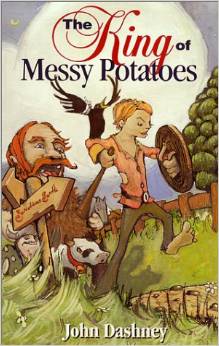
I picked it up at a library book sale. I bought it because the cover image is both sweet and, for me, evocative: a boy marching with stick in hand and shield on arm, with a line of friends and companions by his side: a cow, a giant, a viking, a crow. This is what I imagined as a child. I read Tolkien and Alexander, Lewis and Anthony, and in every case, the story really revolved around the journey: the journey, and the companions. As a fairly solitary child, that was what I wanted. So I had to get this book. Plus: how could you ignore that title? I love potatoes more than I love epic fantasy. If given the option, I would certainly pour gravy on this book and eat it. Who wouldn’t?

For even more fun, the author has written several young adult adventure books, is self-published and small-press published, and this book is signed. It’s perfect.

Now as for what was inside: that was good. I won’t say it was perfect, but it was good — far better than most small-press, self-published authors I have encountered. This book hits a beautiful balance between fantasy and reality, using a frame story about a boy and his grandfather, an aged Episcopal priest and scholar who is writing a history based on Biblical times, a book about the kings of Mesopotamia. Which the boy hears as — Messy Potatoes. (I am proud to say I actually made that connection before I started reading, when I picked up the book and considered reading it next. I am impressed that Mr. Dashney actually had this idea and saw the beauty of it.). The boy asks about it, and though the grandfather laughs, he agrees to make up a story about the King of Messy Potatoes for his grandson.

Then we get the story of Spud. Spud lives on a very special farm, though he doesn’t know it. He doesn’t know much of anything, other than how to grow good potatoes, and that his older brothers are dimwits and the local nobleman is a jerk. But then Spud meets a new friend: a crow, who, if he bites someone and tastes their blood, can speak that person’s language for a full day. This crow tells Spud the truth, and helps Spud to begin his adventures, and pursue his destiny — as the King of Messy Potatoes.

Both of these stories are successful. The frame story of the boy and his grandfather is sweet and heartfelt, and rings very true — especially to me, with my staggeringly erudite and somewhat distant (because eminently dignified) grandmother, who nevertheless loved me dearly. The story of Spud is exciting and amusing and fun to read, and you want to hear both sides of this as you go through it.

It isn’t perfect. There are parts of Spud’s story that are a bit too short, and feel like they’re there just to fill space without really adding anything; the Viking part, for one. The villain is a great idea, but isn’t really pursued completely — understandable, as this is a young book, but still: kids understand evil, and hearing about evil that is vanquished is a good story for any age. Spud is given a dialect that just doesn’t fit and doesn’t make sense, neither for the character nor for the “author,” the Episcopal scholar grandfather. And at the end, I want to hear more of the story of the King of Messy Potatoes, but I never will. Which is too bad.
But overall? I was very lucky to find this book. It made me happy.