This Morning

This morning I am thinking about my wife.

It’s not surprising, I think about my wife all the time: she is always worth thinking about. Everything with her is worth the doing: she is worth seeing all the time, in her beauty and grace and her sweetness; she is worth talking to all the time, in her intelligence and her humor and her generosity; she is worth holding all the time, and supporting all the time, and relying on all the time. She is worth all my time. She is worth all.

Today is our 15th wedding anniversary, though we had been together for almost ten years before we got married. I am excited to give her her present, and eager to get about our day’s activities — I highly recommend to teachers to have celebratory occasions during regular vacations — and so I’m not going to spend any more time writing this.

I wish you all love and joy and perfection. I go to enjoy mine.

No photo description available.

This Morning

This morning I am thinking about my wife.

Today is her birthday.

I have presents for her, and I have a card, and I have my excited “Happy Birthday!” all ready to go. I’m going to take her out to dinner tonight, and I’m going to buy her something delicious for dessert, and I’m not going to tell the waitstaff that it’s her birthday because she hates when the waiters sing the song to her. Even if she gets a free dessert.

But I can’t possibly say all the things I want to say about her. I don’t have the time, and I don’t have the words: even me, even with all the words that I’ve written over the years, I still don’t have enough words to say how perfect she is. I want to use all the cliches, because (as good cliches do) they all fit: she is my everything. She is my queen, my angel, and my goddess. She is my better half, and my partner in crime. She completes me. She carries my heart.

None of that is enough.

But that doesn’t matter.

It doesn’t matter what I call her, what goes in the blank of “She is my ____________.”

That matters is the three words before the blank.

She is mine. And I am hers, but today I am thinking about the fact that she is mine.

There is nothing and nobody that I am happier to say that about, on this entire Earth, in this whole universe, in all of time forwards and backwards from this moment, this day that is her day. She is mine.

Happy birthday, my love.

Image may contain: 1 person, phone and eyeglasses

Love

A student of mine wrote an essay defining “love.” Actually, a number of my students wrote essays defining “love,” because my assignment was to give a concrete definition of an abstract term, and “love” is a term I suggested as a possibility, and which a number of them felt like they had a reasonable grasp on and good cause to want to define. I don’t think most of them did a great job on it, though, for one simple reason: they’ve never been in love. I have – I am – and because of that, I believe that I have a better understanding of love than anyone who has never felt something like what I feel. I’ve always been one of those people who argues against the casual use of the word “love,” always been annoyed by my teenaged students yelling “I love you!” to their friends, often grumbled to myself – generally out loud, though not loudly – “No, you don’t,” when I hear one of them do that. I have always wanted “love” to be a word we reserved for the strongest connections, the most meaningful bonds. I still think that, and so after reading so many essays explaining that love could be used in any circumstance to describe anything at all pleasant, which was the prevailing view, I wanted to write my own to try to clarify what they all are getting wrong, and what I am getting right when I hold my wife in my arms and tell her, “I love you.”

I’ll tell you, though: this one student – one of my best, one of the brightest young people I’ve taught in 20 years – made me think harder about this. Because she said, “If words were seasonings, love would be garlic. Fits well in almost any dish, easily peppered in, improves whatever its included in.” And, well – I love that. I love this, too:

I don’t know if I’ve gone one day since I started speaking without saying the word “love.” If it is able to be overused, I overused it. I still do. I hang up the phone “I love you!” regardless of who I’m calling. I sign professional emails with it. I yell it at random strangers when I try to compliment them. When people who I hardly know share any opinion with me, I usually sum up my feelings towards them with: “Dude! I love you!” I use the word so much because it’s a great word. It means exactly what I’m trying to say. And what I’m usually trying to say is: “this thing or person or idea makes me feel happy and good.” That takes too long to say when someone my age on the street is wearing a Bikini Kill shirt and walking by me and I want them to know that i also like Bikini Kill but I can’t muster up a coherent statement. “I love you (or your shirt, or your outfit or that thing you’re holding)” works just fine. Perfectly non-specific. Perfectly over-intimate.


It felt very much like she was speaking directly to this prejudice of mine against the casual overuse of “love,” but in this opening paragraph, and in the rest of the essay, I was confronted with a simple fact: I overuse “love,” too. Because love is not just what I say to my wife; love is also what I say when I think about Cheez-Its, or coffee, or Monty Python and the Holy Grail. I say it when I see something that makes me feel happy and good. And that makes me a hypocrite.

Now, I don’t really mind being a hypocrite, if by “hypocrite” we mean someone who changes their standards from day to day. This is how my students frequently use the word; they apply it to, for instance, parents who partied in their youth and then tell their kids they shouldn’t party in theirs. (This is a new meaning of the word, I think, and a bad one; if what we mean by “hypocrite” is what I understand the word to really mean, that is someone who betrays their own standard while still holding other people to it, a liar who castigates people for lying, a thief who punishes thieves, then I do not want to be that thing.) Another sentiment I love, this one from Ralph Waldo Emerson, is:

A foolish consistency is the hobgoblin of little minds, adored by little statesmen and philosophers and divines. With consistency a great soul has simply nothing to do. He may as well concern himself with his shadow on the wall. Speak what you think now in hard words, and to-morrow speak what to-morrow thinks in hard words again, though it contradict every thing you said to-day.

People can change. We can learn new things, we can have new ideas, and if those ideas contradict everything we said today, then so be it. This applies to the current subject of love in two ways: one, my understanding of love can change – and change frequently, and then change back again – and two, the meaning of the word “love” can change as society’s general understanding of the word changes. And that is also fine: I don’t feel the need to have one and only one understanding of the word “love.” The meaning of the word doesn’t have to be consistent; it can change according to the circumstances. Context changes the meaning of many words, as it changes the connotations and associations; that’s what makes language so beautiful and so complex. It’s kind of why I still have a job.

I can be inconsistent in my understanding of “love.” It can change according to the circumstances. And within that, there can still be a right and wrong meaning of the word, because someone could use the wrong meaning in the wrong context. So I can happily tell my wife I love her and only her, and then shout to a crowd that I love Ralph Waldo Emerson, and then throw dirty looks at students who say “Goodbye, I love you!” to their friends – but only if I can be clear in my understanding of these three contexts, and say that my students are misusing it in theirs.

Spoiler: they’re probably not. I am writing this to show myself why I am wrong, much more than I mean to show my students why they are wrong. But they’re wrong, too, and I’m right; I’ll get to that.

My instinct is that there are two feelings here. They are two different feelings, though related; we use the same word for them, though perhaps we shouldn’t. This is where language gets tangled (Which is better, tanguage? Or langled? Mmmmmm – neither.), and though that tanguage (See? That’s awful.), that langling (That’s not better! SO WHY DO I KEEP DOING IT! Because I love portmanteaus, that’s why. Love ’em.), means I still have a job, it’s not worth the pain it causes. This is my objection to English as a language: it has so many words, and so many shades of meaning for those words, and because the meanings of words can change according to context, we can’t all agree on what the words mean; because of that, I think, we avoid the words that are ambiguous, or the ones that are complex. We lose the nuances of our language, and force each other to create and learn new meanings of old words, instead. Honestly, I don’t know if that’s a problem with English exclusively, but I know that English could avoid most of these issues if we’d just take advantage of what English can offer, and that is: many, many words.

Look up “love” in a thesaurus. Mine has multiple columns of synonyms for love because love falls into at least four categories, desire, courtesy, affection, and favorite; and that’s not including God’s love, make love, love affair, and love of country, each of which has its own entry, as well. Even the Great Democratizer Google offers these:

love

/ləv

noun

an intense feeling of deep affection.

synonyms: deep affection, fondness, tenderness, warmth, intimacy, attachment, endearment;

devotion, adoration, doting, idolization, worship;

passion, ardor, desire, lust, yearning, infatuation, besottedness

compassion, care, caring, regard, solicitude, concern, friendliness, friendship, kindness, charity, goodwill, sympathy, kindliness, altruism, unselfishness, philanthropy, benevolence, fellow feeling, humanity

relationship, love affair, romance, liaison, affair of the heart, amour


*   a deep romantic or sexual attachment to someone.

synonyms: become infatuated with, give/lose one’s heart to;

fall for, be bowled over by, be swept off one’s feet by, develop a crush on

infatuated with, besotted with, enamored of, smitten with, consumed with desire for;

captivated by, bewitched by, enthralled by, entranced by, moonstruck by;

devoted to, doting on;

informal mad/crazy/nuts/wild about


If we could just use these words, and agree on specific words in specific situations, and not change them all the damn time, then this would all be solved: I adore my dogs, I am besotted with my wife – my inamorata – I am devoted to my mother, I care for my students, I am wild about Cheez-Its. See how easy that is?

But nooooooo, no, that’s too many words to remember, and too many meanings to negotiate and agree on. We’d rather use one word for every one of those feelings, and then try to figure out what someone means when they say “I love you.”

That’s actually where my concern lies, with regards to how my students use the word, with how my bright essayist defined it:

The proper definition of love is supremely vague and exists on a spectrum. Love can be intense or delicate, long-lived or fleeting, romantic or platonic, emotional or physical. It is possible to love so many things in so many ways and for so many reasons, that it’s stupid and almost impossible to pinpoint the specifics. It thrives when left as a nebulous idea or concept. It doesn’t hurt anyone to love things. Why force someone to determine if something is worthy of the title of love? I think it can and should be thrown around as much as possible. It doesn’t need boundaries.


I agree with this; love can be all of these things. I don’t agree that the inconstant, ever-changing nature of love means that it’s “stupid and almost impossible to pinpoint the specifics.” I believe it is quite important: because there is one situation, and only one, where saying “love” and meaning it, and knowing that you mean it, and ensuring that the one who hears you say it knows that you mean it, is absolutely necessary. That is romance.

When I tell my wife that I love her, I mean something different than what I mean when I say it to anyone else, in any other situation whatsoever. This relationship is unlike every other connection I have in my life: this one, and only this one, is unique. I love my mother just like I love my father; I love my students (some of them) just like I love my coworkers (some of them); I love my dog Samwise just like I love my dog Roxie. I love Cheez-Its like I love Boston creme doughnuts.

But I love my wife like nobody else.

I want to explain, because this is the root of this essay, of this discussion for me; this is why I don’t like it when people use the word “love” for something other than what I feel for my wife. But at the same time, I don’t want to explain, because the life we have together is ours and nobody else’s, and I don’t want to share. Let me see if I can thread this needle at least a little bit.

I trust my wife. Completely, and absolutely. There is no one else to whom I would share as much as I share with her. I can’t say I share everything, as there are some parts of me that can’t ever be expressed, as there are with every human being; but everything that I can share, is hers. No question, no doubt. She is the only person whom I would trust to do anything as well if not better than I can. That’s not meant to sound arrogant, there are lots and lots and LOTS of things that I can’t do well; but the things I can do well, I want to do myself so that I can be sure they will be done the way I think they should be done, the way I can do them. Call me a control freak, if you will; it’s not true for everything, but it is true with, say, my teaching. I’d trust my wife to teach my class over anyone else, as much as my fellow English teachers (And more than some of them), even though she’s not an English teacher: I know that she could do it, and do it well. I’d trust her with my paperwork, with filling out, say, arrest forms or hospital forms. I’d trust her with my medical decisions, I’d trust her with my legacy, I’d trust her with my life. It’s not only the big things, either: I’d trust her to take care of our pets, to lock up the house when we leave on vacation, to drive – which she does better than I do, anyway. When I trust her to do something, I don’t worry about it, I don’t have to double check: I know that she did it right, at least as rightly as I could do it.

(Exceptions: I write better than she does. And she doesn’t really do the dishes right. Mmmmmm – that’s it. She could do anything else for me, if she wished.)

Along with that complete trust comes understanding. Because we have shared so much with each other, and experienced so much together, I know exactly how she thinks. I went to get a snack while she was reading this (It’s about her and us, so she gets veto power), and as I was coming back to my office, I thought, “She’s going to get hung up on that dishes comment.” As soon as she heard me coming down the hall, she called out, “What do you mean, I don’t do the dishes right?” This is not a first: we frequently find ourselves having the same thought, and though we don’t finish each other’s sentences, it’s only because we don’t interrupt each other. We don’t think the same way: she’s more liberal, more spiritual, and has a better sense of propriety (One of my most frequent questions to her is, “Too much? Does that joke go too far?” She frequently says, “A little.” And I take it out.), but I understand how she thinks, and she understands how I think. As well as anyone can understand anyone, that is.

My wife is the most beautiful woman in the world. I don’t mean that her features are flawless or perfect – whatever the hell that means – because they’re not; simply that the feeling that one gets when one looks at something beautiful, the feeling of calm joy, a warm spread of soothing happiness and a desire to lose time in looking at it: that’s what I feel when I look at her. Watching her expression is the best: the slow smile, the way her eyes widen when she sees something interesting, the way they focus like lasers when she is working on something. It’s beautiful. I could watch her all day, forever. I’ve never seen another woman whom I could watch the same way. Partly, yes, because it would be creepy; my wife may think I’m creepy when I stare at her, but she lets me do it, anyway, without calling me out, without making me feel uncomfortable – without tearing down that warm calm that comes with looking at beauty. It’s that allowance, that permission to enjoy her, that is part of this; her walls are – not gone, but lower, or farther back, with me than they are with anyone else. That’s part of the privilege of love. Part of the honor of it is how I try to be worthy of that permission, of that trust.

Along with that – and not to get too graphic – my wife is the sexiest woman in the world. All the feelings of attraction and excitement, different and more intense and more fleeting and more addictive than the feelings that come with looking at beauty: I get all of those from being around my wife. Nobody else has ever, or could ever, have the same overwhelming effect on me so often, so immediately; all it takes is one glance in just the right way, and nothing else exists. Only she has that power over me. And it is a power, make no mistake: whatever I may want to say to hedge this topic, to moralize it, to objectify and reduce the feeling of sexual attraction, and the feelings of ecstasy, of connection, and of bliss that come with sex, the truth is, whether I can explain it or not, whether it needs explanation or not, sex is as powerful a part of love as any other.

It’s not necessary: I will say that. My relationship with my wife, our connection, our affection, our trust; none of that is built on sex, none of it relies on sex. I could not imagine, however, having the same relationship with her while having a sexual relationship with someone else. I don’t see how that would work. We could still be friends, even the best of friends; but she would not be my love. I know there are people who have polyamorous relationships, and I have to assume they care for their partners, and are excited by their partners, in the same way as I and my wife; but I can’t understand it. Suffice it to say that if everyone could share all parts of the relationship together, I can at least see how it could work; if people have separate intimate relationships in common, as in my understanding (based exclusively on televised fiction, which is why I don’t pretend to have an answer here) of religious polygamy, where a husband moves from wife to wife to wife on different nights – I can’t see that as the same kind of love that I have with my wife.

But then, I don’t think anyone else on Earth has the same kind of love that I have with my wife: I am unique, and she is unique, and thus what we have together is unique. So on some level, there is no word for what I feel for her, or at least no word that anyone else could ever know or understand or use. It is essentially uncommunicable.

Dang. Maybe my student was right. Maybe there is no point in defining love.

No: I still think it matters. My love for my wife is this way because it has grown and strengthened and become more for better than twenty years. When we met, when we started dating, and when we fell in love, there were all the same flaws and problems that other people have; maybe not as many, maybe not as serious, as there are for some relationships – after all, we stayed together – but love becomes unique and undefinable; I don’t think it starts that way. I think the feeling is, at first, recognizable, similar to what each of us had felt for other people in the past, similar to what other people feel in those circumstances. Knowing that, recognizing it, is what allowed us to first say to each other, “I love you,” and mean it. And I think it’s important that people recognize that phrase, and mean it when they say it, as something distinct from what people mean when they shout “I love you!” as they drive by the McDonald’s where their friends are at work. Because in a romantic situation, when someone says, “I love you,” and the other person says, “I love you too! You’re my best friend!” then there is at least a potential for serious and terrible heartbreak. There are countless dramatic moments in books, films, TV shows, based on this precise miscommunication, because it is one we can understand, relate to, maybe remember. That is the problem with using the exact same word for both very different feelings. And they are different feelings: I will use the phrase “romantic love” to separate them, but that doesn’t work in the moment, because you can’t say “I love you romantically” and mean it. When you tell someone that you love them in the way that I say it to my wife, then the word cannot be qualified and modified: it has to be everything, all in one, because that’s what the word represents: that’s the love I mean when I say it to her. Everything. All that I am, and all that I have, with her, forever. That’s love.


When I was thinking about this essay, I had an idea that I would end up defining two different meanings of the word “love:” one for the happy warm feelings that my student speaks of – call it the garlic love, in her honor – and one for the feelings I share with my wife, which I cannot truly express, not with all my words. I even had the idea that the garlic love, the one I feel for pirates or warm socks or the music of Weird Al Yankovic – and believe me, I do not discount and do not demean that love; I love that love – could be distinguished as the one that allows people to extend the word the way they do on social media, by adding more “e’s” at the end of it – “I LOVEEEEEEEE that movie!” I freely admit that bugs the crap out of me: because IT’S A SILENT LETTER! What the hell does it mean when you say it more, a long pause? But I also admit, just as freely, that this is my humbuggishness talking, that I have no grounds to be annoyed by that; I understand that people are trying to intensify the word within the limitations of the medium: you can’t do bold or italic or oversized font in a Tweet. You can repeat the word – “I love love love that movie” – but that’s neither better nor worse. In both cases, it’s clear communication of intensified feeling, and it does it the same way, by dedicating more characters to the idea.

I can distinguish that from what I feel for my wife, however, because when I tell her I love her, I don’t ever extend it. I don’t ever say, “I LOOOOOOOVVVVVEEEEE you!” I don’t say “I LOVE LOVE LOVE you!” But I would do either of those things – okay, not the second one, which strikes me as insincere, though again, no real reason for that, just prejudice and humbuggishness, the same as how I hate it when people use the word “impactful” – if I was trying to express how I feel about Weird Al. I LOOOOOOVVVVEEE Weird Al.

I love my wife.

Two different feelings, two different terms, even if they are sort of spelled the same. Even if they do both have the same positive, happy-making, basic feeling underlying them. And if I had my druthers, I’d insist that people distinguish: when they talk to their friends about their favorite breakfast cereals, they use the extendable one: maybe spell it “loveee” to be clear. When they talk about the person they want to kiss, they use only “love.” Spelled, and said, the right way.

But there’s no point in trying to do that. Language doesn’t change because people think others are using it wrong; language changes with people’s whims, with fashions, with the ease and quickness of flipping a switch, but never because people say that word there is the wrong word. I suppose I could try to make it unfashionable to use the word “love” in a casual context, but people want to say it. They want to express feelings, want to be open, and they want to be positive. And there’s nothing wrong with that. If saying “I love you” makes two friends happy, then who the hell am I to step in and say, “Actually, that’s not love; you should say you are fond of each other.” I mean, I can be a prick sometimes, but I’m not that bad. And while I said above that I wished we would take advantage of the richness of the language – and I still wish that, all the time and in many contexts – I could never say to my wife, with a straight face, “I am besotted with you.” (Note: I tried. Didn’t work.)

I think it’s okay, though. Because context changes meaning. So what we need to be aware of is the context we are creating when we use the word “love.” When we want to use it differently, when you’ve just been saying, “Man, I love Buffalo wings!” and you have the sudden urge to tell your date, “I love you,” don’t do it one after the other. (Though do picture that, just for a minute. “Man, I love Buffalo wings! I love you, sweetie!” Don’t even give the guy a pause; picture him licking sauce off of his fingers the whole time he says this. Nice.) Change the context. Surround the declarations of romantic everything-love with a situation that expresses what you mean: and if you want to clearly show the difference between uses of the word, then make sure the contexts are different.

What I really want to say, I suppose, is that love is a perfect thing for me. I don’t want to rename it. I also don’t want to keep it from having a name, from saying it is indefinable and indescribable, because I don’t want to keep other people from it – I want other people to feel what I feel. I think it has made me a better person, and given me a better life, than I could possibly have had without it. My wife is my everything, and she has given me – everything. If other people could know what I mean, this would be a better, happier world. But while my love is unique, my experience is not, because I know there are other people who have an everything love as much as I do. They have understood everything I have said here. (I hope.) That common experience is what allows us to communicate at all; and here, it allows us to understand what I mean by the word “love.” But even for those who don’t know, who haven’t felt, what I know and feel, and thus don’t quite know what I mean by “love,” at least understand this: when you say it, make sure the other person understands just what you mean.

I would love that.

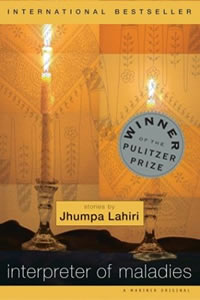
Book Review: Interpreter of Maladies


Interpreter of Maladies

by Jhumpa Lahiri

I didn’t love this book.

Some of the stories were beautiful. All of the writing was lovely, but some of the stories didn’t sing to me, where some did. I was a little disappointed that the title story was definitely not the best; it’s about a man who interprets for a living, who takes a group of American tourists (of Indian heritage) around on a tour of his hometown, which they visit every year or so from their home in New Jersey. The tourists are pretty delightfully obnoxious, and the ending of the story when one of them gets an Indian comeuppance, is delightful; but the major action involves this interpreter (who also works in a doctor’s office, translating people’s symptoms to the doctor – hence the title) developing a crush on the tourist woman. Which was pretty disappointing, really.

I did like about half of the stories. A Temporary Matter, the first one, was maybe the most touching; it’s about a couple trying to find their way after a stillbirth; they are mostly estranged and alienated, until the power company turns off all of the lights in the neighborhood around dinner time, and then these two people find that they can talk in the darkness in a way they can’t when the lights are on. The story doesn’t have a happy ending, which was also a letdown, though it did make sense. It was good, but not my favorite. The second story, When Mr. Pirzada Came to Dine, is pretty much the typical story for the collection: it features a mix of Indian culture and Western, which creates discomfort and conflict; the characters are interesting, the descriptions are lovely – and the story goes freaking nowhere. Ditto for A Real Durwan, Sexy, and The Treatment of Bibi Haldar (The first and last only differ in that they are purely Indian, and so have at least some appeal in showing something of the culture; Sexy is the only story in the collection with a Western main character, and she’s a dud, as is the story.), and, sadly, the title story. Which at least does have the best title, which is, I suppose, why Lahiri picked it for the collection. The other three I’ve listed here were all a little too strange, and a lot too dull: nothing really happens, nothing gets resolved, nobody goes anywhere. I’m sure that was the point, an attempt to show the futility and emptiness of modern life, but — whatever.

The good stories were The Third and Final Continent, This Blessed House, and especially Mrs. Sen’s, which was my favorite. They showed relationships that were fraught, but not doomed; the couple in The Third and Final Continent actually work out quite well, as does the most significant relationship in the story, between the Indian main character and his American landlady, who is 103 years old and is splendid. Say it! Say “Splendid!”

This Blessed House has the most interesting character, in the woman named Twinkle, who reminded me of the classic vivacious hostess, the sort of Katherine Hepburn energetic wit with grace and style who isn’t afraid to get her hands dirty; she was contrasted nicely with her dud of a husband, though I do have to say that, as an introvert, I was kind of on his side: he just wants a quiet house to come home to after work, and his wife keeps throwing parties and doing things. I have never been so glad to be married to a woman even more introverted than me.

Mrs. Sen’s was the sweetest story. It’s about an American boy who spends his afternoons at the home of his babysitter, the titular Mrs. Sen; seeing her through his eyes made her interesting but never offputting – other than the damned knife in the beginning of the story, which I could not for the life of me imagine; it’s apparently an Indian cooking tool, a blade fixed to the cutting board, and you move the vegetables over the knife to chop them. It’s a nice piece of Indian culture, but I just couldn’t grasp it. Still can’t. But I love how Mrs. Sen is so eager to get news from home, and I was heartbroken with her when the news is bad; I thought it was very sweet how she tries to learn to drive, and I actually liked her husband, which made this one of the few relationships in the book that isn’t depressing or disappointing. Plus, I used to have to go to my babysitter’s after school — Mrs. Bergstrom’s —  and so I bonded with the narrator right away, and I sort of wish that Mrs. B. had only had me to watch, instead of the five or six kids she took care of at once. I would have liked to get to know her the way we get to know Mrs. Sen in this story.

Overall, I don’t think it was really worth it; even the good stories aren’t among my favorites, really. If you are in the mood for a sort of gentle alienation, like looking through a soft veil at a surrealist painting, then go for it; if you feel like reading about romances that don’t have a whole lot of closeness in them, as well, then this one is right up your alley. I think it missed my alley.

A Spoonful of Hatred Makes Education Go Down

Sometimes I hate my students.

And that’s actually a good thing.

First, let me affix the boilerplate so as to avoid any whiff of morally reprehensible heresy that goes against the company line: MY STUDENTS ARE WONDERFUL PEOPLE YOUNG AMERICANS AND IT IS A JOY TO SEE THEIR BRIGHT SHINING FACES AS THEY GREET ME IN THE MORNING AND I LOVE TO SEE THE SPARK IN THEIR EYES AS THEY LEARN SOMETHING NEW AND I AM INSPIRED EVERY DAY BY THE THOUGHT THAT I COULD BE HELPING THEM REACH THEIR POTENTIAL I AM MAKING A DIFFERENCE IN THE LIVES OF YOUNG PEOPLE AND THUS HELPING TO CREATE OUR FUTURE.

There. Now, as I was saying, sometimes I really can’t stand the little stinkers. I don’t mean because they’re terrible, or because I’m such a cloistered saint that their vileness taints my purity; they’re just kids, and I’m not, and so they can be awful people and I’m not currently awful enough to be able to ignore their awfulness or cover it with my own. I would have done that when I was their age; I was awful, too, no question, far worse than most of them are now.

But my students tell me, outright, frequently, that my class is boring, that my subject is pointless, that I don’t work hard enough or do the right things as a teacher (By which they mean “You don’t do the work for me and then give me an A.”). They lie, they cheat, they steal. They waste my time, and then get snotty with me because they think I’m wasting theirs. They whine, they complain, they try to intimidate and threaten and manipulate me into doing what they want me to do. They are deeply selfish and insensitive to the feelings of others: they are racist, sexist, xenophobic, hypocritical, hypercritical, ultraviolent, lazy on a scale that can’t be measured or even contemplated by those who aren’t themselves on the scale.

And they’re just kinda gross. They smell bad, some of them. And you should see them eat. Ick.

Now here’s the good side of all of that: because of all of those things, I have very little trouble telling them No. It’s real easy with some of the things they ask me. “Can we watch this (probably inappropriate) YouTube clip?” “No.” The best thing with this exchange, which occurs almost daily, is that they have no actual argument. The most common rejoinder is “Aw, come on,” which is probably about as effective as yelling “Hey baby!” at a female passerby: just like that woman never swoons and says, “Be still, my beating heart,” I never say, “Well, okay, let me look up that NWA video.” Same when they say – as they often do – “Can we just, like, do nothing today?” I have no problem at all saying no to that. And not even because I always want to do productive things; I generally do, but of course I have my moments. No, the reason I can always say no to the siren song of sloth is, I don’t want to hang out with my students. If I’m going to flop on my backside and do nothing more strenuous than exhaling, I’d much rather be at home, where my dog and my couch and my coffee are. The last place I want to be is in that ugly, uncomfortable classroom with all of those people whom, as I have been saying at length, I don’t really like.

I’d rather make them work. It is frequently true that I force them to continue learning not because I think it is valuable or even merely necessary; it is, but the reason I keep teaching them even when they are at their lazy-assed whiniest is, because making them work is my revenge. I torture them with learning. I keep reading, and reading, and reading, even when they just can’t take any more. If they really get on my nerves, I will work right up to the bell and even beyond the bell, and then I’ll assign them homework. I don’t have a work ethic: I have a revenge ethic, and the worst thing I can do to my teenaged students is make them think, and make them work.

And, see, that means they learn, which is good for them. And they suffer, which is good for me. It’s win-win.

There’s more to this, of course. (It’s just so much fun to rip on my students, and talk about torturing them with literature. Hey –I just realized that “torture” and “literature” have the same last letters. There’s an opportunity there. Maybe a rhyming couplet? Maybe a portmanteau? Literatorture?) There are serious problems with the company line that most teachers – no, that essentially all teachers – toe – no, that they lie down on, clasp their hands together, and enter into a meditative trance akin to suspended animation, a state from which they will never arise. Okay, that got too weird.

My point is this. Teaching has a required orthodoxy. Teachers teach because they love their students. They call their students their children. They say everything I joked about above, about the future, and making a difference, and seeing the spark – though I more often hear the loathsome phrase “A-Ha moment,” which just makes me want to start caterwauling “Taaaake ooooon meeeeeeeeeee (Take! On! Me!) TAAAAAAAAKKKKKEEEEEE MEEEEEEEEEEEEE OOOOOOOOOOOONNNNNNN (Take! On! Me!) IIIIII’LLLLLLLLLLLLLLLLL BBBEEEEEEEEEE GGOOOOOOOOOOOOOONNNNEEE!!! AND (mumble mumble I don’t actually know the words to this part but who cares deepbreath) EEEEEEEEEEEEEEEEEEEEEEEEEEEEEEEEEEEEEEEEEEEEEEEEEEEEEEEEEEEEEEEEEEEEEEEEEEEEEEEEEEEEEEEEEEEEEEEEEEEEEEEEEEEEEEEEEEEEEEEEEEEEEEEEEEEEEEEEEEEEEEEEEEEEEEEEEEEEEEEEEEEEEEEEEEEEEEEEEEEEEEEEEEEEEEEEEEEEEEEEEEEEEEEEEEEEEEEEEEEEEEEEEEEEEEEEEEEEEEEEEE!”

You get the point.

Teachers always, always say that they don’t do it for the money. They do it because they believe in the cause, they believe in the importance of education, in the value of helping young people, of passing on knowledge to the next generation and helping to make our world a better place, one child at a time. I hear teachers talking constantly about what the children need: how teachers are better parents to some of them than their actual parents; how some of them don’t ever get to have fun unless a teacher sacrifices an evening or a weekend to some overnight field trip; how these kids shouldn’t miss this opportunity that somehow requires more effort from a teacher than it does from any of the students whose lives are being enriched. If a teacher says anything different, then we get funny looks. We get frowns and furrowed brows and awkward attempts at segues away from the conversational minefield we just stepped into. I assume we get talked about when we’re not in the room, since teachers – professional busybodies and judgmental critics – are inveterate gossips.

I know because I’ve been getting those looks, and saying those heterodox things, for years. Now that my wife, who is braver, more honest, and less patient than I am, has joined me in teaching, she gets the looks even more often. I think she also gets them worse because she is a woman, and therefore expected to be motherly; I think some of my fellow teachers excuse my anti-student bile by calling it something on the order of “tough love.” My students like me, so surely the smack I talk about them couldn’t be real; I must be exaggerating. Kidding! Oh, that wacky Humphrey! No wonder the kids love his class!

Here’s the truth: not all kids love my class. Some freaking hate it, and hate me. Often (Not always) they are the ones who receive my ill-treatment. (“Not always” because sometimes the very worst little twits like me and like my class. Sometimes kids hate me for entirely different reasons, like how I waste time or teach material they don’t like or find useful. Some of them don’t think I’m funny, even think I’m rude. Can you imagine?) They resent that I don’t treat them like special lil angels, because that’s what they get from almost every one of their other teachers.

And that is, of course, the problem. My students aren’t bad people, not at all; they really are sweet kids at heart, and most of them are bright and capable. They’re just kids: they’re lazy, and entitled, and think much too much of themselves. What they need is a dose of reality.

What they get is teachers who coddle them because they’re special lil angels.

We shouldn’t do it. We should treat students like actual human beings: we should expect them to act correctly, to be responsible, to think and act for themselves in their own best interest. And we should do the same. That’s how we can actually help them to reach their potential: make them work. Make them rely on themselves, rather than doing everything for them. We should realize that at some point those lil angels will leave our school, and they will be around people then who – don’t love them. Don’t coddle them. Don’t think they’re special lil angels and do everything for them. If they have no teachers like me, then they will be hurt and confused when their college professors don’t care about them, or when their bosses insist that they show up on time even if they’re not feeling happy that morning. My boss has never taken me out into the hall to have a heart-to-heart. “You seem down, are you feeling okay? Everything okay at home?” This is not something I have ever heard from my supervisor.

Though I have heard it from other teachers.

I’m not talking about tough love. I’m not talking about love: school is a job, and everyone involved has to do their part, and should be expected to do their part. When teachers are willing to provide whatever a student needs, then the students – and their parents – quickly realize that the more they need, the more they get. I think this has much to do with the rise in special education students – students with, as we say, special needs. That is not in any way to say that students who have genuine needs should be neglected or denied what support they need; in order to do your job, you have to be in a situation where it’s possible for you to do your job, and that is the goal of special education, and in my experience it usually works very well. But there are also lots and lots of students who lay claim to needs they don’t actually need. And teachers provide for them, too, because – well, because we love all of our students like they were our own children.

They’re not our kids. They’re also not our clients – another popular, and pernicious, paradigm for schools (Pernicious because the customer is always right, which again puts too much power into the hands of students who are willing to be demanding, and taking all power away from teachers who are willing to be giving.). Students are actually our coworkers. We teachers have a job to do, and students have a job to do; we need them to do their job, and they need us to do ours.

It’s a lot easier to do that when you kind of don’t like them that much. It’s a natural instinct to want to help your friends, and people you like, especially when they seem desperate – and desperation is a state that teenagers excel at. It’s an even stronger instinct to want to protect and help your children. So when we think of students as children, as our children, and we think of ourselves as their protectors and guardians, then we do things for them that we wouldn’t do for strangers – or for our coworkers. Things that they, therefore, don’t learn to do for themselves.

Sometimes they really do need the help, and when they do, we should provide it. Any decent person should do the same, and as a teacher, we do get to know more of the intimate and therefore terrible details of our students’ lives. That does put us in a unique position to provide help to people who really need it, and we should; and the times when I have, I am proud to have done so.

But most of them don’t need my help. They don’t need my care, they don’t need my love. They need to learn how to write an essay. They need me to teach them. If I hate them a little, I can teach them a lot.

It is also true that the students aren’t the only ones who make constant, unreasonable demands of teachers: the school administration does the same. In my almost two decades of teaching, I have seen more evidence every year that the only thing that keeps the education system working at all is the willing self-sacrifice of teachers. If we didn’t give up our free time, our evenings and our weekends, the work wouldn’t get done. If we didn’t bust our asses, and too frequently shell out our own money, then kids wouldn’t be able to do all the fun things they get to do in schools that keep them entertained, and therefore earn whatever commitment they have to the whole endeavor. (One small example is my current school’s robotics team, which engages a fair percentage of our best and brightest – and which is made possible only by teachers giving up their time and energy and money. Without that team, the school would lose dozens of students, current and potential. Multiply that by every school and almost every fun extracurricular: how often are the popular clubs run by the principal? That’s right. Never.) If we weren’t willing to take on this incredibly difficult and frustrating task for insufficient money, then schools would shut down. All of them. Pretty much at once. Realize that I make probably half of what I deserve, as a good and capable teacher: and realize, too, that my class sizes are already too big. So if we were paid what we should be, there would be twice as many students per teacher – and now the money doesn’t matter, and my capacity for teaching doesn’t matter, because the job simply becomes impossible: and I quit and move to a Caribbean island to sell fish tacos and smarmy haikus. And then there’s no more schools. And then what becomes of the lil angels?

But of course, the orthodox catechism of teachers tells us that we love them, and therefore must sacrifice for them. Administrators know this: and so they ask us for anything they might want of us, with one simple, inevitable, never-fail justification: it’s for the students. And every time they say that, there are teachers who are willing to do it. Always. Spend eight hours after school tutoring students for test prep? Well, they really need the help, we say. Spend a weekend baking for a fundraiser – using materials bought with our own money? Well, some of the kids just can’t afford the trip on their own. Take up campus supervision because the administration cut the security guard to save on the budget? Well, the kids need to feel safe! I know I’m unqualified to be a security guard, and already terribly overworked doing my actual job; but – it’s for the children.

I wish that more teachers felt what I feel. I do think most of them do, and they cover it up; because they don’t want to get the strange looks, and they don’t want to let the children down. Here’s the secret, though: most of my students really do like me, and like my class, even though I am entirely open with them about all of this. I tell my students, as I tell my fellow teachers, that I do this for the money: I tell my students that if I win the lottery tonight, I will not be in class tomorrow. I tell them that they are not my friends, and that I don’t want to be their parent. I tell them that if they fail the class, that is their responsibility; I’ll give them the opportunity to learn, but I will not force them, will not chase them down and hold their hand and twist their ear and drag them, kicking and screaming, into a bright future. I tell them that if they don’t want to be there, they can leave, and I won’t stop them. And they like my class. Because I’m honest. And because I offer them what they actually want, and what they actually need: the chance to be themselves, and to do it alone.

Because I’m not going to do it for them.

Beautiful

With all of these arguments — and the end of the school year, when students’behavior gets uglier and uglier with each passing day — I haven’t been writing about beauty. I haven’t been writing enough period, and it’s starting to tell on me; fortunately, the school year ends in five days. I feel like I haven’t  been seeing anything beautiful for weeks, now: I feel like I’ve been sinking down to the bottom of the ocean, everything getting darker and heavier and colder. I hit bottom (Somewhere around where my students in my Lit class told me they’d rather do nothing than read for the sake of reading, and that their grades were all that mattered to them), and now I’m coming up, and now, right now, I can see the light playing on the surface  of the water. I couldn’t do that a few days ago, a few heartbeats ago. Now I can. Now I can see something beautiful.

Last week I got up early enough (My desperate times always bring insomnia with them, which for me is waking up early and immediately starting to think about things other than sleeping) to see something extraordinary, something I have never seen before: the sun was rising, the night just breaking up, the sky still dark, and the full moon was in the sky. It was brighter than I have ever seen a moon before, a shining liquid golden color. But the extraordinary thing was that it was actually behind clouds when I first looked out at the sky, while my dog nosed about the ground in the backyard, and as I watched, the clouds parted and the moon slowly grew in the sky, from a sliver to a slice to a disk, over the course of a time that was just long enough to fall in love. Solid gold emerging in a dark grey-black sky. It was amazing, like the moon was creating itself, appearing from nothing, and made of pure solidified sunlight, even in the pre-dawn darkness, the moon as dream-catcher, flying high above and taking in the sun’s rays as they flew above the Earth, above me. The moon brought them to me as a gift, a gift that (early mornings only having the one advantage, the feeling of absolute solitude, the only existence awake in the world) was only for me. I had never seen the moon that way.

It was the most beautiful thing I’ve seen in quite a while, and coming as it did in the middle of a time without beauty, it was wondrous. The universe, it turns out, can still surprise you.

But then this past Friday, my wife and I went to the graduation at the high school where we both teach. And my wife dressed up for the occasion.

I tried to take a video on my phone of the moon; but it didn’t look like anything but a glowing glob hanging in the sky. Beautiless. Only the moon itself could catch that light, and, luckily, my eyes, as well.

I didn’t even try to take a picture of my wife, because no camera could have caught that light. And there’s nothing I can say to describe how she looked, except to say: she outshone the moon. Golden, extraordinary, appearing out of darkness, made of solid light.

She’s the most beautiful woman I’ve ever seen, and she is a gift just for me, even in a building filled with graduates and families and well-wishers; because she catches all the rays of my love and admiration, and she collects them into herself, and then shines them down on me. Only me. Even in the darkness, she is glowing gold by my side. My love. My light.

My beauty.

Image result for but soft what light through yonder window breaks it is the east and juliet is the sun

On the Twelfth Day of Blogging, Just Dusty Blogged for Me . . .

… A blog about love and epiphanyyyyyy!


If you’ve read this blog before, you’ll know that I – like most people – don’t particularly like my job. In some ways, on some days, it’s fine; but all in all, it’s not where I’d prefer to spend my time. I’ll never get a bumper sticker that says “I’d rather be working.” As I tell my students, “If I win the lottery tonight, I won’t be here tomorrow.” I tell people that I’m a teacher, but I don’t actually define myself that way; I consider myself a writer, and a reader, and a nerd, and a family man. Teaching is my source of income, not my identity.

But since a source of income is a necessity, and teaching is a pretty decent one, I thought I’d share some tips for making work a little more manageable – that is, if you can’t get your boss to change your work hours so he/she will stop torturing you. (There’s a scientist who says we should start work around 10am.)

First, figure out when you can say No. I know it’s true for teaching, and I’ll bet it’s true for a whole lot of jobs, that your employer will keep asking you for more for as long as you keep giving what they ask. They’ll ask you to do extra duties, to join committees, to come in early, to stay late, to take work home, to give up your weekends, your evenings, and your vacations. In my case, they ask me to come to meetings, to go to seminars, to agree to be a mentor or a coach or a tutor. They are constantly after my lunchtime, and they’d love it if I could fill in for the various staff members they’ve laid off or cut back – at my school this includes the security guard and the staff psychologist. They want me to train myself, and then train others. And of course, they want me to give every ounce of energy and every minute of time to the doing of my actual job: they want me to grade eight hours a day, prepare new lessons and new curriculum eight hours a day, and spend at least eight hours a day with students, preferably one-on-one. And for all of this, they want me to do it the way they want it done, whether or not I like that way of doing things or think it is the right way: it is their way, and therefore they want it to be my way.

But with teaching, and I’ll bet with a lot of jobs, there is a specific thing or things I’m supposed to be doing. In my case it is two things: first, I need to be a responsible babysitter, meaning that students cannot be hurt under my watch, particularly not by me; and second, my students need to learn. The first is easy to measure: students getting hurt, or students complaining about how I hurt them, are no-nos. The second is more difficult to measure, but figuring out how the bosses measure it was the key to knowing when and why I can say no. For me, it is two things, one positive and one negative. The positive measure is test scores. My students’ test scores can’t be terrible. They don’t have to be perfect, but they can’t be terrible. The – I guess it’s an advantage? – for me is that I have students measured by multiple tests, and as long as they’re doing well on one, then the other is less critical; so in my case, since I teach AP classes, as long as my AP test scores are sufficient, then the school wants to keep me around and keep me happy, even if my state testing scores are less wonderful. They’re not terrible, but they’re not as good as the school wants them to be; but my AP scores are. That gives me more ability to say No. It gives me No-power.

The negative measure of students learning is even better, for me: there can’t be any students or parents complaining about me. As long as none of my students go to the administration and say that the class is unfair, that the grade was too low, that the test was too hard and that the students weren’t prepared for it, then the school feels confident that I am doing my job. And that gives me even more No-power.

It’s not that simple, of course; there is more to it. I do need the credentials that I have, a degree in my subject and years of teaching experience and so on; I get observed twice a year and I have to look like I know what I’m doing; there are meetings I have to attend and duties I have to perform. I have to go to staff meetings, I have to meet with parents on the scheduled days or when parents request it, I have to be available for extra help if students need it. But those are the main things: babysitting, test scores, no complaints.

How did I figure this out? I listened to what people said about the people who used to have my job. The person who had it the year before me actually had a doctorate and college-level teaching experience; but the students thought she didn’t teach them enough. They thought she spent too long on one unit, they thought she didn’t explain things well, and they thought she couldn’t manage a class well enough to get them to listen. I heard the same things about her from other teachers, too. The person before her was a bad babysitter: she left the students locked out in the hallway after the bell rang; she left early and left the students alone in the classroom; she cussed at them when she was mad. So when one of my students told me that I taught him more in five minutes than my predecessor had taught him all year, I knew I was pretty well set. (I already knew I couldn’t lock my students out of the room, nor leave them alone in it. But that’s kind of a gimme, isn’t it? I mean, really.) The other key was watching the person at the top: the best teacher at the school, the one that everybody listens to and looks up to, the one who seems like they can get away with anything. How does that person get to be that powerful? In my school’s case, it’s basically the same answer, though our top teacher is more of a teacher and less of a babysitter – which tells me that there’s leeway in the babysitting aspect, as long as the test scores are good enough, and as long as the students think they learn. In this teacher’s case, it is more than the negative measure, more than a lack of students and parents complaining: our top teacher earns praise from students and parents. He is the one they thank at graduation for having taught them so much. And that gives him all the no-power he could ever need: he openly defies administrative decrees in certain areas, and nothing happens to him. Because the students think he is their best teacher. Even though he calls them deadbeats and degenerates, and threatens to hide their corpses under the soccer field.

So that’s the most important thing: figuring out what is necessary to gain the power to say No, and then deciding where to spend that power – because nobody, not even the best employee, has limitless power to say No. You do still have to show up (too early) and do your job. You can’t spit in your boss’s face. But you probably can skip out of some meetings, or refuse to serve on certain committees, and you can certainly say you aren’t going to that three-day seminar out of town (unless it’s in a good place and they’re paying expenses). That’s the key to keeping your sanity at work. The first one, at least.

The second key is to keep doing your work. Don’t let it pile up. Because it will pile up, and then it will collapse and smother you in an avalanche of catch-up. In my case it’s grading, which I did in fact pile up this last semester’s end, and it did almost smother me. It wasn’t the first time, either; and if I ever leave teaching behind before I win the lottery, that will be why: because I let work pile up and collapse on me once too often.

In the past I have let the work pile up because I’ve avoided doing it: I’ve collected essays and then looked at them and said, “Not today,” over and over and over again. Sometimes for as long as two months, though I was doing other grading in that span. That’s one of the nice things about teaching, even though it doesn’t always feel that way; I doubt there are a lot of jobs that allow that much slacking for that long. But since I didn’t get students filing complaints with the administration, it didn’t get me fired. I did have some pretty serious grumbling by the end of it, and I now have a (well-deserved) reputation for taking too long to grade things; I have made a conscious effort in the last few years to keep that from happening again. This last semester, the work piled up for a different reason: because I didn’t plan well enough, and I had too many major things due all at the end of the semester. It was a sudden deluge instead of a slow build-up; but it still almost took me down. So now I have two things to be aware of: not letting things pile up, and not creating a huge pile that will all fall on me at once. I’m sure someday I’ll learn those habits. And then I’ll probably win the lottery.

But all of that, though I hope it will be useful for some people to know, is not actually the thing I wanted to talk about. There is something else, something that I think is actually unusual, something that I know that most people don’t. This is my epiphany, if you will. And it is this: if you have the chance, then work alongside of the person you love.

I’ve done it a few times, now. When I was a janitor in college, my wife (then unwedded soulmate) worked in the same facility, selling tickets and concessions for the box office while I cleaned the place. When I became a teacher, she spent two summers teaching summer school with me, once in the same room. We met because we were sort of working side by side: she worked in the college bookstore, and I sold student IDs in the same building; I used to get change from her, and she used to pass my table on her way to get coffee or a bottle of water. And now, by a fortuitous set of circumstances, she is the art teacher in the classroom right next to my English class. And it is the best thing about my job.

Now, it is better for me than it is for her. Teaching unquestionably gets easier with experience; this is her first year of full-time teaching, and it’s my seventeenth. I’ve been at the school for two and a half years now, so I have a better idea of how things work and who I can get help from and who I can’t; she is figuring all of that out. She also got screwed over by her predecessor, who cleaned the room out of any useful materials or curriculum, and left the art supplies in a hellish mess; I came to a classroom with class sets of novels and textbooks, and filing cabinets full of quizzes and worksheets and materials I could use. I have a department with three other English teachers who give me help and advice and share good stuff with me; she’s the only art teacher at the school, and one of two in the district – and the other is also brand-new. She’s starting completely from scratch, and it makes the job twice as hard. And it’s pretty goddamn hard to start with. Add to that the fact that she doesn’t particularly like teaching, either; that it isn’t how she defines herself or any part of her identity, and it’s easy to see that it’s been a tough year for her.

But she does have this advantage: I’m right next door. That means that she, like me, always has someone to cover for her if she needs to run to the bathroom. I always have someone to eat lunch with, and to sit with in meetings. When I’ve had a tough class or an annoying meeting, I can go to her and bitch about it. I can complain – no, scratch that; I never complain about my students, the little angel-babies.

No, sorry, can’t say that with a straight face. When I want to complain about my irritating, obnoxious, tiresome students, I can go straight to her and say whatever I really think, without any fear that she will judge me, or get me in trouble for it. I can get advice from her – and regardless of her inexperience with the profession or in the school, I do, because she is naturally brilliant, and because she knows quite a lot about working in general, having dealt with office politics in an actual office, where they are more pervasive and pernicious than they are in a school, where most people work behind closed doors all day. She’s also, it turns out (No surprise to me), a genuinely good teacher, though without the mixed blessing of test scores, it is sometimes harder for her to see it. And because she is a more dedicated artist than I am, being a good teacher means less to her than it does to me; she cares about being a good artist.

She’s that, too.

But it is a lovely thing to have another person there with you, in that place where you have to spend so many hours, and for such pragmatic, uninspiring reasons. (“I just worked a full day! That means I can pay my heating bill! And maybe the electric, too! WOO!”) We keep our behavior appropriate, of course; but I still get hugs, and even a kiss or two. The main thing is just that I get someone to talk to. We go to the water cooler together, and to the lounge to use the microwave. I walk up to the office with her when she has to drop something off, and I’ve helped her learn the eccentricities of our Xerox machine. She is already friendlier with the rest of the staff than I am, and we like and dislike the same people (But never the students! We love every one of them! Angel-babies, they are!). We drive to work together, and leave together, which makes it much easier to run errands after work and to arrange our morning schedules. It’s really been fantastic, having the woman I love with me all day, at work and at home. I know some people would get tired of that much time together; and we are in separate classrooms for most of the workday, which probably helps – but I have had nothing but joy from this arrangement. I recommend it highly.

And the best part is this: I have never, not once in the last four months, had to say goodbye.

I Hear You.

Hear Me Now: This is What I've Always Wanted to Say Poetry by [Watson, Lisa]

Hear Me Now: This Is What I’ve Always Wanted to Say Poetry

by L.S. Watson


I’ve always been amazed by poetry. (Well, once I started understanding it, that is.) I have no ability to write it, at all. For me, words come in sentences and paragraphs, not lines and stanzas; and what’s worse, they come in enormous torrents: I never use just one word when twenty or fifty will do the same job.

So when I find a poet, like L.S. Watson, who has a remarkable ability to use one word to say many things, I have to just stop and admire. And in that momentary pause, I hear what she says.

I do wish there were more words in one way: this little book, Hear Me Now, is too short. I enjoyed it and I wanted it to keep going. It hooked me right from the start; the first two poems, “Ashes” and “Dancing with Raindrops,” are on facing pages, and show two opposite sides: “Ashes” is about the ugliest side of humanity, our penchant for mindless destruction; and “Dancing with Raindrops” is about the indescribable beauty of short, sudden moments, like bursts of wonder, that come at us sometimes when we’re not expecting them and we need to pay attention, or we miss them. Putting these two against each other heightens the impact of each, as the beauty of nature makes it sadder that men destroy it – but that just means we have to look even harder for the beauty.

The book is like that: I have read it twice, and I expect to read it more, particularly “To Whom It May Concern,” “A Thought,” “The Fight,” and “America, the Free.” There are also several poems about heartbreak that I could not relate to quite as closely, and three that showed me the impact of loss on the poet, “Freddie,” “Mother and Father” and my favorite of these, “Share a Memory.” But my favorite poem in the book is “Imperfections.” I love the message and I love the last two lines especially.

The ending lines are frequently used to maximum impact. Watson’s poems are fairly short, usually one stanza, though that stanza often fills the page and runs over onto the next; the lines are short, often just one or two words. She uses rhyme frequently – which, if there is anything that I didn’t love about this book, it was that; I am less fond of rhyming couplets than Watson – and the short lines and the rhyme force maximum attention onto the specific words used, particularly at the end of the poem, which sometimes – as in “Share a Memory” – falls like a hammer, like a thunderbolt. Or like a dancing raindrop.

Suffice it to say, this is a good book of poems; short, like the poems, but strong, like the poems. I recommend it.

Take luck!

I’m feeling lucky.

This morning, when I put cream into my coffee, I managed to get in just the right amount so that, when I stirred it, none slopped over the side. I’ve been failing at that recently. So this success must be a good sign of more success to come.

When I opened my laptop, there were cookie crumbs inside. Definitely a good omen. Cookies make everything better, and clearly, my laptop held onto that tiny bit of cookie just to make me smile, to remind me that there is humor everywhere, and sometimes, I get to see it. When I’m lucky.

We just moved into our new house, and while we were still in the preparation stage, we were coming over here every day after work, dropping off some things because this house is quite close to the school where we teach, and also watering the new sod we put in as a food source for our tortoise Neo. And there was a dove that had a nest in the eaves of our carport. At first, we weren’t sure she was alive, because she didn’t move much and never flew away when we drove in with our noisy people-carrying-machine; but we did see her little head tilt this way and turn that way, and so we realized that this was, in fact, a real dove that lived in our new carport. This is, for us, a lovely thing (even though – or perhaps partly because – my father’s response was “Hm. Doves’re dirty birds.” So sad.) because we cherish life, and want to keep others’ lives safe and comfortable whenever we can. So we greeted the dove every time we came, and tried not to move too quickly or make too much noise.

And then, the morning after the first night we stayed here, we heard a terrible thump. We ran to the back door and looked out, and indeed, the dove had flown into the window. We have no idea why: the window is small, and was covered with blinds on the inside, and the carport is completely open on one side. Perhaps the dove was scared by something coming into the carport and tried to escape; perhaps she had been sitting so still in her nest in the first place because she was hurt and trying to recover, and her first attempt at flight was ruinously bad. Maybe she just got caught in a bad crosswind that came up at just the wrong moment: just bad luck. All we knew was, there she lay, twitching and bleeding on the ground. Her head seemed twisted to the side, the blood coming from the top of her wing. We went away, unable to watch her suffering; I came back and checked, and she was lying still but for the tip of her tail, which still drifted up and down gently, like a leaf in the wind, like the line of light on an EKG as it shows the last beats of a dying heart. I walked away again, hoping she would die soon.

Trying not to think of this as an omen. But how could I not? Here we were moving into a new house, and the original resident was dying on the concrete in front of me. Surely we had somehow disturbed her. Maybe she was trying to escape the fate of losing her private nesting ground to loud, obnoxious humans. Maybe Nature was trying to tell us something.

But then, Toni came to me. “The dove’s still alive. She’s sitting up.” “What?!” I jumped up, went to the window — and indeed, the dove was now sitting upright, head on straight, looking around, still with blood on her wing. We put a towel into a box and I got some gloves, so we could pick her up and make her comfortable, at least; we had to do what we could for our neighbor. We went out the door, moving quickly but gently, trying not to scare her.

She took off. Flew around the carport, and then off into the bushes nearby. Later that day, she returned to her nest in the eaves; we put out some food and water, and left the towel in the box in case she needed it. But we were happy: because now it was a good omen. She was the dove that lived. So that must mean our new house was willing to accept us.

The dove left, a day or two later. Hasn’t come back.

What kind of omen is that?

Last night, a week after moving in, we were coming back from a celebratory dinner – celebratory because yesterday we finally finished moving out of and cleaning up our old rental – and as we turned into the driveway, I saw something perched on one of the rocks at the end of the driveway. As we drove by, it took off and flew. But it wasn’t the dove: it was an owl. A large and magnificent owl. It flew to our mailbox and perched there, not moving, for the next half hour, at least.

So is that an omen?

Did that owl eat the dove?

So are we welcome here, or not? Teiresias, the blind prophet from Sophocles’s Oedipus cycle, reads the actions of birds in order to know the future (He has a servant describe them to him; one of the earliest examples of an author making a great symbolic statement and then having to come up with some ridiculous bullshit to make it work. “You say he watches the birds to see the omens? But I thought he was blind, and could only see the future clearly.” “Uhhhh – there’s a servant who describes them. Yeah, that’s it. A servant. So anyway…”); what would he make of this chain of events?

We had Chinese food for that celebratory dinner, and of course I had a fortune cookie. My fortune said, “Next week, green will be a lucky color for you.” Okay. Thanks. Though I’m not sure what that signifies. Is it about money? Should I wear green? Will that create good luck for me? Should I look for things that are green, that I can take as signs, so I can find luck?

And is it going to be good luck, or bad luck?

I wanted to write that I don’t believe in luck. That’s what I meant to say. I was trying to think of a good insight for this blog, something about how luck is mostly a misunderstanding of probability, that we underestimate the chances of certain events happening, and overestimate the chances of others; that confirmation bias makes us believe we are seeing a correlation when really we’re just noticing things that fit into our beliefs (“Every time I see something green, something lucky happens!” Right: because you’re looking for green things, and when you see one, you look around for something lucky. And it’s most likely something like “Hey, I didn’t trip and fall into that cactus patch! Thanks, Good Green Luck!”). I was going to write something about the multiverse, about the infinity of possibilities that we live in, and how the particular reality we are in doesn’t show great good luck: it’s just one of uncountable alternatives, most of which are not lucky at all. There’s a great short story that I am currently hurting my students’ brains with, called “The Garden of Forking Paths,” by Jorge Luis Borges, about how reality forks as it moves into the future, creating alternate realities where things are different, sometimes coming back together as two different causes have identical effects; in the story, when this truth is pointed out the main character imagines a forest of ghosts: versions of himself and his interlocutor, living slightly different lives, some where they are friends, some where they never meet. Then the protagonist goes on with the reality he is currently living, and he shoots the other man dead. It’s a story about coincidences, and how there really aren’t any; it’s just that in the infinity of possibilities, some of the forking paths into the future seem highly unlikely, only because we don’t see the others. The chances of this one thing happening may be a million to one: but if slightly different versions of you are walking on all million-and-one paths, one of those versions will seem incredibly lucky. The others? Probably won’t even notice. I mean, do you know how many chances you have had to win the lottery? How many times you could have played and the machine would have spat out a winning ticket, just for you? Somewhere in the multiverse, that’s happened.

That’s luck. So I believe. It’s only a lack of awareness of the other instances.

Good. That feels insightful. Certainly more so than freaking astrology, which I learned was bullshit when I was told that my star sign (The uncomfortably named Cancer, which I can’t believe is still accepted blithely; because the people who follow astrology believe in signs and omens, right? SO WHY THE HELL DO THEY NOT INSIST THEIR STAR SIGN NOT BE NAMED AFTER THE MOST DEADLY DISEASE OF OUR AGE? Can you imagine if one of the signs was named “Gangrene?” Or “Sucking Chest Wound?” [To be fair, they did try to change the name at one point, but they tried to change it to “Moonchildren.” Oh, please. That’s the worst King Crimson song. Should have gone with Crimson Kings.]) showed that I was a romantic introvert, a person with overpowering emotions, who therefore drew into his “shell” to protect himself from the harshness of the world. Sure, kind of accurate. Except my brother is also a Cancer, and he is logical, extroverted, and entirely free of romanticism. So apparently Cancers are romantic introverts except when they’re not. Very handy.

So I’ll write about that. About how luck is simply one possibility that occurs, and we attach more meaning to it than we should. We almost won the lottery once, you know. Picked five of six numbers, and the sixth was – no joke – one off, a 2 when I picked a 3. If I had picked a 2, we’d have won $42 million. Since I picked 3, we won $1300. Was that good luck? Or bad luck? I know which it felt like, which it still feels like. Feels like the universe was screwing with me. Like I’m doomed to come close, but never quite reach the ultimate success.

But at the same time, I feel very lucky. Because there is one way that I feel like I have achieved the greatest of glories: in my marriage. A long series of unlikely events led me to a specific place and time where I met my wife. Who is my perfection. She is my ideal beauty, my ideal partner, my better half, my best friend, my soulmate. She is all those things, and somehow I was lucky enough to find her and capture her attention, because somehow, against all odds, I am all those things to her. (Okay, maybe not ideal beauty: she swoons whenever she sees old pictures of Chris Cornell. And rightly so. But I’m close to ideal, and that’s good enough. Still lucky.) And our paths happened to cross, and we were both single at the time, even though she had just before sworn off of long-term relationships. Lucky. And because despite my star sign, I have not yet developed a fatal cancer. (You want me to knock on wood right now, don’t you? Admit it.) Because I have been able to find my way through life to where I am right now, in this lovely new house, typing on my trusty laptop, while my dearly beloved dog dozes beside me. (Pause for petting.) I don’t think I live in the greatest country in the world, but it is a good country. And I don’t think I live in the best time in history, but it is a good time. I’m a lucky man, living a lucky life. Except for that whole Can’t-get-my-books-published-and-so-my-life’s-dream-remains-unrealized thing. But hey, at least I have this blog, right? And some people read it, and even like it. I’m very lucky.

I can’t escape that feeling, or using that word for it. Because really, luck is just a name for something we notice, but can’t explain. We like to think we can control it, summon the good kind when we need it and banish the bad kind to some dark dimension or shadow realm where it oozes around looking for someone on whom it can inflict suffering – just so long as it isn’t me! – but the truth is, we just notice it sometimes but not others. I notice my luck in discovering my life’s love; maybe I don’t notice my luck in avoiding a serial killer who almost chose me but not quite. Or, more realistically, I don’t notice my luck in being the inheritor of a planet, set in the Goldilocks orbit where liquid water and a stable atmosphere are possible, where the dominant species was wiped out by an asteroid impact that was just large enough to kill them but not large enough to kill my ancestors or to scour the Earth free of life. Still there; still lucky; but we don’t notice.

I only notice how lucky I am that I can listen to my wife’s heart beating.

If I was a religious man, I would call it a blessing; if I was more prosaic I would call it coincidence; I think I may actually prefer the term “luck.” It’s just a word, after all. What matters is the noticing.

The noticing is always what matters.

Then, this morning, even though my love told me I should write, I read instead, because I wasn’t sure how I wanted to end this particular ramble. And then my book – the good and fascinating Toru: Wayfarer Returns by Stephanie R. Sorensen (Review forthcoming) – gave me this, as the epigram to one chapter:

“To a brave man, good and bad luck

are like his right and left hand.

He uses both.”

– St. Catherine of Siena

Yes. Luck may be luck or fortune or fate or chance or a forking path or an iteration in the multiverse or a glitch in the Matrix; or it may be nothing at all.

What matters is what we do with it.

Good luck.

Me Mates are all Jemmy Coves! Wot wot!

So I’m wondering: how far should I be willing to go for my friends?

Now, it so happens that the meme world has quite a bit to say about friendship — but unfortunately, as always with the meme world, the information is not very helpful.


So my  friends are people I like and do stuff with. Okay, I knew that; those are the people I call my friends anyway. But what does “do stuff with” mean? Do I have to do stuff with them in person? Because then a number of my friends probably don’t count any more, since I literally haven’t seen them, face to face, in more than twenty years. And what does “like” mean? I mean, I like cupcakes, and I like my students. But those are two different feelings. Do I have to like my friends all the time? Do I have to like everything about them? 51/49, like/dislike?


I like the sentiment, but I don’t know quite what it means. One of my friends had a lot of trouble finding an au pair that would actually remain reliable for more than a few months. He lives 2,500 miles away from me. How do I make that my problem? I suppose I could look through online listings of au pairs, but is that really helpful? I don’t have children, don’t know anything about au pairs, let alone good ones. Do I fly to Massachusetts to help him interview? Do I become his new au pair? And what if while he is looking for an au pair, another friend is dealing with a sick parent, out in California? And another friend, living in Louisiana, needs to find a cheap apartment?

Maybe I just tell them that I’m sympathetic and will help in any way that I can. But when I know there’s no way I can help, it feels terribly hollow to say that. I don’t feel like a friend when I can’t help. But I can’t always help. Does that make me not a friend?

Maybe it matters that this says “BEST friend?” Do we really still make that distinction? I mean, the Sims do, and 4th graders; but do we all think that way?


So I have to know things about someone that nobody else knows. Well, that simplifies things pretty well, because there is exactly one person in the world that I am that close to. I suppose my wife is my only friend.

So what do I tell all those losers who think I’m their friend?

(N.B.: You can’t get mad if I just called you a loser. Because:)

Now, if I don’t think it is particularly offensive to shout “F*CKNUGGETS!” when I stub my toe, should I be willing to say it in front of friends who prefer not to hear cussing? Or wait — they’re not my friends. My friends are only the ones who yell back “YEAH, HOT BUTTERED DI*K-BISCUITS!”  (Side note: I love those asterisks. I hate that they’re necessary, but I love them. So much. “Profanity? No, I meant ‘Focknuggets.’ It’s a German bar food. And ‘disk-biscuits’ is Cockney for pancakes. Why? What did you think it was?”) But what if I’m around their kids, or their aged grandparents who have taken holy orders to become Catholic nuns? (Yes, including their grandfathers. Don’t try to determine another person’s gender identity, you social fascist.) And maybe it’s that I should be the good friend, and not cuss around friends that I know don’t like cussing? Should I be considerate of my friends’ delicate sensibilities, or should they accept me for the foul-mouthed hooligan I am? In a friendship, who bends to whose standards? If others have to bend to mine, can I mess with that? I mean, can I get someone to agree to be my friend, and then punch them in the face and steal their sandwich, and then just say “Hey, that’s how real friends act. You can punch me and take my sandwich, sometime, too.”

Maybe I should just forget all of this, and when I stub my toe, yell, “Oh, dash it all, what deuced rotten luck, eh wot wot?!” Wouldn’t the world be a better place if we lived like moderns but talked like Victorians?


This one kind of cracks me up, because really, it makes no sense. It combines this idea of insincerity with an idea of priorities. Because it recognizes that people have busy schedules, but, it says, YOU should be THE MOST IMPORTANT THING IN THAT PERSON’S WORLD. Nothing else will do. Anyone who claims to be your friend, but for whom you are not THE MOST IMPORTANT THING IN THE WORLD is a faker, a liar, a superficial person who doesn’t care about you, really care about you, deep down, where the real feelings are, underneath all the bulls*it. They just want something from you. Which apparently you, who want them to literally drop anything else in their lives in order to pay attention to you — what, you don’t want anything from them? Okay, sure.

And you represent that with Minions. The definitive image of depth and genuine human sympathy.

But again, that makes it pretty simple for me. I have one friend. My wife. All of the rest of you shouldn’t waste your time on me. Because I just want something from you.


But here is the meme I agree with.


You damn right, CM. Damn right.


The answer to all this, of course, is that it depends on the friend. With some friends, I am willing to drop most stuff, give up most stuff, if they needed me. With others, I’m willing to give up little stuff — like maybe some of my free time. Sure, I’ll do that. Other friends, I’d give up sleep, I’d give up food, money, comfort. One friend, I’d give up anything I have in this world, other than her. And I call them all my friends. On some level, that’s a problem, because a language as large and varied as English should be able to make distinctions between those types of friends; and we sort of do, because of course I don’t call her my friend, I call her my wife. That shows the differences in commitment quite handily: I would not die for most of my friends; I would die for my wife. Sure. Makes sense.

The issue is that we have grown overfond of the specific word “friend.” So fond we now use it as a bloody verb, like “text” and “impact.” Bah. According to the internet, I have over 350 friends, but if you asked me to name my actual friends, I’m pretty sure I wouldn’t run out of toes. If you named some criterion like “Friends are only those people you see regularly, say, every three years,” then I wouldn’t even run out of fingers.

But we want to call lots of people our friends; that’s why Facebook uses the term. (Not that Twitter or Instagram or the various blogging/content-sharing sites are any better: the term “follower” is almost weirder and more fraught than “friend.” But one strangely warped internet term at a time, eh wot wot? Else it’ll be a fifteen puzzle! Don’t want to get the morbs. [Victorian slang here. It’s some pumpkins.]) It’s not enough for me to call her my wife — that could imply all sorts of different relationships. I have to include the description, “And she’s my friend.” In fact, I generally call her my “best friend.” Not that it isn’t appropriate, but the point is, we’re trying to bring in the term “friend” to relationships where it wouldn’t normally belong. It is now a more inclusive term, rather than exclusive — applying, in some way, to everything from acquaintances to co-workers to the love of my life.

Which means, when it comes to determining my relationship with my friends, deciding just how far I am willing to go for them, it isn’t enough to just say to myself, “He/she is a friend. Therefore I will _________ but I will not _____________.” (Sample answers: share the last cookie/die.) Where, then, do I draw those lines? If I call someone a friend, how much — let’s call it “tolerance,” since that’s generally the measure of my relationship to other humans — does that entitle them to?

I feel as though there is a simple answer to all of this, and it is, “You have to decide, on an individual basis, how much tolerance each friend gets. Put up with a friend for as long as you want that person as a friend, and then stop.” And I feel that my audience is probably thinking this, and getting bored with my philosophicality here. (Hence the Victorian slang, dash my wig! I’ll be poked up if I shoot into the brown here!) And that’s fine in theory, and I’ve probably been putting that into practice, really, for the last few years.

But I’m tired. Having to decide whether or not to stick with friends who are on the margin; trying to decide if I should encourage and support them, or joke around with them, or neither, is becoming exhausting. Even worse is pretending to be friends with people I don’t really like very much, but have some reason to pretend to be friends with, reasons like working together, or for. I used to be in the staff band with one of my administrators, and I really didn’t like the guy, though I wasn’t going to tell him that. And of course, some of the time, he was great — like when we were actually playing together. If I have a friend that is great some of the time, and crappy some of the time, how much of the time does he have to be great to make up for the crappy? Should I just get rid of any friends who are at all crappy? But what if my good friends, who get a whole lot of tolerance, have an opinion I happen to disagree with? An opinion I disagree strongly with? How crappy does that have to feel for me before they cross the line and get dumped?

I try to be forgiving with my friends. I don’t actually mind disagreements. I ended two “friendships” this past weekend, both times because the person shared a meme joking — joking — about the atomic holocausts at Hiroshima and Nagasaki. That was an easy call. But I have other friends who consistently mock Bernie Sanders followers, which generally includes me and several of my other friends. So now the question becomes, do I speak up when they say or post something that annoys me? Or do I ignore it, for the sake of the friendship? What about those who mock everyone who ISN’T a Bernie Sanders fan? Do I really have to decide on an individual basis, every time they say something? In an election year?

This is further complicated for me because I generally have to be careful about what I say on the internet; my past statements and profanity very nearly lost me my license to teach. And I’m friends online with many — hundreds, probably — of my ex-students. I’m pretty open to becoming friends with them, but to be honest, I don’t have a whole lot in common with a lot of them. I remember them fondly from class because they’re bright, or they worked hard, or they had interesting things to say in discussion; but now that I interact with them casually and socially, I find out things like, they only care about cars. Or they’re devoutly religious. Or they’re prickly and combative. Or they believe astrology. Or they want to vote for Trump.

So now what? Do I dump them? Or do I ignore the annoying foibles? For how long?

Do I have to keep a balance sheet for each of my friends? And if I do — where are the cut scores?

I also worry about myself. How much can — should — I interact with them? I am, after all, a lot older than them; if I joke along with their jokes, like a friend, does that make me seem like a creepy old guy desperate for friendly interaction? Do they think that of me? Are they just putting up with me despite my annoying habits out of some sense of obligation because I was their teacher? Of course some of them are — but which ones? If I call them on their bull*hit, does that make me their straight-up honest friend, or some hypercritical *sshole? Of course the difference is in our relationship: but what if they’re of that group of people that prefer straight-up brutal honesty? Do I assume that? Do I use my own standards, and expect them to cleave to what I think is right? Am I more friendly or less friendly if I pick fights with people? What if I say something harsh, but I add “lololololololol” at the end of the comment? Is that something a friend would do? How about an acquaintance? How about a former teacher who gave you an A? How about a former teacher who gave you an F?

I really don’t know. But I’m thinking I may stay off Facebook more, or thin out my friends list a bit, to save myself some effort. And maybe that makes me a bad friend. Maybe I should be willing to put the effort into the friendship, whatever kind of friendship it is. I really don’t know.


I don’t think I have a final insight for this other than: I think we should start using terms other than “friend.” I would like to suggest, as one alternative, “chuckaboo.” Wot wot? Dash my wig, I’m off to bitch the pot. I’m going to get half-rats.