Book Review: The Mighty Swordsmen

Isn’t that beautiful? Interesting how the men are in greater detail than the women, who are graphic and one-dimensional. Maybe there’s a reason for that . . .


The Mighty Swordsmen

Edited by Hans Stefan Santesson


A collection of Mighty Warrior swords-and-sorcery stories, this was like most of its kind: a couple of good ones, some that were okay, and a couple of stinkers.

The stinkers were “Break the Door of Hell” by John Brunner and especially “The Keeper of the Emerald Flame” by Lin Carter. The Carter story was too painfully derivative of Conan stories to be worth reading – though I admit I like the name Thongor – as well as too long and plodding, and the bad guy at the end was completely lame. The John Brunner story had some good bits: the concept is Ahura Mazda, the evil deity of Zoroastrianism, wandering Earth and granting people their wishes – which immediately makes those people regret their wishes. Some of those evil wish-grantings were great. The main city that Mazda goes to torment – and he sees himself as merely acceding to people’s wishes, not in any way working evil, and he’s probably right – has a great number of noblemen who would be sorcerers; they start casting their mojo, and even though they don’t really know what they’re doing, Mazda makes it so that their spells actually work: to their unspeakable regret and torment. That part was pretty fun, but also a bit repetitive; and at the end, the twist just irritated me. Bad story, overall.

The mediocre ones were the Elric of Melnibone story, “The Flame-Bringers,” and one of the two Conan stories, “The People of the Summit” by Bjorn Nyberg. The Elric story was actually fine, but exactly like every other Elric story I’ve ever read: he goes questing with Moonglum, brings out Stormbringer even though he doesn’t want to, chops up some enemies and eats some souls, and then calls out the damn dragons to save his bacon at the end. The one Conan story was also fine – better than Thongor – but it was overshadowed by the one that finished up the collection.

That last one, “Beyond the Black River,” along with the Roger Zelazny story “The Bells of Shoredan,” was by far the best. The Zelazny story was about his Dilvish the Damned character, who’s cool to begin with, and this was, for once, a self-contained story, with a good twist, and Zelazny’s usual beautiful prose and wonderful atmosphere. The last story was Conan as written by Robert E. Howard, and seeing that story along with a Conan by a different author, and the cruddy Thongor knock-off, really drove one point home: Robert E. Howard was a hell of a writer. That last story is the longest in the collection, but also the most exciting; Conan is the ultimate badass, and yet he is the most human and believable hero in the bunch. If you can find this collection – unlikely, as I picked up a faded copy with the cover falling off at a Goodwill in town – then it’s worth getting just for the Howard story. And the sweet 1970 pulp fantasy cover art. Good stuff.
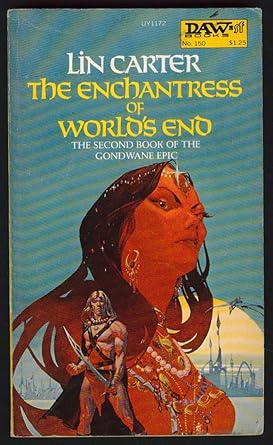
Book Review: The Enchantress at World’s End

The Enchantress at World’s End

by Lin Carter

Book 2 of the Epic of Gondwane, the tale of Ganelon Silvermane!

What ho, faithful companions! Fetch yourselves nigh to my heaving bosom, my bated breath, my excitement-tautened sinews, as I whisper the thrilling tale of the Construct, brought to quickening by the unfathomable will of the unknowable gods in the mist-shrouded halls of the future! He is Ganelon Silvermane, wielder of the Silver Sword, boon companion of the Illusionist of Nerelon and of Xarda, the Knightrix of Jemmerdy: together they will escape the mad city of Chx, defeat the grotesque Death Dwarves, the anti-life minions of the titular (pun intended) Red Enchantress, whose luxurious and tempting clutches they will slip through – only to find themselves in ever-greater peril! Zounds! What will come next?!

The best thing about this book, and the first one in the series, is that it’s all written pretty much like that. Breathless purple prose, ultimate pulp fiction. I thought there were some moments in this one where Carter slipped a little; he tried to make Xarda speak in even more archaic knight-errant language, but it didn’t really seem any different from his own narration, and so her self-conscious noticing of her own odd speech seemed – well, odd. There were also a few places where he crossed the line between fantasy and modernist fiction: he has a character, an ancient dragon who has existed (and hoarded treasure) since the dawn of time, reference some of the great swords of fantasy books past, including Orcrist and Sting and Anduril, and the twin swords Stormbringer and Mournblade; this was cool in that I know the books those swords came from – and a little weird in that the character in the book I was reading knew the books those came from, which felt off. But then the dragon also references ancient tales like Beowulf and the Ring Cycle, and the Bible’s Garden of Eden, and I thought: well, if the Bible can be part of ancient lore, why not Tolkien and Moorcock? So it wasn’t too bad. But it did jar a bit.

On the plus side: lots of action, lots of swashbuckling and derring-do, lots of bizarre names (Carter’s specialty, I think) and weird creatures and strange societies. Carter had a fertile imagination, and he chucks it all over the place in this book. There is an absolutely hilarious chapter when the Red Enchantress, a buxom seductress of the first order, attempts to tantalize Ganelon with her wiles; unfortunately, while Ganelon has the perfect physique of a god, he has the mentality of a bright 8-year-old, so the Enchantress’s wiles fail entirely to wile him, to her murderous frustration. There are definitely some silly parts – the Bazonga-bird, a goofy idea with a goofy name and a goofy character, springs nimbly to mind, and drags with her parallels to Jar-Jar Binks and, I dunno, Carol Burnett – and some moments of questionable writing; but it’s a fun book, just like the first one. I’ll read the next, too.

(Psst! Hey, want to read another time-traveling-fantasy story? Check out my serial about a 17th century Irish pirate who travels to the modern world! The Adventures of Damnation Kane)

The Warrior of World’s End

The Warrior of World’s End (The first book of the Gondwane Epic)
by Lin Carter

I’ve been reading some of the older pulp fantasy/sci-fi books, and this was one of those — a Daw paperback, the pages yellowed on the edges, the cover price only 95 cents. Lin Carter is one of those names I always see on rows of thin, dog-eared paperbacks in used bookstores, but not one I ever needed to read.

But that was only because I didn’t know what I was missing. And if you’re a fantasy fan, especially a fan of cheesy Robert-E.-Howard’s-Conan style fantasy, you must read Lin Carter.

This book was brilliant. I can’t wait to get back to the used store and buy the second book in the Gondwane Epic, and then keep going until I get to the end — and I hope that’s a long way off. The basic idea is this: 700 million years have passed since our current era, and the Earth’s continents have drifted into each other to form a single mega-continent — the title of the epic and name of the continent coming from the primordial Gondwanaland, the mega-continent that was the southern half of Pangaea, when all of the Earth’s land surface was in one land mass that became two and then became many — and things are, of course, very different. It’s a fantasy world-building technique that I’ve always enjoyed; my other favorite use of it was in the Wheel of Time. In this case, you have a traditional swords-and-sorcery society, with the opening narrative from the point of view of a trader riding a donkey from one great city to another, passing through the Crystal Mountains by a great desert, with his wife, who is actually a sentient plant-being. On the way through the mountains, an earthquake shakes the land, and soon they discover a Great Epic Hero wandering through the aftermath, lacking even the ability to speak intelligibly — but his thews are mighty, and his hair is glittering silver. This is Ganelon Silvermane, the hero who will save the world from doom: the star of the epic. The trader and his wife take Ganelon in and raise him like a seven-foot-tall bodybuilder/baby; they teach him to be honorable and courageous and everything a hero should be, and then off he goes a-heroin’.

It’s great. Carter uses all kinds of unnecessarily fancy words and complex sentences, but without making the book as hard to read as, say, H.P. Lovecraft’s work. There is a simplicity and childish glee in it that made me smile the whole time. It reminded me very much of Conan, or of Edgar Rice Burroughs’s John Carter of Mars series, but with a heavier tilt towards fantasy and away from SF — since there is a Red Enchantress, and an Illusionist, and Death Dwarves, and a magic flying bird-vehicle made of brass and granted intelligence and a personality, and the ability to speak. Ganelon meets a lithe Amazonian-type warrior woman, whom he saves from evil priests, and who I’m sure will be a love interest at some point, but our hero is too innocent of the ways of love as of yet; so far all he does is fight great battles and break large things with mighty swings of his flashing sword, all that kind of stuff.

It was a hoot. Highly recommended for those who like this sort of thing.

If you liked this book, you might also like:

Conan stories by Robert E. Howard or Robert Jordan

John Carter, Warlord of Mars series by Edgar Rice Burroughs