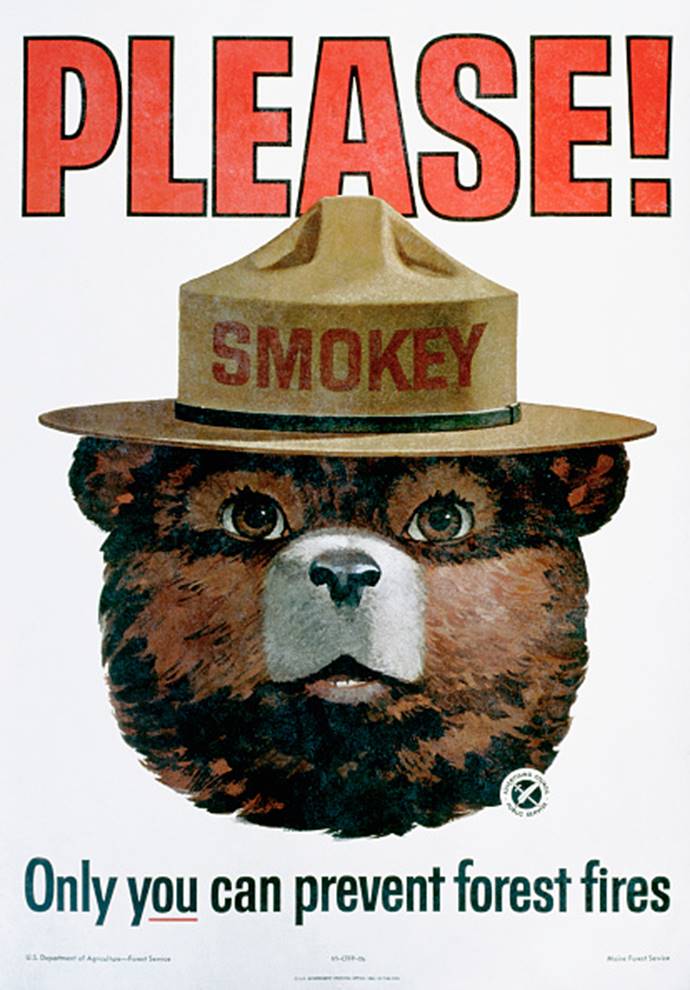
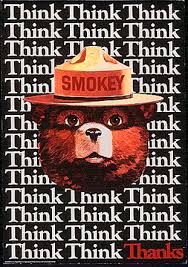
How Do I Say This Nicely?

So there I am, just minding my own business, right? It’s a Saturday morning, I just got out of the shower, so I need a minute to cool off because it’s June in Tucson and it’s already 94 degrees outside, so by the time I finish shaving and brushing my teeth my forehead is slicked with sweat, and I need to sit under the fan to return my temperature to equilibrium before I get one last cup of coffee.

  1. No, I should not drink hot coffee when it is 94 degrees. But I’m going to anyway. Forever.
  2. Yes, I should take cold showers — though I will point out that shaving really should be done with hot water, and that would make me sweat regardless because I am applying said hot water to my face. I do rinse with cold. It doesn’t fix the problem. Only sitting quietly under the fan does.
  3. All of this is beside the point.

I’m looking at my phone, trying to decide whether I want to read (I’m trying to get through four more books before the end of June, because I really want to read at least 52 books this year [and I’m at 22 and if I get to 26 before the first six months of the year are gone that will be meaningful, right?] since I have not done that for the last few years, and I know I shouldn’t worry about how many books I read or whether I’m reading books at all, but I’m not going to start another list) or if I should write, because I have really good ideas for blogs that I want to get to while it is summer and school is not destroying me, or if I maybe want to work on my audiobook (I’m recording myself reading Damnation Kane. It’s going slowly.), or maybe just keep building my ULTIMATE FORTRESS in Minecraft, which is what I’ve been doing to relax for the past week or so, because I spent the past week reading 546 essays about napping for the AP Language and Composition exam. And while looking at my phone, I check my email, and there’s a message from Substack (Which I will maybe start posting these essays to, as per my wife’s suggestion, which is a good one and maybe that would get me more readers — but also, can I handle more readers?), so because I’m considering posting to Substack, I go to check it out and see if it’s easy to put a post on there. So I open the email, and I see this teaser and headline:

“I have never felt very comfortable with the stance that writing, as an undertaking, is both very difficult and emotionally intolerable”

In this edition of the Weekender: vows of silence, teenage idols, and exploring whether writing is actually torture.

So I read it.

Now I need to sit under the fan for a minute.

Here, you can read part of what Monica Heisey wrote.

i have never felt very comfortable with the stance, held by some writers, that writing as an undertaking is both very difficult and emotionally intolerable. while i understand there is plenty about being alone with your thoughts, sharing your ideas in public, and attempting to take something from inside your mind and bring it into the physical realm that is uncomfortable, it is not difficult like digging a ditch. it is not intolerable like having your heart broken, or even like having a sunburn. when people say things like “writing is torture,” i often think, if you really feel this way, why not do something else?

i encountered this line of thinking so frequently in the early days of my career that it occasionally caused me to doubt myself. i loved writing. i couldn’t believe i got to do it for a living, and found it, often, actively fun. did this mean i was doing it wrong, somehow? was there a more arduous and therefore more correct method that would lead me to create stronger work? if suffering for one’s art provided no special benefit, why were writers i admired constantly tweeting or appearing on panels to say their working life was hellish and exhausting?

to this day there is a little voice in the back of my mind that pops up once in a while to suggest i am shirking “real work” by enjoying myself. i was immensely soothed to see ali smith, an objectively wonderful writer with a prolific output, call herself “immensely lazy” in an interview at the hay festival, holding a beer and suggesting she doesn’t really work until she has a deadline and a paycheque scheduled, adding that she “does basically nothing until she has to” and considers staring into space an important part of the creative process. there, i thought watching it, is someone who is enjoying their working life.

WORK: it’s supposed to be fun – by monica heisey

Okay, look. I don’t want to attack this person. To each their own (Which is why I’m also not going to comment on the choice this writer made not to use capital letters), and I understand that, indeed, that is the intended point of this piece: not every writer, not every artist, has the same experience as every other. Valid. In some ways I have a much easier time with writing than a number of my fellow wordsmiths because I have a style and a platform that coheres with single draft composition: I get an idea, I go to my computer, I write something close to stream of consciousness, and I hit “Post” without rewriting. I do not, like many of my fellow writers, suffer from anxiety or depression, or struggle with addiction, or trauma. I’m glad that this writer has a generally good time, a generally pleasant experience, both as a writer and with her professional work. I do not think enjoying herself makes her writing worse, and I do not think that it is necessary to suffer for one’s craft, either as an artist or as a professional of any kind.

But hey lady: writing is fucking hard. It is fucking. Hard.

Like I said, I don’t mean to attack, and I don’t mean to judge. The piece does go on to show that the initial stance taken here is not the whole story, because of course it isn’t.

this is not to say that i do not have bad days, or that i am immune from complex feelings about, in particular, the “putting it out into the world” part of writing. in the last week of editing my most recent novel i dreamt every night about dying or being murdered or murdering someone else. one night i physically felt the tip of my nose touch the lid of my own coffin as it closed over me. it was not, let’s say, “chill.” but the actual writing, in the day, sat up in bed and combing through pages, killing only my darlings, was almost pure pleasure.

Okay, that makes more sense. Yes, I agree: writing does feel good when it is flowing, when it is working, when you’re able to see the thing you want to create and you have a path to get there and you can put one metaphorical foot in front of the other on the way towards creating that thing you want. Yes, I do often have fun with my work. I like (sometimes — not lately) reading what I have written in the past. I like laughing at my own jokes: I think I’m funny. I think I have a decent gift for writing the occasional banger of a sentence, and I like reading those when I hit the bullseye. I think that I have sometimes had something valuable to say, and I have said it clearly and well on this blog, and I am proud of that. I am somewhat mystified, but definitely gratified, to see that, despite my lack of production over the last year or two, and despite my constant whinging when I do manage to write something, people are still finding my blog and looking at my old posts. I am equally gratified to have people buy my books from me, and then, as they sometimes do, come back to tell me that they liked reading them. There are many things about writing that are pleasant, and they are certainly part of the reason why I keep doing this.

So I won’t judge you for wanting to focus on similar parts of your own experience. I won’t assume that my writing life is anything like yours, and so I won’t use mine as a standard to lecture you about yours and what you are doing right or what you are doing wrong. As I said: to each their own, and there is no particular reason why someone would have to suffer for their art — but I do understand the cliche that tells us that we should be suffering for our art, and I appreciate the way you question yourself in those terms. No, you are not doing it wrong, and you are not writing inferior art just because you are not suffering.

Oh look, the essay goes on. What else do you have to say on this?

so! four paragraphs of bragging about how i loooove to work and have sooo much fun doing it… this is insufferable, you are probably thinking. i hope this bitch gets back into her own coffin and stays there! give me a minute. i have tips.

Okay. Now. Now you are indeed become insufferable, but not because you have been writing about how much you love work and how much fun you have doing it: now you are insufferable because you have fucking tips.

Let me be clear about a couple of things. One, although I found this piece irksome because it goes some way to invalidating or at least devaluing and minimizing my own experience, I meant what I said: I won’t judge anyone else based on my experience, whether that means thinking they have it better or thinking they have it worse than me. I don’t know enough about another person to even have any opinions about their lives, let alone judge them. Two, I have thus far resisted the temptation to get snotty about the fact that she is young, and talk about how my life as a writer has been harder than hers, because I don’t know her life and because I don’t think it’s fair to use my age and longer lived experience to discredit a younger person’s understanding; and also, as I said, suffering is not a requirement for art, and so the fact that I have had a harder time as a writer than she apparently has doesn’t make me more of a writer. Three, I haven’t wanted to try to flex my writing ability in comparison to hers, nor to humble myself as a writer in comparison to her, because obviously being a good writer doesn’t change someone’s experience of life as a writer, and isn’t necessarily related to one’s process: some artists have the gift of easy production of work, and some of us struggle with every single thing we do; none of that changes good art, and none of it makes any of us less or more of an artist.

But she has tips. She has a newsletter, too. And that means she is not giving anyone else the grace that I am trying to give her: she is specifically telling me (Well, she is speaking to a faceless audience, not to me personally) that I am doing it wrong, and that she knows how to do it better, and if I read her posts — or even better, subscribe to her newsletter — then I can learn to be the same kind of writer that she is. More importantly, this shows that she is not an artist. She’s a hack.

Hold on. Let me sit under the fan for a minute, and cool off.

Nope: it’s not helping.

Okay, it helped a little: I take back the “hack” comment. I’ll explain that first, because I want to be clear about why this angers me so much; and then I want to talk about my own experience of writing. (Right here. Mark this moment. I’ll explain.)

There is a trend in the modern world — maybe an old trend, I don’t know, this is the only world I’ve lived in and been an artist in and been married to another artist in — of people claiming to be artists who are not in fact artists at all. I’m not trying to gatekeep art, by any means; but I think the meanings of words are important, and “artist” is a particularly important word, and therefore the meaning needs to be clear, even while it must be broad enough and inclusive enough to include any and all kinds of art. So here it is:

An artist is someone who defines themselves by their art.

Okay? That’s it, but it’s important, so let me explain — and hold on until the end of this, because I may either confuse you or piss you off, but I’m going somewhere, so come with me until we get there.

Someone who paints or draws for fun is not an artist. Someone who paints or draws for money is not an artist. Someone who teaches painting or drawing is not an artist. Someone who paints houses, or fills in coloring books, or doodles in the margins, is not an artist. Someone who uses drawing and painting as therapy, for themselves or for others, is not an artist.

An artist can be a person who does any of those things. I would assume that most artists do most of those things — certainly making work for fun should be part of the experience of being an artist no matter what the art is. I would hope that everyone who is an artist has the opportunity to make money with their art; it is magical when it happens. As a teacher, married to a former teacher, I think every artist who has the chance to teach their art is doing a good thing both for themselves and for the world. Hopefully we all experiment with various related tasks somehow connected to our art — I would certainly include reading AP Lang essays about napping as connected to my art as a writer, and my wife makes amazing doodles and also is goddamn good at painting houses. And hell yes, my art is therapeutic: why do you think I’m writing this, so I can make money from it? So I can get you to subscribe to my newsletter?

But to be an artist, your identity has to be tied to your art. It has to mean so much to you that it means you. If it doesn’t, it can be a lot of good things, and you can do a lot of good things with it — but it’s not art and you’re not an artist. I will add one caveat to that last comment, which is that art can come from surprising places, so people who are not artists can absolutely produce art, and even great art; and also that people’s identities change, so someone can be an artist for a time, and then change how they identify themselves, how they define themselves, and cease being an artist; that temporary condition is no more or less valid than my lifelong condition (Now it sounds like a disease — Ooo, did you hear? Dusty caught art. Oh man, poor guy.). But during that time, for you to be an artist, you have to see yourself as defined by that art.

I’m not going to get into what is art here; it’s any creative endeavor that, as I’ve been saying, defines the person who pursues it. Art is defined as much by the artist as the artist is defined by the art. It’s the self-definition that matters.

So the trend that is prevalent in the digital world and might have always been present is people who want to make money by calling themselves artists — not people who want to make a living with their art, and not someone who defines themselves as an artist also calling themselves an artist: but someone who is posing as an artist in order to make money. And what these people do is they create a program: a guide, some kind of how-to instruction manual, that tells other people who want to make money by calling themselves an artist, how to do that. And the number one way to do that is to create a program, a guide, some kind of how-to instruction manual on how to make money pretending to be an artist, and then sell it to other people who want to make money by pretending to be an artist.

I see it constantly: any forum, any interaction that connects writing to money, has at least one shmuck trying to shill their system by which they made some remarkable amount of money, and if you pay them money they will tell you the secret how they did it: and that’s the secret. They made a sales pitch to get people to pay them money to find out how to make money “with art.” But, as should be abundantly clear, these people are not artists: they are marketers. They are salespeople. They are, in my own colloquial lexicon, hacks. So now, when I see someone trying to tell me how to be an artist, how to be either successful or happy as an artist, especially someone who has a newsletter, I think, Hack.

Looking through this woman’s tips, I think she may not be a hack. I think she may actually be a writer: one of her tips is to read, and another is to write, and she has some points about not being too hard on yourself, which is all genuinely good advice for other writers. Sharing your own experience as an artist, even selling your own experience as an artist or using your experience as an artist in order to gain a following, are all valid things to do. As I have no experience of this woman’s work other than this one piece, I will try not to judge her too harshly for what seems to me like hackery but might not be. If she is an artist, then my problem is not with her, it is only with what she said here; so we’ll assume that, and let it go for now.

Now let me tell you why she is wrong.

Let me tell you why writing is fucking hard.

Because I never know. Never.

I never know if I should be writing, or not. Sometimes I try, and it doesn’t work, and I get incredibly frustrated and also caustically self-critical — because why the fuck can’t I write? Am I not smart? Am I not wordly (Should I use that word which is not a word? Will people even see that word, or will they just think I wrote “worldly” and skip past it? Have I made this point too obvious by adding this parenthetical?)? Am I not literate? Am I not creative? Do I not have good ideas? At my most generous, I will think I guess this just isn’t the time to write, and at my least I will think: Because I am not a writer. And when I think that — which is fairly frequently — it hurts. I do not want to be not a writer. I define myself as a writer. It matters to me.

But even though I am a writer, I never know if my writing is good. I never know if it is done, which is why I tend towards one-draft posting; because if I write it fast and then publish it fast, I push it away from me, and that way I don’t have to think about it any more, it’s already out there, it’s already published, I can’t make it any better, it has to be good enough. I never finish: I only surrender. And as I said, I sometimes like reading what I have written; but I don’t like how I always find flaws, or at least things I could have improved. Because then I know that I gave up too soon, that I should have kept working; and maybe that’s why I’m not successful, because I give up too soon, because I don’t revise and polish my work enough.

Because I am not a writer.

I have a thousand ideas. I never know which one is the right one to be working on. I never know which one is the right idea, and I never know what is the right time, and I never know what is the right thing to say, and I never know if I have said it or if I have said it well enough. I never know who my audience is or will be, and I never know how they will accept my writing, whether it will seem good to them or not, whether it will be meaningful or not, whether it will be right or not. That’s why I told you to mark that spot, up above: that was the moment when I thought, Ahhh, nobody wants to read that. Nobody wants to know what your experience of being a writer is. They don’t care. They won’t understand. I think that, or some version of it, every single time I write. Am I right about that? Am I wrong? I never know. And if somebody reads my work, and they tell me it was good and meaningful and right, I don’t know why, and I don’t know how to do it again. I never know. I’m always guessing, always taking a chance, especially when I publish my work; because there’s always the chance that I’m wrong, that I did it wrong, that the work is bad or ineffective: that it is not the art I wanted to produce. And that matters to me, it matters to me if the work is not what it should have been, what it could have been if I had worked harder, or if I had thought more, or if I had greater innate skill or more training or more practice or — I don’t know what. I never know what is lacking. But I know that something always is.

Because I am not a writer.

That’s what I end up telling myself. If I were a writer, then I would know. Then I would be sure. Sometimes I think that’s a matter of innate skill or intelligence, because I didn’t do the thing that great writers do, and create THE GREAT AMERICAN NOVEL when I was in my 20s; sometimes I think it’s a matter of the choices I have made, and the choices I have not been able to make, in my life. I became a teacher because I didn’t think I could write successful novels fast enough to make a living with them right out of college, and I wanted to make a living, so I chose to do something other than writing: and for the last three decades, I have thought that maybe that was the wrong choice. Maybe I could have been a writer if I had tried to do that and nothing else.

But also, I know there are other factors. I couldn’t be a journalist, for instance, because I’m an introvert, so I suck at interviewing people and finding sources and networking and all the rest of that; I didn’t go into film or television writing because I grew up loving books even more than movies or TV. I don’t know if there’s any reason for that, but that’s been my experience, so my writing career has been slow, because I write novels. I have written six, and started several more. And I am still a teacher.

I tried to make a living out of my writing. I tried submitting stories to magazines, and I tried submitting my novels to agents and to publishers. I have never gotten anything other than rejection. Once — once — an agent liked the first six pages I sent them, and asked to see the first 50 pages of my novel; I sent them 50 pages… and they rejected it. (I first wrote “They rejected me.” Which should I say, here? Should I show the self-confidence to recognize that rejection of my work is not rejection of me as a person or as an artist? Or should I say what it felt like, what it always feels like? I know that everyone’s advice is to keep submitting, to never give up, to always send your work in and never take rejection personally. I know that. And I still wrote “They rejected me.” Because that’s how I feel. Should I not feel that way? Maybe I’m doing it all wrong. I guess it’s because I am not a writer.)

I don’t regret becoming a teacher; I am incredibly proud of what I have accomplished as a teacher, the difference I have made in the lives of my students, the ways I have had a positive impact on the world; if I had gone directly into writing and made a career of it, I think I would struggle with not having given back to the world in the way I think I have as a teacher. By the same token, I’m never sorry that I made the life I have: I do not regret moving to the places I have moved, even though I never moved to New York City so I could immerse myself in the writing life. I do not regret the time and energy I have put into being a pet parent, and I am absolutely and always happy with my choice of life partner, because my wife is the best thing in my world, followed by my pets.

But see, maybe if I didn’t have those things, I would be a better writer. Maybe I would have been able to focus more, or been more driven; maybe I would have spent more time, when I was younger and more energetic or more confident or didn’t sometimes struggle with words or didn’t have so many doubts or so many obligations or so many difficult things to deal with — maybe I could have succeeded. Maybe that’s why I am not a writer.

I never know. I never know what I am, or what I am not, or why I got to be this way, or how to change it. I have ideas, and I have feelings, and I have inspirations, and I have despairs: but I never know.

But I still keep trying to write. To be a writer.

That’s why I AM a writer.

That’s why I am an artist. I define myself by my art, by my work, by my ambitions to keep making work, to make better work, to make more work. But because I never know what I’m doing, it’s so goddamn hard to keep coming back to it and trying. I mean, if I had all the time and money in the world, maybe it wouldn’t be hard; and if I knew that a million people would read my work and love it no matter what I wrote, then it wouldn’t be hard; and if I didn’t fucking care, then it wouldn’t be hard.

But none of those things are true. What is always true is: I never know. So it’s always hard. It’s always hard to make myself do this. Even when it’s fun, which it often is, and even when I’m proud of my work, which I often am, and even when I have had some success, which I have had, at least a little, it is still hard to make myself write. Because I never know.

So spare me, Ms. Heisey. I don’t want to attack you, because all this means is that I wasn’t the right audience for your post. I hope the right audience finds it, and I hope it is good and meaningful and right to them. It was not, to me. And I would leave it at that, let your work fly past me to where it belongs — except you tried to tell me how I could live more like you, you tried to give me advice. But you don’t have any idea what this experience of being a writer is like to me, even though you presume to know, and I find that annoying. So spare me.

Let me also stick in here the part that really makes me angry about this, and the reason why I’m not just letting this go: it’s the privilege. I’m glad that this person doesn’t go through what so many artists go through: so many of us deal with depression and anxiety, with mental health issues, with trauma, with addictions; I have none of those, and my life as an artist is still hard. The simple fact of the stress in my life, which is not inconsiderable, makes everything to do with my art even more difficult on top of the difficulties of being an artist that I have tried to show here; I haven’t mentioned all the shit going on right now, which is making everything hard. To go through everything that I go through, AND to suffer as mental illness or trauma make us suffer? Those people, those artists, who deal with that are the strongest fucking people in the world. Everyone who has mental illness or trauma or both, and who nonetheless pursue their life’s goals, are the strongest fucking people in the world. And while that’s certainly not exclusive to artists, it is prevalent among artists, largely because artists are frequently more sensitive and observant and contemplative of the world and our place in it (Is that because we are artists, or are we artists because of that? Egg or chicken?), and I assume also because art is in fact excellent therapy, and because one of the most therapeutic aspects of art is the way it helps us to understand and to connect with our fellow humans so that we can feel less alone, which is so very necessary for someone struggling with mental health or trauma or both. So yeah, a lot of artists have trauma and mental health issues; a lot of people with trauma and mental health issues become artists. And for you to fucking sit there and pull out this, “Ummm, you guys, art is supposed to be fun! If it’s not fun you’re doing it wrong!” That makes me mad. That makes me want to say things to you, and about you, that are not nice. But all I will say directly is this: check your privilege.

Maybe when you have collected more experiences like mine, you will understand more why those of us who say that art is hard keep saying that; maybe when you do, if you do, you will want to read something written by someone who knows why art is hard, why it is always hard. Maybe you’ll even read this. Maybe it will be interesting, and meaningful, and right.

I’ll never know.

One Year Down…

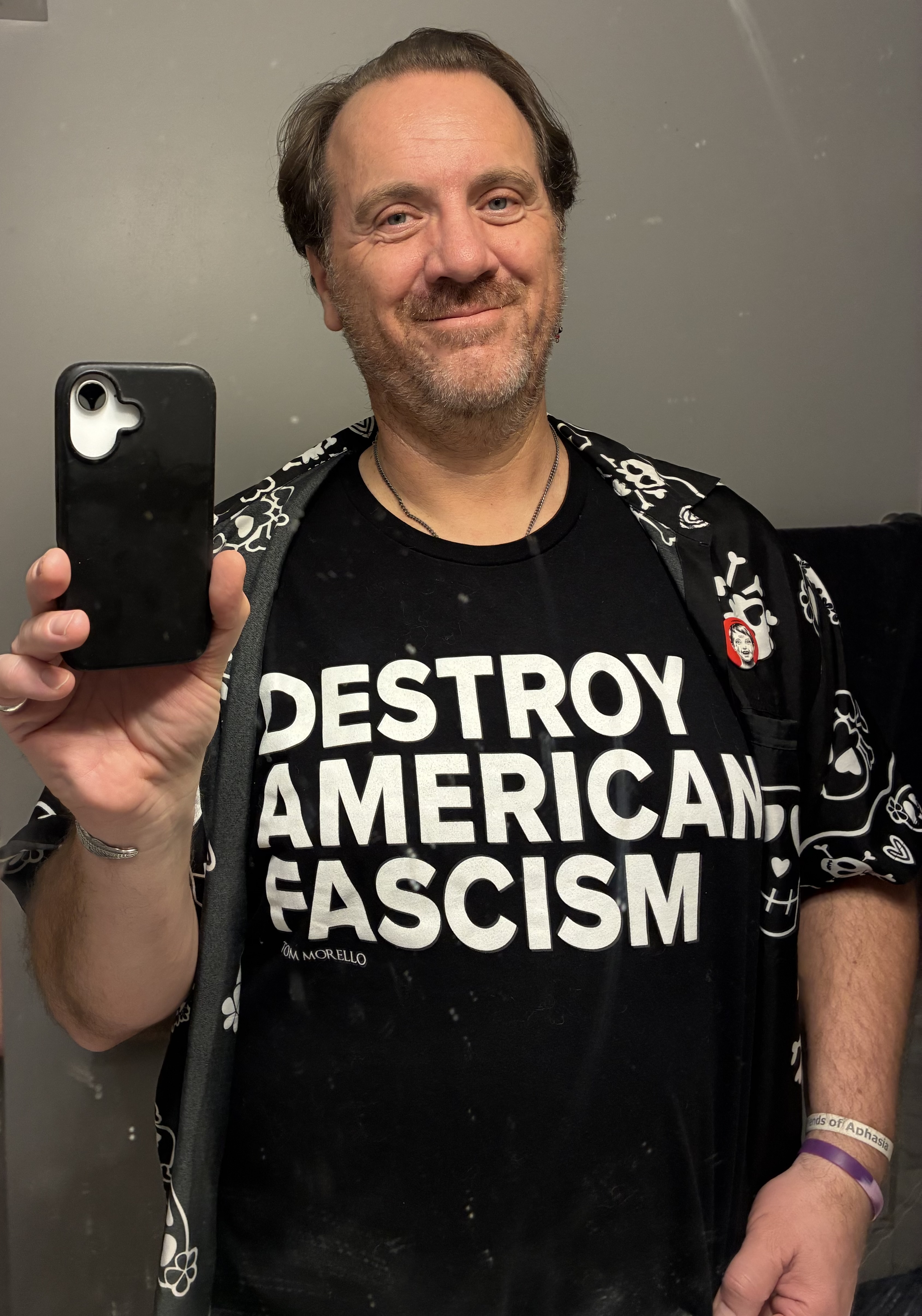
How do you like the shirt I got for Christmas?

Well! It’s been a year, hasn’t it?

We started with DOGE, and Liberation Day, and tariffs that were on and then off and then on and then off. We did not start with the Day One promises to end the war in Ukraine, nor the war in Gaza, nor to reduce the price of groceries and the cost of living. We have moved on to the Department of War attacking boats in the Caribbean without any evidence (so far as we know) that they even have drugs; certainly there is no evidence that they are “narco-terrorists,” as they are not, even if they are transporting narcotics, as they are not people who are using unlawful violence and intimidation, especially against civilians, in the pursuit of political aims. And, if they are transporting narcotics, they are not moving fentanyl to the US, as fentanyl comes from China through Mexico, and not through Venezuela; if they are moving drugs (and there is no evidence that has been presented which says that they are, which means, according to our own concept of justice, that they are innocent, not having been proven guilty) then they are sending cocaine to Europe. Not great, but not the justification used for their slaughter: and there is, of course, no justification for the order to kill two men on a sinking shipwreck, which was an illegal order that the military followed – even though when our elected Congresspeople made a public service announcement to encourage the military not to follow unlawful orders, the administration freaked the fuck out and acted like that was sedition: entirely ignoring the clearly unlawful order that had been issued, and followed. Now the man who followed the order is doing fine, and the man (one of them) who reminded him to follow his oath is being stripped of his rank and pension.

Hegseth is scrutinized by Congress over boat strikes | AP News
These guys say that THAT guy shouldn’t have his rank.
Integrity has defined my brother's service to our nation, as a combat  veteran, astronaut, and US Senator. Any effort to undermine that is an  abuse of power.

It has been a fucking year.

A year with a shutdown, and a tax cut for billionaires, and increased health insurance costs for the rest of us. A year of dissent being squashed in clear violation of freedom of speech, with university students being arrested and jailed and deported for their speech, even while the administration promotes the same genocide the students were speaking out against: it’s almost like we have traded the right to speak our minds, for the opportunity to slaughter innocents, and then steal their homeland and make money from it. A year of our National Guard being weaponized against us in order to stop peaceful protests, while actual insurrectionists were pardoned en masse: almost like our right to assemble and petition the government for redress of grievances has been traded for the freedom of loyal brownshirts. A year of deportations: starting with sending innocent people, both legal immigrants and US citizens, to torture prisons in El Salvador (along with millions of dollars in recompense for the considerate acquiescence and collaboration of the Salvadoran administration), continuing through shocking raids on homes and assaults on children, finally culminating in the recorded murder of an innocent American citizen, and the subsequent shielding of the murderer by the federal government, which continues to lie and accuse everyone who is not one of their murderous thugs. And again, the administration is cracking down on free speech, sending federal troops, and cruelly assaulting anyone and everyone they can.

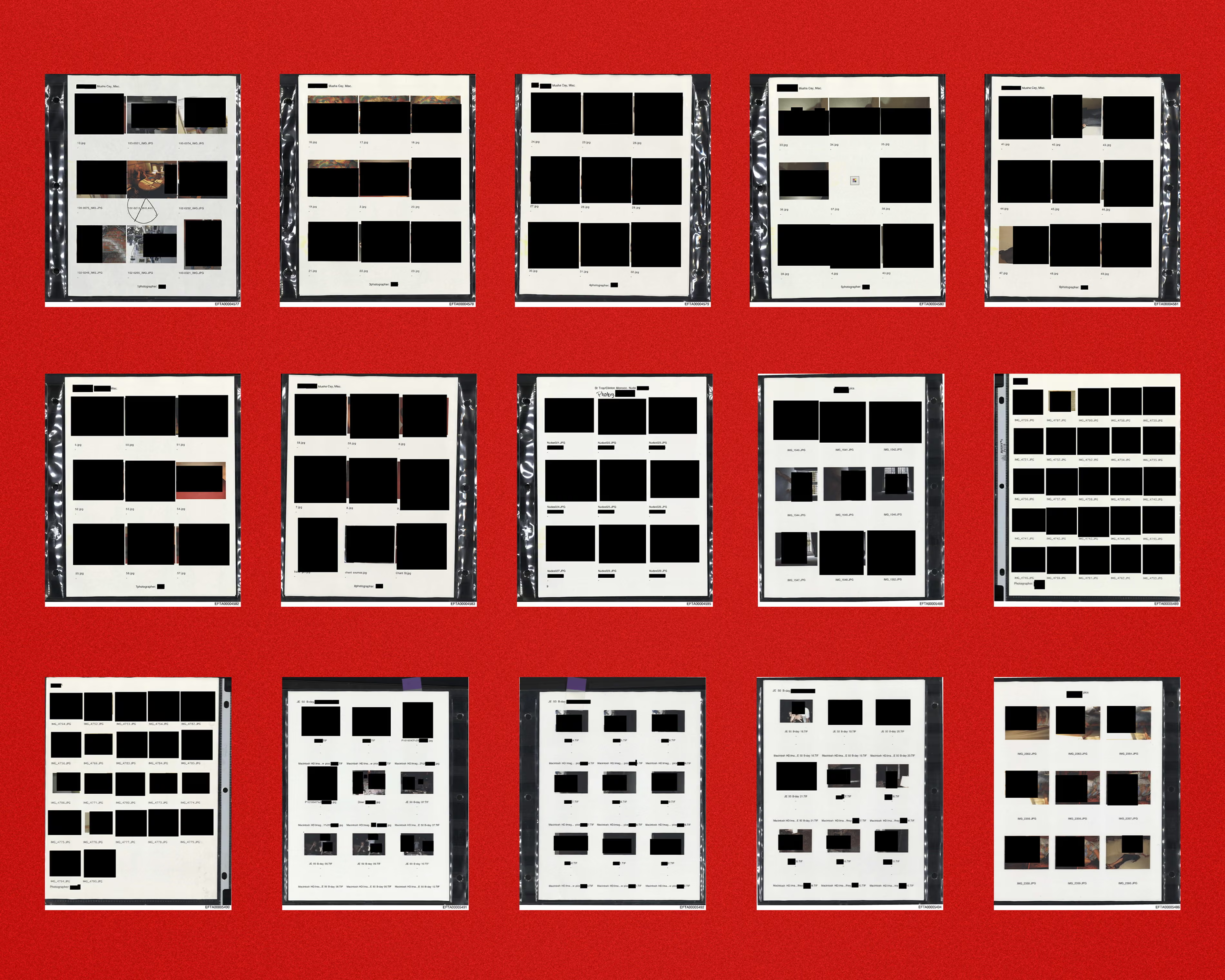
It’s been a year, now, that we still have not gotten the Epstein files. Only about 1% has been released, and that 1% includes absurd redactions and previously-released information.

Happy Anniversary, President Trump. One year ago you took the oath of office for a second time: and you immediately set about destroying the country that elected you, in every way that matters: most often to increase your own wealth and power, sometimes for no good reason that I can discern – why, for instance, do you want to remove the ACA? You don’t give a shit; you don’t have that many employees. You do not profit directly from health care costs going up for individual citizens. I recognize that the likely reason is you have some billionaire whispering in your ear, like fucking Wormtongue only slimier, telling you that the ACA is unAmerican and that removing it will make America great again, and just as you expect your followers to do, you are absolutely willing to get on board without a single second of questioning “Wait – why is government-subsidized health care bad?” I also recognize that there is a certain amount of traditional Republican posturing in your political stances as well; like, you also don’t give a shit about abortion, or about gun rights, but your base expects you to remove the one and protect the other, so you do, because you are yourself entirely indifferent to anything that doesn’t affect you directly; and I know that the right hates all things resembling socialized health care (Except for the Medicaid and Medicare that they and their families use; but I’m not going to get into the hypocrisies of Americans: that blade always cuts both ways, and I’m not interested in yet another round of Whataboutism, which is rapidly becoming our national pastime): but why have you decided that this is the thing you’re so set on destroying? Your congressional delegation is clearly not on your side with this one, not all of them; so why didn’t you give up and let people keep their goddamn subsidies, and just take credit for it like you do with everything else? Why do you feel this burning need to destroy people’s lives?

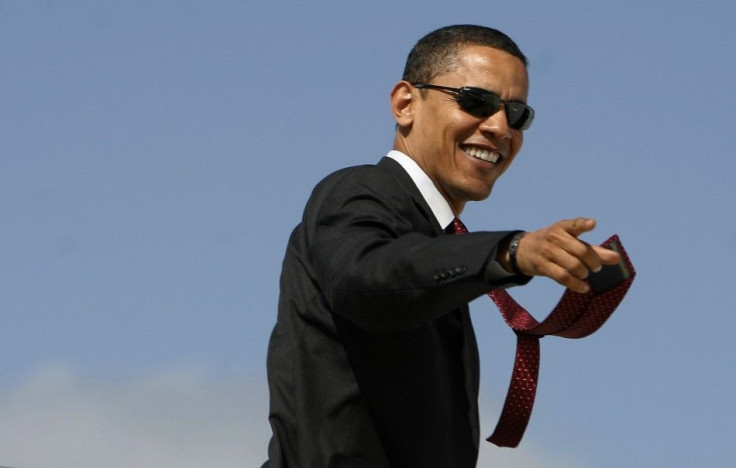
Is it really just because Barack Obama got the ACA passed into law? And you hate him so much, and you are so profoundly jealous of all of the ways that he is better than you (which is, in fact, every single way imaginable except in the Shithead Championships, which you win walking away), that you want to do everything you can to destroy his signature accomplishments? I mean, that would certainly explain you destroying the JCPOA and fucking up our actually effective strategy in Iran, but I assume another benefit there for you is the potential war, which you’d clearly love to have because then you could claim Iran’s oil to go with Venezuela’s; but the ACA and the subsidies that keep people insured have nothing to do with oil. I honestly don’t get it. I get the drug price thing, because you intend to force the drug companies into making sweetheart deals with you so you can sell medications to Americans through your new Trump Rx company; but again, that has nothing to do with insurance or the cost or health care in general.

Mitt Romney And Super PAC Attack Obama's 'Cool' Factor: Will it Work? |  IBTimes
Haters gonna hate, I guess

Are you really just that much of an asshole? Based on how you respond to questions from reporters with insults like “Quiet piggy,” and criticism from random passersby by saying “Fuck you” and flipping them off, it might just be that. But while I can easily accept that you do so much damage to my country and my fellow Americans because you are an evil, greedy fuck, I still struggle with you doing this much harm just because you’re a fucking prick. Maybe in honor of this august occasion, I will make this my gift to you: I will accept that your vile nastiness is on its own enough to explain your actions. Though really, that’s a gift to me. It will make it easier.

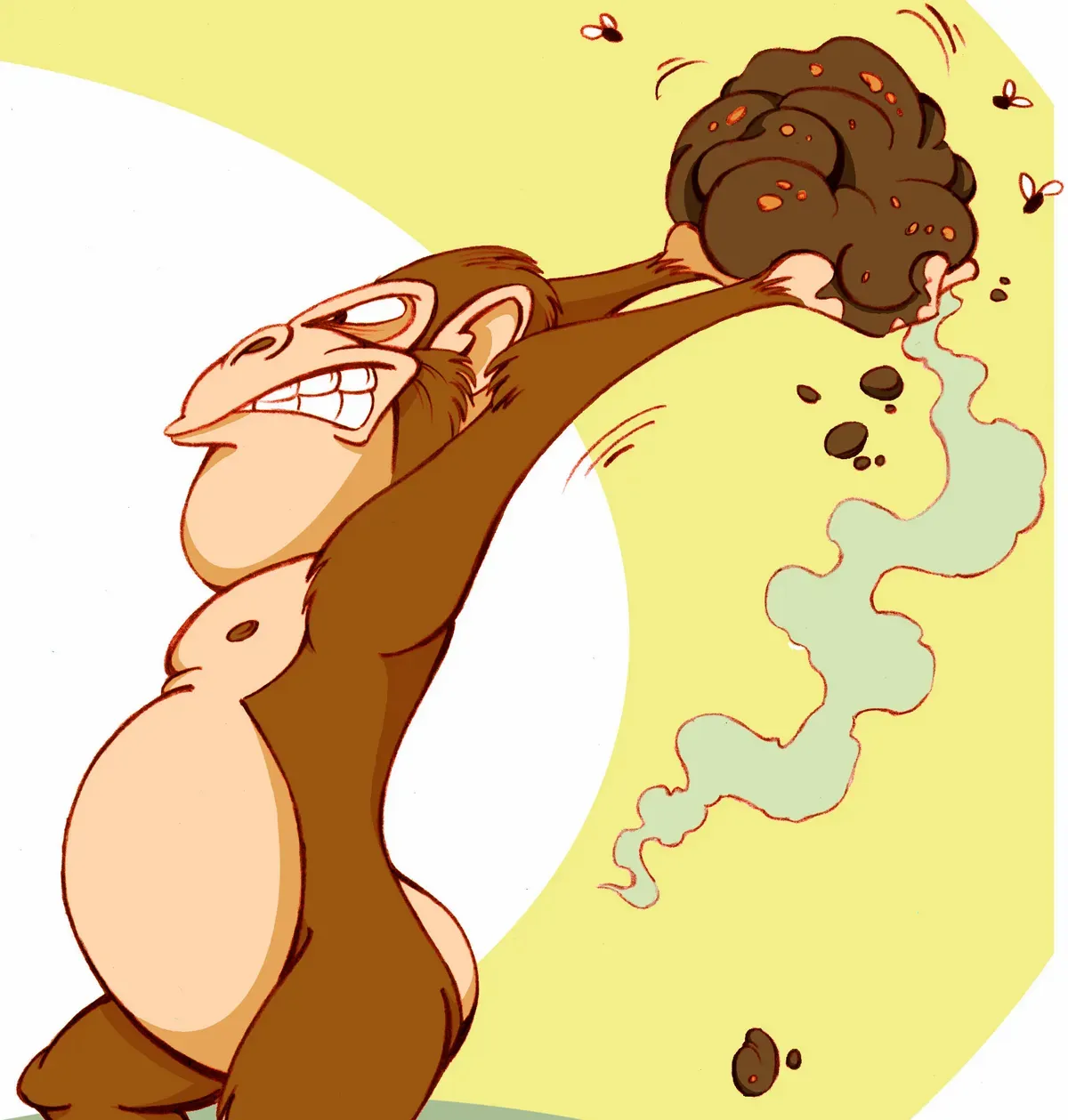
Note to self: Shit flinging gibbon.

And I need to make this easier: because the actual task is going to be very, very hard. And the longer we focus on the wrong thing, the more harm will be done, and the harder it will be to solve the problem and complete the actual task that lies before us.

Here’s the truth, which I want to put before you all now, on this anniversary of the second inauguration of this vile warthog of a man: Trump is not the right thing to focus on. He is not the problem. I don’t say that to delegitimize or devalue everything that we have all done to oppose the slimeball: it was necessary, and to some extent it still is. The thing is, Trump could have been the problem, and to some extent he still can be the problem: because it is still possible that Trump could actually destroy this country. He could do it in two ways: he can start a nuclear war, and he can overthrow the legitimate government based on the Constitution and become an actual dictator. The nuclear war option remains, and will for as long as Trump is in power; the best we can hope for there is that his own self-interest will not be served by the death of the planet. We can also hope that the military will not follow an arbitrary and capricious order to launch nuclear death at the world; this hope that the military will not obey Trump’s most deranged and destructive orders is also what we can count on for the second threat, that of a coup and Trump’s elevation to Emperor – and frankly, I had a lot more confidence in that bulwark keeping us safe before Pete Hegseth told soldiers to murder drowning men, and they fucking did it. And then invaded a sovereign nation to kidnap their president. And they’re proud of it. So I dunno any more if this is something we can feel safe and secure about: would the military actually rise up and betray their oaths, and destroy their own way of life, in order to put Trump onto a throne? I really want to say no. But I can’t be sure.

So: Trump is still an existential threat, and so everything we can do to remove him, personally, specifically, from office is a good thing to do. His actions are doing real harm to real people, so everything we can do to oppose the specific actions of this administration are genuinely good things to do, whether the intent is to prevent the harm, ameliorate the harm, or provide a balancing benefit to offset the harm: all good. All righteous, all positive, all beneficial. Keep doing all those things.

But recognize, too, that so long as Trump doesn’t overthrow the government or set the world on fire, he will have to leave office. And we will still have to live in this country that he fucked up. And the real issue, of course, is that Trump isn’t the one who fucked it up: we did. Because we voted him in.

Okay, not “We.” I don’t think the people reading this mostly voted for Trump, and I don’t believe we are all equally to blame for his election, including those who didn’t vote for him. So “They” did vote him in. But we still have to live with them, in the same country; and if we don’t want to make this country an evil, unjust tyranny, we still have to let them vote. That’s the fight. That’s the work we have to do. Healing.

I don’t know how to do it. I think about that a lot: how can we prevent this from happening again? I think about it most often in specific terms of trying to rebuild the international alliances and cooperations that Trump is setting on fire; like, if he really does break NATO by making more and more absurd demands for Greenland or what have you – I will not assume that owning Greenland is the last or the stupidest idea he will have; this is only the FIRST year of FOUR – how could we convince the other members of the treaty organization that, after Trump is gone, we will never allow another piece of shit like him to take over our country and fuck it up the same way?

What laws could we put in place? What safeguards to ensure that this shit won’t happen again? I mean, we can certainly (in theory) pass a law to rescind the Supreme Court’s absurd decision that presidents are not criminally liable for their actions in office; that would require a congress that were not members of a cult, and a President willing to hold himself or herself to an actual moral and ethical standard; but I can imagine that happening. But so long as the President retains the immunity of the office, which I don’t think should or could be removed, we can’t really guarantee our allies (soon to be our former allies) that they can trust this country: this country that was willing to elect this fucking guy.

Trump rewrote foreign policy as president. If he wins in 2024, he wants to  go further : NPR

Twice.

Honestly, I don’t think we can; I don’t think we will ever be able to heal the rift that we are creating, that Trump is creating, right now. Partly because it is our fault, as a nation: we have never actually healed our own racist and biased culture and institutions, and so this could quite easily happen again. It would look different, but to think that there would never be another Republican demagogue who could tap into the resentment on the right, or a liberal demagogue who could create even worse conflict by actually persecuting the right the way they like to pretend they have been persecuted, is to ignore what gave rise to Trump’s initial success. It was not his brilliance. It was not his charisma. It was not Trump at all, though he did bring enough to the table to make it happen. He was the match, and he started the fire: but the fuel was already there, and it will remain after this match is snuffed out.

I think we have made progress, over time, towards healing the wounds that underlie this country’s dysfunctions. I think that because a hundred years ago, I would not have thought I was racist at all, and today I know that I harbor some prejudices, mostly unconscious, and that I once had some quite serious biases. I know that I live a privileged life, largely built on the privilege of my upbringing, which was at least partly due to my race and my socially-accepted gender identity. A hundred years ago, I would have just thought I was – normal. Natural. So: progress. Now I can work to identify the problems in myself, and get better; and that, multiplied by 330 million, is how we can make this into a country and a culture we can all be proud of, from end to end, rather than only in pieces, and with exceptions and excuses. Just like the fights against Trump himself, all of the work we have done and are doing towards being better people in a better world is all good work, and should continue.

But it’s slow work, and as long as it continues unfinished – and resisted and denied by millions and millions of us – there are openings for evil people to exploit. That’s how we got Trump. And it’s how we’ll get the next one. I am hopeful that this current shitshow will swing the pendulum in the correct direction, and our next few years will be better and more productive; but as long as the system stays the same, the pendulum will always keep swinging, and it will swing back this way again: and then we’ll have to do this shit all over again. And considering that Trump is worse than Bush who was (in some ways) worse than Reagan, who was (in many ways but not all) worse than Nixon, I’m afraid of who the next swing will bring us. And I’m also afraid that the swing away from Trump will not go far enough, as Biden did not go far enough, as Obama did not go far enough, as Clinton…actually, Clinton should be in the list of evil swings, because his predecessor, George HW Bush, did an honestly better job of adhering at least to the status quo and therefore not committing evil acts, though neither of them did good things. The worse the bad ones get, the lower our standards become for the “lesser evil” we are willing to accept. And that’s not good.

I’ll tell you right now, the one bright spot I can see in the fact that this administration is only one year through its four-year run is that the horror show going on in front of us, and including too many of us, is far and away the most effective mirror we could ever hold up to our own faces, our own flaws. The worse it gets, the more we recognize how bad we let it get, how deep and how dark the problems are that gave rise to this.

Please. I beg you. Recognize that the first problem is the determination not to fix the real issues, but rather to slap a bandaid on them and pretend that everything is fine. If you think that electing a moderate centrist who will do the same things Biden did – sign new executive orders that rescind Trump’s, pass a different kind of budget – that may have good things in it, as the Inflation Reduction Act did, and all the rest of Biden’s quite real and positive accomplishments – but that does not change any of the underlying structural problems (Just as Obama’s ACA did not solve any of the larger issues with health care in this country, even though it was genuinely good to make insurance more widely available and to end lifetime maximums and denial of coverage due to pre-existing conditions – and I would be much more interested in the Republican congress’s claims to want to fix the problems instead of just extending subsidies that mainly enrich insurance companies if they weren’t currently in a cult enthralled to the guy who released the Great Health Care “Plan”), then I guarantee you that the pendulum will swing back sooner than you like, and maybe go farther than you can stand.

Just imagine, for a moment, President Joe Rogan. Or President Nick Fuentes.

And then think about what we can do to solve the larger problems, and to do it quicker than we currently are.

Here, just so I don’t name all these issues and sound all these warnings and offer absolutely no solutions: the two most important things I have learned in the last decade are the incredible amount of money that gets spent on politics, and the deep ignorance of so much of this country’s populace. The two are linked: because the wealthy who buy politicians are more powerful if the populace is ignorant – and that does include those who buy Democratic politicians, because while they generally don’t have the same sociocultural goals, they sure as fuck benefit from the same economic policies, which is why the Democratic party doesn’t change the basic economic structure of this country, and somehow opposes Bernie Sanders even if the other option is Donald Trump – and the more ignorant the populace is, the more effective the control mechanisms of the wealthy become. So while I don’t ever want to become a politician directly, and while I am not good at taking actual political action myself, I am exceptionally good at one of the other critical solutions to the larger underlying issues: education. I am a damn good teacher, and also a decent content creator. So that’s my task, and I am doing it, and I will continue doing it, to the best of my ability and the limits of my capacity. And that will make things better.

Especially if we can all do the same.

One year down, everybody. Look forward. Keep moving. Don’t give up.

2025 Wrapped

It’s been a year.

I want to write “It’s been a hell of a year,” but I hear that in a positive sense – “WOO, that was one hell of a ride! Let’s go again!” or, in a more personal and more specific reference, Spike telling Buffy, “You’re a hell of a woman” with that remarkable sincerity that James Marsters can summon despite playing a bleach-blonde British Victorian romantic poet/Sex Pistols punk vampire with a soul, a chip, AND a trigger (If you’ve watched BTVS, then you know; if you haven’t, don’t ask – but also, here it is) – and this has not been a positive year. You can tell because Toni and I finished re-watching the Buffy and Angel series (Serieses? What is the plural of “series?”), which we only do when the television shows we prefer, which tends to be mostly serious dramas like Breaking Bad and You and Dexter and Stranger Things, are too dark and depressing to deal with. Though we did finish the whole Walking Dead series this year; and then moved straight into watching The Great British Baking Show. Which we will probably rewatch, along with our beloved old episodes of Naked and Afraid and Chopped. And the neverending stream of Househunters, which we are now going to intersperse with old Simpsons episodes.

Maybe that’s the right descriptor: this has been a year to watch and rewatch old favorite shows. It has been a year to hide our heads in the sands of nostalgia, and in the moments when I have to look up and move around and do things, to wish that I was still stuck head-down neck-deep in the silt. And since I just read Long Live the Pumpkin Queen, in which Sally, after marrying Jack Skellington and becoming the Queen of Halloween, deals with the Sandman, I think this metaphor is even more appropriate. Except, of course, the Sandman makes me think of Neil Gaiman, and I guess I can’t be a fan of his any more. And I say “I guess” only because the accusations against him are currently unproven; but they are multifarious and choral, and therefore likely true; and in his Sandman series there is one of the most disturbing stories I’ve ever read, about an author who holds an immortal Muse from ancient Greece captive, and gains inspiration for his art by raping her: a story I always admired because it so beautifully captured the corruption of ambition; but now I think it was based on the author’s actual thoughts and feelings, and so I hate that. I so hate that.

I can’t think back over this year without getting depressed: maybe that’s the best way to say it. That makes me want to hide, to disappear, to sleep and not think about everything. That is, by the way, why I haven’t been writing; and I hate that I’m far enough out of practice that my typing now sucks. Which is just another thing for me to be mad at myself about, along with the times I have lost my temper, and the habits I have built and the ones I have let lapse. And maybe the best way to see this sand-concealing metaphor, this desire to sleep and escape, is just to recognize that I have spent the year getting less and less sleep, as I lie awake in insomnia and think about things I didn’t think about during my waking hours. So it’s been a year of emotional assault and subsequent exhaustion. Like I’m being beaten with sandbags.

I don’t intend this to be just an emotional dumping of everything on my mind; but my guess is that I’m not alone in feeling this way. (Spoiler: I already know that I’m not alone in feeling this way.) I don’t need to enumerate all of my reasons: you have your own. Mine are similar enough for us to lock gazes and nod in mutual recognition. Game recognizes game: except the game we’re playing is not in any way a game – so maybe it is despair recognizes despair.

I don’t want it to be that. I used to be optimistic, and my wife sometimes bemoans the fact that I have lost that cheerfulness – not in any accusatory way, the emotional equivalent of “You really let yourself go!” It’s that she is concerned for me, saddened that my joy seems to have been rasped away. It hasn’t all been: I am sitting here in my new gaming chair in my office, and within arm’s reach are: my new dog-shaped Bluetooth speaker (called, of course, the SubWoofer); my foam Minecraft sword, propped up against my dragon clock and currently adorned with the Christmas ornament that my friend gave me a few years ago that says “You are my People, you’ll always be my people” and then has our names on it (Lisa, Dusty, and Danielle); the mini-blackboard that has “You are AMAZING” written on it in my wife’s handwriting; on the wall hangs the original Fahrenheit 451-inspired painting that one of my former students just gave me, and outside the window I can see the Christmas lights still hanging on our house – and all of those things make me happy. As does the music I’m listening to, the remarkable band Soul Coughing, which I have recently discovered even though they were alternative in the 90s and I have no idea how I managed to miss these guys because they are amazing: in fact, my Spotify Wrapped this past year was almost nothing but Soul Coughing – all five top songs were theirs, and I was in the top 0.3% of their fans worldwide – and almost every time I listen to them, it brings me joy. The same with listening to my other favorite music, watching my favorite movies and shows, playing my favorite video games, and especially, every time I see my wife or my pets. I have a lot of joy in my life.

It’s just that the joy doesn’t last.

Because the world outside of my life is not filled with joy.

The world is filled with war: in Gaza, in Ukraine, in Sudan; and then of course there are the wars that Trump has claimed he has stopped (And I’ll give him credit for helping end the fighting between Armenia and Azerbaijan, and the tensions between Serbia and Kosovo … though that one was in 2020 … but Rwanda and the DRC are still fighting, as are Israel and Hamas, and tensions remain high between Cambodia and Thailand, and India and Pakistan; and Iran and Israel are hardly at peace, even apart from the fact that you can’t get credit for ending a conflict you participated in by bombing one side — and Egypt and Ethiopia were hardly at war, but the source of the conflict remains intact): and those should certainly be balanced by the wars Trump has tried to start, in Canada and Greenland (And the Canada thing is just a war of words, maybe even just a joke before he started in with the tariffs, sure, but Greenland? Not so much.), and with the wars he is trying to start, in Venezuela and now in Nigeria, apparently.

And here at home, where we apparently put America first, the government is being broken into pieces by greedy kleptocrats who want there to be no education, no medicine, and no social safety net: nothing but corporations and billionaires extracting more and ever more wealth from the working class, while telling us that affordability is a Democrat hoax. I don’t even have the energy to find links to the stories supporting all of that: as I doubt any of you would have the energy to click on the links and read the articles. It’s okay, that’s not a dig: it’s the sand, the sleep sand blown in our eyes, the piles of sand we want to bury our heads in, the sandblown wastes that will be all that remains after climate change devastates human civilization…

Yeah. Hard to hold onto joy.

It’s all hard. It’s hard to accept that this was only the first year of four of this administration. I am at least a little hopeful that the Democrats will take back the House and maybe even the Senate (though I’m pretty confident that they will find some way to snatch defeat from the jaws of victory with the “upper” chamber, if there is even any hope with the Republican advantage in the Senate and the gerrymandering of red states), but even if they do, it won’t do anything to change the makeup of the Supreme Court, which is waging their own war against this country and everything we are supposed to stand for. That’s hard to even follow or understand; I’ve been listening to the brilliant podcast Strict Scrutiny, which I highly recommend; but I made the mistake of going back to the beginning when I started listening to it, which took me all the way back to 2018, and I’ve been listening to these intelligent, erudite, well-spoken experts talk about what they foresee coming, and I just keep saying, “Just wait. It’s going to get worse,” from my perspective on the other side of the COVID pandemic, and the death of Ruth Bader Ginsburg, and the installation of the 6-3 conservative supermajority, and the overturning of Roe, and the new Presidential immunity doctrine which these thieves and liars have inflicted on us, which has led to Trump stealing THREE BILLION dollars in just one year.

But you know what? I’m actually going to take that as a positive: because if Trump just robs us, if he just uses his position to gain money, instead of using it to install himself as a permanent dictator and destroy our entire country, I’m fine with that. He can have the fucking money. He won’t have long to enjoy it, even if he does live out the term: and if stealing all of that can also satisfy his troglodytic children, so that they don’t continue to infect our politics in Daddy Donald’s name for the next four or five decades, I will consider that a win.

But yeah. Hard to stay positive. And I haven’t even gotten to my personal life — which I am not going to detail, as it is not only my life. Suffice it to say that work has been very difficult, and home has been wonderful but also difficult, and sleep has been difficult, and I just spend so much time and energy worrying about everything and everyone I care about (including myself) that I don’t have anything left to fight against fascism, or the devastation of our country’s economy — and then I feel terrible about that. Which doesn’t help.

But. It’s December 30th. Tomorrow is New Year’s Eve, and the day after that is 2026. Which is bizarre, of course, because I’m not really fully out of the 2010s mentally; but the important thing is that this year is ending. It will be over. 2025 will be done. I don’t really like thinking that way, because I don’t like the idea of being happy to watch time go by, being happy to get through something: every year that goes by is one fewer I have left, is — not necessarily a missed opportunity to accomplish things, because I have accomplished things in this year, just not everything I wanted to accomplish. But celebrating the passage of time is not appreciating the present moment, nor feeling hope for the future, and those are much more how I want to live my life. I want to enjoy it. I want to look forward to it: not long for it to pass.

But (And this is four paragraphs in a row I have started with that contradictory conjunction, which maybe shows something about the conflict I am living through, as we all are — nothing but a series of buts. Or butts, maybe.) whether I like thinking this way or not, it is the truth. 2025 is almost over. 2026 has not happened yet. That is an opportunity. It is another chance, a new one; and though we humans are terrible at understanding probability, the truth is this: it is a good chance. It is a fresh chance. It is not doomed by the last year, or even the last few years.

I want to take this chance to do more that will make me happy. I can’t control the things that are making me unhappy, but I can turn away from them and look to things that will actually make me happy. I did that this last year, and I’m actually quite happy with those choices as I made them; the one thing I do regret is that too many of my choices were for only short-term happiness and not long-term. That felt like the easier thing to do, most of the time, but now I’m regretting that: and so I want to try to do better in this coming year. I want to end it with less regret. I want to live it with more joy. I truly think this is how we fight back most effectively against all of the forces arrayed against us: with joy. Finding it, breathing it in, and then sharing it: because if I can find a way to share some joy with those around me, that spares them from having to work to find it themselves; and maybe they will have just that much more energy to do something more active, more intentional, more directed towards the fight for a better world, a better future. The most important thing we have to know and believe and remember is that: it is we. We are not alone, we are not isolated, we are not the only ones fighting this fight. Not even my small, personal fights, which are shared in my case always by my wife, and nearly always by my family and friends.

We the People. In order to form a more perfect union. Establish justice. Insure domestic tranquility. Provide for the common defense. Promote the general welfare. Secure the blessings of liberty to ourselves and our posterity.

Do.

(Soul Coughing may be my newest favorite: but this will always be one of my longest lasting musical loves. And this song always brings me joy.)

We are spirit bound to this flesh
We go round one foot nailed down
But bound to reach out and beyond this flesh
Become Pneuma

We are will and wonder
Bound to recall, remember
We are born of one breath, one word
We are all one spark, sun becoming

Child, wake up
Child, release the light
Wake up now
Child, wake up
Child, release the light
Wake up now, child
(Spirit)
(Spirit)
(Spirit)
(Spirit)
Bound to this flesh
This guise, this mask
This dream

Wake up remember
We are born of one breath, one word
We are all one spark, sun becoming

Pneuma
Reach out and beyond
Wake up remember
We are born of one breath, one word
We are all one spark, eyes full of wonder

The Most Important Lesson

So this is how I started my English 10 classes this year. I first had my students write an essay about what they want, and what they need. Then I showed them this, and asked them first to discuss what I had to say here about wants and needs, and I asked them to write a second draft of their essay. Then we read a short story — “The Bet” by Anton Chekhov — and talked about how that story said something about wants and needs, because the goal of the class, in part, is to get them to think about what literature has to say about life and about the human condition, and how it relates to them personally and directly. Then I asked them to add another piece to their essay about that short story, which I also did with mine.

So here is my essay, on the most important lesson anyone can learn.

***

When I was learning how to be a teacher, we had a presentation from a guy who had been a teacher for a long time. He came in talking fast and loud, brimming with confidence: his opener was something like “What I’m about to show you is the most important lesson you’re ever going to see!” He was saying that on two levels: he was talking both to us, a group of university students on the way to becoming teachers, and to the students we would eventually have, because this was how he started the lesson he was presenting to us, which was the way he started his own classes as a teacher, and he was telling us what he thought we should say to our future students. He was saying this was the most important lesson we were going to learn, that would make all the difference for us as future teachers, and telling us that we needed to take advantage of it: and he was telling us how to pitch his lesson to our students, the way he pitched it to his, as the most important thing they would ever learn. And then his lesson was on the difference between wants and needs.

Here’s how it went. He would start his class by asking his students what they needed. Right then, in school or out, whatever: he wanted them to say what they needed. He would call on some, get some volunteers, and make a list of things on the board that they said they needed. “A job” was one. “A car” was another. “A girlfriend” was the one he put down as a joke, but I don’t doubt that he got that response many times over his years of teaching this lesson this way. “Sleep” might be another example, or “McDonald’s.” 

Once he got this list, he would then ask: Okay, what happens if you don’t get this? He would pick out the students who gave the different answers, and ask them: what will happen if you don’t get a job? If you don’t get a car? If you don’t get a girlfriend? The students would joke about it, maybe – “It would suck!” “I’d have to rob banks for money!” – and then get down to the answer, the truth: nothing would happen, really. If that student didn’t get the car, they would just continue getting rides from other people, or riding the bus or walking, or however they got around. They would be able to continue on just as they had been up until that point, because of course they did not have a car (Imagine if someone who had something said that they needed it? How ridiculous! You don’t need things you already have!), and they had been able to get to that point in their lives just fine.

“Okay,” the teacher would say. “Then you don’t need that. Right? You don’t need that job, that car, that girlfriend. You just want those things.”

Then he would go to one of the other examples given: like sleep. Or McDonald’s. And he would focus on those: what happens if you don’t get sleep? Is that the same as not getting a car, or a girlfriend? Or McDonald’s: okay, maybe you don’t actually need a Big Mac and fries – but if you don’t have any food at all… you would not be able to keep living.

That was different from not getting a car, or a girlfriend. Without food, without sleep, we cannot live.

“So those,” he would tell his students, “are needs. Things you can’t live without. Everything else is just a want.”

That lesson, that conversation, has stuck with me – obviously – for a long time: more than a quarter century. I’ve never actually used his lesson, because the want/need discussion went on to a different topic, which was his actual point: he would then talk about control. We all want control, he would say to his students, but we don’t need it. His point was that those students did not get to have a lot of control over their own lives – as you do not – and that they wanted it, as you probably do; and it was his belief that much of the misbehavior that students carried out in his class was an attempt to take control: teenager gets bored of doing what the teacher wants, which is really being tired of being controlled, so they yell out something disruptive or do something distracting, because they want to take control of the class. They don’t necessarily want to focus on the distracting thing they say or do: they just want to remove the teacher’s ability to control the class, and to control the time and attention of that particular student who was being disruptive. Who was trying to take control of themselves, and coincidentally, of the class. And he said that he would ask his students to allow him to have control over the class, so that the class could get through the work they needed to do: and that was why he talked about wants and needs, because while the student may want control, what they needed was to learn; and so while he as the teacher may not want control, he needed it if they were going to learn anything. He needed them to let him have control over them, to choose to let him take control. On days when they might be struggling with being controlled, he would take the disruptive students out into the hall and ask them if they could let him take control over them temporarily, and they generally would let him – or, if they just couldn’t stand to let him be in charge of them right then, he would accept that and just ask them to go to the principal’s office, where they would not be under his control, but they also wouldn’t be taking control of the class away from him. And when he gave them that choice, they usually were able to choose one or the other: accept his control over the class, or accept leaving the class for that day.

He said it was the best method he had ever heard of or seen for maintaining discipline in a class. He actually told us that we were not allowed to use his lesson if we ended up teaching in the same school where he taught, because he wanted to be the one to use it and he didn’t think it would work if two teachers used it with the same students. I remember being impressed by that. Because most of the people we learned from were not actually teachers, not in high schools or middle schools; they taught teachers, they didn’t teach teenagers. But this guy did teach teenagers, and this was a lesson that was actually important to him: not just an idea he had that he thought might work, maybe, which was my impression of most of the rest of the examples I was being given.

But I never taught that lesson to my classes. Because I hate the idea of taking control. I like the idea of being allowed to have control, of asking people to consent to my temporary control, because I recognize that I need to have some control to teach the class; but I hate the idea of taking it. I hate telling people what to do. Which is maybe something I shouldn’t be saying to you. Because what if you now think that you can take control away from me, and I won’t do anything to take it back?

See, the thing of it is, I may not want to take control. But if I need to, I can. And I will.

What I would rather do, though, is get you all to understand what you want, and what you need – and what I can do to help you get what you want, and what you need. So let’s get back to that.

The reason that teacher started his lesson about control with a discussion of wants and needs was that he wanted his students to recognize that they did not need to take control of the class, because they already had control over the only part of the class that really mattered: themselves. The teacher was telling his students – and us, his potential future co-workers – that we had control over ourselves, all of us, because we have choice. His students could choose to let him take control over them, or they could choose to leave. If they chose to leave, and go to the principal’s office, there would be consequences, of course – just like if you all choose not to come to school at all, or if I chose to quit my job – but the truth is, there are consequences of every choice: choosing to come to school and sit in class and let the teacher be in charge means you are choosing to be bored, at least some of the time. Choosing to sit through things that you already know, or do not need to know, or do not want to know. Choosing to be uncomfortable, to not have the things you want, right now, like sleep, or McDonald’s.

I never taught the lesson that teacher showed me (Which was titled “EVERYONE IS TRYING TO CONTROL ME AND I CAN’T MAKE THEM STOP!”) because I do not want to take control. I don’t like the idea of telling my students that I need to take control over them. (His explanation of how he proved to the students how they chose to come to school was “Nobody is holding a gun to your head!” And I do not like that, do not like the idea of a want being anything that is not literally a risk to the continuation of your life, do not like the idea that the need I am providing for is, therefore, someone holding a gun to the heads of my students.) I do, however, like the idea of helping my students to see that they already have control, because they have choice: you have choice. You can choose to be here, or you can choose to not be here. Both choices have consequences, of course, but both are possible. There are, in fact, several ways you could achieve your goal, if your goal is to not be here; and all of those ways have consequences, and all of those ways have steps you would need to take to get to where you wanted to be (Not here). For instance, you would not be here if you went to a different school; and there are ways you could try to achieve that. You would not be here if you graduated early; and there are ways you could achieve that – even at your young age, though you would have to have already started on that path to have achieved it by this current moment. Still: you could have achieved that. You could achieve not being here by ditching class, and maybe you could even avoid those consequences; but probably not for long. But hey, maybe your consequences for ditching would be a suspension – and then you wouldn’t be here!

Or, you can choose to be here. Which then leads to several more choices: you can choose to pay attention, or not; you can choose to participate actively, or not; you can choose to disrupt the class, or not. All of those choices have consequences, some good and some bad – though all I mean by that is that some are consequences that you may want and some are consequences that you would not want. (Choices also have moral consequences that make them good or bad, but that’s WAY too big a topic to get into in this conversation.) – but all of them are choices you can make. Because you have control over yourself. Unless you give me control, unless you choose to give me control, I don’t have control over you. Which is good, because I don’t want it. 

Why don’t I want control? Especially when so many other teachers do? Let me put it this way. There’s a part in a story I teach in one of my classes (“The Story of an Hour” by Kate Chopin) where the main character realizes that she is now free, that no one will be able to control her any longer; and she thinks “There would be no powerful will bending hers in that blind persistence with which men and women believe they have a right to impose a private will upon a fellow-creature. A kind intention or a cruel intention made the act seem no less a crime as she looked upon it in that brief moment of illumination.” That last part, when I read it and thought about it, hit me hard: controlling someone else – imposing my private will on them – is a crime, whether it is done with a kind intention or a cruel intention. That’s why I don’t want to take control of you: because I don’t want to commit a crime.

Please notice, though, that when I do take control as a teacher, it is not me imposing my private will on you: it is done because it is my job to be in control of this class, and it is justified by the fact that you personally are not the only person here. There is a public need which overrides private will. But this is beside the point. The point is that I do not want to impose my private will on you. Ever. I want you to choose to work with me.

So that’s why I wanted to write about this, and to share it with you. That’s why I wanted you to write about what you want and what you need, and why I want you now to think about it more – and talk about it more, if you want to do that. Because while that other teacher focused his lesson on control, I want to focus on wants and needs; I think those are much more interesting, and important, to talk about, and think about, and then write about. (If you want to talk about why wants and needs are more interesting than control, we can talk about that.)

I think his distinction, the difference that he described, between wants and needs – that needs are things you can’t live without, and wants are everything else, which you can choose to have or not – is much too simple. I mean, you could get everything you need, and you would survive, but if you never got anything you wanted – would you want to keep living that way? And even in terms of getting what you need to live: how much of it do you need? Are there things we need more than other things we need? We need food and water and shelter, because without them we cannot live; but we also need sleep. But we can live without sleep: just not in any way we would want to live. The same with social interaction, with relationships with other people: we CAN live without any of that at all; but not any kind of full, healthy, satisfying life. And then, for me personally, I don’t just eat because I need to live, I eat because I want to. I love food. (Not McDonald’s, though.) So much, in fact, that I eat more food than I should, and that will at some point lead to me having medical problems that might make it harder for me to live; so, too much of what I need, as much as I want, becomes something I can’t have. 

His claim that, if you didn’t get what you wanted, then nothing would happen, nothing would change, is not true. There are consequences to both getting and not getting anything, wants or needs. And the idea that someone who had a car would not say they needed a car, because you don’t need something you already have, is clearly not true: we say that we need food even when we have food: because the need is ongoing. When we eat the food we have, we will need more food. Having it doesn’t mean we don’t need it any more. In some cases, having something might even mean we need it more, because we get used to having something – like a car, or a girlfriend – and we would suffer without it. Once we have it, and get used to it, we need it more than we did before we ever had it: so even a want can become a need, maybe. 

It’s complicated. But I also think it’s incredibly important. And also pretty interesting.

There’s a story about this, which I think comes at it in an interesting manner: Anton Chekhov’s “The Bet.” The story is about two men, in 1870, who make a bet about – well, actually, it’s not clear what it’s really about, or what their motivations are; it seems fairly clear that the bet is really just an example of how foolish these two men are, in different ways and for different reasons. The bet arises during a dinner party conversation about the death penalty: the participants discuss whether capital punishment is more or less moral than life imprisonment. Uninterested in actually considering what the meaning of “justice” might be, or the purpose of the criminal justice system in our society, a banker gets irritated at a lawyer who claims that life imprisonment is not so bad, and he bets the lawyer two million (he never mentions the units, but maybe “pounds” makes sense – which translates to something like $400 million in modern money) that the lawyer can’t stay voluntarily imprisoned for five years. The lawyer, apparently so incredibly arrogant in his opinions that he cares about nothing more than proving he’s better, ups that time to fifteen years, and the two agree. The lawyer then goes into confinement in a wing of the banker’s house for fifteen years. He actually goes through with it: he spends the next fifteen years trapped in a single room, without talking to a single person, without seeing the sun once. In that time he is given as many books as he wants, and he reads extensively – of course, having not much else to do – and then by the end of his confinement, he has changed. The banker has changed as well: since he is careless with his wealth (As is pretty obvious when a man is willing to bet 2 million pounds for – what? For winning an argument? He says later that this bet doesn’t prove either side, not that capital punishment is better nor that life imprisonment is better. Is it for the thrill of winning? Why didn’t he insist that the lawyer put up stakes? The banker stands to profit exactly nothing from this bet even if he wins it. That’s not a good money manager. So actually, I guess he has not changed.) he has lost much of it, and if he now has to pay out the 2 million pounds, he will be ruined. So, as one does, he decides to sneak into the locked room the night before he loses the bet, and kill the lawyer. However, he finds a letter beside the sleeping lawyer; he reads it and finds out that the lawyer has decided that nothing in this life matters, that he doesn’t want anything, not freedom, not money, not life; and so he will intentionally lose the bet to show that he doesn’t need the money. Saved from destitution, the banker leaves; then the lawyer leaves, losing the bet – and then the banker conceals the lawyer’s letter.

The interesting element of the story, for me, is the choices these two characters make, and the motivations behind them. Why does this bet happen? What are the characters after? In other words: what do they want? It’s definitely not a need – no one needs to bet anything, really. The original bet happens because both men are bluffing: they each want the other to give up. They both go through with the bet because they want to prove that they are men of their word: even when their word is foolish. It makes me realize that I want to be a man of my word, as well; though I think I need to not make foolish promises like “I will stay in one room for fifteen years just to prove that I can.” By the end of the story, the lawyer, after years spent alone reading and studying everything from natural science to philosophy to religion, comes to the personal revelation that Heaven’s value far outweighs everything on Earth, and therefore he does not want the money for the bet – but he also does not care if he has his freedom, or even his life. He stays in the prison voluntarily (as he has all along) to show that he doesn’t need freedom or health or anything on this Earth; he leaves just minutes before he would win the bet to show that he doesn’t need the money, either. I’ll agree with him that money is not something we need, not something of great value: but I could not disagree more that life on this Earth is without any value whatsoever. I need my life, on this Earth, and I need it to have value and purpose, while I am alive. Whether there is a heaven or not at the end of this life is irrelevant to this life, because we do not know anything other than this life exists: therefore this life is, for now, everything.

But in the story, both men’s choices are interesting to me. Among other impressions I get from this, I think it shows that more of our needs are really only wants than we actually think; when the lawyer deprives himself of things we see as critical to our lives, primarily human company, he realizes that he does not actually need those things at all. But I think the story also shows that we do need an audience for the important things we have to say – more often than we probably realize – and that sometimes we need to keep other people from having an audience, which is why the banker hides the lawyer’s letter at the end of the story. The narration claims it was to “avoid unnecessary rumors,” but it does not identify what rumors the letter will start; I have to wonder if it is the “rumor” that maybe two millions – or even $400 million – is not anything of great importance, if you choose to think of it that way. The banker’s decision to murder for that same amount shows that, for some people, that money is certainly important.

I would say that the actually important thing here is choice. 

So now you have a choice, which I am giving you because I don’t want to take control and tell you what to do. (Though I am limiting your choices within the boundaries of what I can control, and I am requiring you to make this choice; so in some ways I remain in control. Though you still, of course, have the choice to pay attention or not, to participate or not. As you always do. With consequences no matter what you choose.) We can talk, as a whole class or in small groups you will choose, about the difference between wants and needs, what it means to want something and what it means to need something; or you can each think about it on your own. In either case you will write about it, expanding on what you wrote before, because I want you to learn that writing about something is an excellent way to help you understand it, as long as you actually think about what you are writing about, especially after you already thought about it and wrote about it a little, and then read something about it and think about it some more.

No matter what you choose, you will eventually need to figure some of this out. You need to know what you need, and what you want, in your life. You need to figure out how you want to get what you need and what you want in your life. Not right now, not all at once – but eventually, you need to know.

Or else you won’t get it.  

And that’s the most important lesson you will ever learn.

***

Unfortunately, my students did not seem to learn this lesson. Their first essays about what they want and need were (mostly) incoherent, because they (mostly) do not think about what they write: they write to complete a task, to get finished and turn something in so they can get a grade. Their second essays were the same: because they (mostly) don’t re-think what they have already done; the task was accomplished without thought, what good would it do to think about it afterwards? Their third attempts, after we read “The Bet,” were confused in two ways: first because they didn’t really understand the story, they just thought it was weird and really dumb that the lawyer would choose fifteen years when he could have gotten the money for five, and they were pretty sure they would have done five years for millions of dollars, because money is (clearly) the most important thing in life; and then they were confused about how to include those weird ideas in their essays, which were about different things, things they want and need, not what some old guy in 1870 wanted and needed.

I’m exaggerating a bit (and leaving out the examples that were from students who really did think about this stuff, and really did have some insights and some interesting thoughts), but basically, my students did not see the need to think very much about any of this. They just wanted to get the task done. And when they found out that they would get a 100% for completing the essay, no matter what they wrote or how, they decided not to think, because it was easier to just do nothing. And while they accept that they need to do schoolwork and get good grades, so they can graduate and get good jobs, so they can make money (because money is the most important thing in the world), they don’t want to do anything other than fun stuff like talk to their friends and play video games. Which, okay, valid.

And I don’t want to control them.

I think I need to find a new career.

Day of Hope

Yesterday was my birthday. I had a great day: my wife and I went out for an incredible brunch at a restaurant in Tucson called Blue Willow – HIGHLY recommend the breakfast burrito, if you go – and then went home and had presents – I got two awesome t-shirts and a video game, Skyrim for my Nintendo Switch, which is a lovely thing mainly because Skyrim was one of those games I avoided when it was new, since I knew it was exactly the kind of video game I love most (sandbox swords and sorcery) and would therefore consume all of my waking hours once I opened Pandora’s Box and started playing it, and as I told all of my students at the time when they asked if I was going to play Skyrim, I have a job; which means that now I have been given permission to go ahead and let my free time be consumed, partly because I deserve and need nice things, and partly because the truth is that I will not actually allow ALL of my free time to be consumed, that I can be trusted to do what is necessary even if I would rather just dive back into the video game (Hold on, the t-shirts reminded me: I need to cull my collection. Be right back. [Got rid of seven shirts. Good progress.]) – and then we went to an arcade with friends, where I got to play pinball and a car racing game and a pirate shooting game and the BIGGEST SPACE INVADERS IN NORTH AMERICA, and then we came home and ordered Chinese food in and then had huge slices of an AMAZING cake. It was a great day.

Yesterday in Washington D.C., the Republican party passed Donald Trump’s “Death to the Poors” bill (I will neither call it the B.B.B. as that shitmouth named it – though honestly I appreciate the bald hypocrisy of that, coming from the party that has been loudly and repeatedly criticizing large omnibus bills for years if not decades, until said omnibus comes from President Turdtongue – nor talk about it as a tax cut bill as the news outlets insist on calling it, while they also name it as a Asslips’s “most significant accomplishment,” which is a wild phrase: just imagine talking that way about, say, Auschwitz, or the Night of the Long Knives, or the invasion of Poland, as Hitler’s “biggest achievements” to date. I will come back to hypocrisy.), which Pres. Butt-Teeth will be signing today, in a continuation of his efforts to taint and corrupt every single piece of American culture so that nobody can ever enjoy anything ever again in this country.

Not that this is my favorite holiday: I’m a vegetarian, and I live in Tucson, Arizona, so barbecues at the park are out on both meat-related and heat-related grounds; plus my dog is terrified of fireworks, and I personally dislike the strong possibility of wildfires being started by an idiot with a bottle rocket and a match. But there are, nonetheless, reasons why I want to celebrate this holiday, and hold onto it in the face of ol’ Colon-Throat’s attempted appropriation. And I want to write about it today because I realized that the reasons for me, for us, to hold tight to the Fourth of July are the very same ideas that I want and need to write about.

I wasn’t sure what I wanted to write about. Part of me doesn’t want to write at all: I just want to curl up on my couch, pet my dog, and play video games. (And not only because I just got Skyrim, though that is definitely part of the draw… I can hear it calling to me right now… No, wait, that’s my cockatiel Duncan screaming because he’s upset about something.) And while I want to rant about Donald Trump, and the Supreme Court, and the Congress, because all three branches of government have been captured by the proto-fascists who want to turn America into a white Christian ethnostate with a patriarchal dictatorship that is decidedly unChristian, I don’t know what the value would be in ranting: the people who would read it already agree with me, and it would just make them sadder than they already are because the horror is relentless and it’s hard to remain so ourselves; and the people who might read it who don’t agree would find it tiresome to just hear more ranting; and the people who are on the opposite side of these issues (who don’t read, but just hypothetically) would be giddy with Schadenfreudish glee, cackling about how angry I am and signing up for WordPress accounts just so they can comment “Cry more!” and throw down some of the memes I’ve been getting hit with because I have (foolishly) been commenting on news stories on Facebook. And I don’t want to create any of those responses.

I recognize that the most important thing we can do is spread good information, and so that makes me want to become a journalist, and share correct information, and – I mean, maybe I should do that. But I already have a job. And it’s a hard job, and I work hard at it. And I have a family which I love, but which, like all families, requires a lot of time and energy – and not that I begrudge that, I do not, I would spend all of my time and energy on my family if I didn’t have to work, and I look forward to the day when that happens; I’m just saying that I will not take time and energy away from my family in order to become a journalist. There are already better journalists, trained and professional journalists, out there doing that work, so I shouldn’t have to. Clearly my fight against misinformation is in my teaching, and I will continue to do my very best there, in every way I can.

But that leaves me with nothing to write about.

It is summer, and so that makes me want to write, because over the school year I am often too tired and burnt out and frustrated to write; but I have been facing this conundrum about what to write about, and I haven’t been writing much. (Also my summer has not been all that restful, but it’s mostly been family stuff, so I don’t resent it.) As I haven’t been writing, however, I have been trying to get back into my other great passion that I haven’t been able to spend enough time on: I’ve been reading. And one of the things I’ve been reading has been these:

These are my great-grandmother’s novels, published in the late 50s, when she had retired from teaching. (Have I mentioned that I come from a line of teachers and writers on  my mother’s side? This is part of that line.) I’ve never read them before, partly because I never knew my great-grandmother; for most of my life I didn’t even know that she had written books or published them or that we had copies. So I’m reading them now, and they have shown me a couple of things. First, because these are young adult books, and historical/regional fiction (They are all set in western Washington, where the Mitchells lived and where both my grandmother and then my mother were born and raised, during the frontier times between about 1970 and 1890, when the Mitchells did not live there – Faye and her husband Burt emigrated from Kansas), they are not great literature in a canonical sense: but they are good stories. And this helps to settle in me something I have always struggled with, because I am not a writer of great literature, and though I don’t want to be, I always think I should be; but I think that in truth I am, like my great-grandmother, a storyteller, not a literary giant. And I would rather be that. Second, these books, because they are set where they are and because the main character, Abby Conner, is a young woman who wants to become a teacher and a writer and who talks about what it means to be a teacher and a writer, are helping me to be prouder of the teacher and the writer that I am, because I think that my great-grandmother would probably be proud of me, and I like that – and my Nonna, whom I loved and respected but who passed before I had even decided to become a teacher, would definitely be proud of me, and I love that. And third, because my great-grandmother clearly wrote about what he knew, I have been thinking about how I need to do that. Not with my novels, which are almost certainly going to stay fantastic and more about vampires and time-traveling pirates and magical dreams that change reality; but with these blogs, and with the things that I write every day: I need to write about what I know.

So this is what I’m going to do: I’m going to write about what I know.

So. What the hell do I know?

I used to be optimistic.

My wife talks about it, about how I used to be much more cheerful, and much more calm, and much more positive. She doesn’t make it sound as bad as I just did: she doesn’t say all those things at once, and she doesn’t say it with any kind of accusation or disappointment or anything – never “You used to be a lot more fun!” or anything like that. She has taken note of it out of concern for me: because my general demeanor has become darker and angrier over the last decade or so. And it’s coming out in ways and in places that I don’t like: I have had a hard time keeping myself from losing my temper with my students, and I have failed at that, and lost my temper, several times in the last few years, sometimes to my real regret. I am also having a hard time keeping my spirits up in order to push back against my wife’s occasional depressing outlook, which is sometimes something she needs me to do (Don’t we all?), and which I have not been doing as well as I used to.

I suspect this happens to a lot of people, if not to all of us. We lose our idealism, and our hopefulness – those of us who ever had it, that is, which is not everyone. But I think as time goes on, and life gets harder, and as people just keep on disappointing us, over and over again – say, by re-electing an orange-tinted fascist would-be dictator even after he tried to overthrow our government the first time: it’s hard to look down the road and think that it actually goes to a better place. And while Trump certainly wasn’t inevitable, the difficult and sad things that happen as we get older are inevitable: we lose people we love, and eventually we lose ourselves, and there is often a great deal of suffering on the way to that. As that happens to us more, and as we are shielded from it less, our lives become sadder in many ways, and it makes sense that we would do the same.

I do also think the last few years have been rough on people in this country. Trump’s two electoral wins and two administrations, the pandemic, the various economic and global crises: it’s been tough to keep looking on the bright side of this pile of shit. I certainly haven’t been immune to that. In fact, it has been directly detrimental to my optimism: because I keep thinking, and saying, and arguing, and preaching, that things are going to work out the right way: and I keep being wrong. I said that Trump was going to lose in 2016, both in the primary and then in the election, and I thought that he would go to trial for his crimes and that he would get convicted, and I thought he would lose in 2024. Wrong, every time. (Okay, he was convicted, but only of the least important one, and it didn’t affect his political ambitions in any way at all, which I also thought it would. Still: he is a fucking convicted felon, and anyone who claims it was only a politically motivated prosecution, you’re goddamn right, and it was a successful one, and it should have kept people from voting for him, and it was therefore the right thing to do – but I think we can see that, even though it was a politically motivated prosecution, that didn’t affect the general populace very much: the election is evidence that the jury was honest and sincere.) That record makes me not want to keep my hopes up: not mainly because I hate being wrong and looking dumb (though I do, both), but mainly because I don’t want to give people false hope and then have them fall farther and harder when my false hope is proven wrong. Again.

But okay: now let’s talk about the Fourth of July. (See, this is why I’m so goddamn wordy and circuitous in my writing, even though the only way to write great literature is to keep it short and simple, as much as possible, to edit even more than you write: because I’m not a great literary mastermind, I’m a storyteller, and this is how stories get told. Thanks, Great-grandmother. Actually, since I called her daughter Nonna, I’m just gonna call Mrs. Mitchell Grandnonna. I hope she would like that. And let me note that, as wordy and circuitous as I am, I get back to where I want to go. Eventually.)

The Fourth of July is a convergence of three of my heroes. Three of the greatest writers in American history, because all three were three of the greatest thinkers and idealists in American history. Not all the best people, but I generally think the art, and the truth, can transcend the people who discover it or create it. If you look at science, for instance, there is not and never has been a scientist who was worthy of the power of what they discovered: not Newton, not Darwin, not Einstein… maybe Carl Sagan. I don’t know if Galileo was a good man, honestly, but how could he possibly be good enough to live up to what he did for our understanding of the universe, for what he made possible? He couldn’t. The same with great artists: the people who affect the lives of millions and even billions of other humans in positive ways couldn’t possibly be good enough in and of themselves to really be seen as deserving of the praise that their impact deserves. Martin Luther King, Jr., could not possibly be good enough as a person to actually deserve the honor that he rightfully gets as the civil rights leader and genius communicator that he was, even if he hadn’t been an egotist who cheated on his wife. But his impact, his positive impact on the world, is beyond measuring: is beyond what one person could contain. So I am willing to praise the work, and the words, and the ideas, even if the person who created those things was worse than their impact.

This does not excuse J.K. Rowling, by the way, though I do also think the criticism of Harry Potter is lazy and vicious and incorrect; but Rowling is, it turns out, a terrible person who should absolutely be canceled entirely. While we all keep reading Harry Potter. Don’t worry, it will get easier when she is dead.

So: the three people who are connected by the Fourth of July and whom I find inspiring are Thomas Jefferson, Frederick Douglass, and Abraham Lincoln. (See what I mean about not the best people? Douglass was a saint, but I only say that because I don’t know enough about him to know the bad stuff; Lincoln was a racist egotist, and Jefferson owned his own children. But the point here is that we need to look at the work, and the ideas, and the words.) Thomas Jefferson, of course, wrote this:

When in the Course of human events, it becomes necessary for one people to dissolve the political bands which have connected them with another, and to assume among the powers of the earth, the separate and equal station to which the Laws of Nature and of Nature’s God entitle them, a decent respect to the opinions of mankind requires that they should declare the causes which impel them to the separation.

We hold these truths to be self-evident, that all men are created equal, that they are endowed by their Creator with certain unalienable Rights, that among these are Life, Liberty and the pursuit of Happiness.–That to secure these rights, Governments are instituted among Men, deriving their just powers from the consent of the governed, –That whenever any Form of Government becomes destructive of these ends, it is the Right of the People to alter or to abolish it, and to institute new Government, laying its foundation on such principles and organizing its powers in such form, as to them shall seem most likely to effect their Safety and Happiness. Prudence, indeed, will dictate that Governments long established should not be changed for light and transient causes; and accordingly all experience hath shewn, that mankind are more disposed to suffer, while evils are sufferable, than to right themselves by abolishing the forms to which they are accustomed. But when a long train of abuses and usurpations, pursuing invariably the same Object evinces a design to reduce them under absolute Despotism, it is their right, it is their duty, to throw off such Government, and to provide new Guards for their future security.–Such has been the patient sufferance of these Colonies; and such is now the necessity which constrains them to alter their former Systems of Government. The history of the present King of Great Britain is a history of repeated injuries and usurpations, all having in direct object the establishment of an absolute Tyranny over these States. To prove this, let Facts be submitted to a candid world.

Those two paragraphs might be the best argument ever written: because the words are perfect, the logic is perfect, and the idea was so much better than the people who formulated it that it has led to better outcomes and a better world for hundreds of millions of people, for two and a half centuries. We hold these truths to be self-evident.

All men are created equal.

(Which also means that we all suck. Just sayin’.)

And I think we know why this idea, these words, and this man are connected to this day, for me. For all of us.

Lincoln, on the Fourth of July in 1863, said this:

Four score and seven years ago our fathers brought forth on this continent, a new nation, conceived in Liberty, and dedicated to the proposition that all men are created equal.

Now we are engaged in a great civil war, testing whether that nation, or any nation so conceived and so dedicated, can long endure. We are met on a great battle-field of that war. We have come to dedicate a portion of that field, as a final resting place for those who here gave their lives that that nation might live. It is altogether fitting and proper that we should do this.

But, in a larger sense, we can not dedicate — we can not consecrate — we can not hallow — this ground. The brave men, living and dead, who struggled here, have consecrated it, far above our poor power to add or detract. The world will little note, nor long remember what we say here, but it can never forget what they did here. It is for us the living, rather, to be dedicated here to the unfinished work which they who fought here have thus far so nobly advanced. It is rather for us to be here dedicated to the great task remaining before us — that from these honored dead we take increased devotion to that cause for which they gave the last full measure of devotion — that we here highly resolve that these dead shall not have died in vain — that this nation, under God, shall have a new birth of freedom — and that government of the people, by the people, for the people, shall not perish from the earth.

This is sometimes described as the perfect speech – partly because it is so short, and therefore nothing that I ever could have produced – and there’s an argument to be made for that. I find it inspiring because I think it translates some of Jefferson’s ideals, which were intentionally more universal, into something more personal, more grounded: this is how the idea that all men are created equal comes to be an American ideal instead of a human one – though it is still, and always should be, a human ideal. Still, Lincoln and this address are why we as Americans should consider this to be something personal, something we own, not simply a truth that exists in the world. Jefferson and the Founding Fathers are part of that as well, because the Declaration of Independence was not just a statement of ideals, but also a political and pragmatic document (which is why I include the first paragraph in the quotation from it, and in what I describe as the perfect argument: that sets the purpose for the second paragraph, where all the intellectual brilliance is. But as a rhetoric teacher, purpose matters, so the first paragraph is part of that, and part of what Jefferson and the rest of them were committed to, like Lincoln.); but because the Founding Fathers were patriarchal slaveowners who didn’t want to pay taxes, their purpose doesn’t rise to the level of their ideals. Which makes them fascinating, really, because slaveowners who didn’t want to pay taxes somehow managed to formulate and then enact one of the greatest ideals in human history, that all men are created equal and that government should be based on that fact and all of the logical consequences of that fact, such as the necessity of consent; but Lincoln’s purpose in saying his words was, first, to honor the sacrifice of people who died for those ideals, which is one of the most important and perhaps most abused elements of recognizing the worth of all humans (and not something expressly focused on in the Declaration, not even in its lists of abuses and usurpations), and second, to maintain the existence of the nation based on that fact, and to help bring it closer to being a nation that lives up to its own purpose, a nation governed by a system based on the fact that all men are created equal. Those purposes are worthy of those words, of the ideas they express, as the words and the ideas are worthy of the purpose. Probably not so with Jefferson.

And then Douglass. I wish I could have heard Douglass speak, because unlike the other two, Douglass was a great speaker as well as a great writer; but at least we have the words he wrote down, and the story he told with them, the story of his own life. And if you don’t know why Frederick Douglass is connected to the Fourth of July, it’s because of this:

(1852) Frederick Douglass, “What, To The Slave, Is The Fourth Of July”

Frederick Douglass

Daguerreotype photo by Samuel J. Miller

That whole speech is worth reading. But let me focus on this:

Fellow-citizens, pardon me, allow me to ask, why am I called upon to speak here to-day? What have I, or those I represent, to do with your national independence? Are the great principles of political freedom and of natural justice, embodied in that Declaration of Independence, extended to us? and am I, therefore, called upon to bring our humble offering to the national altar, and to confess the benefits and express devout gratitude for the blessings resulting from your independence to us?

Would to God, both for your sakes and ours, that an affirmative answer could be truthfully returned to these questions! Then would my task be light, and my burden easy and delightful. For who is there so cold, that a nation’s sympathy could not warm him? Who so obdurate and dead to the claims of gratitude, that would not thankfully acknowledge such priceless benefits? Who so stolid and selfish, that would not give his voice to swell the hallelujahs of a nation’s jubilee, when the chains of servitude had been tom from his limbs? I am not that man. In a case like that, the dumb might eloquently speak, and the “lame man leap as an hart.”

But, such is not the state of the case. I say it with a sad sense of the disparity between us. I am not included within the pale of this glorious anniversary! Your high independence only reveals the immeasurable distance between us. The blessings in which you, this day, rejoice, are not enjoyed in common. The rich inheritance of justice, liberty, prosperity and independence, bequeathed by your fathers, is shared by you, not by me. The sunlight that brought life and healing to you, has brought stripes and death to me. This Fourth of July is yours, not mine. You may rejoice, I must mourn. To drag a man in fetters into the grand illuminated temple of liberty, and call upon him to join you in joyous anthems, were inhuman mockery and sacrilegious irony.

Here we see Douglass’s purpose, and the reason he also needs to be included in this list of great writers connected to the Fourth of July: because Douglass held this country to account for its hypocrisy. (Told you I’d come back to it.) Douglass showed, more clearly than anyone else, that the United States has never lived up to its ideals.

He said this:

I remember also that as a people Americans are remarkably familiar with all facts which make in their own favor. This is esteemed by some as a national trait—perhaps a national weakness. It is a fact, that whatever makes for the wealth or for the reputation of Americans, and can be had cheap will be found by Americans. I shall not be charged with slandering Americans if I say I think the American side of any question may be safely left in American hands.

I leave, therefore, the great deeds of your fathers to other gentlemen whose claim to have been regularly descended will be less likely to be disputed than mine!

My business, if I have any here to-day, is with the present. The accepted time with God and his cause is the ever-living now.

Trust no future, however pleasant, Let the dead past bury its dead; Act, act in the living present, Heart within, and God overhead.

We have to do with the past only as we can make it useful to the present and to the future. To all inspiring motives, to noble deeds which can be gained from the past, we are welcome. But now is the time, the important time. Your fathers have lived, died, and have done their work, and have done much of it well. You live and must die, and you must do your work. You have no right to enjoy a child’s share in the labor of your fathers, unless your children are to be blest by your labors. You have no right to wear out and waste the hard-earned fame of your fathers to cover your indolence. Sydney Smith tells us that men seldom eulogize the wisdom and virtues of their fathers, but to excuse some folly or wickedness of their own. This truth is not a doubtful one. There are illustrations of it near and remote, ancient and modern. It was fashionable, hundreds of years ago, for the children of Jacob to boast, we have “Abraham to our father,” when they had long lost Abraham’s faith and spirit. That people contented themselves under the shadow of Abraham’s great name, while they repudiated the deeds which made his name great. Need I remind you that a similar thing is being done all over this country to-day? Need I tell you that the Jews are not the only people who built the tombs of the prophets, and garnished the sepulchres of the righteous? Washington could not die till he had broken the chains of his slaves. Yet his monument is built up by the price of human blood, and the traders in the bodies and souls of men, shout —”We have Washington to our father.”—Alas! that it should be so; yet so it is.

The evil that men do, lives after them, The good is oft’ interred with their bones.

And this:

At a time like this, scorching irony, not convincing argument, is needed. O! had I the ability, and could I reach the nation’s ear, I would, to-day, pour out a fiery stream of biting ridicule, blasting reproach, withering sarcasm, and stern rebuke. For it is not light that is needed, but fire; it is not the gentle shower, but thunder. We need the storm, the whirlwind, and the earthquake. The feeling of the nation must be quickened; the conscience of the nation must be roused; the propriety of the nation must be startled; the hypocrisy of the nation must be exposed; and its crimes against God and man must be proclaimed and denounced.

What, to the American slave, is your Fourth of July? I answer: a day that reveals to him, more than all other days in the year, the gross injustice and cruelly to which he is the constant victim. To him, your celebration is a sham; your boasted liberty, an unholy license; your national greatness, swelling vanity; your sounds of rejoicing are empty and heartless; your denunciations of tyrants, brass fronted impudence; your shouts of liberty and equality, hollow mockery; your prayers and hymns, your sermons and thanksgivings, with all your religious parade, and solemnity, are, to him, mere bombast, fraud, deception, impiety, and hypocrisy—a thin veil to cover up crimes which would disgrace a nation of savages. There is not a nation on the earth guilty of practices, more shocking and bloody, than are the people of these United States, at this very hour.

Douglass said a lot that could apply to us today, which is why it is worth reading the whole speech. (And I’m thinking now I may teach it next year. We’ll see.)

But, since I have now gone on for far too long (Not gonna feel bad. Storyteller. Also, I was quoting.), let me get to my purpose: the reason why I wanted to talk about these three men and their writings on this day, the Fourth of July.

Because all three of these men represent hope.

If they did not believe that this nation could exist in its ideal state, or at least that it could come closer and that approaching that ideal would be better than moving away from it, they would never have said what they did. None of them lived in this nation in its ideal state, and probably none of them thought they ever would live in that nation: but they all believed it (or something close to it) could exist, and that that wonderful reality was worth fighting for. I know because all three fought to achieve it, for essentially all of their adult lives, with all of the considerable powers at their disposal. They fought, for years, for decades, in the face of insurmountable odds, of endless trudging through swamps of opposition, the stinking mud sticking to them and tainting everything they did and everything they saw, making absolutely no progress, for longer than some people have to live their whole lives.

But they kept fighting. Because they believed they could succeed. They did not give up. No matter what.

That’s what optimism is. It’s determination, and belief. It is hope. It doesn’t have to be based on reality and an understanding of the truth and the terrible odds stacked against us: but when it is based on that, it is that much stronger, that much more potent. That much more indomitable.

I don’t know if I’m indomitable. But I do know I’m stubborn as fuck. And maybe that’s the same thing.

I don’t know if I have that kind of optimism. But I hope I do: and so I’m going to keep fighting, and keep trying, and keep writing. Because I think that my purpose, and my ideals, are worth all of that effort, and all of that fight, and all of that struggle. And because I believe that the world I dream of is possible. Even if I never see it.

But I hope I do. And I hope you will, too.

Happy Independence Day.

There Are No Rules

for life’s not a paragraph

And death i think is no parenthesis

One of the difficult things about teaching English is the number of bad ideas that students have about the rules of writing. 

And one of the things I find most upsetting about teaching English is the number of bad ideas that students have about the rules of writing which they learned from past English teachers. For instance: one should never start a sentence with “and” or “but.” One should never use the pronoun “I” in a formal essay, one should only refer obliquely to one’s self, preferably in the third person. One should use transitions for every paragraph in an essay, because they help the flow; and one cannot go wrong with the transitions “First,” “Second,” “Third,” and “In conclusion.” And, of course, every essay should be five paragraphs, and every paragraph should consist of at least five sentences, and every sentence should be at least — but actually, I don’t know what the drones tell students the proper minimum length for a sentence is; I would guess about 10 words. Also one should never use fragments or run-ons.

Ridiculous. All of it.

There are no rules.

One of my favorite days as an AP teacher is when I mention to my new students that they can now ignore these rules, for the rest of their writing lives, and that, in fact, if they should never use “In conclusion” again, nor limit themselves to five paragraphs as a structure for an essay, they will make me very happy. The relief is palpable — and sad. We constrain young writers so much: and it helps to crush their creativity and desire to use words, and that is an awful thing to do both to young people and to this language. 

There are, I think, two reasons why teachers present these rules to their students as rules; and one of them is understandable, if not valid. The bad reason, the invalid one that is not understandable, is that teachers were taught these things themselves as rules, and they were never allowed to deviate from them, and so now these things are unbreakable rules: sacred cows, taboos never to be questioned, just like the prohibition on the use of the word “Fuck” (And all I really have to say about that is this). I was taught at least some of those things, too — though to be honest, I don’t remember learning them, so either I had genuinely good English teachers, or I spaced out at just the right time and never heard or cared about these rules — but come on. We grow up. We learn to think for ourselves. We see countless sentences that begin with “and” or “but.” We read countless pieces by authors who use “I” in even the most formal of essays. We stop counting words and sentences and paragraphs, and just — read. (I confess I still count pages. This, too, is a bad habit; but if we’re at the page-counting stage, at least the work is long enough that word counts and sentence counts and paragraph counts become moot.) WE FUCKING USE THE WORD “FUCK” WHEN IT IS APPROPRIATE: and we recognize that there are, in fact, many times, many times, when it is appropriate. 

So why don’t teachers teach their students that all of these things are bad rules? For one (And damn me, I first wrote this sentence starting with “Well,” and I HATE when my students do that, answer their own rhetorical question starting with “Well.” I caught it, though. Also, that’s not a rule.), teachers do not always question authority. Teachers come from all groups and kinds and flavors of people, but the majority are those who loved school, who were the top students, and who want to pass those wonderful learning experiences on to other people; those people never challenged a teacher in their lives, they were the ones who argued back against the students who did challenge the teacher, the ones who said “Shut up, he’s the teacher, don’t argue with him!” in class when someone else said “That doesn’t seem like the best way to do that.” And then they become teachers, and they don’t want to be questioned by students — who, to be fair, are completely freaking annoying when they argue, because they are used to having their points of view denied, their arguments summarily contradicted, usually by adults who say “Because I said so, that’s why,” or some permutation of that (Like “Because I’m the teacher, so don’t argue with me.”), and so all they have left is making one irritating point and getting a reaction from the authorities who squash them into molds, every single day. But this all means that when an English teacher says that a paragraph has to have a minimum of five sentences, and a student asks, “Why five?” The teacher wants to respond with “BECAUSE I TOLD YOU SO AND I’M THE TEACHER AND MY TEACHER TOLD ME SO WHICH MEANS IT IS A TEACHER’S RULE SQUARED!

I am not one of those teachers. I did not like school. I questioned authority as a teenager (and I was annoying about it) and I continue to do so now, three full decades out of my teens. So I expect my authority to be questioned; in fact, I invite it. I never say “Because I’m the teacher, that’s why.” (Though I do jokingly argue with students who question my spelling, “How dare you question your English teacher on spelling?!?”) So when I tell students that an essay needs to be longer, or that a sentence is incomplete, and they question me, I tell them why. But then, I’m weird; I like arguing. I like explaining. I like helping people understand why something needs to be changed, why it is incorrect. I think doing that makes the world more comprehensible, and therefore more manageable. I think making the world more manageable for my students is my job, a lot more than making them write five-paragraph essays. 

The more understandable reason why teachers don’t tell students that these foolish rules for writing are not ironclad is more to do with arguments. Students like asking “Why?” Not always because they want an answer, either; but because they want to catch the teacher looking foolish, and they love to waste time and thereby avoid work. Sometimes, then, when they get the real answer, they’re not ready for it; so they don’t understand it, because they weren’t really listening — they asked the question only to make the teacher talk instead of assigning work, so when a teacher answers their question, the only response is “Huh?” So when you present one of these writing rules as they should be presented, as something that is entirely dependent on context and writing intention; that, for instance, the use of the word “fuck” in a formal essay, though not entirely forbidden (If you are quoting a character in a Martin Scorsese film, for instance, you have probably a 90% chance that any given quote will include “fuck,” and any form of censoring the word has a poor effect on the serious treatment of the film because it makes you seem too prudish to deal seriously with a movie that has profanity in it) does tend to contradict the tone of a serious essay, and is therefore jarring for the audience to come across in a context that doesn’t require the word be used; then you are going to get argument. Or stupid questions. Mostly stupid questions. (“Can we say it in class? Can I say it right now? Can I change my name to Fuckface McGee, and then you have to call me Fuckface all the time? Would you still say “fuck” if the principal was in the room?”)

So teachers, who deal with enough stupid questions as it is (And yes, by the way, there are stupid questions — see above), will often state an ambiguity as though it were in fact ironclad, just so they don’t have to argue with students. And since the argument won’t bear weight for the thing it is, we have to rely on even more annoying arguments which do have the advantage of shutting down debate: namely, “Because I’m the teacher and I said so.”

This is why, when I was in 3rd grade, the teacher told me that you could not take a larger number away from a smaller number, that 3-7=x didn’t make sense. Not because that was true, but because the teacher didn’t want to explain negative numbers to me right then. The same reason my mother, when I was 4 or so, told me, when I asked where babies came from and where specifically I had come from, that half of me was in my father and half of me was in her. And I assumed that meant that the bottom half of my body was inside one of them and the top half was in the other and they sort of stuck me together like a Gumby figurine (Don’t get that reference, kid? Look it up.), but also, the answer shut me up at the time, which was my mother’s goal.

I understand how annoying students are, so I understand teachers giving guidelines for good writing (It is a good idea to avoid saying “I” in formal essays for two reasons: first because talking about yourself personally is a way to connect emotionally with your audience, which is informal communication, not formal; and secondly because most of our desire as writers to use “I” is in phrases like “I think” and “I believe,” which we are tempted to use in arguments and statements of truth so that we don’t seem too arrogant, and so that we don’t seem dumb if we should be wrong. It’s safer to say “I think Martin Scorsese’s films say ‘fuck’ too often,” than it is to say, boldly, “Martin Scorsese’s films say ‘fuck’ too often.”) as if they were ironclad rules. It’s just that teaching these things as rules takes away all the nuance, all the flavor, from writing; it makes writing boring, which makes students not want to do it. It’s better to tell the truth, and deal with the consequences: there are no rules in writing that cannot be broken, it’s just a matter of what is the best use of language in a specific context.

And no, Jimmy, that doesn’t mean you can say “fuck” in your essay about Sacagawea.

So this went on much longer than I meant it to: this was meant only as an illustrative example, not as the heart of the essay. I really just wanted to talk about how we try to apply rules when there aren’t any rules, and shouldn’t be any rules, and that that is a problem. My main point wasn’t even about English: it was about life. Where there also aren’t any ironclad rules. That’s why I quoted the poem to start:

since feeling is first

by ee cummings

since feeling is first
who pays any attention 
to the syntax of things
will never wholly kiss you;

wholly to be a fool
while Spring is in the world

my blood approves,
and kisses are a better fate 
than wisdom
lady i swear by all flowers. Don’t cry
—the best gesture of my brain is less than
your eyelids’ flutter which says

we are for each other: then
laugh, leaning back in my arms
for life’s not a paragraph

And death i think is no parenthesis

I love that poem. I did a podcast episode on it if you are interested in the whole breakdown of what it’s about and what cummings meant to say in this; but for now, I just want to focus on his first stanza and his last two lines — sort of his introduction and conclusion, one might say. (Though please note he does not use transitions between his — err — paragraphs. Especially not “in conclusion” before the last one.)

So the first stanza: since feeling is first, he starts with, which means either that feelings occur first, before thoughts or actions or understanding or anything else, or else that feelings are more important than anything else, probably with both thoughts connected; but clearly, feeling is better: because he who pays attention to the syntax of things will never wholly kiss you. I love that, because “syntax” is such a nerdy English writing/grammar thing to talk about; it means the way things are organized to create meaning (words, specifically, but you can have a syntax of almost anything that is organized to create meaning), so word order in sentences and sentence order in paragraphs, and aspects like word length and the use ofpunctuation and so on; all of that is syntax. For the lines about the syntax of things and kissing, I think specifically of this scene from the movie Hitch, where Will Smith’s character tries to teach Kevin James’s character how to kiss: but in this scene, it’s not only about the syntax of kissing and of relationships, but it’s about math: and so though Smith tries to get James to think about the passion of the moment, he focuses so hard on the proper methodology that he does not show any passion at all — and then he loses control and flubs it. 

The point is, there are not rules to kissing, and there is not math. And the more you think about rules and math and methodology for kissing, the less you are focusing on what you are feeling for the person you are kissing: and that means you are not kissing wholly. Because feeling is first. 

So with that in mind, let’s talk about the last two lines, and what I originally set down to write about today. 

for life’s not a paragraph

And death i think is no parenthesis

I love this because it can mean a bunch of different things, and that’s what I like best about poetry: in order to distill the language down to its absolute minimum, just the essence, poets take out much of what is usually there to provide meaning to the audience; this leaves the audience having to fill in gaps, make guesses — bring their own understanding to the conversation. Because of that, poetry does a better job, in my mind, of presenting what literature is supposed to be: a conversation, not a monologue. An author is talking about things they have observed or experienced or imagined, and the audience is listening and then agreeing or disagreeing — and adding to what the author says. A poet leaves more silence for the audience to speak, so though the poet may say the same thing in every conversation, the audience always has something new and different to say — and so one monologue can turn into almost infinite dialogues. I love that.

(And because I am pedantic and wordy, I don’t write poetry, I write novels. Heh.)

But because these last two lines use the names of two syntactical structures — paragraph and parenthesis — these two lines connect to the opening stanza: it is telling us that there is no clear structure to a life, and there is not a simple punctuation mark at the end of life that tells us exactly how a life is to be thought of — and maybe my favorite idea present here when I read this is the idea that death makes life silent, makes it unimportant, like a parenthesis makes the words that it contains, turning them from a main thought into supplemental but unnecessary additions. We treat death too often like it is the most important factor in a person’s life. It is not. The life that precedes it is far more important than death. 

But in either case, life is not a paragraph: it does not have a definite way that it is supposed to go, with a topic sentence to start (After a transition, of course), and then an illustration of the topic, and then two (or more) pieces of evidence or commentary on that topic, followed by a concluding sentence that shows the meaning or importance of this topic in the broader theme.

And then a parenthesis.

We think this way about life far too often. What actually set this whole discussion in motion for me was a conversation I had with my wife, in which she was railing against people who made decisions about how old other people should be to act certain ways, and how people should act based on what is appropriate for their age. 

I am certain you have all had these conversations. Most if not all of you have also made these prescriptions for other people, and probably for yourselves as well. Right? I mean, we all know it: we know that 8-year-olds are too young for R-rated movies with sexual content, and we know that 11-year-olds are too young to drive — and teenagers are mostly too old for dolls and stuffed animals. 

We know that 17 is too young to get married and have children, and that 50 is too old for those things. We know that 18 is old enough to make decisions for yourself, and 25 is when everything starts to go downhill. 40 is too old to buy a new sports car, because then it’s nothing but a midlife crisis; and the same with a second marriage to a younger person. And while we’re on that: 5 years is too much of an age difference when you are under 20, and 10 years is too much of an age difference when you are under 40, and two months is too much of an age difference when one of you is under 18 and the other is over 18 BECAUSE THEN THAT OLDER ONE IS A SEXUAL PREDATOR AND A PEDO AND SHOULD BE CASTRATED AND THEN FED TO WOLVES.

That last one is challenging: because I don’t mean to disagree that people under the age of consent should not have relationships with people who are older and may be taking advantage of them. But I do want to point out that the idea that the second someone hits 18 they are capable of taking care of themselves, and the second before that they are not, is absurd. 

This goes for all of this. There are certainly stages of life and development, and some of them are appropriate for some things and some are not; I do not think that teenagers should be running the country. I know lots of teenagers. They would not be good at the job. But also, the idea that octogenarians are exactly the right people to be running the country is not more reasonable, based on my experience of octogenarians. Especially those running the country right now (and the septuagenarians who want to run the country right now. Not better.) But at the same time, almost every stereotype and bias we have based on age is belied by not just one exception, but by a whole slew of them. Ten years is a big age difference for a romantic relationship, especially in one’s 20s — except my wife and I met when I was 20 and she was just about to turn 30, and we’ve been together now for the same 29 years that she had lived before she met me. I think it’s worked out pretty well. My father and his wife had a ten-year age difference, but since they met when he was 50 and she was 40 (or thereabouts), and since the man was the older one, nobody thought anything of it. And then, although everyone assumed that she would take care of my father at the end of his life, that went exactly the other way, and he was her caretaker until she passed this last February.

Now my dad is 82, and alone. Should he find someone else to love? Or at least have a partnership with, if not a romantic connection? Or is there not enough time left for him to enjoy a relationship? Would it be too much of a burden for him to put on somebody else, to love him for only the few years he has left? Would it be inappropriate for him to date? To date someone younger? Someone older? How much older? How much younger? How much life left is enough to fall in love?

It this is too much of a dark theme, let me ask a few others ones: should my dad have a sports car? Should he have a fun car, like a bright orange VW bug? Should he get a pet, if he wants one? Should he wear a bathing suit in public? Should he dye his hair, if he wants to? Get a tattoo, or a piercing? Or is he too old for that now?

It struck me in thinking about this that we make exactly the same decisions about the very young and the very old: just as most people would see my dad, at 82, as being too old for a fast car or a fast woman, or a new career or a new hobby or a style change that included something hip and modern, so people would think the same about, say, a ten-year-old: that a ten-year-old should not be in a romantic relationship (I agree with that one) and should not have a car (Less certain on that one) and should not have a career path picked out (Don’t agree with that one: if a kid knows that young what they want to do, then mazel tov: my wife knew she wanted to be an artist before she was ten) and should not get their hair dyed or their body pierced (Other than the earlobes, which apparently are fine for stabbing — hey, does that mean a child could get their earlobes tattooed? Or is that shocking and inappropriate?) or wear makeup, or wear clothing that is hip and modern and stylish. 

The way we bracket our lives, with the greatest constraints on the young and the old, turn those two stages of life, the beginning and the end, into — parentheses. We freeze both those times in our lives into immovable requirements: just like kids can’t wear makeup, and can’t possibly make decisions about their sexuality or their gender identity, women must get their hair cut short when they are older, and men have to start playing golf, and men and women both have to retire and may not begin a new job. Kids have to be cheerful and energetic, and old people have to be slow-moving and cranky. And anyone who doesn’t follow these rules, these iron-clad, unquestionable sacred cows, these taboos that are never allowed to change without disapproving frowns and pearl-clutching gasps, is deemed not only unusual or eccentric: but wrong. The butt of jokes, the target of angry stares and social ostracism. Because those are the rules: don’t question society, just do what you’re told. 

But no. Because there are no rules. Look at ee cummings’s poem: there are no rules. None that he follows. And yet: it makes sense, even more sense than what most of us write, even though we may follow the rules in order to make our words make sense. The fact that some people are better off following the supposed rules doesn’t mean those rules have to make sense in that way for everyone. Like I said, there are certainly stages of life and development, and children should not be romantic and should not be required to be responsible and adult before they are ready to be; but beyond the most obvious age distinctions around puberty and adolescence, there is no rule that actually encompasses everyone. And there shouldn’t be. Some kids can handle driving a car. Some could write books or create musical masterpieces. Some can know just what they want to do with their lives. Some can wear makeup and have pierced ears, and make it look stylish and cool. And just the same, while older folk are physically more frail and should take that into consideration when picking new extreme sport hobbies (And let me note: kids should be careful about extreme sports, too — because they are also frail, or at least small and fragile.), there too, there are no rules that encompass everyone. If Tony Hawk gets on a skateboard when he’s 80 (if he lives that long — and let’s hope so, because he’s one of those people who is awesome on the Betty White end of the scale) then I’ll watch him drop into the halfpipe, and cheer when he pulls off a trick. Because he could: and even if he can’t, I’d be happy to let him try, if that’s what he wants to do. It’s his choice. It’s all of our individual choices, and none of society’s business as long as other people aren’t getting hurt. Sure, Tony Hawk at 80 would be in danger of hurting himself on the skateboard: but do you know how often he has hurt himself on a skateboard while he has been young? And then adult? And then middle aged? Right. We let him do it. Because it’s his choice. People should be allowed to do what they want, without the weight of social disapprobation because of their calendar age. It’s stupid. 

Feeling is first. Life is not a paragraph.

Death is not a parenthesis. 

Wanted:


(Couldn’t resist)

I want to say that I want everything back that I’ve wasted. All the money, all the time, all the opportunities.

The money I spent on things that would have been cheaper if I had waited, or if I had gone to another store. The money I wasted on things that I thought would be better than they were. The money I threw away  on things that broke as soon as I bought them: things that I threw away almost before the money for them left my hand. I want back the money I spent on the ten bikes I lost between the ages of 8 and 18. One a year. I want back the money for all the food I have bought and dropped, all the expensive coffee I have spilled, everything I’ve bought that went bad before I got a chance to eat it.  My God, I want back all the money I spent on cigarettes.

I want back the time I’ve lost being bored. Being depressed. Thinking that I just didn’t feel like doing anything useful or important, or even anything fun. Just doing something I enjoyed would have made me feel better; why couldn’t I just do that? Just start? All the time I have spent changing channels instead of turning off the TV, and turning pages of bad books rather than putting them down and picking up better ones, and all the mindless video game levels I have played, and replayed, and played again. I can’t even remember the video games I’ve finished: but I remember  how anticlimactic it has always been to reach that final screen. I have never had a less satisfying “win.”

I want back the time I gave to people who didn’t deserve it, and I want to spend that time with people who deserved more than I gave them. I want to tell Rocco that I made it. I want to talk to my uncle Rob and my cousin Chelsea more. I want my Nonna to read my book.

I want another chance at all the opportunities I’ve missed: because I was too slow, because I was too lazy, because I was too afraid. I should have written twice as many books, and I should have sent ten times as many query letters; maybe if I had, I wouldn’t be writing this: because I wouldn’t be teaching any more. I want the opportunity not to do this any more, and if I’ve had it and missed it, I want it back again.

I want it all back again. That’s what I want to say.

But as I was thinking about this, I realized: those things I wasted were only wasted for me — and not always that. Every opportunity that I missed, gave someone else their chance, or gave me something that I wanted even more. Every dollar that I wasted taught me something, or gave me a laugh, or a story to tell: and those laughs and lessons and stories were worth more than the dollars they cost.

Well. Maybe not the cigarettes. That really was a lot of money. A pack a day for almost 17 years, and the average price of those packs was at least $4.00. It’s about $25,000. I don’t have any stories worth that.

But maybe I do: and maybe I have missed opportunities to write them, or to publish them; but every time an agent said no to me, that agent looked at the next query, and liked it more: and someone else got their dreams to come true. If the agent picked my book, then they would have had one less space to take on someone else; the opportunity only missed me. And my turn will come. In the meantime, I’ve become someone I am proud of. I don’t know if that would have happened if I had gone straight into professional writing; a lot of literary people are not people I want to be. Or if I had stayed a janitor, a job I could do in my sleep; maybe that would have been easier, but I was never proud of how well I scraped gum off the bottom of the seats.

Okay. I was a little proud of that.

Time is never wasted, because no matter what, you keep moving forward: and sometimes the path, even when it’s rocky and difficult, leads places you don’t expect. When I was a teenager, I hated high school. Partly because my father moved to California when I was in 8th grade, and without him around, I lacked structure and discipline,  and my native laziness and idiocy took over. But mainly, I felt like high school wasn’t for me, wasn’t good for me; it didn’t teach me anything I wanted or needed to know. So I never put any effort into it, and I got back pretty much the same nothing. A few teachers mattered, a few classes; a few friends. Not a whole lot. For the most part I was a failure at high school.

But because my father moved to California, that’s where I went to go to college. And because I was a failure, I went to a community college, because I couldn’t get into the university I wanted to attend, with my nothing grades.

And that’s where I met my wife.

If I had been a success in high school, I never would have met her. And that would be the biggest loss of them all. She also helped me become and stay a teacher, where I got the second advantage of my failure: being a teenaged idiot made me a better teacher, because I understand my teenaged idiots better than most of their teachers do, because their other teachers were not idiots.

If I hadn’t wasted time reading bad books, watching bad TV, and playing bad video games, I wouldn’t have the sense of humor I have now, nor the ability to draw something useful from almost any pile of crud you put in front of me. I can do things that matter to me more efficiently now because I’ve wasted so much time in the past. (I wrote this in about 45 minutes.)

The money I’ve wasted, which has gone to make good stories and funny experiences, for the most part, has paid for other people to do things that might have been great. Not many, because I’ve never had much money to waste; but every little bit helps, and it hasn’t hurt me very much. Except for the cigarettes. That one still hurts.

So you know what I want? I don’t want that money back: I spent it, and even if I didn’t get my money’s worth, somebody else did. I don’t want that time back: regretting the choices I’ve made would mean regretting all the wonderful things that I have now because I’ve taken the particular path that led me here. I don’t want those opportunities back: I want to make new ones, better ones, and while I still want to be better about seizing those opportunities, I know that every one I let slip by makes me stronger and faster and better at grabbing the next one: and there’s always another opportunity.

No, what I want is this: I want to take back all the terrible things I have thought and said about myself, all the times I called myself lazy, or a coward, or a failure. I want to see myself as positively and as optimistically and as admiringly as I see almost everyone else: because humans amaze me, yet somehow, I’ve always thought that I came up short of the mark. I don’t. I surpass all expectations. At least some of the time.

I want to be proud of myself for who I am, and never regret the things that made me, me.

Even the cigarettes.

This Afternoon

This morning, I quite literally forgot to write.

I’ve been busy trying to get ready to move, and also to do all the things that pile up during the school year which I save for the summer: I have books to read and books to write, shows to binge watch, movies to re-watch, and of course I have to lose twenty pounds and go visit Las Vegas.

In no particular order.

No, actually: the books are first, after the move. All the rest of it can wait or simply not happen.

But while I was thinking about moving, I thought about the Sims. And I wished that moving in real life could be as simple as moving in the Sims: you click on all of your possessions and put them into your inventory; then you click on the house, click Move Family Out, and then go to the new house and click Move In, and BOOM! Done. Then you just move the furniture back out of your personal inventory, and everything is perfect.

The only realistic touch in moving in the game is that it is absurdly expensive. Though again, point and click and you can instantly make money, by selling furniture that magically vanishes into thin air once you make the decision to sell, without a single awkward phone call or visit from somebody from the depths of Craig’s List. You can even sell the paint off of your walls.

That’s another thing I’d like for real life to be like the Sims: money. First, I’d like to get paid every day; I’d like to get promotions basically every week; I’d like to have increasingly nice vehicles come to pick me up for work every day, ending with either a limo or a helicopter. Though I’d hate getting those phone calls from your boss when you miss work; that would be a pain. I’d like to get hired for every single job I ever asked for, and to be able to go back to an old career at exactly the same spot where I left it. I’d like job searching to comprise between three and seven possibilities every day, every single one of them at least potentially appropriate to me and my needs.

I’d like to be able to gain or lose weight in a matter of hours with a treadmill or a refrigerator. I’d like the refrigerator to supply all the materials of a meal, with only a little chopping and mixing for meal prep. I’d like the food to be cooked in seconds, and I’d like to be able to store leftovers in the fridge simply by picking up the plate of food and shoving it in the ol’ Frigidaire. I’d also really like to be able to pull leftovers out of the fridge and set them on the table exactly as they were when last served: and also steaming hot the second I put them on a plate.

I’d like to be able to learn important and complicated skills like machine repair and cooking with a few hours and a book. I’d like to know what all of my needs are, and how to fulfill them in simple, straightforward ways, and I’d like to reach any of those reward-type events that come from satisfying all of my needs: I’d like to enter the Zone, or turn all gold and sparkly. I’d like to dance with happiness, spontaneously and often.

I’d like to be able to leave my life — though it had better stay on pause when I do; the console version of Sims 3 was an atrocity for that reason — and go visit other people’s. I’d like to be able to manipulate both my own story and other people’s, though I’d like to be able to say that I would only do it benevolently. I’d like that to be true. But I know perfectly well that my Sims play has not shown me to be a benevolent master: I am far more likely to torment than to guide, to debase rather than uplift. What can I say? It’s more fun. Besides, I’m not talking about whether I should be allowed to run the world like a massive game of Sims: clearly I should not, as my long history of Sims serial killers should show; I’m just talking about what I would like.

I would really like to control Donald Trump.

There are certainly aspects of the Sims I would not want to reproduce in my life. First is the time frame: Sims don’t live long. I would not want my life to be measured in days, no matter how efficiently run those days could be. The Sims are always more interested in socializing than I am; my Sims’ social interactions are inevitably rote and reluctant, stuck in between more interesting tasks (where they are not strange and warped as part of my more diabolical plans), and I am always annoyed by their constant need for other Sims in their lives. I do indeed need other people in my life, specifically my wife and my pets, but I don’t suffer the Sims’ rapid disintegration of mood in their momentary absence, and I don’t want to change that. Sims are much too materialistic for me: they are made instantly happier by buying slightly more expensive versions of the stuff they already have, and I have very little interest in that. And, of course, I want to be able to open a door even if someone did leave a plate in front of it — and I would really hate it if I left a puddle on the floor just because someone was standing in front of the door to the bathroom when I had to go.

I’d kinda like it if there were actual fireworks in the sky every time I WooHooed.

Anyway: I guess the point is that I wish I had more control over my life, that every thing I did could be intentional and a valuable use of my time. (Clearly I also want rewards without effort, but hey, who doesn’t?) My Sims play is marked by efficiency: I love nothing more than lining up a dozen tasks for my Sims, and then letting them run through their entire day while I watch and intervene as needed. My life is very much the opposite of that: as you can tell by my rapid decline in posting a This Morning post every morning, as soon as my school year ends. I am nothing if not inefficient. But also, I don’t want to do what would be needed to become more efficient: because it’s my inefficiency, my wasted time, that allows me to be the one thing my Sims can never, ever be:

Me.

This Morning

This morning I am happy. My senior students graduated yesterday; I was the MC for the ceremony, which meant I was nervous and uncomfortable all day leading up to it — because regardless of how much time I spend in front of a classroom full of students, it doesn’t take away my stage fright or my introversion. And also, a classroom full of students is quite different from a gymnasium filled with probably 500 people, including parents and grandparents and all of my fellow teachers and my administrators and my wife. Much more nerve-wracking.

But it went well, my speech was well-received, I made my former students cry. Here, for the sake of those who did hear it and want to remember, is my speech; it won’t mean a whole lot to people who don’t know these kids, but these kids aren’t the only ones who suit these words, so feel free to substitute your own children or students for the ones I was talking to and about.

Ladies and gentlemen, friends and family, students, teachers, administrators – and, of course, graduates.

Welcome to the Graduation Ceremony for the Class of 2019!

(to the grads) I bet some of you thought you wouldn’t make it here today. But you did it. All of you: you did it.

You had help – parents, siblings, relatives; teachers, and friends – and all your online friends, YouTube, Khan Academy, Quizlet, Yahoo answers, Wikipedia, Sparknotes, Slader, 123HelpMe.com.

But the point is: you did the real work. You spent the late nights, and the all-nights; the early mornings, the lunchtimes and the passing periods, cramming and studying and reviewing and furiously finishing assignments. You’ve gone through thousands of sheets of paper, hundreds of pencils and pens, gallons of energy drinks, an average of fourteen Hydroflasks each, and a literal ton of hot Cheetos. You sweated through the tests, the essays, the labs, the presentations. You fought through the despair, and stress, anxiety and depression, fear and anger and sadness and happiness – because honestly, nothing makes it harder to sit down to a test than when you’re having a really good day.

You did all of that. All of it. Make no mistake: if anyone tries to minimize this accomplishment, to tell you that this was easy, that it is not impressive – don’t listen. This is impressive. You are impressive. You made it. High school – all school – is rough. And you’ve made it.

And I only have one thing to say to you: don’t let the door hit you in the butt on the way out.

Seriously – and I say it with love – get out. Go away and don’t come back. We’re all as tired of you as you are of us, and we’re all going to breathe a huge sigh of relief when you all have left. This is one of the most – let’s say “challenging” – classes I think this school has ever seen.

Want to know why?

You’re one of the smartest classes this school has ever seen.

You’re so smart, all of you, that it has been impossible to keep up with you. Impossible to consistently challenge you. Impossible to control you. Speaking from my experience, trying to run a discussion with all of you was insane: too many of you had things to say, and if you didn’t get to say them to the class, you would say them to each other, all at once. It was chaos.

You all burn so brightly that you draw all the air from the room – and because this school, these rooms, are so small, there wasn’t that much air to begin with. I honestly think that’s why you fought so much with each other: too many lions in too small a cage. It was a daily struggle to be on top, to stand out, to show how good you are individually, among all these other amazing people.

So. Now’s your chance.

You’ve been held in this small space, like a flower in a too-small pot, for too. Long. Now – you are free. Free to grow as tall and as grand and as glorious as you can. You will overshadow this place. You will tower over us, spread far beyond us.

I cannot wait to see what you all become.

So get out.

There was a keynote speaker, of course, a NASA scientist and actor who happens to be related to one of our newest alumni. I thought he did a great job with his speech — but I couldn’t help noticing that he leaned pretty heavily on clichés. He was actually quite up front about it: part of his theme was using Google (or technology in general) to find what you need, which was fine since he was talking to a STEM school; but the Commencement Speeches he Googled were apparently pretty generic. It was good and useful advice, but — generic.

So I thought I would write some of my own advice. Here, then, is something like what I would say if I were to be the keynote speaker at a graduation. This is what I would tell a group of students who were about to leave high school and embark on the adult part of their lives — also known as “the good part.”


Speeches like this are always full of clichés. Now, I don’t dislike clichés; I think most of them are true, and have genuinely useful things to say. Clever sayings don’t become clichés if they aren’t true, and truth isn’t talked about unless it is cleverly worded; so pay attention to clichés. At the same time, though, be aware of when the overuse of clichés clouds the message: because it’s a rarely known biological fact that people’s ears go deaf while that person is rolling their eyes. Think of them like memes: they are great, they make you laugh and make you think; then you get tired of them; then they’re dead. Clichés are like your favorite food: you can fall back on them when you have nothing new that sounds good; but you can also get tired of even your very favorite food, and that is a sad day.

I think one of the best things we can do is examine clichés, and reimagine them. Deconstruct them. Critique them. Because then we’re actually thinking about things we normally just swallow whole, without any consideration’ and that is no way to live, nor any good way to eat. You’ve got to chew your food: and your clichés, as well.

Ready? Here we go.

“All you need is love.” One of my favorite songs, and one of my favorite cliches. Also true — kinda. It’s not true that love is ALL you need; but it is true that love is one of the most important things you can have.

Image result for love is all you need meme

The first piece of advice I want to give you is this: find love. True love, if you can; genuine and lasting love, at the least. I did, and there is not a day that goes by that I am not shaken to my core by gratitude and happiness because of it. And though I think I am extraordinarily lucky in love, I am entirely sure that all of you can find love, too. Make it a priority: make time for it, time for the looking and then time for the love once you find it. It doesn’t have to be romantic love, if that’s not what you’re after; it can certainly be love for family, for a parent, for a sibling, for a child; it can definitely be love for your best friend, or for a beloved pet — although, as much as I love my pets, I would recommend finding a human person to love. Because human persons talk back to you, and because pet persons die too soon. But it doesn’t have to be a spouse-type person, and it doesn’t have to be only one person. But in all the years I have spent with my wife, nothing has mattered to me as much as going home to her, as having her support and her companionship, as loving her and being loved by her. Don’t settle for something less than that: keep looking until you find it, because a half-measure of happiness will keep you from the full measure, and it isn’t worth it. If you think you’ve found it, and then you turn out to be wrong, don’t stay: divorce that person, leave that person, kill that person and stuff them in a sack.

Okay, don’t do that last one. But definitely leave the relationship and look for something better. Don’t give up on love. Not ever. And if you lose love, unless the memories of that love are enough for you, go out and find more love, find new love. Always. Life is better with love than without: and I truly believe everyone can find someone to love.

Next: “Never give up on your dreams. Shoot for the moon. Even if you miss, you’ll land among the stars.”

Image result for if you aim for the stars and miss meme

Okay, once again, there’s truth to this. You should have some kind of ambition in life, and it is better if it is grand; but if it is grand, it will also be, for the vast majority of us, unachievable. Which means you will have two options: give up, or keep working for something you may never accomplish. (Whatever you do, don’t look at the affirmational quotations for this one. As someone who has tried for twenty years to be a published author, and who is still a high school teacher, it both amuses and disturbs me to hear celebrities who caught their lucky break telling people to never give up. Sure, if I had been handed my dreams when I was 17, I’d believe that anyone could accomplish anything they wanted to do — if I was arrogant enough to think that luck came to me because of my talent. I’m not bitter.)

Personally, I would recommend not giving up. Not because of this landing among the stars nonsense; that’s neither true nor meaningful — I mean, if my “moon shot” is to be a published author, what does it mean to land among the stars? I can certainly imagine a second-level success — say, I sell some pleasing number of books which I self-publish, or I get to a pleasing number of followers on this blog, both of which are secondary goals I’m working towards and would be happy to achieve — but how does that fit the metaphor? The moon is infinitesimal compared to the stars, which are infinitely farther away; so what does that mean? Nothing, that’s what. But that’s okay: the point is really that working towards your dreams is a good thing to do regardless of whether or not you achieve the original dream. I really prefer this quote to the cliché, because I think this captures my experience and a lot of other people’s, as well. (Makes sense that it came from an actress whose best-known role came when she was 36.)

“As long as you keep going, you’ll keep getting better. And as you get better, you gain more confidence. That alone is success.” –Tamara Taylor

That’s why I say it is worthwhile to have a grand ambition, even if it is one you will never achieve.

But that takes me, in a roundabout way, to what may be the most important advice I have to give you; though it is also probably the most vague. It is this: there are two kinds of people in this world, and two kinds of experiences.

(There are a bunch of these memes…


Image result for there are two types of people


Image result for there are two types of people

Image result for there are two types of people

Image result for there are two types of people

But this one’s my favorite:)

Image result for there are two types of people


Here are my two kinds: One is the kind of person, and the kind of experience, that limits your future choices, your freedom, your ability to control your life; the other is the kind that expands those choices, that freedom, that ability to make up your own mind and to control your own life. Look always for the second kind of person, the second kind of experience. There will be many choices you will make in life, and many of them will limit your future freedom: and those are the choices you have to be most careful of. You have to make them at the right time, and for the right reason. Choices like what to study in college — after you decide whether or not to go to college. Like what job to take. Where to live. When, and if, you will marry; when, and if, you will have children. These are the defining choices in life, and if you are not yet ready to be defined, don’t make them.

More importantly, don’t EVER let someone else make those choices for you. Don’t let someone pick you for marriage unless you pick them, too. Don’t let someone pick your time to have children, or with whom. Don’t let anyone push you into a career path, and don’t push yourself into one unless you want that career to define you. Until you are ready to make that choice, and lose the freedom to choose again later. (Though here’s a secret, and another cliché I won’t deconstruct: it is never too late to change your mind. Though it does get harder as time passes and you get more settled in your place in the world.)

Let me say one more thing about work: this one?

Image result for do what you love and you'll never work a day in your life

Complete bullshit. (You can tell by the background. What the hell kind of job does this image represent? Forest ranger? Have fun chasing poachers and meth cooks all over those mountains, in between rescuing dumbass dayhikers who thought they could just take a jaunt through those woods without equipment because they were in the Brownies. Also have fun getting furloughed when the government shuts down the next time.) Jobs are work. There is always work, or else nobody pays you for it; and the aspects that are work are not going to be fun. Jobs are always difficult, even if you love them, because you can’t possibly love every aspect of them (unless you’re on a whooooooole lotta drugs, and that has its own drawbacks.). I love some things about teaching, I really do — but I HATE the paperwork, and the grades, and indifferent students and overbearing parents, and a few other things as well. I love writing — but I HATE promoting myself. Even if I achieve my dreams of being a professional published author, I will need to write to very strict deadlines, and I will have to worry about my next book being a failure and sending me into the oblivion of Used-To-Be’s. I will have to travel, and speak publically, and participate in conventions and panel discussions and incessant insipid interviews, and I’ll have to be positive ALL THE TIME. I will hate that.

Honestly, I think the best way to view a job is to refuse to let it define you, unless you choose to define yourself that way. Back to the idea of limiting or expanding your freedom: if somebody wants to tell you that you are a teacher, and therefore you can’t be, say, a stripper on the weekends, don’t listen to them; you can be a stripper who teaches during the week. If you don’t care what you do for money because your passion is elsewhere, is in your avocation or your craft or your art or your family, then good: somebody asks what you do, you tell them that you make kayaks in your garage. They don’t need to know — they probably don’t really care — that you deliver pizzas for money; the kayak-building is FAR more interesting and important. So the point is, define yourself by your passion, not by your job; don’t expect your job to BE your passion, though it is certainly nice when they coincide. As much as I hate parts of teaching, I love, so much, that I get to spend all day every day with words, with literature, with reading and writing.


There are some other, smaller pieces of advice I would like to give, but they don’t come from clichés and they don’t have their own memes (Advice from a writer and a teacher: stick with a theme only as long as it makes sense; when it’s not working any more, drop it.). One is to take advantage of opportunities when they come up. Saving things for a later day is too often saving them for never; freedom to choose in life hits an early peak and then steadily decreases — until the very end, when you gain the freedom that comes with loss. That is, once you have a house and pets and a family and a career you want to keep, it becomes much harder to travel the world — until you lose all of those things. So if you have the chance to travel, do it.

Another is to pay attention: look around you. Take your time: you actually have quite a lot of it, and it will feel like more if you pay attention. I recommend walking, often, with your eyes and ears open to your surroundings.

Another is to read, and to keep learning. Doesn’t matter what you read, doesn’t matter what you learn; if you read the conspiracy theory websites that show how the Rothschilds are behind the measles outbreak, at least you’ll learn how crazy people are — and if you believe what you read, then the rest of us can learn to avoid talking to you, which is really for the best.

An important habit related to both of those is to always question. Question yourself, question your world, question your assumptions. You have to be careful not to take this to the point of permanent uncertainty and anxiety, but that has more to do with knowing when to trust the answers you get or the answers you make, and to move on to a different question; you can always come back to this question later. (Example: should I have written this blog? Is this too long? Is it a terrible topic, that everyone will find boring? Do I seem too arrogant, giving everyone advice? Well, I’ve written this much, and I don’t have a better idea, so — here it is. If I lose readers because of it, so be it. I’ll write something short and pleasant tomorrow. Also, I’ll hopefully get some feedback on this, which will help me know if it was the right thing to do. Also, please comment and Like content you enjoy, always. One of the best things to happen to me in the last few months was when someone read my book and sent me a comment telling me how much they liked it. I’m still floating from that one.)

Actually, that’s a real piece of advice: speak up. Do it in writing, do it anonymously if you are uncomfortable with direct conversation and confrontation; I certainly do, and I do almost all of my talking through a computer keyboard. I even write letters to my students when I want to chew them out, and you know what? INCREDIBLY effective. Feels much more formal and serious when I tell them in a letter that I’m sick of their bad behavior. Highly recommend it. But: speak. Up. Always. Positive and negative. When you are grateful that someone did something nice, say it — not just “Thank you,” but “I appreciate the way you gave me that/helped out with that/did that nice thing.” Tell your loved ones not only that you love them, but also what you love about them. As often as you think of it, say it. When someone angers you or upsets you, say something. When someone makes you uncomfortable, say something. Don’t suffer in silence: say it. Always. The worst case scenario is that you’ll be a pathetic whiny sniveler, and this way, the rest of us will know that and avoid you: so then everyone wins.

Well, except you.

But that’s what you get for being a whiny sniveler.

Last thing, and it’s not cheerful, but it’s true, and it’s important: people love telling younger people that life gets harder, that high school is nothing compared to college, and that college is nothing compared to the real world. I heard that all through school — “When you get to high school, it’s going to be MUCH harder . . . When you get to college, that’s when school/professors/assignments/grades get REALLY hard . . . When you get out into “the real world,” you’ll see how much better you had it while you were still a student!” — and I’m sure you’ve heard it too.

Well, here’s your last truth from me: it’s all bullshit.

Every stage of life is hard. And every stage of life has rewards that make it bearable. College is harder than high school academically; but the freedom you gain, the agency and control over your own life, makes it worthwhile. Also, you get to meet much better people. That same combined difficulty and reward comes with moving out of school and into the world of jobs and such — whether you make that transition after high school or after college doesn’t matter, it’s always the same — you gain more responsibilities, but also more power. The power gives you more freedom and more agency — you earn your own money and you can spend it how you want, for instance — but the responsibilities reduce that freedom, as well.

It’s always like that. When you are older you will probably have more financial security, but your health will probably be worse, and you’ll be aware of your dwindling years to enjoy your life. When you are young, you have all the time in the world — and too much of it has to be spent struggling.

I’m not saying this to depress you, just to let you know: it doesn’t get worse. In most ways, it gets better, because even though there are troubles to weigh down your joys, there is something else that happens as you go through life: you get stronger. Whatever does not kill you, right? It’s true: you get stronger every single day you are alive. It doesn’t make the troubles you face less — but it means you have an easier time handling them. And as long as you keep your eyes open, and take the time to recognize what you have, your happinesses will seem greater. I am happier now than I have been at any time in my past. Last year I would have said the same thing. Ten years ago I would have said the same thing. (Not nine years ago, though. That was a shitty year. But you can’t avoid those, so don’t worry about them. Try to get through them, that’s the best you can do.)

I’m going to end this with my attempt to make my own cliché — but because I thought of it, I actually find it much too annoying to just say; so I’m going to say it with memes. (Another piece of writer’s and teacher’s advice: know your audience.)

They tell us to never give up — but sometimes, giving up means you can walk away, and go find something better to try. So the best way to look at this is:

Image result for picard make it so

or

Image result for let it go frozen


Thank you for coming to my TED talk.

This Morning

This morning I am thinking about my midlife crisis.

I think I’ll skip it.

I am,with luck, just about midlife now. I’m 44, my grandparents lived to be 87 and 88  –the two that lived past their 60s. And I’m aware that time is passing, and the door is closing on certain opportunities: I’m not as hot as I once was, and I won’t be hot at all before too much more time passes; soon I won’t be capable of picking up women in bars.

Which is too bad, because I was never capable of picking up women in bars. I mean, I never tried it, because I met my wife before I could legally go to bars; but up until that point, I was staggeringly bad at picking up women, so I have to assume that the application of alcohol would not have improved my game. Fortunately, I have literally zero interest in picking up women anywhere, with alcohol or not; my wife is the finest and most wonderful woman who ever existed, to me, so I already won this game: I can retire undisputed champion, right now.

Speaking of champions and retirement, I’m not as physically fit as I once was: I’m now in the age where I heal slower, where exercise offers less positive result, and what there is comes slower. I grunt when I stand up, and often when I sit down. I have aches and pains that don’t go away — I have had more than one bout with plantar fasciitis, which sounds like a villain from the original Star Trek series. Soon I won’t be able to do all those physical things I meant to do: master a martial art (and KICK SOMEONE’S ASS), climb a mountain, learn to surf, to ski, to skydive.

Oh wait, that’s right: I never meant to do those things. Never wanted to skydive, nor ski; and I’m afraid of drowning and of sharks, so I think surfing is right out. I would like to climb a mountain, but really, I’m most interested in the kind you can walk up: and I can still walk. I admit I kinda do want to kick someone’s ass. Maybe I can look into martial arts lessons.

The main thing is, I don’t want to feel old. I don’t want to feel like my life is over, or the good part is over, or I’m running out of time to do young things. Maybe I should buy a sports car, get a body part pierced; maybe I should go to some all-day rock festival with all of my students.

Wait a second: I don’t want to hang out with my students. I don’t want to be like my students. I don’t envy them; I don’t miss being a teenager; I hated being a teenager. I hated being in high school, hated being condescended to and instructed as to what my life would be and what it should be and what I needed to do in order to get there. I hated having people tell me that what I wanted  to do was right or wrong, when it wouldn’t have bothered anyone to just let me do what I want. (For the most part. There were a couple of things I genuinely shouldn’t have done, shouldn’t have been allowed to do, things which did indeed hurt other people. But other than those, and there weren’t many of them, I could have been given free rein and nothing would have gone wrong.) I much prefer being an adult.

Hell, I prefer being middle-aged. And I don’t want to do anything new, don’t want to catch up on the experiences I missed out on; certainly not with any urgency. I mean, I’d love to have a nice car — though I’d prefer some enormous boat of a car, a Cadillac or a Lincoln or one of those 1950’s five-ton Detroit rolling steel behemoths, rather than a sports car; I hate going fast, but I kinda like the idea of taking up the entire road, the entire parking lot — but I don’t see anything wrong with getting that car when I’m 80. I’d rather have it now, I guess, but I don’t need to hurry. I do want to travel the world, and I’d like to experiment with some different careers; but again, I don’t need to do that before some arbitrary deadline when I imagine time runs out. I’d like to do it soon, I can wait, and whatever I don’t get to, oh well.

You know what I really want? I want the second half of my life  to be as good as the first half has been. I’ve been quite lucky, and I’ve done pretty well, and I’d like to have more of the same. I expect the last fifteen or twenty years to mostly suck, but the first fifteen or twenty mostly sucked  too, so it’s a wash. But even if I don’t get that wish, here’s the truth: I’ve had a good life. Not a perfect life, but nobody has that. For not perfect, I’m  quite happy with what I’ve had. So even if every subsequent year is less pleasant from here on out, I’ve already had a good run.

No crisis for me, thank you. I’ll just take more life.