The Rest of the Words

I keep not doing this: but I need to do this. Now, because there are always other things which I can write about, which I want to write about; this week I got into an incredibly stupid argument on Twitter, which is crying out for me to write a full-length takedown of my opponent; also, we had parent conferences, which opens up a couple of good discussions about students in general; also, I agreed to go to an AVID conference this summer, which means I can talk about AVID and conferences and so on; also, we had to pay money in taxes this year AND IT’S MY SCHOOL’S FAULT —

So there’s a lot I could write about.

But I need to write about this.

I already wrote about the beginning of Dr. Martin Luther King Jr.’s “Letter from Birmingham Jail,” but I didn’t write about the whole piece. Intentionally, because my essay was already too long, and the place where I stopped is important enough and valuable enough to receive the final emphasis of closing that piece with it; but now we need to talk about the rest of the piece, not least because it is still brilliant, nor only because it is still relevant to our society today, and the discourses we have around race and prejudice and equality and so on. Also because I said I would do this: and I need to keep my word.

So here we go again.

(One quick note: I have put some jokes in here, particularly in a couple of the links; I hope that doesn’t come across as too irreverent. Dr. King is and will always be one of my most idolized heroes. I just think that a little humor helps to get through an essay this long, with this much heavy subject matter. But I do apologize if any of the jokes hit a sour note.)

The First Essay

So the section I covered there goes to the end of the second page; I wonder how much of that length is intentional in that it seems like a piece that long and no longer could easily be reprinted in newspapers, but I don’t know. It also builds beautifully as an argument, leading to that conclusion. In any case, the next paragraph opens a new line of argument — though it is related, of course. This link shows another iteration of the letter, this one with a clear transition at this point, which I like.

YOU express a great deal of anxiety over our willingness to break laws. This is certainly a legitimate concern. Since we so diligently urge people to obey the Supreme Court’s decision of 1954 outlawing segregation in the public schools, it is rather strange and paradoxical to find us consciously breaking laws. One may well ask, “How can you advocate breaking some laws and obeying others?” The answer is found in the fact that there are two types of laws: there are just laws, and there are unjust laws. I would agree with St. Augustine that “An unjust law is no law at all.”

Notice that Dr. King continues the same tone and structure of argument, even after he has had this incredible cri de coeur about the African-American experience in the U.S.: he states their objection, and then turns it around on them. Willingness to break laws is a concern, you say? By gum, you’re right! You all should obey the Supreme Court’s decision to desegregate schools, shouldn’t you? But again, he offers this point about their hypocrisy in the politest possible way: by saying that it might be strange to see the civil rights activists doing the same apparently hypocritical thing, defending the law while breaking the law. But then he explains why the civil rights activists are not, in fact, doing anything hypocritical — and note that he uses “paradoxical” rather than the term “hypocritical:” because a paradox is only seemingly contradictory, generally from one perspective; there is another perspective by which it makes perfect sense (For instance, the paradox “To preserve peace, you must prepare for war.” It only seems like a contradiction; it actually makes perfect sense in a world where not everyone shares a desire for peace.): because there are two types of laws. King separates here the concept of “legal” from the concept of “just” — a distinction we point out again and again in our society.
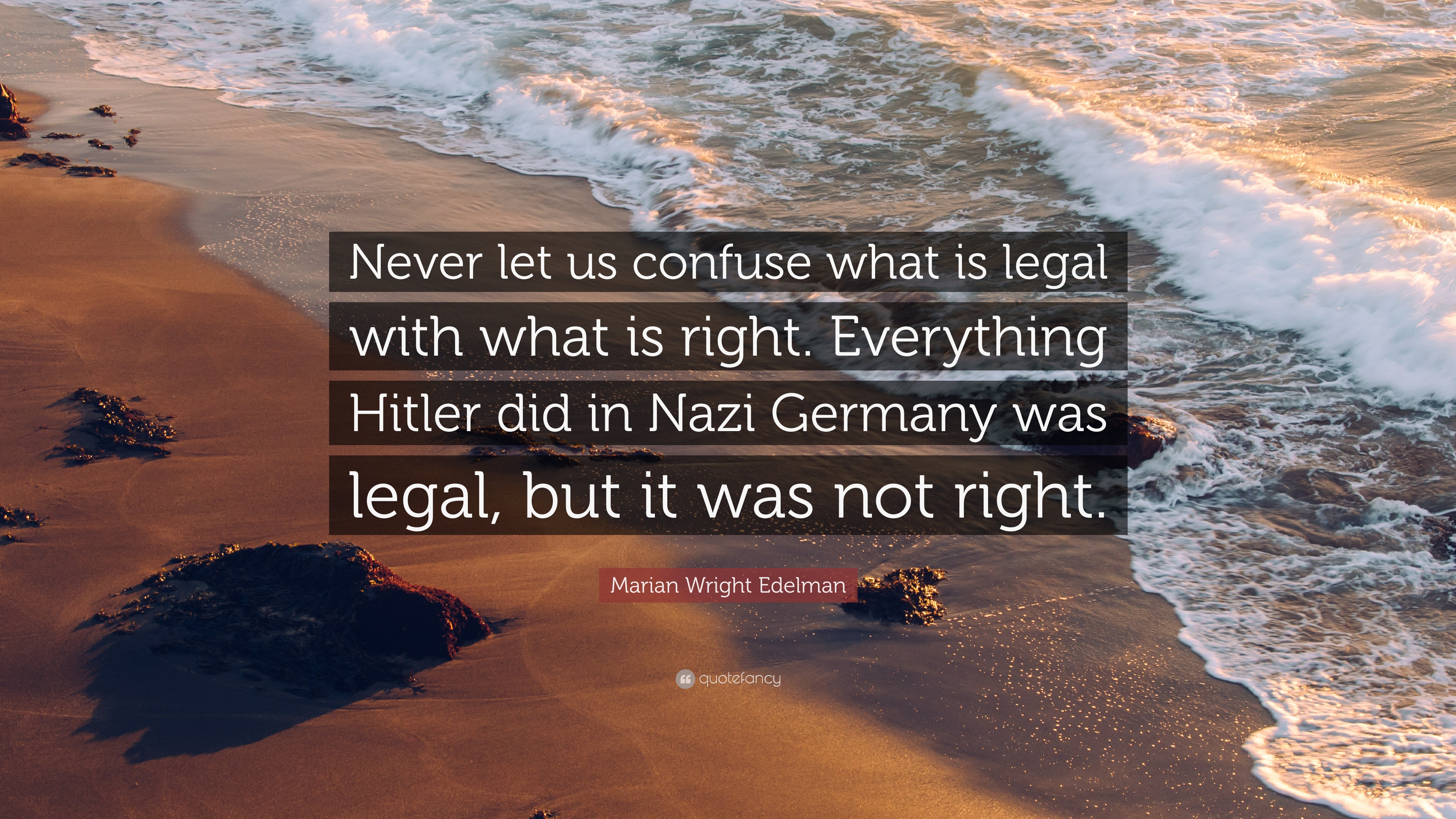
Marian Wright Edelman Quote: “Never let us confuse what is legal with what  is right. Everything Hitler did in Nazi Germany was legal, but it was not  r...”
By the way: Mrs. Edelman was referring to Dr. King’s Letter when she said this. It’s on p. 8 of this speech, for one example.

And where does Dr. King get the justification for his distinction? Why from Saint Augustine: one of the most important and influential of all Christian thinkers. How you like them apples, Clergymen?

Continuing his explanation of the distinction between law and justice, Dr. King refers to the other most influential and important Christian thinker, St. Thomas Aquinas:

Now, what is the difference between the two? How does one determine when a law is just or unjust? A just law is a man-made code that squares with the moral law, or the law of God. An unjust law is a code that is out of harmony with the moral law. To put it in the terms of St. Thomas Aquinas, an unjust law is a human law that is not rooted in eternal and natural law. Any law that uplifts human personality is just. Any law that degrades human personality is unjust. All segregation statutes are unjust because segregation distorts the soul and damages the personality. It gives the segregator a false sense of superiority and the segregated a false sense of inferiority. To use the words of Martin Buber, the great Jewish philosopher, segregation substitutes an “I – it” relationship for the “I – thou” relationship and ends up relegating persons to the status of things. So segregation is not only politically, economically, and sociologically unsound, but it is morally wrong and sinful. Paul Tillich has said that sin is separation. Isn’t segregation an existential expression of man’s tragic separation, an expression of his awful estrangement, his terrible sinfulness? So I can urge men to obey the 1954 decision of the Supreme Court because it is morally right, and I can urge them to disobey segregation ordinances because they are morally wrong.

And yes: he also referred to Paul Tillich, one of the most influential Christian philosophers of the 20th century; and to Martin Buber, “the great Jewish philosopher.” (How you like them apples, Rabbi?) Let me emphasize here, if I didn’t do it enough before, that Dr. King wrote this letter in jail: without reference materials. He just knew all this stuff. (I mean, he did have a doctorate in systematic theology; and his dissertation was partly about Tillich’s work, so.) The only way to improve an ethos argument this strong, with references to authorities this relevant to both your point and your audience, is to show that you yourself are an authority to be reckoned with.

The argument itself is remarkable. He provides three different definitions of his distinction between just and unjust laws: first, a religious one — just laws square with the law of God (and note he includes non-religious people by also calling it “the moral law”, and then brings it back to religion and Aquinas by referring to the idea of laws “not rooted in eternal and natural law”); second, a psychological definition, saying that just laws uplift human personality and unjust laws degrade it; and third, Buber’s philosophical concept of the “I-it” relationship replacing the “I-thou” relationship, turning people into objects. Into things. And look at the use of parallelism here: three reasons why segregation is unsound, followed by another way that it is wrong (and adding the idea that segregation is sinful”; three different ways that segregation is an expression of man’s evil; and a juxtaposition of two antithetical examples that match King’s categories: one just law, and one unjust law.

Then, if that isn’t enough ways to help his audience understand this concept , King gives us this next paragraph:

Let us turn to a more concrete example of just and unjust laws. An unjust law is a code that a majority inflicts on a minority that is not binding on itself. This is difference made legal. On the other hand, a just law is a code that a majority compels a minority to follow, and that it is willing to follow itself. This is sameness made legal.

That’s right, a more concrete definition, with another simple summative way to understand it: difference made legal, and sameness made legal. He’s right: this is more concrete, and has none of the religious overtones of the last paragraph — but it makes just as much sense, and is just as sound. Have we got enough ways to understand this now? Of course we do.

And then he adds another one:

Let me give another explanation. An unjust law is a code inflicted upon a minority which that minority had no part in enacting or creating because it did not have the unhampered right to vote. Who can say that the legislature of Alabama which set up the segregation laws was democratically elected? Throughout the state of Alabama all types of conniving methods are used to prevent Negroes from becoming registered voters, and there are some counties without a single Negro registered to vote, despite the fact that the Negroes constitute a majority of the population. Can any law set up in such a state be considered democratically structured?

Here Dr. King brings in another issue: voting rights. How can a law be democratic when the people were not capable of opposing nor supporting its passage, because of the suppression of their rights and their franchise? The argument is so plain and irrefutable that he doesn’t even bother to answer his rhetorical question. Instead, perhaps feeling understandably bitter as he sits in a jail cell writing about justice and injustice, Dr. King moves to one other complexity in the distinction between legal and just: when the application of a law makes it unjust. And I say he might have been bitter because his example is once again his own, talking about the city of Birmingham’s use of a parade permit ordinance to remove the civil rights activists’ First Amendment rights.

These are just a few examples of unjust and just laws. There are some instances when a law is just on its face and unjust in its application. For instance, I was arrested Friday on a charge of parading without a permit. Now, there is nothing wrong with an ordinance which requires a permit for a parade, but when the ordinance is used to preserve segregation and to deny citizens the First Amendment privilege of peaceful assembly and peaceful protest, then it becomes unjust.

Then he goes on to compare Birmingham first to three villains from history, and himself and his allies to the heroes who were suppressed by the villains — and then Dr. King confirms Godwin’s Law (Within a different context), while breaking the corollary to Godwin’s Law. Because Dr. King brings up Adolf Hitler. And THEN he throws in Stalin and Communism: it’s like the perfect American argument, here. Note that the three villains and heroes he mentions before going to the Nazis are both religious and political: Nebuchadnezzar, the Babylonian king who tried to kill the three Jewish prophets Shadrach, Meshach, and Abednego (I’M SORRY DR. KING I HAVE TO) in the Old Testament; the Romans, who tried to suppress Christianity with various atrocities; and the elite of Athens, who executed Socrates for teaching the truth. Note also that all three villains lost these fights.

Which side is Dr. King’s? Which side would you rather be on?

Of course, there is nothing new about this kind of civil disobedience. It was seen sublimely in the refusal of Shadrach, Meshach, and Abednego to obey the laws of Nebuchadnezzar because a higher moral law was involved. It was practiced superbly by the early Christians, who were willing to face hungry lions and the excruciating pain of chopping blocks before submitting to certain unjust laws of the Roman Empire. To a degree, academic freedom is a reality today because Socrates practiced civil disobedience.


We can never forget that everything Hitler did in Germany was “legal” and everything the Hungarian freedom fighters did in Hungary was “illegal.” It was “illegal” to aid and comfort a Jew in Hitler’s Germany. But I am sure that if I had lived in Germany during that time, I would have aided and comforted my Jewish brothers even though it was illegal. If I lived in a Communist country today where certain principles dear to the Christian faith are suppressed, I believe I would openly advocate disobeying these anti-religious laws.

Once again, Dr. King has made an argument so strong, so irrefutable at this point, after he has given so many different ways to understand it, and so many different reasons to accept it, that I really can’t fathom why people still don’t agree with this argument. Except for those who haven’t read it, of course.

The next part of King’s letter brings up the element that my brother, when I mentioned that I had written an essay about Dr. King, used to identify the Letter from Birmingham Jail as distinct from Dr. King’s other masterworks: “Ohhh,” he said to me on the phone when I was trying to tell him which piece I had analyzed, “is that the one with the white moderates?”

Yes it is.

I MUST make two honest confessions to you, my Christian and Jewish brothers. First, I must confess that over the last few years I have been gravely disappointed with the white moderate. I have almost reached the regrettable conclusion that the Negro’s great stumbling block in the stride toward freedom is not the White Citizens Councillor or the Ku Klux Klanner but the white moderate who is more devoted to order than to justice; who prefers a negative peace which is the absence of tension to a positive peace which is the presence of justice; who constantly says, “I agree with you in the goal you seek, but I can’t agree with your methods of direct action”; who paternalistically feels that he can set the timetable for another man’s freedom; who lives by the myth of time; and who constantly advises the Negro to wait until a “more convenient season.” Shallow understanding from people of good will is more frustrating than absolute misunderstanding from people of ill will. Lukewarm acceptance is much more bewildering than outright rejection.

He confesses: and then he destroys us with his disappointment. This part of the essay I have trouble reading and teaching; not because it’s too complicated, or too upsetting in its language and images (as some of my students find the Perfect Sentence I wrote about in the first post) — but because it’s true, and it’s me. I am a White moderate. I mean, I’m pretty goddamn liberal — but also, I don’t act in order to achieve a more just society; I simply support the cause. It’s not entirely me, because I don’t object to the methods used by those who are more active in pursuing our common goal; but it’s me because I don’t participate in those methods.

King here juxtaposes this critique of people who support the cause but not enough, with those who oppose the cause though they claim to be understanding of it: the Clergymen. No White moderates, those Alabamians; they seem like pretty rock-ribbed conservatives, fitting perfectly into the mold of paternalistic White leaders whom King refers to above, as they compliment “their” [“our”] Negro community for keeping the peace, which is exactly what King is taking issue with. But he does it in such an incredible way:

In your statement you asserted that our actions, even though peaceful, must be condemned because they precipitate violence. But can this assertion be logically made? Isn’t this like condemning the robbed man because his possession of money precipitated the evil act of robbery? Isn’t this like condemning Socrates because his unswerving commitment to truth and his philosophical delvings precipitated the misguided popular mind to make him drink the hemlock? Isn’t this like condemning Jesus because His unique God-consciousness and never-ceasing devotion to His will precipitated the evil act of crucifixion? We must come to see, as federal courts have consistently affirmed, that it is immoral to urge an individual to withdraw his efforts to gain his basic constitutional rights because the quest precipitates violence. Society must protect the robbed and punish the robber.

That’s right: not only does King compare himself, for the third time, to Socrates — now he actually compares himself to Jesus. And, of course, he’s right: blaming the victims of oppression for inciting the violence of the oppressors is precisely like blaming Jesus for making the Romans crucify him. And who does that in the story of the Passion?

Why, this guy, of course.

(I know, this is probably the wrong thing to use for this reference. But I love rock opera. Please ignore the ridiculous whiteness of the Jews in the crowd, and especially of Jesus — but DON’T ignore the AMAZING homoeroticism of the flogging performed by what appears to be The Village People, while a sunburned Disco hedonist looks on and cackles.)

In the next paragraph, King jumps back to the White moderates, connecting the two not only with their half-hearted support or opposition to King’s cause, but with a parallel to the teachings and goals of the Church:

I had also hoped that the white moderate would reject the myth of time. I received a letter this morning from a white brother in Texas which said, “All Christians know that the colored people will receive equal rights eventually, but is it possible that you are in too great of a religious hurry? It has taken Christianity almost 2000 years to accomplish what it has. The teachings of Christ take time to come to earth.” All that is said here grows out of a tragic misconception of time. It is the strangely irrational notion that there is something in the very flow of time that will inevitably cure all ills. Actually, time is neutral. It can be used either destructively or constructively. I am coming to feel that the people of ill will have used time much more effectively than the people of good will. We will have to repent in this generation not merely for the vitriolic words and actions of the bad people but for the appalling silence of the good people. We must come to see that human progress never rolls in on wheels of inevitability. It comes through the tireless efforts and persistent work of men willing to be coworkers with God, and without this hard work time itself becomes an ally of the forces of social stagnation.

By putting these two groups, White moderates who say they support civil rights but oppose the methods used by the activists, and the Alabama clergymen who say they understand the desires of African-Americans for freedom but show they really would rather maintain the status quo of segregation and oppression, in such close parallel, switching back and forth with what almost seems a complete lack of connecting transitions between subjects, King achieves his goal: he shows that these groups are essentially the same. There is what they say, and then there is what they do: and their actions speak louder than their words. He is thus chastising both groups, by comparison to each other: the clergymen are no better than Northern White moderates, synonymous in the South with lying hypocrisy; and the White moderates are no better than White Southerners: synonymous with racist oppressors. Neither group is willing to be coworkers with God: they are the forces of social stagnation which the coworkers with God oppose.

(Okay, I don’t think that’s me any more. Though I still worry that I would disappoint Dr. King.)

Dr. King’s next argument has to do with “extremism.”

YOU spoke of our activity in Birmingham as extreme. At first I was rather disappointed that fellow clergymen would see my nonviolent efforts as those of an extremist. I started thinking about the fact that I stand in the middle of two opposing forces in the Negro community. One is a force of complacency made up of Negroes who, as a result of long years of oppression, have been so completely drained of self-respect and a sense of “somebodyness” that they have adjusted to segregation, and, on the other hand, of a few Negroes in the middle class who, because of a degree of academic and economic security and because at points they profit by segregation, have unconsciously become insensitive to the problems of the masses. The other force is one of bitterness and hatred and comes perilously close to advocating violence. It is expressed in the various black nationalist groups that are springing up over the nation, the largest and best known being Elijah Muhammad’s Muslim movement. This movement is nourished by the contemporary frustration over the continued existence of racial discrimination. It is made up of people who have lost faith in America, who have absolutely repudiated Christianity, and who have concluded that the white man is an incurable devil. I have tried to stand between these two forces, saying that we need not follow the do-nothingism of the complacent or the hatred and despair of the black nationalist. There is a more excellent way, of love and nonviolent protest. I’m grateful to God that, through the Negro church, the dimension of nonviolence entered our struggle. If this philosophy had not emerged, I am convinced that by now many streets of the South would be flowing with floods of blood. And I am further convinced that if our white brothers dismiss as “rabble-rousers” and “outside agitators” those of us who are working through the channels of nonviolent direct action and refuse to support our nonviolent efforts, millions of Negroes, out of frustration and despair, will seek solace and security in black nationalist ideologies, a development that will lead inevitably to a frightening racial nightmare.

Specifically, King is replying to this sentence in the Statement: “We do not believe that these days of new hope are days when extreme measures are justified in Birmingham.” (Blogger’s Note: Since I did that to them, I’m going to do this to Dr. King’s words: “We must come to see that human progress never rolls in on wheels of inevitability.“) This line clearly pissed King off: but more important, it’s an idea that he can’t allow to shape the narrative. So as he does with so many other parts of the Statement’s argument, he smashes this again, and again, and again. He shows the two extremes in the African-American community: one extreme is those African-Americans who have been worn down by the oppression that has defined their lives; and the other is — Malcolm X. King doesn’t name the other man, with whom he was so often presented in juxtaposition as two opposites, the moderate and the extremist; but he doesn’t have to. Elijah Muhammad (Himself no moderate) and his Nation of Islam are synonymous with Malcolm X, and though King and X were a hell of a lot closer in a lot of ways than most people thought or said, it is exactly these kinds of people, these southern Clergymen, who would have used King as an example of a better leader, a more reasonable leader, than X, because King used non-violence while Malcolm X talked about violence. I suspect this comparison and the implication that King was softer and more accommodating to the oppressors’ status quo, made the man angry: and so the description at the end of this paragraph — a fine example of Dr. King showing that he did not believe that non-violence was the only way to achieve freedom: just that it was the best way, as it would not lead to “floods of blood.” If the warning is not clear, he reiterates it in the next paragraph:

Oppressed people cannot remain oppressed forever. The urge for freedom will eventually come. This is what has happened to the American Negro. Something within has reminded him of his birthright of freedom; something without has reminded him that he can gain it. Consciously and unconsciously, he has been swept in by what the Germans call the Zeitgeist, and with his black brothers of Africa and his brown and yellow brothers of Asia, South America, and the Caribbean, he is moving with a sense of cosmic urgency toward the promised land of racial justice. Recognizing this vital urge that has engulfed the Negro community, one should readily understand public demonstrations. The Negro has many pent-up resentments and latent frustrations. He has to get them out. So let him march sometime; let him have his prayer pilgrimages to the city hall; understand why he must have sit-ins and freedom rides. If his repressed emotions do not come out in these nonviolent ways, they will come out in ominous expressions of violence. This is not a threat; it is a fact of history. So I have not said to my people, “Get rid of your discontent.” But I have tried to say that this normal and healthy discontent can be channeled through the creative outlet of nonviolent direct action. Now this approach is being dismissed as extremist. I must admit that I was initially disappointed in being so categorized.

But as I continued to think about the matter, I gradually gained a bit of satisfaction from being considered an extremist. Was not Jesus an extremist in love? — “Love your enemies, bless them that curse you, pray for them that despitefully use you.” Was not Amos an extremist for justice? — “Let justice roll down like waters and righteousness like a mighty stream.” Was not Paul an extremist for the gospel of Jesus Christ? — “I bear in my body the marks of the Lord Jesus.” Was not Martin Luther an extremist?– “Here I stand; I can do no other so help me God.” Was not John Bunyan an extremist? — “I will stay in jail to the end of my days before I make a mockery of my conscience.” Was not Abraham Lincoln an extremist? — “This nation cannot survive half slave and half free.” Was not Thomas Jefferson an extremist? — “We hold these truths to be self-evident, that all men are created equal.” So the question is not whether we will be extremist, but what kind of extremists we will be. Will we be extremists for hate, or will we be extremists for love? Will we be extremists for the preservation of injustice, or will we be extremists for the cause of justice?

(Note on the text: the iteration of the Letter I have been pulling from separates this into two paragraphs. This one doesn’t. I think it should be one paragraph.)

This is another of my favorite arguments, and not least because King again compares himself to Jesus Christ — and also to Abraham Lincoln and Thomas Jefferson, along with the Jewish and Christian luminaries Amos, St. Paul, Martin Luther, and John Bunyan. (Also I love that he drops his namesake in there without even batting an eye — and don’t forget that the vast majority of Southern White Christian racists were of Protestant denominations). I also love the rapid-fire call-and-response of rhetorical questions with direct quotations that serve both as answers and as proof, while making use of all of the poetry in these various wonderful statements, and also showing off, again, King’s own erudition and understanding of the power of the right word at the right time for the right reason. And then those final rhetorical questions, with the explicit use of “we” inviting the audience — the White moderate, the White Southern clergyman, and every single person who ever reads this letter, including me and including you — to come up with our own perfect words, our own response to this call. What will we do? What kind of extremist will we be?

After this King closes his criticism of White moderates with the most terrible form of the guilt-imposing “I’m not mad, I’m just disappointed” position that he is using here: the “Maybe I expected too much of you.”

I had hoped that the white moderate would see this. Maybe I was too optimistic. Maybe I expected too much. I guess I should have realized that few members of a race that has oppressed another race can understand or appreciate the deep groans and passionate yearnings of those that have been oppressed, and still fewer have the vision to see that injustice must be rooted out by strong, persistent, and determined action.

Look at that. Look at it! “I guess I should have realized?” GodDAMN, sir. I would like to personally apologize for everyone and everything, ever. He does lighten the load slightly by naming a number of White activists, primarily reporters who had given fair or even favorable coverage to the Civil Rights movement, and thanking them for their contribution. Which makes me feel a tiny bit better because I’m writing this. But I’m still sorry, sir. I have eaten the plums that were in the icebox, the ones you were saving.

This next part, though? I got nothing but smiles for this. Because then he goes after the church.

Honestly, I’m going to skip over this, because this is not my area. I have not attended church since around about 1986, and my personal animus for religion would color my analysis of this too much. I want to pick out every single detail where King tells his fellow clergymen that the White church has let him down, and highlight every one, like some kind of manic hybrid of a mother-in-law and Vanna White, finding every single possible fault and holding it up for the audience to observe, while I smile from ear to ear. But I won’t do that. I will just point out that he specifically mentions one of the Eight Clergymen, Reverend Earl Stallings, for his action in allowing Black worshippers into his church without segregating them; this seems to me like a direct response and even challenge to the passive aggressive way the Clergymen never name Dr. King, even though EVERYBODY FUCKING KNOWS THAT’S WHO THEY MEANT. “Outside agitators,” my ass. I still recommend reading the entire letter, including this section; but here I’m just going to post his conclusion, because it’s so damn beautiful.

I hope the church as a whole will meet the challenge of this decisive hour. But even if the church does not come to the aid of justice, I have no despair about the future. I have no fear about the outcome of our struggle in Birmingham, even if our motives are presently misunderstood. We will reach the goal of freedom in Birmingham and all over the nation, because the goal of America is freedom. Abused and scorned though we may be, our destiny is tied up with the destiny of America. Before the Pilgrims landed at Plymouth, we were here. Before the pen of Jefferson scratched across the pages of history the majestic word of the Declaration of Independence, we were here. For more than two centuries our foreparents labored here without wages; they made cotton king; and they built the homes of their masters in the midst of brutal injustice and shameful humiliation — and yet out of a bottomless vitality our people continue to thrive and develop. If the inexpressible cruelties of slavery could not stop us, the opposition we now face will surely fail. We will win our freedom because the sacred heritage of our nation and the eternal will of God are embodied in our echoing demands.

“We were here.” I love that. “Our destiny is tied up with the destiny of America.” Just incredible.

At this point, having made all of his arguments, he’s almost — no, wait, he’s not done. He has one more thing to say.

I must close now. But before closing I am impelled to mention one other point in your statement that troubled me profoundly. You warmly commended the Birmingham police force for keeping “order” and “preventing violence.” I don’t believe you would have so warmly commended the police force if you had seen its angry violent dogs literally biting six unarmed, nonviolent Negroes. I don’t believe you would so quickly commend the policemen if you would observe their ugly and inhuman treatment of Negroes here in the city jail; if you would watch them push and curse old Negro women and young Negro girls; if you would see them slap and kick old Negro men and young boys, if you would observe them, as they did on two occasions, refusing to give us food because we wanted to sing our grace together. I’m sorry that I can’t join you in your praise for the police department. It is true that they have been rather disciplined in their public handling of the demonstrators. In this sense they have been publicly “nonviolent.” But for what purpose? To preserve the evil system of segregation. Over the last few years I have consistently preached that nonviolence demands that the means we use must be as pure as the ends we seek. So I have tried to make it clear that it is wrong to use immoral means to attain moral ends. But now I must affirm that it is just as wrong, or even more, to use moral means to preserve immoral ends.


I wish you had commended the Negro demonstrators of Birmingham for their sublime courage, their willingness to suffer, and their amazing discipline in the midst of the most inhuman provocation. One day the South will recognize its real heroes. They will be the James Merediths, courageously and with a majestic sense of purpose facing jeering and hostile mobs and the agonizing loneliness that characterizes the life of the pioneer. They will be old, oppressed, battered Negro women, symbolized in a seventy-two-year-old woman of Montgomery, Alabama, who rose up with a sense of dignity and with her people decided not to ride the segregated buses, and responded to one who inquired about her tiredness with ungrammatical profundity, “My feets is tired, but my soul is rested.” They will be young high school and college students, young ministers of the gospel and a host of their elders courageously and nonviolently sitting in at lunch counters and willingly going to jail for conscience’s sake. One day the South will know that when these disinherited children of God sat down at lunch counters they were in reality standing up for the best in the American dream and the most sacred values in our Judeo-Christian heritage.

He leaves this until the end. He knows that this is the one part of this letter most likely to anger his readers, because he is here criticizing the police — and even now, 60 years later (And please note that this April will be the 60th anniversary of this whole ordeal), I think we all know what happens to people who criticize the police. But he can’t not say this. He doesn’t have proof, not that the Clergymen or the White readership at large will accept — it is only the word of the arrested activists; nobody was there with a cell phone to record this scene — and you can see his bitter acknowledgement of the superficial truth of what the Clergymen said, that the police have been “rather disciplined in their public handling of the demonstrators.” Though even there, look at the use of the phrase “rather disciplined,” instead of the words “calm” and “restraint” which the Clergymen used. Notice the emphasis on “public,” immediately contradicted by the word “handling,” with its implication of manhandling, echoed in the word “disciplined,” with its sense of harsh control and even physical punishment. But of course, because he is Dr. Martin Luther King, he immediately shows how this example is the precise opposite of the “nonviolent” label the police might claim: because they are pursuing immoral ends. And they are contrasted against the truly nonviolent protestors and pioneers, who use genuine nonviolence to promote moral ends of justice — “the best in the American dream and the most sacred values in our Judeo-Christian heritage.” And since this comes here, at the very end, it has extra weight — I do think the overall length of this letter does make this seem more like a postscript than a strong conclusion; I think the passage I quoted above, at the end of the section about the church, is the real conclusion — but this is one final blow that is impossible to ignore. But of course, the police do not get the last word: that goes to the real heroes of the South, James Meredith, and Rosa Parks, and all of the people who fought alongside Dr. King for freedom. I, for one, would like to thank them all for their courage and their honor and their sacrifice.

Speaking of postscripts — and of too-lengthy writings, which need to finally be brought to a close — let me just end with the saltiest “Yours truly” in the history of letters:

If I have said anything in this letter that is an understatement of the truth and is indicative of an unreasonable impatience, I beg you to forgive me. If I have said anything in this letter that is an overstatement of the truth and is indicative of my having a patience that makes me patient with anything less than brotherhood, I beg God to forgive me.

Because in the end, even though the accusation that the civil rights movement and Dr. King were “impatient,” were “unwise and untimely,” was entirely false and absurd — it would be much, much worse if Dr. King were too patient.

And now, Dr. King’s actual “Yours truly,” which I would humbly like to echo myself, to everyone who reads this.

Yours for the cause of Peace and Brotherhood

Wallingford prepares for MLK Day ceremony

Imperfect Persistence


One of my flaws as a teacher is my insistence on persistence. I like finishing things: I don’t like leaving them incomplete. It’s a problem for my classroom because it means that I don’t always adapt quickly to how my students are taking in the material, how much they are learning from it; I have, more times than I can count, stubbornly kept on reading the same piece, the same essay, the same story, the same book, even though my students have completely lost interest, simply because WE’RE NOT DONE YET. Maybe even worse, I have gotten irritated about reading excerpts, and have gone ahead and given my students the entire piece to read, just so we can do the whole thing; then, when they get tired of it — or, honestly, if the author gets out of their golden zone and drops down into less stellar writing — and nobody is paying any attention to what I am reading, I keep reading it anyway. Why? BECAUSE WE’RE NOT DONE YET. Again, this is because I was unsatisfied with an excerpt, and insisted on reading the whole thing. (This example, by the way, comes from my experience with Ralph Waldo Emerson’s “On Self-Reliance,” which is a lyrically beautiful piece of writing, with amazing ideas in it — aaaaaand it’s also over 10,000 words long, which is about 19 pages of 19th century transcendentalist sermon. Most textbooks that cover the era or the genre have excerpts from it. I gave a class the whole thing and tried to read it to them. The excerpts were better.)

To be somewhat more fair to me, I love literature and words and writing and reading more than I can clearly explain; so for me, all of Emerson’s essay is beautiful, and essentially all of it can be inspiring. I also feel a sense of — duty, I suppose, in that I find it disrespectful to take only excerpts from a longer piece. If all Emerson had to say was the thing about trusting yourself, that’s all he would have said; obviously, he thought there was more that was worth saying, and since Emerson was an incredible genius with words and ideas, and one of my heroes and inspirations, I want to honor the man and his work by taking it in, and giving it to my students, in the form Emerson intended: all 19 pages of it. So I gave my students the whole thing to read because I thought, and I think, that it’s worth reading the whole thing, that reading the whole piece is the right thing to do.

It turned out they disagreed with me, and as always, the students win those arguments by the simple expedient of shutting down, no matter how passionately I read, or how carefully I point out the valuable material in the rest of the essay after you get past the “Trust thyself: every heart vibrates to that iron string.” Maybe there’s a way I could have maintained their interest as Emerson goes on and on and on — no, there’s definitely a way; I just don’t know that it’s worth it when there are other good things to read in the world, and limited time to do that reading. At some point even my desire to finish things caves in the face of continued passive resistance, and I do (I did with Emerson) give up and discard the piece in favor of something newer and more interesting for the class to work on.

Though if I think their resistance to the learning was because they were being lame, rather than me being lame in my choice of material or pedagogy, I will often re-inflict the same sort of thing on them. I mean, what if we move on from Emerson — and go straight to Thoreau? CheckMATE, teenagers! Transcendentalism IN YO FACE!

On the other hand, one of my flaws as a political activist is a distinct lack of persistence. Or maybe it’s a lack of focus: I don’t have a single cause that I fight for; inasmuch as I have a political side and a set of causes to fight for, I don’t push myself very far into that fight. I give up very easily. I will argue until the cows come home — and then I will argue with the cows — but I won’t go out and do things, won’t collect signatures or donations, won’t canvass or march, won’t join political action committees or grass roots organizations. It goes straight back to the same point I made with what I teach in my class: because as much as I love literature, I do not love being around people. I guess I won’t say I hate it, because there are certain people I like being around as much as possible; but I hate going out among strangers. It’s one of the things that makes teaching an acceptable career for me, as an introvert; because I get to know my students, in some cases quite well, and that makes me more comfortable being around them. I hate the beginning of the year, and I hate getting new students and losing old students I like; because new students in new classes are strangers, and I don’t want to be around them until I get to know them better. (I don’t have to like them, actually, but I still feel more comfortable and get along better with students I know and dislike, than with students I can’t even recognize or attach a name to.) But that same discomfort with new, strange people keeps me out of political activity: because a march is thousands of people I don’t know, and all other grass roots political activity is focused entirely on meeting new people and getting them into the fight on my side. And I don’t want to do that.

But the result is, I don’t do much to make the world a better place, even though I want to, even though, knowing my abilities, and ignoring my personality and preferences and comfort level and anxieties and everything else apart from my abilities, I always tell myself that I would be good at politics. And I would: I think well, I listen well, I speak well; I’m very good with people. But also, there’s simply no way that I could be happy and comfortable being surrounded by strangers all the time, which is essentially the life of most political activists. Certainly the life of politicians, which I have also thought (And continue to think, in my less self-aware moments) that I could be successfully. I could give a speech. I could draft a law, and argue for it. Of course, I wouldn’t be able to make and maintain the friendships and alliances that would be absolutely necessary to get anything at all done in politics; I’d always want to just go back to my office, sit by myself, maybe read something; but that doesn’t matter, right?

Thinking this way has always had me considering whether or not I should start running for political office. (Also my students frequently tell me that I would be a good candidate and they would vote for me. It would mean a whole lot more if they voted. Or knew anything about political candidates beyond the most superficial information. Hey, they’re kids; what do you expect? It’s nice to hear, which is actually their point anyway.) I could start small, maybe a local school board; then something like a state representative, and then who knows? Congressman Humphrey? Why not? I wouldn’t want to go much farther than that, since greater power requires greater compromise, and I wouldn’t want to sell out; but I hear about congresspeople like Earl Blumenauer of Oregon, who do the work of the Congress, who do the research and write the bills and all the behind-the-scenes grinding that is required to get stuff done. I could do that, I think. It would be useful if I did that. And I would give a good speech, and I would be awesome in a debate. Which makes me think I could get some useful things done, if I could go that far.

It struck me hard in this strange, idle ambition of mine when I heard that Mitch McConnell, whom I loathe more than most politically opposed people in this country, but who is unquestionably one of the most effective politicians of the last half-century if not more, absolutely hated working with Barack Obama: because Obama wanted to explain the ideas behind his political goals and actions, wanted to get into the philosophy and convince McConnell to work with him on the merits of the thoughts and his ability to communicate them; and McConnell just wanted to do a fucking deal. Because that would 1000% be me, trying to get into the underlying morality and the cause and effect of any legislation or policy I wanted to pursue; and the other politicians, the deal makers and negotiators, all those goddamn extroverts, would just roll their eyes and say they had another appointment.

So no. I should not go into politics. I should not run for office. If I could just jump straight into the role for which I am suited, I would be a real asset to the country or the state or whoever I worked for — I would make a hell of a speechwriter, I think — but that’s sort of like the ambition I had when I was a kid, to work my way into the NBA by becoming a 100% never-fail flawless free-throw shooter, who they could substitute in whenever a foul was called, and then I could calmly hit all the free throws and help win the game, despite being 5’10” and essentially unathletic. The problem being, of course, that the game doesn’t work that way. To become a speechwriter for a political campaign or organization, I would have to work in the field, and especially network in the field, for years; and I would have to do all the things I don’t want to do in order to do the one thing I want to do.

This same persistence makes me a good author, because I can keep working on one story until it is a whole book. And the same lack of persistence makes me an unpublished author with five — almost seven — genuinely good novels sitting on my computer, and not on bookstore shelves. The contrast, and what seems to me to be fairly extreme opposite traits, is difficult to wrap my head around sometimes: because how can I give up so easily on some things, and fight so goddamn hard and so goddamn long on others? If I’m willing to put in so very much time and effort to write a novel, to the extent that it takes over my life at times, and becomes one of my defining attributes, that I am a writer, that I am a novelist: why on Earth won’t I fight to get my books published? Do I just want to write, but not have other people read what I write? Why would I want that? And yet, that seems to be exactly the life choice that I have made: I’ve been writing novels for almost 20 years now, and have not published a single one, other than through self-publishing. (I know, I know — hang on, I’ll come back to it.) But you see, I know, with a bone-deep conviction of total understanding, that writing is communication, and therefore requires an audience for the writing to be anything real. I want people to read what I write. I am happy that people came and read my blog two weeks ago, when I posted the chapter from my novel Brute, and I am disappointed that fewer people read the one from last week, about Martin Luther King’s Letter from Birmingham Jail. (That combination has contributed significantly to this topic, by the way. I’ll come back to that, too.) I do want readers. I want my work to be published.

So why do I give up?

And the larger problem is, how do I get myself to change? If I can’t understand my motivations, the causes of my actions, I can’t address them, can’t change them; self-awareness is the most important factor in self-change. How do I tell myself to keep fighting for the things I give up on, when there’s no simple explanation for why I give up on those things and not on others? I’m neither 100% stubborn, nor 100% (Hey, what’s the opposite of stubborn? Wishy-washy? Flimsy? Weak-willed? Maybe adaptable.) adaptable, so I can’t just point at my nature and say “That’s just who I am, I never/always give up.” At the same time, if I’m willing to give up on things because of inherent or essential aspects of my personality — I am not going to stop being an introvert, which means I’m never going to be a good political operative — why do I keep persisting in the areas that are just going to keep hitting this wall? If I’m never going to be a good political operative, why do I keep trying to get involved in politics? If I’m never going to push myself to publish a novel, why the fuck do I keep writing them?

This is where I come back to self-publishing, then. Because honestly? It’s the perfect compromise. I have printed and sold somewhere in the hundreds of copies of my three published novels. (One has never been printed because it’s only available as an ebook. But there are a fair number of people who have read it electronically.) That means I have an audience: I have readers. The feedback I have gotten from my readers about my novels has been almost entirely positive. (Some people think I’m too wordy. No, sorry: EVERYBODY, including me, thinks I’m too wordy; some people think that’s a problem with my books. Mostly agents and publishers.) It also means I don’t have to do all the shitty things I would have to do if I were to become a professionally, traditionally published author, namely: I don’t have to compromise. I don’t have to edit my books to someone else’s standard, which standard would be almost entirely derived from what the market research said would be most profitable. Why didn’t my first novel sell? Because it was too long: it’s a young adult fantasy novel, based almost to the point of plagiarism, on Harry Potter, and it’s 600 pages long. And sure, the last HP books topped 600 pages — but the first two did not. After those first two became the most popular YA fantasy novels of all time, Rowling was able to write whatever the fuck she wanted and sell it to anyone, which is how we got The Cursed Child. (By the way, I liked parts of that. But not enough of it. And there’s no reason on Earth why it is a very short play, rather than what would likely have been a very good novel, other than Rowling decided she wanted to write a play, and was arrogant enough to think she had to be right because she’s JK Rowling. Which is also how we got this neverending TERF bullshit that has tainted the entire franchise. Sometimes persistence is not a virtue.) So once again, I want to skip all the difficult stuff and just go right to doing whatever the fuck I want to do, namely writing the very long books I enjoy writing.

However: let me also point out that the book is so long because it’s actually two and almost three books combined into one: the character has a life in the “real world,” a second life in the world of dreams which is the main fantasy aspect — and a third life in a role-playing game he runs, which I narrated as a real story, lending the book an element of swords-and-sorcery fantasy which I think is a real strength. Telling three stories means a lot of pages. Also a lot of work. But even writing this paragraph out here is making me excited about the concept all over again; maybe it’s time to go back and write the sequels I never wrote. Because I gave up on that series when it didn’t sell, even though I loved it and loved where I planned to have it go.

So maybe I do give up on writing sometimes. Well, like I said, I did eventually stop reading “On Self-Reliance” at my students. I don’t like doing things that don’t work. I don’t like wasting time. I have too much other stuff to do. More productive stuff.

More productive stuff like publishing my own books. Another accomplishment I am very proud of. And even though I don’t like being around strangers, I have, twice now, been very successful at selling my novels to strangers at a booth at the Tucson Festival of Books. Which I’m going to do again this year. And that’s an area where I actually like interacting with people: because they are book people, and I get to talk to them about pirates and stuff. And then they give me money, and they take my book away with them, and hopefully read it and enjoy it. A couple of them have told me they did read it and enjoy it, so I think I can assume that other people did, too. (I know for sure that several of my friends have read and enjoyed my books, and I’m grateful for that, and for them. I’m just saying that of the strangers who bought my books, most of them probably read the books, and some number of them enjoyed the books. A couple of those strangers have told me so.)

So then, why, if I’m happy self-publishing, if I get an audience and also a sense of accomplishment, and freedom as a writer — why do I still want to publish with a traditional legacy publishing house?

Because my other dreams and aspirations persist, too. I don’t just want to write: I want to get rich from writing. I want to be famous because of my writing. I want to be invited to speak on a panel at a convention, where I can see people dressed as my characters. I want people to write essays about my books like I have written essays about the authors whose works I admire.

It’s the same thing with politics: I don’t want to be around strangers and I don’t want to compromise; but I do want to make a difference. I do want to make the world a better place, to make people’s lives happier and more fulfilling. And sure, I’d like to be famous as a politician, too. As someone who made a difference. (Also, if I was a politician then I could get my damn books published.)

I meant for this topic to be just a brief introduction, a lil hook, to my intended goal with this post: to finish talking about Dr. King’s Letter from Birmingham Jail. There’s a whole second half, more than half, of that essay which I left off, last week. I talked to my brother, who told me the interesting truth that Martin Luther King Jr. Day is his favorite holiday: that the ideas and values represented by the holiday, associated with Dr. King, are closest to him, most important to him, compared to those associated with other holidays. And I told him that I had just written about Dr. King that weekend, about the Letter, and he asked which piece by Dr. King that was: was it the one about the long, slow arc of justice that bends towards freedom? No, I said, it was the one where he said “Injustice anywhere is a threat to justice everywhere.”

“Oh,” my brother said, “the one about white moderates, about how he was disappointed by the white moderates.”

“That’s the one,” I confirmed: and immediately felt guilty. Because I left that part out. I stopped before that section of the Letter, which goes on for many more pages, covering many more ideas — and continuing to be brilliant.

I should have kept going, I thought. I didn’t finish the piece, and I left out important parts of it.

But then again, my wife, after reading the post last week, said it was good — but also that it was long. And my WordPress stats counter told me that not very many people read it. (Actually, my most popular posts continue to be my old book reviews, a couple of them in particular, and some of my essays about novels — especially the one about The Lord of the Rings and Gollum, and The Metamorphosis and Gregor Samsa.)

Regardless, though, I thought this week, I would finish analyzing the rest of the Letter. For Dr. King, another of my ideological and wordsmithing heroes; and for my brother, and for the sake of getting to the powerful statements the Letter makes in the last two-thirds, particularly about just laws and unjust laws, and about white moderates. Because, first, I want to finish the piece; and second, I worry that I am one of those white moderates who would have disappointed Dr. King. Because I don’t keep fighting for justice, don’t maintain my persistent participation in the political struggles that affect people in this country and in this world.

And thinking about that got me to here. On a subject about which, apparently, I have a lot to say. (I think I will probably finish analyzing the Letter next week. But we’ll see.)

I don’t want to be one of the white moderates who disappointed Dr. King. I don’t want to be wishy-washy, and tell myself that I’m being adaptable, when the thing I am adapting to and accepting is failure to do what is right, what should be done. If I should get my books published, I don’t want to be a coward who gave up and failed simply because I didn’t have the strength of will, the persistence, to keep fighting. If I have a role to play in achieving a more just world, I do not want to be the person who backed away from the fight simply because I don’t feel comfortable around strangers.

But the answer to this is not what I am implying there — what I frequently catch myself saying to myself, as a criticism, until I remember that it should not be a criticism, not even of myself. The answer is not to never give up, ever, for any reason under any circumstances ever ever ever. The answer is not to become a zealot who never compromises, to become an extremist. (Though Dr. King makes a wonderful point about extremists in the Letter, calling himself an extremist for love, and for freedom, and for justice. I could be that kind of extremist, I think.) Dr. King himself was a moderate: he wanted change to come without violence, without tearing down the systems and institutions that were tainted with intolerance and injustice. He wanted this country to be better: but he still wanted it to be this country.

I’m reading a book, currently — Shock Doctrine, by Naomi Klein — that is about extremists who were willing to do anything to achieve their ideological goals: they recognized that the only way to really achieve the change they wanted was to create a crisis, a shock, that would set a people back on their heels, and while the people were all reeling, the changes could be implemented because people wouldn’t be able to resist. And those people? They’re evil. Not only because their ideas were wrong and bad for humanity (The specific group Klein is focusing on is the neoliberal economists of the University of Chicago, under their prophet Milton Friedman — and fuck that guy), but because they refused to accept anything less than everything. They were not moderates. Their economic theory requires absolute purity, not a single element of compromise; and so they are zealots. And because Friedman was himself a zealot, who spent his long life fighting for this one cause, for this one idea, for the supremacy of his theories and the absolute elimination of all else, he did incalculable harm to this world. And it stuns me, and I’ve commented to myself in my annotations in the book (Of course I annotate books I read. Don’t you?), that Friedman and his colleagues and disciples could have such complete courage in their convictions, such unwavering confidence in themselves and their rightness, and their righteousness. Such complete, perfect, persistence. The ideology and Friedman’s example both lend strength to that tendency; but I think that’s a sign of zealotry in all cases, that absolute unquestioning confidence. And zealotry, in all cases, is bad.

I don’t want to be a zealot. Not even for a good cause. But I also don’t want to be weak, don’t want to give up when a fight is worth fighting.

So the answer?

Compromise.

Self-publishing my novels is the right thing for me to do. It’s where my focus and my energy should go. I may send away queries to agents, sure, and I may even hit the lottery and get published; but otherwise, I should compromise between what I want, and what the reality of my strengths and weaknesses dictate. There’s no point in wishing I could network with the publishing industry and get published that way; it’s not who I am. Sure, self-publishing means I am unlikely to ever get rich and famous from my writing; but that’s the idea of compromise: you don’t get all of what you want. But you focus on the main goals, and you work hard to get those, even if you have to give up something else.

My main goal has always been to be a writer. To create worlds. Part of that means I need to have people read and participate in my writing. That’s the main goal. That’s what’s important. And if I have to give up fame and money in order to achieve that? Fine. Probably better for me, even if it doesn’t feel like that.

Another of my main goals has always been to help people. This one, like the goal of becoming a writer, is essential to who I am, and who I want to be. If I want to make a difference, it doesn’t have to be a difference that affects the whole world, or even the whole country or the whole state: making a difference for one person is making a difference in the world. And I do that: for my family and friends, for my readers, and for my students. And since I’ve had thousands of students, I can actually say that I’ve had a pretty strong impact on the world around me, because I have had an effect on a pretty big number of people.

And I did it by staying true to who I am, and knowing what I can do and do well, and then doing that, exactly that. Not by wishing I could do something else, or be someone I am not. I do wish, sometimes, that I could do or be more than I am — I wish I was more tech-savvy as a teacher, and more organized, and better about using different styles of teaching and learning; and I wish I could be more of an extrovert when it would be useful to interact more with other people — but I have my strongest effect, and make my greatest progress, by doing what I do well, and persisting in that. Knowing what is actually important and what is actually good — and knowing, on the other hand, what would be nice, but isn’t necessary. And also, in contrast to Milton Friedman and his Chicago Boys (And if you want to know why I will continue to say #FUCKMILTONFRIEDMAN, read Shock Doctrine, or listen to Unfucking the Republic.), being open to the idea that what you think is the most important thing, and what you think is true, may not be — and being willing to learn what is true. That is also part of knowing what is really important, what is really good. I believe that reading is vital for everyone, that to be able to have a full and valuable life you must be literate: but I am coming to accept the idea that people don’t need to read. It’s still good and always will be, and for me personally it is vital; but not everyone needs to read. I can accept that. Because I’m not a zealot. And I’m not an asshole.

I’m not saying you shouldn’t have some confidence, some persistence in believing that what you think is actually true: you need some. I have to believe my writing is good enough to publish, or I would never put it in front of any audience, and then I would not be a writer. It’s important to believe in yourself and your decisions, to trust your decisions about what is important, which means you need to trust yourself; but the best way to do that, in my experience, is to trust your process whereby you came to the decision, and to base it on good processes: gather information, verify the information, draw conclusions from what you know; be open to newer or better information, even if it contradicts what you used to believe. As long as you are willing to abide by new information (also, good information), then what you decide based on what you currently know is the best you can do: and that should be good enough. Trust yourself — but verify your information. Friedman never questioned himself, not even when other facts interfered with his conclusions; he had an explanation for everything that showed how his theories weren’t flawed, it was the world that was wrong. That’s too much self-confidence. That’s arrogance and zealotry. But also, when I ask why I never got published, part of me wants to think it is because I’m not a good writer: and I know that isn’t true. I am a good writer.

What I am, is someone who has read Emerson’s “On Self-Reliance,” the whole thing. I understand what he meant when he said “Trust thyself.” And I know that his point rests on an older commandment, which is even more important: Know thyself. Know what you can do. Know what you should do. And when those two streams converge, when the two strings vibrate in harmony: keep going, keep fighting, and never give up.

The Greatest Words

I just realized that I’ve never written about Dr. Martin Luther King, Jr.

This weekend seems the right time to fill that gap.

I haven’t written about the man for obvious reasons: I am not qualified to do it. I don’t know enough about his legacy or his impact on the US or on the fight for civil rights; I know what everybody else knows, and not much more. I don’t know enough of his philosophy or his writing to speak informatively and usefully about either; I know something, but not enough — and there are books out there about all of this, so I have not enough to add to that.

But there is one thing I can write about (and therefore should: because all that any of us can do is add our own unique perspectives on things to the conversation. Even if my insights are not the greatest insights, still they are mine; bringing them up can help inform or influence other people, or inform or influence the conversation, in positive ways. If we want people to stop talking about nonsense like which kind of stove we are allowed to use, then we need to make an effort to shift the conversation away from nonsense, and onto things that matter more.): and that is Dr. King’s rhetoric. (I should maybe make this a podcast episode. I don’t know if I’m ever going to continue my podcast, or if I should, but if I do, this would be a good subject.)

I don’t know that I studied his rhetoric very carefully in high school. I remember hearing the “I Have a Dream” speech. I remember that my high school choir sang what our director told us was Dr. King’s favorite spiritual, “Precious Lord.” (Can’t do it better than Mahalia Jackson.) I remember being shocked when I heard that the state where I currently live — which thought never not once crossed my mind, that I would eventually become a goddamn high school teacher in Arizona — was the only one in the country not to recognize Dr. King’s birthday as a national holiday. (Can’t do it better than Public Enemy.) I mean, who would refuse a Monday off? And who wouldn’t want to celebrate the life and work of Dr. King? But I don’t remember reading “Letter from Birmingham Jail.” Not until I got to Arizona, and found out it was part of the standard curriculum at my school, and also that an excerpt from it was in the packet on syntax as a rhetorical strategy which I got as part of my training to become an AP English teacher.

So now I’ve been teaching the Letter from Birmingham Jail as part of two of my classes, Sophomore English, when we study argument, and AP Language, when we study rhetoric — specifically, syntax, the arrangement of words into sentences and sentences into paragraphs, and how that arrangement affects meaning. And as with everything I teach, the more I teach it, the more I learn about it: and in the case of Dr. King’s essay, the more I grow to revere the man who was capable of writing it.

So let me explain why.

First: context. This is the information I give to my students when we study the piece. There is some historical information; then two pieces written by white clergymen in Birmingham in the 1960s: “An Appeal for Law and Order and Common Sense,” which I include because the open letter written by the eight clergymen references it — and because it is a fascinating piece — and then the Public Statement by Eight Alabama Clergymen, which was the precipitating event for Dr. King’s masterwork, as the background explains. Remember that, although the Public Statement doesn’t name Dr. King, he is the target of it: he is that “outside agitator” they mention.

BACKGROUND INFORMATION FOR “LETTER FROM BIRMINGHAM JAIL” BY THE REVEREND DR. MARTIN LUTHER KING, JR.

King’s Letter from Birmingham Jail, 50 Years Later

APR 16, 2013

On its 50th anniversary, take a look back at a seminal text On April 12, King and nearly 50 other protestors and civil rights leaders (including Ralph Abernathy and Fred Shuttlesworth) had been arrested after leading a Good Friday demonstration as part of the Birmingham Campaign, designed to bring national attention to the brutal, racist treatment suffered by blacks in one of the most segregated cities in America—Birmingham, Alabama. For months, an organized boycott of the city’s white-owned-and-operated businesses had failed to achieve any substantive results, leaving King and others convinced they had no other options but more direct actions, ignoring a recently passed ordinance that prohibited public gathering without an official permit. For King, this arrest—his 13th—would become one of the most important of his career. Thrown into solitary confinement, King was initially denied access to his lawyers or allowed to contact his wife, until President John F. Kennedy was urged to intervene on his behalf. As previously agreed upon, King was not immediately bailed out of jail by his supporters, having instead agreed to a longer stay in jail to draw additional attention to the plight of black Americans.

Shortly after King’s arrest, a friend smuggled in a copy of an April 12 Birmingham newspaper which included an open letter, written by eight local Christian and Jewish religious leaders, which criticized both the demonstrations and King himself, whom they considered an outside agitator. Isolated in his cell, King began working on a response. Without notes or research materials, King drafted an impassioned defense of his use of nonviolent, but direct, actions. Over the course of the letter’s 7,000 words, he turned the criticism back upon both the nation’s religious leaders and more moderate-minded white Americans, castigating them for sitting passively on the sidelines while King and others risked everything agitating for change. King drew inspiration for his words from a long line of religious and political philosophers, quoting everyone from St. Augustine and Socrates to Thomas Jefferson and then-Chief Justice of the United States Earl Warren, who had overseen the Supreme Court’s landmark civil rights ruling in Brown v. Board of Education. For those, including the Birmingham religious leaders, who urged caution and remained convinced that time would solve the country’s racial issues, King reminded them of Warren’s own words on the need for desegregation, “justice too long delayed is justice denied.” And for those who thought the Atlanta-based King had no right to interfere with issues in Alabama, King argued, in one of his most famous phrases, that he could not sit “idly by in Atlanta” because “injustice anywhere is a threat to justice everywhere.” Without writing papers, King initially began by jotting down notes in the margin of the newspaper itself, before writing out portions of the work on scraps of paper he gave his attorneys, allowing a King ally, Wyatt Walker, to begin compiling the letter, which eventually ran to 21 double-spaced, typed pages. Curiously, King never sent a copy to any of the eight Birmingham clergy who he had “responded” to, leaving many to believe that he had intended it to have a much broader, national, audience all along.

King was finally released from jail on April 20, four days after penning the letter. Despite the harsh treatment he and his fellow protestors had received, King’s work in Birmingham continued. Just two weeks later, more than 1,000 schoolchildren took part in the famed “Children’s Crusade,” skipping school to march through the city streets advocating for integration and racial equality. Birmingham’s Commissioner of Public Safety Eugene “Bull” Connor, who King had repeatedly criticized in his letter for his harsh treatment, ordered fire hoses and police dogs be turned on the young protestors; more than 600 of them were jailed on the first day alone. The brutal and cruel police tactics on display in Alabama were broadcast on televisions around the world, horrifying many Americans. With Birmingham in chaos and businesses shuttered, local officials were forced to meet with King and agree to some, but not all, of his demands. On June 11, with the horrific events in Birmingham still seared on the American consciousness, and following Governor George Wallace’s refusal to integrate the University of Alabama until the arrival of the U.S. National Guard, President Kennedy addressed the nation, announcing his plans to present sweeping civil rights legislation to the U.S. Congress. Kennedy’s announcement, however, did little to quell the unrest in Birmingham and on September 15, 1963, a Ku Klux Klan bombing at the Sixteenth Street Baptist Church left four young African-American girls dead.

By this time, King’s Letter from Birmingham Jail had begun to appear in publications across the country. Months earlier, Harvey Shapiro, an editor at The New York Times, had urged King to use his frequent jailing as an opportunity to write a longer defense of his use of nonviolent tactics, and though King did so, The New York Times chose not to publish it. Others did, including the Atlantic Monthly and The Christian Century, one of the most prominent Protestant magazines in the nation. In the weeks leading up to the March on Washington, King’s Southern Christian Leadership Conference used the letter as part of its fundraising efforts, and King himself used it as a basis for a book, “Why We Can’t Wait,” which looked back upon the successes and failures of the Birmingham Campaign. The book was released in July 1964, the same month that the landmark Civil Rights Act was signed into law by President Lyndon Johnson.

Today, 50 years after it was written, King’s powerful message continues to resonate around the world–the letter is part of many American school curriculums, has been included in more than 50 published anthologies and has been translated into more than 40 languages. In April 2013, a group of Protestant clergy released an official—albeit considerably delayed—response to King’s letter. Published in The Christian Century, one of the first publications to carry King’s own words, the letter continues King’s call to religious leaders around the world to intervene in matters of racial, social and economic justice.

An Appeal for Law and Order and Common Sense

In these times of tremendous tensions, and change in cherished patterns of life in our beloved Southland, it is essential that men who occupy places of responsibility and leadership shall speak concerning their honest convictions.

We the undersigned clergymen have been chosen to carry heavy responsibility in our religious groups. We speak in a spirit of humility, and only for ourselves. We do not pretend to know all the answers, for the issues are not simple. Nevertheless, we believe our people expect and deserve leadership from us, and we speak with firm conviction for we do know the ultimate spirit in which all problems of human relations must be solved.

It is clear that a series of court decisions will soon bring about desegregation of certain schools and colleges in Alabama. Many sincere people oppose this change and are deeply troubled by it. As southerners, we understand this. We nevertheless feel that defiance is neither the right answer nor the solution. And we feel that inflammatory and rebellious statements can lead only to violence, discord, confusion, and disgrace for our beloved state.

We therefore affirm, and commend to our people:
1. That hatred and violence have no sanction in our religious and political traditions.
2. That there may be disagreement concerning laws and social change without advocating defiance, anarchy, and subversion.
3. That laws may be tested in courts or changed by legislatures, but not ignored by whims of individuals.
4. That constitutions may be amended or judges impeached by proper action, but our American way of life depends upon obedience to the decisions of courts of competent jurisdiction in the meantime.
5. That no person’s freedom is safe unless every person’s freedom is equally protected.
6. That freedom of speech must at all costs be preserved and exercised without fear of recrimination or harassment.
7. That every human being is created in the image of God and is entitled to respect as a fellow human being with all basic rights, privileges, and responsibilities which belong to humanity.

We respectfully urge those who strongly oppose desegregation to pursue their convictions in the courts, and in the meantime peacefully to abide by the decisions of those same courts. We recognize that our problems cannot be solved in our strength or on the basis of human wisdom alone. The situation that confronts us calls for earnest prayer, for clear thought, for understanding love, and For courageous action. Thus we call on all people of goodwill to join us in seeking divine guidance as we make our appeal for law and order and common sense.

PUBLIC STATEMENT BY EIGHT ALABAMA CLERGYMEN

April 12, 1963

We the undersigned clergymen are among those who, in January, issued “An Appeal for Law and Order and Common Sense,” in dealing with racial problems in Alabama. We expressed understanding that honest convictions in racial matters could properly be pursued in the courts, but urged that decisions of those courts should in the meantime be peacefully obeyed.

Since that time there had been some evidence of increased forbearance and a willingness to face facts. Responsible citizens have undertaken to work on various problems which cause racial friction and unrest. In Birmingham, recent public events have given indication that we all have opportunity for a new constructive and realistic approach to racial problems.

However, we are now confronted by a series of demonstrations by some of our Negro citizens, directed and led in part by outsiders. We recognize the natural impatience of people who feel that their hopes are slow in being realized. But we are convinced that these demonstrations are unwise and untimely.

We agree rather with certain local Negro leadership which has called for honest and open negotiation of racial issues in our area. And we believe this kind of facing of issues can best be accomplished by citizens of our own metropolitan area, white and Negro, meeting with their knowledge and experience of the local situation. All of us need to face that responsibility and find proper channels for its accomplishment.

Just as we formerly pointed out that “hatred and violence have no sanction in our religious and political traditions,” we also point out that such actions as incite to hatred and violence, however technically peaceful those actions may be, have not contributed to the resolution of our local problems. We do not believe that these days of new hope are days when extreme measures are justified in Birmingham.

We commend the community as a whole, and the local news media and law enforcement in particular, on the calm manner in which these demonstrations have been handled. We urge the public to continue to show restraint should the demonstrations continue, and the law enforcement official to remain calm and continue to protect our city from violence.

We further strongly urge our own Negro community to withdraw support from these demonstrations, and to unite locally in working peacefully for a better Birmingham. When rights are consistently denied, a cause should be pressed in the courts and in negotiations among local leaders, and not in the streets. We appeal to both our white and Negro citizenry to observe the principles of law and order and common sense.

C. C. J. Carpenter, D.D., LL.D. Bishop of Alabama

Joseph A. Durick, D.D., Auxiliary Bishop, Diocese of Mobile, Birmingham

Rabbi Hilton L. Grafman, Temple Emanu-El, Birmingham, Alabama

Bishop Paul Hardin, Bishop of the Alabama-West Florida Conference

Bishop Nolan B. Harmon, Bishop of the North Alabama Conference of the Methodist Church

George M. Murray, D.D., LL.D., Bishop Coadjutor, Episcopal Diocese of Alabama

Edward V. Ramage, Moderator, Synod of the Alabama Presbyterian Church in the United States

Earl Stallings, Pastor, First Baptist Church, Birmingham, Alabama

So that’s why Dr. King wrote the letter. And I appreciate the irritation that made him do it — even though, as was described above, he had been looking for an opportunity to explain his understanding of his actions more fully; still, the decision to do this while he was in jail was surely due to his irritation at this particular statement by these particular men, because this would have been much easier to do when he was at his home, in his office, where he was comfortable writing. (Though he was probably able to focus better while he was in jail; similar to Malcolm X, who was able to teach himself to read and write and think while in prison because he had nothing else to do — I think I’ve said before that boredom can be useful) The fact that he was capable of producing this incredible work while in a jail cell says, better than any words I could come up with, how amazing Dr. King was.

Let me show you.

(I’m not going through the whole letter: it’s almost 20 pages long. I struggle with the decision to read the whole thing in class; I know the students completely lose focus before the end of it, but it’s just so damn good, I hate to stop reading it before the finish. Generally I read the whole thing and then only teach to a certain point: I’ll cover the same section now. And put a link to the whole letter, if anyone wants to read that. It is all good.)

Letter From Birmingham Jail

Here’s how he starts:

My Dear Fellow Clergymen:
While confined here in the Birmingham city jail, I came across your recent statement calling my present activities “unwise and untimely.” Seldom do I pause to answer criticism of my work and ideas. If I sought to answer all the criticisms that cross my desk, my secretaries would have little time for anything other than such correspondence in the course of the day, and I would have no time for constructive work. But since I feel that you are men of genuine good will and that your criticisms are sincerely set forth, I want to try to answer your statement in what I hope will be patient and reasonable terms.

See why I say he was driven to write this because of irritation? Look at the subtle shade he throws here: starting with the matter-of-fact description of coming across the Public Statement while he happened to be in jail, which conflicts with the address to My Dear Fellow Clergymen, the contrast showing the difference between them, that though they are all clergymen, only one of them is in jail; then the not-very-subtle flex about how he seldom answers criticism: because of course he gets more criticism than these men could even dream of, and theirs is hardly the worst or the most significant of Dr. King’s critiques; he is a national figure, after all. And then the comment about his secretaries, plural, who would not have time to do constructive work — clearly putting this whole exchange into the realm of non-constructive work, along with showing how much more busy and important Dr. King is, with his large staff and his extensive constructive correspondence: all of which has come to a halt because he is currently confined in jail. So, hey, why not write back to these gentlemen? Who, he feels (but does not know, because it is not clear that they are, based on the two statements essentially in support of segregation and racism) are sincere men of goodwill? So he will try to show that he can be “patient and reasonable,” a direct reply to their criticism which he quoted, calling his actions “unwise and untimely.” And what follows is a perfectly crafted, 7,000-word shellacking of these jerks, their state, their government, their churches, their very souls, published only a week after their shallow little gripe.

So he begins:

I think I should indicate why I am here in Birmingham, since you have been influenced by the view which argues against “outsiders coming in.” I have the honor of serving as president of the Southern Christian Leadership Conference, an organization operating in every southern state, with headquarters in Atlanta, Georgia. We have some eighty five affiliated organizations across the South, and one of them is the Alabama Christian Movement for Human Rights. Frequently we share staff, educational and financial resources with our affiliates. Several months ago the affiliate here in Birmingham asked us to be on call to engage in a nonviolent direct action program if such were deemed necessary. We readily consented, and when the hour came we lived up to our promise. So I, along with several members of my staff, am here because I was invited here. I am here because I have organizational ties here.

Notice the polite way he pretends that their argument is not their thought, but only that they were influenced by others who held the view that he is an outsider. Notice also how he quotes that phrase, in order to refuse it legitimacy; these aren’t his words, these are the words that were thrown at him, and which these good men have unfortunately repeated. Why is here, in Birmingham? (And though he doesn’t say it, the corollary “Why am I in your jail?” echoes through this entire section, leaving them to answer that question themselves) Because he was invited here by members of his larger organization; the very same people they addressed in their own letter to the people of Birmingham, the “Negro community” and its leadership.

And that’s enough reason, of course. Hard to call someone an outsider when they were invited by insiders. And let’s note, as Dr. King points out, that his organization is headquartered in Atlanta, Georgia. Which is in the next state. It’s 147 miles away. Google Maps says the drive would take about two hours. Boston to NYC is 211 miles. San Francisco to LA (both in the same state) is 383.

But Dr. King doesn’t stop there: having made a reasonable response to the accusation — which is lame, anyway; calling Dr. King an outsider in order to delegitimize his argument is a logical fallacy called Poisoning the Well; the source of the argument is bad, so the argument must be bad, which of course doesn’t follow, because the dumbest person in the world can say the smartest thing — he makes a second rebuttal to the claim, one that is more directed at his specific opponents here:

But more basically, I am in Birmingham because injustice is here. Just as the prophets of the eighth century B.C. left their villages and carried their “thus saith the Lord” far beyond the boundaries of their home towns, and just as the Apostle Paul left his village of Tarsus and carried the gospel of Jesus Christ to the far corners of the Greco Roman world, so am I compelled to carry the gospel of freedom beyond my own home town. Like Paul, I must constantly respond to the Macedonian call for aid.

This is a more abstract argument, because the first is very plain and straightforward; this one uses a religious allusion to make an analogy. It’s a damn fine religious allusion — and actually, it’s two, because one of the eight clergymen who signed the Public Statement was a rabbi, so first he refers to the Jewish prophets of the Old Testament, and then he refers to the Apostle Paul, for the seven Christian ministers who signed the statement: but in both cases, he equates himself with the carriers of the Gospel, those spreading the word of God: which would make those who oppose him the Babylonians, or the Romans: basically the enemies of God. Neither is a good association for a clergyman to accept. But if you accept that there is injustice in Birmingham, then his intent to oppose the injustice has to be seen as a good thing, which obviously has to put him in line with the will of God. What clergyman could oppose the “gospel of freedom?”

This should be enough to shut them up — and it might have been; I don’t know how much the eight clergymen shrunk when they read Dr. King’s letter. (Imagine that, though. If a nationally recognized figure wrote directly to you. To tell you why you’re wrong. For almost 20 pages.) But he’s STILL not done. Think about that. Think about how hard it is to come up with one good response to an argument that somebody makes to you. Think how much we all struggle in forming actual, reasonable replies, particularly to unreasonable people, who do stupid things like call us carpetbaggers, which is the association the Birmingham clergymen were probably trying to make in calling Dr. King an “outside agitator.” Just one clapback is really all we can ask of ourselves. But Dr. King? He has three.

Moreover, I am cognizant of the interrelatedness of all communities and states. I cannot sit idly by in Atlanta and not be concerned about what happens in Birmingham. Injustice anywhere is a threat to justice everywhere. We are caught in an inescapable network of mutuality, tied in a single garment of destiny. Whatever affects one directly, affects all indirectly. Never again can we afford to live with the narrow, provincial “outside agitator” idea. Anyone who lives inside the United States can never be considered an outsider anywhere within its bounds.

I mean, “moreover” is just kinda mean. How do you argue with people who talk like that, and do it right? “I am cognizant” implies both that you are not, and that you should be. And then Dr. King shows that he was one of the greatest wordsmiths since Abraham Lincoln: he creates not one, not two, but three different phrases that became legendary: “Injustice anywhere is a threat to justice everywhere.” “We are caught in an inescapable network of mutuality, tied in a single garment of destiny.” “Whatever affects one directly, affects all indirectly.”

They’re all beautiful phrases: two of them perfect examples of parallel structure, putting similar phrases next to each other in order to create echoes and emphasis through repetition, combined with discernible differences made clearer by the juxtaposition; and in between a beautiful and powerful metaphor that makes clear an abstract but inspiring idea of humanity, a vast network of mutuality. It’s amazing writing. And while King’s opponents are reeling from that — again, imagine if a national figure, an international figure to be if he wasn’t yet (this was all prior to the March on Washington, but King was certainly already extremely well known; let me point out that the goddamn president of the United States intervened on King’s behalf to get him access to his attorneys while he was in jail) — he closes down the argument, by pointing out that we are all Americans, and the idea of an “outside agitator” from the same country is narrow, provincial thinking (read: stupid) that just doesn’t make any sense.

All right: having trashed the eight clergymen’s first claim, King moves on to his main argument: that his actions were neither “unwise” nor “untimely.” He introduces his argument here:

You deplore the demonstrations taking place in Birmingham. But your statement, I am sorry to say, fails to express a similar concern for the conditions that brought about the demonstrations. I am sure that none of you would want to rest content with the superficial kind of social analysis that deals merely with effects and does not grapple with underlying causes. It is unfortunate that demonstrations are taking place in Birmingham, but it is even more unfortunate that the city’s white power structure left the Negro community with no alternative.

Look at how polite he is: he is disappointed that they failed to recognize the real problem, which is the root cause of the demonstrations rather than the demonstrations themselves — but he doesn’t say he’s disappointed in the clergymen; it’s only their statement that “fails.” He is sure that none of those good, sincere men would be satisfied with “the superficial kind of social analysis” that doesn’t focus on root causes. He knows, as they know, as we all know, that they are indeed focused only on the superficial symptoms of the problem rather than the root causes; their entire argument is that everyone should calm down, not that anyone should try to solve the problem. And then he imitates their passive voice, their passive-aggressive tone, by stating “it is unfortunate” that bad things are happening — but it’s much worse (sorry, “even more unfortunate”) that the white people caused those bad things. Isn’t it?

Of course it is.

So then King gives the description of the four steps of a nonviolent campaign: “collection of the facts to determine whether injustices exist; negotiation; self purification; and direct action.” And then slowly, painstakingly, he goes through all of these steps in the letter. He refers to the city’s history of not only segregation but also violence — which his opponents have to stipulate, since that same violence was the root cause of their statements, and their first statement clearly asks the white people of Birmingham to stop causing problems and let the issues be worked out by the courts. (And please note that all of this exchange happened before the Children’s Crusade, which led to the famous and terrible footage of the Birmingham police using firehoses and police dogs to attack children peacefully protesting, and also before the KKK bombing of the Sixteenth Street Baptist Church which murdered four young girls. So yes, I think we can fucking well stipulate that Birmingham was a violent and racist place.) He then explains how the local community tried to negotiate, and the white people in Birmingham were the reason the negotiations failed. He talks about their attempts at self purification, and then he talks about their decision to move to direct action.

Then he talks about how the delayed their direct action. For the mayoral election. Which, one would think, would be a perfect opportunity for an agitator — perhaps a secret Communist, as King was absurdly accused of being several times — to cause as much disruption as possible, and have a large impact on the community. But they didn’t do that. And then when there was a runoff — even though one of the candidates in the runoff was Eugene “Bull” Connor, the Commissioner of Public Safety who would later order the firehoses turned on children — they delayed their protest march again.

What were those guys saying about “unwise and untimely?”

Right.

He ends this portion of the argument following the same pattern he established in the beginning, with the rebuttal of the “outside agitator” accusation: first a straightforward, concrete refutation based on facts (“I was invited here,” in that first instance), and then he expands the discussion into larger, more abstract, but also more important ideas. (“Injustice anywhere is a threat to justice everywhere.”) In this case he says this:

You may well ask: “Why direct action? Why sit ins, marches and so forth? Isn’t negotiation a better path?” You are quite right in calling for negotiation. Indeed, this is the very purpose of direct action. Nonviolent direct action seeks to create such a crisis and foster such a tension that a community which has constantly refused to negotiate is forced to confront the issue. It seeks so to dramatize the issue that it can no longer be ignored. My citing the creation of tension as part of the work of the nonviolent resister may sound rather shocking. But I must confess that I am not afraid of the word “tension.” I have earnestly opposed violent tension, but there is a type of constructive, nonviolent tension which is necessary for growth. Just as Socrates felt that it was necessary to create a tension in the mind so that individuals could rise from the bondage of myths and half truths to the unfettered realm of creative analysis and objective appraisal, so must we see the need for nonviolent gadflies to create the kind of tension in society that will help men rise from the dark depths of prejudice and racism to the majestic heights of understanding and brotherhood.

I love this because he points out the hypocrisy of the White community in Birmingham asking for peaceful negotiations, and thus turns the argument around on them. It’s like he’s saying, “Negotiation? We would love to negotiate! Let’s negotiate!” And by so doing he calls their bluff, because of course, it is not the Black community that refused to talk about these issues. And then he gives us this amazing, dry, sarcastic discussion of “tension,” which I love because I love knowing that Dr. Martin Luther King, Jr., was a smartass: “I confess that I am not afraid of the word ‘tension.'” The idea that he is confessing to something that should be plainly, easily, universally true: because what the hell is scary about the word “tension?” In fact, “tension” is necessary and important for change; and he then refers to Socrates, equating himself to the father of philosophy, the man famously convicted wrongly by his city’s establishment, and executed when he had committed no real crime other than creating “tension.” And his magnificent gift with words shows in the ultimate goal of that creation of tension: “the kind of tension in society that will help men rise from the dark depths of prejudice and racism to the majestic heights of understanding and brotherhood.” Beautiful. And, what, are you saying you would be against that? You wouldn’t want that? Because you’re afraid of tension?

Eye Loewe GIFs - Get the best GIF on GIPHY

Not satisfied with simply having shown that the protestors were not impatient or “untimely” in their marching, King takes this chance to explain to everyone everywhere why the civil rights movement isn’t willing to wait. And this is where my AP Lang class picks up this thread. First, King says this:

We know through painful experience that freedom is never voluntarily given by the oppressor; it must be demanded by the oppressed. Frankly, I have yet to engage in a direct action campaign that was “well timed” in the view of those who have not suffered unduly from the disease of segregation. For years now I have heard the word “Wait!” It rings in the ear of every Negro with piercing familiarity. This “Wait” has almost always meant “Never.” We must come to see, with one of our distinguished jurists, that “justice too long delayed is justice denied.”

Here King is not speaking to the clergymen. The language is too aggressive: oppressor and oppressed, while absolutely the accurate terms here, are not words that will appeal to the nice churchmen who want peace and quiet. Here King is speaking to everyone who has said the civil rights movement is pushing too hard, and going too fast; and the man is tired of talking about this. And again, he makes the same point successfully, several times, which just shows the pathetic weakness of the initial claim, that the civil rights movement is going too fast and should instead just wait for things to work out. His first statement makes an entirely valid point: oppressors do not give away power, they do not simply let people go. Which makes the claim ridiculous, because why wait for something that will never happen on its own? Then his second comment, starting with “Frankly,” in which you can hear his irritation with this whole discussion, points out that people who stand to lose power are not the ones who should get to decide when the oppressed should demand their freedom. Then he raises this to an eternal, universal experience that every oppressed African-American in the US has had to deal with, has been pierced by the ring of, this word “Wait.” And he refers to Supreme Court Chief Justice Earl Warren, writing in the Brown v. Board of Education decision, that “justice too long delayed is justice denied,” the Chief Justice’s own poetic truism.

That’s three reasons why “Wait” is a stupid argument to apply to the civil rights movement. But then, King does this:

We have waited for more than 340 years for our constitutional and God given rights. The nations of Asia and Africa are moving with jetlike speed toward gaining political independence, but we still creep at horse and buggy pace toward gaining a cup of coffee at a lunch counter. Perhaps it is easy for those who have never felt the stinging darts of segregation to say, “Wait.” But when you have seen vicious mobs lynch your mothers and fathers at will and drown your sisters and brothers at whim; when you have seen hate filled policemen curse, kick and even kill your black brothers and sisters; when you see the vast majority of your twenty million Negro brothers smothering in an airtight cage of poverty in the midst of an affluent society; when you suddenly find your tongue twisted and your speech stammering as you seek to explain to your six year old daughter why she can’t go to the public amusement park that has just been advertised on television, and see tears welling up in her eyes when she is told that Funtown is closed to colored children, and see ominous clouds of inferiority beginning to form in her little mental sky, and see her beginning to distort her personality by developing an unconscious bitterness toward white people; when you have to concoct an answer for a five year old son who is asking: “Daddy, why do white people treat colored people so mean?”; when you take a cross county drive and find it necessary to sleep night after night in the uncomfortable corners of your automobile because no motel will accept you; when you are humiliated day in and day out by nagging signs reading “white” and “colored”; when your first name becomes “nigger,” your middle name becomes “boy” (however old you are) and your last name becomes “John,” and your wife and mother are never given the respected title “Mrs.”; when you are harried by day and haunted by night by the fact that you are a Negro, living constantly at tiptoe stance, never quite knowing what to expect next, and are plagued with inner fears and outer resentments; when you are forever fighting a degenerating sense of “nobodiness”–then you will understand why we find it difficult to wait. There comes a time when the cup of endurance runs over, and men are no longer willing to be plunged into the abyss of despair. I hope, sirs, you can understand our legitimate and unavoidable impatience.

He puts a number on it, to show that people have waited long enough for justice: 340 years, which hearkens back to the founding of the European colonies at Jamestown and Plymouth: in other words, the very beginning of what the US claims as its history as a nation. It has always been like this here. He makes a comparison between countries the US considers both less developed, and less dedicated to the ideals of freedom and equality, the nations in the “Third World” that were at this time throwing off their colonizers and beginning to build new nations, with varying degrees of success — but all with a faster pace of change than the US, for all of our vaunted modern innovative, creative spirit and love of freedom, and he uses a fantastic metaphor to show how sad and simple this all is, that African-Americans have to fight this hard just to get a goddamn cup of goddamn coffee (Cusswords added for emphasis, because Dr. King was much too polite to say it himself).

And then Dr. King writes what may be the best sentence I’ve ever read.

Do you see that? It’s all one sentence, from after “Perhaps it is easy for those who have never felt the stinging darts of segregation to say, “Wait.” up until he says, “then you will understand why we find it difficult to wait.” He uses full sentences inside it, when he quotes his son asking why white people are so mean; but it’s still only one sentence. 316 words.

And it’s unbelievable: everything in it, from the way he describes the different experiences of African-Americans in the US, to the way he starts with the most active and deadliest threats, and then ends with the most personally and emotionally troubling and dehumanizing, going through all the different ways one is affected, in every single aspect of one’s life, through all of one’s identities, not only as a civil rights leader and a member of an oppressed people, but also as a husband, as a father, and as a man; everything he does in this sentence is amazing. The way he uses the second person “you” to include his — mostly White — audience, so that maybe the White people can understand some of what King and every other African-American understands, and uses “father,” “mother,” “brother,” “sister,” and every other family relationship to show that everyone, every human, are our brothers and sisters, our family. The way he names lynching and murder, and equates violent mobs with policemen, as both groups have savagely brutalized African-Americans in this country. The way he appeals to parents by including not one but two heartbreaking scenes with a father having to explain to his children why they must suffer in an oppressive and unjust society. The incredible metaphor he uses, about the people smothering in an airtight cage of poverty, in the midst of an affluent society: because the airtight cage is a paradox, a cage is only bars, so it should not be able to smother anyone; just as poverty should not be suffocating people in this society: and it in the midst of this society, because affluent people are all around those who are suffering and dying, are watching them die, and doing nothing about it. The cage itself makes this seem like a zoo: an exhibition put on for the amusement of the crowd. The poetic way he uses phrases like “your tongue twisted and your speech stammering,” and then throws the harsh, crude word “n*gger” at us as it has been thrown at him, casually, frequently, like it’s his first name.

The way this periodic sentence — a term for a sentence that has the main clause, the most important subject and verb, closer to the end than the beginning of the sentence — ends with the final statement, “then you will understand why we find it difficult to wait.” Making the audience wait, through 316 words, for that final statement of the sentence’s purpose. Ending with the word “wait,” that same word that set all of this off. With the incredible understatement of “we find it difficult to wait,” through lynching, through drowning, through beating, through suffocating, through the tears of children, through one’s own dehumanization: it would indeed be difficult. But it is cause and effect, if-then: when we have gone through what King and other African-Americans have gone through in this country, then we will understand. And the corollary, of course, that until we have gone through it, we cannot understand it: but at least now we have a description of it.

It’s the most amazing single sentence I know. It’s one of the best arguments I’ve ever read, in a piece that continues after this to build up his argument for another 30 paragraphs, point by point explaining why the actions of the protestors in Birmingham, and King’s movement’s actions more generally, are right and good, and should get the support that the White community denies them. I have never been capable of teaching it fully to my students: I can’t make them understand how remarkable King’s achievement is in this essay, because it’s so far beyond their usual argument that it’s like another language. I doubt I’ve done it justice here today; but I felt like I had to try.

Happy Birthday, sir. And thank you for all that you gave this society.

Home | Martin Luther King Jr: An extraordinary life

This is a test. It is only a test.

(How perfectly ironic is it that the above clip was preceded by an advertisement by HP that runs on the tagline “Every student learns differently.” Now let me talk about standardized testing of those different-learning individuals, shall I?)


It’s testing season again.

If only that meant we could shoot them.

I have been reluctant to write about testing from a teacher’s perspective, because it feels so obvious: of course we hate tests. Of course we do. Everybody knows it, right?

But in the last week I’ve been asked by two different people – one a current high school student, not one of mine but one who presumably knew I’d be good for a rant; the other an auditor for the state of Oregon, who sent me (and presumably thousands of others – but wouldn’t it be funny if it was just me? If some random number generator landed on my Roulette-wheel slot, and my answers were the only ones that mattered?) a link to a survey looking for feedback – about standardized testing. And I’ve had to give standardized tests to my students, and I am working to prepare my AP students for standardized tests that are coming up soon and that are freaking them out; and in my discussions of those tests with those students, I have been sending mixed messages. And presumably thousands of other teachers have done exactly the same.

So there is a reason to write about this. Because maybe it’s not so obvious that teachers hate standardized tests.

But it should be.

I know I’ve written about standardized tests before in terms of grades and evaluation, and that criticism holds true: we put too much weight on test scores only because they are easy to understand. We feel like knowing that someone scored a 1500 on their SATs, and a 142 on their IQ test, tells us something about that person’s capacity and ability and potential. But think of it this way: if I tell you that I scored a 92 on my driver’s test, does that tell you how well I drive? Of course not: it tells you how well I drive when there’s a DMV employee with a clipboard in the car watching my every move. The situation is artificial, and therefore the results are not representative of my genuine abilities or normal performance. And the testing people would say yes: we create a situation of artificial intensity in order to put someone to the test; that’s what a test is, a crucible that melts away the impurities and discovers someone’s purest essence, so to speak. My driving abilities under pressure should represent my best driving abilities, right?

But they’re not, are they? As I drive around town, I will not be driving the same way I did when I drove for the clipboard-man. I will not be as alert, and I will not be as cautious, and I will not be as scrupulous in following the rules. And because of that, I will not drive as well. I will not be using my full driving capacity because I won’t feel the pressure. And so which is my purest essence: the things I can do in an artificial high-pressure situation, or the things I do on a daily basis? Which is my verbal language ability: the 720 I scored on my SATs, or the successes and failures in my day-to-day reading and writing, my failure to comprehend reading material that I didn’t pay much attention to, my failure to make someone else understand my point in an email or a letter or a memo? Wouldn’t it be the latter? Will Durant wrote, “We are what we repeatedly do.” (Often attributed to Aristotle, because Durant was writing about and paraphrasing Aristotle when he wrote it. But Durant was the one who actually said that.) So I would argue that it is our daily practice that shows our actual skill level, not the level we can force ourselves to when put on the spot: that reveals much more about our ability to handle pressure. Even that is flawed: because test pressure is different from actual crisis pressure, because tests are expected and planned, and we can prepare for them, study hard, psych ourselves up, have a good breakfast, bring extra #2 pencils; whereas crises happen without foreknowledge and with infinitely more chaos. What does my ability to handle clipboard-man pressure reveal about my ability to drive in a haboob?

(Note to non-Arizonans: a haboob is a sudden and intense sandstorm or duststorm. It is one of the hazards that Arizona drivers face. But I only included that because I wanted to write “haboob.”)

Nothing at all. And that’s what tests give us in terms of useful information: nothing at all. The nice thing, I suppose, is that now the test companies aren’t even pretending to give useful information; because teachers don’t get to see the test questions.

That’s right. Standardized tests are, like all tests, supposed to tell us how well a student is doing, right? To show us where the student is struggling, so we can focus our instruction on that area and help the student improve? Right: except standardized tests don’t do that any more, because they don’t reveal their questions, nor do they show a student’s right and wrong answers. The scores on standardized tests are also becoming more obtuse: test companies wish to preserve their market, and so they make their score reports esoteric, in order to ensure that people require the company’s services to interpret the test scores. Students don’t get a 70%, a 95%, or an A; they get a number without any context at all. Either a percentile rank, which tells you how well you did in comparison with other students, or you get a raw score that means essentially nothing. When I taught in Oregon and pushed my students through the proprietary Oregon reading test, the OAKS (Oregon Assessment of Knowledge and Skills, isn’t that clever; if test companies and others who sell education materials excel at anything, it is generating semi-clever acronyms.), they got their score automatically at the end of the 54-question multiple choice test. The highest score I ever saw was a 274. The lowest score I ever saw was a 206. So you tell me what that means. Sure, 274 is higher than 206. But does the 206 mean that the student got nothing right? Did the 274 student get everything right? Does that mean the 274 needs no further instruction in reading? Does the 206 kid go back to elementary school? Who knows: the range of scores is wider than the number of questions on the test. It’s not even a matter of multiple points, or partial credit; it’s a multiple choice test. And even if I could know how many questions a student got right or wrong, I don’t get to see the questions, because of fears about test security, because the testing company doesn’t want to have to create entirely new tests every year because that’s expensive. So all I as the teacher know is: the student got a low score on the reading test. Tell me how I plan instruction to help that student improve.

Which brings us, I suppose, to the real problem with standardized tests: students don’t care. It was extremely rare for the students who got the lowest scores to be the ones who actually have the most trouble with reading. Those students, aware of their troubles with the subject, tried harder than anyone else, because they wanted to do well, they wanted to improve, they wanted to succeed. In almost every case, the lowest scores came from those who simply didn’t try on the test, who clicked through the screens guessing randomly rather than paying attention to the (hideously boring) reading passages, because they didn’t think the tests mattered. And they were right: even when I attached a grade in my class to the test scores, it was only one grade, and it didn’t ever change much in the grand scheme of things. Besides, how many of my students really cared about their grades? Cared so much, that is, that they would take two hours to complete a test they could zip through in about twelve minutes? The students who did well were those who wanted to do well on the test; the students who scored the highest generally weren’t my very best students in terms of language ability, but rather my very best students in terms of diligence. What a shock: standardized tests reveal the best standardized students, the ones who respond best to the usual motivators, the ones who can put forth the most consistent effort on the most tedious tasks. The ones who can work without passion and never feel the lack. Essentially, the ones who are the best at not caring: because they can not care, and still complete the task.

Tests do not find the smartest people; they find the best cubicle monkeys, the best worker drones. And perhaps that’s what schools are for: we have surrendered the idea that education builds a meritocracy, that the cream rises to the top, that the very best students at the very best schools are the ones who should be in charge or our companies or our country; no, we’d rather have the guy who swills beer and watches football, the guy who goes to church, the regular Joe as our president, and we’d rather have the guy who shows results in charge of the company – tangible results. Increased profits. Higher test scores.

This is the real value of standardized tests. They allow people who profit thereby to manipulate the system. The new politician, the new superintendent, the new principal, they come in, they point to the low test scores; because no matter how successful a school is, there will be low test scores. Especially when test scores are reported as percentile ranks; because that means there has to be a bottom rank as well as a top rank – even if everyone who took the test scored 95% and above, percentile ranks simply compare those students to each other, so the ones who scored the 95% now get placed in the bottom rank of students, because other students scored 96% and above. So the new hired gun points at the low test score and says, “This is unacceptable. I will change this.” Then they do a few obvious things: maybe they dedicate more computer labs to the tests, or longer testing periods. Maybe they offer prizes, like pizza parties, to the students if they do well. Maybe they force the teachers to provide free after-school tutoring to students who are struggling. Maybe they buy a test-prep program – conveniently provided by the same company who runs the testing, because why wouldn’t you use them? They make the tests, of course they can tell you how to pass the tests! And then the scores go up. The new principal or superintendent or politician points to that raised score, they claim success, they collect huzzahs; then they parlay that result into a better position, moving higher up the ladder, lifted skyward by their new reputation as an Education Reformer.

Tests are very good at that. They are also very good at making profits for the companies that make the tests – mostly the College Board, which runs the SATs and the AP and ACT tests, and Pearson Testing, which makes pretty much every state assessment for public schools – who make billions off of their purported ability to reveal important information about a student’s learning, and about a school’s success in teaching, when they actually reveal nothing of the kind. At least the College Board releases their test questions after the fact. But they take a three-hour test, following a year’s intensive study, and boil it down to a number between 1 and 5. Then they return their test scores attached to advertisements for products, books and seminars and training and websites, that will absolutely no question guaranteed raise those 1’s to 3’s, and those 3’s to 5’s.

Teach those students more? Help them to learn? Pssh. Why would we do that? We can raise their scores. What else matters?

This matters: every minute, every consultant, every dollar dedicated to test prep is time and money and effort and people taken away from actual education. When students are learning how to succeed on tests, they are not learning how to read and write and think and calculate and plan and analyze and evaluate and hypothesize and create. They’re not even learning how to play dodgeball.

I’d rather they spent the same amount of time playing dodgeball. At least they’d have some fun and get some exercise. And when it’s a question of my tax dollars going to buy tests, or going to buy those big red rubber balls, I’d rather subsidize Wham-o than Pearson any day.

It’s just like health care, and the military. We spend more money on education than most other countries, and yet we don’t get good results.

In 2011, the United States spent $11,841 per full-time-equivalent (FTE) student on elementary and secondary education, an amount 35 percent higher than the OECD average of $8,789. At the postsecondary level, U.S. expenditures per FTE student were $26,021, almost twice as high as the OECD average of $13,619. Source

Why? Because this is capitalism. Our money funds profit. It funds profit for the companies that make the tests, and for the administrators and politicians who come in, raise scores, and then move on, without having actually improved anything, without having had any effect on education itself. I have no doubt there are teachers who do the same thing: who swoop in to low-performing schools, teach their students a good trick or two, bribe them with donuts on test day, and then reap benefits in the form of a reputation as a reformer, and maybe even merit pay bonuses. I myself have profited from my predecessor’s low test scores, because the fact that mine (and when I say “mine,” I mean “The scores earned by students I’ve taught”) are higher helps to ensure my job security. But the difference is, I actually teach. And I’ve never earned merit pay.

But I have helped to create this problem. I have told my students, in all sincerity, taking advantage of my reputation as a trustworthy authority figure with their best interests in mind, that tests are important and they should try their hardest. I have attached grades in my class to test scores that I can’t predict, that I can’t really improve, and that I can’t even see, in some cases; I have given students grades in my class based on their effort on the state tests, based largely on how long they took to complete it while I watched. I have shook my head and gotten annoyed, and I have even lectured my students, when they blow off the tests as unimportant. Right now I have students who are paying almost $100 apiece and who knows how much in stress and anxiety to take the AP test simply because I have decided that those who take the AP test get an automatic 100% on the final exam in my class – and some of them have told me straight out that they’re doing it to buy the grade from me. I have taken money to fix grades, and I haven’t even gotten the profit myself. I should ask College Board for a bonus.

I have told parents that test scores matter. I have offered ways for students to improve their test scores. I have even given out those atrocious, terrible test prep books from Princeton Review and Kaplan and the like, and told people they can use them for practice in order to master the tests. Not the material: the tests. I have sat through meetings about test scores and discussed the reasons why they’re low, and ways to raise them. So has every other teacher I know, and presumably every teacher across this country.

When put to the test, the real test of understanding and caring about education, I and my fellow teachers have failed.

In his Letter From Birmingham Jail, Martin Luther King, Jr., said this:

“[T]here are two types of laws: just and unjust. I would be the first to advocate obeying just laws. One has not only a legal but a moral responsibility to obey just laws. Conversely, one has a moral responsibility to disobey unjust laws.”

“Now, what is the difference between the two? […] Any law that uplifts human personality is just. Any law that degrades human personality is unjust. All segregation statutes are unjust because segregation distorts the soul and damages the personality. It gives the segregator a false sense of superiority and the segregated a false sense of inferiority.”

Is there any better description of how test scores make us feel? A false sense of superiority and inferiority? A segregation between the haves and the have-nots?

“Let us consider a more concrete example of just and unjust laws. An unjust law is a code that a numerical or power majority group compels a minority group to obey but does not make binding on itself. This is difference made legal. By the same token, a just law is a code that a majority compels a minority to follow and that it is willing to follow itself. This is sameness made legal. Let me give another explanation. A law is unjust if it is inflicted on a minority that, as a result of being denied the right to vote, had no part in enacting or devising the law.”

So: students. Who, when it comes to having any real say in their own education, have been left behind.


I agree with Dr. King’s argument. I think he’s right, that we have a moral obligation to disobey unjust laws – and unjust policies – when we know them for what they are. And so I would like to call on my fellow educators to join me in finding ways to resist, non-violently, of course, the invasion of standardized testing in American schools. Let me quote Dr. King again:

“I hope you are able to see the distinction I am trying to point out. In no sense do I advocate evading or defying the law, as would the rabid segregationist. That would lead to anarchy. One who breaks an unjust law must do so openly, lovingly, and with a willingness to accept the penalty. I submit that an individual who breaks a law that conscience tells him is unjust, and who willingly accepts the penalty of imprisonment in order to arouse the conscience of the community over its injustice, is in reality expressing the highest respect for law.”

Or, in this case, the highest respect for actual education. I believe that we must defend education against the tests: we should begin simply, by telling the truth, by calling the tests what they are: a sham and a fraud. Useless. A waste of time and money and resources. A drain on students and teachers and schools and the entire country, perpetuated only for the profit of a select few. Say it. Say it in public, say it to your students, say it to their parents, say it to administrators, say it to your fellow teachers, and help them to start saying it, too.

We are teachers: we must be the leaders in this fight. We won’t have to risk jail, not for refusing to pretend the tests have value. We may risk our jobs, but there are ways to counter that, particularly if we are good enough teachers to help students learn and therefore improve, with or without test scores.

If I may end by quoting a less august source, but one no less poetic and no less accurate than Dr. King:

It has to start somewhere.

It has to start sometime.

What better place than here?

What better time than now?

All Hell can’t stop us now.