What’s In a Name?

I want to write about the AP exam I scored. But those scores haven’t been released yet, and neither have the examples and so on, which show how the scores were earned; and I don’t want to get in trouble for posting confidential material.

So, without going into too much detail about the exam or the prompt or how a student earned a specific score, I’m going to talk about one general aspect of the exam which I noticed this year more than most: terminology.

In keeping with the theme I seem to have established of talking about my dad, and also of using quotations to center and introduce my thoughts, here is one of my dad’s all-time favorite quotes:

“The map is not the territory, the word is not the thing itself.”

This is from the science fiction novel, The World of Null-A, by A.E. van Vogt. It hasn’t been turned into a meme on the internet — so I’m going to put the cover of the novel here, because it’s awesome.

A.E. van Vogt – The World of Null-A (1948) Review | A Sky of Books and  Movies
Wouldn’t you love to live in Purple World? Arches and spires everywhere? STAIRCASES TO NOWHERE?!?

The quote is slightly adapted from a statement originally from Alfred Korzybski, a Polish-American philosopher and engineer, and while van Vogt’s words have not been memed, Korzybski’s have been.
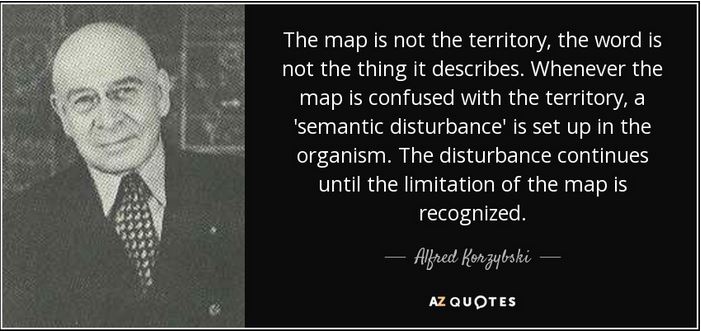
Map And Territory - We Confuse The Map With The Territory

That’s the full quote, and you can see how quickly it makes one’s eyes cross. Here it is made even more confusing by the visuals:
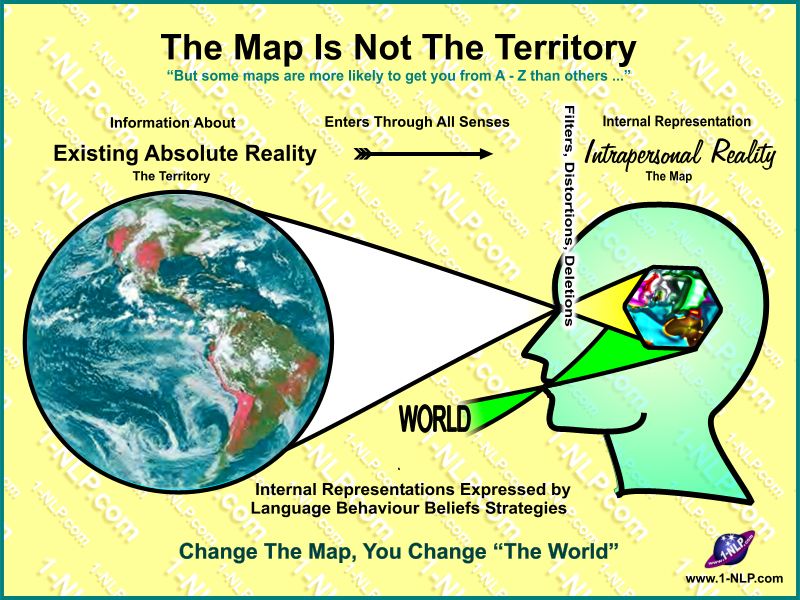
The Map is Not The Territory – Explained in Simple Terms – Welcome to Club  Street Post
This was made by someone who does not understand how to explain things.

But that’s okay, here’s the simpler version, complete with standardized background image:

The more observant among you will notice the resemblance to a meme I used in yesterday’s post here.

But really, I prefer this last version, because I also like Watts’s iteration of this — and I love Rene Magritte.
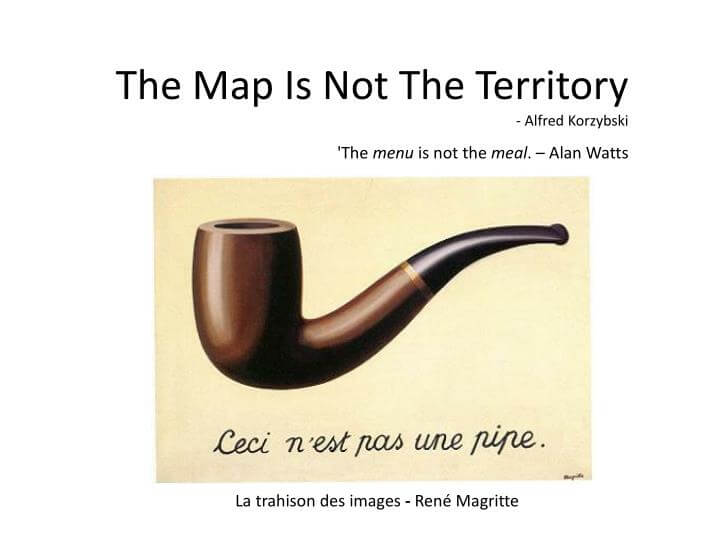
The map is not the territory - Tom McCallum

So the point of this, then, is to recognize the limitations of representation and image — and of language itself. The map is probably the best example, because a map always sacrifices detail for coverage, showing a greater area while not showing everything about that area. If a map showed every detail of the area it depicted, it would be a photograph, not a map — and its value would be limited.

(Though it might be funny sometimes.)

On some level, this shows the difference between “book knowledge” and “world knowledge” — which my students still, still, call “street smarts,” a perfect example of a name that has lasted despite its limitations, which makes it a perfect example of the second half of this statement. If you know the name of a thing, that is analogous to “book knowledge;” and if you understand the thing (which is where I think the quote is going here, to a point about understanding, because certainly with a concrete object there is no doubt that the word could be the thing itself: I’m not sitting in the word “chair” right now.), that is equivalent to the experiential and deeper understanding implied by “street smarts.” Knowing the name for something does not mean you understand that thing, because the word is not the thing itself; again like the map, words reduce specific details in order to gain another value — generally universality, and economy, meaning I can communicate a fair amount of information, to a lot of people, without too many words. If I say I own a black SUV, then you don’t have much detail about my car — but (if you speak English) you have a general understanding of the category of vehicle to which my car belongs, and a general idea of its size and shape and appearance and so on, because we understand what aspects are included in the category “SUV,” and we know the color “black.” Also, as my wife has pointed out many times, with steadily growing annoyance as each year passes, all SUVs look the same — and a large proportion of them are black. But that means, while you can get a general idea of many, many cars with just two words, you can’t really identify those specific cars very well. And you definitely don’t know the things that make my car special, that make my car into my car. Not terribly important to understand the special things about my car, of course; but if you want to understand a person, you need to know much more than their name.

This comes into focus with the AP exam because I teach my students that they don’t really need to know the name of what they are talking about: but they need to understand the thing. This is, clearly, not how all AP teachers instruct their students, because I had MANY essays that used vocabulary the student did not really understand: and it showed. They named things they didn’t really have, because they didn’t understand the thing named. So that I don’t do that, to explain the details lacking in the term “AP exam,” so that you have more understanding of this thing instead of just knowing the name, the essay I scored last month was for the AP Language and Composition exam, which focuses on non-fiction writing, and examines primarily rhetoric. “Rhetoric” is another good example of a word which people know and use without really understanding it, because the connotations of the word have changed; now it mostly comes in a phrase like “empty rhetoric,” and is used to describe someone — usually a politician — who is speaking insincerely, just paying lip service to some idea or audience, without saying anything of substance; or in more extreme cases, using words to lie and manipulate their audience for a nefarious purpose. My preferred definition of rhetoric, the one I teach my students, is: “Using language to achieve a purpose.” What I am doing now in this blog is rhetorical: I am choosing words and using examples that I think will achieve my purpose — in this case to explain my idea, and to a lesser extent, to convince my audience that I am correct in my argument: that knowing the name of a thing is less important than understanding the actual thing.

So in the AP exam on Language and Composition, which focuses on rhetoric — or understanding and explaining how a speaker or writer uses language to achieve their purpose, as when a politician tries to convince an audience to vote for him or her — there are 50 or so multiple choice questions, and three essay questions. This year I scored the second essay question, which is the Rhetorical Analysis question; for this year’s exam (This is not privileged information, by the way; the questions were released right after the exam in May. It’s the answers that are still secret.) they used a commencement speech given at the University of Virginia at Charlottesville by former U.S. poet laureate Rita Dove. The goal of the essay was to “Write an essay that analyzes the rhetorical choices Dove makes to deliver her message about what she wishes for her audience of graduating students.”

Interestingly enough, the AP exam writers have given hints to the students in this instruction, which I’ve taken from the exam. They generally give important context in their instructions, quite intentionally; it’s easier to analyze rhetoric if you understand the context in which the speech or writing was delivered, so knowing that this speech was given at a commencement, at a university, in 2016, gives you a better idea of what is going to be said in the speech — you get the general shape of what is included in the thing named “commencement address.” One of the key aspects of this speech by Dove is both the expectation of what is included in a commencement address, and how she subverts that expectation: and that centers around the term “wish.” That’s the hint in the instruction there, along with the buzzwords “message” and “audience,” which are commonly part of a study of rhetoric and of rhetorical analysis.

Okay, that wasn’t interesting. I’ve lost you here, I realize. Let me use fewer words and just give you the general gist of my point: when students were analyzing Dove’s rhetoric, they did much better if they explained what she was doing and why, but didn’t know the proper name for her strategy; some of them knew the name of the strategy — or of a strategy — but couldn’t really explain it. They had the name, but not the thing itself.

Partly that’s because the study of rhetoric is very old, and thus has an enormous amount of terminology attached to it: much of it based on Latin and Greek roots, which makes the words sound really smart to modern speakers and readers of American English. It’s cool to use the words “antithesis” and “juxtaposition” and “zeugma,” so students remember the words and use them for that reason. I think it is also partly because a number of AP classes focus on remembering the word for something, rather than knowing the thing itself, because lists of words are easier to teach and easier to memorize and easier to test. Partly it’s because students under pressure try to impress teachers with the things they can do, to dazzle us and make us not notice the things they can’t do — like actually explain the thing they named.

Again, I don’t want to get into too many specifics on this particular essay because it hasn’t been released yet and I don’t want to get in trouble, so let me just give general examples.

There’s a rhetorical device called “polysyndeton.” (Cool name, isn’t it? Little annoying that the two y‘s are pronounced differently…) It means the use of more conjunctions than would be strictly necessary for grammar. If I listed all of my favorite activities and I said, “I love reading and writing and music and games and spending time with my pets and eating delicious food and taking walks with my wife,” that would be an example of polysyndeton. And if you were writing an essay about my rhetoric (Please don’t), you could certainly say that I used polysyndeton, and quote that sentence as an example. And if you used that sentence, it would be a correct example, and the person scoring your essay would recognize that you know what polysyndeton is, and you correctly defined and identified it, which is surely worth some points. Right?

But what does polysyndeton do? What did I do when I wrote the sentence that way, instead of, for instance, “I love reading, writing, music, games, spending time with my pets, eating delicious food, and taking walks with my wife.”? The ability to understand that, and to explain that — and, most importantly for the AP exam and for rhetorical analysis, the ability to explain how the effect I achieved through the use of polysyndeton helps to deliver my message, to achieve my purpose — that’s what matters. Not knowing the name.

(It’s a bad example here, by the way, because I made up the sentence just to show what the word meant, so it isn’t really part of my larger purpose; the purpose of using polysyndeton there was just to show what the hell polysyndeton is. And sure, I guess it was effective for that.)

The worst offenders here, on this year’s exam as in most, are the terms logos, pathos, and ethos, which are words used to describe certain kinds of argument, and also certain aspects of rhetoric. The words are Greek, and were chosen and defined by Aristotle; most rhetoric teachers at least mention them, usually, I imagine, as a way to show that there are many different ways to win an argument and to persuade an audience. That’s why I mention them in my class. But while a lot of students know the words, they don’t understand the thing itself, and so they find items in a passage they’re analyzing that looks like it belongs in one of those categories. Like statistics, which they identify as logos arguments, meaning arguments that appeal to reason and logic, which is indeed one way that statistics can be used. Dove uses a statistic in her speech, and a raft of student writers identified that as an instance of logos. The problem is that it isn’t logos, partly because it’s not a real statistic — she uses the phrase “150% effort,” and at one point lowers that to “75% effort” and “50% effort;” but at no time is she trying to present a reasoned and logical argument through the use of those numbers, which of course don’t come from any study or anything like that — and even more, because she’s not really trying to persuade her audience.

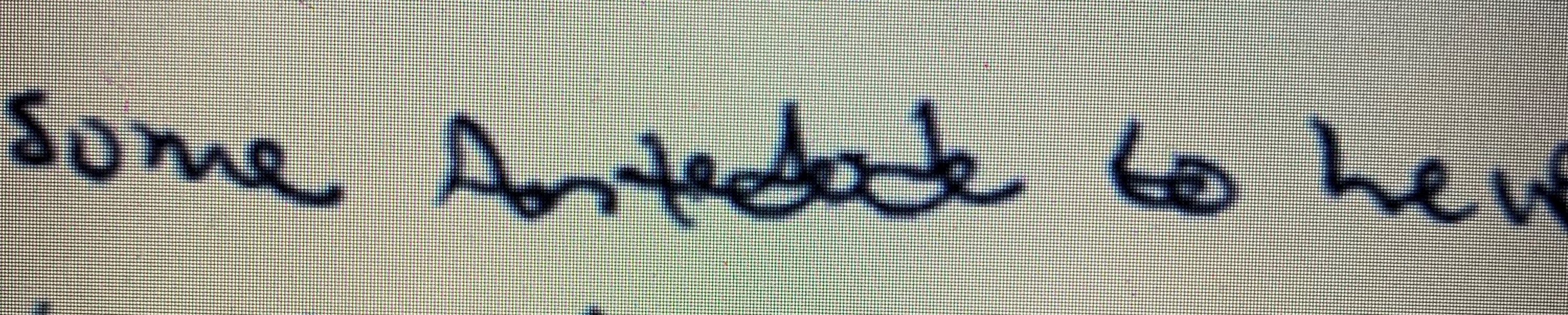
She was telling her audience an anecdote. And that’s where I ran into a stumbling block, over and over again in reading and scoring these essays: just because students know the name for something doesn’t mean they understand the thing: and just because students remember the name for something doesn’t mean they remember how to spell it.

Let me note, here and now, that these students are brilliant and courageous for even trying to do this damn test, for even trying to write three college-level essays in two hours AFTER answering 45 difficult multiple-choice questions in one hour. Also, because this was written under pressure in a short time frame, and with almost certainly only one draft, mistakes are inevitable and should be entirely ignored when they don’t get in the way of understanding. I knew what every one of these students were trying to say, so I ignored their spelling, in terms of scoring the essay. I also ignored their generally atrocious handwriting, not least because mine is as bad as any of theirs and usually worse.

I just thought this was a fine example of knowing a term but not really knowing it. Ya know?

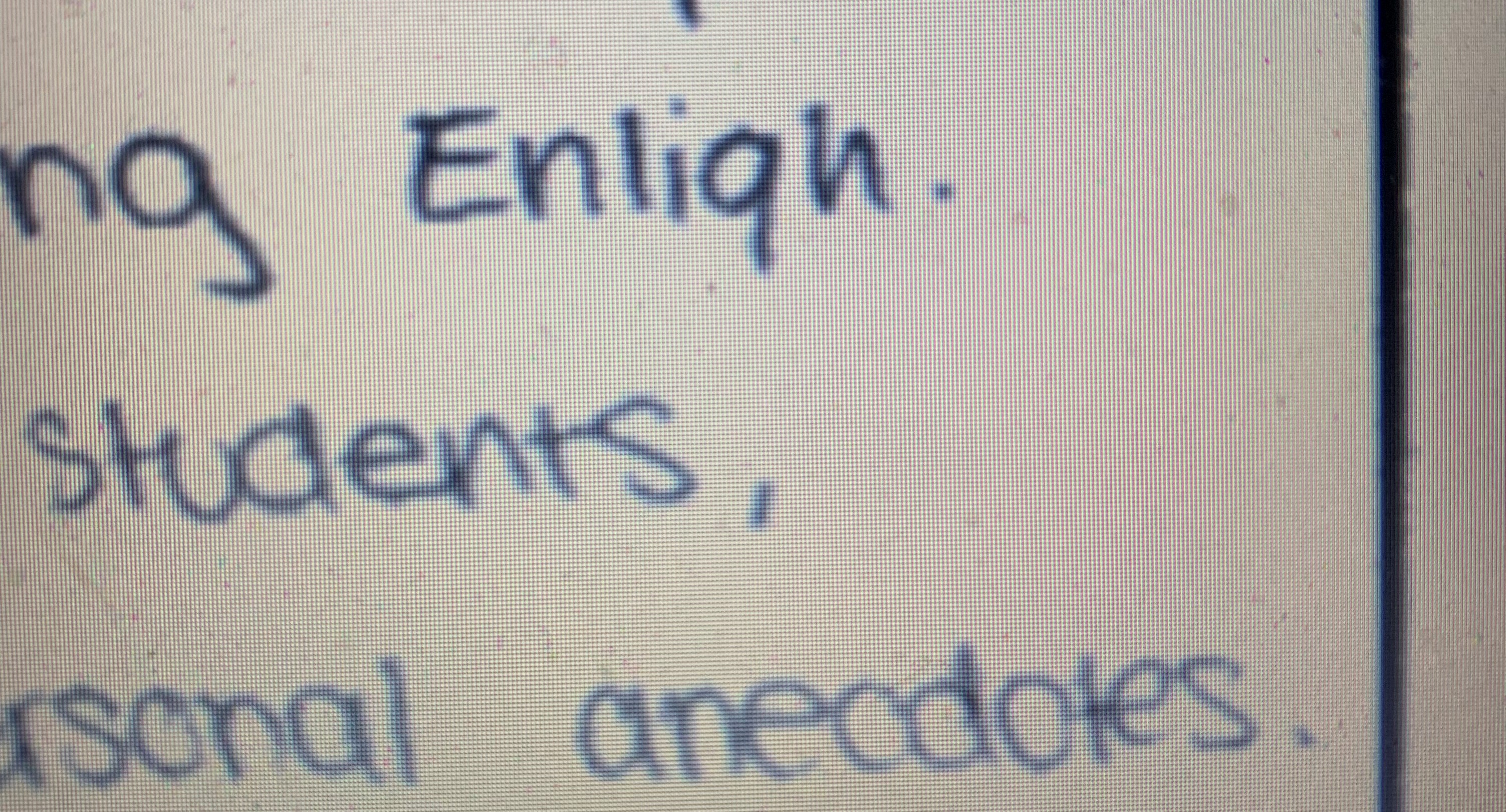
(Also I apologize for the image quality. Just trying to make a point. And the picture is not the point.)

The first one gets it right. Another one gets it right — but spells “English” as “Enligh.” Also please note the spelling of “repetition” which students repeatedly struggled with.
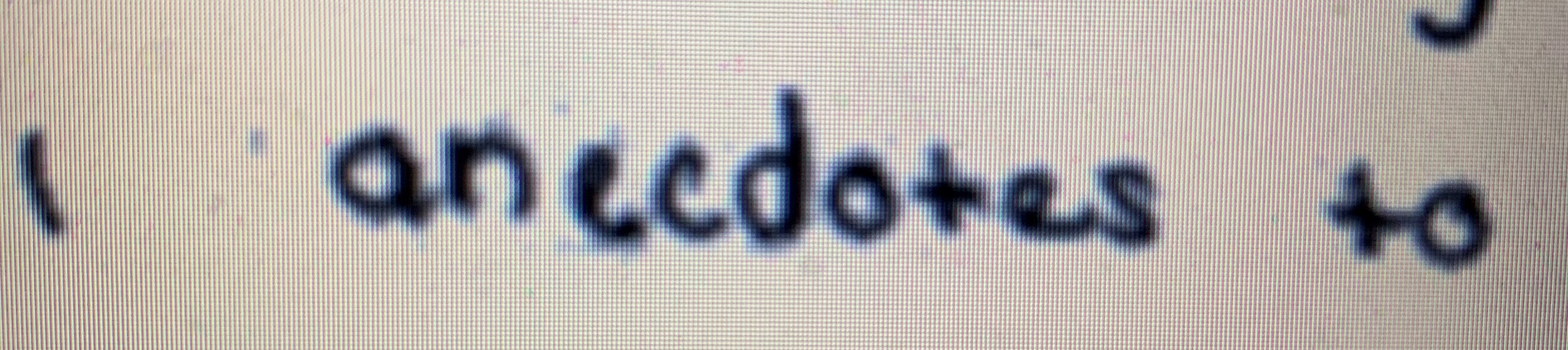
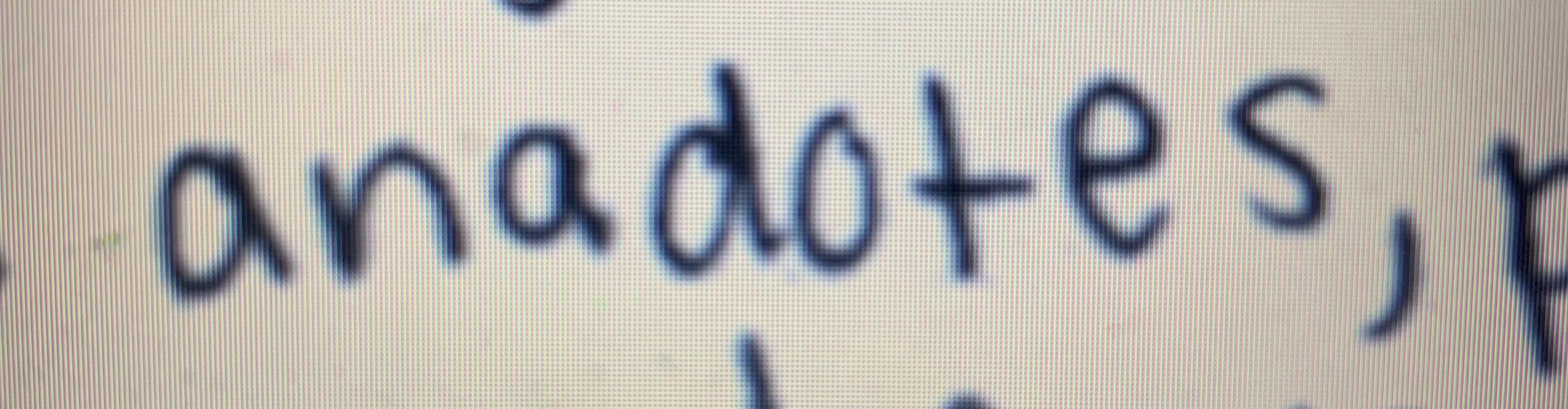
Fun, huh? I scored 695 essays this year. Last year it was over a thousand. And that exam passage also used anecdotes.

I’m really not trying to mock the students; just using this fact to show that knowing a term doesn’t mean you understand the term, because the word is not the thing itself. By the same token, knowing the spelling doesn’t mean you know the term, or that you understand the thing itself; which is why we ignore misspellings in scoring these essays. I think understanding the thing is much more important than knowing the word — and I’m a word guy. I love words. (Flibbertigibbet! Stooge! Cyclops! Wheeeee!) But I’m a word guy because I think this world is magnificent and incredible, and I want to understand as much of it as possible; words help me to do that, and to share my understanding of the world we live in. That complicated image I used above to show how some people can’t explain things well? Here, I’ll bring it down here so you don’t have to be confused which one I’m talking about.
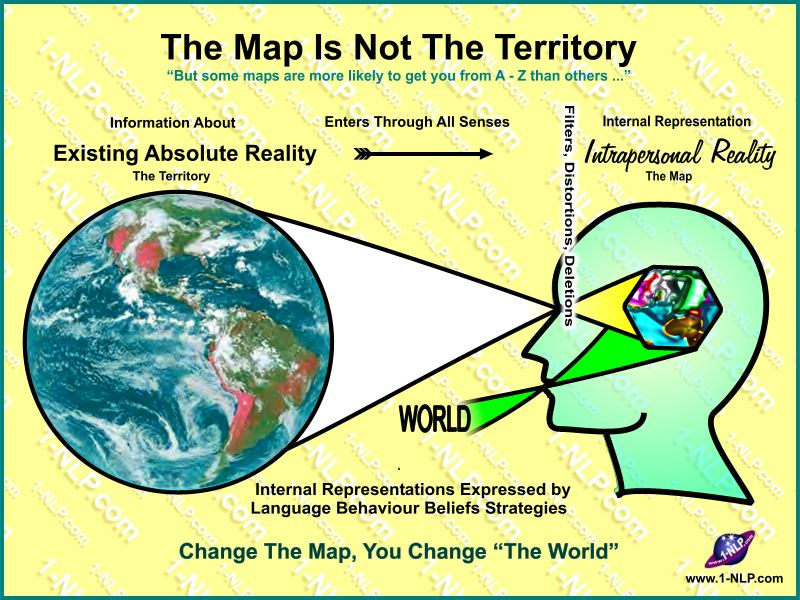
This one.

This makes a few important points, even if it makes them badly. I do like how it goes from an image of the Earth, to a jumbled collage of colors inside the head, to the one word “world.” I think that, once you can follow it, makes this point well, how much translation and simplification happens between observed reality and the words we use to represent them. Though it should also lead to another head, of a listener, and show how that one word activates their own jumbled collage of colors in their head represented by the word “world.” (Far be it from me to suggest making this more complicated, though.) Because communication happens between two minds, and both minds contribute to the communication: which is why language works despite this simplifying process.

I do also like the statement at the bottom of the image: “Change the map, you change the world.” (Even though I hate how they capitalized and punctuated it.) Because that’s the last point here: while words are not the things they represent, they are incredibly important to our understanding of the world and our reality. Because we think and communicate in words. Not exclusively: my wife, for one, is deeply eloquent in communicating with images; my dogs can communicate with a look; musicians communicate with sounds that are not words. And so on. But language is our best and most effective form of interpersonal communication: and also one of the main ways we catalogue and recall our knowledge inside our heads. So getting the names of things right is incredibly important to our ability to use the information we know, and to communicate it to others. And what is the most important factor in getting the names of things right? Understanding the things we are talking about.

Because a rose by any other name would smell as sweet — but if you want people to know you are talking about one of these, you better call it a rose.

How to Say Rose in Different Languages | 1800Flowers Petal Talk

And for my sake, please spell it right.

This Morning

This morning I am thinking of a strange question. It is: how right do I have to be?

My thinking of it now comes from an ill-advised dip back into a particular cesspit of an argument from my past. I didn’t win the argument, because I threw up my hands and walked away. I think I did the right thing for my sanity, but I’ve never been happy with failing to win the argument. I want to be entirely right. I am still somewhat haunted by the idea that I may not be right at all, because if I’m not right in an argument that I feel strongly about, but can’t muster the intellectual chops to actually win on the battleground, as it were — what does that mean for my other ideas that seem right, that feel right? Does it mean that nothing I think is right, at least not right enough to win an argument over it?

Does that matter?

Hence my question. How right do I have to be?

Let me give an example, and see if I can illustrate the conundrum here. I have found myself, as a high school teacher of English and therefore of persuasive essays, rhetoric, and argumentation, discussing the legalization of drugs in the U.S. time and time again over the last twenty years. It  is always a topic that comes  up, and now that I’m doing argument with three of my classes, it has come up again.

My opinion on the issue is complex, and not worth hashing out again now; I’ve written about it too many times. (Here’s one. And here’s another. Second one has a better soundtrack.) For this example, all I want to say is this: I waver on whether or not it would be a good idea to legalize all of the drugs. I see arguments for both sides. I don’t know which side has the better points, the truer final argument; I’m not sure which to choose. That’s why my opinion is complex, and why I keep coming back to it, never fully comfortable with my decisions about what policy to support, not sure how to come to a final conclusion.

The question is, should I keep doing this? Should I keep coming back and thinking about it again and again? On some level that is valuable, as it keeps making me revisit my own past opinions and decisions, and I think the changed perspective through time gives good insight. I also think it’s valuable not to get too dogmatic about things — though I confess I enjoy appearing dogmatic, and I often act as if I have not a scintilla of doubt in my mind about various opinions; but mostly that’s for show. There are few things that I’m 100% sure about — mostly it’s that my wife is the best wife in the whole world, education is entirely good  as a concept, if not as an institution, and reading is the greatest thing in the world, except maybe for the satisfaction of basic needs like food and sleep and hugs.

So it may not be bad that I can’t come to a final determination. On the other hand, if there is a 100% right answer and I can know it, then that is the thing I should be working towards and supporting and arguing for, right? Shouldn’t I do the right thing? If I can know the right thing, then I can do the right thing; and that means I should figure out how to know the right thing and go from there. Because  if I’m not doing the right thing, then I’m doing or on some level participating in the wrong thing, and I don’t want that.

How much do I have to know to know the right thing? Beyond a reasonable doubt? 110% entirely completely sure, with evidence and logic to back me up? If it’s the second one, then I have to be very careful about what arguments I take up, as settling them with absolute clarity and certainty would take a crap-ton of time and effort, and I can’t do that with every argument; so I need to be selective.

How do I know which arguments are worth taking up and finding out the definite answer to? Is there a 100% true answer as to which arguments I should be arguing? Is that what I should spend my time on  first, deciding what to know?

If it doesn’t have to be 100% certainty before I can know the right thing, then what else do I use as the basis of my decisions? They feel right? They seem right, based on my upbringing and my culture and my morality? Why would I assume those things are right, especially in the face of obvious arguments to the contrary, things about this culture that strongly imply that this culture is wrong? I am and have been wrong countless times; why would I ever trust my gut on anything of import?

But if I don’t trust my gut, who or what do I trust?

This comes up in my writing, too. I have to decide what the right story is to tell. Writers’ advice tells me to tell the story I feel I have to tell, and satisfy my own inner critic first; but what if I have several stories I feel I have to tell? Which one comes first? And what if my inner critic is an idiot? How can I know?

Do I actually need to trace out the entire epistemology and philosophical basis for all knowledge, so I can be sure of my knowledge,  so I can be sure of my decisions? How long will that take? How many aspects of life will it apply to — and how many will I lose because I’m focusing on this one endeavor, seeking purity of knowledge and purpose? And if  I go out and read all the books that underpin Western reason, how sure can I be that those authors followed the same rigorous standard for confidence in their ideas? What if they went with their guts, rather than establishing a sound logical basis for everything they say?

Does that mean they were wrong?

Does that mean I can’t actually trace perfect knowledge and understanding and thus make a 100% perfect decision?

Yeah, I don’t think I can do that last one, either. So if there can’t be a 100% perfect decision, is there at least a sound basis, a bedrock to build knowledge on? Or is it just turtles all the way down?

Image result for turtles all the way down

Image taken from here. And it’s for sale, and you can vote for it.

So that’s the question, then: how right do I have to be before I make a decision about what side to choose, who to support, how to argue? How right is right enough? How aware is aware enough? And is it even so bad to be wrong, or to change my mind?

I don’t know this answer. I’m genuinely not sure I should know — but regardless, I want to.

I suppose I can only start  by asking the question.

If anyone has an answer, I’d surely like to hear it. And if I have confused you entirely, I apologize; I feel the same way, believe me.

And I don’t know what to do about it.

This Morning

This morning I’m thinking, Well! That’s quite a line you’re following, there, Dusty! First you rail against science, and then you complain about the foundation of American exceptionalism, capitalism and the profit motive? Why don’t you go for the trifecta?

This morning, I say to my sardonic self (Who uses sarcasm to conceal the quiver in his lip): all righty then.

Capitalism and the profit motive have helped make this country the absolute powerhouse that it is militarily, culturally, and especially economically. The drive to succeed, to win, to gain the maximum benefit for one’s self from one’s labor, have been a powerful motivator for as long as this country has told us we can pull ourselves up by our bootstraps; though profit and competition haven’t made that particular impossible feat possible, they have allowed us to turn a thousand other impossible things into realities: they helped us get to the moon (because we had to beat the Commies there) and they helped us invent the first atomic bomb (because we had to beat the Nazis) and they helped us lead the way in the information revolution of the 1980’s (because Apple had to beat Microsoft, and Microsoft had to beat Apple). Our continuous growth, our continuous progress, have been driven largely by exactly this: by money, by profit, by competition for limited resources, whether those resources are time or money or fame or love or just food.

I can’t argue with that. I hate competition, hate the very idea of fighting other people in order to gain greater profit; but I can’t deny the results. America is an exceptional place, and our incredible speed forward has been increased again, and again, and again, by this essential underlying system: the one in front, the one on top, gets what he wants, and other people have to make do with what’s left over, with what’s left behind. Our system of government, our great and wonderful freedoms —  and they are great, and they are wonderful — are predicated on that idea, with this addition: anyone, in theory, can be the one on top, the one who gets all the stuff first. In practice it can’t be anyone, and it’s almost  always been the same type of people — mostly white Christian men — but in theory, it could be anyone, and our ability to pretend that that is true, and our desire to push for greater rights for other people mainly because we think those opportunities will reflect some benefit back on us, are what has allowed us as a society to spread those freedoms to more people, in more situations.

Just as long as we can pretend the people gaining the freedoms are like us. When they’re not like us, when they live on the other side of the world and speak a different language and live a different way, well. Then it’s probably all right if they have less freedom. Particularly if we profit thereby, with, say, cheap consumer goods.

Am I being too cynical? Look: the slaves were freed because it served the purpose of the white men who freed them. Woodrow Wilson changed his stance on women’s suffrage from opposition to support because he needed women to continue supporting the American effort in World War I. At least part of Lyndon Johnson’s intention in signing the Civil Rights Act of 1964 was to ensure the Democratic party would not fracture along racial lines — and that all of them would support his bid for election in November. And so on, so on. I do agree with Dr. Martin Luther King that those in power do not give up their power voluntarily, only when there is sufficient pressure on them to do so; I know that some of the progress we have made towards greater freedom has been because of grass roots movements and political and social pressure. The will of the people does sometimes prevail. Maybe even often.

But far more often, money talks, and people bend and crawl. And that’s capitalism.

Technology, meanwhile, has often been touted as a means of making life easier for the common man; but all too often, it has in fact made life harder. We have more technology, and we work longer hours and suffer more stress. We have longer life spans, now, that much is certainly true; but more of our lives is spent in misery, and often in ill health. We’ve gotten more quantity of life, but not more quality. And even more true is this: when progress has been made, it pushes us forward  —  off of another cliff. The Green Revolution of the mid-20th century, led by Norman Borlaug, saved at least a billion people from starving to death in Asia. A magnificent success, and a great leap forward.

How many billions are going to die now because of climate change? How much of that climate change was driven by the increase in human population made possible by the Green Revolution?

I don’t mean to say it was a bad thing. Lives were saved, and I am in favor of humans, and of living humans over dead humans. The same thing is true of our longer life spans: what I said about quantity but not quality is true, but also, the rise of lingering and terrible diseases that afflict us as we age has come at least partly because we are now still alive to age. We die of cancer now because we don’t die of sepsis like we used to. We have Alzheimer’s now because we’re not all dead at 65-70 from heart disease. Do you realize how many of the world’s greatest authors, along with millions of others, literally drank themselves to death before they were 50? Do you realize how much of that is attributable to a lack of understanding of and treatment for alcoholism? How much was, quite simply, due to the inability of medical science to perform a liver transplant? Medical advancements just mean we die in different ways, and after longer lives — and as a person who would like to live a good, long time before he dies, I see that as entirely positive.

But the problem is, the problem with all of this is, that we think of our temporary fixes, our incremental advances  — our progress– as a solution to the problem. But it never is. All we’ve been doing since the Industrial Revolution if not before, is treating the symptoms and not the real underlying problem. We are better at waging war: but we haven’t figured out how to stop fighting. We live longer lives: but not better ones. We make more profits: but we don’t get greater rewards. We live in a magnificent country: but it survives by exploiting and destroying other countries, other people, and it always has.

Progress is not our salvation. Progress is our drug. We’re not making real progress in our real problems — not much, and not quickly, and too often the real progress is swallowed up by backsliding; we have actually gotten more empathetic and more aware, and the backlash from that is the alt-right and Donald Trump. Which is making us less empathetic and less aware, as we draw deeper into our shells to avoid looking at the shit that is piling up outside. And I am entirely guilty of this, don’t think I’m not: I have stopped listening to or reading the news because I feel powerless to do anything about it. I’m not: I have as much power as any person, and more than most because I am a white Christian man, to help make the world a better place, and instead, I’ve done — well, nothing useful. I’ve probably made some progress. But I haven’t solved anything.


I don’t think I’ve been clear enough in this blog. I’ve been having trouble lately making my point clear; and this one is a tough one to get across. Let me boil it down and then I will see if I can explain it at greater length in future posts.

What we call progress, in technology, in the growth of our economy, in the expansion of this nation’s military and political power, are rarely if ever actual progress towards a useful goal, a valuable purpose. Almost always the goal is — motion. Like football: you try to get the first down, you try to move the chains. You hunker down and focus on the immediate task, convincing yourself that that one task, that one all-consuming goal, is a good thing. And in the immediate sense, in a single, narrow context, it is good: football players are successful when they get first downs. Soldiers are successful when they carry out assigned missions. Workers are successful when they bring home a paycheck. Scientists are successful when they complete an experiment as it was intended  — say, by injecting human brain DNA into macaques. We see immediate success as progress, especially when it is followed by another success. We’ve taken another step along the path.

But we rarely, if ever, think about where the path is leading. And too often, the successes right now cause even greater problems down the line.

That doesn’t mean we should ignore the problems, nor that we should try not to solve them; winning World War II was the right thing to do, even if it did start the Cold War and the nuclear arms race and so on. Norman Borlaug absolutely should have saved billions from starving, and Alexander Fleming absolutely should have deciphered penicillin, and Dr. King absolutely should have fought for civil rights.

But we need to stop thinking that progress, movement forward, is the answer, is the solution, is the goal. Movement for the sake of movement will not ever get you to where you need to go, to where you should be. Only purposeful, intentional movement can do that. A plan. Understanding.

So maybe, instead of bulling ahead ever farther, ever faster, ever harder, we should– slow down. And think. Even if it means we don’t solve the problems we’re dealing with right now. Maybe it will help us find a real solution, instead of a solution right now that leads to another problem tomorrow.

Truth

It seems to me there are three ways to come at this essay about the different kinds of truth. The first and most obvious – to me, at least – is to quote the diabolical Sideshow Bob from The Simpsons, who, when on the witness stand and told that the court wants the truth, scoffs, “You want the truth? You can’t handle the truth! No truth-handler you! Bah, I deride your truth-handling abilities!”

The second (and only slightly less amusing) is to make reference to the classic Dwight Schrute meme where Dwight points out the problem with a statement – here, if I may indulge in a visual, is one of my favorites:

Image result for dwight schrute false meme

But I believe I will select the introductory quote about truth that is nearest to my own heart: Dan Rather, the former anchor for the CBS Evening News, said, “The dream begins with a teacher who believes in you, who tugs and pushes and leads you to the next plateau, sometimes poking you with a sharp stick called ‘truth.’”

I would like to poke you with a sharp stick called ‘Truth.’

This would seem, at first, a fruitless enterprise. After all, truth is truth; how can there be kinds of truth? But in fact there are, simply because we are flawed creatures, we humans; we cannot know everything, and so we cannot know absolutes: there may be circumstances and conditions under which anything we think to be true may in fact not be. Therefore there are at least two levels of truth: truth we can know, and truth we cannot because it is absolute and thus requires omniscience. Or more simply, truth we can know and truth we cannot know, but which is nonetheless truth. The key here is to accept that knowing truth changes its truth-value, which is the concept I hope to prove in this essay; the upper limit is truth which requires omniscience to know, but there are degrees leading up to that limit, and recognizable categories, which I will attempt to explicate.

By the way: because I wrote out that Sideshow Bob quote, now my word processor wants to autocomplete “truth” into “truth-hand” every time I write it. This is both wonderful and annoying.

Like truth.

Let us begin with a basic understanding of truth. Truth is perhaps best defined through defining its opposite, falsehood; I would argue that there are essentially two kinds of falsehood, which are one, untruths, and two, lies. Untruths are things – ideas, statements, assumptions – that are not truth because when one attempts to verify them objectively, one finds reality does not match the untruth. If I were to believe it is raining outside because I am in a room with no windows, I can look out through the door and discover whether my belief is true, or untrue: if it is raining then the belief is true, and if it is not raining, then the belief is untrue. This is the first point in arguing that knowing truth changes the truth-value: because the belief that “It is raining outside” is objectively true somewhere, presumably at every possible instant that one could believe it – especially if one broadens the concept of “rain” to include liquid precipitation on other planets and celestial bodies. So sure, it is always raining SOMEWHERE – but unless it is raining where I personally can verify it through my senses, then it doesn’t really matter to the truth-value of my belief; if I were to step outside into a sunny afternoon and say “It’s raining,” someone’s response would likely be

Image result for dwight schrute false

The second kind of falsehood is a lie: this is when the truth, objectively verifiable through the senses, is known, and an idea is put forward that is known to be counter to that truth. This is when I am in a room with windows, looking out at the sun, and I say, “It is raining.” The advantage for our purpose here is that it doesn’t matter which kind of falsehood it is, the truth is always the same: objectively verifiable through the senses.

But there is a difficulty there. Because there are truths that we have discovered, truths that we know, that are not verifiable through the senses, that are not objective. A strict prescriptivist of truth would argue that these truths are therefore not true, because only objectively verifiable facts can be true. To those people I say: talk to Heisenberg. (And this is funny, because it’s mostly science-y people who would say that, and Heisenberg is about as science-y as you can get. Take that, science!) The Heisenberg Uncertainty Principle tells us that when a particle has two complementary properties, such as position and momentum, we cannot know both properties at the same time. If we know precisely where the particle is at a given moment, then we have frozen that particle in time, which means at that instant, to us, it has no momentum: picture it as a snapshot of the particle, showing us where it is, but in that snapshot, it is not moving. Alternatively, we could know the particle’s momentum, its velocity and direction; but we can only measure that by tracking its movement – which means that, over the time period when we re tracking its movement, we cannot say precisely where it was: only give a range, somewhere between Point A and Point B.

The real point is, that particle has both momentum and position, and both of those properties have objective truth, both are definite, verifiable facts – but we can only know one at a time. Knowing one makes it impossible to know the other, but it doesn’t change its truthiness.

Therefore we must add a word to our definition of truth: truth is an idea that is potentially objectively verifiable through the senses. If we had world enough and time, we could verify it; therefore it is true. But I hope we can all see that a truth that is objectively verifiable through the senses has more impact, more weight – more gravity, let us say – than a truth that is only potentially verifiable. If I suspect that the rain falling outside my room is in fact acidic, but I don’t have the instruments to test, then I may want to respond as if it were acidic, and act to protect my plants, let us say; but in the process I will undeniably encounter the verifiable truth of the rain itself: I will get wet. I am more likely to respond to the fact of wetness than to the theory of acid; that truth, then, has more weight, more potential to change my thoughts and actions. That truth has more gravity.

As I was saying, then, the lowest level of truth is one that is only potentially verifiable, but cannot be objectively verified. In fact there is one level of truth lower than that, based on knowledge – or rather, on ignorance; because if knowing a fact gives it more weight, then not knowing gives less. So the lowest kind of truth is truth we don’t know. It’s true, but for us, it is meaningless; because of our ignorance, this is equivalent to the absolute truths we can’t know. In either case, we can’t act on it, or change our thought process or paradigm because of it; it has no impact on us. For us, it might as well not be true, and so it has only the barest sliver of truth. That bottom level is the fact of rain outside a room with no windows and no doors. Or whether or not the worm currently crawling through the earth beneath me is depressed. I don’t know, and so cannot act on it. That’s the lowest kind of truth—and I apologize for using an underground worm’s depression as an example; I really didn’t think about the pun there.

As for truth that could be verifiable but can’t be objectively verified, let’s use as an example the infinite nature of the universe. Is the universe infinite? No idea. We’ll never know. In theory one could find a mathematical proof of it, if we could find the existence of the multiverse and the mechanism whereby new universes are created, but we can’t ever know it for sure. The only thing this kind of truth can do for us is give us a headache: it feels like we could know, but we can’t actually know. This kind of truth is a tease. At best a Zen koan.

Just above that level is an idea that I think is true, but I don’t know why I think it’s true. This kind of truth has the potential of being objectively verifiable, but I as the knower don’t know how to do that, and therefore could never verify it. This is where most racist ideas live. Why do racists think white skin is better than brown skin? They don’t know, but they think it’s true. There are quite a number of outright lies at this level, because people might be able to figure out how to verify their beliefs, but they don’t want to, because the truth will likely be the opposite of what they believe it is. That, in my opinion, is a lie: when I say it’s raining outside, but I refuse to open the door and look because I think it is probably sunny – but I won’t admit that.

The next level up is something that I am sure is true, and that I have evidence for, but which is not clearly objectively verifiable based on my evidence. This is where superstitions are found: Michael Jordan believed that his lucky shorts were one of the reasons for his success, and he wore them for every game he played. He won six NBA championships and three MVP awards wearing those shorts; so there is some evidence that the shorts were lucky. Just not verifiable evidence, because “luck” can’t be tested for – but just like (Okay, not just like) the uncertainty principle, if we were to create a laboratory experiment to confirm that the shorts were not lucky, the element of luck in the form of blind chance or influences on the experiment that we could not control would ruin the results: if we had Michael Jordan play half the time with his lucky shorts and half the time with “control shorts” (Which makes him sound like he has bladder control issues, which is just sad), that doesn’t mean we can make his teammates play the same in both games, or his opponents play the same, or even control all the other factors that go into Michael Jordan playing well or poorly. We can’t prove the shorts are or are not lucky, but there’s objective evidence in the form of success that says they are. And that’s why luck still exists as a concept, and why Jordan wore the same pair of shorts every game for almost fifteen years.

Oh – he did wash them, by the way. After every game.

The next level is one I don’t want to include, but I have to because of the parameters I have set forth. If someone knowing a thing makes it more true than something that nobody knows, then if a lot of people know a thing, it has to be more true than if only one person knows it. Because a known fact has more weight, more gravity, and that is an element of the fact’s truth-value. So the next level up is a thing that is known, with evidence but without objective verification (but still potentially objectively verifiable – have I broken your brains yet?), by a lot of people. I hate this because I don’t want to say that the popularity of an idea has any bearing on its truth, but in fact, if we want to include a truth’s potential to change someone’s mind or behavior – and I do, because otherwise there is no point to speaking about truth at all – then I have to make this a separate and higher level, because something that a lot of people believe to be true has a much greater chance of changing their behavior. This is something like this statement: Hillary Clinton’s use of a private email server makes her a poorer candidate for president (Meaning she would have been a worse president than someone otherwise identical but who didn’t use a private email server; the statement that the private email server made her less likely to win is objectively verifiable truth, because: well, look.). A lot of people believed that Clinton’s private email server made her less trustworthy, and therefore a bad candidate for the Presidency. And because a lot of people believed it, with evidence (Because that’s an untrustworthy act) but not objectively verified (Because she never became president and so we can’t see how untrustworthy she would have been in the Oval Office), it had more weight: it had more impact. It changed enough votes that it, along with other factors, changed the outcome of the election. That truth had more value, more gravity, because more people thought it was true.

Are we having fun yet?

The next level is something that is true not because it is objectively verified but because it cannot be disproven. This is sort of an offshoot from the last level, because there isn’t objective verification, but there is somewhat more weight to these ideas because there is an argument to be made for them, that nobody can disprove the idea, that makes it more likely that people will accept it as truth, which increases the truth-value or gravity of the idea. (Don’t worry: we’re almost at the top. Almost at simple truth. But not quite.) This is the level where God lives. The existence of an omnipotent, omniscient, non-material personal deity is impossible to disprove: there is no observation I can make that would prove that God doesn’t exist. According to science, this makes the god-hypothesis false, because it is unfalsifiable; but I’m not talking about science, I’m talking about impact on humans through the intersection of objective reality and knowledge. There are quite a few people who know God’s existence is real, and since God cannot be disproven, that gives the idea more weight than Michael Jordan’s lucky shorts. (You have to be an atheist to make that statement with a straight face. Okay, I was smiling a little when I wrote it.) It moves the truth of religion to a higher level, how’s that? Not objectively proven, but not objectively disproven, either.

But now, at last, after ignorance and belief and faith and falsifiability and religion and – Lord help us – even sports, we come to the simplest level, and nearly the top. This is where we find: the truth. Simple truth. Facts, with known evidence, which are objectively verifiable: I can look out my door and see that it is or is not raining, and I can actually test it to make sure that it is rain. I can step outside, and I will get wet. Truth. Simple truth.

Of course, even this level isn’t that simple, because the evidence of our senses is, sadly, not necessarily reflective of objective reality; all my senses could verify that it is in fact raining, but I could be mad, or in the Matrix. But that moves us over into the question of absolute truth, and since I can’t know absolute truth, it doesn’t matter to me: absolute truth is actually down at that bottom level, truth I don’t know. (There’s no way out of Descartes’ labyrinth here, by the way. In the Matrix, it is possible to know that the Matrix is not real – but then, the second movie shows us that there is another level of truth, that Neo is the sixth version of the One, and the other characters did not know that truth; and then past that there is another level – because the character Neo, like the character of the Architect who makes him, who made the Matrix, don’t know that they’re actually in a fictional movie. The only truth we can ever know is what our senses tell us. Period. Cogito ergo sum.) We take our reality as just that, as reality, and that is all we know, and all we need to know. That is truth.

One level left: that is the important truth. The weighty truth, the truth that is both objectively verified and also able to change thoughts and actions of humans; the kind of truth that makes a paradigm shift, that combines both science and popularity, and therefore moves mountains and changes continents. Proven facts that also have gravity. This is, for example, the truth that every living thing dies.

The truth that love conquers all.

The truth that money makes the world go ’round.

The truth that man’s inhumanity to man makes countless thousands mourn.

The truth that art is humanity’s highest calling.

The truth that beauty is in the eye of the beholder.

The truth that evolution through natural selection is sufficient to explain all complexity in the biosphere.

The truth that we’ll never know how many angels can dance on the head of a pin.

My last truth is this: we can handle the truth. We can. We do.

Just not enough.