Book Review: The Aeronaut’s Windlass

The Aeronaut’s Windlass

by Jim Butcher

I’m tired, now.

I’m not tired because it’s Monday (Okay, no, I am tired because it’s Monday – but that’s not the main reason.), but because I just got finished being dragged along, like a dinghy tied to the back of a battleship, in the wake of probably the best action writer working right now.

Jim Butcher.

The Aeronaut’s Windlass is the first book in a new series, The Cinder Spires; it is science-fiction, and it is steampunk. It is set in a world where the people live in impossibly tall structures, called Spires, that stand miles into the atmosphere; people travel between Spires on airships that fly using electrical currents in the atmosphere which they catch with great webs of silken ropes, like solar sails. The main characters include the captain of the fastest air ship on the planet – which is not Earth; it seems to be a planet with a much denser atmosphere, as the ships are described as sinking down into the permanent mist, or sailing up out of it in order to navigate or to fight – as well as a pair of what might as well be called wizards, master and apprentice Etherealists with strange powers and the strange penalties that so often accompany power. There are also a selection of nobles of the main Spire in the story, Spire Albion; nobles both wealthy and poor, honorable and deceitful, beautiful and deadly. They duel, they backstab, they fight for position and prominence and power. There are several soldier characters, as well, as this is the story of a war between Spires, or at least the beginning of the war: and the first strike is not only the deadliest, but it carries deeper meaning, as well. There are wheels within wheels, here, and fires within fires. There are also some of the nastiest villains I’ve read in quite a while: an evil Etherealist and her bodyguard, and they are extraordinarily vicious and disturbing. All I’ll say is: their allies of choice are enormous alien arachnids that skitter up walls before they leap down and tear limbs off with their giant insectoid jaws, wrapping up their human opponents in strands of sticky web-silk. And those are the less-frightening ones.

But hold on: because all is not lost. As confused and desperate as these humans become – and the heroes really do sink pretty low, though I’ll spoil this: they don’t lose every fight – they still hold onto hope.

Because some of the characters in this book are cats.

That’s right: steampunk, airships, war, magic, battle, alien spider-monsters – and talking cats.

And because it’s Jim Butcher, the battle scene starts about a third of the way into the book: and then it. Does. Not. Stop. Even on the last page, we are finding out about new betrayals, new dangers, new challenges that face our heroes. It is enormous fun to read, because Butcher does it the right way: he has his characters face setbacks and surprises and even awful defeats; but then the right person with the right ability is in the right place at the right time, and out of that good fortune or good planning comes– victory. At least a small one. Sometimes a large one. And you’re cheering for them the whole way, because Butcher also writes wonderful characters, complex and intriguing and genuine, and of course, Butcher has that wonderful sense of humor, which sparkles through the whole book – particularly the scenes with the cat interacting with his human companions (and inferiors, as he sees them; he is, after all, a cat.).

It’s not flawless; the way the airships function was hard for me to follow at times, and the world is larger and more complex than could ever be covered in one book unless that book was nothing but history and atlas. This one isn’t, so there are things I want to know more about and things I don’t yet understand. But this was tremendous fun to read. And for the rest?

You’re durn tootin’ I’m going to read the next book to find out. And the one after that.
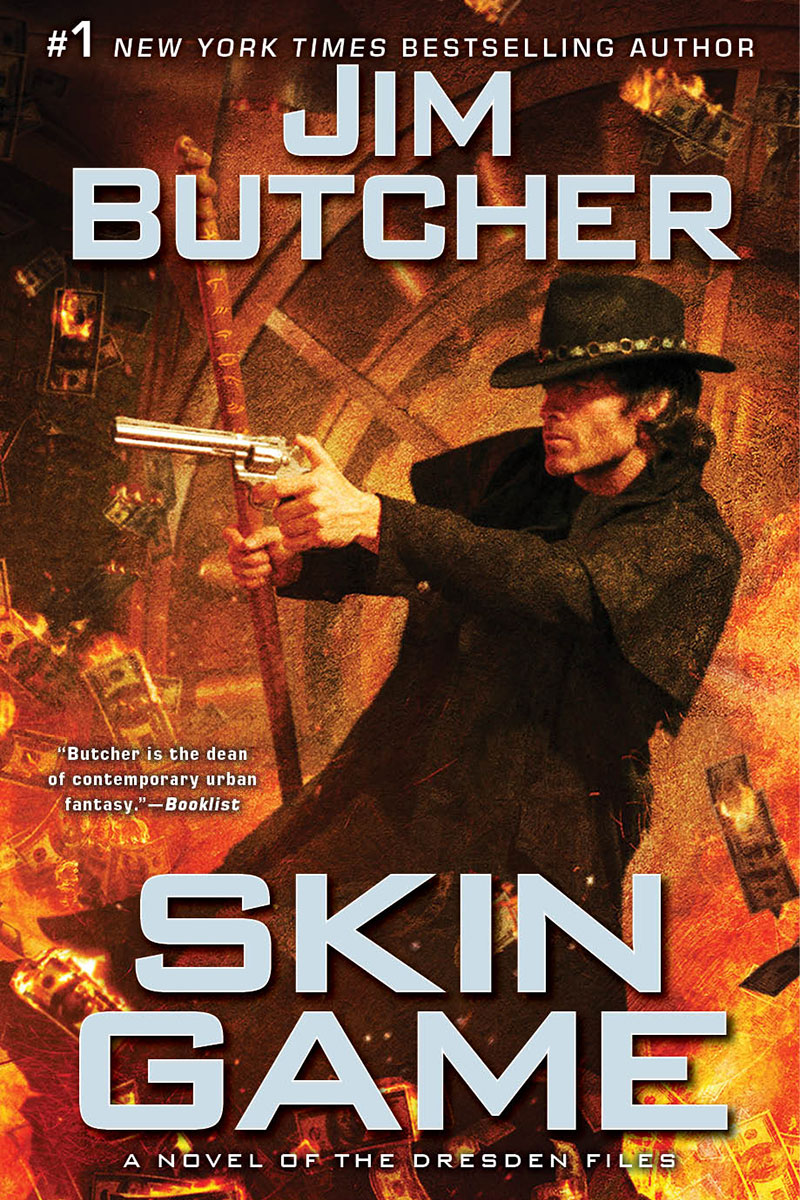
Skin Game (Harry Dresden #15)

Skin Game (Dresden Files #15)
by Jim Butcher

I’ve read lots of book series. I went through a lengthy mystery phase, when I read pretty much every Nero Wolfe book that Rex Stout wrote; I read all the Travis McGee novels of John D. MacDonald — and in both cases I read a few of the knockoffs by imitators, and was unimpressed. I’ve read all of the Wheel of Time, and Stephen King’s Dark Tower series. I read twenty or so of Laurell Hamilton’s Anita Blake books, and every one of the Sookie Stackhouse novels. I read all of the Series of Unfortunate Events, and the Bloody Jack Faber series.

I stopped reading the Song of Ice and Fire after Book 4. Because I won’t put up with that kind of nonsense, Mr. Martin. You publish your books before you make the TV series. At the least, work on both concurrently, sir. I’m using up all of my patience with Diana Gabaldon’s Outlander books; but at least she has to do extensive historical research before she writes each book. You make ’em up, George. I learned from Robert Jordan the risks of waiting too long for a series to end; didn’t you learn, too?

The point is, I enjoy the series. I’ve seen them get better as they go (LOTR) and I’ve seen them get worse (ABVH), I’ve seen them end too soon and too late.

Never — not once — have I enjoyed a series as much and as long as I have enjoyed Jim Butcher’s Harry Dresden books.

It is extraordinary to me that Butcher is able to keep these books as alive as they are. They are nothing but action: generally 400-500 pages, they cover only a day or two, and the entire time is spent in some form of combat, chase, or intrigue. Harry Dresden must be the tiredest man in the imagined universe. And yet, despite fifteen books with the same general outline, they have never gotten boring, nor repetitive; I have never left the edge of my metaphorical seat. The key is that the book is much, much more than action (despite my prior statement): even though Harry never stops fighting, there are many pauses and lulls in between the knock-down drag-out brouhahas, and in these pauses, Butcher has built not only a world and concept of magic that I find as compelling as any I’ve ever read, but also some of the most completely realized characters that I can imagine finding in an action novel. Dresden is not Man-Compelled-To-Fight-By-Need-For-Justice, though there’s some of that, and he’s not Man-Torn-Between-Good-And-Evil, though there’s some of that. Harry is a man, a complicated, flawed, man, both strong and weak, admirable and despicable. (Part of this is the fact that Butcher has had a canvas fifteen books wide to paint this character on. Some of the less prominent but still important characters — Michael, Thomas — are a bit more one-dimensional. But even those sorts of characters have their hidden sides — think of Bob. Mac. Charity.) On top of all that, Butcher has an ability to weave in philosophical sorts of musings, on what it means to be human, to be mortal, to be powerful; to love, to hate, to fight; along with the best sense of humor since Douglas Adams. And his nerd references are a solid 10.0. Funniest thing in this book is when a character starts quoting Monty Python without even realizing it.

The point is, I love these books, completely, unabashedly. I’ll keep reading them as long as Butcher writes them, and cry when he stops. Then I’ll re-read them all.

This book is a heist story. The tension comes from the fact that Harry has to work with his enemies, yet they remain enemies, regardless of any cooperation (Like the Winter Court, though the Fae are not as prominent in this novel.). Some allies come back, out of semi-retirement from the main plotline, which was wonderful; new villains are introduced, who were excellent; there is a fantastic cameo by a god; there is a hell of a plot twist; there is one of the coolest Ascension scenes (When a character becomes something more than he or she was before — like Molly at the end of Cold Days) ever, with one of the best nerdgasm moments of all time.

Best of all? I can’t wait to read the next book. I have to see what happens with Dresden’s daughter.

No: the other one.

Cold Days

Cold Days by Jim Butcher

I wish I could write like that. I don’t know how he does it, but I wish I could write like that.

I can’t, though. I can’t weave together a mix of humor, and moral philosophy, and myth exploration, and — this phrase, though trite, is in this case quite literally true — non-stop action, and somehow make it all come out right, together. I can’t make a story that satisfying, have that many moments when the reader is nodding his head, grinning madly, even fist-pumping while saying, “YES!” Dozens of them. Dozens of moments like that: from the pitch-perfect reference; to the beautifully lucid description of how it feels to love, to hate, to fear, to howl, to weep, to suffer; to the heart-thumping adrenaline-pumping cheer as the righteous defeat the vile, again and again.

If it isn’t clear yet, I love these books. Love them. I love this book. The Dresden series has never let me down, but the remarkable thing is that — even through fifteen books, now, counting the short story collection Changes — it just keeps getting better. I don’t know how Jim Butcher does it, but I hope he never stops. I’ve read this one before, when it came out, but I didn’t remember much of it; none of the denouement. And so it had me, rapt and wild-eyed, as everything came together at the end, with just the right mix of pure victory with surprising defeat to make it seem — perfect. I read this 500-page novel in two days, just as excited about the next chapter as I was the first time I read it; that I remember.

I can’t write like this. But at least I can read like this. And I plan to keep on doing it: Skin Game was published just a couple of weeks ago, and it’s sitting on my shelf right now. I’ll bet you anything it will be even better than Cold Days, as Cold Days was better than Ghost Story. I’ll let you know as soon as I finish it.

Probably be a couple more days, though. I have to go to work tomorrow.


If you liked this book, I would recommend — reading the whole series over again.

And, I suppose, Neverwhere by Neil Gaiman, the Nightside books by Simon R. Green, and the first few Rachel Morgan books by Kim Harrison.