Book Review: The Alchemist of Souls

Image result for the alchemist of souls

The Alchemist of Souls

by Anne Lyle

First, the things about this book that I appreciate.

I appreciate, first and foremost, that Lyle was inspired (as she describes in her author’s note) by a name she came across in her research; she said that as soon as she saw the name Maliverny Catlyn, a minor but genuine historical personage, she had to use that name in her book. She’s completely right; the name belongs on the hero she created for this book; and since my own book was also inspired partly by a name, I approve of this wholeheartedly.

I appreciate that the book is exhaustively researched and detailed; that it covers quite a number of aspects of Elizabethan English life; I appreciate that it focuses on the theatre of the time but barely mentions Shakespeare. I appreciate that she made subtle changes, such as making Elizabeth I marry and bear two sons to succeed her, while keeping so many other things historically accurate (As far as I know, that is): that’s a fine line to walk, and she does it well. I really appreciated the religious and political tension she was able to capture; the intrigues were excellent.

I appreciate the skraylings as a theme: this is the major change that turns this into fantasy instead of a historical novel, that when the European explorers traveled to the New World, they discovered not merely the Native American populations, but also a humanoid race with an advanced civilization and apparent control over magic. So now Europe has a new ally to woo and also plot against in their wars between Catholic France and Spain, and Protestant England. It’s a good theme, and it’s done well.

I appreciated that there are strong gay characters and nobody really thinks too much about it. They get some grief for being all sinful and stuff, even from one of the other characters, which Lyle takes advantage of to create a great scene where the bigot gets called out for her hypocrisy. It’s extremely well done, and the most romantic aspect of the book, which does have a variety of romantic entanglements between the several characters.


What I did not appreciate about the book:

It’s too long. I don’t like to say that, since I’m a wordy writer myself, and I love 1000-page epic fantasies like the work of Robert Jordan and GRRM and the like. But this one dragged. There were a few too many characters and a few too many plotlines, and those plotlines went on for too long. While the two main gay characters were interesting in and of themselves, they could have been removed from the story entirely without any real loss to the plot, and the same goes for the weeks of buildup to the theatrical competition. There’s a lot of life in the book, which also has its own attraction, but isn’t necessary for this story. It’s a bit bothersome because this is the first in a series, and it’s like Lyle couldn’t stand to hold back and put some of the interesting things into later books, so she packed it all into this one – and it’s too much.

Though I liked them thematically, I didn’t really care for the skraylings. There were some really interesting tidbits that showed excellent thought and planning from Lyle – like the linguistic nugget that has the skrayling/English pidgin avoiding the letters p, b, and m, because skraylings find them effeminate; and the reason for this is that the skraylings show their canines as a gesture of assertiveness and dominance, and those three letters are the only sounds that require you to close your mouth entirely. That is cool as hell. (Though in the actual writing of the pidgin, Lyle uses normal English, essentially leaving the pidgin implied; so what the hell? I mean, that’s just lazy. There was a guy wrote an entire novel without the letter E, and you can’t write a few lines of dialogue without those three letters? THAT LAST SENTENCE DID IT AND IT WASN’T EVEN HARD! THERE, I DID IT AGAIN!) But the ambassador is a weak character, and none of the other skraylings are given a chance to stand out; I don’t understand the ambassador’s particular personal situation, nor the connection to Mal Catlyn; I don’t like the way Mal just keeps running away, and the ambassador passively lets him go. I just didn’t think much of them.

I hate the ending. At the end of this longish slowish book is a rapid-fire explosion of events that suddenly introduce a new bad guy, have a surprise twist regarding the main character and his family, grant magical powers where they haven’t been before, throw the characters into a search-and-rescue and also a duel to the death, and then end with the bad guys sort of winning. It’s clearly a set-up for the next book(s), and I doubt the bad guys will win in the end; but it made this particular book freaking annoying. Which makes me not want to read the next books.

It’s too bad about this book, because it does have some good elements; but the plotting and pace make it not worth the time. Don’t recommend.
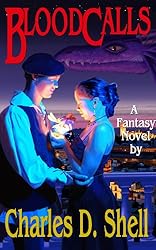
E-Book Review: Blood Calls by Charles D. Shell

Image result for blood calls charles shell

Blood Calls

by Charles D. Shell

(Please note: I was given a free copy of this e-book in return for my honest review. This is it.)


Now that was a fun book.

I haven’t read a ton of independently published e-books; but of the ones I have read, this was without a doubt the best.

It’s the story of two outcasts, a man and a dragon, both the victims of deep-seated and vicious prejudice, who find friendship and solace with each other; until they are finally forced to leave the land of their birth. The man, Corbin, who is a nobleman of his home country of Denza despite being an unwanted bastard with a mother from a despised minority, is given a minor diplomatic post in neighboring Sunal, thanks to the influence of his influential uncle. Corbin and his only friend, the dragon Blood, travel to Sunal, where, if everything goes according to plan, Corbin should be able to sink into relative obscurity, pursuing his twin passions of drinking and womanizing, and perhaps occasionally dipping his toes into diplomacy.

But world events, and Corbin’s heart, have other plans. Corbin finds that the prejudice that he has suffered under for all of his life is nonexistent in Sunal, where the Skuranese, his mother’s people, are accepted. Corbin is able to find friendships (with other men, for once) and even to pursue a woman for more than a roll in the hay. This would be enough changes in Corbin’s life: but there’s more. War is coming to Sunal. War that could threaten everything that Corbin has found there, as well as his homeland, his life and the life of his dragon, and perhaps everyone on the continent. Unless Corbin and Blood can do something about it.

The world-building in this book is top notch. The relationships between the various nations and their people are interesting, and enough historical backstory is given to make it all seem quite realistic. The magic system is done well, with different spellcasters making use of summoned spirits and creatures, or simple control of the four elements, or Frankenstein/steampunk creations made of living creatures mixed with machines. There are some unusual elements in the magic system that were very intriguing – like sonomancy, the use of sound for magic and also as a weapon; Shell was also able to reflect that form of magic in the society that makes use of it, which was a thoughtful and effective choice. The military aspects of the war – which is told not only through Corbin’s experiences, but also from the point of view of an officer of the aggressor nation of Gurein, which is trying to conquer and consolidate an empire, no matter what the cost – are as good as any military fiction I’ve read. I did wish there was a map, a visual aid that I have always found both interesting and useful in books like this; hopefully the author, with his arts background, will be able to provide one in future books.

The book isn’t perfect. I thought the romance was a bit haphazard: Corbin has never been anything but a womanizer, and though it makes sense that he’s never had an opportunity to be anything more, he jumps from that habit to a pursuit of true love a little too easily; he also settles on the object of his affection without much more inspiration than Romeo and Juliet, and though I love the Shakespeare play, I don’t really believe in love at first sight, especially not when it is turned into a chivalrous courtship, as this one basically is (though not entirely, I hasten to add). The dialogue and banter between the characters is often amusing, but much too close to our own society, using slang and colloquialisms that don’t make a lot of sense in world that isn’t ours; hearing a man from Denza call his telepathic dragon a “smart-ass” sort of took me out of the fantasy. (Also, maybe it’s me, but I want fantasy books to have fantasy names; though most of the main characters do, there are side characters with names like Jerry or Terri, which again kind of burst the bubble.) I didn’t like the character of Dante Firetongue, who is a newspaperman straight out of modern comics – he even refers to a good story as a “scoop” – and who never really settles on a personality, leaving us guessing whether he’s a shallow, selfish bastard or a good guy with a high defensive wall around his heart. I also thought Blood, the dragon, who is a good guy with a high defensive wall around his heart, was just too much of a jerk sometimes, when I wanted him to be lovable even when he was being sharp-tongued.

However, none of these things are the heart of the book. The heart of the book is the characters learning how to live together, accept each other, and protect what is truly worth protecting. That, the book does extremely well. There is good action, good suspense, and good humor throughout; and I enjoyed the ending as much as I enjoyed the beginning, which is the sign of a good novel. I’d recommend this book for fantasy fans, and I plan to see what else Mr. Shell has to offer.