This Morning

This morning I’m thinking about sadness.

I woke up feeling blue. Not too sad, really; it’s Saturday, which is lovely, and though I had a long and difficult week, there were some excellent moments with friends, with writing, with my wife and our pets. But I was down; melancholy. I slogged around the house for a half an hour while the coffee cooked, and then I took my dogs for a long, slow walk. (Though they wanted to go for a long, fast walk, with many sudden stops for sniffies. I wouldn’t let ’em. Misery loves company. [Actually, I let  them have their sniffies. We just didn’t walk that fast. They didn’t seem to mind too much.])

While I was walking, I was thinking. Why do we get sad? I’m an atheist, so anything to do with metaphysics or God’s will or sin isn’t a good enough answer for me. I know the Buddhist answer is that suffering is a consequence of desire; I get that for anger, or grief, and certainly envy or jealousy; but melancholy? I don’t think I was desiring anything this morning other than not being sad — and being sad because I wish I wasn’t sad seems like much too cruel a cosmic Catch-22 to be reasonable. I suppose there could be an argument that the particular melancholy this morning was the result of an unfocused desire, that I wish my life was different in some ways and so when I woke up into the same life, as a steadily aging public school teacher who still hasn’t achieved success as a writer, it made me sad. Maybe so, but I wasn’t really thinking about any of those things; I was just — blue.

What about modern science and pyschology? As far as I know (And that bummed me out, too, because I realized that even though I don’t know what role sadness plays in our psyche or our evolution, somebody out there does; so this whole chain  of thought isn’t because I’m deep, it’s because I’m ignorant. I feel like that is pretty much always true: that any question I have, someone out there knows the answer, and if I just took the time to look, I’d learn the truth. Sometimes that makes me hopeful, and sometimes it makes me hopeless.) the model of emotions is that they are nothing but chemical reactions, hormones released in the brain and limbic system in response to stimuli. I think as well that the idea is that all aspects of human existence evolved as the result of some kind of survival pressure, because in some way it gives us an advantage. Anger makes us strong and aggressive; love helps us pair-bond for mutual cooperation and procreation; fear is a warning of danger. Even when those emotions are not targeted in an evolutionarily advantageous way, like when we get angry at video games, or fall in love with our cars, or when we’re afraid of moths (Don’t look at me like that: they are Satan’s butterflies.)

Image result for moth

Know what that is? That’s a moth DRINKING TEARS FROM A BIRD’S EYE. Fucking tell me they’re harmless. Bullshit.

But what evolutionary advantage does sadness give us? How does being blue help me to find food or evade predators on the savannah?

It’s possible that sadness is a misdirected emotional cue. Like modern food and eating habits make us fat because our bodies are geared towards craving sugar, salt, and fat, as all three of those have definite survival advantages if you’re living out on the savannah: sugar gives you quick energy to run away from lions, fat contains vitamins and gives long term energy storage, salt helps us BECAUSE ELECTROLYTES ARE WHAT A BODY CRAVES. It’s just that food today can be manufactured with so much fat, salt, and sugar, where foragers or hunter-gatherers on the savannah had a much harder time collecting them, that our reward system, geared  to give strong rewards for tiny amounts gained after strenuous work, overrewards us for just sitting around and horking down Cheez-Its. It’s a misdirected survival mechanism, because we didn’t evolve with 2019 in mind.

But sadness, I would argue, doesn’t always have a trigger. (As I’m writing this, though, I’m getting more and more tired, and curling up with a blanket and going back to sleep sounds absolutely wonderful, so suddenly I’m wondering if melancholy is simply a signal to slow down and have a snooze. Maybe so. I’m still going to finish my point.) Even when it does, when you see someone hurt, or hear about suffering and despair in the world, how does it help me to deal with that if I feel depressed because of it? What possible adaptive value could being in a funk present?

So there I am, walking my dogs, dragging my feet and hanging my head, and thinking about the value of sadness, and what it could possibly be good for. What could sadness do for us. What power does sadness have. Power. And then I thought: imagine if someone gained power from being sad. Like Samson and his hair, but with angst. Imagine if the Hulk  got stronger when he was sad, instead of when he was angry. Imagine if someone had to make themselves sad in order to be strong, and the sadder they got, the stronger they were. Imagine if someone was a sorceror, say, and instead of sacrificing a virgin to Baal, they had to break their favorite childhood toy, or watch a hurt animal try to walk.

Hmmm. Just imagine.

And just like that, I came up with an idea for a book  I’d like to try to write. I still need to flesh it out, work on the characters and build the world, and come up with a plot and all; but I really love the concept. Which  I came up with because I was feeling down.

So that, I think, is the value of sadness. It does help us to slow down and take it easy, too, because when we’re sad I think we don’t want to do anything but curl up and sleep, and particularly in our overworked overstressed world, that is very important and very, very good for us. But mainly, I think that sadness, by the simple fact that we generally don’t like it, makes us want to do something to change the way we feel. This is the same argument I make with my students about learning: they need to feel uncomfortable, they need to feel like they’re missing something, in order for them to learn; if they are perfectly content, then their brains don’t seek out a solution to the problem, because there’s no problem. So the brain just closes its eyes and takes a nap, so to speak, if the person is too comfortable. It’s when we are uncomfortable that the brain seeks out a new equilibrium, by observing and processing what is around ; that is how we learn best.

Maybe sadness does the same. Maybe sadness is an inspiration, a impetus, to get off our butts and do something to take the sadness away.

Or else it’s my brain and body telling me I really need to nap. I’m going to go lie down, now. And maybe think about my new idea.
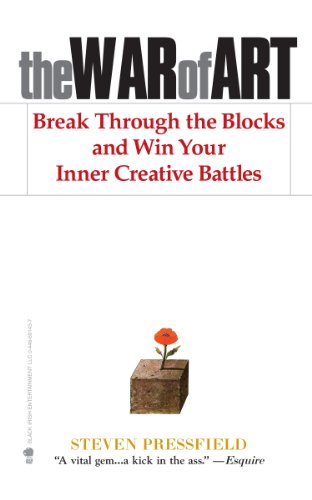
Book Review: The War of Art

Image result for the war of art

The War of Art

by Steven Pressfield

In retrospect, I should have known from the foreword that this was the wrong book for me: Robert McKee talks about art like it’s a war that Pressfield will help me to win; and while I think art is a struggle, I really don’t think it’s a war; indeed, as I am a pacifist, couching things in warrior’s terms is just going to push me away. He also references golf as evidence that Pressfield is a consummate professional (Pressfield wrote The Legend of Bagger Vance, which I have neither read nor seen; I guess it’s about golf? I guess Pressfield likes the game? But he writes anyway instead of playing, which – I guess is impressive?), and there’s the second best way to alienate me. He talks about tearing up over the Spartans’ death at Thermopylae, which was the subject of Pressfield’s other big book, Gates of Fire, which I did read, and did like quite a lot – but it didn’t make me weepy, and I don’t know what it has to do with inspiration to make art. So I’m really having trouble relating to this foreword author – and then he ends his intro with this:

“When inspiration touches talent, she gives birth to truth and beauty. And when Steven Pressfield was writing The War of Art, she had her hands all over him.”

Creepy sexual metaphors, especially about things that are not remotely sexual – like the act of putting words on a page – that is the number one way to make me say “Nope.” So I should have known.

Let me say this, though: this is a book intended to inspire artists, to help people break through creative blocks and create art they can be proud of. I can’t think of many more noble things to try to do, and I appreciate Pressfield’s earnest and genuine attempt to give people tools to do what they should be doing. So: if you do appreciate sports metaphors, and war metaphors, and you like a good, strong pep talk – or as the cover blurb calls it “A vital gem… a kick in the ass,” (which also should have been a warning sign for me) – then please ignore this review, and go get this book. I hope it helps.

It didn’t help me.

There are moments when I agree with Pressfield. He talks about questioning his writing, and feeling hopeless, and the strength and stamina it requires to push through all that and just keep working. He calls it work, and talks about how important it is to just keep putting in the hours, to keep trying, to keep seeking to hone your craft and do the best you can – but first and foremost, to just put the goddamn letters on the goddamn page, and to never give up. And I agree with that entirely. He talks about how he was in his 40’s before he found success, and how it came from an entirely unlikely source, which was, logical or not, simply the book he had to write at the time; and as a 44-year-old writer who is working on his second novel about a time-traveling Irish pirate, I appreciate everything about that.

But then there are the places where he talks about being a Marine, and how other servicemen in other branches are weaker than Marines because Marines love being miserable (This is a metaphor for how artists should be: willing to suffer and be miserable. I kind of see that. This whole Marines-have-bigger-dicks-than-other-soldiers? Nah.) and the other services are soft. Where he talks about writing and art like it is a war to be fought and won; or an animal to be hunted and then eaten; or a football game where you have to “leave everything on the field.” And I hate all of that. He talks about the urges and habits that get in the way of art as Resistance, and that’s pretty good, but he also talks about how like not cleaning your room is a way to lose to Resistance, and – what? And how golf is an art, and Tiger Woods is the greatest artist of all because he can be interrupted mid-swing, stop his swing, and then refocus and hit a golf ball really hard and – I fail to see the art in that. And he says that mental illness, depression and anxiety, are not real, but only a failure to combat resistance, which can be overcome by determination and the earnest pursuit of one’s true calling, and hey, fuck you, Pressfield.

He’s got a strange (And contradictory) section where he tries to talk about thinking territorially instead of hierarchically, and basically he means you should do what you think is right rather than worry about what other people think is right, and okay, sure – but first, he says elsewhere in the book that he knows he’s written well when his family is pleased and proud of him, which is hierarchical thinking by his own definition and explanation, so either he’s a REALLY bad editor who missed that continuity break, or he’s full of crap in one of these places; and second, his example of someone thinking territorially is Arnold Schwarzenegger going to the gym. Which is both weird and not at all artistically inspiring. It gets really weird in the third section, where the devout Christian Pressfield (Though he also admires the ancient Greeks so damn much that he seems to kinda want to worship Zeus and Apollo. I can’t really disagree with that, though I wouldn’t pick the same gods.) talks about angels who help inspire artists to work, because God wants us to create beautiful things for Him to admire, and how everything an artist is comes from God and we should understand that we contribute nothing, that we are only the vessel through which the divine will is worked. I mean, when we’re not being hardcore fucking Marines. Or hitting 310 yards off the tee. Otherwise, though, we should be all humble before God. It is not quite this Christian – he really does admire and know a lot about the Greeks – but it does read that way, as a repudiation of human accomplishment and a glorification of the eternal Whatever. And as an atheist and a part-time humanist, I am not at all down with that.

This thing reads exactly like what it is: a privileged Baby Boomer looking down on everyone else who doesn’t have all of his privileges; and by the way, he says some interesting and intelligent things that show me he really is an artist like me. Just way more of a shmuck. Hoo rah.

This Morning

This morning I am thinking about words.

I’ve written about 700,000 words worth of books, over five (longish) novels. I’ve no doubt I’ve written twice that in blogs and essays and book reviews, and probably its equal again in journals and diaries, notes and letters and the various ephemeral thoughts that find their way onto paper. That means I’ve written somewhere above 3,000,000 words in my lifetime.

How many of them were the right word? The best word? Twain said that the difference between the right word and the almost-right word is the difference between lightning and a lightning-bug, and nobody has said it better. Not all of mine are the best words, not by any stretch; but I think some of them have been. Sometimes. and even where they weren’t the perfect word, the best word, quite a few of them have been good words. And when the total is 3,000,000 words, “quite a few” — well, that’s something. It’s something.

I wonder how many people have read my words. I’ve read my essays to students for as long as I’ve been teaching, and sometimes my short stories or even an excerpt from one of my books; that’s around 3,000 students over the last twenty years. Three thousand people. And of course, I’ve written notes and comments and such on their work, and answered their questions and concerns in emails now to the tune of thousands of words, tens of thousands of words. I’ve never sold a lot of books, but I have sold some, and I’ve had blogs, with some number of readers, for more than a decade.

How many times have my words made people smile? Made them widen their eyes? Made them feel angry, or sad, or touched? How many times have my thoughts made someone else think something truly powerful, a sky-shattering inspiration, a ground-shaking memory, a tidal wave of thoughts?

I think those things have already happened. I think I’ve done them several times. I have. With my words.

This morning, I’m proud of that.

This morning, I hope I get to do it more, and more, and more.