I Did It My Why

when admin says remember your why - Tony Stark Eye Roll Meme Generator

It’s inservice season!

Of course that should be the time of year, as the old joke goes, when we all get to hunt inservices, but it just means that this is the time of year when teachers go back to work in order to pre-game before the students arrive. (Yes, if you’re wondering, we’ll be drinking – but not enough. Never enough.)

If you are wondering – or, if you are one of my fellow teachers, which means your mouth is hanging open and you are cussing foully at the very thought of this – yes, this is absurdly early. In fact I am writing this at the end of the first half-week of inservice: this year I went back to school on July 16th. I kept seeing memes from teacher meme accounts that joked about our general outrage over Back to School sales happening now, with some kind of How-dare-you caption or comment that included the phrase, “It is JULY!” And though I share that outrage, every time I saw it I had to just sigh. Because not only am I back to work in the middle of July, but I will actually have students in July: classes this year start on Tuesday, July 29th. Thereby spelling the doom of that last vestige of the past advantages of being a teacher: it used to be a steady job, that was respected and appreciated, and which offered good benefits and a lovely, long summer vacation; now none of that is true, at least outside of the wealthier blue states.

But at least we’re still badly paid. So that tradition goes on.

Whenever I think about inservice – which I try not to do whenever I am not in the middle of it, but when I am in the middle of it, I always find myself stuck in uncomfortable chairs in rooms full of people who will look askance at me if they do not actually accuse me of disrespectful misbehavior should I have the audacity to distract myself from the pointless and condescending lecture being presented as helpful instruction, and so I end up spending quite a bit of inservice time pondering in silence the meaning of various available abstractions like this one – I wonder: What is inservice? (Also Why am I here? And Is there value in suffering?) It’s a strange word, after all: is it intended to differentiate this process from some other system called outservice? Which, frankly, if the only difference between inservice and outservice is that outservice is carried out in some place other than the school building, I’ll still take that one every time. And whether the service is in or it is out: who is being serviced? Am I and my fellow teachers the recipients of said service, like cars out of tune? Or are we the ones servicing something or someone else? If it is the teachers performing the service, what (who?) are we servicing, and why?

The ostensible answer is that inservice is meant to provide teachers with time and training to help us prepare for the upcoming school year; so essentially, it is the first one: we teachers are rolling into the garage like smoke-belching, backfiring, broken-down jalopies (Not entirely inaccurate), and the mechanics tune us up to get us ready for the race about to begin. I’m not sure what that makes the students, who are not the drivers and not quite passengers – maybe the cargo? Maybe the road we are driving on? – but I think that’s taking the metaphor too far. This lens does bring into clarity a number of obnoxious things that happen during inservice, not the least of which is: remembering my why.

There are themes that run throughout inservice everywhere, always, and which return every year, like a repeating motif in a Beethoven symphony, or like a recurring nightmare; one of these is the certainty that someone, almost certainly someone who does not teach, will ask the teachers to remember their why.

Why do we teach? Why do we take on this difficult and underappreciated job? Why do we come back to it year after year? Is it like returning to an abusive relationship? Is it like trauma that hides behind a memory block, as is supposed to happen with women who go through natural childbirth and then have to forget how incredibly painful the experience is or they would never have any more children?

As I have never given birth, nor been in an abusive relationship other than working in education, I cannot say. I will say that I remember, every year, how awful the previous year was – and also how wonderful it was, at times.

Which brings me to this year, and the current inservice season, and the direction – which was indeed delivered last week, by a presenter who is not a teacher – to remember my why.

Last year was bad. It wasn’t my worst year – that will always be 2011-2012, when I was working through a recession and a state investigation and a union contract negotiation in which I was the lead negotiator (And it says something that 2012 was the year I won Teacher of the Year for my school district in St. Helens, Oregon) – but it was bad. I spent a fair amount of time last year thinking about, and looking for, jobs that were not teaching jobs. That’s how bad it was: it changed my why into a What the hell am I doing here?, a question that is much less conducive to being a good teacher, and so not one that will be recognized at most inservice training sessions, even though surely many teachers at those sessions are asking that question, repeatedly, sometimes out loud, though under our breaths, so we don’t get dirty looks.

But here I am, one more time – my 26th – starting a new school year, about to teach high school English to a new (Well, partly new; partly familiar, which is at least part of the problem) cohort of students. And I found myself this past week thinking, genuinely wondering, Why?

Why am I teaching? Still? Why am I doing this to myself?

I don’t have an answer, not an immediate one. On some level, I don’t want to be here any more, don’t want to be teaching, don’t want to be teaching at the school where I have been teaching for the last 11 years. But that, too, is not the whole answer, and the whole answer is not immediately obvious in that context, either.

So let’s talk about it.

Why am I here? Why am I teaching?

First of all, most clearly and fundamentally, I’m here because I need a job. If I lived in a different kind of society – one that I think would be better in countless ways – that did not define a person’s value by their economic activity, then I would not be a teacher, at least not a classroom teacher. I have often thought I would like to teach the way Socrates did: at dinner parties, in conversations with interested parties, or out on the streets with random passersby; obviously I couldn’t do that for money, but I think I’d be pretty good at it. But I don’t live in that society, I live in this individualistic capitalist one, and so I must work for money so I can have a house and food and air conditioning, all the vital necessities of life. It’s possible I could survive without a job, but my level of misery would go up exponentially, even over what I went through, what I go through, as a teacher. So I work, rather than become homeless and starve on the street.

But does it need to be this job? At the moment, that answer is close to a definite yes, because my wife, who was also a teacher last year, and who had a far worse year than I did, lost her job to budget cuts at the end of last year; as she is working to build her entrepreneurial endeavors, it falls to me to provide a steady income and health insurance; because teachers are generally more valuable as we gain experience, our pay goes up every year and then drops precipitously if we change schools or school districts – I have done this twice, the first time losing about 20% of my annual pay and the second time 40% — so that means I need to stay in this job, rather than get another teaching position. That wasn’t an easy or a simple decision: I applied for, and could have gotten, a job teaching in a different school that would have earned me about 30% less than I make now; but I just couldn’t afford the drop in pay. So here I am. (It does help that I have many dear friends at this school, and that some of my students are lovely people. But it only helps, it doesn’t make the decision easy. It’s not the why.)

It is possible I could change jobs entirely, even change industries; but because most jobs pay more with experience, like teaching does, I would have to start at the bottom of the scale, and that is generally also less than I make as a teacher, even if the upper end of pay would be more. I am also painfully aware that the current political power structure puts continuing health insurance across changes in employers at serious risk of ending, which makes me doubly unwilling to leave my current job for a new one. Any job that would pay as much as or more than I make teaching would require additional training and/or certification, which makes them possibilities for the future, but not for now. (Also, I am 51, so starting a whole new career at the bottom and working my way up is both less attractive and also less likely than it would have been 20 years ago. Plus ça changeplus c’est la même chose.)

But of course, I could do those things. I could get a job in marketing, or in public relations, or in corporate training. (I could become one of the people who provide inservice to teachers, but I would really have to hate myself to do that.) Especially if I and my family moved states, to one that had a generally higher payscale for professional jobs, I could find something that provided the same approximate income. Yet here I am, back teaching again. So there’s more reason for my returning to teaching than just necessity, more than just money. I will also point out that, if I just wanted to receive my paycheck and cared about nothing else, it would be fairly easy for me to keep my job despite becoming a terrible teacher, because it is in fact quite hard to fire bad teachers. So long as I didn’t hit or harass one of my students, I could treat my job very differently from how I treat it now, how I have always treated it, so that even though it was the same job, it would be a very different experience.

Let me be a little specific. I teach English to high school students, and I do it well. I make literature both understandable and interesting to my students – or at least I create an opportunity for them to find literature both understandable and interesting. I make the class as valuable and entertaining an experience as I can, as much of the time as I can – and that’s a good amount of the time (though of course the experience of my class is subjective and I don’t doubt that some students think I do a terrible job of teaching, and/or that my class is boring as hell. But mostly, they don’t think that, not if they pay attention and try.). I work very hard to achieve that: I spend hours and hours thinking about what I am going to teach and how, hours and hours preparing materials and assignments and activities, and then when it is time to go and teach those things, I show up, every day, as ready as I can be to teach the material to the students I have. I ignore the inconveniences and frustrations of my daily work, of my classes and my situation, and do my best to treat every class period as an opportunity for both progress and also fun. I try to learn as much as I can about my individual students, both so that I can teach them better and so I can show them the respect they are due as human beings who are as wonderful and valuable as every other human being, despite being adolescents (That’s not a dig, not really; adolescence is miserable, and all of us react to that misery by inflicting misery on others. I did it too. I don’t blame them for it: but it can be very hard to deal with them while they work their way through it.). I try to be as honest and vulnerable and trusting with them with my own genuine self as I can be, again so that I can teach them better and so I can show them the respect of being real with them, so they can trust me, so they can work with me.

The fact that I do that, that I have done that every year, is part of the reason why I had a bad year last year, and part of why I don’t want to do this any more: because my students last year did not generally return my respect and my openness. They did not listen or value my honesty and vulnerability, and they did not show me the respect I deserve as a fellow human being, let alone as a teacher who has some ability to affect their lives, possibly for the better. They mostly didn’t disrespect me maliciously, just being teenagers in this modern world; but it was hard to remember that and to keep caring about them and keep trying to be the kind of teacher I want to be with them while they treated me with callous indifference. There were many times, for instance, when I would ask my students about something, and they would ask me what I thought or what my experience was in regards to that idea or situation, and while I was answering the question they asked me, they would not listen: they would turn away and have side conversations, or look at their phones or Chromebooks, or leave the room, because they were bored. Not because they hated me and wanted to insult me, but just because they didn’t care, and they didn’t feel like they needed to show me the respect of their attention, even as I answered the question or gave the explanation they asked for. So as I said, not malicious, but nonetheless hurtful, and hard to deal with. And this year, I will have many of those same students back again. Will they treat me more respectfully? Will they listen to me when I talk, either as their teacher or as a fellow human being?

Probably not. But I am willing to try.

I don’t have to: I could assign them readings, and questions, and maybe videos or audio files of literature – particularly non-fiction, which is what my administrators want me to focus on anyway, as it is the heart of the testing that produces the data that is the obsession of all administrators everywhere –  and I could sit at my desk and monitor their online activity to ensure they were on task. To my school, that would be considered teaching, to a degree sufficient for me to keep my job and my current pay, which is not really related to my success or failure in actually teaching my students. If I produced data that was better than what I currently engender with my involved, honest, human, active, interactive teaching, then I would be even more secure in my job. I might even get a little bonus money if their test scores went up. And it would be so easy. Especially if I just had AI design my “lessons” for me. And grade their assignments.

I choose not to do that. I choose to take the much more difficult path, which does not necessarily make my job more secure, and which definitely does not produce the best test scores. And why do I choose that, you might ask?

That’s the Why worth thinking about.

I teach the way I do because I don’t just teach for money, and I don’t ever teach for test scores. I think that my teaching methods help students to get better at understanding literature and at explaining their understanding in writing, and so higher test scores should be the result of my methods; but those test scores are not my why. If anything I sometimes, perversely and against my own best interests, want those scores to go down while my students’ knowledge and abilities improve, for the data to become less reflective of my students’ actual learning and abilities. Because I want my students – and also my school and my community and my society – to care less about test scores and measurable progress data. Ideally they would not care about it at all, ever; and my hope is that when students grow and learn in my class, and know that they grow and learn in my class, and everyone around them knows that they grow and learn in my class, and then those test scores don’t improve, or even go down, then it shows the truth: that test scores do not measure what matters in education. Test scores and measurable progress data are the wrong focus for educators, because they put the focus on the wrong thing, especially in my subject: English as a subject of study is not about measurable progress in discrete skills. There is no “mastery” in English. It is about growing: growing as a person, as a thoughtful person, as a person who thinks about the world and our place in it, who is curious about the world, who is appreciative of the world, and who cares about the humans who live in it with them.

I want my students to be that. It will make them better people, with better lives, in a better world. I want to make that happen. So I am willing to work for it. Even though it’s hard. I’ve worked for it, worked hard, every day and every week and every month and every year, for coming up on three decades.

Last year, and to a lesser extent the few years before that, it didn’t work as well as I thought it should. My students did not grow as much as I wanted them to. Partly because they did not pay attention enough and did not try enough to actually improve in the subject, to actually work and learn in the class; because they did not pay me the respect I deserve as their teacher and as a fellow human being with some ability to improve their lives and the world they live in, who is working hard to do that, who shows up every day and who is as honest and vulnerable and genuine and compassionate as I can be with them, as often as I can be, and regardless of how they treat me and the work I do and the subject I love. Part of what made last year bad, I think, was that I was not able to keep being patient with my students when they disrespected me and my class: it made me lash out in frustration, or it made me shut down, which then confirmed for them that this was not a class and I was not a person they needed to listen to or be respectful of. We spiraled, because of that, both my students and myself, more than once; it took extra effort to drag us out of those spirals – and very little of that effort came from my students. If anything the majority of them encouraged that spiral, because they know that if I give up, and they give up, then they can stop trying, and they can just do nothing for as long as I have given up, as long as I stop trying and do nothing. For many of my students, for much of the time, their goal is to do absolutely nothing, to put forth no effort, to achieve no ambitions – to have no ambitions – and to not care about anything at all. Because of that they put all of the requirement for effort and motivation on me: often consciously and intentionally, again so that they can give up by making me give up.

But I did not give up, not in the long run (though I did, too often, in specific moments with specific classes), no matter how annoying some of my students were to work with, to be honest and vulnerable with, no matter how disrespectful they were in not listening, in not trying to think or empathize with me or to connect to the material. And the reasons why I didn’t give up are another part of my why, and more of what brought me back to teaching again this year.

The first one, the simpler one, is that I love English. I love literature, I love poetry and plays and novels and stories and essays and screeds and letters and songs and – all of it. I love reading and writing, and I love talking about those things, and learning about them, and teaching about them. All of it is fascinating and beautiful and magical to me, as well as incredibly important, both practically and esoterically, concretely and abstractly. It would wound me, deeply, if I were to treat my subject as something not worthy of real attention and focus and thought and energy, if I were to reduce it to excerpts and handouts and multiple choice questions and AI-generated content. It would dishonor this area of knowledge, this way of living in and interacting with the world, that has meant so much to me, that has consumed so much of my time and effort, that has brought me so much joy and also so much power. And I won’t do that, not even though my students do it every minute of every day, in every class, to one extent or another. Part of my why, part of my reason for teaching, is to fight back against that apathy and indifference and cynicism, that belief, endemic among my students and my society and growing worse every year, that reading is boring and pointless unless it is reading the captions on a TikTok or the comments on a YouTube video or a SubReddit, that writing is something best done with a prompt to ChatGPT. Preferably one entered with talk-to-text. I don’t think I can change that attitude in all of my students; certainly not in the ones who never even try to get better in my class, the ones who prefer to do nothing, at least in this context, and to be nothing as a consequence, at least in this context; but I can help change it for some of them, at least. And because I have read and taught and thought about Ray Bradbury’s novel Fahrenheit 451 for so many years, I know that winning some people over to the side of the angels, to the side of the readers and the writers and the thinkers, the poets and the storytellers and the wordsmiths, is enough to save the soul of humanity and society – at least until we blow it up.

But then we will rebuild. If there are people who have not given up. The character Granger says it at the end of the book, after their world has, at least a little, blown up:

“There was a silly damn bird called a Phoenix back before Christ: every few hundred years he built a pyre and burned himself up. He must have been first cousin to Man. But every time he burnt himself up he sprang out of the ashes, he got himself born all over again. And it looks like we’re doing the same thing, over and over, but we’ve got one damn thing the Phoenix never had. We know the damn silly thing we just did. We know all the damn silly things we’ve done for a thousand years, and as long as we know that and always have it around where we can see it, some day we’ll stop making the goddam funeral pyres and jumping into the middle of them. We pick up a few more people that remember, every generation.”

That’s the other reason why I keep teaching, and again it is fairly abstract and idealistic, and again it is generally ineffective with the majority of my students: I want to make my society a better place. I want my students to understand the damn silly things we do, and that burn us up, so that they can help get us closer to that day when we stop jumping in the middle of our own goddamn funeral pyres. I want some of them to remember. To never give up.

I can’t fix all of it, of course, and so that makes it harder to keep coming back and trying again; just this year, I have had to sit through a conversation among teachers, who should all know better, about how AI is both inevitable and a valuable tool, and so we should not only accept it, but take part in it, contribute to its growth, tumor-like, on the collective mind of humanity; hearing that from my fellow teachers felt like being stabbed in the gut, and it makes me want to throw up my hands and cry out “A plague on both your houses!” I have for years chosen not to fight my students on their use of electronics, preferring to ask them to come along with me into the world of literature I make available and interesting and useful in my class; but I have watched as more and more and more of them have refused my kind invitation, my well-meaning passivity, and have failed to gain anything from me as a consequence. So now I will have to fight to make my classes available to my own students, and I don’t know how well that will work – and I don’t want to do it. I have no choice, so I will; but I don’t want to. That’s a why on both sides: I want to teach so I can fight for the souls of my students, and I want to let them do what they want, even if it destroys them.

But as I have learned from literature and from being a part of humanity and thinking about humanity, when some people are allowed to destroy themselves, they bring the rest of us down with them. I don’t want to allow that, not for a reason as stupid and worthless as laziness or fear of failure which creates failure, which are the main reasons why students don’t pay attention in class. Again, I don’t think I can save all of them – I don’t think I can save any of them, really, but I think I can help make a change in the paths for some of them, which will allow them to save themselves – but if I can save some, that will be enough. Not enough to make me happy, or to make my job easy; but enough to keep society moving mostly forward, and to allow humanity to continue to get better. If I can help them to empathize with others, as they might learn from To Kill a Mockingbird, or to think about the consequences of lies and self-serving fingerpointing, as they might start doing after reading The Crucible, or if I can just make them curious about the real value and power of reading, as they might learn from Fahrenheit 451, then I will accomplish that goal. I’ve done it before: and I hope to do it again. And again. Until I can’t do it any more.

That’s why.

Time For My Annual Tradition

It’s Inservice Time again!

That means it is back to work for me.

It is Icebreaker time.

It is time to travel to Phoenix, 120 miles away and approximately 120° Fahrenheit, because my school district wants to pretend that we are all one community — even one family.

It’s time for gratitude ponchos.

This is the time of year when a professional pedagogist who makes ten, twenty times my annual salary (sometimes for each appearance) comes to my school, and tells me why everything I’ve ever even thought about doing in a classroom is wrong, and therefore, if I don’t want my students to fail utterly at everything in life, and if I want to even dream about maybe keeping my job, I will need to change every single thing that I do: because all of it is wrong.

Essentially, this is the time of year when I get mad. Frequently. Vociferously.

And my wife is now tired of listening to me rant about this issue.

So now, Dear Reader, it is your turn.

So this year, when we drove from Tucson to Phoenix to spend time with our beloved school family (Which, if that were the case, seems like icebreakers wouldn’t really be necessary? You have icebreakers at family reunions? Or Thanksgiving?), after we had the icebreaker, we listened to a motivational-speaker-sort-of-pedagogist who wanted us to think of teaching in a new way.

She said that our minds are wired to consider certain weighty moments in our lives as what she called “temporal markers” (Or was it milestones? I didn’t listen too closely.), and said we take these moments — milestone birthdays, the start of a new year, the anniversary of some important occasion — as signals to move away from the past and orient towards the future. She said we give ourselves a chance, at these times, to start over with a blank slate: and that our minds actually promote this, by taking a new perspective, examining what has gone before, and then considering new aspirations. We see ourselves as having closed a chapter, and started a new one; and this gives us new energy, it clears away old thoughts and feelings and gives us room for new ones. She talked about this like it was a very positive thing.

She asked us, as pegagogists and motivational speakers are wont to do, to share with our table partners (Oh — we were assigned tables with random teachers from the other schools, so that nobody was sitting with anyone they knew well, because Lord knows the last thing teachers need to be at an inservice is “comfortable.”) how we marked these moments of change, from past to future, in our classes, in our daily lives. And I thought about it, and I realized: I don’t really do this. I mean, okay, sure, when I had my birthday three weeks ago, I thought, “I’d like to spend today doing the things I want to do for this whole year, so I can start a trend or a habit right now and continue it all the way until my next birthday.” But I didn’t follow through with it. I don’t make New Year’s resolutions — I quit smoking on December 28th, as I recall, five months after I turned 35. I started going to the gym more regularly last May, and stopped around November, and picked it up again in February. I don’t celebrate things happening in multiples of 5 and 10; in fact, the two numbers I think I notice most (Other than 420 and 69, which I always have to notice because I am a high school teacher and I know those are going to get a response) are 42, because of Hitchhiker’s Guide to the Galaxy, and 37, because that’s how old Dennis is.

There’s some lovely filth down here…

And in terms of my teaching, I don’t have any kind of clean breaks: when one class ends, I almost always have students who stay after the bell to talk to me for a couple of minutes, which leads directly to students in the next class coming in a couple of minutes early to talk to me. They stay into lunch, they stay after school; some of them contact me outside of school hours. I frequently give extra time for tests, letting them run into the next day’s class; I have been known, even, to continue reading a novel even after the end of the semester when we started reading it.

I don’t tend to break my time up: I tend to blend it together.

This also represents my teaching style: because I think my primary purpose, as a higher-level literature teacher, is to connect things: I want to connect my students to other people, and to the feelings of other people as well as their own. I want them to recognize that historical events and epochs are connected to the lives of people, and also connected to the present, and to our own lives. I want them to see the web of relationships that spans all of our world, and all of our history. I want them to connect art to life, and life to art, themselves to the greatest authors of all time, who were, after all, only human, and were once themselves depressed and horny teenagers.

Nobody more so than William Shakespeare.

So then, when the motivational pedagogist told us that we should create this sort of temporal mind marker with EVERY SINGLE CLASS, so that EVERY SINGLE CLASS was an opportunity for a fresh start, for a clean slate, for a new beginning with new hope and new energy, a chance to CHANGE THE WORLD, I felt — well, a little sad. Obviously I was doing this wrong. Here I am, thinking of every class as connected to every other class, and wanting to get deeper into longer learning experiences, that bleed from day into day, from week into week, from month into month. I like that I have students for multiple years — though I also think they should get a chance to have different teachers, too; I did actually teach one student for all four years of high school, so that essentially everything that young person gained from high school ELA instruction was all from me, but I think that is definitely not the ideal. But I like connecting year to year, idea to idea. I think that’s much of what is missing in our culture and society — connection — and I want to promote it.

But that’s wrong, I guess.

I should be starting every new class fresh, completely discarding what happened in the past and looking only to the future. I guess.

I also thought: My god, how much energy do you have to have to infuse that much new optimism into EVERY SINGLE CLASS?? I work hard enough trying to keep my bad moods from bleeding into the next class, and to change from one specific topic into a new one for the new class; I’m not sure I can close my eyes, ball my fists, and think, “Okay, Dusty: here we go READY TO CHANGE THE WORLD AGAIN!”

But I should be doing that, I guess. Just like I should be at the door greeting every new student who comes into my room with their own special signature handshake, so they know that they are special and individual to me. (Though, for someone to be special to you, doesn’t that mean you have to build a relationship? And remember it, from one day to the next? Would it be better to discard the past every day and treat every day as a new chance to succeed?) I guess.

Who Are You Again GIFs | Tenor
Also, who is that person you’re sitting next to?

So then, after a brief break for a brain wake-up call (We played Rock-Paper-Scissors! With our non-dominant hand! Which was way better than just sitting quietly by myself for a few minutes!), the motivational pedagogist moved on to her next topic: direction. And destination.

Where before the center of the analogy had been milestone birthdays — her husband had just turned 50, and I bet you’ll NEVER GUESS what he did for his 50th birthday! (And if you guessed this, you were right!) — this time the metaphor was flying airplanes. And she talked about compass headings, and how if you were off even one degree, out of 360 degrees on the compass, it would, over time, take you quite far away from your destination — in fact, her example was of an airplane that was two degrees off on their heading, and they CRASHED INTO A MOUNTAIN.

SO OKAY.

THAT’S COMFORTABLE.

I’M FEELING GREAT RIGHT NOW.

And how did she analogize this back to teaching and education? Well you see, if you — or rather I, since I was the target here — I focus in my planning and curriculum design too much on what I am teaching, rather than on what students are learning — that’s a bad compass heading. It may be close, it may only be off by a couple of degrees — but over time, those few degrees’ worth of difference will — well, you know.

Plane Crash GIFs | Tenor
Crashed-airplane GIFs - Get the best GIF on GIPHY
Burning Plane Crash GIF by South Park - Find & Share on GIPHY

Okay: so now, not only am I failing my students because I am not treating every single class like it’s New Year’s Eve and I only get one wish AND IT’S FOR YOU KIDS TO LEARN THIS SONNET!, but also, I am failing because, it’s true, I do often think first, “Okay, what am I doing next class/tomorrow/next week?” I do often think about what I am teaching, rather than what my students are learning.

And my failure? It’s right here:

Plane Crash Plane Crashing GIF - Plane Crash Plane Crashing Crashing Plane  - Discover & Share GIFs

But here’s the thing.

I don’t buy this.

Not only do I not believe that starting fresh every single period is the best relationship to have with students, or the best perspective to have of school, or the best way to CHANGE THE WORLD; but I also don’t believe that student learning has to be the center — the course heading — for every single lesson I teach. I don’t believe, at all, that there is a single destination in education that can only be reached by adhering to a specific course heading. Partly that’s because I think of my lesson objectives in a similar way to how I think of classes ending and starting: I like to make connections. Or more precisely, I like the students to make connections. So there is never a single destination for me, it is always connected to other destinations — and since I want the students to do that part of the thinking, rather than having me prescribe exactly what connection they should make and what it should mean to them, I don’t think my lessons have only one possible (connected) destination.

For instance:

I teach this poem sometimes. Mostly as a joke, but also, because it has a useful point in it that I can make about poetry.

Candy is dandy, but liquor is quicker.

This is actually a poem titled “Reflections on Icebreaking,” by the comedic poet Ogden Nash, one of my favorite poets. When I teach this, most of my students connect it to Willy Wonka (Johnny Depp says it, too, in the remake), and they chortle and chuckle over the scandalous idea of their English teacher promoting drinking! Alcohol! The very idea!

We’ll leave out the facts about how steeped our society is in alcohol, and the fact that I teach high school students who have very little innocence left and certainly none about the existence of intoxicating beverages: and just look at the poem. It’s very short, obviously; Nash’s original only has four lines (Candy/Is Dandy/But liquor/Is quicker), but in those four lines, there are two rhymes, and one of them — liquor/quicker — is really quite clever.

But beyond that, between the title, which in this case provides vital information about the message of the poem, and the specific word choice that Nash gives us, there actually is an interesting point to be made by this poem. First, while my students always think the point is that liquor will get you wasted faster than candy will, I only have to challenge them once on whether or not they think of candy as a way to get wasted before they realize that probably isn’t what the poem is about. Then I focus them on the title, ask what ice breaking is (Most of them don’t really know, those sweet, sweet summer children), and get them to recognize that these are two ways to “break the ice,” to loosen up awkward social occasions. I ask them how candy can do this, and when it is used; they always think of Halloween parties and such, where candy is put out in dishes — but nobody thinks of the doctor’s office, where the child is given a lollipop to ameliorate the pain of the injection; or smokers who chew gum to alleviate their cravings for nicotine. There are countless places where candy is offered, or consumed, in order to help people relax: but Nash has, most likely, a specific social situation in mind, which we can tell because of the second ice breaker he names: liquor. Now, liquor is used to ease awkwardness and uncomfortable politeness in many situations, as well (Though hopefully not the doctor’s office); when I met my new boss this past summer, I made sure to go out with him for tacos and margaritas, even though I didn’t feel like being social, because I wanted him to get to know me better, because he’s my new boss. But there is only one social situation, traditionally, where both candy and liquor are frequently used to reduce awkwardness: it’s dating. For breaking the ice on a first date, a gift of candy is dandy — but liquor is quicker.

And that’s when I make what I think is the real point here: Nash does not say that liquor is better. He simply says it breaks the ice quicker. And it does: it lowers inhibitions, which obviously would reduce awkward tension. But because it does this fast, probably too fast, it can also lead to regret: which might be why your better choice would be candy. Which is dandy. Everybody likes candy.

So okay, that’s a lesson I teach. I think it shows the importance of specific word choice, and of important phrases like titles, and that every poem can have something genuine to say, even if it isn’t anything terribly deep.

So am I off target here?

Have I got the wrong compass heading? Will I miss my destination?

Am I headed for the mountainside?

Crash-into-plane GIFs - Get the best GIF on GIPHY

See, I don’t think so. I think there are, in truth, many possible destinations. If I can get a student to understand that poems have messages, that’s a victory — that’s a destination I want to reach, and which is worth reaching. If I can get a student to appreciate that poetry uses specific words to create specific meanings, that’s a destination worth reaching. If I can get a student to recognize that references in movies and TV shows can have much more depth and meaning than you would think, that’s a destination worth reaching. And if I can get a student to laugh, and enjoy either English class or poetry or both, just a little more, that’s the best destination of all.

So which course heading is that?

If I’m off by one or two degrees – will I miss my destination?

Do I need, as the pedagogical motivationist went on to say, a sharp focus on every tiny detail of the lesson, always keeping the destination in mind, because a mistake of only one degree would mean that I miss the destination and crash into the mountainside?

No. No to all of it. It’s not true, and in fact it is dangerous and damaging to what education should be.

The purpose of the metaphor, and of the pedavational motigogist in general, was to get us to focus on standards. On learning objectives. On SMART goals – Specific, Measurable, Achievable, Relevant, and Time-Bound – because that’s how you aim at a specific target, and hit it every time: when the target is tiny, and close by, and simple to recognize, to name, to teach, and to assess whether or not it was hit. And when education focuses, as education so often does, on students reaching the standards, and nothing else, then sure, the only way to teach is to focus exclusively on those tiny little learning targets. And I guess taking your eyes off the next inch you need to crawl might make it harder to reach that target in a timely manner. 

But honestly: if you are flying a plane, shouldn’t you look a little higher up, a little farther out, than the next inch? You may want to keep the compass heading locked on specifically – but don’t you also want to watch the horizon? Don’t you want to keep an eye out for, I dunno, MOUNTAINS YOU MIGHT NOT WANT TO CRASH INTO???

Wouldn’t it be a better metaphor to think of teaching and learning as flying a plane, and looking around, observing the situation around you, considering what might be a good place to land – gauging, judging, using experience to guide your assessment of the circumstances based on observations – and then bringing the plane in safely? Or flying wherever the hell you want to go, following your dreams to anywhere in the world they might lead you? Wouldn’t those be good ways to think of the school-plane we’re flying?

I think so. Though I guess it wouldn’t be proper pedamotive gogyvation.

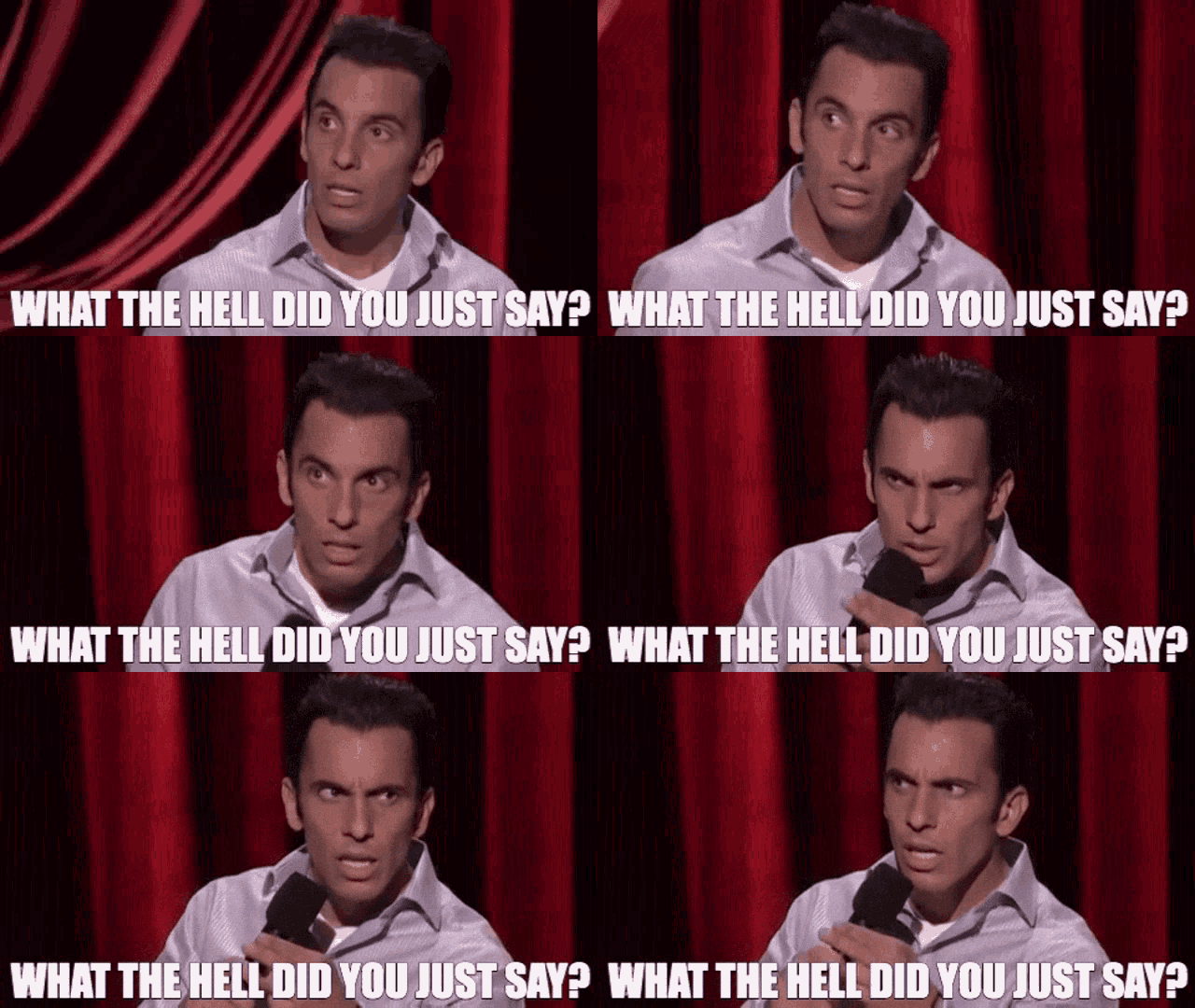
Sebastian Maniscalco Maniscalco GIF - Sebastian Maniscalco Maniscalco Wth -  Discover & Share GIFs

So here’s my new plan. I’ve thought for a long time that I would be an excellent inservice presenter. I’m good in front of a group of people, I speak well, I have a good sense of humor; and I think I know a fair amount about teaching, and could have some useful things to say to help make people improve as teachers and educators. 

But I would never get hired. Because no administration would want to buy my inservice program of “Let The Teachers Teach Whatever The Hell They Want To Because They Know Better Than You.” That system is not guaranteed to raise test scores, which is really the only reason why administrators bring in inservice presenters.

So this is what I’m going to do. I’m going to make the slickest presentation imaginable, about how I’m going to strip teachers of every shred they are clinging to of self-esteem or confidence, so that they will only do what they are told, and will never, ever, argue with their administrators ever again, no matter how inane or nonsensical are the programs and innovations those administrators come up with. And when I get hired to train a staff, I will get the administrators to leave me alone with the teachers – and then I will do nothing but praise those teachers, and honor them for the work they do and the dedication they put into it. I will thank them for everything they sacrifice to try to help their students. I will point out – because I think it’s important to remember – that students are the ones actually doing the work of learning, and that it is goddamn hard work; they deserve praise and honor as well, for every one of their victories large or small. I will help my audience of teachers see that the job of a teacher is to help students find the strength and the courage to keep working, even though the potential rewards of all of their very hard work are very far away and very abstract – and not always guaranteed, or even likely. I would encourage those teachers to talk to each other, and to their students, before they talk to any administrator, or any damn pedagogical expert, when looking for inspiration and guidance about how to create a new and better lesson for helping students get what they need. I would try to give the teachers the self-confidence to try new things, and to experiment, and to be honest with themselves and their students when they don’t know what the right answer is, or if the new thing they’re trying is the best thing: but they should try it anyway, and let students see them trying it, and thus encourage innovation and creativity and problem solving, along with honest reflection and assessment of one’s success. And I will tell those teachers to ignore every single test result, and every administrator who focuses on test results; and I will say that, if they do use standards, to remember that standards are only one small piece of a whole system of education, and they cannot ever be the most important one: because standards are not people. And education is people. Really, it is nothing but people.

And then, I will ask all of those teachers to go on Yelp or Google Reviews or whatever is the Google Pedagogy website (PedaGooglogy? We’ll workshop it.), and give me a five-star review, and lie and say that I helped them realize that they need to focus on nothing but standards in order to raise test scores, and they’ve never been so excited to do just that. 

And then I’ll use those reviews, and my slick sales pitch of a presentation, to go to another school, and do the same thing over again. 

Until I crash into the mountainside.

This Morning

This morning, I’m embarrassed: apparently my groundbreaking new idea for a school is — a Montessori school. And here I thought I was so clever. I guess it’s true that there are no new ideas, that everything’s already been thought of, and all we can do is change the wording or add a digital clock to it. (That’s an old joke now, of course. Who even has clocks any more?)

Well, this morning, I’m going to say the same thing I said when I realized that my first novel was strongly based on other books I’d read: So what? So what if the idea isn’t mine: I make it mine by spending my time and thought on it. I shape it, convert it, change it, even if it’s only a little bit — whoever first put digital clocks into stoves and coffeepots is responsible for making me aware of the time more than any damn clockmaker — and then it is no longer the story it was, it is the story I made it. Shakespeare didn’t come up with his stories, either — but he told them better than anyone else ever has, before or since.

(In case you’re wondering, my first novel was intentionally based on Harry Potter — 11-year-old boy with a sad home life finds out he’s one of a group of magical people — but about a third of the way into writing it, I also realized that it was a multi-layered narrative about a lonely kid, with a father but no mother, who reads books and tells stories and has vivid dreams of himself being a hero in a magical land called Illusia. Ever read The Neverending Story? Yeah, me too.)

So let’s get back to the matter at hand: my Montessori-rip-off dream school. In Sunday’s post I described how the school would work: students take individual units from subject-matter teachers, advancing to the next unit only when they master this unit, but able to schedule their units in any order and at any pace they like; and they graduate when they complete a set number of units. There will be more to graduation, because school is not (or should not be) solely about classwork, but today let’s focus on the most important part of this school of mine: the teachers.

That’s right: the teachers are the most important part of school. They’re not the only necessary part, because without students, a teacher is just a crazy person talking to desks and walls and making PowerPoint presentations in the darkest hours of the morning; but teachers are more important than students because one of us can provide for dozens and scores of them, and because one student is more easily replaceable than one  teacher. And if you are a student  and your feelings are hurt by that, deal with it; I said you were necessary. In an abstract sense, you are the heart of the school, because without you there is no reason to have a school; but the teachers are the bones of the school, because without them the whole thing falls apart into a puddle of inert goo. With a big beating heart in the middle of it, flopping around like a dying fish. Hope you like that image, students. (We need each other. I hope we all know it.)(I also hope that anyone my age clicks on that link and knows instantly why I picked it.)

So teachers: here’s the most important thing. At my school you will work only four days a week. There’ll be a full salary for those four days, and no required duties beyond them — though I will ask the teachers if they are willing to work more in exchange for more money, any extra duties will be entirely voluntary, and entirely compensated. I don’t know anything about school budgets, and where all the money goes; but I do know that every penny I could scrape together beyond the necessities like utility bills and rent and upkeep and insurance, every penny goes to the teachers. We’ll fund-raise for new books; teachers already do that, anyway. But the salary will be as high as I can possibly make it, partly because you deserve it, and partly because I need good teachers to handle this gig, because they’ll need to deal with a mixed-age class that changes every two weeks or so, and that sounds pretty nightmarish. (I also have a plan to make that easier, I hope.)

I’m a bit torn on salary increases: because I kind of want all teachers to be paid the same. There would be cost of living increases, of course, and like I said, there would be extra duties available; but I’m not sure that paying teachers more for experience is the best way to go. New teachers have a much harder time, so I would want them to be compensated well, and I know that paying experienced teachers more tends to push for more teacher turnover, which I don’t want. At the same time, I know that experienced teachers tend to be better teachers, and I would  want to reward that and retain them. I’m open to suggestions. For now, I think there’s one high, flat rate for all teachers.

I expect the teachers to teach within a single subject area. I think that’s better, because  we all have preferences and areas of expertise, and that’s what I want the students to have access to. The younger grades may get confused by multiple teachers, and they may miss the chance to bond with a single loving adult; but I want them focused on learning, not on how much they love Miss Johnson from first grade. Ever notice that? When my students talk about upper  grade teachers they’ve had, it almost always focuses on the subject, did that person teach them, did they learn anything; but elementary teachers, it always seems to be, “Oh, I loved Mr. Braunschweiger!” “Mrs. Colgate? I couldn’t stand her!” It’s the person, not the subject. I don’t like that. Now, I don’t expect first graders to plan their units and select their new schedules; I’ve got no problem with the units for the younger grades being directly prescribed by the teachers. But I want them to get used to seeing individual teachers as the experts of specific fields.

Within those fields, I would want the teachers to design their own units; some administrator (And all of my administrators will be former teachers, in genuine content areas, with several years of experience, preferably at different levels) will make sure all the standards are being touched upon, but I want the teachers to design the curriculum.

The curriculum will include English, social studies and humanities, science, math, languages, art, and Career and Technical Education. That’s right: no PE. I plan for there to be physical activity, but I see no need whatsoever for an ex-jock to yell at kids who don’t like playing baseball. THAT’S RIGHT, GYM TEACHERS, I’M LOOKING AT YOU. AND SAYING “NO.”

There will be no inservice. There will be no required professional development: I want teachers who love their subjects, and will learn more about the subject because they want to. I want teachers who will get better over time because they believe in the value of education and want to do it well; I don’t think that I need to stand over them and watch them do what I tell them to do, and then check a box. There will be observations in the classroom, but they will be frequent and always informal; basically just me coming to watch people teach well. If I see someone doing something I think is poor teaching, I’ll either talk to the teacher about it, or I will ask the department to look into it, and they can decide if the teacher needs help fixing a problem. Otherwise there will be no formal evaluations, no rating system, and good Lord, no merit pay.

I think that’s everything; the extra duties, and the bell schedule, and my PE replacement, and all the specifics about classes and graduation requirements, will all come in future posts.

How am I doing so far? Any teachers want to come work in my school?

Teaching the Teacher Teachers

I never want to be an administrator. I don’t like paperwork. I don’t like dealing with angry people. I don’t like solving people’s problems, unless their problem is, “How do you spell ‘necessary?'” I don’t really like making decisions that affect lots of other people, and I wouldn’t like listening to the bitching that would inevitably result. I know that sounds a little funny coming from a teacher, since I do all of those things; but all of them are less obnoxious for a teacher. I mean, yes, I have too much paperwork to do; but much of it is only seen by students, so the standards are not very high: what I write needs to be helpful, but it doesn’t need to be politic, nor even polite. My students laugh when I make fun of them in the comments. I don’t think the state department of education would chuckle if I put a troll-face meme on the Title I report. And yes, I do some problem solving, but really, most of it is related to my subject, which makes it easy for me to solve; when it isn’t related to my subject — and I have dealt with very different problems, romantic problems, job problems, serious personal issues like drugs and abuse and homelessness — then it is really just one person helping another, and has very little to do with my job. I mean, if a teenager came up to me while I was drinking coffee in a cafe and told me that he was being abused at home, I’d try to do all the same things I do as a teacher, so that doesn’t really feel like part of my job. And making decisions for other people, while also something I do, is something I can very easily dodge responsibility for — “We’re studying this because it’s in the curriculum.” Boom. Buck is passed.

By the same token, I wouldn’t want to be a teacher teacher. I wouldn’t want to teach teachers how to teach, not in a university setting, and not as an inservice trainer. I don’t want to be that guy. I don’t want to follow the current trends, and that’s all those people do; and I certainly wouldn’t want to be that superficially chipper about it. I mean, if I ran an inservice about something that was total bullshit — say, integrating STEM into a literature class, to pick a completely random example — I’d want to be honest, as I am with my students: “I know, guys, this is complete horseshit. But the administrators are making us do this, so let’s try to get through it and then we can do something fun, okay? Like read a poem, or have a debate on a controversial issue.” And if I did that, I’d get fired after the second sentence. If not the first. (Somehow, even though they are adults talking to adults, teacher trainers never let themselves swear. I suppose it’s more professional, but I heard a man, for the first time in my life, use the word “chump” in earnest. And of course it’s because he couldn’t say “asshole.” Or, considering the particular bro I’m talking about, he probably would have said “bitch.” But I’d have more respect for him if he’d sucked it up and said “asshole.” Though less respect if he’d said “bitch.” A little less.)

But despite not wanting those jobs myself, I’m going to give some advice to both administrators and teacher teachers, right now. Because all of those people, despite their general lack of qualifications in my field — their lack of knowledge, and their lack of expertise, skill, or insight — have no trouble at all telling me how to do my job. They do it several times a year, in fact. So now it’s time for me to tell them how to do their jobs.

All right, first, for the teacher trainers: know how to teach. I mean, come on; you are standing in front of a whole room, sometimes a large room, full of teachers. And yeah, a number of them may be new — but some of us have been doing this for a long time. And even among the newbies, many of us are actually quite good at it, and know the way it should be done. So why is it that almost none of you know what I know?

For instance: understand your technology. I get it if you’re bad at technology; I struggle with it sometimes, too. But if you’re going to use a PowerPoint presentation, then use it. There’s nothing more ridiculous than to watch someone skip through slides, saying, “No, we don’t need to go over that.” So then why is the slide there? Or when people set up those cool effects, fades in and out, bullet points that pop up one at a time; and then they just click through all of that stuff to get the final overstuffed slide, which they go through piece by piece. If all you want to do is throw a bunch of information up there all at once, why do the effects? It’s distracting, and it makes you look incompetent.

For another thing, know that you shouldn’t lecture for three hours straight. Give people a break. Include audience participation, maybe some group work. (I mean, I hate that crap, but most teachers are more social than I, and they like it; if you knew your audience, you would include some group work.) Certainly ask some questions, and listen to the answers; maybe have a discussion. Oh — and ice breakers. Don’t do ice breakers. Most of the teachers know each other, and you will never, ever see us again; you don’t need to know our names and what we teach and one wacky thing about ourselves. Don’t make us think of wacky factoids early in the morning the first day back from vacation. Don’t do it. If you really think the ice needs to be broken, then listen to the wisdom of Ogden Nash: “Candy is dandy; but liquor is quicker.”

And please, have basic competence. Speak audibly. Understand a microphone. Know how to make the image fullscreen. Understand how to make your movie clips work, and how to get sound out of them (And get an aux cord. Please don’t hold your microphone up to the laptop speakers, or even worse, crank the volume on the laptop and ask everyone to be real quiet.). Learn how to use the remote, OR DON’T USE IT. Grasp the physics of a whiteboard. Have your materials prepared ahead of time, and make sure they’re the right materials. (All of these, by the way, are things I have seen presenters fail to do, over the course of my 17 years in inservice — errr, I mean teaching. No — I mean Hell.)

Once you get past the same level of presentation competence that I expect from my students, let’s talk about what you’re talking about. Make sure that your presentation is relevant. I know you want the gig — I want to get paid, too! — but I would never take a job as a physics teacher and then show up and talk about poetry. If you are doing an inservice at a high school, don’t talk about elementary school techniques and concepts. Don’t present on English language learners to a school that has a grand total of four of them. I mean, that’s the administration’s fault, too, for hiring you to talk about something essentially irrelevant — but you’re the one that has to stand up there and waste the teachers’ time; I have to think that much hatred focused all on you at once has to be uncomfortable. And if a faculty has already learned everything you have to talk about, don’t go talk to them about it again. Think of something new to say, or cancel the inservice.

Once you know that your subject is relevant, the last key is: talk about your actual subject. Don’t talk about yourself. I’m sure you have fascinating stories about yourself, about your martial arts experience, or your motorcycle, or your world travels, or your penchant for organic gardening (All of those, by the way, were discussed by the same speaker. The only lie in that sentence is the word “fascinating.”), but now is not the time. Teachers, if you didn’t know, have shit to do, especially at the beginning of a semester. We don’t appreciate having our time taken up learning about you and how unbelievably macho you are (“I was doing MMA before MMA was a thing.” Actually, I swear to you, a direct quote. He also used the word “vicarious” when he meant “precarious,” in the sentence, “Now you have put them in a vicarious situation.” I don’t mean to nitpick, but this guy was actually a nit, and he should have been picked, squashed, and flicked at a garbage can. Too harsh? Hang on; there’s more.). Also, don’t insult your audience by saying that you are smarter than them because you got out of teaching (Same guy.), and don’t tell them that anyone who doesn’t sign up for your other, more extensive training is stupid (Yup: also the same guy. Want to guess what precipitated this particular blog?). And I know this is out there — the very idea that someone would actually do this is laughable! — but don’t compare teaching to slaughtering chickens, with the analogy showing how teachers get jaded — just like someone who has cut the heads off of too many chickens.

I really want to say that was a different guy. It wasn’t. Gave a three-hour talk, nonstop, no break, and at the end of it, asked if there were any questions. (By the way: this one is for the teachers in the audience. If, at the end of a multi-hour presentation, the presenter asks if there are any questions, then anyone who actually asks a question, thereby making us all sit there longer and listen to more inanity, is going to go straight to Hell, where they will be strapped into an Iron Maiden and forced to listen to presentations about the variations of Mahjongg, written in Sanskrit and then run through Google translate and read aloud by a drunk with no teeth. Keep your damn questions to yourself. Go up and ask them personally if you have to — AFTER THE REST OF US HAVE LEFT.) The question that was asked (And even though this was a good question, still: straight to Hell.) was basically, “So did you ever tell us the thing we actually need to know?”

To which the answer was, No. He did not. He proceeded to do so, taking about five minutes, which tells me that the entire presentation could have been done in about fifteen minutes, total. In fact, I could do the presentation more effectively in a series of haiku. (No, I won’t torment you with the actual haiku; this was still an education inservice, and nobody who isn’t a teacher should ever go through that, even as a joke.) But then we wouldn’t have heard about his experience pouring concrete, which is what led him into the world of education. Yes, I’m serious.

Administrators: I really only have one piece of advice. Don’t ever hire that guy. Everything else is relatively acceptable. Just. Not. Him.