I Wish for Each

“Congress shall make no law respecting an establishment of religion, or prohibiting the free exercise thereof; or abridging the freedom of speech, or of the press; or the right of the people peaceably to assemble, and to petition the Government for a redress of grievances.”

So all right. We’ve been hearing a lot about this lately, right? Those are the words of the First Amendment to the Constitution. But what does it mean?

What is free speech?

Does it mean anybody can say anything they want? Anything? Or are there limitations? Should there be?

Does it only apply in American? Only to citizens? Does it apply differently to public figures, to famous people?

And why the hell are we still talking about this? Do we not know what it means? Shouldn’t we know what it means by now? I mean, really?

Okay: well first, let me just address that. I do not think there is anything wrong with having a conversation again. I don’t believe that something can be talked through once, and then that’s it, and we all know everything there is to know, and there’s no need to bring it up again. I understand that people get tired of having the same conversation over and over again, but you see, I’m a high school teacher: my whole job is essentially to have the same conversation over and over and over again. From one year to the next, from one class to the next, from one student to the next, I have to continuously repeat myself, and that often means I have to continuously find new ways to say the same things I have said before. The fact that I am willing to do that, even eager to do that, is what makes me a good teacher: because if I got impatient with students who didn’t hear or didn’t understand what I said to another student, then nobody would learn after the first student. I confess that I do get tired of saying the same things to the same people over and over again, but that’s not the same thing as having the same conversation: that is stating the rules, the limits and boundaries which are necessary for us to live and work together and abide one another, and then stating them again because some childish, selfish person decided they didn’t have to follow the rules. And then I repeat myself: and then I get angry about it.

But if you didn’t understand what I said before? I will say it again. If you don’t understand it after the second time, I will say it a third time, in different words or with different examples. And I will keep repeating it until it is clear and fully understood. And then, when you have a new thought or a new experience, and that changes how you view what we talked about before, I will happily talk about it again: perhaps after I have thought about it some more, to integrate whatever new concept or perspective you brought into it today, apart from what we discussed yesterday. No problem.

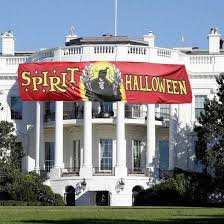
We seem to still be having trouble with freedom of speech. We are still talking about it, still debating it, still disagreeing over it; and now we are doing this in the wake of Charlie Kirk’s death. In that wake, and, I suspect, pretty directly related to that terrible crime, my wife was censored by Facebook, because someone reported a post she shared about Trump, calling it spreading misinformation. It was not, it was simply a joking criticism of the administration; specifically, it was this:
Exploring Shutdown Day 1: Discovering New Perspectives

My working assumption is that the person who reported her post was a Trump supporter, angered (as always) by libs and the left and so on, and recently energized by Kirk’s murder and the gaslighting from the right, convincing people to take action now to defend free speech (And please stop talking about the Epstein files and the still ongoing wars in Gaza and the Ukraine and the swiftly tanking U.S. economy), who probably reports every left-leaning or Trump-criticizing meme they see. Probably laughing while they do it. Facebook, as a private company that doesn’t want to suffer the wrath of the Trump administration, not only took down my wife’s post, but has also been monitoring and restricting her posts ever since: they are limiting her free speech. These new situations — unique neither to Charlie Kirk nor to my wife — has given people a new perspective on the issue, so: let’s talk about it again.

Here. This is where we start.

“Congress shall make no law respecting an establishment of religion, or prohibiting the free exercise thereof; or abridging the freedom of speech, or of the press; or the right of the people peaceably to assemble, and to petition the Government for a redress of grievances.”

Okay, so the First Amendment actually says a lot of things. It restricts Congress’s ability to control religion, and the press, and peaceable assembly, and the right to petition, all in addition to the freedom of speech. Let’s put those other aside for now: though it may be worth considering why all of those different, and all of those important, ideas were all packed together into a single amendment, and then the next one is only on one issue: guns. And the one after that is only about not letting soldiers sleep in your house against your will. Both important, maybe (though neither as important as freedom of speech) but both very narrow topics. Why are all these other things together in one place? Honestly, I haven’t read enough on the Founding Fathers and their choices regarding the Bill of Rights, so I could only speculate; but either way, we can ignore this topic for now, because we’re only here talking about the freedom of speech (and the others will become more clear as we focus just on speech, I think). Freedom of the press might come into it directly if we want to talk about Jimmy Kimmel, but it’s not clear to me that that discussion needs to involve anything other than free speech; that one right seems enough to cover what happened there. So let’s focus.

What is freedom of speech? Why do we have a right to it?

So hot take: freedom of speech is not actually critical. It is a roundabout way to protect the actually critical thing — or rather, two critical things: freedom of thought, and freedom to express those thoughts. Freedom of thought is absolutely critical to humanity, because in the most essential sense, we are our thoughts. I am what happens inside my skull. My body is also a critical part of me, but if I have a broken body, I am still me, because it doesn’t change what is inside my skull. It changes how well I can act out and reflect the decisions I make inside my skull — my freedom to express my thoughts — but it doesn’t change who I am. But if my brain dies, then who I am is gone, even if my body remains. My body can’t express my thoughts if I have no more thoughts: and without those thoughts, there is nothing for my body to express, no purpose for it to achieve; it can continue for a period of time, and then it will, mercifully, stop.

I wonder if my body would be sad if my brain died. Would my body grieve the loss of my mind?

Well: I would grieve the loss of my mind, so the question of my body’s reaction is academic. It is a part of me.

Now, in the ordinary way of things, there is nothing that could limit my freedom of thought. It’s one of the great things about being a sentient, thinking being; on that most essential level, we are always free. (Well, almost.) It’s because we are always essentially alone, and because there is no substance to thoughts: they can dance and flit anywhere we can imagine, always within the skull that holds the brain; and nothing will change other than the thoughts themselves — and potentially the mind having those thoughts. Nothing else is affected, and so nothing else can affect those thoughts: they can dance and flit to anywhere else, faster than anything that actually exists. Nobody else will even ever know where our thoughts are going, inside our minds. This was what Henry David Thoreau was talking about in On Civil Disobedience, when he described the inability of the state to actually punish him with a night in prison after he refused to pay his taxes:

I could not but smile to see how industriously they locked the door on my meditations, which followed them out again without let or hindrance, and they were really all that was dangerous. As they could not reach me, they had resolved to punish my body; just as boys, if they cannot come at some person against whom they have a spite, will abuse his dog. I saw that the State was half-witted, that it was timid as a lone woman with her silver spoons, and that it did not know its friends from its foes, and I lost all my remaining respect for it, and pitied it. Source

As he says, his thoughts cannot be trapped inside the cell, but can go anywhere that Thoreau wishes to send them: and the attempt to punish his body because they cannot punish his mind is just pitiable. What the State wants here is to control his thoughts, because they want to control Thoreau’s actions through his decision-making ability. Because their initial attempt to control his actions, through a threat to his body’s freedom if he made a certain decision the way the State didn’t want him to decide, didn’t work: knowing the threat, Thoreau still decided not to pay his taxes. His thoughts were uncontrolled, and his person/body/being followed along that thought decision, and didn’t pay his taxes. So then the State put him in jail: and he just kept right on deciding not to pay his taxes, regardless of what they did to his body. His thoughts were entirely unaffected, and uncontrolled, and they did the thing that the State didn’t want them to do — without any influence from the State at all. And so we all do, every thought we have that is in defiance of what our society demands of us. We are free to think whatever the fuck we want to, even the thoughts we’re not supposed to have, or not allowed to have.

Please take a moment and think a thought or two, which people outside of your head would not allow you to have, if they could tell you what to think. Any thought you like. Any thought at all.

Nice.

So because nobody can control a person’s thoughts, the laws focus on the second critical part of the process of having a free mind: the expression of our thoughts. Free speech, and in a broader context, free expression. Let me focus on that second aspect for a moment, because it shows more clearly what the point is here.

I can have my thoughts, and you can’t stop me. So far so good. But obviously, if I can’t act on those thoughts, then my thoughts cannot be complete. If, for instance, I think about spitting on the sidewalk, decide to spit on the sidewalk, but I cannot spit on the sidewalk — at the moment that is just because there is no sidewalk near me; I could spit on the floor of my office and call it a sidewalk, and to some extent I would have acted out my thought, and brought that thought to its completion, but then I would have to deal with my spittle, and also my wife would kick my ass — so I don’t spit: and thus the thought is not free, it is limited. I think, “I’m going to spit on the sidewalk!” and then I can’t do it: the thought is constrained. When the thought is constrained by reality — “I want to grow nine arms and use them to juggle chainsaws!” — then again, my thought is not free, but there’s no point in talking about our freedom to do things that we can’t do, or the need to pass laws to prevent things that are not possible. At that point, all we can do is shrug, and say, “It sucks to suck, Dusty. But you go ahead and dream of nine chainsaw-juggling arms, that’s fine, you can think about it all you want.” Freedom of thought is still protected, because I can carry the juggling arms thought as far as it can go; and as thought is still the most essential aspect of being human, that’s fine then. Thoreau can think that his taxes should not be collected by a government that supports both human chattel slavery and a war of conquest against Mexico (the reasons Thoreau didn’t pay his taxes), and if the action is not possible — if taxes didn’t exist and so he couldn’t choose to pay them or not to pay them — then he has all the freedom he could ever have.

But see, what happened is, Thoreau’s aunt paid his taxes for him, against his will. I don’t know why: I suspect she either thought he was suffering in jail and wanted to help him, or she was ashamed that her nephew was in jail, and wanted him to stop embarrassing her. (I would guess the second one, because she did not consult with him before she did it, and if she wanted to help, seems like she would at least visit and ask if he was okay.) Which then limited his free expression of his thoughts: he could think his money shouldn’t go to the government, and he could decide not to give his money to the government; but the government got his money anyway. Not because it was impossible for the government to have his money, but because someone else took his choice away. I guess it wasn’t really his money, it was his aunt’s money; but Thoreau’s idea was not to save his own pocket change, it was to refuse to participate in the government’s immoral acts, and when money went to the government in his name, it defied and negated his decision. Imagine if he talked to someone about not paying his taxes, if he argued with the government tax collector about the issue, and expressed his disagreement with the government, and said, “I will never contribute to this immorality, sir!” Can’t you just see the agent smirking and saying, “Sure, buddy. I mean, we already have your money, so you can say what you want.” Thoreau’s thought, while still free, has been constrained in its expression: and that pretty much ruins the thought; a thought which was not constrained by impossibility, it was possible, and he could have acted upon it — but then the option was taken away.

This is why, of course, jail is actually a very effective punishment for most people: because while we are all free to think our way out of jail, I would guess most people in jail want to walk out of jail: and they can’t. Which means their thoughts, while potentially free, are nonetheless really trapped along with their bodies. It is worth noting that, if you can find a way to free your thoughts, then prison wouldn’t matter so much; it would become a struggle to try to force you, through continued discomfort, to think about being in prison and how much you don’t want to be; then your thoughts are controlled, and trapped, and you are suffering for your punishment. But when Malcolm X was in prison, he found freedom in learning: and he talked in his autobiography about how prison really didn’t bother him at all, once he taught himself how to read and found things worth reading — and also once he found his faith in Islam, which also gave him something to think about that wasn’t constrained by being in a cell.

I have often reflected upon the new vistas that reading opened to me. I knew right there in
prison that reading had changed forever the course of my life. As I see it today, the ability to read
awoke inside me some long dormant craving to be mentally alive. I certainly wasn’t seeking any
degree, the way a college confers a status symbol upon its students. My homemade education gave
me, with every additional book that I read, a little bit more sensitivity to the deafness, dumbness,
and blindness that was afflicting the black race in America. Not long ago, an English writer
telephoned me from London, asking questions. One was, “What’s your alma mater?” I told him,
“Books.” You will never catch me with a free fifteen minutes in which I’m not studying something I
feel might be able to help the black man.

But I’m digressing. I told the Englishman that my alma mater was books, a good library. Every
time I catch a plane, I have with me a book that I want to read-and that’s a lot of books these days.
If! weren’t out here every day battling the white man, I could spend the rest of my life reading, just
satisfying my curiosity – because you can hardly mention anything I’m not curious about. I don’t
think anybody ever got more out of going to prison than I did. In fact, prison enabled me to study
far more intensively than I would have if my life had gone differently and I had attended some
college. I imagine that one of the biggest troubles with colleges is there are too many distractions,
too much panty-raiding, fraternities, and boola-boola and all of that. Where else but in a prison
could I have attacked my ignorance by being able to study intensely sometimes as much as fifteen
hours a day? Source

So again: the real goal of punishment, the only kind that is possible being constraint of the body, is to control the mind; and if the mind is able to continue thinking, then the constraint of the body is essentially meaningless. But in the vast majority of cases — and also, I will point out, in these two cases I have mentioned, because I don’t doubt that at some point Thoreau would have wanted to get out of jail and therefore would have felt trapped, and therefore actually would have been trapped, and Malcolm X would have been severely constrained if he had not been released to become the leader he became — trapping the body, because it limits the expression of thoughts, is an effective way to control a person’s thoughts. And even more importantly, for the purposes of society in general, constraining someone’s actions, the expression of their thoughts, is enough, because the purpose of prison is to stop a person from affecting others, and thoughts have no effect without expression. So just like I accept that I can’t ever have those juggling arms I dreamed of, society accepts that it can’t ever control our thoughts: and it just makes do with having potentially total control over our bodies.

And that’s where the amendment comes in.

I hope it is clear that thought without expression through the body, whether through action, through communication, or through a public display of some kind, is incomplete, and more importantly, useless. A useless thought is not a bad thought: all impossible thoughts are useless in and of themselves, which includes every dream, every fantasy, and every imagined existence; but they can still have enormous impact; and even if they don’t, they can encapsulate important things about the person who thought them, and that’s good, even if that encapsulated thought never reaches outside the mind that dreamed it. But when society wants to control us, controlling the impact we can have on other people is the primary goal and thus also the primary means of controlling people and the thoughts that define us. And that’s why the Founding Fathers included an Amendment that protects free expression in several different forms, most importantly speech and press and peaceable assembly.

Let me be clear now: the Founding Fathers were not always right. You don’t have to look any further than chattel slavery to know that they and their ideas, and the documents and the nation that they built, were fundamentally flawed, right from the beginning. There were some bad thoughts in there, and we’re still dealing with the legacy of those bad thoughts. But they were right in this: government wants to control people, and that means they need to control our thoughts — but they can only control our bodies, which is what they try to do. The First Amendment is there to set a baseline protecting our thoughts, through protecting the only things the government can attack and control, which is our actions.

So that is the essence of the Amendment, and the right: we have the right to express our thoughts, freely. The government cannot control our expression of those thoughts, so long as the thoughts do not have a direct impact on others in a way the government can control, and should control. In other words, if I decide to pick up a rifle and shoot someone I disagree with, that is no longer simply the expression of my thought, now it is an attack on another person, and it can be controlled, and should be because it is harmful. Though I will point out that, to some extent, the expression of that thought can’t always be controlled; sometimes it can only be reacted to after I have already done the thing I decided to do. But insofar as it can be predicted, and thus prevented, it should be.

Do I need to talk about why I shouldn’t have the unfettered ability to inflict harm on my fellow humans? Or can I assume we’re all on board with that? Just for the sake of saying it, the issue is that I have no right to control other people’s thoughts, nor their expression of their thoughts, except in the service of preventing harm. If I do harm to another person, I am affecting their ability to express and complete their thoughts, or possibly even their ability to think thoughts in the first place. If I am the one looking to do harm, not just prevent harm, then someone should have the ability and the right to stop me before I do harm.

Should that be the government? My first thought was to say that of course it should be; that this is the reason why we create governments and cede to them the power to control us: so they can prevent us from doing harm to one another. But government is frequently bad at this, and in that case, maybe other people and other authorities should have that power, that right, that responsibility, to prevent my harmful actions. But this is where we get into a conversation about how society should work, and that’s too complicated for right now. Suffice to say that the government, as imagined by the Founding Fathers — that is, existing with the consent of the governed — is a reasonable place to invest the power to control people’s obviously harmful actions. I would like to expand on the FF’s ideas about the governed who were consenting to the government, to include all of those who are governed, which would include people they didn’t consider worthy of consideration, or even consider to be people; it would also include all those who reside within the jurisdiction of the government in question, and who would be subject to the government’s control: those people should be considered “governed,” and therefore should be asked for consent to the government over them. Yes, that means undocumented migrants as well as those who don’t have full legal status. And also suspects, convicts, prisoners and parolees, all those governed by the justice system: they, too, must consent to the government over them, or else it becomes illegitimate and tyrannical.

And to be clear, when I say “consent,” I mean continuous, affirmative, and enthusiastic consent. The only kind of consent that matters.

Also at this point, I would like to express my burning volcanic rage that the First Amendment does not include the right to vote. What the actual FUCK, Madison? Why did you leave that one out?

It was the slaves, wasn’t it.

So all right: we should give the government the power to control our actions which can be harmful (and which can be controlled): but we retain the power to consent to be governed, and also the power to abolish the government if it becomes destructive of the ends we created it for, ideally through voting in free and fair elections. Since the government exists with our consent, what one thing do we most clearly need in order to legitimize that government?

A voice. The power to say “Yes,” and the power to say “No,” and to have those words heard. The power to consent, in the simplest terms. Continuous, affirmative, enthusiastic consent. If we don’t have that power, the government has taken too much control and has lost its legitimate authority, and should then be abolished: and that is the intent of the First Amendment, to protect and enshrine, first and foremost, our power to keep or abolish our government, which would otherwise have unchecked power over us.

You know: the power to vote. But in the absence of that, the power at least to speak, and to be heard. Not just to think freely, but to actually express those thoughts. The power to spit on the sidewalk. And on fascists.

So. Now. Did Charlie Kirk have freedom of speech? He did, and he should have: he spoke, and was heard. He lost that freedom when another person caused harm to him, murdered him, in an act that our government should have done all it could to prevent. Was Charlie Kirk a promoter, and therefore a martyr, for the cause of free speech? He was not: it was not his job to protect people’s right to free thought nor to free speech as an expression of their thoughts; inasmuch as he encouraged free thought and the free exchange of ideas through debate, then he was a proponent of free speech; but watching his debates makes it very quickly clear that he was not interested in the expression and free exchange of ideas, he was interested in scoring points and (as my students would say) farming aura: trying to get famous and powerful because he was seen as a staunch defender of his political and religious views. This is no criticism of the man: I would also like to get famous and powerful using my words, though I’d probably rather write than speak; but I want the same thing. But it does mean he was not a martyr for the cause of free speech, because free speech was not his cause: it was the means by which he tried to achieve his purpose, to fight for his cause. He shouldn’t have had to defend his free speech, he should have simply been able to exercise it. And just like Charlie Kirk, as a private citizen, it is not my job to protect free speech directly: that is what the government is for. To secure these rights, to Life, Liberty, and the Pursuit of Happiness.

Let me emphasize that again, because we talk about free speech as though it is just something that needs to be protected from the infringement of the government on our rights, that the point of the First Amendment is to constrain the government from taking away our free speech; the First Amendment is that thing, that is its point — but also, the real point of the amendment is to tell the government that it should be working to protect and secure that right for all people within its jurisdiction and influence. Actively. Affirmatively. Enthusiastically. Continuously.

Which means, in practical terms, that the government should not only have done more to protect Charlie Kirk from being murdered (if we believe the government could have done more to prevent that, which I think is self-evident, but that’s not the argument I’m making here), but also, it should be doing more to ensure that all people under the jurisdiction of the U.S. government, all persons resident in this country and under its control around the world, have the opportunity to be heard, to express their thoughts freely. By publishing their opposition to the war and genocide in Gaza, without losing their legal status. To have their case heard before an immigration judge, through the due process of law. Through posting whatever the fuck you want on social media, even if other people don’t like it, so long as it is not actively, directly causing harm. Through speech, through the press, through petition, through peaceable assembly.

Which means the government should have kept the Fairness Doctrine. And in this modern era, the government should ensure that social media does not censor people’s free speech, so long as that speech does no harm. In fact, I would argue that the government should have a platform for people to be heard, to be seen, to which all people who must consent to the government over them have access. I would include NPR, PBS, and VOA among those platforms, but I would argue the government should also provide some simple form of social media, to at least offer an alternative to the private companies, which are all controlled by billionaires with agendas. I don’t think the government should seek to control the social media companies per se, but they have a responsibility to ensure our rights: including the right to speak our thoughts, online as well as through print and speech. The government should also protect protestors and ensure that they have the right to assemble and petition for redress of grievances, so long as they are peaceable in that assembly.

Yes, that last clause, as well as the earlier condition that speech should be protected as long as it does no harm, does create an opportunity for the government to limit free speech, depending on what we mean by speech that does harm, or by peaceable assembly. I think the current laws distinguishing between protest and riot, and the laws preventing libel and slander, make sense and should remain (I don’t know enough about the specific laws and so can’t speak to their current efficacy, but conceptually, I’m in favor), and where these two rights cross over, with the law preventing speech that incites to violence, is also a useful law that protects people from harm. I also think there should be a gray area around and beyond those laws (Does “Fight like hell or you won’t have a country” count as incitement to violence? I honestly can’t say, not without further evidence of intent and context. If only there had been a trial…), and that the burden of proof within that gray area should definitely be on the government, as the ones who enact the control of people’s speech, to show that someone lost their right because they were causing harm with their speech. We have a system in place to carry out that process: but we need to have people in the government who are dedicated to maintaining and using that system.

We do not currently have that. We have an authoritarian who wants to eliminate free speech because he doesn’t want anyone to have rights except himself. We have a legislature that agrees with him, completely and slavishly — they are not expressing their thoughts, they are expressing only his. (The opposition, presumably, is not expressing the authoritarian’s thoughts. We just need to find where that opposition is hiding…) We have a Supreme Court that also thinks no one should have rights other than the President, and themselves, because they think their trump card over Trump (pun obviously intended, as all puns should be — also, we should have a right to pun…No, we do have a right to pun, and it should be protected by the government.) enables them to live as exceptions to the dictatorial power they want to give him, and they like the idea that a dictator could enhance the lives of the people whom they (the “justices”) deem worthy of enhancement, and destroy the lives of those whom they deem worthy of destruction, without they themselves dirtying their lil fingies. They’re wrong, of course, because if Trump ever did become a dictator, he would end up killing or jailing the justices because they have defied him in the past, and no dictator can abide that kind of challenge to their power; but then, all of these people are wrong. They all think that the dictator would only use power the way they want him to use power, and that’s not how dictatorship works.

Please take note, all you MAGA voters who want Trump to hurt the people you hate, but not you yourself. That’s not how dictatorship works. He doesn’t dance to your tune. If the Supreme Leader is the only one with rights, then we will no longer have rights ourselves: not the right to life, not the right to liberty, not the right to the pursuit of happiness. We will then not have the right to express our thoughts through speech or writing, through assembly and protest and petition; more importantly, we will no longer have the right to consent, and though that immediately means the government will no longer be legitimate, it also means that we won’t have the ability to remove it without violence.

That is where the Second Amendment comes in. It is not, as the fools who care only about that one and not the First would have us all believe, the right which ensures all the others; that is the First Amendment. It is free speech. It is the power to consent, and to withdraw consent. The practical power that enforces the moral and intellectual power is the right to communicate, to agree, to assemble and stand together: that is what changes governments. (Also, if we don’t lose it, the right to vote. Tell me why the right to free exercise of religion usurped the place that should have gone to the ballot, I beg you.) The right to defend ourselves physically is the last resort when the first one has been lost: and every one of those gun rights advocates, from the rational ones to the chuckleheads, have been ignoring the infringement of the First Amendment while trying to protect the Second. Protecting it, I might add, through their right to free speech.

So. Free speech is not only important, it is critical, it is definitive, both to us as humans, and to our country as a free country, with government of the people, by the people, for the people. It is the most important right we have, and it is the best way to delegitimize, remove, and replace the current government, which I think we can say safely does not have our consent any longer to govern us, taking “our” and “us” in the largest collective sense, meaning the majority of people governed by this administration. The government should not only not be infringing on it, the government should be actively protecting and promoting it: that is the government’s job, the reason it exists, and the best way to ensure that the other rights are also maintained. Because free speech leads to the free exchange of ideas and information, to the shining of a light into the darkness where tyranny grows. It’s what lets us all communicate and understand each other, and then agree: and take action.

Before it’s too late.
The Truth

Me (far right) as a janitor
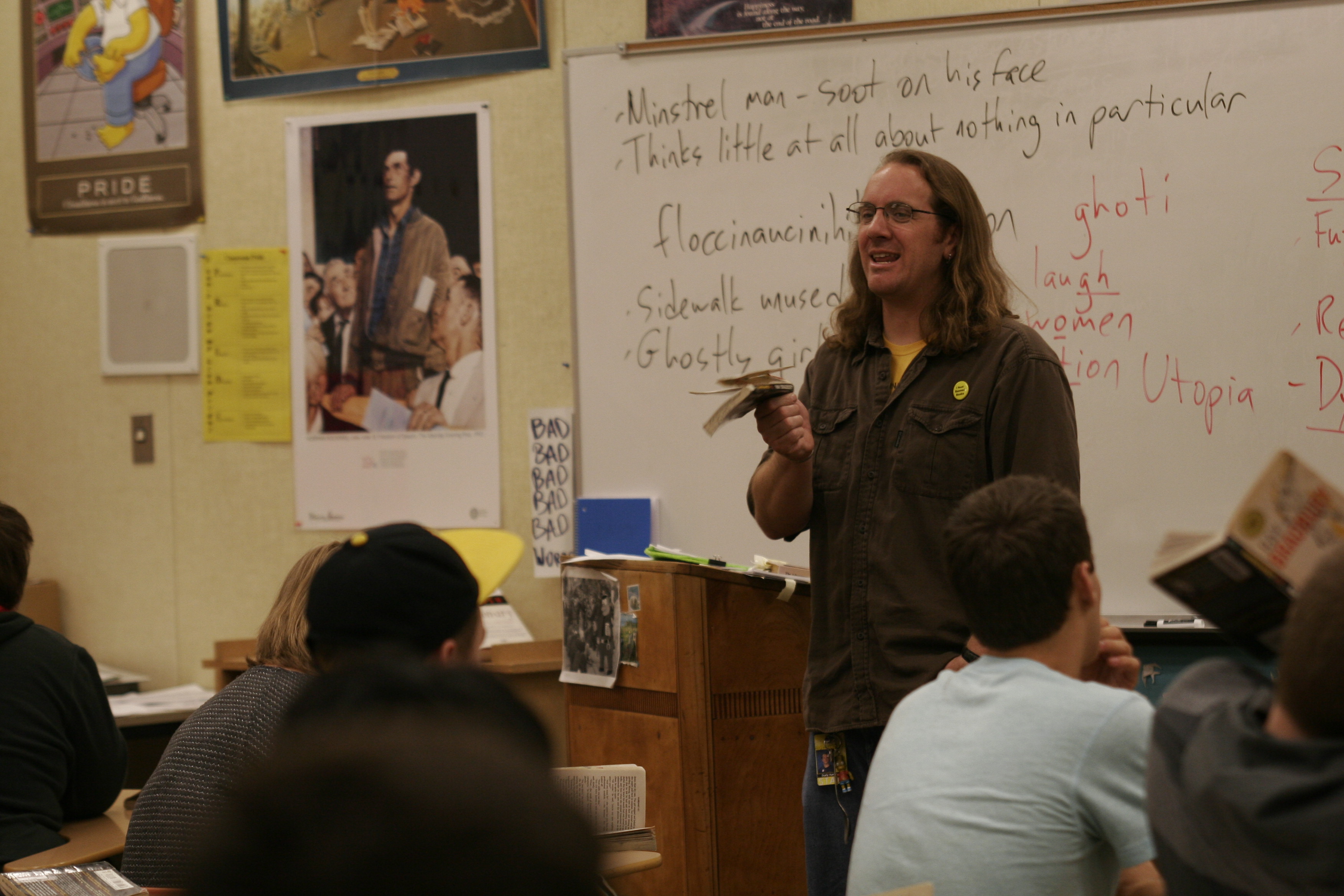
Me as a high school English teacher. Which one looks happier?

I have been a high school teacher for a very long time. Too long, in some ways, because I have watched education change enough in that time to make me very nearly obsolete, and if you stay in a job until your job doesn’t exist any more, that’s too long. I fear that the day is coming when English teachers will not exist: and possibly the day when teachers will not exist.

I’m here today to try to forestall that day. Not for myself – if I reach a point where I cannot teach, I will move into janitorial work, and be quite happy; probably happier than I have been as a teacher. After 25 years of cleaning up student writing, I would rather clean up public restrooms. It’s less work.

But it’s also less important work. Not unimportant work, it’s incredibly important because janitors keep our world working, and keep it livable – but for me, as someone who works in education, that work is more important. I’m just saying custodial work is a good backup for me. I worked in maintenance for five years before I became a teacher, and I liked it. In some ways more than teaching.

So if I liked being a janitor more, you may be thinking, why am I a teacher? And why do I still like and sometimes love being a teacher, despite the issues in education that I deal with every day?

It’s because I love humanity. I think we are incredible. I believe we have infinite potential for goodness, and infinite capacity for wonder. What we have achieved as a race is miraculous – and also sometimes terrible – and despite our almost limitless ability to dream and imagine, we can’t imagine how many more miracles we can achieve. And, hopefully, how many terrors we can avoid, or even eliminate, in the future.

And the key to that, the key to unlocking our potential and achieving progress and positive growth, and to actually making miracles real, is education.

That’s why I’m a teacher. Because my faith, my zeal, my heartfelt belief, is this: the best thing about all of us is that we are human, and the most important thing one can do is help us all become better humans. That’s what I try to do as a teacher. And that’s why I’m here today, speaking to all of you about school. Because I want to help you all to learn something about which you have been deceived – or at least misled. I don’t think any of you really understand what school is or should be – and what you think it is, what you have been told the purpose of school is? That’s a lie.

The lie is that school is about money. All of you students have been told that the purpose of school, the reason you are here and the reason you should try hard and do all of your work, is because that way you can get into a good college, get a good job, and make good money. You’ve been told that all along – though in elementary school it may not have been stated explicitly; but back then you were certainly told, with absolute sincerity, that the purpose of your schooling was to prepare you for the next step, which would be harder, and would matter more: 2nd grade is meant to get you ready for the rigors of 3rd grade, 3rd grade gets you ready for 4th; all of elementary school is preparation for middle school, which is preparation for high school. And all the way along, more often the farther you get in your thirteen years of compulsory schooling, you have been told that the goal of high school is to get you ready to go to college. So that you can get a degree, so you can get a good job, so you can make good money. And since schools also tell you that the next stage is always more important than the current one – “When you get to high school, things get serious, that’s when grades really matter” – the clear implication is that the final goal is the one that really, really matters: college, degree, money. Did you absorb the message in 2nd grade that everything then was intended to prepare you for college and a job and good money? Maybe not, but the cumulative effect of all of this is the same: the goal of school is – money.

Teachers, and especially administrators, you have said this. You have said it to all of your students, probably with certainty, certainly with absolute sincerity. All of you have lied. All of you have misled all of your students. Don’t feel bad: it’s what you were taught, what you were told, what the whole apparatus and engine of the educational system forced on you. So you didn’t know, you couldn’t even think, that it might be a lie. This is some of the power of education: it can influence our beliefs, and therefore our behavior, in pernicious ways as well as positive ones. As always, the pernicious influence is easier. The idea that school is intended to help students make more money is a pernicious lie, and I need to convince you to stop saying it, to stop thinking it.

Don’t take this as a personal attack, either, teachers: I’ve said this too. With certainty. With absolute sincerity. Because it’s what I thought, and it’s what I was taught. But luckily for me, I had an extra advantage that most teachers don’t have, something that helped me realize the truth: I’m an artist. And I’m married to an artist.

My wife and I both went to college to study art. And though I ended up studying education – one of the more useless endeavors of my life – I earned my degree in art, specifically in literature. My wife, who is stronger and braver and smarter and better than I am, stayed with art all the way through. And she had one of the most difficult undergraduate programs I’ve ever heard of; harder than any pre-law or pre-med program, I would be willing to wager, and with far less prestige.

And here’s the thing, the magic secret: she didn’t do it for the money. Neither did I – though I did sell out and become a teacher. Actually, it’s not the becoming a teacher that was selling out; I still reflect and promote the ideas of my art in my teaching, and I am proud of the career I have had, because it is a noble vocation, when it is done right. But I should have kept studying art while I was in school. I hate to think of the potential I lost, the opportunities I walked away from by switching from literature to education. And it’s funny: just as my time in public school didn’t prepare me successfully for college, my college education didn’t prepare me successfully for my career in public school education. The time I spent studying art was far more useful to my teaching than my training in how to be a teacher.

It was in teacher training that I was first trained in the Big Lie, though of course I heard it in some form or other all the way through my own K-12 schooling: the idea that the purpose of school is to get students higher incomes than they would get without it. I was shown the statistics, the data, the graphs, that argue that college graduates make more money, on the average, than non-college graduates. I was shown this, and told to use it on my students, because it’s one of the most effective ways to get students to take school seriously, to work hard and therefore (incidentally) to learn. I assume that’s why all trained educators in this country have been shown the same data: because scaring children with threats about their future is effective. It’s cruel, essentially abusive, and it has some quite severe secondary and unintended consequences, as we are now discovering; but it’s effective. It makes those lazy little punks – that’s you, students – work harder and try more. At least some of them. At least some of the time.

Look: you can’t blame us. Teaching is hard. Everything about it is hard. Organizing curriculum is hard, planning lessons is hard, finding and adapting materials is hard. It’s hard to stand in front of a room and command attention, let alone respect. It’s hard to manage a room full of individual people and get them all to focus, together, on one thing. It’s hard to communicate clearly, and hard to understand children who haven’t yet learned to communicate clearly.

(Let me just say one thing to all the students here: speak up. I’m old; I’ve lost some of my hearing. I cannot understand you when you whisper, when you mumble. Whatever you have to say to me: speak up, please.

(And I’ll try to talk slower.)

And then, after completing all of those difficult tasks, teachers run into the biggest difficulty of all, the one that feels insurmountable: getting the students to do the work. We create this curriculum, design these lessons to deliver it, gather the materials, summon all of our strength, invent positive energy from somewhere, and teach our hearts out: and then all of you students, just – don’t do it. There are many individual reasons why you don’t do it, but in a large number of instances, maybe more common than any other, the reason you don’t do the work is just because you don’t want to. You don’t feel like it. You don’t see the point. You don’t think it matters. You don’t care.

Confronted with that, over and over in student after student, day after week after month after year, teachers have reacted understandably: we try to MAKE you care, dammit! Sometimes we do it angrily, resentfully, with hurt feelings; because we care. And when you care, it hurts to try so hard and have somebody just say, “Nah.” That’s why teachers then try to scare students, that’s why we threaten.

“Your boss won’t accept this kind of work when you have a job.”

“Your college professor won’t care about you, so they won’t make exceptions for you: they won’t even know your name.”

“You think you can act like that out in the real world? Think again!”

Hurt people lash out. We may tell ourselves we’re doing it to be helpful, but we’re doing it because we’re hurt. It makes it easier for us to tell the lie, because the lie is hurtful, where the truth is just difficult – and we’re lashing out at those who hurt us. We shouldn’t do that, but also, maybe all you students should stop hurting your teachers. When a student comes to my class and says something like “This is boring. Can we do something fun instead?” to my face, every day, I definitely want to snap at them about how their attitude won’t be acceptable in the future. Because it’s just not right to insult someone’s passion the way students insult mine.

So it makes sense that teachers have done this, that we’ve told this lie. It makes sense that we’ve structured school, and thought about how we can teach our subjects, and explained this whole endeavor to students, on the basis of this fundamental assumption, this base falsehood, that the purpose of school is to prepare students for the real world, specifically for college, so they can get good jobs and make good money. It makes sense – though, teachers, I won’t take us off the hook entirely, because we really should have recognized the falsehood in this, and seen the hypocrites we make of ourselves, when we tell our students they should study hard specifically so they can make more money: because we are all so very well-educated, and worked so hard to become so, and we are so poorly paid for that effort and education. Did you all go to school, do all that work, and then take this very hard job, for the money?

Neither did I. (Though also, I expect and deserve and demand that I get paid what I am worth. So should we all.)

I do need to point out that we make this claim about the purpose of school in more ways than just talking about money. We do also talk about getting a “good” job, by which we mean a job you like and find fulfilling, a job that you feel has value, to yourself or to society or both. Teaching is all of those things for me, as it is for many of my colleagues; and the money has been generally sufficient, if not actually good, or representative of what I’m worth. We do also talk about getting our students prepared, with skills and knowledge, for the real world, beyond and apart from college. I think we do that, a little. Not enough, though also, here we run into a question of how much someone can be prepared, in school, for the world outside of school, and also how much someone should be prepared in advance of actually living. But regardless: our efforts to prepare students for the real world, as we call it, are founded on the same principle: we try to get them ready for their jobs. We want them to have work skills, and know how to find a job, apply for and interview for a job, succeed in a job. When we talk about our students’ future – other than some basic insincere lip service to the worn cliches “You can be anything you want to be!” and “You can do anything you want to do,” – it’s always the same basic idea. It’s all about the money.

Okay. So those are the lies. Now: are you ready for the truth?

Deep breath.

The truth is, you can not be anything you want to be. You can only be yourself.

The truth is, you cannot do anything you want to do: there are limitations on all of us, some internal, most external.

The truth is school does not prepare you for college or for work. Only you can do that, and no matter how well you do manage to prepare yourself, you will still be surprised, and sometimes unprepared and overwhelmed; and to some greater or lesser extent, you will fail.

The truth is, school is not preparing you for the real world: you are already in the real world, and you always have been. And no, it doesn’t get better. It doesn’t get easier.

The truth – the big truth, the last truth – is that the purpose of education is not, cannot be, and should not be stated as, helping students to get a good job or to make more money.

The purpose of education is to create more life.

***

Okay, that was a lot of truth. Take another deep breath, and then I’ll soften it up some, make it easier to swallow and to digest.

By the way: we absolutely should teach our students how to breathe. There’s nothing more important. Literally.

Okay: now for the softer side of the truth.

While it is true that you can only be yourself, that is also the very best thing you could ever be. Because every single one of you, of us, is as good and valuable and worthy as every one else; and there is also no other person you could be as successfully as you can be yourself. It’s also true that figuring out who exactly you are is incredibly difficult and complex, and the work we do on that project in schools is good work. You get to explore your self and your society and your skills and interests, even while we are barking at you that you need to master proper MLA format for your resume.

While it is true that there are limitations on all of us, which keep us from doing anything we want to do, limitations can be overcome. Muggsy Bogues played a full career in the NBA despite being only 5’3” tall. Also – and this may be even more important – a lot of things we think we want to do are actually really bad ideas. When I was 6, I wanted to be a stage actor, a fireman, and an astronaut. All bad careers for me, for the person I became – especially all at the same time.

The truth is that school does not prepare you completely for college or work: but the truth also is, it helps. We will, as I said, always fail, in college and career and life; but no failure needs to be total, or permanent. Failure always precedes growth. And – heh – school can prepare you for failure.

Unfortunately, the truth – and I cannot soften it – is still that school does not prepare you for the real world. But that’s because you’re in the real world, right now, while you are in school, and there’s no preparing for it, for any of us. There is only living it. Experiencing it. Learning from it. That’s all we ever do, whether in school or not. I do think it’s important that we teachers stop telling students there is some distinction between school and the real world, especially with the implication that the real world is somehow worse, harsher or harder, colder or crueller. People who really think that do not remember what it was like to be in middle school or high school. Or they do not understand the situations that many students, many children, live through. As I said: it doesn’t get better and it doesn’t get easier; but you will get better. And then, if you can, you will make your life better. And that process will continue for as long as you keep trying to learn and improve: always in the real world.

Last one – and, because I know my persuasive rhetoric, this is the important one. This is the point. This is what education is for.

Our world has, I believe, an objective reality. It’s not just in my mind, or in the Matrix. The world would – will – still be here when I am not here to perceive it; it will still be the same world when all of us are gone from it. Although it will be quieter, and less messy. No matter how I imagine the world to be, whether I think the Earth is round or flat, 6,000 years old or 4.5 billion, floating in space or resting on four elephants who are standing on a turtle – there is a truth, a real situation that I don’t change through my perception of it.

However: my perception of the world shapes my world, changes how I experience it, more fundamentally than I think we realize – certainly more than we think about very often. How we see determines what we see. We cannot perceive things that we cannot imagine existing; sometimes we cannot perceive them intentionally, consciously. Take the flat Earth example. If I believe, absolutely, that the world is flat, then there are things I will not do, places I will not go, because of my belief, because of my perception. I will not get on a plane that I think would fly off the edge of the world. I will not go to the world’s edge, let alone beyond it – so I will never see that there is no edge. So even though the world is in fact round, I will never perceive the world as round, because I will avoid – or more simply, deny – anything that would prove to me that the world is round. So for me, functionally, the world would be flat. And I will miss out on any experience associated with the round Earth. My world, shaped by my perception, would be less full: only two-dimensional.

Let’s take a more realistic and more common example. If I were a racist, and hated, let’s say, plaid people, then I would avoid, or dismiss as unworthy of my time, any and all plaid people. They would essentially not exist in my world except as an amorphous abstraction for me to hate and fear and blame. I would never get to know, never get to appreciate, never get to love, anyone who is plaid. And therefore my world, my life, would be smaller.

Because plaid people are some of the finest people there are.

And if you don’t know any plaid people – or, even more shocking, you somehow think that they don’t exist – I think you need to open your eyes and pay more attention. America’s no place for plaid-deniers.

But in all seriousness, this fact, that perception shapes reality, is true in all ways: things that we can’t understand, we avoid; things that we can’t conceive of, we don’t even perceive. And in contrast, when we have heightened understanding, we have heightened perception: my wife’s experience of an art museum is much richer, much fuller, than mine, because her knowledge of art, and her experience with creating art and the deep understanding of the artist’s craft she has thereby, lets her see the works on display in more ways than I can, who makes art only with words. My experience of literature is similarly fuller than most people’s. My dog’s experience of the world of smells is many thousands of times more complex and interesting than my experience of smells: which is why he chooses to sniff cat poop, which I simply avoid. Because he finds it interesting, and I just think it smells gross. But I have to assume that if I could smell what he can smell, I would interact with cat poop the same way he does: my nose would be riveted to every turd. Think how much more enjoyable it would be to live with cats, then. Having the litter box in the house would be a benefit. Maybe we’d put the box on the coffee table. Make it a conversation piece.

I know that sounds bizarre and insane. It sounds that way to me, too. But understand: it only sounds that way because of how we perceive cat poop. Or rather, how we don’t perceive it. How our experience of the world is limited by our range of perception.

Education can change that (Maybe not with cat poop.), because education can introduce us to things, and show us how to perceive them. I wasn’t born reading literature the way I do; I learned that. Because I learned it, my experience of reading is better than most people’s. My world of books is larger, more vibrant, more diverse, more entertaining, more inspiring, more challenging, than most people’s book world. Not because I’m better than other people, not because I’m just built different: because I have been educated. Because I learned. Because I learned how to read and understand what I read to an unusually high degree, I have a larger world to live in. It means I can find greater pleasure and fulfillment in the world of books. I will never get tired of reading books. I will never be bored, not as long as I can get my hands and my eyes on books. I can still perceive all the non-book things as well as all the rest of you can – though some people perceive individual pieces of non-book-reality better than I can, because I don’t know much about cars or sports or calculus, or about being a parent, or about traveling to other places or into other cultures – but in the areas where I learned well, my world is larger than the world of people who didn’t learn as well. In all the areas where I am not ignorant, my life is larger than the world of ignorant people. I live a larger life, in a larger world, than someone with less education with me.

That’s why I’m a teacher. Because I love humanity. Because I want to help people to live larger, fuller, richer lives. To have more chances to be human, to be more human. To make miracles. What else could I possibly do that would be as valuable, as important?

But, you see, my work has, of late, become less valuable. Less effective, and therefore less important.
Because my students are less willing to work with me, to listen to me. They are less willing to learn.

But that’s our fault, teachers, parents, adults in general: because we’ve been lying to them. And they have caught on. These are the unintended consequences of our choice to use the threat of future poverty and failure to scare our students into obedience. Rather than explain the real value of education, even though the idea is complicated, even though it is hard to accept, we have chosen to use the simple lie that the entire point of education is to prepare students for future work. We still tell them, as we have for years, that going to college is the best way, even the only way, to get a good job and make good money, and the point of compulsory public education is to prepare them for college and for jobs – and that’s it. It’s not all we think education is for, but when we are frustrated with difficult and disobedient students, we don’t usually talk about the wonderful benefits of education: we just threaten them. “If you drop out, or get expelled, how will you get a good job? You’ll be flipping burgers for your whole life!”

But, see, we have now gone through a pandemic, and more than one recession; today’s students are in the world of social media, which gives them access to people’s lives and internal thoughts. So they’ve seen behind the curtain, they’ve torn down the veil. They know that there are countless people who have good jobs without ever having finished college, and countless people with lots of education who have miserable jobs. And now college is so absurdly expensive that even those who would want a college-level job – for whom a job that required a college degree would be a “good” job – are not willing to accrue the debt to get that job, and so they’re looking for different jobs, ones that are easier to get, that have fewer requirements. Or, more often than I think we educators realize, they have come to the conclusion that life is not, and should not be, defined by a job: and so what job they end up with simply doesn’t matter to them, as long as they make enough to survive and do what they want to do. What they want to think about and plan for is all the non-job parts of life.

So here you are, students. You’ve been hearing for years, again and again, that school is necessary for getting into college and getting a good job. And you don’t want that. And you know that we are lying to you, that you don’t need college for many good jobs. You also know that life shouldn’t be only about a job.

What, then, is the value of this education we offer and demand, for a student who doesn’t want what we have claimed is the main and even the only goal of that education?

There isn’t any. So you don’t want it. Of course not.

And the more we try to threaten, and cajole, and cozen you into doing the difficult work of education anyway, the more you resist. Of course: you don’t like being lied to, and you don’t like having your time wasted. Wasting time is wasting life, and we all want all the life we can get.

So you ignore and evade and escape education that is nothing for you but life-draining, time-wasting oppression.

And therefore you remain more ignorant than you could be. Not totally ignorant, of course, because you learn on your own. But school could teach you so much more than you can easily learn on your own; and without putting effort into school, you will absolutely know less than you would if you could really do this the way it should be done.

And since you will know less, therefore you will have less life.

***

It has to stop. We need to stop telling students that school equals college equals job equals money. We need to stop focusing on money. I don’t teach literature because it makes money, either for me or for the students – or even for the authors, who I do think deserve money for their work; but that’s not why I want the book, and it’s not why I want to teach the book. I do it because literature expands and improves my experience of being human: and I want that larger life. And I want other people to have what I have. Especially now: because the world kinda sucks. And especially the kids I teach: because being in middle school and high school kinda sucks.

Teachers: we need to tell our students the truth: school sucks, but education will make your life suck less. It will give you more life, and a better life, because it will let you understand more, and therefore do more, and perceive more. And we need to believe this when we say it, and we need to want that for our students.

Otherwise we should all just give up and become janitors.

At least then the world would be cleaner.

What A Piece Of Work

Meeting Alien Astronaut On Mysterious Planet Stock Illustration 1796849164  | Shutterstock

So every year, I teach a class called College Readiness. It is intended, among other things, to help students apply to college and win admission; since I am an English teacher, that means helping them write application essays. I generally use the Common App prompts — which I recommend, if you’re looking for college admission essay topics — and they write several drafts over the year, with revisions and feedback about how to make their essays more interesting and more effective.

And then, for their last essay draft of the year, I have them pick one of the topics from the University of Chicago’s list of topics. They have two essay questions for their applicants: the first is a very standard, straightforward essay, about why you want to attend UChicago and what you are looking for there; and then the second — well.

They asked prior students and graduates for ideas for essay topics. And those students and alumni delivered.

You should go take a look at them — but here are some highlights.

Essay Option 1

Exponents and square roots, pencils and erasers, beta decay and electron capture. Name two things that undo each other and explain why both are necessary.
– Inspired by Emmett Cho, Class of 2027

Essay Option 2

“Where have all the flowers gone?” – Pete Seeger. Pick a question from a song title or lyric and give it your best answer.
– Inspired by Ryan Murphy, AB’21

Essay Option 3

“Vlog,” “Labradoodle,” and “Fauxmage.” Language is filled with portmanteaus. Create a new portmanteau and explain why those two things are a “patch” (perfect match).
– Inspired by Garrett Chalfin, Class of 2027

Essay Option 4

A jellyfish is not a fish. Cat burglars don’t burgle cats. Rhode Island is not an island. Write an essay about some other misnomer, and either come up with and defend a new name for it or explain why its inaccurate name should be kept.
– Inspired by Sonia Chang, Class of 2025, and Mirabella Blair, Class of 2027

Essay Option 5

Despite their origins in the Gupta Empire of India or Ancient Egypt, games like chess or bowling remain widely enjoyed today. What modern game do you believe will withstand the test of time, and why?
– Inspired by Adam Heiba, Class of 2027

Essay Option 6

There are unwritten rules that everyone follows or has heard at least once in their life. But of course, some rules should be broken or updated. What is an unwritten rule that you wish didn’t exist? (Our custom is to have five new prompts each year, but this year we decided to break with tradition. Enjoy!)
– Inspired by Maryam Abdella, Class of 2026

Essay Option 7

And, as always… the classic choose your own adventure option! In the spirit of adventurous inquiry, choose one of our past prompts (or create a question of your own). Be original, creative, thought provoking. Draw on your best qualities as a writer, thinker, visionary, social critic, sage, citizen of the world, or future citizen of the University of Chicago; take a little risk, and have fun!

So I require my students to choose one of the topics — there are over 40 others after these six — and write an essay on it. And I ask them if there is one topic they would like me to write an essay about.

This was their choice for this year:

You are on an expedition to found a colony on Mars, when from a nearby crater, a group of Martians suddenly emerges. They seem eager to communicate, but they’re the impatient kind and demand you represent the human race in one song, image, memory, proof, or other idea. What do you share with them to show that humanity is worth their time?

And here is my response.

Okay look. There are a bunch of assumptions in this question. First it assumes that I want to communicate with the Martians, when in reality I might just want to atomize them with my Blastotron 5,000,0000X Destructothunderation Disintegratorianator. And that does seem like a poor assumption since I am an American, after all. When have we ever talked first and slaughtered after? Then it assumes – even more strangely – that the Martians have the same senses we do, and would be able to appreciate something I could present to them at all, let alone having the same aesthetic senses or interest in what I would have to present. It assumes that I would have this thing on me at the moment I met them, or access to it (which probably shows an assumption based on the existence and ubiquity of smartphones, which is fine, I would no doubt have my phone with me on the Martian surface – but also, I bet the wifi signal there sucks.), and that I wouldn’t just be limited to what I would normally be able to produce on the spot – which now relies on my performance skills. (Which are, I grant, stellar. Out of this world, even. Especially my punnery.)

And worst of all: the question assumes I believe humanity is worth the Martians’ time. 

So, considering all these considerations, I have several answers, the specific choice between being reliant on the specific situation. 

First, I would not immediately blast the Martians, because of course it would be better to lull them into complacency and then carry out a sneak attack later, preferably on their home territory; that’s the proper American way.

Second, we’ll take it as a given that the Martians would have at least similar senses to mine – though I will say, if they do have a different set of senses, I would absolutely play to that, because a society focused on smell would be far more impressed by our greatest olfactory achievements than any symphony or art work or whatever I could present. (And in that case, the smell would be a Thanksgiving feast: the scents of turkey and gravy, fresh bread, and apple pie, with a delicate touch of the smell of candle wax burning, hickory wood burning in the fireplace, and a whiff of my wife’s perfume.) But for the sake of argument, we’ll accept that they would use primarily sight and sound to interact with their environment, otherwise they wouldn’t be able to communicate their intentions to me, and if they just came at me waving their tentacles or whatever, it’s Blastotron time. On sight.

So what would I show them to prove that humanity is worthwhile – or, in a more moralistic sense, that we are good? See, now we get into questions of aesthetics, for art, or into questions of values in general, and it becomes almost impossible to answer. I recognize that the goal of the prompt is to examine my aesthetics, my values, to find out what I think is the highest achievement of humanity; but since my area of interest and expertise is actually rhetoric, and that means I choose my communication with my audience in mind, I know better than to decide something like this only using my own criteria and nothing else. If you seriously just want me to pick the best thing in the world according to me with no other considerations at all, I’m going to go with the poetry of ee cummings, particularly “anyone lived in a pretty how town.” But see, much of the beauty in that poem comes from understanding both human society and the history of human poetry, and it wouldn’t translate quickly enough to the Martians; so that can’t be my answer.

If we imagine that the Martians have been watching us through Martioscopes for centuries – and why wouldn’t they? Don’t we watch fail videos constantly on YouTube? And what is human history if not one giant fail video? – then the background knowledge necessary to understand the context could actually be assumed; and in that case, I might go with something like cummings’s poetry. Or for visual art, I would probably select Michelangelo’s Pieta, or the Sistine Chapel ceiling. Or, for the sake of including multiple senses in my appeal for the value of humanity, I might go with a performance of an opera or a musical, because that can include singing, dancing, music and literature, all at once. In that case I would pick Hamilton, which I think is utterly brilliant  dramatically, musically, and poetically — though that thought process does lead me to consider movies as a way to include visual and auditory art, and to include many different kinds of aesthetic appeal: and in that case I would choose either Pleasantville, partly because it includes quite a bit of very beautiful art; or Fantasia, because it includes so much beautiful music.

But this all assumes that art is the highest achievement of humanity. I think there is an argument for that, because what is important for humanity, specifically, has to be the things that are unique to humanity; and the only things I believe are unique to humanity are the search for truth, and the creation of beauty, both for no reason apart from the intrinsic value of truth, and of beauty. Other creatures seek and discover truth – the best way to pull termites out of a mound, for instance – but they do it in pursuit of survival, not for the joy of discovery and the goal of understanding. Not that survival is less valuable than art for art’s sake and truth for understanding’s sake; but survival for survival’s sake is less human. So I do think that beauty is one of the crowning achievements of humanity: but I would have a much more difficult time arguing that it is the only, or the best, achievement of humanity, rather than truth.

So I have to also consider: what is our greatest truth?

Is it science? Perhaps; but the creation of the scientific method as a formula is pretty well associated with only one man – and I have a hard time accepting that a dude who died trying to freeze chicken is literally the one best person in the history of humanity. Especially when his name was Francis Bacon. But then, if it’s not science, what is it? What is the one greatest truth that humanity has ever known, which I could then speak to an alien race and show them what we have accomplished?

I can’t think of one. (Take it as a given that it is not math.) Mainly because so much of our truth-seeking has to do with ourselves: and we still don’t know jack about ourselves, not really. I could go with “The only thing that I know is that I know nothing,” from Socrates, or “Existence is suffering, and suffering is caused by desire” from the Buddha; but honestly, I think “All you need is love” by Sir Paul McCartney is just about as profound and valuable as either of those. 

That’s why I turn to art. But that’s not fair: because I’m biased. So my biased answer suits the intent of the essay prompt, as my choice says something about me; but it wouldn’t actually present the pinnacle of human achievement unless I assume that I am qualified to judge that – which implies that I am the pinnacle of human judgment. And I’m not: I ate Peeps dipped in salsa. That was not sound judgment on my part. This, of course, also implies that I should not be choosing the pinnacle of human artistic achievement (though I sure did that without hesitation, didn’t I?), as that too requires judgment.

So I think the best answer is this: I would not choose.

Because I know nothing, because I have great respect for humanity (And much respect for myself, don’t get me wrong; but more for humanity), and because I don’t actually accept the premise of this question, I think that what I would choose to present to show the worth of humanity is – humanity. 

All of it. All of us. Because part of the glory of humanity is how incredibly different we all are, how various, how multifarious; and yet at the same time, how similar: because my mom is nothing like your mom, and yet somehow, the way my mother used to kiss my head when she tucked me in is exactly how your mother kissed you when she tucked you in. Or maybe how your father did, or your grandparent. The way I look up into warm raindrops and smile is exactly the same way you do it, when we are dancing in the rain. The incredible pride I feel when I finish the project I’ve been working on – whether it’s a novel about vampires or pirates, or a bookshelf I built, or the successful sale of my mother-in-law’s house after her husband died – is the same as the incredible pride you feel when you finish what you’ve been working on, whether that is a sales presentation, a complete re-watch of every episode of Supernatural, or helping your child master their dance for the Christmas recital. And yet how much does your child’s dance recital routine resemble my pirate novel?

It depends: does your kid dance the hornpipe?

If I want to show humanity’s greatest achievement, I think I have to show humanity’s greatest strength: our diversity, our individuality, and our unique and personal ability to take almost anything and turn it into a work of art, a magnificent accomplishment, just because one human being – and often, no one else on the whole damn planet – saw that activity, that pursuit, that project, that idea, as worth all of one human being’s time and energy and focus: and thus that one human being accomplished something incredible.

Now, this would likely encounter some resistance from the Martians. Because, as the prompt says, these beings are impatient: they are the ones who asked me for one single piece of work to present to them to represent all of humanity.

But really? That’s just a request for a sales pitch. They’re asking me to convince them that one thing is the best thing in all of human history. (I would prove this by asking them to show me, first, the one thing that represents all of Martian culture. And by the way, if they could do so, then I would have an excellent idea of what their aesthetics or values are, and I could think of one wonderful example to show them in return. But I bet I’m right: because this seems like an absurd request with any race. I mean, show me the best cat of all time. The best horse. The greatest star. You see? There are too many criteria, too many options, in almost any collection of items as large as everything accomplished in an entire race’s history.) So I would first show them this:

And then express that here we have an example of nearly perfect writing, combined with – I wouldn’t necessarily call it nearly perfect acting, because I don’t want to judge; but it’s not only one artist, you see? The words have to be brought to life by the actor, and the end result – is that the accomplishment of one human? Or two? Or many, since directors and acting coaches and everyone else who contributed to these performances also participated in the creation of this moment. And since there are so many interpretations and versions of this particular speech written by William Shakespeare, it’s hard to say if this one is the best version of it – or maybe this one.

Or this one.

Or no. It’s this one.

(Actually, I can’t find a clip of my favorite version of this speech, which was my first encounter with it: when Nick Nolte gives the monologue in the movie Down and Out in Beverly Hills. Other than that one, I think I actually like Cumberbatch the best out of these.)

But the point is, I would argue, that because of the individual ability of humans to interpret reality, and to translate it, inculcating our own ideas and feelings into what we take in, blending what we learn with what we are – to understand one great accomplishment of one human, one also has to appreciate the other versions of the same idea, the same art, the same achievement. When I was young, I was deeply impressed by Thomas Edison – and then when I learned about Nikola Tesla, I was even more impressed by him, because of what I had felt about Edison; and then, honestly, I was once again impressed by Edison (Though I know that isn’t the popular interpretation, as the memes nowadays would have us believe that Tesla was all of the genius and Edison only stole it: but no, Edison was more than that. But this isn’t the argument I want to have with these Martians.).

If I got them listening with my versions of this speech as presented by different actors, I would then point out that every one of Shakespeare’s plays was based on a story written by someone else. That the Bard himself, whom I still consider the greatest wordsmith in the history of the English language, wrote adapted rather than original screenplays – and who knows, maybe the Boccaccio version was better. 

(Okay, that pun might be the greatest accomplishment of humanity. But probably not.)

So then, once I had them on the hook with this idea that different humans can create different versions of the same masterpiece and make it into entirely new and different masterpieces – then I would show them all of humanity that they could ever want to see.

I would show them the internet.

I would hand over my phone, and starting with the items that I have mentioned here – the poetry of ee cummings, and the art of Michelangelo, and the work of Shakespeare and of Lin-Manuel Miranda, and of Pleasantville and Fantasia, and also Mozart’s Requiem and the album In the Court of the Crimson King and Tolkien’s The Lord of the Rings and Arundhati Roy’s The God of Small Things and everything else that is perfect – I would show them everything that can be found on the internet that shows what humanity is and what humanity can do.

Including the wars. And the genocides. The atrocities and the errors and the destructions. The atomic bombs. The Holocaust. The history of holy wars around the world. Because those, the perfect masterpieces of evil that we have created: those are humanity too.

And the Martians should have some warning, at least.

And then, once they were all completely riveted by what they saw on the screen?

Blastotron.

Free to be Safe, Safe to be Free

A friend of mine posted this:

IMG_3831
And so, because this is what I do, I asked: why? Why is freedom more important than safety?

He couldn’t answer.

He replied that freedom was the very fabric that the U.S. was drawn on, which is a lovely statement of sentiment — but not an answer. That tells me why freedom might be so important to Americans, if we accept that freedom is indeed what the U.S. was drawn on; but it doesn’t say either why that is the foundational principle of this country, nor why that foundational principle (or this country) are especially important — nor does it answer my first question, about why freedom is more important than safety. (Heh — I just wrote “freedom is more important than slavery.” Not only pretty close to a tautology, but also a pretty good indicator that my subconscious is damned libertarian, if it equates safety with slavery. Actually, I was just listening to the 1619 Project podcast about the foundations of this country, and I have an argument against freedom being the fabric this nation was drawn on. But that’s another subject for another time.)

Understand that this is a good guy, a really good guy. A generous plenty of his posts are focused on telling his friends that he loves them, especially his male friends, explicitly using the word “love” and supporting them in every way he can; sharing his own struggles with depression and alienation; telling anyone and everyone that he is always willing to listen. Basically he is an antidote to toxic masculinity. He is masculine antitoxin. (Also hilarious. Also a frequent and fully self-aware shitposter. Also a boogaloo boi: his second response to my questioning was a citation of the Second Amendment as the only necessary source of safety. People are complex, aren’t they?) He wasn’t attacking me, calling me a coward or a libtard; he wasn’t even treating me as a troll commenter, which would be an understandable response to my asking philosophical questions on a meme. He was really trying to answer my question, and in so doing, revealing at least some of his ideals, if not his explicated arguments for his ideals.

And I don’t think they’re bad ideals. I think this country should be drawn on the fabric of freedom; and though I don’t agree with The Libertarian Cartoon Head (And I find it kind of hilarious and very telling that it is so very Nordic and square-jawed, with furrowed brow and shaped beard and curled ‘stache, blond hair and blue eyes), I also don’t agree with the woman with the sign. (I will give her slightly more credit in her argument because she put “freedom” in sarcastoquotes, which implies that the debate is set on false premises as these debates often are and maybe have to be by definition; but also, I have no idea where this picture is from or if it is even real, so I can’t say if she knows how to use sarcastoquotes or meant those for emphasis, or if she ever really held that sign in the image, or if it was Photoshopped. So.)

Let me tell you what I think: I think both safety and liberty are, quite simply, vital. They are necessary. Both. I’ll actually throw in the pursuit of happiness, too: all vital to our continued existence as thinking, feeling individuals. That’s why they are unalienable rights.

There’s a deeper and harder conversation about what rights are and where they come from, and what it means to have them, which I am not qualified to have; I have a lot more reading to do in the philosophy world before I can take that on. But for  this conversation, the layman’s understanding of rights should be just fine.

A right is what you have simply by virtue of being an individual, a specific human being: a person. Your rights are essentially a list of what is required for you to experience and explore that existence as a person, as an entity with reason and free will. You must have life, because if you’re dead, you can’t experience your existence as a person. You must have liberty, because liberty is essentially the opportunity to have your own thoughts and feelings, to express your own thoughts and feelings, and to act on your own decisions, which are based on your own thoughts and feelings. Without liberty of thought, of speech, and of action, you are not able to explore and experience your existence as a unique individual. It’s pointless to say you have reason if you are not allowed to think your own thoughts, and then express what you think (Because freedom that is only locked inside your head is not freedom: a human being is capable of expressing and communicating their thoughts, and that expression and communication of thoughts is a fundamental part of being a human; you cannot be a human if you can only think but never speak your truth.); it is untrue to say you have free will if you cannot act according to that will.

You must have life to be you, and so you have the right to life; you must have liberty to truly be you, and so you have the right to liberty. Either without the other is meaningless and empty. The pursuit of happiness, the third unalienable right listed in the Declaration of Independence, is the realization of these two rights extended forward in time: if I have life and liberty right now, I can be myself; and if I can be assured that I will still have life and liberty tomorrow, I can begin planning and acting with that understanding in mind, seeking most likely to achieve a greater happiness for myself according to my wishes. Also necessary, I would argue — although the argument for this one is a bit more fraught, not only because Thomas Jefferson, after cribbing these rights from John Locke, changed Locke’s third unalienable right into the pursuit of happiness; Locke said the third was the right to property, meaning the right to own the fruits of your own labor. That’s a different conversation. It’s also fraught because Jefferson was one of history’s greatest hypocrites, writing that all men are created equal while being attended by James Hemings, his wife’s half-brother — Jefferson’s own brother-in-law, who shared a father with Jefferson’s wife — whom Thomas Jefferson owned. Jefferson also, of course, owned James Hemings’s sister (And Martha Jefferson’s half-sister) Sally. And he owned his and Sally’s six children until his death. All men are created equal, eh?

Regardless of who wrote the words, though, the ideas are sound as written, if not as Jefferson embodied them and helped to codify them into the founding documents of this country. All people are created equal: each and every one of us is a unique individual, essentially capable of thinking and feeling, and in possession of free will. Therefore each and every one of us has the unalienable right to life and liberty, both.

Both.

That’s the trouble with this argument. It’s not that life (which I would argue is represented by safety; I’ll get to that in a second) is more important than liberty, nor that liberty is more important than life. It’s that you cannot separate the two.

Is safety the same as life, here? I don’t want to argue a red herring, to make a false equivalence between the safety in this argument and the right to life in the Declaration of Independence. But what do we mean by safety? Safety, I think, represents the assurance of continued life; like the pursuit of happiness, it is the right extended into the future. If I am safe, I not only know that I am alive right now, but I expect that I will continue to be alive in future, and so I am confident and comfortable in that expectation. In its essence, safety is about the preservation of life over time — and also the preservation of liberty, without which life is meaningless and so too is safety. I know that’s a circular argument, but really: if you were sure that tomorrow you’d be alive, but you’d be in jail, would you say that you felt safe?

And on the other side, if you were free to do as you wish, but you knew you would die tomorrow, would you really feel free?

I know the knee-jerk answer to that second question, from people who agree with the meme (probably my friend as well), would be a resounding HELL YEAH BROTHER! Because part of this argument is based on a quintessentially American/(toxically) masculine ideology that not only honors, but pursues and relishes, death, especially death by martyrdom on the altar of freedom. But while self-sacrifice is honorable and noble, and I am grateful for those who have sacrificed their lives for me  — those sacrifices did not ensure the continued existence of liberty. They (depending on the specific situation) may have helped to eliminate a present threat to liberty with their sacrifice — probably also a threat to life; while the Fascist regimes in WWII were certainly a threat to liberty, they were clearly a much more dire threat to the essential existence of millions if not billions of human beings — but that doesn’t ensure, cannot ensure, that liberty will continue into the future.

Only safety can do that.

Now: it is certainly true that some attempts to limit liberty are presented under the guise of promoting safety; those must be guarded against. But that is not, despite the fanaticism of some liberty-lovers, true of every single attempt to ensure safety, nor even every attempt to limit liberty — some are presented as morally correct, for instance, regardless of whether they create more safety; like certain White House occupants sending certain Federal troops to certain cities to, errr, safeguard statues. That is certainly an attempt to limit liberty, but there’s not really a way to claim that keeping Robert E. Lee atop his horse atop a marble pedestal will make us safer. (There is some attempt, in the name of law and order, to claim that those who would pull down statues are threatening to create — or actually creating — chaos and danger for Americans. But let’s not buy into the bullshit, yeah? The only safety really being promoted there is the safety of the monuments, and the comfortable white supremacy they generally represent.) It’s like the argument that every single gun law is an infringement on the right to bear arms: that’s not really true. The essence of the Second Amendment is to preserve the right of self-defense — which preserves both life and liberty — and so long as one is able to do that, the right is uninfringed. Slippery slopes are not an argument, they’re a rhetorical scare tactic.

It is also true that some attempts to create safety also bring an unacceptable limitation on liberty; I think that’s the argument against lockdowns as a measure against the pandemic. As I think this year has made clear, though, temporary limitations on liberty become more acceptable when they are more effective in preserving life; the way to avoid a restriction of liberty is to find a way to have your cake and eat it too, to ensure safety while also preserving liberty — which in this case would be: masks. Masks are a way to effectively preserve safety by stopping the spread of Covid-19 while also not infringing on liberty, because so long as everyone wears a mask, we can continue with almost all of our preferred activities.

Brief aside to squash this nonsense: Liberty does not mean an unlimited right to do whatever the hell you want, to say no just because someone else says yes, to insist that somehow you don’t need to wear a piece of cloth on your face just because you don’t wanna BECUZ THIS’S AMURRRRRRRICA. It means the ability to control your own actions based on your rational decisions, so long as those actions don’t harm anyone else’s ability to do the same. Anyone making a rational decision not to wear a mask — i.e., “I have claustrophobia and the masks cause panic attacks, so instead I MAINTAIN A STRICT SOCIAL DISTANCE AND MAYBE WEAR A CLEAR FACE SHIELD” or “I don’t enjoy wearing a mask SO I DON’T GO OUT IN PUBLIC” —  is fine; those are rational decisions, and I doubt anyone would have a real problem with those. That’s why exceptions for health reasons are written into every mask ordinance, and why no mask ordinance mandates people leave their homes.  Now, it is certainly true that, all else being equal, the individual should be the one to decide for themselves what is a “rational” basis for their own decisions; but in a pandemic, the actions of individuals have outsized impacts on the life and liberty of others, and therefore some limitation of an individual’s actions is reasonable. The outsized impact on others means that one cannot make a determination of a rational action depending only on one’s own individual will. It means a reduction of one’s ability to choose for one’s self.

To preserve safety. And liberty. Because that’s what it means to live in a society. People who want to be so fanatical about their liberty that they accept literally no restrictions on their liberty imposed by others can still make that choice: they just don’t get to be a part of our society. Society requires compromise. Them’s the breaks. Your right to swing your fist ends where my nose begins, so if you want to swing your fists without any boundaries, get the fuck away from my nose. And then go nuts. Feel free.

Benjamin Franklin gave us one of the more popular arguments about this issue. He said,

“Those who would give up essential Liberty, to purchase a little temporary Safety, deserve neither Liberty nor Safety.”

Now, this quote, like everything else from the Founding Fathers — and, well, everyone famous ever, in this age of disinformation inundation (™) — is pretty regularly misquoted. A Google search for this one gets me this meme, which changes the quote pretty appreciably:

Notable Quote - Benjamin Franklin - Granite Grok

(It also gets me this one, which is hilarious because there’s absolutely no way Benjamin Franklin said this — and not just because “guy” was not commonly used to mean “that fellow over there” until around 1850, 60 years after Franklin’s death BUT MOSTLY BECAUSE OF THAT:)

TOP 25 BENJAMIN FRANKLIN QUOTES ON LIBERTY | A-Z Quotes

(I also really want that not to be a portrait of Franklin, but it probably is. Oh, well.)

But case in point, the comments on the meme that my friend shared had this image in them:

Image may contain: 3 people, beard, text that says '12:23 Kacey Elise Wheeler Kacey Elise Wheeler Yesterday Extreme Liberty 10:55 This shirt our Scofflaw collection has been really popular lately! Get while it's hot! [Link below] ...See More Those would upliberty purchase alety are bitches. Beajamin Franklin (probablyi Like Comment Share Whoolor ខ'

Which really represents what happens when people stop thinking about this stuff. Nothing wrong with wearing a t-shirt, of course; but this is not an argument, any more. Now it’s silly. Now it’s a meme.

But the best and most important thing about Franklin’s actual statement is this: it doesn’t mean what we think it means.

WITTES: The exact quotation, which is from a letter that Franklin is believed to have written on behalf of the Pennsylvania General Assembly, reads, those who would give up essential liberty to purchase a little temporary safety deserve neither liberty nor safety. [emphasis added]

SIEGEL: And what was the context of this remark?

WITTES: He was writing about a tax dispute between the Pennsylvania General Assembly and the family of the Penns, the proprietary family of the Pennsylvania colony who ruled it from afar. And the legislature was trying to tax the Penn family lands to pay for frontier defense during the French and Indian War. And the Penn family kept instructing the governor to veto. Franklin felt that this was a great affront to the ability of the legislature to govern. And so he actually meant purchase a little temporary safety very literally. The Penn family was trying to give a lump sum of money in exchange for the General Assembly’s acknowledging that it did not have the authority to tax it.

SIEGEL: So far from being a pro-privacy quotation, if anything, it’s a pro-taxation and pro-defense spending quotation.

WITTES: It is a quotation that defends the authority of a legislature to govern in the interests of collective security. It means, in context, not quite the opposite of what it’s almost always quoted as saying but much closer to the opposite than to the thing that people think it means.

SIEGEL: Well, as you’ve said, it’s used often in the context of surveillance and technology. And it came up in my conversation with Mr. Anderson ’cause he’s part of what’s called the Ben Franklin Privacy Caucus in the Virginia legislature. What do you make of the use of this quotation as a motto for something that really wasn’t the sentiment Franklin had in mind?

WITTES: You know, there are all of these quotations. Think of kill all the lawyers – right? – from Shakespeare. Nobody really remembers what the characters in question were saying at that time. And maybe it doesn’t matter so much what Franklin was actually trying to say because the quotation means so much to us in terms of the tension between government power and individual liberties. But I do think it is worth remembering what he was actually trying to say because the actual context is much more sensitive to the problems of real governance than the flip quotation’s use is, often. And Franklin was dealing with a genuine security emergency. There were raids on these frontier towns. And he regarded the ability of a community to defend itself as the essential liberty that it would be contemptible to trade. So I don’t really have a problem with people misusing the quotation, but I also think it’s worth remembering what it was really about.

Source

In the end, the things we need to remember are these: safety is important. Preserving life is important. The reasonable assurance of future safety is also important  — I don’t want to get into Maslow’s hierarchy of needs, but liberty is waaaay up at the top of the pyramid, around “self-actualization,” and safety is at the base, the second level just above food — and, dependent on circumstances, justifies a limitation on individual liberty. The preservation of liberty is equally important — but because liberty is more abstract than life, it requires more careful thought to reasonably determine what is, and what is not, a threat to liberty.

The whole reason we have the right to liberty is that we have the ability to reason. If we want to protect that right, then we must use that same reason to know when it is actually under threat. We have to think.

And stop taking memes too seriously. You know: like I just did.

Brave New World Aftermath: Can’t we all just get along?

Image result for brave new world

Aldous Huxley’s Brave New World  is a classic dystopian novel.

In which everyone is happy.

It’s quite wonderfully insidious; usually a dystopian novel shows us a world where no one is happy, and challenges us to find a way to imagine happiness in it: in 1984, everyone suffers all the time, until Winston Smith tries to find a way to, well, live, laugh, and love; the jackboots of Big Brother and the Thought Police stomp that dream out of him. In Fahrenheit 451, the people are committing suicide and killing each other, while screaming at their television sets and cringing away from their devilish firemen; but when Clarisse McClellan tries to think for herself, she is vanished (and probably killed), and when Guy Montag wants to read books instead of burning them, he is arrested and forced to murder his former friend and then run for his life. In The Handmaid’s Tale, happiness is not the thing; purity is. Nobody gives a shit about happiness, and so that’s exactly what they get: shit happiness.

But in Brave New World, when John the Savage wants to be different from the people of the Brave New World, he demands the right to be sad and miserable and angry. And then he is chased out of society, because everyone there is happy, and no one has the freedom to frown, so to speak. Really, no one has the freedom to be alone, which is probably the more disturbing part; that is a common thread in all four books, and I think in all dystopias; everyone is watched, all the time, and it’s horrifying.

I should point out here that we are also watched all the time, and it’s no less horrifying for being real; but there is still some difference for us: the government has the ability to watch us all the time, but they don’t actually care about what 99% of us do.  And while our friends and neighbors are in our business every day, it’s usually because we put our business on social media, or on the grapevine. We still, generally speaking, have the option of privacy. Corporations building data profiles of us are involved in every second of our day that they can be, and that’s probably the most ominous; but really, they just want to sell us shit, so while it’s creepy that the Facebook ads reflect what we were just thinking or talking about, it’s nothing more than something to scroll past. At some point the corporations will realize that they can create markets for their products by screwing with us; that’s when it will get bad. It’s also incredibly dangerous that the data collected on each of us could very easily be turned over to the government (I was going to write “seized by,” but really, what corporation would ever say no to Uncle Sam come looking for intel? They can still sell things to people under NSA surveillance, after all. Maybe rotate some ads for firearms or “Don’t Tread On Me” flags into their feeds.), because the government is certainly willing to screw with us; but as of this moment, to quote the Doors, “They got the guns, but we got the numbers,” and so these tools are not yet  effective. Certainly something to watch out for.

But in the Brave New World, the people don’t have to watch out, they don’t have to suspect their government: they are happy. All of them. All the time. The Big Speech — another common thread through all these books, and perhaps in some form in all dystopian novels, as every dystopian novel has a message to give, and an important one, so the authors don’t want to take a chance on us missing it — given by World Controller Mustapha Mond (Huxley was a brilliant writer, but really, his names are lame. The use of Communist/Socialist names — Marx, “Lenina,” Trotsky — is annoyingly on the nose, and while it’s kinda clever that Mustapha in Arabic means “chosen” or “selected,” the fact that “Mond” means “world” and Mond controls the world… well.) at the end of the novel explains why the society of Brave New World chose happiness and stability over freedom and progress: because there was a terrible war, and afterwards, people wanted to be safe. So they chose to create a stable, safe society, and the only way to do that was to make everyone happy, all the time — or rather, maybe the goal was to achieve happiness for everyone, and the only way to do that was to make sure society was stable, was safe, was static. Every aspect controlled, nothing left to chance.

The result? A society where everyone is designed to be happy. Where the people are cloned, genetically and chemically modified, conditioned and trained from birth to have specific needs and specific wants and specific fears and specific aversions, all of that intended simply to make them happy with their life exactly as it is. They are built to do specific tasks in society, to enjoy simple things like sex, sports, and soma, the wonder euphoria drug that eliminates all chance negative emotions, and never to want to do or be anything other than exactly what they are.

And I read this, and I think: are they right?

Isn’t a happy, stable society better than one that has misery and suffering? Even if, as John the Savage (The one person in the society born to be a part of society, but not raised in it, so not controlled by it) argues — rightly, I think — that sorrow is necessary for tragedy, which is necessary for great art and great genius? Do we really need art and genius? It seems like a reasonable argument to say that most people would prefer to be happy, rather than great, and that happiness — contentment — seems much more likely to make us productive and useful members of society, and to ensure the continuation of the species. Aren’t those the goals?

Even if they aren’t, isn’t the loss of freedom worth the great benefit that the society actively seeks in the novel: the elimination of war? There is not a doubt in my mind that war is the greatest evil, the most abhorrent atrocity, that humanity has ever created or faced; what price should we be willing to pay to free us of it?

After reading this book — though it did genuinely give me pause and make me think twice, and then a couple more times after that — I think the answer is No. No, the price of safety and stability is not worth it. No, the goal is not simply happiness and contentment for all people at all times. Even, I think at least half of the time, if we achieved the end of war.

Because what makes war such an abomination is that it degrades our humanity. In addition to creating or multiplying every other horror we face — death, famine, pestilence, cruelty, greed, deception, hysteria, you name it and war is where you will find it more often and to a greater degree than anywhere else — war takes away everything that ennobles us. In the midst of famine, we can find unmatched ingenuity, and inconceivable endurance, and breathtaking altruism and generosity and self-sacrifice; in the midst of plague, we find kindness and grace and dignity in the midst of and because of the suffering; and so on, through all of it.

But war does quite the opposite. War makes kind people cruel, and healthy people sick, and civilized people into savages. War is the triumph of inhumanity over humanity.

But so is the Brave New World. Because whatever those people are, they are not human. Humans are not designed, and humans are not crafted and shaped like pottery on a wheel, and humans are not set into a groove out of which they will never skip. Humans cannot be perfectly ordered: we are chaos, we create chaos. It’s one of the reasons we are so good at war, because we are so very, very good at destroying things. Especially ourselves. We’re good at building — or else there wouldn’t be any targets for war to aim at — but we’re even better at burning it all down.

And that’s necessary. Because without destroying what is there now, you would never be able to build anything new. Creation implies destruction, but it is valuable  when destruction is for the purpose of creation, when it is part of a continuing cycle: whereas if we end destruction, and end creation too (The people in the book are not created as humans are, through the act of love and the processes of nature; they are built like machines, which is origination, but not, I would argue, creation — and I’m not even touching on the religious argument, which would be a much more poetic way to say the same thing), what we achieve is — stasis. The end of movement.

Death. And not a death that continues the circle of life, giving rise to something new to replace what is lost; here nothing is lost, and so nothing can replace it. Everything is just — still. Stopped. Perfectly motionless, without growth, without progress, without change. Which is no less dead than death itself. And while I will often argue that progress for the sake of progress is cancerous and absurd and deadly, I certainly wouldn’t prefer the final end of all progress.

Not even if it made me happy.


I do not think that this means we need to accept war. I still believe it is the extreme end, the Ultima Thule, of human malignancy; which means we can draw back from it, lessen it, even essentially eliminate it; though it is probably also true that some shadow, some residue, will always remain to harm and torment us. It is in our nature: not that we are made to war, but that we are made to try and reach and explore and find new ways to do things, and one of the ways to do things is to go to war; so even if we forgot it, we would rediscover it again, and again. Curiosity killed the cat, and we are forever curious. But just as more freedom and individuality is better than less, even if it is an imperfect freedom and individuality (which is what we have now), less war and more peace is better than the reverse. So I think there is a goal, and a way to achieve it, without also losing everything that we are.

I also recognize that there are events and actions that might be labeled war, but are not the horrors I’ve been describing; there are times when people have taken up arms to put an end to the horrors, when military intervention is the only way to save people. I don’t want to use the phrase “police action,” because Vietnam was a lie and the police as saviors is a fraught idea anyway; but there are times when force is both necessary and humanely applied. Someone who uses force to defend themselves or another from an attacking force has done nothing wrong. I don’t mean to either denigrate that, nor argue that even that should be (or could be) eliminated; that is the shadow and the residue of war that probably should remain — though ideally, since that sort of violence is triggered by the inhumane violence of dictatorship and oppression and vast chaotic upheavals, if we could end those, we wouldn’t need to send the Marines to intervene. But I’m not sure we could end those, either, because I think having the good and valuable tool of a defensive force can very quickly be turned to evil purposes (Which is why the Founding Fathers of this country pushed for a militia and abhorred the idea of a standing army — COUGH COUGH LOOKING AT YOU, MILITARY INDUSTRIAL COMPLEX), and then the solution becomes the problem. So it goes. We can’t close Pandora’s box.

So no. I don’t think we can live like the Brave New World. (And let me point out that, we discover, neither can they, not entirely, because there are people who don’t fit their molds, and who cause problems, and who are eventually exiled; Mustapha Mond is grateful that there are so many islands in the world to send misfit toys to — but that’s not a  solution, it’s just pretense.) I don’t think we can all just get along.

But I think we can get by. And get to be ourselves. And that’s probably better. Because that way we get to have art and beauty and truth — and that, I think, is really the point.

Shakespeare, as usual, (and as Huxley himself recognized) probably said it best:

O, wonder!
How many goodly creatures are there here!
How beauteous mankind is! O brave new world,
That has such people in’t!

The Brave New World, for us, is wondrous because of the people in it; it is brave because it faces turmoil and tribulation and suffering; it is new because it moves through the cycle of destruction and creation. It lives, and it changes, and it grows. Like us.

In the book, the quote is used ironically. We have to make it true.

This Morning

This morning, I think I have an answer to my question from yesterday morning.

Yesterday, I was wondering what I could say to my wife, to my students, to myself, that would help comfort us in the face of inevitable suffering, and I wished that I could rely on God as that answer, because then I could at least stop thinking about it — and I should have said worrying about it and fretting about it, because that’s the point; it’s not the idea of not thinking, it’s the idea of “let go and let God.” Which I can’t do, but I appreciate that people can.

But I have another cliche that I have gleaned from outside of the fields of the Lord (And that enormously obscure reference is brought to you by the podcast I’ve been listening to, Sunday School Dropouts. Probably also why God has shown up in this atheist’s morning ramblings.), that as I understand it, many churches focus on as the heart of their message (and others may sprinkle in, in between railing against homosexuals and abortion and Democrats in Washington), which is this: God is love.

Once again, that doesn’t work for me. But it comes with another way of looking at it, that I think does fit in nicely with what I’ve been looking for:

Love is God.

That is to say, love is everything. Everything that matters. It is the alpha and the omega, it is the answer to all questions, all doubts and fears. Love. And love, I think, can offer an answer precisely as satisfying  — and not any more satisfying — as can the answer “God.”

What should I tell my students when the future looms ominously over them? Love. Look for love in your life, look for love in what you do; if you don’t find any love in your life, then change it, and if you don’t find any love in what you do, then stop doing it. Don’t work for money, work for love: and I don’t mean to be flippant there, because I am a person who works for money precisely because he cannot live on what he loves; but for me, the money I earn is spent on those I love, and used to give me an opportunity to do what I love, which I am doing right now. So I never mind my job very much, because it is done for love, if not always in love. And yes, sometimes I love my job: I do love books and poetry, and I love writing, and I guess I don’t entirely loathe my students. (No, I love some of them. More, I love the people they become, and the potential I see in them when they are young.)

What do I tell myself when I am in my darkest, foulest, most hopeless moods? Love. I have lost some of my liberal idealism in these last few years, and I have begun to lean a wee bit more conservative; it has made me worry, because I know that this is a common pattern, especially among aging white men, as we start to get a taste of power and become greedy and start worrying about people taking away what we have. And I do not want to be that guy. But I think that so long as I focus on love, so long as my actions and intentions are begun with love in mind, then I won’t turn into someone I would hate. At least some of my shifting to the right is based on the consideration that people on the right can’t be bad people, can’t be evil people, not all of them. (Trump is.) Not any more than there are evil people on the left. It’s not reasonable to take a person’s political leanings as the sole evidence of their morality or their value, or anything else apart from their political leanings; evil people are conservatives, conservatives aren’t evil people. Thinking that makes me give some conservative ideas (like the free market and lower regulation, the independence of states and, perhaps most shocking to me and those who know me, the value of the Second Amendment) the benefit of the doubt, and that makes me move away from my liberal roots.

But that doesn’t matter. It doesn’t matter if I’m a liberal or a libertarian or a moderate or an anarchist: so long as I consider what is best for my fellow men, and treat them always with respect and with love, then my ideas will never be bad, even if they are wrong.

I also need to remember this for myself when I am disappointed in my writing career. When I think about how old I am compared to other writers, and when I realize how good I am compared to some other writers — and then when I think about how entirely devoid of success I am compared to most other writers; I need to remember: love. I do this because I love it, because I love the me who does this. And so long as I write for love, with love, and out of love, then I can’t be a failure. I am a writer.

What do I tell my wife when she worries about our future, about what we’ll do for money, about where we’ll live, about how we’ll see the world and how we’ll live in it? I will tell her, as I do as often as I possibly can, that I love her, without limits and without end, and that I always will, and that love will see us through, no matter what else happens. Always. Love.

It doesn’t solve the problems we all face. But then, neither does God. I hope that it brings you some comfort, as it brings me some. I hope that it gives us all the strength to keep fighting towards our goals, and I hope it keeps us from hating those who fight against us, or at least in the opposite direction. I hope that the love in your life is enough to make you smile, as it is for me, even on a Monday morning.

Thank you for reading what I write. I won’t say I love you, because I don’t know you, but I love the fact of you and the existence of you, and what you give to me. Thank you.

Now go love!

Getting Deeper into Atlas Shrugged

This is the first of what may be a new category of post on this blog. As you’ve probably noticed if you’re a follower, I’ve been moving away from the usual ranting essay type of post and more into book reviews; this is intentional. But sometimes, I have more to say about a book, and when I do, I will write one of these. I’m going to call them DustNotes. (Maybe HumpNotes? No. Definitely DustNotes.)

I will also say that this one comes from requests that I got from friends, several of whom said they were glad that I had read this book because now they didn’t have to. This gave me an idea: I have plenty of TBR books of my own, of course — too many, really — but I would be willing to take requests, if there are any books that someone wants to get my opinion on. That includes new and unpublished authors, by the way; I’m willing to read and review pretty much anything you want my take on. You can email me at writeth@tonidebiasi.com if you’re interested.

For now, here are my DustNotes.


Book: Ayn Rand’s Atlas Shrugged

Concept: While the book was being written, the working title was The Strike; that is the concept. (Gotta say: Atlas Shrugged is actually an excellent title, and a clever way to describe the theme. Godlike being holding up the world, and the weight grows too much for him, so he – shrugs it off.) The Prime Movers (as Rand referred to them in her notes, though not in the novel), the most valuable members of society, withdraw from society – they go on strike – and society collapses without them. In general, these people are the Men (and the book is bloody sexist, though maybe a reflection of the times, as it was written between about 1946 and 1957) of the Mind; most of them are industrialists – an oil man, a steel man, a copper man, a man who makes cars and another who builds airplanes. Though there is also a physicist and a philosopher, a banker, and a token few artists. They are the Men of the Mind because they are extremely intelligent, extremely capable, extremely strong-willed; they are perfect rational beings, which Rand saw as the human ideal.

The reason the Men of the Mind go on strike is because they recognize that society only exists because of their contributions, but that society gives them nothing in return for what they provide to their fellow men. We need them, but they don’t need us. Not that people couldn’t live without them at all, but rather, without the Men of the Mind to prop up the society we have built which relies on them so heavily, will inevitably and rapidly destroy itself. According to this book, the Men of the Mind are good in all ways, and the rest of society are weak and lazy, incapable and, as Rand frequently states unequivocally, evil. Intentionally, utterly evil. Why? Because we don’t produce, we simply take what the Men of the Mind produce. We are looters.

Rather than get into a specific synopsis – which, considering how excessively long this book is, would be too dull to read – I’m going to break down the ideas in the book into the ones that are Interesting, those that are Silly, and those that are worth More Thought. I will probably not explain these too well; partly that’s because I’m trying to be brief about some complicated things, some of which I still need to think more about in order to understand and agree with or critique; partly it’s because the explication of these ideas came in the form of a novel that was too long by a factor of ten. I got tired of trying to understand, and Rand’s writing doesn’t make it easier. I will try to present them anyway. Here we go.

Interesting idea: man is a rational animal; a creature of “volitional consciousness.” The means of our survival is our reason, which is our ability to perceive reality and then act upon it and shape it through the application of our intellect. The “volitional” part is where Rand states that we must choose to use our rational faculty; if we do not choose to do so, then we are not human, or not good. It is interesting to state that our purpose is to think, and that thinking defines us; so many of our definitions have to do with chosen associations like nationality or religion or politics, or accidental ones like race or bloodline or family name. I like this idea.

Idea that needs more thought: the realization of man’s rational faculty is – production. Rand is very clear about this: because production is the means of our physical survival, it is the natural and correct result of our reason – which is the means of our survival, remember, so by using our reason, we produce, generally concrete value, preferably in the form of steel or coal or oil or a railroad. The pinnacle of our society, she says, our greatest accomplishment as a race—is New York City. This is also why the industrialists are the pinnacle of human achievement, because they are the most productive. I am not sure that everything that humans do qualifies as productive – if a scientific theory doesn’t lead to better steel or a faster car, is it productive? If not, does that make it evil or a waste of time? What about art? – and I am not sure that our purpose is to continue surviving through concrete productivity. More thought on this one, for me.

Silly idea: The United States of America is the greatest country in the history of the world because it was the only country founded on the idea that men should be free to use their reason and be independent individuals; all other countries are founded on random chance and evil institutions. Okay, sure, the Constitution is a genuinely special document, and the Founding Fathers were, in my opinion, some of the greatest political geniuses who ever lived, and we are the recipients of their genius; but that really doesn’t mean that every other country is a pile of shit, which is essentially what Rand says. Particularly not now, when a large number of modern nations have exactly the social and political structure that Rand claims is the only moral one – that is, capitalism (though of course, she wants it laissez-faire – but hell, America ain’t that, either.) and a foundation of individual rights. It’s American exceptionalism taken to an extreme, and it ignores both the flaws in this idealized nation and the successes of other nations. It’s silly. Though I guarantee that this is one of the reasons this book is so very popular among Americans. I should note that the book was written during the height of the Cold War, and Rand herself lived through the rise of the Soviet Union and suffered because of it; she was virulently anti-Socialist, and in the book, every other nation on Earth is socialist, and all of them are propped up by goods provided by the United States. So she might have been picking a very specific bone in a specific context; given the world of 2017, she might pick out a couple of other nations that are acceptable, the UK or Australia or Germany or South Korea or Japan.

Interesting idea: industrialists are the greatest contributors to our modern productivity. Through innovation and economic leadership, they add more to our productive capacity than anyone else, and therefore create more wealth and save more time, through freeing up people from menial labor, than anyone else in history. For this we should be grateful; instead we tend to castigate them as greedy, soulless robber barons. I hadn’t thought of industrialists this way, and I think there is validity to it (Note that you have to agree that the purpose of humanity is production to accept the full conclusion that Rand gets to, which is that the industrialist is the ideal human being, just as NYC is the ultimate achievement. I’m not there, but I can appreciate the things that industry has done for us. I’m glad I don’t have to spend my life behind a plow.). I know I have been hard on capitalists and industrialists and corporate men in the past, and this has made me realize I shouldn’t have been. Sure, of course some of them have been and are vile people; but just the fact of being a successful industrialist isn’t a crime, and shouldn’t be seen as morally reprehensible.

Needs more thought: the individual is better, in all ways, than the collective; altruism, which for Rand means sacrificing something of value for the sake of another person, is evil. This is the fundamental piece of the book’s philosophy that I have the most trouble with. The leader of the Men of the Mind has them all take an oath: “I swear that I will never live for the sake of another man, nor ask another man to live for mine.” The book argues that any gift is a sin, that the only moral interaction between people is voluntary trade, with value given for value and the consent of both parties. It is very clear that charity is evil: not only for those who ask for help, but also for those who grant help, unless it is part of a trade. Rand has to do some fancy stepping to make things like love and family fit into this ideal; she claims towards the end that giving aid to someone you deem worthy is a trade, because you as the giver gain the value of supporting someone you think worth supporting; this strikes me as a real stretch. She grants marriage the status of a trade largely because of sex; she says nothing about raising children. I don’t see how raising children can be anything but a gift from parent to child; I know I certainly can’t repay my parents for what they gave me. I suppose the possibility that I will care for them in their old age as they cared for me in my youth, but what if that doesn’t happen? Certainly it isn’t a debt that can be called in except under specific circumstances, and if it isn’t called in – isn’t that a gift?

Rand is also clear that only the person who owns a thing, a thought, an invention, a piece of property, should be permitted to judge what to do with it. Having any form of government or social control over an individual’s property is always theft. Only an individual can decide what to do with his mind, or the product of his mind; any attempt to coerce that individual is a denial of that individual’s rights, and also, interestingly, a denial of the coercer’s basic humanity: because when I claim that I need someone else to do something for me, to make a decision for me, then I am saying that I can’t make the decision for myself. I am denying my own rational capacity, which is, Rand says, what makes me human. (One of the unfortunate corollaries of this in the book is the idea that anyone who supports charity is actually a murderous, larcenous, amoral villain; everyone who isn’t a Man of the Mind in the book is essentially a caricature of a cackling mustache-twisting criminal. It gets a little tired.) The Men of the Mind in this book are always absolutely sure of their own individual decisions; everyone else can’t make a decision even when their lives depend on it. This theme is repeated so often that it turns first into a parody, and then into just repetitious drudgery. After 1070 pages of the non-awesome-people saying, “I don’t know what to do! I can’t decide! You decide for me!” and the awesome people lifting their mighty chins and saying, “No,” I wanted to freaking decide for them just to shut them up.

Point is: the idea that I have to choose what I do, that only I can choose for myself, that I must trust my own judgment over all others’; interesting idea. The argument that taxes, therefore, for any purpose other than police or courts or national defense are only theft of an individual’s property at the barrel of a gun – the libertarian ideal – still needs more thought for me, though this book did make me move a bit more libertarian and a bit less liberal, at least at the moment. The idea that this also means that I can’t ever give anything to anyone, that altruism is suicide, that EVERYTHING must be traded value for value – pretty freaking questionable.

Silly idea: All of the Men of the Mind are tall. All of them are slender, and all are white except for one Argentinian. Who’s pretty danged white, since he only speaks English, never spends time with anyone who isn’t a white American (Not when he’s in the actual narration. He does go back to Argentina, where he talks, presumably, to other Argentinians, but we never follow him there.), and has blue eyes. All of the Men of the Mind have light-colored eyes, blue or gray or green. A lot of ’em are blonde, though they are mostly tan, so not all white. But that doesn’t matter; we’re concerned with their abilities and their actions, not their appearance. Still, the book talks a whole lot about the good people being slender and the evil ones all being either pudgy or scrawny; the pattern is too consistent to be accidental, or anything other than specific intentional symbolism. And as a member of the House of Pudge, I found it annoying and distracting. Though I will note that Rand would have thought me evil. So maybe she was onto something.

Interesting idea: Happiness is the moral purpose of life. Our purpose in existing is to experience joy, the complete, fulfilling, guilt-free joy that comes with actually doing what we are meant to do. Now, this gets a little tangled around the idea of “purpose.” Our purpose as living things is to keep living, but that’s not enough for happiness; our means of living as humans is reason, but just thinking isn’t enough for happiness; our purpose in living is happiness. I’m not really sure how to parse those all out, but I like the idea that we exist to be joyful. Rand claims that our joy comes from the realization of our individual values, which I find more questionable – because in Rand’s eyes, we all have the same values, namely that we are all happiest when we are being productive, and I question that because Jeffrey Dahmer was happiest when he was murdering and eating people – but still: joy good. Rather than “sacrifice to a greater good” being our source of true fulfillment, or a specific thing like raising a family, living a good Christian life, whatever – we should live to be happy. There are interesting implications of the idea, but mainly, I just like it.

Needs more thought: Existence exists, reality is real, A is A. This comes apparently from Aristotle, so isn’t properly Rand’s thought; but it is a major theme of this book, because the book claims repeatedly (exhaustingly, just like everything else in this book) that contradictions cannot exist, that when we think we see a contradiction, we are mistaken in one of our premises – and I am very glad that I don’t have to read, again, about the Men of the Mind emitting some manly condescending chuckle and saying, “Check your premises.” Buncha know-it-all smug-butts. Apart from that, though, this is the foundation of Rand’s epistemology, and apparently has a lot to do with her criticism of modern society. It seems we make shit up a lot, and act as though it is real; in so doing, we create contradictions, and then either ignore them even as they break down our ability to progress, or use the contradiction we have created as evidence that there is nothing absolute in life, that everything is relative, which leads eventually to nihilism.

It isn’t so much that I question this tenet. It’s more that I question the converse which Rand is criticizing. It turns out a lot of this book is, for me, a straw man argument: a whole lot of the immoral collectivist thought that damages and imprisons the Men of the Mind is actually Christian thought – the idea of Original Sin, the doctrine that knowledge of good and evil led to man’s fall from paradise, the idea that suffering in life leads to bliss in the afterlife, and the basic sundering of spirit from body – and I don’t agree with any of that. So for a thousand pages, I was told that I’m an evil man who’s destroying what humanity could and should be – because of my Christian dogma. And, well: nope. I’m not a nihilist, either, so all the declarations that reality is knowable and that we can act based on our knowledge weren’t challenging for me. So I don’t know how much this philosophy changes my paradigm, and therefore how much it matters to me.

I also question the idea that there can’t be contradictions. I think maybe there can be. I get the idea that it is probably because of a mistaken assumption; when I teach paradox, I generally point out that most paradoxes rely on a specific perspective, and if you change the perspective you eliminate the paradox, which is that “Check your premises” shtick. But there are contradictions that, even if we know it is a mistake in perspective, we can’t resolve. Modern physics, for instance: Schrodinger’s cat leaps to mind. Telling me to check my premises isn’t going to fix that problem. So this one needs more thought.

Silly idea: all smart people think alike. Okay: Rand was trying to make a philosophical point about the ideal Man. Her ideal Man is an industrialist, an extremely productive person. Okay, sure. The thing is: none of the Men of the Mind are drunks. None of them are teetotalers. All of them smoke. (There is a TON of smoking in this book. Pretty funny, really.) None of them are bipolar, or manic-depressive, or have traumatic pasts. None of them are cantankerous, or impolite, or smelly; none of them habitually refuse to wear pants or eat nothing but cornbread. None of them are even gay, which would seem like the simplest way to have some variety in the characters, if you don’t go for the equally obvious choice of having a couple of them not be honkies. They all love classical music – not a jazz fan, or a blues fan, or a country and western fan in the bunch. They all believe in the value of money, and in the essential goodness of capitalism, and of productivity. They are all rationalists. When the leader tells them his secret, none of them disagree, or refuse to join the strike. (I should say: one of the real main characters, probably the most important character in the book, does refuse to join the strike. But she does it while agreeing with everything the strikers believe. Even she doesn’t think differently; she’s just more optimistic, or less beaten up by the world, than the rest of them. She’s also pretty much the only woman. Coincidence?!?) None of them are vegetarians. None of them have pets. All of them are open-minded about the same things. All of them feel the same way about everything. Now, that level of conformity follows logically from an ideal based only on a couple of very simple tenets – A is A, man is rational, only trading can be moral – but it really undercuts the message of individualism. I think it’s pretty well exemplified by the fact that at least four of the Men of the Mind are all in love with the same woman, the one female main character, the railroad tycoon Dagny Taggart. (By the way: Rand has some spectacular character names, particularly among the bad guys; but a lot of her heroes have really dumb names. Midas Mulligan is one of the dumbest. Ragnar Danneskjold and Francisco d’Anconia are fine, but a bit of a mouthful. Ellis Wyatt and John Galt are good. But Dagny Taggart? Yick.) And even though she chooses only one of them in the end, they are all perfectly happy for her, and perfectly at peace with all of their rivals for her affection. Come on: not one of them is petty? I mean, we’re all rational beings, sure, but we’re still human.

Idea that I want to label as silly but Rand seems really damn sure of it so maybe it needs more thought: compromise is evil. When John Galt speaks at the end of the book and reveals an encapsulated version of Rand’s philosophy which this book is supposed to represent, he talks about morality and right and wrong. And he says that the people in the middle of a moral argument are the worst people, the greatest evil. Someone who takes the wrong side is at least taking a side, even if they are wrong about it; people who want to compromise are the real villains. So for me, this is complete bullshit; compromise is how humans build society and survive with each other. But this book is one large slippery-slope argument; the looters – like me, with my support for taxes and public welfare – have survived as long as we have while leeching off of the Men of the Mind because the M.o.t.M. are willing to compromise with us. They give us a little; then we ask for a little more. They give us more; we ask for the rest. They give us the rest; we ask for their lives. The book depicts this as inevitable, and the only solution is what the M.o.t.M. do in this book: they stop it dead, they walk away, they say “No more!” and go on strike. Leaving all of us looters to die in chaos and bloodshed, whining pathetically that it’s all their fault.

Now, as a public school teacher, I understand the danger of a slippery slope. My school is always asking me for a little bit more, and a little bit more, and a little bit more. It does seem as though taxes just keep going up and up; the American Revolution was fought over a tax burden of about 1-3% of total income. But the fact that compromise shifts you off of your extreme position doesn’t mean that you can no longer make a stand: it means you have to select a new position somewhere more towards the middle, and stand there. Whether you stand on the far side or three steps in from the edge makes no difference; in either case, the strength of your stance is the same, whatever determination you can muster to maintaining that position. The difference is that a position somewhere in the middle acknowledges that other people have minds, as well, and probably have a point in their argument; believing Rand’s argument that I must trust my judgment above anyone else’s doesn’t mean I never listen to anything anyone else says, ever. And it doesn’t mean that I shouldn’t try to get along with other humans, which requires compromise. Rand seems to believe that life should be a constant competition, and if you aren’t the winner, then you should get the hell out of the way. Personally I think that damns the vast majority of humanity to essential worthlessness, which seems bad. But then, I don’t really like the majority of humans very much, so maybe there’s something to it.

Since I have to take an extreme position, though, I’m going to call this idea silly.


In the end I think there are better ways to get the same set of ideas, rather than reading this book. Then again, the book is still selling, still being read; maybe this really is the best form of the argument. Maybe there’s something good here that I missed, or didn’t appreciate. I will note that if you happen to be a tall, thin, money-loving independent American businessman, then accepting the ideas in this book would make you the pinnacle of humanity and the source of all good things in the world: that is a very attractive reason to think Rand has a point. If you are one of those.

But as a liberal, moderate, government employee, and member of the unproductive bourgeois, I guess I’m not one of the Men of the Mind. That’s okay: I don’t want to die, as every other character in the book does when society collapses and returns to the Dark Ages; but I also wouldn’t want to hang out with those people. They don’t read enough. And clearly, I read too much.


COROLLARY  DISCUSSION:

After I posted a link to this on Facebook, a friend and former teaching colleague of mine, who has spent far more time reading and thinking about Rand’s work than I have, commented on that link about this review/explanation of Atlas Shrugged. Her comments came in two parts because of the permissible size of Facebook comments (I had to do the same thing in my reply to her); I responded to the first half but not the second, and then she replied to me. All of that discussion is below; I’m appending it because her explanations of Rand’s thoughts and the corrections she made to my above explanations are both important and useful. There are still some things I disagree with, and still things that require more thought; the second half of her initial response requires more reading of Rand’s non-fiction, which I plan to get to eventually, and until I do there’s no point in continuing our discussion of compromise — but it’s going to end up being a sticking point, I think. At any rate, if you read this post, please do go on and read this discussion: it is very helpful. Any further discussion is entirely welcome in the comments.

The only formatting change I’m going to make is to mark quotations we both used. All her quotations are from me; I quoted myself and her response, and marked it as such. The name-links lead to our respective Facebook pages.


Jessica Porter Dusty, I enjoyed reading your take on Atlas Shrugged. Your review is more thoughtful than many I have read. I first read Atlas Shrugged about three years ago and have spent a considerable amount of time since then mulling things over and sorting through the different pieces of Rand’s philosophy to see if they stand. Your review is fair in some areas but off in others. There are several places in particular where the book’s big ideas are not quite accurately represented—and since many people are never actually going to read Atlas Shrugged but will look to reviews like this for a summary instead, I think it’s only fair to push back on a few things.
__________________


“The reason the Men of the Mind go on strike is because they recognize that society only exists because of their contributions, but that society gives them nothing in return for what they provide to their fellow men…. According to this book, the Men of the Mind are good in all ways, and the rest of society are weak and lazy, incapable and, as Rand frequently states unequivocally, evil. Intentionally, utterly evil. Why? Because we don’t produce, we simply take what the Men of the Mind produce. We are looters.”

-This summation is incorrect. It’s not that the producers are upset that society merely provides nothing in return for their contributions; it’s that what society does provide in return is contempt, derision, and threats. “Society” also steals from the producers, taking values through violence that were not offered freely, value-for-value. For the producers, this is a matter of justice. The framing of their motives is important, and your framing obscures the injustice that underlies the trade imbalance between the producers and the consumers. Your summary frames everyone who is not a producer as being a looter worthy of total contempt. For Rand, though, the label of evil is for the James Taggarts of the world: those whose entire mode of operation is looting and non-thought. Not all lesser-producers are this way in Atlas Shrugged, and Rand does not condemn all of the non-industrialists as she condemns James Taggart. What distinguishes good people from bad people, in Rand’s view, is essentially: are you trying to focus and think, or are you purposefully trying to do the opposite? Taggart seeks non-thought and non-production and is entirely happy to mooch off of others. A person could be weak, lazy, and incapable but yet still be seeking rationality, pursuing the full achievement of their values, and trying to be better. I think Rand would, in that case, not categorize that person as evil at all but as a person who is at least making a noble attempt.

“Note that you have to agree that the purpose of humanity is production to accept the full conclusion that Rand gets to, which is that the industrialist is the ideal human being.”

-This is not the case. First of all, I don’t think that Rand would even agree that there is a “purpose of humanity” at all. Individuals have purposes. Humanity as a collective does not. For each individual, though, Rand’s take is that each person’s purpose is not production, but rather the achievement of their personal happiness (which you discuss later in your post). Production of some sort is necessary for the achievement of values, but Rand is in no way stating or suggesting that industrial production is the purpose that every individual should pursue. She is also not suggesting that those who do not pursue industry are any less noble or valuable as human beings than those that do. Also, for Rand, the ideal human being is John Galt (and all of the characteristics that define him), not the “industrialist” in a disembodied, abstract sense. Galt’s skill set includes innovator, inventor, and philosopher. He is a man of thought and action, moral and practical. He is not a stand-in for Bill Gates or Elon Musk. Among other things, I think Atlas Shrugged was a thank you note from Rand to the industrialists who made the Western world great, and this is why many of the heroes in this book happen to be industrialists. In The Fountainhead, by contrast, Rand’s hero is a starving artist.

“The book argues that any gift is a sin.”

-No, the book does not argue that any gift is a sin. Rather, any sacrifice is a sin. A sacrifice, according to Rand, is “the surrender of a greater value for the sake of a lesser one or of a non-value.” For example, in the book, when Hank Reardon tolerates his wife’s denigration of his life and his values, he makes a sacrifice. Hank is giving up the full expression of his own pride and accomplishments for the sake of getting along with a wife who is an awful person. He does this merely because he assumes without giving it much thought that this is expected of him. Hank gives up (until he meets Dagny) the opportunity to be with people who actually value him for who he really is and respect him for what he values for the sake of keeping up appearances and doing what society expects a person to do. Rand would agree that sacrificial charity is evil, but she would not agree that all charity or gifts are evil.

“Rand has to do some fancy stepping to make things like love and family fit into this ideal [of love as being selfish rather than altruistic]; she claims towards the end that giving aid to someone you deem worthy is a trade, because you as the giver gain the value of supporting someone you think worth supporting; this strikes me as a real stretch.”

-It sounds like your trouble with this is that you don’t see how a love-based relationship like marriage or parenting could be fundamentally selfish and not altruistic. Ask a parent: Is your life richer for having had children? If their answer is no, then their experience of parenting would fit your framing and would be considered altruism. If their answer is yes, however, then the act of parenting, even though it takes a huge amount of work, also brings huge rewards. For many people, choosing to parent is a choice that is made in order to bring joy and fulfillment to life. By Rand’s definition, this is selfishness, not altruism. Your analysis neglects the fact that relationships do bring enormous values to many people. Watching a child you love grow up and experience the world, for example, is worth more than what it costs to be a parent for many people (which is not to say that being a parent doesn’t cost something). Same with marriage. Does marriage have a cost? Absolutely. But many people choose marriage because the rewards it brings outweigh the costs. This is not altruistic. For Rand, love is 100% a selfish act, according to her definition of selfishness, which may be worth looking into further.

“Anyone who supports charity is actually a murderous, larcenous, amoral villain; everyone who isn’t a Man of the Mind in the book is essentially a caricature of a cackling mustache-twisting criminal.”

-Be careful not to equivocate on the concept of charity as it is used in the book. If a person supports forced, sacrificial charity, then according to Rand, yes, that is bad. But if a person supports the trading of value for value, which includes non-sacrificial charity, then that is great. Also, Eddie Willers is not one of the leading industrialists but is also not characterized as a mustache-twisting criminal. What is different about Eddie that causes Rand to frame him in noble terms even though he is not in the ranks of Galt, etc? This matters. If you perceive one of Rand’s points as being that if a person is not a super star Superman industrialist, they are an evil, pathetic loser, you may be reading your own concerns into the book.

Jessica Porter

“Because in Rand’s eyes, we all have the same values, namely that we are all happiest when we are being productive, and I question that because Jeffrey Dahmer was happiest when he was murdering and eating people “

-A valid question, yet this overlooks the fact that rationality and reason are absolute requirements for true happiness. Galt sums it up well when he says, “Happiness is not to be achieved at the command of emotional whims. Happiness is not the satisfaction of whatever irrational wishes you might blindly attempt to indulge. Happiness is a state of non-contradictory joy—a joy without penalty or guilt, a joy that does not clash with any of your values and does not work for your own destruction, not the joy of escaping from your mind, but of using your mind’s fullest power, not the joy of faking reality, but of achieving values that are real, not the joy of a drunkard, but of a producer.” I am no expert on Jeffrey Dahmer, but I doubt very much that Dahmer’s actions fall into the category of non-contradictory, non-destructive joy. I suspect one would find a great number of contradictions in Dahmer’s personal philosophy.

“It turns out a lot of this book is, for me, a straw man argument: a whole lot of the immoral collectivist thought that damages and imprisons the Men of the Mind is actually Christian thought …. So for a thousand pages, I was told that I’m an evil man who’s destroying what humanity could and should be – because of my Christian dogma. And, well: nope. I’m not a nihilist, either, so all the declarations that reality is knowable and that we can act based on our knowledge weren’t challenging for me. So I don’t know how much this philosophy changes my paradigm, and therefore how much it matters to me.”

-If you don’t think that Rand’s label of evil applies to you, then why are you sure that throughout the entire book, she is saying you are a horrible person? I don’t think Rand’s criticism is so much against Christianity as it is against the altruist morality, which is 100% not exclusive to Christianity. Rand’s background was an atheist dictatorship rather than a Christian one, and as far as I know, she reviled and wanted to destroy socialism much more so than she did Christianity (although she hated Christianity as well). What makes you think that her philosophical criticisms are targeted primarily at Christian dogma?

“Compromise is how humans build society and survive with each other.”

-I recommend that you read the essay, “The Anatomy of Compromise” by Rand.

“Rand seems to believe that life should be a constant competition, and if you aren’t the winner, then you should get the hell out of the way. Personally I think that damns the vast majority of humanity to essential worthlessness, which seems bad. But then, I don’t really like the majority of humans very much, so maybe there’s something to it.”

-Where does Rand say that life should be a constant competition and that if you aren’t a winner, you should get the hell out of the way? That is not an idea I have encountered in my readings of Rand. Where are you getting this? She definitely does not shy away from judging people, but nowhere does she advise against thinking through other people’s ideas, having friends, acknowledging that other people have minds, and pursuing the values that are unique to you personally (not everyone is a steel magnate). You frame this as if Rand is some sort of non-human Nazi with a riding crop incapable of living any sort of thoughtful life with other human beings. That, I think, is a bit of a caricature. You have to take the whole of Rand’s philosophy into account, where there is plenty of room for love, connection, and thought. Compromise, not so much, but again, you should read “The Anatomy of Compromise” for more details.


Theoden Humphrey

Me in blog:'”The reason the Men of the Mind go on strike is because they recognize that society only exists because of their contributions, but that society gives them nothing in return for what they provide to their fellow men…. According to this book, the Men of the Mind are good in all ways, and the rest of society are weak and lazy, incapable and, as Rand frequently states unequivocally, evil. Intentionally, utterly evil. Why? Because we don’t produce, we simply take what the Men of the Mind produce. We are looters.”‘

You: -This summation is incorrect. It’s not that the producers are upset that society merely provides nothing in return for their contributions; it’s that what society does provide in return is contempt, derision, and threats. “Society” also steals from the producers, taking values through violence that were not offered freely, value-for-value. For the producers, this is a matter of justice. The framing of their motives is important, and your framing obscures the injustice that underlies the trade imbalance between the producers and the consumers. Your summary frames everyone who is not a producer as being a looter worthy of total contempt. For Rand, though, the label of evil is for the James Taggarts of the world: those whose entire mode of operation is looting and non-thought. Not all lesser-producers are this way in Atlas Shrugged, and Rand does not condemn all of the non-industrialists as she condemns James Taggart. What distinguishes good people from bad people, in Rand’s view, is essentially: are you trying to focus and think, or are you purposefully trying to do the opposite? Taggart seeks non-thought and non-production and is entirely happy to mooch off of others. A person could be weak, lazy, and incapable but yet still be seeking rationality, pursuing the full achievement of their values, and trying to be better. I think Rand would, in that case, not categorize that person as evil at all but as a person who is at least making a noble attempt.

Me now: You’re right, I should have included the concept of justice and injustice; it is critical to Rand’s explanation of this situation. I don’t know that I agree with her description of society’s treatment of producers, that the injustice of a trade imbalance, as you describe it, leads to contempt, derision, and threats; I suppose that is the distinction, that it is evildoers like Taggart who take us from – can I say “mere injustice?” I don’t mean to belittle the problem, but I do see a distinction between the injustice involved in taking the production of people, and doubling down on that injustice by offering them contempt, derision and threats. Taggart and his ilk take it to that point. Society – “only” – steals from the producers. I should have talked about the theft.

I don’t know that I saw that critical distinction about thought and focus being enough to earn Rand’s approbation. Yes, Taggart seeks non-thought, I saw that; but I’m not sure I agree that this book depicts a world where a lazy, weak, incapable person, who is seeking to get better, is valuable. There is a set of evildoers who are the real villains – but the workers at the 20th Century Plant, and the citizens of Starnesville who return to savagery as a result of what Jed Starnes’s heirs do, are not good. They are not as villainous as those heirs, and the guy at the end, the drifter with the clean collar – is it Jeff Allen? – whom Dagny gives a job to, is clearly one of those people who has done wrong by participating in the corruption of the 20th Century plant, but is trying to do better now, and he receives positive treatment from Dagny and from Rand. So I see what you’re saying. But he seemed the exception. I felt like the book was tremendously critical of everyone who was not on board with Galt’s ideas, in general. It seemed like ignorance was not much of an excuse. Maybe I was misreading suffering for villainy, since the villains suffer as well.

Me in blog: “Note that you have to agree that the purpose of humanity is production to accept the full conclusion that Rand gets to, which is that the industrialist is the ideal human being.”

You: -This is not the case. First of all, I don’t think that Rand would even agree that there is a “purpose of humanity” at all. Individuals have purposes. Humanity as a collective does not. For each individual, though, Rand’s take is that each person’s purpose is not production, but rather the achievement of their personal happiness (which you discuss later in your post). Production of some sort is necessary for the achievement of values, but Rand is in no way stating or suggesting that industrial production is the purpose that every individual should pursue. She is also not suggesting that those who do not pursue industry are any less noble or valuable as human beings than those that do. Also, for Rand, the ideal human being is John Galt (and all of the characteristics that define him), not the “industrialist” in a disembodied, abstract sense. Galt’s skill set includes innovator, inventor, and philosopher. He is a man of thought and action, moral and practical. He is not a stand-in for Bill Gates or Elon Musk. Among other things, I think Atlas Shrugged was a thank you note from Rand to the industrialists who made the Western world great, and this is why many of the heroes in this book happen to be industrialists. In The Fountainhead, by contrast, Rand’s hero is a starving artist.

Me now: I was confused by the idea of purpose in this book. The achievement of personal happiness comes from achievement of values, which requires some form of production; doesn’t that mean that productivity is, if not THE purpose of a human life, a critical element of it? I got lost in the idea of what is good and what is purposeful and what is valuable. I’m not explaining my confusion well, I know. I do understand that industrial production is not the key, but it is telling to me that the focus of much of Rand’s praise is related to industrial production. She talks about how innovators and inventors and industrialists have saved us time, and therefore life, along with providing the means of sustaining life, through increasing our productivity; she doesn’t say as much about the value of, say, medicine as a means of saving lives, or the value of producing art. She has a doctor character in Galt’s Gulch, so it isn’t that industrialists are the only good men – but it seemed like they were the best men. I see your point about Galt’s various qualities, but there is also the point that he specifically avoids academia to go work for a commercial, industrial concern; isn’t there a higher value, then, placed on that sphere of activity? You say it, too: “the industrialists who made the Western world great.” Did they? Is that who did it? Then doesn’t that mean that there is indeed a bias towards industrialists?

Theoden Humphrey Me in blog: “The book argues that any gift is a sin.”

You: -No, the book does not argue that any gift is a sin. Rather, any sacrifice is a sin. A sacrifice, according to Rand, is “the surrender of a greater value for the sake of a lesser one or of a non-value.” For example, in the book, when Hank Reardon tolerates his wife’s denigration of his life and his values, he makes a sacrifice. Hank is giving up the full expression of his own pride and accomplishments for the sake of getting along with a wife who is an awful person. He does this merely because he assumes without giving it much thought that this is expected of him. Hank gives up (until he meets Dagny) the opportunity to be with people who actually value him for who he really is and respect him for what he values for the sake of keeping up appearances and doing what society expects a person to do. Rand would agree that sacrificial charity is evil, but she would not agree that all charity or gifts are evil.

Me now: Okay, yes, but if a gift comes with a reward in return, then it isn’t a gift. If it is better for me to use the word “sacrifice,” so as not to taint the idea of gift-giving, then sure; I’m not trying to critique Rand by saying “She’s against BIRTHDAY PRESENTS!” I have an issue with the idea that all sacrifice is a sin, and I used the word “gift” to signify a sacrifice of value that doesn’t come with an equal return of value.

Me in blog: “Rand has to do some fancy stepping to make things like love and family fit into this ideal [of love as being selfish rather than altruistic]; she claims towards the end that giving aid to someone you deem worthy is a trade, because you as the giver gain the value of supporting someone you think worth supporting; this strikes me as a real stretch.”

You: -It sounds like your trouble with this is that you don’t see how a love-based relationship like marriage or parenting could be fundamentally selfish and not altruistic. Ask a parent: Is your life richer for having had children? If their answer is no, then their experience of parenting would fit your framing and would be considered altruism. If their answer is yes, however, then the act of parenting, even though it takes a huge amount of work, also brings huge rewards. For many people, choosing to parent is a choice that is made in order to bring joy and fulfillment to life. By Rand’s definition, this is selfishness, not altruism. Your analysis neglects the fact that relationships do bring enormous values to many people. Watching a child you love grow up and experience the world, for example, is worth more than what it costs to be a parent for many people (which is not to say that being a parent doesn’t cost something). Same with marriage. Does marriage have a cost? Absolutely. But many people choose marriage because the rewards it brings outweigh the costs. This is not altruistic. For Rand, love is 100% a selfish act, according to her definition of selfishness, which may be worth looking into further.

Me now: Correct, I don’t see how a love-based relationship can be fundamentally selfish and not altruistic. I suppose again I’m considering altruism as something other than sacrifice; I think of it as meaning “kindness.” Totally selfless kindness, if that is the definition (and according to Google it is, so I suppose I’m wrong on this), is not what I think of in regards to love-based relationships; I agree that we enter into those relationships because we gain rewards from them. I don’t think anyone thinks differently: I didn’t see Lillian Rearden as a realistic character. Is she? Is that really how people are in a marriage, demanding that the other person destroy themselves? So is there a marriage that isn’t the pure trading of value between Galt and Dagny, but isn’t the abusive marriage of the Reardens?

I think I’m having trouble understanding the distinction between trading value for value, and acting in a kind way in order to receive emotional rewards – or rather, I think there’s a distinction there that Rand maybe wouldn’t make. Maybe it is the harsh criticism of acting on feelings that runs throughout the book; I know that’s because the non-rational characters use “feelings” as an excuse for their irrational behavior, but it was hard – it is hard – not to feel incorrect whenever I talk about feelings. Like that last sentence: I see it as wrong because I said “to feel incorrect.” I know, happiness is the goal, and so if parenting brings true happiness, then that is value returned for the sacrifice (But it isn’t a sacrifice if it makes me happy. Still confused about which word to use.). But it doesn’t come from the kid, it comes from the existence of the kid; the kid doesn’t return value specifically. It’s not a trade. I think I see your point, but it is confusing.

Me in blog: “Anyone who supports charity is actually a murderous, larcenous, amoral villain; everyone who isn’t a Man of the Mind in the book is essentially a caricature of a cackling mustache-twisting criminal.”

You: -Be careful not to equivocate on the concept of charity as it is used in the book. If a person supports forced, sacrificial charity, then according to Rand, yes, that is bad. But if a person supports the trading of value for value, which includes non-sacrificial charity, then that is great. Also, Eddie Willers is not one of the leading industrialists but is also not characterized as a mustache-twisting criminal. What is different about Eddie that causes Rand to frame him in noble terms even though he is not in the ranks of Galt, etc? This matters. If you perceive one of Rand’s points as being that if a person is not a super star Superman industrialist, they are an evil, pathetic loser, you may be reading your own concerns into the book.

Me now: What exactly is non-sacrificial charity?

You’re right about Eddie Willers, and Cherryl Taggart is another one. I do not think that it is simply a dichotomy of John Galt and James Taggart. But Eddie and Cherryl both die when everything falls apart, so I dunno – didn’t seem like they were all that positive as role models for the reader. I had trouble discerning where the criticism of the looters ended and the – what, the pity? – for the regular folks who weren’t either the villains or the victims began. I wasn’t sure how much the regular folks should have been working to avoid the villainy of the looters. Are they villains to some extent because they allow the looters to control the government? Because they vote for the government officials, because they believe the propaganda, and they are not always properly grateful to the men of the mind? Because they don’t understand what the men of the mind understand?

And of course I’m reading my own concerns into the book; am I not supposed to? Am I not supposed to see how this relates to me, how I fit into this worldview? Was I supposed to read this book just as an escape, a pastime? Maybe I’m misunderstanding your comment. Are you saying that I am feeling my own guilt for my own actions and seeing Rand’s criticism of regular folk too harshly, is that it? I have no idea how to answer that, in any case. Don’t know how to step out of my own perceptions and critique them. I will say I have no idea how Rand would have seen me (I’m pretty sure I’m not a villain, but I am not a hero. I do not know if Rand would have seen me as rational. Please don’t answer that for me; I am going to continue reading Rand and figure it out for myself.), and that probably contributes to my overall confusion here. I did say a lot of this needs more thought.

Jessica Porter

1. “I’m not sure I agree that this book depicts a world where a lazy, weak, incapable person, who is seeking to get better, is valuable…. I felt like the book was tremendously critical of everyone who was not on board with Galt’s ideas, in general….Maybe I was misreading suffering for villainy, since the villains suffer as well.”

I agree with you that the book is not centered around lazy, weak, incapable people seeking to be better who are painted as noble. You are right about that. But Rand’s book is primarily a novel with a plot, and just because she doesn’t place many characters like that within this particular plot, that doesn’t mean anything in any moral sense about those characters. Atlas Shrugged is first and foremost a novel; it doesn’t seek to answer every question of Objectivism, cross every T, and refute every objection that could ever exist. There is much that goes unaddressed. Weak people trying to be better would be one of those things that Rand does not focus on in this book, although she addresses moral questions related to that in her other writings. But mostly, my point here is that just because Rand’s world in this particular novel does not include a specific thing that you are interested in or an idea that you want to see doesn’t mean that her philosophy rejects that thing. You probably wouldn’t write a pirate novel, for example, with large chapters focused on the pirate captain’s many children growing up alone without a father on an exotic island somewhere if their story didn’t contribute to the book you were trying to write. As a side note, Rand expressed in her theory of aesthetics that in any work of art, absolutely every element is and must be essential. And this, I think, is why weak yet noble characters are de-emphasized in A.S. They are just not relevant to the story Rand wanted to write, and I don’t think it’s useful to draw moral conclusions from their absence.

Also, you are right that characters like Eddie, the train hobo, and Cherryl are exceptions and that Rand expresses general criticism toward most of the Joe Schmos in the book. I think this is because Rand’s view of the average person is that most people just kind of go with the flow while the leaders set the tone for a society. Rand thought that most folks take their philosophical and political cues from the leaders and repeat whatever the leaders emit. But if the moral leaders of the day are James Taggart and his ilk and are setting the tone for the millions under them, people will likely behave badly. But that is more a tragedy of circumstance than it is a moral failing, I think. To what extent it is a moral failing, though—that is not addressed in A.S. as far as I can remember. I think the resentment you are reading in Rand’s tone has more to do with the worldview the common people have accepted from their leaders than with the fact that they are not industrialists or producers like Galt. There are two classes of people that I think you might be conflating: actual looters (people who actively contribute to and participate in stealing from the producers and create moral justification for doing so) and low-level producers (who don’t participate in politics and just do their low level jobs every day). It’s the first group, the people who forward along the looting meme, that Rand really has a hard time with.

And finally: “Maybe I was misreading suffering for villainy.” In Rand’s universe, unlike in the Christian moral universe, for example, people don’t necessarily get what’s coming to them in the moral sense. There is no karma (although her heroes always win—but that’s a different topic, I think). Rand’s point is not that what happens to people is what is just. I think her point is more that what happens to people is a combination of their personal effort, luck, their environmental circumstances, and the kind of society that they live in. So, when good people like Eddie suffer and die, Eddie doesn’t suffer because he is ignoble, he suffers because the society of Atlas Shrugged is impossible to live in.

2. “Doesn’t that mean that productivity is, if not THE purpose of a human life, a critical element of it?”

Well, yes. It is. I thought that you were trying to say that industrial production in a sterile, pre-selected, universal sense, is the collective purpose of humanity, and that industrialists are morally superior to every other kind of person in Rand’s view. I guess it really just depends on what you mean by production, and I was not sure what you meant. For Rand, production really just means, “the application of reason to the problem of survival.” Or, to quote her further (this is one of my favorite quotes on this subject), “Whether it’s a symphony or a coal mine, all work is an act of creating and comes from the same source: from an inviolate capacity to see through one’s own eyes—which means: the capacity to perform a rational identification—which means: the capacity to see, to connect and to make what had not been seen, connected and made before.“ So, yes. Production in this sense would be a necessary component of any full, human life.

3. “It is telling to me that the focus of much of Rand’s praise is related to industrial production. She talks about how innovators and inventors and industrialists have saved us time, and therefore life, along with providing the means of sustaining life, through increasing our productivity; she doesn’t say as much about the value of, say, medicine as a means of saving lives, or the value of producing art…..You say it, too: “the industrialists who made the Western world great.” Did they? Is that who did it? Then doesn’t that mean that there is indeed a bias towards industrialists?””

Rand’s point in A.S. is not that industrialists as human beings are morally superior to doctors and artists; rather, her point is that society does not recognize the enormous value that innovators have added to the world. In Rand’s view, all rational people are equally moral, but in a purely quantitative sense (entirely removed from the realm of morality) industrialists and innovators have been humanity’s greatest benefactors (after philosophers and perhaps artists). But people already know that philosophers and artists provide us with great ideas and inspiring works. Philosophers and artists are much less controversial than industrialists, who are painted as greedy, exploitative, unfeeling robber barons who love to watch children go hungry if it pads their wallets. Because of the efforts of a few great innovators (great in the sense that what they did was extraordinarily helpful to the lives of others, not great in the sense that they are more moral than any other rational person), the world is exponentially easier and more pleasant to live in. This is just a matter of economic fact, and it is a fact that was particularly important to Rand, as she saw society as completely overlooking this. Take for example, the person who invented modern agronomy: Norman Borlaug. Borlaug’s contributions, and others made billions of lives possible at the most basic level: he made it possible for them to eat. In Atlas Shrugged, Rand is trying to dramatize the millions of people starving that we in our non-Atlas Shrugged world didn’t have to see because of contributions like Norman Borlaug’s. So, yes, she does elevate industrialists, but she does so in order to reveal them as benefactors, not to christen them as the moral gods of humanity. And she does this because people do not commonly see it.

Jessica Porter

4. “But if a gift comes with a reward in return, then it isn’t a gift…. I have an issue with the idea that all sacrifice is a sin, and I used the word “gift” to signify a sacrifice of value that doesn’t come with an equal return of value.”

Really? Then is it not a gift if I treat my mom to a tour of the Japanese Gardens on Mother’s Day and then give her a gift card to the gardening store? I get a huge return of value from that—I love to see my mom feel loved and happy. Creating a situation where I get to make my mom’s life a little happier brings a lot of value to me because a world where my mom is happy is a world I want to be in. If I hated my mom, though, and if I bought her flowers for Mother’s Day even though I resent her for every moment of my childhood, would that be a proper gift according to your definition? If I were to take my mom to the Japanese Gardens and then say, “But you have to pay for lunch so that we are even,” then I would agree with you that that is not a gift. But in Rand’s world, it’s not that there is some God of Value-for-Value Payments hanging out in the sky calculating who owes what to whom. It’s more that each individual should act for her own benefit. She should do things that make the world more like a place she wants to live. If giving a gift to someone makes the world better for you, then giving that gift is not a sacrifice. It doesn’t matter where the “payback” comes from or what sort of currency it’s in. All that matters is that you receive some value from giving the thing and that you aren’t trading a higher value away to the universe for a lesser one. It does not matter where the value comes from (whether it comes from the exact person you gave the gift to or not).

5. “Correct, I don’t see how a love-based relationship can be fundamentally selfish and not altruistic. I suppose again I’m considering altruism as something other than sacrifice; I think of it as meaning “kindness.” Totally selfless kindness, if that is the definition (and according to Google it is, so I suppose I’m wrong on this), is not what I think of in regards to love-based relationships; I agree that we enter into those relationships because we gain rewards from them. I don’t think anyone thinks differently: I didn’t see Lillian Rearden as a realistic character. Is she? Is that really how people are in a marriage, demanding that the other person destroy themselves? So is there a marriage that isn’t the pure trading of value between Galt and Dagny, but isn’t the abusive marriage of the Reardens?”

I am a bit confused by your confusion. First you say that you don’t see how love-based relationships can be fundamentally selfish rather than altruistic. But then you say that you disagree with the definition of altruism in the dictionary, and you think of altruism as meaning something other than what Rand is saying that it means. (“Kindness” is not at all what Rand is talking about when she talks about altruism, just like a stingy lack of regard for others is not what she means when she talks about selfishness.) And then you say that people do enter into relationships because people gain rewards from relationships. And then you ask whether Lillian Rearden is a realistic character. I am not quite following. Rand is pretty clear about what she means by altruism and what she means by selfishness. And if people enter into love relationships because they gain rewards and they want to be kind to their loved one….then isn’t that an internally consistent way of framing selfishness? Why would the existence of a non-abusive, non-value-for-value marriage be relevant here?

6. “Maybe it is the harsh criticism of acting on feelings that runs throughout the book; I know that’s because the non-rational characters use “feelings” as an excuse for their irrational behavior, but it was hard – it is hard – not to feel incorrect whenever I talk about feelings.”

It’s not acting on feelings that Rand condemns, but acting on feelings as a primary. Emotions are supposed to be the shortcut to knowing how to respond to the world; there’s supposed to be reasoned-out values bolstering them from below. Rand condemns those who respond to the world from feelings that they themselves do not understand and do not want to understand. Feelings themselves are not being criticized. What’s being criticized is irrational action based on unexamined emotion.

7. “What exactly is non-sacrificial charity?”

Non-sacrificial charity would be the same thing as taking your mom to the Japanese Gardens and paying for lunch because her happiness makes you happy. Or giving money to a cause you believe in because doing so contributes to the world becoming more of the place you want it to be. It is giving away a value in order to receive an equal or greater value without expecting something in trade from the person who receives the gift.

8. “And of course I’m reading my own concerns into the book; am I not supposed to? Am I not supposed to see how this relates to me, how I fit into this worldview? Was I supposed to read this book just as an escape, a pastime? Maybe I’m misunderstanding your comment. Are you saying that I am feeling my own guilt for my own actions and seeing Rand’s criticism of regular folk too harshly, is that it?”

I don’t mean that you should not read the book with your concerns and worldview in mind, and I especially don’t mean to say that you must be expressing your own feelings of guilt. Not at all. I do mean that the concerns you (or anyone) brings to a book this challenging can obscure what Rand is actually getting at. If we take for granted, for example, that altruism is just kindness based on a sort of vague, culturally absorbed definition, then Rand’s treatment of altruism will probably seem contradictory or bizarre, but it isn’t either of those things. But it can be difficult to see what Rand is talking about at times if a person is not able to set aside the culturally-absorbed definition of altruism, for example. I say this after having personally struggled a lot with my own concerns clouding my ability to really follow some of Rand’s ideas all the way to the end at first. So, I did not mean any insult. If I offended, it was not intended.

Book Review: The Naked Ape

The Naked Ape

by Desmond Morris

I’ve been carrying this one around for a while, never sure how much I actually wanted to read it; the cover talks about how explosive and controversial the book is, and that’s cool, but it was published in 1967, so it’s unlikely the controversy would still feel controversial, and might not even feel interesting. I had no idea what to expect from a book about human sexuality and interpersonal relationships from an evolutionary standpoint.

Turns out it was what I should have expected: this book (I’m sure it’s not the only source) was where the ideas were codified that people still repeat in terms of the evolution of humanity. This is where you can read about how men are hunters, while women are caregivers, so that humans have created pair-bonds of unusual strength so that the men can go out and hunt while the women stay home and care for the children, and both can trust that the other won’t go out pair-bonding with some tramp or the hunter next door.

This is where you can read about everything about humans is designed specifically for sex: we have tiny hair (Despite the title, we actually aren’t less hairy than other apes; it’s just that our hairs are mostly really tiny – at least for Caucasians like me. Africans, Asians, and Native Americans are indeed less hairy than monkeys. Maybe instead of Honkies, we should be Hairies. Heh.) so that we can enjoy touching each other more; we have earlobes so that we can enjoy more variety of erogenous zones; women have breasts because men can’t see their butts from the front, and poofy red lips because – never mind. He also comments (and this little factoid is repeated in the Wikipedia article on the book —  can’t imagine why this one should be the one people pick out in describing the book) that humans have the biggest penises out of all the primates. Fancy that.

This book explains everything. Unfortunately, almost every single word of it is speculative. It’s funny, because there’s a point in the beginning when Morris scoffs at one particular theory which was made without direct evidence; and then he proceeds to spin theory after theory without even a scrap of direct evidence for any of them. (Because I thought it was interesting: the theory Morris scoffs at is the explanation that we lost our coarse body hair because in between the fruit-eating monkey we once were and the savannah-living hunter/gatherer hominid we became, there might have been a coastal/aquatic stage, when the monkeys discovered the abundance of rich food at the seashore. This might explain the evolution of hairlessness, as a means of streamlining in the water; this fits because the body hair that remains actually mimics the pattern of water flowing over a swimming body. It also explains our hands being wide and flat and paddle-like. It’s an interesting theory. It’s a better one than “We have earlobes so we don’t cheat on each other when we’re out hunting!”) Morris has a fair amount of negative evidence that he derives from the animals he knows so well (Morris was a zoologist and zookeeper); so the explanation that human women’s breasts don’t need to be large for the sake of nursing, because chimpanzees breastfeed but have essentially flat chests, makes sense; but the idea that they are therefore specifically erogenous because breasts, nipples, and areolae swell during sexual excitement, and particularly the idea that they are meant to imitate the buttocks because humans mate face-to-face, are entirely speculative and really pretty ridiculous. (I have to recommend this song, particularly the last verse; beware, it is not safe for work.)

Probably the most amusing thing in reading this book – other than the smutty dirty parts, which are always fun to read (and this book talks A LOT about sex) – was the glib way Morris plays up his own ethnocentrism. He mocks other ethnologists and anthropologists who study small, extraordinary populations, claiming that the real information should come from a study of the mainstream, “most successful” version of humanity – which, he assures us, is clearly the Western European and American culture. Just look how many of us there are! Obviously we’re the best and most normal human. (And again there is a remarkably oblivious hypocrisy in this, because Morris goes on to talk several times about rare and unusual ape behavior or traits as analogous explanations of human behavior; the breasts-as-front-facing-buttocks thing comes partly from one particular type of baboon that has a similar adaptation. One type of one species of ape. “Who would think it was a good idea to study small and atypical populations to understand a whole species? Ridiculous!”) It was fascinating because I know that at the time, the book was seen as incredibly radical and liberal and offensive, arguing as it did that our tendency to pick a single mate for life is evolved, not set down as right and good by Almighty God, et cetera; but now, the stances it espouses are become almost entirely conservative: American is the best kind of human; the family should stay as a single unit; the man should work outside the home (modern version of hunting, Morris tells us several times — and describes how men are always competitive, seeking “the kill” in their business lives because we don’t hunt mammoths any more. Not sure what “the kill” is for a high school teacher…) while the woman raises the children; the best sexual position is face-to-face, probably missionary style – “Good old-fashioned, man-on-top-get-it-over-with-quick,” to quote George Carlin. I wonder what Morris would have made of the current ideas about gender. Since he talks about how homosexuality is an evolutionary failure and therefore anomalous, I have a guess.

Overall, it was more interesting in terms of what it said about the author and the culture he was writing in, than in what the book actually purports to explain. As an ethnologic artifact, it’s not bad; as an explanation of humanity, I wasn’t impressed.

This Post Is Covered With Shit. But Not Full of It.

There are a lot of ways to look at education.

You can see education as a means for students to practice and perfect skills: writing skills, reading skills, math skills, science skills. Incremental improvement in ability over time, largely through careful, guided practice. The steady honing of a functional tool, which will then be slotted into its proper space in the Machine.

You can see education as a place for children to explore: to learn what is out there in the world, and what connections they can make to it, and to each other, and to themselves. School is a big pot of fun ‘n’ friends; the Best Time Of Their Lives.

You can see education as the passing on of a torch, the filling of a vessel with the golden ambrosia of knowledge — or maybe the cooking of a roast. New people come to the school, and they are unburnt, or empty, or raw; and we light them, fill them, roast them, and then they are — like us. Members of a culture and an intellectual tradition, with an awareness of what that means and how they can pass the fire/water/ uh . . . heat? What does cooked meat pass? Calories? A delicious aroma? Whatever, they can pass it on to the next generation.

Or you can see education the way my students do: as the longest, most agonizing obstacle course they have ever faced, filled with everything bad — pain, fear, sorrow, impotent anger, self-loathing, failure, futility, and wedgies — going on for years and years and years, draining every drop of life from them, only to spit them out the end: where they become, most likely, new obstacles on the course for the next batch of runners.

Or you can see education the way I do, the way most teachers do: it’s a job. Better than some, worse than others. Probably not worth what we put into it.

That’s not all it is, though. And I don’t doubt that most people see education as a combination of those things, and maybe a few others — I know there are certainly those who see it as indoctrination; at my last school, in a small rural town in Oregon, I know school was seen by many as the best source for husbands and wives, for fathers and mothers of the next generation, which they saw no reason to wait to produce. There was a daycare in the school building for the children of students. Also the children of teachers and a few children from the general populace, but still: that daycare housed a whole lot of, let’s call them extracurriculars.

However we see education, though — and I don’t think we all need to agree about what it is and what it should be; I think an ongoing debate about education is probably a healthy tension — the one thing we should all agree on is this: it is important. Maybe not school, maybe not for everyone or in every way; but education is a part of how our race survives: because humans are born useless and pathetic. Giraffes and horses and moosen can stand mere minutes after being born, and run not long after that; we can’t even put on our own pants for years. Humans without education are dead. Period. So if we matter, then education matters.

And it takes the same thing to make us matter that it takes to make education matter. That thing is substance. There has to be something inside us, something behind the mask, something that makes us move, that makes us act. Something that tells me the words to say next.  Some people are driven by their emotions and passions; some people are driven by their reason; and some people are driven by the desires of something larger than themselves, even if it is larger only in their own minds. That thing could be a religion, or a nation, or a father, or just society’s approval in general; whatever it is, those people take their cue from someone outside themselves, and that is what drives them: they live to please and honor that larger thing. And I don’t mean to denigrate that type of substance, especially not when it is so clearly part of my own motivation. I want to live up to the example of those who came before. I want to please my readers. I want to win awards. And I want to experience and honor my passions, and I want to follow the course set down by my reason. All at once. All mixed up.

Nothing’s ever simple, is it?

(That’s why we need education.)

My strongest motivation is this: I want to make my wife proud. I want to make her happy. I want to take away all of her regrets, and all of her fears, and all of her frustrations; I want to give her a perfect launching pad for her own life, for her own dreams, her own motivations; I want to be the support for her substance. I mean, I want my own substance, too; but I want her to have hers, first. Because she’s better than me. And I am not at all ashamed to say that: I am proud that I am the one she chose, and I am proud that I can work to give her her chance.

And I am furious that she has to deal with bullshit instead of flying free and doing what she wants, what she is capable of. It drives me crazy that she has to claw her way out of the muck of this cesspool of a world before she can become herself. It’s like a giant, sticky, neverending cocoon made of petrified bullshit: and people like my wife, people who are and always have been butterflies, have to kill themselves getting out of it. Goddamn it.

But what this all comes down is substance. I know, I know, I haven’t defined it well. I got onto a rant-tangent — a rangent, if you will (Or tangerant?) — because I am angry about my wife’s fight against bullshit. But let me try to get back to my point. I started with education because that’s what I know best, but it could as easily be politics, or commerce, or family, and the issue would be the same: to be worthwhile, to be something that actually does for humanity what it is supposed to do, the thing must have substance.

For a family to have substance, the family members have to actually do and feel and think the way a family is supposed to, fulfilling the role that family is to fill: they have to love and support one another. There has to be genuine connections between the family members, and all involved have to honor and maintain those connections. When a family has that real bond, then it improves the lives of the members of the family; it gives them shelter in the shit-storm (A veritable shit-climate, in fact), and a way to climb up out of the muck, to break free of their cocoons. (Can I call them poop-cocoons without losing the thread here? It’s just — it’s calling to me. Poop-cocoons. I can’t help it. Sorry.) Because there is something real there, it lends real mass, real energy, real velocity, to the constituent parts; their substance has something to back it up, to drive it, and so they can have real substance.

Am I making sense here? I feel like there’s a genuinely important thing underlying this, and I fear that I’m losing it. Let me keep trying.

When politics works well, then it creates an opportunity for the citizens of the political entity — call it a country for simplicity’s sake — to be something they could not be if they lived in a place where their politics did not work well. Because this country has, through much of its history, had politics that worked well, we have been able to do extraordinary things, to be extraordinary things. Not all of us, for a lot of reasons; but we have been extraordinary. We were the first to fly, and the first to touch the moon; we cured polio; we split the atom; we created the blues, and jazz, and rock and roll, and hip-hop. George Carlin was an American. Those things came out of this nation because the nation’s political structure had substance. It was driven by serious people working for serious reasons (whether those reasons for a particular person were emotional, logical, or ethical), and taking their jobs seriously. They didn’t just live up to the appearance of their role, the mere surface; they went deep inside. And I know that because look at what happened: it worked. We created substance, which only comes from substance. Something doesn’t come from nothing.

Nothing can come from something, though. Sadly. We can come from substance, from something real, and we can turn it into a joke. And there are as many reasons for that as there are for people to live with substance, but they all have one trait in common: they are shallow. Greed, for instance, if we can turn to commerce. When someone runs a business with substance, when they recognize their role in providing goods or services to customers, and earning a fair profit in return, then great things happen: Hollywood movies and Apple computers and Ford motors. But when people seek only profit, and they recognize that creating the appearance of substance is cheaper than actually creating substance — but if the facade is good enough to fool the customers, then they can charge the same as companies that have substance — then you get reality TV, and Goldman-Sachs, and Wal-Mart. Driven only by greed, they create only hollow hills, which collapse under their own weight when we try to climb them. They don’t get us out of the shit: they bury us in more of it. A neverending shit-storm.

When education has substance, no matter what is taught, no matter how fast students learn it or how many students learn it or how much exactly they learn — they learn. When education has substance, students come out of it changed, and improved, even if indirectly. Education with substance comes, only and always, from educators with substance. They don’t have to be teachers, of course, and most of the time, probably, they are not; I’d say the most common educators with substance are parents, followed by best friends. They teach us and they make us better. They use their substance to give us substance.

I do think the majority of teachers bring substance to their work. It’s hard not to, because it’s hard to miss the importance of the job — as I said, without education, there are no people; that’s a heavy weight, which I’m glad we don’t bear alone: but we hold some of it. When we have substance, we teachers, we can hold up a fair amount of that weight. Raise it up out of the shit.

And the worst thing in the goddamn world for teachers is when we are trying to maintain our substance — using up our own personal substance to do it — and we are forced to spend our time and energy instead on surface bullshit. On forms and paperwork that cover the asses of administrators, that stroke the egos of spoiled parents, that allow shallow, empty politicians to get elected one more time by people who don’t really know what the fuck they’re doing in the voting booth.

What precipitated this rant? A lot, actually; a lot of shit. But the clearest trigger was this last weekend, this three-day weekend, a holiday in honor of Martin Luther King’s birthday (A man of substance, to be sure), which my wife and I spent a large portion of shoveling shit. Not building a structure of substance for our students, or even better, ourselves, to stand on and reach out of the shit; no no no — we were throwing shit. We were working on a syllabus for an Advanced Placement class, because we both teach AP courses at the high school where we work, me AP Literature and AP Language, she AP Art. When you teach an AP class, to be allowed to use the official AP designation, you have to turn a syllabus into the College Board, which runs the AP program (Also the SAT.).

Those syllabuses are bullshit.

The requirements for what has to be included on the syllabus are so entirely unrealistic that I doubt that a single one — not one of the thousands upon thousands of AP courses out there who have gone through this — really represents what happens in the actual class. I know mine certainly don’t reflect reality, not for either of my classes. If I taught to an empty room, I couldn’t cover all of that material, not in the kind of depth that is needed. See, the purpose of an AP class is to earn college credit while still in high school; that’s why my students take it, at least. Well, that’s the surface reason. The real reason is because these classes are challenging, and they give students a better understanding of and ability in the subject. They are classes with substance. I know both of mine are. I go into those classes with everything I have: with my experience, and my expertise, and more preparation and organization than I have ever brought to my regular classes — and I’m a good teacher in a regular class. For the AP classes, I’m better. And my students respond: I watch them grow and improve, and for the most part, I see them succeed. Some of them don’t, but that’s because they don’t bring their substance to the class; they take the class because their friends are in it, or they think I am cool (I am — but only on the surface) and they wanted to take a class, any class, with me; or they didn’t really think about how hard it would be. Or they were put in the class without any input of their own. You know: surface reasons. Bullshit reasons. Those students don’t succeed, necessarily. But the ones who come with real motivation, who do real work for real reasons? They get better. They grow. They become educated. I give them a platform to stand on — which I bust my ass building and maintaining — and they climb up out of the shit. Sometimes they even fly away.

None of that is on my syllabus. Largely because substance takes time and focus, and so you can’t cover a whole lot of ground — it’s dense. Concentrated. Has to be. But the AP syllabus has to cover, for literature, all of Western literature from 1500 to the present day: poetry and drama and prose, both short form and novels. All of it. They have to know what a sonnet is, and how William Shakespeare’s differ from ee cummings’s. They have to know both the traditional canon of dead white men, and they have to be familiar with the contributions to Western literature that have come from non-whites, and from the non-dead, and from non-men (Also called women.). They have to be able to read deeply, and analyze correctly, and write eloquently, and do all of it in 40 minutes.

And I have to spend my weekend correcting a syllabus. To make sure that it covers every one of the required learning components, that it has sufficient evidence to show that it covers every learning component, and that the evidence is in the form the AP auditors prefer. And their feedback looks like this:

Component (Which I’m making up, but isn’t far from the truth) #28: The course shows students the wide range of literary techniques from Guadalajara, Mexico, as represented by the many poets and playwrights who have hailed from that locale over the last four centuries.

Evaluation guideline: The syllabus must include the wide range of literary techniques from Guadalajara, Mexico, as represented by the many poets and playwrights who have hailed from that locale over the last four centuries.

Rating: Insufficient evidence

Rationale: The syllabus must list specific literary techniques used in specific titles of specific types (prose, poetry, and drama) by specific authors. The literary techniques, titles, and authors must be specifically connected to specific activities that show specific criteria for student mastery of the wide range of Guadalajaran literature.

Please examine our sample syllabi, or contact a Curriculum Specialist for personalized feedback, though be aware that this latter course will take weeks and weeks and run you right past the deadline for when this syllabus has to be approved for this school year.

So we got this for the syllabus we were working on, right? And we added in “The course shows students the wide range of literary techniques from Guadalajara, Mexico, as represented by the many poets and playwrights who have hailed from that locale over the last four centuries.”
It’s a lie, because I don’t consider Guadalajaran literature important enough to cover to the depth demanded by the component; instead, I teach the same wide range of literary techniques with, say, Oaxacan literature, which I spend two months on in my class. We add this lie to the syllabus — no substance there, just a surface checkmark to please someone looking only at the surface — and send it in. And get it back. Rejected again. With the exact same feedback.

So we add more evidence. We list out those literary techniques, and we list those Guadalajaran authors, and the Oaxacan ones just for good measure, and then we throw in three or four haiku-writers from Tenochtitlan, just in case. We describe the multiple essays, treatises, and book-length theses the students are going to have to write on each and every one of these elements. And then we send that pile of sloppy, gooey bullshit in.

Approved.

And that’s the end of it. The College Board doesn’t follow up on this. They don’t come and watch the class. They don’t come and ask the students what they have learned — don’t even correlate test results with specific syllabi, and ask teachers to look for areas for improvement; none of that. They don’t survey students or parents or teachers. They don’t ask us to send in work samples, or example lesson plans. All they want is the syllabus. Which they want to say very, very specific things, but which they don’t write for us; they just keep telling us we’re writing it wrong until we get it right. Which is when it’s all bullshit. Which fact they have to know: there’s no way they couldn’t. Not when every one of those thousands and thousands of syllabi are nothing but bullshit.

Here’s the kicker: once the syllabus is approved, it never has to be resubmitted. It just gets re-approved, every year, automatically. Even though my class, like pretty much every class of substance, changes substantially from year to year. Doesn’t matter.  In fact, if the course had a syllabus at the same school with a previous teacher, the College Board encourages the teacher to simply copy and “update” the old syllabus.

It’s all bullshit. I have no doubt that the intent is twofold: to prevent lawsuits from students who fail the AP exam — “I’m sorry your daughter got a -6 on the test, Mr. Svenswinderssonsen, but the syllabus on file from her school clearly states that she was taught all of the Guadalajaran literary techniques.” — and to present the AP program as being extremely rigorous. Is it actually rigorous? Not through any fault of the College Board. And not as it is purported to be on those syllabi. Which took hours and headaches to get right. So that everybody can now ignore them until the end of time.

This turned into a much larger piece than I intended it to be. But I’m feeling pretty deep in the bullshit right now, and it takes a lot of shoveling to get out. Because this isn’t just an AP issue: this is all of school. Everything I do that isn’t actually teaching is related to the same sort of thing: I give bullshit tests to show bullshit data about bullshit growth so the administrators can tell the school board and the politicians that the school has the surface appearance of actual substance. I fill out forms for students who get IEPs for exactly one reason: to avoid lawsuits. To maintain a reputation. To create an appearance of rigor and value and substance. And every hour I spend on that bullshit is one less hour I have to provide actual substance to my actual students.

We’re burying ourselves in bullshit, and ruining the one thing that we actually need, just because — we’re looking at the surface, only at the surface. Not at the substance — or lack thereof — underneath it.

Maybe in this mixed-metaphor ramble, I have uncovered something of substance for you to stand on. Maybe you can make a little more progress on getting out of your poop-cocoon. I hope so, I really do. Some of us have to become butterflies. Some of us have to take to our wings and fly. All of this shit-shoveling has to lead to something good. Something extraordinary.

I’m just afraid that the most extraordinary people are exactly the ones neck-deep and shoveling, and the ones climbing out aren’t butterflies in poop-cocoons: they’re just giant bags of shit. Standing above us, and looking down.

Happy Inauguration Day.

The Truth About Beauty

[V]erse is ‘made.’ But the word ‘make’ is unsufficient for a true poem. ‘Create’ is unsufficient. All words are insufficient. Because of this. The poem exists before it is written.

That, I didn’t get. “Where?”

T.S. Eliot expresses it so – the poem is a raid on the inarticulate. I, Eva van Outryve de Crommelynck, agree with him. Poems who are not written yet, or not written ever, exists here. The realm of the inarticulate. Art” – she put another cigarette in her mouth, and this time I was ready with her dragon lighter – “fabricated of the inarticulate is beauty. Even if its themes is ugly. Silver moons, thundering seas, clichés of cheese, poison beauty. The amateur thinks his words, his paints, his notes, makes the beauty. But the master knows his words is just the vehicle in who beauty sits. The master knows he does not know what beauty is. Test this. Attempt a definition now. What is beauty?”

(From Black Swan Green, by David Mitchell)

I read this to my class the other day. And then I stopped and challenged them as Madame Crommelynck, the aged Belgian artiste, challenges her protegé Jason, the 13-year-old would-be poet: define beauty.

Here’s how I picture Madame.

My students couldn’t do it either. They did try, and they were annoyed with me when I disagreed with their assertions, but their answers didn’t work, not entirely. One said, “Every thing is beautiful,” because someone, somewhere, perceives it as such. I asked her if murder could be beautiful, and she said it could, to someone. But I beg to differ: I think anyone who considers murder “beautiful” is also murdering the word “beauty,” making it entirely meaningless. The same goes for any other extreme example: if we broaden the meaning of the word so much that it includes everything, then it means nothing. One argued that beauty is the “absorption of enjoyment.” I took that, like the previous attempt, to be too broad, too all-inclusive; I said, “Have you ever REALLY had to pee? When you finally get to go, isn’t that experience enjoyable?” He nodded. “But it isn’t beautiful,” I argued, though he continued to defend his definition, using enjoyable now as a synonym.

There’s nothing beautiful about that.

He was smart: he used a turkey sandwich as his example, saying that eating a turkey sandwich when you were craving one is a beautiful experience; in the right moment – around 1:00 in the afternoon on the Saturday after Thanksgiving when you have leftover turkey and some good bread – I would indeed take that as proof, and have my answer. But I don’t believe enjoyable is the same thing as beautiful. Enjoyment is too simple to include all of beauty; it’s like saying that life is breathing. Sure, that’s part of it, and an important part; but it is unsufficient.

turkey-sandwich

I give you the ‘Murrican turkey sandwich.


Several of my students gave some permutation of Beauty is in the eye of the beholder, arguing that there is no intrinsic quality of beauty, but only what we construct through our individual subjective perceptions. I agree with that, but it is also true that there are certain sights, certain experiences, that are considered beautiful by many people, even people that have otherwise nothing at all in common: the night sky, a lullaby, love. There is such a thing as beauty, and we respond to it not as individuals with unique subjective perceptions, but as human beings with a shared consciousness and universal experiences: because we are all alive in the same sense, with the same five senses in the same universe. Madame Crommelynck agrees:

When beauty is present, you know. Winter sunrise in dirty Toronto, one’s new lover in an old cafe, sinister magpies on a roof. But is the beauty of these made? No. Beauty is here, that is all. Beauty is.”

Beautiful?

But Madame and I differ on this: she also tells Jason that beauty is immune to definition. I disagree. She gets into Platonic forms, saying that the potter that has made a beautiful vase has made the vase where beauty resides, but not the beauty itself; that’s true, but unfair, because the beautiful object has captured beauty, it reflects and contains beauty, and that is as much as human creation can ever do. It’s not our fault that the universe existed before us, and so too did whatever ideal that we call beauty. When we make a piece of beauty, something that echoes in its limited physical or experiential form the immortal beauty that resides in the inarticulate – the beauty that is – then our efforts, too, echo the first creation of existence, the coming into being of beauty as a potential quality. It is fair to say that we have made beauty if it is fair to say we make anything.

Our disagreement on this is easy to explain, though: she is speaking to a student. Teachers have to lie to students. When my math teacher told me that you can’t take a big number away from a small number, she was lying, because it wasn’t time for us to study negative numbers yet. When teachers tell students they cannot use the word “I” in a formal essay, it isn’t actually because one cannot use the word “I” in a formal essay, it is because there are various bad habits that writers have (The tendency to rely too much on subjective opinion rather than on evidence, for example; something that I do all the time. But it’s much harder to say “This is true because I think it is” when one cannot say “I;” the line “This is true because one thinks it is” or “Some people believe this is true” doesn’t have nearly the same pizzazz. Not nearly the same beauty.) that can frequently be eliminated by this rule; and if teachers set the rule like the word from on high, carved in stone by a burning bush, then they don’t have to get into the explanations about the bad habits. It’s simpler and keeps the teacher from losing too much time arguing with the students. Madame Crommelynck wants Jason to stop trying so hard to make his poems beautiful; she tells him, “A touch of beauty enhances a dish, but you throw a hill of it into the pot! No, the palate becomes nauseous.” And then, more beautifully put, “You belief a poem must be beautiful, or it can have no excellence. […] Beauty is not excellence. Beauty is distraction, beauty is cosmetics, beauty is ultimately fatigue.” She doesn’t want to explain precisely what beauty is, how we can identify it, what it means; she just wants him to stop thinking about it. So she tells him an absolute rule: beauty cannot be defined.

Well, Madame, I don’t believe in absolute rules (Except when I do.). I tell my students they can use “I” in an essay, and they can start sentences with “and” and “but” and “because,” and they can take big numbers away from small numbers, dammit!

And we can define beauty. Even if the words may be unsufficient.

Here we go.

Let’s start with basic principles. Beauty is abstract, but like love and unlike cliche, it can be experienced concretely: it is detected by the senses, most frequently but not exclusively sight for we humans. This means there is a biological, physical element to it. Just as love is, on some level, a chemical reaction in the brain that offers a survival advantage, so is beauty, at least when applied to another of one’s own species. A beautiful shrew, to another shrew, is one that represents a survival advantage; it is an advantage for the survival of one’s genes, not one’s own precious self, but the instincts are all about that DNA.

Now that’s a beautiful shrew.

So beauty in a Darwinian sense is a list of physical attributes (physical because concrete, detectable by senses) that represent a good breeding partner: symmetry of form and features, traits that connote health, traits that represent child-rearing strengths. Marilyn Monroe was beautiful because she was symmetrical, had healthy skin and hair and teeth and eyes, and had curves that showed good baby-making potential.

Plus, if I may quote Christopher Moore’s A Dirty Job: “I mean, [she] got the badonkadonk out back and some fine bajoopbadangs up front, know what I’m sayin’, dog? Buss a rock wid a playa?” Word, Mr. Moore. Word.

See? Look how symmetrical.

Beauty is more than that, though. Because sunsets and symphonies and the smell of rain have nothing to do with child-rearing.

I’m going to take this as the point where humans and animals diverge. Not because I can say with any surety that animals don’t enjoy the sunset for the sake of the colors and the patterns in the sky, but because without language, I can’t be sure that they do, nor why they do. My dog loves to chase the innumerable tiny lizards that scatter across the desert where we live, but is he appreciating their coloration, the quickness and grace of their movements? Or is he thinking about how good they’d taste on a cracker?

And if he is, is that not beauty? The turkey sandwich argument speaks to this: deliciousness is a form of beauty detected by taste rather than sight, isn’t it? So there must be some element of beauty in a turkey sandwich, in a delicious lizard-on-Ritz hors d’oeuvre?

I would say so, but again, I think that it is the simple, animal form of beauty, the survival beauty, in most cases. I’ve eaten a lot of turkey sandwiches, and generally speaking, they are more often satisfying than beautiful. The potential for beauty-beyond-survival is there, certainly, but in the sense I want to explore now, it usually is not.

The abstraction of beauty is, so far as we can know, an exclusively human concept. It is difficult, because we are merely bald apes, to mark clearly the line between humans and animals, but one of the best lines is abstraction. Animals tend not to imagine things separate from their immediate circumstances (though some of them do, it seems) and humans do. The reasons why we do can be simple survival strategies; because imagination makes humans better hunters and gatherers than other animals, thereby justifying our oversized noggins and the weak, ungainly bodies attached to them. But to create abstract ideas, for abstract reasons? That, so far as we can know, is uniquely human.

For years now, I have associated this activity of abstraction for the sake of abstraction with two names: truth and beauty. Humans, I have said, are the only living things that seek truth and beauty for their own sake. We wish to discover new truths, not because they offer a practical survival advantage, but simply because we wish to know truth; we create beautiful things, and seek beautiful experiences, simply for the desire to experience them. I think of this as art, because I am an artist married to an artist, though others may call it science or faith or love or whatever entirely human abstraction you wish; there are many other ways to name the pursuit of abstraction. Regardless, I would argue – I have argued – they all come back to truth and beauty. Those are our defining ideals, we humans.

But now I think that these two ideals are really one and the same. “‘Beauty is truth, truth beauty,’ – that is all / Ye know on earth, and all ye need to know,” as Keats said to his Grecian urn. (And now I have to include the Simpsons reference: when the family goes to visit the military academy where they will be sending Bart for disciplinary reasons, Lisa observes a cadet in a class reciting that line as if responding to a drill sergeant – “BEAUTY IS TRUTH, AND TRUTH BEAUTY, SIR!” She gasps in joy at the thought of actually discussing poetry, something that never happens back at ol’ Springfield Elementary; but then the instructor, sounding and looking just like a drill sergeant, shouts in the cadet’s face, “But sometimes the truth can be harsh and disturbing! How can THAT be beautiful?!?” After which Marge comments, “Well, he sucked the life right out of that.”)

“Gentlemen, welcome to flavor country.”

The two ideas, truth and beauty, have always been closely linked. In science and math, a good solution, a true theorem, must have elegance to be considered worthwhile; in art, a beautiful piece must have some reflection of truth, of reality, of genuine human experience. This is because they are, I would argue, one and the same experience; two sides of the same coin, with the only distinction being how they are taken into the soul.

Ralph Waldo Emerson, in his “On Self-Reliance,” described the experience of truth as “that gleam of light which flashes across his mind from within.” He described a sensation of instant awareness of genuine truth, the vibrating of a heart to an iron string. He was talking about epiphany, the moment of clarity, what teachers (rather unfortunately) call the “Aha! moment.” There is a sense of rightness about truth that marks it as such, because a truth is echoed and repeated in everyone’s human experience, and all the truth does is give a name to what we already know. Home is where the heart is. The love of money is the root of all evil. Haters gonna hate. These truths don’t need to come with examples, because every single one of us can supply them from our own memories. That is the ring of truth, the gleam of light that Emerson talks about: when we make a connection between the statement of truth and our own personal subjective knowledge, and recognize both that the thoughts and experiences of others are actually relevant to our own lives, despite the appearance of perfect isolation that comes with being a human soul trapped inside a cage of flesh and bone, and also that our lives make sense, have reason and symmetry to them: that we are as true to life as others are to us. There is a greater world, and we are part of it; that is the truth, and what we recognize when we come across actual truth, and know it for what it is.

But here’s the thing: that’s what beauty is, too. That same ring, that same jolt, that moment of clarity and recognition, that awe: that is the experience of beauty. Think of what you felt when you first looked out of an airplane window and saw a mountain wreathed in clouds.

Think of what you felt when you first heard Pachelbel’s Canon.

When you smelled your favorite perfume, or let fine chocolate melt down your tongue. Think of a time when you genuinely hugged or kissed someone you love. This is what beauty feels like: when you feel your connection to the greater world, to all of the people before you who felt what you feel right now. You feel as big as the sky, as ancient as the stars: you can feel your heart expand to contain all of the other hearts that have felt what you feel, that are feeling what you feel, across all of time and space. You know that what you are feeling is right, and that it makes sense: you know that this feeling is true.

I would put it like this: truth is an intellectual recognition of one’s place in the order of existence; beauty is the emotional recognition of the same. Beauty is the truth of the heart.