
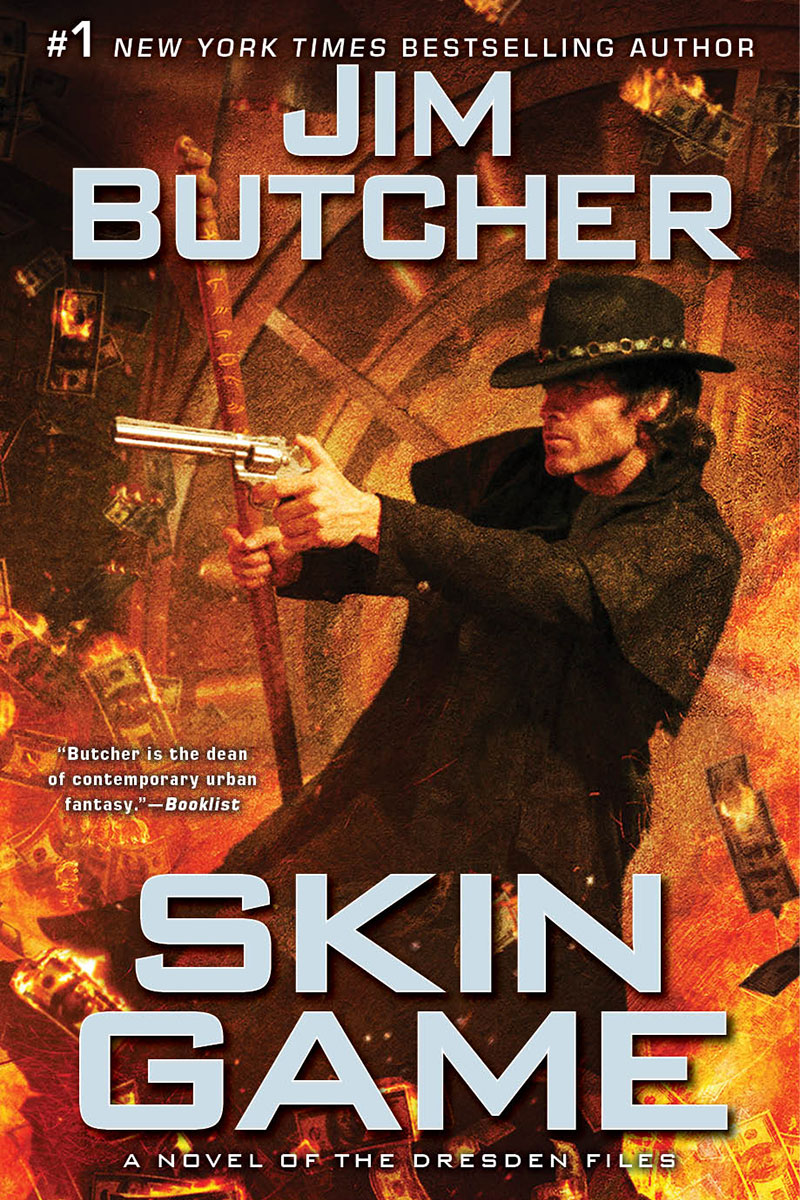
Skin Game (Dresden Files #15)
by Jim Butcher
I’ve read lots of book series. I went through a lengthy mystery phase, when I read pretty much every Nero Wolfe book that Rex Stout wrote; I read all the Travis McGee novels of John D. MacDonald — and in both cases I read a few of the knockoffs by imitators, and was unimpressed. I’ve read all of the Wheel of Time, and Stephen King’s Dark Tower series. I read twenty or so of Laurell Hamilton’s Anita Blake books, and every one of the Sookie Stackhouse novels. I read all of the Series of Unfortunate Events, and the Bloody Jack Faber series.
I stopped reading the Song of Ice and Fire after Book 4. Because I won’t put up with that kind of nonsense, Mr. Martin. You publish your books before you make the TV series. At the least, work on both concurrently, sir. I’m using up all of my patience with Diana Gabaldon’s Outlander books; but at least she has to do extensive historical research before she writes each book. You make ’em up, George. I learned from Robert Jordan the risks of waiting too long for a series to end; didn’t you learn, too?
The point is, I enjoy the series. I’ve seen them get better as they go (LOTR) and I’ve seen them get worse (ABVH), I’ve seen them end too soon and too late.
Never — not once — have I enjoyed a series as much and as long as I have enjoyed Jim Butcher’s Harry Dresden books.
It is extraordinary to me that Butcher is able to keep these books as alive as they are. They are nothing but action: generally 400-500 pages, they cover only a day or two, and the entire time is spent in some form of combat, chase, or intrigue. Harry Dresden must be the tiredest man in the imagined universe. And yet, despite fifteen books with the same general outline, they have never gotten boring, nor repetitive; I have never left the edge of my metaphorical seat. The key is that the book is much, much more than action (despite my prior statement): even though Harry never stops fighting, there are many pauses and lulls in between the knock-down drag-out brouhahas, and in these pauses, Butcher has built not only a world and concept of magic that I find as compelling as any I’ve ever read, but also some of the most completely realized characters that I can imagine finding in an action novel. Dresden is not Man-Compelled-To-Fight-By-Need-For-Justice, though there’s some of that, and he’s not Man-Torn-Between-Good-And-Evil, though there’s some of that. Harry is a man, a complicated, flawed, man, both strong and weak, admirable and despicable. (Part of this is the fact that Butcher has had a canvas fifteen books wide to paint this character on. Some of the less prominent but still important characters — Michael, Thomas — are a bit more one-dimensional. But even those sorts of characters have their hidden sides — think of Bob. Mac. Charity.) On top of all that, Butcher has an ability to weave in philosophical sorts of musings, on what it means to be human, to be mortal, to be powerful; to love, to hate, to fight; along with the best sense of humor since Douglas Adams. And his nerd references are a solid 10.0. Funniest thing in this book is when a character starts quoting Monty Python without even realizing it.
The point is, I love these books, completely, unabashedly. I’ll keep reading them as long as Butcher writes them, and cry when he stops. Then I’ll re-read them all.
This book is a heist story. The tension comes from the fact that Harry has to work with his enemies, yet they remain enemies, regardless of any cooperation (Like the Winter Court, though the Fae are not as prominent in this novel.). Some allies come back, out of semi-retirement from the main plotline, which was wonderful; new villains are introduced, who were excellent; there is a fantastic cameo by a god; there is a hell of a plot twist; there is one of the coolest Ascension scenes (When a character becomes something more than he or she was before — like Molly at the end of Cold Days) ever, with one of the best nerdgasm moments of all time.
Best of all? I can’t wait to read the next book. I have to see what happens with Dresden’s daughter.
No: the other one.

 Just Dusty