Opening The Window

…Maybe Shouting Out of It

I have been thinking about writing. I do that a lot: mostly because I haven’t been writing a lot. But I just don’t know what to write.

Then I saw this:

@therapyjeff

You’ve got, like, 1 to 3 business days before hypernormalization drags you back under. #mentalhealth #therapy

♬ original sound – TherapyJeff

It hit me.

It’s hard to predict what will hit you, what will have an impact; that’s part of why I haven’t been writing as much — I don’t know what to say to have an impact on my audience (if I even have any audience left), and I can’t predict what will have an impact on me. And the hypernormalization that he talks about is definitely real, and strongly controlling of my day-to-day interactions with the world and the world of current events. I will also say that my role as a teacher is partly to encourage some of that hypernormalization, because my students freak out, often because they enjoy freaking out and more often because they are young people in a terrifying and confusing world; and whether they are freaking out for the sake of their shattered nerves, or for the sake of the meme (or freaking out for the meme as a way to disassociate from their shattered nerves) , the answer is always to remain calm and to try to pour water on the flames they are fanning. So I spend part of pretty much every working day trying to calm the tempestuous waters of teenaged souls. Then I come home, and sometimes my wife is freaking out — in that case it is never for the meme, it is only because of her shattered nerves or because the world really is a dumpster fire and sometimes we are caught in the flames (which is NOT FINE) — and then sometimes, again, my job is to make awful things seem normal and manageable and not a big deal. Sometimes my job is to freak out with her, which, sadly, I am bad at, because my freaking out usually looks like me getting really mad, and that doesn’t always make people around me feel peachy; but I do my level best anyway, Partly because my nerves are shattered, too.

But this is counterproductive for my writing, because I don’t want to write about how things are normal, how they are just fine. I want to write about how they are fucked up. I don’t want to freak out, because nobody wants to read pages and pages of AAAAAAAAAAAAAAAAAAAAAAAAAAAAAAAAAAAAAAAAAAAAAAAAAAAAAAAAAAAAAAAAAAAAAAAAAAAAAAAAAAAAAAAAAAAAAAAAAAAAAAAAAAAAAAAAAAAAAAAAAAAAAAAAAAAAAAAAAAAAAAAAAAAAAAAAAAAAAAAAAAAAAAAAAAAAAAAAAAAAAAAAAAAAAAAAAAAAAAAAAAAAAAAAAAAAAAAAAAAAAAfuckfuckfuckfuckfuckfuckfuckfuckfuckfuckfuckfuckfuckfuckfuyckfukfuyckfuckfuckfukfuckfuckfuck Hey that’s pretty fun when you get the rhythm going!

But it’s hard to write, calmly and rationally, about how things are fucked up when you are yourself freaking out. Which is, of course, what the powers that be want: they want us to draw into our individual isolated shells and hide from the horrors they have put into the world, because that makes us easier to control, and easier to eliminate; and that’s why this very nice therapist made this TikTok, in which he tells us to take a step, even a small step, towards interacting and connecting with others during this particular moment of jarring insanity; because, as he says at the close of that video, even that small step of having a conversation or connecting with a group of potentially like-minded people, is much bigger than sinking back into the hypernormalization without having done anything other than twitch bonelessly for the 1-3 business days of this moment when we can break loose.

So let’s break loose. Rationally. Without freaking out, but also without rationalizing everything into normality. Because this is not normal: a man shot Charlie Kirk in the throat. Charlie Kirk is dead — apparently assassinated, though one thing I will say is that we absolutely must stop speculating about shit we know nothing about, until we actually know what is going on. We don’t know that the murderer was an assassin in the sense that we know for sure that the killing was politically motivated, and that Kirk was murdered because he was a prominent political voice; he was a prominent political voice, so in the case that we see any such death as an assassination, then it was, but I think it is important to distinguish between John Hinckley’s attempted killing of Ronald Reagan and Lee Harvey Oswald’s successful killing of John F. Kennedy: Oswald intended to kill the US President because he disagreed with Kennedy’s political stances and actions, and maybe what Kennedy represented; Hinckley thought Jodie Foster would notice him if he shot the President. That second one is not, to me, an (attempted) assassination. If we assume that this one was an assassination, which is a reasonable assumption but not a certainty because the killer carved fucking memes into his bullet casings — “If you read this you are gay LMAO” is not a political statement — it is also not clear if it was done because Kirk was too right wing, or if he was not right wing enough, which means we may be able to label it as an assassination, but not then go on to say anything meaningful about that fact other than it was a terrible, horrible thing, like every murder, especially unnecessary ones. (Yes, there are necessary murders. Not many, and they are still terrible, but there are. Not this one, so that is not our topic.) We do not know, and I will disagree with the people saying all over the internet and TV, that Kirk was killed for his political views, or his ideological beliefs, or his past statements which the killer may have found too offensive or not offensive enough; when all of that becomes clear, then we can discuss it — though we are unlikely to come to any useful consensus about it. And that’s partly because of Charlie Kirk.

I don’t want it to be because of me, too. I like to think it never could be, because I, of course, am rational and reasonable — and also correct, which, as I like to tell my students (quoting the late great Bill Hicks), gives my argument that extra oomph — but of course we all think that about ourselves. I do certainly write divisive things, both because my arguments are aggressive and confident, sometimes even spoken in words as hard as cannonballs (to quote Ralph Waldo Emerson), and because my language and my personal statements about my opponents and enemies are frequently deeply offensive. If people who disagree with me read these posts, they probably get pretty mad at me, and at them. Though they may deny it, because of course online debaters must never admit that they are upset, that they are emotional and out of control.

I am quite emotional. I am often somewhat out of control, usually, as I said, because I have a temper, and because my nerves are shattered. Anybody who doesn’t feel the same, at least that last part, is either lying or a sociopath.

Because stuff is fucked up. Deeply, multifariously, evilly fucked up. A man was murdered, and we all flipped our shit about it: and on the same day, two children were wounded by a third, who shot them at their school and then killed himself. I don’t even know how many other people have died in the days since Kirk was killed, but if we keep up this year with last year’s average it would have been about 47 per day. The right accused the left of causing Kirk’s murder with our political rhetoric; the left accused the right of causing Kirk’s murder with their violent fascism; people posted about how saddened they were by the death, especially because his wife and children were there and saw it happen; other people posted about how they were glad Kirk had been killed because of the awful things he had said and the positions he had espoused in the past, including racism and sexism and homophobia and transphobia.

It’s all fucked up. And even the virtuoso guitar playing of Stevie Ray Vaughan (Who was only five years older than Kirk — 36 to Kirk’s 31 — when SRV died in a helicopter crash) can’t make it better, can’t make me feel calmer and more in control at this moment.

So I had a thought. A step to take, in this window (which may have closed already, because it’s been four days since he died; but I’m going to try to do this anyway because I don’t think I’ve sunk back into the hypernormalization yet) of opportunity. Not to argue for gun control, though I am doing that on social media; not to argue against hyperpartisanship because arguing against people arguing badly is a losing endeavor, no matter how you slice it; not to lament the loss of free speech in this country, because Malcolm X was assassinated sixty years ago — also in front of his wife and children — and the Alien Enemies Act signed into law by President John Adams in 1798 was used by President Donald Trump in 2025 as a legal justification for deporting both citizens and non-citizens without due process, so I would argue that we have never had fully free speech in this country.

I want to try to reverse the polarity of this moment. I want to try to speak positively. Not about Kirk’s murder, which is nothing but horrendous; I just want to use this moment to try to imagine a world in which Kirk would not have been murdered. A world that certainly could have existed, if we had made different choices as a nation and a people, and one that we can certainly bring into existence if we try. Maybe if I try to normalize hope, then we can have some when we sink back into our absurd routines.

Let’s start with a beautiful image. This one came from here, and is advertised as using no AI.

I don’t see why not. Hope is not any harder than despair: hope takes work, but we have to work to keep our despair gurgling inside of us, just as much. We have to spend time looking for more reasons to feel despair, have to keep thinking negatively about what is in our world or in ourselves — or what is not there — have to keep all of that front of mind, or else we might spot a video of a cute puppy and not be sad any more. If you’ve ever felt sorrow or despair, then you know the struggle to keep it that I am talking about. (Depression, now: depression does not require any work to maintain; that’s why it is depression. But I’m not talking about mental health, other than to say that hope and positivity in a non-toxic way might help with depression, as well. Not going to oversimplify the facts of depression, but still. Here’s that puppy.)

Your Puppy: What to Expect at 13 to 16 weeks - Vetstreet | Vetstreet
This is my favorite ear configuration: one up, one down. And nobody does it better than Corgis. This image is from here.

I’m not trying to slap some pretty pictures up over the horrors: that kind of forced, hollow veneer just makes things feel worse because we know how thin it is. I’m just using the images to counteract the — let’s call it the acidity of the first part of this post, the corrosiveness of horror and violence and conflict. But for the hope, I want to speak genuinely. Because I think the hope is real.

First, what am I hoping for? I’m hoping for a society that recognizes the value of all of its members, and takes all stakeholders seriously when considering what to do collectively. I’m hoping for a world where people are able to find and create joy, consistently, throughout their lives. A country where we try to find our common ground, and respect our common humanity, before we disagree about what our country should look like. A life where people recognize the liars and conmen, the gaslighters and manipulators, and see the corruption for what it is, and don’t tolerate it because it smells just like our own. A world of integrity and trust.

No. It isn’t impossible. I’m certainly speaking in broad generalities, because no, I don’t expect any world to reach a point where problems are eliminated, where there is no conflict, where liars are vanished and corruption is prevented before it taints everything. But I do know that our world, our society, our ethos, used to be different, in at least some ways and to some degree; and that means that change is possible. We talk about the pendulum swinging, and it does, and it will — though I suspect that the pendulum, like most other political machinery in this ever-so-exploitable country, has been manipulated in some way to ensure that the people in power don’t lose that power when the pendulum swings; but the power of the pendulum metaphor is that the swings are inevitable, and reactive: you can hold back the pendulum, you can even push it farther away from plumb; it’s just going to swing harder and faster when it finally goes, and swing farther in the other direction when it does. It can’t be stopped. And it can’t be stopped because people are essentially good, despite what our cynical profiteers would have us all believe — because they want us all hiding in our individual isolated shells, hiding from the horrors, easily controlled and easily exploited. No: people are essentially good. We are just — we’re really, really scared. That’s what we have to overcome.

Here’s a nice picture of individual shells:

🔥 Cuban snails ( Also said to be the most beautiful land snails ) :  r/NatureIsFuckingLit
These are Cuban snails. Image from the subReddit NatureIsFuckingLit. Hell yeah.

And it begins with trust.

That’s the message I want to share today. Hope is possible, and achieving what we hope for is possible, especially if we all hope for (essentially) the same things. It begins with trust: we need to trust each other, to believe that we all will cooperate, so far as we can, to achieve those things we hope for.

I know this because I am a high school English teacher. And I have watched my classes struggle more, in some ways, every year, as their attentions spans wane, as their interest in reading disintegrates, as they become less and less literate. I have certainly lost hope at times; I have certainly lost trust in my students, have believed that they do not want to learn what I have to teach, that they do not want to read, that they do not want to do anything other than play video games, watch TikToks, and be annoying. I have believed all of those things because there are days when they act like that. Some of my students act that way all the time, and some of those even say that they have no interest in learning to read better, no interest in ever reading as long as they live. It’s hard to keep trusting kids who say that to me, especially the ones who know the impact on me of what they are saying.

But those are only some days. And those kids? They are only kids. They don’t want to read because they don’t have any hope. They are not incapable of reading, and they are not incapable of hope. On my worst days, I don’t believe that; but on my best days, I inspire hope in them. I know it: I’ve seen it, and I’ve been told about it, both in the moment and years afterwards. I was having a rough day this last Friday: and then one of my students — now former student, because they have departed my school for online schooling — came back to thank me for being their teacher. They gave me a lovely hardback copy of To Kill a Mockingbird, the book I taught them. Because they saw it and they thought of me, and they wanted me to have it. They saw a book: and they recognized the value of that book, because I taught them that book had value. And, I mean, I’m a good teacher: but I’m no miracle worker. This was just an ordinary interaction, a regular unmotivated and difficult student, who I happened to connect with enough that they trusted me when I said that TKAM was worth reading: and then I proved it. And for the rest of their life, they will know at least one book that has value, that is something worth giving to another person as a thank-you gift.

That’s hope.

And it starts with trust.

I’m going to keep going with this idea, because I like it, and I think there is value in it. Hopefully I can get some of you (if there are any of you — but I trust that there are) to trust me enough to start hoping, as well. And if we can agree on what we should be hoping for, then we can make it happen. We’ll turn that goddamn pendulum into a wrecking ball — one made of candy.

That’s how we’ll change it.

This Morning

This morning I do not have time to think. Sorry: I have seniors who are graduating in two days, and I need to grade their work. I spent part of last night arguing when I should have been grading, and so this morning, I need to spend time grading which I would rather spend writing.

This is a good substitute, though: since I started my gun posts with a discussion of what needs to be done to fix school shootings — but I never got to a practical answer — here is a reasonable and practical answer that actually has very little to do with guns, from a teacher in Colorado. Please do read it.

I’ll try to write again tomorrow.

I am a TEACHER in COLORADO and Here is Why Guns are NOT the Problem or the Solution.

This Morning

This morning I’m thinking about the Constitution. About the Second Amendment.

“A well regulated Militia, being necessary to the security of a free State, the right of the people to keep and bear Arms, shall not be infringed.”

I have thought about this particular sentence quite a lot over the years. I’ve shifted my position on this several times, generally in the same direction; not because the side I’ve shifted towards is entirely right (Though it is the right-wing position, the conservative position, that doesn’t make it the right-minded position), but because I came into this debate with a pretty extreme view.

See, I was raised to hate firearms. Violence of all types, certainly, but firearms in particular. My mother, a nurse and a pacifist and the kindest person I have ever known, never even let me have a BB gun, no matter how many times I watched “A Christmas Story.” There was one occasion when I was about 8 or so when our family went over to visit friends for dinner; my mom and dad liked this couple quite a lot: he was a computer guy who worked with my dad, and she was a ceramic artist. They all got along great — until Ben, the husband, showed my brother Marvin and I his pistol. I have a clear recollection of the gun — a revolver — being entirely unloaded, the cylinder open with no shells in it; I remember him letting us hold it. And I remember my mother coming in the room and finding us there holding a gun.

We never saw them again. Not only didn’t go over to their house, but we never saw the Kirchners again. I think my mom saw Mrs. Kirchner at some point, because we had a number of mugs that she made; but we never saw Ben after that.

So I’ve never been in a fight, and I’ve never gone hunting, and I’ve never killed an animal larger than a mouse, and I’ve never fired nor even held a gun past that one time when I was eight. I remember being in an online debate when I started taking this topic on, and my opponent accused me (as online debaters — read “assholes,” including myself when I debated online — are wont to do) of being a hoplophobe, someone who is irrationally afraid of firearms (Please note that this is just a politically charged insult recently coined, like “snowflake” or “soyboy” or that kind of bullshit.). And my response, which stunned the asshole who threw the word at me, was, “Yes. Yes, I am.” I did add the clarifications that I was afraid of people wielding firearms, not of the weapons themselves, and that this fear was not in fact irrational.

The response was basically that I should get a gun and learn to defend myself like a man.

This is a bullshit argument.

But it’s not actually the argument behind the Second Amendment.

Let’s be clear: the Second Amendment has been misinterpreted (in my opinion) by the courts, and even more by the general populace. It does not define the right to self-defense: there is no need to define and protect the natural right to self-defense, because self-defense is never a crime. But I don’t believe there is a guarantee in the Second Amendment that an individual has a right to, needs to, or even should, have a gun for self-defense.

The Second Amendment is also not in any way a defense of hunting or target shooting or collecting firearms to display in your home. None of those are rights. They’re amusements, hobbies; you have no right to a hobby. “But Dusty, what about people who hunt for food?” Well actually, you don’t have a right to food, either. People should have food, and it makes sense for us as a country to ensure that people have food and the ability to get food; but we do it because it makes sense, not because it’s a right. If it stops being sensible to provide food — let’s say we all voluntarily go into the Matrix, and survive on pink goo pumped directly into our gastrointestinal systems — then the provision of food will stop, without any violation of rights.

Let me explain a bit before I go too far into the weeds. The Second Amendment states that the people — not a person — have the right to keep and bear arms, in order to defend the security of a free State. The implication is that the main threats to a free State are external: I think that’s the “security” line. If it was primarily about the defense of a free people from the state, then it would say something more like “to ensure the integrity and continuation of a free State.” But I don’t mean to be one of those people who parse every word of the law in order to determine what the point is: I don’t actually idolize the Founding Fathers, and don’t think that their intentions should be the deciding consideration when trying to interpret the Constitution. I think we should look at what the document is really supposed to do, not necessarily what the men who wrote it wanted it to do.

The Constitution is intended to create and preserve a nation based on the rule of law, and not the whims of men. Laws need to be interpreted and executed by people, so our opinions have some importance; but the defining, essential purpose of the Constitution and the Founding Fathers was to escape and prevent the tyranny of powerful men.

You know how you escape the tyranny of powerful men? You spread power out as much as humanly possible. You create separate but equal branches of government, with checks and balances. You ensure that, as much as possible, the people who run that government are beholden to the masses, through the power of the ballot. (It’s probably a good idea to ensure that the people who are in charge of the actual laws are not quite so beholden to the people, but rather to the law itself — but that’s a different topic.) And because physical force is a source of power, you spread out the physical force as widely as possible: you don’t allow it to concentrate in the hand of a few, or even, if you can manage it, in the hands of many: you put it in the hands of all. That’s what the Second Amendment does, and what it does is right to do: the wider the dispersal of power, the less likely power is to be abused.

I do think the Second Amendment is intended partly to ensure that the people stay free and are able to defend that freedom against a rising tyranny in their own government. But it’s not that specific: it’s intended to create resistance to any gathering of power. The Ku Klux Klan have less power when the Black Panthers have rifles: it’s really as simple as that.

That means that we need to have the right to own firearms, as firearms are the most powerful individual force-multiplier we people can own. Tanks would be better, and an entire air force or navy owned by each individual WAY better; but that’s not feasible.  Anyone can own a gun, and a person with a gun is more deadly than one without. That’s why the Amendment defends the right to keep and bear arms. That does also imply that we should have the right to defend ourselves from personal harm using firearms. It makes sense: the point of maintaining a free State is so we free individuals can have a place to live; therefore the purpose of defending a free state also encompasses defending a free individual. Also, not to get too silly, but you can’t defend the state if you get killed by an intruder in your home.

But here’s the thing: there’s nothing in the Amendment, neither the wording nor the logic, that implies that we should not require background checks on every single purchase of a firearm. And a national gun registry of every owned or manufactured firearm. And red flag laws that allow the removal of firearms from dangerous individuals. And mandatory firearms training and testing, just like we have for motor vehicles. And limits on types of firearms (To some extent — there should be a limit on the limits so that the limits do not become a de facto ban), and on magazine capacity, and on everything else that we see fit to regulate. See, the goal here is to ensure that power is spread out: not that power has to be granted and defended for every halfwit who can pull a damn trigger. Not that the power has to allow one sovereign citizen to take on the military, or even the police, and win. The arguments against regulation are all predicated on the (rather paranoid) idea that the main purpose of the Amendment is to limit the ability of the federal government to control people, and that’s just not the case. Anyone who is a threat to us needs to be controlled, primarily by the limiting of power in the hands of those who are a threat. Note that: if we fear the rising power of the Federal government, then clearly the answer given by the Constitution is to limit that power, not to rise up against it. The worst case scenario is that the people will need to overthrow their own government, but the Amendment isn’t the plan for that; the Amendment is part of the plan for preventing that.

Our ability to own firearms is one thing that helps keep the government from the most simple and brutal sort of tyranny (And it really does do that, and I think I’ll have to talk about that at greater length on another day; the topic is too complex for a single post); but to keep us from turning our power on each other (And to keep the citizens from turning their power on the government for corrupt reasons, too; let’s not forget that. Let’s not imagine that most revolutions are idealistic and freedom-loving.), well — that’s why it says “Well-regulated.” Right there in the front of the Amendment. Even before the “keep and bear arms” part.


I think this will have to be continued.

This Morning

This morning I am thinking about ending gun violence.

Really, the solution is quite simple: after the apocalypse, when we’ve all reverted back to Stone Age savagery (Well, mostly died; those few who remain will revert), guns will be nothing but strangely-shaped clubs that occasionally explode. But since I seek to save lives, the idea of letting things go their course until the majority of people have died (My same solution would work for climate change, too, I’ll note) is antithetical to the purpose. So let’s be serious.

For simplicity’s sake, because I want this to be a short blog, let us assume that the Second Amendment is worth preserving. I’ll come back to it tomorrow and discuss it at length  (Hopefully not too-long length) but for now, let’s just agree that it’s part of our Constitution, that it’s the accepted law of the land, and that fighting against it or arguing against it directly is going to be counterproductive. I hope we can also agree that there is value in it — I think there is — but we’ll save that for tomorrow.

Because the first thing I want to say about this cause, preventing gun violence, particularly trying to put an end to gun violence in schools (This post is a continuation of this one, if you haven’t been reading along.), is this: it doesn’t begin in our schools.

It begins with the military.

There are two reasons. Three, really, but one of them will wait for tomorrow. The first is that we live in a culture soaked in violence, steeped in blood; that culture influences us to see violence as an answer. The military is the first and most prominent source of this idea, that violence is a solution to problems; because not only does our diplomacy start and end with force, but we laud it, incessantly, as the best thing about us: we are the world’s superpower, we are the global police force, we are the shining light on the hill — which we think is the Bat signal. Anyone anywhere needs help, one of the first things we do is send the Marines. Hoo rah. All of our military veterans are heroes, everything good about this country — our freedoms, our values — are due to the military.

And what does the military do? The military kills people.

Of course that’s not all the military does; and the other tasks, I would gladly maintain. I would cherish a global rescue force that sent in manpower and superior engineering knowledge to help with natural disasters. I would absolutely adore a massive collection of dedicated, patriotic men and women who actually lived and worked among real people in terrible places, and helped them, and got to know them; I think those soldiers, the ones who win hearts and minds, are indeed heroes, and the best possible face that we could put on America to people around the world.

But only if those same soldiers don’t kill the people they have gotten to know.

That’s the second reason why the military has to be the first place we do something to end gun violence: because an Iraqi child’s life is not worth less than an American child’s life, and while we grieve sorely for the school children we have lost to gun violence, I don’t hear the same outpouring for the tens of thousands of children in Iraq and Afghanistan whom we killed.

I don’t blame soldiers for the violence they commit and represent; that is their job, and it is we, the people, who ask — who insist  — that they do it. So this is the first place to start, if we’re serious about ending gun violence. Anything else, any attempt to remove firearms from the hands of our civilian populace, while we pay a million men and women to circle the globe with their fingers on the trigger, is absurd. First we have to put down the nation’s gun.

In a practical sense, I’d suggest keeping a massive and essentially unbeatable National Guard, with as much of it as practicable as Reserves: let’s go back the Minutemen, one of the first and most important ideas of the founding fathers, and one of the first that they lost, because a standing army is just such a useful tool. You can use that hammer to smash anything. Or anyone. I’d also suggest that as many of our current assets as possible be transferred to the UN for their peacekeeping forces — or to another similar body if we’re not happy with the United Nations specifically. I do recognize that force is necessary at times, to stop atrocities around the globe; but I also recognize that we are too reluctant to commit our own troops to that cause. So we should participate in the cause, but not be in charge of it. Frankly, we could use the humility.

That’s first. The second step in ending gun violence for real is something that should happen in this country, and it is this: legalize all drugs.

I don’t know that drug users and drug dealers are the biggest source of illegal activity that includes gun violence, but I know they are one of the worst, and also one of the easiest to put a stop to. Legalize drugs, control them, build a market for them, and not only does the majority of crime in this country stop (or take on a different tenor, which is certainly likely; the other thing we need to do to stop crime is reduce income inequality — but that’s a different blog and also a societal issue that leads to property crime more than violent crime. Drugs tend more towards violence, especially between and among dealers.), but also the majority of violent crime and societal instability in Mexico.

Are you listening, Trump? You want to make Central and South America a better place, with fewer gangs and less violence, and therefore less reason for people to emigrate to the US? Here’s your chance. Legalize drugs. Problem — not solved, but certainly ameliorated.

But the legalization of drugs, while it would stop some of the worst gun violence we face, would actually contribute somewhat to what is possibly the saddest cause of gun violence, and the hardest to fix: domestic violence and abuse. This is the third step we have to take. Not only because the thousands of women who are killed by their partners every year are not worth less than the school children we grieve so sorely, but also because it has to be obvious by now that one of the potential causes of school shootings is a violent, unstable home life, generally one cause by abuse and neglect. (And inasmuch as drugs and alcohol contribute to abuse and neglect, my second solution makes this one harder; however, I would hope that legalized drugs would have less stigma attached to seeking help, and maybe that would make some difference, too. There would need to be stiff penalties for crimes committed while under the influence. That’s probably another blog.)

I don’t know how to stop this, to be honest. I can’t understand someone turning in anger and attacking their own loved ones — and I also can’t understand someone living with people they don’t love. Of course desperation is part of it, especially for people who stay with abusers; so maybe solving our income inequality and poverty problems are more imperative in this cause than I thought. I do feel like this one is the hardest and the longest-lasting problem, one that will take at least a generation of hard work to reduce if not eliminate; because the only way to solve this is to break the cycle of abuse. Abusers are broken people; and they break the people they abuse. (Not everyone. But it’s no shame to be broken by someone who seeks to do it, and it does happen, far too often.)

That is, when the abusers don’t simply murder them. Often with guns.

So these are the first three steps we must take. And I’m fully aware that just that first step is essentially impossible in this country in this day and age; everyone in politics is beholden to the military, forced to kowtow to them in a country where even the NFL, a bastion of American spirit if ever there was one, was humbled by the rumor of disloyalty to the military. And of course there is the very real possibility that the military would not allow itself to be dismantled: there are a number of very powerful people with a vested interest in maintaining our addiction foreign wars, and if we think a military junta couldn’t overthrow our government simply because this is America, then we haven’t been paying attention. There’s also the awesome might and influence of the military-industrial complex, and they have less than no morals. I kinda feel like, if this blog were to go viral, they would murder me just for suggesting this.

That’s all right, I’m not scared of them.

I’m scared of someone coming to my school with a gun to kill people. To kill my students, my friends. To kill me. But despite my fear, despite the immediacy of it, if we don’t start with these three steps, then anything we do claiming to reduce gun violence is just hollow.

Let’s do this right.

This Day

This day, I’m thinking about Kendrick Castillo. And about Riley Howell. And about gun violence.

Kendrick Castillo was the high school senior, three days from graduating, who lunged at a fellow student who came into his classroom with a gun in Highlands Ranch, Colorado, this past Wednesday. He was shot to death. Eight other students were wounded by the two gunmen, one of whom was detained by a school security guard. Two other seniors tackled Castillo’s killer, and the other people in the classroom credit Castillo with saving their lives.

Riley Howell and another young man tackled another gunman at UNC-Charlotte on April 30. Again, it’s believed that their actions stopped the shooter from murdering more people, potentially many more people. Howell was shot three times, and died of his wounds.

We call them heroes.

We call them martyrs.

We grieve for them, we remember them, we hold military funerals and vigils for them.

And then we make more of them.

I had a brief discussion — not a bad one, though I was a bit rude and I made the other person upset with me — on Facebook about Kendrick Castillo and whether or not he was a hero. I said he was a tragedy, and I was told that his situation was certainly a tragedy, but that calling him anything other than a hero dishonored him and his leadership and his legacy. And I struggled with how I wanted to respond to that. At first I said that I understood the other person’s point, and I agreed with it, for the most part. But really, I’m not sure that I do. I don’t mean to rehash the argument without giving the other person a chance to rebut my points, so I don’t want to get too far into this specific topic, but — I don’t think that my consent and participation are necessary for someone to be honored. I’ve disagreed often with those we choose to view as heroes, as leaders, as those worthy of honor; I don’t think my opinion has much of an impact on their status or their reputation or their legacy. Especially not something I say in a Facebook comment, or even on this blog. I will say that I would not state my opinion directly to the person or their loved ones, I wouldn’t go to John McCain’s funeral and call him an asshole even though I wrote a multi-page essay to that effect during the 2008 presidential race. But I do also think that if I lost someone I loved, if my wife sacrificed her life to save her students from a school shooter, it would not make me feel better if people told me she was a hero. So if I ever spoke to Kendrick Castillo’s family, I think the first and last thing I would say is, “I’m so sorry for your loss.”

But none of that is the point I wanted to make here; just the impetus that has me writing about this terrible topic, again. During that same discussion, I wanted to say that I would rather use my grief for the loss of Kendrick Castillo, and for Riley Howell, to try to ensure that this never happened again, that nobody else would ever have to make the choice that they made.

But I couldn’t say that. First because I don’t know that I am grieving. I’ve grieved for deaths before, and this feels nothing like that. I will say that, inasmuch as you can grieve for someone you’ve never met, I do feel genuinely sad and sorry about these deaths, and I have been thinking about them all day; so if that’s grieving, then I am. If it’s not grieving, then I’m doing whatever this is, and maybe that honors their lives and their loss.

More to the point, though, I don’t think I’m going to do anything to prevent this from happening again. I want to, I genuinely do; but I’m not sure what. I can post on this blog, or elsewhere on the internet, and maybe my opinion can sway some others — but first I have to know how to sway them (you)  in order to make a difference, to move us closer to this goal we all share of never again having to hear of a school shooting. I usually think that’s the most powerful impact I can have on issues; because I have this small platform, and I can use it. Though as I said above, I’m not sure how much this blog, my words, these posts, really matter. Probably not much. I could run for office, but I wouldn’t win nor want the job; I could work for a campaign — and I might — but I’d have to be sure that the campaign I was working for was the right one, the one that would help make this happen. Of course I can vote, and will  — but again, I have to know that I’m voting for the right person. And when it comes right down to it, if the options are between someone who doesn’t share my opinions about preventing gun violence, and, say, Donald Trump — well, I’m not fucking voting for Trump.

I suppose I could also carry a gun, and stand guard at a school building. But I don’t think that is the right answer.

So the first thing that I need to do, to actually accomplish, is to decide what I think is the right thing to do. And then look for opportunities to pursue that right thing.

I’m saying this because I want to help move other people to do the same. My opinions may not sway anyone, but I do hope that when I say things that make sense, that aren’t simply my opinions, then people will listen: and this makes sense. We need to figure this out. We should all decide what we think is the best thing to do. We should also be open-minded and willing to listen, and honestly think, about what other people say is the best thing to do. We need to do this thinking because if nothing else, the 20 years between Columbine and Highlands Ranch, and the incessant stream of similar tragedies that have paraded by us over those two decades, should show us that we don’t know what to do. Because we’ve done nothing. Nothing other than drill students in how to deal with school shooters: and that has led directly to this point, these two dead men, these — heroes. We made them. We taught them what to do, we encouraged them, we failed to do anything else to prevent these situations where they chose to sacrifice themselves for others. If they are martyrs, then we are not the inheritors of their gift, the beneficiaries of their sacrifice: we’re the ones who killed them. We’re the Romans, with the cross and the nails. We’re the Inquisition, with the stake and the fire. We’re Jack and the hunters, chanting “KILL THE PIG! KILL THE PIG!” while Simon comes down from the cave.

At best we’re the ones watching it happen. At best.


I actually intended this post to be about what I think we should do to stop this. But it hasn’t gone that way, and I don’t want to get into it now. And tomorrow is Mother’s Day, and I don’t want to talk about ending gun violence on  Mother’s Day. So I think I will leave this here, for now, and come back to it next week — probably Monday.

I will end with this last remark. I do not think honoring dead men like Kendrick Castillo and Riley Howell as heroes does one single thing to reduce the tragedy of their loss. In a perverse way, if they are heroes, then that makes their loss worse, because heroes are valuable people, people who improve the lives of others, and they shouldn’t have to die to do that: they don’t have to die to do that. If they die doing it, then that is the end of their heroism, and it is a loss, it is a terrible loss in addition to the unforgivable loss of their lives. I think they probably were heroes, because I think that fighting to stop or prevent harm to others is a good thing, one of the best things, and so people who try to do it are good; if they try to stop harm this horrific, then they are great. I can call them heroes for that.

But still, the only thing I can say is: I am so sorry for your loss.

Image result for kendrick castillo

Kendrick Castillo

Image result for riley howell

Riley Howell


Letter To My Congresswoman

I’m an American high school teacher, so as you can imagine, this last week has been a time of turmoil. And for the first time — a fact which I find shameful– this latest school shooting has actually driven me to do something. I wrote my representative in Congress, Martha McSally, who is currently running for the Arizona Senate seat that will be vacated by the retiring Jeff Flake, about gun control.

I should have done this many times in the past, and I can’t justify my own inaction. I’ve argued about this topic for years, but to say that I’ve never voiced my opinion to the people who can actually do something — well. I’ve done it now. Sent the email ten minutes ago. I will also be sending a version of this to every candidate who runs for McSally’s seat — one which will probably be hotly contested, considering the political climate in this country and the fact that this is a Democratic area with a Republican representative — and I welcome anyone who wants to use this as a framework for their own letter. Steal it, steal a paragraph, steal everything you want. Do more than I have done. Let’s see what we can make happen.

February 23, 2018

To Representative McSally:

I am an independent voter living in Tucson, in the 2nd Congressional District for Arizona. I am an educator: I have taught high school English for eighteen years, for the last four at Sonoran Science Academy, one of the premier STEM charter schools in the state – the only high school in Tucson which Governor Ducey visited this past year. I am writing to you despite knowing that you are currently very busy, seeking a new job in addition to performing the duties of your current position, because you should know that I will also be seeking a new position, and quite possibly a new profession, unless you and your fellow Congresspeople can do the right thing. Unless you bring some sense to the debate over gun control, and specifically firearms in schools, then Tucson, and Arizona, and this country will lose thousands of outstanding teachers and educators. Like me.

The sense I seek – the sense I demand – in this debate has three elements, one positive change, one negative stance, and a general direction. The positive change is simple: Congress must repeal the Dickey Amendment of 1996, which prohibits the Centers for Disease Control from performing any research into gun violence in this country if said research “may be used to advocate or promote gun control.” I find this law appalling, entirely apart from my stance on gun control, because it is nothing more than enforced ignorance: it is a law passed by our government intended solely to limit and suppress knowledge. It flies in the face of science because it presumes an outcome and refuses the research for fear of that outcome – but it is entirely possible that the outcome of that research would be evidence against gun control! There is absolutely no reason to prevent the CDC from investigating the causes of gun deaths, and 30,000 reasons to allow that research to go forward, every year. I say that as an educator, not as an advocate for gun control; the truth is always better than ignorance, and I for one would gladly change my stance on gun control if the evidence supported such a change. Congress must allow the CDC to dispel our ignorance, to teach us why this problem is unique to the United States. That knowledge, suppressed for twenty years, is why this debate is still so acrimonious: because we do not know the facts behind it. We do not know if the right to bear arms is a cause of those 30,000 annual deaths, or if it prevents even more deaths while contributing to none. We are left searching for reasons, for answers, while the body that could provide us with several of those answers sits with its hands tied. Please: make this the first action you take regarding this debate. Jay Dickey himself regrets his namesake law and argued for its repeal in 2012, after the shooting in Aurora, Colorado. Strip away the veil of ignorance, and let us know the truth. Repeal the Dickey Amendment.

The negative stance I would ask you to support has to do with a common reaction to the atrocity of school shootings. I have been a teacher since 2000, and I was in school to become a teacher when the massacre happened at Columbine; I have watched, again and again, as maniacs with firearms have devastated communities by targeting our children. Every time this happens, whether the debate remains local or expands to include the entire nation, at some point, someone will suggest arming the teachers. This time the suggestion came most clearly from our president, Mr. Trump. He Tweeted that “Highly trained, gun adept, teachers/coaches would solve the problem instantly, before police arrive. GREAT DETERRENT!” Allow me to state, unequivocally, that this is false. Highly trained teachers is what this nation already has, but we are, as we should be, highly trained in education, not in combat. I would never presume to lecture you, who have been in combat, on what that experience means and what training and preparation went into making it possible for you to fight for our country, but I am entirely and absolutely sure that I do not have what you had. I do not have the training, I do not have the preparation, I do not have the will to fight. My classroom is not a battleground, and I am not a warrior. What’s more, I will not become such. Turning me from an educator into a fighter would destroy too much of what I need to be successful in my profession: it would change my relationship to my students, it would change my view of myself and my role, it would change the priorities for my continuing professional development and the allocation of resources. It would make my position untenable for me, and if it ever becomes policy, I will quit. I will quit immediately and without reservation, and I will not be alone: please recognize that thousands and thousands of teachers feel as I do. The country already has a teacher shortage, and a longstanding problem with hiring and retaining quality educators; do not make it worse by misunderstanding who we are and what we do. I will never carry a weapon in school, and I will never fire on a student. Don’t ask me to.

Lastly, I would ask you to join me in moving the gun control debate in a general direction that I hope you will be able to support. I recognize the right to self-defense and the concomitant right to keep and bear arms. I oppose authoritarian government, and applaud the democratization of physical force through the private ownership of firearms. But the reality is that the ready availability of firearms, particularly of weapons that have uniquely destructive properties, allow for the unequal and devastating use of force in a way that reduces individual rights: one 19-year-old man’s ability to purchase an AR-15 and “countless” magazines has taken the right to life, the right to liberty, the right to pursue happiness, away from thousands of students. While of course such simple measures as a waiting period for semi-automatic rifles, or an age limit of 21 on the purchase of long guns, or a limit on magazine capacity, or a universal background check system, would not stop all massacres and would not affect the majority of gun deaths, the simple fact that such measures would stop some massacres, and would reduce gun deaths, without materially affecting the right to bear arms or the ability of Americans to defend themselves, makes these measures requisite. It makes them necessary. It makes their continued absence a failure and a dereliction of duty. I myself was inspired to write you, an action I have not taken in the past, by the political will and activity of the victims of the Parkland shooting; I consider myself to be derelict in my duty in not having taken up this cause in the past with the same vigor and determination that these teenagers are showing us now. I am a teacher; I am an adult; I should have been fighting this fight, not waiting for children to fight it for me. Had I fought for these measures in the past, had everyone who agrees with me done so, had all the congresspeople and elected leaders in this nation done what we all (I hope) know to be the right thing, then this particular massacre would not have occurred. That weighs on me, and though I don’t hope it weighs on you, I hope you can empathize with me about it. I hope you can understand the determination that I now have, that this situation not continue as it has in the past, that we not let this moment sink back into oblivion and change nothing and do nothing. I will not take up arms and fire on a student: but neither will I be silent while madmen do exactly that.

I hope you can agree with me on these three actions: to repeal the Dickey Amendment and allow the CDC to investigate the causes of gun violence; to oppose the absurd idea that our schools should encourage or require teachers to carry arms as a means of defending students from attack; and to press for some common-sense gun safety measures that would help to regulate arms without removing any citizen’s inalienable right to self-defense. Please believe that my vote, and my support, depend on that agreement.

Sincerely,

Theoden Humphrey

Tell me about the rabbits again, George.

I’ve decided I want to be stupid.

If I were stupid, I couldn’t be a teacher. No, that’s not true: I couldn’t be a good teacher, but we all know there are plenty of bad teachers out there. So I wouldn’t be a good teacher any more, which is sad; but I wouldn’t know it, so there wouldn’t be any problem. What’s more, I wouldn’t ever worry about being a good teacher. I’d never have to worry about whether my students were really understanding the point I was trying to make, because I’d never have a point. I wouldn’t have to read their essays any more, and write comments on them trying to make them better, and feel the frustration when they don’t pay any attention to those comments but go right on making the same mistakes; I could start grading essays according to how many words they are and whether they follow MLA format perfectly and how many words over three syllables they use. I wouldn’t realize the damage that standardized testing does to students, and to education, because I wouldn’t understand the purpose or the power of education, and I wouldn’t know what an opportunity is lost when students are beaten down with tests; I’d just do what I was told, and teach to the test, and threaten my students with bad grades if they don’t pass. So I’d never have to worry about lesson plans ever again. I would swallow all of the snake oil that gets sold to teachers, and I’d believe everything the salesmen said about it, so I could change entirely my policies and lesson plans and teaching methods every three or four years; so I wouldn’t even get bored. Every day would be a PowerPoint presentation and a jigsaw lesson, followed by a standardized test. And you know what? I bet my students would love me. Because they’d never have to think, either.

If I were stupid, I couldn’t be a writer. But wait: that isn’t true, either. It just means I couldn’t write well. But – assuming I still wanted to be a writer, which I probably wouldn’t because I wouldn’t be able to see the world the way I do now and I wouldn’t care about what I couldn’t see; I wouldn’t believe that art could help make the world a better place, as well as making me a better person; I wouldn’t even believe that writing was an art, because I’d think that art was only painting pictures. So if I were a stupid writer, that would work out great: because my books wouldn’t take so long to complete, and I wouldn’t have to work so hard to write them well. I could just vomit out whatever drivel I wished about super-powered vampire werewolves who drive around at night in Lamborghinis (which I’d always call a “Lambo” because I couldn’t spell the full name) –

Dear God, I wouldn’t have to worry about spelling any more.

– fighting demons with their super-powered vampire werewolf kung fu and having sex with hot chicks at the same time. Then I could self-publish my e-books on the internet.

I bet they would sell a million goddamn copies.

I could stop reading challenging books: right now I am reading Arundhati Roy’s The God of Small Things because I will be teaching it to my AP class, and I am also reading Bertrand Russell’s Wisdom of the West (a condensed version of his three-volume A History of Western Thought) because I admire the hell out of Bertrand Russell and I am thirsty for more understanding of philosophy. But fuck that – sorry, screw that (if I were stupid, I’d believe that cursing is bad, especially the F-word): if I were stupid, I wouldn’t be teaching that strange and wonderful and ethereal and challenging novel; it’s got weird sexy stuff in it, and I’d know that was wrong to show to little kids like the high school juniors in my AP class. Plus I wouldn’t understand it because the story jumps around a lot and the plot is hard to follow. Plus I wouldn’t like it because it isn’t set in America and there aren’t any super vampire werewolves in it. Plus my class wouldn’t teach any full novels, because that takes too long and isn’t necessary to pass a standardized test that only asks you to read short passages and excerpts. And there’s no way I’d read philosophy, especially not a survey of philosophy starting in ancient Greece; I’d think the Greeks were homos and philosophy is gay. I’d get rid of every book like that and just read James Patterson. And books about sports. Though I’d prefer the audio books, because it’s easier and faster and not as boring.

Speaking of sports, I could watch football instead of spending my Sundays doing school work or reading or writing, and go to bars at night with my buddies and drink beer (and I’d just drink cheap American beer, instead of having to take the time to peruse the menu looking for good beer) and watch more sports and yell real loud when my favorite sports-squadron scored a goal-unit-basket. And I could wish that I had been good enough at sports to go pro, but known deep inside that it would never have happened, because I’m white and black people are better at sports. Which is why I would like baseball and hockey and NASCAR so much, because lots of white people are good at those sports. Though not hockey as much because they’re all Canucks and Russkies. Though watching the fights would be fun. And I could watch MMA and laugh when Kimbo Slice (That’d be a great name for one of my super vampire werewolves! Maybe I could change it to Jimbo, and then he wouldn’t sue me. Then I could make him white, too.) challenges his opponent to actually compare testicle size during a pre-fight interview.

Though I would have to worry about the size of my genitalia. And whether the size of my hands and feet gave an accurate representation of that size.

Speaking of hand and genital size, if I were stupid, I wouldn’t have to argue and debate and worry about politics: I could just vote for Donald Trump to make America great again, and go back to watching football. And then I could watch Fox News and never have to worry about reading or thinking about what is going on in the world: I could just be sure that America is the best country, that we have to have a strong enough military to keep everyone from invading us, but that if they did invade us, I’d be ready with all of my guns to fight them back, just like in Red Dawn, which would be one of my favorite movies. And maybe I’d have to worry about that socialist Bernie Sanders getting voted in, but I’d be pretty sure, in my heart of hearts, that America would never let that happen: I’d probably secretly believe that the Statue of Liberty and the statue of Rocky Balboa would come to life and drag Sanders down into New York harbor. And I’d never worry about that broad Hillary getting elected over The Donald: no way would America pick a woman over a man. We all know you can’t trust a woman with power – what happens when she has her period? She’d fire the nukes if she didn’t get enough chocolate ice cream! (I would have written Haagen-Dazs, but I can’t spell that, either. And Ben and Jerry are socialist hippies.)

I would believe that a wall on the border could keep out Mexican illegal immigrants. I’d believe that immigrants are bad. I could ignore uncomfortable irony like the history of my own family’s immigration to this country. Because I’m white.

I could chant “USA! USA!” without irony. And tear up when a small child or a crippled person sings the Star-Spangled Banner at my ballgames. And secretly hate that Beyonce sings better than anyone in country and western.

I could listen to country and western music. I wouldn’t have to change radio stations any more, because there’s only one country station here and I’d love every song because they all sound the same. I wouldn’t have to listen to challenging or depressing lyrics, or admire musical talent or songwriting ability; I’d just like the ones who say America is great and talk about drinking American beer and driving around in trucks. Which is all of them.

I could stop taking criticism to heart. I would think I was great because I am American, and a white male, and therefore I am the best people in the world, and everyone else is just jealous of what I have. Except for that genital thing. But I’m sure I could convince myself that there was no problem there. My hands are pretty big, after all. And it wouldn’t matter to me if people thought my writing was bad, or my teaching, or that I was behaving in any way wrongly: because I’d think they were haters, and Taylor Swift (who I would totally listen to, and try not to think about how hot I’d think she is because she’d be too young for me, but I’d know in my heart of hearts that she would totally have sex with me if I ever met her in a bar, because I am an American white male with not-too-small hands.) would have told me that haters gonna hate, hate, hate, and I just needed to shake it off. Man, that song is just so catchy! And that Kanye West guy is a racist. Though his wife is hot. And of course she married a black guy, because she’s got a huge butt and black guys like big butts. Sir Mix-A-Lot told us that.

If I were stupid, I would think that “were” sounds weird: because I wouldn’t know about the subjunctive mood and statements that are contrary to reality requiring a different verb; so I’d just say “was.”

If I was stupid, I wouldn’t worry about my diet. I wouldn’t care if animals suffered in factory farms, because they’re just animals and they don’t feel pain, plus the Bible says they’re here to serve us. I’d love bacon more than anything except steak, and best of all would be steak wrapped in bacon and topped with lobster. Wrapped in bacon. Maybe with a bacon milkshake on the side. I wouldn’t care about my cholesterol, because I’d know that America has the greatest health care system in the world and I could have all the triple and quadruple bypasses I needed when my ticker started giving out. And I wouldn’t care about my weight, because I’d lift weights – that is to say, I’d do it differently than I do now, because I would do bench presses and curls and maybe five sit-ups a week and call it good – because as long as my pecs and arms were big, I’d think I was hot, because check out these guns! Plus women don’t think the same way about appearance. Men are visual, they need chicks to be hot; but women just need them to be manly, so they feel protected and safe. And I’ve got all the guns I need. Get it? Get it? Because I meant my biceps AND the Glock on my nightstand!


Yes. I want this. Last night I went to see Of Mice and Men on stage, and it was lovely and heart-wrenching; but if I was stupid, I never would have gone to see it, and it wouldn’t have made me sad. And then afterwards, I spent a fair while writing an irritated response to a comment on Facebook from a woman who didn’t understand everything I was saying in my argument, but she was pretty sure I was a socialist and wanted to take tax money away from hard-working Americans to give to the junkies on welfare. But then I had to delete my reply. Because reasoned discourse is no longer acceptable in this country: all we care about is if people agree with us, and if they don’t agree with us, there must be something wrong with them; and if they tell us we are wrong, then we get offended. I had to delete the comment because I am a teacher, and teachers are not allowed – ever – to be offensive, even if the only reason we are offensive is because other people don’t like our arguments.

I had to delete my comment because six years ago, an offended woman on Facebook nearly got me fired and banned from teaching in Oregon by complaining about a comment I made, which led my employer to my blog, where I had written things that were true, but not polite, and not acceptable coming from someone who was supposed to love and protect and coddle all of the children while preparing them for the tests and cheering for them at football games, which is, I think, how most political entities view ideal teachers. I was called “morally reprehensible” for what I said. And the worst thing is this: that I have had to think about that, and whether it is true, and decide that to some extent it is, and then I have had to feel both shame and doubt because of it.

And last night, I realized: as long as I am a teacher in America, I will never be able to say exactly what I think, and I will never be able to argue, especially not about controversial issues like politics and guns and war and racism and religion and education, because telling someone that they are wrong, especially when they are, is offensive, and particularly for me because of my history, offending anyone, anyplace, anytime, could very easily get me fired. This means not only that I will always have to worry about what I write and post online, but also that I cannot use my abilities, my greatest assets – my intellect and my words – to do what I think is right, to try to make the world a better place through critical thought and reasoned argument, because I will never be able to argue, not as long as I teach. And probably not after that, because I’d like to be either a professional writer or own a small business, but if I make people mad at me by taking their bad arguments apart online, they will give me bad publicity, which will hurt my career, whatever career it is. I will always have to worry about what someone else will do to me if I tell them they are wrong. Because reasoned discourse is dead. We prefer circuses.

And I decided that I don’t want to worry about anything any more. I just want to do what I’m told and work hard and do the things that make me feel good.

I’d rather be Lennie than George. All the way to the end.

The First Step

You almost got me. Almost.

I came this close to throwing in the towel: I actually posted a blog entitled “I Surrender.” And in it, I did so. I said there was no hope, no chance, no point. I accepted defeat. I ceded the field of battle to the enemy. I walked away.

But then I thought about it. I thought about how, even in my acceptance of defeat, I acknowledged that I have had some success in this fight. I thought about how important this argument is: quite literally, it is about life and death. I thought about how the last piece I wrote focused on the importance of never giving up: never give up your dreams, I said. Try, try again, I said.

I took down the white-flag-blog-post. I thought about this argument, and I realized, first, there is another aspect of it that should be examined, which I could examine, so that I wouldn’t just be saying the same old things over again, and expecting different results. I realized, second, that even if I don’t have anything new to say, I should still say the same things, say them again and again, say them loudly and repeatedly and, above all, reasonably; make it harder for the other side to shout me down with their inanities and their absurdities and their lies. Maybe it won’t work. But I should try.

And I thought: the hell with it. No retreat, no surrender. You can have my argument when you pry it from my cold, dead fingers.

So, once more, no matter how futile it may feel at times, because it is a fight worth fighting, because it is as important as life and death, let’s talk about guns.

First: for all of the people who, after this latest tragedy (If you’ve already lost track, or if there has been another shooting that I have not heard about yet, I am speaking about the ten deaths in Roseburg, Oregon.), are claiming that we should be talking about anything other than guns, you’re wrong. You’re just feeling what I was feeling, that there is no way to get this country free from its addiction to guns. But doing anything other than confronting the problem head-on is just enabling the continued destructive behavior. Praying for those who lost their lives, while admirable and surely comforting, does nothing to prevent the next atrocity. Focusing on mental health is ineffective, partly because those who commit atrocities are not consistently identifiable as mentally or emotionally unstable beforehand (though they surely are identifiable after the fact, which is what makes this such an effective distraction from the underlying issue), and partly because the key to changing the effectiveness of mental health treatment in this country is to stop thinking of mental illness as an illness, which goal will not be achieved through looking at mental health through the lens of atrocity. Examining the underlying callousness, or lack of empathy, or unconcern for human life, that plays a part in atrocities, although it certainly is a reasonable target at which to aim, is not a short-term solution, and so shouldn’t be the only target. While we are considering what may cause a man’s indifference to the suffering of his fellow man, let’s also do the obvious: let’s make sure that those who are indifferent to the suffering of their fellow men cannot shoot those men.

All right: one thing at a time. Let’s look first at my description of this country’s attitude about guns as an addiction. Definition, please, O Almighty Google?

“Addiction is characterized by inability to consistently abstain, impairment in behavioral control, craving, diminished recognition of significant problems with one’s behaviors and interpersonal relationships, and a dysfunctional emotional response. Like other chronic diseases, addiction often involves cycles of relapse and remission. Without treatment or engagement in recovery activities, addiction is progressive and can result in disability or premature death.”

From the American Society of Addiction Medicine

That sounds about right. Our country is unable to consistently abstain from guns: no matter how many atrocities, no matter how many data sets show that guns are not safe to own, we still own more than any other country, per capita and total. We show impairment in behavioral control — certainly true; between accident, intentional homicide, and suicide, guns caused almost 34,000 deaths in 2013 alone. Craving? 300 million guns are owned by about 50 million households. When you already have a gun for each hand, a gun for each foot, and one for your mouth, and you think, “I should really have one more,” that’s a craving. Diminished recognition of significant problems with one’s behaviors and interpersonal relationships? And does this behavior result in disability or premature death? Of course it does. That’s the point.
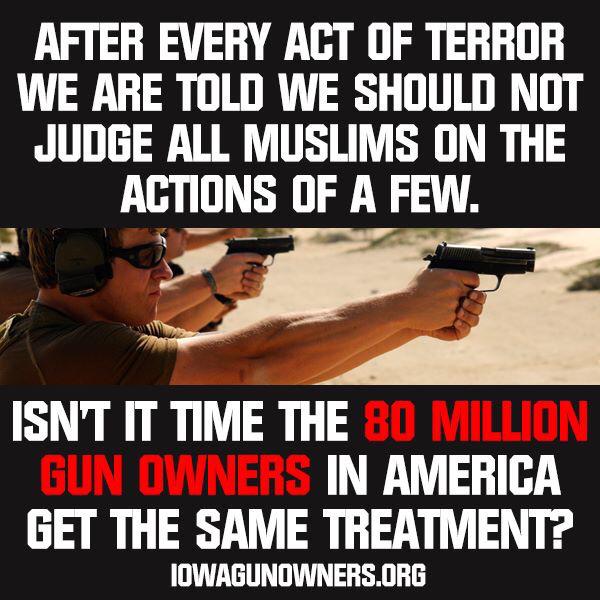
How does one deal with addiction? First, we have to recognize the problem. We need to talk about it, and keep talking about it. We have to keep paying attention to gun deaths, both in specific and in general. We have to confront gun owners with statistics and facts. We have to treat guns as what they are: murder machines. We can’t shy away from it, we can’t ignore it and hope it goes away — and we can never give up. I will try to remember that.

We do also need to examine the underlying factors that cause the problem. In this case, here in America, I think the reason for gun ownership is fear. We fear our government, and we fear crime. It would be great if we could address the causes of that fear — eliminate crime through drug legalization and the reduction of income equality; reduce the fear of government through reducing the military, increasing government transparency, and improving political education — but what we need to do first is recognize our fear, and recognize that our reaction to it is irrational and harmful. Just as alcohol doesn’t fix the problems that drive people to drink, guns do not fix the problems that drive people to shoot. Good people with guns do not stop bad people with guns. Columbine had armed law enforcement personnel on campus. The Navy Yard shooting and the Fort Hood shooting were both on military bases. There were armed civilians at Umpqua College, and yet they did not stop the atrocity — and neither, for all of his genuinely admirable heroism, did the army veteran who tried to stop the shooter. Chris Mintz was shot seven times trying to keep the killer out of the classroom, and yet the killer got past him into the classroom, and murdered several other people inside. Is there a better argument for the particular deadliness of firearms than this?  People say that, if guns were banned, killers would use knives. Do you think a murderer with a knife would have gotten past that guy? Neither do I. The shooter did, because guns are murder machines, and they are very efficient and effective. That’s why people use them. It stands to reason, then, that removing those murder machines would make murder less efficient and less effective, and therefore rarer. Isn’t that a good thing? Isn’t that the goal of everyone, including, in theory, those who want everyone to carry guns everywhere? Isn’t the argument against “Gun Free Zones” exactly this, that those places increase the likelihood of murder? So how can the removal of the murder machines do anything other than reduce murder? I know, I know: if we ban guns, only criminals would have guns, and if a criminal wants a gun, he’s going to get a gun. Gun bans in other countries have proven both of these tropes to be false. People make the same claim about easy access to illegal drugs, but that isn’t true either: right now, sitting here, I have no idea where I could safely buy crack. I know exactly where I can buy a firearm. The same goes for 99% of the population of this country. As sincerely as I oppose the war on drugs, I have to admit that it has made it harder to get those drugs than it would be if they were legal; can’t gun owners admit the same thing about a comprehensive ban on firearms? Just so we know we’re all on the same page, thinking rationally, and dealing with reality? Here, I will concede this: a comprehensive ban on firearms would violate the Constitution as it has been interpreted by the Supreme Court, and it would infringe on the rights of responsible, law-abiding gun owners. I’m not suggesting a comprehensive gun ban for those reasons. Can’t we all admit that, even if it is illegal and probably immoral, a ban on firearms would at least be effective in making guns harder to get, regardless of what other problems it would cause? Let’s at least face reality, okay?

Here’s some more reality people don’t want to face: even apart from atrocities, people do not use firearms to protect themselves from crime. Every claim of how often they do is based on one — one — thoroughly discredited random phone survey, performed by Gary Kleck and Marc Gertz. (See here) It’s exactly like the link between vaccinations and autism, except the people who accept pseudoscience as reality in this case are more numerous. And armed.


Here’s the thing I’d like to address. It’s this notion of self-defense. I want to know what, exactly, gives someone the right to kill another human being. Why do we have the right, morally and legally, to use lethal force in the name of preventing the use of lethal force? Or even worse, the right to use lethal force to prevent non-lethal force? Even to prevent property crimes? I can legally shoot someone who is breaking into my house in order to steal my stapler. Can anyone defend that rationally?

I recognize that we have the right to defend ourselves, or another human being. But do we have the right to kill? If I can stop someone from killing me without killing them, isn’t that the extent of my right? Even if murder is necessary to prevent murder, how do we know that someone is intending our death? How can it be that I have the right to shoot someone simply because he breaks into my house? Someone breaking a lock or prying open a window does not put my life in danger. Even someone attacking me does not necessarily put my life in danger. People do not want to take the chance that an intruder is not an attacker, or that an attacker is not intending to kill; but that is a matter of convenience and egotism: it is only more convenient to assume that an attacker is intending lethal harm and therefore lethal force should be applied in stopping him; and it is mere egotism to say that my life is more important than an attacker’s just because he’s the attacker. I mean, seriously? Our moral argument is “He started it?”

Someone intending harm should be prevented from doing harm. But it seems to me that using lethal force to prevent that harm is, quite literally, overkill. If there are non-lethal means of preventing harm, aren’t those means the extent of what is justified? As soon as the attacker is no longer intending to kill me, I am no longer defending myself. Right? So if I punch him in the face, and he decides, “Never mind, I don’t want to kill this guy,” I am done defending myself. And if I punch him again, now I am the attacker. Now he should have the right to defend himself against me. The scenario as I describe it is absurd, yes — but how absurd is it to assume that anyone who breaks into my house is intending to inflict lethal harm on me? And without that intent, what is the justification for using lethal force to stop him?

The fact that I have a gun shouldn’t mean I am right in using it when I could use a Taser just as easily. Aren’t non-lethal means of prevention of harm available to citizens? Things like good locks, alarm systems, access to police? Self-defense weapons like pepper spray and stunguns? Martial arts training? Guard dogs? Neighborhood watch? How about a bat?

As far as I know, the only argument against these things is that they are less effective and/or less efficient (meaning “slower”) than guns in stopping an attacker. No: I suppose there is also the argument that “bad guys” deserve death. We Americans relish playing Dirty Harry and Wyatt Earp, blowing away the “bad guys,” thus making the world safer by ensuring that they won’t attack anyone else ever again, and putting a notch in our gunbelts. But apart from our comic-book-vigilante fetish, it is just this point: stunguns and pepper spray are not as effective as guns, partly because they require someone to get close enough for the attacker to fight back, and they do not cause as much harm as quickly as does a gun, and so the attacker may still harm the defender.

I refuse to accept that someone threatening me, or even worse, threatening to take my stuff, is deserving of the death penalty. If we believe that, why don’t we kill everyone who commits any crime? The best indicator of future crime is past crime; the best indicator of future violence is past violence. Shouldn’t we be lining schoolyard bullies up against the wall and putting a bullet in the back of every head? Ditto for every kid who shoplifts, or tags a wall, or smokes a joint? I also refuse to accept that the simple fact that I own a gun, but not an effective non-lethal means of self-defense, justifies my using the gun; when my explanation is “Well, it’s what I had in my hand,” I lose the argument. “Honey, why did you give me a ball of pocket lint and a used wad of gum for an anniversary present?” “Well, it wasn’t like I could just go to the store and buy flowers! You said, ‘Happy Anniversary,’ and I had to react in a split-second!” Or maybe this: “Sir, I’m afraid I’m going to have to insist you pay for your purchases with actual money, not this piece of paper with your grocery list written on it.” “Hey, man — you can’t expect me to get out my wallet, find the money, pull it out, count it, and then reach all the way over there to hand it to you! You could have given away my purchases half a dozen times by then!”

Self-defense should be limited to what is required to end the threat. Not the easiest means of ending the threat, not the fastest, not the most viscerally satisfying of my bloodlust; only what is necessary. Anything beyond what is necessary now makes me a greater threat to my attacker than he is to me. If I shoot an unarmed man, or even a man armed with a weapon less dangerous than my gun, then I am become the attacker, not the defender. Anyone who uses a gun to kill when it is not necessary is a murderer; isn’t that the standard we use for police? Aren’t we enraged to the point of riot when that standard is not upheld? And yet we think nothing of a homeowner with a gun safe full of weapons unloading on an unarmed burglar who was trying to score drug money?

Of course, those who own the guns almost certainly disagree with me; they probably think that police are justified and right in killing unarmed civilians who merely seem to pose a threat. (Though those gun owners should consider this issue when arguing that our government is a threat, as well; isn’t it this very standard that allows them to be such a threat? Maybe there is a solution to both problems . . . ) But here’s the thing I have to keep in mind: I have to remember that argument, particularly in a debate like this one, is not simply intended to sway the zealots of the opposition. It is intended to provide points of consideration for the rational, regardless of their initial position in the debate. So for those of you who are rational, consider this. How much offense is necessary for defense? How much harm can one do in the name of preventing harm?

How much harm must we do to each other, and ourselves, for the sake of clinging to our prejudices? How many people have to die before we recognize that we have a problem, and we need to deal with it?

Addicts must change their lives: they have to change their way of thinking, their understanding of themselves and their behavior, their concept of their addiction and what it does for them. They must avoid the people and the places and the activities that served in the past as triggers for their addictions. They need to work, and keep working; they can never ease up, not ever. We are addicted to guns. There are a lot of things that need to change before we can quit the guns; we can’t go cold turkey, that I will concede. But just because it’s hard to accomplish doesn’t mean it isn’t the right thing to do, nor that it shouldn’t be attempted. 34,000 deaths a year beg us to do what must be done. Think of how many people you know. Think how much it hurts when one of them dies. Recognize how many orders of magnitude that is away from 34,000 deaths. Recognize that that number occurs in this country every year.

Let’s take the first step: admit that we have a problem. And let’s do the work.

Gun Is God

I saw this on Facebook today. And my immediate reaction was to attack: Well but that isn’t the same thing at all — people have an inherent right to freedom of religion, which is codified in (though not granted by) the U.S. Constitution’s Bill of Rights. And religion isn’t used to kill people. And pssh — Iowa. Come on. Like anything intelligent ever came out of Iowa.

Then I immediately thought: but the right to bear arms is also in the Bill of Rights. Even if I think it shouldn’t be. The Second Amendment does represent a natural right, the right of self-defense. Even if I think there are better ways to go about defending one’s self.

And as for religion: seriously, Dusty? It isn’t used to kill people? Even apart from the indisputable facts that have led to the prejudice represented here (more on the prejudice later), namely the sheer number of Islamic terrorists and war-mongers of the last — what, sixty years? — religion is behind most of the wars of human history, or has at least been used as the justification for them, as well as countless atrocities — the Inquisition, the witch-burnings, the Holocaust, the pogroms, chattel slavery, colonialism — Jesus, do I need to go on?

Absurd of me even to take up this argument, if this is all I have.

But that third one — that’s kind of right. Tom Arnold is from Iowa. So is Michele Bachmann. And Steve King, of course  (The moronic Congressman, not the author.). Ashton Kutcher. Charles Osborne, the guy with the world record for the longest lasting case of hiccups. Sure, there are a couple of scientists and mathematicians on the list of Iowans, several astronauts, and a few authors I like — Bill Bryson, especially — but you don’t get away from Michele Bachmann that easily. Not even with the Ringling Brothers.

So what does this mean? I’ve been arguing against guns for years and years now, and here I find myself stymied. Does it mean I should be changing my stance on gun control? Have I been unfairly critical of gun owners? Has this meme changed my argument? DID IOWA JUST WIN THE GUN FIGHT?!?

Well, no. It didn’t. The problem with this argument is that it equates religion and gun ownership, claiming that a prejudice against one is as morally and intellectually bankrupt as a prejudice against the other. This much is true: prejudice is always morally and intellectually bankrupt. It is also always instinctive for humans because we evolved to be hunter-gatherers and our minds are evolved to discover patterns, so we see them everywhere, and frequently use them as a basis for action and reaction; when we eat  the red berries and they are tasty, then the next time we see red berries, we assume they’ll be tasty. And sometimes they are tasty, and the prejudice is therefore efficient; and sometimes they are toxic and we die, and the prejudice is inefficient. Evolution argues that it is more frequently efficient than inefficient when used as a survival strategy — but that has no bearing whatsoever on the value of prejudice in society. There, the value is almost always outweighed by the costs.

But that doesn’t mean either that gun ownership is equivalent to religion, nor that the argument against gun ownership is equivalent to the argument against Muslims.

First: religion and gun ownership. Sure, both are personal rights enshrined in the Bill of Rights. Both are defended fanatically on the Fox network. Both are, theoretically, under attack by liberals with an agenda — and neither actually are. And yes, both often catch the blame for atrocities carried out by terrorists.

But religion, however it may have been used in the past, whatever people may think of it, is not a weapon intended to do harm. The goal of religion is truth, and subsequent salvation. The question of relative harm as it is created by religious tenets, as in, “If I allow you to die unshriven, you will burn in Hell forever; therefore I should torture you until you confess your heresy and renounce your beliefs– and then you’ll go to Heaven!” is certainly a troubling one, as religion here grants people a moral justification for doing harm; but that is an application of a specific religious principle, carried out by the person — it is not the intention of the religion as an entity.  Christianity was not founded in order to justify torture or slavery or war. I won’t say that those things are a misuse, as that implies that the actual intended purpose is a correct and proper usage of the religion, and as an atheist I don’t accept that; but I think there can be no argument that religion was not and never has been created intentionally to do harm.

Firearms, on the other hand, were invented, produced, and evolved over time intentionally and specifically to harm others. They exist for that reason. The possession of firearms is considered a right, both a natural right and a right in the Constitution, because of that reason; people may own firearms simply for amusement, but that is not why they feel a right to own them — if so, we’d all have the right to a Playstation 4, and I would currently be suing Sony. We have the right to bear arms because arms are the most effective way to harm others so that those others cannot harm us: the ability of firearms to do harm A)rapidly to multiple targets, B) from a distance that keeps the bearer safe from retaliation, and C) without physical strength, dexterity, or training, is unmatched in the world of weapons. This is why people use the Second Amendment to protect guns, rather than, say, swords and spears and personally owned stealth bombers. It is a disingenuous argument to claim that any weapon could be used to kill another person — and therefore the government can’t take away my gun. There is a reason why guns are the focus of the argument: because they are the most effective and efficient killing machine on the planet. The millions — billions? — who have been shot since the invention of firearms show this.

So we should not make analogies between religion and firearms, not even in criticizing anti-religious prejudice with anti-firearm prejudice. And let me just add: why would you want to do that? When I used to debate online against guns, I was frequently dismissed as a hoplophobe, one who suffers from a morbid and irrational fear of guns; the classic, er, “argument” that goes “Guns don’t kill people, people kill people” is based on the same objective understanding of firearms as inanimate objects, incapable of independent action, and therefore the incorrect focus for the fear felt by those who promote gun control. But this emotionless, objective, apparently logical stance is lost if one makes the comparison between gun owners and devotees of a religion; now those who own firearms are — true believers. Members of the faith. Followers of their prophet/messiahs, Smith and Wesson and Remington and Colt. This is not an opening which gun rights advocates want to give us hoplophobes.

But the real problem with this meme? It’s a meme.  The concept of the meme was created by Richard Dawkins, the British evolutionary biologist; Dawkins described the meme as the modern version of genes, now that mankind survives through social adaptation to environmental pressure, rather than biological adaptation. That is, rather than better genes propagating more than worse genes through reproduction and natural selection, we make adjustments for “bad” genes through our society: we take care of people who can’t survive on their own; we use medicine to give those with “bad” genes a full life; we create niches for those with differing strengths, so both the man with the strong back and the man with the strong mind can survive and thrive. The ideas that create those situations, the belief that family members should take care of those who cannot take care of themselves, for instance, are spread through our culture, and help that culture survive, along with the people who spread it. Our modern human culture is our survival strategy: we live and reproduce because our culture protects us far more than our bodies do.  Because of that, although we are continuously evolving as a species, today, our genes do not change very much; rather, our memes do.

The purpose of a meme, like the purpose of a gene, is not to create the perfect being, or the perfect argument: it is to reproduce. That means it has the qualities that will make it most likely to spread and multiply, not necessarily the best qualities. Blonde hair and blue eyes do not make someone a better human being — but if they make that person more likely to reproduce and spread those genes, then those genes will survive and thrive. Watch Idiocracy: there’s a meme, a reproducible bit of culture, that shows why neither genes nor memes need to be the best to be the most successful. It shows, in fact, how memes are become more powerful than genes in human evolution: successful memes actually make people’s genes worse, and the people themselves less biologically adapted to survive.

So this:

is not the best thought, not the best argument, but it is likely to be reproduced and propagated; therefore, it is a successful meme.

What internet memes do — what the meme that started this blog did — is oversimplify, because on the internet, simplicity is king. That’s why so many memes are crude line drawings, or this sort of simple joke. They use the same photos again and again, and the same font, and the same sentence structures and joke patterns because those things have been selected, have proven successful in the past, have been propagated and reproduced.

And all of that’s fine. Memes are jokes, and plenty of them are funny — this one cracks me up:

And this one is not only funny but true:

But none of the things that make these successful memes make them good thoughts or good arguments. Just — good at grabbing people’s attention so they click “Share.”

So for that, this meme

is successful, because it has an interesting enough idea, formulated in an eye-catching way — with a picture that is both relatable and idealized, because that guy looks ordinary and also badass; and using the all-caps font with red for a highlight; short words, simple sentences, rhetorical question — and so it was shared. And it is also successful in that it provokes thought: it took me some time to work my way through the meme’s rhetorical question and come to my answer. Time spent thinking is always good.

The answer is: no. It is not time the 80 million gun owners in America get the same treatment. First because gun ownership is not a religion, and the analogy doesn’t work. Second because although there is a right to self-defense, it should not be realized through firearms, which are unnecessarily deadly even when used to protect one’s self. The Second Amendment is wrong: arms should be regulated, for the safety of all, because private gun ownership creates as much danger as it eliminates, and generally more; the presence of weapons creates a feeling of safety far more often than it creates actual safety, and yet those weapons are most often used to do more harm than could be done without them. We could certainly get into a debate about personal liberty versus safety — so long as nobody quotes the Benjamin Franklin meme. Which oversimplifies and relies entirely on the persuasive power of the author’s name.

Lastly, the answer is No because, simply put, gun owners have never been treated the way that Muslims have. Yes, massacres that have been carried out with firearms have led to calls for gun control — but thanks to the Second Amendment, they have never led to even the beginning of a discussion of banning guns. Armed police and military are expected and appreciated. The only gun law that was passed using a mass shooting as impetus, the Brady Bill’s ban on assault weapons, was allowed to expire, because gun owners and manufacturers made it pointless. We can still buy extended clips like Jared Lee Loughner used in Tucson when he shot Gabrielle Giffords and 18 others — without reloading — and we can still buy weapons online as James Holmes did before he shot 82 people in Aurora. People speak out against guns, as they do against Muslims (And let me note the prejudice inherent within the meme itself, when it claims that every terrorist attack is related to Islam — only days after Dylann Roof killed nine people in a church in South Carolina. With a gun given to him for a birthday present, and therefore requiring no background check. He could also have done what Adam Lanza did, and used his parents’ guns.), but no laws ever pass, no action is ever taken. No innocent gun owners are beaten in the streets as happened after 9/11; no gun owners are unfairly targeted in airport searches; nothing has been done that is analogous to the Bible Belt states’ bans on Sharia law. No Baptist preachers are burning Guns & Ammo.

We have not yet invaded Austria to eliminate the Glock company.


In summation, all I have to say to this meme is this: