Book Review (Graphic Novel) Mr. Punch by Neil Gaiman and Dave McKean

Image result for neil gaiman mr. punch

The Comical Tragedy or The Tragical Comedy of Mr. Punch

by Neil Gaiman and Dave McKean


This is the second book I’ve read (Riddley Walker by Russell Hoban was the first) that focused on the traditional Punch and Judy show. That one was disturbing because it’s post-apocalyptic, and written in a language that is not quite English and is very difficult; this one is disturbing because it’s Neil Gaiman and Dave McKean. Both are disturbing because Punch and Judy? That’s one messed up story.

So the basic plotline, if you can call it that, of the traditional Punch and Judy puppet show follows the story of Punch. Punch is a sinner: a violent, horny, drunken lout who is clever enough and evil enough to get the better of everyone else in the show – if by “get the better” we mean “beat to death with a stick,” which is basically what Punch ends up doing to everyone, including Judy, who attacks Punch after he throws their baby off the stage to its presumed puppety death. Punch also murders a doctor, a police officer, a crocodile, and the Devil himself; I assume there are variations performed by different people, but both novels tell the same basic story about the murderous Mr. Punch.

Both also describe the traditional puppeteers who tell the story. They are strange people, with an unhealthy and almost religious, even zealous, respect and devotion to the show, especially to Mr. Punch himself. In Russell Hoban’s book, the Punch puppeteer is still doing the same story from medieval England, even though the book is set hundreds of years after the nuclear holocaust that wiped out our civilization; all that remains are some broken fragments of language (the book is written in a very strange invented patois), some relics and buildings and such, and the Punch and Judy show, which is retained in exactly the same form.

In this one, the puppeteer seems to be mystical, in that he talks about an old man, one of the other characters, as having been his apprentice long ago, which would make the puppeteer unnaturally long-lived, it seems. Though it’s hard to say, because the story is told from the point of view of a young boy with a strong imagination, and there are other elements of almost magic realism: the main setting is in a carnival at the seashore in England, and the narrator’s grandfather (the one who used to be the puppeteer’s apprentice) has employed a woman to perform as a mermaid, sitting in a costume on a rock in an indoor pond, brushing her hair and singing. The boy takes her as a real mermaid, so maybe the longevity of the puppeteer is imagined, too.

But there’s also the puppets. The puppeteer talks to the boy and tells him about the Punch show, and he seems to imply that once you put the puppets on your hand, then you gain secret knowledge – and lose something, as well, mainly the ability to take the puppets off again, metaphorically, at least. The boy puts on the crocodile puppet and comments on how magical it is that a puppet can come to life once your hand is inside it; the puppeteer offers him the Punch puppet – the one that is the key to the show, and the only puppet that never comes off the hand, as the Punch and Judy show is a one-man act, so there are never more than two puppets on stage at a time (And the narrator points out that this helps to explain all the murders, as the puppeteer has to keep getting rid of the left-hand characters so he can introduce a new one), and one of them is always Mr. Punch. Who, after he kills another puppet, says, “That’s the way you do it!” Freaking weird. And this is a children’s entertainment. I think knowing that he grew up watching Punch shows helps to explain Neil Gaiman, and maybe a lot of other English authors and creatives.

To add to the weirdness, the book is not only about the Punch puppet show; the boy’s grandfather is losing the last vestiges of his sanity, and also about to lose his carnival house, since nobody goes to the seashore to go inside and see a sad mermaid or a weirdass Punch show. The boy is shy and awkward, and not treated well by his maddening grandfather; there is also some tension between the grandfather and his brother, who helps out with the show and who has a hunchback, though the reason for his deformity is a bit of a mystery commented on by the narrator. There is also an unfortunate love affair involving the mermaid girl, though the boy doesn’t understand it and so neither do we, since the story is told from his point of view.

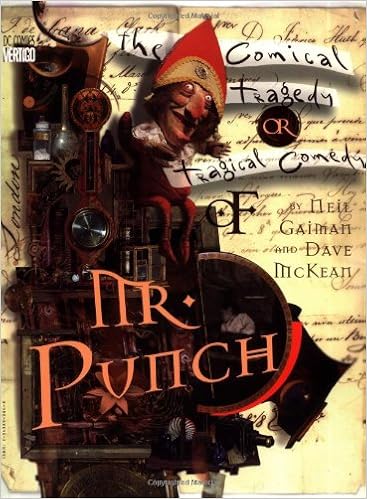
Overall, it is strange and depressing, but also utterly fascinating, like most Neil Gaiman books. And if there were no other reason to read this graphic novel, it would be worth it just for the art: because Dave McKean is a freaking genius, and the way he mixes painting and drawing and collage and photography in the images of this book make the entire experience twice as fascinating as it would be without him; and it’s fascinating enough already.

Highly recommend, though with a warning about the creepiness and the sadness, which is not resolved neatly at the end. Like life.

That’s the way you do it.
Book Review: Christopher Moore’s (Alas!) Bad Book

Image result for the griff

The Griff

by Christopher Moore and Ian Corson


I hate this. I hate it!

I love Christopher Moore. He is one of my all-time favorite authors, one of my heroes. I’ve read everything he’s written, and I’ve loved everything he’s written.

Except this.

This is a crappy book.

Well, I suppose it had to happen sometime; there have been some of his books (Island of the Sequined Love Nun, Lust Lizard of Melancholy Cove) that I haven’t liked nearly as much as his best works, like Lamb and Fool and Sacre Bleu. It’s reasonable to think that one of them could sink down low enough to actually be unenjoyable. It is not surprising to me that the one that did so was a collaboration, which none of his novels are; and that it was a graphic novel, which is not Moore’s usual medium. I would guess that Moore had little to do with the actual illustrations – which, unless I’m reading the credits in the book wrongly, seem to have been sort of mass-produced? They are all owned by Harper-Collins, and though a half-dozen people are thanked, no one is listed as the actual artist, other than the person who did the cover, Jennyson Rosero – and the illustrations are a fair piece of the problem with this. But really, there isn’t much here that’s good, so I can’t cover Moore on this one. He made a stinker.

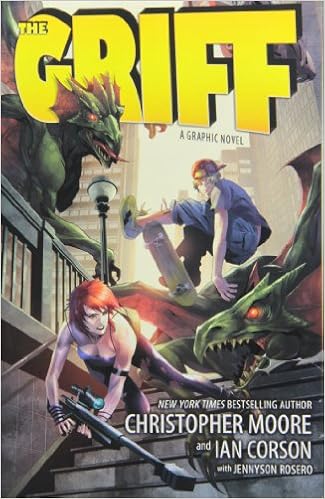
All right: details. So this is an apocalypse story. The Griff are, quite literally, monsters from outer space. They are called The Griff because they look something like griffins: four legged beasts with claws, wings, and lizard/dragon like heads with sharp beaks. They arrive in large space ships, much like Independence Day, and immediately fall to wiping out humanity. (Reminded me of Footfall, if any of you are as deep into sci-fi nerdery as I am. Also, they seem to be summoned by an accidental signal sent into space by guys who uncover a mysterious artifact from the sea-bottom, which made me think of Star Trek IV. Woo! Nerdiverse!) So far so good: but that’s where the first problem appears. The design of the book is so poor that there are a couple of pages that literally can’t be deciphered; the rapid transitions between scenes of slaughter and ineffective human resistance to the invasion are just a jumbled mess. But that doesn’t really matter, because the majority of this story is about the survivors of the initial onslaught.

Which is where the larger problems come in.

First, the character development and much of the plot leans heavily on people being comic book hot, and endlessly horny. Now, Moore uses a lot of humor around sex; but this isn’t funny, this is just lame. The two female characters are in absurdly revealing outfits – one woman wears a wetsuit for the entire story, which seems to be the only reason she is a trainer at SeaWorld – and the male characters do nothing but make horndog remarks, which the women shoot down. Then the one woman – not the one in the wetsuit, the one with absurdly large breasts in a skin-tight spaghetti-strap crop-top, which is generally what one wears as the world ends – has a ridiculous sexualized response to finding a BFG, a Big Fucking Gun, with which she’s gonna go Griff-hunting. Because that woman is a gamer, a master programmer and a genius; therefore, somehow, she is capable of using an actual .50-caliber military rifle, since she’s used them in video games. Suuuuuure. I mean, she’s played all the video games, even created some of them, so she’s badass, right? But hey, none of that matters: what matters is that she’s hot. And, as the book goes on, horny. Her character is mostly depicted as a pinup. Who does finally sleep with the goofy nerd horndog who’s been coming on to her, because comics are all about nerd wish fulfillment.

Image result for the griff graphic novel

Then, at the end of the story, though there is a good twist regarding the Griff, it turns out that the Griff are the minions of – the little gray men. Yes, them. Scrawny bodies, large heads, huge featureless black eyes. Them. Just like every other alien story for the last 20 goddamn years. And the humans finally win, because that’s what humans do: we fight, and we kill, and we win. WOO! USA! USA! I mean – Earth! Earth! Earth!

Anyway. Characters are lame, design is poor, the art is too CGI-crisp for my taste (though to each their own) and the climax and ending of the plot were cliché and anti-climactic and annoying.

I hate that Christopher Moore wrote this, but not that much; everyone throws out a pile of crud every once in a while. Much more than that, I hated this book. Do not recommend.

“Comic” Books: Two Reviews In One

Books With Pictures:

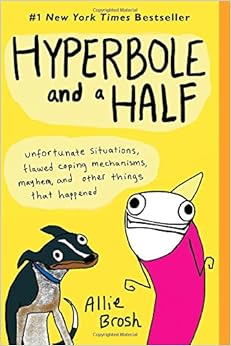
Hyperbole and a Half by Allie Brosh

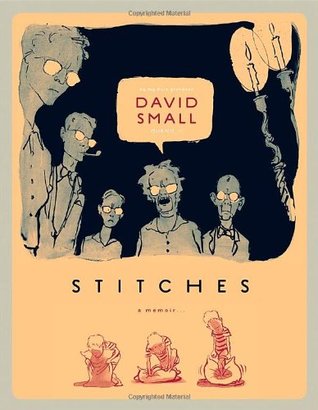
Stitches by David Small


So I’m a word guy, right? I love books, love reading; I enjoy movies and TV, but not the same way. I teach Fahrenheit 451 pretty much every year; in fact, I’m teaching it now. We’re at the point when Captain Beatty is explaining why the firemen are a good thing, because books, he claims, are a bad thing. He says, along with a mess of other interesting statements, that things started changing when photography came into its own, followed by motion pictures, radio, and TV – and, though Ray Bradbury didn’t predict it, the internet, YouTube, memes, GIFs, et cetera. Beatty says that things got simpler because they had mass: because a picture of a face is more solid than the face that one might imagine given a description. Guy Montag, the hero of the novel, is described as 30 years old, having a thin face, black hair, heavy eyebrows, and a “blue steel shaved-but-unshaved look.” So which is more solid, the face you’re imagining after reading those words, or this:


(By the way: took me twenty minutes looking through Google image search to come up with that. Searching for the description got me page after page after page of male models with swirly/spiky hair on top that was shaved on the sides. I mean, this dude

is not Guy Montag.

(Also by the way: I had to go back and re-do this search because my GODDAMN MS-WORD CLONE CAN’T SAVE PICTURES AND THEN UPLOAD THEM TO MY BLOG AND WHENEVER I TRY IT CRASHES THE THING AND THEN THE WHOLE POST IS BLANK AAARRRRRGGGGH Okay, I’m fine now. This is also why I like words more than pictures.)

Now, Beatty is the bad guy in the book, and if he is for it, I’m pretty much against it, including replacing books with visual mediums like film and television and the interwebs. But as Professor Faber (he is the Yoda to Montag’s Luke Skywalker) explains later, it is possible for books and movies and TV to all accomplish the same good things – the same things that music, and art, and conversations with good friends can all accomplish.

I think these two books, even though they are as visual and pictorial as they are literary – as many pictures as words, and the pictures essentially communicate as much as the words do – do the right things in the right way. That’s why I’m putting them together in this review. That, and the fact that both, despite the largely light-hearted genres they ostensibly belong to (Stitches is a graphic novel and Hyperbole and a Half a web comic), are actually quite somber and poignant and sad.

Hyperbole and a Half is a web comic that I discovered, as I think a lot of people did, because the author, Allie Brosh, wrote about the Alot. I hate that word; I love that comic. So I got the book that Brosh published, and read it. It’s a collection of her comics, which are about herself and her life: and though they are frequently stunningly funny, they are also profoundly sad and poignant to read. Brosh lives with fairly severe depression, according to what she depicts here, and she pulls absolutely no punches in describing what that life is like, and also allowing that condition, those feelings, to bleed into her other comics, as it no doubt bleeds into all parts of her life. Realizing how much she struggles with this turns even the more conventionally funny and wacky comics a bit more serious; because the strangeness that at first was just amusing now seems another piece of Brosh’s lifelong alienation.

But as hard as that is at times to read, it is also, simply, brilliant. I have rarely read something so honest and perceptive and brave, something that so perfectly shows a unique mind both in turmoil and in triumph.

Oh hey – know when else I read something that showed the same sort of genius and pain at once? Why, it was when I read Stitches, by David Small.

This one is a more traditional graphic novel; as such, it is in a more familiar storyboard format, and the art looks more like comic art; Small is an excellent illustrator, where Brosh’s art is intentionally simple and childish (Though still effective, and amusing as hell where it isn’t heartbreaking.). This is also a single story, told in words and images, rather than a series of shorts and vignettes like Hyperbole and a Half. It is the story of David Small’s family, particularly his violently abusive mother. The title comes from Small’s experience with cancer as a child: he had an undiagnosed tumor in his throat, which eventually led to the removal of one of his vocal chords, leaving him essentially mute, and also with a Frankensteinian line of stitches across his neck. This one is an even more terrible story. It’s maybe a little easier to live with, because it has villains and therefore heroes; Small should be considered heroic simply for surviving and growing up and getting his freedom, and then finding the strength to write this book – but the fact of his heroism makes the villains that much more terrible, and the story that much harder to get through.

But like Hyperbole and a Half, it is worth getting through. And in both of these cases – despite what Captain Beatty might think – the images don’t make the story easier to read, though I do think they give the stories mass. Almost too much of it, in fact.

I hope I haven’t made these books seem too dark or painful to read; they are both hard to read, but both are wonderfully realized, and really more moving than anything else. They are both genuine and honest memoirs written by intelligent and creative people, and I recommend them both.

Just – don’t read them one after the other. Put something more cheerful in the middle, there.

(Here: try this. I think it’s funny.)