Standards (De)Based Education

All right. It’s time.

Let’s talk about standards.
I won’t say I appreciate or admire the people who picked the word “standards” to describe their prescription for education in this country. But I will acknowledge an absolute masterstroke of rhetoric, which is what that was. “We have high standards,” they could say. “Don’t you think schools should have standards? Don’t you have any standards for your students?” they could ask teachers who objected.

What can I do but hang my head in shame, and agree to teach THE STANDARDS?

I’ll tell you what I can do: I can, and do, object to the standards as they are written. I object, too, to the very idea of standards: but let’s take one thing at a time. And the less radical, first.

It’s not too far out there to object to the standards, at least in one way: pretty quickly after the Common Core were adopted in most states, they received the approval of the Obama administration – and therefore the whole-hearted hatred of the Republican side of the country, particularly during the Tea Party boondoggle. So if I say I hate the Common Core, I at least have allies – though they’re not necessarily the allies I want to have. But I’ll take them, because they are correct in essence, if not in attribution of causation.

Backing up. First, what are the standards? According to the Arizona Department of Education, they are this:

These standards define the knowledge and skills students should have within their K-12 education careers so that they will graduate high school able to succeed in entry-level, credit-bearing academic college courses and in workforce training programs. The standards:

  • Are aligned with college and work expectations;
  • Are clear, understandable and consistent;
  • Include rigorous content and application of knowledge through high-order skills;
  • Build upon strengths and lessons of current state standards;
  • Are informed by other top performing countries, so that all students are prepared to succeed in our global economy and society; and
  • Are evidence-based.

Standards are a list of skills and knowledges that students should have when they graduate high school. Jim dandy. Seems useful to know what a student should know.

Quick question: who decides what a student “should” know? And how do we decide that? What is the basis for picking a specific skill and saying a student “should” know that before graduating high school? That knowledge of X, Y, and Z is necessary to “earn” a high school diploma?

Hang on: first let’s look at the sales pitch for the standards.

Critical Message about Arizona’s College and Career Ready Standards – English Language Arts/Literacy and Mathematics

· The purpose of the new standards is to provide a consistent set of English Language Arts (ELA)/Literacy and Mathematics expectations that prepare all students for college and career options.

· The standards are designed to ensure that our students remain competitive in the global market of the 21st century.

· Arizona’s College and Career Ready Standards – English Language Arts/Literacy and Mathematics standards include Arizona additions. Arizona’s adoption of these standards ensures a more seamless education for high mobility students since grade level standards and expectations are consistent across 46 participating states.

· The creation of the English Language Arts/Literacy and Mathematics standards was a state-led effort coordinated by the National Governor’s Association (NGA) and the Council of Chief State School Officers (CCSSO).

Okay: a consistent set of expectations that prepare all students for college and career options. Cool. Equity of access and opportunity is important, it is a fundamental promise of this country, and it is also one of the best ways to assure the general welfare of our people; so yes, all students should have access to the same preparation for college and career options.

I mean: they don’t. There are several other factors involved in educational outcomes, primarily the students’ socioeconomic status and family educational levels (which are also, of course, socioeconomically influenced if not determined). And because education funding in this country is primarily a factor of local district tax base, it ensures that students in the richest schools have access to the best educational opportunities and resources, and students in the poorest schools do not, and that system will survive that way as long as we keep the same archaic, institutionally-racist and classist funding structure.

But yes, surely all students should meet a certain minimum set of expectations. I’m with that. Standards, right? We have standards, and students have to live up to our standards, or we won’t accept them.

Umm…not sure what that means. I mean, if someone I go on a blind date with doesn’t meet my standards, then they go off to find someone else whose standards they do meet, and I go home alone, But what does it mean when a child – when a fellow citizen – doesn’t meet our standard? Does it mean they don’t get to live in this country? Don’t get to be citizens? Does it mean they have to struggle for the rest of their lives, because they weren’t good enough according to our standard?

You ever think about what it says about a student – a child, that is, since I’m talking about K-12 education, and the majority of students are still under 18 when they graduate high school – when we say that student doesn’t deserve a diploma? Hasn’t earned an education? Didn’t prove themselves to be good enough? If all education meant was the achievement of a specific set of skills and knowledges, then it would be appropriate to say those things (though the implication of merit in words like “deserve” and “good enough” is questionable if not outright wrong); but it doesn’t just mean that. We attach quite a number of value judgments to people who “earn” a diploma, and withhold them from people who “fail” to “earn” one. Those who don’t meet our standards, that is. Those children, we determine and decree, will suffer and struggle, because they’re not good enough. Never mind that there are countless ways to live, and live successfully, without ever mastering the skills and knowledges that “earn” one a high school diploma. Never mind that high school diplomas don’t necessarily show that one has or has not mastered the skills and knowledges: a diploma shows that one was able to prove one’s mastery of skills and knowledges to the satisfaction of those who decide who earns that diploma – me, in other words, as a teacher who gives grades, who determines who passes and who fails my classes. Me and all of my fellow educators. We decide who gets a diploma, who has shown to our satisfaction that they have mastered the skills and knowledges we chose for them to master, to our standard, on our assessments.

I think about my wife, who is one of the smartest and most capable people I have ever known (And I’ve known a hell of a lot of smart people), who was not allowed to earn a diploma because she called her principal an asshole. After he told her that she wasn’t good enough to graduate from his school, because he thought she was lazy and disrespectful. She was expelled from the school. She got a GED, a Graduation Equivalency Diploma – hang on; that’s not it. I just looked it up, and it actually stands for General Educational Development test. Huh. Did you know that’s what it was? Maybe I’m the only one who didn’t. Anyway, she earned her GED certificate, and also a high school proficiency certificate, by acing those two tests (because she is incredibly intelligent, if I didn’t already make that clear – they wanted to skip her two grades in elementary school. TWO GRADES. Nobody ever suggested I skip any grades. I’m not jealous, though.) and then went to work: but she couldn’t get a job, because she wasn’t yet 18 and so wasn’t allowed to work in most places in California during the regular school day. She was also told that the GED wasn’t as good as a diploma because she hadn’t shown she had the work ethic to complete the normal schooling program.

So I guess it isn’t just about showing mastery of the skills and knowledges required for college and career readiness. Huh? It’s also about showing oneself to be the kind of person our society approves of. It’s about winning the good regard of teachers, who are by nature and training judgmental. I mean, I’m a swell guy, and surely all of my judgments of my students’ characters are right on the money, and totally should have a significant impact on the lives of all of the students who pass through my classes. Some of those other teachers, though… pretty sketchy.

My wife’s story – this point I’m making about teachers and our generally subjective judgments of students – is one of the arguments behind standards, of course. Because CHUDs like the guy who told her she wasn’t “Aptos High material,” and she’d never amount to anything in her life, shouldn’t be the ones keeping the gates and refusing entry to our citizens. If students can show that they possess the skills and knowledges we expect them to have, then that should be enough: and no individual with their own biases and prejudices should be able to torpedo any person’s progress into productive citizenship.

I agree with that. It’s the one argument for standards, and for standardized testing, which I agree with and support whole-heartedly. My wife got the shit end of this stick because she was what this guy saw as a “troublemaker;” maybe because she is a woman, maybe because she was not in the same socioeconomic class as many students at that school (Though not all the students at the school were wealthy, not by any means), maybe for any of several other reasons. But there are millions of kids who suffer this same sort of fate, being prevented from achieving not because they lack the skills, but because someone in charge doesn’t think they’re good enough: and the most common reason, of course, is racism. I have heard people who know better than me point out that standardized tests, while imperfectly anti-racist themselves, are at least objective and colorblind in their allocation of success or failure: which means a student with racist teachers can still pass the test, can still prove they have met the standards, and therefore should be able to earn a diploma no matter what their racist teachers think. I appreciate that argument, and I therefore wouldn’t want to argue that all standardized tests and grades and so on should be removed, at least not until we can ensure no bias in the people acting as gatekeepers.

I will argue that we should remove the idea of gates, and specific standards of achievement.

But hold on: before I argue against standards entirely – before I show that I do not, in fact, have any standards – I want to finish my point about the standards we all have right now. They are no longer the Common Core standards, which became politically tainted during the 2010’s; though if you think they are appreciably different from those Common Core standards, you don’t know education: we don’t like changing things, we like keeping the old things – or even better, resurrecting the older things – and giving them a new name. The Common Core State Standards look like this: “By the end of grade 10, read and comprehend literature [informational texts, history/social studies texts, science/technical texts] at the high end of the grades 9–10 text complexity band independently and proficiently.” And the all-new, all-improved Arizona College and Career Readiness Standards look like this: “By the end of grade 10, read and comprehend informational and functional text, including history/social studies, science, and technical texts, at the high end of the grades 9–10 text complexity band independently and proficiently. (AZ.9‐10.RI.10)” You can see for yourself how Arizona is independent, and not still following along with that whole socialist Common Core mandate. WOO! States’ rights!

So my question is, still: who decided what were the skills and knowledges required to graduate high school? Who determined what students “should” know?

It’s not actually a simple question to answer – neither the one about what students should know, nor the one about who decided it. The issue with deciding what students should know is deciding what we think students should be ready to do. Do we think they should be ready to go to work? Do we think they should be ready to go to college? Do we think they should be capable of teaching themselves? Or do we think they should already know everything they will ever need to know? What mixture of those four things is correct, job/college/already know/can learn? But then there are more questions: what should students know to be ready to go to work? What kinds of jobs are we talking about? And what does “ready” mean? I haven’t ever been “ready” for any job, if “ready” means “already capable of every aspect of the job required.” I have always had to learn on the job. Do we want them ready for entry level, or ready to move up to the top echelons of management? Do we want them ready for local jobs, or do we want them to be ready for any jobs? Please note that if we decide to make our students ready for any jobs, then they’re going to be learning a whole lot of things that seem like they aren’t important, because those students will look around their part of the world, look at the people they know, and they will think, “Nobody in my town knows physics, or needs to know physics. Why do I need to know physics?” If our only answer is, “You might find a job somewhere else that requires a knowledge of physics,” we’re not going to convince a lot of students to try very hard in physics class. But also, if we decide that nobody who goes to school in this town needs to know physics, then we are sentencing those students to live only in places and have only careers that do not require any knowledge of physics. Maybe that’s fine: we decided, pretty unanimously, that none of the students in American schools need to be familiar with Mongolian folk dancing; we therefore cut them all off from careers involving Mongolian folk dancing.

Pretty fucked up, guys. Denying our children that avenue in life? Who were we to decide that for them?

But also: how much time and energy do we want to dedicate to teaching Mongolian folk dancing, on the expectation that some number of our students will pursue a life that involves Mongolian folk dancing?

And before you scoff too hard at that: recognize that almost all American students were, at some point in the last several decades, taught how to square dance. We thought that was a valuable use of time and resources. And I, for one, would rather know Mongolian folk dancing than how to do-si-do.

This is amazing.

(Let me also point out, though this is off topic and too large a subject, THAT WE SHOULD NOT FOCUS EDUCATION ENTIRELY ON THE ABILITY TO MAKE STUDENTS PRODUCTIVE AND CAREER-READY. LIFE IS NOT JUST ABOUT YOUR JOB. STOP TELLING STUDENTS THAT EVERYTHING THEY LEARN AND EVERYTHING THEY DO IS GETTING THEM READY FOR “THE REAL WORLD OF WORK.”)

But okay, we’re really only talking about English/Language Arts and Mathematics. (Hey: who decided those two were the most fundamental skills? I agree that communication is vital in essentially everything; but is English the only way to learn to communicate? What if we decided instead to teach every student to be fluent conversationally in three different languages other than English? Or what if we decided that proper communication required an understanding of our context, including our cultural context and the context of our interlocutors, and therefore all students must master 12 years of social studies including sociology and psychology? AND DON’T GET ME STARTED ON MATH.) So surely the expectations of what should be mastered in those subjects is more straightforward. Right?

It may be. I object to a number of the standards – for instance, I am supposed to dedicate considerable time and energy to this one: “Analyze various accounts of a subject told in different mediums (e.g., a person’s life story in both print and multimedia), determining which details are emphasized in each account.” (AZELA Standard 9-10.RI.7) – but I can’t argue against the ones which say students should be able to read proficiently and independently, or that students should cite evidence for their claims, or that students should know how to analyze complex characters. And all of the different sets of standards were all written with input from various teachers and teacher groups and other educators.

But not only teachers.

Common Core, for one example (And there are lots of examples, of course. Education is a very profitable business. Lots of companies get involved in trying to create educational resources, and then trying to sell them to the very large market of schools and teachers flush with all that gummint porkbarrel money), was written by the Council of Chief State School Officers, which is essentially all of the various Superintendents of Instruction from each of the 50 states. They took input from the National Council of Teachers of English, the Association of Mathematics Teacher Educators, the NEA and the AFT (the two largest national teachers’ unions), and various other teachers and educators. I suppose I should point out that most of the chief state school officers have education backgrounds, though not all of them; but more importantly, I think, is that the CCSSO was not the only organization involved: it was also the National Governors’ Association, which certainly has a stake in education at the state level, but generally includes a whole lot fewer educators; and also, a certain non-profit group founded in 1996 called Achieve. (Don’t be too impressed, by the way, by this group being non-profit; the College Board is non-profit, and they’re the ones who make all of the AP tests, and the ACT, and the SAT. And then charge millions of students hundreds of millions of dollars every year to take their tests. But they’re not profiting from it.)

That last one is the interesting one. Because you figure the CCSSO and the teachers’ unions are going to represent what the educational establishment wants: what is best for the current school structure, and for the teachers. And the Governors’ association will represent the will of, if not the people, at least the constituents who have the ear of the governors; which surely includes parents’ groups and the larger constituency special interests. I think it’s safe to say that both groups, the CCSSO and the NGA, of politicians would represent the interests of the monied class in this country: since that is who commands the attention if not the obedience of politicians.

So who did Achieve represent? Maybe the students? The ones who have the most skin in this game, so to speak, the ones most affected by all of this wrangling, and the ones who, as lacking votes and money in general, do not have the attention and obedience of the politicians?

Of course not.

Alice In Wonderland Disney GIF - Alice In Wonderland Disney Mad Hatter GIFs

Achieve’s website tells us this: “Achieve is an independent, nonpartisan, nonprofit education reform organization dedicated to working with states to raise academic standards and graduation requirements, improve assessments, and strengthen accountability.”

Very nice! That sounds great. But…who are you?

I couldn’t actually find a list of the board of directors on their website (I admit I didn’t look too hard, as I expected to have to go outside of the organization to find what I wanted to know), but I found one on Ballotpedia, interestingly enough; seems like Achieve has some involvement in politics, as well as in education. Well, they said they work with the states, right?

Here are their directors, according to Ballotpedia (Which got the list from the Achieve website, accessed in 2016; unfortunately when you follow the same link to the current list of the board of directors, you get this:

Achieve is led by governors, business leaders, and influential national leaders committed to improving K-12 educational outcomes for all students.

Created in 1996 by a bipartisan group of governors and business leaders, Achieve is leading the effort to make college and career readiness a priority across the country so that students graduating from high school are academically prepared for postsecondary success.

Cool, thanks.)

Here’s the list from 2016:

  • Mark B. GrierVice chair
  • Michael CohenPresident
  • Craig R. BarrettChair
  • S. James Gates Jr.
  • Governor Bill Haslam (R-Tenn.)
  • Governor Jay Nixon (D-Mo.)
  • Governor Maggie Hassan (D-N.H.)
  • Former Governor John McKernan Jr. (R-Maine)
  • Louis V. Gerstner Jr.Chairman Emeritus

Sorry to use out of date information, but also: Mark B. Grier is listed by Ballotpedia as the current top executive at Achieve, and while he has also moved on to a director position at Freddie Mac, his profile there still lists him as a board member at Achieve, so I’ll take this list as representative if not current.

Who are these people? Glad you asked.

Dr. Sylvester James Gates, Jr., is a badass. An award-winning and influential theoretical physicist, professor, author, and documentarian, his involvement with Achieve could only improve their work. Not sure how much sway he actually has, but his presence on the board is the best thing I found. (He’s also the only African-American on the board, but surely that’s neither here nor there.)

Michael Cohen, president (Not THAT Michael Cohen) is actually an educator (Though he worked for Bill Clinton, so he’s a neoliberal educator). He is also the only one with a page readily available on the Achieve website – though to be fair, their Search function is not currently available, and the website hasn’t been updated since 2021. Craig R. Barrett, chairman, is the former CEO of Intel. Mark B. Grier, vice chair (and maybe current chair) is the former CFO at Prudential. (Also: “Grier’s leadership on the board continues Prudential Financial’s longstanding commitment to improving education outcomes.  Former Prudential Chairman Art Ryan served on the Achieve board from 1999 to 2008, and as the chairman from 2005 to 2008.” So again, if the list isn’t current, it’s at least representative. Mark Grier to Lead Achieve Board | Achieve) Louis V. Gerstner Jr., Chairman Emeritus, is the former CEO of IBM, and the former chairman of the Carlyle Group, a private equity firm. Gov. Bill Haslam of Tennessee  is also the former president of Pilot Corp, a petroleum company that owns the Flying J rest stops. Former Gov. Jay Nixon of Missouri is one of the Democrats on the “nonpartisan” board, and is a lawyer turned politician rather than a corporate overlord, so he wasn’t too bad – but did hand control of Ferguson over to the state highway patrol and later called in the National Guard to put down riots after Michael Brown was shot and killed. Maggie Hassan (The only woman on the board, but surely that’s neither here nor there) and Jock McKernan are also former lawyers turned politicians, Hassan the current embattled Democratic senator from New Hampshire, McKernan the Republican governor of Maine in the late 80s and early 90s (And the husband of Senator Olympia Snowe, if that matters), and are generally not offensive.

So that’s who wrote the Common Core. Teachers – but also politicians, and business executives. And who do we think had the most influence, the final say? Probably not the teachers. And definitely not the students.

But is that so terrible? I think I hear you ask. What’s wrong with business executives promoting the standards? Well, inasmuch as they were simply people who understood complicated systems and processes, and who live in this society and therefore may have a stake in its success, nothing. But that’s not all they are. Businessmen, especially executives of these sorts of large, international corporations, are not particularly loyal to any one society; they are loyal to the bottom line: shareholder value. I cannot believe that these men created Achieve, and pushed for the Common Core standards to be accepted nationwide, for any reason other than they knew it would be good for business.

From what I can see of the standards, and the intent of those who wrote them, they are very good at producing exactly what businesspeople seem to want: conformist rule-followers who don’t think very originally, and who don’t question authority, but who are very good at mindless, repetitive tedium, and who seek simple entertainment and satisfaction at the end of the very long work week. Good workers (Remember how the work ethic is as important if not more important than mastery of the skills?) who are also good consumers. Good employees, and good customers.

How do standards do that? In a number of ways. Partly because they are standard: the goal is to make every student the same as every other student, capable of all the same things. If we see those things as a baseline, and give schools room and resources to reach beyond that, then there’s no problem; but that’s not how the school system works – and again, that is because of the same people wielding the same influences. Because the other part of the push for common standards is – the push for accountability. It’s right there in the Achieve mission statement. “Achieve is an independent, nonpartisan, nonprofit education reform organization dedicated to working with states to raise academic standards and graduation requirements, improve assessments, and strengthen accountability.(Emphasis added)

See, we can’t have universal standards unless we can be sure they are adhered to. Right? We have to make sure these schools, and those wacky tree-huggin’ hippie teachers, are doing what they’ve been told to do. So in addition to creating new standards that will define what is taught, we will create and implement test after test after test after test, to make sure that the teaching is – well, meeting the standard.

Do you know what happens when you create an entirely new system of curriculum, and a new set of assessments? Particularly during a global recession, when state education budgets are being slashed and burned like virgin forests in logging country? (By the way, Jay Nixon of Missouri was also called the “cutter-in-chief” for all the cuts he imposed on the Missouri state budget. But he did also support investment in education when things started turning around, so. Good and bad, I suppose.)

The schools fail, that’s what. New curriculum takes time to figure out and make functional. New assessments take time for students to get used to them. Even in the ideal testing situation, the whole idea is that you take the results of the test and use it to inform the next year’s instruction in order to raise the scores: which pretty much requires that the first year’s scores are going to suck.

And so they did. And do.

Which opens up a lot of options for those who want to control the education system in this country, say, in order to produce better worker drones and more consumers to buy products.

Any time the school does not meet the standard, any assessment that shows the students are not showing the specific evidence asked for which proves they have mastered the chosen skills and knowledges to the extent and in the manner determined by the people in charge, then the school is failing, the teachers are failing, the students are failing. And when a school is failing, we will sanction it in some way, and follow one of a number of alternative courses: we could use that  failing school as evidence that a current politician has failed their constituents, and thus push for the candidates we like; we could use that failing school to argue that the school system in general is failing and therefore we should promote vouchers for private schools; or to argue that the school system is failing and therefore the state needs to loosen the requirements for charter schools; or to argue that the school system is failing and it is the fault of those damn teachers’ unions. So many options!

We could also argue that the school system is failing, so there needs to be greater emphasis on achieving the standards. Now that we have these lovely standards written, we can push to have them adopted across the country (Maybe in conjunction with a huge federal mandate, which rhymes with Moe Wild Heft Refined, which also mandates accountability…), and then use that to impose more expectations that schools will adhere to the standards, so that every child in every state can have the same results! Won’t that be wonderful? If … Moe wild is heft refined?

(Sorry.)

Once we decide that the school is failing and the most important thing is to make sure that students MEET THE STANDARD, the stage is set for the process we have watched play out across this country: we start teaching to the test; and more devastating, we eliminate everything that is not teaching to the test. Electives are cut, because the students need more remedial instruction in math and English. Which frustrates the students, and makes them feel like the system is not helping them but is instead out to crush their spirits (because it is), and of course they resent it, and so of course they rebel against it: they don’t try as hard as they could on the tests, because fuck the tests, man!
That Test You Didnt Study For GIF - Fuck This Shit Give Up Unprepared GIFs

Which means the school does not meet the standard: and so we can go through another round of whatever-flavor-of-damage-we-want-to-inflict-on-the-system.

My school knows that I’m a good teacher. It’s hard not to: my students generally like me, their parents generally like me; the surveys the school does of parents and students always reward me with sterling reviews. I was even named in a Google review of the whole school as one of the reasons why my school is worth going to. And, if I may presume, I think that anybody who comes and watches me teach will see that I am good at it. (I mean, I’m not always sure I’m good at it, but that’s because I have imposter syndrome and a certain amount of anxiety over my abilities. Never mind. It’s not important.)

But what the school tells me, every single time they evaluate me, (Which in this environment of hyper assessment, is every goddamn year; also I live in a “Right to Work” state, for a charter school, which means there is no teacher’s union to represent me, and therefore no tenure. Can’t let them lazy goddamn teachers just relax and teach! They need to worry about losing their jobs all the time! That’ll keep ‘em in line!) is that I need to provide documentation that I am teaching the standards. I need to write objectives on the board. I need to review those objectives with my students, every class. I need to align my instruction and my assessments, and now my grades, with those standards. I need to write daily lesson plans that show I’m focusing on the standards. I need to give common formative assessments, five times a quarter, to show that my students are progressing in their mastery of the standards.
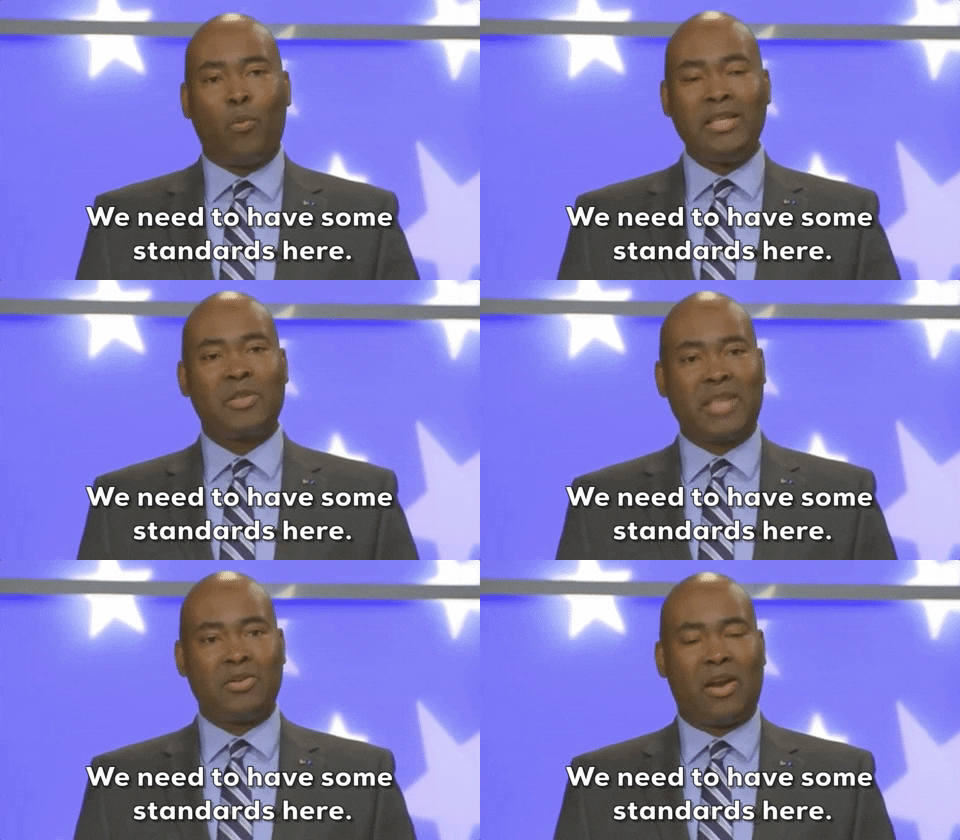
We-need-to-have-some-standards-here GIFs - Get the best GIF on GIPHY

That’s what my job has become. Standards-based instruction, with (eventually) standards-based grading. Everything standardized. Which makes the businesspeople happy: and since my charter school is run by a corporation, and therefore by businesspeople, they will be happy, too. They’re pretty dang sure that creating a laser focus on the standards will achieve the results they want: proof that all of our students are meeting and exceeding all the standards, because all our teachers do all day long is try to get them to learn and master the standards. Because, we are told, that is how the school is assessed and graded by the state: according to our ability to make our students meet the standard of mastering the standards on standardized tests.

Yeah, it stopped meaning anything to me, too. Quite a while ago now.

You know what might be the most insidious part? There’s still an argument to be made for standards. As I said, there is nothing wrong with a baseline of ability that all students should be provided an opportunity to reach. I still think we should not tell a child that they are “failing” just because they can’t pass fucking Algebra or whatever, but I do think that a general education is a good idea, and that there are things that should be included in everyone’s education. Yes to that. Assessment of student achievement and ability is an important part of education (Though there are YEARS worth of caveats and qualifications in that. Most of which I’ve already written about, and I’ll get to the rest.), so assessment of a student’s mastery of a standard is a valid pursuit.

Here’s the thing that kills me about standards-based education: you get what you measure. You find what you are looking for. If what you want is to see if students have mastered a standard, and you teach to the standard and then assess the standard, then students will show that they achieved mastery. If you focus harder on the standard and teach it more, they will generally do better. If you point out to the students, by writing it on the board and going over it with them every day, exactly what they are supposed to learn and which standard they have to master, then they will do as they are told: they will focus on that idea, that knowledge, that skill, and they will master it. Which means the student data in that class will improve when you do things like write the objectives on the board and go over them in class every day. It works. And, as I have also written about for years, teachers are so hungry for proof that what we spend our lives doing is worth something, when we see those results, see those data points march upwards, know that students are passing the assessments: we like it. We want more of it.

So we do it. We teach to the standards. We use standards-based curriculum, and standards-based grading. It works, after all; and it’s what’s expected of us.

We stop questioning where the standards came from: they’re just the standards, and we have to teach them, so we do. We stop thinking about how dumb those standards are. We forget about the things we used to teach that weren’t measured by the standards – those things are long gone, and after all, they’re not part of the test, not part of the assessment of the students or the teachers or the school. They can’t be that important.

But they are important. All the things that aren’t in the standards are the things that matter most. The things that inspire people, that make them love learning, that make them grow and change. Things like real literature, poetry and novels and plays. Things like learning, for the first time, the history of the oppressed people and the non-dominant cultures – especially important if you happen to be part of one of those cultures, one of those people. Things like relating to and empathizing with other people. Things like school spirit, and community service, and even sports, goddamn it. These things still exist: but they are fading. Students are losing access to sports because they have to spend their after-school time in tutoring, because they haven’t mastered all the standards. Clubs and service organizations are less active, less involved, because there’s not enough time for all of that: students have to study for tests. Teachers can’t give the lessons and assign the projects that become part of a student’s life and personality, because we have to focus on the standards. All of that gets lost by the focus on the standards. Not least because the standards are, by design, simple, measurable nuggets of information. There’s no standard for the intangibles.

You get what you measure. And you lose everything that can’t be measured.

There’s a guy I used to teach with who I think is wrong about almost everything he’s ever said: but there was one thing he said which I thought was 100% accurate. He said that there should only be one standard, one expectation, one guiding goal that drove all of education: Students will learn to think critically. I would actually add to that something more human, like “Students will learn to love their world and themselves,” but I don’t know that schools should consider that a definite and intentional goal, so I’m willing to keep mine as an unspoken purpose, and focus only on the one.

What else is there? There are a dozen ways to learn to think critically, and all of them are valuable. Every subject, every class, can help students to do that. That one skill, with all of the myriad aspects that contribute to it, is the most important thing that people today should have – and that too many of us today can’t do.

And the best part of all? It can’t be measured. And it can’t be standardized.

That’s something that meets my standards.

Best Your Loner GIFs | Gfycat

This Morning

This morning I am happy. My senior students graduated yesterday; I was the MC for the ceremony, which meant I was nervous and uncomfortable all day leading up to it — because regardless of how much time I spend in front of a classroom full of students, it doesn’t take away my stage fright or my introversion. And also, a classroom full of students is quite different from a gymnasium filled with probably 500 people, including parents and grandparents and all of my fellow teachers and my administrators and my wife. Much more nerve-wracking.

But it went well, my speech was well-received, I made my former students cry. Here, for the sake of those who did hear it and want to remember, is my speech; it won’t mean a whole lot to people who don’t know these kids, but these kids aren’t the only ones who suit these words, so feel free to substitute your own children or students for the ones I was talking to and about.

Ladies and gentlemen, friends and family, students, teachers, administrators – and, of course, graduates.

Welcome to the Graduation Ceremony for the Class of 2019!

(to the grads) I bet some of you thought you wouldn’t make it here today. But you did it. All of you: you did it.

You had help – parents, siblings, relatives; teachers, and friends – and all your online friends, YouTube, Khan Academy, Quizlet, Yahoo answers, Wikipedia, Sparknotes, Slader, 123HelpMe.com.

But the point is: you did the real work. You spent the late nights, and the all-nights; the early mornings, the lunchtimes and the passing periods, cramming and studying and reviewing and furiously finishing assignments. You’ve gone through thousands of sheets of paper, hundreds of pencils and pens, gallons of energy drinks, an average of fourteen Hydroflasks each, and a literal ton of hot Cheetos. You sweated through the tests, the essays, the labs, the presentations. You fought through the despair, and stress, anxiety and depression, fear and anger and sadness and happiness – because honestly, nothing makes it harder to sit down to a test than when you’re having a really good day.

You did all of that. All of it. Make no mistake: if anyone tries to minimize this accomplishment, to tell you that this was easy, that it is not impressive – don’t listen. This is impressive. You are impressive. You made it. High school – all school – is rough. And you’ve made it.

And I only have one thing to say to you: don’t let the door hit you in the butt on the way out.

Seriously – and I say it with love – get out. Go away and don’t come back. We’re all as tired of you as you are of us, and we’re all going to breathe a huge sigh of relief when you all have left. This is one of the most – let’s say “challenging” – classes I think this school has ever seen.

Want to know why?

You’re one of the smartest classes this school has ever seen.

You’re so smart, all of you, that it has been impossible to keep up with you. Impossible to consistently challenge you. Impossible to control you. Speaking from my experience, trying to run a discussion with all of you was insane: too many of you had things to say, and if you didn’t get to say them to the class, you would say them to each other, all at once. It was chaos.

You all burn so brightly that you draw all the air from the room – and because this school, these rooms, are so small, there wasn’t that much air to begin with. I honestly think that’s why you fought so much with each other: too many lions in too small a cage. It was a daily struggle to be on top, to stand out, to show how good you are individually, among all these other amazing people.

So. Now’s your chance.

You’ve been held in this small space, like a flower in a too-small pot, for too. Long. Now – you are free. Free to grow as tall and as grand and as glorious as you can. You will overshadow this place. You will tower over us, spread far beyond us.

I cannot wait to see what you all become.

So get out.

There was a keynote speaker, of course, a NASA scientist and actor who happens to be related to one of our newest alumni. I thought he did a great job with his speech — but I couldn’t help noticing that he leaned pretty heavily on clichés. He was actually quite up front about it: part of his theme was using Google (or technology in general) to find what you need, which was fine since he was talking to a STEM school; but the Commencement Speeches he Googled were apparently pretty generic. It was good and useful advice, but — generic.

So I thought I would write some of my own advice. Here, then, is something like what I would say if I were to be the keynote speaker at a graduation. This is what I would tell a group of students who were about to leave high school and embark on the adult part of their lives — also known as “the good part.”


Speeches like this are always full of clichés. Now, I don’t dislike clichés; I think most of them are true, and have genuinely useful things to say. Clever sayings don’t become clichés if they aren’t true, and truth isn’t talked about unless it is cleverly worded; so pay attention to clichés. At the same time, though, be aware of when the overuse of clichés clouds the message: because it’s a rarely known biological fact that people’s ears go deaf while that person is rolling their eyes. Think of them like memes: they are great, they make you laugh and make you think; then you get tired of them; then they’re dead. Clichés are like your favorite food: you can fall back on them when you have nothing new that sounds good; but you can also get tired of even your very favorite food, and that is a sad day.

I think one of the best things we can do is examine clichés, and reimagine them. Deconstruct them. Critique them. Because then we’re actually thinking about things we normally just swallow whole, without any consideration’ and that is no way to live, nor any good way to eat. You’ve got to chew your food: and your clichés, as well.

Ready? Here we go.

“All you need is love.” One of my favorite songs, and one of my favorite cliches. Also true — kinda. It’s not true that love is ALL you need; but it is true that love is one of the most important things you can have.

Image result for love is all you need meme

The first piece of advice I want to give you is this: find love. True love, if you can; genuine and lasting love, at the least. I did, and there is not a day that goes by that I am not shaken to my core by gratitude and happiness because of it. And though I think I am extraordinarily lucky in love, I am entirely sure that all of you can find love, too. Make it a priority: make time for it, time for the looking and then time for the love once you find it. It doesn’t have to be romantic love, if that’s not what you’re after; it can certainly be love for family, for a parent, for a sibling, for a child; it can definitely be love for your best friend, or for a beloved pet — although, as much as I love my pets, I would recommend finding a human person to love. Because human persons talk back to you, and because pet persons die too soon. But it doesn’t have to be a spouse-type person, and it doesn’t have to be only one person. But in all the years I have spent with my wife, nothing has mattered to me as much as going home to her, as having her support and her companionship, as loving her and being loved by her. Don’t settle for something less than that: keep looking until you find it, because a half-measure of happiness will keep you from the full measure, and it isn’t worth it. If you think you’ve found it, and then you turn out to be wrong, don’t stay: divorce that person, leave that person, kill that person and stuff them in a sack.

Okay, don’t do that last one. But definitely leave the relationship and look for something better. Don’t give up on love. Not ever. And if you lose love, unless the memories of that love are enough for you, go out and find more love, find new love. Always. Life is better with love than without: and I truly believe everyone can find someone to love.

Next: “Never give up on your dreams. Shoot for the moon. Even if you miss, you’ll land among the stars.”

Image result for if you aim for the stars and miss meme

Okay, once again, there’s truth to this. You should have some kind of ambition in life, and it is better if it is grand; but if it is grand, it will also be, for the vast majority of us, unachievable. Which means you will have two options: give up, or keep working for something you may never accomplish. (Whatever you do, don’t look at the affirmational quotations for this one. As someone who has tried for twenty years to be a published author, and who is still a high school teacher, it both amuses and disturbs me to hear celebrities who caught their lucky break telling people to never give up. Sure, if I had been handed my dreams when I was 17, I’d believe that anyone could accomplish anything they wanted to do — if I was arrogant enough to think that luck came to me because of my talent. I’m not bitter.)

Personally, I would recommend not giving up. Not because of this landing among the stars nonsense; that’s neither true nor meaningful — I mean, if my “moon shot” is to be a published author, what does it mean to land among the stars? I can certainly imagine a second-level success — say, I sell some pleasing number of books which I self-publish, or I get to a pleasing number of followers on this blog, both of which are secondary goals I’m working towards and would be happy to achieve — but how does that fit the metaphor? The moon is infinitesimal compared to the stars, which are infinitely farther away; so what does that mean? Nothing, that’s what. But that’s okay: the point is really that working towards your dreams is a good thing to do regardless of whether or not you achieve the original dream. I really prefer this quote to the cliché, because I think this captures my experience and a lot of other people’s, as well. (Makes sense that it came from an actress whose best-known role came when she was 36.)

“As long as you keep going, you’ll keep getting better. And as you get better, you gain more confidence. That alone is success.” –Tamara Taylor

That’s why I say it is worthwhile to have a grand ambition, even if it is one you will never achieve.

But that takes me, in a roundabout way, to what may be the most important advice I have to give you; though it is also probably the most vague. It is this: there are two kinds of people in this world, and two kinds of experiences.

(There are a bunch of these memes…


Image result for there are two types of people


Image result for there are two types of people

Image result for there are two types of people

Image result for there are two types of people

But this one’s my favorite:)

Image result for there are two types of people


Here are my two kinds: One is the kind of person, and the kind of experience, that limits your future choices, your freedom, your ability to control your life; the other is the kind that expands those choices, that freedom, that ability to make up your own mind and to control your own life. Look always for the second kind of person, the second kind of experience. There will be many choices you will make in life, and many of them will limit your future freedom: and those are the choices you have to be most careful of. You have to make them at the right time, and for the right reason. Choices like what to study in college — after you decide whether or not to go to college. Like what job to take. Where to live. When, and if, you will marry; when, and if, you will have children. These are the defining choices in life, and if you are not yet ready to be defined, don’t make them.

More importantly, don’t EVER let someone else make those choices for you. Don’t let someone pick you for marriage unless you pick them, too. Don’t let someone pick your time to have children, or with whom. Don’t let anyone push you into a career path, and don’t push yourself into one unless you want that career to define you. Until you are ready to make that choice, and lose the freedom to choose again later. (Though here’s a secret, and another cliché I won’t deconstruct: it is never too late to change your mind. Though it does get harder as time passes and you get more settled in your place in the world.)

Let me say one more thing about work: this one?

Image result for do what you love and you'll never work a day in your life

Complete bullshit. (You can tell by the background. What the hell kind of job does this image represent? Forest ranger? Have fun chasing poachers and meth cooks all over those mountains, in between rescuing dumbass dayhikers who thought they could just take a jaunt through those woods without equipment because they were in the Brownies. Also have fun getting furloughed when the government shuts down the next time.) Jobs are work. There is always work, or else nobody pays you for it; and the aspects that are work are not going to be fun. Jobs are always difficult, even if you love them, because you can’t possibly love every aspect of them (unless you’re on a whooooooole lotta drugs, and that has its own drawbacks.). I love some things about teaching, I really do — but I HATE the paperwork, and the grades, and indifferent students and overbearing parents, and a few other things as well. I love writing — but I HATE promoting myself. Even if I achieve my dreams of being a professional published author, I will need to write to very strict deadlines, and I will have to worry about my next book being a failure and sending me into the oblivion of Used-To-Be’s. I will have to travel, and speak publically, and participate in conventions and panel discussions and incessant insipid interviews, and I’ll have to be positive ALL THE TIME. I will hate that.

Honestly, I think the best way to view a job is to refuse to let it define you, unless you choose to define yourself that way. Back to the idea of limiting or expanding your freedom: if somebody wants to tell you that you are a teacher, and therefore you can’t be, say, a stripper on the weekends, don’t listen to them; you can be a stripper who teaches during the week. If you don’t care what you do for money because your passion is elsewhere, is in your avocation or your craft or your art or your family, then good: somebody asks what you do, you tell them that you make kayaks in your garage. They don’t need to know — they probably don’t really care — that you deliver pizzas for money; the kayak-building is FAR more interesting and important. So the point is, define yourself by your passion, not by your job; don’t expect your job to BE your passion, though it is certainly nice when they coincide. As much as I hate parts of teaching, I love, so much, that I get to spend all day every day with words, with literature, with reading and writing.


There are some other, smaller pieces of advice I would like to give, but they don’t come from clichés and they don’t have their own memes (Advice from a writer and a teacher: stick with a theme only as long as it makes sense; when it’s not working any more, drop it.). One is to take advantage of opportunities when they come up. Saving things for a later day is too often saving them for never; freedom to choose in life hits an early peak and then steadily decreases — until the very end, when you gain the freedom that comes with loss. That is, once you have a house and pets and a family and a career you want to keep, it becomes much harder to travel the world — until you lose all of those things. So if you have the chance to travel, do it.

Another is to pay attention: look around you. Take your time: you actually have quite a lot of it, and it will feel like more if you pay attention. I recommend walking, often, with your eyes and ears open to your surroundings.

Another is to read, and to keep learning. Doesn’t matter what you read, doesn’t matter what you learn; if you read the conspiracy theory websites that show how the Rothschilds are behind the measles outbreak, at least you’ll learn how crazy people are — and if you believe what you read, then the rest of us can learn to avoid talking to you, which is really for the best.

An important habit related to both of those is to always question. Question yourself, question your world, question your assumptions. You have to be careful not to take this to the point of permanent uncertainty and anxiety, but that has more to do with knowing when to trust the answers you get or the answers you make, and to move on to a different question; you can always come back to this question later. (Example: should I have written this blog? Is this too long? Is it a terrible topic, that everyone will find boring? Do I seem too arrogant, giving everyone advice? Well, I’ve written this much, and I don’t have a better idea, so — here it is. If I lose readers because of it, so be it. I’ll write something short and pleasant tomorrow. Also, I’ll hopefully get some feedback on this, which will help me know if it was the right thing to do. Also, please comment and Like content you enjoy, always. One of the best things to happen to me in the last few months was when someone read my book and sent me a comment telling me how much they liked it. I’m still floating from that one.)

Actually, that’s a real piece of advice: speak up. Do it in writing, do it anonymously if you are uncomfortable with direct conversation and confrontation; I certainly do, and I do almost all of my talking through a computer keyboard. I even write letters to my students when I want to chew them out, and you know what? INCREDIBLY effective. Feels much more formal and serious when I tell them in a letter that I’m sick of their bad behavior. Highly recommend it. But: speak. Up. Always. Positive and negative. When you are grateful that someone did something nice, say it — not just “Thank you,” but “I appreciate the way you gave me that/helped out with that/did that nice thing.” Tell your loved ones not only that you love them, but also what you love about them. As often as you think of it, say it. When someone angers you or upsets you, say something. When someone makes you uncomfortable, say something. Don’t suffer in silence: say it. Always. The worst case scenario is that you’ll be a pathetic whiny sniveler, and this way, the rest of us will know that and avoid you: so then everyone wins.

Well, except you.

But that’s what you get for being a whiny sniveler.

Last thing, and it’s not cheerful, but it’s true, and it’s important: people love telling younger people that life gets harder, that high school is nothing compared to college, and that college is nothing compared to the real world. I heard that all through school — “When you get to high school, it’s going to be MUCH harder . . . When you get to college, that’s when school/professors/assignments/grades get REALLY hard . . . When you get out into “the real world,” you’ll see how much better you had it while you were still a student!” — and I’m sure you’ve heard it too.

Well, here’s your last truth from me: it’s all bullshit.

Every stage of life is hard. And every stage of life has rewards that make it bearable. College is harder than high school academically; but the freedom you gain, the agency and control over your own life, makes it worthwhile. Also, you get to meet much better people. That same combined difficulty and reward comes with moving out of school and into the world of jobs and such — whether you make that transition after high school or after college doesn’t matter, it’s always the same — you gain more responsibilities, but also more power. The power gives you more freedom and more agency — you earn your own money and you can spend it how you want, for instance — but the responsibilities reduce that freedom, as well.

It’s always like that. When you are older you will probably have more financial security, but your health will probably be worse, and you’ll be aware of your dwindling years to enjoy your life. When you are young, you have all the time in the world — and too much of it has to be spent struggling.

I’m not saying this to depress you, just to let you know: it doesn’t get worse. In most ways, it gets better, because even though there are troubles to weigh down your joys, there is something else that happens as you go through life: you get stronger. Whatever does not kill you, right? It’s true: you get stronger every single day you are alive. It doesn’t make the troubles you face less — but it means you have an easier time handling them. And as long as you keep your eyes open, and take the time to recognize what you have, your happinesses will seem greater. I am happier now than I have been at any time in my past. Last year I would have said the same thing. Ten years ago I would have said the same thing. (Not nine years ago, though. That was a shitty year. But you can’t avoid those, so don’t worry about them. Try to get through them, that’s the best you can do.)

I’m going to end this with my attempt to make my own cliché — but because I thought of it, I actually find it much too annoying to just say; so I’m going to say it with memes. (Another piece of writer’s and teacher’s advice: know your audience.)

They tell us to never give up — but sometimes, giving up means you can walk away, and go find something better to try. So the best way to look at this is:

Image result for picard make it so

or

Image result for let it go frozen


Thank you for coming to my TED talk.

You Have Been Weighed, You Have Been Measured.

I spent a large part of last weekend grading. Not unusual, really; I’m a teacher. I generally spend part of every weekend grading, along with every free moment in between classes during the school day (and the former because there aren’t many of the latter, between teaching and planning and corresponding); and that’s even after my student count was cut in half when I changed from the comprehensive public school to the STEM charter school where I am now. Grading is something I have ranted and raved about far too often in the past; because it is, quite simply, the worst thing about teaching. Well, maybe the second worst thing: being treated like a criminal is no frosty chocolate milkshake.

But enough of ranting about grades: I need to be more positive. I need to spend less time being angry, and more time trying to see the light and share the light. I need to make more jokes. I need to offer solutions instead of pointing out problems, especially problems that everyone already knows about. The time has come to try to fix the problem. Today, I wish to share my plan: how to replace grades with a system that would actually work.

A brief summation of the many, many rants: The problem with grades is that they summarize what should be expanded upon. A student is a person, a complete person; not an A or a B or an F. Because grades are only summaries, everything that matters is lost: character, personality, the challenges and obstacles one faces and overcomes – none of these are apparent in a grade. The grade doesn’t even clarify positive traits: was it earned through natural intelligence and aptitude for the subject? Through grueling hard work? Through charm and sly manipulation? It isn’t clear: but this answer is terribly important, because the decisions we make based on grades are intended to be based on these actual qualities. If you want to hire an applicant for a job, or accept a student into your college, you want to know how they got A’s: was it work or talent? Or charm?

In other words: was the applicant in Ravenclaw, Hufflepuff, or Slytherin? Or perhaps they had the courage to overcome great personal difficulty, earning a high grade by fighting for it, the way a Gryffindor should?

People need to know these things. But we don’t do that. Because all they know is this: B+ in Language Arts. A- in Math. C in Economics. A in Physics. And because I don’t teach at Hogwarts. Which is too bad: I’d be an awesome wizard teacher.

This lack of useful information means that grades are not doing their intended job. I would give grades an F. (Now imagine if all I said in this whole piece was “Grades get an F.”) But I’d also include a note that it isn’t really their fault; we just ask too much of their limited abilities. Grades shouldn’t be graded, really; they’re not up to the work we are demanding. They are incapable. Really, they should be on an IEP or a 504; they need extra support.

Man, there’s just nothing like a SPED joke.

But the reality is, we make those decisions that matter — about hiring, about college entrance — the way they should be made; and in every case, grades are not discounted, but they are negotiable. You can get into any college, and you can, I think, get any job you want, with poor grades; it’s just a matter of what else you can do to show your ability and character, and what explanation you can give for the grades.

So why are grades given such weight? Why is it so ingrained in us to seek grades, to give grades, to look for grades as the answer to our questions – how many stars did this book get? Did this movie get two thumb’s up, or only one? Did you get an A- on that test, or only a B+? (Please note that the difference between those grades is exactly one percent. Where else does one percent matter to us quite so much as the line between 89 and 90? I mean, other than milk, of course.) It’s because grades are symbols. We like symbols. We like attaching additional meaning to things that don’t have it intrinsically; this is why we salute and pledge allegiance to the flag, rather than to our actual country or its leaders. We actually enjoy reinterpreting symbols to mean what we want them to mean, completely apart from what the symbols originally meant; this is why Republican Jesus exists.

Republican Jesus - republican jesus prefers guns for all instead of ...: Politics, Dust Jackets, Dust Wrappers, Even, Republican Jesus, Book Jackets, Liberalism, Dust Covers, Republicanjesus

The problem is that we very often reinterpret and reinterpret symbols until – we forget what they actually stood for. Kind of like the decorations on a red Starbucks cup. Grades are only symbols representing a student’s work/aptitude/determination; but we have forgotten the actual matter represented, instead focusing solely on the symbol itself: parents are happy, students are happy, schools are happy, the President is happy, as long as students are getting A’s, because each of us takes that grade to mean exactly what we want it to mean. As a teacher, I take my students’ good grades as evidence that I taught well, and they “got it” – frequently, I think, despite their lack of ability. Go me. I have no doubt that my students take their good grades as representative of their own hard work, frequently despite poor teaching. Their parents take them to represent good parenting, and possibly an early retirement with little Syzygy and her brother Ermingarde  footing the bill. We don’t really care how we get the good grade as long as we get the good grade – but that’s the only thing about an A that actually matters: how did you get it? Grades conceal that.

Okay, so not a brief summation.

Let me try again: At the end of a time of learning, a student should be told whether or not they were successful. (though I would argue that they already know; but it is true that we learn to judge these things by having our own judgments confirmed by experts; it is also true that there are a few folk in the world who think they’re much smarter than they are.) The student should be aware of strengths and weaknesses, and especially where they showed improvement and what future potential this area of education holds for them, and they for it. A letter grade simply cannot carry all of that information.

A better system is narrative evaluations. At the end of the semester, the end of the class, the teacher writes up a paragraph or so explaining what each student in the class did well or did poorly: “Odwalla does very well on tests, but listening to her speak in class is like hearing someone bash one of those ‘The cow goes MOOO!’ toys with a sharp rock.” These allow instructors to go into more detail regarding a student’s strengths and weaknesses, their successes and failures. Switching to these would be a real improvement, in part because it would force teachers to get to know their students better, and would thus (it is to be hoped) force schools to keep class sizes low enough to make it possible for teachers to do this job how it should be done.

Here we see one of the problems with grades: it is a problem with schools. The fact that teachers can’t teach 40 students in a class didn’t stop us from putting 40 students in a class. We are not willing to do what it takes to make education work. Which means this endeavor is doomed unless we re-form society, as well.

I’m working on that. My own Republic. Needs a new name, though – that one’s been taken.

But for now, let’s try to deal with the present. Going to narrative evaluations would not change the way people think about grades: students and parents – and probably admissions officers and employers – would scour through the evaluations looking for buzzwords, and then translate the evaluation into a letter grade. I write the equivalent of narrative evaluations on student essays, telling them everything I can about what they did well and where they need to improve; and every time I hand back a paper, students run their eyes over the margins, looking for a letter or a percentage standing alone, like wolves searching for yak calves (Can those be called “yaklings?” Actually, can my students be called yaklings? Or yaklets?)

Mama yak and two yaklets.

that wandered away from the herd; when they don’t find one, they turn on me. “What did I get on this?” they cry. If narrative evaluations came only at the end of the class, parents and students would go back through and do the math, adding up grades and percentages on individual assignments, and then they would report that in some way, posting it on Facebook for their own satisfaction, and making sure that the grade percentage got into the application letter for the college or was dropped casually in the interview. We could try to do narratives for every assignment, but not only would the workload become prohibitive, not every assignment deserves a narrative evaluation: if I give a three-question multiple-choice pop quiz, what could I write in the narrative? “Helsinki got all of the answers right, but she needs to work on the way she circles the letters of the correct answers. Those ‘circles’ are at best ovoid, and one of them wasn’t even closed.” I guarantee you, as well, that plenty of teachers – every single math teacher, for one – would write narrative evaluations that looked like this: “You got a B. 85% on tests and 84% on homework. Good job.”

We can’t simply replace grades with a longer grade. We need to change the way we think about evaluating students and putting that information before those who need to know it. Like I said: we need to remake society entirely.

So, ignoring for now all of the societal changes we would need to make in order to get to the schools that I think we should have, let me describe how student evaluation should work.

One of the constant threads in the mad tangle that is education is the idea that students should do the work, rather than teachers. Modern pedagogical theory (which will henceforth be known as “edutainment,” first because it fits their “Make the ‘customers’ [the students and their parents] happy!” philosophy, and second because those yak-butts don’t even merit a good nickname) takes this too far, as edutainment does with everything, saying that teachers should guide the students to creating their own knowledge rather than transmitting information to them; this becomes a large problem that will receive its own essay. But the essential concept is correct: students should build their own knowledge. I think that part of knowledge building is the awareness of your progress. Not a psychic vision of a loading bar that reads “Chemistry – 51% complete,” but the ability to judge, or at least to ascertain, where you are sufficient and where not, and what you can do with that.

So let’s have students do that. What’s the best way to know if you’re ready to move on to the next stage, to go from Spanish 2 to Spanish 3? It’s to go from Spanish 2 to Spanish 3. It is to move on to the next stage, where you will succeed or fail. It is to find the place of your competence and your struggle, and try to advance that place further along the continuum.

You gotta set the difficulty to Hard to know if you can win the game on Hard.

Why should teachers be the arbitrators of advancement? The trouble with me as the gatekeeper is that I don’t know everything about my students, not even within my own subject: if a student does poorly in my class, was it because of the subject and the student’s aptitude within it? Was it because the student doesn’t get along with me, didn’t like me, didn’t want to do the work I assigned? Was it because of entirely external struggles that happened to coincide with my class? I don’t know. You know who knows? The students know.

So let’s have the students decide for themselves. Just think how satisfying it would be to have some precocious, arrogant teenager tell you “I don’t need this class, I already learned this,” and you say, “All right then, go. Get out.” And then the kid actually leaves. Oh, that would be sweet.

But of course the students will frequently be wrong. They will want to change classes because they are bored or because the teacher has weird hair. They will want to move on with their friends. Their parents will want them to advance fastest so they can WIN! They will believe they learned the subject when they only scratched the surface. In all these cases, they will move on to the next level – where they will fail. So what we need is the ability for students to go back to the previous class and try again – and for this not to have a stigma.

This means we need to eliminate the “levels” of school, the numbered grades. Students shouldn’t be segregated by age; they should be sorted by ability. I hope we all realize how ridiculous it is to put students together based on when they were born, rather than what they know and what they need to learn; just think back to your own elementary education and remember the difference between the smartest kids and the dumbest in your class. Yup. But at least you all had the same number of candles on your birthday cakes. This means we’ll need K-12 schools, with all grades in one building, so that a 10-year-old math whiz can take calculus classes with the older students while sticking with his age group for English; but frankly, I think that would be an advantage: it would certainly make it easier for parents with multiple children, who currently have to run to as many schools as they have kids, and who therefore have to miss some events, and have to make extremely awkward arrangements for transportation, care, and feeding of little Cabaret and littler Burlesque. Older siblings could look out for younger siblings at the same school – or serve as constant reminders to little brothers and sisters of what not to do. Either way is good. It would enable the staff to get to know kids and families for the long term, to build relationships with them, which would also be beneficial.

So here we are: in a K-12 school, which is no longer a K-12 school because there is no K and no 12. Students go into the classes they think they are ready for, and then go back a step if they were wrong. There would need to be a fair amount of give in the structure of the classes; the first month or so, you’d have a lot of students transferring up or down, and they shouldn’t have to be left behind when they did. There are no grades apart from marks and critiques: this answer is right, this one is wrong; this aspect of this project needs improvement. There will still be some temptation to translate those marks into letter grades, so I would recommend that the teachers try to focus on narrative evaluation here as much as possible; after all, even on a math test, would you need to know exactly what problems you got wrong if the teacher writes “You need to work on simplifying fractions” at the top of the paper? Wouldn’t that be enough to guide the student to improving what they need to improve? Perhaps not; perhaps the red pen is still necessary. Even with that, if a total percentage correct is not given (because the total percentage means nothing, of course, just like every grade) and there is no emphasis on grades as markers of success, the temptation to do one’s own math and wear the total as a medal or a scarlet F would fade away soon enough. Education would focus on learning, rather than just the empty symbols of it.

The only question left is graduation: when is a student ready for the real world, for college or jobs? And how will those colleges or employers know what the former student is capable of?

The obvious answer is that when a student finishes the sequence of classes, they are ready to graduate. But first, if we’re letting students decide, there’s going to be a fair amount of backtracking – especially when the decision is when one is ready to leave school. Are there any kids who don’t think they’re ready to go out on their own somewhere around 14 or 15? When everything, every rule, every adult, every responsibility, is stupid and pointless, and you just want to be free to live like adults do, hanging out with your friends all day, playing video games all night, eating Cheez-Its with frosting for every meal? Those kids who leave school before they are actually ready need to be able to come back, but if they are free to try, a lot of time will be wasted, a lot of awkward changes will need to be made and unmade, for no real good reason. The second problem with simply allowing students to leave when they feel they have mastered a subject is that almost no one learns all subjects at the same rate, so a student may be done with math but still need to work on English and social studies. I’m not even going to get into the issue of students who believe they will never need math, ever. We’ll leave it at this, that students may be done with some things but still need to master others; and the question is, how many subjects must they master, and to what extent, before they can leave school? We can’t leave it entirely up to them, and we can’t go entirely the other way – that students have to master EVERY subject the school offers before they may leave. Though that is tempting. I love the idea of a balding 35-year-old who just can’t get the notes right for “Hot Crossed Buns” on the recorder, but he can’t graduate UNTIL HE CAN PLAY THAT SONG!

“Welcome to Adult Recorder Education. Thank you all for obeying our dress code.”

A couple of answers: one would be internships. If a student had mastered all of the math classes, and was interested in going further with math while still working in language arts in a school setting, that student could go out and do an internship, part-time after the school day (which would be shortened to just some Language Arts classes, etc.), in a math-based field, computers or architecture or what have you. That way, the transition from school to skilled work would be essentially seamless: as the student/intern finished up classes, they would have more time to work, and would eventually just be an employee of the company where they interned. Or they could move on to college with some real-world experience and an excellent bullet point for a resume. This does presume professional work settings close by the schools, which would be an issue in more rural areas; but educational opportunities are already limited in rural areas, which is a larger problem than I am proposing to fix (But which I will address in my utopia.); the best we can offer those in the boonies might be the internet.

Another piece of the answer is that it may not be so bad: if some students figure they can leave school early, because school is stupid and stuff, and then those students slink back with their tails between their legs, it may be an effective object lesson for the rest. As well as for those students themselves: one of the best students I ever taught left school after sophomore year, and then came back at the age of eighteen to finish two years of high school. Worked harder and tried more, and did better, than anyone else.

The rest of the answer is for me to go back on what I said earlier: teachers would become the gatekeepers. I said that I can’t really know why a student has done well or badly in my class, and therefore I shouldn’t be the one to decide when a student should go on to the next level; but more importantly, I can know when a student has actually mastered the material, learned the skills necessary to succeed in my subject, even if I don’t know for sure how they did it. It still holds that students should be the ones to decide when they are ready to move on, because they should be aware of what they know and what they don’t, of what they can do and what they can’t; but when the transition in question is one entirely out of school, they should have some confirmation of their self-analysis.

So there should be a conversation. Between the students and the teachers, and anyone else involved – the prospective employer, the college admissions officer, what have you. There can be a task to prove competence, such as a senior project or a thesis with an oral examination; but I would argue the best way would be for teachers to simply get to know their students well enough to say when they were done learning what that teacher, that school, has to offer. And after that conversation, if everyone agrees, congratulations, Graduate. On to college, on to employment. And if the employer or the admissions officer can’t actually sit in on every conversation, then they should contact the teachers, or a school graduation representative – call it a counselor – and have a conversation about the conversation with someone who was in it and who knows the student. It is hard for me to accept that student application essays and teacher letters of recommendation are the best way to know if a kid is ready for college or a job; I know for damn sure that transcripts aren’t it. Maybe a conversation with a counselor wouldn’t be any better, but I think it might, provided the counselor actually knows the student and had some interest in what was best for J’oh’nn’y. Of course, all of this assumes that relationship between teacher and student, along with a teacher’s genuine ability to judge mastery of the subject, which certainly implies mastery on the part of the teacher.

But shouldn’t we be able to assume those things? Shouldn’t all schools be interested in what’s best for their students? Shouldn’t all teachers be masters of their subjects? I’ll tell you this: I could spend more time learning about my students, and I could spend more time improving my own knowledge in my subject, if I could spend less time grading papers and filling out report cards. I’m not talking about telling students what they did right and what they did wrong; I’d still need to write comments and critiques on essays, and mark answers right or wrong. I’m talking about the time I spend thinking, “Is this paper a B+? Or an A-?” I’m talking about the time I spend recording those letters into a grading database. Most of all, I’m talking about the time I spend telling students, and students’ parents and coaches and other teachers, what little Aardvark’s grades are, why they are what they are, what Aardvark can do to improve her grades, how much effect every individual assignment has on a grade, what the hypothetical grade would be if the alleged work is turned in tomorrow, and then arguing with all of those people in all of those circumstances why the grade shouldn’t be just one percent higher.

Believe me. It’s a lot of time. And all wasted.

Now if you’ll excuse me, I have essays to grade. I can’t spend all my time thinking and writing. I’m a teacher, after all.