Don’t Worry

So first, here’s a sneak peek of what’s coming up on the blog:

More ranting about education.

But you knew that already. More specifically, I will be posting about standards, because I hate and oppose those little buggers, and I think more people both would and should if they thought about them the way that I do. I will also be posting about how school administration imposes new expectations and demands and responsibilities on teachers, in the form of new programs that get added every year, without ever taking away any programs or recognizing that teachers are already overwhelmed. Both of these posts are intended as foundations for a post I want to write about censorship in schools: because my colleague recently had to fight to get In Cold Blood by Truman Capote approved for her class for seniors.

Why did she have to fight? Because the administrators worried that the book would be too graphic and disturbing for students. That’s right. The book written in 1965, which does describe the murder of a family and the crime scene afterwards, is somehow going to be upsetting to students — seniors — who listen to true-crime podcasts, who watch horror movies and cop shows and more true crime documentaries. And that book is somehow more objectionable than 1984, with its scenes of torture, and Night and The Diary of A Young Girl with their (also historical and non-fictional) accounts of the Nazi occupation and the Holocaust, and every Shakespeare play ever with all of the murders and suicides and dirty jokes (And sexism and racism and so on, but that’s beside the point, right?), and The Iliad and The Odyssey with all of those multiple murders and sexual assault and misogyny and cannibalism and Hell and so on; and The Things They Carried, by Tim O’Brien, which is about the Vietnam War and includes a scene where two soldiers have to scrape the remains of their friend off of a tree after he gets blown up by a mine. All of those books are on the approved reading list.

I was trying to decide between the first two options, standards or new programs, when something happened: and it combines both problems. As part of the fallout from the tussle over In Cold Blood, there was a meeting yesterday with the faculty of my school and the academic team, who preside over all curricular decisions for the whole charter network, which comprises seven schools in two cities.

Now I have to write about that meeting.

So here’s the deal. The school system I work for is moving to Standards-Based Grading. At all schools, at all levels. The move has been discussed frequently for the past couple of years, always with caveats where I and my fellow high school teachers were concerned: Don’t worry, we were told. It won’t happen for a long time, we were told. It’s only going to be the elementary schools that do it. Welp, there’s been a change in leadership, and now the decision has been made: all schools, all levels. Next school year. So I guess that shows you how much you can believe people who tell you not to worry.

Standards-Based Grading, referred to in the acronym-manic pedagogy system (Hereafter to be known as AMPS) as SBG, is the idea that students’ grades should reflect their learning and their skills: not their work. The basic idea is that grades, rather than being applied to the level of completion of assignments — “You did half of the problems on the math homework sheet, Aloysius, so you get half credit. Sorry.” — should be applied only based on level of mastery of the specific standards for the class, according to a single summative assessment (Though there are caveats there, too. Don’t worry.): “You got 80% on the quiz, Nazgul, so you achieved Proficiency in the standard. Kudos.” Whether Nazgul completed the homework or not is irrelevant; she was able to show proficiency on the standard, and so she gets a passing grade for that unit, for that standard. If she continues to show mastery of the standards, she will earn a passing grade for the class, regardless of the work she completes other than the actual assessments.

Now. The idea of this is to make grades reflect the students’ actual learning and mastery of the key skills, the standards. How the students reach mastery is not the point: which means, proponents of SBG say, that a student is not penalized if they cannot complete work for reasons other than ability (such as they have too many other obligations, too much other homework, they get sick, they don’t have materials, etc.), and students do not have to waste time doing homework when they already know the information, have the skill, mastered the standard; which in theory streamlines education and stops making it feel like a waste of time and an endless grind for the students. The academic team was big on advocating for those poor, poor students who are ahead of the class, and who are bored with work when they already understand the concept and have the skill in question. (By the way: boredom is good for you.) It would also reduce the workload for teachers, because we wouldn’t have to grade all that homework and stuff; and as a sop to teachers who don’t like being told what to teach or how to teach it, with SBG we would have freedom to use whatever content and whatever teaching methods we wished, so long as the assessments and grades for the class focused on mastery of the standards.

That’s the ideal. And in some cases, it works: there are examples (usually cherry-picked, but nonetheless real) of SBG being effective. It is more common at the elementary level, because it makes more sense there to have students’ grades focus on mastery of skills; elementary report cards always have: remember how you got ratings in various traits, which were added up sometimes to a letter grade or the equivalent? But there were no percentages, no test scores averaged with quiz scores averaged with daily bell work scores. Just “Dusty does not play well with others. Dusty’s reading is exemplary. Dusty’s Nerdcraft is LEGENDARY.”

So what they want is for me to teach students, say with a short story, but really (they tell me, adding, “Don’t worry”), it could be anything, a poem, an essay, a full novel, about how to Analyze how complex characters (e.g., those with multiple or conflicting motivations) develop over the course of a text, interact with other characters, and advance the plot or develop the theme. Or as we call it in the biz, Arizona Reading Literature Standard 9-10.RL.3. And then after I have taught them — or, really even before I’ve taught them, because one of the selling points of SBG, remember, is that it allows students to avoid doing unnecessary work when they already know the information or possess the skill — so before I teach them, I would give them a pre-assessment (They like the term “assessment” much more than the word “test,” and they are quick to tell us that the assessments don’t have to be multiple-choice quizzes, Don’t worry,) to see if they already know the standard, and then teach them, and then give them a post-assessment to see if they have mastered the standard after the instruction. Those who master the standard, on either assessment, get a passing grade.

See how nice that looks? How simple it is? Just two required assessments, and you have a complete picture of which students learned what they were supposed to learn, and which did not. None of that muddy water that comes from Student A who does all their work and yet can’t pass the test — but passes the class because they do all their work, and then graduates from the class without having mastered the actual skills — and Student B who does none of their work but who can ace the assessment, either before or after, because they already know how to analyze how complex characters develop over the course of a text. (Don’t think too much about the students who pass the pre-assessment and therefore don’t need to do any of the instruction in the unit, and who would therefore sit and be bored… there’s a whole lot more to say about this aspect, and I will.)

So that’s SBG. And according to my district academic team, it is coming, soon, and it will affect every teacher, including me. And, they said, they hope it will make things better: it will give us a laser focus on the standards. It will make grading more representative of students’ actual growth, as measured by mastery of the standards. It will simplify grades, to the satisfaction of all concerned, teachers and parents and students as well as the state Department of Education, which mandates that all schools teach mastery of the standards they set, and assess a school’s success rate using standardized tests of standards mastery — in our case, as a high school in Arizona, using the ACT, one of the College Board’s premier college application tests (the other is the SAT), which tests all 11th grade students in Reading, Writing, Math, Science, and Writing again (The first one is a multiple-choice exam of grammar and style questions; the second writing exam is an essay the students write for the exam.). They’re sure this is the right way to go.

Don’t worry.
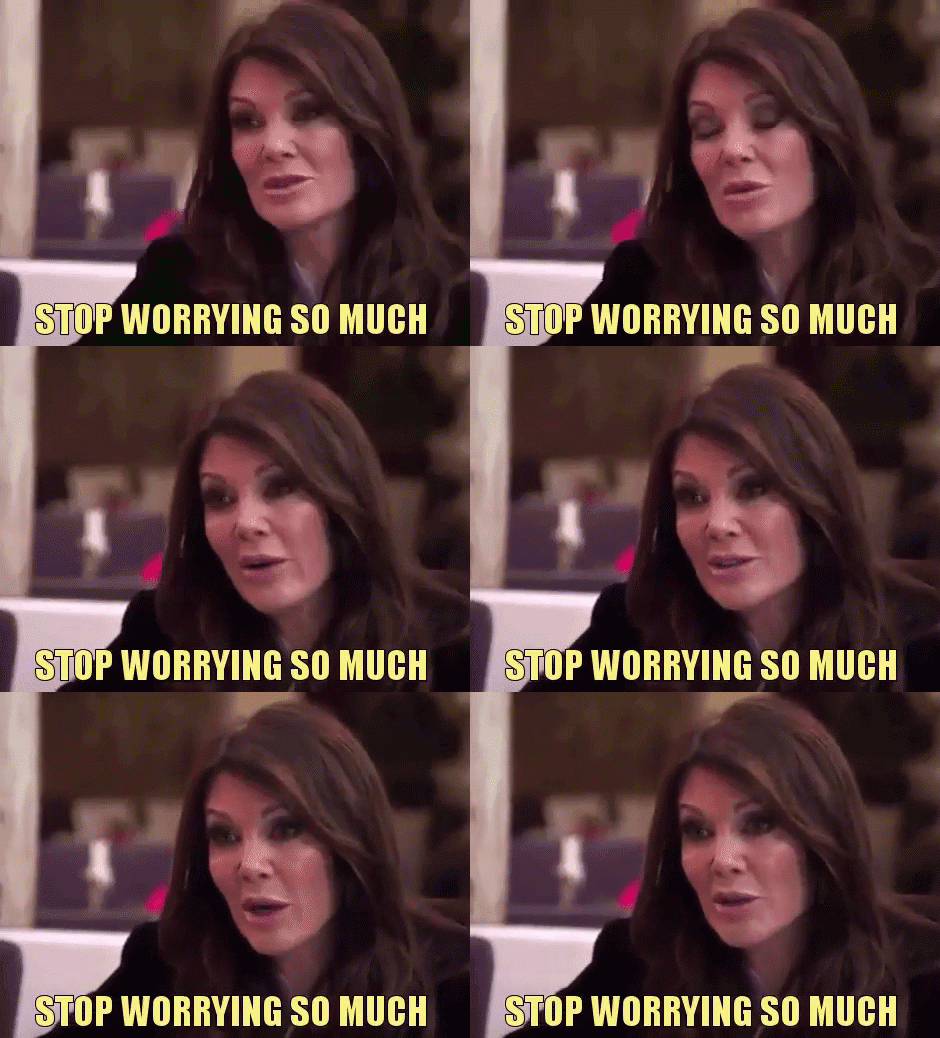
As you can tell (And if you’re a teacher who has heard of or dealt with SBG, you already knew from the moment I mentioned the topic), I am worried. Very worried. As were the majority of my colleagues, from all subject areas, who came to the meeting. The purpose of the meeting was for us to ask questions and voice our concerns with this move to SBG, and we had a lot to say.

The academic team, however: not worried at all. They are confident. And every time a question was asked or an objection was raised — and there were several, which I’ll address here — the response from the academic team was, essentially, “But that’s not really going to be a problem, so — don’t worry.” Or, “That potential issue won’t matter as much as this improvement we expect to see, so — don’t worry.” Or, “We think that question shows that you don’t understand what we’re talking about, or that you are somehow against students learning, so — shut up.”

That last sort of response? That was an asshole response. It happened more than once.

But that’s not the issue here.

The issue here is SBG. The first question, the first worry, is: why are we doing this? Why make a change away from traditional grading, and why is this a better system? The answer according to SBG proponents is what I said earlier: SBG focuses more on student achievement of the standards, rather than completion of tedious and repetitive homework, like math worksheets of hundreds of similar problems, or English vocabulary assignments that require students to just copy down definitions or memorize spelling. SBG is simpler and more streamlined. There is also a stronger focus (“Laser-focused” was the phrase that our chief academic officer kept using; but he has a doctorate in optics, so of course he would enjoy a laser metaphor. [If you’re wondering why our chief academic officer has a doctorate in optics instead of education, well. I can’t talk about it. Or my head will literally explode.]) on the standards themselves, rather than on old models that focused on content: as an “old school” English teacher (Sorry; that made even me cringe), I think of my class as organized around the literature: the first quarter we focused on short stories, and now we are reading To Kill a Mockingbird; next semester will be argument essays featuring Martin Luther King’s “Letter from Birmingham Jail,” and then drama, most likely The Crucible, and poetry. What SBG will do, it is to be hoped, is force me to focus instead on the standards: because proponents of standards believe that standards should be the goal of education, rather than completion of units, rather than a goal based around something amorphous and unassessable, like “Students will understand and appreciate great literature.”

I have a response to that. And when I write about standards, and why I hate those evil little gremlins, I will explain.

For now, put it aside: SBG proponents believe that focusing grades on the standards will focus both the teachers and the students on the standards, and therefore improve the students’ ability to master those standards, because the instruction will be more targeted and specific, and because the students will be more aware of what is expected of them, and therefore will try harder to achieve exactly that. Obviously if mastery of the standards determines their grade, then they will try to master the standards.

Our academic team, when my colleague asked why we needed to change to SBG, said that it was forward progress. When she asked more explicitly what in the current system was broken, what was wrong, which necessitated this change, she was told that nothing was wrong; this was simply a better system, for the reasons listed above.

She was also told (along with the rest of us, of course, because we were all in the same meeting) some bullshit: we were told that traditional grading systems are unfair, because the standards that define a grade for a specific teacher are malleable and individually determined. If you give five teachers the same assignment, those five teachers will grade it five different ways. One will focus on the correct answers; one will focus on the student’s process for reaching the answers; one will focus on the neat presentation of the work. All different standards, all different grades.

Remember how I said that they told us not to worry because not all assessments for mastery of the standards had to be multiple-choice-type quizzes or tests? Right. That was because more than one teacher asked about assessments like essays, or labs, or long projects, or large unit tests, rather than single-standard, short, multiple-choice style tests. “Of course you can use any assessment that you like,” we were told. “Don’t worry, we don’t want to force you all to give nothing but multiple-choice tests to the students.”

Shall I mention here that the curriculum which the academic team purchased and imposed this year features short, five-question multiple-choice tests as assessments for all of the standards? Shall I also mention that this curriculum doesn’t apply to any subjects other than math and English — also known as the tested subjects? No, you know what, I’ll wait until later to mention that. Forget this paragraph for now.

We were also told, when my friend also objected that the purpose here seemed to be test preparation, that of course we should be focusing on test preparation: the school is rated according to the results of the ACT (and other standardized tests for other grades); and research shows (They are big on research. Less interested in actual experience teaching, but they do love them some research. Our chief academic officer has also never taught. [Head. Will. Explode.]) that one of the best ways to improve student scores on standardized tests is test practice: exposure to the system of the test, familiarity with the format of the questions and the means of providing the answers (Bubble sheets vs. writing numbers in boxes vs. clicking on options on a screen, and so on, so on). So if one of our goals is to improve the test scores (And the administrator answering this objection asked my friend if she wanted to have our scores go down, and then the school’s rating would go down, and then we would lose students and close, and did she want that? Which, of course, is a belligerent attempt to turn an uncomfortable question back on the person asking, using a strawman argument. It’s bullshit. It’s not a response to a question, it’s not what it looks like to hear someone’s concern. Because the academic team doesn’t listen. Did I mention that the point of the meeting was, ostensibly, for the academic team to hear our concerns and answer our questions?), and test scores are improved by practice with similar testing format, and the assessment test in question is the ACT, which is a multiple-choice test: guess which type of assessment is going to be favored by the academic team?

It ain’t essays. Or projects. Or labs. Or large unit tests. Well — essays will get some respect, because one of the sections of the ACT is an essay. But there aren’t any, for instance, poetic recitals, or creative writing, or music performance, or any of the million things that teachers and schools create so that students can do something more than just bubble in A, B, C, or D. You know: the assignments and projects and grades which mean something, which give students a chance to make something important to them, something authentic, something real.

So this is why what they told my friend was bullshit: because if they really meant that we could use various other forms of assessment, so long as those assessments focused on the assigned standard, then they were lying about SBG being intended to make grades more fair. If their argument is that different teachers will focus on different aspects of the same piece of student work, and make different grading decisions about that same work, then the exact same thing will still be true if we grade according to a standard. Because it is still up to an individual teacher what it looks like when a student achieves mastery of a standard. Also true for a multiple-choice quiz, by the way: because what is “mastery?” 60% right? 80%? 75%? Different ideas of proficiency, individual standards of success. Which, by the way, reflects everything else in life, because our success or failure is generally determined by individual people with individual standards of success. And the way we deal with that is not to try to standardize everyone into adhering to a single standard: it is making sure we understand what the measure of success is, and how we can achieve it. You know: learning what your boss wants from you and then providing it? Does it matter if the bosses at two different jobs have different expectations of you? It does not. So why would it matter if two different teachers have different expectations of you? It does not. To be sure the grading is fair, we need to make sure that the teacher consistently applies the same standards to all of their students. That’s fair.

You can address that issue, by the way, if you want all of your teachers to grade according to the same criteria and the same success expectation. But SBG is not how. You need to bring your teachers together, give them the same piece of work, and discuss with them what grade (or proficiency measure, or whatever you want to call it) that piece of work should receive, and then make them practice until they all grade approximately the same way. It’s called “norming,” and I’ve done it several times, in different contexts. It’s actually good practice, and I support it.

But it doesn’t answer my friend’s question about why we are changing to SBG. Because you can (and should) norm while retaining traditional grades. Using the need for norming as a justification for changing the entire system? Bullshit.
There’s another aspect of the change to SBG which I should maybe mention now, though I realize that this post is getting too long. (It was a long meeting. There were a lot of concerns. I have a lot of worries about this.) They are also intending to eliminate the usual percentage-based grades. There are four levels of mastery of a standard, as determined by the Arizona Department of Education: Minimally Proficient, Partially Proficient, Proficient, and Highly Proficient. The academic team wants to use those four as the new grade scores, for the purpose of averaging into a final grade for a course: 4 for Highly Proficient, 3 for Proficient, 2 for Partially and 1 for Minimally. The student’s class grade will therefore be something like a 3.23, or a 1.97, etc. Sure, fine, whatever; it’s not like I need to use A, B, C, D, and F.

But see, they want to translate those numbers back into letter grades. Because students and parents like letter grades. Because (As was mentioned, as yet another concern, by yet another colleague) colleges, and scholarships, use letter grades — or, more frequently, the overall GPA, weighted and unweighted, that is the standard across this country. So that’s fine, right? We can just translate the proficiency numbers directly: Highly proficient, A, 4.0. Proficient, B, 3.0. Partially is a C, Minimally is a D.

There’s the first issue, by the way. Not Proficient is not an option. Which means there is no F. As long as a student takes the assessment, they will pass the class. Or so it seemed to me: I admit I didn’t ask that question or raise that concern; in fact, other than a few outbursts under my breath, I was silent throughout the meeting. Because I knew if I started talking, my head would explode. That’s why I ranted at my friend for a full 30 minutes after the meeting, and why I’m writing so damn much right now. So they may intend to include Not Proficient, or simply Failing, as a possibility; say if someone takes a test assessment and gets a 0, then they might earn an F. But maybe not. It’s a concern.

But the other problem is this: the academic team has a conversion chart they want to recommend for how to turn this 4-point proficiency scale into a letter grade: and it’s not what you think. They think that a 3, a proficient, should be an A-, a 90%. 4, Highly Proficient, should be an A+, a 100% or close to it. The B grade range should be 2.5-2.99, the C would be 2.0-2.49. D would be 1.00-1.99. (F would, presumably, be 0-0.99, but if there is no score less than a 1…)

I mean, sure. You can set the grade breaks anywhere you want. They did point out that any college asking for our students’ transcripts and so on would be given an explanation of how we arrive at their letter grade, so there would be transparency here. But how many colleges or employers or grandparents looking to give money prizes for every A would actually read the breakdowns? When they are handed a simple overall GPA, in the usual format?

I also have to say, because bullshit pisses me off, that one reason the academic team gave us for the change to SBG was that traditional grading leads to grade inflation: because students who do extra work get extra credit, and therefore score over 100%, which makes no sense if we’re talking about mastery of standards, because once you master it 100%, that’s it, there is no more, and how much work you did to reach mastery doesn’t matter. The standard of mastery to earn a particular letter grade, in this paradigm, is watered down by the inclusion of grades for practice work, what are called “formative assessments.” Think of it like a rough and final draft of an essay for English: when I get a rough draft of an essay, I give feedback on the draft so the student can improve it for the final draft. I give credit for students who completed the rough draft, but it’s just a 100% completion grade: because I want to encourage them to try, and to turn in whatever they complete so they can get feedback, even if it isn’t very good. So I don’t grade the rough draft on quality, just completion. The rough draft grade is a formative grade; it’s just to recognize the work a student put into the rough draft. The final draft grade is the one that “counts,” because that’s where the student shows how much they mastered the actual skill and knowledge involved. That’s called a “summative” grade. SBG would only count summative grades into the final grade for the class. And in order to fight back the grade inflation they see in me handing out 100% grades to students just for turning in a pile of garbage they call a rough draft, they want to change to — this system. Where a 3 is magically turned into a 4, and there is no 0. Nope, no grade inflation happening there, not at all.

And that’s my biggest issue here. Again and again, the academic team told us that the only thing that should matter for a grade is mastery of the standard. Nothing else. No work should ever be graded, because how a student achieves mastery is not the point: only mastery. (Sure. Ask any math teacher if how you get the answer matters, or if it’s only the answer that counts.) They told us that grading for work completion is a waste of time, and essentially corrupt; because it made it possible for a student to pass without mastering the standard.

The essential assumption there, aimed without saying it outright in the face of every teacher in every school, is that the work we assign does not create mastery of the standard. The assumption is that when I give vocabulary homework, it shouldn’t count in a grade because whether a student does it or not makes no difference to their mastery of the standard. In other words, all the work I assign is bullshit, and any grade I give based on completion of it is bullshit.

That. Is. Not. True.

More importantly in terms of what is coming for my school, if a student is told that the homework, the practice work, the rough drafts of essays, are not counted into their grades, they will stop doing them. Of course they will: we just told them those things don’t count. All that counts is the final assessment, whatever that is. It wouldn’t matter how much practice I gave them, how much feedback I wanted to give them; I would have to give all my students an opportunity to show mastery on the final summative assessment, and if they showed mastery, they would get a grade for that standard. A high one, if they showed proficiency. Now, they will have a much harder time reaching that proficiency without the practice work I assign in class: because my assignments are not in fact pointless busywork, I fucking hate pointless busywork and I try very hard not to have any in my class; but regardless of the value of my assignments, if my students don’t get a grade for them, they won’t do them. Period. Except for a very few students who want to try hard, who want to learn, who want to do their best. But those students already succeed, so they’re not the ones we’re trying to help here, are they?

You know what the rest of them will do? They will sweat out the final assessment. They will focus on that. They may study for it, but they will have so much pressure, and so much stress, before any test I give them for a particular standard, that they will not do as well on them as they would with traditional grades and grades for practice work and my own non-test assessments. (Because generally speaking, I also hate tests and try very hard not to have any in my class. I like essays. I like personal responses to questions that ask the students to relate to the literature, to connect to some aspect of it, and to write maybe a paragraph or so. I like annotations on literature, so students interact with the text. I think high school English students should write, as often as possible, and when I ask students to do work in my class, I want to recognize their effort by giving them credit for it in the form of a grade. But I guess that’s unfair grade inflation, right? Busywork? Assignments that don’t show mastery of the standard and so shouldn’t count in their grades?)

I also have to point out that a lot of my students, given the opportunity to do literally no work and then take one assessment to determine their grade in the class? They will guess. Some of them may guess well, but they will guess. Stories will spread of the students who guessed their way to an A on a difficult assessment in a difficult class, and others will try to repeat the feat. I know: I’ve seen them do it. I’ve watched students lie about getting high grades, when they actually got low grades, when they guessed on a test, and that lie made other kids try it. I’ve watched brilliant students describe what they do on tests as “guessing,” when what they mean is that they picked an answer they weren’t 100% sure about: after reading the question, the answer options, using the process of elimination and their generally excellent knowledge to narrow it down to only two good choices, they “guess.” And score high, because that’s actually a really good way to “guess.” But when they say they guessed and got a good score, other students, who are not as brilliant, guess by completely randomly picking a letter, and hope to get the same result — and so ruin their chances of getting a good result, or a realistic result, which they would have gotten if they just tried.

This will make that problem worse. I guarantee it.

And what problem will it solve?

Will it make grades more fair? No: that would take norming.

Will it make grades actually reflect learning? No: students will try to guess and get lucky, or they will cheat. They already cheat, sometimes, but SBG in this model will make it worse because there will be so much weight on single assessments.

Will it make students focus more on mastery of the standards? Maybe, but it will also make them more likely to ignore the work that would actually help them master the standards. You know: the stuff that educates them. Which, yes, is sometimes tedious. Kinda like taking multiple-choice tests several times a week, in all of your classes. But I guess if that helps them score higher on the ACT, then the school is going to look great. Right?

Right?

Don’t worry.
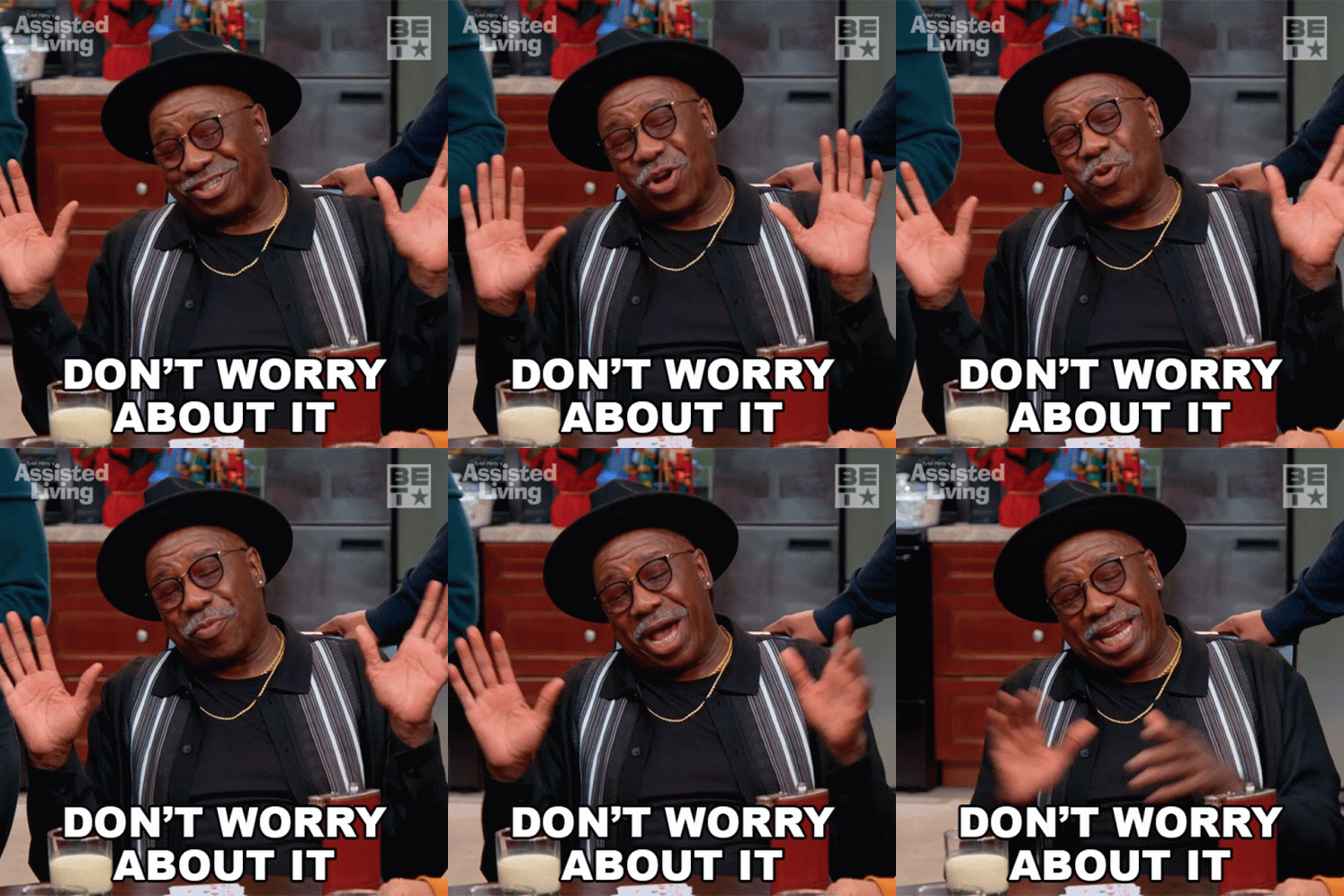
There’s more. Here’s where I should bring up that the curriculum they bought and imposed doesn’t have any material for several of the subjects in the school. That’s sort of a separate issue, because any teacher can create their own curriculum using SBG or not; but whenever teachers asked how we were supposed to implement this, we were pointed to the curriculum and the resources that came with it: which only applies to math and English. The tested subjects. There are also classes, such as my AP classes, and the new electives that we created this year, which don’t have any standards because they are not official Arizona Department of Education classes. And that’s why I like teaching those classes: but how will I do my grades next year if every class has to use SBG and the class has no standards?

Not only do I not know, but the academic team doesn’t know, and even John C. McGinley doesn’t know.

They also claimed that SBG would make grades and student learning more clear to parents, that parent teacher conferences would focus on what the student could and could not do, rather than the teacher merely saying “Little Tikki Tikki Tembo-no Sa Rembo-chari Bari Ruchi-pip Peri Pembo is missing three homework assignments.” Of course, speaking for myself, when I have parent conferences, I EXPLAIN WHAT THE STUDENT SHOULD HAVE LEARNED ON THE MISSING ASSIGNMENTS AND HOW THAT LEARNING CONNECTS TO THE OTHER LEARNING IN THE CLASS, LIKE “When Tikki Tikki Tembo-no Sa Rembo-chari Bari Ruchi-pip Peri Pembo didn’t do the study questions for the first three chapters, that means he probably didn’t completely understand those chapters, and that makes it harder to understand the rest of the novel.” (Though of course, I failed to point out the standard which little Tikki Tikki Tembo-no Sa Rembo-chari Bari Ruchi-pip Peri Pembo didn’t master, so — my bad.) I can’t really fathom a teacher telling a parent the number of missing assignments and then not going on to explain what that means; but that’s how the academic team described our current practice, going on to say that SBG would make those conversations more helpful to parents because we would explain exactly what the student knew and didn’t know, exactly what deficits there are. Which means that their current (apparently, in their eyes, deeply incompetent teaching staff) would change our habit of explaining nothing to parents so long as we had better data to point to.

And one of the staff very intelligently and clearly pointed out that we would be setting students up with a different standard from all the rest of the world, even if everything they hoped for regarding SBG happened exactly as they hoped: because in college, they still use traditional grading, with work counted in the final grade, with individual standards of success and personal bias from the professor. They didn’t listen to her, either.

They told us that we teachers would be helping the academic team to chart the course, that our input would have an effect on the way this process moved forward; but since they didn’t actually listen to any of our questions at this meeting, and they told us that SBG is coming in 8 months regardless of anything we may say, here’s what I have to say to that:

The only times that the academic team agreed with anything the teachers said was when one of my colleagues, and then another, pointed out that parents and students — and teachers — would have a very difficult time adjusting to this entirely new system, and there would be a lot of problems in the transition, and a great need for support. “That’s true,” they said.

But you know what support we will get? We teachers, our students, their families, the whole school community?

“Don’t worry.”
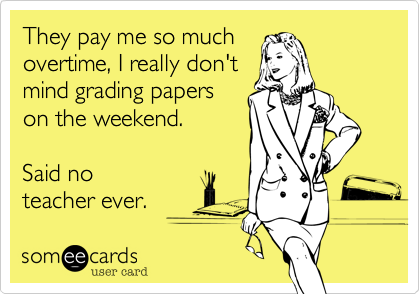
I’ll be a little happier if they at least sing this. A little.

This Morning

This morning I’m thinking about deadlines.

I’m a little afraid I’m going to miss this one, because I woke up this morning without a definite idea of what I was going to write about, and then in trying to think about a topic in the shower (one of my most productive thinking times), I thought of too many topics, and I couldn’t focus on one and follow a line of thought to a conclusion. That’s okay, I often don’t know where these written thoughts will end up when I start them; that is, I know what my opinion is when I start — I’m against deadlines — but I don’t know exactly what I’m going to say about them. Will I end up affirming my opinion? Will I find some compromise? Who knows?

This comes up most often at school, of course. I try not to use deadlines. I don’t quite believe in standards-based grading — which means that the only grade a student should really get is whether or not they have met the standard, and it’s a large topic that I will write about another time (Note to self: SBG.) — but I do agree with a component idea of it, which is that grades should be based on the work a student does, not on a student’s behavior. I think schools have taken on too much of the responsibility for raising our students, and I don’t think it’s good, and personally I don’t want to do it; therefore I don’t want to use the school’s (theoretical) focus, education and achievement, to bully students into doing what they’re told. Giving students a deadline, and then imposing grade penalties when they miss that deadline, is not educating them in a subject; it is an effort to instill a work habit. It’s a good work habit, but that’s more akin to character building than it is to education, and therefore I’m pretty much against it.

Now: I am not against being a model, as a teacher, of good work habits. Good any habits, really; I think it’s important that I be visibly and clearly respectful of others and their opinions, that I be kind and generous, that I explicitly oppose sexism and racism and intolerance and injustice. Without doubt. I think that everyone should do those things all the time with everyone they know: I think I should model good behavior with my wife as well as with my students, though for an entirely different reason: I don’t need to show my wife what good behavior looks like, I need to show her that I know what good behavior looks like so she knows I’m not an asshole. And if that sounds, by the way, like a lot of work, if it sounds like I always have to be performing and therefore I always have to be focused on doing certain things and not others, that’s true, but it also assumes that my relaxed, default state is being an asshole, and it takes extra effort to resist being one when I’m at home; I don’t think that’s true, and if it is, I don’t want it to be.

So I am in favor of meeting deadlines as a teacher. I try. I try to get their work back to them before grades come due. I try to have materials ready in time to use them. I try to have lessons planned well enough in advance that I’m not giving them what they keep asking for, a “work day” or a “free day.”  I do miss all of those deadlines sometimes, especially the grading ones; the most common response I get from my students when I give work back is, “Oh, I forgot about this!” And I give them work days, and I have had to change lesson plans in the moment because I don’t have handouts ready or I couldn’t get the reading done myself the night before.

But that’s the point: things come up. Things don’t work out. I get insomnia, or I have to deal with a sick dog, or my car gets a flat tire. The copy machine breaks, or is full of multi-page math jobs. A student stops me to ask for help, or even worse, comes to me in tears in a crisis. Things happen, and stuff doesn’t get done on time. We all know it: we all live with it constantly. I hate being late for appointments, but sometimes there’s traffic. And sometimes I get to the doctor or the dentist or the hair salon and they’re running late, and they ask me to wait for a little while before they can get to me. I complain all the time about the thousand little tasks that are incessantly assigned to me as a teacher (A colleague of mine refers to this as “death by a thousand cuts.”), and what bothers me most is that they are given artificial and unreasonable deadlines, often without sufficient notice: this year we were asked to contribute to our own evaluations (which is its own travesty — note to self; personal evaluations) and were told we needed to collect “artifacts” (which does have a nice Indiana Jones feel to it, which I like; I kind of want to burst into my principal’s office, sweaty and covered with cobwebs and maybe a couple of blowdarts, and drop a golden idol on his desk and say, “I GOT THE ARTIFACT!”) as evidence of our expertise; but we weren’t told of this in advance, simply given a deadline about a month out, during our busiest time of year. I am not ashamed to say I didn’t make that deadline.

So when I impose deadlines on my students, what am I teaching them? That they are held to a higher standard than me. That I have the power to boss them around, but they can’t return the favor — after all, they never get to tell me when I need to have something graded by, and if they even try, I bristle and get self-righteous about it. On some level, I tell them that their behavior, adhering to a deadline, is more important than their work, because if a student writes an A paper and turns it in late, they don’t get the A; the quality of the work never overrides the lateness of it.

So what priorities am I modeling? When they see their parents missing appointments, running late to work, turning in their taxes on April 16th, and not really suffering very serious penalties, if any; and then I cut their grade in half if they’re a day late, or even a few hours? What does that say?

You know perfectly well what that says. It says the thing we pretty much all said when we were in high school: it’s a joke. It doesn’t prepare us for the real world, because the system in high school is exclusive to high school. It is self-contained. It mimics the real world in a number of ways, but there are a number of things we do in high school because we have traditionally told ourselves that they are preparation for the real world: and then we just do them, without really thinking about them. At some point they become self-sustaining, because we keep trying to think of better ways to make this artificial system work for us; until we stop thinking about why we do it in the first place.

I take it back: that is preparation for the real world. It’s just preparation for the very worst parts of it.


Wow, that was longer than I thought it was going to be. But most important: DID I GET IT DONE ON TIME???

This Morning

This morning I am thinking about school. More specifically, I am thinking about the school I would create if I was the kind of person who wanted to set myself on fire by becoming an administrator and dealing with all of the very worst of American bureaucracy: the public education system.

(N.B: can confirm that melancholy leads to creativity; I was blue again this morning, mainly because I am deeply tired because I did not sleep well, and I was cranky and logy until I thought of this idea, and then I was happily off on the tracks of the idea. I got distracted frequently, because neither exhaustion nor creativity are necessarily good for focus; but it was great fun to think about this and to try to problem-solve. So much fun, in fact, that I think this will end up being more than one blog.)

All right, let’s start with the basic structure, and the most fundamental changes I would make to the current education system (while still trying to work within it, which is why this is not something I would ever pursue.). Personally I’d want it to be high school, because I like teenagers more than littluns, and middle schoolers are demons in human skin; but it makes much more sense for it to be K-12, so we’ll go with that, and I’ll just pretend I’d have a partner who would handle the lower grades, and an exorcist for the middle grades. We would follow the traditional schedule with summers and weekends off, and the school day would be 8-3.

But here’s the big difference: there are no grades. (Anyone who knows me saw that  coming from the first sentence of this post.) And I don’t just mean abstract letter rewards for paperwork filled out, I mean there aren’t grade levels: no first grade, second grade, tenth grade, fourth grade, eighth grade. That’s why it should be K-12, because my students should not be divided by their birthdays. It’s just about the stupidest possible way to group people, and it NEVER HAPPENS ANYWHERE EVER outside of education and then, like, bowling leagues. Students at my school will advance through subjects as they master the subjects: regardless of what age they are. When I was in the sixth grade, I was reading at something higher, let’s say the tenth grade level because I don’t actually remember my own lexile scores: that means I should have been in a tenth grade reading class. Or even better, in a class with anyone else who read at a tenth grade level regardless of their ages.

So that’s how it works. The basic idea is this: the classes will be run by unit, not by grade level. You can attach the units to standards, if that makes your ears wiggle, but I think of it like a novel unit, a sonnet unit, an argumentative essay unit, and then those can be repeated at different difficulty levels, Easy, Medium, Hard, Brainmelting, etc. Short pieces, a few weeks to a few months, though that would also depend on subject, like if a math unit on fractions takes a year, then so be it: year long unit. Students sign up for units they need and ones they are ready for, according to what the teachers are offering at any given time.

I realize this would be a logistical nightmare. I imagine it as a series of two-week units, so that every two weeks, students re-register for classes. I think on some level it would straighten itself out because most students would want to continue with a single subject, especially if they liked the teacher, so my units, for instance, could go through my usual “tenth grade English” class in sequence, and students at about that skill level could just keep signing up for my class every two weeks or so, and that would cover the school year. On the other hand, if students are the type who get bored with subjects quickly, they could bounce around more; take more English one month, and then more math the next month, and then nothing but art the month after that. This way, while it would be difficult to arrange the master schedule as it would be changing all the time (And I would need at least one full-time registrar just to track where everyone is at any given time, and presumably more depending on how many students and teachers are at the school and how much technology can fill this need. Though I also have a plan for getting help to the people running the basic functions of the school, which I’ll get into later.), it would eliminate entirely the bored pain-in-the-ass students who disrupt classes constantly just because they’re tired of English and would rather be in science. Fine: go take a science class this month. Come back to English when you’re tired of science.

It would also allow students to re-take single units they didn’t master without having to re-take an entire year of a subject. Depending on how well you could stagger math units, it would solve the problem of students getting lost halfway through Algebra and then never recovering: because they don’t understand everything that comes after that point in their Algebra class, and then in most schools, they either take a second trip through the same class, or move on to a new class they’re not ready for, or take both the repeat class and the new class, and have a horrible time in both. None of those are good solutions, and all of them lead to students hating math and believing they are bad at math, through no fault or actual lack of their own. If a kid can’t get a math concept, they should stick with that math concept until they get it right, and only then move on to the next part.

The ideal with math, then, since math is so sequential (Though I question that; I would guess that at least some of the sequential nature of math instruction is because we’ve always done it that way. I’d guess that some algebraic concepts could be taught much earlier than others, and would be helpful in mastering other mathematical areas.), would be for a math teacher to focus on, say, the first half of what is now geometry, divided into month-long units — say five of them, though we’ll get into the class schedule later — so Geometry Month 1, Geometry Month 2, Month 3, Month 4, and Month 5. If that teacher taught five classes, they could teach all five months, one period a day each, all year long, and students could advance through the months or repeat the months as needed by shifting what period they took math each month. (If the teacher got bored with that, the math department could rotate the months through several teachers. Point is, all five months of the first half of Geometry are constantly available.)

Each unit would be basically pass/fail, with whatever final assessment product the teacher wanted to use. After the unit and the assessment, the teacher would approve the student to move on to the next unit, or say the student had to repeat the unit. I imagine that each student would collect stamps or stickers, essentially, each stamp saying that they had completed and mastered a single unit; graduation would come after the students collected all of their stickers.


I’ve got much more to say about this school, but I think I’m going to break this imagined school system up into several posts, so it doesn’t get too ponderous. What do you think so far? Is this clear, what I’m proposing here? If not, please comment and ask questions, and I’ll try to clarify. There will be more to come.

“Teachers” Teaching Teachers

The trouble with education in America today is this: the teachers that are teaching teachers how to teach can’t teach.

I have a friend who is going through teacher training right now. (My friend has requested anonymity, and so I am going to leave out everything including gender.) I have been a teacher for a long time, and I know this friend very well, and here’s the truth: my friend is going to be an excellent teacher. My friend knows the subject matter, knows how to deal with teenagers – the intent is to teach at the high school level. Most importantly, my friend, like me, had a tumultuous personal experience in high school, and has been both a good student and a crappy student, both a model citizen and a juvenile delinquent; my friend will be able to speak with students, relate to students, understand students. My friend will teach students, and for some of those students, my friend will be their favorite teacher, the one they remember for years afterwards. Though they won’t come back to visit, just like they don’t come back to visit me. It’s okay – they don’t come back because most of the students who really bond with me do so because they are having a spectacularly miserable high school experience, the kind that beat poems and punk rock songs are written about. And if they came back to visit me, they’d have to relive what I hope was the worst time in their lives – and what I hope I helped them through. I don’t need to shake their hand to know they needed me to be who I am.

My friend will be the same. I know it. I try to be convincing and confident when we talk about the future teaching career, but my friend is also humble enough to have doubts, doubts that have taken me fifteen years to dispel, doubts I haven’t completely dispelled even now. It’s okay. Doubt combined with ideals makes us try to improve. It’s a useful tension.

You know what’s not a useful tension? Having a class that is half the duration of the usual college level course, and going almost half of it without getting any feedback from the professor. No grades, no comments, nothing for three and a half weeks, which covered ten graded assignments. No grades on any of them. That is not useful tension: that is a teacher not doing her job. And it drives me nuts, hearing about this, because I’m a slow grader, for two legitimate reasons: I don’t assign my students busy work during class, which means I never get to get grading done while my students are working on their new worksheet (Yeah, math teachers, I’m looking at you, you lazy punks); and two, I read everything my students write, and I try to give substantive feedback on everything I can. So it takes me a while. Except for two times during the year: the end of the semester, when I have to kill myself getting the grades in on time, and the beginning of the year, when I realize that my students are not familiar with what I want from them, what I am like as a grader, what is really important to me. They need to get a grade and feedback from me before they can feel comfortable doing assignments for me. So I try to grade the first serious assignment as quickly and thoroughly as I can – generally I can pound it out in a weekend, though I tell them it will never happen that quickly again. From that assignment, they learn the following: I don’t really care much about deadlines. Don’t care much about spelling, unless it is a formal essay. I don’t care at all about format, font, handwritten-versus-CG, or those little frilly edges that come from ripping pages out of a notebook. I care about what they think and how well they can express it to me. That’s what their grades are based on: and I make sure they know that before they have to turn in their second assignment.

My friend’s classes are all online. Which means there is no lecture, and there is no class prep; the teacher’s only job is to grade the work and monitor discussions. And yet the teacher – who had in her instructions dire warnings against even the thought of turning work in late – took three and a half weeks to return the first grades.

That’s not all: not by a long shot. The assignments come fast and furious: every week, the students in these classes – all of whom have degrees already, and so most of whom are already working, some full-time – need to read at least two chapters from the text, post a discussion topic that is thoughtful and thought-provoking and that cites sources; respond to at least four others students’ posts or responses to posts; and read at least 75% of the posts and replies in the discussion forums. For extra fun, the other students, eager little gold-star-seeking chipmunks that they are, try to post on every single topic and reply to every single response, sometimes at 11:00pm on the due date. And the more responses there are, the more each student has to read in order to hit the 75% of responses read mark. Thanks, guys. Way to throw your classmates under the bus in order to suck up. (But I also have to say: how American.) And each week culminates in a quiz, an essay, or a PowerPoint presentation on the week’s topic. Times two classes, times eight weeks. And even though both classes have large final projects due in the last week, which are weighted more heavily in the final grade, the discussions and responses and reading are still assigned for that last week. Nothing like giving people large projects and not giving them time to get them done!

The grades – now that my friend has gotten some (To be fair: in the other of the two classes my friend is currently taking, the professor, a former high school English teacher, responded within a week with the first set of grades, with reasonable comments. It’s only one of the two professors who can’t keep up with her own class’s pace.) – are sort of based on the content; but every assignment, my friend has lost some points not because of what the essay or presentation said – but rather because of the formatting of PowerPoint slides, or, more commonly, the lack of correct APA (That’s the American Psychological Association. Why are we using their format? Who knows?) citation formatting. This despite both professors letting some elements of APA formatting slide – the APA says, for instance, that every paper must have a title page and an abstract; neither professor has required that. But God forbid you fail to use hanging indents on your references page!!!

The textbooks are absurdly poorly written: they drag on and on and on, repeating the same information in a slightly different format, with ridiculous and unrealistic examples that don’t actually illustrate the concepts. For example, one chapter, on constructivist cognitive theory, explained the need for self-directed learners thusly: because change occurs rapidly, and certain innovations – like smartphones and green energy – have a large impact on society, it is vital that our students learn to become problem solvers. Now I agree that it is important that students become problem solvers, but the reason is because there are quite a number of problems that need solving, and the solutions will need to come from new minds that understand the problems and the possible solutions in new ways; traditional methods will not be effective. And the speed of change in society has precisely fuck-all to do with that. Thanks for the explanation, Mr. Textbook Guy. (Note: that is not a correctly formatted APA citation.)

The essays have minimum and maximum page assignments; this is common practice, I know, but as with every essay that has ever been assigned with a length requirement, the students focus first on the length, and only afterwards on the content. This aids in both creative editing and bombastic word-fluffing; not in learning content.

The short, informal discussion topics are worth 30 points and the essays are worth 35 points. That would be fine, except the essays are far more difficult and take at least three times as long to complete. For five more points. Way to prioritize. And here’s the best part: if you don’t earn a B on the final project, you cannot pass the class. That’s right: you can bust ass for seven weeks, run at 100% over 20 or so assignments; get a C on the final project – and fail the class. Really makes all that earlier effort seem worthwhile.

The quizzes, which are multiple choice and allow for multiple correct responses on one question, draw from different chapters that give different answers to the question, and require contradicting responses both marked as correct responses (I.e., the question was something like “Which are elements of how students learn?” and the responses had both “Through information processing” and “Through behavioral training,” which are opposing theories of learning – and both were correct answers.).


Here’s my point, in case I’m being unclear. Every single thing I’ve described here is terrible teaching practice. Good teachers build personal relationships with their students: these teachers are only online, and only contact their students indirectly, late, and in the vaguest possible terms. (And one of them uses Comic Sans. In multiple colors. With large amounts of capital letters and exclamation points. Reading her e-mails is like looking at Doge memes. But without the cute dog in the middle.) Content assessment should evaluate mastery of content, above all else if not to the exclusion of all else. Focusing on the minutiae like deadlines and formatting ruins the actual instruction of content. It’s fine to teach study habits that way, but not actual subject matter. Tests should never be tricky or obtuse, and the content resources should be clear and easy to understand, no matter how complex the subject – in fact, the more complex the subject, the easier the text should be to read.

And these are the people who are teaching new teachers how to teach.

My only hope is that the people in the class, including my friend, will learn nothing from these people. The last thing we need is a bunch of new teachers who don’t talk to their students, who give warnings but not grades, who give their students failing grades because they didn’t use one-inch margins and twelve-point font, and fail to help their students learn what they actually need to know.

Martin Luther King said that we have an obligation to disobey unjust and immoral laws. I would like to add that we have an obligation to ignore teachers who model bad teaching.

Out With The Old, In With The New. Well, Maybe.

Toni and I just got SlingTV a month ago, and for the first time in two years, we can watch HGTV. At last.

First, let me just say that this “a la carte TV” thing is starting to work out. We first killed our cable (though at that time it was Dish) in 2006, because we had been watching too much and paying far too much for the privilege. For two years, we got all of our news from the internet, and watched DVDs. It was good, for a time; this was when Blockbuster was still renting movies, and we had a store in our town, and they had their mail-order service working; so we would get DVDs of interesting movies in the mail, and then we would go and trade them in at the store for a free rental of another interesting movie. We watched some TV shows that way, too – Deadwood, if I recall, and The Sopranos, and the first season of Dexter. It was tough to manage the TV shows, though, because you only got them one disc at a time, and you had to space them well in the queue of discs you wanted to rent so that you could get the next one when you wanted it, but not be inundated with show discs.

But then Blockbuster went bankrupt, and the store in our town closed, and the mail-order service folded soon after; the go-to entertainment activity of my youth went away, to be replaced by “Netflix and chill.” (I have only recently discovered that this is the slang for “Come over and let’s have sex.” Back in my day, we just said “Come over and let’s have sex.”) We looked into cable again, because we had Comcast for internet, and we decided to get regular broadcast television again. It was nice, to go back to watching actual shows as they were broadcast instead of months or years after they had ended, though our movie consumption went down again as we didn’t have to fill up a queue with movies that we thought we might want to watch; on the plus side, we stopped watching so many bad movies. Plus we had HGTV, and Animal Planet, and Bravo and AMC; we got to watch The Dog Whisperer, and Millionaire Matchmaker, and The Amazing Race – and our beloved House Hunters. This period ended when Comcast just got too expensive for the package we wanted: it became our highest bill, and we just weren’t watching enough TV to justify it.

But we had heard of Hulu, and Amazon had TV now, and of course there was Netflix, that flimsy cover for teenage hormones. We had just bought a Playstation 3, and we decided we’d try out streaming all of our TV and movies. The price was wonderful, and the convenience, as well; there was also a Redbox, now, that we could walk to when our streaming TV had nothing worth watching – which frequently happened, as they didn’t have a lot of good stuff on there, none of the premium channel shows we had been watching on cable, no Nurse Jackie, no Shameless. But we knew we would be moving, and we didn’t want to get caught up in contracts.

So we moved, and because Comcast didn’t cover Tucson, we had to change internet providers; fortunately – I guess it was fortunate – Comcast had a sister company, another tentacle of its media juggernaut beast-parent company, that ran the cable business in southern Arizona. So we went to Cox and signed up for internet service – and they offered us a bundle with TV, for the same price. Only the basic channels, but with HBO and Starz, free for a year. Sure, we said, free TV? Why not? Well, because the basic service had about two channels that weren’t home shopping, religious, or local access, and those two channnels were generally filled with shows we didn’t much want to watch. And we still had the Playstation and subscriptions to Hulu and Amazon – we would have kept the Amazon Prime regardless, as it gave us free shipping on our frequent Amazon orders. Plus they had Downton Abbey and Sons of Anarchy.

But of course, Cox jacked up the price at the end of our free year of TV bundling (That’s what they used to call sex back when the Puritans had cable), and so we shut them off and went back to streaming. And now, after two years without HGTV or the Food Network, we found SlingTV, and signed up for a three months’ subscription which got us a free Roku. Now, once more, we can watch House Hunters. And see broadcast news on CNN, and even ESPN, if I ever decide to follow basketball again.

All of which is not the topic I meant to discuss. (Don’t worry; this will all come together in the end. Which is what they used to call sex back in the 60’s.) I was going to use House Hunters to introduce the conflict I am interested in: the tension between tradition and progress. So let me get to that. (That was how they asked for sex in the 70’s. At least that’s how Shaft did it. And his woman understands him, even if no one else does.)

House Hunters, if you are not a devotee, shows people, usually a couple, who are looking for a new home. The show and its spin-offs span the globe, though the majority are in the US; they have people looking to rent $500-a-month apartments, and to buy $5 million islands. There is no host, just a camera crew and some voiceovers and graphics added later, and the pattern is always the same: the realtor shows the client three places, and the client tours them, complains incessantly about minor deviations from perfection, and then makes a choice, first eliminating one and then picking between the other two. The last minute of the half-hour program shows them after a few days or months living in their new home and talking about how happy they are with their purchase. It’s a great show, and it will never run out of episodes, because there will always be people looking to buy homes and be on TV, and the only overhead is the camera crews (I presume there are several working all at once, as they pump out episodes at an amazing rate; you can watch two of these a night and never see a repeat.) and the one woman’s voiceover salary. No host, no script, no studio, nothing but homes. And carping clients.

The inevitable tension on the show comes from the different wish lists of the people buying the home; I presume the show prefers couples so they can have that drama, because they always play it up. And the conflict is almost always the same: he wants modern/contemporary, clean lines and open spaces, and she wants traditional, with historical charm and cozy comfort. He wants it to be move-in ready, and she wants a fixer-upper, or at least some projects, so she can put her stamp on it, make it her own.

Since we’ve been watching this show at least once a day since we got the Roku, I’ve been thinking about this conflict a fair amount. And it occurred to me that it related to the question a friend of mine posed after the last blog I wrote about education – You Have Been Weighed, You Have Been Measured – which was this: Trend v. tradition. The powers that be seem to thrive on pushing us deeper and deeper into proficiencies and standards, yet they cling to an archaic grading system of A-F? Once the dust settles from all the rubric scores we then assign a letter grade??? What gives?”

Why is that? Why is there a strain between conservative and progressive, between clinging to the past and reaching for the future?

I have at least something of an answer. (Thanks, HGTV.) Though I’ll have to stretch a bit to make it suit the actual question about education. Here goes.

When we are trying to do something that will last, like buy a home or teach a class, we look back to the experiences we have had ourselves: we buy homes based on the ones we lived in, we teach based on the way we learned. This probably goes for everything: I write the way I do because of the authors I have read; Toni paints the way she does because of the art she has seen. We raise Sammy the way we have because of our experiences with Charlie, and, I would assume, people raise their human children using their own parents as a model.

But not everything we have experienced is positive, and so we use our past experiences as both examples and warnings, things to do and things not to do. If I were to have children, my children would read the same way my parents had me read: they gave me the best children’s books in the world, Harold and the Purple Crayon and Where the Wild Things Are and of course Dr. Seuss, Green Eggs and Ham and The Fox in Socks and The King’s Stilts. My mother read me the books she had loved as a child, like The Land of the Lost and Uncle Wiggily and Freddy the Pig. When I was past that stage, my father read stories to the entire family: Sherlock Holmes and Edgar Allan Poe and J.R.R. Tolkien. My kids would have that same experience, with the addition of books that are more recent but also awesome – my kids would read Harry Potter. But on the other hand: my parents gave me the opportunity to participate in the classic team sports, soccer and baseball – which I absolutely loathed. So my child would not suffer through that experience. My child would do something more awesome, like rockclimbing or kayaking or hiking or martial arts. (My parents did put me in martial arts, which I liked but was no good at, so it didn’t last long.) Or fencing and sailing. I’d like to make my child into a pirate. But that’s not the point.

The point is that we try to keep the things we like, and replace the things we don’t like. I think it telling but not surprising that this plays out along gender lines on House Hunters: traditionally speaking, women have the role of nesters, seeking to make things comfortable and welcoming; hence traditional and cozy and charming. Men traditionally seek to build things and make things bigger and better and newer, to conquer new heights and expand into new territory, partly for the glory and partly to improve their family’s situation. And so, when looking for a home, men seek modern things, things that are new and don’t need to be patched up, things that require little maintenance – because they have to go out there and get to work bringing home the bacon, hunting down a mastodon, subjugating the neighboring tribes. You know – man stuff. And of course this isn’t always the way it breaks down: I hate modern and contemporary styles, and while Toni also dislikes the coldness of modern homes, she does like to have as little maintenance as possible: when we are watching someone coo over their enormous bathroom with its walk-in shower, Toni’s inevitable thought and frequent comment is “Do you know how long it would take to clean that?” There are sometimes couples that agree, or with the reversed preferences; because traditional gender roles are sometimes discarded for something more new, something that works better than what was done in the past.

So that explains both House Hunters and a la carte television, which allows us to watch the shows we’ve liked for years, and also try new things like Mozart in the Jungle and Orange is the New Black, which never appeared on broadcast television. But does it answer the original question?

I think it does. I think people teach based on the way they learned, and they keep what they liked and they try to replace what they didn’t. So those of us who didn’t like handwriting instruction embrace word processing, and those who write a lovely script bewail the demise of cursive. People who have fond memories of running track or making it to the state championships in softball argue that sports are an integral part of schooling, and people who eschewed jocks and embraced the arts consider music and drama and painting to be the linchpin of education. And even in the classroom: my favorite teachers used to discuss the subject matter at length; they would joke with us and tell stories. There were very few worksheets and not a lot of group work – I hated group work. I hated having to be teamed up with people I couldn’t stand, and I hated doing all the work for them. I didn’t mind doing all the work, but I hated the freeloaders getting a grade that I earned them, that they couldn’t have gotten without me – because it was unjust, and even worse, the pricks were never grateful enough to stop picking on me.

So what does my classroom look like? It’s fun; we discuss and tell stories; I love my subject and I show that to my students. And there is never, ever, any groupwork, and there are only worksheets when I’m angry and want to punish them. Other than vocabulary. I loved vocabulary. And silent reading, though that doesn’t work very well, since my students don’t really love to read.

This is not merely an emotional reaction to our own childhood (though I think the power of that should never be discounted): there is logic in keeping what works and replacing what doesn’t. The only question remaining, and it’s a difficult one with education, is – how do you decide what works? And when something doesn’t, how do you get rid of it? Because letter grades, as I argued before, don’t work: they really don’t work when, as my friend pointed out, we use more modern assessment methods, like rubrics and working portfolios and the like, which clash with the overly simplistic letter grades.

The answer, I think, is that those things stay because the people making the decisions like them, and think they work just fine. Because most of the people in charge are the ones who won their spots on top of the heap because they work well within the current system, the same one they came up through. When our current politicians and superintendents were in school, they were popular; they were elected to class office; they had great GPAs because they wrote neat papers and did well on multiple-choice tests. They were proud of their A’s, and they remember fondly how happy their parents were when they got that report card at the end of the semester, how they called Grandma to brag, and posted the grade printout on the fridge with a magnet. (This also describes the majority of teachers, by the way.) Those people think that system works beautifully, and so long as it continues to produce people just like them, and reward those people for doing those specific things well, then they will continue to believe the system works well. And as long as the system puts people like that into positions of authority, they will keep making the same decisions; and as long as people keep thinking that certain things have to be the way they’ve always been – as long as we keep telling our students, and they keep believing, that grades are a valid means of figuring out how well or how poorly one is doing in a class, and as long as we keep thinking of an A as a reward and an F as a punishment, and telling our students that they have to do the work in order to get the grade, the system will remain in place. I really don’t think the commercial education industry (which is the other major driving force behind changes in education, though that is only partly for the sake of improving what doesn’t work, with the other half coming from what is most profitable) cares at all about letter grades. But my students’ parents certainly do. So here we are.

And here I am. Facing the truth: that I don’t want either a traditional Victorian or a modern loft: I want a castle. On top of the Cliffs of Insanity, with a pirate ship docked below. I don’t want the past, or the future – I want the fantastic. I want the epic. I want the legendary.

I’m just not sure where to find it.

You Have Been Weighed, You Have Been Measured.

I spent a large part of last weekend grading. Not unusual, really; I’m a teacher. I generally spend part of every weekend grading, along with every free moment in between classes during the school day (and the former because there aren’t many of the latter, between teaching and planning and corresponding); and that’s even after my student count was cut in half when I changed from the comprehensive public school to the STEM charter school where I am now. Grading is something I have ranted and raved about far too often in the past; because it is, quite simply, the worst thing about teaching. Well, maybe the second worst thing: being treated like a criminal is no frosty chocolate milkshake.

But enough of ranting about grades: I need to be more positive. I need to spend less time being angry, and more time trying to see the light and share the light. I need to make more jokes. I need to offer solutions instead of pointing out problems, especially problems that everyone already knows about. The time has come to try to fix the problem. Today, I wish to share my plan: how to replace grades with a system that would actually work.

A brief summation of the many, many rants: The problem with grades is that they summarize what should be expanded upon. A student is a person, a complete person; not an A or a B or an F. Because grades are only summaries, everything that matters is lost: character, personality, the challenges and obstacles one faces and overcomes – none of these are apparent in a grade. The grade doesn’t even clarify positive traits: was it earned through natural intelligence and aptitude for the subject? Through grueling hard work? Through charm and sly manipulation? It isn’t clear: but this answer is terribly important, because the decisions we make based on grades are intended to be based on these actual qualities. If you want to hire an applicant for a job, or accept a student into your college, you want to know how they got A’s: was it work or talent? Or charm?

In other words: was the applicant in Ravenclaw, Hufflepuff, or Slytherin? Or perhaps they had the courage to overcome great personal difficulty, earning a high grade by fighting for it, the way a Gryffindor should?

People need to know these things. But we don’t do that. Because all they know is this: B+ in Language Arts. A- in Math. C in Economics. A in Physics. And because I don’t teach at Hogwarts. Which is too bad: I’d be an awesome wizard teacher.

This lack of useful information means that grades are not doing their intended job. I would give grades an F. (Now imagine if all I said in this whole piece was “Grades get an F.”) But I’d also include a note that it isn’t really their fault; we just ask too much of their limited abilities. Grades shouldn’t be graded, really; they’re not up to the work we are demanding. They are incapable. Really, they should be on an IEP or a 504; they need extra support.

Man, there’s just nothing like a SPED joke.

But the reality is, we make those decisions that matter — about hiring, about college entrance — the way they should be made; and in every case, grades are not discounted, but they are negotiable. You can get into any college, and you can, I think, get any job you want, with poor grades; it’s just a matter of what else you can do to show your ability and character, and what explanation you can give for the grades.

So why are grades given such weight? Why is it so ingrained in us to seek grades, to give grades, to look for grades as the answer to our questions – how many stars did this book get? Did this movie get two thumb’s up, or only one? Did you get an A- on that test, or only a B+? (Please note that the difference between those grades is exactly one percent. Where else does one percent matter to us quite so much as the line between 89 and 90? I mean, other than milk, of course.) It’s because grades are symbols. We like symbols. We like attaching additional meaning to things that don’t have it intrinsically; this is why we salute and pledge allegiance to the flag, rather than to our actual country or its leaders. We actually enjoy reinterpreting symbols to mean what we want them to mean, completely apart from what the symbols originally meant; this is why Republican Jesus exists.

Republican Jesus - republican jesus prefers guns for all instead of ...: Politics, Dust Jackets, Dust Wrappers, Even, Republican Jesus, Book Jackets, Liberalism, Dust Covers, Republicanjesus

The problem is that we very often reinterpret and reinterpret symbols until – we forget what they actually stood for. Kind of like the decorations on a red Starbucks cup. Grades are only symbols representing a student’s work/aptitude/determination; but we have forgotten the actual matter represented, instead focusing solely on the symbol itself: parents are happy, students are happy, schools are happy, the President is happy, as long as students are getting A’s, because each of us takes that grade to mean exactly what we want it to mean. As a teacher, I take my students’ good grades as evidence that I taught well, and they “got it” – frequently, I think, despite their lack of ability. Go me. I have no doubt that my students take their good grades as representative of their own hard work, frequently despite poor teaching. Their parents take them to represent good parenting, and possibly an early retirement with little Syzygy and her brother Ermingarde  footing the bill. We don’t really care how we get the good grade as long as we get the good grade – but that’s the only thing about an A that actually matters: how did you get it? Grades conceal that.

Okay, so not a brief summation.

Let me try again: At the end of a time of learning, a student should be told whether or not they were successful. (though I would argue that they already know; but it is true that we learn to judge these things by having our own judgments confirmed by experts; it is also true that there are a few folk in the world who think they’re much smarter than they are.) The student should be aware of strengths and weaknesses, and especially where they showed improvement and what future potential this area of education holds for them, and they for it. A letter grade simply cannot carry all of that information.

A better system is narrative evaluations. At the end of the semester, the end of the class, the teacher writes up a paragraph or so explaining what each student in the class did well or did poorly: “Odwalla does very well on tests, but listening to her speak in class is like hearing someone bash one of those ‘The cow goes MOOO!’ toys with a sharp rock.” These allow instructors to go into more detail regarding a student’s strengths and weaknesses, their successes and failures. Switching to these would be a real improvement, in part because it would force teachers to get to know their students better, and would thus (it is to be hoped) force schools to keep class sizes low enough to make it possible for teachers to do this job how it should be done.

Here we see one of the problems with grades: it is a problem with schools. The fact that teachers can’t teach 40 students in a class didn’t stop us from putting 40 students in a class. We are not willing to do what it takes to make education work. Which means this endeavor is doomed unless we re-form society, as well.

I’m working on that. My own Republic. Needs a new name, though – that one’s been taken.

But for now, let’s try to deal with the present. Going to narrative evaluations would not change the way people think about grades: students and parents – and probably admissions officers and employers – would scour through the evaluations looking for buzzwords, and then translate the evaluation into a letter grade. I write the equivalent of narrative evaluations on student essays, telling them everything I can about what they did well and where they need to improve; and every time I hand back a paper, students run their eyes over the margins, looking for a letter or a percentage standing alone, like wolves searching for yak calves (Can those be called “yaklings?” Actually, can my students be called yaklings? Or yaklets?)

Mama yak and two yaklets.

that wandered away from the herd; when they don’t find one, they turn on me. “What did I get on this?” they cry. If narrative evaluations came only at the end of the class, parents and students would go back through and do the math, adding up grades and percentages on individual assignments, and then they would report that in some way, posting it on Facebook for their own satisfaction, and making sure that the grade percentage got into the application letter for the college or was dropped casually in the interview. We could try to do narratives for every assignment, but not only would the workload become prohibitive, not every assignment deserves a narrative evaluation: if I give a three-question multiple-choice pop quiz, what could I write in the narrative? “Helsinki got all of the answers right, but she needs to work on the way she circles the letters of the correct answers. Those ‘circles’ are at best ovoid, and one of them wasn’t even closed.” I guarantee you, as well, that plenty of teachers – every single math teacher, for one – would write narrative evaluations that looked like this: “You got a B. 85% on tests and 84% on homework. Good job.”

We can’t simply replace grades with a longer grade. We need to change the way we think about evaluating students and putting that information before those who need to know it. Like I said: we need to remake society entirely.

So, ignoring for now all of the societal changes we would need to make in order to get to the schools that I think we should have, let me describe how student evaluation should work.

One of the constant threads in the mad tangle that is education is the idea that students should do the work, rather than teachers. Modern pedagogical theory (which will henceforth be known as “edutainment,” first because it fits their “Make the ‘customers’ [the students and their parents] happy!” philosophy, and second because those yak-butts don’t even merit a good nickname) takes this too far, as edutainment does with everything, saying that teachers should guide the students to creating their own knowledge rather than transmitting information to them; this becomes a large problem that will receive its own essay. But the essential concept is correct: students should build their own knowledge. I think that part of knowledge building is the awareness of your progress. Not a psychic vision of a loading bar that reads “Chemistry – 51% complete,” but the ability to judge, or at least to ascertain, where you are sufficient and where not, and what you can do with that.

So let’s have students do that. What’s the best way to know if you’re ready to move on to the next stage, to go from Spanish 2 to Spanish 3? It’s to go from Spanish 2 to Spanish 3. It is to move on to the next stage, where you will succeed or fail. It is to find the place of your competence and your struggle, and try to advance that place further along the continuum.

You gotta set the difficulty to Hard to know if you can win the game on Hard.

Why should teachers be the arbitrators of advancement? The trouble with me as the gatekeeper is that I don’t know everything about my students, not even within my own subject: if a student does poorly in my class, was it because of the subject and the student’s aptitude within it? Was it because the student doesn’t get along with me, didn’t like me, didn’t want to do the work I assigned? Was it because of entirely external struggles that happened to coincide with my class? I don’t know. You know who knows? The students know.

So let’s have the students decide for themselves. Just think how satisfying it would be to have some precocious, arrogant teenager tell you “I don’t need this class, I already learned this,” and you say, “All right then, go. Get out.” And then the kid actually leaves. Oh, that would be sweet.

But of course the students will frequently be wrong. They will want to change classes because they are bored or because the teacher has weird hair. They will want to move on with their friends. Their parents will want them to advance fastest so they can WIN! They will believe they learned the subject when they only scratched the surface. In all these cases, they will move on to the next level – where they will fail. So what we need is the ability for students to go back to the previous class and try again – and for this not to have a stigma.

This means we need to eliminate the “levels” of school, the numbered grades. Students shouldn’t be segregated by age; they should be sorted by ability. I hope we all realize how ridiculous it is to put students together based on when they were born, rather than what they know and what they need to learn; just think back to your own elementary education and remember the difference between the smartest kids and the dumbest in your class. Yup. But at least you all had the same number of candles on your birthday cakes. This means we’ll need K-12 schools, with all grades in one building, so that a 10-year-old math whiz can take calculus classes with the older students while sticking with his age group for English; but frankly, I think that would be an advantage: it would certainly make it easier for parents with multiple children, who currently have to run to as many schools as they have kids, and who therefore have to miss some events, and have to make extremely awkward arrangements for transportation, care, and feeding of little Cabaret and littler Burlesque. Older siblings could look out for younger siblings at the same school – or serve as constant reminders to little brothers and sisters of what not to do. Either way is good. It would enable the staff to get to know kids and families for the long term, to build relationships with them, which would also be beneficial.

So here we are: in a K-12 school, which is no longer a K-12 school because there is no K and no 12. Students go into the classes they think they are ready for, and then go back a step if they were wrong. There would need to be a fair amount of give in the structure of the classes; the first month or so, you’d have a lot of students transferring up or down, and they shouldn’t have to be left behind when they did. There are no grades apart from marks and critiques: this answer is right, this one is wrong; this aspect of this project needs improvement. There will still be some temptation to translate those marks into letter grades, so I would recommend that the teachers try to focus on narrative evaluation here as much as possible; after all, even on a math test, would you need to know exactly what problems you got wrong if the teacher writes “You need to work on simplifying fractions” at the top of the paper? Wouldn’t that be enough to guide the student to improving what they need to improve? Perhaps not; perhaps the red pen is still necessary. Even with that, if a total percentage correct is not given (because the total percentage means nothing, of course, just like every grade) and there is no emphasis on grades as markers of success, the temptation to do one’s own math and wear the total as a medal or a scarlet F would fade away soon enough. Education would focus on learning, rather than just the empty symbols of it.

The only question left is graduation: when is a student ready for the real world, for college or jobs? And how will those colleges or employers know what the former student is capable of?

The obvious answer is that when a student finishes the sequence of classes, they are ready to graduate. But first, if we’re letting students decide, there’s going to be a fair amount of backtracking – especially when the decision is when one is ready to leave school. Are there any kids who don’t think they’re ready to go out on their own somewhere around 14 or 15? When everything, every rule, every adult, every responsibility, is stupid and pointless, and you just want to be free to live like adults do, hanging out with your friends all day, playing video games all night, eating Cheez-Its with frosting for every meal? Those kids who leave school before they are actually ready need to be able to come back, but if they are free to try, a lot of time will be wasted, a lot of awkward changes will need to be made and unmade, for no real good reason. The second problem with simply allowing students to leave when they feel they have mastered a subject is that almost no one learns all subjects at the same rate, so a student may be done with math but still need to work on English and social studies. I’m not even going to get into the issue of students who believe they will never need math, ever. We’ll leave it at this, that students may be done with some things but still need to master others; and the question is, how many subjects must they master, and to what extent, before they can leave school? We can’t leave it entirely up to them, and we can’t go entirely the other way – that students have to master EVERY subject the school offers before they may leave. Though that is tempting. I love the idea of a balding 35-year-old who just can’t get the notes right for “Hot Crossed Buns” on the recorder, but he can’t graduate UNTIL HE CAN PLAY THAT SONG!

“Welcome to Adult Recorder Education. Thank you all for obeying our dress code.”

A couple of answers: one would be internships. If a student had mastered all of the math classes, and was interested in going further with math while still working in language arts in a school setting, that student could go out and do an internship, part-time after the school day (which would be shortened to just some Language Arts classes, etc.), in a math-based field, computers or architecture or what have you. That way, the transition from school to skilled work would be essentially seamless: as the student/intern finished up classes, they would have more time to work, and would eventually just be an employee of the company where they interned. Or they could move on to college with some real-world experience and an excellent bullet point for a resume. This does presume professional work settings close by the schools, which would be an issue in more rural areas; but educational opportunities are already limited in rural areas, which is a larger problem than I am proposing to fix (But which I will address in my utopia.); the best we can offer those in the boonies might be the internet.

Another piece of the answer is that it may not be so bad: if some students figure they can leave school early, because school is stupid and stuff, and then those students slink back with their tails between their legs, it may be an effective object lesson for the rest. As well as for those students themselves: one of the best students I ever taught left school after sophomore year, and then came back at the age of eighteen to finish two years of high school. Worked harder and tried more, and did better, than anyone else.

The rest of the answer is for me to go back on what I said earlier: teachers would become the gatekeepers. I said that I can’t really know why a student has done well or badly in my class, and therefore I shouldn’t be the one to decide when a student should go on to the next level; but more importantly, I can know when a student has actually mastered the material, learned the skills necessary to succeed in my subject, even if I don’t know for sure how they did it. It still holds that students should be the ones to decide when they are ready to move on, because they should be aware of what they know and what they don’t, of what they can do and what they can’t; but when the transition in question is one entirely out of school, they should have some confirmation of their self-analysis.

So there should be a conversation. Between the students and the teachers, and anyone else involved – the prospective employer, the college admissions officer, what have you. There can be a task to prove competence, such as a senior project or a thesis with an oral examination; but I would argue the best way would be for teachers to simply get to know their students well enough to say when they were done learning what that teacher, that school, has to offer. And after that conversation, if everyone agrees, congratulations, Graduate. On to college, on to employment. And if the employer or the admissions officer can’t actually sit in on every conversation, then they should contact the teachers, or a school graduation representative – call it a counselor – and have a conversation about the conversation with someone who was in it and who knows the student. It is hard for me to accept that student application essays and teacher letters of recommendation are the best way to know if a kid is ready for college or a job; I know for damn sure that transcripts aren’t it. Maybe a conversation with a counselor wouldn’t be any better, but I think it might, provided the counselor actually knows the student and had some interest in what was best for J’oh’nn’y. Of course, all of this assumes that relationship between teacher and student, along with a teacher’s genuine ability to judge mastery of the subject, which certainly implies mastery on the part of the teacher.

But shouldn’t we be able to assume those things? Shouldn’t all schools be interested in what’s best for their students? Shouldn’t all teachers be masters of their subjects? I’ll tell you this: I could spend more time learning about my students, and I could spend more time improving my own knowledge in my subject, if I could spend less time grading papers and filling out report cards. I’m not talking about telling students what they did right and what they did wrong; I’d still need to write comments and critiques on essays, and mark answers right or wrong. I’m talking about the time I spend thinking, “Is this paper a B+? Or an A-?” I’m talking about the time I spend recording those letters into a grading database. Most of all, I’m talking about the time I spend telling students, and students’ parents and coaches and other teachers, what little Aardvark’s grades are, why they are what they are, what Aardvark can do to improve her grades, how much effect every individual assignment has on a grade, what the hypothetical grade would be if the alleged work is turned in tomorrow, and then arguing with all of those people in all of those circumstances why the grade shouldn’t be just one percent higher.

Believe me. It’s a lot of time. And all wasted.

Now if you’ll excuse me, I have essays to grade. I can’t spend all my time thinking and writing. I’m a teacher, after all.

Caveat

*world's


Caveat Emptor, they say. Let the buyer beware.

I want to add a caveat: Caveat Magister. Let the teacher beware.

There are a lot of problems and difficulties, even hazards, in being a teacher; someday I’ll write about all of them, and why people should — or, more likely, why you should not — go into teaching. But right now, I want to focus on only one problem. It’s tempting to say it’s the worst or the most serious, but it may not be; what it is, though, is the source of a great number of difficulties that teachers face, on a great number of fronts.

It is this: very few people understand what we do.

Please don’t add a new misunderstanding: I am not complaining “Nobody unnerSTANDS me!”; I am not feeling a black, absinthe-scented drizzle of angst slipping icily down my spine; I am not currently pouting. (All right, I’m pouting a little. But it’s because I’m hungry and yet I have to wait for my lunch to cook. Where the hell is my Star Trek replicator? Or maybe those instant food-pills they had on the Jetsons? Hell, right now I’d take the fat-making shakes from Wall-E.) The issue is not that being misunderstood makes us sad. The issue is that being misunderstood, because of the way we are misunderstood, means that our job, the task of teaching, becomes impossible, if one means to do it in any meaningful way.

The issue is this: at some point in the past fifty years (I’m looking at you, 1980’s) this country decided that all that mattered in life was income. Now, we are a democracy and a capitalist society, which means that we have always focused on money as motive: because in a free society, anyone can improve their lot in life; and in a capitalist society, one rises through wealth. Put these together, and you have a country where cash is the key to the kingdom, and here we are: in a world where we teach our children that they can be anything they want to be — and what they want to be, we tell them, is rich. But looking at our social institutions, particularly education, one sees the pervasive and controlling belief that education was good for people: good for the mind, good for the soul; not just good for the wallet. People used to fight for education; now they just fight it. College cost less, and taught more; K-12 schooling was more difficult, more challenging, more effective, more reasonable. Teachers were more respected, seen as experts, because what they offered was valuable in a larger, holistic sense — the way that religious leaders are respected, the way that doctors and law enforcement and firefighters are respected, because they offer something more than a simple exchange of goods and services for money: they give something that means something. Teachers used to be seen that way, I would argue. It is possible I am wearing rose-colored glasses.

But we certainly don’t think that way now. The predominant (though not the only) view of school is as a means to one very specific end. The progression goes like this: elementary school gets you ready for high school; high school gets you ready for college; college gets you a job. The goal is the job. We have a somewhat broader view of that end, because we want our children to have a job that is satisfying, and valuable, in addition to financially rewarding; but the crux of the biscuit is the number of zeroes in front of the decimal point at the end of the year.

My students think this, universally and uncritically. Whenever I ask them, “Why are you here?”, which I do with some regularity (Because I am fascinated by this and terrified, too), they joke that they’re here because they are forced to be (They’re not joking.). But then the serious answer, the one they think I want to hear and the one they parrot with eerily similar language, year after year, is this one. High school gets you ready for college, college gets you a job. They even have a similar cutoff of the pragmatic value of education: they all tell me that you learn skills and knowledge that are directly applicable and necessary in life until around 8th grade; then, once you know all the math and literacy you will need to get through your day, it’s all about the college-job-paycheck.

They think this because their parents think this. Their parents want them to do well, but mainly, they want them to be made ready for college, and to get into a good college, because a good college means you get a good job — a mediocre college means you get a mediocre job. Or at least, a good college means a better job.

And because the parents think this — or perhaps this is the reason the parents think this — the administration and the political system behind schools all think this. Our success is determined by our graduation rate, and inasmuch as we can follow it, the rate at which our students go on to successful (meaning well-paid) careers.

These aren’t bad goals, of course. The job you do matters, both to you and to society; and in this society, money talks. I do this job because I get paid to do it, and though there are times when I wish I could leave it, I don’t because I don’t know what I would do that I would enjoy more and get paid as much. And college was a prerequisite for doing this job. I even agree that most people get by on what they learned before 9th grade. That’s why they have so many problems spelling text messages. (Please note the meme above.)

But there’s a problem when you focus on the financial side to the exclusion of all else. When money is the only thing that talks. We see that in our national politics these days, when the wealthy get elected to represent the interests of the wealthy, and the rest of us just shuffle along behind hoping we don’t get trampled on by the sudden changes in direction. The problem in the predominance of money in education is this: when we keep our eyes on that particular prize, we blind ourselves to all else.

When elementary school is only intended to prepare one for high school, then all that matters is promotion through the grades. Parents pressure administrators, administrators pressure teachers, and students who aren’t ready get promoted, when twenty years ago, they would have been held back until they learned what they needed to learn — back when the goal was education and improvement, a goal that takes some people longer than others. Parents don’t care now if their kid is learning everything; they care if their kid gets promoted. Because elementary school isn’t what matters: high school matters. Because high school gets you into college and college gets you a good job, and nowhere in that equation does a child need to master the multiplication table. If a kid has trouble with math, well, he’ll go into a career that doesn’t need math. He’ll be a lawyer. He likes to argue. Besides, his brother is good at math. Can’t read, but he’s good at math. That one’s going to be an engineer. Probably with computers. Computers magically make something a good job, did you know? Yes: that’s why we have to have computers in school, now. Because kids need to learn the skills that are necessary in today’s economy. That’s why they’re in school.

So the children are promoted to high school. Now it’s time to get serious. Serious about grades, that is. Because the purpose of high school is to get into a good college, and so all that matters is the GPA. Sure, sure, they need to learn how to do the things they’ll do in college — and that’s the magical argument, by the way, which we all use, including me: they need to read this book because it’s the sort of thing they will do in college — but really, the focus is the grades. We trust the grades to tell us that the child is progressing properly, learning what he needs to succeed: the grades are all we need to worry about. And the same thing for the administration and the politicians, except you can replace “grades” with “test scores.”

I’ve never taught at the college level, but I have no doubt it is the same thing there: the second a child is accepted to a school, he is expected to know what his career after graduation will be — preferably down to the exact position he wants and the exact company where he wants that position, but at the least, a field of endeavor and a job class. And I am sure that everyone grumbles about the classes they are forced to take but don’t need for their career, just like they did in high school, just like they do in elementary school about the stuff they won’t need in high school or college, like learning cursive. And I am sure this myopic view of college as nothing but a series of hoops to jump through until you make lots of money has all the same deleterious effects as it does in K-12.

And what are those, exactly? What are the problems with focusing on promotion — grades — career? Only this: you learn what you set out to learn, gain what you intend to gain, from everything in life. And if all you mean to gain from school is getting out of school — then that’s all you get. I know: that’s what I got from high school. All I wanted was to be left alone. So I was left alone. It was college where I found that learning could expand my mind and make me into a person I liked more with every new thing I learned. College made me who I am. High school didn’t even make me ready for college, because I didn’t try to make it do that for me. I had friends who went to the same high school I did, who went on to far more intellectually challenging college experiences than mine, and into more — well, maybe not “challenging,” but I think probably more cognitively difficult careers than mine, and I’m sure that our high school prepared them better than it did me. Because they went there trying to do that. They focused on learning, and they learned. Garbage in, garbage out: and so with nothing.

There are other problems. The focus on promotion — grades — career moves resources and support into those areas, and not into others. If we need our students to learn more math in order to increase promotion rates, then we will focus on math, and drop art and music. Because after all, they don’t need art and music to succeed in high school or in college or in their careers. If students are having trouble in high school English, then we don’t add classes or more teachers to reduce class size: we dumb down the curriculum, restrict it to basic skill drilling. It doesn’t matter if they learn less, because as long as the curriculum focuses on easily mastered skills, they will inevitably get good grades, and that means they will get into college and we win. And thus we have Common Core, where the focus is on easily mastered skills, and which has been and continues to be pushed onto teachers so that students can get good grades and good test scores, and our graduation rates go up and our college attendance rates go up. Sure, our college graduation rates suffer; but that doesn’t matter to us here at the high school level, just as high school failure based on students coming in with below-grade reading skills doesn’t matter to the elementary schools that focused on promoting students no matter what the cost, because that is the only thing that matters to the administrators, because it is the only thing that matters to the parents, because all that matters in life is a good job with a big paycheck.

It’s not true. Of course future failure bothers teachers, but we have little control over this. I am, for the first time in sixteen years, teaching Common Core this year. Because that is what my administration told me to do, and because I now work in a school that has no tenure — because teacher’s unions are essentially non-existent in this Republican-controlled Right-to-Work state (A state of affairs that exists largely because teachers are not respected like they used to be, because all we do is give kids good grades and get them ready for college so they can get a good job, and then, when the child does eventually fail, because the entire system is broken, teachers make a handy scapegoat. And if it doesn’t sit right with your conscience to talk about teachers like they are all incompetent pinko hellspawn, because you remember your own teachers being good to you, well, you can always blame the teachers’ unions.) — and therefore I have to do what I am told if I want to continue earning a living. And so because my school focuses on grades and test scores and graduation and college acceptance to the exclusion of all else, I am told to teach a canned curriculum that focuses on improving basic skills in order to improve grades and test scores and graduation rates and college acceptance. And I do it.

And here’s what gets lost: novels. There aren’t any in my Common Core curriculum. Because the focus is on easily mastered skills, and because the tests that create the test scores do not require the completion of any full-length texts, just comprehension of short passages. Unless I change the curriculum in some way, I will not teach any full-length novels to my classes this year. No Shakespeare plays, except in excerpts. These students will not have the patience or the perseverance to finish anything that can’t be finished in one setting. I hope that they will learn it somewhere else, because they won’t learn it from me. But I know they won’t. (One quick note: I am allowed to change the curriculum. They will by god read To Kill a Mockingbird. And all of one Shakespeare play. But if I wasn’t the age that I am, with the experience that I have, and the curmudgeonly attitude, I wouldn’t change that curriculum. So what happens when a kid who wasn’t raised reading novels takes my place?)

Here’s what gets lost: our culture. I know it seems like America doesn’t have any beyond Disney and organized sports and bacon, but we do: we have Mark Twain and John Steinbeck and Emily Dickinson and Robert Frost and Toni Morrison and Maya Angelou and Ernest Hemingway and F. Scott Fitzgerald. People in this country read To Kill a Mockingbird and Catcher in the Rye and The Call of the Wild. Our schools have always taught those works, and that gives us something important, along with all of the wonderful gifts that come from making literature like that a part of you: it gives us something in common. It’s books like these, learned in school, for no other reason than because they are worth learning, that make us who we are and that keep us as human as we are, because they are the ones that teach us it’s a sin to kill something that doesn’t do any harm to us, and that we should stand on the edge of the cliff and catch those kids running through the rye, and that every life counts, even a dog’s. And I’m only focusing on the literature because it’s what I know, but you could do the same thing with art, with Norman Rockwell and Andy Warhol and Jackson Pollock and Frederick Sackrider Remington (No — I’m not making up that middle name.); you could easily do the same thing with music, or with film.

None of these things are part of the promotion — grades — career path. All of them are our culture. And if we don’t teach any of these things in school — and we don’t, because they don’t relate to our one overriding purpose for education — then we’ll have no culture left except for organized sports and bacon. And perpetual war, of course.

Toni and I just watched The Wolf of Wall Street last night. It’s about a guy who cared about nothing but money, and did whatever it took to get as much of it as possible, and then went about living the most worthless, hollow excuse for a human life I can think of outside of serial killers and the Inquisition. And the movie focused on that, for three hours, in excruciating detail. I have never seen that many scenes with hookers in my life. It’s a true story, based on an autobiography of the same name; the reviews online of the book (which I will not be reading myself) make the guy sound just as he was portrayed in the movie: as a guy who would lie and cheat and steal as much as he had to just to get more money to put on the pile, so that he could spend it on drugs and prostitutes and midget-throwing parties at work. (Not making that up, by the way.) Who would not regret anything in his life, because, in my opinion, he lacked sufficient humanity to know regret. All he knew was money. All he cared about was money. Now, because the movie was made by Martin Scorsese, it was not actually a celebratory movie: it was an expose of the emptiness of this kind of existence. And I have never felt happier about my life and my choices than I felt while I was watching this epic debauch. I am so proud of myself and everyone who helped me to become what I am — my parents, my wife, my teachers, my culture — that I care about things other than money, that I see money only as a means of survival and not of any source of self-worth or identity definition. I am so happy to be me instead of that shit-heel who called himself “Wolf.” I hope that was Scorsese’s intent, because if so, it was a masterful piece of work that was completely successful.

But I couldn’t help but think: if my students watched this movie, they would want to be this guy. Because he made money. And if I asked them, the next day, why they were in school, they would tell me “Because I want to be like the Wolf of Wall Street.” (I’ve heard similar sentiments in the past, but using Hugh Hefner as an example, or Bill Gates.) And that scares the hell out of me.

Caveat Populus. Let all of us beware.

Teaching Hard

I’m tired.

I hate the end of the school year.

But let me tell you why.

Teaching requires an inordinate amount of energy. It’s why there is such a prejudice towards younger, newer teachers, and against older, wiser teachers: we all know that both age and inevitable cynicism detract from available verve (By the way, if I ever need a stage name, I’m going to use Available Verve.), and we know (Some of us know) just how much pep is required in this profession.

It’s a lot. Because we have to fight children all day.

I’m just going to leave that image to simmer for a minute.

Aaaaaand now I’ll explain.

Elementary school teachers have to fight to first contain, and then direct, a classroom full of sugar-hyped attention-deficient kidnadoes. Think about what it takes to force a child to eat when it doesn’t want to, to sleep when it doesn’t want to, to take a bath when it doesn’t want to; now think about making them do math. Elementary teachers have to be an unbreachable wall standing against a stampede, an immovable object against 25 — or 30 — or 35 — irresistible forces.

High school teachers have the opposite problem: our classrooms are carpeted with anthropomorphic phlegm-globs, like the spittoon of a frost giant with a head cold, that would rather sleep than breathe (And who would be ecstatic if they could sleep without breathing. Or circulating blood. Except you wouldn’t recognize the ecstasy, as expressing it would, like breathing, be too tiring.), and somehow we need to motivate them to read poetry and study history and solve mathematical equations. We must be an irresistible force for a room full of immovable objects.

In either case, it’s bloody exhausting.

Add in the requirements of pleasing supervisors (who want pre- and post-observation conferences, and PLC meeting minutes, and professional development buy-in) and calming frazzled parents (The most-common phrase a teacher hears from adults is probably “I just don’t know what to do with him/her.” It has always amazed me that I, who am and will ever remain childless, can somehow give out parenting advice without getting a face full of “Excuse me? Who the hell do you think you are?” It’s not because my advice is good, though — it’s because I care enough to give it, because I take the time to try. But this, too, is exhausting, because I am handing over just a little bit more of my time and my energy.) and the endless paperwork and the endless guilt, and you might be able to imagine how tiring this profession is.

But that’s not the hard part.

The hard part is that teachers, more than any profession other than the medical fields, emergency services, and ground-level social work, get emotionally invested in the work. My clientele, if we can call them that, are people. They are children (Though in my case they have beards, breasts, and body odor [Not all three at the same time (Well, not often [See, I can’t even make this joke without feeling bad for mocking them in such a personal way. But as an English nerd, I am very pleased by this:].).].), children that are unhappy most of the time. They are confused: confused by difficult school subjects, confused by awkward romance and even more awkward bodies, confused by changing social alliances and the tidal forces of unstable families. They are bereft of childhood, and lament that lost innocence; they are terrified by a future both uncertain and looming, and avoid everything that reminds them of it. And they are angry, and sad, about all of those things.

In “Dover Beach,” Matthew Arnold described our modern world this way:

…For the world, which seems
To lie before us like a land of dreams,
So various, so beautiful, so new,
Hath really neither joy, nor love, nor light,
Nor certitude, nor peace, nor help for pain;
And we are here as on a darkling plain
Swept with confused alarms of struggle and flight,
Where ignorant armies clash by night.


Arnold was describing a world without faith. That’s adolescence. That’s my students.

I sympathize with them. I remember it. I remember how my world got so very much harder when I became drenched in hormones around 8th grade (though not, sadly, drenched in sex appeal and confidence to match), and then exponentially harder again when I got to high school and, for the first time, had to work hard to succeed academically. I remember my hopes and dreams feeling shattered by reality. How everything seemed so dark, and so hopeless, and so insane. All of my writing at the time was about madness, loss, betrayal, destruction, murder. About fear and anger. That’s all I was for several years, a ball of fear and anger. With pimples. And an erection.

So when I talk to my students, I feel for them, and I want to help. Helping generally means listening to their problems, really listening and then trying to give some sort of useful response. A lot of the time — too much, really — I can’t help, and I know it; but that’s not any easier, especially when it’s because I know they wouldn’t listen to what I have to say, or that I shouldn’t say it because they should figure it out for themselves. Holding the words in is as hard as speaking them. Sometimes it’s harder. When one of my nerdy students — and as a lifelong nerd and a former awkward loner (Perhaps I flatter myself with that “former,” but my wife tells me I’m handsome and cool and funny, so shut up.), I feel the nerds’ pain more intensely — when one of them tells an awkward joke, or says the wrong thing at the wrong time, or laughs like a dork or fails to control their body odor, I want to say, “This is why girls don’t talk to you. This — and your hair.” But I can’t say it. It wouldn’t help. And it wouldn’t be right for me to do.

It’s hard to remember that. It takes effort to remind myself that I don’t have all the answers, that what worked for me won’t work for all of my students, that often they cannot hear me or believe me because of who I am. The key is to remember that they are in the same situation: no one can hear or believe them, either, because of who they are. But even when I remember that nothing I say will help, I still want to help. So I do what I can: I help them with schoolwork.

I try not to give my students busywork, because I want to show that I value their time. So my assignments tend to be lengthier, and more thoughtful. To help them both be successful and feel confident, I try to read everything they write, and give the best feedback I can; I am known for writing more on some essays than the students themselves. I respond to their thoughts more than the form of them, the grammar and syntax and vocabulary, because the ideas are the important part and also, much of the time, their strength.

But all of that takes time and energy. If I just gave them worksheets all day, I could grade everything in five minutes — or even give them to a T.A. to grade. Or my wife, who loves grading. She likes the power of the red pen. But because I give them extended questions and thought-provoking assignments, and because I want to respond to their thoughts, it means I have to grade everything myself, and I have to read everything, and I have to pay attention while I’m doing it.

And then I have to try to fix their problems. But it’s just like fixing their life problems: sometimes I can’t, and sometimes I shouldn’t; and even when I can and should, it takes time and effort. At least when they come to me with their life problems, they want an answer; but when the issue is that they don’t know when to use a semi-colon or what the point of The Odyssey is, they don’t generally want to deal with fixing that problem; they just want it to go away so they can sleep.

This is probably the worst thing: that when I try to help them, by making their assignments more meaningful and effective, they want me to give them work that is easier. They want worksheets. Because they are tired and stressed, and they don’t want to think, and if I’m trying to be helpful, why can’t I just give them easy stuff to do, or even better, no work at all? Why do I have to make them think all the time?

That’s why they turn into a sticky layer of marshmallow fluff melting over a desk. And then it’s up to me to motivate them, to scrape them up, mold them back into a vaguely humanoid shape, and crack open their brains so I can pour in the knowledge.

Except that’s not actually the way it works. I have to get them to think. Which means I have to get them to want to think.

Which is hard. And it makes me tired.

So then the end of the school year comes slouching towards us. They’re tired and sick of school, and thus that much harder to motivate. I am exhausted myself, and so now I need to do two motivatings: I have to perk myself up to perk them up. God forbid I have seniors, because then the inertia of the Senior Slump becomes quite simply insurmountable. And, though I don’t want to set myself up as being different from other teachers, I do have a couple of added difficulties that I don’t know if they share: first, I didn’t and don’t like school (though I love education), and so the glamor of the end of the school year, the proms and the yearbook signings and the graduation ceremonies, all fail to cheer me; and second, I don’t want to use grades as a means of motivating my students.

I don’t believe in it. Too much emphasis is placed on grades already for this very reason, so that they might be a more effective stick and carrot for tempting and prodding the phlegmatics. (That’s the name of my new band, by the way. The Phlegmatics. Available Verve and the Phlegmatics.) But grades are deceptive: they are an inaccurate measure. If a kid gets an A in my class, was it because of hard work? Natural ability which made effort unnecessary? Is the kid a successful cheat? Was it because my class was too easy? Because this kid had the advantage of a stable home life, with enough money for food and clothing so that this kid didn’t have to work 20-30 hours a week after school? Was it because this kid has learning disabilities and consequent accommodations?

Grades do not help students learn. Grades teach students to game the system. My students focus on large assignments rather than small ones, because small ones don’t change grades as much. But without the practice that comes from doing small assignments, and the steady incremental improvement gained thereby, they don’t do very well on the large assignments. So they ask for extra help. They ask if they can do work over again for a higher grade (Meaning I have to grade it a second time, after reading it a second time), or ask if I can look over work before they turn it in (so I can look it over again) and tell them what grade it would get (Before I grade it again, officially). They hunt, like pigs after truffles, for extra credit. And, of course, they cheat. Not because they’re lazy or stupid, most of the time, but because they don’t think they can do the assignment well enough to get the grade they want. And much of the time, they’re right — again because of the lack of steady incremental progress. That’s what grades do: they focus only on the ends, and thus destroy the means. They harm education. They replace education.

And then because we use grades as carrot and as stick, they cause stress, for students, for parents, for teachers, for schools. And that makes everything worse: my students are more miserable, and more exhausted, and so am I, both from their stress and from my own. Which is always worst at the end of the year, when the grade becomes THE GRADE.

I don’t want to add to their stress and misery. I don’t want to scare them. So I don’t hold their grades over their heads. They’re up there anyway, that sword of Damocles called THE TRANSCRIPT and THE PERMANENT RECORD, but I don’t point to it and put on my angry face. (Full disclosure: my own transcript, which was pretty ugly, hurt me exactly — none. Affected me not at all. Which is part of the reason I don’t try to use grades as a stick, because they meant zip to me personally back when I was a rage-horn-ball. But again: does that apply to all other people? Probably not.)

Unfortunately, that means I have to find some other way to motivate them. And the best one — the only one — requires of me a higher output of energy. I have to make the class, and the work, interesting. To teenagers. I have to make it useful, and also fun. I have to treat my students like the unique feeling individuals they are, and I need to show them that what matters is the thinking and the learning — not the grades.

I have to do that five times a day, every day, for ten months. And the farther we get into the year, and the closer we get to summer, the harder it gets.

I hate the end of the school year.

I’m tired.