Opening The Window

…Maybe Shouting Out of It

I have been thinking about writing. I do that a lot: mostly because I haven’t been writing a lot. But I just don’t know what to write.

Then I saw this:

@therapyjeff

You’ve got, like, 1 to 3 business days before hypernormalization drags you back under. #mentalhealth #therapy

♬ original sound – TherapyJeff

It hit me.

It’s hard to predict what will hit you, what will have an impact; that’s part of why I haven’t been writing as much — I don’t know what to say to have an impact on my audience (if I even have any audience left), and I can’t predict what will have an impact on me. And the hypernormalization that he talks about is definitely real, and strongly controlling of my day-to-day interactions with the world and the world of current events. I will also say that my role as a teacher is partly to encourage some of that hypernormalization, because my students freak out, often because they enjoy freaking out and more often because they are young people in a terrifying and confusing world; and whether they are freaking out for the sake of their shattered nerves, or for the sake of the meme (or freaking out for the meme as a way to disassociate from their shattered nerves) , the answer is always to remain calm and to try to pour water on the flames they are fanning. So I spend part of pretty much every working day trying to calm the tempestuous waters of teenaged souls. Then I come home, and sometimes my wife is freaking out — in that case it is never for the meme, it is only because of her shattered nerves or because the world really is a dumpster fire and sometimes we are caught in the flames (which is NOT FINE) — and then sometimes, again, my job is to make awful things seem normal and manageable and not a big deal. Sometimes my job is to freak out with her, which, sadly, I am bad at, because my freaking out usually looks like me getting really mad, and that doesn’t always make people around me feel peachy; but I do my level best anyway, Partly because my nerves are shattered, too.

But this is counterproductive for my writing, because I don’t want to write about how things are normal, how they are just fine. I want to write about how they are fucked up. I don’t want to freak out, because nobody wants to read pages and pages of AAAAAAAAAAAAAAAAAAAAAAAAAAAAAAAAAAAAAAAAAAAAAAAAAAAAAAAAAAAAAAAAAAAAAAAAAAAAAAAAAAAAAAAAAAAAAAAAAAAAAAAAAAAAAAAAAAAAAAAAAAAAAAAAAAAAAAAAAAAAAAAAAAAAAAAAAAAAAAAAAAAAAAAAAAAAAAAAAAAAAAAAAAAAAAAAAAAAAAAAAAAAAAAAAAAAAAAAAAAAAAfuckfuckfuckfuckfuckfuckfuckfuckfuckfuckfuckfuckfuckfuckfuyckfukfuyckfuckfuckfukfuckfuckfuck Hey that’s pretty fun when you get the rhythm going!

But it’s hard to write, calmly and rationally, about how things are fucked up when you are yourself freaking out. Which is, of course, what the powers that be want: they want us to draw into our individual isolated shells and hide from the horrors they have put into the world, because that makes us easier to control, and easier to eliminate; and that’s why this very nice therapist made this TikTok, in which he tells us to take a step, even a small step, towards interacting and connecting with others during this particular moment of jarring insanity; because, as he says at the close of that video, even that small step of having a conversation or connecting with a group of potentially like-minded people, is much bigger than sinking back into the hypernormalization without having done anything other than twitch bonelessly for the 1-3 business days of this moment when we can break loose.

So let’s break loose. Rationally. Without freaking out, but also without rationalizing everything into normality. Because this is not normal: a man shot Charlie Kirk in the throat. Charlie Kirk is dead — apparently assassinated, though one thing I will say is that we absolutely must stop speculating about shit we know nothing about, until we actually know what is going on. We don’t know that the murderer was an assassin in the sense that we know for sure that the killing was politically motivated, and that Kirk was murdered because he was a prominent political voice; he was a prominent political voice, so in the case that we see any such death as an assassination, then it was, but I think it is important to distinguish between John Hinckley’s attempted killing of Ronald Reagan and Lee Harvey Oswald’s successful killing of John F. Kennedy: Oswald intended to kill the US President because he disagreed with Kennedy’s political stances and actions, and maybe what Kennedy represented; Hinckley thought Jodie Foster would notice him if he shot the President. That second one is not, to me, an (attempted) assassination. If we assume that this one was an assassination, which is a reasonable assumption but not a certainty because the killer carved fucking memes into his bullet casings — “If you read this you are gay LMAO” is not a political statement — it is also not clear if it was done because Kirk was too right wing, or if he was not right wing enough, which means we may be able to label it as an assassination, but not then go on to say anything meaningful about that fact other than it was a terrible, horrible thing, like every murder, especially unnecessary ones. (Yes, there are necessary murders. Not many, and they are still terrible, but there are. Not this one, so that is not our topic.) We do not know, and I will disagree with the people saying all over the internet and TV, that Kirk was killed for his political views, or his ideological beliefs, or his past statements which the killer may have found too offensive or not offensive enough; when all of that becomes clear, then we can discuss it — though we are unlikely to come to any useful consensus about it. And that’s partly because of Charlie Kirk.

I don’t want it to be because of me, too. I like to think it never could be, because I, of course, am rational and reasonable — and also correct, which, as I like to tell my students (quoting the late great Bill Hicks), gives my argument that extra oomph — but of course we all think that about ourselves. I do certainly write divisive things, both because my arguments are aggressive and confident, sometimes even spoken in words as hard as cannonballs (to quote Ralph Waldo Emerson), and because my language and my personal statements about my opponents and enemies are frequently deeply offensive. If people who disagree with me read these posts, they probably get pretty mad at me, and at them. Though they may deny it, because of course online debaters must never admit that they are upset, that they are emotional and out of control.

I am quite emotional. I am often somewhat out of control, usually, as I said, because I have a temper, and because my nerves are shattered. Anybody who doesn’t feel the same, at least that last part, is either lying or a sociopath.

Because stuff is fucked up. Deeply, multifariously, evilly fucked up. A man was murdered, and we all flipped our shit about it: and on the same day, two children were wounded by a third, who shot them at their school and then killed himself. I don’t even know how many other people have died in the days since Kirk was killed, but if we keep up this year with last year’s average it would have been about 47 per day. The right accused the left of causing Kirk’s murder with our political rhetoric; the left accused the right of causing Kirk’s murder with their violent fascism; people posted about how saddened they were by the death, especially because his wife and children were there and saw it happen; other people posted about how they were glad Kirk had been killed because of the awful things he had said and the positions he had espoused in the past, including racism and sexism and homophobia and transphobia.

It’s all fucked up. And even the virtuoso guitar playing of Stevie Ray Vaughan (Who was only five years older than Kirk — 36 to Kirk’s 31 — when SRV died in a helicopter crash) can’t make it better, can’t make me feel calmer and more in control at this moment.

So I had a thought. A step to take, in this window (which may have closed already, because it’s been four days since he died; but I’m going to try to do this anyway because I don’t think I’ve sunk back into the hypernormalization yet) of opportunity. Not to argue for gun control, though I am doing that on social media; not to argue against hyperpartisanship because arguing against people arguing badly is a losing endeavor, no matter how you slice it; not to lament the loss of free speech in this country, because Malcolm X was assassinated sixty years ago — also in front of his wife and children — and the Alien Enemies Act signed into law by President John Adams in 1798 was used by President Donald Trump in 2025 as a legal justification for deporting both citizens and non-citizens without due process, so I would argue that we have never had fully free speech in this country.

I want to try to reverse the polarity of this moment. I want to try to speak positively. Not about Kirk’s murder, which is nothing but horrendous; I just want to use this moment to try to imagine a world in which Kirk would not have been murdered. A world that certainly could have existed, if we had made different choices as a nation and a people, and one that we can certainly bring into existence if we try. Maybe if I try to normalize hope, then we can have some when we sink back into our absurd routines.

Let’s start with a beautiful image. This one came from here, and is advertised as using no AI.

I don’t see why not. Hope is not any harder than despair: hope takes work, but we have to work to keep our despair gurgling inside of us, just as much. We have to spend time looking for more reasons to feel despair, have to keep thinking negatively about what is in our world or in ourselves — or what is not there — have to keep all of that front of mind, or else we might spot a video of a cute puppy and not be sad any more. If you’ve ever felt sorrow or despair, then you know the struggle to keep it that I am talking about. (Depression, now: depression does not require any work to maintain; that’s why it is depression. But I’m not talking about mental health, other than to say that hope and positivity in a non-toxic way might help with depression, as well. Not going to oversimplify the facts of depression, but still. Here’s that puppy.)

Your Puppy: What to Expect at 13 to 16 weeks - Vetstreet | Vetstreet
This is my favorite ear configuration: one up, one down. And nobody does it better than Corgis. This image is from here.

I’m not trying to slap some pretty pictures up over the horrors: that kind of forced, hollow veneer just makes things feel worse because we know how thin it is. I’m just using the images to counteract the — let’s call it the acidity of the first part of this post, the corrosiveness of horror and violence and conflict. But for the hope, I want to speak genuinely. Because I think the hope is real.

First, what am I hoping for? I’m hoping for a society that recognizes the value of all of its members, and takes all stakeholders seriously when considering what to do collectively. I’m hoping for a world where people are able to find and create joy, consistently, throughout their lives. A country where we try to find our common ground, and respect our common humanity, before we disagree about what our country should look like. A life where people recognize the liars and conmen, the gaslighters and manipulators, and see the corruption for what it is, and don’t tolerate it because it smells just like our own. A world of integrity and trust.

No. It isn’t impossible. I’m certainly speaking in broad generalities, because no, I don’t expect any world to reach a point where problems are eliminated, where there is no conflict, where liars are vanished and corruption is prevented before it taints everything. But I do know that our world, our society, our ethos, used to be different, in at least some ways and to some degree; and that means that change is possible. We talk about the pendulum swinging, and it does, and it will — though I suspect that the pendulum, like most other political machinery in this ever-so-exploitable country, has been manipulated in some way to ensure that the people in power don’t lose that power when the pendulum swings; but the power of the pendulum metaphor is that the swings are inevitable, and reactive: you can hold back the pendulum, you can even push it farther away from plumb; it’s just going to swing harder and faster when it finally goes, and swing farther in the other direction when it does. It can’t be stopped. And it can’t be stopped because people are essentially good, despite what our cynical profiteers would have us all believe — because they want us all hiding in our individual isolated shells, hiding from the horrors, easily controlled and easily exploited. No: people are essentially good. We are just — we’re really, really scared. That’s what we have to overcome.

Here’s a nice picture of individual shells:

🔥 Cuban snails ( Also said to be the most beautiful land snails ) :  r/NatureIsFuckingLit
These are Cuban snails. Image from the subReddit NatureIsFuckingLit. Hell yeah.

And it begins with trust.

That’s the message I want to share today. Hope is possible, and achieving what we hope for is possible, especially if we all hope for (essentially) the same things. It begins with trust: we need to trust each other, to believe that we all will cooperate, so far as we can, to achieve those things we hope for.

I know this because I am a high school English teacher. And I have watched my classes struggle more, in some ways, every year, as their attentions spans wane, as their interest in reading disintegrates, as they become less and less literate. I have certainly lost hope at times; I have certainly lost trust in my students, have believed that they do not want to learn what I have to teach, that they do not want to read, that they do not want to do anything other than play video games, watch TikToks, and be annoying. I have believed all of those things because there are days when they act like that. Some of my students act that way all the time, and some of those even say that they have no interest in learning to read better, no interest in ever reading as long as they live. It’s hard to keep trusting kids who say that to me, especially the ones who know the impact on me of what they are saying.

But those are only some days. And those kids? They are only kids. They don’t want to read because they don’t have any hope. They are not incapable of reading, and they are not incapable of hope. On my worst days, I don’t believe that; but on my best days, I inspire hope in them. I know it: I’ve seen it, and I’ve been told about it, both in the moment and years afterwards. I was having a rough day this last Friday: and then one of my students — now former student, because they have departed my school for online schooling — came back to thank me for being their teacher. They gave me a lovely hardback copy of To Kill a Mockingbird, the book I taught them. Because they saw it and they thought of me, and they wanted me to have it. They saw a book: and they recognized the value of that book, because I taught them that book had value. And, I mean, I’m a good teacher: but I’m no miracle worker. This was just an ordinary interaction, a regular unmotivated and difficult student, who I happened to connect with enough that they trusted me when I said that TKAM was worth reading: and then I proved it. And for the rest of their life, they will know at least one book that has value, that is something worth giving to another person as a thank-you gift.

That’s hope.

And it starts with trust.

I’m going to keep going with this idea, because I like it, and I think there is value in it. Hopefully I can get some of you (if there are any of you — but I trust that there are) to trust me enough to start hoping, as well. And if we can agree on what we should be hoping for, then we can make it happen. We’ll turn that goddamn pendulum into a wrecking ball — one made of candy.

That’s how we’ll change it.
The Truth

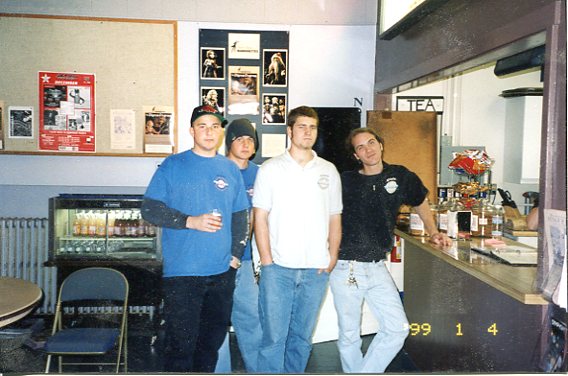
Me (far right) as a janitor
Me as a high school English teacher. Which one looks happier?

I have been a high school teacher for a very long time. Too long, in some ways, because I have watched education change enough in that time to make me very nearly obsolete, and if you stay in a job until your job doesn’t exist any more, that’s too long. I fear that the day is coming when English teachers will not exist: and possibly the day when teachers will not exist.

I’m here today to try to forestall that day. Not for myself – if I reach a point where I cannot teach, I will move into janitorial work, and be quite happy; probably happier than I have been as a teacher. After 25 years of cleaning up student writing, I would rather clean up public restrooms. It’s less work.

But it’s also less important work. Not unimportant work, it’s incredibly important because janitors keep our world working, and keep it livable – but for me, as someone who works in education, that work is more important. I’m just saying custodial work is a good backup for me. I worked in maintenance for five years before I became a teacher, and I liked it. In some ways more than teaching.

So if I liked being a janitor more, you may be thinking, why am I a teacher? And why do I still like and sometimes love being a teacher, despite the issues in education that I deal with every day?

It’s because I love humanity. I think we are incredible. I believe we have infinite potential for goodness, and infinite capacity for wonder. What we have achieved as a race is miraculous – and also sometimes terrible – and despite our almost limitless ability to dream and imagine, we can’t imagine how many more miracles we can achieve. And, hopefully, how many terrors we can avoid, or even eliminate, in the future.

And the key to that, the key to unlocking our potential and achieving progress and positive growth, and to actually making miracles real, is education.

That’s why I’m a teacher. Because my faith, my zeal, my heartfelt belief, is this: the best thing about all of us is that we are human, and the most important thing one can do is help us all become better humans. That’s what I try to do as a teacher. And that’s why I’m here today, speaking to all of you about school. Because I want to help you all to learn something about which you have been deceived – or at least misled. I don’t think any of you really understand what school is or should be – and what you think it is, what you have been told the purpose of school is? That’s a lie.

The lie is that school is about money. All of you students have been told that the purpose of school, the reason you are here and the reason you should try hard and do all of your work, is because that way you can get into a good college, get a good job, and make good money. You’ve been told that all along – though in elementary school it may not have been stated explicitly; but back then you were certainly told, with absolute sincerity, that the purpose of your schooling was to prepare you for the next step, which would be harder, and would matter more: 2nd grade is meant to get you ready for the rigors of 3rd grade, 3rd grade gets you ready for 4th; all of elementary school is preparation for middle school, which is preparation for high school. And all the way along, more often the farther you get in your thirteen years of compulsory schooling, you have been told that the goal of high school is to get you ready to go to college. So that you can get a degree, so you can get a good job, so you can make good money. And since schools also tell you that the next stage is always more important than the current one – “When you get to high school, things get serious, that’s when grades really matter” – the clear implication is that the final goal is the one that really, really matters: college, degree, money. Did you absorb the message in 2nd grade that everything then was intended to prepare you for college and a job and good money? Maybe not, but the cumulative effect of all of this is the same: the goal of school is – money.

Teachers, and especially administrators, you have said this. You have said it to all of your students, probably with certainty, certainly with absolute sincerity. All of you have lied. All of you have misled all of your students. Don’t feel bad: it’s what you were taught, what you were told, what the whole apparatus and engine of the educational system forced on you. So you didn’t know, you couldn’t even think, that it might be a lie. This is some of the power of education: it can influence our beliefs, and therefore our behavior, in pernicious ways as well as positive ones. As always, the pernicious influence is easier. The idea that school is intended to help students make more money is a pernicious lie, and I need to convince you to stop saying it, to stop thinking it.

Don’t take this as a personal attack, either, teachers: I’ve said this too. With certainty. With absolute sincerity. Because it’s what I thought, and it’s what I was taught. But luckily for me, I had an extra advantage that most teachers don’t have, something that helped me realize the truth: I’m an artist. And I’m married to an artist.

My wife and I both went to college to study art. And though I ended up studying education – one of the more useless endeavors of my life – I earned my degree in art, specifically in literature. My wife, who is stronger and braver and smarter and better than I am, stayed with art all the way through. And she had one of the most difficult undergraduate programs I’ve ever heard of; harder than any pre-law or pre-med program, I would be willing to wager, and with far less prestige.

And here’s the thing, the magic secret: she didn’t do it for the money. Neither did I – though I did sell out and become a teacher. Actually, it’s not the becoming a teacher that was selling out; I still reflect and promote the ideas of my art in my teaching, and I am proud of the career I have had, because it is a noble vocation, when it is done right. But I should have kept studying art while I was in school. I hate to think of the potential I lost, the opportunities I walked away from by switching from literature to education. And it’s funny: just as my time in public school didn’t prepare me successfully for college, my college education didn’t prepare me successfully for my career in public school education. The time I spent studying art was far more useful to my teaching than my training in how to be a teacher.

It was in teacher training that I was first trained in the Big Lie, though of course I heard it in some form or other all the way through my own K-12 schooling: the idea that the purpose of school is to get students higher incomes than they would get without it. I was shown the statistics, the data, the graphs, that argue that college graduates make more money, on the average, than non-college graduates. I was shown this, and told to use it on my students, because it’s one of the most effective ways to get students to take school seriously, to work hard and therefore (incidentally) to learn. I assume that’s why all trained educators in this country have been shown the same data: because scaring children with threats about their future is effective. It’s cruel, essentially abusive, and it has some quite severe secondary and unintended consequences, as we are now discovering; but it’s effective. It makes those lazy little punks – that’s you, students – work harder and try more. At least some of them. At least some of the time.

Look: you can’t blame us. Teaching is hard. Everything about it is hard. Organizing curriculum is hard, planning lessons is hard, finding and adapting materials is hard. It’s hard to stand in front of a room and command attention, let alone respect. It’s hard to manage a room full of individual people and get them all to focus, together, on one thing. It’s hard to communicate clearly, and hard to understand children who haven’t yet learned to communicate clearly.

(Let me just say one thing to all the students here: speak up. I’m old; I’ve lost some of my hearing. I cannot understand you when you whisper, when you mumble. Whatever you have to say to me: speak up, please.

(And I’ll try to talk slower.)

And then, after completing all of those difficult tasks, teachers run into the biggest difficulty of all, the one that feels insurmountable: getting the students to do the work. We create this curriculum, design these lessons to deliver it, gather the materials, summon all of our strength, invent positive energy from somewhere, and teach our hearts out: and then all of you students, just – don’t do it. There are many individual reasons why you don’t do it, but in a large number of instances, maybe more common than any other, the reason you don’t do the work is just because you don’t want to. You don’t feel like it. You don’t see the point. You don’t think it matters. You don’t care.

Confronted with that, over and over in student after student, day after week after month after year, teachers have reacted understandably: we try to MAKE you care, dammit! Sometimes we do it angrily, resentfully, with hurt feelings; because we care. And when you care, it hurts to try so hard and have somebody just say, “Nah.” That’s why teachers then try to scare students, that’s why we threaten.

“Your boss won’t accept this kind of work when you have a job.”

“Your college professor won’t care about you, so they won’t make exceptions for you: they won’t even know your name.”

“You think you can act like that out in the real world? Think again!”

Hurt people lash out. We may tell ourselves we’re doing it to be helpful, but we’re doing it because we’re hurt. It makes it easier for us to tell the lie, because the lie is hurtful, where the truth is just difficult – and we’re lashing out at those who hurt us. We shouldn’t do that, but also, maybe all you students should stop hurting your teachers. When a student comes to my class and says something like “This is boring. Can we do something fun instead?” to my face, every day, I definitely want to snap at them about how their attitude won’t be acceptable in the future. Because it’s just not right to insult someone’s passion the way students insult mine.

So it makes sense that teachers have done this, that we’ve told this lie. It makes sense that we’ve structured school, and thought about how we can teach our subjects, and explained this whole endeavor to students, on the basis of this fundamental assumption, this base falsehood, that the purpose of school is to prepare students for the real world, specifically for college, so they can get good jobs and make good money. It makes sense – though, teachers, I won’t take us off the hook entirely, because we really should have recognized the falsehood in this, and seen the hypocrites we make of ourselves, when we tell our students they should study hard specifically so they can make more money: because we are all so very well-educated, and worked so hard to become so, and we are so poorly paid for that effort and education. Did you all go to school, do all that work, and then take this very hard job, for the money?

Neither did I. (Though also, I expect and deserve and demand that I get paid what I am worth. So should we all.)

I do need to point out that we make this claim about the purpose of school in more ways than just talking about money. We do also talk about getting a “good” job, by which we mean a job you like and find fulfilling, a job that you feel has value, to yourself or to society or both. Teaching is all of those things for me, as it is for many of my colleagues; and the money has been generally sufficient, if not actually good, or representative of what I’m worth. We do also talk about getting our students prepared, with skills and knowledge, for the real world, beyond and apart from college. I think we do that, a little. Not enough, though also, here we run into a question of how much someone can be prepared, in school, for the world outside of school, and also how much someone should be prepared in advance of actually living. But regardless: our efforts to prepare students for the real world, as we call it, are founded on the same principle: we try to get them ready for their jobs. We want them to have work skills, and know how to find a job, apply for and interview for a job, succeed in a job. When we talk about our students’ future – other than some basic insincere lip service to the worn cliches “You can be anything you want to be!” and “You can do anything you want to do,” – it’s always the same basic idea. It’s all about the money.

Okay. So those are the lies. Now: are you ready for the truth?

Deep breath.

The truth is, you can not be anything you want to be. You can only be yourself.

The truth is, you cannot do anything you want to do: there are limitations on all of us, some internal, most external.

The truth is school does not prepare you for college or for work. Only you can do that, and no matter how well you do manage to prepare yourself, you will still be surprised, and sometimes unprepared and overwhelmed; and to some greater or lesser extent, you will fail.

The truth is, school is not preparing you for the real world: you are already in the real world, and you always have been. And no, it doesn’t get better. It doesn’t get easier.

The truth – the big truth, the last truth – is that the purpose of education is not, cannot be, and should not be stated as, helping students to get a good job or to make more money.

The purpose of education is to create more life.

***

Okay, that was a lot of truth. Take another deep breath, and then I’ll soften it up some, make it easier to swallow and to digest.

By the way: we absolutely should teach our students how to breathe. There’s nothing more important. Literally.

Okay: now for the softer side of the truth.

While it is true that you can only be yourself, that is also the very best thing you could ever be. Because every single one of you, of us, is as good and valuable and worthy as every one else; and there is also no other person you could be as successfully as you can be yourself. It’s also true that figuring out who exactly you are is incredibly difficult and complex, and the work we do on that project in schools is good work. You get to explore your self and your society and your skills and interests, even while we are barking at you that you need to master proper MLA format for your resume.

While it is true that there are limitations on all of us, which keep us from doing anything we want to do, limitations can be overcome. Muggsy Bogues played a full career in the NBA despite being only 5’3” tall. Also – and this may be even more important – a lot of things we think we want to do are actually really bad ideas. When I was 6, I wanted to be a stage actor, a fireman, and an astronaut. All bad careers for me, for the person I became – especially all at the same time.

The truth is that school does not prepare you completely for college or work: but the truth also is, it helps. We will, as I said, always fail, in college and career and life; but no failure needs to be total, or permanent. Failure always precedes growth. And – heh – school can prepare you for failure.

Unfortunately, the truth – and I cannot soften it – is still that school does not prepare you for the real world. But that’s because you’re in the real world, right now, while you are in school, and there’s no preparing for it, for any of us. There is only living it. Experiencing it. Learning from it. That’s all we ever do, whether in school or not. I do think it’s important that we teachers stop telling students there is some distinction between school and the real world, especially with the implication that the real world is somehow worse, harsher or harder, colder or crueller. People who really think that do not remember what it was like to be in middle school or high school. Or they do not understand the situations that many students, many children, live through. As I said: it doesn’t get better and it doesn’t get easier; but you will get better. And then, if you can, you will make your life better. And that process will continue for as long as you keep trying to learn and improve: always in the real world.

Last one – and, because I know my persuasive rhetoric, this is the important one. This is the point. This is what education is for.

Our world has, I believe, an objective reality. It’s not just in my mind, or in the Matrix. The world would – will – still be here when I am not here to perceive it; it will still be the same world when all of us are gone from it. Although it will be quieter, and less messy. No matter how I imagine the world to be, whether I think the Earth is round or flat, 6,000 years old or 4.5 billion, floating in space or resting on four elephants who are standing on a turtle – there is a truth, a real situation that I don’t change through my perception of it.

However: my perception of the world shapes my world, changes how I experience it, more fundamentally than I think we realize – certainly more than we think about very often. How we see determines what we see. We cannot perceive things that we cannot imagine existing; sometimes we cannot perceive them intentionally, consciously. Take the flat Earth example. If I believe, absolutely, that the world is flat, then there are things I will not do, places I will not go, because of my belief, because of my perception. I will not get on a plane that I think would fly off the edge of the world. I will not go to the world’s edge, let alone beyond it – so I will never see that there is no edge. So even though the world is in fact round, I will never perceive the world as round, because I will avoid – or more simply, deny – anything that would prove to me that the world is round. So for me, functionally, the world would be flat. And I will miss out on any experience associated with the round Earth. My world, shaped by my perception, would be less full: only two-dimensional.

Let’s take a more realistic and more common example. If I were a racist, and hated, let’s say, plaid people, then I would avoid, or dismiss as unworthy of my time, any and all plaid people. They would essentially not exist in my world except as an amorphous abstraction for me to hate and fear and blame. I would never get to know, never get to appreciate, never get to love, anyone who is plaid. And therefore my world, my life, would be smaller.

Because plaid people are some of the finest people there are.

And if you don’t know any plaid people – or, even more shocking, you somehow think that they don’t exist – I think you need to open your eyes and pay more attention. America’s no place for plaid-deniers.

But in all seriousness, this fact, that perception shapes reality, is true in all ways: things that we can’t understand, we avoid; things that we can’t conceive of, we don’t even perceive. And in contrast, when we have heightened understanding, we have heightened perception: my wife’s experience of an art museum is much richer, much fuller, than mine, because her knowledge of art, and her experience with creating art and the deep understanding of the artist’s craft she has thereby, lets her see the works on display in more ways than I can, who makes art only with words. My experience of literature is similarly fuller than most people’s. My dog’s experience of the world of smells is many thousands of times more complex and interesting than my experience of smells: which is why he chooses to sniff cat poop, which I simply avoid. Because he finds it interesting, and I just think it smells gross. But I have to assume that if I could smell what he can smell, I would interact with cat poop the same way he does: my nose would be riveted to every turd. Think how much more enjoyable it would be to live with cats, then. Having the litter box in the house would be a benefit. Maybe we’d put the box on the coffee table. Make it a conversation piece.

I know that sounds bizarre and insane. It sounds that way to me, too. But understand: it only sounds that way because of how we perceive cat poop. Or rather, how we don’t perceive it. How our experience of the world is limited by our range of perception.

Education can change that (Maybe not with cat poop.), because education can introduce us to things, and show us how to perceive them. I wasn’t born reading literature the way I do; I learned that. Because I learned it, my experience of reading is better than most people’s. My world of books is larger, more vibrant, more diverse, more entertaining, more inspiring, more challenging, than most people’s book world. Not because I’m better than other people, not because I’m just built different: because I have been educated. Because I learned. Because I learned how to read and understand what I read to an unusually high degree, I have a larger world to live in. It means I can find greater pleasure and fulfillment in the world of books. I will never get tired of reading books. I will never be bored, not as long as I can get my hands and my eyes on books. I can still perceive all the non-book things as well as all the rest of you can – though some people perceive individual pieces of non-book-reality better than I can, because I don’t know much about cars or sports or calculus, or about being a parent, or about traveling to other places or into other cultures – but in the areas where I learned well, my world is larger than the world of people who didn’t learn as well. In all the areas where I am not ignorant, my life is larger than the world of ignorant people. I live a larger life, in a larger world, than someone with less education with me.

That’s why I’m a teacher. Because I love humanity. Because I want to help people to live larger, fuller, richer lives. To have more chances to be human, to be more human. To make miracles. What else could I possibly do that would be as valuable, as important?

But, you see, my work has, of late, become less valuable. Less effective, and therefore less important.
Because my students are less willing to work with me, to listen to me. They are less willing to learn.

But that’s our fault, teachers, parents, adults in general: because we’ve been lying to them. And they have caught on. These are the unintended consequences of our choice to use the threat of future poverty and failure to scare our students into obedience. Rather than explain the real value of education, even though the idea is complicated, even though it is hard to accept, we have chosen to use the simple lie that the entire point of education is to prepare students for future work. We still tell them, as we have for years, that going to college is the best way, even the only way, to get a good job and make good money, and the point of compulsory public education is to prepare them for college and for jobs – and that’s it. It’s not all we think education is for, but when we are frustrated with difficult and disobedient students, we don’t usually talk about the wonderful benefits of education: we just threaten them. “If you drop out, or get expelled, how will you get a good job? You’ll be flipping burgers for your whole life!”

But, see, we have now gone through a pandemic, and more than one recession; today’s students are in the world of social media, which gives them access to people’s lives and internal thoughts. So they’ve seen behind the curtain, they’ve torn down the veil. They know that there are countless people who have good jobs without ever having finished college, and countless people with lots of education who have miserable jobs. And now college is so absurdly expensive that even those who would want a college-level job – for whom a job that required a college degree would be a “good” job – are not willing to accrue the debt to get that job, and so they’re looking for different jobs, ones that are easier to get, that have fewer requirements. Or, more often than I think we educators realize, they have come to the conclusion that life is not, and should not be, defined by a job: and so what job they end up with simply doesn’t matter to them, as long as they make enough to survive and do what they want to do. What they want to think about and plan for is all the non-job parts of life.

So here you are, students. You’ve been hearing for years, again and again, that school is necessary for getting into college and getting a good job. And you don’t want that. And you know that we are lying to you, that you don’t need college for many good jobs. You also know that life shouldn’t be only about a job.

What, then, is the value of this education we offer and demand, for a student who doesn’t want what we have claimed is the main and even the only goal of that education?

There isn’t any. So you don’t want it. Of course not.

And the more we try to threaten, and cajole, and cozen you into doing the difficult work of education anyway, the more you resist. Of course: you don’t like being lied to, and you don’t like having your time wasted. Wasting time is wasting life, and we all want all the life we can get.

So you ignore and evade and escape education that is nothing for you but life-draining, time-wasting oppression.

And therefore you remain more ignorant than you could be. Not totally ignorant, of course, because you learn on your own. But school could teach you so much more than you can easily learn on your own; and without putting effort into school, you will absolutely know less than you would if you could really do this the way it should be done.

And since you will know less, therefore you will have less life.

***

It has to stop. We need to stop telling students that school equals college equals job equals money. We need to stop focusing on money. I don’t teach literature because it makes money, either for me or for the students – or even for the authors, who I do think deserve money for their work; but that’s not why I want the book, and it’s not why I want to teach the book. I do it because literature expands and improves my experience of being human: and I want that larger life. And I want other people to have what I have. Especially now: because the world kinda sucks. And especially the kids I teach: because being in middle school and high school kinda sucks.

Teachers: we need to tell our students the truth: school sucks, but education will make your life suck less. It will give you more life, and a better life, because it will let you understand more, and therefore do more, and perceive more. And we need to believe this when we say it, and we need to want that for our students.

Otherwise we should all just give up and become janitors.

At least then the world would be cleaner.

Pride Goeth Before… Something Something

I got stopped by a fellow teacher this past week and asked a question I had never thought about before: between the two most common science fiction future predictions, that is, that humanity will evolve and transcend in some way, or that humanity will destroy itself, which did I think was the most likely? And although I had never thought about that before, I have read enough sci-fi to have encountered both of these predictions — actually, in my new elective class on fantasy and science-fiction literature, we have read both a dystopian novel (Feed by M.T. Anderson — HIGHLY recommend) that predicts that humanity will destroy itself and the Earth’s ecosystem along with us; and a short story by Isaac Asimov called “The Last Question” (Asimov said this was his best story. It’s probably not — but it’s a cool idea, and it’s very well realized. Also recommend. But not as highly as Feed.) which depicts humanity evolving and transcending. Along with our computer intelligences, I might add; which is a nice element to include in this unusually hopeful story. So I was able to formulate an answer, quickly; one that responded to the question but also considered some of the complexities in the topic: I said, immediately, that the doom option is far more likely — but I also pointed out that said doom is certainly not going to be the actual end of the human race, because we are enormously adaptable and incredibly good at surviving, so some people would live through the end of the rest of us, and those people would end up being very different from the people who came before the doom; and therefore those people may be said to transcend. But also, I asked what was meant by “evolve” and by “transcend?” Humanity has largely stopped evolving physically, because we now evolve societally; our greater height and longevity, our now-selective fecundity but also our incredibly improved survival rate — all these are changes that have been wrought by society, and not by physical evolution through natural selection. So is evolution to be defined as something that happens naturally through the same process of environmental pressure which differentiated us from the other great apes? Then hell no, humans will not evolve. But is evolution simply about the changes wrought on the species by their — our — continued survival and our steady adaptation to differing circumstances? Then yes, we will continue to evolve. Also, does “transcend” mean changing who we are as a species? Being born different, as the kids say? Or is it about changing individuals after birth? That is, if I am born as a normal weak-ass human, but then I add machine elements to my body, and end by uploading my consciousness into a robot body: have I transcended? Have I evolved?

Is this an evolved human? I mean, other than because it is Patrick Stewart…

Anyway, the point is I talk too damn much. But also (And this is more the point): I’m very smart. I was able to start answering the question, and then think about both the question and my answer, while making my initial point. I thought of these two works I have named, and thought about how they fit into the spectrum of future possibilities. I could have kept going. I could have turned this into a lesson, or even a unit, without thinking too hard. (We should also include “Harrison Bergeron” by Kurt Vonnegut. Great story about evolution, and also dystopian doom. And “By the Waters of Babylon” by Stephen Vincent Benet is a nice example of people surviving past the cataclysm, and maybe becoming better? Maybe stronger?) I could have put this to students, and maybe helped them to recognize the importance of trying to become better, rather than worse, even though worse is MUCH easier. I have used it as an example here, but I could have turned this into a whole essay; it might have been a good one.

I am proud that I can do that. I am proud of my abilities. I read well and remember what I read; I think well and speak well and write well. Over the last 20+ years of teaching, I have actually learned to think like a teacher: surprising, considering that I didn’t even think like a student when I was growing up. Part of why I do that, why I think like a teacher? I’m proud of being a teacher. I’m proud of what I have done as a teacher. Not as proud as what I have done as a writer; I still think art is more important than education, because education has been co-opted and commodified, and also to some extent Balkanized (Meaning it has been broken up into small pieces, as the Balkan states were broken off of the Soviet Union; now there are lots of them, but they are individually much less than they used to be, partly because they are hostile to each other. Huh. I actually didn’t know that last part was in the definition. Now I have to think about whether that applies to teaching. Yeah, probably; I have often had conflict — beef, as the kids say [By the way: I do that “As the kids say” thing precisely because it is “cringe,” which is hilarious. I can actually make my students shiver with loathing when I say something like “No cap, for real for real.” I love it.] — with other teachers, and that probably is a result of the system, at least in part.); while that has definitely happened to art on the internet (which was where and how I discovered the term Balkanization, in a description of how the internet has affected art), art is able to — well, to transcend that process, and remain valuable, which education has struggled to do. So when asked what I have accomplished that I am proud of, the immediate answer is always: my books. I have written books. They are good books. I am proud of them. Only after I have said all of that — and probably much more — do I maybe add — “Oh, and I’m proud of teaching, I guess.”

And that’s why I’m writing this: because two weeks ago I wrote about value and worth and price, and I recommended that people stop buying stuff, which theme I wanted to expand on lest I be too holier-than-thou; and both that piece and this one are in response to the number of my friends who question their value and their worth: particularly in terms of their art and their accomplishments as artists. I do it too, and for some of the same reasons; but I do it less. Because I’m a proud man.

And Pride goeth before a fall.

Okay: so what is pride? What does it mean to be proud of something, or of someone? What does it mean to be proud of yourself — and is that the same as being proud as a person? Of having pride? Is pride good, or bad?

According to Christian values, pride is bad. We should instead be humble. But okay, what does that mean? My immediate thought is that humble means “Not proud;” so I should define “pride” first, and then “humility” in relation to it. I suspect we are more familiar with and have a better understanding of pride, especially we Americans. So we’ll start there.

I think of pride in two contexts: pride in one’s accomplishments, and the pride a parent feels about their child. That’s not to limit it to those: I am proud of my wife, I am proud of my brother, I am proud of my father (Maybe even more so than he is proud of me…), I am proud of my friends. I am proud (in a way) of things about me that I wouldn’t label as accomplishments, like my intelligence and my empathy. But the first things that come to mind are the first two I stated. When I talk about being proud of my accomplishments, I think that feeling is a sense that what I have done is good, is important, and is something I think is defining for me. I’ve done stuff that I’m not proud of (Which should be a simple statement describing things like “I drove to the post office today” but has a strong negative connotation, implying things that I have done which I am not only not proud of, but that I am ashamed of; those things also exist), and some of it is good and important — like food. I make dinner sometimes. I made dinner last night. Sandwiches. Pesto, tomatoes, mozzarella cheese. Potato chips on the side. (I didn’t make those.) Delicious. Food is good and important, the fact that I make the food sometimes so my wife doesn’t have to is good and important — but I’m not proud of that. Because I don’t see it as defining.

That’s another aspect of this we struggle with, I would guess. It’s hard for us to define ourselves. It’s particularly hard for artists to define ourselves, because most of us — almost all of us — have other jobs. Almost no one makes their living exclusively from their art. And here in our capitalist society, we define ourselves first and foremost by our jobs; that is, by our income-earning vocations. Even that word is misused: it means a career or occupation (One regarded as particularly worthy and requiring great dedication, the Google tells me, so the definition is closer to what I want it to be, and I’ve just been misusing it. But I wonder how many people who use the word use it to that full definition.), but it comes from the Latin word for “to call,” vocare, so it is a calling. Something we are summoned to, something we are compelled to do — no, even that doesn’t have the right feel, because honestly, I am summoned and compelled to earn a paycheck because I have a mortgage and because I need to buy tomatoes and pesto and mozzarella for my sandwiches. A vocation should be something that thrums the iron string of our soul that Emerson wrote about in On Self-Reliance. Something that makes sense of us, and by which we make sense of ourselves and our world. My father spent five years or so working as human resources director for a tech company in Boston; but his vocation was always particle physics, and when he went back to that, he made sense to himself. So he is proud of his work at SLAC [Stanford Linear Accelerator Center], and not as proud of his work at the tech company. Similarly, I am proud of my writing, and proud of my teaching — and I mean, I guess it’s cool that I have put a lot of work into home renovation projects over the years.

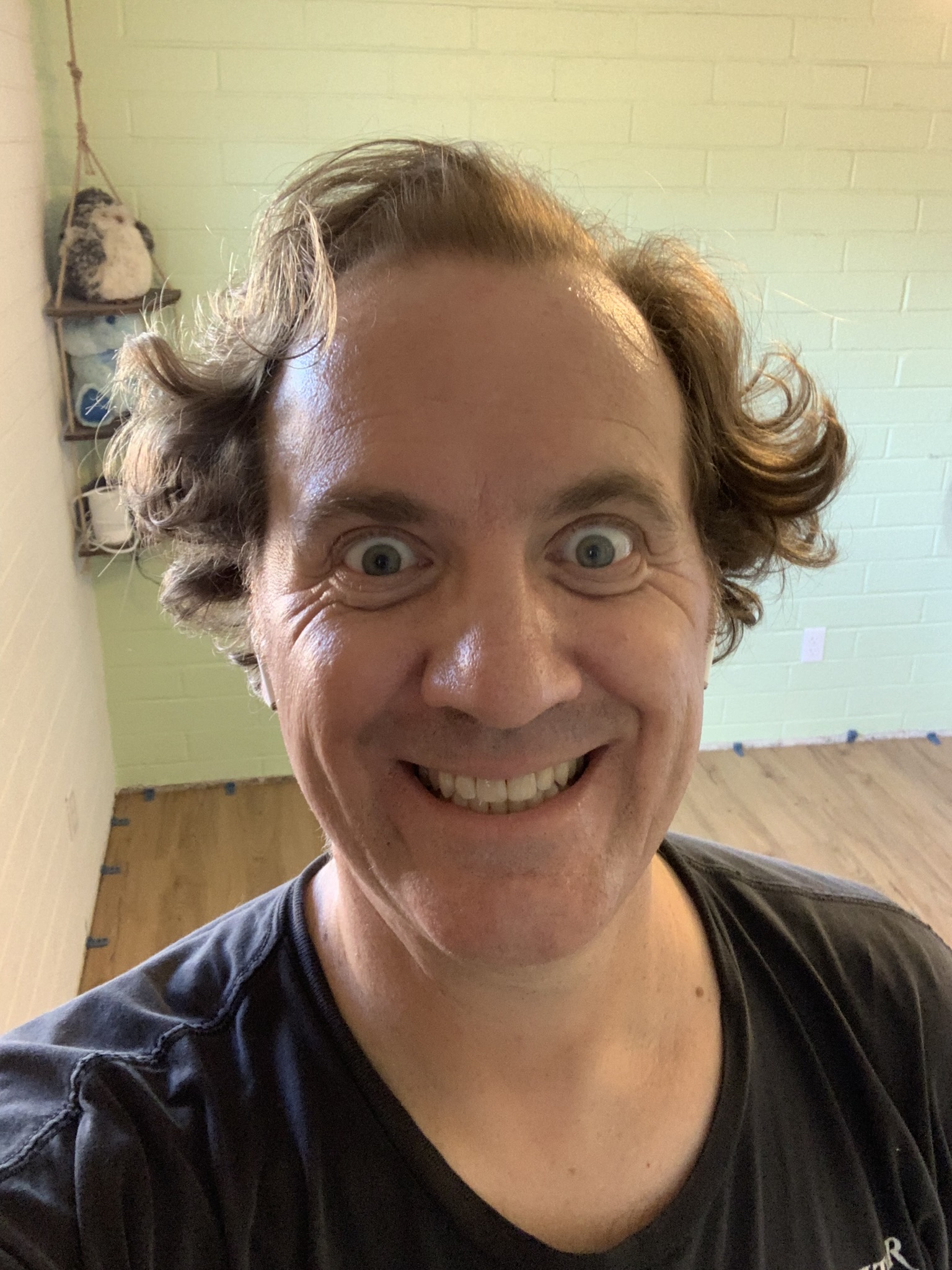
I’m quite proud of this image of me, which I captured after I spent several hours installing that floor. I guess I’m proud of the floor.

So that’s the first part of pride. When you do something that is good and important and defining, then you are (or should be) proud of that. “Important” is a word in there that probably needs defining too, though it is definitely subjective for me: there’s no real reason to think that my writing is important, as I have not been groundbreaking or influential or even particularly successful with my writing; but I think it is important. And I see a distinction between my important writing, like this blog I keep trying to keep up, and my books; and my unimportant writing, like my journal or the emails I send, stuff like that.

So if that is pride, I’m not sure why it’s a thing that Christianity would be against. Other than, of course, the cynical assumption that the faith wants to put all goodness into God so that people need to rely on the church; if God is the source of all good things, then there isn’t anything for any human to be proud of, because we didn’t do that stuff, God did; he just let us borrow it. Personally I don’t like that. But then I’m not a Christian. That may be exactly the mindset they’re going for.

But I don’t think that’s the source of the idea that “Pride goeth before a fall.” (Hang on, let me check on that, because I used “Spare the rod and spoil the child” in an essay I wrote once for school and claimed it was from the Bible, and later on I looked it up and it does not in fact come from the Bible at all. I am actually proud of that essay in a particularly perverse way: I think it’s one of the worst things I’ve ever written, which it was meant to be, and it has been an effective example for my classes because it is so bad. Okay, so this one is from the Bible but I’m misquoting: it is “Pride goeth before destruction, and an haughty spirit before a fall.” Proverbs 16:18, King James Version) I think — though I agree that my understanding of Christian ideology is a pretty laughable foundation for a discussion — that the pride spoken of there is a different kind of pride: and now that I have actually found the correct quote, I feel pretty well confirmed in that.

It’s the haughty spirit. That’s the point. That’s the bad pride, the one that leads to karmic justice in some way.

See, there are plenty of people who take enormous pride in things that they didn’t even do. So it’s one thing to take pride in something that isn’t good; I’m pretty damn proud of my longstanding hobby (One might even call it a vocation?) of stapling papers in the wrong corners in order to mess with my students:

Trigger warning: if you like things being done just so and being done right, you will not like what I did to these papers.

But there’s nothing good about that.

And then there are plenty of things I am proud of which are not important — like the video games I have beaten, that sort of thing. And I already spoke of things that aren’t defining, like cooking dinner for my family. Those things may not really deserve pride — and because of that it does make me question whether I feel proud about them — but regardless, there is no harm in being proud of things that don’t really matter much.

But then there are people who are proud of things they didn’t even do: like being American. Or male. Or tall. Or white. Don’t get me wrong, you can like those things, you can appreciate being those things (I’m not really sure why you would, but to each their own): but what on Earth would make someone proud of being born in this country? What did you do to make that happen? What time and effort did you put into it? Now, if you emigrated here, went through the enormous upheaval of moving to a whole new country; if you made a life and a home here, and created a place for yourself: that would be something to be proud of. But if you are proud of the fact that were born here, well. Bill Hicks has something to say about that: (**Please note: this clip is not safe for work.)

In To Kill a Mockingbird, Miss Maudie talks about Atticus’s shooting ability, once it is revealed that he was called One-Shot Finch, after he shoots the rabid dog. The kids can’t understand why Atticus never talked about how he was a dead shot, and why he never goes shooting if he is so good at it. Miss Maudie theorizes (Falsely, in a way, because he later says what he wanted his kids to think — that courage is not a man with a gun — but this point of Maudie’s also makes sense and might be part of his reasoning) that it is because Atticus recognizes that there’s no sense in taking pride in what she calls a God-given talent. She says that being born with a good eye and a steady hand is nothing that comes from hard work and dedication; it’s just a thing that is true about Atticus, like being tall.

I don’t entirely agree with Miss Maudie — I think that shooting a gun accurately would take a hell of a lot of practice, and therefore would be something to be proud of; but also, you would need to shoot in a good way, and also in an important way, for it to earn pride in my definition — but I see her point and I agree with the idea that taking pride in something you didn’t do, something you aren’t responsible for, is silly. That’s the idea of the Bible verse, too, I think.

See, if you put in the effort on something, if you really do the work, then it’s damn difficult to be proud of it. Because first of all, you’ve seen alllllll the mistakes you made in the process of learning; and if it is something hard to do, then you made a lot of mistakes. You also know, better than anyone, how much effort you have spent, and also you should know the difference that effort made: and that should pretty clearly show you that anyone else who put in the same effort would probably make the same progress — unless you were born with a gift of some kind that contributed to your ability, like having a sharp eye and a steady hand. But if it is something really difficult, then you also recognize that your sharp eye and your steady hand are not the things that make you good, or that make you great: they make it easier for you to be good or great — but only effort and dedication makes you good, or makes you great. The physical gifts are not something you did, so not something you should be proud of: the pride comes from what you put into making yourself into someone you can be proud of. Michael Jordan certainly has physical gifts that make him a great basketball player: but he’s Michael Jordan because he had the will and the drive, and he put in the effort. Therefore, I think he should be proud of what he accomplished. Shaquille O’Neal, on the other hand — well, he should be proud that he is apparently a very nice person. And then, of course, if you do what most of us do with our passions, and you look around at other people who do the same thing, what you are bound to find is people who do it better than you. Because nobody, not even Michael Jordan, is actually the greatest: there’s always somebody better. Knowing that keeps us humble, even if we have accomplished something to be proud of.

But even though it is difficult to take pride in what do, if that thing we do is a calling, if that thing is very difficult, if that thing takes years of dedication and effort to accomplish: then we have to take pride in it. We have to. Because there’s another aspect of pride.

The pride a parent takes in a child, that I take in my wife, my friends, my family, is not the pride of accomplishment. I mean, I’m proud that I support my wife in her art (and I’m proud I make her delicious sandwiches for dinner, without which she could not continue to make art), but otherwise? Her art isn’t my accomplishment. I did nothing to make her into the artist she is, not really. My support and sandwiches were helpful, but she could have done it without them, of course. But I am so incredibly proud of what she can do. So is that like the pride that dumb people take in being born between Canada and Mexico?

No: it’s something else.

The quality of an accomplishment that makes it pride-worthy, the aspects of it that make it (to one’s subjective viewpoint) good, and important, and defining, can be boiled down to one simple emotion: the most powerful emotion. Love. I write because I love what writing can do, and I love what writing is; and therefore I love writers — and therefore, when I write, I love myself. I love when I am able to create the effects that make me love writing. I am so very proud of those moments, of those effects, of what I did, and of myself for achieving them. And yes, it is entirely subjective: but then, often, so is pride. That doesn’t make it bad.

Pride is bad when it is not based on love. That’s the second half of the proverb, the “haughty spirit.” When one bases their pride on their contempt for others, then pride is bad. When one sets oneself above others, and is proud as a corollary to that, that is bad. That leads, in a righteous universe, to destruction: to a fall. (I know it doesn’t always. This is not a righteous universe.)

So really, it’s not that it’s dumb to be proud of being an American; it’s dumb to think that other people are lesser for not being Americans. (I knew that, actually. I am proud of my country. But also, I am humbled by it, because I can never do enough to make it the country that it should be, which means I am not fully worthy of it: so my pride does not create in me an haughty spirit. What a phrase that is. Don’t you just love the KJV?) It’s not that bad to be proud of being tall, or of being white; it’s bad to think that short people are worse off, or that people who aren’t white are somehow worse or less than white people. That’s where pride goeth before destruction: at least it is to be hoped that it does goeth before destruction. Because that kind of pride should be destroyed.

That’s not the pride that people have in their children, unless those people are really damn awful. Parents who put in a lot of work helping their kids to achieve something can take pride in their accomplishment, too, but mainly, parents are proud of their kids because they love their kids. And that love is pride; that pride is really just love.

I think that pride is love turned outwards. Love is generally directed into the person, or the pursuit, or the object, for whom/for which you feel the love; or it is turned into ourselves, as we enjoy the loved thing or the loved one being around us and bringing us joy. When we are proud of someone, as when we are proud of our accomplishments, we want to share that love with others: we want to express it, we want others to see it, we want everyone to know about it. That’s pride. I am proud of my books because I love my books. I am proud of my wife because I love my wife. I want to show off my books, I want to show off my wife, because I want other people to know of my love, and I want other people to understand how much I love, and why I love, and how lucky I am to have these loves in my life: both my accomplishments, and my incredible, incomparable wife.

Also: I am sometimes not proud of being an American. Because I do not always love my country. I am always proud of my wife.

But please remember this, whoever is reading this: if you work on something hard; if you think that thing is good; if you think it is important; if you think it defines a part of you: then be proud of it. Be proud of it like a parent is proud of their child. Notice that I have not spoken of the value or the worth or the price of the thing you do of which you are proud: love has no price, and so neither, therefore, should pride. You just feel it, and want to share it: and you should. Always. And if you are a parent: be proud of your child, especially when that child is proud of themselves. Love them for who they are and for what they do: and love yourself the same way. Don’t talk yourself out of it because you could have done better, or someone else could have done better, or it wasn’t exactly what you thought it would be: just love what you did, and love yourself for doing it. Be proud.

You deserve it.

This Morning

This morning, I think I have an answer to my question from yesterday morning.

Yesterday, I was wondering what I could say to my wife, to my students, to myself, that would help comfort us in the face of inevitable suffering, and I wished that I could rely on God as that answer, because then I could at least stop thinking about it — and I should have said worrying about it and fretting about it, because that’s the point; it’s not the idea of not thinking, it’s the idea of “let go and let God.” Which I can’t do, but I appreciate that people can.

But I have another cliche that I have gleaned from outside of the fields of the Lord (And that enormously obscure reference is brought to you by the podcast I’ve been listening to, Sunday School Dropouts. Probably also why God has shown up in this atheist’s morning ramblings.), that as I understand it, many churches focus on as the heart of their message (and others may sprinkle in, in between railing against homosexuals and abortion and Democrats in Washington), which is this: God is love.

Once again, that doesn’t work for me. But it comes with another way of looking at it, that I think does fit in nicely with what I’ve been looking for:

Love is God.

That is to say, love is everything. Everything that matters. It is the alpha and the omega, it is the answer to all questions, all doubts and fears. Love. And love, I think, can offer an answer precisely as satisfying  — and not any more satisfying — as can the answer “God.”

What should I tell my students when the future looms ominously over them? Love. Look for love in your life, look for love in what you do; if you don’t find any love in your life, then change it, and if you don’t find any love in what you do, then stop doing it. Don’t work for money, work for love: and I don’t mean to be flippant there, because I am a person who works for money precisely because he cannot live on what he loves; but for me, the money I earn is spent on those I love, and used to give me an opportunity to do what I love, which I am doing right now. So I never mind my job very much, because it is done for love, if not always in love. And yes, sometimes I love my job: I do love books and poetry, and I love writing, and I guess I don’t entirely loathe my students. (No, I love some of them. More, I love the people they become, and the potential I see in them when they are young.)

What do I tell myself when I am in my darkest, foulest, most hopeless moods? Love. I have lost some of my liberal idealism in these last few years, and I have begun to lean a wee bit more conservative; it has made me worry, because I know that this is a common pattern, especially among aging white men, as we start to get a taste of power and become greedy and start worrying about people taking away what we have. And I do not want to be that guy. But I think that so long as I focus on love, so long as my actions and intentions are begun with love in mind, then I won’t turn into someone I would hate. At least some of my shifting to the right is based on the consideration that people on the right can’t be bad people, can’t be evil people, not all of them. (Trump is.) Not any more than there are evil people on the left. It’s not reasonable to take a person’s political leanings as the sole evidence of their morality or their value, or anything else apart from their political leanings; evil people are conservatives, conservatives aren’t evil people. Thinking that makes me give some conservative ideas (like the free market and lower regulation, the independence of states and, perhaps most shocking to me and those who know me, the value of the Second Amendment) the benefit of the doubt, and that makes me move away from my liberal roots.

But that doesn’t matter. It doesn’t matter if I’m a liberal or a libertarian or a moderate or an anarchist: so long as I consider what is best for my fellow men, and treat them always with respect and with love, then my ideas will never be bad, even if they are wrong.

I also need to remember this for myself when I am disappointed in my writing career. When I think about how old I am compared to other writers, and when I realize how good I am compared to some other writers — and then when I think about how entirely devoid of success I am compared to most other writers; I need to remember: love. I do this because I love it, because I love the me who does this. And so long as I write for love, with love, and out of love, then I can’t be a failure. I am a writer.

What do I tell my wife when she worries about our future, about what we’ll do for money, about where we’ll live, about how we’ll see the world and how we’ll live in it? I will tell her, as I do as often as I possibly can, that I love her, without limits and without end, and that I always will, and that love will see us through, no matter what else happens. Always. Love.

It doesn’t solve the problems we all face. But then, neither does God. I hope that it brings you some comfort, as it brings me some. I hope that it gives us all the strength to keep fighting towards our goals, and I hope it keeps us from hating those who fight against us, or at least in the opposite direction. I hope that the love in your life is enough to make you smile, as it is for me, even on a Monday morning.

Thank you for reading what I write. I won’t say I love you, because I don’t know you, but I love the fact of you and the existence of you, and what you give to me. Thank you.

Now go love!

On the Sixth Day of Blogging, Just Dusty Blogged for Me . . .

A political post; his specialtyyyyy!

Here’s the truth: we all know what’s coming.

The Republicans are coming.

It’s like watching a storm coming in: the clouds roll out across the sky like a cloth unfurling; first they are white, then grey, then black. The color leaches out of the world. The wind turns cold and biting, and then the first drops arrive: if it is a summer storm, then the big, fat splashes are refreshing, though the tang of ozone in the air is alarming.

But I don’t think this is a summer storm. It feels like winter. Those drops are cold. We are shivering.

When the storm hits in winter, it brings quiet. The wind may howl, but after it goes, everything is still. Frozen. Asleep, or dead.

That’s what I think this feels like. Like the storm is coming, and we need to get into shelter, and cover everything. Anything left out will freeze solid, will turn black, will die. We have to cover ourselves, we have to batten down the hatches. And ride it out.

But hang on: winter storms don’t kill everything. Yes, there will be some death: the EPA seems doomed, and Obamacare will be lobotomized, dissected, cut down into pieces too small to sustain itself any longer. Maybe the Department of Education, too, since the nominee for Education Secretary is against public education. Irrevocable harm will be done to the environment as new oil leases are sold, new mining contracts offered, coal dug and burned at will. Internationally, the day of the strong man is on the rise: the new administration will be a friend to Putin, and Netanyahu, and probably Assad and a dozen others who hold an iron grip with their right hand. America will no longer be the defender of freedom around the world. But then, we haven’t actually been that for a long time: we have defended our interests, and little else. That will continue, to the joy of the exceptionalists. Surely we will no longer fight against genocide or oppression: pity is the most delicate flower, and will be the first to freeze.

But not everything will freeze. It will get deathly cold, but our shelters run deep, and are well-protected. And though the storm will be bad, it will not last long. That’s the truth: it will not last long. At some point, perhaps in four years, perhaps in only two when the new Congress is elected, the storm will break, and the skies will clear.

Then we will have to see if there is another storm behind this one. It is possible, you know. This storm may last eight years. If it does, we’re going to have a lot of frostbite.

But think of this. No party has won three elections in a row since Bush followed Reagan. Before that, not since Truman followed Roosevelt. Twice in almost a century have we had a Democratic president after a Democrat, or a Republican after a Republican – Johnson following Kennedy and Ford following Nixon notwithstanding, for obvious reasons. Which means that things will change. The storm will end. Believe it.

Here’s what we hope for, between now and then.

Hope that the storm does some good. Storms do, you know. They wash things clean, they break away dead branches and scour away debris. I am a progressive, and I believe in the power of government to do good things; but the truth is that our government has a lot of debris stuck in its branches. And some dead branches, I think. It is entirely possible that, even while it harms and breaks good things, the storm will also clear away some of the bad. We have to hope so. Maybe there will be some positive effects.

The key for us – for all of us – is going to be objectivity. We must be dispassionate, and we must be rational. Reasonable people can agree, can compromise, and what was most noticeably absent from this last election was reason — and therefore agreement, and therefore compromise. To keep the weather metaphor: some people like cold weather, like storms, like the rain; other people prefer warm sunshine. But only unreasonable people claim that there is nothing good about cold, that only warm sunshine can ever be acceptable; only unreasonable people claim to hate it when the sky clears and the sun comes out, at least once in a while. Reasonable people realize that Arizona summers are too freaking hot, that New England winters are too freaking cold, that the Pacific Northwest is too overcast and rainy, and the Southeast is too muggy.

We have to be reasonable. If the Republican control of the government leads to some good things, leads to some reductions in unnecessary regulations (and there are such), leads to some reversal of government overreach and invasion into private lives (and there is such), then we must be happy that good things are happening. We must not make the same mistake that unreasonable people have made when they have claimed that, for instance, President Obama has been bad for the economy. Or that the First Family has been an embarrassment to the country. Hate Obamacare all you want, but the economy has turned around since the recession. (And I say Fie to anyone who claims that the economy would have grown faster had the president for the last eight years been Republican. Fie. Prove it. Show me where economic predictions have ever been reliable. If a simple cause and effect were provably true, the argument would be over. It ain’t. So fie.) The Obama family are a model of dignity and grace.

So let’s not make the same mistake. Let us be reasonable. Let us take the long view and see: if a thing is broken or taken away, was that thing actually necessary? Perhaps not. Perhaps when Obamacare is destroyed by the storm, we will come out of our shelters when the sky clears and build something even better.

In To Kill a Mockingbird, when Miss Maudie’s house burns down during the winter freeze, she simply says this:

Miss Maudie looked around, and the shadow of her old grin crossed her face. ‘Always wanted a smaller house, Jem Finch. Gives me more yard. Just think, I’ll have more room for my azaleas now!’ 

You ain’t grievin’, Miss Maudie?’ I asked, surprised. Atticus said her house was nearly all she had. 

Grieving, child? Why, I hated that old cow barn. Thought of settin’ fire to it a hundred times myself, except they’d lock me up.’

But—’ 

Don’t you worry about me, Jean Louise Finch. There are ways of doing things you don’t know about. Why, I’ll build me a little house and take me a couple of roomers and – gracious, I’ll have the finest yard in Alabama. Those Bellingrathsll look plain puny when I get started!’

There are ways of doing things. That’s how we have to see this. Like the burning down of an old house. It’s dangerous and damaging – and we have to try to fight the fire, and we have to try to save what we can from its flames – but we have to remember that after the storm, after the fire, life goes on. And maybe the new day will dawn even brighter. Anything that is destroyed that shouldn’t be, we can rebuild. Maybe we can even make it better.

Now: that is me being reasonable, because we should be, about Republican control of government. Republicans are not fools, and are not evil; though I think political parties are harmful to this country, it is certainly true that two parties are necessary, that one party alone, even my party, would be doomed. I think of when Frodo offers the One Ring to Galadriel, and she refuses it because she would become a queen, awesome and terrible — “All will worship me and despair,” she says, as she’s imagining it. Gandalf turns it down, too, for the same reason: nobody can use it safely, even if they mean to do good. The federal government is, in some ways, the Ring. The key to using it safely is in numbers: no one person can hold it for too long; no person can go it alone. Frodo never makes it to Mt. Doom without Samwise. Realize that, while we seem to have handed the Ring to Denethor, the madman on the throne of Gondor, it wouldn’t be any better if we hung on to it ourselves: we’d go mad like Frodo does, and decide to keep the Ring for ourselves. That is a fate to be feared no less because progressives have, I think, the right idea. I may write more about this another time.

For now, let’s talk about the other part of the winter storm scene from To Kill a Mockingbird: let’s talk about the Morphodite.

You remember the Morphodite, right? The snowman that Jem and Scout build, that is actually only a coating of clean snow over a big ball of mud? Right. Jem turns him into a caricature of their loud, obnoxious neighbor Mr. Avery, but at Atticus’s request, he changes it into a more innocent imitation of Miss Maudie, dressing it with her sun hat and hedge clippers. She, of course, takes it as an insult (though she doesn’t mind too much) and names it a morphodite, meaning a thing that changes its shape. The Morphodite melts in the heat of the burning house, and Scout and Jem have to clean up the muddy, filthy, sticky mess.

I think we all know what I’m talking about. I don’t, in theory, have a problem with the Republican party taking control of the government — though I am extremely nervous that, after they push through a conservative Justice for the Supreme Court, they will control all three branches of the Federal government — but we’re not just talking about conservatives or Republicans, are we? We’re talking about this guy:

You know — the Morphodite. See? Clean and white on the outside, nothing but sticky brown nastiness underneath. (And I’m not making a racial reference here, just using the symbolism of white snow=purity, and mud=shit=corruption.)

So here’s the thing with the Morphodite. He was picked largely as an alternative to a lot of bad choices, mostly (but not solely) on the Republican side. I still believe, absolutely, that he entered the race solely to increase his name recognition and give himself a veneer of patriotism; maybe to make some political connections he could use to his advantage for his business. I think nobody was more shocked than he when he started winning, and that state of shock continued all the way through the final victory. I mean, he’s been unprepared the whole way; it’s no less true now. And he’s filling his cabinet with people who are likely to support him and his ideas personally, with their own selfish interests in mind, rather than people who are civic-minded, or who will likely consider what is best for the American people before considering what is best for themselves. Just like him.

The man’s a narcissist, that much is clear. He acts like a spoiled child: and he seems happiest when he breaks things and gets attention, which he then turns into more attention as he mocks the people who chastise him for breaking things. He thrives on attention. It is why he entered the race, why he ran so hard and why he has acted the way he has since his election.

So what do you do with a spoiled child who acts out for attention?

You ignore him. Don’t give him the satisfaction. Don’t give him what he wants, because it is the only thing he wants, and he doesn’t care in the least if it is good attention or bad attention. All he wants is for people to talk about him.

So stop. Stop using his name. Fortunately there are a thousand alternatives, from John Oliver’s call to make Donald Drumpf again, to the various versions of orange-themed insults that plaster the internet. Any of those are fine; he wants to see his name, his actual name. I think he prefers The D_____, actually, though clearly the last name, associated with the business, is the #1 priority. But there are so many others, too: Rump. Dump. Chump. Chimp! Lump, Slump, Gump, Hump (Wait — not that one. Too close to home.), Bump, Thump, Clump. So many possibilities, and not a one of them will give him what he wants.

If you feel a call to protest, please do. But address your concerns to the part of the government that is actually still a government. And when the reality TV guy comes on stage — change the channel. Or better yet, just turn him off.

Let him melt back into a puddle of goo. Then we can have a couple of kids rake him up and throw him away.

Never Stop! Never Stop Fighting Until the Fight Is Done!

Hey. HEY!

Stop being sad. Stop it.

I know: I feel the same way. This was not the result I was expecting. I was growing more and more stunned all last night as I watched  the results come in, and in, and in. I watched the commentators on CNN and then on BBC being just as stunned.

We didn’t think this was possible. We didn’t think this was our country.

It was possible. It happened.

And this is still our country.

It is not The Donald’s country. He did not win us. I know he thinks he did, and at some point today I’m going to have to watch a victory speech from that smug  asshole that is likely to make me vomit. He is going to have to start lying —

Wait. I honestly can’t believe I actually wrote that.

His lies, ongoing and ever more egregious, will now focus on trying to convince people he hates that he doesn’t hate them, right before he begins working to enact policy to prove that he hates them. The hypocrisy, and the assurance of our gullibility, will be infuriating. I’m already annoyed that my Republican friends are crowing over the victory. And I know I’m going to be mad a lot over the next four years, at least.

But this is still my country. And like it or not, that rotten son of a bastard is going to be my president.

My wife says he’ll never be her President. She said she may not be able to stand for the Pledge of Allegiance for the next four years.

Good.

We all know exactly what happened: millions of people looked at their options, and chose what was, to them, the lesser of two evils. Millions more of us think they chose wrong. And millions of us are racists, and sexists, and xenophobic bigots who want walls built, refugees interned, and immigrants deported.

Not everyone who voted for him. Not everyone. Millions, yes. But not everyone.

The thing that makes this worse is that we didn’t expect it. We didn’t realize this was coming. Neither did the media. This should tell us something: the discussions I have  seen of late that say that our world is turning into an echo chamber, where we only hear what we want to hear, where we only communicate with people who agree with us  and share our views, are correct. If you settled the election based on my  own Facebook feed, then Bernie Sanders would be president. If not Cthulhu.

This,  then, is our task. Tasks. There are several.

First, we have to start listening to each other. Even to people we disagree with. We have to be better than the hypocrite that just got elected, who will ignore the needs of millions of people who were not in the demographics who supported him, whom he campaigned against. We have to understand that there are millions of people who thought Donald Trump was the lesser of two (or four) evils. Millions. Those people must be heard, because the biggest reason that they voted for Trump was, I think, that they believe they have not been heard.

So listen. Take them seriously. They are people, and they are important. Not the racists and sexists and xenophobes: fuck them. But listen to the millions of rational, genuine people who believed Trump was the best choice, or at least the least-bad.

Second, we have to fix this government. Millions who voted for Trump, and millions who voted for third party candidates, and many, many millions who did not vote, believe our government is broken. It is. We have to fix it, because Trump won’t. He will take advantage of the breaks to break it more — for one thing, he’s going to nominate a hard-right pro-life conservative to the Supreme Court, and then perhaps another, since the liberal justices are aged and unwell. That means all three branches of government will be Republican, behind Donald Trump. So we must work. We must be vigilant. We must read the news — unbiased sources, if we can find them, because if the surprise on the newsmen’s faces last night says anything, it says that the liberal media bias has some validity, that the news channels, too, are become something of an echo chamber — and we must speak out, and we must organize, and we must march, and we. Must. Vote. 59,000,000 some odd votes  for Clinton, 58,000,000 some odd votes for Trump. 330 million people in the country. 219 million eligible voters.

This is broken. We must fix it. We can fix it.

Last,we have to deal with the worst part of this. Millions of Americans are sexist and racist and bigoted xenophobes. We have, it seems, spent too long considering them anachronisms and harmless cranks, and sweeping them under the rug. We pushed them out of the echo chamber. And then they found a  candidate who was just racist enough, but not too racist — “He was talking about illegal immigrants, not Latinos! He meant Syrian refugees that might be terrorists, not all Muslims!” — and sexist enough, but not too sexist — “He was just talking. He wouldn’t actually sexually assault anyone! He’s got a beautiful wife! He hires women!” — that millions of other people could stand to vote for him.

Remember that. Not everyone who voted for Trump is racist or sexist.

But there are millions who are. And we must deal with them. Not simply demonize and push them away: deal with them. Educate them. Argue with them. Fight them, if necessary: but we cannot continue to ignore them.


We can do this. We can. I mean it. We were hoping that Hillary Clinton and the Democratic party could save us, and they failed. They failed. Not us. Not those of us who voted for her, and not those of us who were too disillusioned to vote for her. We did not fail.

The only way to fail is to give up trying.

So don’t give up. Fight. Fight for the country you want, and you believe we can have. Be active: learn, and speak, and act, donate, protest, canvass, join a third party and run for political office. Always oppose Trump’s plans, if he ever actually makes any real ones. Listen to the people who voted for him, who aren’t terrible people. Fix our government. Fight the evil that has reared its head all the way into the White House: the evil of racism and sexism and bigotry.

Do something. Don’t be sad: be determined.

We  can do this.