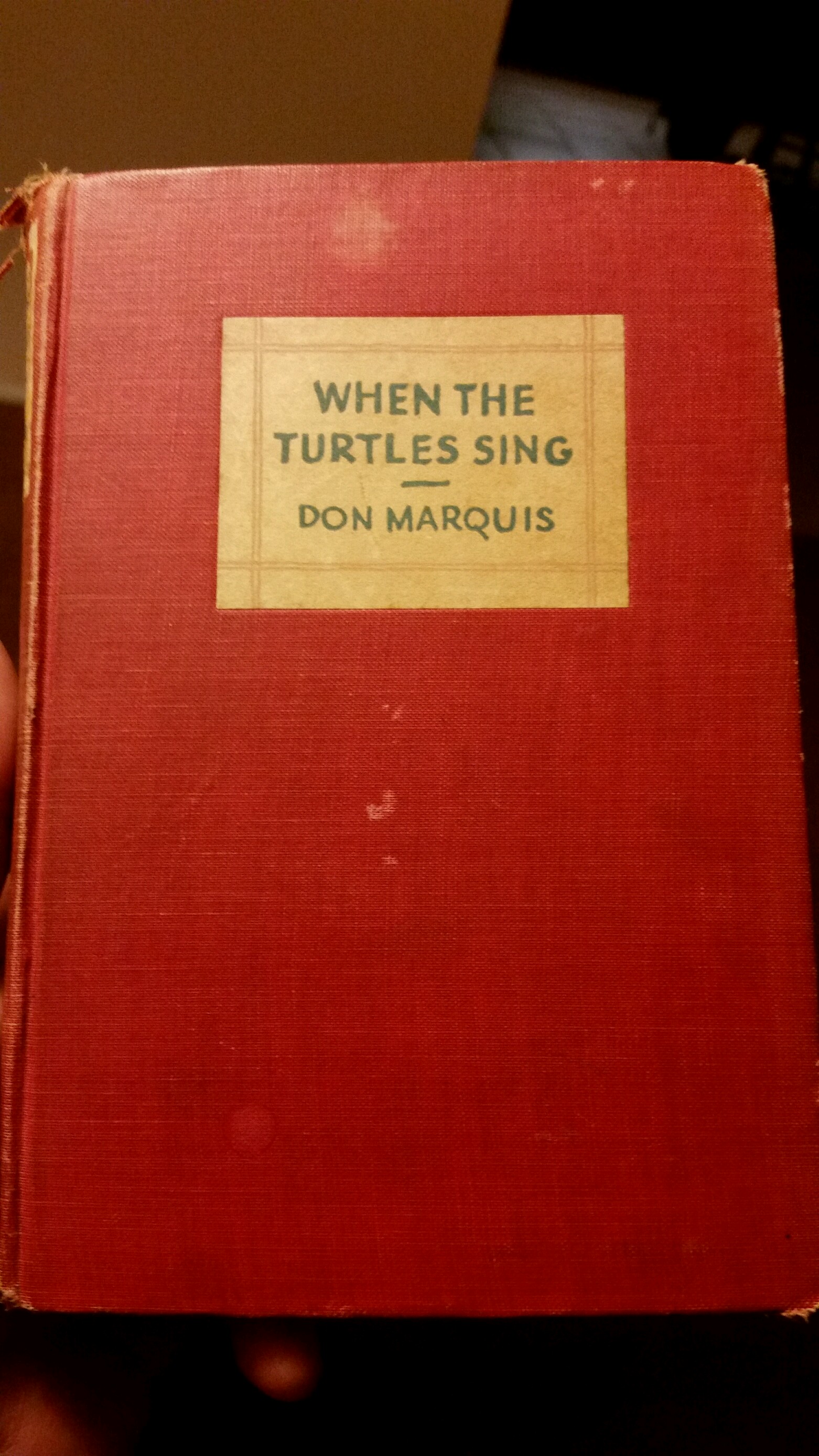
Book Review: When the Turtles Sing

When the Turtles Sing

by Don Marquis


This was a sweet book.

It’s ten short stories, published in 1928, by Don Marquis, a humorist and poet that I have been long acquainted with because my parents read and shared with the family Marquis’s collection Archy and Mehitabel, about a cat and a cockroach who are both reincarnated spirits; the cockroach was a poet, and he sneaks out at night and types poems on Marquis’s typewriter, one key at a time, without any capital letters because he can’t hold down the Shift key. I loved that book, and got my dad’s old copy of it a few years ago, whereupon I read it to my wife, who also loved it. So when I was at the Friends of the Library Book Sale, and I saw this lovely old hardback with a great title and a familiar author, I had to get it.

I’m glad I did. Marquis had a hell of a sense of humor, and more important, he had a hell of a sense of fun: these stories are mostly just fun. They’re good ideas, and they’re actually well-realized; a couple of them take really surprising dark turns, which fits the characters and plots, even if it doesn’t seem to fit the book. But it was an interesting choice, because you have what seems a parody, a caricature of human beings, who get into absurd situations – and then, for some of them at least, you have a fairly serious result, one which follows logically from the story’s events; but I didn’t think we were speaking logically.

The humorous stories are in two sets, one a trio of stories recounted to us by the Old Soak, an elderly gentleman who tells us stories about the strange residents of his small town, particularly the ones who live in a nearby swamp. One of the stories, the title one about the turtles singing (which is actually a quote from the Bible), has a mixed-up comic romance worthy of Shakespeare; but another of the Old Soak’s stories tells about a love triangle that might include a murder, as one man dies accidentally while in the presence of the second man. That story might get wacky, except it was much more about the woman’s attempts to become a full and complete version of herself despite the town’s bias against her, as she comes from the swamp and is therefore unclean and unacceptable. Her story is something of a triumph, as she finds a way to go to college and complete the education she had to begin herself, and then travels to Europe, unencumbered by marriage (She does marry both guys, but the second marriage is more open and free companionship than the sort of ownership that would have been common at the time) and child-rearing; all fine and good – except the story ends with her husband going mad with guilt over the death of the first man, and at the end he shoots himself. So, y’know – not funny.

The other funny ones are much funnier: a pair of tall tales told by an Irish father to his two sons; Marquis gives in to the temptation to write in Irish dialect, which isn’t my favorite thing to read, but he does it well and not too excessively. He does it with the Old Soak stories, too, which have a Twain-esque hillbilly style to them, with a number of malapropisms and strange spelling/pronunciations from a Southern American English dialect. More important, he doesn’t rely on the accent for humor: the stories are funny, and the narrator is hilarious, in both cases.

So I enjoyed the book, which was generally light-hearted and well-written. But now I’m sort of stuck: you see, I liked it, but I wasn’t inspired by it, so normally, I’d sell this book back into circulation so someone else could enjoy it. But this copy is actually from 1928, and it’s falling apart; the binding is broken, and the pages are coming loose from the spine. So I can’t sell it, and if I give it away, it will just get trashed. I can’t let Don Marquis get trashed. Not a book about singing turtles, either. I think that this book will get to sit on my shelf, hanging around like the Old Soak, just waiting for someone to sit for a spell and listen to his stories.

I like that.

Book Review: Noir by Christopher Moore

(Been a while, I know. Even with my avowed intentions to use this blog to talk about my experiences trying to become a published writer. I didn’t want to sound like I was kvetching —  so instead, I haven’t been posting.

But I got this ARC of Christopher Moore’s newest novel, and I could not think of a better way to come back into my book reviews, at the very least. So here it is.)

Image may contain: 1 person, smiling

The product model is my birb Duncan.


Noir

by Christopher Moore

Trouble walked in, shaped like a dame.

Also shaped like a black mamba. (Though he didn’t walk in.)

Also shaped like an alien straight from the crash in Roswell, New Mexico in 1947. (He didn’t walk in, either. Also might not be a he. I mean, probably not, really.)

Also shaped like the usual suspects from a Christopher Moore novel: smartasses and dumbasses, goons and gadflies, men in drag and women in drag and a venerated Chinese uncle who runs an opium den and has a most unfortunate nickname. (It sort of translates to “cat lover.” In a non-traditional sense.)

The trouble? Noir. In San Francisco, in 1947, and it all comes down on Sammy Two-Toes and his friends and allies, and enemies and victims, and especially on that rotten little foul-mouthed kid that keeps waking Sammy up.

Hate that kid.

But I love him, too. And I loved this book.

It is hilarious: I don’t know of anyone else since Douglas Adams who writes books that can make me laugh out loud, hard enough that I have to put the book down, but Christopher Moore can do it, and he has done it again; from the description of the manly scream on the first page, to the black mamba giving a raspberry to the guy he bit on one of the last pages (Not THE last page; the book ends with one of those wrap-ups describing how everything falls out for all of the characters, and no spoilers here –well, not big ones.), I laughed all the way through this book. There are some fantastic zingers, some absolutely glorious descriptions – my favorite is the one of the whorehouse madame in her tight green dress and flaming red hair described as looking “like a tube of red paint that someone squeezed hard in the middle,” because my God, that is just incredible – and some utterly delicious dialogue, particularly when the characters get into their snappy 1940’s noir patter, which I doubt that anyone writing today could do as well as Moore can. In the afterword, he describes his own book as a cross between Damon Runyan and Bugs Bunny, and I think that’s perfect, too. There is also some slapstick, some goofy sex jokes, a bit of gross humor, as there usually is; because that’s Christopher Moore, too.

And then there is the love story (Remember that dame who walked in and brought trouble? That’s the one). It is wonderfully sweet and romantic, and also a little sad; and for me it elevated this hilarious book into something that I would recommend to anyone who doesn’t mind a little filth in their fun; it’s not the whole plot, as of course there is the wacky story line that I will leave to be discovered, but there is also a Cannery Row sort of story about the boys, the ones who live right on the edge of the skids, but who hang on, mostly because they hang together; on some level this is their story, and it’s a good one. I was rooting for them the whole way. And once again, I don’t want to spoil anything – but at least one of these plot lines turns out all right, which made me walk away with a smile, even after the laughs stopped.

This is a great book. You should read it.

My Life

#1: “I feel bad when I have a cold when I go to the doctor. I don’t want to get germs all over them.”

#2: The other night she shuffled slowly from the living room into the kitchen, set herself, drew back one slippered foot, and then gently kicked me – really more of a boof – in the shin. Then she said “You called me a poop. Don’t call me a poop.” (Actually what I had called her was Poopzilla.) I hung my head, laughing, and said, “Consider me properly chastised.” She nodded, said, “Okay,” and shuffled away.

She doesn’t wear curlers, actually. I just like the image.

Source


#3: Speaking of her students: “If I don’t keep spewing a steady stream of hatred towards them, they just want to talk to me.”

#4: Speaking to a student:

Student: “My brother moved to Utah.”

Jokingly: “Utah? Why, to become a Mormon?”

Student (baffled): “We’re Mexican. We can’t be Mormons.”

Squirrel Seeks Chipmunk

Squirrel Seeks Chipmunk
by David Sedaris
Illustrations by Ian Falconer
In one way, I loved this book. And in another, I have probably never been as shocked and appalled by anything I’ve ever read.

It starts off so nice: it is “A Modest Bestiary,” as the subtitle calls it. All of the stories, and they are all quite short, are about animals. Animals that stand in for people in various ways: they work, they talk, they go to hairdressers, they wait in line to complain about shoddy products. The title story, for instance, is about a couple that try to date, but they really don’t understand each other — and not because they are a squirrel and a chipmunk, though that does cause trouble; the chipmunk’s mother forces her to break it off with him partly because he is a squirrel, and not appropriate for a young chipmunk. No, they break up because he loves jazz, and she doesn’t know what jazz is. And the story tells of how someone goes through various versions of understanding based on different circumstances: when she’s with the squirrel, it is something mysterious and probably wonderful; after they break up, it becomes everything bad, and she is horrified that she ever told the squirrel that she was fond of it (Because after all, she can’t just admit she doesn’t know what jazz is). Over the course of her life, “jazz” changes twice more. And the best part? All of these different ideas are, in some way, reasonable definitions of what jazz is, with the last being the best. It’s a great story, both sweet and insightful. The other beginning stories are also about human foibles: the way service people suck up to their clients and how we let them; the way married couples tell stories, and collect stories to tell; the way people react differently to frustrations — that one, “The Toad, the Turtle, and the Duck” is freaking hilarious.

And each story has at least one lovely illustration by Ian Falconer, the artist who created Olivia. The illustrations are beautifully done, and adorable; they bring the stories to life and are worth looking at even without the stories for context.

But then you get to “The Motherless Bear.” Which is somewhat about human foibles as represented by the animals, but is more about how bloody horrible animal lives are when they interact with humans. And it was one of the most depressing things I’ve ever read. And it had adorable illustrations by Ian Falconer, too. Which just made it worse.

And so it goes: “The Parenting Storks” is cute, “The Vigilant Rabbit” is laugh-out-loud hilarious; “The Crow and the Lamb” makes you want to gouge your eyes out so you don’t have to look at it any more. (If you’ve read the book, sorry about that. And if you read the book, you’ll get that.) Sedaris goes after envy, hypocrisy, adultery, egotism, enabling behavior — every human foible, as seen through animals. He skewers us all, which is probably what makes the book so hard to read at times: it’s honest, and it’s accurate. It’s a tough mirror to look into.

Honestly, this is a hell of a good book. But it is not for the faint of heart.

My Wife Is Funnier Than Me

Toni: “Why is it that every door-to-door Christian woman has thick ankles? And is badly dressed?”

Me: “I don’t know about the thick ankles, but I’d think they’re trying to dress plainly, sort of that humble Quaker thing. Or Puritan.”

Toni: “If Jesus didn’t want us to dress well,  He wouldn’t have made fashion designers.”

Me: “That’s a valid point.”

Toni: “If I was the King of the Universe, I’d want my people looking good when they represent me.”

Me: “So you’d, what, put them in a snappy uniform?”

Toni: “No, no uniforms — they can pick what they like, as long as it looks good on them. And they wouldn’t have thick ankles, that’s for sure. My disciples would be the best-looking people.”

***

Three in a row:

Me (Complaining about post-workout-exhaustion): I thought working out was supposed to make me stronger.

Toni: You are stronger. You don’t cry nearly as much as you used to.


Minutes later, in the car driving home — and apropos of nothing — she said:

“Do you think if small children were left out in the sun that they would be more likely to melt? I mean really small children. Like, new ones. Because their bones haven’t, you know, congealed yet.”


And then, trying to find good music on the radio, she punched buttons to get away from heavy metal screaming, and then Rod Stewart, and then Huey Lewis and the News — but nothing made her punch the button harder and faster than a few seconds of a small child’s voice as part of a radio commercial. Then, when I pointed that out, she said,

“Yeah.  There’s nothing I hate more than turning on the TV and seeing little kids talking. Or pooping. Or whatever it is they do.”