Book Review: The Patron Saint of Lost Dogs

By the way: that cute dog isn’t even in the book. So disappointing.


The Patron Saint of Lost Dogs

by Nick Trout

So it turns out the author of this book is a real vet. And it reads like it.

I don’t mean to be too critical: this was a sweet book, with a genuinely happy ending; I was rooting for several of the characters – hoping for rewards for some, and comeuppance for the others – and pretty much everybody got just what they deserved. And, not to spoil anything, but there is no terribly sad animal death, as there is in nearly every other book about pets, from Where the Red Fern Grows to Marley and Me. It was lovely to read about animals who come into a vet’s office not feeling well, and then leave feeling better. It made me smile, and if that would make you smile, the book is worth reading.

But the hero, Dr. Cyrus Mills, is just such a weenie. There are reasons for it, and he deals with them and improves; but it takes him so long to dig his way out of his weenie-ness that first the book feels annoying, and then a little unrealistic, because how could a guy who’s that deep in the ween-pit finally turn it around that quickly? And while not all of the small-town Vermont characters were obnoxious, there were several who were, and when the hero-weenie can’t deal with them beyond getting tongue-tied and scratching at the back of his head, which is quite literally how every conversation ends for the first half of the book, it makes you want to crawl into the book and start punching. Which is less sweet than the feeling you get from cured animals.

Mills is not a people-person: I get that. I’m an introvert myself, and I don’t handle confrontation well, either; but the trouble is, he’s not even good at not being a people-person. Mills is a veterinary pathologist by trade who finds himself in a small-town vet practice, trying for the first time to deal with actual living pets and their owners, rather than slides of tissue and the remains of deceased pets in a quiet, sterile lab. He is cold and clinical and tends to hide in scientific jargon. All of that makes sense. But he is also tender-hearted: being around the animals is almost instantly emotional for him, breaking through his shell; this is what makes him tongue-tied, because he is aware that he is cold and harsh-seeming, and he tries to change that for the sake of communicating successfully with the pets’ owners. I don’t buy that. If he has spent fifteen years in a basement lab with dead things, and liked it enough to do anything he can to get back to it (which is the basic conflict in the plot), then he would be indifferent to the feelings of the humans who come to see him, and probably of the animals, too. Sure, the sweet puppy faces might break through that hard exterior, but it wouldn’t happen with the first one. If, on the other hand, he’s a big softie who loves the animals – a position I fully support – how could he have been happy sitting in his basement lab for fifteen years, never even owning a pet?

All the reader is left with is the determination that this guy is a weenie who either doesn’t know what he really wants, or doesn’t have even a little of the gumption needed to go out and get it. By the end of the book, he sorts this out – but I disliked him enough in the beginning to not really care that he wins by the end. I was happy that his victory works out well for a lot of other people in the book, who I actually liked better than Cyrus himself.

Especially Frieda Fuzzypaws.

Overall, it’s not a bad book. There are probably better.

We Are Pirates Review

We Are Pirates by Daniel Handler

That’s it. I’m never reading a sad book again.

I don’t know how people do it. How do you all read literary classics and modern mainstream novels, and enjoy them? How do you read them one after another? I mean, John Steinbeck is one of my favorite authors, but how do you go from Of Mice and Men to The Grapes of Wrath without reading, say, The Hobbit in between? I can’t do that. I’ve tried for years, I have a degree in literature, I’m an English teacher, I’m a book reader and reviewer, and an author: I know that there is a certain prestige that attaches to the great novels, and almost every one of them is sad, is tragic. But I just can’t do it any more.

I got this book because I loved the Lemony Snickett books, and because I love pirates. Stupid, I know; but why not? The Series of Unfortunate Events (Also sad — I’m aware that I should have paid more attention to the very obvious clues) was genuinely well written, and pirates are not only fun (But also sad: because the average lifespan for a Caribbean pirate was about two years, before they died of disease, alcoholism, or a “short drop followed by a sudden stop.” Like I said: many clues.) but also fascinating, because they represent savagery, and also egalitarianism, among other things. Escape, and rebellion, and a final middle finger to a cruel world.

This book was exactly that. Daniel Handler captured not only the world of the pirate, the anger, the pain, the fight against all conformity and thus against all society and even against humanity itself; he also captured the modern world — and thus made me long to be the pirate, even while I sorrowed for those following that path, pitied them their rage and their pain. And I raged against those who tried to contain the pirates; and then I felt their pain, as well. Because as Handler points out, with the title and with the entire book: we ARE pirates. We all are. We are.

The book is good, damn good, maybe even brilliant; I just finished it minutes ago and maybe don’t have the perspective to really grasp all of its insights and nuances. But I laughed at passages, I recognized people, I loved and hated and felt contempt and pity for the characters and their lives. It’s written the way a book should be written, and it’s about a great subject — not only pirates, but also family and children and growing up and careers and ambitions and dreams and, of course, disappointments. It’s got a wonderful twist at the end, which changes your understanding of things; more than one, actually. It is multi-layered and complicated, but nonetheless still easy to read, and it has some beautiful flourishes and original creations. This is a very impressive piece of work.

And it’s sad. And I’m done.

Book Review: The King of Messy Potatoes by John Dashney

Messy Taters

The King of Messy Potatoes
John Dashney

You know what? I’m just happy I found this book.

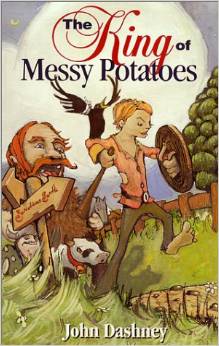
I picked it up at a library book sale. I bought it because the cover image is both sweet and, for me, evocative: a boy marching with stick in hand and shield on arm, with a line of friends and companions by his side: a cow, a giant, a viking, a crow. This is what I imagined as a child. I read Tolkien and Alexander, Lewis and Anthony, and in every case, the story really revolved around the journey: the journey, and the companions. As a fairly solitary child, that was what I wanted. So I had to get this book. Plus: how could you ignore that title? I love potatoes more than I love epic fantasy. If given the option, I would certainly pour gravy on this book and eat it. Who wouldn’t?

For even more fun, the author has written several young adult adventure books, is self-published and small-press published, and this book is signed. It’s perfect.

Now as for what was inside: that was good. I won’t say it was perfect, but it was good — far better than most small-press, self-published authors I have encountered. This book hits a beautiful balance between fantasy and reality, using a frame story about a boy and his grandfather, an aged Episcopal priest and scholar who is writing a history based on Biblical times, a book about the kings of Mesopotamia. Which the boy hears as — Messy Potatoes. (I am proud to say I actually made that connection before I started reading, when I picked up the book and considered reading it next. I am impressed that Mr. Dashney actually had this idea and saw the beauty of it.). The boy asks about it, and though the grandfather laughs, he agrees to make up a story about the King of Messy Potatoes for his grandson.

Then we get the story of Spud. Spud lives on a very special farm, though he doesn’t know it. He doesn’t know much of anything, other than how to grow good potatoes, and that his older brothers are dimwits and the local nobleman is a jerk. But then Spud meets a new friend: a crow, who, if he bites someone and tastes their blood, can speak that person’s language for a full day. This crow tells Spud the truth, and helps Spud to begin his adventures, and pursue his destiny — as the King of Messy Potatoes.

Both of these stories are successful. The frame story of the boy and his grandfather is sweet and heartfelt, and rings very true — especially to me, with my staggeringly erudite and somewhat distant (because eminently dignified) grandmother, who nevertheless loved me dearly. The story of Spud is exciting and amusing and fun to read, and you want to hear both sides of this as you go through it.

It isn’t perfect. There are parts of Spud’s story that are a bit too short, and feel like they’re there just to fill space without really adding anything; the Viking part, for one. The villain is a great idea, but isn’t really pursued completely — understandable, as this is a young book, but still: kids understand evil, and hearing about evil that is vanquished is a good story for any age. Spud is given a dialect that just doesn’t fit and doesn’t make sense, neither for the character nor for the “author,” the Episcopal scholar grandfather. And at the end, I want to hear more of the story of the King of Messy Potatoes, but I never will. Which is too bad.
But overall? I was very lucky to find this book. It made me happy.