What a Weekend!

WOW! That was… amazing.

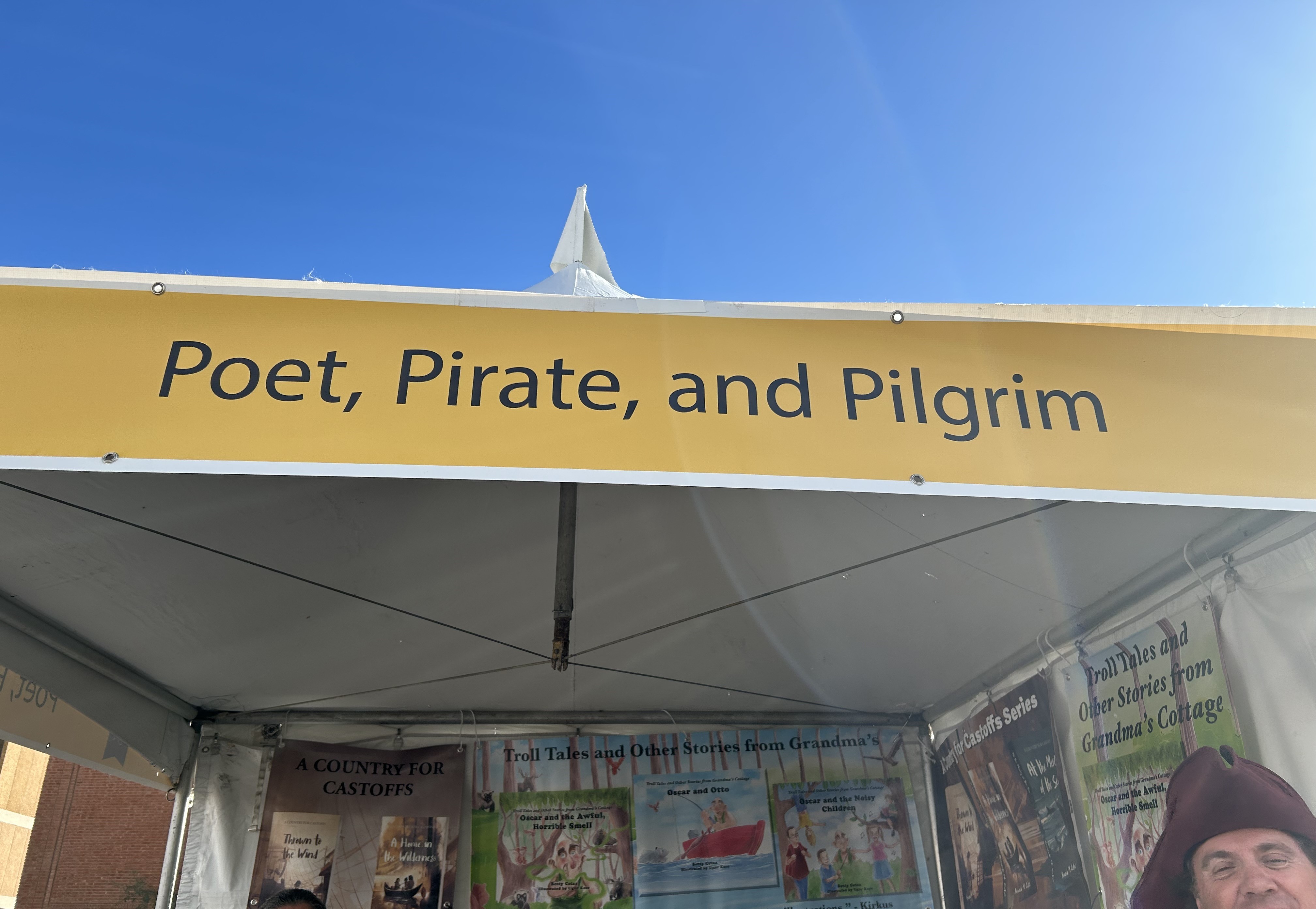
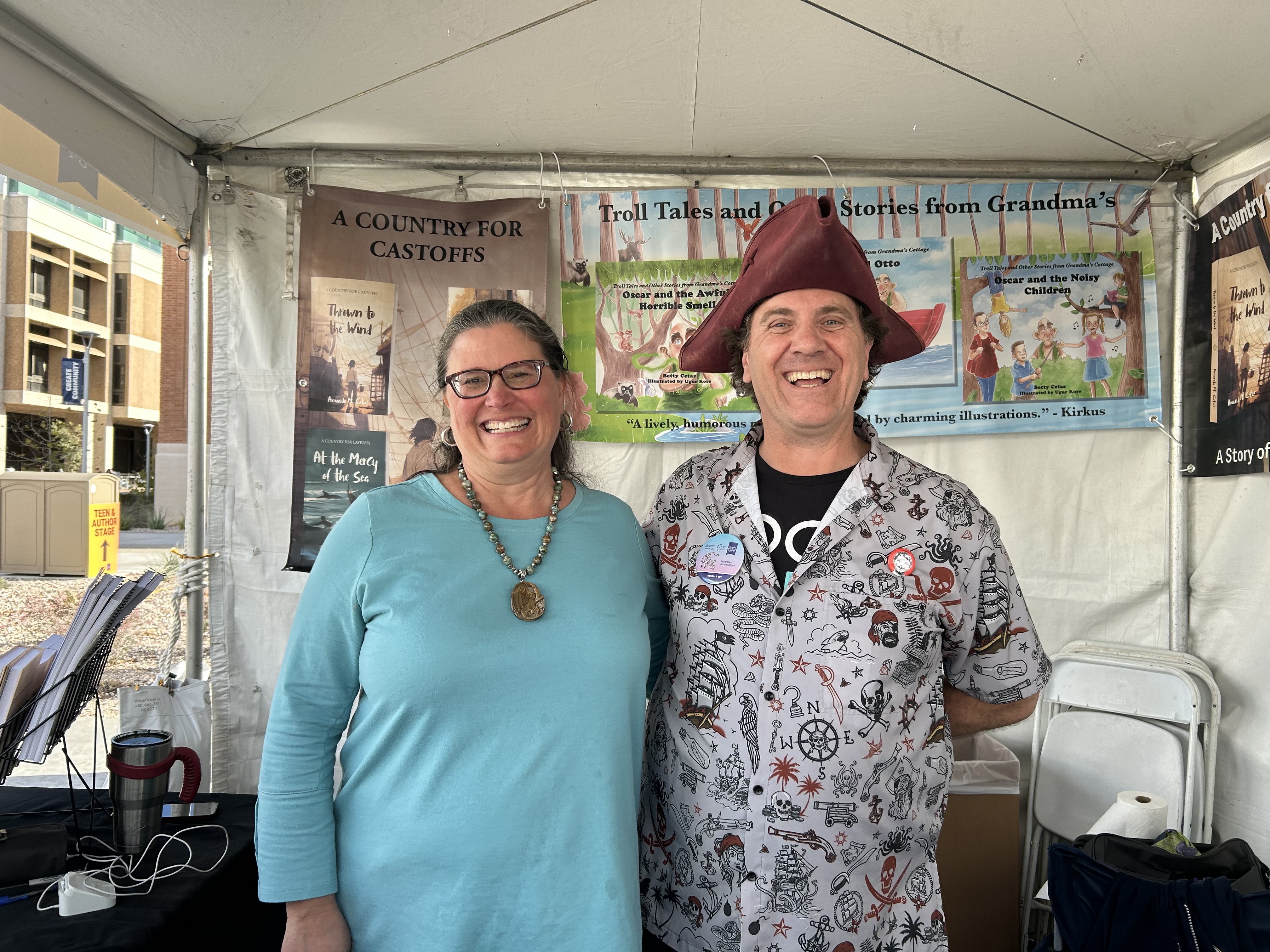
This last weekend was the Tucson Festival of Books. And for the fourth year, I had a booth, and I offered my pirate books, the three volumes of The Adventures of Damnation Kane, for sale to anyone who: 1) Saw my tri-corner hat and pirate-themed shirt; 2) Noticed the name of the booth, or 3) Paused to look at the INCREDIBLE art that my wife Toni DeBiasi created for all three Volumes of the series.

And that was a LOT of people.

I went there with, I think, about 65 books.

The first day, Saturday, I sold 42 of them. (The Answer to Life, the Universe, and Everything!) I sold every copy of Volume I I had with me. I went home, got the four other copies of Volume I at my house, also grabbed my VERY FIRST copy, the first printed copy of any book I have ever written, and brought that on Sunday. I used the very first copy (which was NOT for sale) as a display copy.

I sold the other four. And six more copies of Volume II and Volume III. And I unfortunately had to turn away a few other people because I didn’t have a copy of Volume I to sell them, at the end of the day, or else I would have had at least two or three more sales.

I now have 13 copies left of the 69 copies I brought with me to the Festival.

I have never done that well. The Festival has always been pretty good to me: I have a good book (Three of them, I think), I have a good hook — “Can I tell you about my time-traveling Irish pirate?” — and the aforementioned three attention-grabbers (sign, cover art, and stylish chapeau) brings people close enough to get drawn in by my elevator pitch. But my previous record was, if I remember right, 29 books sold. So I almost doubled that.

Thank you, thank you, thank you, to everyone who came and bought my books. I am honored beyond belief. And now I am anxious as hell that you all won’t like the books, or that you won’t like the third book, or — I dunno, something. So if you could see your way clear to tell me if you do like the books: go to the Contact link at the top of the page (Under the three lines, on mobile), or click on the Feedback link that should be floating in the bottom left corner of the page, and send me a message. Send me a Facebook message or Instagram message — @TheodenHumphrey, in both cases. (Also the same handle on X, if you are a glutton for punishment — or Threads, if you’re a glutton for social media.) Or if you’re really feeling good about my work, post a review somewhere — Amazon, or Goodreads, or Lulu.com where the books are produced — and then let me know that you did so. Thank you.

Thank you, as well, to my fantastic booth partner Amanda Cetas, who stood with me on a patch of sole-stabbing gravel for eighteen hours over two days, who covered me when I wanted to take a break (And made sales for me, too), who directed people to my side of the booth when they seemed more interested in fantasy than in historical fiction, and who stayed positive and energetic all the way through. Thank you, also, to all the people who bought Amanda’s books — she said she did better this year than she has before, too, so it wasn’t just the Pirate who made out like a bandit.

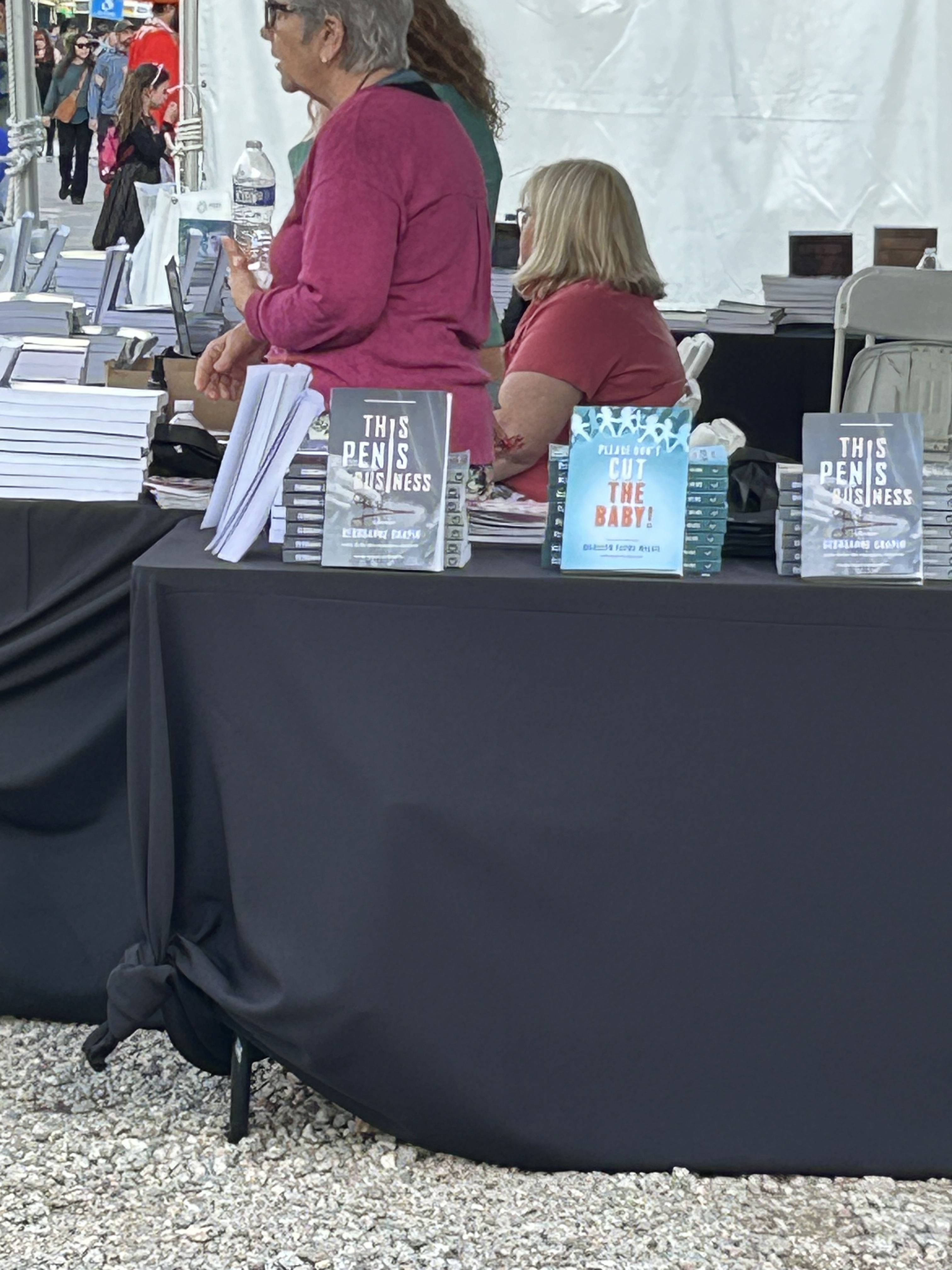
Amanda also shared my confusion over our nearest neighbors, who were… intactivists. Anti-circumcision activists. With whole books. About… circumcision. Now, I actually know the arguments against circumcision, and — how do you fill an entire book with them? Let alone TWO?!?

Needless to say, they did not send many customers over our way, and we didn’t send any their way, either. I didn’t have any people come to my booth and say, “Pirates, huh? You wouldn’t have anything about foreskins, by any chance?”

(I would have sent them over if they did. But they didn’t. The people over there still had people at their booth all weekend, so I think they did fine, too.)

If you didn’t get the book or books you wanted, or you now want more books, then please use the links on this page to Contact me or to order yourself a copy from Lulu.com. (If you Contact me, I will sign the book for you before I ship it.) If you didn’t make it to the Festival this year, then come to next year’s — Amanda and I will be there (Hopefully with our partner, the Poet, Lisa Watson, who wasn’t well enough to attend this year), and I will have all of the Adventures and at least one new book, as well. Amanda will probably have nine new projects, all of them as wonderful as the ones she has right now.

And if you bought books, two things: thank you for reading. You, along with the rest of the literate people, are the bulwark holding back the tide of Fahrenheit 451. You are giving my world meaning. You are joining me in this weird sort of slow-motion conversation that is a novel.

And also: get off the internet and go read. Like I’m about to do.

(If you’re wondering, I only bought two books this year. But that’s because this is my TBR pile.

No, I’m not kidding.)

Here are the two books, anyway.

Happy Reading, all.

Sneak Preview! Dusty Wrote A Vampire Book!

It’s getting close, now.

The Tucson Festival of Books is one month from now. Four weeks.

This week I ordered my copies of the two Damnation Kane books, 30 of Volume I and 20 of Volume II; I should have waited, but I got worried that I might not have anything to sell at the Festival, and I hated that idea, so now I can at least be sure that I will have 50 copies of books about pirates. So I just have to hope that everyone who comes by is new, and hasn’t already bought both of those books. (Since I brought and sold the same number last year, there are at least ten people who bought the first book and not the second; so hopefully if they come back, they’ll want Volume II.)

But once I had that set, I turned to the new book.

Which was a pain in the butt.

I hadn’t put a book together at Lulu.com, which does my printing and online sales for me, for, what, three years? I forgot the difficulties in making the text look the way it’s supposed to look for the paper book. I edited the whole thing — 128,000 words, it is — and then I thought I’d be able to just drop it into the template I downloaded from Lulu. So I Control-A, Control-C, and Control-V — and the template disappears, and the text is formatted like the original document, set up for 8.5×11 pages instead of the 6×9 trade paperback format. I tried it again, same thing. Downloaded a new template, tried it again — same thing.

So I had to drop the text into Notepad: which erases all formatting.

Which included all of the italics. In 128,000 words.

But at least the margins were right.

So I’ve been going through the text and putting all the italics back. It’s been good, actually: I caught a couple more mistakes, made a few changes I like; I think the book is a little stronger for the effort I’ve put in this week.

And then when I put this chapter into this post, I realized I missed an incongruity: I changed the timeline of the book a few years, for the sake of believability for a later important chapter (where characters needed to be a leeetle bit younger), and missed one of the references I made. So now I need to double check all the time references to make sure I didn’t miss any others.

Sigh.

It’s fine. The book may not be out in time for the Festival, but even if it isn’t, I will publish it — and anyone who is interested in purchasing a copy can get it directly from me. Signed, sealed, and even delivered, if you live in the Tucson area and don’t mind me dropping by your house, or you want to come to my school.

So in order to keep you all as excited about this new book as I am, here’s another sneak preview: this is the first chapter, which comes right after the Prologue I posted before. I hope you like it!

Chapter 1

            I don’t remember dying.

            You’d think I would, wouldn’t you? The narrowing of vision as everything faded to black, the tunnel of light, the sight of loved ones there waiting for me: Gramps, and Uncle Bill, and Oscar, my first dog. If my buddies in the Army counted as loved ones, there’s be a whole parade of faces at the end of that tunnel. Though they might not be so happy to see me. I’m sure a psychologist would call it survivor’s guilt, the idea that my friends who died would hate me for living, but what the hell does a shrink know? If it’d been me who’d gotten nailed, I would have been royally pissed at everyone who made it out, who made it back to the world. Hell, I am pissed at all of you. That’s why I eat you.

            But I don’t remember any of it. The lack of memory might be because of the way of my dying: it could have been the booze, it might have been the smack, but whatever it was, whether it was cirrhosis or a heart attack or a stroke brought on by the abuse I put my body through in those last few years, I’m sure that at the time I was so wasted I didn’t feel a thing. I probably slept through my own death, which, I know, sounds peaceful and all – but I wish I could remember. I might even have been murdered, lying unconscious in an alley somewhere; I have scars I can’t account for, can’t remember where they came from – though there are plenty of ways I could have gotten those. I lived through my tour in ‘Nam, but I doubt that anyone came out of that without scars.

            I remember ‘Nam. I remember the fear, and I remember the disgust; and I remember the anger that came out of them, and made it possible to pull that trigger. More than anything I remember being tired: just wanting to sleep, sleep for years. I remember other things, too, but I don’t look at those memories. They were what pushed me into the haze of alcohol and drugs that carried me like a sleeping baby into the darkness at the end.

            I remember a few things from before the war: Mom and Dad, my sister Anne, my little brother Franklin, the farm in rural Iowa. I remember some things from after: San Francisco and the Haight, the few moments of lucidity in between stupors that could have lasted for weeks, months, or even years. I do remember a girl, kisses and whispers and silky movement under the moonlight, and for that memory, I’m grateful.

            For the most part, though, those days blended together into a thick gray fog, without beginning or end, for so long that I lost track. I wouldn’t have any idea how old I was when I died, except that I know what year it is now, and I know how long it has been since I shuffled off this mortal coil, and awoke again to see that face looming over me, awash in the haze of red light that has tinted everything I have seen from that day to this. A little subtraction tells me the answer: I was 27 when I died 29 years ago. I’d be 56 now, if I was still alive.

            But I’m not alive now, walking and talking notwithstanding. Those don’t count. You’re not alive if you don’t age: your years on this earth are nothing if there’s to be no end to them. The two absolutes are that everything must be born and everything must die; if one of those (or both) does not apply to you, then you are – nothing. My body may function, my eyes may still see, my ears hear; I may still think and feel, a little; but I’m dead. I killed myself in 1978, another delayed casualty of a war that nobody won.

            I was not reborn on that night when the vampire brought me back. I was remade. No longer human, not quite a machine, but a combination of both living thing and automaton. I am a slave, and I may very well remain a slave until the sun goes out. Who knows? Even that may not be the end. My master is a creature of the night, after all; perhaps the perfect blackness of space would be his idea of Heaven.

            Christ knows if there is a heaven like the one in the Bible, then he ain’t getting in. But then, neither am I.

            I walked into the apartment and threw my keys on the table by the door.  I was stripping off my clothes before the door even swung shut, dropping them on the floor in a line headed toward the shower. I had had to take a dip in the Bay, after, to wash all the blood off; I used the kid’s clothes to dry myself before getting dressed again. But then I had to bury him, along with his clothes, and that was a dirty business. Besides, you think the Bay smells bad to you? Try my nose on for size. Between the stink of sewage and rotting fish, the iron-scent of blood that lingered underneath, and the smells from his clothing, his sweat and soap and cologne, I felt like I would gag every time I caught a whiff of myself. The thought made me laugh. I could devour a human being with relish and pleasure, commit heinous and depraved acts at the whim of my master without batting an eye – but the smell of polluted water and body odor made me sick.

            When I didn’t stink any more, I got out, toweled off, and walked out of the bathroom. I spotted my clothes lying where I had left them like scraps of scraped-off onion skin, and went to pick them up. I went to the kitchen and pulled a large plastic garbage bag off the roll on the counter, shoved the suit into it and tied the bag closed. I dumped it outside the door, in the hallway. My laundry was picked up and dropped off each day. If they were going to clean it anyway, what did wrinkles matter, right? Besides, I had a dozen more suits just like that one – my livery, so to speak.

            I walked out into the main room of the apartment and looked around. The only furniture was the overstuffed, oversized armchair in front of the windows, the catch-all table by the door, and the stereo system that sat on the floor by one wall. I don’t have anything else because there’s nothing else I really need – not now.

            I haven’t turned the stereo on more than half a dozen times in the last two years. I used to listen to it every waking moment. The apartment used to be filled with books, and there used to be art on the walls, and even, as God is my witness, a potted plant on the windowsill. But that was before. I realized that nothing I could put in this apartment would make it anything but a cage, a kennel for the dog. So I took everything out, threw it all away because I didn’t know anyone I could give it to and I couldn’t see myself holding a garage sale. I kept the stereo because – I don’t know why. I’ll get rid of it, too. Soon.

             Suddenly I couldn’t stay in here any longer. I couldn’t smell the Bay, or the blood and sweat and the stink of humanity – but I could smell myself. Nothing in here but the stale smell of me, the hours – the years – I had spent sitting in that chair, watching the sun rise because it was the only rebellion I allowed myself, to look at what my master could not. I could smell every one of the days and weeks I had spent in this apartment, in some pathetic mockery of life; I could see it smeared on the walls and dripping from the ceiling. I had to get outside.

            I went to my closet, donned a pair of pants and a dark shirt, shoved my feet into loafers without socks, and left, throwing on my overcoat as an afterthought on the way out the door. I left the door unlocked. Any thief could have whatever he could find in there. It was all trash.

***

            I went downstairs and out onto the sidewalk, and I started walking. All I could think about with every step was how many times I had walked this way: how many times I had come up this street, gone through that door; how many times I had walked up the five flights of stairs to my apartment – no, that wasn’t right. Not my apartment: the apartment where they kept me. How many times I had washed blood from my skin and left a bag of stinking clothing in the hallway.

            Almost thirty years. And I barely remembered the first ten.

            Oh, they picked a good one when they found me, all right. Not that they knew my personality, of course, or the particular shape of the demons that drove their needles into my brain and dragged me down Skid Row to the morgue. They knew that I was young, that I had been in the military and thus had combat training, that I was big – a corn-fed Iowa farmboy – and that I had no family, proven by the fact that I died a derelict junkie on the streets of San Francisco, and my body then lay unclaimed in the morgue for a week. They might not even have cared about that last when they picked me out of the morgue drawer and laid me out for the ritual. I died young and left a good-looking corpse, and that was all they needed.

            No. That’s not true, and I knew it. They did not want a zombie: they wanted a monster. That’s why they picked me. They knew exactly what my demons were: knew that I suffered from a severe case of post-traumatic stress disorder, knew that I drank and drugged myself to death to escape the memories of what I had done. This made me even more attractive to them: it showed that I take orders well, that I would do what my superiors commanded even if I personally found it so horrifying that I would rather be dead than remember it. After all, I killed myself so that I could forget – but I did the things I wanted to forget in the first place, didn’t I? I was already a monster before I died. I was already a slave. The vampires just gave me sharper teeth.

            But dying had done what I had wanted it to do: it had given me oblivion. At least for a while. For a long while, actually; for ten years, I hadn’t had a coherent, rational thought. I don’t know why that changed, not exactly. But it had: I had woken up, and my mind woke up with me; and once I started thinking again, I couldn’t stop. So I had tried to find a different way to live with what I was. That was when I decided that hedonism would make up for the fact that I was an undead monster.

            It still makes sense, in a way. It seems to me that we all have to pay for what we’ve got. If you have a good life, you owe, and you have to pay. A debit for a credit – balance the books. If I have been given this eternal life – eternal barring a violent death, of course – then I have to do something to earn it, to be worthy of what I have.

            And what makes us worthy of life? Living to our purpose. If, say, we are here to spread the word of God, then that’s what we need to do, and the happier and more enjoyable our lives are, the harder we have to work to earn that by spreading His word that much farther.

Of course, being an undead man-eating ghoul who hurts people for a crime syndicate run by a soulless monster pretty much eliminates “spreading the word of God” as my purpose, don’t you think? Yeah. Me too.

            No, when I started thinking again for the first time in ten years, I decided that my purpose was more earthy, something simple and concrete. I figured that a creature as unnatural as me has to work as hard as possible to make life as natural as possible, and to enjoy the natural parts of life as much as I can. Thoreau would have sent me to Walden and told me to grow crops, but to me, the natural parts of life are all the things that make humans human. That set humans apart from animals. Good music. Art. Literature and philosophy and science, wisdom and knowledge and imagination.

            After all those years living without thinking, I started spending all of my time doing just that: thinking. Learning. Reading, listening, seeing. I swam in a sea of beauty and truth, truth and beauty – and splashed as well through ugliness and lies and bloody, pointless deaths that put the cap on tawdry, shallow little lives. They were the twin currents that spun me, like a leaf in a stream, for almost twenty years. When I had a job to do for my master, or when I got hungry, I threw myself into the blood, into the pain and fear and death, and tried to revel in the animalistic slaughter. I tried to feel like the predator my rebirth had made me. When I didn’t have a job, when it was just me, then I read every book I could, I listened to as much music as I could, I saw every piece of art on display in San Francisco and as many other places as I could get to within my limitations.

            And for most of that time, for most of eighteen years, it was fine – I was fine. I actually enjoyed it, enjoyed the passionate lives I glimpsed in the jazz clubs and the galleries, in the books and on the streets, sweating and loving and bleeding and crying and laughing and dying. I loved it, loved them. Loved life.

            But the more I learned to love life, the worse it made me feel when I ended it for others. Every time I did it, every time I killed, I reduced a human being from the height of divine creation and earthly evolution to a mere bag of flesh and blood and bone. The more I learned to respect and cherish those lives and all that they were capable of, the more I hated myself for ending them, just so I could go on enjoying what they had made.

            And so, when I couldn’t stand it any more, I stopped. Stopped learning, stopped living life to its fullest, because it wasn’t my life that I was living. I already threw away my life, with a little help from Uncle Sam and Jack Daniels. Enjoying my stolen life as much as possible didn’t make it any less stolen: it made it more so.

            For the past two years, then, I have been trying to live like I did the first ten years after I was remade: without thought, without any connection to the world or events around me. Maybe I’m trying to atone for my life by not enjoying it now; I don’t know. I’m trying not to think that hard about why I do what I do, why I am what I am.

            But it isn’t working. I can spend my time brooding instead of reading, hating myself and the world instead of enjoying it, but I can’t get rid of the sick feeling in my gut. I can’t seem to wash off the stink. I can’t go back to ignorance. I can’t go back to being dead.

            I wish I could.

            I looked up then and saw that I had walked quite a ways, from my apartment near Fisherman’s Wharf to Dogpatch, at the base of Potrero Hill. I realized my hands were in the pockets of my coat, and I felt my sunglasses; startled to find that I wasn’t wearing them, I hurriedly put them on. It made me notice the light in the air, that the sun would be rising soon. I needed to head back. I got my bearings, turned around – and stopped.

            I knew that Hummer.

            I dug around in my overcoat, and found what I needed in the inside pocket: a small notebook, one of those things you can pick up for a buck at any drugstore – one of those things that makes an old Iowa boy like me think, “Back in my day, we could buy that for a nickel!” I flipped through the pages, scanning the entries, glancing up now and again to check the license plate on the forest green Hummer that was parked with two wheels up on the sidewalk to accommodate the thing’s wide wheel base. And there it was: almost two months ago now, the note “tree grn Hum. 3AHN619. 2x hit.” And then, underlined twice: “FAT.”

            I believe in karma. Maybe not the karma that a Hindu or a Buddhist would know; I believe in my own version of karma. It’s back to that balancing act I think we all have to do: something good to make up for something bad. There may be a power in the universe that takes care of that for us, but I don’t have enough patience to wait for it. I like to help out. It makes me feel useful. So I keep this little notebook, and when I see somebody do something that requires punishment, I write it down – and when I get a chance, sometime down the road a bit, I carry out that punishment. This notebook is my karma to-do list.

            Here in San Francisco, I try to focus on the most common, most frustrating, and least punished offenders: bad parkers.

            If you’ve never been to San Francisco, understand this: while every city has parking problems, good ol’ Frisco has the added bonus of being built on steep hills, with narrow, twisting streets, often one-way, often with a stop sign right at the peak. So not only is parking hard to find, but actually getting into a spot can be next to impossible. Naturally, not everyone handles this challenge well; naturally, when someone does it badly – or worse, rudely – it makes an already difficult situation into a melting pot of imminent murder.

            My job, then, as the karma assistant, is to teach bad parkers a lesson, in the hopes that they will change their ways, and make every driver’s life a little easier.

            This particular twit had, my note said, smashed into two cars while I watched – front and back – while trying to pull out of a space, and then driven off without even leaving a note. And because he drove a Hummer, his damage had been minimal, and all to the bottom of his massive black bumpers; but he had torn huge gashes in the hoods of both other cars. I had been hoping that I would have a chance at this one, and here it was. Just when I needed it most.

            I glanced around quickly to see if anyone was watching; it wasn’t yet dawn, though it was close, and the streetlights were just flickering off. People would be moving around soon, but right now, they were still hitting the Snooze button or getting into the shower. I had a few minutes.

            I moved around to the street side, the driver’s side, and lay down on my left side next to the mighty green beast. I reached under and took hold of the front axle, just behind the wheel, with both hands, and then I squeezed and twisted. Slowly and carefully, because I wanted to get it just right. Another little twist, and – there! The body of the car settled, just a little bit, but it held when I let go. I rolled over to my other side and turned around, and then did the same to the rear axle, crumpling the metal just enough to make the chassis sag maybe an inch, but no more. Then I slipped around to the sidewalk side and did the last two wheels.

            My goal here was simple: I had observed that the driver of this Hummer was, shall we say, built proportionally to his grossly oversized vehicle – hence the subtle notation “FAT” in my notebook. If I did this right with the wheels, then he wouldn’t notice anything wrong with his car until he sat in it – when the axles would fail and the wheels would all fold, and the whole thing would come crashing down. He wouldn’t even be able to get the thing towed, not without on-the-spot repairs of some kind, or else a crane. Which served him right. Really: how hard is it to leave a note? You can afford a Hummer, but not the insurance bill? How about two new axles, pal: can you afford those?

            I finished, and slid out from under the metal behemoth (which now rested on dainty girlish ankles, so to speak). I nearly queered the whole deal when I nudged it with my shoulder as I twisted my torso to get my hands under me; the metal groaned slightly and quivered, and I went absolutely still, holding my breath and waiting. It didn’t fall. I scooted a foot away and then came to my feet quickly, dusting myself off and checking for witnesses. None. I was clear.

            I just hoped the owner moved quickly, too, and jumped in before he discovered what I had done to the Hummer. But even if he didn’t get to sit down harder than he expected, I still got to cross this one off my karma to-do list, and there’s nothing better than completing a to-do list. Maybe I should make myself a complete self-improvement list – you know, things like “Adjust to new lifestyle” and “Learn to accept adversity with a zen-like serenity.” Maybe even “Free self from magically enforced servitude.”  But at any rate, I felt better now than I had when I left the apartment. My head felt clearer.

            I headed back. Home.

Thrill Time

I’m excited about this.

I’m nervous about it, too: and also somewhat conflicted. But mainly, I’m excited.

I’m going to publish a new book.

Part of the conflict in me is that it isn’t the book I intended to publish. I regret to inform those who are waiting, patiently or impatiently, that I am not going to be publishing the final volume of The Adventures of Damnation Kane this spring. I won’t have the book finished in time for the Tucson Festival of Books, which was the immediate deadline I was trying to hit; I worked on it all through the end of 2022, but I realized that I wasn’t going to be able to get it done AND make it good in time for the Festival. I’m not going to bring out a book that isn’t good: but I very much wanted to bring out a book for the Festival. I spent a bunch of money on a booth, and I didn’t want to be there with only the same two books I had last time.

So instead, I am going to publish a different book.

It’s a book I wrote some time ago, and I think it’s one of my best pieces of work — honestly, better than Damnation Kane, though there are lots of things about my pirate story that I love unreservedly. But there are limitations in the Damnation books, and this one really captures the kind of writing I want to do, the kind of writer I want to be. It’s an urban fantasy novel, dark almost to the point of horror, with a total smartass for a main character; I think it captures the same tone that one of my fantasy writer heroes, Jim Butcher, has mastered with the Harry Dresden books, which I think is one of the best series and one of the best characters since Tolkien.

And that’s the other conflict for me in publishing it. See, this book got closer than anything else I’ve written and submitted to actually getting picked up by an agent, and then (presumably) by a publisher. Jim Butcher’s agent read the first chapter, and then asked to see the first 50 pages of the novel — the only time in fifteen years of writing and trying that I have not simply been rejected by an agent. She then turned it down, but still: I thought this was my best shot at getting an agent, and getting published by a traditional publishing house. And I’ve been holding the book back, refusing to self-publish it, because I still dream of finding representation and a legacy publisher to produce my work. That, along with winning awards and worldwide fame and wealth, is the last ambition I have as a writer. I’ve already done the main things, the big things: I’ve written books, good books, and had people buy them, read them, and tell me they are good books. That, for me, is success. I am enormously proud of my accomplishments as a writer.

But there was still that one remaining ambition: and this was the book I meant to use to achieve it. (There’s another book I’ve never published, but that’s because I don’t think I can publish it under my name unless I quit teaching first. That’s a whole other thing.)

But I realized: first of all, though I think this is a good book, I don’t think it’s the best book I’ll ever write. I wasn’t one of those flash-in-the-pan literary prodigies who created my one good work before I was 25; I think I’ve gotten better with every book. I’m hopeful that the last Damnation Kane book will be even better than this book, and the one I write after that will be even better than both of them. I think my last book will be my best book, and I’m a long, long way from my last book. And secondly. just because I publish these books myself doesn’t mean they can’t be picked up by agents or legacy publishers; at this point, honestly, my publication of my books is also my best advertising for them, so making this book available is the best way for me to get it noticed.

And finally, you know what? Even more than I want to use this book to get published, I want to share it with people. I want people to read it. I want you all to like it. Maybe even love it. That’s really why I write, after all: because it’s fun, and inspiring, and meaningful; and I want other people to find the same fun and inspiration and meaning that I find in the words.

So to that end, I’m going to post the first chapter of the book, which captures the spirit of it, and which gives a good idea of what the book is about. Sometime soon I will be able to post the cover of the book, and sometime soon after that I will be able to make copies available for purchase: and I hope that you all will be willing to buy it, and read it, and — I hope — enjoy it.

Let’s start with this.

The novel is called BRUTE.

(Content trigger warning: this scene includes violent death and, well, nasty stuff.)

BRUTE

Prologue

I see him, though he doesn’t know it. I see him watching. Watching me.

            He leans against the wall, shadows draped across one side of his face, the other side glowing in the harsh light from the halogens above. There’s a bored expression on his face as he sips Coke through a thin red straw, like blood through a tiny vein. His head turns from far left across to far right, then down to grab the straw with lips and tongue and drink another sip.

            He is too young to be here in this club, so I doubt there is rum in the glass, but I am too far away to smell it and know for sure in this air, crowded with the scents of too many. He looks soft and well-fed, his clothes wrinkled, torn, savagely black; but they are soft, too, and nothing to do with work. His soft hair is dyed black, as well. To me, he looks wealthy. Spoiled. Probably the neglected child of a powerful parent. I bet he got into the club with a last name instead of an ID.

            He went straight to that wall when he arrived, and his eyes immediately began roving, searching for someone cool. But since he saw me, his gaze has hurried over the rest of the club so it can linger on me, concealed by his lashes as he sips his drink.

            He wants to be nonchalant, so he keeps his distance. That all-important distance. Nothing can be allowed to break that shell of cultivated boredom, the complete alienation which separates him from the unwashed masses, who can’t possibly understand his pain. Maybe – maybe – I can.

            I might be what he wants me to be. What he hopes I am, the thing he has hoped to find. But I also might be a freak, a loser; and if I am, he can’t be seen showing any interest in me. I am wearing a dark fedora forty years out of style, and a dark overcoat, dark leather gloves, and heavy sunglasses – at night, in a bar, on a warm spring night in San Francisco. I sit alone in the bar and sip my drink, and nobody talks to me and nobody looks at me. These things have intrigued him. So he watches.

            Of course, he might simply be gay. I do look pretty damn hot in this hat. Either way, I don’t want him to approach me in here. I am curious about the pickup lines he might use: maybe something like, “Pardon me, but you look like someone who understands the cosmic loneliness that envelops us all in a cloud of neverending night. Can I buy you a drink to drown our sorrows in as we wait for the inevitable curtain to fall?”

            Actually, that’s not bad.

            I take a deep breath, enjoying the harsh antiseptic smell of my gin and tonic, and then I down the last swallow in the glass, tasting nothing. I drop money on the table, enough to cover the tab and a generous tip for the waitress, a pale, pretty redhead who had served my drink without trying to see what was behind the sunglasses. If she had tried, and succeeded, then she would have gotten much more than money for her gratuity. She would not have wanted it.

            I walk out past the bouncers, through the short maze of corridors that once connected the office spaces to the open central area, back in the 70’s when this was a warehouse. A sweatshop, actually: three hundred and fifty Vietnamese women stuffed behind ancient sewing machines dangerous with exposed gears and needles that punched through fingers as easily as cloth. They spent sixteen hours a day in here, making those tiny American flags – the ones that people would wave on Memorial Day to honor the men who died in Vietnam.

Sometimes the world paints the irony with a heavy hand.

            The sweatshop had been closed down thirty years ago amid headlines and indictments, and the warehouse had sat empty for fifteen years before it had been bought and converted. But very little had changed. The doors were scarred steel on rollers, the walls were ugly exposed brick, the lights were harsh and unpleasant. The lights were not supposed to make you relax, they were supposed to make you feel watched. Seen.

            The corridors, once intended to slow down any government officials who happened to come in the front so the workers (or at least the owners) could slip out the back, now served as a sound baffle, dulling the edge of the industrial music that rattled the club during drinking hours. Not that the people in this neighborhood would complain about the noise. The warehouse was the last stop on the way out of a depressed and crumbling industrial zone and into the dead and rotting tenements that had once housed the workers, who were now dead and rotting themselves. The tenements now held nothing but the fear and pain and desperation the people had left behind, smeared on the walls like soot, blowing in the wind like cold, greasy ashes. That wilderness of old pain is what draws us here to this club, both me and that kid – who watches my every step as I leave – though we come for different reasons. He and others like him come here because the surroundings confirm what he always suspected about the uselessness of it all.

            My reason’s easier. I love the night life. I love to boogie.

            I grin as I walk out into the night and take a deep breath of the clammy air. I can smell the Bay, of course, because that’s what you do when you breathe in San Francisco, but I can also smell the heat and the sweat oozing out of the club. I can smell the musky scent of those who come here to hunt, and the quivering eagerness of those who know they are prey and come here because they wish to be hunted, to be taken, and devoured, and freed. I smell beating hearts and moist palms, clenched stomachs and lungs shivering like a new butterfly’s wings. A line of slaver runs down my chin and I wipe it away with one gloved hand. My grin widens into a smile I couldn’t wipe away if I wanted to.

            Quickly now: into the darkness. He’ll know where I’ve gone. It will make him follow all the faster.

            But before I make it to the corner and turn into the deep shadows there, I am impressed. He steps out from an alley that runs between the warehouse and the moldering brick building beside it. He is in front of me. He used a back door and made a good guess about which way I would turn – a good guess if I am not predictable. I hope I am not predictable. He plants himself boldly in my path and he smiles.

            His eyes widen when he sees my teeth, which are now grown too large and numerous to cover with my inadequate lips. They are not a human being’s teeth. But they are also not the teeth he expected.

            He falters back, just a little, and I quicken my step. I shove past him, hard. I hate being surprised. I do not like to be seen, like this. As I shoulder past him, I can smell – everything: he is afraid, and both excited and angered by his fear; his cologne is good, understated and expensive; his clothes smell rich, clean; his fingers smell of tobacco, his wrists and chin of the filet mignon he had for dinner; his lips and tongue smell of Coke and dark rum – he is older than I thought, or else he snuck a bottle past the bouncers.

            The hunger wakes up and roars inside of me, making my head spin as it drives iron spikes into my spine. But that doesn’t matter. He has seen. I’ll kill him for that. But later; not tonight. I wasn’t ready for him to see me, and that makes it all wrong, ruins the whole deal. I’ll find a wino, an alley crawler as usual. I quicken my step, lean away from him into the night.

            “Master, wait!”

            Around the corner and into the dark, I pause. He stumbles after me, stuttering to a halt ten feet behind my back. I close my eyes. I don’t want this. Fear is good, fear is fine, but horror and disgust are not. I have learned this. But then his scent trickles into my nose, and brings the truth, for scents cannot lie. He is not disgusted. He is – eager. And still afraid. He smells of sweat and adrenaline, and dry eyes opened wide.

            “Master. Please.” He takes a hesitant step toward me and holds out his hand, the thread of tobacco and tender meat rising in the tapestry of his scent. The spikes drive deeper, into my neck and the base of my skull and the hinges of my jaw.

            Very well. I cannot fight it. I have nothing left to fight it with. I have learned this, too.

            I take off my sunglasses, slowly, though I do not turn to face him. “Who dares to speak to me?” I ask. I growl to hide the slight lisp from my teeth. My part doesn’t call for a lisp.

            I know this role, this scene, quite well. I have read the same books he has, I have seen the same movies. I know why he was hanging in the darkest, most depressing nightclub in town, and I know why he picked me out and followed me away from there, to this place, which is even worse. He has convinced himself that what he saw of my teeth, what he saw when my human mask slipped, is false. A trick of the light, no more. Surely I have only two oversized teeth, instead of a mouthful. And now that I have spoken, in a dark voice full of menace and arrogance, now he is sure he is right. He is sure that I am a Childe of Darkness, One Who Walks With The Night, a godlike immortal who drinks the precious nectar of life, the blood of the innocent.

A vampire.

            He takes another step toward me. “I am nothing compared to you, my lord – uhhh, Master.” He pauses, probably mortified that he stumbled over the proper honorific. Does Miss Manners prescribe a form of address for someone who is about to kill and eat you? He goes on. “I am one who seeks to serve you. Who wishes to become like you. Who wishes to receive the gift of immortality.”
            I almost ruin the scene again, by laughing. That’s the second biggest lie in the books and the movies: that you can “earn” the gift, that it is given for love or as a reward for services. If you catch their attention and impress them enough, we are told, you will be made one of them. What a crock.

            The biggest lie, of course, is that it is any kind of a gift at all.

            I haven’t responded, haven’t moved an inch, but he starts smelling encouraged. Probably because I haven’t laughed at him. He expects to be laughed at.

            “Why would you serve?” I ask in a low voice, just a murmur.

            He takes another step, and now I can hear his heartbeat, the racing blood that stains his pale cheeks red and brings the heady scent of warm flesh closer, closer. “Because. Because I want to show them. I’m going to show everybody.” He sniffs, and I can smell just a trace of tears, tears and anger. “I’m going to show them why they shouldn’t laugh.”
            I understand, though I wish I didn’t. It would be easier for me if I didn’t understand. Or if, like my masters, I understood but simply didn’t care. If I didn’t understand I could walk away, despite the pounding steel hunger. If I didn’t care I wouldn’t want to walk away. But then, if I didn’t care, I would be something I don’t want to be, something I have not yet become.

            Not yet.

            He takes another step. “Master, please. Take me. Take me with you.”

            The smell of eagerness rises, like an electric current running through musk. The smell of his adrenaline, coursing, rings through me like a bell in my ear. The hunger drives all else out of my mind.

            He is three steps, then two steps behind me now, close enough to hear me as I whisper. “Do you know what you ask? Are you sure you want what I offer?”

            One step. “Yes, Master.”

            I give him what he wants.

            When he is dead, I sling him over one shoulder and start running. His weight is nothing to me. I wish I could fly. They can fly. That’s one thing the movies got right. But thinking of them reminds me of what else I’d have to do if I could fly, if I was like them, and then I don’t want to fly any more. Running is fine. I never really get tired, after all – just hungry. Like now.

            I get him away from the streets, down by the edge of the water, and then I throw him down. His head flops on his broken neck, and his eyes look up at me, glazed in death but still somehow accusing. He expected me to embrace him, to plunge my fangs into his throat – not to kill him quickly, simply, with a single twist of my hands. His face is the face of thousands just like him, thousands who haunt the dark places, who dream of dark things. If he had been less desperate or less determined, if he had let me leave without seizing the moment and chasing after me, then he might have lived out his life as the rest of them do: never catching more than a passing glance at the things that live in the dark places. Things like me.

            I take a deep breath to make sure nobody is nearby. I smell only death: the dead fish in the Bay, the body someone buried over there several months ago – smells like a wino, curdled and rotten before he even died – and, of course, the dead man at my feet. My stomach rumbles then, and it takes a lot of willpower to resist it. But I like this coat. I close my eyes as I strip off my clothes, and again I inhale deeply, filtering out all the scents but his: again I smell the meat and the liquor on his tongue, and the fear and the pain that are ripe on his flesh. And I hate that he smells that way, because I love it.

            And when I am naked and ready, I dive in. I tear his clothes from him because they would stick in my teeth, and then I feed. It is not the beautiful moment he expected, that essentially erotic coupling that is the vampire’s kiss. I am a predator, and he is prey. That is all.

            I eat his tongue first. Fear makes the flesh salty, and pain makes it bitter, and both are good. But it is only when I eat their tongues that I can taste what I really want, what I haven’t had for thirty years now: the taste of food. Cooked food, the food a man would eat, instead of this dog’s dinner that I get now, the raw flesh and cooling blood of the kill. I tear the meat apart with my teeth: the jagged, cutting teeth of a shark, rather than the graceful fangs he expected. He wanted them to be fangs, he wanted me to use them to take his blood, just as he wanted me to make him my slave. He had that part wrong, too. I’m the slave. I’m not the master, because I’m not a vampire. He wasn’t the beloved vessel that holds the stuff of life which the vampire craves; the red blood, the passion, the warmth of life, the caress of the soul that runs through it.

            He’s nothing but meat for a ghoul.

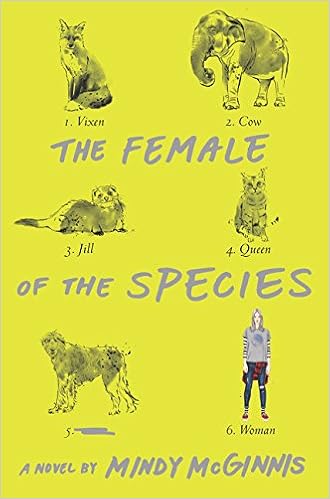
Book Review: The Female of the Species

Image result for the female of the species

The Female of the Species

by Mindy McGinnis


It is probably best, in reviewing books, to stay away from comparisons; no two authors are the same, no two books are the same, no two readers are the same, and so any attempt to compare experiences will inevitably come up short.

On the other hand, if you can’t compare two reading experiences, there’s not much point in book reviews and recommendations in the first place. So let me give this a shot.

I have two comparisons I want to make with this book. The first is to another book, probably more famous, called Thirteen Reasons Why by Jay Asher. That book is about teenagers, as this one is; it is about grief and heartbreak and mental illness, among other things, as this one is; it is an indictment of rape culture, as this one is. So there are enough points of comparison for me to say something valid, I think. Now here’s the difference: that book, compared to this one, is crap. Absolute shlock. The characters are unrealistic, the events are underwhelming and overdramatized, the ending and the book’s overall message were just obnoxious, in my opinion.

This book is none of those things. These characters are some of the most fully-realized and relatable that I have ever read. My favorite thing about this book is that none of the characters – not even the static characters, the foils for the protagonists, the minor characters who only pop into a chapter or two – none of them are permitted to be one-dimensional. The bitchy cheerleader has depths, and real kindness. The golden boy is not all golden: he has flaws, and shortcomings, and he fails, more than once. The villains are recognized as not being that different from the heroes.

And the hero is a psychopath. An entirely sympathetic and fascinating psychopath. I know there are other books that have taken that approach – Dexter, American Psycho, I Am Not a Serial Killer – but this one is by far the best, in my opinion. (Since I’ve been talking about comparisons, let’s be clear: Dexter and American Psycho are entirely different books, different stories, different characters. I Am Not a Serial Killer has some similarities in that it is also a YA book with a teenaged hero; but that book is about self-doubt, and this book is not. At least not from the psychopath’s point of view.) This psychopath, you cheer for. She’s a badass, which was a lot of fun to read. And she volunteers at an animal shelter, and is good to the dogs. I got more than a little upset with the other characters for not being able to relate to her at times, when she’s so clearly right.

But at the same time, because she’s not one-dimensional, the psychopath is not only right. Some of the things she does are terribly wrong, and we know it. This is part of the advantage of McGinnis’s use of multiple point-of-view characters: we get to see all of the major characters from multiple perspectives, both inside and outside themselves, which is part of what makes the characters, and the book (which is entirely character-driven) so good.

And that brings me to the second comparison: the writing. I am a writer. I’ve written for young adults, and I’ve written about violent, mentally ill protagonists. So though I know I shouldn’t, when I encounter a book that is in some small way similar to something that I’ve written, I tend to compare the writing to my own; particularly when it is the first time I’ve read something by a particular author. I don’t do it all the time; when I’m reading something by Steinbeck or Khaled Hosseini or something similar, I don’t even try. But I do think, “I would have done that differently,” or, “I could have written that better.”

I couldn’t have written this book better. I wouldn’t have done it differently, but: there’s no way I could write this well. I actually got a little sad for a while when I was reading it, because this book was so good, so well-written, the characters so genuine and interesting, the action so arresting, that I thought, “Well, what could I add to the literary world when it already has something like this?” I got over myself, of course, but the point is this: this is one of the best pieces of young adult fiction I’ve read. This is one of the better novels I’ve read, period.

So here’s one last comparison: me, to you. I’ve read this book. You haven’t. Which means I’m happier than you. You should fix that. Go get it.

I’m going to go try to learn to write better. And read another book by Mindy McGinnis.

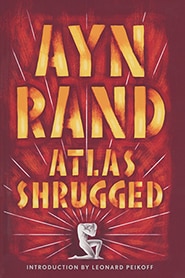
Book Review: Atlas Shrugged

Atlas Shrugged

by Ayn Rand


My god.

Now: I’m a word guy, a writer and a literature teacher, so I read quickly. I enjoy it, so I dedicate a lot of my free time to it. I’m a high school teacher and it’s summertime, so I have a lot of free time. I’ve been averaging about a book a day since school ended.

Until I hit this one.

1070 pages of some of the smallest print I’ve seen outside of User Agreements. 562,000 words, according to the Indefeasible blog. For scale, that is 25,000 words less than War and Peace by Tolstoy, and 400,000 words more than The Grapes of Wrath, the longest book I’ve ever tried to teach. It is equivalent to 12.186 Fahrenheit 451s.

This took me eight days to read. I spend at least 3-4 hours a day reading, too. It was a tough slog, too; because it is a philosophical treatise as much as it is a novel, I had to concentrate on the ideas harder than I would on, say, a book from The Wheel of Time or Harry Potter. I did it because the book was recommended as an important first step in understanding a former colleague and debate opponent’s worldview, which he describes as Aristotelian and bears a lot of resemblance to Rand’s philosophy, which she called Objectivism. I wanted to understand his worldview because his ideas are different from mine, and he is very, very sure of his positions and opinions; so I wanted to know from whence came his surety, and if I could and should be thinking along the same lines. So I read the book.

It made me think lots of interesting things. It really did: it made me realize that there are some things that I have done (like mock and castigate industrialists – in my case my favorite target was Bill Gates) that I shouldn’t have done, some things that I do that I shouldn’t do (like use words ambiguously, or symbolically, with little concern for their actual meaning), and some things that I haven’t done that I should do (like think about what my purpose in life really is, and why). There are some parts of the philosophy espoused and exemplified that I find interesting, and that I plan to investigate further and perhaps even adopt, if I can verify that they work for me.

However: reading this book was not worth it. Even with my personal interest in knowing what it has to say, I got so bloody tired of reading it that for the last three days, I had to work twice as hard to pay attention – and since I had to work twice as hard as normal to pay attention in the first place, this has been a mentally draining task. I did it, though, and now I’m here to tell you: don’t do it.

Rand was not a good writer. I’ve read three of her books now, and while this one was leagues better than Anthem, that’s like saying that shaving with a chipped-flint spearhead is better than shaving with sandpaper: you still wouldn’t want to do it. I read The Fountainhead in high school, so I don’t remember it well; once I’ve recovered sufficiently from this one, I may read that one. I dunno, though. It’s only 311,000 words, but that’s still two Grapes of Wrath.

That’s the biggest problem. She used too many words. And I say that as a wordy writer, which I am; my first book was 200,000 words. But she repeats things too many times, unnecessarily, as though using five words to describe something makes up for the fact that she is telling and not showing; and when she explains them, she uses too many synonyms and appositives. As a random sample from a page I just flipped to:

The scream of an alarm siren shattered the space beyond the window and shot like a rocket in a long, thin line to the sky. It held for an instant, then fell, then went on in rising, falling spirals of sound, as if fighting for breath against terror to scream louder. It was the shriek of agony, the call for help, the voice of the mills as of a wounded body crying to hold its soul.

So there was an alarm, then. You know, just the word “alarm” implies that it was bad, and “scream” implies fear; you could basically say this same paragraph in three words:

An alarm screamed.

Now of course repetition creates emphasis, which is presumably the point of the extended description; but there doesn’t seem to be anything in this book that Rand doesn’t want to emphasize – which means, of course, that nothing is really emphasized, because all of it seems almost like – well, like a screaming alarm siren fighting for breath, crying to hold its soul. By the end of this book I was very tired of being yelled at. I can’t imagine how fatiguing a conversation with this woman must have been.

In addition, the level of rage leveled at people like me – political liberals, that is, which means Rand saw me as a looter, a moocher, a liar, a coward, a fool, a murderer, a thug, and the destruction of humanity – was just as exhausting. I knew going in that there was a critical speech at the end, when John Galt speaks (No spoilers – that’s the name of the chapter, “This is John Galt speaking.”), which explained the whole worldview being dramatized in this book; but the problem was that most of what Galt says had already been said by the narrator or one of the other characters. I probably could have just read Galt’s speech and skipped the rest of the book. I would have been happier, too, because Galt carries the deepest anger, the most righteous condemnation of anyone who would support, you know, taxes and welfare and stuff. So I had to read that after reading another 900 pages of pretty much the same stuff, just not quite as angry as when Galt says it. I got really tired of being insulted so many times, and with such bile.

I will also say that, while the story itself is interesting (though much too long) and, I think, disturbingly realistic, the characters are not. Not that I think Rand’s idealized hero-industrialists are absurd; I mean, they are, but they are absurd the same way that Tom Brady or Michael Jordan is absurd, or William Shakespeare, or Isaac Newton, or Michelangelo or Mozart: nobody should be that good at what they do. But as all those names (Just the first few to come to mind. Of course there are many more examples.) show, people really are that good at what they do. It is possible. No, these characters are unrealistic in the way they read each others’ expressions. Like this:

The suggestion of a smile on Mrs. Hastings’ face held sadness, but the face had no imprint of tragedy, only a grave look of firmness, acceptance and quiet serenity.

Picture that face, that smile, in your mind. Okay, that’s good, just the suggestion of a smile . . . No! No imprint of tragedy. That’s better – but it needs a little more firmness in that look of quiet serenity. Got it, now? Or this:

There was the faintest coating of mockery spread, like shellac, over the smooth notes of her voice.

I mean, I like that, it’s a nice phrase – but what the hell does that sound like? And how would someone pick up on it?

These aren’t the best examples, the best examples are when someone heroic looks into the face of one of the villains and sees what they intend to show, along with what they’re hiding, and also what they are unaware they are really feeling; but I didn’t want to spend the time looking through the book to find one. It took me long enough to find these examples.

There are thoughts worth thinking in this book. I intend to spend more time thinking about those ideas. But good grief: I have already spent enough time reading this book. No more.

Spring Break Book Review #2: Robert Louis Stevenson

Image result for The Body-Snatcher and other tales

The Body-Snatcher and Other Tales

by Robert Louis Stevenson

Only three stories in this one, but they were remarkable: the first two, The Body-Snatcher and The Merry Men, are both ghost stories, of a sort; certainly atmospheric and creepy, and with extremely dark endings. The third, The Bottle-Imp, isn’t as dark overall, as there is romance to leaven the creepiness — but since it’s about hell and damnation, it ain’t exactly The Poky Little Puppy.

The Body-Snatcher is about two men who purchase cadavers for use in medical school; Stevenson connects his characters directly to Edmund Burke, the famous murderer (whose method actually became eponymous, and which I found out about it when one of my Honors students brought this to the class: to burke [burked; burking] is to murder someone by sitting on their chest so that they cannot breathe, thereby creating an appearance of a non-violent death and making it easier to sell the cadaver) who sold his victims’ bodies for dissection. And I can’t help but wonder how someone could think that was a reasonable way to come into money. I mean, “reasonable” is of course relative; we’re talking about murderers, here. But how much did they make off the medical schools? This isn’t the mafia selling contracts on their enemies and paying accordingly; colleges and universities can barely pay their staff. How much was a body worth, $50 in the equivalent amounts for the time? $100? I can’t believe people murder for that little. Now, if you have another reason to murder – if you’re a knee breaker for a bookie, say, and someone owes too much and you cancel their account; I can see bringing the corpse to the medical school as a way of disposing of the body you’ve already got, and hey, $50 for your trouble? Good deal. That makes more sense to me.

It makes more sense to the men in the story, too. Stevenson explores all of the alternatives: they buy bodies from murderers; they go out and rob graves themselves; they become complicit in covering up a murder when one of the two main characters recognizes the new corpse produced and turned in by the Burke-character; and then, finally, one of them commits a murder and sells the body for dissection in order to cover it up. Ah, for the halcyon days when nobody needed a death certificate!

Stevenson turns the story rather suddenly at the end, though – a trick which he repeats in The Merry Men, and to some extent in the last story, The Bottle-Imp. The two corpse-buyers go out on an acquisition mission and suddenly find themselves in a ghost story: but only in the very last sentence of the story. That’s it: it ends with the unexpected appearance of the specter. It’s interesting; I don’t see a lot of stories that have a climax in the last sentence: and in this book there are almost three of them.

But the best thing about The Body-Snatcher? The alternate job title for grave-robbers who provide dissection cadavers: Resurrection Men. I cannot imagine why he didn’t use that for the title. If I ever write about grave robbers, you bet your sweet bippy I’ll call it that.

The second story is even more atmospheric than the first; the melancholy mood is not created by the actions of the characters, but by the environment. Stevenson, impressively, loses nothing in the change: he is as good at making the coast of Scotland creepy as he is at showing how creepy body-snatchers are. The Merry Men are not men, they are actually waves that crest and crash near the farm that is the setting for the story; Stevenson describes how the waves, which appear on stormy nights and pose a serious and deadly danger to any ship caught amongst them, seem to be laughing and shouting as they smash into each other and pummel the rocky shore. That is just chilling, and it and the rest of the shoreline and the surrrounding area are beautifully described in the story. The story concerns a series of shipwrecks along this shore: one back when the Spanish Armada tried to invade England and was scattered by a storm; one a few months before the story takes place; and the last during the story. In the process, the owner of the farm close by Shipwreck Central loses his mind entirely, despite the best efforts of his daughter and nephew, the other main characters. I loved the descriptions of this, pretty much every one of them, but especially when the narrator goes diving for the Spanish shipwreck and explores the bottom of the lagoon; and also the final sequences of storm and madness. The action and tension are good, too, though I had one problem with the downward spiral of the farmer’s mental state: he commits a murder seemingly without reason or provocation, which is not too far out there – except that it happens at the beginning of his losing his mind, not at the end. It doesn’t happen in the story, and we never hear the farmer’s side, which is too bad; I wanted to know why. Otherwise, I loved this one, even the sudden and ghastly ending sentence, even bleaker than the first story’s final words.

The third story, though: that one was tougher. I loved the concept and the setting: it actually happens in Hawaii, where Stevenson (I didn’t know this) spent the last years of his life, and the story concerns a young man who receives a magic bottle. In the bottle is an imp, an imp that will grant any wish to the bottle’s owner. The catch, however, is that if the bottle’s owner dies while the bottle is in his possession, he will spend eternity in Hell. So of course, the thing to do is get the bottle, make your wishes, and then get rid of it before you die. But here’s the second catch: the bottle must be bought, and it must be sold at a loss. So if I bought it for $100, I’d have to sell it for no more than $99. Or presumably, $99.99.

It’s a great concept for a story. Logically, though, it’s got a lot of flaws. Like, why wouldn’t you sell it for one penny less than you bought it? There’s a comment in there that the bottle has to be sold for actual coined money, I guess so I couldn’t get someone to give me a check for $99.99999999999999999 dollars; but why? Who made up that stupid rule? The bottle was first sold for millions, they tell us — because apparently inflation isn’t a thing in this world, so thousands of years ago they were selling bottle for millions of modern dollars. Sure, okay. And in the process of changing hands over the centuries, the price has gotten down to $90. But why? The guy who has it at $90 says he can’t sell it for $89, because that’s a weird price and it makes the buyers squidgy (My word, not his); but he tells the main character the whole story when he sells it to him for $50. So why not $89? The whole thing seems designed to catch only one person: whoever buys it for one cent, because they can’t sell it for less than that. (But why not? How about trading the bottle for a rock? Why does it have to be coined money? Because otherwise the story doesn’t work, that’s why.) It all just takes a lot of suspended disbelief. Of course, we are talking about imps and wishes and Hell, so…

Getting past those issues, I liked the story. The young man gets the bottle, wishes for a beautiful house and then gets it; then he gets rid of the bottle – and then he falls in love. And then he finds that he has leprosy. And so he has to get the bottle back – paying less for it than he sold it for, of course. The story goes downhill from there. It was romantic and sweet, and I would have done what these two people do. And this one also had a surprise ending: which I won’t ruin.

Surprisingly, this review has gone on almost longer than the book, which is well under 100 pages. But they were good stories, and that inspires me. I would recommend pretty much anything by Robert Louis Stevenson, including this book.

Book Review: MacHugh and the Faithless Pirate


MacHugh and the Faithless Pirate
by William S. Schaill


First, let me say something about the publisher: because this book is from Fireship Press, (Website is here) a small independent press here in Arizona that specializes in nautical and historical fiction. I found this press, and this book, at the Tucson Festival of Books, a glorious local event that celebrates the printed word, and because I am a pirate fanatic, this book jumped out at me immediately. But Fireship has a number of authors, with a number of titles, and the books themselves are top notch, good printing, good binding, good cover art. The copy editing was imperfect — but honestly, I just read another book published by Bantam Spectra which had as many typos if not more, so I won’t split hairs. This is a good press that makes good books.

And this is a good book. It’s not a great book, I’ll say that; the characters are a little too simply drawn, and the main character annoyed me a little at certain places (Largely because he thinks of younger women as romantic interests, which was entirely accurate for the time period, but still a little weird to read — a grown man going over to the home of a friend and checking out his daughter is just too funky for me.) and I wish the Faithless Pirate could have been more than just a villain, because I do love pirate narratives.

But this is, bar none, the best nautical action/adventure I’ve read, in terms of its accuracy and its verisimilitude and its author’s encyclopedic knowledge of the sea and tall ships and marine combat. Reading about these men struggling with this ships on these seas, fighting weather and currents and politics, searching for pirates, finding them, fighting them, winning and losing various battles in various ways — it was just great fun to read. The suspense is excellent, the action is exciting, and the historical and nautical details are as accurate as any I’ve known. For the sake of enjoyment, and for the sake of reading about cannons blasting and cutlasses slashing and blood spurting and everything else, this book was excellent. I hope the author continues to write MacHugh stories — because whenever he isn’t creeping on 18-year-olds, I thought this Scottish wine merchant/privateer was a great character (Though he did seem to have a whole lot of “In his younger days” adventures that made me wonder: just when did this guy start living this life of adventure? And did he ever, I don’t know, take a week or two off?) and I’d love to read more.

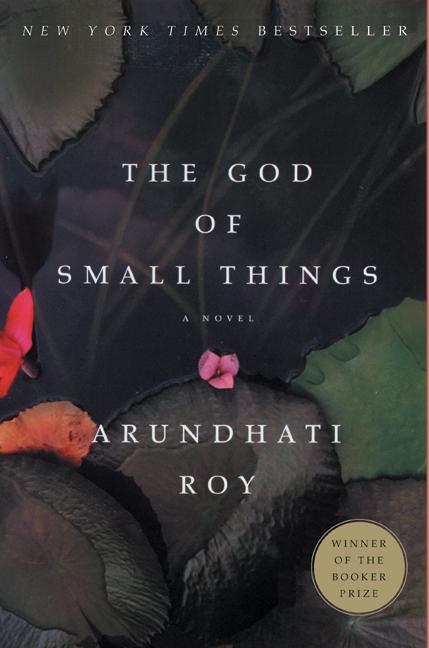
Book Review: The God of Small Things

The God of Small Things
by Arundhati Roy

I don’t know what I can say about this book that hasn’t already been said. It’s a prize winner, an internationally acclaimed best seller, and has been for twenty years. But I read it for the first time in 2014, when I moved to Arizona and started a new teaching position with new materials, including this book; I liked it then, liked the style of it, liked the way Roy wrote and the things she had to say, but it was one of several books that I read in an awful hurry, and with a whole lot on my mind at the time.

I read it again, this past two weeks, just finishing it this morning. And this time, because I am encouraging my AP Literature students to read books actively, that is, with a pen in hand and the margins of the book’s own pages as their paper, to comment and question and interact with the text, I did just that: I used my new purple ball point (Which may be the best thing about the gym that my wife and I joined last October: it has good equipment, but not great, and it had been fairly uncrowded until our last work out when a visiting college baseball team came in en masse and inundated us in jockery: but at least they give away ballpoint pens with purple ink!) so that the ink would stand out against the black typeface, and I underlined and I arrowed and I added everything I thought that I thought was worth thinking and adding to the text.

I read it more, this time. More carefully, more attentively, more thoughtfully. I was invested in the text, this time.

And this time, I didn’t just like the book. I loved it.

I was actually enlightened by it. Roy made me think about my own society, and particularly my own family, in a way that I never had before. She crystallized some thoughts for me that might never otherwise have come clear. She also showed me an elegance and a musical grace in words that I never would have seen: words written backwards, and words broken up in new ways — there is a Bar Nowl that lives in the warehouse and hunts mice on silent wings — and a poetry that I don’t ever see in prose. She showed a depth of perception, both in descriptions of environment and of character and of humanity as a whole that I don’t know that I’ve ever seen done better. And she wrote this book on the other side of the world. In her second language. I don’t know if that shows the grandiosity of her genius or if it reveals the power of an outsider’s perception, both hers of my mother tongue and mine of her world and how it parallels my own; I think perhaps she was writing about what she knows, and I see the same things in what I know because people are people all around the globe — but regardless, this book is magic. It is going up on my Very Top Shelf, with Fahrenheit 451 and To Kill a Mockingbird and Of Mice and Men and Shakespeare and ee cummings.

And that’s what I have to say about this book.

Short Story: Life With Bird

Fine. It was fine.

It was fine when Mark was awakened by kissy noises — the sound of lips pursed and relaxed rapidly several times, followed by one long drawn-out inhale, a sort of raspberry in reverse — even though the sounds were made with no lips at all. But it wasn’t fine when he cracked open one eye to see another eye, round, lidless, a black hole in a white disc, hovering inches from his own: so close it seemed no more than a spot of dirt on his lens, as if he could blink and clear that nightmarish darkness from his vision.

The kissy noises repeated, like the sound of eggs being whisked, and then the outstretched one — pulling milkshake through a straw — this time culminated in a low two-note whistle, and then a noise that Mark had always described as a scrawk, which sounded a little like the onset of an old man’s laugh and a little like a chair being dragged across a linoleum floor. The noises came from just to the left of the eye floating in his sleep-blurred vision, the eye without expression, without emotion, without humanity.

Mark closed his eye and turned his head sideways on the pillow.

A sharp pinch skewered his earlobe, stabbing through to his brain, bursting the bubble of sleep. “Ow!” Mark hollered, his tongue heavy, his face half-smothered in pillow and sleep. “Geddoff! Ow!” He managed to drag one hand out of the quicksand of slumber and flail it once over his head, covering his offended ear with his arm.

There was a flapping noise and then clawed feet stepped up his wrist to his forearm, perching triumphantly on his bent elbow, currently the highest point on his body. Another pinch, lighter this time, on the less-sensitive skin of his upper arm; another scrawk.

Sleep fled at last. Mark opened his eyes, blinked, sighed, smacked his lips and swallowed. The kissy noises once again, and the two-note whistle: and now Mark smiled. He lifted his arm slowly, contorting his shoulder as he swung the limb without rotating his elbow downward; he could reach just far enough that if he craned his head back and around, he could see all of the large white bird that gripped his arm with its dark blue talons.

“G’morning, Merlin,” he said; he tried to whistle — failed — licked his lips with a dry tongue and managed half a note that turned to a hiss. Merlin bobbed his head up and down, his yellow crest lifting, and whistled the opening bars of “The Old Grey Mare,” his favorite tune. He walked up Mark’s arm to his shoulder, where the bird normally spent most of his day; but with Mark reclining, Merlin could not find purchase; so he continued up onto Mark’s head. Another whistle, more kissing, and then Merlin bit Mark’s ear again.

“Ow, goddammit, bird,” Mark shouted hoarsely and sat up quickly, trying to dislodge the bird from his head. Merlin flapped his wings as he lost his balance and then clutched with his talons; he hung on despite Mark’s sudden movement. Then he took a grip on Mark’s ear with his beak: like a grandmother threatening a disobedient child. Mark froze. “All right, okay, calm down,” he said, patting the air with one hand, his voice and movements slow, placating. He tilted his head slowly to the side, his non-hostage ear flat on his shoulder, so that Merlin would have a place to stand; then Mark swiveled his legs off the side of the bed and stood slowly. His neck was cramping and his scalp itched fiercely under the heavy talons, but he cleared his throat, wet his lips, and whistled the theme from The X-Files: one of Merlin’s preferred melodies.

It worked. Merlin let go of Mark’s earlobe, whistling the same six notes back to Mark. Then he crab-walked down Mark’s neck to his shoulder. Mark lifted his head with a grunt, and put his left hand on his right shoulder; Merlin stepped onto the back of his hand, and Mark lifted him and held him where he could glare at the bird through narrowed eyes.

“We’re going to have to practice your wake-up call manners.”

Merlin clicked and whistled a tune that only he knew, ending with a loud scrawk. He walked up Mark’s arm to his shoulder again. Mark sighed. “Right, got it. I’m not allowed to lecture you. Fine.” He turned and headed to the bathroom, Merlin riding on his shoulder as he stood before the toilet and peed. He left the door open; there was no one else in the apartment, after all.

***

Mark sipped his well-sugared coffee, savoring the hot sweetness on his tongue, then blowing air out in a sigh. Merlin hissed, his crest rising; he didn’t like that noise. “Right, sorry,” Mark said. He reached up with his finger curled, offering to scratch the back of Merlin’s neck. Merlin bit him. “Ow. Okay, fine, no scritchy.” Mark took another sip of coffee and then breathed out through his nose.

“What shall we have for breakfast?” He gathered a plate of food for Merlin — nuts, some slices of fruit, a pile of oil-black sunflower seeds, some leaves of Romaine lettuce washed, dried, and julienned so Merlin could eat them easily — and then he threw two slices of bread in the toaster for himself. He held bits of food up to Merlin as he prepared the plate, arranging the elements neatly, adding a dish of fresh water in the middle, and then carried Merlin and his breakfast to the table, setting him down at the head. He buttered his toast, and then sat at the foot — he had to sit at a distance, or Merlin would take his toast right out of his hand. Out of Mark’s mouth, if he could reach.

“So what are we going to do today, bird o’ mine?” Mark asked. Merlin grabbed a piece of apple and chewed through the meat, then dropped it and dug into the sunflower seeds, scattering them across the plate. The lettuce was ignored after a desultory inspection and despite Mark’s admonishment that he needed to eat more greens. Merlin turned his head to the side and fixed his gaze on Mark as he cracked black sunflower seeds with his black beak.

Mark considered his audience. “Well, I don’t have that much work to do, but I should still check in.. We can go to the cafe for that.” Merlin’s crest rose and he bobbed his head; the internet cafe was approved. “Oh,” Mark said as he remembered, “I need to do laundry, too.”

Merlin dropped the seed that was in his beak. He rose up, his feathers ruffling and his crest standing straight up. “No!” the bird said clearly, his voice like Mark’s but an octave higher. He tossed his head to one side and then the other, his beak snapping shut; Mark was absurdly reminded of movie-cliche gangbangers with their guns held sideways. “No!” the bird said again.

Mark put down his coffee cup. “I know, I know — you don’t like the noises in the laundromat. But I have to do — I’m running out of clothes and –”

Merlin cut him off with a loud scrawk; he unfurled his wings and flapped sharply three times, budging not an inch from the tabletop, throwing air in Mark’s face. “No!” he said a third time, and clacked his beak shut.

“Merlin,” Mark started to say.

Merlin lowered his head, his beak open, and with his wings held out to the sides, he advanced on Mark, crossing the table in a rapid but clumsy waddle. Mark sat back in his chair, holding his hands up in surrender — and to keep his fingers far away from that snapping beak, which could splinter a two-by-four. Or a fingerbone. “Okay, okay — no laundromat. No laundry. You win, Merlin.”

Merlin stood tall on Mark’s plate, one foot atop the last crust of toast. He flapped his wings, the feathers brushing across Mark’s face; Mark turned away, closing his eyes. The cockatoo squawked loudly once more as Mark ducked, holding his wings spread wide, his crest bristled. Mark peeked up through one eye, his head held low. “Sorry,” he said quietly. The bird folded his wings and lowered his crest. Mark slowly extended his hand, and Merlin stepped onto it, digging in momentarily with his talons. “Let’s go take a shower,” Mark said, rising. “Then we’ll go to the cafe.”

Merlin whistled and made a kissy noise.

***

Mark ran his face under the shower spray one last time, and then shut off the water. He rubbed one eye clear, opened it and looked up to where Merlin was sitting on the shower curtain rod; he carefully slid the curtain halfway open without disturbing the bird’s perch and reached for a towel. Merlin’s whistling alternated between random notes and snatches of his favorite tunes — a few notes of The Addams Family theme led to a chorus of “La Cucaracha” into “My Darling Clementine” — he really loved the “Oh my Darling” part. Mark rubbed the towel vigorously over his head, frizzing his hair out; when he looked up, Merlin shook his feathers out to match. Mark reached up, took the bird onto his hand, and transferred him to the vanity. Then he filled the basin to shave, while Merlin preened beside him. The bird’s crest popped up as Mark filled his hand with shaving cream; he dabbed a gobbet on the countertop, and Merlin toyed with it while Mark shaved around his smile.

When they were finished with the shaving cream, he walked in his boxers into the closet and came out with two shirts. He moved to the bathroom doorway and presented the options to both the mirror and the much harsher judge beside it. “Which one?” he asked. The first, a comfortable plaid, seemed too drab; but the second, a silk-blend bowling shirt with electric blue dragons across the front and back, brought a scrawk. “No?” he asked, turning to Merlin, his tone disappointed. The bird lowered his head and turned to the side, flapping his wings twice. He reached out with one foot, talons outstretched like a black-lacquered starfish.

Mark looked down at the shirt held against his chest. “Really? We don’t like this one?” He frowned at the mirror, and at the bird beside it. Merlin shook his head again, clicked his beak and his talons against the countertop, one-two, one-two.

“Ah!” Mark rolled his eyes up with a nod. “Right — I forgot.” He turned and went back to the closet, where he hung the blue dragon shirt back on the bar. He pulled the plaid off its hanger, pulled it up his arms and buttoned it. He pulled the silk shirt to him, running the material between thumb and forefinger. “I forgot you have trouble holding onto this silk.” He pulled the shirt out farther, looked at the dragons. “I should just get rid of this.” He ran his hand down the shirt, over the dragons; he pushed it back into line with the others. He straightened the plaid, buttoned the cuffs, and went to get Merlin.

“Let’s go, buddy.”

Merlin shook his feathers out once more, tightened his grip on Mark’s plaid shoulder, and started whistling “Side By Side.” Mark joined in as he grabbed his laptop, keys, and wallet.

Oh, we ain’t got a barrel of money,
Maybe we’re ragged and funny,
But we travel along, singin’ a song,
Side by side!

***

“Hi,” Mark returned the coffee clerk’s greeting with a smile, ignoring the look of glazed semi-panic in the man’s eyes as Merlin stood tall and stretched up his feathery crown. “I’d like a — a Cafe Americano, please.” If this had been a workday, he would have ordered something more high-octane than a single shot of espresso in hot water, but it was Saturday, and he was here mostly for the outing. It would be bad if he and Merlin stayed shut up inside all the time, buried indoors as if underground; he sometimes felt like he was growing roots and bark, subsiding into his couch, his bed, the walls of his apartment. Perhaps he would stay so still he would crystallize, he thought; the atoms and molecules of his body aligning perfectly and freezing in place, ordered, structured, permanent.

Yeah: he needed to get out more.

“And a scone, please,” he added. Merlin scrawked, lifted a foot and hooked one black talon — gently, for now — in the cup of Mark’s ear. “Right — sorry, Merl, sorry — scone with almonds, please. Lots of almonds.” The clerk changed his target, reaching for a scone coated with pearl-colored slivers. He put it on a plate on top of the glass counter, and the talon was removed from Mark’s ear. Mark breathed a sigh of relief, and Merlin cluck-chuckled — a positive sign. Mark slid his credit card through the reader and picked up Merlin’s scone. He glanced to his side, and saw that Merlin was grooming the talon that had just been in Mark’s ear; watching him, Mark was reminded of a muscled bully kissing his own biceps. “Nice guns,” he said drily. “Here’s your scone. Your almond scone.” Merlin met his gaze, fluffed his feathers and gripped Mark’s shoulder. Mark made his way to the table by the window and sat, facing out so Merlin could see the street outside. He opened his laptop, and Merlin walked down his arm to the tabletop and went to work on the almond scone. The waitress brought Mark’s Americano, and Mark thanked her absentmindedly as he logged on to his webmail. Merlin also said, “Thanks!” and the waitress blinked and then left without a word.

Three emails-and-responses later, Mark heard a voice say, “Oh, what a pretty bird!” He and Merlin both looked up, Merlin’s crest rising. Mark felt the blood rising to his cheeks when he saw the woman standing by the table; he had an absurd moment when he wanted to say, “No, you’re the pretty bird,” but thankfully, he bit the words off of his tongue, chewed them up, and spat out only, “Thanks.”

The woman — who was a very pretty bird — smiled and reached out a hand to Merlin, moving too quickly for Mark to say, “Be careful, he bites,” or “Please don’t touch his wings, they are delicate.” Or even, “Will you please keep your hands off of my bird? Why does everyone think they have the right to pick him up, or pet him or poke him? Because he’s small? Because he’s soft? Damned arrogant humans.” He watched, opening his mouth to speak and then closing it again, as the woman did — just the right thing: she held her hand out, palm down, fingers curled in; you could hold out a single finger to a smaller bird, but a parrot Merlin’s size wouldn’t see a perch, he’d see a chew-toy. Then the woman made a kissy noise, and Merlin tilted his head and then offered his usual greeting, a scrawk followed by a two-note whistle. Mark had taught it to him, along with his name, when he and Merlin first started living together; the scrawk-whistle was the standard parrot noise from the old Looney Tunes and the like, and Mark thought it sounded piratey. And parroty.

Then he had stopped teaching Merlin tricks. A parrot like Merlin has the intelligence of a four- or five-year-old human child; you don’t teach children tricks. You talk to them, and then listen to what they have to say.

The woman laughed when she heard Merlin’s scrawk-whistle. Mark and Merlin both drew back slightly: it was a terrible laugh, loud and high and false, as if she had decided to simply say the words “Ha! Ha!” Too bad, Mark thought. She is pretty. But then he decided she should have another chance; maybe she was nervous. Walking up to a stranger in a cafe, I would be, he thought. So he said, “Go on, Merlin.” Merlin glanced to him, then reached up a foot and stepped onto the woman’s hand, walking up to her wrist.

“Wow, he’s so light!” she said. She lifted her hand and Merlin to the level of her head, but slowly, so Merlin didn’t get startled; and she didn’t put her face within biting range. Mark was impressed. “Does he talk?” she asked.

Mark opened his mouth to give his usual answer — Only if he has something to say — when the woman, who had been doing so well, took a running start and leapt off the cliff. She bugged her eyes out, pooched out her lips, and said, “Does pitty-bird-ums talkie-talkie? Does oo wike to talk? Yes you do! Yes you do!” This last was delivered with a side-to-side head wiggle, her nose thrust right up to Merlin’s beak; and she lifted her other hand and ruffled it through Merlin’s crest, bending the proud golden feathers as if they were fur.

Merlin reacted the only way he could, the way anybody would in similar circumstances. He bit the ruffling hand, and shat on the perching hand.

Thankfully, Merlin hadn’t broken the skin, and so Mark wouldn’t have to pay for an emergency room visit; merely for the round of free coffee he offered the other patrons as apology after the shrieking woman had launched the large white-and-gold parrot off of her hand and into the air, said parrot then completing three full circuits of the room, flying inelegantly but determinedly, before coming to a landing on the shoulder of a petrified grandmotherly woman who sat stock still, head turned just enough to lock gazes with Merlin, who kept fluffing his feathers, flexing his talons, and flapping his wings while he eyeballed his elderly perch. She stared right back, neither of them blinking, the woman appearing not to breathe. But she also wasn’t screaming, as was the baby-talk woman behind him, so that was an improvement. Mark, hurrying over to rescue — well, one of them, anyway — filled in the dialogue mentally, giving Merlin (who usually sounded a bit like Sir Ian McKellen’s Gandalf in Mark’s mind) a touch of Travis Bickle: You lookin’ at me? You wanna start somethin’? You make the move, Grandma. It’s your move.

“Come here, tough guy,” Mark said, reaching out a hand for Merlin to step onto. “Just hold still and he won’t bite,” Mark said to the woman, followed by “Sorry about this.” Mark would say that several more times in the next few minutes. Merlin wouldn’t say it once. Neither would Ms. Babytalk.

“Oh, not at all,” the woman said, her mouth the only part of her to move. “I just hope she didn’t hurt Merlin’s lovely head-feathers.”

Mark’s gaze whipped from bird to woman; she glanced back at him and smiled. Behind Mark, the shrieks continued, alternating between disgust and shock as the babytalk woman examined one hand for blood and the other for remaining smears of birdshit.

“I come here quite often,” Merlin’s perch said to Mark. “As often as the two of you. I have frequently admired Merlin — and your relationship with him. Much more than a master and his pet.” She turned her head slightly, facing Merlin more squarely; Merlin was calming, now, though he would lift his crest and open his beak each time the shrieking woman hit her high note of “Oh my GOD!” above middle C. The elderly woman smiled at the parrot. “In fact,” she said, with another quick glance at Mark, “Why don’t we just let Merlin collect himself here with me, while you handle that train wreck over there?”

Relief swept over Mark. He had been thinking he could take the bird and run, since he couldn’t go back to soothe the shrieking woman while Merlin sat on his shoulder, hissing and clacking his beak; nor could he leave Merlin alone, as the outraged parrot would show the woman what real shrieking sounded like, were Mark to ignore him in his moment of need: humans could neither compete with nor comprehend the volume and piercing tone that an affronted parrot could reach, and then sustain indefinitely. Mark had been trying to decide if he could sacrifice his laptop in the name of just getting out of there: the door was close by, and he could find another cafe.

But now, another option. Merlin was definitely calming; as Mark drew his hand back slowly, Merlin fluffed his feathers once more, and then commenced grooming. Mark sighed in relief. He smiled at the kind woman. “That would be wonderful. Thank you. Just don’t — ”

“Touch him. I know,” the woman finished. Then she spoke to Merlin. “We’ll just sit here and groom, all right? I’m sorry I don’t have any food for you. Such a handsome bird.” She spoke in her normal tone, perhaps a little softer and lower, soothing the recently jangled parrot. The woman’s gaze flicked back to Mark. “Go on. Make her be quiet. Please.”

“Thanks,” Mark whispered, and then turned to deal with Merlin’s victim. He always carried antiseptic wet wipes, naturally, and the woman deigned to accept his sincere-sounding apology, allowing Mark to clean and inspect her hands before she flounced off to the ladies’ room to wash once more. Mark apologized to all of the disturbed patrons and handed his credit card to the clerk, saying, “Another round for everyone, on me.” He grabbed up his laptop and the rest of Merlin’s scone, downing the last of his own Americano in three hurried gulps.

When he returned to Merlin and Merlin’s new friend, he reached out once more for the bird; again the woman stopped him, this time with a shake of her head. “You can’t leave yet. You’re going to need to apologize again, and give her your business card and offer to pay for anything she needs. Keep it vague; don’t give her ideas. I doubt she’ll have any of her own.”

“But he didn’t even break the skin!” Mark said in outrage.

The woman fixed her gaze on him. “If you don’t offer, she will decide you owe it to her, and she will come after you. Offer it, and it will be charity: beneath her dignity to accept.”

Mark blinked, and blinked again, and then put down the laptop and the scone. The woman said. “Ah!” and reached slowly across the table for the scone, which she slid close to Merlin; she put her hand on the table near the plate, and Merlin took his cue: he shuffled down her arm to the tabletop, shook himself vigorously, and then started nibbling almonds.

“Thank you. Again. I don’t know what I can do to –”

The woman waved her hand, shook her head. “It’s all right. I’m a grandmother, I know. It takes a village, they say.”

“Can I buy you more coffee? For the next month or so?”

She shook her head at the offer. “No, that’s fine. But,” her eyes sparkled, and when she smiled, Mark saw a dimple. “I have a daughter. Who is a single mother. How do you feel about human children?”

Mark blinked. Then he smiled.

Then he turned to apologize profusely and give his business card to the pretty woman, now turned into sour-faced-outraged woman. Fortunately, she thought he was trying to pick up on her, and she laughed her terrible laugh and threw the card back at him before storming out of the cafe. Remembering what Merlin’s new friend — and Mark’s new matchmaker? — had said, he picked the card up and brought it to the clerk, trading it for his credit card (which somehow seemed lighter, now) and murmuring that the woman should contact him if she came back for any reason. Then he hurried back to his friend, and their new acquaintance.

***

“Merlin! I’m home!”

From the living room came the “Rawwwk!” and the two-tone whistle, followed by Merlin himself, waddling his ungainly way across the floor; when he saw Mark, he raised his crest and tossed his head, the bird-greeting that always reminded Mark of bros saying “‘Sup, bro? ‘Sup?” Mark often thought that he should teach Merlin to say “What’s up, Doc?” but he knew that once he taught it to the bird, that was that: it would never be forgotten, it would be frequently repeated at odd times, it would be repeated over and over and over again. And Merlin could expect to live as long as Mark did. A parrot’s speech was a dangerous weapon.

But all that mattered now was that he was home, and Merlin was glad to see him. He shoved the door shut with his heel, dropped his keys on the counter, and bent down to pick Merlin up. Merlin stepped onto his hand as soon as it was in reach, and made kissy noises as Mark lifted him up to his shoulder and deposited him there. “Okay — let’s get a tray and see what’s on.”

Soon Mark was ensconced on his couch with a beer in one hand and the remote in the other, food spread on an oversized TV tray in front of him — oversized to give room for Merlin to stand on the edge, eying Mark’s food. Mark settled on a Simpsons repeat as Merlin ducked his head and tasted the main course.

“Oh, Merl, you gotta hear this,” Mark began with relish. “So I go into the Boston Market, right? And there was nobody in line, so I go straight up to the counter and order.” Mark paused, cut a forkful of food away from the rest and scooped it into his mouth; he continued talking as he chewed and swallowed, while he maneuvered a green bean onto his fork and offered it to Merlin. The bird took it with his beak and then held it with one foot while nibbling delicately at the end. “And since I didn’t have time to think about it, I just rattled of the usual — quarter chicken dinner with sides and cornbread.”

Mark took another bite, then wiped his mouth and put down his fork so he could concentrate on his story. Merlin listened attentively, one eye locked on Mark, snacking on his green bean. “So the clerk is this Millennial dude, right? I mean, Bieber-hair, gauges in his ears, skinny jeans, the whole bit. And when I order the chicken, he kind of stares at me, and then he goes,” Mark dropped his voice, speaking slow and low through his nose, as if speech were a terrible burden; his eyes closed half-way and his shoulders slumped under the weight of inertia: “‘Heyyy, aren’t you the guy who, like, carries around that bird or whatever?'”

Merlin’s crest went up, he scrawked, and then he shook his head.

“I know!” Mark crowed with a laugh. “You’re a whatever, Merl!” He scratched the bird on the breast, Merlin gently biting his fingers in reciprocation. Then he continued the story. “So I said, ‘Yeah, that’s me — Merlin’s waiting at home, and he’s hungry!’ Here, give me that — take this.” He eased the stub of green bean out of Merlin’s grip and replaced it with a corner broken off of the square of cornbread. Merlin said, “Mmmm!” like someone who smells dinner cooking and attacked the cornbread, scattering crumbs everywhere, getting perhaps one in four down his throat.

“And the kid flares his eyes at me, right? Like he’s shocked that I don’t see the point he hasn’t even come close to making. So I just wait, and finally he says, ‘You can’t eat chicken in front of a bird. That’s, like, cannibalism or something.'” Mark paused, widening his eyes at Merlin for effect. Merlin put down his foot, now empty of all but a few crumbs sticking to his talons, and tipped his head to one side, exactly as if he were saying, “Are you kidding me?”

“I know!” Mark laughed again. “So listen, so I wait a beat, right? Just kind of hoping that the light will dawn on Marblehead and he’ll recognize the idiocy of that statement. But nothing. I mean he doesn’t move at all, just stands there with his eyes all outraged and his mouth hanging open like a Neanderthal with Bieber hair and ear gauges. So finally I say, ‘Well, you’re half right: I can’t just eat chicken in front of him.’ Then I lean close and whisper, ‘I have to share.'”

Mark burst out laughing, slapping the TV tray with an open palm. Merlin joined in, cackling like a cross between Mark and the Wicked Witch of the West. The noise made Mark laugh harder, and Merlin began to bob his head, yo-yoing it up and down farther than would seem possible, an action which always broke Mark up. Soon Mark was snorting in between giggles, which might have been Merlin’s goal: because the bird imitated the noise perfectly, which kept Mark laughing until tears rolled down his cheeks.

When he was in control of himself again, he tore off the drumstick and handed it to Merlin, after stealing a healthy bite for himself. Merlin grabbed it avidly and began tearing off bites and swallowing them; this — one of his favorite foods — he ate neatly. “Sorry I didn’t get it no-salt. Ah, it’ll be fine, right? We’ll eat in for a couple of nights. Oatmeal.”

Merlin raised his head and his crest and stared at Mark.

Marl laughed. “I’m kidding, I’m kidding. Enjoy your chicken. Cannibal.”

***

Mark lay his arm across the back of the sofa. His gaze traveled in the direction of the TV screen, and through and beyond, into the dark, twisting maze of the future.

“What do you think, Merlin? Should I call this woman, the daughter of that nice lady in the cafe?”

Merlin dipped his head, rolled the chicken bone against the tray, dug at a bit of meat he might have missed: but his gaze stayed on Mark.

The man pursed his lips, took a sip of beer. “It would be nice to have some company. Especially of the feminine persuasion.”

The bird scrawked softly, then walked over to the plate and flipped through the remaining scraps of food with his beak. Finding nothing — and having no contribution to make to the man’s ponderings — he lifted a wing and began to clean his feathers.

“Naomi. It’s a nice name.” Mark’s gaze came back from the far reaches, and roamed over his world: the apartment, small and dark and cozy and filled with his life; his companion, with his bright and unpredictable mind, his magical ability to communicate: what Merlin said was so clear, if only one listened. Could he bring another person into that world? This particular person was also a mother — so two people. “How do we feel about kids? Do you even like kids, Merlin?”

Merlin, curled into himself and away from the world, did not respond.

Mark would have to think about it. Romance, if it could come from this, would be wonderful — but really, he wasn’t lonely. He wasn’t alone.

So maybe there was no rush. Mark finished his beer and stood, picking up the dinner dishes in his other hand, leaving the tray for Merlin to perch on while he groomed.

***

When the Simpsons episode ended, Mark flipped channels until he landed on a Bollywood musical which made Merlin’s crest shoot upright: the cockatoo loved pageantry and melodrama, and singing and dancing. They had a treat: Bailey’s in milk for Mark, a millet spray for Merlin. Then, when it was time for bed, Mark set up Merlin’s perch, right by his side of the queen-sized bed, and reached out a tender hand to scratch under Merlin’s feathers while Merlin cooed and clucked softly, nipping at Mark’s hand as he tossed his head this way and that, moving the scratching to the left and right and everywhere he could, his eyes closed in bliss.

“Good night, you little feathered weirdo.” Mark lay back on his pillow and turned out the light; though he kept a small nightlight on so it wouldn’t be pitch black — Merlin was afraid of the dark.

From the perch by his side, a small voice said, “Good night.”

Mark fell asleep with a smile.

Book Review Request: The Nth Day

27815772

The Nth Day

by Jonathan Huls

I was given a free copy of this e-book and asked to provide an honest review; so here goes.

This is a terrible book.

There is almost nothing good about it. The writing is bad on every level, from grammar to logic to elegance. I have taught many teenagers who have a better grasp of English than this book shows. The mechanics are poor, making it hard to read; the overly long sentences wind and twist clumsily before snapping from the strain, making the reading even harder; and several times, the wrong word is used – “seized” instead of “ceased,” for instance, or “communal” instead of “tribunal.” This book need more than an editor: this book needs a writer.

The plot doesn’t make much sense. The basic idea is that God is born into modern times, and His coming brings mayhem and destruction; not immediately, however, as the child first must grow up like a reasonably normal human being, though his youth is filled with strange events and miracles. Around the age of ten, his father – well, his stepfather, really, as the child was born of an immaculate conception – tries to discipline the boy, for the first time, over a temper tantrum during a board game; and the young God, in a moment of even more petulant wrath, destroys his parents with a sudden tornado. He then strikes out walking across the country, leaving more destruction and inexplicable occurrences in his wake, until he reaches his destination. Unfortunately, the book ends without any actual resolution: he reaches his destination, causes some more destruction, and then vanishes. That’s it. No explanation for the journey, no reason for the mayhem he caused, no actual point to the book.

The only thing Huls does with any style is disgust the reader: the lengthy, detailed descriptions of vomit and excrement and blood and rot are the most vivid moments in the book. There are a lot of them, and they made me more nauseated than any other reading experience I can think of. And although there isn’t a lot of it, this author also made sex more distasteful than any other author I can remember reading. The sweet moments – and there are actually a few, including a loving union between two of the characters, and a father-child relationship that was somewhat heart-warming – are surrounded by so much putrescence that there was just no way to enjoy them. The father-child relationship, for instance, begins with the child saving the father-figure from choking on his own vomit in a drunken stupor; said puddle of vomit figures prominently in the next dozen pages, before the two share a laugh over a raucous belch. Hard to see a Zuzu’s petals-moment there.

If I had to give a reason for the creation of this book, I would guess that the author hates humanity. The people are almost entirely horrible, representing every deadly sin with their every word and deed; the heroes, if that word can apply to the point-of-view characters, are better, but they are also generally victimized by events, and since there is no final resolution, there seems to be no reason for their suffering other than “Life is awful, and so are human beings.” By the end of the book I was rooting for an apocalypse, but even that opportunity was missed, as the young God apparently decides to let the world continue. Until the next time someone beats him at Connect Four, that is – and then watch out.