MERCE Review

M.E.R.C.E.
by J.P. Hart

I teach Advanced Placement English, and so I spend a fair amount of time involved in deep, close reading, of great and grand literary works, Shakespeare, Homer, Emily Bronte. I just spent a month poring over every sentence and every word of Mark Twain’s Huckleberry Finn, examining the diction, the syntax, the figurative language.

So it is a real relief when I can read a book that’s just — fun. MERCE was one of those books.

If you’re looking for a paranormal romance/thriller, this book has what you want: there is the damaged and vulnerable heroine whose pain hides her awesome power; there is the dark and brooding hero who is brought out of his shell by the heroine’s love. There is the all-consuming threat of evil that intrudes on their idyllic bliss, and there is the deadly fight over the fate of the world. There are secrets being revealed in nearly every chapter — secrets about the nature of the characters, about the nature of the world, about the nature of love and friendship and family.

There is action, both pulse-pounding and darkly frightening. There is humor, both sarcastic and absurd. There are twists, some a bit predictable, others entirely out of left field. There are some lovely details, and some excellent writing. There is an EXCELLENT dog, which is always a plus. Sure, there are flaws: some of the chapters cut off in strange places, and some of the writing needs some polish; the romance moves a bit too quickly into total trust and harmony and the heroine moves too quickly into full-on badassery; the terrible, traumatic events of the past are left behind a little too easily. But this is a fun, quick book, by a writer with talent, and as the first book in a series, it’s worth checking out: if you like these characters, you’ll like reading this book, and probably the ones that will follow. I’d give it around 3.5 to 4 stars.

The Warrior of World’s End

The Warrior of World’s End (The first book of the Gondwane Epic)
by Lin Carter

I’ve been reading some of the older pulp fantasy/sci-fi books, and this was one of those — a Daw paperback, the pages yellowed on the edges, the cover price only 95 cents. Lin Carter is one of those names I always see on rows of thin, dog-eared paperbacks in used bookstores, but not one I ever needed to read.

But that was only because I didn’t know what I was missing. And if you’re a fantasy fan, especially a fan of cheesy Robert-E.-Howard’s-Conan style fantasy, you must read Lin Carter.

This book was brilliant. I can’t wait to get back to the used store and buy the second book in the Gondwane Epic, and then keep going until I get to the end — and I hope that’s a long way off. The basic idea is this: 700 million years have passed since our current era, and the Earth’s continents have drifted into each other to form a single mega-continent — the title of the epic and name of the continent coming from the primordial Gondwanaland, the mega-continent that was the southern half of Pangaea, when all of the Earth’s land surface was in one land mass that became two and then became many — and things are, of course, very different. It’s a fantasy world-building technique that I’ve always enjoyed; my other favorite use of it was in the Wheel of Time. In this case, you have a traditional swords-and-sorcery society, with the opening narrative from the point of view of a trader riding a donkey from one great city to another, passing through the Crystal Mountains by a great desert, with his wife, who is actually a sentient plant-being. On the way through the mountains, an earthquake shakes the land, and soon they discover a Great Epic Hero wandering through the aftermath, lacking even the ability to speak intelligibly — but his thews are mighty, and his hair is glittering silver. This is Ganelon Silvermane, the hero who will save the world from doom: the star of the epic. The trader and his wife take Ganelon in and raise him like a seven-foot-tall bodybuilder/baby; they teach him to be honorable and courageous and everything a hero should be, and then off he goes a-heroin’.

It’s great. Carter uses all kinds of unnecessarily fancy words and complex sentences, but without making the book as hard to read as, say, H.P. Lovecraft’s work. There is a simplicity and childish glee in it that made me smile the whole time. It reminded me very much of Conan, or of Edgar Rice Burroughs’s John Carter of Mars series, but with a heavier tilt towards fantasy and away from SF — since there is a Red Enchantress, and an Illusionist, and Death Dwarves, and a magic flying bird-vehicle made of brass and granted intelligence and a personality, and the ability to speak. Ganelon meets a lithe Amazonian-type warrior woman, whom he saves from evil priests, and who I’m sure will be a love interest at some point, but our hero is too innocent of the ways of love as of yet; so far all he does is fight great battles and break large things with mighty swings of his flashing sword, all that kind of stuff.

It was a hoot. Highly recommended for those who like this sort of thing.

If you liked this book, you might also like:

Conan stories by Robert E. Howard or Robert Jordan

John Carter, Warlord of Mars series by Edgar Rice Burroughs

Third Time’s the Charm

UnLunDun
by China Mieville

I’ve tried to read Mieville’s books before. Twice. Couldn’t do it either time. (Same thing with Mervyn Peake’s Gormenghast trilogy. Two strikes. There won’t be a third pitch with that bloated sack of wood pulp.) Admitting that makes me feel like less of a fantasy reader, as everyone seems to just love China Mieville’s work. He”s one of the stars of fantasy fiction of the last ten years. What kind of a twerp can’t appreciate his writing?

So that feeling of inferiority, that niggling voice that tells me that everyone else is right, and I’m just not reading this stuff the right way (Must be because I’m not smart enough?), made me go back a third time to try Mieville’s work. I tried to read Perdido Street Station and couldn’t; I tried to read King Rat and couldn’t — maybe this one will be better.

UnLunDun.

You know what? This one was better.

In fact, I loved this book. I loved the two heroines, the pair of school-age tween girls from the council flats (British version of the projects) who find their way to UnLunDun; I loved the Wonderland feel of the anti-city that these two girls go to; I loved the characters they meet there, particularly the bus conductor, the strong man in the diving suit, and the rooftop Parkour gypsies. I loved the humor of the book, the sheer joyful whimsy of it. I loved the bad guy, the patsies, the thugs and monsters on both sides. I loved the ladder-tower of books — and I know what my UnLunDun job would be. I loved the morals tucked away here and there between the puns, and how they didn’t rise up and slap you in the face, but just sat there, quietly, waiting for you to notice them: books are a path to wonder. Destiny doesn’t matter as much as choice. Courage and loyalty can win the day — sometimes. Corruption is everywhere — but it can be fought.

This is a book I would strongly recommend. I would recommend it to people who love fantasy, to people who love humor, to people who want to see the world in a new light. I would highly recommend it to young women looking for fantasy books with female heroes, as this may be one of the best examples I’ve read of that particular under-represented character in the fantasy/sci-fi world: girls who kick ass.

And I’d recommend it to people who want to read China Mieville but just can’t get into his books. This one worked for me.

Maybe I’ll give another of his books a try.

Dark Elf Fantasy

(Probably not what you were thinking.)

Homeland (Book One of the Dark Elf Trilogy in the Forgotten Realms world of AD&D)
by R.A. Salvatore

I’ve never read these books before, though every gaming nerd I’ve taught English to in the last fifteen years has read and loved and recommended them. Drizzt Do’Urden is one of the most prominent and well-known characters to rise out of the D&D universe, which has run the gamut from role-playing games to countless novels to bad TV shows and worse movies. Drizzt is a Drow, a dark elf, one of the evil races of the D&D universe, like orcs and goblins and the like, and this book takes on the interesting task of making the Drow seem vile and cruel and merciless, while also making Drizzt himself sympathetic.

It’s a tough challenge, but Salvatore did it fairly well. I have read better books with a similar concept — the Elric of Melnibone series by Michael Moorcock are probably the best at this, along with Fritz Leiber’s Lankhmar books — but this one was well done. Drizzt is born into a noble House of the underground kingdom of dark elves called Menzobarranzan; as the third son (the kingdom is both matriarchal and theocratic, with the dark elf women serving as priestesses of an evil goddess named Lloth) he would have been sacrificed at birth, except that one of his elder brothers assassinates the other the same night when Drizzt is born, opening a slot for Drizzt to remain alive. He does, and grows into a hero, the greatest swordsman of the realm, and, most unusual for a Drow, a man with a sense of honor and a conscience.

The world is very well built, internally logical and consistent and in keeping with the larger D&D world; the Drow read like what they are, a universally evil race who worship a spider-demon and loathe kindness and mercy and love and anything else virtuous or good. It was interesting to see the ways Salvatore used elements of fascism in the Drow world: the children are very clearly indoctrinated, taught to hate an external enemy and blame that enemy for all of their own suffering, though that suffering is clearly inherent in their way of life; at the same time, they must obey the dictates of their own unquestioned supreme leader, constantly trying to curry her favor and savagely turning on those who displease her, even though they do not know why she is angry or why she is happy with any particular Drow. I imagine this is much what it was like to live in Hitler’s Germany, which I’m sure was Salvatore’s intent, or at least his inspiration.

I was a bit less pleased with Drizzt himself. Partly that is because I hadn’t read his previous adventures; these books are an origin story for a beloved character from another series, and so there were moments that were supposed to be meaningful for me that weren’t — for instance, the Drizzt character is well known for his companion, a magical black panther named Guenhwyvar; when she was introduced, I should have thought, “Hooray!” but it didn’t register at all other than :”Hey look, a magical black panther.” More problematic was the author’s attempt to make Drizzt a better man than his family: because there was no particular reason why he should have been more decent or honorable or merciful than every other Drow — he just was. Some of it came from his (not-quite-as) honorable mentor, who trained him; but why was the mentor more honorable then? Well, he just was, too. And sure, that’s how it works in D&D, but I think characters in a novel should make more sense.

The action was good, the world was great, the characters were fine. I’ll be reading the sequel.

If you liked this book, I would recommend:
Elric of Melnibone by Michael Moorcock (And the rest of the series)
The Fahfrd and Grey Mouser series by Fritz Leiber (Swords and Deviltry, Swords Against Death, Swords in the Mist, etc.)
The Conan books — I’d recommend the two Roberts, E. Howard who created the character and Jordan who wrote it better than anyone else since.

The Last Unicorn

The Last Unicorn
by Peter S. Beagle

I’ve been a lifelong fantasy fan and English guy; yet I’ve never read The Last Unicorn. Clearly there is something missing, a gap in the castle keep built in my mind on a foundation of Tolkien and Piers Anthony and Dr.Seuss, with towers called Robert Jordan and Stephen King (That one’s a dark tower) and Dungeons and Dragons and Harry Potter. I assume it’s the gap where the Red Bull lives — and I wonder if the drink took its name from this book, and if so, why nobody’s creeped out by that.

So I read the book. I’ve owned this copy for years; I don’t even remember when or where I got it. I never felt strongly enough to get into it. Maybe because I don’t really care for unicorns: the idea of preternatural, untouchable beauty just kind of irks me; I much prefer the unicorn in Roger Zelazny’s Amber series, who is captured by Oberon and who bears his many children; or the unicorn in Mary Brown’s excellent book The Unlikely Ones, who lost its horn to an evil witch. Beauty should be real, should be tangible, should be breakable: not because it should be broken, but because it should not be, and that should be a conscious, active choice. How do you love something you can’t protect, because it can’t be hurt?

I also never read it because I saw the movie, and it put some dark images into my psyche at a young age.

But hey: I like dark images. And Peter Beagle clearly feels the same way I do about unicorns, because the whole concept of this book is this question: should perfect immortal beauty exist? Is it better if it is in the world but unseeable, or is it better if you can point to it every day? Or is it better if the beauty is that of a woman who loves you, who you love; a woman you can marry, a woman you can kiss? The villain in the piece is a king who refuses to rule, and the monster is entirely intangible: the Red Bull sleeps and wakes, snorts, rumbles, charges, terrifies — but he quite literally touches nothing at all.

I have to say, now that I’m thinking about it more, I’m liking the thought of this book more than I did while I was reading it.

Okay, so let me say this: the writing is absolutely gorgeous. Lush and captivating without being overcomplicated, this is some of the best wordsmithing I’ve seen in a fantasy novel. I can understand how it managed to become a classic. And the ideas are rather unexpectedly intriguing, and probably bear more thought than I have given it.

But this book pissed me off. Because it’s post-modern. Because it breaks the fourth wall, because it questions its own meaning and message. Because the hero is named Schmendrick. Because the Robin Hood mock-up is waiting for the field researchers to come record his folk songs. Because it’s way too self-referential and smarmy. Maybe Beagle thought that was funny, and maybe he was trying to deconstruct the fantasy tropes — whatever. Fantasy is not for avant garde anti-establishment attacks by people who read too much Sartre. It’s for goddamn fantasy. If this book had none of the overly clever parts, I would think it was a beautiful piece of work. But as it is, I find it annoying.

Skin Game (Harry Dresden #15)

Skin Game (Dresden Files #15)
by Jim Butcher

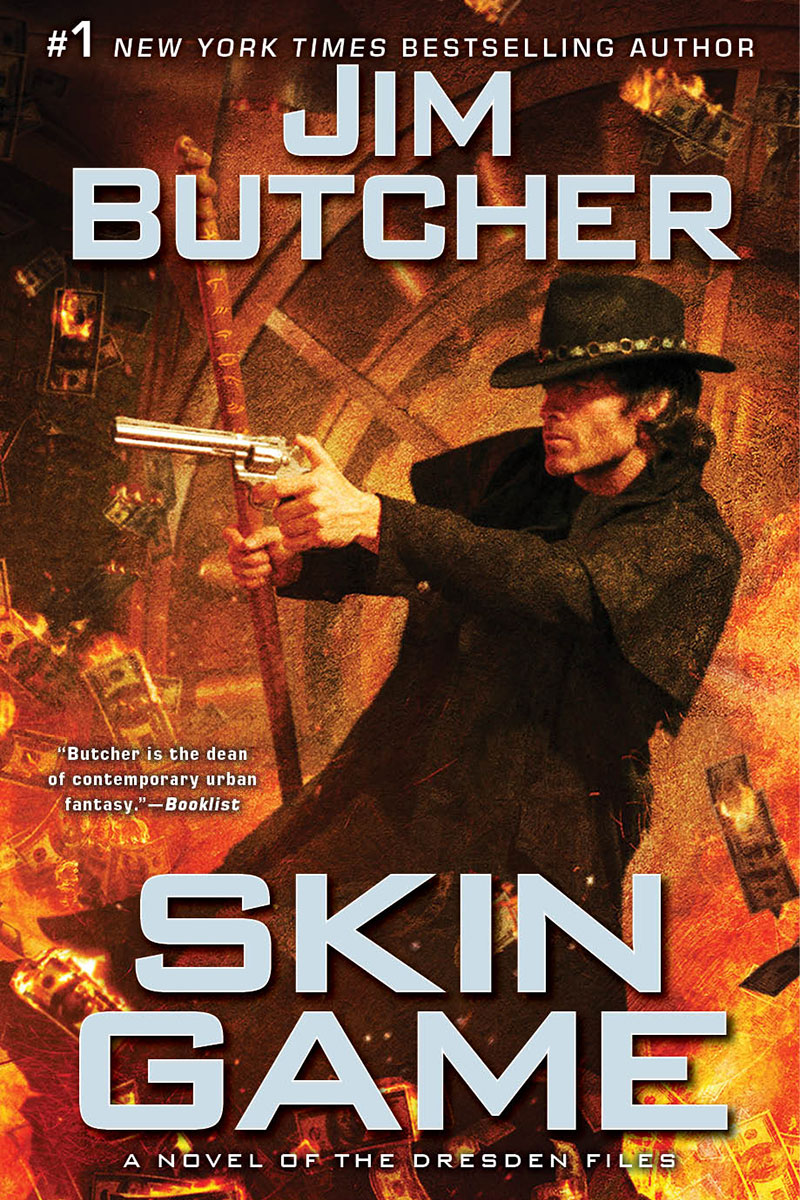
I’ve read lots of book series. I went through a lengthy mystery phase, when I read pretty much every Nero Wolfe book that Rex Stout wrote; I read all the Travis McGee novels of John D. MacDonald — and in both cases I read a few of the knockoffs by imitators, and was unimpressed. I’ve read all of the Wheel of Time, and Stephen King’s Dark Tower series. I read twenty or so of Laurell Hamilton’s Anita Blake books, and every one of the Sookie Stackhouse novels. I read all of the Series of Unfortunate Events, and the Bloody Jack Faber series.

I stopped reading the Song of Ice and Fire after Book 4. Because I won’t put up with that kind of nonsense, Mr. Martin. You publish your books before you make the TV series. At the least, work on both concurrently, sir. I’m using up all of my patience with Diana Gabaldon’s Outlander books; but at least she has to do extensive historical research before she writes each book. You make ’em up, George. I learned from Robert Jordan the risks of waiting too long for a series to end; didn’t you learn, too?

The point is, I enjoy the series. I’ve seen them get better as they go (LOTR) and I’ve seen them get worse (ABVH), I’ve seen them end too soon and too late.

Never — not once — have I enjoyed a series as much and as long as I have enjoyed Jim Butcher’s Harry Dresden books.

It is extraordinary to me that Butcher is able to keep these books as alive as they are. They are nothing but action: generally 400-500 pages, they cover only a day or two, and the entire time is spent in some form of combat, chase, or intrigue. Harry Dresden must be the tiredest man in the imagined universe. And yet, despite fifteen books with the same general outline, they have never gotten boring, nor repetitive; I have never left the edge of my metaphorical seat. The key is that the book is much, much more than action (despite my prior statement): even though Harry never stops fighting, there are many pauses and lulls in between the knock-down drag-out brouhahas, and in these pauses, Butcher has built not only a world and concept of magic that I find as compelling as any I’ve ever read, but also some of the most completely realized characters that I can imagine finding in an action novel. Dresden is not Man-Compelled-To-Fight-By-Need-For-Justice, though there’s some of that, and he’s not Man-Torn-Between-Good-And-Evil, though there’s some of that. Harry is a man, a complicated, flawed, man, both strong and weak, admirable and despicable. (Part of this is the fact that Butcher has had a canvas fifteen books wide to paint this character on. Some of the less prominent but still important characters — Michael, Thomas — are a bit more one-dimensional. But even those sorts of characters have their hidden sides — think of Bob. Mac. Charity.) On top of all that, Butcher has an ability to weave in philosophical sorts of musings, on what it means to be human, to be mortal, to be powerful; to love, to hate, to fight; along with the best sense of humor since Douglas Adams. And his nerd references are a solid 10.0. Funniest thing in this book is when a character starts quoting Monty Python without even realizing it.

The point is, I love these books, completely, unabashedly. I’ll keep reading them as long as Butcher writes them, and cry when he stops. Then I’ll re-read them all.

This book is a heist story. The tension comes from the fact that Harry has to work with his enemies, yet they remain enemies, regardless of any cooperation (Like the Winter Court, though the Fae are not as prominent in this novel.). Some allies come back, out of semi-retirement from the main plotline, which was wonderful; new villains are introduced, who were excellent; there is a fantastic cameo by a god; there is a hell of a plot twist; there is one of the coolest Ascension scenes (When a character becomes something more than he or she was before — like Molly at the end of Cold Days) ever, with one of the best nerdgasm moments of all time.

Best of all? I can’t wait to read the next book. I have to see what happens with Dresden’s daughter.

No: the other one.

Cold Days

Cold Days by Jim Butcher

I wish I could write like that. I don’t know how he does it, but I wish I could write like that.

I can’t, though. I can’t weave together a mix of humor, and moral philosophy, and myth exploration, and — this phrase, though trite, is in this case quite literally true — non-stop action, and somehow make it all come out right, together. I can’t make a story that satisfying, have that many moments when the reader is nodding his head, grinning madly, even fist-pumping while saying, “YES!” Dozens of them. Dozens of moments like that: from the pitch-perfect reference; to the beautifully lucid description of how it feels to love, to hate, to fear, to howl, to weep, to suffer; to the heart-thumping adrenaline-pumping cheer as the righteous defeat the vile, again and again.

If it isn’t clear yet, I love these books. Love them. I love this book. The Dresden series has never let me down, but the remarkable thing is that — even through fifteen books, now, counting the short story collection Changes — it just keeps getting better. I don’t know how Jim Butcher does it, but I hope he never stops. I’ve read this one before, when it came out, but I didn’t remember much of it; none of the denouement. And so it had me, rapt and wild-eyed, as everything came together at the end, with just the right mix of pure victory with surprising defeat to make it seem — perfect. I read this 500-page novel in two days, just as excited about the next chapter as I was the first time I read it; that I remember.

I can’t write like this. But at least I can read like this. And I plan to keep on doing it: Skin Game was published just a couple of weeks ago, and it’s sitting on my shelf right now. I’ll bet you anything it will be even better than Cold Days, as Cold Days was better than Ghost Story. I’ll let you know as soon as I finish it.

Probably be a couple more days, though. I have to go to work tomorrow.


If you liked this book, I would recommend — reading the whole series over again.

And, I suppose, Neverwhere by Neil Gaiman, the Nightside books by Simon R. Green, and the first few Rachel Morgan books by Kim Harrison.

Written In My Own Heart’s Blood. So That’s Why It Took So Long.

Written in My Own Heart’s Blood by Diana Gabaldon

First of all, if you haven’t read these books, stop reading this review: go now and find a copy of Outlander. Seriously. Do it now.

After you’ve read Outlander, fallen in love with this author and these characters and this absolutely lovely series of books, go ahead and read all of the rest of the series, and then come back when you reach the 8th book, which this is. (And while you’re at it, be grateful you’re coming into the series now, rather than doing what my wife did, and discovering Gabaldon when Outlander was first published — 25 years ago. It’s been a long time, waiting for this series to get this close to the end. A very long time. But she still loves it: every book, every chapter. Worth the wait.)

So for those who are caught up, this is a great book. A great one. This one gets back on track, in some ways; there are more moments of joy than heartbreak, which has not felt true of the last few books, but is one of the reasons why I love the series so: because they are lovely, and loving. It’s a true romance, rather than a heartbreaker for the sake of poignancy. And because love is good and great and sublime, there is more joy than sorrow — and though I don’t want to spoil, I will say that there is much more love in this book than just Jamie and Claire.

Of course there are heartbreaking moments. There is more than one death that just tore me up inside. There are frustrating times — particularly with William. Those damned stubborn Frasers. You understand. There is more than one terrifying moment, particularly those associated with more than one life-threatening injury. But this book does the right things, and goes the right places, and I loved it. I would say I can’t wait for the next one — but I have to wait, don’t I?

If I had one complaint, it was this: I always enjoy the historical elements, and the accuracy and detail are remarkable; it’s why I’m willing to wait patiently (Well, somewhat patiently) for the next installment, unlike George R.R. Martin, on whom I gave up years ago. But I don’t think all of the historicity actually serves the story. Gabaldon went to great lengths to make a few real Revolutionary personages true to their historical selves, even quoting their personal papers for their dialogue. Why? To please the seven people in the world who would recognize a genuine Nathanael Greene quote from a false one? I appreciate the realism of the British retreat from Philadelphia, and the influence that has on the lives of our heroes; but do we need every single aspect of the Battle of Monmouth to be on the record? I’m really not reading a history book, here. I do understand that every instance when Gabaldon varies from the truth earns her a dozen irate letters from fanatics; but I personally vote she lets that go, and does more things like name Fergus’s paper The Onion. Which I just got, by the way. These books are not historically accurate: you can tell by the 20th century doctor in the middle of the Revolution. Verisimilitude is wonderful, and I appreciate all the work that goes into making the books feel and sound real; but they don’t actually need to BE real. I’ll love them anyway.
If you like the Outlander series, I would also recommend:
The Bloody Jack series by the wondrous L.A. Meyer
The Fever series by Karen Marie Moning
The Temeraire series by Naomi Novik (Who is not afraid of changing history to include dragons)
Everything by Jeffery Farnol, my favorite historical romance novelist. Check out the pirate books, especially.

Divine Misfortune Review

Divine Misfortune by A. Lee Martinez

I liked this book right from the start. From the very first chapter, when the main human character, Phil, goes looking online — on a divine version of Match.com which is one of the funniest things I’ve read in a while — for a god to worship, I knew this was the kind of thing I love to read. Funny and irreverent, but with just enough social criticism to give it some bite, and something to ground the silliness. Oh yeah: this is definitely a book about a slacker luck god who looks like a raccoon in sunglasses and a Hawaiian shirt, who crashes in your house and orders pizza with anchovies and invites his god buddies over for a party; but it’s also a book about the callous and self-serving way that people treat faith and religion. It’s a book about the way that religion exploits its own worshipers, as represented by my favorite character, Quetzalcoatl — “Just call me Quick.” It’s a book about how having the right credentials, which often includes religion, can make or break your career. And it says some interesting things about all of those topics, which alone would make it worth reading — because the writing is good, the characters are both fun and genuine, and it’s never too heavy nor too light. But when you include the fact that Martinez makes great use of the concept of a luck god, imagining all of the possible benefits of having luck on your side — you find enough spare change to buy a new microwave; should anyone (Say, the bloodthirsty cultists who worship THAT OTHER god) come by to try to shoot you, their guns will jam and then blow up in their hands; that kind of thing — as well as the ups (and downs) of serving a hideous lord of chaos, and the fact that the book includes a goodly amount of smiting, then this book becomes something not only worth reading, but worth telling other people that they should read, too.

You should read this book. It’s a lot of fun. I haven’t even mentioned most of the things that make it amusing and enjoyable: you should check them out yourself.

Are there flaws in the book? Sure. I don’t think the human characters are developed enough; they’re just “regular folks,” there to give the gods somebody to play with or fight over. The final battle was something of an anti-climax, though it does fit the plot perfectly. And as amusing as the pagan gods are walking around in modern America, I think it’s been done better, by Christopher Moore, Kevin Hearne, Neil Gaiman, probably others.

But this book was, for me, a lucky find. I’d recommend it.
If you liked this book, I would also recommend:
Good Omens by Neil Gaiman and Terry Pratchett
The Iron Druid series by Kevin Hearne
Coyote Blue, Dirty Job, Practical Demonkeeping and others by Christopher Moore

Book Review: The King of Messy Potatoes by John Dashney

Messy Taters

The King of Messy Potatoes
John Dashney

You know what? I’m just happy I found this book.

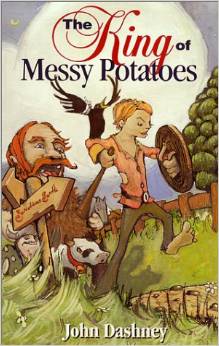
I picked it up at a library book sale. I bought it because the cover image is both sweet and, for me, evocative: a boy marching with stick in hand and shield on arm, with a line of friends and companions by his side: a cow, a giant, a viking, a crow. This is what I imagined as a child. I read Tolkien and Alexander, Lewis and Anthony, and in every case, the story really revolved around the journey: the journey, and the companions. As a fairly solitary child, that was what I wanted. So I had to get this book. Plus: how could you ignore that title? I love potatoes more than I love epic fantasy. If given the option, I would certainly pour gravy on this book and eat it. Who wouldn’t?

For even more fun, the author has written several young adult adventure books, is self-published and small-press published, and this book is signed. It’s perfect.

Now as for what was inside: that was good. I won’t say it was perfect, but it was good — far better than most small-press, self-published authors I have encountered. This book hits a beautiful balance between fantasy and reality, using a frame story about a boy and his grandfather, an aged Episcopal priest and scholar who is writing a history based on Biblical times, a book about the kings of Mesopotamia. Which the boy hears as — Messy Potatoes. (I am proud to say I actually made that connection before I started reading, when I picked up the book and considered reading it next. I am impressed that Mr. Dashney actually had this idea and saw the beauty of it.). The boy asks about it, and though the grandfather laughs, he agrees to make up a story about the King of Messy Potatoes for his grandson.

Then we get the story of Spud. Spud lives on a very special farm, though he doesn’t know it. He doesn’t know much of anything, other than how to grow good potatoes, and that his older brothers are dimwits and the local nobleman is a jerk. But then Spud meets a new friend: a crow, who, if he bites someone and tastes their blood, can speak that person’s language for a full day. This crow tells Spud the truth, and helps Spud to begin his adventures, and pursue his destiny — as the King of Messy Potatoes.

Both of these stories are successful. The frame story of the boy and his grandfather is sweet and heartfelt, and rings very true — especially to me, with my staggeringly erudite and somewhat distant (because eminently dignified) grandmother, who nevertheless loved me dearly. The story of Spud is exciting and amusing and fun to read, and you want to hear both sides of this as you go through it.

It isn’t perfect. There are parts of Spud’s story that are a bit too short, and feel like they’re there just to fill space without really adding anything; the Viking part, for one. The villain is a great idea, but isn’t really pursued completely — understandable, as this is a young book, but still: kids understand evil, and hearing about evil that is vanquished is a good story for any age. Spud is given a dialect that just doesn’t fit and doesn’t make sense, neither for the character nor for the “author,” the Episcopal scholar grandfather. And at the end, I want to hear more of the story of the King of Messy Potatoes, but I never will. Which is too bad.
But overall? I was very lucky to find this book. It made me happy.