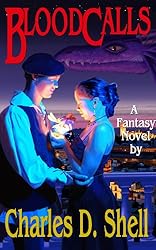
E-Book Review: Blood Calls by Charles D. Shell

Image result for blood calls charles shell

Blood Calls

by Charles D. Shell

(Please note: I was given a free copy of this e-book in return for my honest review. This is it.)


Now that was a fun book.

I haven’t read a ton of independently published e-books; but of the ones I have read, this was without a doubt the best.

It’s the story of two outcasts, a man and a dragon, both the victims of deep-seated and vicious prejudice, who find friendship and solace with each other; until they are finally forced to leave the land of their birth. The man, Corbin, who is a nobleman of his home country of Denza despite being an unwanted bastard with a mother from a despised minority, is given a minor diplomatic post in neighboring Sunal, thanks to the influence of his influential uncle. Corbin and his only friend, the dragon Blood, travel to Sunal, where, if everything goes according to plan, Corbin should be able to sink into relative obscurity, pursuing his twin passions of drinking and womanizing, and perhaps occasionally dipping his toes into diplomacy.

But world events, and Corbin’s heart, have other plans. Corbin finds that the prejudice that he has suffered under for all of his life is nonexistent in Sunal, where the Skuranese, his mother’s people, are accepted. Corbin is able to find friendships (with other men, for once) and even to pursue a woman for more than a roll in the hay. This would be enough changes in Corbin’s life: but there’s more. War is coming to Sunal. War that could threaten everything that Corbin has found there, as well as his homeland, his life and the life of his dragon, and perhaps everyone on the continent. Unless Corbin and Blood can do something about it.

The world-building in this book is top notch. The relationships between the various nations and their people are interesting, and enough historical backstory is given to make it all seem quite realistic. The magic system is done well, with different spellcasters making use of summoned spirits and creatures, or simple control of the four elements, or Frankenstein/steampunk creations made of living creatures mixed with machines. There are some unusual elements in the magic system that were very intriguing – like sonomancy, the use of sound for magic and also as a weapon; Shell was also able to reflect that form of magic in the society that makes use of it, which was a thoughtful and effective choice. The military aspects of the war – which is told not only through Corbin’s experiences, but also from the point of view of an officer of the aggressor nation of Gurein, which is trying to conquer and consolidate an empire, no matter what the cost – are as good as any military fiction I’ve read. I did wish there was a map, a visual aid that I have always found both interesting and useful in books like this; hopefully the author, with his arts background, will be able to provide one in future books.

The book isn’t perfect. I thought the romance was a bit haphazard: Corbin has never been anything but a womanizer, and though it makes sense that he’s never had an opportunity to be anything more, he jumps from that habit to a pursuit of true love a little too easily; he also settles on the object of his affection without much more inspiration than Romeo and Juliet, and though I love the Shakespeare play, I don’t really believe in love at first sight, especially not when it is turned into a chivalrous courtship, as this one basically is (though not entirely, I hasten to add). The dialogue and banter between the characters is often amusing, but much too close to our own society, using slang and colloquialisms that don’t make a lot of sense in world that isn’t ours; hearing a man from Denza call his telepathic dragon a “smart-ass” sort of took me out of the fantasy. (Also, maybe it’s me, but I want fantasy books to have fantasy names; though most of the main characters do, there are side characters with names like Jerry or Terri, which again kind of burst the bubble.) I didn’t like the character of Dante Firetongue, who is a newspaperman straight out of modern comics – he even refers to a good story as a “scoop” – and who never really settles on a personality, leaving us guessing whether he’s a shallow, selfish bastard or a good guy with a high defensive wall around his heart. I also thought Blood, the dragon, who is a good guy with a high defensive wall around his heart, was just too much of a jerk sometimes, when I wanted him to be lovable even when he was being sharp-tongued.

However, none of these things are the heart of the book. The heart of the book is the characters learning how to live together, accept each other, and protect what is truly worth protecting. That, the book does extremely well. There is good action, good suspense, and good humor throughout; and I enjoyed the ending as much as I enjoyed the beginning, which is the sign of a good novel. I’d recommend this book for fantasy fans, and I plan to see what else Mr. Shell has to offer.
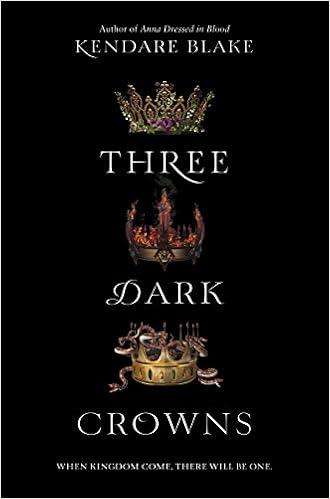
Book Review: Three Dark Crowns

Image result for three dark crowns

Three Dark Crowns

by Kendare Blake

This book got me. Got me good. If we had been fighting a duel, I would have bowed my head, said, “Touche,” and apologized for however I had given offense. And then probably applauded my honorable opponent for the impressive victory.

And then the next thing I knew, I’d be flat on my back, completely stunned, looking up at the book smirking over me, hearing the onlookers making shocked noises at how badly I had been slammed. Because just when I thought the book was done – it wasn’t done. It was just setting me up for the knockout.

All right, enough metaphor: let’s just get into it, shall we?

This is a young adult fantasy novel, one with young female protagonists and a fair amount of romance and social drama – friendships being made and broken, trusted advisors turning traitor, and so on – and so it would most likely appeal to young female fantasy fans. But I am only one of those things, and I enjoyed reading the book, so don’t let me pigeonhole it: it’s a good fantasy novel. It’s the first in a series, so it’s setting up the world and the long-haul plot; both are interesting. The world is based around a magical island, hidden by mists and guarded, so the people believe, by a goddess. This goddess creates a new group of potential rulers for the island once a generation, and that group is always the same: a set of triplets, all girls, born to the previous queen.

The difficulty is that only one of the girls can become queen.

The other two have to die.

The other key factor here – and honestly, the part of this book I had the most trouble with (Other than the portrayal of a couple of the teenaged boys, who were idiots or cads, but I’m not going to complain about that because Lord knows there have been more than enough fantasy novels where the female characters are the crappy ones, and it’s certainly not all the guys in this book who are twits; just two, one idiot and one cad. I’ll just shut up and take my lumps.), because it doesn’t work terribly well – is that each of these triplets has a magical power. There are three main magical powers on the island, grouped into houses; whichever house has the triplet who wins the crown becomes the ruling council for the length of her reign. The three powers are: elemental control, animal telepathy, and – poison.

Look, I don’t mean to be one of those comic book guy, gaming fantasy nerds who complain about a fantasy world being not as good as, say, Tolkien; but this honestly felt off to me. The animal telepathy I’ve got no problem with; there’s not an epic fantasy story in the world that hasn’t made me want to pull a Doctor Doolittle. I want to speak to the Eagles like Gandalf, and run with the wolves like Perrin Aybara, and communicate with dragons like Daenerys Targaryen. So that power was great. The elemental power seemed overbroad, because that queen can do everything: she can bring storms, she can bring earthquakes, she can dance wreathed in fire. And on the other hand, the poison-powered queen can, umm, eat poison. And not die. That’s it. Seems lame in comparison. Also not terribly useful in a magical duel to the death. So I admit, that bugged me a little, particularly because the story is about these three girls approaching the age when they are supposed to start fighting over the throne, meaning they have to kill each other; and really, what are the odds here? The animal telepath can control animals and send them to kill her sisters, and the elemental sister can bring fiery wrath from the skies; the poison sister can – not die while she eats poison. I really couldn’t make that work well in my head, and so it was a bit of a stumbling block.

But here’s the thing: apart from that, the story is great. The girls have different power levels, which means some of them expect to die and others expect to kill their own sisters; and neither is a good place to be. That tension is very well done. The desperation of the weaker sisters to find some way to make their powers sufficient to survive and even kill, that’s also well done. And all of the intrigue, the social interactions, the boys hovering around them trying to become the consort of the next queen (which also means they have to bet on who’s going to win this fight), that was very well done. I liked all of that. I liked all three of the sisters’ characters, even though they’re all entirely different. I was trying to think of a way out of the conundrum they were in, and regretting that I couldn’t; that’s a sign of a good piece of writing, when it leaves the reader looking for a solution to the conflict.

But then: then it got me. At the very end (and no spoilers), an event happened that I pretty much expected, though the means of it was a surprise. But it turned out to have a twist, which I really didn’t expect; Blake set this plot up so well that I was genuinely thrown when the twist happened.

BUT THEN THERE WAS ANOTHER TWIST! Completely unexpected, totally out of left field. And that one, hooooooo BOY – that was the one that knocked me on my ass. But it was great, because it also changed the way I saw the book I had just read: I went from thinking it was okay, to finding it much more interesting once I had this new piece of information. And the best part about it was that it set up a whole different expectation for what would happen in the second book, which means that, of course I have to read that one, now.

So this was a good one. I will want to read the sequels before I recommend it entirely, because I’m not going to recommend a fantasy series that doesn’t end as well as it starts; but this was definitely a promising beginning.

Helma: Tros Book II

Image result for helma talbot mundy

Helma (Tros Book II)

by Talbot Mundy

**Spoilers for the first book here**

The sequel to the epic historical fantasy TROS! OF! SAMOTHRACE! (Emphasis added, but, I think, implied.) is a good book: except it has completely the wrong title.

One nice thing is that this one picks up directly after the first one leaves off; like only minutes have gone by since last we left Tros, sailing back to England from Gaul, having managed to get his father away from Caesar’s legions. He arrives back near Lunden (Don’t judge me, that’s how they spell it) with his men ferociously mutinous because several of them were killed by Romans, and yet they came away with no plunder at all, and therefore no glory, which is the only reason they went on the voyage in the first place. Now they arrive back home, and find that Norsemen have come to raid England, and they see their opportunity to fight for glory and plunder. Tros has a hell of a time trying to fight them and keep them in line; he is only moderately successful, and finally his ship joins the combat against the Viking raiders. Tros, being Tros – or, pardon me, I mean TROS! OF! SAMOTHRACE! – wins his battle, and in the process, wins possession of a troop of Viking warriors when he defeats their leader in single combat. He also takes one of their longships as his own new vessel, the tub he sailed to Gaul having given up the ghost in the fight.

Why am I telling you all of this? Because, you see, the sister of that Viking war leader is – Helma. Over time, the Vikings come to serve Tros willingly, and he puts them in charge of building his new ship, his dream ship; Helma, he marries.

I feel I can spoil this because – there’s no point to it. At all. The romance is awkward and barely present at all in this story; Helma is a decent character, but really she’s a means to an end: the Northmen can’t speak Tros’s language, and Helma is the go-between for Tros and her brother. I suppose we are to see her as the perfect loyal woman, but there’s a much better example in this story: Fflur.

The main plot of this one has little to do with Caesar, though he is the snake in the grass behind most of the intrigue, the prime mover of the betrayals and infighting that fill this book. Caesar has sent agents to corrupt and break apart the British tribesmen, and they are, sadly, very effective; this book made me dislike several of the British tribesmen I got to like in the first book, as well as Conops, Tros’s main lackey, who disapproves of Tros’s marriage to the blonde Valkyrie. The worst casualty here is Caswallon, the king of the British tribe that Tros is allied with; he is a hero in the first book, and nearly Tros’s equal in importance and coolness, but in this book, he’s just a pain in the ass. His wife, Fflur, still rocks, and that’s why I don’t think Helma was necessary; she doesn’t add anything to the story that Fflur hadn’t already brought, other than she is married to Tros, instead of Caswallon.

Overall, the action in this one was still great, but the intrigues and the plot and the character development weren’t as interesting. I really want Tros to finish his ship and just sail the hell away from Caesar and all of this; I know Caesar is going to conquer Britain (Because that’s what happened, and Mundy was trying to stick to history with the Romans), and so I want Tros to try to circumnavigate the world, the goal he expresses in this book. I didn’t see the point of Helma, really didn’t see why Mundy named the book for her; this makes me both eager to read the third book, and also leery – as it is named for another new female character. Well, we’ll have to see, won’t we?

Mattimeo: Redwall Book III

Mattimeo

by Brian Jacques


The third book in the Redwall series – and I’m a little concerned. Because this was the first book of the three that started to feel formulaic.

It wasn’t, not entirely; Jacques was wonderful at creating characters, and he introduces half a dozen new ones – a young otter who was hilarious, a heroic badger whom I enjoyed very much, a kite that had a wonderful alien feel to him, as well as a new generation of Redwallers and, of course, new villains. The first book focused on the battle for Redwall, the second on the battle that led to the rise of Redwall; this one goes outside of Redwall for its main conflict, though there is a second conflict that happens within the Abbey walls. The combination was effective, because it made it easier to maintain suspense for the entire book in both plotlines, and that was good. I also have to compliment Jacques for being unafraid to kill off his characters: there was a whole group of Redwall creatures who were wiped out in this book, and though I hated that it happened – this group were some of my favorites – it does show that the characters we enjoy aren’t safe, and I think that is a necessary tension in a long-running series.

But: Matthias is essentially indistinguishable from Martin the Warrior, and so for all three books now, we’ve had a heroic mouse swinging a big sword to save the day. His son, Mattimeo, becomes more like his father over the course of the book, so I worry that the trend will continue. The old abbot is the same, as well, as is the mighty and cantankerous badger; Jacques even added a second badger (though I liked the new guy – he carries a giant battle-axe) so there could be a badger in both plotlines. The villains are stoats and weasels and rats, and they are exactly alike in every way; Basil Stag Hare, though I love his character, changes not a whit from the first book to this one. You have the fight for control of the Abbey, and the quest outside of the Abbey for the key that will win the main fight – a plot that also happened in the second book, as Martin went off in search of the great sword so he could win the battle against the cat queen. There’s a lot of talk about food, and a lot of mooning over adorable baby animals (Not that I’m against baby animals, but I prefer actual fuzzy puppies in front of me rather than narration and description.), and a secret within the Abbey that tells the animals what they need to know, all of which happened in the first and second books. So it made me a little wary.

Now, the villains in this were great: the fox who leads the raid on Redwall and kidnaps all the younguns for enslavement was a good character, as was the corrupt and decadent despot who plans to buy the slaves. The final battle scene regarding those slavers was truly epic. The assault on Redwall was honestly a little more annoying, but the villains there were new and more interesting, with different strengths and weaknesses than the usual weasels and rats; and the twist that made a Redwall victory possible was really neat. Reminded me of Hagrid’s brother Grawp from the last three Harry Potter books.

Overall, there were enough new things, and enough things that Jacques has done well for all three books, to make me enjoy this book; I did, quite a lot. I will definitely read the next book, as well. I’m just – a little concerned for the series as a whole, that’s all.

Book Review: The Mighty Swordsmen

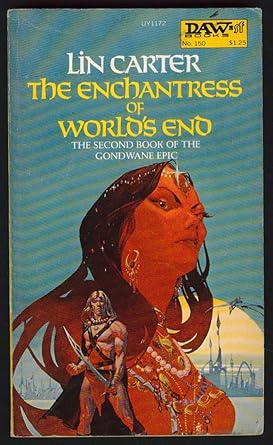
Isn’t that beautiful? Interesting how the men are in greater detail than the women, who are graphic and one-dimensional. Maybe there’s a reason for that . . .


The Mighty Swordsmen

Edited by Hans Stefan Santesson


A collection of Mighty Warrior swords-and-sorcery stories, this was like most of its kind: a couple of good ones, some that were okay, and a couple of stinkers.

The stinkers were “Break the Door of Hell” by John Brunner and especially “The Keeper of the Emerald Flame” by Lin Carter. The Carter story was too painfully derivative of Conan stories to be worth reading – though I admit I like the name Thongor – as well as too long and plodding, and the bad guy at the end was completely lame. The John Brunner story had some good bits: the concept is Ahura Mazda, the evil deity of Zoroastrianism, wandering Earth and granting people their wishes – which immediately makes those people regret their wishes. Some of those evil wish-grantings were great. The main city that Mazda goes to torment – and he sees himself as merely acceding to people’s wishes, not in any way working evil, and he’s probably right – has a great number of noblemen who would be sorcerers; they start casting their mojo, and even though they don’t really know what they’re doing, Mazda makes it so that their spells actually work: to their unspeakable regret and torment. That part was pretty fun, but also a bit repetitive; and at the end, the twist just irritated me. Bad story, overall.

The mediocre ones were the Elric of Melnibone story, “The Flame-Bringers,” and one of the two Conan stories, “The People of the Summit” by Bjorn Nyberg. The Elric story was actually fine, but exactly like every other Elric story I’ve ever read: he goes questing with Moonglum, brings out Stormbringer even though he doesn’t want to, chops up some enemies and eats some souls, and then calls out the damn dragons to save his bacon at the end. The one Conan story was also fine – better than Thongor – but it was overshadowed by the one that finished up the collection.

That last one, “Beyond the Black River,” along with the Roger Zelazny story “The Bells of Shoredan,” was by far the best. The Zelazny story was about his Dilvish the Damned character, who’s cool to begin with, and this was, for once, a self-contained story, with a good twist, and Zelazny’s usual beautiful prose and wonderful atmosphere. The last story was Conan as written by Robert E. Howard, and seeing that story along with a Conan by a different author, and the cruddy Thongor knock-off, really drove one point home: Robert E. Howard was a hell of a writer. That last story is the longest in the collection, but also the most exciting; Conan is the ultimate badass, and yet he is the most human and believable hero in the bunch. If you can find this collection – unlikely, as I picked up a faded copy with the cover falling off at a Goodwill in town – then it’s worth getting just for the Howard story. And the sweet 1970 pulp fantasy cover art. Good stuff.

Book Review: Lloyd Alexander’s Westmark

Westmark

by Lloyd Alexander


I grew up reading the Chronicles of Prydain by Alexander, and I only discovered as an adult that, in fact, the man wrote several other books. It’s been a lot of fun discovering and reading those other novels, even though it makes me feel kind of dumb that I didn’t already know about them; after all, Alexander won two National Book Awards and was nominated for four more, so . . . I guess everybody but me knew about his broader legacy. I would like to blame my parents for not telling me about Alexander’s other books. And also Piers Anthony, who so captivated my youthful love of fantasy that I read every single one of his books. Including his genuinely crappy autobiography, Bio of an Ogre.

Blame and castigations aside though, this is a genuinely good book. It is more adult than the Chronicles of Prydain: it really only belongs in fantasy because it’s Lloyd Alexander. He never writes with too much magic, but this book has none; rather, it has – politics. It’s about a printer’s assistant, Theo, who goes on the run after his master Anton is killed by the military as part of an attempt to control the press. The printer’s assistant hooks up with a con man and snake oil salesman who is a mixture of Shakespeare’s Falstaff, and the King and Duke from Huck Finn; he’s a big, bombastic, lovable rogue who makes no bones about the fact that he’s in it for the money and will tell whatever lies he can in order to get it. He’s a lot of fun and he makes the book a lot of fun.

It isn’t all fun and games, though: the fear and anger over the printer’s death and the subsequent flight are quite serious. Theo eventually parts ways with the con man and joins up with a group of intellectuals leading a rebellion, who are a great set of characters; the last third of the book is a quite realistic portrayal of the beginnings of a revolution, including Theo’s efforts to print anti-royalist pamphlets as his own efforts to free the people. Yeah: definitely not a simple children’s book.

The book leans more fantasy in the royal aspect of the politics: although there is a definitely historical feel in the elements about revolution, the causes of the nation’s oppression come straight from a fairy tale. The king is bereft and despondent to the point of uselessness over the death, several years ago, of his beloved only daughter. An evil counselor – I definitely think of Jafar from Disney’s Aladdin, or Flagg from Stephen King’s The Eyes of the Dragon – has taken over running the kingdom, and is trying to consolidate power for himself, becoming a tyrant in the process. He is overcome not by the revolution, but by the direct actions of our hero, who essentially saves the day – though there is a twist I won’t give away.

It’s a good book. The characters are well-drawn, as is the setting; the plot is a little haphazard, which I think is because of the mix of fairy tale and historical novel, but it isn’t hard to follow. And the other reason for the somewhat complicated course of the story is: this is the first book of a series of three. So there are seeds planted here, paths started but not taken to their ends, because there is more story to tell.

I’m going to try to find the other two books. I recommend this one.

One last note: the biggest downside of this book, for me, was honestly the cover. I hated this image, and the way it depicted the characters, so much that I tried not looking at it while I was reading the book, and even now I can’t stop thinking bitter thoughts. Yech. But of course, don’t judge this good book by its crappy cover.

Book Review: The Enchantress at World’s End

The Enchantress at World’s End

by Lin Carter

Book 2 of the Epic of Gondwane, the tale of Ganelon Silvermane!

What ho, faithful companions! Fetch yourselves nigh to my heaving bosom, my bated breath, my excitement-tautened sinews, as I whisper the thrilling tale of the Construct, brought to quickening by the unfathomable will of the unknowable gods in the mist-shrouded halls of the future! He is Ganelon Silvermane, wielder of the Silver Sword, boon companion of the Illusionist of Nerelon and of Xarda, the Knightrix of Jemmerdy: together they will escape the mad city of Chx, defeat the grotesque Death Dwarves, the anti-life minions of the titular (pun intended) Red Enchantress, whose luxurious and tempting clutches they will slip through – only to find themselves in ever-greater peril! Zounds! What will come next?!

The best thing about this book, and the first one in the series, is that it’s all written pretty much like that. Breathless purple prose, ultimate pulp fiction. I thought there were some moments in this one where Carter slipped a little; he tried to make Xarda speak in even more archaic knight-errant language, but it didn’t really seem any different from his own narration, and so her self-conscious noticing of her own odd speech seemed – well, odd. There were also a few places where he crossed the line between fantasy and modernist fiction: he has a character, an ancient dragon who has existed (and hoarded treasure) since the dawn of time, reference some of the great swords of fantasy books past, including Orcrist and Sting and Anduril, and the twin swords Stormbringer and Mournblade; this was cool in that I know the books those swords came from – and a little weird in that the character in the book I was reading knew the books those came from, which felt off. But then the dragon also references ancient tales like Beowulf and the Ring Cycle, and the Bible’s Garden of Eden, and I thought: well, if the Bible can be part of ancient lore, why not Tolkien and Moorcock? So it wasn’t too bad. But it did jar a bit.

On the plus side: lots of action, lots of swashbuckling and derring-do, lots of bizarre names (Carter’s specialty, I think) and weird creatures and strange societies. Carter had a fertile imagination, and he chucks it all over the place in this book. There is an absolutely hilarious chapter when the Red Enchantress, a buxom seductress of the first order, attempts to tantalize Ganelon with her wiles; unfortunately, while Ganelon has the perfect physique of a god, he has the mentality of a bright 8-year-old, so the Enchantress’s wiles fail entirely to wile him, to her murderous frustration. There are definitely some silly parts – the Bazonga-bird, a goofy idea with a goofy name and a goofy character, springs nimbly to mind, and drags with her parallels to Jar-Jar Binks and, I dunno, Carol Burnett – and some moments of questionable writing; but it’s a fun book, just like the first one. I’ll read the next, too.

(Psst! Hey, want to read another time-traveling-fantasy story? Check out my serial about a 17th century Irish pirate who travels to the modern world! The Adventures of Damnation Kane)

On the Eighth Day of Blogging, Just Dusty Blogged for Me . . .

…A book review from Purgatoryyyyy!

A quick word: though I have said a lot about the uselessness of New Year’s resolutions, I’m still going to  make something akin to one. Because I’m not against promises, just against them being attached to January 1, and the promise I’m making has little to do with that, as it isn’t bounded on either end by 2017. But the promise is this: books. This year — and beyond — will be about books. I have a book to finish writing, and two books to publish, and at least 100 books to read, before another year has passed. This book is the first of this year, though I started it last year, and don’t actually care what year it is. Point is: books. Lots and lots of books.

This was a good place to start, if starting is what I’m doing.


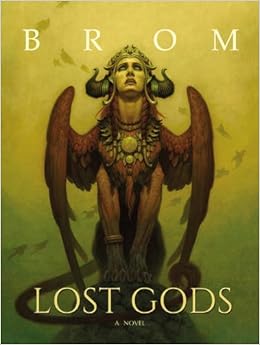
Lost Gods

by Brom

This is the fourth book I’ve read by the illustrator Brom – the other three were The Child Thief, The Devil’s Rose, and the unforgettable Plucker – and I feel about this one much as I felt about the others: Brom has an incredible imagination, a good ability to tell a story, and a thorough obsession with blood and gore and hell. I still think he should stick to the illustrated novels, though, because The Plucker is by far his best work, including this one.

This is a good book. It’s a fantastic cosmology, with Brom following in the footsteps of Jim Butcher and Kevin Hearne and others, finding a way to unify ancient mythologies with the modern monotheistic religions; in this book, set largely in Purgatory/Hades/The Underworld, the idea is that the One Gods (And maybe my favorite word play in this book is that one: the plural “gods” after the number “one”) have taken over from the ancient pagan gods and driven them into the Underworld, where all souls go. There the gods have continued their ways, trying to draw worshipers and maintain their own power and glory, but still losing out to the modern religions and to ambitious and godless men.

Enter our hero, a man with a mission: to save his wife and child. Whatever the cost.

I don’t want to give away more than that – don’t even want to tell you which character is actually the hero, because the first impressions you get, from pretty much every character, are wrong. That was the best part of the novel, for me: the underlying idea that nobody can be taken at face value, neither good nor evil. That was done extremely well in this book, and it kept me guessing all the way. Kept me reading, and enjoying it. There are characters to root for, and ones you hope will be destroyed; many of them end up exactly where you want them to, and it is satisfying. But there are also some that make you change your mind: first you want them to fail, but then you want them to succeed; some of those resolutions were actually the most satisfying.

Other than that, the world-building was great, as I said, and the visuals are brilliant at times: Brom doesn’t always have a great gift for describing things in detail, but the pictures he imagines, and then puts into words, are stunning. It’s why I wish he’d stick with illustrated novels, because when he paints those visuals, then the whole story is elevated to magic. Fortunately, this book has a set of full-color plates, illustrations of the demons and gods in the Underworld, which are beautiful. Combine that with a good fantasy world, a good story, lots of action and violence and blood and gore, and with interesting characters, and this is something worth reading. (And spend the money for the hardback: you want the illustrations full-size. Don’t know what they’ll be like if there’s a paperback. If you find it in a store, check: they’re inset about two-thirds of the way through the novel, in a group. Not necessarily the best part of the book — it is a good story — but they are a necessary part of the book.)


In his acknowledgments at the end, Brom says a wonderful thing while thanking his editor for helping him put this book together. He says,
“When I started writing this novel I never stopped to consider the logistical challenges of my idea. I, like so many creatives, don’t have time for such silliness. I needed to plunge in, chase my muse before she slipped away. I did not realize until later that in order to make my particular vision of purgatory believable, I would need not only to invent an entire history, a system of government, a political/social structure for both souls and gods, tie it into all religions, add some kind of monetary system, define magics and spells and powers, but also to invent a physiology for the dead, figure out if souls eat, drink, and if so, what. Can the dead die? If so, how? And, as with most mysteries, answering one question often leads to ten more.”

He’s never been more right. And he’s done a good job of this with Lost Gods. I recommend it.

On the Third Day of Blogging, Just Dusty Blogged for Me — A Book Review of Maguire,Gregoryyyyy!

After Alice

by Gregory Maguire


(If you don’t know: Gregory Maguire writes new novels set in classic fantasy worlds — Oz, mostly, but this one is in Lewis Carroll’s Wonderland.)

So the thing with Gregory Maguire seems to be: you have to absolutely love the original.

The man writes an excellent homage. I’ve read Alice in Wonderland and Through the Looking Glass, and the style and feel of this book is remarkably similar. He has the same imaginative twists (though not as many), the same absurdist humor mixed with Victorian understatement, the same satire of upper class manners and fashions, and of everything else that the author can think of. The writer’s voice is an excellent imitation, and I mean that as sincere flattery.

But I don’t love Lewis Carroll. I think the man was brilliant, and what he wrote was a watershed that led to Douglas Adams and Monty Python and Mel Brooks and Christopher Moore, all of whom I love or have loved – honestly, more than Carroll. So while I’m grateful for the existence of an Anglican mathematician with more imagination than either of those descriptors would imply, a whole world of imagination, I’d rather read (or watch) the others than him.

Consequently, I’d rather read them than Gregory Maguire.

I think this book also suffered for being too much outside of Wonderland. I mean, really: that’s the point of Carroll’s books. That’s why they’ve survived and are still beloved enough for Maguire to turn his hand to them. And half of this book by the chapters, and more than half of it by the pages, is set in Oxfordshire in 1861, following around Alice’s and Ada’s families as they search for the missing girls: and though Darwin is present, no time at all is spent with him; all that happens is that his old man’s needs – for help to the privy, to leave early – screw the day up for everyone else. Everyone else is just as annoying: it made me understand completely why Alice would want to follow a white rabbit down a hole, and why the heroine of this book,Alice’s friend Ada, would want to do the same.

If the book was just Ada in Wonderland, maybe finding new places and people rather than just following in Alice’s footsteps, I think I would have liked it more. But the Wonderland stuff was less about imagination and more about following a path, and that made it less interesting than the original. As I said, if I dearly, deeply loved the original, I’d probably like this book just for the sake of going back there again; but I didn’t love the original, and so I didn’t really like this book.

Well done, just not interesting.

Book Review: Too Many Curses

Too Many Curses
by A. Lee Martinez


This book was a surprise for me. I’ve read three or four by Martinez before, and he writes a pretty good wacky/funny fantasy. I expected this one to be the same.

And there are some elements of wacky/funny fantasy in here: it is the story of an evil wizard, one who spends his long life seeking more power for himself, which he then uses mainly to unleash his cruel vengeance on anyone who irritates him. His victims then live in his castle, transformed into mice, into decapitated animated skeletons, into nothing but an echo.Some of the curses are loony and silly and fun, and so are some of the characters living with those curses — a hero turned into a fruit bat, the wizard’s mother transformed into a clinging ivy plant while his brother occupies a small jar, reduced to nothing but a few body parts floating in goo, a banshee that can only materialize to give dire warnings, so she stretches the meaning of the word “dire” in order to materialize as often as possible, whereupon she moans hideously, “Yooooouuu’ll stub your TOOOOOOEEEEEE!” And so on.

But the main character is the very opposite of wacky. She is serious, and she is a genuinely good protagonist — both for the story, and as a person. Nessy the Kobold takes care of the evil wizard’s castle; that is her task, and she does it well. When things go wrong with the wizard, it is up to her to take care of things, simply because there is nobody else who can. Fortunately, Nessy is good at taking care of things, and she does the best she can with her limited abilities.

It’s a good story. There are some nice twists. I was a little disappointed with the revelation of what’s behind The Door That Must Not Be Opened, but the secret of the castle itself, and of Tiama the Scarred, and the final fate of the wizards in the story, was most satisfying. I loved Sir Thedeus (He’s the fruit bat), and the monster under Nessy’s bed who just wants her to read him stories every night. And I really did love Nessy, both as a character and as a protagonist; I agree with the message she presents to the reader, which is basically the same message from Tolkien’s Lord of the Rings: heroes may be small, but it is the small, good things that we do which make all the difference in the world.

Good book. Recommended.