
This year, for the first time in my 23-year teaching career, I am teaching an elective.
I’ve taught required electives before; I teach one of those now, and have for several years — seven, I think? The required elective is one of those unique artifacts of the modern education system where the least important factor in making educational or pedagogical decisions is “What the student wants.” So when the school determines, as it is wont to do, what the student NEEDS, frequently those needs take precedence over students wants; and so College Readiness, a course designed to help students explore and apply for college, and (MUCH more important from the school’s point of view) also prepare for the high stakes tests that are sometimes (Less and less often these days) required for admission to competitive institutions, takes the place of one of the students’ “elective” courses. Willy-nilly. Hence, an elective that wasn’t chosen, but was rather imposed, but which only earns the student elective credit: so they still need to take four years of English, three years of science, three years of math, and so on. This hasn’t mattered all that much in past years, at my current school, because we don’t offer very many electives; students end up taking another computer class, or a second (or third or fourth) year of PE, or if they are seniors, they can take a reduced schedule of classes or become a TA. But if they are juniors, they take College Readiness. (In past years I have taught English Support, which did the same thing, parasitizing the students’ schedules because the school decided they needed more English in addition to the four years of required English. That was not a popular class. It was not fun to teach.)
This year, though? My elective is Fantasy and Science-Fiction. Which I chose to teach and suggested, and for which I get to pick everything we read and everything we do, with no limitations beyond what my students are willing to do; because the class isn’t even an English credit — it’s only an elective.
I took a similar class — mine was called Mythology, Folk Tales, and Science Fiction — in high school, and it was one of my very favorite classes. I’ve always been a fantasy/sci-fi nerd, as I’ve written about EXTENSIVELY in the past; I loved that I got to read books that I would have read on my own, except this time I got to discuss them in class, and get credit for doing homework about sci-fi novels. It rocked. I’ve wanted to teach this class for 20 years. This year, thanks to my new administration, I finally got the chance.
And if you think I let this opportunity pass without requiring students to read J.R.R. Tolkien, well. You haven’t noticed my first name.
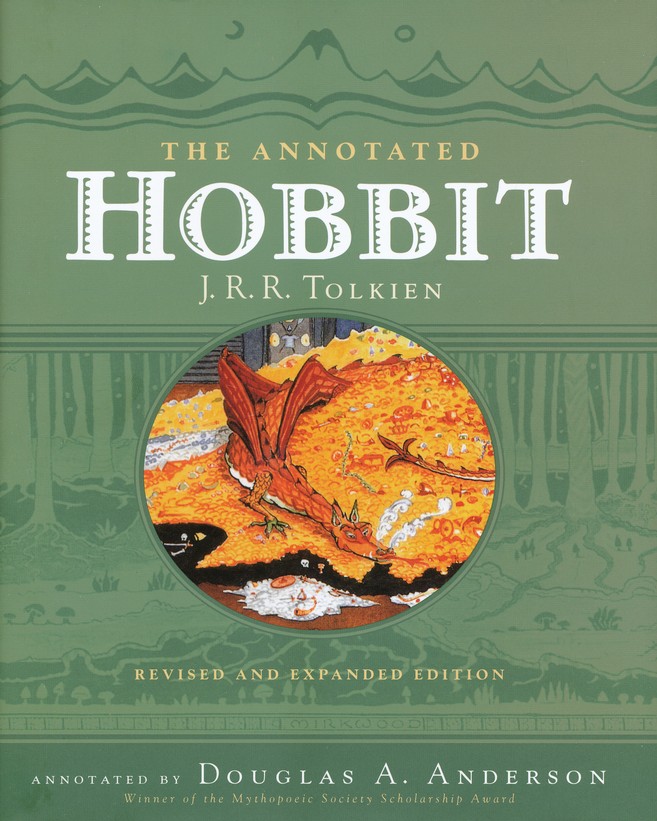
So because I am requiring my students to read The Hobbit, one of the two books most responsible for creating the modern fantasy genre (The other is The Lord of the Rings, and yes it’s one book, shut up), I got the school to buy me this annotated copy of this incredible work, so I could learn maximum nerdish trivia to share with my students. We just barely started reading the book in class before Spring Break came this week; so I was a little behind, because I only finished reading this yesterday.
The headline is that I’m glad I got it, and I would recommend it to big Tolkien fans or to others teaching The Hobbit, for one simple reason: Anderson includes all of the art he could find. Including these:


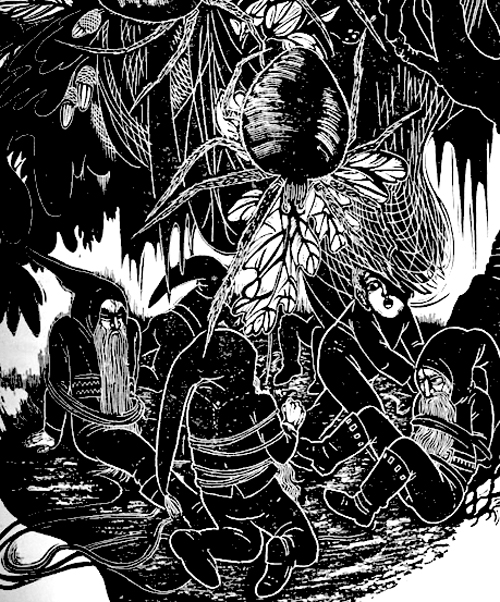


I actually did not know that Tolkien had created all of the original illustrations for his book, and I loved seeing those even more than the kitschy and strange and intriguing international versions; Anderson includes far more of Tolkien’s art than is present in traditional editions of The Hobbit, because he includes sketches and different versions of the finished pieces, along with the usual images in both color and black-and-white. The art alone makes the book worth it, in my opinion.
/https://tf-cmsv2-smithsonianmag-media.s3.amazonaws.com/filer_public/8d/0a/8d0a1e50-ca73-4db7-87d8-41dd2bc7c1f8/bilbo_comes_to_the_huts_of_the_raft-elves__the_tolkien_estate_limited_1937.jpg)
Along with that, Anderson includes quite a few of Tolkien’s poems, published in other places and at other times than The Hobbit; those were also wonderful, though honestly the art and the poetry distracted me from the actual text, so I don’t know how successful it all was as an annotated edition of the novel. It does have quite a bit of info, some of it interesting, so that was valuable, as well. Anderson shows where Tolkien got the inspiration for his fantasy creatures, including their names; he includes several pieces of Tolkien’s letters that explain some of these factoids, and in other cases, he was able to extrapolate from works that Tolkien was known to have read and enjoyed, and sometimes said he was inspired by; I liked reading all of that, too.
What I really didn’t care for, and thought there was too much of, was the repeated attention paid to changes in the text from edition to edition. Some of it was somewhat interesting: because Tolkien wrote The Hobbit first, and only after it was published did he realize he needed to make this story work with The Lord of the Rings; so there was some need to change some details in The Hobbit, to reconcile them with the details in the subsequent work. The travel from The Shire to Rivendell, for instance, takes several days longer in The Hobbit than it does in The Fellowship of the Ring; that one stayed incongruous, but other details like the story of how Bilbo found the Ring and got it from Gollum, those were changed. But most of the notes that showed changes in the text? They were when Tolkien or one of his editors found a typo.
Let me be frank: JRR Tolkien is my hero. I love his books inordinately. I know I could never aspire to accomplish what he accomplished, but by god I will always admire and appreciate and laud what he did accomplish: and I could not care less that he missed a comma, or used “was” instead of “were” and then caught it only after the book was published. It humanizes him for me, to know that even Tolkien made mistakes — and then cared about them, and had them changed in future editions — but I don’t actually need to see what is inside the sausage, thank you very much.
Just show me all the Gollums.



Beyond the art, and the poetry, and the frequently interesting and useful trivia about Tolkien and the history of the novel, the most important thing in this book is: the story. I’m assuming at this point that most people are aware of the story of The Hobbit, but let me just take a moment to talk about it.
First, it isn’t what you see in the movie version. The Peter Jackson movies do half of it right, and half of it very wrong (They succeed with the epic end, but fail utterly with the fairy tale and the travel work — also, they left out Beorn, which is just lame as hell); the Rankin and Bass animated movie does a little bit of it right (Mostly Gollum and Bilbo, and I personally love the songs) and a whole lot of it wrong; and though they are going to be creating more Middle Earth movies and content, nobody is ever, ever going to capture what Tolkien was able to do with this novel. Second, please understand, if you’ve never read it before, that this book is not like other fantasy novels — not even The Lord of the Rings, which is pretty much the standard for epic fantasy, in my mind — and that there are no other books quite like The Hobbit. Part of that is me putting historical weight on this novel, because it was the only book of its kind when it was written, which is made clear by the annotations in this edition; but part of that is just the truth. Nobody will ever write like J.R.R. Tolkien. And not even Tolkien ever wrote anything else like The Hobbit. There was a unique alchemy in the creation of this work, and it will never be repeated.
Just figure it: the author was a man who grew up as a poor orphan, who became an Oxford don with a comfortable life and an idyllic family — his wife was the love of his life; they had four healthy kids; they never had any terrible crises, never really wanted for anything (Want to guess where the hobbits came from, with their love of peace and quiet and family and food and nature and so on?) — who studied and taught ancient tales in ancient languages, and so was an expert in mythology and folklore, and poetry, and language, and writing; who also had worked on the Oxford English Dictionary; who had been in the trenches of World War I, and so had an understanding of real suffering and the horrors of industrial destruction and violence. He started the tale as a bedtime story for his kids, but eventually turned it into his love letter to stories, creating a new genre in the process while also placing his work squarely in the ranks of two past genres: and the result is this book, which is a fairy tale set in an epic fantasy world, with a travel writer for a hero. Which was originally published as a children’s book.
C.S. Lewis, in reviewing his friend’s novel (anonymously, because friends review friends’ books like that), described it as beginning like a children’s book — and it does, you can see some of the standard tropes of children’s books, with the narrator as a storyteller coming into the story to explain not only what is going on, but also to offer his opinion of what is going on, that sort of “Now I don’t know if you think like I do, but I think this kind of breakfast sounds delightful,” that kind of commentary in the middle of the narration — but then saying, quite correctly, that it becomes more like the ancient epics with every passing chapter. I mean, this children’s book ends with a Battle of Five Armies, which gets pretty detailed with its slaughter, and which kills one of the book’s heroes in particularly epic fashion, before sending the main hero back home to find that all his stuff is being auctioned off. He never gets back his spoons, either, which is freaking criminal. But that’s not a fairy tale ending: that’s a Beowulf ending. A Gilgamesh ending. Of course it is: because that’s what Tolkien knew, as well as anyone on Earth in his time.
Do you see what I mean? It is a children’s book, a fairy tale, with wizards and dwarves and trolls who magically get turned to stone right in the nick of time; Bilbo gets a magic ring, which in this book has no down sides; it just enables him to be invisible whenever he wants to be, which is a very fairy-tale/children’s book thing. But a lot of the book is travel, as they go through every possible environment, through deep woods, through mountain ranges — both over and under — and down rivers; and all of it is beautifully described, with quite a lot of emphasis on food: because Bilbo is off on his Grand Tour, his life’s big adventure, his fully exciting experience; and though he is clearly in real danger several times, he is never really anywhere close to dying, mostly thanks to the Ring; and so he is able to focus on his pocket handkerchiefs. At the same time, this is a story of how dwarves take back their kingdom from a dragon, and how dwarves and elves and men fight off goblins and come to an arrangement that keeps the peace between all of the good races of the world. Also, you have a perfectly happy ending for Bilbo — which is not really an ending, and we know it — and a tragic ending, literally, for the dwarves and men and elves; so you have the epic mythology story with the dwarves, and the fairy tale with Bilbo, and the high fantasy story of the War of the Ring waiting in the wings.
There’s never going to be another book like this one. Not ever. There are other books as well written, of course; and other books as influential or more so. But there’s never going to be another book like this one. And if you haven’t read it, you need to read it. And if you’ve read it and loved it, you may want to find a copy of this edition and enjoy it, as I did.
I’m glad I got this book. And as always, I loved reading the actual story in Tolkien’s words. That, I heartily recommend.
 Just Dusty