I’m Doing My Best

Yesterday was a bad day.

That’s why I didn’t get a post up; I had one, about half done, which I started last Thursday; but yesterday I couldn’t handle finishing it and posting it.

Because yesterday, I lost faith in myself.

It’s pretty easy to do, really; I’m human, I make mistakes. All the time. Sometimes those mistakes are easy to brush off — I’m terrible at estimating time and distance; I know this about myself, so usually I don’t trust my first instinct when I think, “Oh, that’ll only take ten minutes to drive there. What is it, five miles away?” Because I know both of those numbers are wildly inaccurate. So if I need to know the distance, I will look it up; if the time to get there is important, I will double my original estimate. Or triple it, maybe. So that means I generally leave early and arrive early: but that’s no problem, because I get up every day at the crack of dawn anyway, and if I arrive early, it just means I don’t have to search for parking or an empty seat, which I hate doing anyway.

What I don’t do, however, is get mad at myself for mistaking the time or distance, and decide that I’m an idiot who can’t do anything right, and I’m therefore doomed to a life of mediocrity and failure, and it’s my fault for not working hard enough, or learning enough, or making the right decisions in the past. No, I save that kind of existential crisis for when I’ve done the worst thing I do: screw things up for somebody else.

It doesn’t have to be a big thing. If I give bad advice, or advice that doesn’t help; if I teach badly, or fail to control my class, and get called out on it; if I try to do a thing and fail at it: any of those are enough to send me into a certain kind of shame-spiral, when I start thinking, Well, if I can’t do that right, then I probably can’t do those other things right; and that means everything I do is wrong, and I’m useless and stupid and I’ve wasted my life and harmed people by inflicting my stupidity on them when what they really need is someone who can help them. Basically, I think of myself as an intelligent person, and if I experience something that makes me feel unintelligent, then I doubt everything connected to my intelligence, and everything that I’ve ever done comes crashing down like a house of cards.

Of course, this is not a new phenomenon. And it is not unique to me. There’s a whole thing.
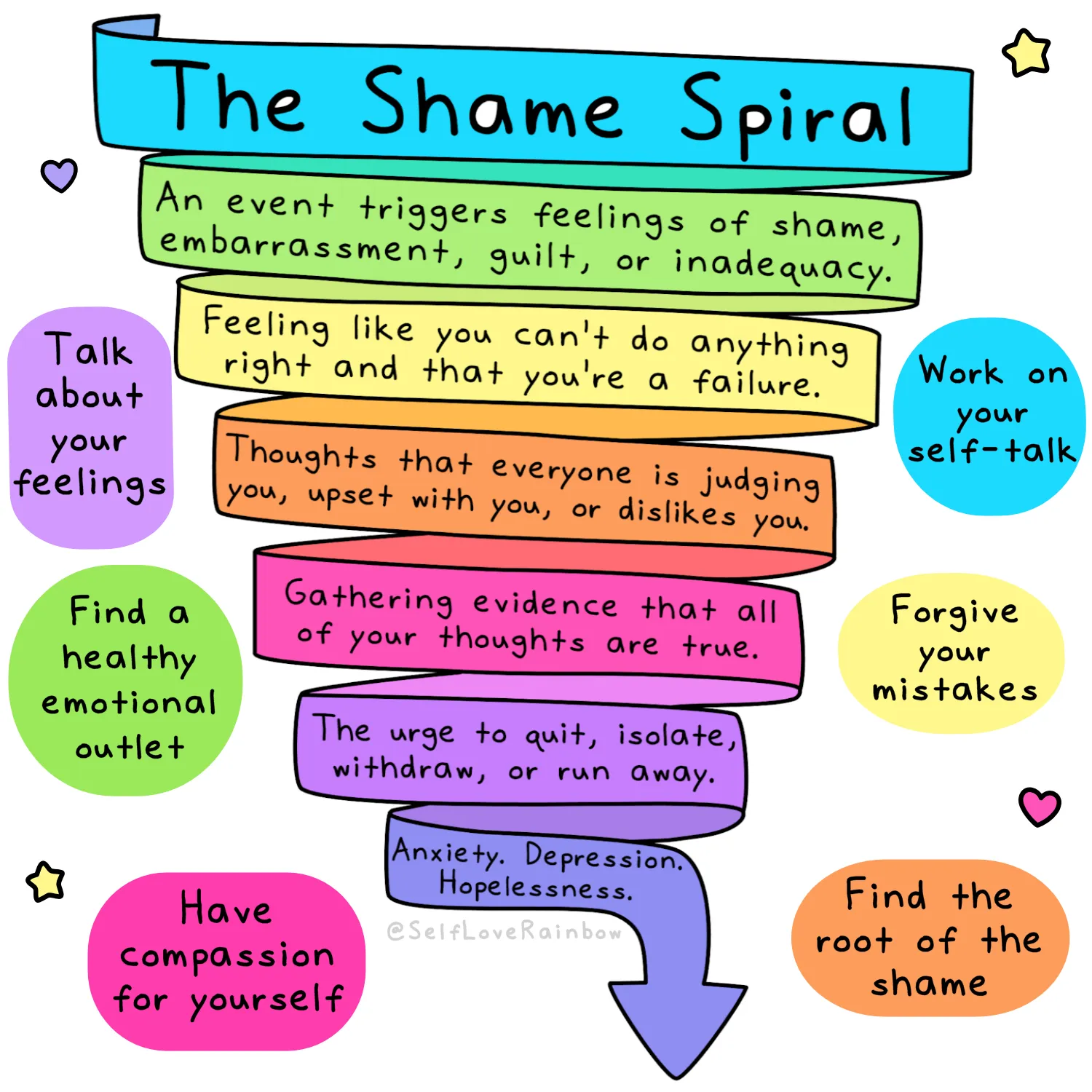
This came from this site, which looks quite delightful and helpful, so please go look if this speaks to you:

The bubbles around the edges are the ways to fight the downward spiral. I didn’t do those yesterday; I went straight to avoidance, and spent most of the day playing Minecraft. (I’m going to have to do a post on Minecraft, by the way, which I have only discovered this last year — that is, I knew about it, but I didn’t know that I would love it as much as I have grown to in the last year.) And so last night, I couldn’t sleep: because I was ashamed of having done nothing useful yesterday, including this blog, which I really do want to keep up with; and I failed. I blew it. I must be a terrible person…

Fortunately, my shame spiral this morning was interrupted by two things: first, I started writing this blog while I was eating my breakfast bagel, with the intent of finishing it tonight, because I can certainly accept posting one day late (Have I mentioned that I’m not real big on deadlines?), and so that reminded me that I can give myself one day of grace on my tasks without assuming that I am worthless; and second, I had to stop writing this blog so I could go to school. And while I was completely exhausted at school today — I was falling asleep while I was grading AP essays this morning (That is not a comment on how boring those essays were [Yes it is.] and also I surely did not lose focus on the essays while I was determining their final score […]) — and that made me cranky as hell, I also taught today. And I taught well. We went over the climactic end of the first act of The Crucible, and while my other class is not grasping the play, this class is. My AP Lit class is really getting into the details of Donald Barthelme’s amazing story GAME (Though they still haven’t figured out why Shotwell has the jacks). The Fantasy/Sci-fi class finished another chapter of The Hobbit, and I got to do a Mirkwood-spider voice, which was fun.

And now here I am, back trying once more to finish this blog.

So I am not stupid. I am not lazy. I am not incompetent, or incapable.

It is true that I’m not sure I have the level of expertise that makes this blog worth reading. Depending on the subject: when it is literature or teaching or writing, I’m fine; I understand those things better than most people, and anyone who understands them more than I do is always welcome to take issue with what I say. (Anyone is, really. Please feel free to comment on the post, or use the Feedback link on the bottom left of the screen, or go to the Contact link at the top. I’d love to hear from you, for whatever reason.) But the post I started last week is not about any of those things, so I’m more uncomfortable about it; hence, yesterday, when I was doubting myself and my abilities and my worth, I couldn’t gather the confidence to say what I want to say on the topic.

But, see, I don’t really write this blog as an expert. As I said, in literature and teaching and writing, I think I can at least hold my own, at my level — you will not find any doctoral theses on this page — but otherwise, when I write about politics or society or life, I’m not writing as an expert. I’m writing as a person. I have my perspective. I think the value I offer in this blog is not necessarily the brilliance of my insights: it is the clarity and the precision, and to some extent the humor, that I add in the writing of my insights. Basically, I’m just a guy with some ability to observe the world around me, and crystallize what I observe into a thought: and a genuine ability to put all that into words. And if that’s enough to make you read what I write, great: I hope my words on my perspective help you to have some thoughts of your own. I don’t think of it as advice.

If it hasn’t become clear, the specific problem yesterday was that I gave a student advice, and it wasn’t good advice. I mean, so it goes, right? I gave it my best shot, I didn’t make the best call. Nobody died, nothing was permanently broken. But I got into this thought pattern like: If I don’t give good advice, what am I doing teaching? If I don’t understand teenagers well enough to know what they should do in a certain situation, why do I work with them? Why should they listen to me? And if I’ve wasted 23 years of my life teaching when I shouldn’t be doing it in the first place, am I doing that only because I need to avoid being a writer for real? And I’m just fooling myself into thinking I’m a good teacher when actually I’m just kinda charming and easygoing, and so the students like me because I don’t make them work too hard, and that’s why I’ve kept my job even though I’m basically incompetent and, let’s face it, just pretty fucking stupid, right???

And what the hell am I doing offering my wisdom on this blog if I can’t even give good advice? Why would anyone listen to me?

I dunno. Why would anyone listen to anyone? Because sometimes, we get things right. Even if sometimes we don’t.

So here’s what I want to do. I don’t want to give advice: because I don’t know more than other people do, except in my small areas of expertise. But I do want to share some of the things I have figured out. I want to share my understanding, my perspective. And if it is helpful, or if it is interesting, then great: and if not, come back next week and see if I have anything better to say.

Okay?

Here we go.

#1: Love really does make the world go round.

Also The Beatles are even more wonderful than you think they are.

My greatest joy is my wife. Living with her, seeing her, talking to her; supporting her, cheering her on, protecting her, watching her be amazing. She is my everything: because I love her. That keeps me wanting to do more with her and for her, and keeps me from being tired of her or resenting her or any of that other shit that comes between people. I am incredibly lucky that I can still feel this strongly for her after almost 30 years: but if I didn’t, if she didn’t still love me, then I would hope we could amicably separate, and go find other people to love. Because love is the most important thing in our relationship, as it is the most important thing in any of our lives. That love is more important than the relationship: the relationship remains because the love remains (And if we fell out of love, we might have a companionable love that would remain, and we could stay in that kind of relationship, and that would be fine: as long as there is love. It doesn’t always have to be the same kind of love. [Though I hope it does stay. It’s awfully nice.]), and the love is what matters, more than the relationship.

I write because I love it. I read because I love it. I teach because, basically, I love humanity. I am a pacifist for the same reason (Even though sometimes I want to hit my — well, maybe not my students. But I want to hit things around them, you know?). Every important thing about me is based on what I love, or what I don’t.

Love is everything.

#2: Life is long — but never long enough to do everything you want.

I hear people talk about how fast time goes: and I don’t understand it. I mean, sure, my childhood is loooooong gone, and I don’t remember everything that happened between then and now; so that might seem like it was a shorter time than it should have seemed like; and I have definitely felt some dilation of time in the last few years: I cannot fathom that the pandemic and the quarantine were three years ago. So I definitely do that thing where I go “What?!? Three years??? Seriously? Where did the time go?”

But then I actually think about it: and the last three years have been — three years long. I’ve done a whooooole lot of stuff in that time. A lot of it is the same stuff over and over again, but it’s been different every time. And it’s always like that. Life is very long. I hear the cliches about how we only have a very short time on this Earth and in this life, and that’s true: but only from the perspective of mountains. From a human perspective, we have a very long time to live. My students are so goddamn young; and I am 30 years older than they are. And 30 years? That’s a long fucking time. If I have 30 years left to live, that’s a long fucking time left. A very long time.

At the same time: in those 30 or 40 or 20 or however many years I have remaining, there are more things that I will not do, than there are things I will do. Partly because I will have to spend a huge amount of those remaining years doing shit like — grading AP essays while I try not to fall asleep. And that time lost will be sad, because it won’t be spent doing things I love. And it should be. Because see #1.

So we have to pick and choose what we spend our time doing. It’s important to choose, and to do it intentionally, and thoughtfully, as much as we can. Don’t let time slip by without paying attention to it at all; because we have a lot of time — but we can still waste it, and we shouldn’t. We should love our lives, as much as we can. Because #1.

#3: There are three things you can have with any job, any task, anything you buy or hire for: you can have good, you can have fast, and you can have cheap. You can only have two of them at a time. So if it’s good and fast, it ain’t cheap; if it’s good and cheap, it ain’t fast; and if it’s fast and cheap, it ain’t good.

This is the best single piece of wisdom I ever got from my dad (Though there are a lot of other things he’s taught me, more than I could count. It’s just that this is the best.). I think about this all the time. I’ve written about it a lot of times, too. Hiring a plumber: not cheap. But usually they do good work, if they’re professionals; and it’s always MUCH faster than doing the repair yourself. Or you can think about it in terms of buying a car: you can get a POS rusted-out Mustang, that still might be fast, and it will be comparatively cheap: but that won’t be a good car. Or you can get a good, cheap car like a used Toyota — and it will not be fast. Or you can buy a good fast car: but it’ll cost you. Or getting music on the Internet: you can get free music without ads (That’s what I’m calling “fast” in this case: no download delays and minimal interruptions), if you don’t mind listening to shit on Soundcloud; or you can get good music fast (without ads) if you don’t mind paying for premium services; or you can get free good music on YouTube (I’m currently listening to this, which I find both beautiful and amazing, but I also genuinely feel bad for this guy’s forearms. It’s like you can smell the tendonitis in the air, like smoke.) if you don’t mind sitting through ads.

Also: you don’t always get two. You can get only one. Or you can get none: because you can buy expensive shit that takes a long time to get finished, and when it’s done, it still sucks.

#4: The most important thing in any relationship, from friendship to love to family to business to neighborhood association to — anything — is communication.

I’m teaching argument right now, and if my students are understanding it, they should be figuring out that the first key to any argument, to understanding what someone else is saying, is always to define your terms. And clarify your meaning. And show where you get your information from, and why it leads you to the conclusions it does. And the same is true in any interaction: I am a good teacher because I want to understand my students, and I’m good at making them understand me. My wife and I still have a strong relationship, apart from our love, which is irrational and magical and incomprehensible and the most powerful force in the universe, because we communicate: because we tell each other what we think and feel, and we listen when the other is talking. I get along with my coworkers because I talk to them and listen to them. My students don’t complain about my grades because I am clear about why I give students what I give them — and if they have opinions about those grades, I listen to them, fairly. And if their communication makes sense to me, I am willing to change the grade. Their parents don’t complain about me because whenever they have a question for me, I answer it, fully, completely, and honestly.

Corollary to #4: communication requires honesty, which is why honesty — not patience, not courage, not intelligence nor openmindedness nor anything else — is the most important virtue.

No, you don’t have to be honest all the time. Yes, you can lie and say someone looks good in that outfit, or the food was tasty when it was not. But understand the consequences of those lies. And be as honest as you can.

#5: Everybody should have pets.

I have no opinion for or against children: if you want them, I wish you the very best; if you don’t, I wish you the same. But everyone should get pets. They are pure love and they teach pure love.

I always use the dogs for this, so here’s a video of Dunkie the cockatiel whistling. He’s adorable, too.

#6: Everybody should exercise, even if it’s only walking. Or dancing.

When I was a kid, I rode my bike everywhere. So much better than driving. Now I walk my dogs every chance I get, and also go to the gym. Movement helps with everything physical, mental, and emotional. We were made to move: so do it. Make sure it is something you enjoy, or you won’t do it — but when you enjoy it, do it as much as you can. It’s always good for you.

#7: Doing it yourself is better than buying it: but see #2. And #3, because doing something yourself instead of buying it is cheap, which means you can’t have it be both good and fast.

I was thinking of this in context of making food. Cooking yourself is healthier, in this country; generally cheaper than food from a restaurant (If it’s not cheaper, it’s DEFINITELY healthier), and if you can do it right, it tastes better, too. My advice for cooking is to learn a couple of specific dishes, and really master those: I can’t make eggs, but I can make three different kinds of mac and cheese, and they are all AMAZING. Also I am good with sandwiches. And my wife says I make good salads, too.

But it goes beyond that: my wife and I (with my dad’s help when he came for a visit) painted our first house, the entire exterior, two coats; and we did a hell of a job, and it was an accomplishment I was proud of. It was worth doing. But it did take a damn long time, I will say. It was a lot of work. Because of that, it is certainly worth it to hire an expert to do things for you sometimes, rather than take the time to do it yourself, always, because #2 means you have to pick and choose where and how you spend your time.

But if it’s important to you, and if you love it, do it yourself, as much as possible. Learn how and then do it.

#8: Everybody should read.

More than we do, unless you already read as much as you possibly can. I’m not against watching TV and movies and playing video games, and all outside/physical activities are good too, as is just relaxing and doing nothing. But we all need to read. It does more for the mind than any other intellectual activity. It brings us closer to the world every time we do it, because good writing is about the world. And writing is communication, which allows us to build and strengthen relationships, every time we read. It’s just the best thing. We should do it more.

Also, it will prevent the arrival of the world of Fahrenheit 451, which is closer now than ever before, and getting closer all the time — and that is not a good thing.

Also: everything is better with music. So listen to lots of music.

Now I’m listening to this. And to be honest, I have something of a pseudo-crush on the singer/songwriter/rhythm guitarist for this band. Which I’m only saying because honesty is important. And nobody is 100% straight. And damn, he’s got a good voice.

Also, this is maybe my favorite love song. Though I don’t have a crush on this singer. But he does have an amazing voice. Damn fine piano player, too. And I have no idea how he made this gruesome concept into a romantic song — but he did.

And this is one of my favorite songs about life. Which I should listen to more. It makes me feel better about myself.

#9: Put your own mask on first.

When the oxygen masks fall from the ceiling in an airplane emergency, what do they tell us to do? Put your own mask on before helping anyone else. Because if you pass out from lack of oxygen, you can’t help anyone.

I suck at this. I sacrifice myself for others all the time. Not in the grand sense: there’s almost no one I would be willing to die for; and the ones I would be willing to die for, I don’t want to die for, because I want to stay alive so I can love them and be loved by them. But I give up way, way, WAY too much of my time and energy for other people. I fight for my political beliefs because I want to do good in the world. I spend too much time working on my teaching because I want to help my students. And I do these things even when I can’t find the strength to do it: because it’s important to me. And then, when I do take a day off to play some Minecraft, I feel guilty about it for days afterwards. I get mad at my wife when she does things that I was going to do — say, vacuum or wash the dishes — because I was going to do them, and she shouldn’t have to do my tasks. But one of my favorite things to do for her is to take a chore that she was planning on doing, and do it for her, so she can relax.

But the more I spend of myself on others, the less there is of me. We get used up. And we don’t realize it, because we think we’re happy helping others — and we are (At least I am [and maybe I should have included the statement Don’t Be a Selfish Asshole, but I feel like we all know that already. Right?]), but helping others takes energy. It takes time. It takes: when we give, we lose something, even if we get a little bit back from sharing joy and human kindness. Whereas if we would take the time to take care of ourselves, we would have more to spend helping the people we want to help, the more capable we would be to do the things we want to do, which would then give us more time and energy and satisfaction/happiness to be able to share more with others. Think of it in terms of #2: a low-stress life will let me live longer; and the happier and more content I am, the more energy and will I would have to do things that I want to do — like paint my own house. Or help my students learn how to write better arguments. Or learn how to cook eggs. But if I am stressed, then I don’t want to learn to cook eggs: I just want to order a pizza and watch TV.

So: take care of yourself first. And then take care of other people. Definitely do the second one: putting time and energy into other people helps with #1, and makes all of our lives better; but do it second. Put yourself first. When you don’t need any more attention, you’ll turn to others; and it won’t be a struggle. Happy people are helpful people. Helpful people are happy people.

And that explains the current state of the GOP.

Frank Thorp V on Twitter: "Randy Rigdon of Cincinnati wears a "TRUMP 2016 - FUCK  YOUR FEELINGS" shirt at Trump's rally at the US Bank Arena ==>  https://t.co/HFDnuJYdHJ" / Twitter
Look at ’em. Are those happy people? They are not.

#10: Be kind. Everybody deserves it — though not everyone deserves it twice.

Make sure you are kind to yourself, too, and that certainly means removing unkind people from your life: and don’t feel bad about it when you do it. But otherwise: start every interaction with kindness, and try to end every interaction the same way. Why? Because
Standards (De)Based Education

All right. It’s time.

Let’s talk about standards.

I won’t say I appreciate or admire the people who picked the word “standards” to describe their prescription for education in this country. But I will acknowledge an absolute masterstroke of rhetoric, which is what that was. “We have high standards,” they could say. “Don’t you think schools should have standards? Don’t you have any standards for your students?” they could ask teachers who objected.

What can I do but hang my head in shame, and agree to teach THE STANDARDS?

I’ll tell you what I can do: I can, and do, object to the standards as they are written. I object, too, to the very idea of standards: but let’s take one thing at a time. And the less radical, first.

It’s not too far out there to object to the standards, at least in one way: pretty quickly after the Common Core were adopted in most states, they received the approval of the Obama administration – and therefore the whole-hearted hatred of the Republican side of the country, particularly during the Tea Party boondoggle. So if I say I hate the Common Core, I at least have allies – though they’re not necessarily the allies I want to have. But I’ll take them, because they are correct in essence, if not in attribution of causation.

Backing up. First, what are the standards? According to the Arizona Department of Education, they are this:

These standards define the knowledge and skills students should have within their K-12 education careers so that they will graduate high school able to succeed in entry-level, credit-bearing academic college courses and in workforce training programs. The standards:

  • Are aligned with college and work expectations;
  • Are clear, understandable and consistent;
  • Include rigorous content and application of knowledge through high-order skills;
  • Build upon strengths and lessons of current state standards;
  • Are informed by other top performing countries, so that all students are prepared to succeed in our global economy and society; and
  • Are evidence-based.

Standards are a list of skills and knowledges that students should have when they graduate high school. Jim dandy. Seems useful to know what a student should know.

Quick question: who decides what a student “should” know? And how do we decide that? What is the basis for picking a specific skill and saying a student “should” know that before graduating high school? That knowledge of X, Y, and Z is necessary to “earn” a high school diploma?

Hang on: first let’s look at the sales pitch for the standards.

Critical Message about Arizona’s College and Career Ready Standards – English Language Arts/Literacy and Mathematics

· The purpose of the new standards is to provide a consistent set of English Language Arts (ELA)/Literacy and Mathematics expectations that prepare all students for college and career options.

· The standards are designed to ensure that our students remain competitive in the global market of the 21st century.

· Arizona’s College and Career Ready Standards – English Language Arts/Literacy and Mathematics standards include Arizona additions. Arizona’s adoption of these standards ensures a more seamless education for high mobility students since grade level standards and expectations are consistent across 46 participating states.

· The creation of the English Language Arts/Literacy and Mathematics standards was a state-led effort coordinated by the National Governor’s Association (NGA) and the Council of Chief State School Officers (CCSSO).

Okay: a consistent set of expectations that prepare all students for college and career options. Cool. Equity of access and opportunity is important, it is a fundamental promise of this country, and it is also one of the best ways to assure the general welfare of our people; so yes, all students should have access to the same preparation for college and career options.

I mean: they don’t. There are several other factors involved in educational outcomes, primarily the students’ socioeconomic status and family educational levels (which are also, of course, socioeconomically influenced if not determined). And because education funding in this country is primarily a factor of local district tax base, it ensures that students in the richest schools have access to the best educational opportunities and resources, and students in the poorest schools do not, and that system will survive that way as long as we keep the same archaic, institutionally-racist and classist funding structure.

But yes, surely all students should meet a certain minimum set of expectations. I’m with that. Standards, right? We have standards, and students have to live up to our standards, or we won’t accept them.

Umm…not sure what that means. I mean, if someone I go on a blind date with doesn’t meet my standards, then they go off to find someone else whose standards they do meet, and I go home alone, But what does it mean when a child – when a fellow citizen – doesn’t meet our standard? Does it mean they don’t get to live in this country? Don’t get to be citizens? Does it mean they have to struggle for the rest of their lives, because they weren’t good enough according to our standard?

You ever think about what it says about a student – a child, that is, since I’m talking about K-12 education, and the majority of students are still under 18 when they graduate high school – when we say that student doesn’t deserve a diploma? Hasn’t earned an education? Didn’t prove themselves to be good enough? If all education meant was the achievement of a specific set of skills and knowledges, then it would be appropriate to say those things (though the implication of merit in words like “deserve” and “good enough” is questionable if not outright wrong); but it doesn’t just mean that. We attach quite a number of value judgments to people who “earn” a diploma, and withhold them from people who “fail” to “earn” one. Those who don’t meet our standards, that is. Those children, we determine and decree, will suffer and struggle, because they’re not good enough. Never mind that there are countless ways to live, and live successfully, without ever mastering the skills and knowledges that “earn” one a high school diploma. Never mind that high school diplomas don’t necessarily show that one has or has not mastered the skills and knowledges: a diploma shows that one was able to prove one’s mastery of skills and knowledges to the satisfaction of those who decide who earns that diploma – me, in other words, as a teacher who gives grades, who determines who passes and who fails my classes. Me and all of my fellow educators. We decide who gets a diploma, who has shown to our satisfaction that they have mastered the skills and knowledges we chose for them to master, to our standard, on our assessments.

I think about my wife, who is one of the smartest and most capable people I have ever known (And I’ve known a hell of a lot of smart people), who was not allowed to earn a diploma because she called her principal an asshole. After he told her that she wasn’t good enough to graduate from his school, because he thought she was lazy and disrespectful. She was expelled from the school. She got a GED, a Graduation Equivalency Diploma – hang on; that’s not it. I just looked it up, and it actually stands for General Educational Development test. Huh. Did you know that’s what it was? Maybe I’m the only one who didn’t. Anyway, she earned her GED certificate, and also a high school proficiency certificate, by acing those two tests (because she is incredibly intelligent, if I didn’t already make that clear – they wanted to skip her two grades in elementary school. TWO GRADES. Nobody ever suggested I skip any grades. I’m not jealous, though.) and then went to work: but she couldn’t get a job, because she wasn’t yet 18 and so wasn’t allowed to work in most places in California during the regular school day. She was also told that the GED wasn’t as good as a diploma because she hadn’t shown she had the work ethic to complete the normal schooling program.

So I guess it isn’t just about showing mastery of the skills and knowledges required for college and career readiness. Huh? It’s also about showing oneself to be the kind of person our society approves of. It’s about winning the good regard of teachers, who are by nature and training judgmental. I mean, I’m a swell guy, and surely all of my judgments of my students’ characters are right on the money, and totally should have a significant impact on the lives of all of the students who pass through my classes. Some of those other teachers, though… pretty sketchy.

My wife’s story – this point I’m making about teachers and our generally subjective judgments of students – is one of the arguments behind standards, of course. Because CHUDs like the guy who told her she wasn’t “Aptos High material,” and she’d never amount to anything in her life, shouldn’t be the ones keeping the gates and refusing entry to our citizens. If students can show that they possess the skills and knowledges we expect them to have, then that should be enough: and no individual with their own biases and prejudices should be able to torpedo any person’s progress into productive citizenship.

I agree with that. It’s the one argument for standards, and for standardized testing, which I agree with and support whole-heartedly. My wife got the shit end of this stick because she was what this guy saw as a “troublemaker;” maybe because she is a woman, maybe because she was not in the same socioeconomic class as many students at that school (Though not all the students at the school were wealthy, not by any means), maybe for any of several other reasons. But there are millions of kids who suffer this same sort of fate, being prevented from achieving not because they lack the skills, but because someone in charge doesn’t think they’re good enough: and the most common reason, of course, is racism. I have heard people who know better than me point out that standardized tests, while imperfectly anti-racist themselves, are at least objective and colorblind in their allocation of success or failure: which means a student with racist teachers can still pass the test, can still prove they have met the standards, and therefore should be able to earn a diploma no matter what their racist teachers think. I appreciate that argument, and I therefore wouldn’t want to argue that all standardized tests and grades and so on should be removed, at least not until we can ensure no bias in the people acting as gatekeepers.

I will argue that we should remove the idea of gates, and specific standards of achievement.

But hold on: before I argue against standards entirely – before I show that I do not, in fact, have any standards – I want to finish my point about the standards we all have right now. They are no longer the Common Core standards, which became politically tainted during the 2010’s; though if you think they are appreciably different from those Common Core standards, you don’t know education: we don’t like changing things, we like keeping the old things – or even better, resurrecting the older things – and giving them a new name. The Common Core State Standards look like this: “By the end of grade 10, read and comprehend literature [informational texts, history/social studies texts, science/technical texts] at the high end of the grades 9–10 text complexity band independently and proficiently.” And the all-new, all-improved Arizona College and Career Readiness Standards look like this: “By the end of grade 10, read and comprehend informational and functional text, including history/social studies, science, and technical texts, at the high end of the grades 9–10 text complexity band independently and proficiently. (AZ.9‐10.RI.10)” You can see for yourself how Arizona is independent, and not still following along with that whole socialist Common Core mandate. WOO! States’ rights!

So my question is, still: who decided what were the skills and knowledges required to graduate high school? Who determined what students “should” know?

It’s not actually a simple question to answer – neither the one about what students should know, nor the one about who decided it. The issue with deciding what students should know is deciding what we think students should be ready to do. Do we think they should be ready to go to work? Do we think they should be ready to go to college? Do we think they should be capable of teaching themselves? Or do we think they should already know everything they will ever need to know? What mixture of those four things is correct, job/college/already know/can learn? But then there are more questions: what should students know to be ready to go to work? What kinds of jobs are we talking about? And what does “ready” mean? I haven’t ever been “ready” for any job, if “ready” means “already capable of every aspect of the job required.” I have always had to learn on the job. Do we want them ready for entry level, or ready to move up to the top echelons of management? Do we want them ready for local jobs, or do we want them to be ready for any jobs? Please note that if we decide to make our students ready for any jobs, then they’re going to be learning a whole lot of things that seem like they aren’t important, because those students will look around their part of the world, look at the people they know, and they will think, “Nobody in my town knows physics, or needs to know physics. Why do I need to know physics?” If our only answer is, “You might find a job somewhere else that requires a knowledge of physics,” we’re not going to convince a lot of students to try very hard in physics class. But also, if we decide that nobody who goes to school in this town needs to know physics, then we are sentencing those students to live only in places and have only careers that do not require any knowledge of physics. Maybe that’s fine: we decided, pretty unanimously, that none of the students in American schools need to be familiar with Mongolian folk dancing; we therefore cut them all off from careers involving Mongolian folk dancing.

Pretty fucked up, guys. Denying our children that avenue in life? Who were we to decide that for them?

But also: how much time and energy do we want to dedicate to teaching Mongolian folk dancing, on the expectation that some number of our students will pursue a life that involves Mongolian folk dancing?

And before you scoff too hard at that: recognize that almost all American students were, at some point in the last several decades, taught how to square dance. We thought that was a valuable use of time and resources. And I, for one, would rather know Mongolian folk dancing than how to do-si-do.

This is amazing.

(Let me also point out, though this is off topic and too large a subject, THAT WE SHOULD NOT FOCUS EDUCATION ENTIRELY ON THE ABILITY TO MAKE STUDENTS PRODUCTIVE AND CAREER-READY. LIFE IS NOT JUST ABOUT YOUR JOB. STOP TELLING STUDENTS THAT EVERYTHING THEY LEARN AND EVERYTHING THEY DO IS GETTING THEM READY FOR “THE REAL WORLD OF WORK.”)

But okay, we’re really only talking about English/Language Arts and Mathematics. (Hey: who decided those two were the most fundamental skills? I agree that communication is vital in essentially everything; but is English the only way to learn to communicate? What if we decided instead to teach every student to be fluent conversationally in three different languages other than English? Or what if we decided that proper communication required an understanding of our context, including our cultural context and the context of our interlocutors, and therefore all students must master 12 years of social studies including sociology and psychology? AND DON’T GET ME STARTED ON MATH.) So surely the expectations of what should be mastered in those subjects is more straightforward. Right?

It may be. I object to a number of the standards – for instance, I am supposed to dedicate considerable time and energy to this one: “Analyze various accounts of a subject told in different mediums (e.g., a person’s life story in both print and multimedia), determining which details are emphasized in each account.” (AZELA Standard 9-10.RI.7) – but I can’t argue against the ones which say students should be able to read proficiently and independently, or that students should cite evidence for their claims, or that students should know how to analyze complex characters. And all of the different sets of standards were all written with input from various teachers and teacher groups and other educators.

But not only teachers.

Common Core, for one example (And there are lots of examples, of course. Education is a very profitable business. Lots of companies get involved in trying to create educational resources, and then trying to sell them to the very large market of schools and teachers flush with all that gummint porkbarrel money), was written by the Council of Chief State School Officers, which is essentially all of the various Superintendents of Instruction from each of the 50 states. They took input from the National Council of Teachers of English, the Association of Mathematics Teacher Educators, the NEA and the AFT (the two largest national teachers’ unions), and various other teachers and educators. I suppose I should point out that most of the chief state school officers have education backgrounds, though not all of them; but more importantly, I think, is that the CCSSO was not the only organization involved: it was also the National Governors’ Association, which certainly has a stake in education at the state level, but generally includes a whole lot fewer educators; and also, a certain non-profit group founded in 1996 called Achieve. (Don’t be too impressed, by the way, by this group being non-profit; the College Board is non-profit, and they’re the ones who make all of the AP tests, and the ACT, and the SAT. And then charge millions of students hundreds of millions of dollars every year to take their tests. But they’re not profiting from it.)

That last one is the interesting one. Because you figure the CCSSO and the teachers’ unions are going to represent what the educational establishment wants: what is best for the current school structure, and for the teachers. And the Governors’ association will represent the will of, if not the people, at least the constituents who have the ear of the governors; which surely includes parents’ groups and the larger constituency special interests. I think it’s safe to say that both groups, the CCSSO and the NGA, of politicians would represent the interests of the monied class in this country: since that is who commands the attention if not the obedience of politicians.

So who did Achieve represent? Maybe the students? The ones who have the most skin in this game, so to speak, the ones most affected by all of this wrangling, and the ones who, as lacking votes and money in general, do not have the attention and obedience of the politicians?

Of course not.

Alice In Wonderland Disney GIF - Alice In Wonderland Disney Mad Hatter GIFs

Achieve’s website tells us this: “Achieve is an independent, nonpartisan, nonprofit education reform organization dedicated to working with states to raise academic standards and graduation requirements, improve assessments, and strengthen accountability.”

Very nice! That sounds great. But…who are you?

I couldn’t actually find a list of the board of directors on their website (I admit I didn’t look too hard, as I expected to have to go outside of the organization to find what I wanted to know), but I found one on Ballotpedia, interestingly enough; seems like Achieve has some involvement in politics, as well as in education. Well, they said they work with the states, right?

Here are their directors, according to Ballotpedia (Which got the list from the Achieve website, accessed in 2016; unfortunately when you follow the same link to the current list of the board of directors, you get this:

Achieve is led by governors, business leaders, and influential national leaders committed to improving K-12 educational outcomes for all students.

Created in 1996 by a bipartisan group of governors and business leaders, Achieve is leading the effort to make college and career readiness a priority across the country so that students graduating from high school are academically prepared for postsecondary success.

Cool, thanks.)

Here’s the list from 2016:

  • Mark B. GrierVice chair
  • Michael CohenPresident
  • Craig R. BarrettChair
  • S. James Gates Jr.
  • Governor Bill Haslam (R-Tenn.)
  • Governor Jay Nixon (D-Mo.)
  • Governor Maggie Hassan (D-N.H.)
  • Former Governor John McKernan Jr. (R-Maine)
  • Louis V. Gerstner Jr.Chairman Emeritus

Sorry to use out of date information, but also: Mark B. Grier is listed by Ballotpedia as the current top executive at Achieve, and while he has also moved on to a director position at Freddie Mac, his profile there still lists him as a board member at Achieve, so I’ll take this list as representative if not current.

Who are these people? Glad you asked.

Dr. Sylvester James Gates, Jr., is a badass. An award-winning and influential theoretical physicist, professor, author, and documentarian, his involvement with Achieve could only improve their work. Not sure how much sway he actually has, but his presence on the board is the best thing I found. (He’s also the only African-American on the board, but surely that’s neither here nor there.)

Michael Cohen, president (Not THAT Michael Cohen) is actually an educator (Though he worked for Bill Clinton, so he’s a neoliberal educator). He is also the only one with a page readily available on the Achieve website – though to be fair, their Search function is not currently available, and the website hasn’t been updated since 2021. Craig R. Barrett, chairman, is the former CEO of Intel. Mark B. Grier, vice chair (and maybe current chair) is the former CFO at Prudential. (Also: “Grier’s leadership on the board continues Prudential Financial’s longstanding commitment to improving education outcomes.  Former Prudential Chairman Art Ryan served on the Achieve board from 1999 to 2008, and as the chairman from 2005 to 2008.” So again, if the list isn’t current, it’s at least representative. Mark Grier to Lead Achieve Board | Achieve) Louis V. Gerstner Jr., Chairman Emeritus, is the former CEO of IBM, and the former chairman of the Carlyle Group, a private equity firm. Gov. Bill Haslam of Tennessee  is also the former president of Pilot Corp, a petroleum company that owns the Flying J rest stops. Former Gov. Jay Nixon of Missouri is one of the Democrats on the “nonpartisan” board, and is a lawyer turned politician rather than a corporate overlord, so he wasn’t too bad – but did hand control of Ferguson over to the state highway patrol and later called in the National Guard to put down riots after Michael Brown was shot and killed. Maggie Hassan (The only woman on the board, but surely that’s neither here nor there) and Jock McKernan are also former lawyers turned politicians, Hassan the current embattled Democratic senator from New Hampshire, McKernan the Republican governor of Maine in the late 80s and early 90s (And the husband of Senator Olympia Snowe, if that matters), and are generally not offensive.

So that’s who wrote the Common Core. Teachers – but also politicians, and business executives. And who do we think had the most influence, the final say? Probably not the teachers. And definitely not the students.

But is that so terrible? I think I hear you ask. What’s wrong with business executives promoting the standards? Well, inasmuch as they were simply people who understood complicated systems and processes, and who live in this society and therefore may have a stake in its success, nothing. But that’s not all they are. Businessmen, especially executives of these sorts of large, international corporations, are not particularly loyal to any one society; they are loyal to the bottom line: shareholder value. I cannot believe that these men created Achieve, and pushed for the Common Core standards to be accepted nationwide, for any reason other than they knew it would be good for business.

From what I can see of the standards, and the intent of those who wrote them, they are very good at producing exactly what businesspeople seem to want: conformist rule-followers who don’t think very originally, and who don’t question authority, but who are very good at mindless, repetitive tedium, and who seek simple entertainment and satisfaction at the end of the very long work week. Good workers (Remember how the work ethic is as important if not more important than mastery of the skills?) who are also good consumers. Good employees, and good customers.

How do standards do that? In a number of ways. Partly because they are standard: the goal is to make every student the same as every other student, capable of all the same things. If we see those things as a baseline, and give schools room and resources to reach beyond that, then there’s no problem; but that’s not how the school system works – and again, that is because of the same people wielding the same influences. Because the other part of the push for common standards is – the push for accountability. It’s right there in the Achieve mission statement. “Achieve is an independent, nonpartisan, nonprofit education reform organization dedicated to working with states to raise academic standards and graduation requirements, improve assessments, and strengthen accountability.(Emphasis added)

See, we can’t have universal standards unless we can be sure they are adhered to. Right? We have to make sure these schools, and those wacky tree-huggin’ hippie teachers, are doing what they’ve been told to do. So in addition to creating new standards that will define what is taught, we will create and implement test after test after test after test, to make sure that the teaching is – well, meeting the standard.

Do you know what happens when you create an entirely new system of curriculum, and a new set of assessments? Particularly during a global recession, when state education budgets are being slashed and burned like virgin forests in logging country? (By the way, Jay Nixon of Missouri was also called the “cutter-in-chief” for all the cuts he imposed on the Missouri state budget. But he did also support investment in education when things started turning around, so. Good and bad, I suppose.)

The schools fail, that’s what. New curriculum takes time to figure out and make functional. New assessments take time for students to get used to them. Even in the ideal testing situation, the whole idea is that you take the results of the test and use it to inform the next year’s instruction in order to raise the scores: which pretty much requires that the first year’s scores are going to suck.

And so they did. And do.

Which opens up a lot of options for those who want to control the education system in this country, say, in order to produce better worker drones and more consumers to buy products.

Any time the school does not meet the standard, any assessment that shows the students are not showing the specific evidence asked for which proves they have mastered the chosen skills and knowledges to the extent and in the manner determined by the people in charge, then the school is failing, the teachers are failing, the students are failing. And when a school is failing, we will sanction it in some way, and follow one of a number of alternative courses: we could use that  failing school as evidence that a current politician has failed their constituents, and thus push for the candidates we like; we could use that failing school to argue that the school system in general is failing and therefore we should promote vouchers for private schools; or to argue that the school system is failing and therefore the state needs to loosen the requirements for charter schools; or to argue that the school system is failing and it is the fault of those damn teachers’ unions. So many options!

We could also argue that the school system is failing, so there needs to be greater emphasis on achieving the standards. Now that we have these lovely standards written, we can push to have them adopted across the country (Maybe in conjunction with a huge federal mandate, which rhymes with Moe Wild Heft Refined, which also mandates accountability…), and then use that to impose more expectations that schools will adhere to the standards, so that every child in every state can have the same results! Won’t that be wonderful? If … Moe wild is heft refined?

(Sorry.)

Once we decide that the school is failing and the most important thing is to make sure that students MEET THE STANDARD, the stage is set for the process we have watched play out across this country: we start teaching to the test; and more devastating, we eliminate everything that is not teaching to the test. Electives are cut, because the students need more remedial instruction in math and English. Which frustrates the students, and makes them feel like the system is not helping them but is instead out to crush their spirits (because it is), and of course they resent it, and so of course they rebel against it: they don’t try as hard as they could on the tests, because fuck the tests, man!

That Test You Didnt Study For GIF - Fuck This Shit Give Up Unprepared GIFs

Which means the school does not meet the standard: and so we can go through another round of whatever-flavor-of-damage-we-want-to-inflict-on-the-system.

My school knows that I’m a good teacher. It’s hard not to: my students generally like me, their parents generally like me; the surveys the school does of parents and students always reward me with sterling reviews. I was even named in a Google review of the whole school as one of the reasons why my school is worth going to. And, if I may presume, I think that anybody who comes and watches me teach will see that I am good at it. (I mean, I’m not always sure I’m good at it, but that’s because I have imposter syndrome and a certain amount of anxiety over my abilities. Never mind. It’s not important.)

But what the school tells me, every single time they evaluate me, (Which in this environment of hyper assessment, is every goddamn year; also I live in a “Right to Work” state, for a charter school, which means there is no teacher’s union to represent me, and therefore no tenure. Can’t let them lazy goddamn teachers just relax and teach! They need to worry about losing their jobs all the time! That’ll keep ‘em in line!) is that I need to provide documentation that I am teaching the standards. I need to write objectives on the board. I need to review those objectives with my students, every class. I need to align my instruction and my assessments, and now my grades, with those standards. I need to write daily lesson plans that show I’m focusing on the standards. I need to give common formative assessments, five times a quarter, to show that my students are progressing in their mastery of the standards.

We-need-to-have-some-standards-here GIFs - Get the best GIF on GIPHY

That’s what my job has become. Standards-based instruction, with (eventually) standards-based grading. Everything standardized. Which makes the businesspeople happy: and since my charter school is run by a corporation, and therefore by businesspeople, they will be happy, too. They’re pretty dang sure that creating a laser focus on the standards will achieve the results they want: proof that all of our students are meeting and exceeding all the standards, because all our teachers do all day long is try to get them to learn and master the standards. Because, we are told, that is how the school is assessed and graded by the state: according to our ability to make our students meet the standard of mastering the standards on standardized tests.

Yeah, it stopped meaning anything to me, too. Quite a while ago now.

You know what might be the most insidious part? There’s still an argument to be made for standards. As I said, there is nothing wrong with a baseline of ability that all students should be provided an opportunity to reach. I still think we should not tell a child that they are “failing” just because they can’t pass fucking Algebra or whatever, but I do think that a general education is a good idea, and that there are things that should be included in everyone’s education. Yes to that. Assessment of student achievement and ability is an important part of education (Though there are YEARS worth of caveats and qualifications in that. Most of which I’ve already written about, and I’ll get to the rest.), so assessment of a student’s mastery of a standard is a valid pursuit.

Here’s the thing that kills me about standards-based education: you get what you measure. You find what you are looking for. If what you want is to see if students have mastered a standard, and you teach to the standard and then assess the standard, then students will show that they achieved mastery. If you focus harder on the standard and teach it more, they will generally do better. If you point out to the students, by writing it on the board and going over it with them every day, exactly what they are supposed to learn and which standard they have to master, then they will do as they are told: they will focus on that idea, that knowledge, that skill, and they will master it. Which means the student data in that class will improve when you do things like write the objectives on the board and go over them in class every day. It works. And, as I have also written about for years, teachers are so hungry for proof that what we spend our lives doing is worth something, when we see those results, see those data points march upwards, know that students are passing the assessments: we like it. We want more of it.

So we do it. We teach to the standards. We use standards-based curriculum, and standards-based grading. It works, after all; and it’s what’s expected of us.

We stop questioning where the standards came from: they’re just the standards, and we have to teach them, so we do. We stop thinking about how dumb those standards are. We forget about the things we used to teach that weren’t measured by the standards – those things are long gone, and after all, they’re not part of the test, not part of the assessment of the students or the teachers or the school. They can’t be that important.

But they are important. All the things that aren’t in the standards are the things that matter most. The things that inspire people, that make them love learning, that make them grow and change. Things like real literature, poetry and novels and plays. Things like learning, for the first time, the history of the oppressed people and the non-dominant cultures – especially important if you happen to be part of one of those cultures, one of those people. Things like relating to and empathizing with other people. Things like school spirit, and community service, and even sports, goddamn it. These things still exist: but they are fading. Students are losing access to sports because they have to spend their after-school time in tutoring, because they haven’t mastered all the standards. Clubs and service organizations are less active, less involved, because there’s not enough time for all of that: students have to study for tests. Teachers can’t give the lessons and assign the projects that become part of a student’s life and personality, because we have to focus on the standards. All of that gets lost by the focus on the standards. Not least because the standards are, by design, simple, measurable nuggets of information. There’s no standard for the intangibles.

You get what you measure. And you lose everything that can’t be measured.

There’s a guy I used to teach with who I think is wrong about almost everything he’s ever said: but there was one thing he said which I thought was 100% accurate. He said that there should only be one standard, one expectation, one guiding goal that drove all of education: Students will learn to think critically. I would actually add to that something more human, like “Students will learn to love their world and themselves,” but I don’t know that schools should consider that a definite and intentional goal, so I’m willing to keep mine as an unspoken purpose, and focus only on the one.

What else is there? There are a dozen ways to learn to think critically, and all of them are valuable. Every subject, every class, can help students to do that. That one skill, with all of the myriad aspects that contribute to it, is the most important thing that people today should have – and that too many of us today can’t do.

And the best part of all? It can’t be measured. And it can’t be standardized.

That’s something that meets my standards.

Best Your Loner GIFs | Gfycat

Wanted:


(Couldn’t resist)

I want to say that I want everything back that I’ve wasted. All the money, all the time, all the opportunities.

The money I spent on things that would have been cheaper if I had waited, or if I had gone to another store. The money I wasted on things that I thought would be better than they were. The money I threw away  on things that broke as soon as I bought them: things that I threw away almost before the money for them left my hand. I want back the money I spent on the ten bikes I lost between the ages of 8 and 18. One a year. I want back the money for all the food I have bought and dropped, all the expensive coffee I have spilled, everything I’ve bought that went bad before I got a chance to eat it.  My God, I want back all the money I spent on cigarettes.

I want back the time I’ve lost being bored. Being depressed. Thinking that I just didn’t feel like doing anything useful or important, or even anything fun. Just doing something I enjoyed would have made me feel better; why couldn’t I just do that? Just start? All the time I have spent changing channels instead of turning off the TV, and turning pages of bad books rather than putting them down and picking up better ones, and all the mindless video game levels I have played, and replayed, and played again. I can’t even remember the video games I’ve finished: but I remember  how anticlimactic it has always been to reach that final screen. I have never had a less satisfying “win.”

I want back the time I gave to people who didn’t deserve it, and I want to spend that time with people who deserved more than I gave them. I want to tell Rocco that I made it. I want to talk to my uncle Rob and my cousin Chelsea more. I want my Nonna to read my book.

I want another chance at all the opportunities I’ve missed: because I was too slow, because I was too lazy, because I was too afraid. I should have written twice as many books, and I should have sent ten times as many query letters; maybe if I had, I wouldn’t be writing this: because I wouldn’t be teaching any more. I want the opportunity not to do this any more, and if I’ve had it and missed it, I want it back again.

I want it all back again. That’s what I want to say.

But as I was thinking about this, I realized: those things I wasted were only wasted for me — and not always that. Every opportunity that I missed, gave someone else their chance, or gave me something that I wanted even more. Every dollar that I wasted taught me something, or gave me a laugh, or a story to tell: and those laughs and lessons and stories were worth more than the dollars they cost.

Well. Maybe not the cigarettes. That really was a lot of money. A pack a day for almost 17 years, and the average price of those packs was at least $4.00. It’s about $25,000. I don’t have any stories worth that.

But maybe I do: and maybe I have missed opportunities to write them, or to publish them; but every time an agent said no to me, that agent looked at the next query, and liked it more: and someone else got their dreams to come true. If the agent picked my book, then they would have had one less space to take on someone else; the opportunity only missed me. And my turn will come. In the meantime, I’ve become someone I am proud of. I don’t know if that would have happened if I had gone straight into professional writing; a lot of literary people are not people I want to be. Or if I had stayed a janitor, a job I could do in my sleep; maybe that would have been easier, but I was never proud of how well I scraped gum off the bottom of the seats.

Okay. I was a little proud of that.

Time is never wasted, because no matter what, you keep moving forward: and sometimes the path, even when it’s rocky and difficult, leads places you don’t expect. When I was a teenager, I hated high school. Partly because my father moved to California when I was in 8th grade, and without him around, I lacked structure and discipline,  and my native laziness and idiocy took over. But mainly, I felt like high school wasn’t for me, wasn’t good for me; it didn’t teach me anything I wanted or needed to know. So I never put any effort into it, and I got back pretty much the same nothing. A few teachers mattered, a few classes; a few friends. Not a whole lot. For the most part I was a failure at high school.

But because my father moved to California, that’s where I went to go to college. And because I was a failure, I went to a community college, because I couldn’t get into the university I wanted to attend, with my nothing grades.

And that’s where I met my wife.

If I had been a success in high school, I never would have met her. And that would be the biggest loss of them all. She also helped me become and stay a teacher, where I got the second advantage of my failure: being a teenaged idiot made me a better teacher, because I understand my teenaged idiots better than most of their teachers do, because their other teachers were not idiots.

If I hadn’t wasted time reading bad books, watching bad TV, and playing bad video games, I wouldn’t have the sense of humor I have now, nor the ability to draw something useful from almost any pile of crud you put in front of me. I can do things that matter to me more efficiently now because I’ve wasted so much time in the past. (I wrote this in about 45 minutes.)

The money I’ve wasted, which has gone to make good stories and funny experiences, for the most part, has paid for other people to do things that might have been great. Not many, because I’ve never had much money to waste; but every little bit helps, and it hasn’t hurt me very much. Except for the cigarettes. That one still hurts.

So you know what I want? I don’t want that money back: I spent it, and even if I didn’t get my money’s worth, somebody else did. I don’t want that time back: regretting the choices I’ve made would mean regretting all the wonderful things that I have now because I’ve taken the particular path that led me here. I don’t want those opportunities back: I want to make new ones, better ones, and while I still want to be better about seizing those opportunities, I know that every one I let slip by makes me stronger and faster and better at grabbing the next one: and there’s always another opportunity.

No, what I want is this: I want to take back all the terrible things I have thought and said about myself, all the times I called myself lazy, or a coward, or a failure. I want to see myself as positively and as optimistically and as admiringly as I see almost everyone else: because humans amaze me, yet somehow, I’ve always thought that I came up short of the mark. I don’t. I surpass all expectations. At least some of the time.

I want to be proud of myself for who I am, and never regret the things that made me, me.

Even the cigarettes.

This Morning

Image result for damnation kane

This morning I’m thinking about selling books.

I’m going to be at the Tucson Festival of Books this weekend, March 2nd and 3rd, in a booth with my friend Lisa Watson. We call ourselves the Pirate and the Poet. (I’m the pirate. Did I mention that I wrote a book? Here it is.) I’m going to be trying to sell my book, in person, to random passersby.

I have no idea how to do that.

I know how to write. I know how to talk about writing.  I know how to describe the book quickly — it’s about an Irish pirate who travels through time from the 1600s to 2011, and ends up in Florida —  and how to do it more extensively. I have some comparable authors for my writing style, and some comparable books and movies for the themes and ideas of it.

But I don’t know how to sell it.

This is an ongoing problem, and I know it’s not just my problem. I’ve written four novels, and tried to get all of them published, tried to get all of them picked up by agents, and it’s never worked. I’ve never been able to sell my own stories well enough to get disinterested people to want them. Oh, I can sell books to people who know me; that’s always been my audience. But I can’t make the jump from friends  and family, to general public. I’ve been trying for fifteen years, and so far, pretty much nothin’.

So this weekend, I’m going to try again. I’ve got a booth, I’ve got a big sign, I’ve got bookmarks with my name and the book title printed on them. I’ve got 30 copies of my book ready to go. I’ve got a Square for my phone so I can take credit cards, and I’ve applied for both a sales tax reporting code and a business license (which it turns out I didn’t need– but I applied for it anyway!). I’ve even got a pirate hat and a decent pirate accent that I’m going to bust out for the people who come up to the booth and say, “Where’s the pirate?”

I am looking forward to this. My wife and my friends have told me that the worst that could happen is I spend time at a book festival, with my friends, surrounded by hundreds of thousands of people who love books. They’re right, and I want to do that  — though the introvert in me wants to hide, hates the thought of spending my whole weekend out among people, wants to prepare every possible convenience to take with me so I have almost all of the comforts of home. But they’re also wrong, because the worst that could happen is that nothing even remotely hopeful comes of this: that nobody stops at my booth, that nobody asks about the book, that nobody buys it (other than my students, whom I appreciate for their support, but they’re still in my regular audience of “People who buy my books because they know me.), that this is yet another dead end in a career of them.

I don’t think that’s likely. But I can’t say it’s not possible.

Wish me luck.

Things Not Failing At Would Be Good

My student told me the other day that he had had a dream about me. Fortunately, the dream wasn’t as creepy as that statement: he was in my classroom, and I was teaching a “lesson” on the Twenty Worst Things to Fail At (Ending a sentence with a preposition? Apparently Dream-Me has a crappy sense of grammar.). He said I went through the list, and #2 was “Life,” and #1 was “THIS CLASS!

It seems Dream-Me is also one of those teachers who talks about his class like it’s the only thing standing between students and a roaring tsunami of doom and destruction and disappointed parents who don’t love their children quite as much if they go to a state school. Apparently Dream-Me also enjoys a nice soupcon of anti-climactic irony. I mean, really, Dream-Me? Failing at your class is worse than failing at life? Isn’t the idea supposed to be that failing the class leads to failing in life? You blew your own point, pal. Don’t you know anything about rhetoric?

Though I have to add that I often act like a jerk in my wife’s dreams, where I tell her that she’s unattractive and ignore her when she’s scared or in pain. So maybe I have an evil Dream-Twin.

After telling the class about his dream, the student asked me to come up with my own version of the twenty things. I didn’t have a ready answer for him, but I said that I would think about it. Here’s what I thought. I could only come up with nineteen that needed to be on the list. Because I don’t live my life by other people’s rules.

Nineteen Potentially Terrible Failures

19. Starting the coffee in the morning, as I failed to do today. It’s an unforgivable sin.

18. Realizing that not everything is a competition, or that not everything needs a grade. Life is not a game, capitalism and competition do not make people better, sports are not the basis of human culture. There’s little that’s more annoying than when you reach the end of a difficult obstacle and then someone turns to you and says, “Ha! I beat you.” Or asking someone how you did with a difficult task, and having them say, “I give you a C+.” (By the way: no, it isn’t ironic that I said that and I’m a teacher. I know this to be true because I’m a teacher. Because I know it to be true, I hate grades, and tell my students so as often as I can.) One should not try to decide if this one thing is better or worse than this other thing – especially not with people – and one should never use a single and generally insignificant criterion to make that judgment, as in, “My class is more important than the rest of your life because my class has me in it,” or “Sports are better than reading because sports are more exciting to watch on TV.” It is reasonable, within a narrow scope, to consider, “Is this thing/person/event good or bad in this specific way in this specific instance?” because you can choose criteria and then decide if the thing matches them — and if your scope is narrow, you can have enough information to be reasonably sure of a valid appraisal. When trying to decide if I should eat an item of food, for instance, I ask myself two questions: one, Am I hungry? And two, Is it a doughnut? If either of those answers is Yes, then I eat. I don’t ask: Will eating this make me a winner? or, Is this the best thing to eat? or, Which doughnut is better?

Eat all the doughnuts. Then they’re all winners. And so are you.

17. Avoiding the use of memes and Vines. Memes and Vines are two things: they are amusing, and they are fast. But that’s it. They have no practical purpose. And yet, people post memes and Vines all over social media, attempting to lay claim to positions or to express opinions or preferences/allegiances (“Share this meme if you remember what this is!” “This Vine shows what it means to grow up in the 90’s!”) And I don’t mean there are good memes and bad memes, or good Vines and bad Vines; there are, but the point here is that they have no particular use: memes should never be used to argue, and Vines should never be used to communicate. Memes are never the best form of the argument; they are always oversimplified, generally exaggerated, and always mocking if not directly insulting. Vines are too short to have any poetry in them: six seconds is not long enough to set up a punchline, or build up expectation and suspense, or to create irony. Vines are just one big pratfall, everything bang, boff, and wow! It relies on an aesthetic of contempt, of laughing at the fool, of pointing at the freak. Of course there is a millennia-old tradition of this, but any other medium has at least the potential to grow past shock value. What serious thing are you going to say in six seconds? Would you even have time to ask that question?

16. Remembering what you thought of in the shower after you get out of the shower. Godddamnit. I know I had something else that should be on this list. What was it? Too late. It’s gone. I really need to get some waterproof whiteboard or something, so I can take notes in the shower; that’s one of the best places for thinking. It’s one of the only places in the world where there is, usually, nothing but silence: the white noise of the water, and the sound of your own thoughts.

And speaking of silence . . .

15. Silence. Ray Bradbury, in Fahrenheit 451, put this as “leisure” and said it was one of the three critical elements that would keep our society from turning into the dystopia he imagined. He said that we need real information – denied the people in the novel by the burning of all books – and quiet time to think about it. Time without televisions or radios, without people talking, without cars rushing around or sirens blaring. (Just for the sake of completeness: the third thing we need is the right to act on decisions made with the use of the first two.)

This society has plenty of information. Too much, in fact. What we don’t have is a quiet moment to sit and think about that information. My students generally don’t like silence: they start feeling awkward, and then they make noise in order to block out the silence. When asked to work quietly, many of them insist on listening to music, saying that it helps them concentrate. It doesn’t: music asks for, and receives, some kind of attention, especially when the other task is not entertaining; the evidence is overwhelming that people cannot actually multitask, and doing two things at once means you pay less attention to both. But music in one’s ears does eliminate that awful, shuddering, heaving beast, Silence; and for them, that’s the goal.

But the thing is, silence allows us to dive deeper into our own minds. Of course this is what teenagers are trying to avoid; they don’t want to think about what’s inside themselves or why, or what it means, and so they build a wall of noise and hide behind it. But that doesn’t make what’s inside us go away, and someday, we must confront it, work through it, and then turn it into strength. We take things in and make them a part of ourselves, turning difficulties and sorrows and any powerful experience into the foundation on which we build the temple of our Self: grief becomes courage, anger becomes determination, heartbreak becomes wisdom. But it’s a process, and it requires thought, and thought requires silence.

Maybe we should all just take a whole lot more showers.

14. Doing your job. We live in a society, and people depend on other people. For me to be a good teacher, I need someone else to produce my food, to build my house, to maintain my car. For the mechanic to do a good job maintaining my car, he needs someone else to make the parts and the tools, and the auto manufacturer to maintain quality standards. For the auto manufacturer to maintain standards, he needs to understand science and math: engineering and physics, and measurement and data management; and for that, he needs a good teacher. When any of us fails to do our job, the others are put at a disadvantage. Now I have to install washer/dryer hookups in my new rental because the property management company failed to inspect the connections properly: and that’s time I can’t spend teaching. “United we stand” is always true, not just when we are at war.

And speaking of war . . .

13. Peace. I should probably make this #1, but I’m not trying to create a hierarchy here (See #18). But in truth, there is no greater travesty, no greater horror than war. War is hell. That doesn’t mean war is uncomfortable, or unfortunate but necessary, or kinda bad but at least it helps the economy. War is hell. War is the worst thing imaginable, the home of all sins and all evil, the farthest point from goodness. It is one of my deepest discomforts to know that my country, my homeland and my family’s for at least three generations back, has failed at peace for nearly its entire existence. This fact puts the lie to all claims of American exceptionalism: we are not the greatest country in the world, everyone else does not envy us, we are not even a good country, because we have built this country on war. War is the source of our economic and scientific advancements, war is the foundation of our international relations. We are war. We are hell.

12. Putting down the phone. This is the other reason for America’s failure to achieve real greatness: because we are so very bad at this. It’s not just the phone, though, and it’s not just this generation; twenty years ago, I would have said “Turning off the TV.” The only difference is that now we can take the TV with us everywhere we go; it’s an increase in quantity, not a change in quality.

Don’t get me wrong: smartphones are wonderful things. The convenience and quantity of available information is staggering. If you added a phaser, it would be every gadget the away team uses on Star Trek: it’s already a communicator and a tricorder. (They should add a phaser. And it should go off automatically if you subscribe to Donald Trump’s Twitter feed.) Smartphones are fine and useful, as were televisions and radios before them.

But the phone, and the TV, are substitutes for real experience. With a phone you never have to look in someone’s eyes when you tell them you love them, or hate them. With a phone you never have to get up and go outside to see how the weather is. With a phone you never have to find something to do to occupy your mind. In other words, a phone allows you to avoid thinking, feeling, and doing. It allows you to avoid life. So the key with a smartphone is to put it down as often as possible, to use it only when it is convenient. One should never need it.

And speaking of Donald Trump . . .

11. Not being Donald Trump. Which means that every single person on Earth is successful in avoiding this failure, with one notable exception. Think of it that way and you almost pity him.

A corollary to this is: not voting for Donald Trump. Our country is already hell. Let’s not put an idiot in charge.

10. Honesty and avoiding hypocrisy. Yeah, telling the truth is hard. Yeah, living up to your own standards and sticking to your own principles is hard. But when you fail to do this, when you fail at honesty, you destroy yourself: when other people know you for a liar, as inevitably follows being a liar, people stop trusting anything that you say. You essentially silence yourself; you make all of your opinions, everything you say, into nothing but hot air and bull puckey. You take away your own ability to contribute to and participate in human society. Which makes it a terrible travesty that we lie so much, and even worse, accept that people lie and say that they should lie. The idea of a “little white lie,” which says that it is better to tell someone they look good in that dress and their hair is pretty and their rear end isn’t at all enormous, is a terrible foundation for a society. It makes us liars. Little white lies are just gateway lies that lead to adultery, embezzlement, and Watergate.

But the truth is: you can’t live a lie. You can keep piling more lies on top of it, but eventually, the weight grows too great, and your lie-pile collapses in on itself. And then you find yourself in court.

9. Keeping your dreams alive. This is something, I think, that we often lie to ourselves about: we tell ourselves we are happy with things the way they are, when really, things the way they are are okay for now – but we want something different. We want more. We want to achieve, to accomplish, to become. And that thing we want, that dream, is difficult and scary and risky, and so we tell ourselves that we really don’t want that, really don’t need that; this is enough. We say it enough that we let that dream die.

(A secondary point: if people tell us little white lies about our ability, tell us that we’re really good singers when in truth we’re not, it holds us back from accomplishing our dreams and makes those dreams more frustrating: because the truth may push us to work harder, or to change dreams – an acceptable choice, and one that shouldn’t be construed as failure; the point is to have a dream, not only one dream – where the lie makes us just keep trying to make it work, and not know why it isn’t working. If I wanted to be a professional singer, I would hope that someone would tell me that I need to work on my singing more, so that I could get good enough, instead of giving me false confidence which will lead to failure because I’m genuinely not good enough. Tell me again that little white lies are a good thing.)

It does take courage and fortitude to hold onto hope, to keep working towards something without realizing success in it, or even worse, to keep waiting for your moment to come when you can try, or try again. But this is who we are: fish gotta swim, birds gotta fly, and humans aspire. My dreams are me: I am who I am, and I do what I do, because it will lead me to accomplishing my dreams, to becoming the me I want to become. Giving up your dreams is giving up humanity, identity, self. If you do that, if you fail at hope, what’s left?

8. Naming your children. I cannot, for the life of me, understand why people name their children the way they do. I don’t understand why people want their children to have unique and different names. It doesn’t make the child unique and different: it makes the person who named the child unique and different, because that’s who came up with the name. It’s a selfish, narcissistic act. How do we not see this? The child may like its name, but how could you possibly know at birth what the child will like? You can’t.

Your child’s name is not the appropriate place to show your creativity.

So here are the rules. A person’s name should be a name. You shouldn’t name a child after an object – Apple Paltrow – nor after a profession – Pilot Lee – nor after a character trait – Moxie Jillette. Some of these sorts of names have a long enough history that they have become acceptable, have become names, like Prudence or Hunter; but it takes history and tradition to make that happen. You cannot start a new one just because you want your child named Upholsterer. (Upholstery Jones has a nice ring to it, doesn’t it?)

Most important of all: a person’s name should be spelled correctly. If you like the way a name sounds, then focus on the sound, and give the child that name. If you want your child to have a different name, THEN GIVE IT A DIFFERENT NAME. This is not hard: there are millions of names out there. Millions. Many of them are lovely and unique: in all my years of teaching and meeting people, I have only met one Ambrose. I am the only Theoden I know. I have never met a Gwendolyn, or a Marguerite. And despite knowing dozens of them, I still think the name Sarah is beautiful. I still like the names Jacob, and Thomas. A good name is a good name, even if there are five of them in the class; and if there are five Dylans in the class, it doesn’t help that one of them is Dillon, and one is Dylin, and one is Dillan, and one is Dyl’lyn. If I call out “Dylan,” they all look up at once. If you want your child to have an uncommon name, then give it an uncommon name. But for the love of all that’s good and pure, give your child a name worthy of the human being it will be attached to.

Speaking of children . . .

7. Raising children / Raising pets. First, let’s be clear: neither of these is more important, or more fulfilling, than the other. Either or both are, in my opinion, necessary elements of life, because everyone should know what it is to experience unconditional love and absolute dependence. Everyone should know that another being exists because you provide that existence. Everyone should have the chance to know that you gave a being the opportunity to live and love and have fun and be strong and be sad and give joy and give comfort. Everyone should be part of a family, and at some point, everyone should have their own family, should take care of their own family. What that family looks like is entirely up to each individual: I wouldn’t necessarily tell people they should have pets instead of children, or children instead of pets, or both, or neither. Everyone should have a family. That’s it.

And as part of that, everyone should do a good job taking care of and raising their family. Pets should be raised to be loving and polite, and so should children. All needs should be provided for, and neither expense nor inconvenience should keep a need from being met. Not all wants should be given, because kids should not be spoiled – the idea that all children should be spoiled is simply an outgrowth of our obsession with youth, and the absurd idea that childhood is the best time in life, and therefore children should be given everything they want and prevented from ever experiencing anything sad or painful. Let’s be clear: childhood is life, and life sometimes sucks. Life never gives you everything you want, and the same should be true for childhood. A good childhood is one where all the necessities are provided, and there is love. The same goes for a good puppyhood, or cathood, or birdhood, fishhood, iguanahood. The adult’s job is to create that life: all necessities, and love. Do that, and you’ve succeeded.

And speaking of love . . .

6. Love and compassion. I don’t think I need to explain this. Again, if I was making a hierarchy, this one would vie with “Peace” for the top spot. If you don’t understand what these are, and you don’t understand why they’re important, then you probably wouldn’t have made it this far in my list anyway. So all I’ll say is this:

5. Cleaning, specifically washing dishes. Why is this on the list, and why did it come directly after love? Because this is the key to a happy marriage. Of course you don’t want to clean everything. Nobody wants to clean everything. Even people that love cleaning want someone else to help, because they want someone to share in the joy of cleaning. Most people that insist on cleaning everything do so because other people do a crappy job. But everyone wants help cleaning. So learn how to do it, and then do it. And doing the dishes is most important because A, even if you have a housekeeper/cleaning person, you’re going to make an occasional dish late at night, and it’s uncouth and/or unsanitary to leave it until the next day, and B, the worst thing to find unclean is a dish. Nothing worse than coming across a fork that still has dried egg yolk between the tines. So wash your own dishes, people.

Speaking of doing things yourself . . .

4. Local TV and radio advertising. It is possible to do this right. What you do is show scenes of your place of business, if it’s TV, and in either case, have some pleasant, non-offensive background music and hire a professional to speak over the background music and describe your business and what makes your business special.

Here’s how to fail at this:


3. Tattoos. First, don’t get one unless you mean it. There are very few things that are forever. One of them is tattoos. This means that the subject matter of the tattoo should be forever, as well. Tattoos that represent unchanging values, or aspects of your personality? Fine. Tattoos that represent loved ones, or things you wish never to forget? Excellent choice. Spongebob? No. Even if he was your favorite cartoon character, he won’t always be. Believe me: I used to love the Gummi Bears cartoon. (Still do, actually.) But if I had a Gummi Bears character tattooed on me, it would lead to sheepish explanations every time someone saw it. Sheepish explanations should not be forever.

And second: location, location, location. Don’t tattoo your face. There’s just no reason for it. The same goes for your neck. There is not, and never has been, a neck tattoo that doesn’t tell the world “I look like a neo-Nazi meth head.” I don’t care if it’s your child’s name in Old English script, if it’s on your neck it looks like it says “More Meth, Please.” There’s lots of skin on the body. Pick somewhere else. And if there is no other blank skin on your body, STOP GETTING TATTOOS. Find a new hobby. Knit a scarf that says “More Meth, Please!”

2. Sunglasses. There are only two rules, and they are very simple: first, no white frames. Ever. Second, sunglasses belong on your face or on top of your head. If they are not on your face or on top of your head, TAKE THEM OFF. Hold them in your hand, put them in your pocket, hang them from a handy clothes-hole – neckline, pocket, belt, whatever. Do not put them on the back of your head. Do not hang them under your chin, like a plastic Lincoln beard. Do not put them around your neck. Do not hang them from a string unless you are a lifeguard.

Just take them off.

Like you can never do with that tattoo of Rick Astley saying “Never gonna give you up, never gonna let you down.” Someday, even Rick-Rolling someone with your bare biceps will lose its charm. Even Rick Astley isn’t forever.

1. Trying again. Here’s a quotation that would actually be worthy of a tattoo somewhere.

Success [is] never final and failure never fatal. It [is] courage that [counts].

(The quote, amusingly enough, doesn’t come from Winston Churchill or Joe Paterno or John Wooden, as the Interwebs and The Almighty Google would have you think. It’s from a 1938 Budweiser advertisement. Quote Investigator )

To be honest, this list should be one item long, and this is it. The only thing that makes you a failure is giving up. That is not to say that giving up is always failure: sometimes it’s the right thing to do, and then it is a success, as it allows you to put your time and energy where they belong, rather than in the wrong place. But if it’s a thing that you want to do, that you should do, the only way to fail is to stop trying. Be brave. Try one more time.

And then once more again.