Pride Goeth Before… Something Something

I got stopped by a fellow teacher this past week and asked a question I had never thought about before: between the two most common science fiction future predictions, that is, that humanity will evolve and transcend in some way, or that humanity will destroy itself, which did I think was the most likely? And although I had never thought about that before, I have read enough sci-fi to have encountered both of these predictions — actually, in my new elective class on fantasy and science-fiction literature, we have read both a dystopian novel (Feed by M.T. Anderson — HIGHLY recommend) that predicts that humanity will destroy itself and the Earth’s ecosystem along with us; and a short story by Isaac Asimov called “The Last Question” (Asimov said this was his best story. It’s probably not — but it’s a cool idea, and it’s very well realized. Also recommend. But not as highly as Feed.) which depicts humanity evolving and transcending. Along with our computer intelligences, I might add; which is a nice element to include in this unusually hopeful story. So I was able to formulate an answer, quickly; one that responded to the question but also considered some of the complexities in the topic: I said, immediately, that the doom option is far more likely — but I also pointed out that said doom is certainly not going to be the actual end of the human race, because we are enormously adaptable and incredibly good at surviving, so some people would live through the end of the rest of us, and those people would end up being very different from the people who came before the doom; and therefore those people may be said to transcend. But also, I asked what was meant by “evolve” and by “transcend?” Humanity has largely stopped evolving physically, because we now evolve societally; our greater height and longevity, our now-selective fecundity but also our incredibly improved survival rate — all these are changes that have been wrought by society, and not by physical evolution through natural selection. So is evolution to be defined as something that happens naturally through the same process of environmental pressure which differentiated us from the other great apes? Then hell no, humans will not evolve. But is evolution simply about the changes wrought on the species by their — our — continued survival and our steady adaptation to differing circumstances? Then yes, we will continue to evolve. Also, does “transcend” mean changing who we are as a species? Being born different, as the kids say? Or is it about changing individuals after birth? That is, if I am born as a normal weak-ass human, but then I add machine elements to my body, and end by uploading my consciousness into a robot body: have I transcended? Have I evolved?

Is this an evolved human? I mean, other than because it is Patrick Stewart…

Anyway, the point is I talk too damn much. But also (And this is more the point): I’m very smart. I was able to start answering the question, and then think about both the question and my answer, while making my initial point. I thought of these two works I have named, and thought about how they fit into the spectrum of future possibilities. I could have kept going. I could have turned this into a lesson, or even a unit, without thinking too hard. (We should also include “Harrison Bergeron” by Kurt Vonnegut. Great story about evolution, and also dystopian doom. And “By the Waters of Babylon” by Stephen Vincent Benet is a nice example of people surviving past the cataclysm, and maybe becoming better? Maybe stronger?) I could have put this to students, and maybe helped them to recognize the importance of trying to become better, rather than worse, even though worse is MUCH easier. I have used it as an example here, but I could have turned this into a whole essay; it might have been a good one.

I am proud that I can do that. I am proud of my abilities. I read well and remember what I read; I think well and speak well and write well. Over the last 20+ years of teaching, I have actually learned to think like a teacher: surprising, considering that I didn’t even think like a student when I was growing up. Part of why I do that, why I think like a teacher? I’m proud of being a teacher. I’m proud of what I have done as a teacher. Not as proud as what I have done as a writer; I still think art is more important than education, because education has been co-opted and commodified, and also to some extent Balkanized (Meaning it has been broken up into small pieces, as the Balkan states were broken off of the Soviet Union; now there are lots of them, but they are individually much less than they used to be, partly because they are hostile to each other. Huh. I actually didn’t know that last part was in the definition. Now I have to think about whether that applies to teaching. Yeah, probably; I have often had conflict — beef, as the kids say [By the way: I do that “As the kids say” thing precisely because it is “cringe,” which is hilarious. I can actually make my students shiver with loathing when I say something like “No cap, for real for real.” I love it.] — with other teachers, and that probably is a result of the system, at least in part.); while that has definitely happened to art on the internet (which was where and how I discovered the term Balkanization, in a description of how the internet has affected art), art is able to — well, to transcend that process, and remain valuable, which education has struggled to do. So when asked what I have accomplished that I am proud of, the immediate answer is always: my books. I have written books. They are good books. I am proud of them. Only after I have said all of that — and probably much more — do I maybe add — “Oh, and I’m proud of teaching, I guess.”

And that’s why I’m writing this: because two weeks ago I wrote about value and worth and price, and I recommended that people stop buying stuff, which theme I wanted to expand on lest I be too holier-than-thou; and both that piece and this one are in response to the number of my friends who question their value and their worth: particularly in terms of their art and their accomplishments as artists. I do it too, and for some of the same reasons; but I do it less. Because I’m a proud man.

And Pride goeth before a fall.

Okay: so what is pride? What does it mean to be proud of something, or of someone? What does it mean to be proud of yourself — and is that the same as being proud as a person? Of having pride? Is pride good, or bad?

According to Christian values, pride is bad. We should instead be humble. But okay, what does that mean? My immediate thought is that humble means “Not proud;” so I should define “pride” first, and then “humility” in relation to it. I suspect we are more familiar with and have a better understanding of pride, especially we Americans. So we’ll start there.

I think of pride in two contexts: pride in one’s accomplishments, and the pride a parent feels about their child. That’s not to limit it to those: I am proud of my wife, I am proud of my brother, I am proud of my father (Maybe even more so than he is proud of me…), I am proud of my friends. I am proud (in a way) of things about me that I wouldn’t label as accomplishments, like my intelligence and my empathy. But the first things that come to mind are the first two I stated. When I talk about being proud of my accomplishments, I think that feeling is a sense that what I have done is good, is important, and is something I think is defining for me. I’ve done stuff that I’m not proud of (Which should be a simple statement describing things like “I drove to the post office today” but has a strong negative connotation, implying things that I have done which I am not only not proud of, but that I am ashamed of; those things also exist), and some of it is good and important — like food. I make dinner sometimes. I made dinner last night. Sandwiches. Pesto, tomatoes, mozzarella cheese. Potato chips on the side. (I didn’t make those.) Delicious. Food is good and important, the fact that I make the food sometimes so my wife doesn’t have to is good and important — but I’m not proud of that. Because I don’t see it as defining.

That’s another aspect of this we struggle with, I would guess. It’s hard for us to define ourselves. It’s particularly hard for artists to define ourselves, because most of us — almost all of us — have other jobs. Almost no one makes their living exclusively from their art. And here in our capitalist society, we define ourselves first and foremost by our jobs; that is, by our income-earning vocations. Even that word is misused: it means a career or occupation (One regarded as particularly worthy and requiring great dedication, the Google tells me, so the definition is closer to what I want it to be, and I’ve just been misusing it. But I wonder how many people who use the word use it to that full definition.), but it comes from the Latin word for “to call,” vocare, so it is a calling. Something we are summoned to, something we are compelled to do — no, even that doesn’t have the right feel, because honestly, I am summoned and compelled to earn a paycheck because I have a mortgage and because I need to buy tomatoes and pesto and mozzarella for my sandwiches. A vocation should be something that thrums the iron string of our soul that Emerson wrote about in On Self-Reliance. Something that makes sense of us, and by which we make sense of ourselves and our world. My father spent five years or so working as human resources director for a tech company in Boston; but his vocation was always particle physics, and when he went back to that, he made sense to himself. So he is proud of his work at SLAC [Stanford Linear Accelerator Center], and not as proud of his work at the tech company. Similarly, I am proud of my writing, and proud of my teaching — and I mean, I guess it’s cool that I have put a lot of work into home renovation projects over the years.
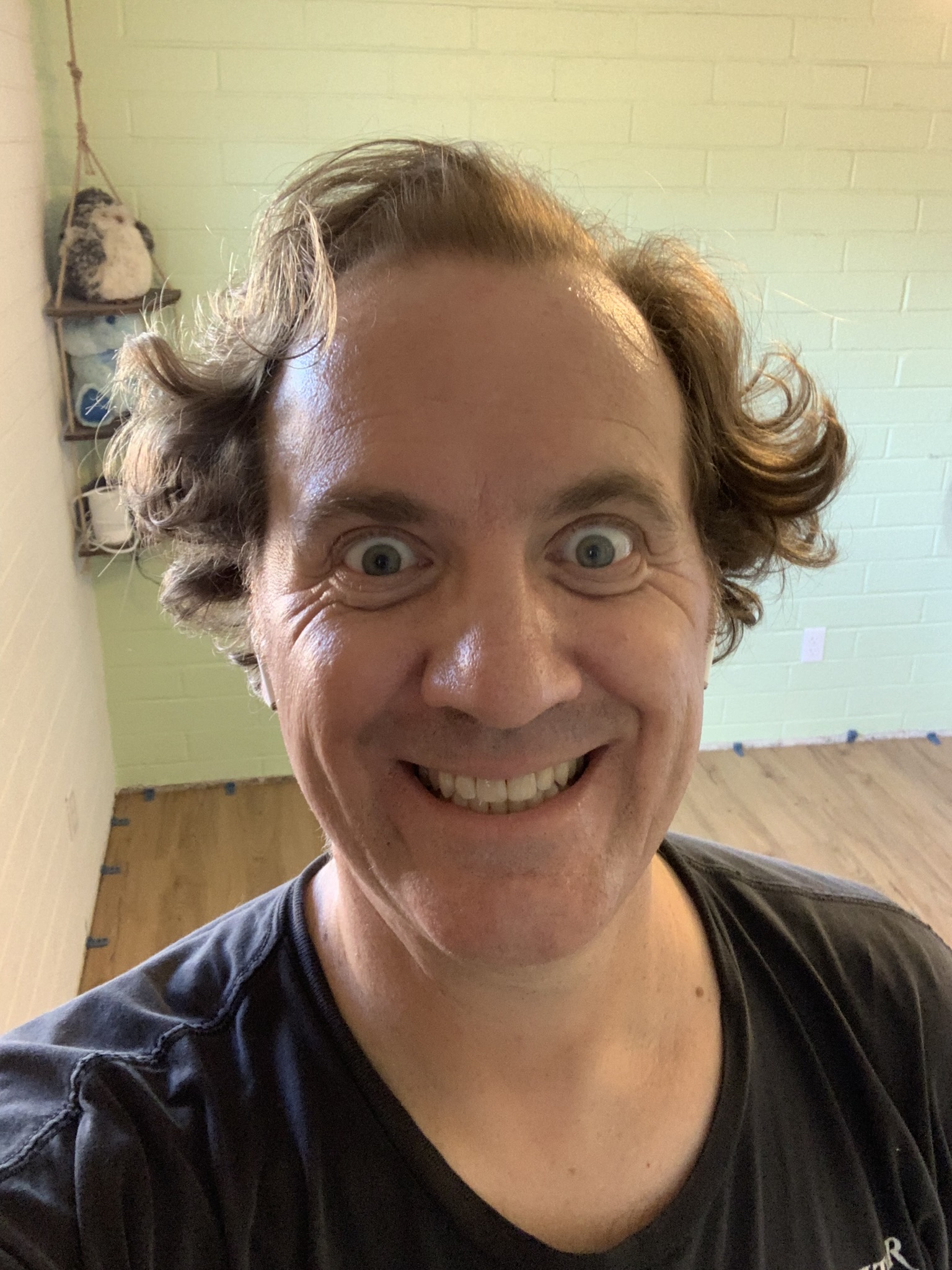
I’m quite proud of this image of me, which I captured after I spent several hours installing that floor. I guess I’m proud of the floor.

So that’s the first part of pride. When you do something that is good and important and defining, then you are (or should be) proud of that. “Important” is a word in there that probably needs defining too, though it is definitely subjective for me: there’s no real reason to think that my writing is important, as I have not been groundbreaking or influential or even particularly successful with my writing; but I think it is important. And I see a distinction between my important writing, like this blog I keep trying to keep up, and my books; and my unimportant writing, like my journal or the emails I send, stuff like that.

So if that is pride, I’m not sure why it’s a thing that Christianity would be against. Other than, of course, the cynical assumption that the faith wants to put all goodness into God so that people need to rely on the church; if God is the source of all good things, then there isn’t anything for any human to be proud of, because we didn’t do that stuff, God did; he just let us borrow it. Personally I don’t like that. But then I’m not a Christian. That may be exactly the mindset they’re going for.

But I don’t think that’s the source of the idea that “Pride goeth before a fall.” (Hang on, let me check on that, because I used “Spare the rod and spoil the child” in an essay I wrote once for school and claimed it was from the Bible, and later on I looked it up and it does not in fact come from the Bible at all. I am actually proud of that essay in a particularly perverse way: I think it’s one of the worst things I’ve ever written, which it was meant to be, and it has been an effective example for my classes because it is so bad. Okay, so this one is from the Bible but I’m misquoting: it is “Pride goeth before destruction, and an haughty spirit before a fall.” Proverbs 16:18, King James Version) I think — though I agree that my understanding of Christian ideology is a pretty laughable foundation for a discussion — that the pride spoken of there is a different kind of pride: and now that I have actually found the correct quote, I feel pretty well confirmed in that.

It’s the haughty spirit. That’s the point. That’s the bad pride, the one that leads to karmic justice in some way.

See, there are plenty of people who take enormous pride in things that they didn’t even do. So it’s one thing to take pride in something that isn’t good; I’m pretty damn proud of my longstanding hobby (One might even call it a vocation?) of stapling papers in the wrong corners in order to mess with my students:

Trigger warning: if you like things being done just so and being done right, you will not like what I did to these papers.

But there’s nothing good about that.

And then there are plenty of things I am proud of which are not important — like the video games I have beaten, that sort of thing. And I already spoke of things that aren’t defining, like cooking dinner for my family. Those things may not really deserve pride — and because of that it does make me question whether I feel proud about them — but regardless, there is no harm in being proud of things that don’t really matter much.

But then there are people who are proud of things they didn’t even do: like being American. Or male. Or tall. Or white. Don’t get me wrong, you can like those things, you can appreciate being those things (I’m not really sure why you would, but to each their own): but what on Earth would make someone proud of being born in this country? What did you do to make that happen? What time and effort did you put into it? Now, if you emigrated here, went through the enormous upheaval of moving to a whole new country; if you made a life and a home here, and created a place for yourself: that would be something to be proud of. But if you are proud of the fact that were born here, well. Bill Hicks has something to say about that: (**Please note: this clip is not safe for work.)

In To Kill a Mockingbird, Miss Maudie talks about Atticus’s shooting ability, once it is revealed that he was called One-Shot Finch, after he shoots the rabid dog. The kids can’t understand why Atticus never talked about how he was a dead shot, and why he never goes shooting if he is so good at it. Miss Maudie theorizes (Falsely, in a way, because he later says what he wanted his kids to think — that courage is not a man with a gun — but this point of Maudie’s also makes sense and might be part of his reasoning) that it is because Atticus recognizes that there’s no sense in taking pride in what she calls a God-given talent. She says that being born with a good eye and a steady hand is nothing that comes from hard work and dedication; it’s just a thing that is true about Atticus, like being tall.

I don’t entirely agree with Miss Maudie — I think that shooting a gun accurately would take a hell of a lot of practice, and therefore would be something to be proud of; but also, you would need to shoot in a good way, and also in an important way, for it to earn pride in my definition — but I see her point and I agree with the idea that taking pride in something you didn’t do, something you aren’t responsible for, is silly. That’s the idea of the Bible verse, too, I think.

See, if you put in the effort on something, if you really do the work, then it’s damn difficult to be proud of it. Because first of all, you’ve seen alllllll the mistakes you made in the process of learning; and if it is something hard to do, then you made a lot of mistakes. You also know, better than anyone, how much effort you have spent, and also you should know the difference that effort made: and that should pretty clearly show you that anyone else who put in the same effort would probably make the same progress — unless you were born with a gift of some kind that contributed to your ability, like having a sharp eye and a steady hand. But if it is something really difficult, then you also recognize that your sharp eye and your steady hand are not the things that make you good, or that make you great: they make it easier for you to be good or great — but only effort and dedication makes you good, or makes you great. The physical gifts are not something you did, so not something you should be proud of: the pride comes from what you put into making yourself into someone you can be proud of. Michael Jordan certainly has physical gifts that make him a great basketball player: but he’s Michael Jordan because he had the will and the drive, and he put in the effort. Therefore, I think he should be proud of what he accomplished. Shaquille O’Neal, on the other hand — well, he should be proud that he is apparently a very nice person. And then, of course, if you do what most of us do with our passions, and you look around at other people who do the same thing, what you are bound to find is people who do it better than you. Because nobody, not even Michael Jordan, is actually the greatest: there’s always somebody better. Knowing that keeps us humble, even if we have accomplished something to be proud of.

But even though it is difficult to take pride in what do, if that thing we do is a calling, if that thing is very difficult, if that thing takes years of dedication and effort to accomplish: then we have to take pride in it. We have to. Because there’s another aspect of pride.

The pride a parent takes in a child, that I take in my wife, my friends, my family, is not the pride of accomplishment. I mean, I’m proud that I support my wife in her art (and I’m proud I make her delicious sandwiches for dinner, without which she could not continue to make art), but otherwise? Her art isn’t my accomplishment. I did nothing to make her into the artist she is, not really. My support and sandwiches were helpful, but she could have done it without them, of course. But I am so incredibly proud of what she can do. So is that like the pride that dumb people take in being born between Canada and Mexico?

No: it’s something else.

The quality of an accomplishment that makes it pride-worthy, the aspects of it that make it (to one’s subjective viewpoint) good, and important, and defining, can be boiled down to one simple emotion: the most powerful emotion. Love. I write because I love what writing can do, and I love what writing is; and therefore I love writers — and therefore, when I write, I love myself. I love when I am able to create the effects that make me love writing. I am so very proud of those moments, of those effects, of what I did, and of myself for achieving them. And yes, it is entirely subjective: but then, often, so is pride. That doesn’t make it bad.

Pride is bad when it is not based on love. That’s the second half of the proverb, the “haughty spirit.” When one bases their pride on their contempt for others, then pride is bad. When one sets oneself above others, and is proud as a corollary to that, that is bad. That leads, in a righteous universe, to destruction: to a fall. (I know it doesn’t always. This is not a righteous universe.)

So really, it’s not that it’s dumb to be proud of being an American; it’s dumb to think that other people are lesser for not being Americans. (I knew that, actually. I am proud of my country. But also, I am humbled by it, because I can never do enough to make it the country that it should be, which means I am not fully worthy of it: so my pride does not create in me an haughty spirit. What a phrase that is. Don’t you just love the KJV?) It’s not that bad to be proud of being tall, or of being white; it’s bad to think that short people are worse off, or that people who aren’t white are somehow worse or less than white people. That’s where pride goeth before destruction: at least it is to be hoped that it does goeth before destruction. Because that kind of pride should be destroyed.

That’s not the pride that people have in their children, unless those people are really damn awful. Parents who put in a lot of work helping their kids to achieve something can take pride in their accomplishment, too, but mainly, parents are proud of their kids because they love their kids. And that love is pride; that pride is really just love.

I think that pride is love turned outwards. Love is generally directed into the person, or the pursuit, or the object, for whom/for which you feel the love; or it is turned into ourselves, as we enjoy the loved thing or the loved one being around us and bringing us joy. When we are proud of someone, as when we are proud of our accomplishments, we want to share that love with others: we want to express it, we want others to see it, we want everyone to know about it. That’s pride. I am proud of my books because I love my books. I am proud of my wife because I love my wife. I want to show off my books, I want to show off my wife, because I want other people to know of my love, and I want other people to understand how much I love, and why I love, and how lucky I am to have these loves in my life: both my accomplishments, and my incredible, incomparable wife.

Also: I am sometimes not proud of being an American. Because I do not always love my country. I am always proud of my wife.

But please remember this, whoever is reading this: if you work on something hard; if you think that thing is good; if you think it is important; if you think it defines a part of you: then be proud of it. Be proud of it like a parent is proud of their child. Notice that I have not spoken of the value or the worth or the price of the thing you do of which you are proud: love has no price, and so neither, therefore, should pride. You just feel it, and want to share it: and you should. Always. And if you are a parent: be proud of your child, especially when that child is proud of themselves. Love them for who they are and for what they do: and love yourself the same way. Don’t talk yourself out of it because you could have done better, or someone else could have done better, or it wasn’t exactly what you thought it would be: just love what you did, and love yourself for doing it. Be proud.

You deserve it.

This Morning

This morning I  am thinking: what the fuck, China?

Scientists added human brain genes to monkeys. Yes, it’s as scary as it sounds.

Okay. Let’s be clear. I am in favor of science. Scientific advancements save lives and improve the quality of our lives. I am also of the opinion that our highest calling as human beings is to create beauty, and to discover truth.

But this? This is not beautiful.

Of the 11 transgenic macaque monkeys they generated, six died. The five survivors went through a series of tests, including MRI brain scans and memory tests. It turned out they didn’t have bigger brains than a control group of macaques, but they did perform better on short-term memory tasks. Their brains also developed over a longer period of time, which is typical of human brains.

I am, of course, generally not in favor of animal experimentation, nor human experimentation —  I say “Of course” not because I presume my audience knows that I am a humanist, a pacifist, a vegetarian and an animal lover, but because I am a thinking, feeling human, and thinking feeling humans should all generally oppose experimentation on sentient creatures. I understand that sometimes animal experimentation is necessary. Medical advancements, for instance: when those experiments move forward, lives are saved and lives are improved, and that is probably worth the cost. It is sometimes impossible to move a project forward without live subjects, and animals are probably better subjects than humans, ethically speaking.

But this is not a medical advancement. This does not help humans live longer, nor better. This was done entirely, completely, because they could.

Although the sample size was very small, the scientists excitedly described the study as “the first attempt to experimentally interrogate the genetic basis of human brain origin using a transgenic monkey model.” In other words, part of the point of the study was to help tackle a question about evolution: How did we humans develop our unique brand of intelligence, which has allowed us to innovate in ways other primates can’t?

They excitedly described the study as the first attempt to do BIG FANCY SCIENCE WORDS. The attempt to answer that question is nonsense: how a macaque is affected by people injecting weird DNA into its genome has nothing whatsoever to do with human evolution, and anyone with a high school education knows it. There’s no possible way to isolate the variables and find specific information. I’m sure this would give hints that could lead to new knowledge — but six dead animals and five fucked-up ones seems a very high price for hints.

And of course, though I do not like slippery slope arguments, there’s no need to speculate about this experiment leading to more like it, coming faster and going farther: that’s already happening.

The Chinese researchers suspect the MCPH1 gene is part of the answer. But they’re not stopping there. One of them, Bing Su, a geneticist at the Kunming Institute of Zoology, told MIT Technology Review that he’s already testing other genes involved in brain evolution:

One that he has his eye on is SRGAP2C, a DNA variant that arose about two million years ago, just when Australopithecus was ceding the African savannah to early humans. That gene has been dubbed the “humanity switch” and the “missing genetic link” for its likely role in the emergence of human intelligence. Su says he’s been adding it to monkeys, but that it’s too soon to say what the results are.

Su has also had his eye on another human gene, FOXP2, which is believed to have graced us with our language abilities. Pondering the possibility of adding that gene to monkeys, Su toldNature in 2016, “I don’t think the monkey will all of a sudden start speaking, but will have some behavioral change.” He would not be breaking any laws.

Ohhh, he would NOT be breaking any laws! Well, shit, I guess that’s fine, then.

The article goes on to make a fairly obscure point, which is that monkeys made to be more like humans will suffer even more in a constricted lab environment; it also points out that “normal” monkeys suffer enough as it is, that macaques have intricate and important social lives that they can’t experience in a lab. This is all true, and makes this experiment unethical — or it would, if there was any ethical argument to be made for this experiment.

Look, I understand that science does not always have clear connections to a practical use. My father, a nuclear physicist, spent his career working on multi-billion dollar projects that had no direct application in the world. But of course practical application was not the point: expanding knowledge leads to better understanding, which leads to both greater expansion of knowledge and, at some point, practical applications, which is where longer and better human lives come in. But we can’t just focus on the eventual positive outcome: we have to consider the cost right now, and the benefit right now, with the potential benefit considered only after that. And the cost of this experiment is much too high, while the benefit from it is — little more than bragging rights. This doesn’t change our understanding of human evolution, it confirms, slightly, something we already thought was true. It can’t confirm it too conclusively, because again, macaques infected with human DNA are not the same thing as  Australopithecines evolving under natural selection. Not even close.

Last two things I want to point out about this: one, Chinese geneticists have already altered human DNA, entirely against any standard of scientific ethics. (They may have arrested the scientist who did it, but really, what does that even mean in China?)

And two, China is not the only nation involved. Of course not.

When it comes to studying monkeys, a researcher gets much more bang for their buck in China, as the Atlantic’s Sarah Zhang reported last year:

A standard monkey in China costs about $1,500, compared to roughly $6,000 in the United States. The daily costs of food and care are an order of magnitude lower as well.

In the past few years, China has seen a miniature explosion of genetic engineering in monkeys. In Kunming, Shanghai, and Guangzhou, scientists have created monkeys engineered to show signs of Parkinson’s, Duchenne muscular dystrophy, autism, and more.

Because of the relative ease of conducting primate research there, some researchers regularly travel from the US to China for scientific work on monkeys. As Zhang pointed out, researchers at Emory University recently collaborated with scientists in China who work on genetically modified monkeys. And Su’s study involved University of North Carolina computer scientist Martin Styner. Styner, who told MIT Tech Review that his participation was minimal, said he considered pulling his name from the study and has come to believe such research is not “a good direction.”

Although the US is not green-lighting studies like Su’s, American universities that collaborate with Chinese scientists on such studies may still be complicit in any ethical harm they cause.

I hope we’re all ready for what comes next.


This Morning

This morning I’m thinking about sadness.

I woke up feeling blue. Not too sad, really; it’s Saturday, which is lovely, and though I had a long and difficult week, there were some excellent moments with friends, with writing, with my wife and our pets. But I was down; melancholy. I slogged around the house for a half an hour while the coffee cooked, and then I took my dogs for a long, slow walk. (Though they wanted to go for a long, fast walk, with many sudden stops for sniffies. I wouldn’t let ’em. Misery loves company. [Actually, I let  them have their sniffies. We just didn’t walk that fast. They didn’t seem to mind too much.])

While I was walking, I was thinking. Why do we get sad? I’m an atheist, so anything to do with metaphysics or God’s will or sin isn’t a good enough answer for me. I know the Buddhist answer is that suffering is a consequence of desire; I get that for anger, or grief, and certainly envy or jealousy; but melancholy? I don’t think I was desiring anything this morning other than not being sad — and being sad because I wish I wasn’t sad seems like much too cruel a cosmic Catch-22 to be reasonable. I suppose there could be an argument that the particular melancholy this morning was the result of an unfocused desire, that I wish my life was different in some ways and so when I woke up into the same life, as a steadily aging public school teacher who still hasn’t achieved success as a writer, it made me sad. Maybe so, but I wasn’t really thinking about any of those things; I was just — blue.

What about modern science and pyschology? As far as I know (And that bummed me out, too, because I realized that even though I don’t know what role sadness plays in our psyche or our evolution, somebody out there does; so this whole chain  of thought isn’t because I’m deep, it’s because I’m ignorant. I feel like that is pretty much always true: that any question I have, someone out there knows the answer, and if I just took the time to look, I’d learn the truth. Sometimes that makes me hopeful, and sometimes it makes me hopeless.) the model of emotions is that they are nothing but chemical reactions, hormones released in the brain and limbic system in response to stimuli. I think as well that the idea is that all aspects of human existence evolved as the result of some kind of survival pressure, because in some way it gives us an advantage. Anger makes us strong and aggressive; love helps us pair-bond for mutual cooperation and procreation; fear is a warning of danger. Even when those emotions are not targeted in an evolutionarily advantageous way, like when we get angry at video games, or fall in love with our cars, or when we’re afraid of moths (Don’t look at me like that: they are Satan’s butterflies.)

Image result for moth

Know what that is? That’s a moth DRINKING TEARS FROM A BIRD’S EYE. Fucking tell me they’re harmless. Bullshit.

But what evolutionary advantage does sadness give us? How does being blue help me to find food or evade predators on the savannah?

It’s possible that sadness is a misdirected emotional cue. Like modern food and eating habits make us fat because our bodies are geared towards craving sugar, salt, and fat, as all three of those have definite survival advantages if you’re living out on the savannah: sugar gives you quick energy to run away from lions, fat contains vitamins and gives long term energy storage, salt helps us BECAUSE ELECTROLYTES ARE WHAT A BODY CRAVES. It’s just that food today can be manufactured with so much fat, salt, and sugar, where foragers or hunter-gatherers on the savannah had a much harder time collecting them, that our reward system, geared  to give strong rewards for tiny amounts gained after strenuous work, overrewards us for just sitting around and horking down Cheez-Its. It’s a misdirected survival mechanism, because we didn’t evolve with 2019 in mind.

But sadness, I would argue, doesn’t always have a trigger. (As I’m writing this, though, I’m getting more and more tired, and curling up with a blanket and going back to sleep sounds absolutely wonderful, so suddenly I’m wondering if melancholy is simply a signal to slow down and have a snooze. Maybe so. I’m still going to finish my point.) Even when it does, when you see someone hurt, or hear about suffering and despair in the world, how does it help me to deal with that if I feel depressed because of it? What possible adaptive value could being in a funk present?

So there I am, walking my dogs, dragging my feet and hanging my head, and thinking about the value of sadness, and what it could possibly be good for. What could sadness do for us. What power does sadness have. Power. And then I thought: imagine if someone gained power from being sad. Like Samson and his hair, but with angst. Imagine if the Hulk  got stronger when he was sad, instead of when he was angry. Imagine if someone had to make themselves sad in order to be strong, and the sadder they got, the stronger they were. Imagine if someone was a sorceror, say, and instead of sacrificing a virgin to Baal, they had to break their favorite childhood toy, or watch a hurt animal try to walk.

Hmmm. Just imagine.

And just like that, I came up with an idea for a book  I’d like to try to write. I still need to flesh it out, work on the characters and build the world, and come up with a plot and all; but I really love the concept. Which  I came up with because I was feeling down.

So that, I think, is the value of sadness. It does help us to slow down and take it easy, too, because when we’re sad I think we don’t want to do anything but curl up and sleep, and particularly in our overworked overstressed world, that is very important and very, very good for us. But mainly, I think that sadness, by the simple fact that we generally don’t like it, makes us want to do something to change the way we feel. This is the same argument I make with my students about learning: they need to feel uncomfortable, they need to feel like they’re missing something, in order for them to learn; if they are perfectly content, then their brains don’t seek out a solution to the problem, because there’s no problem. So the brain just closes its eyes and takes a nap, so to speak, if the person is too comfortable. It’s when we are uncomfortable that the brain seeks out a new equilibrium, by observing and processing what is around ; that is how we learn best.

Maybe sadness does the same. Maybe sadness is an inspiration, a impetus, to get off our butts and do something to take the sadness away.

Or else it’s my brain and body telling me I really need to nap. I’m going to go lie down, now. And maybe think about my new idea.

This Morning

This morning I am thinking about art.

These thoughts were inspired by a book I just finished reading, Steven Pressfield’s The War of Art; I’ll be reviewing it later, (Sneak peek: IT SUCKS.) though after  yesterday’s post I’ve decided to keep the book reviews and This Morning separate. This Morning is what I think a blog should be, and what I haven’t been doing well despite my years of keeping a site for my writing: it should be a Web-log, a recounting of events, thoughts, feelings, etc. Part of me says “Then why the hell would anyone want to read it?” But that takes me to what art is.

Art is one of the two pursuits, ambitions, goals, that make humanity what we are, that set us apart. We share 99% of our DNA with chimpanzees, and everything we have — tools, technology, society, language, family, war — is echoed in the animal world. The only two things that make us unique (And they may not actually make us unique, as there may be other creatures on Earth with the same pursuits) are art, and truth. We  pursue truth for the sake of truth, and art for the sake of art, and I think there are no other creatures that can definitively be said to do the same. The argument could be made for birdsong and whale song, and for the way some animals play, and the way some animals dance; but I think all of those can be identified as survival traits in one way or another.

I think art  and truth can be seen as survival traits for humanity, as well, but the connection is more tenuous, more distant. Art and truth can be paths to personal success, financial or social, in society, and thus are they survival strategies; they can create pleasure in the individual, which makes us more likely to do other things that help us survive that we tend to do when we’re happy, and also helps us deal with the stress that kills us; they can be used to achieve pragmatic and temporal goals and to transmit and influence culture, which are all part of the survival strategies of the social animals that we are.

But the thing is, there are a lot of us who pursue art and truth despite those pursuits taking away from everything that would be seen as beneficial to Darwinian survival strategies. My art cuts me off from other people. It often makes me sad. It takes time away from the things that earn me money, that earn me social success. Art kills quite a few of us: Vincent van Gogh, Virginia Wolfe, Ernest Hemingway, David Foster Wallace, among others, by suicide; James Joyce and Jack London and Dylan Thomas, among others, by alcoholism. (I’m oversimplifying: they all suffered from various conditions that surely contributed to their deaths, particularly, in the case of the suicides, severe depression; but if you don’t think that the life of an artist was a factor as well, then you don’t do enough art. You should try to do more. I promise it won’t make you suicidal. Well, I don’t think it will.) Truth does a lot of the same things to scientists and mathematicians and philosophers, and where it has been used to have a direct impact on society, then sometimes lots of people die, particularly the one who speaks truth: this category, I would argue, includes Dr. Martin Luther King and Mohandas Gandhi and Martin Luther and Karl Marx. Also J. Robert Oppenheimer and the rest of the Manhattan Project, and Werner von Braun.

So art and truth are not, or not only, survival strategies; in some cases they are hazards — and yet we continue to pursue them. Because there is value in them, for society and for the individual, beyond survival, beyond life and death. That’s what art is: value beyond life and death. It’s something worthwhile even if we can’t say precisely why it is; we know it is. There are as many reasons why as there are people, but I think that for all of us, there is a reason why art is worthwhile beyond life and death. That’s not to say that we should die for art, nor that we should want to; it means the value of art is nothing to do with living or dying.

(I will say I think there is a biological evolutionary explanation for the pursuits of art and truth: I think our giant complicated brains evolved in order to keep us alive despite our essentially incompetent bodies, but then our brains got a jump on survival pressures when we created society, and gave ourselves an enormous lead in the race for survival — so strong a lead, in fact, that we’re probably going to kill ourselves off with the very things that help us survive, like the food we eat and the technology we create and the standard of living we uphold and the population  we sustain. But another aspect of this oversuccess is that we don’t actually need all of our brains in order to live; so we turn that excess energy into a pursuit that consumes brain power, and offers us some kind of valuable reward, but that doesn’t contribute to survival. Art. And truth.)

The difference between these two is the distinction between heart and mind, emotion and thought. Truth is thought, and art is emotion. That’s too glib and simplistic, of course; they almost always blend and combine and lead from one to the other and back. But one of my favorite quotes, from Vladimir Nabokov, is, “To call a story a true story is an insult to both art and truth.” The goal of fiction, which is Nabokov’s subject there, is not to depict the world, but to interpret the world; the same should be true for pictorial art, and for music, and for anything else that isn’t trying to capture and explain the world; that is the realm of truth-seekers, not artists.

When I think of the pursuit of truth, by the way, I think of my father. My father is a retired particle physicist, and for years, since before he retired, he’s been working on a physics problem in his free time. I can’t explain it; it has something to do with reconciling Newtonian physics with quantum mechanics. He had an inspiration years ago, and he’s been searching for the math to make it work ever since. He does this without expectation of reward; the best he can hope for is publishing an article in a physics journal, which would lead to no tangible reward. He has hit many stumbling blocks: he has had to look for math texts that can give him a formula or a method that he thinks he needs, and those are often dead ends. He has come close, only to find a flaw in his own math, which means he needs to start over again. He’s still working on it. He does it late at night when he can’t sleep, because simply working on it gives him peace. That’s the pursuit of truth, because all of those things would apply to someone, say, writing a novel, except my father is looking for an answer. That’s his goal even more than publication: he thinks this idea will work, and he wants to assure himself that it will. He is his own audience.

That, with the goal of capturing or creating a feeling, is art.

(To be continued. Because the pursuit of art never ends.)

Book Review: The Naked Ape

The Naked Ape

by Desmond Morris

I’ve been carrying this one around for a while, never sure how much I actually wanted to read it; the cover talks about how explosive and controversial the book is, and that’s cool, but it was published in 1967, so it’s unlikely the controversy would still feel controversial, and might not even feel interesting. I had no idea what to expect from a book about human sexuality and interpersonal relationships from an evolutionary standpoint.

Turns out it was what I should have expected: this book (I’m sure it’s not the only source) was where the ideas were codified that people still repeat in terms of the evolution of humanity. This is where you can read about how men are hunters, while women are caregivers, so that humans have created pair-bonds of unusual strength so that the men can go out and hunt while the women stay home and care for the children, and both can trust that the other won’t go out pair-bonding with some tramp or the hunter next door.

This is where you can read about everything about humans is designed specifically for sex: we have tiny hair (Despite the title, we actually aren’t less hairy than other apes; it’s just that our hairs are mostly really tiny – at least for Caucasians like me. Africans, Asians, and Native Americans are indeed less hairy than monkeys. Maybe instead of Honkies, we should be Hairies. Heh.) so that we can enjoy touching each other more; we have earlobes so that we can enjoy more variety of erogenous zones; women have breasts because men can’t see their butts from the front, and poofy red lips because – never mind. He also comments (and this little factoid is repeated in the Wikipedia article on the book —  can’t imagine why this one should be the one people pick out in describing the book) that humans have the biggest penises out of all the primates. Fancy that.

This book explains everything. Unfortunately, almost every single word of it is speculative. It’s funny, because there’s a point in the beginning when Morris scoffs at one particular theory which was made without direct evidence; and then he proceeds to spin theory after theory without even a scrap of direct evidence for any of them. (Because I thought it was interesting: the theory Morris scoffs at is the explanation that we lost our coarse body hair because in between the fruit-eating monkey we once were and the savannah-living hunter/gatherer hominid we became, there might have been a coastal/aquatic stage, when the monkeys discovered the abundance of rich food at the seashore. This might explain the evolution of hairlessness, as a means of streamlining in the water; this fits because the body hair that remains actually mimics the pattern of water flowing over a swimming body. It also explains our hands being wide and flat and paddle-like. It’s an interesting theory. It’s a better one than “We have earlobes so we don’t cheat on each other when we’re out hunting!”) Morris has a fair amount of negative evidence that he derives from the animals he knows so well (Morris was a zoologist and zookeeper); so the explanation that human women’s breasts don’t need to be large for the sake of nursing, because chimpanzees breastfeed but have essentially flat chests, makes sense; but the idea that they are therefore specifically erogenous because breasts, nipples, and areolae swell during sexual excitement, and particularly the idea that they are meant to imitate the buttocks because humans mate face-to-face, are entirely speculative and really pretty ridiculous. (I have to recommend this song, particularly the last verse; beware, it is not safe for work.)

Probably the most amusing thing in reading this book – other than the smutty dirty parts, which are always fun to read (and this book talks A LOT about sex) – was the glib way Morris plays up his own ethnocentrism. He mocks other ethnologists and anthropologists who study small, extraordinary populations, claiming that the real information should come from a study of the mainstream, “most successful” version of humanity – which, he assures us, is clearly the Western European and American culture. Just look how many of us there are! Obviously we’re the best and most normal human. (And again there is a remarkably oblivious hypocrisy in this, because Morris goes on to talk several times about rare and unusual ape behavior or traits as analogous explanations of human behavior; the breasts-as-front-facing-buttocks thing comes partly from one particular type of baboon that has a similar adaptation. One type of one species of ape. “Who would think it was a good idea to study small and atypical populations to understand a whole species? Ridiculous!”) It was fascinating because I know that at the time, the book was seen as incredibly radical and liberal and offensive, arguing as it did that our tendency to pick a single mate for life is evolved, not set down as right and good by Almighty God, et cetera; but now, the stances it espouses are become almost entirely conservative: American is the best kind of human; the family should stay as a single unit; the man should work outside the home (modern version of hunting, Morris tells us several times — and describes how men are always competitive, seeking “the kill” in their business lives because we don’t hunt mammoths any more. Not sure what “the kill” is for a high school teacher…) while the woman raises the children; the best sexual position is face-to-face, probably missionary style – “Good old-fashioned, man-on-top-get-it-over-with-quick,” to quote George Carlin. I wonder what Morris would have made of the current ideas about gender. Since he talks about how homosexuality is an evolutionary failure and therefore anomalous, I have a guess.

Overall, it was more interesting in terms of what it said about the author and the culture he was writing in, than in what the book actually purports to explain. As an ethnologic artifact, it’s not bad; as an explanation of humanity, I wasn’t impressed.

Spring Break Book Review #1: Angels and Ages

(So here’s the deal: it’s my Spring Break, and I plan to spend it reading. I will be posting as many reviews as I can. Here’s the first, for the book I finished reading Saturday, March 18 — first day of Spring Break.)

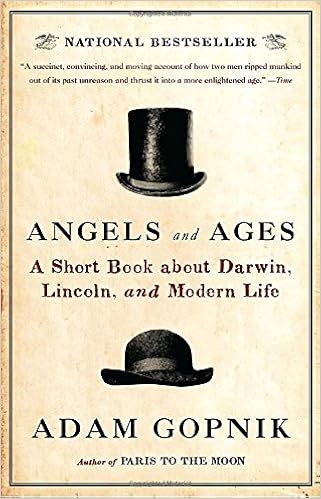
Angels and Ages: A Short Book about Darwin, Lincoln, and Modern Life

by Adam Gopnik

This was an interesting one: one of those “slow burn” sort of books. I came across it at my local used bookstore (Bookman’s in Tucson – Woo! Bookman’s!) in the discount rack, marked down to $1. I had just a day or two before read an article by Mr. Gopnik (Who is a 30-year veteran at the New Yorker) online, and so I recognized the name; even though I have been trying not to buy new books until I clear off my To Be Read shelf –or, rather, shelves – I couldn’t resist the subject matter. So I bought it, and even though I haven’t been able to find time or energy very well of late, what with school-before-Spring-Break, I decided to give it a read.

Odd phrase, that. Am I being generous with my time, granting Mr. Gopnik, and Mr. Darwin and Mr. Lincoln, a few of my hours, growing ever more precious as I age? I am acting as an audience, without which they would be forgotten (Well, at least a little bit. But then, the whole point of the Darwin half of this book is that those little bits, little bits of time and little bits of life, are all there are.). But then again, they are giving me something even better: they are inspiring me.

Mr. Lincoln, who comes off a little bit worse than his iconic status (and rightfully so) nonetheless inspires me to believe in the power of a single man to change things; particularly in the last summative chapter, this book points out how incredibly influential Lincoln was with this analogy: imagine if Boris Yeltsin had been able to maintain the Russian empire, and also install a functioning democracy obeying the rule of law. That is Lincoln’s accomplishment, and though the Civil War likely would have happened without him, and the subsequent events of Reconstruction, Jim Crow, and eventual ongoing equality, the country wouldn’t have been the same. He also inspires me because he was a freethinker, an atheist, an introvert, and a deeply literate man.

Mr. Darwin, who comes off a bit better than most depictions and associations of him (and rightfully so) inspires me with his ability to be focused on both the infinite and the infinitesimal. Gopnik shows how Darwin had extraordinary powers of concentration and observation, and these, along with a constant need to ask, “Why is this so? How did this get to be this way?” are what led him to his great world-changing theory – which he knew was world-changing, also knew was absolutely correct (as far as science can ever be absolute or correct), and sought, and found, the best way to pour this thought into the collective consciousness of the world. It is remarkable, Gopnik shows, that a theory that in most people’s hands would have been a mere footnote in biology and likely would have taken generations if not centuries to percolate up through the strata until it hit the top – like, as Gopnik says, Gregor Mendel’s work on genetics – was able to completely shift the world’s conversation from a Young Earth creationism to the truth in a single generation. I also love that Mr. Darwin was so deeply in love with his wife that he delayed publication of his work because it would upset her, and also that his own atheism was softened by the same knowledge: that his devout wife would be upset by too-vigorous protestations of what he knew to be true. Though I don’t have to make the same compromise, I appreciate that he did it for her.

I am inspired, last but not least, by Mr. Gopnik. This is a complicated book; too complicated, in some ways, because the ideas and the writing are dense, and for me, the subject matter a touch too abstract to hold me down while I work my way through it. It’s written like an essay – unsurprisingly, it started as two essays in the New Yorker, one on each great man (United in this book first by the coincidence of a shared birthday – February 12, 1809 – and second by their impact on the world) – and it’s tough to follow, because Gopnik intentionally didn’t write it as a historical/biographical book. Since I haven’t ever read a good biography of either man, some of this book was lost on me. But I appreciate the enormous effort and scholarship that went into all the thought in this book, and the basic thesis that the two men are equally important to the creation of the modern world, Lincoln in the proof of the ability of liberal democracy and the rule of law to survive, Darwin in the revolution he led that changed essentially everything in the world about how we live with science. I appreciate the effort it shows in the density and complexity and beauty of the language Gopnik uses. I appreciate that he shows how Darwin and Lincoln are Darwin and Lincoln – and not, say, Alfred Russel Wallace and Stephen Douglas – because of how extraordinarily good both men were as writers. Both masters of rhetoric. Both able to accomplish what they did because of how Lincoln spoke, and how Darwin wrote, and how both of them argued.

I like this argument. I like how it’s written. I would like to be able to do the same thing as any or all three of these, at least as a writer.

Thank you, gentlemen. I appreciate your time.