I Did It My Why

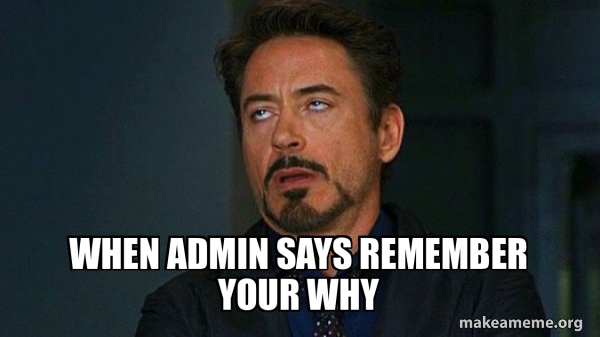
when admin says remember your why - Tony Stark Eye Roll Meme Generator

It’s inservice season!

Of course that should be the time of year, as the old joke goes, when we all get to hunt inservices, but it just means that this is the time of year when teachers go back to work in order to pre-game before the students arrive. (Yes, if you’re wondering, we’ll be drinking – but not enough. Never enough.)

If you are wondering – or, if you are one of my fellow teachers, which means your mouth is hanging open and you are cussing foully at the very thought of this – yes, this is absurdly early. In fact I am writing this at the end of the first half-week of inservice: this year I went back to school on July 16th. I kept seeing memes from teacher meme accounts that joked about our general outrage over Back to School sales happening now, with some kind of How-dare-you caption or comment that included the phrase, “It is JULY!” And though I share that outrage, every time I saw it I had to just sigh. Because not only am I back to work in the middle of July, but I will actually have students in July: classes this year start on Tuesday, July 29th. Thereby spelling the doom of that last vestige of the past advantages of being a teacher: it used to be a steady job, that was respected and appreciated, and which offered good benefits and a lovely, long summer vacation; now none of that is true, at least outside of the wealthier blue states.

But at least we’re still badly paid. So that tradition goes on.

Whenever I think about inservice – which I try not to do whenever I am not in the middle of it, but when I am in the middle of it, I always find myself stuck in uncomfortable chairs in rooms full of people who will look askance at me if they do not actually accuse me of disrespectful misbehavior should I have the audacity to distract myself from the pointless and condescending lecture being presented as helpful instruction, and so I end up spending quite a bit of inservice time pondering in silence the meaning of various available abstractions like this one – I wonder: What is inservice? (Also Why am I here? And Is there value in suffering?) It’s a strange word, after all: is it intended to differentiate this process from some other system called outservice? Which, frankly, if the only difference between inservice and outservice is that outservice is carried out in some place other than the school building, I’ll still take that one every time. And whether the service is in or it is out: who is being serviced? Am I and my fellow teachers the recipients of said service, like cars out of tune? Or are we the ones servicing something or someone else? If it is the teachers performing the service, what (who?) are we servicing, and why?

The ostensible answer is that inservice is meant to provide teachers with time and training to help us prepare for the upcoming school year; so essentially, it is the first one: we teachers are rolling into the garage like smoke-belching, backfiring, broken-down jalopies (Not entirely inaccurate), and the mechanics tune us up to get us ready for the race about to begin. I’m not sure what that makes the students, who are not the drivers and not quite passengers – maybe the cargo? Maybe the road we are driving on? – but I think that’s taking the metaphor too far. This lens does bring into clarity a number of obnoxious things that happen during inservice, not the least of which is: remembering my why.

There are themes that run throughout inservice everywhere, always, and which return every year, like a repeating motif in a Beethoven symphony, or like a recurring nightmare; one of these is the certainty that someone, almost certainly someone who does not teach, will ask the teachers to remember their why.

Why do we teach? Why do we take on this difficult and underappreciated job? Why do we come back to it year after year? Is it like returning to an abusive relationship? Is it like trauma that hides behind a memory block, as is supposed to happen with women who go through natural childbirth and then have to forget how incredibly painful the experience is or they would never have any more children?

As I have never given birth, nor been in an abusive relationship other than working in education, I cannot say. I will say that I remember, every year, how awful the previous year was – and also how wonderful it was, at times.

Which brings me to this year, and the current inservice season, and the direction – which was indeed delivered last week, by a presenter who is not a teacher – to remember my why.

Last year was bad. It wasn’t my worst year – that will always be 2011-2012, when I was working through a recession and a state investigation and a union contract negotiation in which I was the lead negotiator (And it says something that 2012 was the year I won Teacher of the Year for my school district in St. Helens, Oregon) – but it was bad. I spent a fair amount of time last year thinking about, and looking for, jobs that were not teaching jobs. That’s how bad it was: it changed my why into a What the hell am I doing here?, a question that is much less conducive to being a good teacher, and so not one that will be recognized at most inservice training sessions, even though surely many teachers at those sessions are asking that question, repeatedly, sometimes out loud, though under our breaths, so we don’t get dirty looks.

But here I am, one more time – my 26th – starting a new school year, about to teach high school English to a new (Well, partly new; partly familiar, which is at least part of the problem) cohort of students. And I found myself this past week thinking, genuinely wondering, Why?

Why am I teaching? Still? Why am I doing this to myself?

I don’t have an answer, not an immediate one. On some level, I don’t want to be here any more, don’t want to be teaching, don’t want to be teaching at the school where I have been teaching for the last 11 years. But that, too, is not the whole answer, and the whole answer is not immediately obvious in that context, either.

So let’s talk about it.

Why am I here? Why am I teaching?

First of all, most clearly and fundamentally, I’m here because I need a job. If I lived in a different kind of society – one that I think would be better in countless ways – that did not define a person’s value by their economic activity, then I would not be a teacher, at least not a classroom teacher. I have often thought I would like to teach the way Socrates did: at dinner parties, in conversations with interested parties, or out on the streets with random passersby; obviously I couldn’t do that for money, but I think I’d be pretty good at it. But I don’t live in that society, I live in this individualistic capitalist one, and so I must work for money so I can have a house and food and air conditioning, all the vital necessities of life. It’s possible I could survive without a job, but my level of misery would go up exponentially, even over what I went through, what I go through, as a teacher. So I work, rather than become homeless and starve on the street.

But does it need to be this job? At the moment, that answer is close to a definite yes, because my wife, who was also a teacher last year, and who had a far worse year than I did, lost her job to budget cuts at the end of last year; as she is working to build her entrepreneurial endeavors, it falls to me to provide a steady income and health insurance; because teachers are generally more valuable as we gain experience, our pay goes up every year and then drops precipitously if we change schools or school districts – I have done this twice, the first time losing about 20% of my annual pay and the second time 40% — so that means I need to stay in this job, rather than get another teaching position. That wasn’t an easy or a simple decision: I applied for, and could have gotten, a job teaching in a different school that would have earned me about 30% less than I make now; but I just couldn’t afford the drop in pay. So here I am. (It does help that I have many dear friends at this school, and that some of my students are lovely people. But it only helps, it doesn’t make the decision easy. It’s not the why.)

It is possible I could change jobs entirely, even change industries; but because most jobs pay more with experience, like teaching does, I would have to start at the bottom of the scale, and that is generally also less than I make as a teacher, even if the upper end of pay would be more. I am also painfully aware that the current political power structure puts continuing health insurance across changes in employers at serious risk of ending, which makes me doubly unwilling to leave my current job for a new one. Any job that would pay as much as or more than I make teaching would require additional training and/or certification, which makes them possibilities for the future, but not for now. (Also, I am 51, so starting a whole new career at the bottom and working my way up is both less attractive and also less likely than it would have been 20 years ago. Plus ça changeplus c’est la même chose.)

But of course, I could do those things. I could get a job in marketing, or in public relations, or in corporate training. (I could become one of the people who provide inservice to teachers, but I would really have to hate myself to do that.) Especially if I and my family moved states, to one that had a generally higher payscale for professional jobs, I could find something that provided the same approximate income. Yet here I am, back teaching again. So there’s more reason for my returning to teaching than just necessity, more than just money. I will also point out that, if I just wanted to receive my paycheck and cared about nothing else, it would be fairly easy for me to keep my job despite becoming a terrible teacher, because it is in fact quite hard to fire bad teachers. So long as I didn’t hit or harass one of my students, I could treat my job very differently from how I treat it now, how I have always treated it, so that even though it was the same job, it would be a very different experience.

Let me be a little specific. I teach English to high school students, and I do it well. I make literature both understandable and interesting to my students – or at least I create an opportunity for them to find literature both understandable and interesting. I make the class as valuable and entertaining an experience as I can, as much of the time as I can – and that’s a good amount of the time (though of course the experience of my class is subjective and I don’t doubt that some students think I do a terrible job of teaching, and/or that my class is boring as hell. But mostly, they don’t think that, not if they pay attention and try.). I work very hard to achieve that: I spend hours and hours thinking about what I am going to teach and how, hours and hours preparing materials and assignments and activities, and then when it is time to go and teach those things, I show up, every day, as ready as I can be to teach the material to the students I have. I ignore the inconveniences and frustrations of my daily work, of my classes and my situation, and do my best to treat every class period as an opportunity for both progress and also fun. I try to learn as much as I can about my individual students, both so that I can teach them better and so I can show them the respect they are due as human beings who are as wonderful and valuable as every other human being, despite being adolescents (That’s not a dig, not really; adolescence is miserable, and all of us react to that misery by inflicting misery on others. I did it too. I don’t blame them for it: but it can be very hard to deal with them while they work their way through it.). I try to be as honest and vulnerable and trusting with them with my own genuine self as I can be, again so that I can teach them better and so I can show them the respect of being real with them, so they can trust me, so they can work with me.

The fact that I do that, that I have done that every year, is part of the reason why I had a bad year last year, and part of why I don’t want to do this any more: because my students last year did not generally return my respect and my openness. They did not listen or value my honesty and vulnerability, and they did not show me the respect I deserve as a fellow human being, let alone as a teacher who has some ability to affect their lives, possibly for the better. They mostly didn’t disrespect me maliciously, just being teenagers in this modern world; but it was hard to remember that and to keep caring about them and keep trying to be the kind of teacher I want to be with them while they treated me with callous indifference. There were many times, for instance, when I would ask my students about something, and they would ask me what I thought or what my experience was in regards to that idea or situation, and while I was answering the question they asked me, they would not listen: they would turn away and have side conversations, or look at their phones or Chromebooks, or leave the room, because they were bored. Not because they hated me and wanted to insult me, but just because they didn’t care, and they didn’t feel like they needed to show me the respect of their attention, even as I answered the question or gave the explanation they asked for. So as I said, not malicious, but nonetheless hurtful, and hard to deal with. And this year, I will have many of those same students back again. Will they treat me more respectfully? Will they listen to me when I talk, either as their teacher or as a fellow human being?

Probably not. But I am willing to try.

I don’t have to: I could assign them readings, and questions, and maybe videos or audio files of literature – particularly non-fiction, which is what my administrators want me to focus on anyway, as it is the heart of the testing that produces the data that is the obsession of all administrators everywhere –  and I could sit at my desk and monitor their online activity to ensure they were on task. To my school, that would be considered teaching, to a degree sufficient for me to keep my job and my current pay, which is not really related to my success or failure in actually teaching my students. If I produced data that was better than what I currently engender with my involved, honest, human, active, interactive teaching, then I would be even more secure in my job. I might even get a little bonus money if their test scores went up. And it would be so easy. Especially if I just had AI design my “lessons” for me. And grade their assignments.

I choose not to do that. I choose to take the much more difficult path, which does not necessarily make my job more secure, and which definitely does not produce the best test scores. And why do I choose that, you might ask?

That’s the Why worth thinking about.

I teach the way I do because I don’t just teach for money, and I don’t ever teach for test scores. I think that my teaching methods help students to get better at understanding literature and at explaining their understanding in writing, and so higher test scores should be the result of my methods; but those test scores are not my why. If anything I sometimes, perversely and against my own best interests, want those scores to go down while my students’ knowledge and abilities improve, for the data to become less reflective of my students’ actual learning and abilities. Because I want my students – and also my school and my community and my society – to care less about test scores and measurable progress data. Ideally they would not care about it at all, ever; and my hope is that when students grow and learn in my class, and know that they grow and learn in my class, and everyone around them knows that they grow and learn in my class, and then those test scores don’t improve, or even go down, then it shows the truth: that test scores do not measure what matters in education. Test scores and measurable progress data are the wrong focus for educators, because they put the focus on the wrong thing, especially in my subject: English as a subject of study is not about measurable progress in discrete skills. There is no “mastery” in English. It is about growing: growing as a person, as a thoughtful person, as a person who thinks about the world and our place in it, who is curious about the world, who is appreciative of the world, and who cares about the humans who live in it with them.

I want my students to be that. It will make them better people, with better lives, in a better world. I want to make that happen. So I am willing to work for it. Even though it’s hard. I’ve worked for it, worked hard, every day and every week and every month and every year, for coming up on three decades.

Last year, and to a lesser extent the few years before that, it didn’t work as well as I thought it should. My students did not grow as much as I wanted them to. Partly because they did not pay attention enough and did not try enough to actually improve in the subject, to actually work and learn in the class; because they did not pay me the respect I deserve as their teacher and as a fellow human being with some ability to improve their lives and the world they live in, who is working hard to do that, who shows up every day and who is as honest and vulnerable and genuine and compassionate as I can be with them, as often as I can be, and regardless of how they treat me and the work I do and the subject I love. Part of what made last year bad, I think, was that I was not able to keep being patient with my students when they disrespected me and my class: it made me lash out in frustration, or it made me shut down, which then confirmed for them that this was not a class and I was not a person they needed to listen to or be respectful of. We spiraled, because of that, both my students and myself, more than once; it took extra effort to drag us out of those spirals – and very little of that effort came from my students. If anything the majority of them encouraged that spiral, because they know that if I give up, and they give up, then they can stop trying, and they can just do nothing for as long as I have given up, as long as I stop trying and do nothing. For many of my students, for much of the time, their goal is to do absolutely nothing, to put forth no effort, to achieve no ambitions – to have no ambitions – and to not care about anything at all. Because of that they put all of the requirement for effort and motivation on me: often consciously and intentionally, again so that they can give up by making me give up.

But I did not give up, not in the long run (though I did, too often, in specific moments with specific classes), no matter how annoying some of my students were to work with, to be honest and vulnerable with, no matter how disrespectful they were in not listening, in not trying to think or empathize with me or to connect to the material. And the reasons why I didn’t give up are another part of my why, and more of what brought me back to teaching again this year.

The first one, the simpler one, is that I love English. I love literature, I love poetry and plays and novels and stories and essays and screeds and letters and songs and – all of it. I love reading and writing, and I love talking about those things, and learning about them, and teaching about them. All of it is fascinating and beautiful and magical to me, as well as incredibly important, both practically and esoterically, concretely and abstractly. It would wound me, deeply, if I were to treat my subject as something not worthy of real attention and focus and thought and energy, if I were to reduce it to excerpts and handouts and multiple choice questions and AI-generated content. It would dishonor this area of knowledge, this way of living in and interacting with the world, that has meant so much to me, that has consumed so much of my time and effort, that has brought me so much joy and also so much power. And I won’t do that, not even though my students do it every minute of every day, in every class, to one extent or another. Part of my why, part of my reason for teaching, is to fight back against that apathy and indifference and cynicism, that belief, endemic among my students and my society and growing worse every year, that reading is boring and pointless unless it is reading the captions on a TikTok or the comments on a YouTube video or a SubReddit, that writing is something best done with a prompt to ChatGPT. Preferably one entered with talk-to-text. I don’t think I can change that attitude in all of my students; certainly not in the ones who never even try to get better in my class, the ones who prefer to do nothing, at least in this context, and to be nothing as a consequence, at least in this context; but I can help change it for some of them, at least. And because I have read and taught and thought about Ray Bradbury’s novel Fahrenheit 451 for so many years, I know that winning some people over to the side of the angels, to the side of the readers and the writers and the thinkers, the poets and the storytellers and the wordsmiths, is enough to save the soul of humanity and society – at least until we blow it up.

But then we will rebuild. If there are people who have not given up. The character Granger says it at the end of the book, after their world has, at least a little, blown up:

“There was a silly damn bird called a Phoenix back before Christ: every few hundred years he built a pyre and burned himself up. He must have been first cousin to Man. But every time he burnt himself up he sprang out of the ashes, he got himself born all over again. And it looks like we’re doing the same thing, over and over, but we’ve got one damn thing the Phoenix never had. We know the damn silly thing we just did. We know all the damn silly things we’ve done for a thousand years, and as long as we know that and always have it around where we can see it, some day we’ll stop making the goddam funeral pyres and jumping into the middle of them. We pick up a few more people that remember, every generation.”

That’s the other reason why I keep teaching, and again it is fairly abstract and idealistic, and again it is generally ineffective with the majority of my students: I want to make my society a better place. I want my students to understand the damn silly things we do, and that burn us up, so that they can help get us closer to that day when we stop jumping in the middle of our own goddamn funeral pyres. I want some of them to remember. To never give up.

I can’t fix all of it, of course, and so that makes it harder to keep coming back and trying again; just this year, I have had to sit through a conversation among teachers, who should all know better, about how AI is both inevitable and a valuable tool, and so we should not only accept it, but take part in it, contribute to its growth, tumor-like, on the collective mind of humanity; hearing that from my fellow teachers felt like being stabbed in the gut, and it makes me want to throw up my hands and cry out “A plague on both your houses!” I have for years chosen not to fight my students on their use of electronics, preferring to ask them to come along with me into the world of literature I make available and interesting and useful in my class; but I have watched as more and more and more of them have refused my kind invitation, my well-meaning passivity, and have failed to gain anything from me as a consequence. So now I will have to fight to make my classes available to my own students, and I don’t know how well that will work – and I don’t want to do it. I have no choice, so I will; but I don’t want to. That’s a why on both sides: I want to teach so I can fight for the souls of my students, and I want to let them do what they want, even if it destroys them.

But as I have learned from literature and from being a part of humanity and thinking about humanity, when some people are allowed to destroy themselves, they bring the rest of us down with them. I don’t want to allow that, not for a reason as stupid and worthless as laziness or fear of failure which creates failure, which are the main reasons why students don’t pay attention in class. Again, I don’t think I can save all of them – I don’t think I can save any of them, really, but I think I can help make a change in the paths for some of them, which will allow them to save themselves – but if I can save some, that will be enough. Not enough to make me happy, or to make my job easy; but enough to keep society moving mostly forward, and to allow humanity to continue to get better. If I can help them to empathize with others, as they might learn from To Kill a Mockingbird, or to think about the consequences of lies and self-serving fingerpointing, as they might start doing after reading The Crucible, or if I can just make them curious about the real value and power of reading, as they might learn from Fahrenheit 451, then I will accomplish that goal. I’ve done it before: and I hope to do it again. And again. Until I can’t do it any more.

That’s why.
Separate Has A Rat In It

All right: so I have two classes of College Readiness, and they both had to write a UChicago essay — and they both picked a prompt for me to write. (If you don’t know what I’m talking about, read this. If you want to see all the prompts, go here.)

The other class chose this one:

People often think of language as a connector, something that brings people together by helping them share experiences, feelings, ideas, etc. We, however, are interested in how language sets people apart. Start with the peculiarities of your own personal language—the voice you use when speaking most intimately to yourself, the vocabulary that spills out when you’re startled, or special phrases and gestures that no one else seems to use or even understand—and tell us how your language makes you unique. You may want to think about subtle riffs or idiosyncrasies based on cadence, rhythm, rhyme, or (mis)pronunciation.

Here is my response.

Language Separator

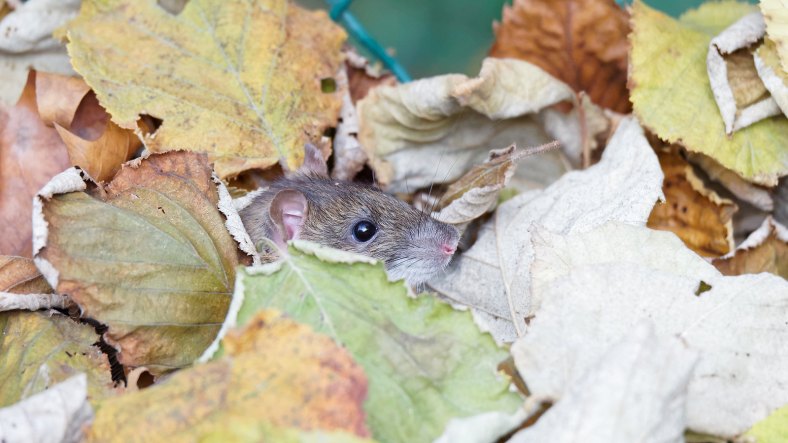
See the rat?

I am a dull man. 

I am utterly unspecial, solidly in the mainstream: I am a white American male, cis/het, raised vaguely Christian but now a non-practicing atheist. I am married. I am 49 years old. I own a car and a house, with a mortgage on the house. I have a Bachelor’s degree, more debt than savings, and I vote Democratic. All completely “normal,” in that people who look and live like I do have made sure that our culture believes that people who look and live like I do are the norm, the standard, the expectation – and therefore everyone else is a little weird, a little off, a little less than what they are “supposed” to be. Like most people who look and live like me, I am aware of my privilege, I oppose the unfair societal structures and institutions that promote it – but I don’t really do too much to change them, because after all, I do benefit from them. I feel guilty when I think about that, so I try not to think about it.

Sorry: that went too political. (I am keenly aware that some people find it awkward and uncomfortable – challenging – when I speak of political matters. I do not want to offend them, so I usually do not speak of political matters.) My real point is that there is very little about me that is, according to our society’s generally understood and accepted standards, abnormal.

Until I open my mouth.

My mouth itself is pretty normal (Though I have WAY more fillings than is normal, I think – over 40, with 5 crowns. I have abnormally bad teeth.), it’s what comes out that is abnormal. First of all, I have a weird accent: my parents (The most important influence on a person’s accent and dialect) are from the West Coast, Washington and California, so I speak somewhat in their accents; but I was raised first on Long Island, which has a distinct accent, and then in a suburb of Boston, which has a STRONG accent. I didn’t acquire or keep either of those accents in their entireties, but I did pick up a few pronunciations; and more, Boston’s speech patterns were strongly influential: I speak too fast, as Bostonians do, and I talk faster the more excited I get; and I cuss intemperately. So I sound like a mishmash of two coasts and four states.

It’s more than my accent and my speech patterns, though: it’s what I say.

Don’t get me wrong: I am a student and an artisan — a wright. A smith. — of language. I study literature and rhetoric, and have mastered them to a degree that allows me to teach, generally successfully. I possess linguistic capacity more than sufficient to enable the utilization of language both fanciful and ornate, drawing from the recondite and recherche realm of jargon as well as splashing through the filigree fountain of poetry.

I talk good, is what I’m saying.

 And, as you can see, because I can use language well: I can also abuse it.

My favorite form is mispronunciation. I enjoy completely destroying the actual sounds of words, especially foreign ones. Especially French. Because if any language has worse pronunciation than English, it’s French. That word I used between “recondite” and “realm?” I would enjoy saying that “ruh-churchy.” So I feel that we should pronounce La petite fromage, the little cheese, the way it is spelled: lah puh-teet froh-midge. I draw from classic influences to pronounce the K and the G in “knight,” and to describe for my students when they put the emPHAsis on the wrong syLLAble.

But mispronunciation alone is too simple; a little tame, really. Much more funner is improper forms of words, particularily when the wordination is constructicated of rootages and suffixery (Holy crap, autocorrect accepted that one!  Is that really a word?! Mmmmno, it’s redlined. I think I stunned the autocorrect.) that are close, almost recognizable — but also completely wrong. That’s the besterest. Though one step higher here is when I can corrupt a common usage of a modern slang term in order to make it seem more grammatical while also being deeply annoying: when I was on Twitter, for instance, I made a point of saying I twitted a twit, not tweeted a tweet – because after all, it wasn’t called “Tweeter,” was it? (Now it should be xitted a xit on Xitter, not xeeted a xeet on Xeeter. Though either one would presumably make Elon Musk apoplectic, and that’s a good use of language.)

I admit it’s a touch upsetting that I say these kinds of things and play these kinds of games with my students, because for some reason, they trust me to steer them right with their usage of English, the poor innocent fools; I’m sure I’ve given more than one a bad idea about words from some joke or other — though I will further admit that that’s funny. I do teach them the real insane trivia hidden deep in the pockets of the English language: the word floccinaucinihilipilification (WHICH I TYPED RIGHT THE FIRST TIME) and the sentence “Buffalo buffalo Buffalo buffalo buffalo buffalo Buffalo buffalo.” Both of which are real. And “Y’all’d’nt’ve,” which is not real, but should be. These all show actual facets of this mad and madcap and maddening language that I love, so they are all lessons, on some level, at some point. And I’ll bet you dollars to donuts that most English teachers do not teach those lessons.

Then there are the foreign accents (Or as I am fond of saying, the furrin accents, which we don’t talk here in ‘Murrica.). A number of them show up when I read aloud, when there is some identifiable speech pattern in the dialogue, or a clear setting in an accentish area. I’ll read British stories in my best London fog, and I’ve read ev’ry danged word of Huck Finn by that Mark Twain feller in my best countrified speechery. I do sometimes use my past exposure to New York and Boston accents to play those characters when reading, especially if someone needs to be a tough guy; but I don’t put on my Pepe Le Pew when I read Guy de Maupassant’s “The Necklace.” And I never use Apu Nahasapeemapetilon’s accent, not even when I read The God of Small Things. On the other hand, I will neither confirm nor deny that Neil Gaiman’s story “Truth is a Cave in the Black Mountains” retains a place in my Fantasy Literature elective specifically because I get to use my Scottish brogue.

Of course, none of these accents have the same color, force or frequency as my pirate accent. Not only because I dress up like a pirate for every Halloween, and dress up my voice like one on every September 19th (International Talk Like a Pirate Day, if ye be of the uninitiated). Also because I love doing that accent, and so it shows up whenever anyone makes a pirate reference around me, which is fairly frequent given my reputation and the assorted pirate paraphernalia which I have acquired over the years. If anyone tells me a pirate joke, I am honor-bound to respond in the appropriate manner: “AYE LAD, THAT WERE A FINE SALLY — I’LL SHARE IT WITH ME OWN CREW, THE NEXT TIME I WANT THEM ALL TO FALL ILL OF VILE PUN-ISHMENT! HAR HAAARRRRRRR!!”

Even this list, though, is not exhaustive, because it doesn’t include the character voices I use. In class there are a few definite ones; I am very fond of the voice of Gollum from The Lord of the Rings, as performed by Andy Serkis; it’s a bit rough on the throat, but so very taassssstttyy, precioussssss… And just to one side of that, almost two sides of the same coin, is the voice of Edna Mode from The Incredibles, which I also love using, as long as it is attached to the right character (NO! CAPES!). Those two are my favorites, though also I am not above talking like a Goodfella (“Do I amuse you? What am I, some kinda clown to you?”) or the Lennie of the cartoons (“And I will hug him and pet him and love him and squeeze him and call him George!”) though never when I read Of Mice and Men because that book makes me cry and I can’t make fun of it that way. 

And it goes on from there. When I am reading test directions aloud and I get to a portion that is capitalized or in bold print, I will shout those words at the top of my lungs (“DO NOT WRITE IN THE MARGINS OF THE ANSWER SHEET”), without any warning at all; partly because I like to make my students jump (and laugh, because breaking the tension is part of my job), and partly because I want to make fun of the directions, which are universally terrible. I can actually sing reasonably well, but when I sing in class I usually make my voice sound as awful as I possibly can, intentionally breaking and scratchy and missing all of the notes. I sometimes read as fast as I can, which thanks to my Bostonian upbringing is pretty damn fast, so that all the words run together into a completely indistinguishable fog of sounds.

So the question is: why? Why do I do this? Why am I like this? Especially given my responsibility as a teacher, and my deep and abiding love for my language, and for speech both written and spoken?

Honestly? I don’t know.

It might be because I don’t want to conform. I have to follow the rules in too many ways already; even worse, I have to fight for the rules, have to make other people obey them, have to get them in trouble when they break them: and I hate that. I also can’t stand it when people turn up their noses – or even worse, break into that violent, assaultive cackle that people put on – when they catch someone saying something “wrong,” and they take advantage to say, “It’s ‘wrongly,’ you pathetic dolt!” I hate the arrogance of that, the contempt of it. I hate the hard-edged insistence on rules: when we all know that in English, the rules don’t apply. Tell me the “I before E rule.” Go on. I dare you. 

There are no rules in English, other than the only rule that matters in any language, in any form of communication: if communication was successful among all parties, then the language was effective. That’s it. That’s the whole point. We speak and we write in order to communicate something. Sometimes there is a secondary purpose (or even a primary one) such as intimidation or seduction or persuasion; but in those cases, the goal of the intimidator or seducer or persuader is still a goal that must be communicated, even if only by achieving it. But if my audience can understand what I want them to understand, then nothing else matters: that’s the truth. That’s what I want people to understand, to absorb and believe. That’s why I tell my students (sometimes to the chagrin of my fellow English teachers) that you may start a sentence with “and” or “but,” and you may use “I” in a formal writing context, and you may use contractions, as well. And you may cuss: because sometimes the only word that properly communicates one’s message is “FUCK!!”

Oops. Got too offensive there. Now this document’s going to get flagged. A much worse F-word.

I love playing with English. That’s why I love ee cummings (Even though much of his poetry is political, and even more of it is offensive: but all of it is fun.), who wrote like this:

love is more thicker than forget

more thinner than recall

more seldom than a wave is wet

more frequent than to fail

it is most mad and moonly

and less it shall unbe

than all the sea which only

is deeper than the sea

love is less always than to win

less never than alive

less bigger than the least begin

less littler than forgive

it is most sane and sunly

and more it cannot die

than all the sky which only

is higher than the sky

 and why I admire and enjoy the novel Riddley Walker by Russell Hoban (Even though it is very political, and therefore quite offensive… but it’s okay, because Russell Hoban also wrote this), which looks like this:

Looking at the moon all col and wite and oansome. Lorna said to me, ‘You know Riddley theres some thing in us it dont have no name.’ 

I said, ‘What thing is that?’ 

She said, ‘Its some kynd of thing it aint us but yet its in us. Its looking out thru our eye hoals. May be you dont take no noatis of it only some times. Say you get woak up suddn in the middl of the nite. 1 minim youre a sleap and the nex youre on your feet with a spear in your han. Wel it wernt you put that spear in your han it wer that other thing whats looking out thru your eye hoals. It aint you nor it dont even know your name. Its in us lorn and loan and sheltering how it can.’ 

 and A Clockwork Orange by Anthony Burgess (Which is both extremely political and EXTREMELY offensive, so…maybe we shouldn’t talk about it.), which looks like this:

“What’s it going to be then, eh?” 

There was me, that is Alex, and my three droogs, that is Pete, Georgie, and Dim. Dim being really dim, and we sat in the Korova Milkbar making up our rassoodocks what to do with the evening, a flip dark chill winter bastard though dry. The Korova Milkbar was a milk-plus mesto, and you may, O my brothers, have forgotten what these mestos were like, things changing so skorry these days and everybody very quick to forget, newspapers not being read much neither. Well, what they sold there was milk plus something else. They had no licence for selling liquor, but there was no law yet against prodding some of the new veshches which they used to put into the old moloko, so you could peet it with vellocet or synthemesc or drencrom or one or two other veshches which would give you a nice quiet horrorshow fifteen minutes admiring Bog And All His Holy Angels and Saints in your left shoe with lights bursting all over your mozg. Or you could peet milk with knives in it, as we used to say, and this would sharpen you up and make you ready for a bit of dirty twenty-to-one, and that was what we were peeting this evening I’m starting off the story with.

and all the fantasy novels and science fiction movies and so on that make up entirely new languages, and then translate them into English: because language is fun. The more fun you have, the better it works. The more fun it is, the more you want to use it: and that makes more communication, which means more connection, which means more peace, love, and understanding.

And that would be the besteresterest.

The point of this essay was meant to be what in my language use sets me apart, divides me from other people; I do think it is the degree to which I mess with language, the number of games I play with it, the variety of ways I push the bounds of what is acceptable and what is normal. I do all those things more than most people; and that’s what sets me apart. What I don’t try to do, ever, is make my language harder to understand, to make communication fail: it is maybe my worst habit as a writer that I always try, over and over, to make my communication more clear, to explain further, to give another example, another synonym. As you can see. It makes me much too wordy in my writing. But it also makes me a good (if talkative and boring) teacher. It makes me a good friend, and a good husband, because I always try to explain what I am thinking and what I am feeling; I always try to communicate (And I realize that communication also requires listening, if you were thinking that I do all the talking. I don’t. It’s just that my turn takes three or four times as long.). My wife and I rarely fight because of that, and our fights usually end in compromise and agreement: because we communicate. (I don’t deserve all the credit for that. My wife is exceptionally good at understanding me, and herself, and she listens too. She is also very patient with me, which I appreciate forever.) I think it’s good that I am able to use humor to break up those long, repetitive speeches in which I try to explain everything I am thinking, over and over again.

I just wish other people enjoyed my portmanteaus as much as I do.

Oo! That’s one I forgot to mention! Portmanteaus: when you put two words together into a single word, like breakfast+lunch=brunch, or smoke+fog=smog. I love those things. I think of them constantly, and I bring them up all the time – here, wait, I have a list of my favorite ones.

What’s that? Oh – you have to leave? No time to discuss word nerdery with me? I understand. 

Maybe next time.

And then again: maybe not. 

Just know that I’ll always be here, ready to talk about words, ready to play word games – and ready to communicate. And whether that makes me different, or makes me just like everyone else, I don’t actually care. As long as we’re having fun. And not being … too offensive.

Oh and — fun being offensive? That’s offunsive. And that is a portmanteau.

I was going to do it anyway…

Here we go: time for teaching argument again. I had my students write a sample essay, so I could see how well they argue already and what they need to learn; while they were writing, I was writing.

This one was my choice of topic.


Is there any value in teaching argument?

The cynical part of me says no, because my students either know how to argue or they don’t, and going through my class doesn’t seem a terribly good way to get them to understand what argument is or how to craft a good argument. I’ve taught argument for twenty years now, and still people make the same mistakes and have the same wrong conceptions of what argument is. They still yell at each other; they still try for insults, mockery, and Gotchas as a way to “win” an argument. They still think that everyone has the right to their opinion, no matter how absurd, unfounded, or even dangerous that opinion may be; and they don’t think that a person should have to support their opinion, because they don’t think people should question each others’ opinions. Mainly because they don’t want me or someone like me to question their opinion, because they can’t support their opinions: they can yell about them.

But if I judged what topics should be taught by how well my students absorb them, then honestly, I wouldn’t teach anything; because no matter what I teach, or how I teach it, some of my students don’t get it. I could give the same description, or a similar one, for any topic I present to my class, any skill I try to instill in them. Sometimes they go out knowing only as much as they knew coming in. 

But that’s not entirely true. First because the topics in English class (and probably every class, but this is the one I know) are not discrete and mutually exclusive; reading narratives and writing essays and analyzing setting and character and especially plot are all skills that will serve the students well if they ever decide to participate in a serious argument. Speaking and listening, and writing and reading, are generally useful skills, and they all encourage growth in each other; and while my students may not all master argument, they do all improve in some way in my class, and any area of improvement is at least somewhat valuable in every other area. (This is also why I don’t like standards based grading, but that’s a different argument.)

Secondly, it is impossible to say what effect I have on my students in the long term. I know for a fact, because I have been told this by former students, that my class, for any of a myriad reasons, had a significant impact on them, often in ways they did not expect and I could not predict, often years after they moved on to another teacher or another school. So do my students learn better argument from me even if they don’t show tangible improvement while we are working on the unit? I hope, and think, yes. 

So my answer would be: yes. There is value in teaching argument. The impacts may be invisible, they may be far in the future; they may even be tangential, as argument skills may be improved by some other part of the class, or other skills may be improved by the work on argument. The important factor is this: argument itself is important. People in our world need to know how to argue. They need to know how to clearly define their subject and their claim, they need to know how to find and build support for their opinions, they need to know how to listen to, analyze, question, and address alternative viewpoints. They need to know that opinions are not inherently equal in value, nor sacrosanct, just because an individual (who is equal in value to all other individuals) holds that opinion, and they need to know how to dislodge someone from a dangerous or wrong opinion, both for their own convenience and for the greater good. They need to know how to recognize when an argument is lost and should be given up. They need to know how to deal with being wrong, and having someone else prove it to you.

We need these skills in our society. I don’t know for sure that our country is falling apart, or rather being blasted apart, by partisan intransigence and rancor; but I know, for sure, that our inability to argue rationally is making everything in our democracy worse: less sure, more troubled, more irrational and therefore dangerous. And when democracy fails, then some form of tyranny is the inevitable result. And we don’t want that: not even if the tyrant is on our side.

Don’t believe me? Then let’s argue about it.


But You Get Summers Off!

[Read Part One: Money Talks]

[Read Part Three: Walking Out]

The day begins at 8:15. That’s when class starts.

But of course that’s not when the day begins. Students come inside at 8:05, and as soon as they do, I am teaching. That’s when the day begins.

Unless I have morning duty: then it starts at 7:45, when I have to show up, unlock the two gates, and then stand in the parking lot and make sure nobody gets run over while all the parents are dropping their kids off at school, and the high schoolers are whipping into the parking lot, trying to make sure that no one took THEIR SPACE. That’s work. 7:45 is when it starts, some days.

Although it might be fair to say that my day begins at 5:20, when my alarm goes off and I get up and take a shower; because in that shower, I am thinking about school. Always. Planning what I will teach, thinking about what I have to grade, trying to remember what meetings I have this week – is this Wednesday a faculty meeting, or grade-level teams? Do I have an IEP meeting today, or is that next week?

But if we begin with the thinking, then the day begins around 2:30 am. Because that’s when my insomnia kicks in, and I start thinking about school. Trying to go back to sleep, of course, but that isn’t always possible; it depends on whether I’ve done anything wrong. Did I lose my temper and snap at a student who asked for the fifth time if we could watch a movie? Did I have to explain a grade to a student who thinks they are a brilliant writer, but really they’re not, and I had to find a way to let them down easily while still encouraging them – but also making it crystal clear that they aren’t as good as they think they are, because otherwise they will get their parents to file an official complaint about the grade, and I’ll have to have three meetings, at least, to iron it out? Do I have a class that’s misbehaving, and I need to explain to them all, again, why they shouldn’t act that way? Because if I do, I will start working on my script at 2:30, and I won’t be done until 3:30 at the earliest. 4:30 is more common, on the days when I have a controlled-anger lecture to give.

That’s when my day begins.

Then, 5:20, alarm, and I have my morning; I have sometimes taken advantage of my early rising to get some correcting done, because I’m fresher first thing in the morning with that first coffee jolt, and I can get through eight or ten vocabulary assignments in under an hour. My vocab assignments are tougher than some, because I make them define the word and then use it in an original sentence, so I have to make sure that the definition is correct, that the sentence uses the word correctly, and that the sentence is grammatically acceptable; that’s also why I can’t let TAs grade the vocab, because they don’t know enough grammar and can’t always pick out which of several similar definitions of the word is the best one. I also give them credit for the sentence even if they got the definition wrong, but the sentence can make sense anyway; and I don’t trust teenagers to do that. So I do it. There are between ten and twenty words per assignment, so it takes me between five and ten minutes for each student to check the whole thing over – longer if I want to give feedback on why the sentence is incorrect, maybe offer a correct alternative so they can see what it looks like to use an adjective properly. 97 times, every two weeks. (I know, only 97 students? I have such small classes! At my last school I hit 180 students, some years! I’m lucky, now. Oh – and I do have more students than that, but two of my classes don’t do vocabulary assignments.) Then it’s breakfast, walking the dog, getting lunch ready, making sure I have all the papers and materials I need for the day. Then it’s off to work.

Morning duty. Usually I’m just a presence; the parents who drive badly (A good 30-40% of them) assiduously avoid eye contact. If it’s a student who speeds through the parking lot or swerves too close to a 6th grader crossing their path, I can yell at them to watch where they’re going and they’ll at least give me an apologetic shrug, but mostly my job is to scowl at the drivers and wave at the students. And watch the clock: because at 8:05 I have to unlock the school door and let the students in; and then I’m supposed to stay out there until 8:15 – but my class starts at 8:15. Do I open the classroom door while I’m outside, let my students hang out in my room until I get in there? If I leave them unsupervised they may get in a fight, or steal something, or break something valuable; I better leave the door locked. Which means they will stand in a loud, obnoxious clump outside my door, and block the hall for everyone else. Oh, well, can’t be helped.

I fudge the end of morning duty, go in about 8:13; usually my boss is coming down the hall to make sure the door is locked, so he sees me. Damn. I’ll be getting an email later about how important duty is, how we need to make sure our students are safe. Well, anyway: into the classroom, 21 freshmen for Honors English, and here we go. I need to:

*Log onto my computer, start Chrome, open the email program and make sure I don’t have any emails with subjects like “EMERGENCY: BOMB THREAT HAS BEEN RECEIVED,”

*Start the attendance program, log in, take attendance (If I don’t do this in the first three minutes, the front office will call to remind me.), mark the tardy students absent (We don’t mark them tardy during first period; if they come in late, they have to go to the front office for a note, and then we mark them Present; the front office changes their attendance to Tardy for us.), change the Absent students to Present as they walk in late with notes

*Start Internet Explorer (Because that’s where I have the Bookmark) and open the morning announcements.

*Get the students’ attention: impossible because they are too busy chatting and visiting and teasing each other.

*Stand for the Pledge of Allegiance when it comes over the PA

*Go over the morning announcements: a witty quote that is either over the students’ heads, or strange and offputting, or both; the same five announcements that have been on there for a week; a new video from the Character Education class about Inclusion, this week; God forbid a new episode from the journalism class with this week’s school news (They do a fine job, but my students love nothing more than criticizing, and so every week when the new episode is posted, I’m in for several minutes of snark and sass, and then indifference and distraction when I stop them from being crappy.); and then sports scores that none of them want to know about unless they were on the team that won, and then they want to make sure that the scores are seen and they get congratulated.

*Start class.

What am I teaching again?

Oh, right, To Kill a Mockingbird. Well, at least these students get their own books off the shelf – though I have to remember to tell them to stop throwing the books across the room to their friends, because somebody’s going to get hurt, most likely the book; I’ve been able to pick up a few used copies to replace the worst ones, but I already can’t tell the difference between the ones I bought and the ones I got from the English teacher next door when I took over this class: covers are falling off, spines are snapped, chunks of the book are falling out. Okay, so now I’ve got them on the right page (Mostly: there are four different editions, all with different page numbers, so someone is always lost), and it’s time to start reading. They’re still chatting, and I shush them. I start reading.

They’re still talking. I shush them again, louder, and add “Quiet, please!” I start reading again.

Still talking. Now the students have gotten annoyed with their peers, and one of them cries out, “SHUT UP!” I should tell her to be more respectful, but I’m on her side. Plus, it worked. So now I read. It’s a good class, the Honors class, so they pay attention, mostly; there are only three or four who are still scrolling through their phones behind their books or under their desks while I’m reading aloud; when I stop to ask a question, I get several kids willing to answer. Actually, they might be too involved: the one kid who loves to talk has his hand in the air every five minutes, often starting his comments with, “This is a little off-topic, but…” And the one precocious girl always wants to share when she has had some insight, when she has spotted a thematic connection; it’s great, but her classmates are tired of her being a know-it-all, as they see it, so as soon as she starts talking, they start making noises, having small side conversations; and the girl speaks too quietly and I can’t hear her.

But I read, enjoying every minute of it, because it’s Harper Lee and every page is brilliant. The kids like it too, and everything is going great – except now it’s 9:09, and the class is almost over (First period is longer to allow for the morning announcements.) and DAMMIT, I forgot to give them their reading project assignment, again. I’ll have to remember to change the due date on the assignment sheet and make a new set of copies. I stop reading with a minute left, they put the books back on the shelf; the precocious girl and the talkative boy both come up to my desk to talk to me, at the same time, and I try to listen to both as the bell rings and the room empties. By the time I have laughed at the boy’s joke and heard the girl’s last insight, my next class has started coming in: they are juniors, so they drop their bags on their desks and then go back out in the hallway, to the bathrooms and the water fountains. I check the email, make sure there aren’t any bomb threats; I have an email from a parent and one from the Special Ed teacher, both of which I have to open immediately. (I also have eight assignments from students, two communiques from the principal, and seven pieces of spam.) The parent email is asking about a student’s grade in their class, so I mark it Unread and try to remember to read and respond later; the special ed teacher is reminding me that we have an IEP meeting this afternoon. Crap.

The bell rings and it’s time for 2nd period: College Readiness. A required elective which the juniors all resent; it’s intended to help them succeed on SATs and ACTs and college applications; they split the week between math, college counseling, and me for English. It’s annoying to them because most of them are already in more advanced math classes than what is on the tests, and they already have me for English some other time during the day, but they still have to take this class. They are all late, either because they took too long coming from first period or because they’re in the bathroom, expecting their bags to count as attendance placeholders; sometimes I mark them absent and then change it as they trickle in, sometimes I mark them all here and forget about it. But when I do that, I always remember my college professor telling us that the attendance record is a legal document, and if I mark a student here when they’re absent, it could be used as evidence in court, say if that student is actually off robbing a Kwik-E-Mart while I said they were in my 3rd period class. And if I mark them absent while they are present, that makes the automated system call their parents and say the kid is absent from this class; then the parent texts the student to ask where the hell they are, and I get an email. And if I don’t get the attendance taken in the first three minutes of class, the front office will call and remind me.

So what were we doing in here? Oh, right, they are practicing their college application essays. So I want them to make their rough drafts twice as long, and then they will cut them down to 650 words max, the recommended max length from the Common App. So I could use one of the samples that I wrote, and show the students where I would add more details, more information, more words just to hit the target length (Even though I hate writing for length, as all that should matter is purpose and audience; this is the only class where I assign minimum and maximum lengths for essays, because college applications expect that), but I think it would be better to get one of them to tell me a story, and I’ll type it up on the projected screen while they all watch. I’m lucky; the class clown is in this group, and he always has a story, and the one today actually isn’t that bad – though it is about running off campus to buy snacks from the Circle K in between classes, which isn’t allowed and I should say something about it. But I get the story down, which takes about half of the class time; and then I start talking about where the essay thus created could be added to.

Nope: they’ve stopped listening. Well, after all, it’s not a real class; the assignment isn’t due today; the story on the board isn’t theirs, and though it was entertaining, they already heard it when the clown told it to me the first time. So they have no reason to pay attention. I give up, and let them do nothing; I sit at my computer and start answering that parent email –

Fire drill. The loudest damn siren in the world, makes me jump every time. Fortunately the students know what to do, so they head outside; if it was a lockdown drill, they’d be anxious and awkward and unsure, and I’d have to guide them where to go and what to do. I grab my attendance folder off the wall, shut off the lights, go back for my sunglasses because the sunlight makes me sneeze, and then lock the door and go out. I have to hold my hands over my ears as we pass the outside siren, because the noise is actually painful. Then we’re outside, and I have to direct the students to the right place after all, because we’ve changed protocol this year (They used to go through the locked gate, which meant they all piled up until I got there to open the lock; now they go through the parking lot to the far side), and tell them not to mess with the parked cars, and no, they can’t run down to Circle K for some snacks. Not even if they bring me some. Take attendance again outside, hold up the green card because they’re all there, and then wait for the signal to take them back inside. Still waiting. Still waiting. “Hey Student X, put Student Y down, please. Student Z, stop spitting sunflower seeds on people.” Still waiting. Okay, there we go: back inside. They file back in just in time to get their things, and then the bell rings to end the period. My third period students already left their second period, so they’re coming in even before second period ends, asking, “What are we going to do today?”

What are we – oh, crap! I need the Chromebooks. They’re doing research for their argument essays this period. Race to the computer (Unlock it because it timed out while I was outside), bring up the Staff Forms page, open the Chromebook Cart Reservation page, check the three carts – Cart #3, okay. Dammit, it’s all the way down at the other end of the school. Pick out two students and send them to get the cart. Then it’s time for attendance, and I have a minute or so to remind them of their tasks before the computer cart arrives, at which point they stop listening to me because they now get a computer to play with, and they all swarm the cart and grab Chromebooks.

Except there aren’t enough. The last teacher didn’t manage to collect them all, because of the fire drill. So I send some students down to fetch them. They do, but there still aren’t enough, because this is my big class, 26 sophomores (Well, 25 sophomores and one senior taking Sophomore English for the third time, bless her heart. She won’t pass this time, either.) and the cart only carries 24 Chromebooks. So I send two more students on a quest for random Chromebooks, which they track down in only 20 minutes of roaming the halls. But no great loss, because that same time has been spent in the classroom watching YouTube videos and finding ways to play free online video games, or else bringing up Google and then looking at a phone. The rest of the class period goes the same, and at the end, they ask if they will also have tomorrow to do research. I shake my head, unable to muster any better answer, and send them away when the bell rings. Then I have to collect all the Chromebooks they left on their desks, return them to the cart, make sure all of them are plugged in –

No, wait, that has to wait for a minute: I haven’t been to the bathroom in three hours. I race down to the teacher’s lounge, because the boy’s room across the hall is filthy and usually occupied, and I have bashful kidneys. By the time I get back to my classroom, the Chromebook cart is gone; hopefully to the right place. I don’t know: this is my prep period, the best time of the day. No students for fifty – no, forty-one glorious minutes.

I have to:

*Actually read all of the emails that came in today, and any I didn’t get to yesterday.

*Respond to all emails that need a response, in the following order of importance (most to least): parents, special ed, other teachers, administration, students.

*Check that I have the right handouts for the three classes after lunch, that I know what I’m teaching, that I know what assignments I have to collect and what due dates I have to remind them of

*Make any copies I may need this afternoon or tomorrow morning, as I won’t have time to make copies in the morning (Xerox machine is always tied up before first period) and I have an IEP meeting after school

*Make more coffee before I collapse into a stupor

*Use the bathroom at least one more time

*Do as much grading as possible. Usually not very much. Today, none: because one of my colleagues stops in to ask me if I’ve heard the latest absurdity the admin’s gotten up to, and I haven’t, so we need to discuss it. We do. It’s infuriating.


Now I have eight minutes left. Didn’t get any grading done.

But that’s okay, because the next class is lunch; not quite as satisfying as prep, because there are students in here, mostly hanging out (with their terribly smelly food) but some looking for help or to check on due dates or to ask if I’ve graded that essay they turned in late. The students who are hanging out want to talk to me, because they want to tell me what they did yesterday, or show me that meme or the video they found that was hilarious and I’ll like it because there are dogs in it, or they want to ask my advice, or for me to settle an argument (Is cheesecake a pie or a cake? Have I seen the trailer for the new Fahrenheit 451 adaptation, and what do I think of it? Should they move into the dorm for college next year, or live with their parents to save money? Should they even go to college? Don’t I think the new math teacher is an asshole?) [Answers: I say cake, because of the name, but really it’s a tart; yes, and I think it will be a good movie but not the wonder that the book is; they should move out if they can afford it; yes unless they have a different plan that is as useful as a college education would be; and no, because I like the teachers more than the students, even though I agree that math is evil. Yes, these are all things I have said to students.].

I eat my lunch, finally make my coffee while also finishing up the copies I need for class after lunch, and spend a few minutes talking to my wife. (On the phone for the first sixteen years of my career, in the next classroom for the last two years, as she has been teaching at the school where I work. It’s lovely to have her there. It makes my blood absolutely boil to see the way they treat her, the goddamned admin and the obnoxious students and the entitled parents. Drives me nuts.) Then it’s time for 6th period: Advanced Placement Literature and Composition. Today I am teaching Julius Caesar by Shakespeare, which is nice, because I’ve taught it for years and I know everything about it; I also worry that I’m not seeing it with fresh eyes for the same reason, and so there are things that I’m missing. I need to help them see through the text, because this class is struggling with the AP expectations for analysis; they write well, for the most part, but they don’t always get what they’re reading. Because with one or two exceptions in this class of twelve seniors, they don’t ever read outside of what is assigned for school. They never have. They tell me, half ashamed and half proud, how few books they’ve read this year, or the last four years, or their entire lives.

People wonder why I read books out loud to my high school students. It’s because it is literally the only way I can be sure they will read at least one book in my class.

This is one of the factors that makes English an impossible subject to teach: the students don’t read. I have to find a way to keep them interested in books, which they believe, with all of their hearts, are boring and obsolete; I have to find a way to make them want to put thought into the books, because that’s the only way they’ll see the value of literature. I have to both know everything about the books I’m teaching, so I can answer their questions and ask them good ones in return, and also improvise constantly, and use whatever I can to relate the literature to this class, these students, this point in time and place; because of that, I generally can’t re-use old lesson plans, and I have to constantly learn everything there is to know about new literature. Teaching writing is even more difficult, because it has all of the same inherent feel of being boring and obsolete to students who are never disconnected from the internet; and also because it makes the students feel inadequate, because they know they don’t write well, and they don’t want to be embarrassed, and they don’t want a bad grade – and so they try not to write, which means they don’t practice and they don’t get better. When I do ask them to write, they often put as little effort into it as possible, and then they confirm for themselves that they don’t write well.

18 years teaching, and I don’t know how to fix that. I try something new every year. Sometimes it works. With some of them. I think.

But I can’t really say that English is harder to teach than other subjects: we all have individual difficulties, and mine aren’t worse. At least I have stories, with sex and violence and beautiful language; math teachers need to constantly think of ways to keep students interested in abstractions, thinking in ways they don’t normally think; history and science teachers have to present an enormous amount of information, and somehow make it digestible; arts and technical teachers have to constantly circle the classroom, never sitting down for a second all day, looking over students’ shoulders and trying to figure out what they’re doing wrong and help them do it right, all while the students are incessantly calling out the teacher’s name – if you’ve never been in a high school arts or tech classroom, just imagine 20-30 hungry baby birds in different nests, with one bird trying to feed them all while also keep them from falling out of the tree or pecking each other to death, while they just keep crying out, crying out for attention. It’s quite the dance.

Elementary school teachers have to do all of this at once. Though with a lot fewer students, admittedly. Still: it’s not a job I’d want; the one day I subbed in an elementary school was one of my worst as a teacher. I prefer high school, and Language Arts. At least I think I do. A lot of the time, I’d rather just be a janitor.

6th period goes well; they’re great kids. Almost graduated now. I worry about some of them. Especially the one student who recently had a death in the family. I worry a lot about that one, because the death hit hard, and all plans have changed, and I don’t know if that’s a warning sign or just the normal healthy grieving process. I’ve been a teacher for eighteen years, and I’ve had three of my students commit suicide: I don’t want to have a fourth. I’ve also had to make reports to social services twice, once for an abusive parent and once for a girl who had a “boyfriend” who was twenty years older than her. Neither report led to a good outcome. I don’t need to report this one: everyone knows the whole situation, which means everyone treats this student like they’re kryptonite. I try to be normal with the student. I try to talk to them every day, to be present for anything that needs to be said, to be as honest and open as I can be, always, no matter what. I don’t know how well I do. I don’t know if it will make any difference. But it’s all I can do. So I do it.

When I have time.

We don’t get through much Julius Caesar, because they constantly distract me and the class with their jokes and their stories and their questions; I encourage that, because I think it helps make the class more meaningful and more useful, and also because there are pedagogical theories that encourage students to associate knowledge with their own lives, their own experiences, and so letting them voice all of their thoughts encourages that sort of association. Or maybe it just wastes time; I don’t really know. I know they like my class. I know we don’t cover half as much material as most other teachers. I don’t know any other way to teach.

Speaking of teaching: now it’s time for 7th period. AP Language and Composition.

What the hell was I doing in this class?

Oh right: they’re halfway through “Shooting an Elephant” by George Orwell. We’re talking about imagery. I find my copy under the pile of papers by my podium, and I tell them to get out theirs; I remember to take attendance then, and go to my computer to do it – and realize I forgot to take attendance for the senior class last period. Dammit. Huh, well, at least the front office didn’t call. I mark attendance for both classes, then hand out replacement copies to the two students who lost their packets since yesterday and one to the kid who has it but doesn’t want to dig through his backpack and find it, and then we’re off: to Burma, in the 1920’s, when a young George Orwell is about to slaughter an elephant because he doesn’t know how to let the elephant live and still be a white police officer in a British colony. He hates everything, especially himself. I can kinda relate.

I get into it, reading the piece; Orwell was such a damn good writer. I wish I could write like that. I know it’s because he was able to live his writing, almost all of it: when he wrote Homage to Catalonia, about the Spanish Civil War, it was after he went to Spain and joined the anti-fascist militias, and actually fought on the front lines. I wish I could do that. Not fight in a war, but go to where I am needed, and do what I believe needs to be done, and then write beautiful, crystal-perfect books about what I had done. Though I’d rather not die at age 48 of tuberculosis: I’m 43 now, so that’s not much time left. Still haven’t published a book. Not that much time in my day to write; certainly no time to do anything worth writing about.

I can’t get too into it, though, because this is my annoying class. This is the class with the one student who likes to irritate everyone, and so says intentionally sexist or racist things, and then says, “I’m just kidding.” He knows I’m a vegetarian, so he likes to bring up how he slaughters his own meat. He likes to make the stories as disgusting as possible, and then smile at me. And there’s that other student who can’t sit still: she will stand up and dance right in the middle of class, while I’m reading. Or she will make hand gestures and funny faces at other students in the class, laughing loudly while we’re trying to have discussion. She’s the smartest one in the room, so if I call her on it, she’ll apologize, share some insight to mollify me – and then go right back to disrupting the class, while also making some passive-aggressive statement about how limiting and controlling school is, how that’s unhealthy for a growing mind. Then she’ll stare at her phone for half an hour, turning it around to show funny memes to students across the room. And the rest of the students in here would rather be studying for their math class which they have next period, or grumbling about the history class they had last period. The class often feels like a complete waste of time.

Speaking of not much time left: class is almost over now. I cut the article off with one paragraph left; we’ll finish it tomorrow, but the mood will be ruined, because they won’t remember tomorrow what we read today, other than the bare facts: Orwell shot the elephant. Now it’s time for 8th period: the second AP Lang class, the big one – twice as many students as 7th period. Fortunately, this is the one time when I don’t have to remember what we were doing, the one time when I have the same class twice in a row; unfortunately, the two classes don’t go at the same pace, so I don’t remember where we were in the Orwell article with this class. When I remember, I mark the paper where each class stops. When I remember.

Unfortunately, fighting through 7th period has put me into a bad mood, and worn me out entirely. Well, at least I have four minutes to recover. I take deep breaths, try to shake it off, try to treat the new class fairly, not take out the last class’s misbehavior on these kids. It’s tough. Especially at the end of the day.

The class goes by in a blur, but also, because it is the end of the day and I am exhausted, it crawls by. The clock doesn’t move and doesn’t move and doesn’t move, and then suddenly there are only 20 minutes left and we haven’t finished the reading. We get through it, the whole thing (so now they’re ahead of 7th period), and I’m about to lead them into the analysis: when the bell rings. 3:30. Day’s over. They swarm out, and silence descends.

Then my classroom phone rings: I forgot the attendance again. I apologize, and take it now. I fall into my desk chair, open my email. Oh right: I have an IEP meeting. Down I go to the special ed room to talk about how well that student is doing in my class (or how poorly) despite learning disabilities or physical disabilities or autism spectrum challenges. Or all three.

An hour later, and it’s all I can do to gather my things and leave. Home, to dinner, and dog walking, and family time, and some relaxation; then, around 8:00, after dinner is done, I remember: I haven’t actually graded anything all day. I grab up the laptop, sit on the living room couch, open my email, and start grading vocab assignments that students sent to me online. If I’m lucky, I can get a whole class done before I have to go to sleep, sometime between 10:00 and 11:00.

I need to get a few hours of sleep before I wake up at 2:30. I’m worried about that kid in my 6th period class. Seemed … off today. I hope there’s nothing going on. I hope nothing happens. I hope I didn’t say or do the wrong thing. I hope.

This is no exaggeration. This is what I do, what I have done for 18 years. I don’t always have fire drills, or adventures with the Chromebook carts; sometimes it’s a lockdown drill. More than once in my career it has been a bomb threat, and an evacuation. Oftentimes I realize I don’t have the copies I need to teach the lesson I wanted to teach, and I have to do something I make up on the spot. More than once I have gone to the computer lab and found another class using the computers. Schedules change, students are out for field trips or athletic events. I don’t always grade at night; sometimes I get more done at school, and then I let myself do something else in the evening. I pretty much always grade on weekends, and during vacations; I’m an English teacher. I have essays to read. A single essay takes between 20 and 30 minutes to grade and comment on, and I have 100 students, and I assign multiple drafts.

Ask me to communicate regularly with parents. Or to stay until 7:00 or 8:00, three or four times a year, for parent conferences.

Ask me to have extra meetings with troubled students.

Ask me to plan and organize curriculum, or to discuss pedagogy with other teachers, or interventions for students who aren’t successful.

Ask me to plan, organize, and run extracurricular events, on evenings or on weekends. To coach teams, to run clubs, to offer extra tutoring to students who need it. Ask me to be the department chair, and the community liaison, and the head of the recycling program.

God forbid you ask me to raise my own children on top of all of this. I don’t know how teacher-parents do it.

Now ask me how much I get paid for the job I do. Ask me how much I should get paid.

Then ask me why teachers are going to be walking out across Arizona tomorrow.

You can ask. But I think you already know the answer.