The Essay That Is


Here you go, the answer I should have written for the prompt I gave my AP Lit students this week.

Maybe.

AP English Literature and Composition 2023 Free Response Question #3:

Many works of literature feature a rebel character who changes or disrupts the existing state of societal, familial, or political affairs in the text. They may break social norms, challenge long-held values, subvert expectations, or participate in other forms of resistance. The character’s motivation for this rebellious behavior is often complex. 

Either from your reading or from the list below, choose a work of fiction in which a character changes or disrupts the existing state of societal, familial, or political affairs. Then, in a well-written essay, analyze how the complex motivation of the rebel contributes to an interpretation of the work as a whole.

How does one become a rebel?

It seems like a simple question, but I don’t think it is. There is one obvious way that one could become a rebel: one could be made into a rebel by the sudden appearance or dominance of an authority that takes away the freedom or the lifestyle that one was familiar and comfortable with; if another country invaded this one and overthrew my government and imposed Draconian laws on me, I would rebel against that invader. But first, that seems uncommon; though there have certainly been such invasions and takeovers in the past, they are not the norm; and second, “rebel” implies that there is an established authority, an accepted norm, which the rebel then fights back against — if there is an invasion and a conqueror, then really one who fought that would be a freedom fighter, not a rebel. The invading conqueror would call you a rebel, sure, but only because they want to pretend their power grab was legitimate; and that’s just propaganda.

If you are not conquered by an outside force, then either you were born a rebel, and had to grow up under the established authority, which would make it hard to stay rebellious as they would pressure you, all the time, from all sides, to conform to what is accepted; or the oppressive regime had to grow slowly, over time, getting worse and worse — and then the question becomes, what would be the final straw? What would push you, at the last, from grumbling about the government, to fighting back against the government? Sometimes there may be a sudden shift, a surprise attack that would move the needle well beyond what was acceptable all of a sudden; but I think most authority doesn’t work that way — and surely social conventions do not. The American Revolution was motivated by a long serious of usurpations and abuses, according to the Declaration of Independence; though the American Civil War kicked off after Abraham Lincoln was elected president, there were a hundred smaller elements of the conflict before that. So why was one of the earlier actions of the authority not the one that set off the rebellion? Why was it not a later one? What makes the last straw the last straw?

Those, I think, are not easy questions to answer. But I surely would like to know, not least because I am an authority figure in a classroom full of naturally rebellious people; and not least because I live in a country that at times seems to be sliding slowly into tyranny, one which I will not accept — but where will I draw the line? What is the right place to draw the line?

In the novel Fahrenheit 451 by Ray Bradbury, the protagonist Guy Montag becomes a rebel. But he does not start that way. In fact, Montag lives his entire life, until 30 years of age, not only accepting the norms and authorities that control him, but actively participating, encouraging, defending those norms and that authority: Montag is a fireman in a society where firemen, formerly rescuers, are now tasked with eliminating the possibility of rebellion, by destroying free thought and free thinkers. In the novel, the society — an American society set some number of centuries in the future — uses the particular oppressive mechanism of ignorance: they have banned, and now routinely destroy, all books. Montag burns books. It is the first thing that happens in the story, and even more, we immediately know that Montag loves it: the first line of the book is “It was a pleasure to burn.” Even later, when he has changed and is working against the oppressive society that raised him, he still loves burning, he still loves destruction; he still turns to it as a solution to his problems, even though he knows it doesn’t work. But old habits die hard: and that’s my point about rebellion. If a rebel, like Montag, grew up in the oppressive regime, how would they maintain their will to fight back, for their whole lives? Montag has the seed of rebellion in him even before the events of the book bring it to fruition: he steals books that he is supposed to burn, and keeps them; he has been doing this for a year before the novel’s plot begins, and has twenty or so illicit books inside his house. He also fails to report a book reader he meets in a park, simply keeping his name and address in his own personal files, even though in the encounter he knew the old man had a book of poetry in his pocket. So even before the book starts, Montag is not entirely conformist, not completely comfortable with who he is and the world that has made him this way: but he does not at first rebel against it. He does end up subverting expectations, by turning on the very society he helps prop up; but before that, he had to conform to the expectations before he could subvert them. And which act is more significant? If I spend ten years kicking your ankles, and then one day get you an ice pack for your bruises — and I now the good guy? Is Montag?

Clarisse, on the other hand, has always been a rebel: we are told that this young woman, Montag’s neighbor, has always been different, has never fit in. And we can see the cost of that: she is being watched carefully, along with her whole family, by the government, Fire Captain Beatty reveals to us; Clarisse tells us that she has been often kept out of school and has to report to a psychiatrist to make her act “right.” She says that she doesn’t really have any friends among her peers, because children her age scare her: bereft of the empathy and broader perspective that reading books can provide, along with the other results of living under an oppressive tyranny, the young people in this world are savage and violent, killing people for fun. Clarisse is different, and her difference has an effect on Montag: when she speaks to him, in a way that is not any longer an accepted and conventional way of speaking to people, she inspires in him a curiosity that drives him to try to learn things he didn’t know before. This is certainly part of what makes Montag a rebel: but it is also probably part of what kills Clarisse, who vanishes early on in the book, never to return; we are told she was killed in a car accident, which is probable, considering how the people act and how they drive; but also, maybe the government removed a threat to their control over the people. 

So why isn’t that done to Montag? 

It makes sense that he would be driven to fight back once he realizes that Clarisse had shown him how terrible his world is; but why does he realize that? He responds more honestly and openly to Clarisse when she starts speaking to him; she comments on it. But wouldn’t that imply he was willing to speak to the “crazy” people like Clarisse before, and just never got caught at it? Why didn’t he get caught? Captain Beatty knows right away that Montag has been speaking to Clarisse. It’s one of the great things about this novel: the ruling power structure is not stupid, and are more than capable of discovering and eliminating threats to their hold on power. 1984 makes the same point, even more effectively, because in that book, Big Brother wins — which raises the question of just how rebellious is Winston Smith?

How rebellious is Montag? Are you rebellious if you fail?

Clarisse was rebellious in following her passions and her curiosity, exploring her world, speaking to people as she wanted to, rejecting the mind numbing activities and schooling that keeps all of her peers asleep in their own lives; in all of that, she rebels, and is successful at it. But she never even thinks about attacking the power structure: she just wants to stay alive. That makes sense to me. Faber, too, the old man in the park with a poetry book whom Montag did not turn in, is somewhat rebellious in mind and heart: he has considered ways that the power structure could be fought, mostly eliminating impossibilities — which shows how existing effective power structures become incredibly adept at preventing rebellion — but keeping a couple of tricks up his sleeve; when Montag comes to him looking for help and advice, Faber is able to give Montag at least a little bit. But he doesn’t actually help. He advises Montag against taking action. He refuses to do anything more than talk to Montag while Montag takes all the risks. I don’t know how rebellious that is, though Faber is rebel-adjacent, at least. 

But that only occurs because Montag refused, on a whim, to turn Faber in when he should have, and now Montag has a desire to rebel — and no idea how he should actually do it.

So what pushed Montag to rebellion?

He mentions a few experiences: Clarisse’s death, after her friendship with Montag, is certainly one. Another is that Mildred, his wife of ten years, overdoses on pills right at the beginning of the book; the clear depiction of this in the novel is that overdoses like hers are incredibly common — the hospital doesn’t admit her, instead sending technicians to her home to pump her stomach and filter her blood, and when Montag asks why there isn’t a doctor there to help her, they laugh and say that’s not necessary, all they need is the machines and two plumbers. And they do treat her like a broken toilet, for whom they don’t care one way or another: because Mildred is nothing special, just like all the other people who live or die in this world. So Montag recognizes the heartlessness of his society, separate from Clarisse’s example. But also, when the firemen talk about how they use the Mechanical Hound, a robot who tracks fugitives by smell and kills them with a massive overdose of opiates, to alleviate boredom by setting it to kill one of a small group of animals released in a closed space, betting on which one will get caught and killed, Montag mentions how he stopped participating in that practice some time ago. So did he have empathy before? How? If it was strong enough to affect him, how did he not get caught showing unseemly feelings for his fellow men, or even just for the cats the firemen set the Mechanical Hound to kill?

Did he hide his non-conforming attitudes and behaviors? How? He’s not really an actor: when he does try to pretend that everything is fine, he is in a constant state of near-panic, and Captain Beatty always knows it — though Beatty doesn’t always comment on it. Beatty knows how to keep secrets.

Want to know one secret Beatty kept? He has read books. Lots of books. The clear implication is that Beatty was once a reader and lover of reading, but then was convinced to join the forces of darkness and oppression, and he does it, gladly and whole-heartedly. It’s another question which could (and should) be explored: why do rebels sometimes stop rebelling, and swing all the other way to become enforcers of the status quo? 

One more influence that seems to help drive Montag to rebellion is the woman on Elm St. — my personal hero in this book — who, when the firemen show up at her house to burn her books, and threaten to burn her, beats them to the punch, setting her own house and her own self ablaze. Montag is strongly affected by it, which again shows that he may be different, that he may care more when people die horribly; but the other firemen are silent, as well, as they drive away. So they seem to be affected by this, just like Montag. So why does he resist, and the others do not? 

To return to the main question, then: what drives Montag to rebel? Because he does, finally, rebel: he reads the books he stole, and then when Mildred brings her vacuous friends over to watch TV with her, he reads a poem from a book at them — Matthew Arnold’s “Dover Beach,” about the slow loss of faith in the world and the terrible emptiness that remains when all hope and goodness are lost. And maybe that poem represents why Montag fights back against his society; but also, in the poem, Arnold doesn’t fight against the loss of faith, he simply asks for true love to protect himself and his new wife from the terrible darkness and the dangers all around them. Like Faber, he accepts the loss of a good world, and tries to survive if he can. Not so Montag, who then goes on to fight more openly and aggressively: when Beatty tries to arrest Montag, knowing that he has stolen a book and read it (Montag is reported for the Dover Beach incident, though that’s not the only way Beatty knows about Montag’s defiance of their norms), Montag instead murders Beatty, assaults two other firemen, destroys the Mechanical Hound, and goes on the run. On the way out of town, he also stops and plants his own ill-gotten books in the home of another fireman, calling in the alarm himself so that the fireman will lose his home and suffer suspicion that he won’t deserve. Is that rebellion? In a way, certainly, because he’s breaking the rules and harming an enforcer of the tyrannical government; but also, that fireman is no more guilty of oppressing society than is Montag himself. 

Is it rebellious if you remove yourself as an enforcer of norms and conventions? If you simply refuse to participate in making other people toe the line, are you a rebel? Doesn’t feel like enough. Imagine if George Washington had just — not collected the Stamp Tax. So if pulling himself out of the ranks of enforcers isn’t enough to make Montag really a rebel, then why would it be enough to ruin one other guy’s life? Just one more drone removed from the ranks; what is the point of that? There are always more drones.

Then again: if Clarisse was the catalyst for Montag’s rebellion, then maybe losing their home to an unfair raid by the firemen would be enough to change the views of Mr. and Mrs. Black.

In the end, it is not really clear why Montag rebels. He doesn’t plan it out, he doesn’t think about it; he just does it — and he doesn’t know what he’s doing or why while he is actually doing it, in most cases. When he steals a book from the home of the woman on Elm St., he watches his hands tuck the book inside his jacket, and he describes them as someone else’s hands, not his, nothing to do with him; clearly that isn’t true, but it shows his understanding of his actions at the time — or rather, his almost total lack of understanding. He wonders, repeatedly, why Clarisse affected him so much; he also asks where she came from, how someone like her could exist. And we don’t know. Her family is different: but why are they allowed to exist? We know why Faber exists and lives in this society that is everything he hates: he is a coward, self-professed, and cannot bear the thought of fighting; even when he joins Montag, Faber actually does nothing active or practical to fight against the government that has taken everything away from him, over the course of decades. He helps a rebel, but he isn’t one. 

This is the final message of Bradbury’s book, and of his characterization of Montag as the protagonist and main rebel against this dystopian regime: Montag doesn’t have any special reason to rebel. Montag is not in any way special. He’s just a guy. He’s not particularly smart, he’s not particularly brave, he doesn’t really have any insights; within his circumstances, the things that happen to him are not that extraordinary. But for some reason, they affect Montag just a little bit differently, just a little bit more, than they might affect another person — and so everything changes.

That’s the point. Regimes like this dystopian nightmare are doomed: because nobody can predict what would make someone rebel. The totalitarian tyranny would naturally seek to eliminate all questions, all threats, all non-conformity; and they would probably do so very effectively. But it doesn’t take much to make someone take action. Sometimes, all it takes is one friend: gaining one friend, and losing one friend. Sometimes all it takes is realizing the answer to one simple question: Are you happy? Montag realizes he is not: and that’s what makes him fight to change his world. 

But Bradbury’s book, unlike the film versions that have been made based on it, is also not that hopeful: because in the end of Bradbury’s novel, the result of Montag’s rebellion is — nothing. He has no impact whatsoever. The tyrannical government collapses on itself through its own actions, not because Montag saved the day. So while the government’s attempt to prevent rebels like Montag from existing is hopeless, because the motivation, the driving force behind those rebels is mysterious and will always remain so; the rebellion of people like Montag is equally hopeless: because while the flapping of a butterfly’s wings can start a hurricane on the other side of the world, it can’t save human society. 

Because it can’t make people want to read books. 

However: that isn’t the end of this. Because Bradbury’s book is not just about people reading books, nor is it simply about a dystopian world with a totalitarian state; it is not only about Montag and his futile (though well-meaning and justified) rebellion. After Montag kills and escapes the servants of the state, he returns to Faber: who takes action and helps Montag to escape. And then Faber takes further action, leaving the city to seek out a printer he knew, so they can begin printing books once again — unquestionably rebellious, and also a more effective form of rebellion than Montag’s plan of planting book in all the firemen’s houses. Faber also tells Montag to leave the city and seek out a group of people who live on the outskirts of civilization, which Montag does: and those people, former professors and scholars and readers, and still current thinkers, show Montag (and us) the hope Bradbury sees even in his dystopian vision. It is learning. Granger, the leader of this group, describes for Montag how humanity seems to always destroy itself, and then rebuild itself out of the ashes — but the difference is that humanity learns from its mistakes. We recognize the damn stupid thing we just did, he says, and we learn not to make the same mistake. Sure, we go ahead and make a new mistake, and destroy ourselves again — but we don’t do it the same way twice. Which means, eventually, we may learn not to destroy ourselves any more.

That’s the hope. And it runs throughout this novel: because the point of this is that change, and improvement, are slow and incremental. Exactly as I described the slow degradation into tyranny and the slow rise of rebelliousness at the outset of this essay. Things don’t tend to happen quickly in our society: but they do happen. Montag doesn’t overthrow the government — but he tries. He changes. He changes because Clarisse talked to him, asked him a question, treated him as a friend; little things, but they were enough to influence Montag. Montag changed Faber, not much, but a little, just as Faber was changing Montag, giving him direction, giving him support. Granger changed Montag, and is changed by him in return: because at the very end of the book, Granger lets Montag take the lead, stepping aside for him. Just as they are walking: but for a small change, it is symbolic.

Like Montag’s rebellion. It comes in small steps, comparatively, and it has small impacts: but so does everything we do. And as this book shows, just the right small impacts in just the right places at just the right times — it can set the world on fire.

Or put it out.
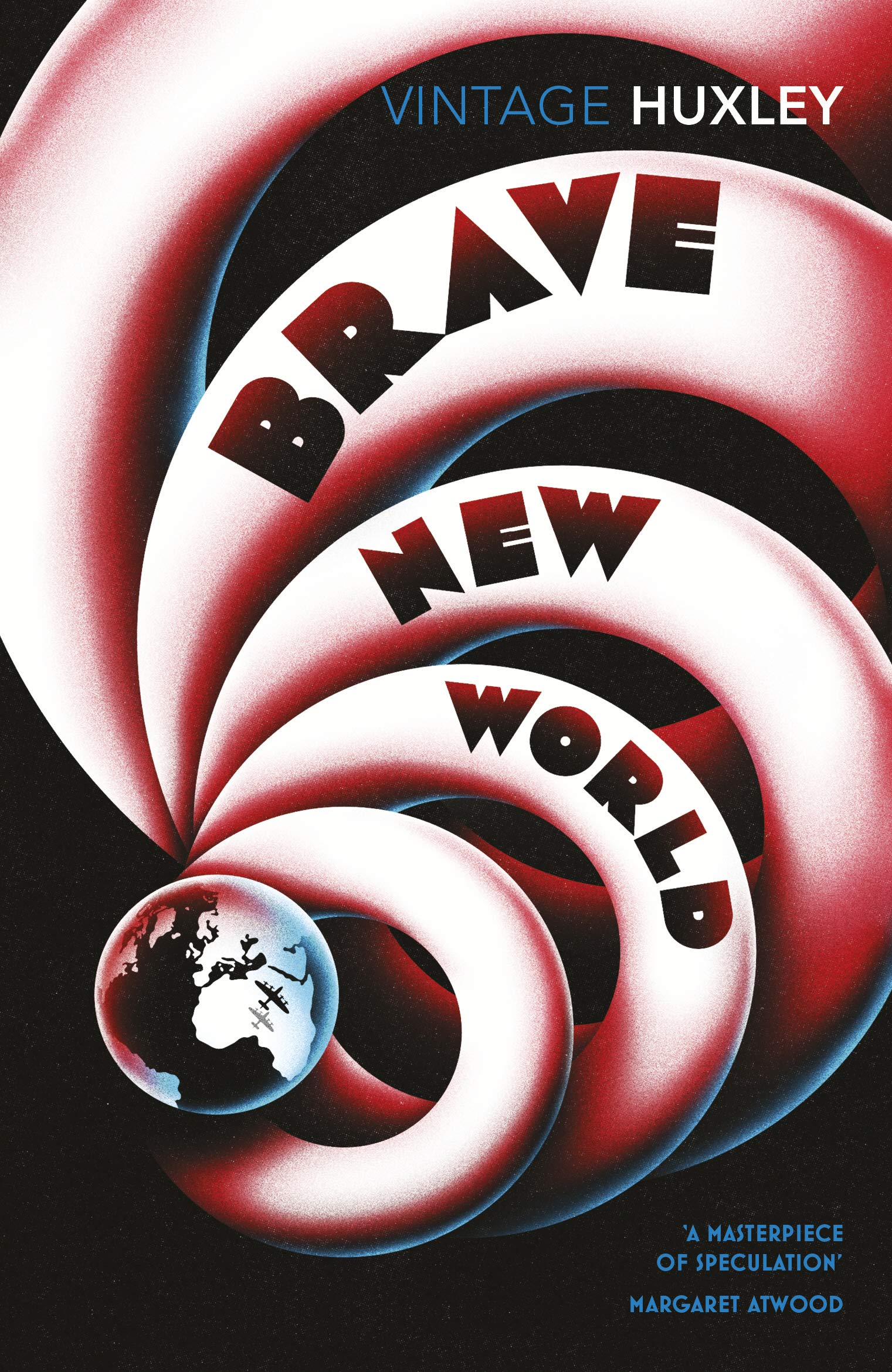
Brave New World Aftermath: Can’t we all just get along?

Image result for brave new world

Aldous Huxley’s Brave New World  is a classic dystopian novel.

In which everyone is happy.

It’s quite wonderfully insidious; usually a dystopian novel shows us a world where no one is happy, and challenges us to find a way to imagine happiness in it: in 1984, everyone suffers all the time, until Winston Smith tries to find a way to, well, live, laugh, and love; the jackboots of Big Brother and the Thought Police stomp that dream out of him. In Fahrenheit 451, the people are committing suicide and killing each other, while screaming at their television sets and cringing away from their devilish firemen; but when Clarisse McClellan tries to think for herself, she is vanished (and probably killed), and when Guy Montag wants to read books instead of burning them, he is arrested and forced to murder his former friend and then run for his life. In The Handmaid’s Tale, happiness is not the thing; purity is. Nobody gives a shit about happiness, and so that’s exactly what they get: shit happiness.

But in Brave New World, when John the Savage wants to be different from the people of the Brave New World, he demands the right to be sad and miserable and angry. And then he is chased out of society, because everyone there is happy, and no one has the freedom to frown, so to speak. Really, no one has the freedom to be alone, which is probably the more disturbing part; that is a common thread in all four books, and I think in all dystopias; everyone is watched, all the time, and it’s horrifying.

I should point out here that we are also watched all the time, and it’s no less horrifying for being real; but there is still some difference for us: the government has the ability to watch us all the time, but they don’t actually care about what 99% of us do.  And while our friends and neighbors are in our business every day, it’s usually because we put our business on social media, or on the grapevine. We still, generally speaking, have the option of privacy. Corporations building data profiles of us are involved in every second of our day that they can be, and that’s probably the most ominous; but really, they just want to sell us shit, so while it’s creepy that the Facebook ads reflect what we were just thinking or talking about, it’s nothing more than something to scroll past. At some point the corporations will realize that they can create markets for their products by screwing with us; that’s when it will get bad. It’s also incredibly dangerous that the data collected on each of us could very easily be turned over to the government (I was going to write “seized by,” but really, what corporation would ever say no to Uncle Sam come looking for intel? They can still sell things to people under NSA surveillance, after all. Maybe rotate some ads for firearms or “Don’t Tread On Me” flags into their feeds.), because the government is certainly willing to screw with us; but as of this moment, to quote the Doors, “They got the guns, but we got the numbers,” and so these tools are not yet  effective. Certainly something to watch out for.

But in the Brave New World, the people don’t have to watch out, they don’t have to suspect their government: they are happy. All of them. All the time. The Big Speech — another common thread through all these books, and perhaps in some form in all dystopian novels, as every dystopian novel has a message to give, and an important one, so the authors don’t want to take a chance on us missing it — given by World Controller Mustapha Mond (Huxley was a brilliant writer, but really, his names are lame. The use of Communist/Socialist names — Marx, “Lenina,” Trotsky — is annoyingly on the nose, and while it’s kinda clever that Mustapha in Arabic means “chosen” or “selected,” the fact that “Mond” means “world” and Mond controls the world… well.) at the end of the novel explains why the society of Brave New World chose happiness and stability over freedom and progress: because there was a terrible war, and afterwards, people wanted to be safe. So they chose to create a stable, safe society, and the only way to do that was to make everyone happy, all the time — or rather, maybe the goal was to achieve happiness for everyone, and the only way to do that was to make sure society was stable, was safe, was static. Every aspect controlled, nothing left to chance.

The result? A society where everyone is designed to be happy. Where the people are cloned, genetically and chemically modified, conditioned and trained from birth to have specific needs and specific wants and specific fears and specific aversions, all of that intended simply to make them happy with their life exactly as it is. They are built to do specific tasks in society, to enjoy simple things like sex, sports, and soma, the wonder euphoria drug that eliminates all chance negative emotions, and never to want to do or be anything other than exactly what they are.

And I read this, and I think: are they right?

Isn’t a happy, stable society better than one that has misery and suffering? Even if, as John the Savage (The one person in the society born to be a part of society, but not raised in it, so not controlled by it) argues — rightly, I think — that sorrow is necessary for tragedy, which is necessary for great art and great genius? Do we really need art and genius? It seems like a reasonable argument to say that most people would prefer to be happy, rather than great, and that happiness — contentment — seems much more likely to make us productive and useful members of society, and to ensure the continuation of the species. Aren’t those the goals?

Even if they aren’t, isn’t the loss of freedom worth the great benefit that the society actively seeks in the novel: the elimination of war? There is not a doubt in my mind that war is the greatest evil, the most abhorrent atrocity, that humanity has ever created or faced; what price should we be willing to pay to free us of it?

After reading this book — though it did genuinely give me pause and make me think twice, and then a couple more times after that — I think the answer is No. No, the price of safety and stability is not worth it. No, the goal is not simply happiness and contentment for all people at all times. Even, I think at least half of the time, if we achieved the end of war.

Because what makes war such an abomination is that it degrades our humanity. In addition to creating or multiplying every other horror we face — death, famine, pestilence, cruelty, greed, deception, hysteria, you name it and war is where you will find it more often and to a greater degree than anywhere else — war takes away everything that ennobles us. In the midst of famine, we can find unmatched ingenuity, and inconceivable endurance, and breathtaking altruism and generosity and self-sacrifice; in the midst of plague, we find kindness and grace and dignity in the midst of and because of the suffering; and so on, through all of it.

But war does quite the opposite. War makes kind people cruel, and healthy people sick, and civilized people into savages. War is the triumph of inhumanity over humanity.

But so is the Brave New World. Because whatever those people are, they are not human. Humans are not designed, and humans are not crafted and shaped like pottery on a wheel, and humans are not set into a groove out of which they will never skip. Humans cannot be perfectly ordered: we are chaos, we create chaos. It’s one of the reasons we are so good at war, because we are so very, very good at destroying things. Especially ourselves. We’re good at building — or else there wouldn’t be any targets for war to aim at — but we’re even better at burning it all down.

And that’s necessary. Because without destroying what is there now, you would never be able to build anything new. Creation implies destruction, but it is valuable  when destruction is for the purpose of creation, when it is part of a continuing cycle: whereas if we end destruction, and end creation too (The people in the book are not created as humans are, through the act of love and the processes of nature; they are built like machines, which is origination, but not, I would argue, creation — and I’m not even touching on the religious argument, which would be a much more poetic way to say the same thing), what we achieve is — stasis. The end of movement.

Death. And not a death that continues the circle of life, giving rise to something new to replace what is lost; here nothing is lost, and so nothing can replace it. Everything is just — still. Stopped. Perfectly motionless, without growth, without progress, without change. Which is no less dead than death itself. And while I will often argue that progress for the sake of progress is cancerous and absurd and deadly, I certainly wouldn’t prefer the final end of all progress.

Not even if it made me happy.


I do not think that this means we need to accept war. I still believe it is the extreme end, the Ultima Thule, of human malignancy; which means we can draw back from it, lessen it, even essentially eliminate it; though it is probably also true that some shadow, some residue, will always remain to harm and torment us. It is in our nature: not that we are made to war, but that we are made to try and reach and explore and find new ways to do things, and one of the ways to do things is to go to war; so even if we forgot it, we would rediscover it again, and again. Curiosity killed the cat, and we are forever curious. But just as more freedom and individuality is better than less, even if it is an imperfect freedom and individuality (which is what we have now), less war and more peace is better than the reverse. So I think there is a goal, and a way to achieve it, without also losing everything that we are.

I also recognize that there are events and actions that might be labeled war, but are not the horrors I’ve been describing; there are times when people have taken up arms to put an end to the horrors, when military intervention is the only way to save people. I don’t want to use the phrase “police action,” because Vietnam was a lie and the police as saviors is a fraught idea anyway; but there are times when force is both necessary and humanely applied. Someone who uses force to defend themselves or another from an attacking force has done nothing wrong. I don’t mean to either denigrate that, nor argue that even that should be (or could be) eliminated; that is the shadow and the residue of war that probably should remain — though ideally, since that sort of violence is triggered by the inhumane violence of dictatorship and oppression and vast chaotic upheavals, if we could end those, we wouldn’t need to send the Marines to intervene. But I’m not sure we could end those, either, because I think having the good and valuable tool of a defensive force can very quickly be turned to evil purposes (Which is why the Founding Fathers of this country pushed for a militia and abhorred the idea of a standing army — COUGH COUGH LOOKING AT YOU, MILITARY INDUSTRIAL COMPLEX), and then the solution becomes the problem. So it goes. We can’t close Pandora’s box.

So no. I don’t think we can live like the Brave New World. (And let me point out that, we discover, neither can they, not entirely, because there are people who don’t fit their molds, and who cause problems, and who are eventually exiled; Mustapha Mond is grateful that there are so many islands in the world to send misfit toys to — but that’s not a  solution, it’s just pretense.) I don’t think we can all just get along.

But I think we can get by. And get to be ourselves. And that’s probably better. Because that way we get to have art and beauty and truth — and that, I think, is really the point.

Shakespeare, as usual, (and as Huxley himself recognized) probably said it best:

O, wonder!
How many goodly creatures are there here!
How beauteous mankind is! O brave new world,
That has such people in’t!

The Brave New World, for us, is wondrous because of the people in it; it is brave because it faces turmoil and tribulation and suffering; it is new because it moves through the cycle of destruction and creation. It lives, and it changes, and it grows. Like us.

In the book, the quote is used ironically. We have to make it true.

Book Review: Ship Breaker by Paolo Bacigalupi

Image result for ship breaker

Ship Breaker

by Paolo Bacigalupi


I wish I’d written this book. And not just because I wish my last name were Bacigalupi – though I do wish that, too. This is the kind of book I wish I could write: it’s an outstanding idea, it’s a fast-paced thriller, and it has a wonderfully relatable hero that made it possible for me to feel like I was in the story, along with characters that hint of far greater depth to the world, which makes me want to read the “companion” book, The Drowned Cities. And I probably will.

On the other hand: because there are hints of depth to the world-building, and especially to the most interesting character, the half-man Tool, which are left entirely out of the story, I feel like this book was just gutted by editors who wanted to pick up the pace and cut down the word count so it would sell better. I know that if I had written this book, it would be at least twice as long, and so I’m kind of glad that I didn’t write this book because I would hate to have my book cut in half – and then have it be successful? Have it be a finalist for the National Book Award? That would drive me crazy. I realize, of course, that the success and the accolades that accrue to a book this short with this rapid pace tells me something about my own writing – it’s too wordy and slow to ever enjoy this kind of sales in the modern market – but I still hate the idea of taking out all the good stuff to pander to a readership that gets bored inside of fifteen seconds.

(There’s a lot of background to this, by the way. I’ve written four novels, all of which have been repeatedly rejected by agents and publishers; the two times I’ve gotten interest in short samples and sent in longer portions of the work, I’ve been rejected both times after a second reading because my writing is too wordy and too slow. Rather than cut out half of my stories to make a book like this one, I’m self-publishing my long works, because fuck ’em if they like their books short. Yes, I’m an idiot. But I also wish that prizes like the National Book Award didn’t go to the short fast books. Though this one is probably good enough to deserve to be a finalist even in its presumably truncated form. And maybe I’m wrong all the way, and Bacigalupi wrote it exactly like this. But I wouldn’t have, so there it is. I’m bitter, and he’s successful. Moving on.)

The story is set in this wonderfully real and timely dystopia: climate change has raised sea levels and created Category 6 “city killer” hurricanes, and corporate capitalism has so run amok that it seems to be the only basis of social organization; all else is might-makes-right anarchy. The story mainly takes place in a beach – uh, I guess it’s a “community” – in the Gulf of Mexico; the beach is strewn with the rusted remains of the old steel ships, cargo ships and oil tankers and the like. Oil has now become rare enough that it is no longer how cargo is moved: the modern cargo ships are sleek hydrofoils called “clipper ships,” and they sail with wind power – jet stream winds, that is, since they have huge sails that they launch, with cannons, several miles up into the stratosphere. And the people in the book make a living by ripping the old steel ships apart for salvage. Hence the title.

The main character, Nailer, is a teenaged boy who lives a hard and brutal life among the ship breakers. This is where the writing really shines, because Bacigalupi has created a society where environmental and economic devastation has made life a thousand times worse than it is in our world today – and yet, the problems on the human level are exactly the same. (I have no doubt, as well, that there are places in the world that are pretty much exactly like this place, and it’s only science fiction to me because I live in the sheltered part of the world. Like Lucky Girl in the book.) Nailer’s mother is dead and his father is a violent drug addict; Nailer has to work to earn his own food and possessions, and he is constantly having to prove himself or else someone else will take his job and he will starve – he can’t take time off when he gets hurt at work, for instance, or he will get replaced. Nailer lives in a dog-eat-dog world, where everyone fights everyone else for everything they have, all the time. Almost no one is willing to help anyone else, because it puts themselves at risk; we see this early in the book, when Nailer, whose job in ship breaking is to crawl through the duct work and collect copper cable, gets trapped in the depths of a derelict ship, and when he turns to another person for help, he is refused and left to die. His death would be more profitable to the other person than his life, and so that means – Nailer is left to die. (Spoiler: he doesn’t.) Because that is his world, the most important thing to him is loyalty, and the greatest virtue is – kindness. Generosity. It is the rarest quality, and so it is prized.

That leads Nailer into the main conflict, when a modern clipper ship is wrecked on their beach, and Nailer discovers it – and the survivor aboard, one of the people from the other side of the world, where wealth protects and shelters you from all of the terrible conditions that Nailer lives with on a daily basis. And again, despite everything else that is going on in the world and around them, the things that matter at that point are loyalty, and kindness. That’s the story of the book.

There’s more: but not enough more. The story ends with the resolution of the main conflict, but it ends right there; you don’t get to know what comes next, even though a number of things change, in very important ways, for the main characters. The half-man, Tool, is a great creation; the half-men are genetically altered mixtures of human and canine DNA, and they are fanatically loyal to their owners, even dying, samurai-like, when their master dies – except for Tool, who has no master but himself. He’s a remarkable character, and I desperately want to know his backstory, but I never get it; he also vanishes at a certain point in the book, and we never find out what happens to him, which also drove me batty, and is the reason I think the book got the crap cut out of it before publication. And I understand the need for a book to be fast-paced and exciting, especially when it’s YA fiction like this one; but dammit, I want to know Tool’s story. I want to know what comes next in Nailer’s story. I want more of this book!

Ah, well. This is a good book, a fast read that I enjoyed quite a lot. I definitely recommend it. Though I hope that people also look for and buy the books that go more in depth, that give a reader something to think about beyond the bare essentials, that give you a world and characters you can sink your teeth into. (Maybe buy my books, for instance. They will be available soon. Don’t worry: I won’t turn every review into a sales pitch. Just this one.)

Spring Break Book Review #5 (With bonus rant!): Anthem

Image result for ayn rand anthem book cover

Anthem

by Ayn Rand

This one was interesting for me. Politically, at least, which is probably the only way that Ayn Rand can be interesting to most of us. I read The Fountainhead in high school, on my (overly intellectual) brother’s recommendation; I didn’t think a whole lot of it. That was it for me and Ayn Rand, other than seeing her name and ideas associated with various smug libertarians; I didn’t think a whole lot of them, either. But recently, I’ve been involved in more serious political discussions with a fellow who has opened my eyes in several ways (Though honestly, I don’t think a whole lot of him, any more), and he has recommended Ayn Rand as the philosopher, and her Objectivism as the philosophy, for the future of this country. And so I plan to re-read The Fountainhead, and add in Atlas Shrugged, and see if I want to go forward from there. And while I was cleaning out my classroom bookshelves, I came across a copy of Anthem, which, like Willa Cather’s O! Pioneers, I have seen taught to high school lit classes in the past, though I’ve never taught it or read it myself. But heck, I’m going to be reading Ayn Rand quite a bit, soon; and this one’s short, so let’s give it a try.

Okay, Ms. Rand. I get it. The perfect man, perfect in all ways – tall, strong, handsome, ever so Aryan, dominant and masterful, intelligent, courageous, and perfectly logical and rational – exists purely out of nature, regardless of upbringing or environment. In a dystopian future, a society degraded and debased by the horrors of COLLECTIVISM, there is no hope for the ennoblement of humanity: until a noble man is born. Once born, he cannot be restrained: he will discover his own perfection, he will stand up to the forces of evil and oppression; he will choose his mate – who will, of course, offer herself up in perfect submissive surrender to the perfect man’s perfectness, because who could resist that perfect man? – and then he will forge on into the wilderness and the chaos and conquer all that lays before him. This is his destiny.

That’s the book.

I’m being a tad too critical, however, so let me pull back. Anthem is the story of a future dystopia where everyone lives for the common will of mankind, and individuality in any form is forbidden and savagely squashed. One man is born different, and he struggles against what he is taught: that there is no truth other than what the collective holds to be true; that there is no good other than what the collective holds to be good; that the purpose of his life is to serve his brothers in all things. In his rebellion, he discovers first that there is a better way to live, one found through his own individual efforts, his own individual genius; he discovers an ancient subway tunnel, and in it he performs experiments on the forgotten relics of our own time, buried and intentionally suppressed as not for the benefit of the collective, who do not want life to be easy, as it is the purpose of man’s life to toil in service of his brethren. The individual man re-discovers electricity – because he’s a genius – and tries, in the most noble and altruistic way, to share his discovery with the collective so that life can be improved for his brethren. And he is mocked, and shunned, and driven out for his crime, for discovering things that are not known to all of the collective – and so therefore, they cannot be true.

I see the point here, I do; and it is worth thinking about. Much of our society relies on shared ideals, on shared standards of truth and goodness; we still believe things because “Everybody knows it’s true.” We do think that what is good for all is good for one, and that a person who lives purely for himself is selfish, and therefore sinful and bad and wrong. We don’t believe it to the extent portrayed in this book, but that’s the point of dystopian satire: to take our flaws and magnify them in order to draw attention to them now, before they reach that terrible future point. And living purely for a collective, which destroyed Ayn Rand’s native Russia under Stalin and the communists, can surely become a great evil. I get that. I do. I see where we should keep this in mind when we attack each other for not holding to the orthodox view: the need for liberal orthodoxy leads to the movement against GMOs, which almost certainly hold no harm in and of themselves; and from there it’s a short step to the anti-vaccination movement, which has taken the distrust of Western medicine and pharmaceutical corporations to such an extreme that now it has become a hazard to the health of us all. And we liberals, with our elitist snobbery and disdain for those who are “ignorant,” as we call them – mainly those who hold other views (and not, ironically, we liberals ourselves, even in those areas where we cannot explain our positions but merely cling to them because they are the orthodox dogma, despite our own ignorance) – we are to blame for this sort of thing, to the extent it is really happening. Ray Bradbury makes a similar point in Fahrenheit 451 when he points out that the desire to remove any and all offensive material leads to the destruction of all literature and art and creative thought; another slippery slope that liberals tend to ride down in our worst moments.

And all that’s fine: but this book is not. The warning is somewhat valid, but the solution offered, the belief that one single epic hero-man-god – Harrison Bergeron, if you will – can solve all problems through his own heroic efforts, is disproved by the story itself, no less than is the pure goodness of life for the collective. This dude doesn’t save the world by himself; he re-discovers what other men already knew, using their artifacts. He doesn’t run off into the wilderness by himself; he takes a mate with him, and even though he says the only happiness he has found is what he has discovered by himself, the most happy moment in the book is when he first kisses that woman he rescues – or rather, that woman who rescues herself, as she leaves the collective and tracks him down in the wilderness. And then she submits herself entirely to his will: and while he chooses a manly individual name for himself, he then gives a name to her – and it’s a name that keeps her in a subservient position, valuable only as breeding stock for the continuation of his manly genes, as he becomes Prometheus, the Fire-Bringer, and she is – Gaea. The Mother. Of the sons (not daughters) he plans to raise to be manly men just like him. And he doesn’t forge a new life with the strength of his own arms; he discovers a house built by other men, and books written by other men. And once he has built himself a mighty army of like-minded individualists, what does he plan to do? Go back into the collective society and save those of his brethren he happens to like and wish to help.

So the idea that a single man acting alone is the only source of all good things? Nope. The idea that happiness can only come from individual action, without reliance on other people? Still nope. The idea that every man must live only for himself, that no man should impose his will on another, that violence can only be used in self-defense? Nope: he uses his will to suppress the will of his Gaea, and intends to commit violence against the collective in the name of his fellow men.

In terms of the writing, meh. She had the clever idea to write the story in the first person, but without the singular, because the collective has eliminated the concept of “I,” allowing only “we.” Watching the narrative then twist itself into knots trying to describe single individuals while only calling those individuals by “we” or “they,” that was pretty interesting. Did a better job than the actual plot of showing how vital is the individual human ego. And I believe the individual is vital: but not because Ayn Rand convinced me of it.

I realize this is only a novella, and not one of Rand’s key works; but so far, all I can see is that her philosophy is self-defeating – though certainly attractive, in that if I follow her advice and refuse to allow my individual energy and accomplishment to be taken from me for the good of others, then I get to see myself as one of these perfect epic heroes who understand the truth, that only egotism is right and good. But apart from appealing to the selfish, so far it seems like a whole lot of hooey.

Didn’t like the book, would not recommend.