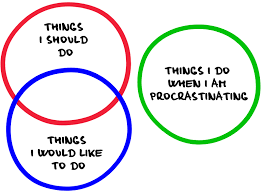
Late to Work, Work Too Late

I have a confession to make: I procrastinate my work.

Specifically, I procrastinate my grading. I procrastinate my paperwork, too; if I’m not the last one every year to get my self-evaluation done, I’m the runner-up. It’s almost a point of pride for me to refuse to turn in my Intent to Return paperwork until it is appallingly late; I dress it up as a sort of protest, because I hate the system — my school requires teachers in February to sign a letter of intent that says we do mean to return for the next school year, and listing the classes we would like to teach (There is also an option on there for “I would like to work for the school district, but I am willing to transfer schools” which I have never and will never check, because if anyone puts me into a middle school, I’m quitting on the spot and becoming a meter maid. Or maybe one of those guys who spin signs for tax preparers.), but then they don’t actually offer us a job, or tell us what we will be teaching, until JULY. I hate that we are supposed to commit to the school MONTHS before they have to commit to us — and in some cases, they don’t tell us the classes we are teaching until the school year starts: in 2021 I was teaching a full set of online classes, but I did not know until an administrator emailed me and asked “Hey, how do these students I have registered for your class sign into the Zoom?” ON THE FIRST DAY OF CLASSES. So yeah, the system pisses me off: but also, I do intend to return, and the people who need my signed letter — specifically my principal — are not the people who set up this obnoxious unbalanced system. So there’s no particular reason why I procrastinate signing the letter; I just do. Like with all of my paperwork. And all of my grading.

I don’t like admitting it, because I’m a teacher, and I’m supposed to set a good example for my students; I’m supposed to not only teach them that, in the real world, deadlines matter, and organization and a work ethic are important; but I’m supposed to enforce that learning by requiring them to hold to deadlines, to be organized, to develop a work ethic, so that they will be prepared for the real world. If I don’t prepare them for the real world, I’ve been told, then not only will I be setting them up for a rude awakening when they get fired from their jobs, but also I am tearing apart the foundations of our society by eliminating personal responsibility, which means that everything in this country will fall apart when this current generation gets out of school and goes into the real world.

Where have I been told this? On Twitter, of course. Where I was this morning when I should have been working.

Step 1: head on Twitter Step 2: regret your life decisions | Twitter | Know  Your Meme

Please don’t get me wrong: I have a strong work ethic. I take personal responsibility for the tasks that are required of me. If anything, I take too much responsibility, and work too hard; where I could just shrug cynically and say “Hey, if those rotten little punks don’t want to read the book, then they’ll fail and they’ll deserve it,” instead I say, “Maybe I should read it to them in class, so I can explain it and make it more interesting, and they can at least understand what’s in the book and what it means, even if they aren’t reading it on their own.” Does that require more of me? It does. Not only do I have to work harder in class, then, but also it means I can’t assign quiet independent work in class, and get my grading done while my students are working; that means I have to do my grading outside of class, which inevitably means I have to do it on the weekends.

Which causes a secondary problem: because I put so much effort into my daily classes, trying to run every lesson, keep every kid involved, cover every topic with them and make the information interesting, so I can be (at least somewhat) sure that they understand and are learning, I have little energy or motivation at the end of the week to do grading. And frankly, at the end of the week of work, I think I deserve a break: and I’m right. I do deserve a break. Teaching is a hard job, and I work very hard at it. It’s important to me: I recognize the value of education, and the value of an educated populace; I think of it as my most valuable contribution to a world that has been very generous to me in my life — and also, I’m good at it. And my students need to learn, and they need to have good teachers and good adults in their lives, and I am all of those things. So while I am at school, and after school, and during my lunch breaks, and so on, I work as hard as I can to do as much as I can for my students.

The result, then, is that on many weekends, I don’t do any grading. Even though I haven’t done it over the week at school, either. Because I’m tired, and because I deserve a break, and weekends are what I get.

The result is that it takes me too long to grade.

It’s a problem. It’s a problem for a lot of reasons: first because it’s bad teaching practice. Feedback should come quickly: students (like anyone) forget in short order what they did on an assignment or how they did it; if they get the assignment back with feedback within a few days, then they can take the feedback as constructive suggestions on how to improve. But if they get the work back two weeks later, or three weeks later, or four, five, six, seven, even eight weeks later — and yes, I have done that — then it’s useless. They don’t even remember doing the assignment. I have frequently handed back a paper to a class, and had them say “What is this? Oh man — I forgot all about this.” I cringe every time. And tell myself I’ll do better: I’ll spend more time grading, less time doing nothing at school or doing other things at home. The job is important, after all.

But then when the weekend comes, I can’t bring myself to do it. And there are all of the other things that I also need to do: I need to spend time with my wife, who is my whole world; and as important as my students are, and as important as teaching is, she is more important. Much more important. Orders of magnitude more important. Plus, spending time with her makes me happy: which does have the added benefit of helping me recover from the work week, which then gives me more energy to teach as well as I can in the next week. Which is also important: and maybe more important than getting those grades done. The same goes for spending time with my pets, and also working on my house, or going to the gym. All of them are important — the gym helps reduce my stress, and will keep me healthy, which will help me live longer (certainly something that teaching will not do for me…); working on my house makes me more comfortable, and also helps increase the value of the house, which means I will be more financially secure in the future — which not only reduces my stress, it also helps to ensure that I will be able to keep this important job in this underfunded, underpaying state of Arizona.

And so on. There are always reasons to do things other than grade: and I don’t mean bullshit reasons like “I just don’t really feel like it right now,” but valid reasons, genuine excuses: other important priorities that should come first. So I put them first. And so I don’t grade.

Grading Memes 20+ Funny Images Only Teachers Will Understand

And then there are the feedback loops.

You see, because I know that I take too long to grade, and I give myself all the excuses I could ever want to keep allowing myself to do that, I can’t bear to make my students stick to hard grading deadlines. Even though it would be easier, because that way there would be less for me to grade. Even though it would be “teaching them about the real world and taking personal responsibility.” Even though it would make the work more meaningful when they did it, because when they come back weeks or months after an assignment was to be turned in and they complete it then, the chance that they are still able to learn from the lesson is almost nil. But I can’t do it. If I don’t stick to hard deadlines, how can I make them?

I mean, of course I could. We have unequal power in the class. I get to set their deadlines, and the consequences for missing those deadlines; and I get to decide when I complete my own work. I have the power to make these determinations.

But I can’t justify it. I can’t justify the time I take to do the grading, so I can’t justify holding my students to a short, hard deadline, and then taking weeks and weeks to give them back the grade on the assignment they turned in on time.

So I don’t hold them to deadlines. Which is how I contribute to the imminent collapse of our society, according to those Twitter pundits who told me that holding students to deadlines is critical for preparing them for the real world.

It’s also, I know, how I leave an opening for students to put themselves into a real bind. Because I don’t hold them to deadlines, and I don’t get mad and yell and get them in trouble and ruin their GPAs if they don’t get the work done for my class, I make it that much easier for them to procrastinate the work for my class. And, see, they have so many classes, and so much homework for all of them, and their math and science and history teachers all keep hard deadlines, and chew them out and shame them when they miss deadlines, and refuse to let them turn work in late, and therefore ruin their grades if they don’t get the work done — that they always choose to do the work on time for their math and science and history classes. They know they can take a little more time for Humphrey’s work. So they take it: because after a long day of sitting in classes and trying desperately to learn — and they are trying — even when it is boring, even when the teacher doesn’t communicate well, even when other things in their lives or in the classroom are distracting them, they are tired. And understandably so: it’s hard work trying to learn. Especially trying to learn complicated advanced concepts like how to write an essay. But that’s okay, they can put off Humphrey’s work; he doesn’t care.

Let me just set the record straight on that one, because it makes me mad every single time they say it.

Are you listening, kids? (Of course not.) Here it is anyway.

I care.

I care about how you act in my class. I care about whether or not you are paying attention to me. I care about whether you are looking at your phone or if you are reading. I care about whether or not you turn in the work on time. I care about your grades. I care about your test scores. I care about everything. All of it. Always. I care.

I just don’t have the energy to apply pressure on all of you, all the time. I can’t do it. I can’t make the lesson interesting and useful to all of you, while also fighting to make you listen to the lesson I have already put effort into to make it interesting and useful. I can’t stand to have to fight to make you listen to my interesting and useful lesson: you should just fucking listen. Okay? You want to talk about not caring? How about all of you little punks not caring about how much you annoy me when you don’t listen to me no matter what I do or say? Even after you say you like me and like my class? You still don’t listen, and you don’t care how much that hurts, and how frustrating that is. You make me fight you, make me make you follow the rules you know you have to follow already, and then when I ask you to follow the rules, you argue, and you fuss. So I have to fight harder.

Think of this: for every action there is an equal and opposite reaction, right? So if it takes a certain amount of time and effort to overcome your resistance to doing work in class any given day, and I have to be the one to overcome that resistance for you, then that means the effort put into my action to create the reaction in you that allows you to learn is just as hard for me as it is for you. So if you struggle to make yourself pay attention and try, I struggle just as hard to make you pay attention and try. The difference is, I have to struggle with 20 of you, every single period, every single day. And then once I have managed the struggle, and gotten you all to pay attention and try — then I have to teach you. And make it interesting and useful for you, so you can keep paying attention. And that takes effort, too.

So much of the time, even most of the time, I just can’t do it. I can’t put out that much effort in every class, every day, with every student. So I blow it off. I procrastinate. I just start teaching the lesson, knowing that not everyone is paying attention; hoping that somehow they will listen to me as I try to make it interesting and useful, and they will do the work themselves, and then I will be able to help them learn.

It never happens. Not with the whole class. Not with a whole unit.

So I have to let it go. And since I let it go, I can’t demand that they put out more effort than I’m willing to put out. To be clear, again: I could do that. Lots of teachers do that. The fact that I don’t do that is one of the reasons they like me. But because they like me, they feel more casual about my class, and it’s easier to blow off work for a class that is more casual, especially when the teacher is cool and doesn’t care about deadlines. (I. CARE.)
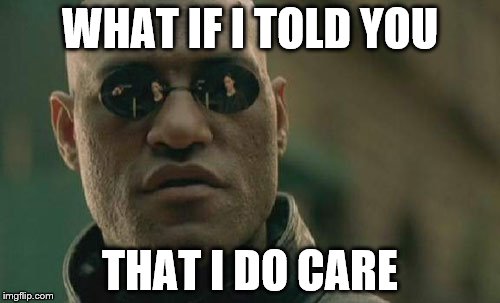
Matrix Morpheus Meme - Imgflip

So the students blow off deadlines, and that creates more work for me. Because I need to try to track them down to get the work completed so I can grade it; or by the time they get around to it, they don’t remember how to do it, and I have to take some time to remind them of what the assignment was. Or they blow off some assignments, which lowers their grade, and then they need to make sure other assignments are perfect so they can bring their grades back up — and that means they need to check with me about what the expectations are, and what they need to do, and if the work they have so far is good enough or how they can change it to make it better and get a better grade. Which is freaking awesome: because it means they’re learning, and they want to learn, and they want me to help them get better, and that is the whole point of all of this —

And it takes more time and energy. Which I am happy to expend on students who ask for help, especially the ones who have been struggling and have low grades because they haven’t turned anything in, which always makes me worry that they don’t understand the assignment or the content at all; when they ask for help, and I help them, and they get it, then I feel like I won. And they turn the work in, very very late, and I grade it immediately because I’m so pleased they got it done, and then I am complimentary in their feedback because I want to encourage them to keep turning in work and showing improvement.

Which, of course, just encourages them to keep turning work in late, and getting extra individual attention, and getting nice feedback and so on.

But then I’m even more tired, and so I get even less done for the class as a whole. Which makes me feel bad, like a slacker, like a bad teacher. Sometimes I get so depressed I can’t stand to work at all. But of course, I keep doing it. Because I have to. Because the students need me. Even if they never act like it.
Meme Creator - Funny You can come back to work now We miss you (& need you)  Meme Generator at MemeCreator.org!

That’s what procrastination is.

I don’t know how or when or why we all forgot that, all got confused about it. Who told us that procrastination was being lazy? Nonsense: blowing off work entirely, never getting it done at all; sometimes that is due to laziness. (Rarely, I would argue. But sometimes.) Procrastinators do the work, we just do it late, or at the last minute, while also applying enormous pressure to ourselves mostly in the form of anxiety. So if you do the work a little at a time from Monday through Thursday, and I cram it all in on Thursday night, and we both turn the work in on Friday — or if I do all the work on Sunday and then turn the work in late on Monday — which of us has done more work? Nobody, of course, unless, as I said, you want to count the extra effort I expended on anxiety and guilt. (And maybe the extra effort you spent on organizing and managing your time and the project — but you loved doing that, and we all know it.) We all do the work. It is certainly true that waiting until the last minute frequently limits the amount of time we have to put into the work: but in my experience it does not at all limit the effort put into it. That is a separate decision, which lots of people make — and sometimes it is due to laziness, I agree. But procrastination is not lazy.

It’s prioritizing.

As I said, when I decide on Friday night that I would rather spend an evening with my wife than grade papers, that is a choice I am making based on what I think is most important: not what requires less effort. Okay, spending time with my wife does require less effort: but considering how much time I spend away from her doing work, it should be clear that I don’t always pick the easier path because it’s the easier path. I usually don’t. When I do choose to spend time with her, it is partly because I have spent all of the effort I can possibly spend, and now I need to do something that puts something good back into me: and an evening with the woman I love will do that. (Also I choose to spend time with her because she is the best and most important person in my world, and she deserves to have my time more than any of my students do.) The time I spend writing is time I could spend grading, and believe me, this is not any easier in terms of intellectual effort. I think it is more important, at least once a week, for my self-understanding and my identity. So I prioritize: I make a choice. And that choice means I have less effort and time to spend on the other tasks. I will still spend as much time and effort on them as I can: but sometimes — frequently — constantly — that effort is not my full effort. It just can’t be.

Because I have too much shit to do.

Want me to get all my work done? Reduce my student and class load, without reducing my pay (Because if I get paid less, I’ll need to go find a second job to cover my expenses, and I will not have more time.). Or even better, make all of my students do their part by having them pay attention to my lesson, to my whole lesson, every day, so I don’t have to fight to make them stay on task and learn the content. Though, to do that, you’ll need to lighten their load as well: because believe me, after being told all their lives that they need to learn everything and get good grades OR ELSE THEY WILL BE DOOMED TO A LIFE OF MISERY AND WASTE BECAUSE THEY DON’T HAVE ANY WORK ETHIC OR RESPONSIBILITY AND THEY WILL HAVE DISAPPOINTED EVERYONE AROUND THEM, they are also trying just as hard as they can: and it isn’t their fault they can’t do everything we demand of them any more than it is my fault.

We are simply demanding too much. And then calling it procrastination when everything doesn’t get done.

This is the point I want to make, and I want to make it twice. Because people on Twitter (Assuming they are people, and not malicious semi-sentient globs of slime) have repeatedly and vociferously claimed that teachers are lazy. We are not. We work as hard as any and harder than most. Of course there are lazy teachers, as there are lazy people in every group; but teaching as a profession takes all that we have, and demands even more. Students, like all children, are a bottomless hole of need: they always need something, and then they always need more. It’s fine; they are children, they’re not supposed to be self-sufficient. But there is never an end to their need. So we who provide care to children, of any kind, we have the full range of tasks required of us professionally — and then we have all those children. And all of their needs. It’s too much: and so I, like all of my colleagues, prioritize. Some of us choose to prioritize work over family, or over ourselves; some of us choose one aspect of work over others — I have colleagues who spend enormous amounts of time and energy making sure that their students are happy, even if the curriculum maybe doesn’t all get covered; I have others who make sure that the students are understanding all the work, even if that means they maybe don’t have the most fun and exciting classes; I try to make sure that my students find some interest in and affection for my subject, because I want, more than anything else, to get them to be readers: and thus lifelong learners, who will grow far beyond what I could ever impart to them. But the issue is, we all try to do all of those things, all at the same time, along with doing all the rest of our work; and it is too much to get done. So we do what we can, and procrastinate the rest, and when we finally run out of time — we say to ourselves that we’ll work on that next year.

And now let me make the same point twice: students need help. They need support. Not all of them need the same help in the same way, but all of them need something. All of them. Partly because they are children: and partly because everybody needs help; everybody, young or old, needs something. What students need more than anything else is grace. They need kindness. They need us to try to understand what each of them individually needs, and to try to provide that to them, as much as we can. We need to know where our boundaries are, when we run out of energy and the ability to give; because they can’t be expected to know how much is too much, and they will always need more than we can give. It’s fine: they are children. Children need support. And there are fortunate children who get most of what they need provided for them by their families and friends; those children don’t need much from their teachers and other caretakers. But they still need something: even if it’s only praise for a job well done, and a suggestion about where they could go next.

The other reason why students all need help and grace is because we demand too much from them. We give them limited time, limited resources, and the limited energy and support of their teachers, and expect them to accomplish — everything. Not only to learn all of the subjects which their teachers have spent our professional lives mastering, but also to learn everything else they need for adult life. And apparently — according to Twitter, at least — they need to learn it all NOW, before they get into the “real world” and discover that they are unprepared for the harsh realities of life. They need to learn to do their work, and do their best, all the time, no matter what they may have going on in their lives outside of school; because in the REAL WORLD, you don’t get to give excuses: you just get fired if you show up late or miss a day of work or miss a deadline or break the rules in any way.

Never mind that I have frequently been late turning in my work. Never mind that I have had colleagues and coworkers who show up late, or miss work, all the time. (I tend not to miss work, and I’m obsessive about being on time. But also, I let my classes get off topic at the drop of a hat, and waste all kinds of time arguing with students over silly subjects instead of pursuing curriculum. We all do the things our bosses don’t want us to do.) Never mind that I and several of my colleagues constantly disobey the dress code, or don’t clock in or out properly, or cuss in front of students, or spend time on our phones looking at social media when we’re supposed to be working. Or show up hungover to work. (I’ve never done that one, either. But I did get suspended because of things I posted online about my students. So I guess I never learned that “If you don’t have anything nice to say then don’t say anything at all” lesson in high school, huh? Must have missed that day. Probably hungover.)

No: we tell these children, who don’t know any different, don’t know any better, because they have only been in school, because we won’t let them leave, that they have no chance in life if they don’t learn everything we have to teach them RIGHT NOW NOW NOW NOW NOW NOW NOW. And then we give them far too much to learn, all at once. And tell them they not only have to learn all of it, but they have to get high grades, or else they are doomed, and we will be disappointed.

And then we are surprised when they procrastinate? When they blow work off sometimes? When they try to take a little bit of time and space for themselves, to do something they enjoy, after hours and days and weeks of doing work, for no tangible reward? We’re shocked when they sleep until noon on the weekends — and then we call them lazy?

How dare we?

No. Students are not lazy. They are doing their utmost to live up to our impossible standards, to our impossible expectations, even with their limited resources and their nonexistent experience, which means they have not mastered the same coping strategies that we have. They don’t know what to do other than — maybe not do some work. And then we get mad at them for not doing their work, and they feel bad, and they fear the consequences we give them right now so they can learn to avoid consequences later; and all of that adds pressure, which wears them down — and they need to take more time off, to escape from even more work. Just so they can survive.

Just like us.

The answer is: they need to work less. We all need to work less. And if we can’t, then the very least we can do for each other is, when we have the power and the opportunity — be nice. Be kind. Give someone a little grace. And take a little for yourself. Even if it looks to others like you’re procrastinating. It’s better to turn in the work too late, than to work until it is too late.

We’re all doing our best.

What We Need In Education: Time and Hope and Change. But mostly time.

Okay, I had two preliminary thoughts this morning, which I want to get to before I dive into the main subject, because both thoughts are pertinent. (And then I came here to write this, and had a third thought, which is — holy crap, there are people reading this blog? Hundreds of people?! When did that happen?!? Welcome, and I’m sorry I haven’t been posting regularly, and I will do my very best to change that. Feel free to check out my years of archives, linked on the sidebar. Also you can go to my website and see my other projects. And a picture of me with a sloth.)

The first thought is in regards to what is happening in the world right now. Russia has invaded the Ukraine, and there are people fighting and dying; I thought it would be awful of me, entirely selfish and exhibiting “blinkered, Philistine pig-ignorance” to quote the great Monty Python, to write about really anything other than that crisis. I keep seeing fluff items in my news feed, things like what Meghan Markle wore to the NAACP Spirit Awards, and I keep thinking, “Man, they’re still going ahead with that kind of thing? Now? When Russia has invaded the Ukraine?” So surely I wouldn’t be so tone deaf to the suffering of others to write something about teaching in the US today? Especially if I wrote something hopeful and positive in tone?

But that’s not fair. First of all, there is literally nothing I can do about Russia and the Ukraine. I don’t think I need to do anything to raise awareness; I’m confident that anyone reading this blog already knows, and most of you certainly know more than I do about this. I may have something to say about it, being a dedicated pacifist, because this is exactly the point where pacifism becomes questionable, when there is violence instigated by a clear aggressor, acting without provocation; does that make it acceptable to fight back against that violence? Recognizing that allowing violence to continue — well, it allows violence to continue; being pacifistic while people are fighting and killing doesn’t reduce the amount of violence in the world, and arguably, if fighting against those who are violent would end their violent aggression, it might reduce overall violence in the world. At the same time, I have to honor the choice of dedicated pacifists like devotees of Buddhism who refuse to fight back when attacked: maybe they have the right idea.

Most importantly, though? There is always suffering in the world. There is always violence, and atrocity. And while we certainly shouldn’t turn a blind eye, neither can we let the suffering of others, no matter how terrible and heartbreaking, stop us from living our own lives, and doing what we can to alleviate suffering about which we can do something. If I can help make life a little easier for myself, for my friends and family, for my fellow teachers and my fellow countrymen, then that is a good thing to do, even if it doesn’t help people currently being bombed by Vladimir Putin’s stormtroopers. It’s good to spread hope, and to promote progress on the problems that face the world today, both the existential crises and the slower, less obviously catastrophic concerns: like the state of education. The fact that people are dying doesn’t change the need to make the American education system better, or to maybe help teachers feel a little better about our world right now.

So I’m going to go ahead. For real, and I’m sorry this took so many words for me to get to the subject. And no, I haven’t forgotten that there were two preliminary thoughts: the other was, simply, that things take too much damn time to do. You know? I got up this morning, fed my dogs, drank some coffee while puttering around on the internet, then I walked the dogs, went to get bagels for breakfast, made a run through Target for some supplies and then came home — and cursed out loud when my wife was already up and met me at the door, because I was carrying presents for her birthday tomorrow, unwrapped presents which I was just about to wrap with the shiny new paper I got from Target, and she wasn’t supposed to be awake yet, but the run to Target had taken longer than I expected and it was already the time when she usually gets up on the weekend, but fortunately she’s wonderful and so when I yelled “GO AWAY!” she ran away and went back in the bedroom so that I could wrap her presents, which I did — and then I ate breakfast and now here I am writing this: and it’s almost 11am and I need to stop so I can give my dog a bath which he sorely needs, after which I will need to take my own shower, and then it will be time for lunch and a nap: and I haven’t even gotten to my subject for this post, and I haven’t done the grading I need to get done this weekend. And my weekend, which was a very welcome four-day break (for the Tucson Rodeo! A four-day weekend! After we didn’t have a day off for Presidents’ Day! And this isn’t even a cowboy sort of area any more! It makes no sense! Wheeee!) is almost over, and I need to get back to work. And I’m not really sure what I’m teaching tomorrow.

So that’s the second thought, and I am using this to enter directly into what I want to talk about, which is: what we need to do about teaching in this country. Because the truth is, what we need to do will take time. A lot of time. And while we are doing those things, while we are making the necessary changes, we also need to keep doing the things we are doing now, because if we put everything on hold today so that we can make tomorrow better, then the people in need today suffer. And while it sucks to realize that working on the immediate needs of present students in the present system will delay the necessary changes that will improve the system, especially when we recognize that much of our work now is necessitated by the problems and flaws in the current system, it’s also important to realize just how much work we’re getting done, and how important that work is.

Let me emphasize this. The biggest problem in education right now, for teachers and for students, is burnout. We are overworked and overstressed, and we’ve reached our limits. Students are showing that by acting out and by rebelling, because they can’t change the system, so instead they refuse to participate (which just makes things worse for teachers, but then, it’s not the students’ fault that they have no other recourse [which does not make it any easier to handle them on a daily basis]); teachers are showing it by quitting, retiring, and also by losing our minds. For me to say that we need to keep doing this work, all of it, and that we also need to put in extra effort to reform the system — well, I sort of want to punch myself in the throat for it. But: first of all, not everyone has to participate actively in the reform of the system. We do what we can, and that’s all we can do; most of us will be simply maintaining the status quo, at least for right now. But that is important, because maintaining the status quo? Means educating students. In a flawed and inefficient way, which promotes even greater burnout; that’s why we need to do something to change the system. But anyone who does anything to help a student to learn is doing a good thing. Teachers, who put all of our time and energy into helping hundreds and thousands of students to learn, are doing wonderful and awesome things.

Don’t forget it. Don’t minimize it. Teaching is of vital, critical, importance, both in the immediate and in the long term. If all you can do right now is teach, or do what you can to support teaching and learning, then that is enough. That is amazing and wonderful. I thank you and honor you for it. And I thank and honor myself, because I’m still doing it, too. I don’t want to go to school tomorrow, but I’m going to. And I’m going to teach as well as I possibly can.

Not totally sure what I’m going to teach. But it’s gonna be something.

Look at my morning. I took up hours doing a bunch of things, and it’s tempting to focus on what I didn’t do — writing, or grading — and see the morning as wasted; but instead of that, look at all I got done: my dogs are well cared for, my wife and I had a delicious breakfast, her presents are now wrapped; I even got little things done, like I stopped and did the recycling, and I listened to an episode of my new favorite podcast. (It’s called Unf*cking the Republic. It is political, progressive, and utterly brilliant. Highly recommend.) Time was spent: but it wasn’t wasted.

Time spent working in education is — no, wait; I can’t say it is never wasted. It is constantly and consistently wasted. But, time that is spent actually helping students or teachers is never wasted. It is always good work.

Sadly — and this is why there is so much burnout right now — it’s a lot of work. And a lot of effort is wasted in the process of doing that work. Take ESS (Exceptional Student Services, the new term that has replaced Special Education — and if there’s anything that is more wasted effort than dreaming up new euphemisms to conceal that there are efforts being made to help students learn, I don’t know what it is): I have a couple of pretty extensive forms I need to fill out for a couple of students who are having meetings to consider their individual learning needs and how those needs are being addressed; I have two after school meetings this coming week to discuss the students’ progress in my class. Figure three hours, outside of the time I normally spend preparing and teaching my classes. Multiply that by the six other teachers each student has, along with the time spent by the ESS coordinator to arrange the meeting and make sure that everyone fills out the paperwork, and the time contributed just to this specific part of the process by the student, the parents (Both of whom, students and parents, spend uncountable hours trying to help the student learn), and the administration, and you’ll see something of why teaching is so hard and why we’re burnt out. And the real issue is? What these students mostly need, in addition to their resource classroom, is — consideration. Extra time on assignments, preferential seating in the classroom, and the ability to check in with teachers about progress and understanding are by far the most common accommodations, along with the option to take breaks when needed and to take tests in a more relaxed setting like a smaller classroom or after school. Tell me which of those things would be refused by any reasonable teacher. Of course, the very fact that we have the official process and all the paperwork shows that there are definitely teachers who have refused to allow those and other reasonable accommodations; and that is certainly one of the problems we need to address in education. And I also recognize that having a system in place to provide plans and communicate needs to individual teachers alleviates the students and their parents of the obligation to discuss with every single teacher what the student needs to succeed; I know full well that without that process, most of my students who need accommodations would never talk to me about them, because it is still stigmatized to need help in any way for any reason.

I can’t quite fathom why it is bad to do what it takes to learn. To want to learn enough to look for and find the particular ways that one can learn successfully despite one’s inherent difficulties. I mean, that’s all the ESS students want, is to learn. Why exactly is that bad? Why is it shameful enough that we need to stop calling them Special Education students? Why has our society stigmatized those who want to learn?

So that’s what I mean. There’s too much work, and too much of it should not be necessary — but to make it unnecessary would require different work in different ways. We would need to make it easier for students and parents to talk to their teachers. We would need to get rid of teachers who stand in the way of learning, thereby necessitating a process that forces them to provide what students need to learn — because any teacher who isn’t willing to take reasonable steps to help students to learn doesn’t need to be in public education. And all of that, either the current work that puts bandaids on the problems, or the additional work that would be needed to heal the problems permanently — it all takes time.

It all cascades, you see. The reason why teachers and students are so burnt out right now is because we didn’t allow ourselves time off when the world came crashing to a halt. Instead, we all doubled or tripled our work load overnight. When I left school on March 13, 2020, I was a classroom teacher; when I went back to school two weeks later, I was an online teacher. All of my students suddenly had to become online learners. We had to find ways to do the same work we had been doing, but in an entirely new way: most immediately for me, I had to figure out how Zoom and Google Classroom worked, how to record the sessions (which my school required), how to help my students get into the sessions, and how to present the content through online media. I scanned two entire books, page by page; I recorded audio of me reading those books chapter by chapter. And I spent the same hours I had always spent teaching classes, grading work, responding to emails, and so on. My students did essentially the same things in reverse.

All, of course, while watching our world collapse, and for many of us, worrying acutely over the health and wellbeing of ourselves or our loved ones.

That continued into the fall, when classes were going to be in person, then went online, then went hybrid, then bounced around all three for the remainder of the school year. All of it required me to do my usual work and also the extra work of making my class available over the internet. All while still watching my world collapse and worrying acutely over myself and my loved ones.

All, by the way, without any extra pay for the extra hours and extra effort.

So because I had to spend extra hours doing the same work, what did I sacrifice? Myself, of course. I slept less. I read less. I played fewer games. My wife and I didn’t do the things we used to do to have fun — go out shopping, go to restaurants, play boardgames with friends, and so on. I didn’t take time for myself, at a time when I desperately needed time for myself, to deal with the constant stresses. I had even less time to decompress, as well as less time to help my family and friends, to do the things I normally do when I am not working, even while the need for all of those things was greater, because I had to spend extra time working just to do the same job in the new circumstances. And all of it was harder, because I knew that it wasn’t working. I read dozens of articles saying everything about why and how it wasn’t working: how we needed to go back to in-person school, how we were incurring “learning loss,” how we were doing a terrible job; and also how it was vitally necessary to protect the health and wellbeing of the students and the staff and everyone’s family by having school online, and it was terribly critical for teachers to figure out how to keep students engaged even over the webcam. All that weight was on us.

I can’t even imagine the pressure that was put on health care workers.

So because I was working harder, and taking less time to recover, and also being told (and seeing direct evidence) that my efforts were leading to less positive results, it wore me out. Worse than any year I’ve had as a teacher — and that’s saying something, believe me.

And then this school year started: and on the first day of classes, with no advance warning of any kind (That is the fault of my specific school, though I don’t doubt that other teachers at other schools had similar problems), I suddenly found out I was teaching four online classes at the same time I was to be teaching six in-person classes.

So it kept on going. All through the first semester. Then, thankfully, the online school hired its own specific teachers, and I and my colleagues no longer had to teach two simultaneous groups of students; so I guess this current semester is easier.

But it sure doesn’t feel like it.

So the wear and tear on my mind and my soul make it feel like I have to do more to take care of myself, to destress and unwind; also, the last two years that I have not had the time and energy to pursue my personal projects as much as I would like — which for me is a particularly big deal, as I still consider myself a writer as much as if not more than I consider myself a teacher — have made me feel guilty and sad, and desperate to get back to who I used to be: and all of that makes it harder for me to take the time to do my work as a teacher. Which then makes me feel guilty because I know how much my students need to get back to normal, and how much they need to learn; and that falls to me, because they aren’t really holding up their end right now, since they are also tired and burnt out and stressed and in need of comfort and a break from work.

All of which — and I know it’s too much, and forgive me for ranting, but this is some of what I need right now — leads me to the one thing I am going to say we need to do to change education, the single most important thing.

[Warning: there is cussing ahead.]

We need to take away the goddamn fucking deadlines.

Who gives a shit, WHO GIVES A SINGLE SOLITARY SHIT, if a student takes two years to master a subject or skill while it takes another student only one year? Why on God’s green and verdant Earth do we need to make sure that every student learns the same stuff IN THE SAME AMOUNT OF TIME?? Why do they have to graduate by eighteen? (For that matter, why the hell do we sort them according to their birthdays? Rather than making groups of students according to their interests and aptitudes, we group them according to age? Whose stupid goddamn idea was that? But hold onto that one, I’ll come back to it.)

Do you realize how much better this whole situation would be if we had just LET STUDENTS TAKE A YEAR OFF??? If we had let teachers just take a year off??? I realize that means teachers wouldn’t be doing our jobs and therefore we wouldn’t get paid — but let me just point out that we should have simply paid everyone who was forcibly unemployed because of the pandemic and quarantine, the whole time. But anyway. If we have to have teachers working, then it would have made perfect sense to offer educational opportunities to those who wanted them, and to offer childcare to families who needed it, without actually calling it a school year; that’s how we could have kept teachers employed. If we didn’t have to think of it as a school year, I guarantee teachers could have found a way to keep kids occupied so their families could go to work; though based on the number of students who actually went in to school even when we were fully online in the fall of 2020, there weren’t actually that many families who needed the help. There were some, and our system is what provides most families with childcare, so I see the need to continue providing that, within the limitations of the pandemic and the quarantine: but why, in the name of all that’s holy, did we have to try to make them learn? Everything they would have learned if nothing had changed? Why did we need to pretend that we could still teach, and they could learn, with the same rate of success as a normal year?

Deadlines, that’s why. Because letting this specific group of students graduate when they were 19 instead of 18 (Again, those who desperately wanted to learn to graduate “on time” could have made use of the opportunities without driving everyone involved to the brink of insanity) was apparently unthinkable.

And that’s why everything in education sucks right now. Because we couldn’t fucking take a fucking year off DURING A FUCKING PANDEMIC.

Okay, sorry. I’m better now.

I have more thoughts for where education should go in the future, but I’m going to save them. I’ll try to write about them next week.

This week, I just want to reiterate, again and again: things take time. Work takes time to get done. If the work is made harder by circumstances, it takes even longer, because it puts more stress on the people doing the work, who then need even more time to wind down from their work, in order to maintain their productivity.

If you are and have been working to help students learn, you have done good work. Thank you. If you are and have been working to help teachers teach — or you have been helping teachers survive — thank you. You have done good work.

And before we talk about anything else with education, start with this: the only reason, the only reason, we have concepts like schedules and deadlines and on-time progress and “learning loss” in education is because we choose to force people to complete things in a specific time period. No exceptions.

That needs to change.

This Morning

This morning I’m thinking about deadlines.

I’m a little afraid I’m going to miss this one, because I woke up this morning without a definite idea of what I was going to write about, and then in trying to think about a topic in the shower (one of my most productive thinking times), I thought of too many topics, and I couldn’t focus on one and follow a line of thought to a conclusion. That’s okay, I often don’t know where these written thoughts will end up when I start them; that is, I know what my opinion is when I start — I’m against deadlines — but I don’t know exactly what I’m going to say about them. Will I end up affirming my opinion? Will I find some compromise? Who knows?

This comes up most often at school, of course. I try not to use deadlines. I don’t quite believe in standards-based grading — which means that the only grade a student should really get is whether or not they have met the standard, and it’s a large topic that I will write about another time (Note to self: SBG.) — but I do agree with a component idea of it, which is that grades should be based on the work a student does, not on a student’s behavior. I think schools have taken on too much of the responsibility for raising our students, and I don’t think it’s good, and personally I don’t want to do it; therefore I don’t want to use the school’s (theoretical) focus, education and achievement, to bully students into doing what they’re told. Giving students a deadline, and then imposing grade penalties when they miss that deadline, is not educating them in a subject; it is an effort to instill a work habit. It’s a good work habit, but that’s more akin to character building than it is to education, and therefore I’m pretty much against it.

Now: I am not against being a model, as a teacher, of good work habits. Good any habits, really; I think it’s important that I be visibly and clearly respectful of others and their opinions, that I be kind and generous, that I explicitly oppose sexism and racism and intolerance and injustice. Without doubt. I think that everyone should do those things all the time with everyone they know: I think I should model good behavior with my wife as well as with my students, though for an entirely different reason: I don’t need to show my wife what good behavior looks like, I need to show her that I know what good behavior looks like so she knows I’m not an asshole. And if that sounds, by the way, like a lot of work, if it sounds like I always have to be performing and therefore I always have to be focused on doing certain things and not others, that’s true, but it also assumes that my relaxed, default state is being an asshole, and it takes extra effort to resist being one when I’m at home; I don’t think that’s true, and if it is, I don’t want it to be.

So I am in favor of meeting deadlines as a teacher. I try. I try to get their work back to them before grades come due. I try to have materials ready in time to use them. I try to have lessons planned well enough in advance that I’m not giving them what they keep asking for, a “work day” or a “free day.”  I do miss all of those deadlines sometimes, especially the grading ones; the most common response I get from my students when I give work back is, “Oh, I forgot about this!” And I give them work days, and I have had to change lesson plans in the moment because I don’t have handouts ready or I couldn’t get the reading done myself the night before.

But that’s the point: things come up. Things don’t work out. I get insomnia, or I have to deal with a sick dog, or my car gets a flat tire. The copy machine breaks, or is full of multi-page math jobs. A student stops me to ask for help, or even worse, comes to me in tears in a crisis. Things happen, and stuff doesn’t get done on time. We all know it: we all live with it constantly. I hate being late for appointments, but sometimes there’s traffic. And sometimes I get to the doctor or the dentist or the hair salon and they’re running late, and they ask me to wait for a little while before they can get to me. I complain all the time about the thousand little tasks that are incessantly assigned to me as a teacher (A colleague of mine refers to this as “death by a thousand cuts.”), and what bothers me most is that they are given artificial and unreasonable deadlines, often without sufficient notice: this year we were asked to contribute to our own evaluations (which is its own travesty — note to self; personal evaluations) and were told we needed to collect “artifacts” (which does have a nice Indiana Jones feel to it, which I like; I kind of want to burst into my principal’s office, sweaty and covered with cobwebs and maybe a couple of blowdarts, and drop a golden idol on his desk and say, “I GOT THE ARTIFACT!”) as evidence of our expertise; but we weren’t told of this in advance, simply given a deadline about a month out, during our busiest time of year. I am not ashamed to say I didn’t make that deadline.

So when I impose deadlines on my students, what am I teaching them? That they are held to a higher standard than me. That I have the power to boss them around, but they can’t return the favor — after all, they never get to tell me when I need to have something graded by, and if they even try, I bristle and get self-righteous about it. On some level, I tell them that their behavior, adhering to a deadline, is more important than their work, because if a student writes an A paper and turns it in late, they don’t get the A; the quality of the work never overrides the lateness of it.

So what priorities am I modeling? When they see their parents missing appointments, running late to work, turning in their taxes on April 16th, and not really suffering very serious penalties, if any; and then I cut their grade in half if they’re a day late, or even a few hours? What does that say?

You know perfectly well what that says. It says the thing we pretty much all said when we were in high school: it’s a joke. It doesn’t prepare us for the real world, because the system in high school is exclusive to high school. It is self-contained. It mimics the real world in a number of ways, but there are a number of things we do in high school because we have traditionally told ourselves that they are preparation for the real world: and then we just do them, without really thinking about them. At some point they become self-sustaining, because we keep trying to think of better ways to make this artificial system work for us; until we stop thinking about why we do it in the first place.

I take it back: that is preparation for the real world. It’s just preparation for the very worst parts of it.


Wow, that was longer than I thought it was going to be. But most important: DID I GET IT DONE ON TIME???

This Morning

This morning I am thinking about what makes me a good teacher. I think it is because I would be a terrible boss.

I’ve given an assignment to two of my classes. It’s an evil assignment, in my favorite tradition of assignments that make my students uncomfortable in what I think are productive ways; I like it because they whine and I don’t have to care about their suffering, because it is productive suffering. I just get to laugh at them. This assignment is a group project — that’s the evil part; group projects are the worst thing about school, in my opinion: and this time the group is the entire class. (They’ve handled it admirably, I have to say. They’ve divided the work in a rational way, and they have assigned themselves exactly the roles I would have assigned them: the best writers are writing, the most outgoing and entertaining students are presenting, and so on. My second class has had a rougher time, but largely because the strongest personalities have been out for sickness; they were all present yesterday, and — with a little prompting from me — they came to a good solution.)

I pitched the assignment like a work project. I said they were a department, and I was their boss, and I called them up and said, “I want background on this subject. Get it done.” Then I left everything else to them. But because I don’t want to make this harder on them than it has to be, I told them that I would let them pick the subject they researched — I suggested it relate to the literature in the class, but I didn’t insist; one class is doing the history of India because we’re reading The God of Small Things, and the other class is doing insane and dangerous monarchs throughout history because next month we’ll read Macbeth — and also the due date. I also told them that they could ask me for an extension if they couldn’t hit their due date, and I would give it to them, as sometimes bosses do that.

While we were discussing it Monday, one of my students said, “You’re being much nicer than most bosses.”

And she was right. Because I’d be a terrible boss.

I don’t like forcing my opinions and decisions onto other people. I am happy and flattered to be asked for and to offer my opinion, but I don’t see why mine has to be THE opinion. Especially not with decisions such as due dates. When I do pick them, they’re essentially arbitrary, and based solely on my schedule, my convenience; but since I’m not the one doing the work before the due date, shouldn’t the people who have to complete that work be the ones to decide on a good time frame? Since they know what else they have to accomplish in the same time frame? I do all the work after the due date, but that’s where I don’t let them estimate how long it should take me or when it will be finished: I take as long as I need to grade work, and they can wait until I’m done. Shouldn’t I offer them the same courtesy? I usually estimate how long it would take me to do something (and then I double or triple it, because I’m better at this stuff than my students are) when figuring how far out the deadline should be; but don’t they have a better idea of how long it will take them to do the task? The same for subject matter, or the form of the product; I pick some of that — I told them I wanted both a written product and a presentation — but why should I pick the actual thing that is being researched? Based on what I think they need to know? What I think is interesting?

Yes: that is precisely what bosses do, what people in charge do. We have a staff meeting today in which our bosses, who are not teachers, and 2/3s of whom have never been teachers, have decided what the teachers need to learn; they have picked the materials, and they will be presenting to us in the manner that they think is best. And every one of those decisions, historically, has been wrong. We don’t need to learn what they’re trying to teach us, and both the materials and the delivery are a textbook example of what NOT to do. This year our training sessions have been on pedagogy, and watching an administrator with no classroom experience do everything wrong — PowerPoint slides that are all text, which are then read to us directly; handouts that are the same as the slides; videos that are hard to see and hear, which often feature elementary school teachers (I teach at a 6-12 middle/high school), and which never give clear examples of the concepts being discussed, and by “discussed” I mean very much the opposite as none of the audience ever talk apart from offering short Yes/No type answers to their simple factual question — it’s pretty agonizing. It is wonderful irony, though. If only that were the lesson.

I couldn’t do that to my staff. I ask my students all the time for their input: what they want to work on, what they want to do next, if they have any alternate subjects or suggestions; I ask them how long they need to do work, when they want it due, when they want the test to be, and so on. I just don’t like demanding that people do what I think they should do. I think it is essentially immoral to impose my will on another human being; if I can convince them I am right, then they will agree to my proposal, and I think those outcomes are  always better. I also hate keeping secrets, which is important in many ways for those in charge of information, as information is power and also potentially harmful; and I cannot bear to inflict harm on those under my authority, which means I would be terrible at firing or disciplining employees, just as I am terrible at disciplining students.

I’m a very good facilitator. I am an awful authority. That’s why I’m a good teacher — and why I should never try to run a serious company, nor become a politician.

Or maybe I should be a politician, for exactly that reason?

Nah. I wouldn’t want the job.


(I should probably start numbering these.)