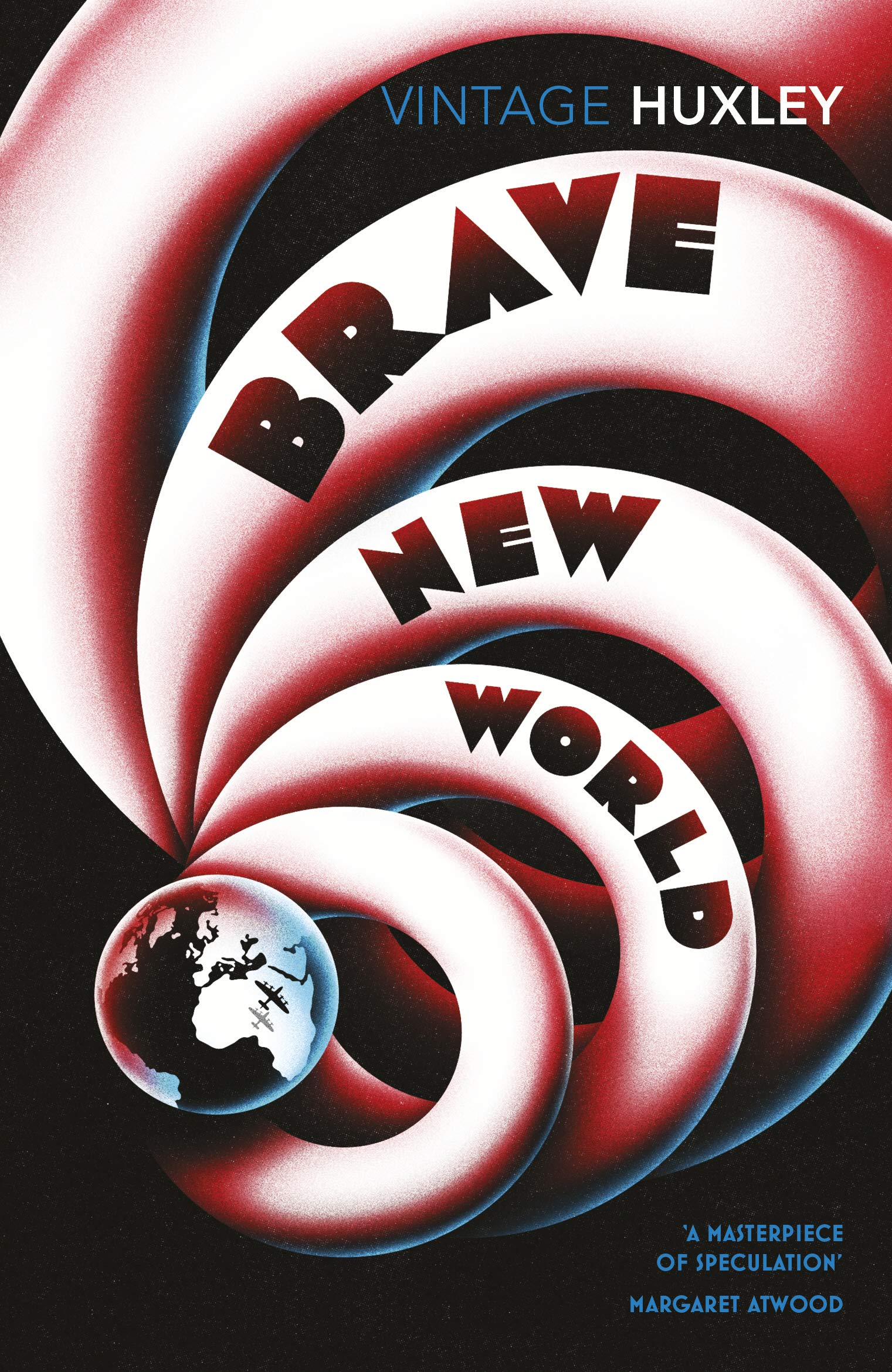
Brave New World Aftermath: Can’t we all just get along?

Image result for brave new world

Aldous Huxley’s Brave New World  is a classic dystopian novel.

In which everyone is happy.

It’s quite wonderfully insidious; usually a dystopian novel shows us a world where no one is happy, and challenges us to find a way to imagine happiness in it: in 1984, everyone suffers all the time, until Winston Smith tries to find a way to, well, live, laugh, and love; the jackboots of Big Brother and the Thought Police stomp that dream out of him. In Fahrenheit 451, the people are committing suicide and killing each other, while screaming at their television sets and cringing away from their devilish firemen; but when Clarisse McClellan tries to think for herself, she is vanished (and probably killed), and when Guy Montag wants to read books instead of burning them, he is arrested and forced to murder his former friend and then run for his life. In The Handmaid’s Tale, happiness is not the thing; purity is. Nobody gives a shit about happiness, and so that’s exactly what they get: shit happiness.

But in Brave New World, when John the Savage wants to be different from the people of the Brave New World, he demands the right to be sad and miserable and angry. And then he is chased out of society, because everyone there is happy, and no one has the freedom to frown, so to speak. Really, no one has the freedom to be alone, which is probably the more disturbing part; that is a common thread in all four books, and I think in all dystopias; everyone is watched, all the time, and it’s horrifying.

I should point out here that we are also watched all the time, and it’s no less horrifying for being real; but there is still some difference for us: the government has the ability to watch us all the time, but they don’t actually care about what 99% of us do.  And while our friends and neighbors are in our business every day, it’s usually because we put our business on social media, or on the grapevine. We still, generally speaking, have the option of privacy. Corporations building data profiles of us are involved in every second of our day that they can be, and that’s probably the most ominous; but really, they just want to sell us shit, so while it’s creepy that the Facebook ads reflect what we were just thinking or talking about, it’s nothing more than something to scroll past. At some point the corporations will realize that they can create markets for their products by screwing with us; that’s when it will get bad. It’s also incredibly dangerous that the data collected on each of us could very easily be turned over to the government (I was going to write “seized by,” but really, what corporation would ever say no to Uncle Sam come looking for intel? They can still sell things to people under NSA surveillance, after all. Maybe rotate some ads for firearms or “Don’t Tread On Me” flags into their feeds.), because the government is certainly willing to screw with us; but as of this moment, to quote the Doors, “They got the guns, but we got the numbers,” and so these tools are not yet  effective. Certainly something to watch out for.

But in the Brave New World, the people don’t have to watch out, they don’t have to suspect their government: they are happy. All of them. All the time. The Big Speech — another common thread through all these books, and perhaps in some form in all dystopian novels, as every dystopian novel has a message to give, and an important one, so the authors don’t want to take a chance on us missing it — given by World Controller Mustapha Mond (Huxley was a brilliant writer, but really, his names are lame. The use of Communist/Socialist names — Marx, “Lenina,” Trotsky — is annoyingly on the nose, and while it’s kinda clever that Mustapha in Arabic means “chosen” or “selected,” the fact that “Mond” means “world” and Mond controls the world… well.) at the end of the novel explains why the society of Brave New World chose happiness and stability over freedom and progress: because there was a terrible war, and afterwards, people wanted to be safe. So they chose to create a stable, safe society, and the only way to do that was to make everyone happy, all the time — or rather, maybe the goal was to achieve happiness for everyone, and the only way to do that was to make sure society was stable, was safe, was static. Every aspect controlled, nothing left to chance.

The result? A society where everyone is designed to be happy. Where the people are cloned, genetically and chemically modified, conditioned and trained from birth to have specific needs and specific wants and specific fears and specific aversions, all of that intended simply to make them happy with their life exactly as it is. They are built to do specific tasks in society, to enjoy simple things like sex, sports, and soma, the wonder euphoria drug that eliminates all chance negative emotions, and never to want to do or be anything other than exactly what they are.

And I read this, and I think: are they right?

Isn’t a happy, stable society better than one that has misery and suffering? Even if, as John the Savage (The one person in the society born to be a part of society, but not raised in it, so not controlled by it) argues — rightly, I think — that sorrow is necessary for tragedy, which is necessary for great art and great genius? Do we really need art and genius? It seems like a reasonable argument to say that most people would prefer to be happy, rather than great, and that happiness — contentment — seems much more likely to make us productive and useful members of society, and to ensure the continuation of the species. Aren’t those the goals?

Even if they aren’t, isn’t the loss of freedom worth the great benefit that the society actively seeks in the novel: the elimination of war? There is not a doubt in my mind that war is the greatest evil, the most abhorrent atrocity, that humanity has ever created or faced; what price should we be willing to pay to free us of it?

After reading this book — though it did genuinely give me pause and make me think twice, and then a couple more times after that — I think the answer is No. No, the price of safety and stability is not worth it. No, the goal is not simply happiness and contentment for all people at all times. Even, I think at least half of the time, if we achieved the end of war.

Because what makes war such an abomination is that it degrades our humanity. In addition to creating or multiplying every other horror we face — death, famine, pestilence, cruelty, greed, deception, hysteria, you name it and war is where you will find it more often and to a greater degree than anywhere else — war takes away everything that ennobles us. In the midst of famine, we can find unmatched ingenuity, and inconceivable endurance, and breathtaking altruism and generosity and self-sacrifice; in the midst of plague, we find kindness and grace and dignity in the midst of and because of the suffering; and so on, through all of it.

But war does quite the opposite. War makes kind people cruel, and healthy people sick, and civilized people into savages. War is the triumph of inhumanity over humanity.

But so is the Brave New World. Because whatever those people are, they are not human. Humans are not designed, and humans are not crafted and shaped like pottery on a wheel, and humans are not set into a groove out of which they will never skip. Humans cannot be perfectly ordered: we are chaos, we create chaos. It’s one of the reasons we are so good at war, because we are so very, very good at destroying things. Especially ourselves. We’re good at building — or else there wouldn’t be any targets for war to aim at — but we’re even better at burning it all down.

And that’s necessary. Because without destroying what is there now, you would never be able to build anything new. Creation implies destruction, but it is valuable  when destruction is for the purpose of creation, when it is part of a continuing cycle: whereas if we end destruction, and end creation too (The people in the book are not created as humans are, through the act of love and the processes of nature; they are built like machines, which is origination, but not, I would argue, creation — and I’m not even touching on the religious argument, which would be a much more poetic way to say the same thing), what we achieve is — stasis. The end of movement.

Death. And not a death that continues the circle of life, giving rise to something new to replace what is lost; here nothing is lost, and so nothing can replace it. Everything is just — still. Stopped. Perfectly motionless, without growth, without progress, without change. Which is no less dead than death itself. And while I will often argue that progress for the sake of progress is cancerous and absurd and deadly, I certainly wouldn’t prefer the final end of all progress.

Not even if it made me happy.


I do not think that this means we need to accept war. I still believe it is the extreme end, the Ultima Thule, of human malignancy; which means we can draw back from it, lessen it, even essentially eliminate it; though it is probably also true that some shadow, some residue, will always remain to harm and torment us. It is in our nature: not that we are made to war, but that we are made to try and reach and explore and find new ways to do things, and one of the ways to do things is to go to war; so even if we forgot it, we would rediscover it again, and again. Curiosity killed the cat, and we are forever curious. But just as more freedom and individuality is better than less, even if it is an imperfect freedom and individuality (which is what we have now), less war and more peace is better than the reverse. So I think there is a goal, and a way to achieve it, without also losing everything that we are.

I also recognize that there are events and actions that might be labeled war, but are not the horrors I’ve been describing; there are times when people have taken up arms to put an end to the horrors, when military intervention is the only way to save people. I don’t want to use the phrase “police action,” because Vietnam was a lie and the police as saviors is a fraught idea anyway; but there are times when force is both necessary and humanely applied. Someone who uses force to defend themselves or another from an attacking force has done nothing wrong. I don’t mean to either denigrate that, nor argue that even that should be (or could be) eliminated; that is the shadow and the residue of war that probably should remain — though ideally, since that sort of violence is triggered by the inhumane violence of dictatorship and oppression and vast chaotic upheavals, if we could end those, we wouldn’t need to send the Marines to intervene. But I’m not sure we could end those, either, because I think having the good and valuable tool of a defensive force can very quickly be turned to evil purposes (Which is why the Founding Fathers of this country pushed for a militia and abhorred the idea of a standing army — COUGH COUGH LOOKING AT YOU, MILITARY INDUSTRIAL COMPLEX), and then the solution becomes the problem. So it goes. We can’t close Pandora’s box.

So no. I don’t think we can live like the Brave New World. (And let me point out that, we discover, neither can they, not entirely, because there are people who don’t fit their molds, and who cause problems, and who are eventually exiled; Mustapha Mond is grateful that there are so many islands in the world to send misfit toys to — but that’s not a  solution, it’s just pretense.) I don’t think we can all just get along.

But I think we can get by. And get to be ourselves. And that’s probably better. Because that way we get to have art and beauty and truth — and that, I think, is really the point.

Shakespeare, as usual, (and as Huxley himself recognized) probably said it best:

O, wonder!
How many goodly creatures are there here!
How beauteous mankind is! O brave new world,
That has such people in’t!

The Brave New World, for us, is wondrous because of the people in it; it is brave because it faces turmoil and tribulation and suffering; it is new because it moves through the cycle of destruction and creation. It lives, and it changes, and it grows. Like us.

In the book, the quote is used ironically. We have to make it true.
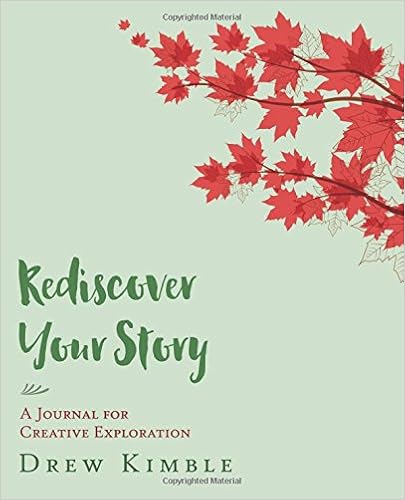
Book Review: Rediscover Your Story by Drew Kimble

Rediscover Your Story: A Journal for Creative Exploration

by Drew Kimble


I’m going to have to make this quick; because I have writing to do.

I have writing to do because this book inspired me to do it.

I am a writer, both a blog/ranter and a novelist; I am also a full-time high school teacher, because my vocation doesn’t make me money. I struggle, constantly and consistently, with keeping my passion and focus as a writer, because it is so easy to let the writing slide off to the side, to tell myself that I “need” to do work for my job, that my job is “important” and “valuable” and “worth spending time on.” It is even easier to find things that are related to writing, but not actually writing, and do those things in my free time; that way I can tell myself that I am writing, without actually doing too much of it. And of course I have to put aside the actual writing until later; I am too busy, and too tired. I don’t have time.

I’m not going to say that this book changed my life, because I’m not done working with it: I haven’t written out all the prompts, haven’t answered all the questions, haven’t examined and reflected and interacted with all of the inspirations inside. (There is one that I immediately want to turn into a piece of art – which I will do myself, though that scares me – and hang on my wall. It is “The unfed mind devours itself.” Page 134. Though in looking back through the book to find that one, I saw three or four others that I want to give the same treatment – “Do not dare not to dare,” and “Great things are done by a series of small things brought together” leap out at me. It may not sound that impressive that I want to make art of these quotes, but you have to understand: I have never been a visual artist, never made anything other than words on a page – and I’m married to a prodigiously talented illustrator. The bar is high, and I have never jumped. But I will try.) I don’t know that the book will change my life when I’m done interacting with it, though I think it likely if I can focus on small changes, planted seeds, an idea of old habits I would like to replace with new habits. That change, I think is pretty likely.

Because Mr. Kimble knows how to do this. The prompts are varied in style, ranging from internet quiz-style questions (Don’t scoff; we all take them.) to soul-searching checklists and life inventories. The types of prompts run the gamut, and the depth as well; I think that everyone will be able to find something useful in here. The quotations which appear in between each prompt-page are fascinating, also showing a wide range of focus and depth, some about the slow march of particulars, some about leaping to the stars. The book could easily be written in, or one could take the prompts and re-write them and one’s responses in a journal, which is what I will be doing; not that there is anything wrong with writing in a book, but I have all of these excellent journals. Though maybe I’m wrong: maybe I should do something different from my usual habit. Maybe I should write in this book.

I think I will.

One last comment: as a teacher, I could definitely use these as journal-writing prompts for my students. Particularly the prompts that push one to search for and define one’s self, one’s identity – and the ones that get you thinking about your future, too. Those would be good for my high school English classes.

This is a good journal. If you’re looking for one, this is a good choice.

Who Goes There?

I am an atheist: start from there. There is no God, no higher power, no consciousness directing the universe. Everything that happens, happens because of random chance, multiplied by time. The essential symbol of my worldview is the Big Bang: everything that exists came from an explosion.

So then how do things make sense?

How does an explosion create a stable planet, in a stable solar system, at the Goldilocks distance from the sun, with liquid water and an oxygen-nitrogen atmosphere? With a tilted axis and an oversized moon allowing for seasons and tides? How does an explosion, nothing more than energy added to matter, create life? How does that life continue to exist long enough for evolution to take place, which eventually leads to – me? How can I be sitting in my air-conditioned living room, next to my dog (who is lying on his back waiting for tum rubs [He gets a good skritch every time I pause. Like now.]), typing these words in English on my laptop computer, drinking coffee with half-and-half and stevia and and cinnamon-flavored honey – because of an explosion?

People of faith see the answer to these questions clearly: the answer is God. We are surrounded by miracles, and there is no clearer evidence of the existence of a benevolent creator. People have been reaching that same conclusion independently for tens of thousands of years, all the way back to the people who were buried with Earth Mother figurines, and those who raised Stonehenge or made the heads on Easter Island. We look at the amazing world we live in, and we assume it had to come from someone or something divine.

But there is no God: that is the starting assumption. So then how?

I hear people say, “Let go, and let God.” I mock it, because I find the idea of surrendering free will, of one’s own free will, inconceivable. I hate being told what to do. I hate trusting someone else to figure things out for me. If I could, I would grow my own food, fix my own car, whittle my own furniture. I have been struggling recently because in the upcoming school year, I have been instructed to use a pre-determined curriculum, one detailed and prescribed down to two-minute intervals, scripted and designed and carefully laid out in every way. Oh, I’ve been told that I can, and should, adapt it to my own preferences; but my preference is to chuck the entire thing out of a moving car, preferably into the midst of a brawl between switchblade-wielding badgers. I don’t want to teach what someone else tells me to to teach. I have never liked that, and I have never done it: other than some small things here and there, an idea for a lesson, a single handout, I have never followed anyone else’s plan for a class (Except for one: I taught David Schmor’s Speech class, pretty much start to finish; his assignments, his lectures, his grading methods. But that says more about how well David designs a class than it does about my predilections. We’ll call it the exception that proves the rule.). Whenever problems arise in my life, I handle them, either by myself or with my wife by my side: two of us against the world. I don’t like the idea of relying on anyone else: certainly not on God, whom I don’t believe in and wouldn’t trust if I did.

But how can I do that? How can I create everything I do as a teacher out of my own head? I was a terrible high school student – skipped or slept through many of my classes, never did the work, passed because of a good memory and a love of reading, and with the mercy of more than one teacher. I didn’t learn anything in my teacher-preparation program, except from the time I spent student teaching – which I largely did on my own; that is to say, I got advice and feedback from my master teachers, but I designed the lessons, I taught the material, I graded the work. I read pedagogical textbooks with an eye so jaundiced it’s nearly blind; whenever I take any teacher training workshop, I either don’t pay attention or I don’t do what I’m told. So how on Earth am I a good high school teacher? Where did that come from?

It’s nearly the same thing when I write. I have never really studied writing, other than as literature I have read; I’ve never had a writing mentor. I don’t edit: the first draft is pretty much the final draft. I don’t think much about what I’m writing in advance; I plan out my novels pretty extensively, but my blogs? I just pick a theme, think of an opening, and go. When I hit the last sentence, I post it On top of that, I’m generally pretty damned lazy, and unfocused: I am one of those people who pick up new hobbies and put them down again right away, because I’d rather be playing video games. How did I get to be a good writer? Where did this ability come from? Not from my parents, who are both intelligent but non-creative. I have writers in my family tree, but are creativity and writing acumen really genetic?

The miracles that surround us aren’t just natural: this morning as I stood in my shower, hot water streaming over me, sluicing away the shampoo and soap, looking at the tile walls, glass window, wood and brick house, electric lights, municipal water supply and sewers, I thought about: how could people possibly create all this? Particularly what has been added to our world, in terms of capability, of convenience, of complexity, all in the last century? A hundred years ago, if I had the running water (Never happen on a teacher’s salary then – but would I have been a teacher 100 years ago?), it wouldn’t have been hot, and I wouldn’t have had the electric lights, the coffeemaker, the refrigerator (Maybe an icebox), the computer, the dog adopted from the animal shelter. Just 100 years ago. My grandparents were there. How have human beings been capable of creating all of this? Did we have guidance? Divine inspiration? Can we create because we were made in the image of a creator? And if not (Not, indeed), how?

When one of the millions of the faithful “lets go and lets God –” what happens? Who goes there? Things don’t stop happening, and the lives of those who put their faith in God do not fall apart in a spectacular collapse; things often work out just fine. It’s like someone’s guiding them, making things work out. So if it isn’t God (And it isn’t. Spoiler alert: this writing is not leading to my spontaneous conversion.), then who is steering the ship? Starting from my basic assumption of atheism, of a universe without a creator; who or what makes things work out for the best?

My wife and I have adopted two dogs from shelters, one in California and the second here in Tucson. Both of our dogs have been absolutely lovely: very smart, very loving, almost no trouble to train and care for. In neither case could we possibly have predicted, when we chose them and brought them home, that those dogs could have been the sweet, wonderful companions they both proved to be. And we frequently ask ourselves: How did we get so lucky?

I’ve been reading The Watchmen, and one of my favorite moments in the book is when Dr. Manhattan, a man-turned-divine being who is trying to decide if he should save corrupt and fallible humanity, tells his former (and very human) sweetheart that he longs to see a thermodynamic miracle: an event so unlikely that is is effectively impossible, like oxygen spontaneously turning into gold. He says that he has realized, in talking to her, that he is in the presence of one such event: her. The chances of her parents coming together to make a child; of one particular sperm out of hundreds of millions uniting with one specific egg; of that zygote’s survival to become a child; of her upbringing and life experience turning her into the woman she is, and of her meeting and loving (and being loved by) Dr. Manhattan, a blue-skinned superbeing who can see neutrinos – that’s a miracle. Every human being is a miracle, Manhattan says; and he decides he will save humanity because of that.

I’ve used a similar example with my students. I met my wife Toni at Cabrillo Community College in Santa Cruz, California. She worked in the bookstore for her workstudy, and I had a job one semester taking ID photos, in the cafeteria upstairs from the bookstore. The IDs were $8, and so I always had to get change; I went down to the bookstore to get it. That’s how we met.

But look at the probabilities involved. Toni didn’t go to college right out of high school; like me, her academic transcript was spotty at best. She chose to enter the world of employment, where she did quite well for several years. She decided to leave a perfectly acceptable middle-class lifestyle, one that would have satisfied millions of Americans, and go back to school to study art. She decided to start her education at the community college; she decided to go full-time, and leave her job, which is how she ended up working in the bookstore. If she had gone to school earlier, or later, or if she’d kept her full-time job or gone to work in the registrar’s office instead of the bookstore, we’d never have met. Me, I wanted to go to UCSC because I wanted to study creative writing, and because my father, who worked at Stanford at the time, had a friend who taught physics at UCSC, who told my father, who told me, that they had a good creative writing program. He showed me the town on one visit, and so I decided to go there. But my grades were terrible, and so I couldn’t get in to UCSC. But rather than choose one of the thousands of other schools – rather than stay in Massachusetts, where I grew up – rather than join the Peace Corps or start a grunge-rock garage band, I decided to go to the community college in Santa Cruz, 3,000 miles away from the place where I lived, with no better recommendation for the university I had decided on than the word of my dad’s friend, for two years before transferring to UCSC. Except then my Cabrillo counselor screwed up, and my general ed. program turned into three years, instead of two.

I met Toni during that third year.

How did this absurd chain of events (And it goes farther: I had just ended a relationship about a month before meeting her. What if I hadn’t? Our first conversation ever featured me acting like an idiot, mumbling and stumbling through every sentence; what if she hadn’t wanted to speak to me again? What if, what if, what if?) come to pass, and lead eventually to my finding the love of my life, my soulmate? It’s no wonder people decide that fate is real, or karma, or God. What other explanation makes sense?

When people pray, and then hear the voice of God tell them the answer, what voice is that? Something tells them what to do, where to go, how to act; something gives them the solution to their problems, the inspiration they need to create something new and revolutionary, or the comfort to survive the slings and arrows of outrageous fortune. If it’s not God, then what is it?

It’s not God. That I’m sure of. So you know what I’ve decided it is? What is responsible for humanity’s incredible accomplishments, and our unbelievable resilience, and adaptability? The reason we can handle anything put before us? The force that makes our world full of wonders, that brings long chains of coincidences into some kind of order?

It’s us. We do these things ourselves. Because we’re fucking awesome.

How can I teach well, without any resources other than my own brain? Because I’m just that good. How do I write well? Because I’m a genius, and because I read the writing of other geniuses, and I pay attention. I am standing on the shoulders of giants, but they are tall because they stand on others’ shoulders – not because God raised them up. Human beings made the miracles, not the other way around.

How did Toni and I get to be the couple we are? The actual meeting had some dumb luck to it, but mostly, we made it happen because we wanted to. She chose to speak to me, and then she chose to speak to me again; eventually, I broke through my awkward shell, and she saw how awesome I am.

How did we get awesome dogs? Because dogs are awesome, and we treat them well and appreciate them for what they are.

How can people handle whatever terrible trials that life throws at us? By being absolutely incredible, strong and determined and intelligent and resilient.

We are incredible. We can do anything. There is no God: we need no God. We are enough, and more. We are.

So the next time your life seems about to overwhelm and drown, remember: remember what humans have done, remember what humans can do. You can do it. You’re human. You’re awesome.

No better way to close this than with the collaborative work of several of my all-time favorite creative humans.