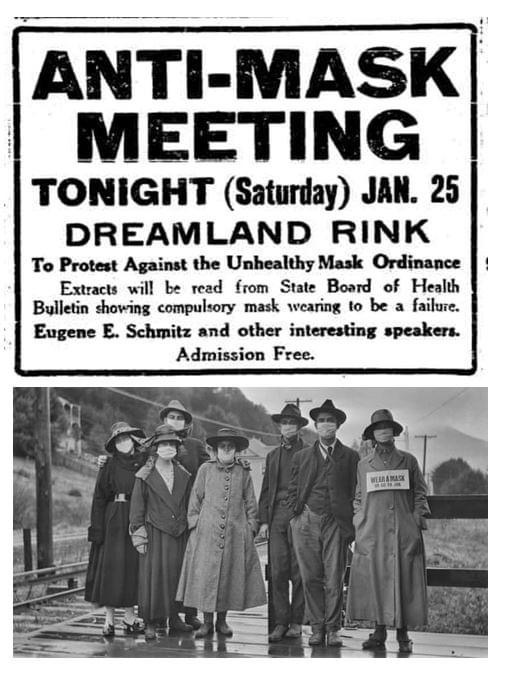
But wut ’bout mah RAHTS??

Got this image from this blog, which says the same things I’m saying, but nicer, and almost a year ago.

All right. I have something to say.

I have several things to say, actually. And I suspect that once I start saying them, even more will bubble up to the surface, like noxious gases from the bottom of the primordial swamp (Or hey, maybe like the scintillant bubbles in effervescing champagne; I probably should shift out of the habit of being maximally dark and depressing. See, there’s another thing I should write about, breaking free of the morass and floating to the surface and freedom, blpblpblpblppPOP!), and soon enough I will have once again exhausted either my readership or my store of ideas. But right now, those things are stacking up, taller and taller, and the ones at the bottom are being squished. Time to Jenga them out of the pile and set them up in their own little spaces.

It’s time to blog.

The first thing I have to say is actually something I’ve said several times already, in various arguments around social media; another reason for me to get back into writing these things. (Yet another reason is that I just said “thing” three times in one sentence: I’ve let my edge get dull, methinks.) You see, I’ve been arguing a lot. It hasn’t gone well. I’ve already destroyed one acquaintanceship (Terrible word. There needs to be another word for the relationship you have with people online who are on your Friends list on Facebook. This guy was not my friend, but I knew him, and we had common interests and values in some areas. So what is that? Normally I’d say acquaintance, or something more specific like coworker or neighbor or my local witch doctor; but what is that when it’s someone on social media? “Mutuals” is a term I appreciate from Twitter and Instagram, meaning someone you follow who follows you; but that doesn’t apply to Facebook. Oop – lost the thread. See? I really do have too much to say. I’m picturing these parentheses as the thin curved walls of the bubbles as they rise up from the depths of my poor swampy head.) and pissed off I don’t know how many people; and so far as I can tell, I have changed zero minds. I know it’s because of the way I’ve been debating these things. Not things, sorry: these issues. The details of it should wait for another post, because I’m too far along the tangent now, but the point is, I realized some time ago that, rather than engage in acrimonious debates with individuals on social media, I should take their topics, and write about them here, where I can make the points I want. The arguments just make people mad. Really, I don’t have them to change minds; I have them because I want to speak my piece, to say what I think – and this is the right place to do that.

I know that the people I have been arguing with, the people who are, in a word, wrong, will not come and read these blogs; but the point is that I haven’t been convincing my opponents anyway, so the arguments have been a waste of time and energy and have produced little more than anger and bitterness, and probably only solidified people in their (wrong) opinions. But maybe if I write a post about the issue, and present my ideas here, people who are interested will read the piece, and maybe spread it in conversation or on social media, and hopefully people will be able to gain some information? Or some inspiration? Or some alleviation of their own turmoil? And maybe that will make a difference.

Enough of my borborygmus. (Hell yes, it’s a word.) Let’s get to the topic.

The question for today is this: do I have a right to not wear a mask?

I know, it probably seems like a dumb question. Because really: who cares if I have a right to not wear a mask? It’s the reasonable and decent thing to do; why would anyone want to not wear a mask during a pandemic? Heck, there are people who love the masks, who have decided to continue wearing them even after the pandemic is over, and bless those people.

But there are millions of people, several of them on my Facebook feed, who hate the masks, hate the restrictions, and REALLY hate the vaccine (I hate to say this, but I’m going to need to write, again, about why vaccines are good and anti-vaxxers are bad. I apologize in advance. But that’s not this post, so let’s let that one sit down in the swamp for a little longer. Down in the toxic murk, where anti-vaxxers come from and where they belong.), and if you talk to them about all of this, at some point they will say “The government shouldn’t get to tell me what to do, where to go, whether or not I should wear a mask or put chemicals in my body. What about my rights?!?!”

That’s what I want to address first. What about my rights? Do I, in fact, have the right to not wear a mask? Do I have the right to keep my business open, which means the government does not have the right to shut me down for purposes of quarantine? Do I have the right to refuse a vaccine?

First, let me say that rights are slippery buggers. I don’t fully understand them, and I won’t pretend to. There is a long and complicated – and fascinating, and important – debate about what a right is and why we have them and which ones we have. So while I have an opinion about this issue of the right to not wear a mask, I freely admit that there may be and probably are factors that I have not considered; I may be wrong. If I am wrong, I invite correction. But here we go with my opinion.

The simple answer is no. I do not have the right to not wear a mask. Not a natural right, nor a moral right. Not an inalienable right, and not a legal right. The Constitution, the Universal Declaration of Human Rights, the Magna Carta, the Bible – none of them say anything about your right to a bare bottom half of your face. A law or regulation requiring you to wear a mask is not a violation of your rights.

Because what would be the basis for it? Again, rights are complicated things and nobody has an incontestable definition of what they are and where they come from, but essentially, the three main sources of rights are: our identity as individual rational human beings; the laws of society and the social contract; and God. God, so far as I know, has not decreed that humans don’t need to wear masks (Indeed, the Abrahamic God seems to be more in favor of covered faces than not). The laws of society are exactly the ones that people are arguing about, because they mostly mandate masks, and the social contract is the main focus of the rest of this writing – and it also probably mandates masks. Our identity as individual rational human beings is the source, according to John Locke among others, of our right to life, liberty, and property; most of the Constitutionally-enumerated rights derive from this. We have the right to speech because we have individual thoughts and opinions, and the free expression of those is a recognition of the value of our individual thoughts and opinions. We have the right to bear arms essentially as a means of self-defense and protection of our continued existence – because I can only exist as an individual rational human being if I’m alive, and my ability to defend myself is a protection of and a recognition of that essential right to exist. My ability to choose my own destiny implies the right to do so, and that’s why I can’t be wrongfully imprisoned. And so on.

But there’s no right to not put cloth on my face. It is not a necessary condition of my individuality. It is not a reflection of a defining characteristic of my reasoning mind. It is not even an inherent preference: in cold weather, most people prefer to cover up their faces as much as they can get away with. When I was a kid in Massachusetts, my favorite piece of winter clothing was a ski mask. And not because I liked robbing banks: because it kept me warm.

There are exceptions, of course, which we all know about (mostly because smug twerps have used them as the basis for false claims to avoid following the guidelines and restrictions) – someone with a phobia or a health condition that might prevent them from safely wearing a mask has a right to refuse to wear a mask, because there is a right to life and to the prevention of bodily harm; nobody has the right to hurt me, nor to force me to hurt myself, in a preventable way. But masks are generally harmless, so we’re going to stipulate those (rare!) occasions where people can’t wear masks with the general statement that people who can’t wear masks are obligated to try to find an alternative that does work for them, that achieves the same purpose as a mask but does not cause harm. And regardless of whether or not someone can wear a mask, the essential obligation of mask-wearing remains.

So let’s get to that. Because while I don’t have a specific right to refuse to wear a mask, that doesn’t mean I should be forced to wear a mask for no reason: the presumption for any question of rights and obligations should be that the individual has every right unless there is a reason to restrict it; that is, all things being equal, I have the right to wear a mask, to not wear a mask, to wear 25 masks stacked on top of one another, to wear a Michael Myers mask while I drive around – I should be free to do whatever the heck I want provided it does not harm anyone else or infringe on any other rights. (The Michael Myers thing is probably an infringement on people’s general well-being. But I think it gets the Humor Exception. Different topic.) What I said above generally holds true: my ability to choose my destiny implies a right to actually do that, to make my own choices and live as I wish to. Every action or inaction should be presumed to fall under my general right to liberty and personal sovereignty – unless it is shown to have an impact on others. If it has an impact on others, then it becomes a question.

The question here is does my not wearing a mask affect other people? And the answer is yes. My breathing, my talking, my sneezing and coughing, without a mask on, has direct and tangible impacts on other people: I can spread a virus to them. It’s provable, it’s known – it’s common sense, really; we’ve all been spat on by close talkers, all been sneezed or coughed on by people who didn’t cover their mouths, all been asphyxiated by the bad breath or our fellow human beings. We all know that a bare mouth and nose in a public space has an impact on other people. As soon as we learned the germ theory of disease, and the properties of viruses, this impact became more clear. Honestly, it’s not clear to me that any of us should ever go without masks: even without Covid-19 as the main reason, we still give each other colds and flus and a dozen other infections simply through bare breathing; maybe face coverings should be universal.

The question then becomes one of burden. Is it reasonable to ask me to wear a mask to protect other people from my spit-propelled infectoids? Is it more reasonable to ask other people to avoid those infectoids? Is the means of prevention a greater burden than the risk of said infectoids getting on with their infecting of other people? If they do get infectionalized (Sorry – like I said, it’s been too long since I wrote, and it’s like a peat bog inside this brain of mine.), does the potential harm they might suffer outweigh the burden on me of prevention? Because again, while there is no enumerated, defined right to not wear a mask, the presumption should be that someone who doesn’t want to wear a mask doesn’t have to wear a mask; individual liberty should be first and foremost in our minds, all the time.

I’m actually going to leave those questions alone for now. Because they are determined by specific circumstances. Basically, the answer is that wearing a cloth mask when I am out in public, in enclosed spaces, within six feet or so of other people, is a lesser burden than the risk of infecting someone with Covid-19. So I should wear a mask during this pandemic. I don’t know if it’s a lesser burden than the risk of infecting someone with the flu; it may be. It is interesting to realize that a generation or so from now, mask-wearing may not even feel like a burden; it may just be the norm, and this whole debate will just be silly. But my topic here is a right: do I have a right to not wear a mask? I do not.

The same argument applies to social distancing, to handwashing, to avoiding handshakes and hugs and so on. It applies to weddings and funerals, to in-person classes and live sporting events. It applies to keeping your business open and serving customers during a pandemic. All of it comes down to the same thing: you are presumed to have the right to do whatever the heck you want with your time and your property; you have control over your own destiny – unless and until it impacts others. All of those activities and preferences, for in-person church, for birthday parties, for holiday gatherings with family, for traveling in planes, trains, and automobiles: all of them create a risk of spreading Covid-19 to others. None of them are necessary for an individual’s continued existence. None of them are rights. I do not have a right to have a wedding or a birthday party or a funeral in the manner and at the time and place of my choosing. All things being equal, I should be presumed to have the liberty to choose my wedding and my funeral arrangements; but not all things are equal during a pandemic. I can still be an individual rational human being without seeing other people in large groups in enclosed spaces without masks and closer than six feet.

There is some question of work: the right to work and to derive an income from work is a right we have, as it is both an expression of our rational selves and a necessity for the continuation of life; there has to be some negotiating around that conflict. If, for instance, society can provide me with an income sufficient to keep me alive and essentially free, then that would compensate for the loss of my ability to work as a waiter or a bartender, for instance. Or if my work can move online, as my job teaching high school English did, then that means I can continue the necessary parts of my human existence, without imposing a risk on other humans that might prevent them from continuing their existence. I do not have a right to make my income however I want. I do not have a right to do my job only in the way I want to do it. I do not, unfortunately, have the right to keep open the business I worked my entire life to create. It breaks my heart to say it, but it’s true: my entrepreneurship, my blood sweat and tears, my lifelong dream – I don’t have a right to any of those. I have a right to exist, and to work to continue my existence. I don’t have a right to thrive: and if my thriving puts other people at risk, as it might during a pandemic, then I don’t get to thrive while putting an undue burden of risk on other people.

Put it this way: if I had a right to keep open my beloved mom-and-pop store, what would that mean if my business failed? If another mom-and-pop store opened right next door to mine, which had lower prices and a better product? Would I have the right to take some of their money? Would I have a right to force customers to come to my store? Would I have a right to demand taxpayer money from the government? Or what if my store caught on fire? What if there was a hurricane, or an earthquake? If I had insurance, then I would get the coverage I paid for – but you don’t need insurance to get your rights, you just get those. And there is, sadly, no right to have my dreams come true, or to keep them from being taken away by a pandemic.

All I have is a right not to have my life taken away because somebody doesn’t feel like wearing a mask.

The last thing I’ll say about this is that anyone who claims to have a right to not wear a mask, or to get a vaccine: you do have that right. You can choose to say no to masks and vaccines. It just means you can’t be around people. At all. If you are willing to quarantine yourself in such a way that you have no risk of spreading the virus to anyone, then you have the freedom to do whatever you wish in terms of refusing masks and vaccines: because your choices will not have any impact on other people, and so your individual freedom prevails. But if you want to live in society, then you have to help society live. That free choice, to be a part of society or to leave society, is the final protector of your individual rights. Again, it is a complicated choice, because not everyone can survive separate from society, and a choice that leads inevitably to my death is no choice at all; society has some responsibility to provide for my continued existence if I can’t have that existence outside of society; that’s why society has a responsibility to provide a minimum income, basic needs, to all members of the society who cannot provide it for themselves. And our particular society does not do a very good job of that. But that’s a topic for another day.

For today, wear your mask. And if you can, get the vaccine.

Do what’s right.
I don’t know what this means.

When I was six, I was walking through the woods on my grandparents’ property in Washington, and I stepped on a yellowjacket nest. I remember the sensation as my foot came down: pushing through the humus of dried leaves, a moment of resistance, and then I crunched through what I thought was solid ground, and fell lower than I thought I should have, on that foot. That’s when I heard the buzzing: z z z ZZZZZZZZZzzzzzzzzz It hit a fast crescendo and then lowered to a purposeful, ominous hum, as if I had prodded a sleeper who did not want to wake and who growled resistance at me.

Then the stings started. One, two, three, each more painful than the last, the infuriated insects stitched their revenge up my leg as I stood, frozen, suddenly unsure of the ground beneath me — was it more hollow still? Would I fall through again? — obeying my training that told me to stand still when bees landed on me because they didn’t want to sting me, after all.

But these weren’t bees: they were yellowjackets. And they wanted to sting me. Understandable, really, since I had just destroyed their house and maybe crushed some of their family members; but that didn’t make me feel good about the fiery needles jabbing into me.

Fortunately my mother was there, and having grown up on that place named for her family, she was familiar with the sound of angry bees and yellowjackets: and she realized this was not a good time to just stand still. She scooped me up and ran. Of course I realize now that she was running to get us both away from the yelllowjackets, but at the time, I was suddenly sure that she was running me back to the house because I was going to die: my father is allergic to bee stings, and even at that age, I knew the potential danger of those tiny packets of venom which I could feel throbbing in my shin — and maybe moving up through my bloodstream? Was this the end?

It was not. It was about to be my first encounter with witch hazel (a name that still feels mysterious and alchemical to me), the rapid soothing of the burning stings, a cookie or two to soothe my burning tears, and the disappointing reckoning of a mere six stings, none higher than my knee. Not enough damage for a good I-stepped-on-a-beehive story, though it’s a damn good indication of my mother’s reflexes and quick thinking.


That moment of stepping down onto, and then falling through the ground and into a sudden attack: that’s what 2020 feels like to me. The hollowness of the hive beneath me, incapable of holding me up, echoed in the middle of me as I realized what was going to happen, a hollowness that seemed to swell and expand even as it grew more empty and dark and cold, as if my fear were a black hole inside, swallowing more and more and growing larger with each terrified thought that fell into it: that’s what I feel like inside, right now, and for the last six months. It’s a much slower process, this time, lasting months instead of seconds; but I feel very much as though my reaction is identical: I am frozen, panicked, trying to figure out what to do and coming up with no good ideas, just standing and watching as the danger swirls up around me.

At the same time: I am not just the kid walking through the woods, this time. I’m the yelllowjackets. The hollowness inside me is the hive, and the shell around that emptiness is too weak, and can’t hold up the weight of the world that is stepping on me. And as everything going on around me crushes through me and into me, I lash out, angrily — maybe understandable, but really, useless  — and I sting, and I bite, and I attack. I have never been so short-tempered, so cranky, so bitter, so apt to strike, so apt to sting with my words and my tongue, as this year. I hate it. I can’t stop it. I can’t: I don’t have the strength. That’s what was hollowed out of me. And I can’t just set myself and bear up under the weight: because the hollowness is under my feet, too, and I am being stung even as I am stinging.

I don’t know what to do. I’m just standing here. I have been for what feels like forever.

And I’m so tired.

And this time, my mother can’t scoop me up and run me back to the house for the twin magics of herbal remedies and baked goods.

This time, I might just get stung to death.


Probably not. I’m aware that as high as the number of Covid-19 cases is, it’s still only a fraction of the population, and that while my state is not handling the pandemic well, I am taking reasonable precautions that should keep me safe; I will most likely come out of this with an unremarkable tally of suffering. I do not mind, this time. I would very much prefer a half-dozen stings, no permanent scars, no need for a doctor. Just some soothing liquid and a cookie or two.

But I’m not just standing still with my foot in the danger zone; I’m still walking forward through the woods. In fact, since school starts tomorrow and goes to in-person classes in four weeks, I may be stepping onto the hive, and then continuing on into it, like walking down into a hive the size of a subway tunnel, with yellowjackets the size of Shelob. (At the same time: those goddamn hobbits are coming into my home, fumbling and ripping through my webs, and they are goddamn well going to pay for it. Nasssty little hobbitses.)

What precautions do I take then, as I move deeper and deeper into this hive pit? My school is trying to stay on top of things, having offered fully online learning as an option, instituting new protocols — social distancing, mandatory* masks, sanitizing spray to be applied every two hours**, fever checks on arrival — intended to prevent the spread of the disease. I don’t know how well it’s all going to work, though; and I have no idea what to do about that. I can’t quit. If I raise too great a stink, they’ll fire me. I guess I just have to stand there. Maybe the small things hovering around me don’t want to sting me, this time.

*Mandatory here means just what it does everywhere: masks are required until someone raises a loud enough political objection, and/or presents a doctor’s note. Then, not. Hope the virus takes doctor’s notes, too. 

**Said sanitation to be applied by me, every two hours, in between classes. On a side note, the spray requires four minutes to take full effect. Time between classes is four minutes. Hope the virus will wait out in the hall.

The danger, though, is not what is haunting me. Perhaps it should be, but the thing that is building a growing ball of hollow darkness inside me, the thing that makes me feel as if my next step will land on an equally hollow surface that will drop me through and out of the world, while at the same time the weight on top of me punches through my thin outer layer and into the hollow within, is this:

I am tired.

The hollowness inside me is not just fear. It is exhaustion. I am so very, very tired. Tired from fighting, tired from standing watch, tired from holding up others as well as myself. I’m tired of watching the pandemic grow, and watching my country wallowing in ignorance and selfishness like a pig in shit — just as filthy and twice as proud of ourselves — as we deny science, and raise alarms for problems that aren’t real, pointing to imaginary dangers that somehow block out of our sight the very real danger of this virus. I am so tired of being angry about it. I am so tired of fighting with people who smugly ignore every fact and every reasonable thought because it doesn’t make them feel safe, or worse, it doesn’t make them feel strong and fearless. Saying they’re not afraid of Covid, that makes them feel strong and fearless.

It’s as if when my mother rushed to scoop me up out of the yellowjacket hive, I had pushed her down, spit on her (Because the people who think this way are some of the rudest, most inconsiderate, most contemptuous hooligans I’ve ever interacted with. And I teach high school.), and then stood with fists on hips, chin jutted, nostrils flaring, and said, “Don’t you tell me where I can stand, I’m an American. You run if you want to, you and all the other sheep!”

While the yellowjackets swarmed around me.

And of course it’s not only the virus. I am so very tired of racism. I am tired of being ashamed of what people who look like me have done to people who feel like me for centuries. I am tired of confronting the same angry, willful ignorance about the protests or about opposition to police violence. At the same time, I am tired of being treated like the people I look like by the people I feel like — and I am tired of knowing that I have no right to complain about any treatment I may suffer, because my world has been built to prop me up, and whatever I may have to go through pales in comparison to the ordeals of those who are less pale than I. I hate that people tell me I have no right to speak my opinion, to take a stand; that all I can do is get out of the way and let better people take what they have been denied for centuries, because people who look like me oppressed them, which has enabled me to become everything that I am — all of it tainted by centuries of crimes against humanity. Not my own gifts and efforts, but my privilege, I am told, is why I am who I am and can do what I can do: and that means I don’t deserve what I have, and using that privilege to try to help solve the problem earns me a sort of sly sneer from those who know that my actions on behalf of the cause are just white guilt, and really, I am still the enemy,still perpetuating the problem if I do anything other than get out of the way.

That’s how it feels. It’s maybe not true that people working for social justice think that way of me, but — that’s how it feels. Of course, maybe that’s just my white guilt talking. And my white privilege thinking that I should be the one to speak up and fight for the cause: because that means I am centering whiteness in a movement that is not intended for the benefit or the recognition of white people or white suffering. It’s so easy to fall into the same patterns that have existed unrecognized throughout my life; how can I tell what is genuine and what is instilled in me by institutions of oppression and privilege? Is everything about me broken and wrong because of the world I grew up in? Is there nothing that is me? No, I want to say; I am good, I am worthwhile, I want to help and I am capable of helping. It is not right that I get pushed aside and marginalized, stereotyped, included in sweeping generalizations, based only on my skin color, my nationality, my gender —

And how pathetic do I sound saying those words.

I’m so bloody tired of irony.

I want to help, is the problem. I don’t want to be like those ignorant yahoos I fight with. I don’t want to be selfish.

But so many people need so much help.

I can do a lot of it. I am happy to do a lot of it: happy to support my family, my friends, those who rely on me. They are struggling, too, because this year has not only been hard for the pandemic and the riots: it’s hard financially, and crippling politically, and my family has had a series of tribulations fall on us like Biblical plagues, one after another and each worse than the last, mostly medical and due to my parents’ generation reaching the stage of life where things go badly. And of course, I can’t do anything. I can’t go help them because I might infect them, and that would kill them — and that would kill me. I worry about them double, because I realize that, on top of everything else, the pizza delivery man might give them Covid-19, and then I wouldn’t be able to visit them in the hospital while they coughed their life away.

And I can’t talk about this, can’t complain about this: because everyone else has it harder than me. Everyone. It’s not just white privilege, not just male privilege; I am healthy, and have remained fully employed, at a job where I am respected and well-liked, and I am generally well-balanced emotionally. I’m not well-balanced this year, of course, but since I started off having an easier time than most, and we’ve all gone down together, I still have more of my head above water than others do who were half-drowning before 2020. So I have no right at all to complain, and if I open my mouth to do it, the response I get back (the response I should get back) is something along the lines of, “Yes, I know, I’m going through that too — and a dozen things that are worse.”

Part of me can’t stand myself, right now, for complaining that I have it too easy in life to complain. And normally, the fact that I do have it easier than most would keep me from complaining because it would keep me from suffering. And even when I do suffer, I don’t have such troubles that I need to vent, need to talk them out. Normally I don’t need much support.

But this year is not normal.

I need to vent. It helps, you see, even if you don’t see how it could possibly help, even if you don’t know why it helps, talking about your feelings helps. I need that help. I need to say how I feel, even if how I feel is gauche or insufficiently woke. (“See that? That’s white sensitivity right there. He needs to grow a thicker skin, learn to deal with being told what he’s doing wrong. It’s just that he’s never been criticized much before, not in this society built for people like him.” Yes. I know it. But this is still how I feel.) Because people need my support, and so long as I am this tired, and feel these hollows under my ribs and under my feet, I can’t give them what they need.

This is what I need: I need to talk. I need to write. I haven’t wanted to do it, not for months now, for all the reasons I’ve been talking about here. There is too much, and I need to figure out what the hell I’m really feeling; I hate to ramble and blunder and sound like I don’t know what the hell I’m getting at. But one of the difficult Catch-22s of being a writer is that writing is exactly how I figure out what I’m feeling; I usually don’t know what I’m getting at when I start writing, I just get there when I get there, and I have a pretty good idea of when to stop. I have no doubt that this blog is irritating and confusing for people who read it. I expect you, too, are short-tempered, unable and unwilling to put out a whole lot of effort helping someone else deal with their shit when you’re sitting there with both hands full of your own.

I’m sure you’re tired too.

It feels strange to write this, because it makes me feel better, and so maybe I want to share that; but I don’t want to be a bother, don’t want to be a burden.

Which is also how everyone else feels, too.

So I’m just going to say it. If what I’m saying is wrong, please feel free to correct me; but first, I need to say it. Actually, I take that back: if you have something you want to say about something I’m doing wrong, put a pin in it. We’ll circle back around to it later. For now, I just need to talk about how I feel. And I won’t ask people to listen to me, because I know you’re all struggling, too — but it would mean a lot if you did.

We all need help. We all need support. We need to ask for it for ourselves. Just asking makes us feel better: because it validates how we feel. Being willing to ask for help, from those whom you are willing to give help to, shows that you consider yourself as important as they are, as worth helping as they are. It shows them that they are not a burden on you, that they can help even as they ask for help for themselves. And everyone feels better when they can help.

I need help. I’m standing on unsteady ground, in a country that is tearing itself apart, and I’m about to go back to work where I will be surrounded (Virtually, for the most part, but still) by students — who all desperately need all the help they can get.

That’s what made me actually open this post and start writing. That’s really what I’m afraid of. I’m afraid of the virus, afraid of what’s going to happen in thousands of schools across the country to hundreds of thousands of teachers and millions of students; but what scares me right now is the knowledge that those students will come to me, and they will need me. They will need me to listen to them, to understand them, to take them seriously, to help them. They are bottomless abysses of need, just like I was at their age, as we all are in that terrible time of adolescence. They will need me even more now, because their world is on fire, too.

I don’t know how much I will have to give them.

I’m so very tired.

I’m just standing here: hoping I don’t get stung.

Can someone please pick me up and run me away from the swarm?

Or if not that — can I have some witch hazel and maybe a cookie or two?

Thanks.

What are we fighting for?

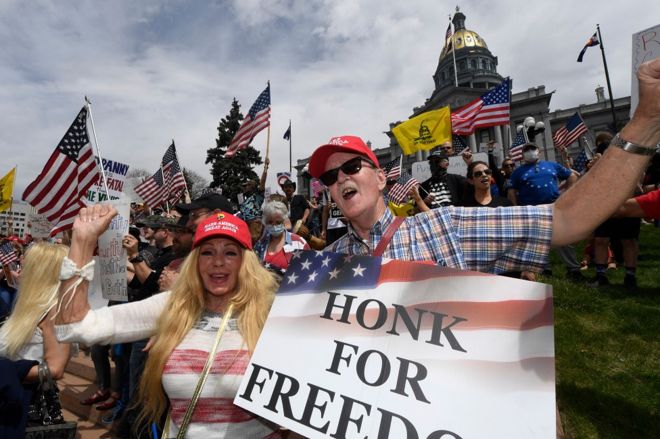
HONK FER FREEDUM

Coronavirus: the US resistance to a continued lockdown

I want to understand the argument.

I don’t. And it’s vital that we understand the argument, even if we don’t agree with it; agreement is not necessary, compromise can be reached, solutions can be found even if we don’t agree.

But if we don’t understand? Then what do we do?

“We believe that the state governor has gone beyond his constitutional authority in shutting down businesses and ordering people to stay at home,” organiser Tyler Miller tells me from the grounds of the state capitol.

In mid-March Washington Governor Jay Inslee announced an emergency proclamation mirroring many issued around the world; closing restaurants and bars and banning large gatherings.

But protestors say that was unconstitutional.

“The state constitution says that the right of the people to peaceably assemble shall never be abridged. We believe that the (emergency coronavirus) proclamations that the governor here ordered violate that,” Mr Miller says.

Mr Miller said he was not protesting against the recommendations from the public health bodies and respected the need to ‘flatten the curve’.

“I even self-quarantined for 14 days back at the very beginning of this myself, when I had an illness that mirrored some of the symptoms,” he says.

“The fact I am protesting does not mean I think it is a good idea to have gatherings, I just believe that the government has no authority to prohibit them.”

Throughout the crisis, Mr Miller has also been able to continue his work as an engineering technician with the navy.

He says the thing that has angered him is what he feels it is an un-American overreach of power by the Democratic governor of Washington.

I don’t understand that argument.

There is a simpler argument, which is just that people are getting desperate: the country has been shut down in places for more than a month now, and people are facing another rent payment, another car payment, on May 1st, this coming Friday. I understand that desperation, that anxiety; I understand and (mainly) support the desire to let government officials know that you need and demand action. I think it’s a mistake to violate social distancing guidelines, and there are people in the article above and others I have seen who say things like “I have a strong immune system, I take care of myself,” who I think are somewhere between ignorant and idiotic: ignorant if they don’t know that Covid-19 has killed young and healthy people as well as older, sicker people; idiotic if they believe unfounded statements (Mostly from conservative “news” sources) that the novel coronavirus is no worse than the flu.

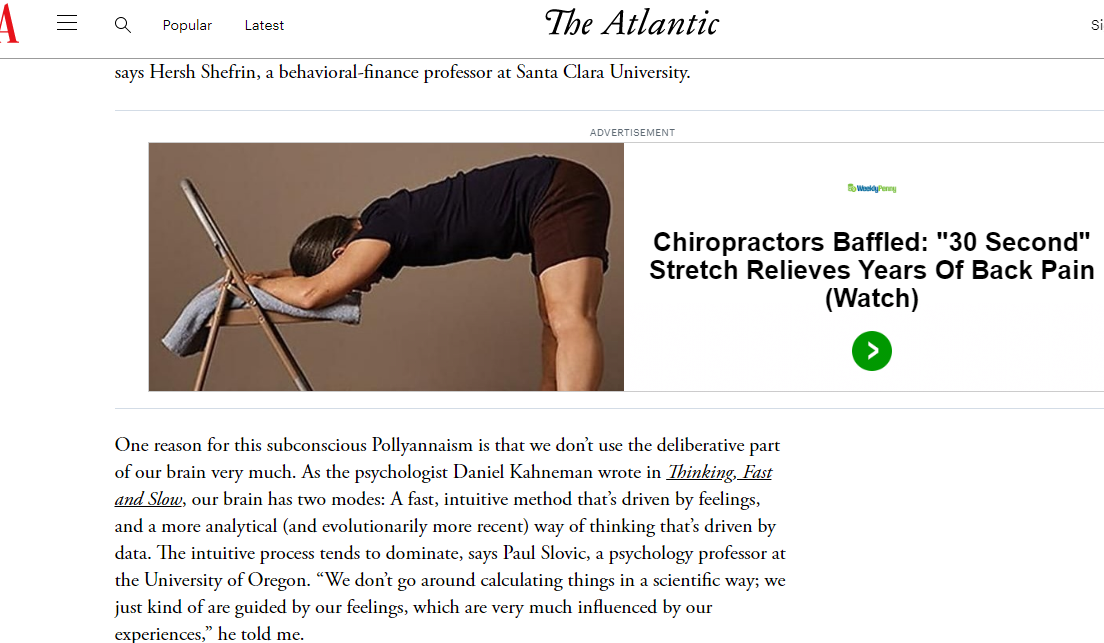
(This may be too harsh: this is an interesting article about how we are wired to be intuitive, and so underestimate the evidence that comes from outside our experience. I know I was telling my students in March that any shutdown of schools would only last a couple of weeks and would certainly not affect their graduation. On the other hand, I am not saying the same thing now, because I have learned better; I’m not sure why these people haven’t, but my two options above are certainly possibilities.

(Also, this ad popped up in that same article about people being too optimistic. Lol.

Screenshot (6)

(If you believe not only that a miracle stretch relieves years of back pain, but also that chiropractors are stunned by it, AND that chiropractors are the authority whose stunning represents a medical breakthrough, then you are unquestionably in this overly-optimistic bunch.)

But while I understand and sympathize with people who are desperate to get back to work and pay their bills, and I believe (and am infuriated) that the federal government has once again bailed out large corporations with deep political donation pockets and left average citizens to twist in the wind, I don’t understand the other argument. The freedom argument.

I don’t think it’s a reasonable argument.

Listen. I worry about government overreach. I won’t say I’m learned in history, but I know about the Japanese internment camps during World War II, and I know some things about the rise of the various authoritarian dictatorships that plagued the 20th century. I have hated the USA PATRIOT Act since it was imposed on us, during the paranoid jingoist nationalist fervor that swept the country after 9/11 and swept us into a neverending war. I know that it gets renewed every time it comes up because the government doesn’t like to give away power that it has seized. Because of that experience, I have been pointing out to my friends who argue against the lockdowns that the thing we need to worry about is the powers the government arrogates to itself after the crisis: the new regulations and limitations, and invasions of citizens’ rights, that follow a partial return to normalcy, and that are intended to prevent this kind of thing from ever happening again. We have to watch out for the permanent changes, or for the attempts, often subtle and underhanded, to make temporary changes permanent.

I don’t doubt those will happen. I think the first attempt will be by President Trump, when he decides to make his temporary limit on immigration permanent.

But see, I think that because Mr. Trump has a long history of a clearly established position to end immigration. I think that because I have read reports that Trump’s anti-immigration advisors have talked about this pause into something more long lasting. Because this article quotes DHS acting secretary, Chad Wolf, as saying to Fox News that

his agency will soon recommend a move to limit temporary work visas as well.

“That is something that the department has been looking at for the past several months, so we are well underway and look forward to presenting to the President those recommendations for additional steps,” said Wolf.

So there’s your government overreach, as part of an established pattern of behavior, aiming at known long-term targets. After the fact. Once the danger has passed. The current actions are not government overreach: they are government responding as government should to a crisis. The stay-at-home orders were issued during a crisis, and in line with scientific facts and the advice of experts. This is exactly when, and exactly why, people’s rights can and should be limited. We have the right to protest, but if you decided to walk into a burning building in order to protest the fire, people would stop you: and they would be right to. We have the right to freedom of speech, and of assembly, but you cannot gather with an army and plan the destruction of the United States: the right is to peaceably assemble, and free speech does not include sedition or criminal conspiracy. Individual rights are not limitless, not under any circumstances; even the most libertarian of us would state clearly that one person’s rights cannot be permitted to infringe on another’s, that your right to swing your fist stops where my nose begins. And of course individual rights are limited in an emergency, because the free exercise of one’s rights puts others into danger.

This is what government is for: to protect people from danger. Now, if you want to argue that the coronavirus is not that dangerous, then you’re in the wrong place. Start with this.

Then read this.

Then read this.

Then read this. 

(Especially that last one; it’s about the infectiousness of the coronavirus. And lest you think that the infectiousness of Covid-19 is lower than SARS or MERS, both of which caused fewer problems and killed fewer people, go back and read those other articles again, and then also pay attention to this quote from that last article:

“An R0 value of 1 means the average person who gets that disease will transmit it to one other person; in that case, the disease is spreading at a stable rate. An R0 of more than 1 means the disease spreads exponentially.”

And then read this essay about exponential growth.

Okay? Okay.

As I said, the government has the right and the responsibility to limit individual freedoms in response to a crisis, in order to protect the people from that crisis. (I’m aware that some people don’t agree with this: some because they don’t think the coronavirus is a crisis, and if you still think that, go back and read the above articles, but this time with your eyes open; and some because they think that nothing should ever limit individual rights under any circumstances: my above examples of protesting inside a burning building, or convening an army to overthrow the US government, are just fine, for them. I will be writing another blog about that. I’ll let you know when it’s done. The important thing is that, while I don’t agree with that argument, I understand it.) I think, though, that the basic argument behind the protests, the reason that President Trump tweeted support for people trying to “liberate” the states that have both lockdown orders and Democratic governors, is that the government is not trying to protect people from the crisis: the government is trying to control people. To take away their freedom. that’s the argument I don’t understand.

(I am also not going to write here about the elephant in the room, namely the upcoming election and the similarities — remarked on in the BBC article I linked first — between the anti-lockdown protests and Trump rallies. People who are going to the rallies just to support President Trump are certainly not reading this, and are not worth the time to put forward an argument. President Trump is probably trying to use the rallies as a way to hype his base up for the election, but he also said that he thinks Georgia Governor Brian Kemp is opening his state too soon, so I’m not going to jump on Trump today. We’ll see what happens tomorrow. Also: I understand this argument.)

But here’s the thing with tyranny: it makes sense. There is reason behind it.

That’s what’s missing from the freedom argument of the protests.

Break it down. Think it through. Okay, the government — pardon me, the govment (Read this article that I wish I wrote) — limits people’s rights to assemble and move freely, to run a business and participate in the free market economy. Because they want to establish tyrannical control over the free people of these United States.

Why?

I understand that the government has taken on, for most of the people who support these protests, the aura of Darth Sidious and the Sith: evil just for the sake of evil; power hungry just for the sake of power. But, see, that’s a character from a movie franchise, and it’s not a realistic one. I admit, if the Democratic governors were trying to raise a clone army from a mysterious source; or they were trying to corrupt a Jedi knight with incredible power but terrible self-control, then I would see the danger.

Why would the Democrats, or the government in general, want to lock people inside? I saw someone argue that the Democrats exaggerated the danger of Covid-19 in order to justify the lockdown expressly so they could destroy Trump’s economy, because that’s the only way they could beat him in the next election.

Come on.

(An argument I have seen but will not be rebutting is that Andrew Cuomo of New York exaggerated the need for ventilators so he could get…a huge excess of ventilators. Sure. As you do. He’s going to put them in one huge room and then go swimming in them like Scrooge McDuck. Swimming through the ventilators.)

First of all, there’s no way that an economy ruined by Democrats would be pinned on Trump. Trump is already positioning himself to argue that it was the Democrats who did the harm in this crisis. (Elephant in the room…) If this is provably true, if Covid-19 is really not that bad and the Democrats have exaggerated the danger, we’ll know it before November, and this Dem gambit will fail. Secondly, and more important, if they ruin the economy, they not only have no hope of winning the next election, but they lose access to the money. If  the Democrats, or the government in general, are corrupt,  they want money. Money does not come from enforcing a stay-at-home order. We are all losing money, including the government. I know they are flinging money around like it’s meaningless paper (…), but there is a limit to that because at some point the economy will actually collapse, and the more they spend now the closer that outcome gets: and why would anyone in power want that? To destroy the economy that underpins the entire system they are ostensibly seeking to control? Nonsense. There are people who want the government and the entire society to collapse, but they are not the ones in power: they are the ones without power. That’s why they want the system to collapse, because they don’t currently gain from it. The ones in the system, the Democrats in Washington and the state capitals, very much want this current system to survive, even if they are corrupt, because this system is how those corrupt people get what they want. The corrupt actions the Democrats take (And yes, many Democrats are corrupt; not all of them or only them, but yes they are.) are clearly intended to increase their wealth and their ability to stay in their current positions so they can continue increasing their wealth. That’s why we still don’t have term limits or meaningful campaign finance reform. Nobody wants to make the money go away, least of all corrupt Washington politicians.

So what’s the reasoning? Because the Democrats are secretly anti-American communists? Okay, let me try to address the idea of Dems seeking power for power’s sake; I still think that sounds like the Sith, but sure, let’s imagine that they are simply evil and that’s their reasoning. Communists, or anyone trying to overthrow the government, would be trying to seize the reins of power. They would be going after the sources of power, trying to control those so they could then get the next source of power, and so on; it’s like Risk. You conquer territory that lets you conquer more territory. You don’t just act arbitrarily, you seek the means of control. In this country, the means of control are (in no particular order): violence and force; the ballot; information; and money.

Which of those things are the Sith-Democrats gaining through the lockdown? Not money; I already talked about that. (Sure, the government is giving money to corporations, who paid the politicians. But those corporations make more money in an open economy. The same goes for people arguing that the government is trying to make people dependent on government handouts rather than their own paychecks: the money will run out if the economy doesn’t open. then the system collapses and the people in power lose.) Greater control over information? If there are secret things going on that we can’t see because we’re all staying home, then I take all of this back and apologize; let me know if the clone army executes order 66, or the Final Order fleet rises from Exegol. Otherwise the press has not seemed limited by the lockdown, and I don’t really see how it would be; limiting reporters’ physical movements seems a loser’s gamble in a world of the Internet and drones with cameras. The ballot? I mean, we’ll see when the election comes, but at the moment, the lockdown seems to play more into Republican hands because it limits voters’ access to the ballot box, which tends to favor conservative politicians.

Does the lockdown give the government more ability to commit violence, more ability to use force against the people? I honestly can’t see how. I mean, I guess they could be trying to force us to obey so we get more used to obeying, so that the next time they give us an irrational and arbitrary order, we’ll obey just because that’s what we do now. But if that were the case, they wouldn’t be using Covid-19 as their cover. Because that gives us a reason, and that means they’ll need to have another reason, as good as this one, to support their next attempt to tell us to stay home: that progression only works with weaker and weaker justifications. Using a global pandemic is not a weak justification; quite the opposite. (And notice that even this one isn’t working…)  Read 1984: O’Brien wants Winston to not only tell him he sees five fingers, he wants him to actually see five fingers; and that’s the only reason Winston gets for the months of torture he undergoes. He is very intentionally not given a reason to obey Big Brother: he just has to do it, or else he suffers. In this case, if we don’t obey, it’s not that we suffer the wrath of the government — it’s that we get sick. (And this is true.) If you want to create a totalitarian state, you need to create loyalty to the state without reason: loyalty to the state based on an emergency doesn’t cut it. Because the loyalty ends when the emergency does.

Now: if this lockdown turns out to continue past when the virus disappears. Or if the virus doesn’t disappear, either because the press is controlled and doesn’t report the true numbers of the disease (And I know people think that is happening, but I’m talking about the press saying there are thousands of cases when there are none, not the medical authorities miscounting the thousands of cases that are in existence; if anything we are undercounting the actual cases, and we all know it.), or because the government takes actions that continue the spread of the coronavirus (I mean, maybe tweeting support for protests that seem to be increasing the chances of the disease spreading would qualify as that?). Then I will agree that this is an attempt to establish tyranny. But you see what the actually despotic actions are there? Enforcing control over freedom of movement when there is no crisis. Controlling the press. Actually using biological warfare, directly or indirectly, against the people. Those are tyrannical actions.

Asking people to stay home is not tyranny. It’s concern. Even if you think it is unfounded concern, I don’t see any reasonable way to argue that it is anything other than concern.

But you know what really concerns me?

People are acting based on this argument. This argument that doesn’t seem to have any real rational basis. It honestly seems to be just “You can’t tell us what to do. Not even if it’s in my best interest.” Rebellion for rebellion’s sake. Cowboy shit. Cowboy shit that has no particular goal, no particular target; it’s just people wanting to act like cowboys. Rebels. March and wave flags. That doesn’t make any sense: but people are still doing it.

The fact that I can’t figure out the argument doesn’t concern me as much as the fact that people seem willing to act even though they don’t understand why they are acting. That’s irrational.

I don’t know how to argue with irrational people.

Even worse, I don’t know how to live in the same country with them.

People say this country is founded on the rule of law, or on the Constitution, or even on the will of God; none of that is true. It was founded on reason. The argument for the Constitution and the rule of law is reasonable, it is rational; it makes sense. The way the Constitution sets up our government is rational, every aspect of it. Hundreds of reasonable people argued — argued! Gave reasons and explanations! Appealing to the intellect of their opponents! — for years to write it. Some of the arguments were wrong, and some of the beliefs were wrong; the people making the Constitution were imperfect, and had some bad reasons, which should give way to better reasons over time — but that’s the system they set up, one in which better arguments, better reasons, will win out over worse ones. It’s all founded on reason.

The country can live through any danger, even the coronavirus. But it can’t live through the death of reason.

That’s what scares me. That’s why I want to understand, because if I can understand, I know that my opponents, even if they are wrong, are still listening to reason, and that means there’s hope.

I hope I can understand.

Salute

It’s hard being a teacher.

I had a committee meeting today. (That’s right, even a deadly global pandemic can’t stop committee meetings.) And it came up, more than once, how hard the teachers at my school are working; because, you see, we’re doing distance learning. My school is — lucky? prescient? — enough to have 1:1 Chromebooks, so in theory, we should be able to reach all of our students with new curriculum.

Heh. I thought it would be easy. And in some ways it is: I don’t have to dress fancy (Though I will say, albeit without judgment of others who make different choices, that I do wear pants every day), I don’t have to drive to school and home, I don’t have to be away from my wife and my dogs and all of my creature comforts. As a lifelong struggler with bashful kidneys and public restrooms, it is a great relief to be able to use MY bathroom in between classes.

But teaching online, it turns out, is goddamn hard. It’s a mental shift, and not an easy one, and so it makes me doubt all of my choices, choices that in class I would be confident in. I’ve been doing this long enough and I have enough ability and knowledge to think that I do it well; but the signals that I’m doing it well, which I’m used to getting from my students, are completely missing. And so, for that matter, are about half of my students; because they may have access to the curriculum, but that doesn’t mean they want it, or can actually show up and take advantage of it. So I just don’t know. Is it working? Is it not? Should I change? Today, for instance: one of my usual central methods is to get input from my students. I give them options about what they want to do next when we finish a unit; I ask them if they have any questions or topics they’d like to ask about or discuss before we get to the work I want to give them. I don’t assign them due dates, I ask them how long they think they’ll need to do something, and I let them decide when they want to turn it in. Today my AP Language class finished early, and so I asked them what they wanted to do: get some new material, or end class.

They couldn’t tell me. Two students said they were fine either way; two others said if we ended early they’d be bored, but that they didn’t really want to do new work, either. And the rest of them said — nothing. Nothing at all. For fifteen minutes. I’m used to students not wanting to make decisions; they prefer when I tell them what to do. It’s a lot easier and they don’t have to take responsibility for the decisions. That’s why I make them do it, of course. But usually they come around to the fact that they have to make some kind of decision,  take some responsibility, and then they do it. But today? Nope. They just sat there. I have no idea what to do with that. It makes it very hard to keep trying to figure it out and do it.

So that’s what came up in the meeting: that the teachers are all working as hard as we can. My principal said that hopefully, after all of this, more people will have an appreciation for what teachers do, and maybe so. Though my immediate knee-jerk reaction was to scoff at the idea; teachers have always worked this hard, and people that haven’t gotten that yet aren’t going to. But hey, since there are many, many parents who are trying to fill teachers’ shoes, maybe I’m wrong; maybe they will have a better idea. I’ll tell you, though, our problem as teachers has not usually been that parents don’t appreciate our abilities and efforts: it’s the people above us that are the bigger problem, and I don’t think that’s going to change. But maybe. Hopefully.

The reason I’m not sure that things will change is because this isn’t a simple shift of teaching responsibilities onto homeschooling parents. If everything else was normal, and parents just had to step into teachers’ shoes (Or again, it’s not really parents; though it’s nice to think that there are many, many administrators and school board members and state education department bureaucrats and elected representatives who suddenly have to teach their kids, and I appreciate that thought very, very much), then maybe the sudden increase in the difficulty of dealing with their kids would help to make the point. But that’s not what’s happening here. The world is on fire: all of us are trying to do our best while also running around trying to beat out the flames with our bare, scorched hands  and feet. Parents aren’t just homeschooling their kids, they’re also dealing with working from home, or not working, and all the financial worries that come with that; along with the health worries; and they are also dealing with their kids as kids, not just as students. It’s too much. Now, teachers are doing the same, as all of us are — I’m trying to teach while also worrying about everything from my every cough, to the health and wellbeing of my loved ones, to the long term financial impact of this; because my world’s on fire, too — but the point is, the hell that we’re all going through is not likely, I believe, to translate into, “Man, that teaching thing is hard!” I think the lesson we will all learn is “EVERYTHING ABOUT THAT WAS ABSOLUTE HELL.”

I also have to say that the toughest thing about teaching is not something that homeschooling  parents have to deal with, at least not in the same way. The toughest thing about this very difficult job of mine is going through some tough situation, an ugly class, a troubled or troubling student, and you deal with that, and it takes a lot out of you: and then the bell rings, and they leave — and a new group of students comes in. And in three to five minutes, you need to put away everything you were just feeling and dealing with, and be mentally and emotionally ready to teach the new group, because of course they had nothing to do with whatever just happened; they can’t lose out on their education just because that last class was awful. That’s the hardest thing. That, and starting over again with the terrible class/student/whatever the next day — and the next, and the next, and the next, for the entire school year. I know how trying children can be, and of course they’re even worse with their parents; but you love your kids. I like my students just fine, but I don’t love them. I just have to put up with them. Day after day after day. And keep trying to teach them, regardless.

And you know what? Sometimes I get those same kids back the next year. And the next.

So no, I don’t think that people will have much of a new appreciation for teachers after this — though I genuinely hope we will have a greater appreciation for a functioning government and leaders who understand their role and who carry out their responsibilities — but that doesn’t matter. Teachers will be fine. We’ll be so happy to be back in our classrooms that for at least a year after this, we probably won’t even complain very much — and believe me, that will be a big change, because the only thing teachers love more than our job and our students is bitching about our job and our students. We’ll be okay.

But there’s someone else who is being forgotten in all of this. Someone who is struggling just as much as the rest of us, though for the most part, we aren’t noticing. Some people notice, of course, and some even acknowledge the difficulty; but mostly, we’re treating them more like game pieces that we move around the board. Or maybe livestock, which we feed and water, groom and shelter; but never ask how they’re feeling about all of this.

The students.

As I said, teachers are struggling, but so is everyone else, and with the same things; parents are struggling, workers are struggling, everyone is struggling: and so are our kids. They have all the same worries, all the same fears, all the same guilts and frustrations. They also have no idea how to handle any of this. They don’t know if anything they’re doing is the right thing, and they have no idea who to ask, or what to do with the answers even if they got them. They may not understand all of the financial implications, depending on their age and awareness; but they certainly understand that their parents are worried about things, and that there’s danger, and while they may have the shelter of ignorance and innocence, they have absolutely no power to affect anything, no control, no opportunity to even try and make things better for themselves and the people they love.

As much as I may be struggling with online learning, my students are having an even harder time of it: and just like me, they are afraid for their health, and for their loved ones, and for the world around them that is on fire, and they can’t escape and they can’t put it out.

And yet they’re trying. Just as hard as me, and probably harder, in most cases. Sure, half of my students are not coming to my online discussions or doing the readings I’m sending them; but half of them are. Despite all of their worries and troubles. They’re still showing up, and still trying to pay attention, and learn. Think about that. Think about trying to follow along with a literary novel right now. I don’t know about you, but I can’t pay attention to anything for longer than about 45 minutes, let alone six weeks. And math? Freaking math?! People are supposed to be learning calculus right now? Now?! It’s insane. It’s impossible. I could barely get past my own problems to learn anything when I was in high school, and I had a comfortable, sheltered, privileged life, with a complete lack of the world being on fire.

And yet they’re trying. I have students writing essays. Good ones. Listening to me reading a novel, and asking questions, and raising points of interest, making observations. Good ones. They’re showing up every day — and when they can’t, they email me and apologize because their internet was down, or because their parents needed their help at the family business that day, or because they slept until noon because they were up worrying until 5am.

Sure, they had trouble today making a decision about whether they wanted to end class or keep going, but that’s because making a decision when your entire soul is one giant Rube Goldberg anxiety machine is almost impossible: I shouldn’t even have asked them to do it. I should have known how hard it would be for them to take responsibility for even a small choice like that, when they have so much to worry about already. They couldn’t do it. Not their fault. Just showing up today was enough. I want them to know that I am pleased with them for that, and proud of them for what they have done over the last four weeks.

My students are amazing. They are hard working  and dedicated, and they are talented and brilliant. All of in spite of what they have lost, and what they are losing, and what they are risking, and what burdens they are having to shoulder, right alongside the rest of us: helping with childcare, and with paying bills, and with taking care of their loved ones and keeping people’s spirits up, and trying to figure out what the hell they can do, what they should do, to make things better, now or in the future. They are doing all of that: and they are doing their assignments. They are inspiring. I am so very grateful to them, and so very proud to know them.

That’s what I want people to learn from this, and to remember after this is all over. That as hard  as it is and has been on us, it is as hard if not harder on these kids, who have fewer defenses and adaptations to difficulties, but who are still, still, doing their best. Let’s try to do our best for them, too.

Losing Spoons

Sorry I haven’t been posting regularly. See, writing a blog, even a short one about happy things, costs me some number of productivity spoons; and I find that I have fewer productivity spoons left to me these days.

(By the way: if you’re not aware of spoon theory, here’s a visual. Read more here.)

This has been a shift for me, because I don’t normally run out of spoons. Well, I do, but I have a lot to spend, most days. I spend a lot of them at work, but I can still usually do a few things in the evening; I can go to the gym; I can go to the grocery store and make dinner; I can sometimes do a task for school, like set up a lesson for the next day. I can almost always get something written even on a school night, if it’s not one of the times in the school year when I’m burnt and exhausted and hate everything. And on the weekends, I can usually spend the entire time working, on grading, or chores, or my writing.

Life’s a lot easier when you don’t have a chronic disease or the weight of mental health concerns.

But my usual easy productivity has not been with me for the last month. Now I have to count my spoons.

It’s remarkable, and I wasn’t prepared for it. I really thought I would be able to do extra things: I thought I would be able to get extra writing done, since I don’t have to spend as much time at work; I thought I would be able to provide extra emotional support to my friends and family — and my students. The first week or two I was throwing around offers to help in any way I could; I suppose I’m lucky that nobody really took me up on it, because if I had had to spend my energy doing extra tasks for others, I’m not sure what I would have had to drop. I was angry with myself for the first couple of weeks: why was I so tired? And if I was so tired, why wasn’t I sleeping? Why wasn’t I getting more things done?

It didn’t really dawn on me at first that the answers were in some of the questions, and all I had to do was put the pieces together: I am tired because I’m not sleeping, and because everything I do — everything — is harder. I’m not sleeping for the same reason that everything is harder: because I am constantly afraid, constantly anxious, constantly trying to find something to do to solve the problem — and constantly aware that I cannot solve this problem. And of course, the more I worry, the less I sleep, and then I have less energy to do things, including worry, but worrying is never the thing I let go of in order to do other stuff: I worry first, and then whatever energy I have left over goes to my job and my daily tasks. I spend more energy getting mad at myself for not getting more done during the day, and because I’m tired and on edge, and I struggle with my temper, I am constantly getting mad at anything and everything around me. And then I feel bad because my family has to walk on eggshells around me so that I don’t snap at them. And there’s some more energy spent, and even less accomplished.

I get it now, I understand; I’m still not dealing with it well, though. I still get angry with myself for not doing more. It’s weird: somehow I still feel pressure to use this extra free time before it runs out, like I find myself thinking that I should do more writing or record more podcasts before the quarantine is over and I have to start going out and doing things more. Like this is a vacation.

But that’s not what this is. This is a natural disaster.

I’ve been through a few of those: a hurricane and more than one blizzard in Massachusetts; a wildfire in California; a flood in Oregon. None of them on the scale of Hurricane Katrina or Maria, or the Loma Prieta or Northridge earthquakes. But they were bad enough to show me what a natural disaster feels like: you watch things fall apart that you had always counted on; you watch danger arise from a direction and in a way that you never expected; you watch that danger come for you, or for those you love: and there’s nothing you can do. Except realize what you are about to lose. And realize you have no idea what to do if and when you lose it, how you will get it back, how you will live without it.

That’s what this is. Covid-19 has taken away things we never expected to lose, and we are in danger of losing even more, if we haven’t already lost everything. And I am aware of how lucky I am to be able to say that I have not lost everything. I see people on social media who have, and I can’t — no, I was going to say I can’t imagine what that would feel like; but I can imagine. That’s a lot of what I do during the day. I imagine what I could lose, and how it would feel, and what I would do about it. And every time I think about, what if I lose someone I love, or what if I lose my job and my home, I realize: there’s nothing I could do about it. I assume I’d adapt and survive, I assume I’d be able to ask for and receive some help; but I don’t know. I just don’t know. I know I couldn’t fix the problem, couldn’t recover the loss. I know I’d be devastated. I don’t know how I’d deal with it. Maybe I wouldn’t be able to. I worry about all of it.

That’s why I can’t get much writing done. Not even happy little blogs: because it turns out that I need to feel happy before I can post happy things; or at least, I need to be close enough to happy to recognize what would be a good happy thing to post. I can write things that  I’m not actually feeling in the moment, but when I try to think up a good topic, or when I try to pick a good link to share, if I’m feeling down or exhausted or angry or afraid, nothing seems like a good idea. Which I also get mad at myself for, by the way. So that’s fun.

This is what it feels like to have to count your spoons. To have a chronic illness, or a mental health condition like anxiety or depression. It feels like nothing works right. And I suspect that you always feel like it’s your fault, like if you could only deal with it better, be smarter, more thoughtful and aware and organized, then everything would be better. Though maybe people who deal with this all the time are smarter about it than I am, maybe they know that they can’t blame themselves for something that’s outside of their control. All I know is that that thought doesn’t help me. Knowing that I can’t do anything about it doesn’t keep me from worrying about it. About anything. Knowing that it’s not my fault doesn’t keep me from getting angry at myself.

I even have that little annoying thing that clearly isn’t the main issue, but keeps popping up and irritating me, because it’s kind of a pain and it’s clearly connected to the larger problems, so when the little irritation pops into my consciousness, it makes me think of the bigger issues, which sets me on edge; at the same time, I can’t believe I also have to deal with that little fucking thing that just won’t go away. I have eczema, you see. On my hands. They itch. And then the skin dries out, and splits, and hurts. And itches more. It’s made worse by repeated hand washing, and by stress, so. Fucking annoying. I feel bad bitching about it, because people are dealing with things that are a thousand times worse, but that only makes it more irritating, because goddammit, my hands itch, and maybe I should be Zen enough to rise above it, but I can’t, and I feel lame and I wish I could just make it stop but I can’t control anything but I can still worry about it.

And around and around we go. Using up our spoons. And getting nothing done.

This wasn’t even the blog I was going to write; I was going to write about my students. And part of me thinks I should add that right here, right now, make the point I was actually going to make; but you know what? I don’t want to spend the spoons. I need to call my dad, and I want to maybe record a chapter of the book I’m reading to my students for their distance learning English class. So I think I will stop here, and write about my students tomorrow. Or maybe the next day.

I’m grateful, honestly, that I’ve had this experience, because I think I get it now, what it is like to have to count your spoons. I’ve been able to sympathize with the people I know who have to do it, but I could never empathize. Now I think I can. But I also realize: if this disaster, and the weight of the worry that I’ve been carrying around for a month now, have reduced my formerly unlimited number of spoons to some number I have to count: what has it done to people who had to count their spoons in the first place?

And the scariest thing of all is: what if this doesn’t stop? I mean, that’s what it’s like to have a chronic illness: you have to recognize that the situation will, or at least may, be permanent. You’ll always have to count your spoons, forever. I  won’t have to face that, at least not with the current pandemic; it may take a year for things to get back to normal-ish, but there will be a vaccine, and things will improve; I don’t know how long the economic damage will last, but I know it won’t be forever. But for some people, the changes  wrought by this disaster will be permanent. And maybe they will be for me, too. Or if that doesn’t happen with this disaster, maybe it will happen with a future one. At some point, I will have to face and deal with a permanent loss, a reduction in my capacities and abilities, a change in my life, that will never get better. And then another one, and then another one.

I think, between now and then, and using what I have learned and what I am going through now, I have to learn to accept that loss, that reduction, that change, and keep going forward with what I have left to me. I’m sure I can do it; I know everybody does. We deal with loss for as long as we live. I hope I am learning how. I hope the learning helps.

What Should Be Saved

I’ve seen this piece making the rounds today. It is worth reading.

Prepare for the Ultimate Gaslighting

Prepare for the Ultimate Gaslighting

After reading this, I started thinking about what I’ve experienced over the last month or so. I tried to decide if there was anything that I would want to keep in my life, and changes that I would want to make permanent, after things — “go back to normal.” It’s not so much about keeping, because everything right now is honestly pretty hideous; I don’t want to keep anything to do with this pandemic once the coronavirus goes back to lurking in the shadows. But the author makes the point that we have a unique opportunity now to step outside of our daily lives and regular routines, and observe,and make decisions about what we really want, what we need, what we want our new normal to look like. Everything will change, we all agree: so the question is, what do we want to keep in the new world after Covid-19, and what do we want to discard?

The first thing that came to mind is something I do not want to keep after the quarantine ends: teaching remotely. When it started, I joked that this was the dream: teaching without actually having to see and interact with students — and also, largely, teaching without grading. I’ve joked for years that teaching would be 1000% better if I just didn’t have any students. Well, now I sort of don’t have any; and since we can’t guarantee access to online material for all students, the school’s policy is that no grades can be applied that would lower the students’  grades from what they were before the quarantine started; so there’s not much grading to be done.

And I hate it. I miss my students. I miss talking to them personally, about their lives and their joys and sadnesses; I miss answering their random-ass questions; I miss being able to interact them while I teach them, because, it turns out, teaching people who aren’t there in front of you is not good. It’s hard enough to get teenagers to participate voluntarily; take them out of the room and put them at home behind a video camera, and participation essentially stops dead. I run a discussion class because that is both the most effective and the most interesting way to teach literature, and now I’m forced to do little more than lecture to a silent room. And it sucks. I miss being good at my job.

However: while I’ve been doing the distance learning online, I’ve been reading The God of Small Things to my AP Literature class; it’s an incredible novel  that I’ve written about before, and reading it to them has so far been worth the time. It works fairly well online, because they can relax and listen to me read; I like that it is helping them reduce stress while also helping them experience the story. It may be somewhat different in the classroom, but also, students need to reduce stress pretty much all the time; that’s not going to change by next spring. So I think I will do it again next year, when I have them in front of me. I think it will be worth it to shift other parts of the class to homework and independent study, and really use the time in class to understand and appreciate this work. So I guess I’ll — keep — that. Also, I am pretty happy to not be grading anything. Sadly, I won’t be allowed to keep that aspect. Ah, well. C’est la guerre.

I miss my coworkers, too. I talk to them pretty regularly through social media and texts, and we’ve been having weekly video chats; but it’s made me realize that I like having them around more than I thought I did. I’d like to spend a bit more time being a bit more social. I think I’ve probably focused too much on my introversion, using that as an excuse to not spend more time talking to people I like talking to; I should stop that. I am an introvert, and there are definitely days, especially as a teacher surrounded by teenagers who demand far more attention than I could give, let alone am willing to give, when I just want to go home and not talk to another human (My wife of course does not count: she is a goddess.); but most days, I think I should stop in to my friends’ classrooms and say Hi.

The dogs and I have been taking extra long morning walks, which I’d love to keep; but that’s more to do with the amount of time I have in the morning before work, rather than because of my preferences. I would like to keep longer, slower mornings; but, c’est la guerre. I’ve always done longer slower mornings on weekends, including extra long walks, so that will stay. I have also been taking short evening walks with my wife: that I would definitely like to keep, at least until the Tucson summer clamps down. It’s less fun to walk around the block in 100-degree heat. I’ve been seeing more of my neighbors out and about on the walks, both in the morning and the evening; I’d love to keep that even after we can all go back to driving everywhere all the time.

My wife and I have been good about doing our long-term meal planning, so we can minimize trips to the store (Don’t give me that look: Tucson has not been a hot spot, and once  I stopped going to school every day, back on March 13, we were entirely within the social distancing guidelines. So no, I have not been locking down and sheltering in place, I’ve been still buying groceries. If it helps, I need to buy fresh produce to feed my tortoise. So it’s not just for me.); we’ve gone up and down on this in the past, because in Oregon the grocery store was a pain to get to, so we shopped large once a week and then bought small items as needed, but here in Tucson shopping is much easier and so we have tended to decide what we want for dinner on the day of, and then do our shopping on the spot. But this is better. We’ve always known it, we just haven’t pushed it; I think we will keep that one.

I’m definitely keeping the podcast. I’m pleased with how it’s going, and how it’s been received; I like doing it and I think I do it well. I’m certainly at a stage in my life where I want to stop wasting time on idle pursuits and I want to be more productive; I don’t know that I can always find it in me to write serious fiction, so I think it will be good to keep different projects going, to use different skills and make different kinds of content. I’ve avoided doing things like this in the past because I think of it as taking time away from my main pursuits: the days I spend making podcasts are days I am not writing. But you know what? I don’t spend all of those days writing, anyway. I spend more of them just taking it easy. Which is good, but not the thing I think I need to do. I’d rather work a bit harder and be more proud of myself; that will be easier if I have more ways I can work, and more things to be proud of.

I think I may keep the daily blogging. I did it for a while last year, and it was great, though it was hard sometimes. It’s been the same this last week: sometimes I have no idea what to say, and sometimes it feels like I don’t have the time to dedicate to writing something serious, and sometimes when I have something to write it takes more time and energy than I thought it would, and so other things don’t get done; but it’s good for me to write. I don’t know how it is for you all to read my ramblings, but it seems like some of you like it, and the rest of you don’t do it, so. I will try. I will also not be too obsessive about doing it EVERY day.

That’s probably the big one. I’ve been working on forgiving myself for not being productive, for not always having the energy to do something “useful” or “valuable.” Because right now, the most important thing we can do with each day we have is — get through it. Stay alive, stay sane, stay ourselves: just keep going, every day, on to the next day. Because each day is a new chance to do something more than that — but if you don’t do that, then you won’t do anything. We have to keep our minds on the main goal, on the most important thing we do: keep going. I’ve learned that, and I’m being better to myself on the days when I don’t have the strength to do more than make it through: because I’m aware that that’s the only strength I really need to make sure of. Just enough to keep going. So long as I have that strength, the other strength will come back. I will be able to do more on another day, and I will still want to. I’ve never believed the conservative  argument that people on welfare want to stay on welfare because they’d rather be lazy; I don’t know why I thought it about myself, but I always have. It’s not true, though: I’ve been lazy, and I’ve been productive; I would rather be productive. So after I rest, I work.I want to work. I look forward to it.

But sometimes I need to rest. It’s okay to not be productive sometimes, even a lot of the time. When I can be, I will; and when I can’t, I don’t have to be mad at myself about it. I can relax about relaxing. I have been letting myself do that, and that one, I’m definitely going to keep.

Bro, Do You Even Socia-Lift?

I’ve been seeing these memes and similarly-themed posts on social media:

DA00C2D6-D752-4E53-AE82-539C7A0F9CA3

I also saw (but cannot now find) a response meme that was exactly right: This isn’t a test run of a Sanders presidency, it is an ACTUAL situation under the TRUMP administration.

It is the TRUMP administration that was so lax, so apathetic, so inefficient and corrupt and broken that they could not prepare properly for a crisis even with MONTHS of lead time. It was January when we all knew about this outbreak, because that was when the Chinese New Year was canceled; and then we all knew that it was something serious. January. And what did the Trump administration do to get ready for the inevitable, when the disease came to the United States? As all diseases do, because there is no realistic way to quarantine any nation in this globally-connected world? As SARS did, as MERS did, as swine flu and avian flu did, as even goddamn Ebola did?

Nothing. They did nothing.

Okay, not nothing. They restricted travel by limiting visas, and quarantined people returning from China where the outbreak started in December; and these tactics have some positive effect, because they slow the spread of infection and give the medical community time to react and plan and prepare. Except the Trump administration did not allocate additional resources: did not stockpile test kits or obvious useful supplies like masks and gloves and sanitation materials; did not rapidly begin increasing capacity in intensive care units or even start planning for a possible rapid increase. No: the president tweeted, and his cronies repeated, that the border was locked “airtight” and everything was fine.

And then, when the shit started to hit the fan, and people responded entirely predictably, with panic-buying things they thought they would need, the administration did — absolutely nothing. This is also entirely predictable, because it is a tenet of free market capitalism: let the markets determine supply and demand, price and availability. The market determined that, at the current price, the supply of toilet paper and sanitation supplies was insufficient to meet the demand.

So be it. Sometimes things go sideways, and while there are some fucked up people who do fucked up things, and who should be stopped from pulling that crap  — like these guys, who were stopped, and who now just get to sit on their hoard while they are investigated for criminal price-gouging; or these women who fought each other over toilet paper (I will note this happened in Australia) — for the most part, it’s manageable. I mean, some people may run out of toilet paper, but they can still poop.

In the end, as long as we are alive, we can all still poop.

That’s clearly the larger point, here. As maddening as it is that people are panicking, and while it’s certainly true that some people will suffer because they cannot get supplies they need, those things will almost certainly not be life-threatening. (I have not heard that medicines are being hoarded to the point of shortages; if that is happening, then it is life-threatening. I hope not. The novel coronavirus is bad enough without us killing each other.) I don’t believe that life is always the only thing that matters; but certainly it always matters more than toilet paper.

As important as that point is (And as much fun as it is to say it), it was not the point I wanted to make here. The point I wanted to make here comes back to that meme about Bernie Sanders: it has to do with the biggest issue that voters seem to have with Bernie Sanders, and is apparently the reason why Joe Biden is currently winning the race for the Democratic nomination despite being the worst available candidate: it’s because Bernie Sanders is associated with…

Image result for scary socialism

Image result for scary socialism

Look at it! LOOK AT ALL THAT SOCIALISM!

Image result for scary socialismImage result for scary socialism

Image result for scary socialism

(That last one is my wife’s favorite. Because skulls. Though she also likes the hammer and chain image. By the way, my wife is the amazing artist found here.)

That’s right, socialism. Scary, spooky socialism. You know: the

 politicalsocial and economic philosophy encompassing a range of economic and social systems characterised by social ownership[1][2][3] of the means of production[4][5][6][7] and workers’ self-management of enterprises.[8][9] It includes the political theories and movements associated with such systems.[10] Social ownership can be publiccollectivecooperative or of equity.[11] While no single definition encapsulates many types of socialism,[12] social ownership is the one common element.[1][13][14] It aims to circumvent the inefficiencies and crises traditionally associated with capital accumulation and the profit system in capitalism.[15][16][17][18]

Come on, guys. Come on. Even Wikipedia knows that there are different kinds and layers of socialism. Democratic socialism, which is what Bernie Sanders espouses, is not Marxist state-controlled socialism. The argument that Sanders’s socialism will lead to Castro’s socialism is an absurdly precipitous slippery slope argument — and anyone who has ever got caught drinking or smoking pot, and who then had to listen to their parents tell them that they were going to be shooting heroin within a matter of hours, knows the problem with the slippery slope argument.

Pot is not a gateway to heroin. Neither is alcohol. There is no logical reason to assume that one thing will inevitably lead to another related thing, particularly not when the guy you are accusing of pushing us down that slope has a very clear record of fighting the centralized authoritarianism that is the actual threat in full-blown Marxist socialism; even his opposition to gun control is evidence of his desire to spread power among the people, to reduce the ability of the central government to control its citzens.

Sanders is not a gateway to Mao Zedong.

I know this has been pounded on again and again; I’m sure that people are tired of hearing it, and me saying this is probably not going to change any minds, or any votes. But this current situation seemed like too good of an opportunity for me to let it go by without making this point.

The things that people are doing right now that are driving all of us up the wall? Perfect nutshell depiction of capitalism. Resources are allocated not according to what is most practical or necessary, but according to demand, which is influenced by, among other things, perception and emotion. There are booms and busts, surplus and scarcity; and we just have to roll with the punches in every case. Which is made harder by the assholes doing asshole things, driven by greed, by the profit motive.

The things that people are doing right now that are showing us that we can still have faith in humanity? That’s socialism. People are sharing. Helping one another. Trying to intentionally ration so that other people can get what they need — particularly those who are less independent, who are in greater need. People are sacrificing for the greater good — you know, acting against their own economic self-interest. We are still, to some extent, acting out of self-interest; but the profit we seek is not money: it is perhaps reputation in our community, but most likely, it is simple altruism. Kindness. Our profit is in feeling good about ourselves and our world, because we were able to help someone in need.

I don’t think that this kind of community spirit should become the organizing principle of the country. It wouldn’t work on a national scale, because we can’t always give, but people in need can always take. I don’t think the country should become a classic Marxist state: central planning is deeply inefficient, as has been amply shown by every nation that has tried to pursue it, all of which have turned back to some kind of market economy — which is dangerous in its own right, because individual people can manipulate the market in a hundred terrible ways, and do harm to everyone else in order to profit themselves. And the centralization of power does create opportunities for the rise of authoritarian autocrats like Stalin and Castro. Where capitalism creates opportunities for Jeffrey Epstein, for El Chapo, who could buy the ability to cause enormous suffering with impunity, simply because they were very good at collecting money  and then spreading it around.

Clearly, clearly, the answer lies in between: in moderation. In some blend of a market economy, with shared resources managed by some collective body, particularly to create a social safety net for when the market goes ker-blooey. Like now.

There’s no way the free market could handle the coronavirus. Quarantine would never be organized enough to limit the spread; the best a capitalist could do in a pandemic would be to Red Death it: lock themselves away in a castellated abbey and die when the clock strikes midnight on their revels. Any company that could create and charge for the various necessities, particularly tests and vaccines, would charge so much that the rest of the economy would be devastated. Without some kind of central government organization looking after things, there would be so much rampant fraud and exploitation, because  everyone is desperate and panicky, that again, the economy would be devastated, and the death toll would be astronomical as people relied on whatever snake oil was offered to them in a compelling way — like the crap being pulled by this shithead, who hasn’t committed a crime (Not this time, at least), but who is at least getting sued by Missouri.

This isn’t even an argument: nobody seriously thinks we should do away with the CDC, with the FDA, with the national guard, with the entire government. So since we are all willing to accept that there are some things that can only be done reasonably by a nationwide government, can we please, please stop pretending that socialism will be the downfall of America? When right now, capitalism and capitalists are clearly the bigger threat?

AS THE NEW CORONAVIRUS spreads illness, death, and catastrophe around the world, virtually no economic sector has been spared from harm. Yet amid the mayhem from the global pandemic, one industry is not only surviving, it is profiting handsomely.

“Pharmaceutical companies view Covid-19 as a once-in-a-lifetime business opportunity,” said Gerald Posner, author of “Pharma: Greed, Lies, and the Poisoning of America.” The world needs pharmaceutical products, of course. For the new coronavirus outbreak, in particular, we need treatments and vaccines and, in the U.S., tests. Dozens of companies are now vying to make them.

“They’re all in that race,” said Posner, who described the potential payoffs for winning the race as huge. The global crisis “will potentially be a blockbuster for the industry in terms of sales and profits,” he said, adding that “the worse the pandemic gets, the higher their eventual profit.”

Source


Now if you’ll excuse me, my school has been closed temporarily, even though most of my students aren’t in any real danger, so that Covid-19 won’t spread to vulnerable populations. And though I could therefore take a nice, long, paid vacation, I’m going to try to figure out how I can deliver the best possible education I can through remote distance learning to my students. Even though it will take extra work, for which I won’t earn any more money. I’m not in it for the profits — though I am in it for the paycheck. Isn’t that remarkable: a mix of profit motive, and altruism. Sounds pretty American, to me.

Oh– and I’m also going to vote, on Tuesday.  For a Democratic Socialist who I know would have handled this crisis better in every way than the billionaire currently sweating on the toilet in the White House.

Do the right thing, everybody. Both with the coronavirus, and your ballot.

Just because it’s the right thing.

Image result for vote for bernie sanders