Either/Or, Neither/Nor

Oof. That was a rough night.

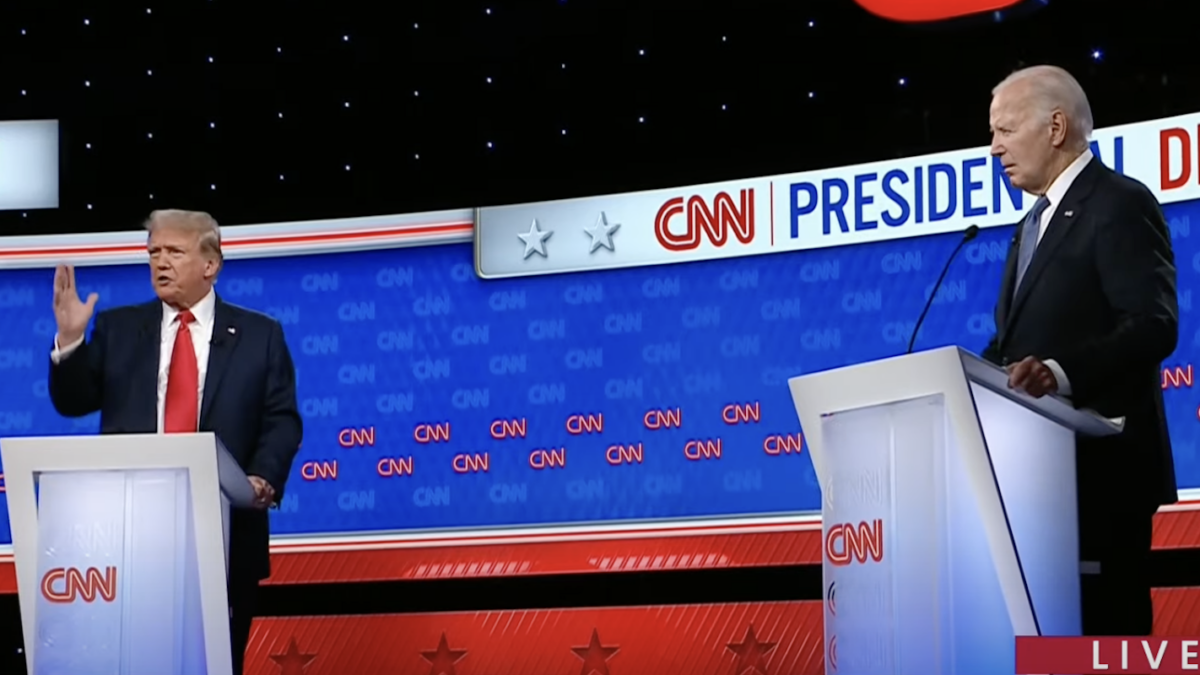
I watched the Presidential debate on CNN last Thursday, and I wish I hadn’t. Or rather, I wish I hadn’t seen what I saw, because I wish it hadn’t happened the way that it did. I wish there hadn’t been a debate for me to watch, because it did not go well for my side. Or, even better, I wish the sides were different: I wish the debate had featured entirely different candidates, giving entirely different answers to the questions — which probably should have been moderated by entirely different journalists on an entirely different channel.

Overall, I’m going to give that debate a vigorous No. None of the Above, please. We saw that Biden is too old and depleted to make up for his shitty moderate stances, and we already knew, and had confirmed for us, that Trump is a lying sack of crap who uses rage and cynicism to make up for his catastrophic reactionary stances. The whole thing just made me feel desperate and hopeless.

And that’s exactly the way it is supposed to be. At least according to the preferences of the people and forces which shape the politics of this country. Which, in our current state of affairs, is not the will of the people nor the votes of the majority: because this country is, practically speaking, not a democracy. The simplest understanding of a democracy is that the majority will of the people rules, and no president has ever been elected by a majority of the citizens of this country, let alone the residents. Certainly not these two specimens.

But that’s fine because this is actually a constitutionally limited republic, not a democracy. So there.

Actually dog Meme Generator - Imgflip
ACtually…

No, I’m fucking around, because there are internet bros who always get snotty when people in political arguments say this country is a democracy. It’s not. By the strictest definition, at least — and it’s a distinction that doesn’t even matter at all, and the fact that shitty people use their nitpickery about it to shame and silence people pisses me off: so I’m mocking those people. Sorry if it is confusing. At least the dog in that Actually meme is cute.

But here’s the real actually: whatever the intended shape of the government for this country, we are in truth currently controlled by an oligarchy: a plutocracy (or maybe a kakistocracy and certainly a kleptocracy) made up of people with too much money, who are willing (unsurprising, but still disgusting) and able (appalling and even more disgusting) to influence the political machinery of the country in order to benefit themselves, at the expense of all the rest of us. They have captured both major parties, thanks in large part to the influential power of money in our elections, particularly as unleashed by the Citizens United decision, and sanctioned de facto by politicians’ continued inability to pass election financing reform, solely because they put their own interests before those of the nation or their constituents.

Unsurprising. But still disgusting.

Because the people who run the politicians who run the country are in the business of doing business — namely using their money to make even more money, which is their sole purpose and motivation, their raison d’etre — the corruptions they create in our politics are mostly those which benefit business. They just got their personal Supreme Court to knock down Chevron deference, for instance, which will make it much easier for them — rich people who can afford the attorneys and legal costs, that is — to challenge government regulations in court, because now judges, who are definitely not experts in such matters as workplace safety or environmental impact, but who, like most people — especially these fucking people
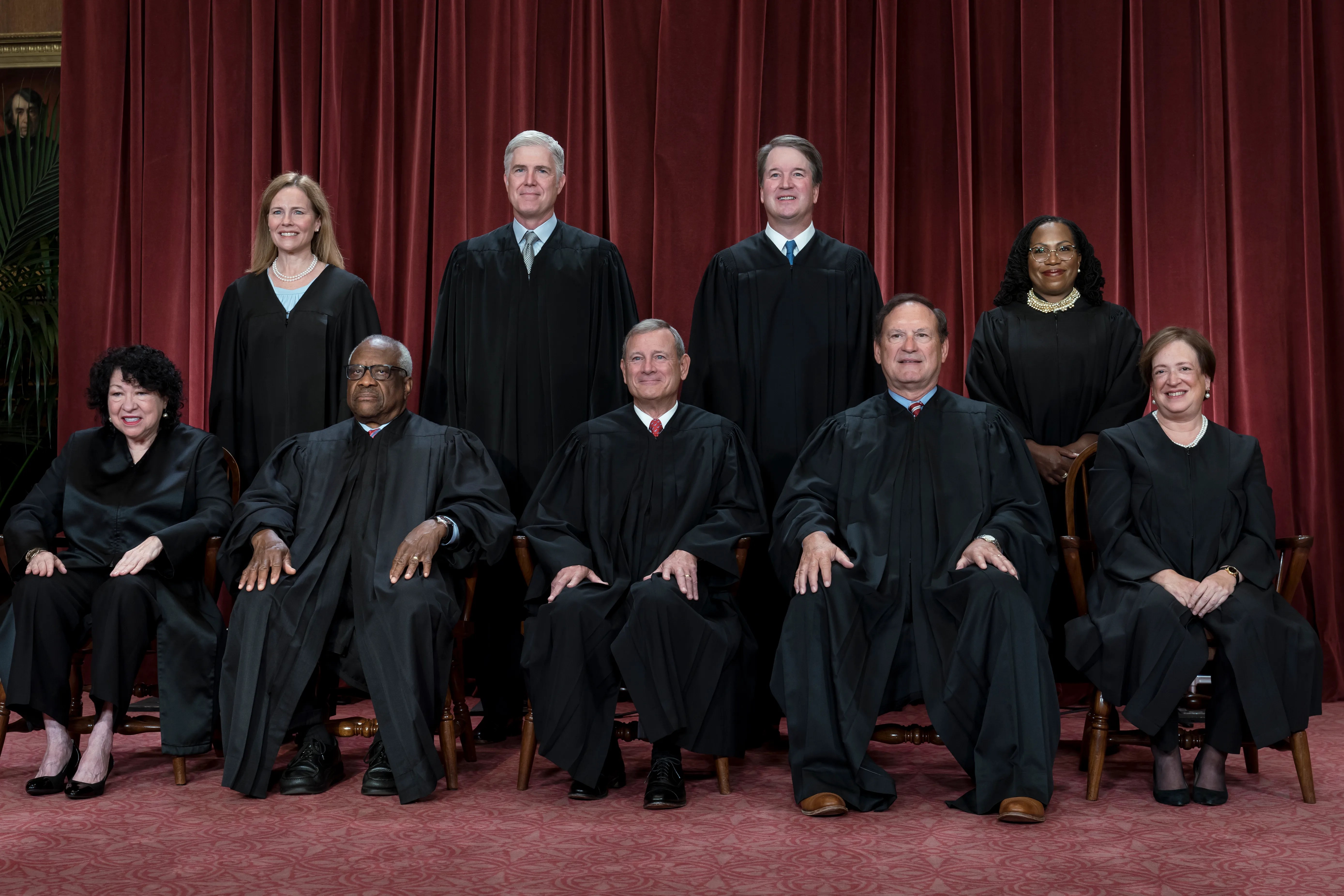
Or at least six of them

— like to think they are experts in every way that actually matters, can knock down regulations that they personally don’t think are valid or necessary. Even if the actual experts disagree with them. And do we think that our One-Percenter overlords will be taking advantage of this process?

You bet your sweet bippy we do.

But the point is, the people in charge are best served by the continued dominance of the two major parties. Because both parties rely on enormous infusions of cash in order to defeat — each other. Elections like this one, choices like this one — like the contest between these two terrible old men, the Mummy and the Blob — serve the preferences of the ruling class, because they make us desperate, not hopeful. If we had a good candidate, one who gave us hope — and the last one such was Barack Obama (who still was not a great president, because he, like Joe, was too moderate and didn’t do enough to change the life of the average citizen of this country; though in fairness to Obama, he was trying to make change pretty much on his own, and fighting against the entire political machine, and of course he lost. Donald Trump gave some segment of the populace hope, but he’s a lying sack of shit, so that hope doesn’t count, in my opinion.) — then it would inspire people to get involved, to take action; the rulers do better, have more control, when we despair, and give up, and lie down and take it. Take whatever they give us, and hate everything — and do nothing. Most of us don’t even vote. Which makes it that much easier for the plutocrats to control the votes of those who do turn out. And they like that it is only two parties, and in every specific electoral contest, for every seat and every office, it is winner take all — the person who gets one more vote beats the person who gets one fewer vote — because that also makes it easier to control the politicians. This system means the two opponents are best served by focusing only on each other, cooperatively blocking any third candidate (who already has a named role in most three-way races: “spoiler”) and fighting to the death against their one nemesis, fighting for every single vote: and that means the holders of the moneybags, the distributors of the thirty pieces of silver — the rich fuckers who try to control everything — have a death grip on the entire system, because they have a death grip on both of the two major parties: because they offer either party a way to destroy the other party if the other party dares to try to give up that sweet, sweet dark campaign money. Their money is the best way for both parties to get one more vote than the other party.

See? If the Democrats stop taking corporate One-Percenter cash, they will lose all elections to the Republicans, and vice versa. Shit, even members of the parties who don’t continue to meet with the approval of our corporate masters can’t win elections, because they can’t win primaries in the face of huge amounts of money. And third parties can’t possibly compete with the amount of money that continues to flow to the two major parties — and there’s no need for the One-Percenters to shift their money to the third parties, because the two major parties do everything their masters ask of them, whether it is Trump cutting taxes on corporations (with a bone thrown to the rest of us in the form of a middle class tax cut which had a sunset clause, the tax cuts ending in 2025 [After the end of a hypothetical second Trump term, and no it’s not a coincidence: there ain’t no cynic like a government cynic], while the corporate tax cut did not.) or Biden failing to rein in the corporate profiteering which helped drive the inflation that may cost him re-election.

But if Biden, like Trump, fails to win re-election, that doesn’t matter, of course, at least not to the people who matter; because if Biden loses, our corporate hegemony will be perfectly satisfied with Trump in the White House. The one they couldn’t abide would be Bernie: and that’s why Bernie lost two primaries to deeply unpopular candidates. Because money. And political machinery controlled by money.
Welcome to politics where votes don't count and only money matters - drew  carey oiler meme - quickmeme

Wow. I’m sorry: I didn’t even mean to go that far down this road. Now I’m wrecked in the eternal darkness of the abyss at the end, mired in hopelessness.

No. Fuck that. You know why? Because there is hope. Really. There is hope because, whatever those racist elitist pricks who founded this country meant to do, what they actually did was create a lasting democracy. A democracy — shut the FUCK up about a constitutionally limited republic, please, Internet Bros — because the power to change the entire government rests, in the end, in the hands of the people. No matter how cynical we are, I am, about who is in charge, and no matter how we keep feeling like there’s no way anything can change: there IS a way for things to change, and it is through Americans casting votes for their choice of candidate (and in some cases for their choice of laws). Because we can choose to remove and replace our elected officials, who — money or not — are chosen ONLY by votes, according to our laws, according to our system of government. There is no tiebreaker that counts how much money the candidate has. All that matters, for determining who runs this country, is the votes.

Yes: of course those votes are generally easy to influence through money; that’s how we got to where we are. But influence is not control. No matter how many times I call them overlords and masters and rulers, they are not: the rich influence everything, and so end up getting what they want most of the time. But not all the time. Because it is still votes that change the government. All of it: obviously we could vote in a new President, and new Senators and Representatives; but also, if we stack up enough votes for congresspeople who will actually do what we want them to do, then even the Supreme Court, the one unelected branch, can be controlled: they can be impeached and removed from office, they can be outnumbered by an expansion of the Court, their decisions can be overridden by laws passed by Congress, and even, if necessary, by Constitutional amendments: which are passed by popular vote.

Make no mistake: getting people to vote for anything is nearly impossible, unless you have, at this point, billions of dollars to pour into the campaign. But if something is nearly impossible, it is still possible.
YARN | Now, mostly dead is slightly alive. | The Princess Bride | Video gifs  by quotes | cb1a7c60 | 紗
Just like my hopes. Not all dead. Not yet.

(And also, let me note in passing that we have as much money as the One-Percenters: we just spend it on food and stuff. But we could buy ourselves an election, even in the face of all the dark money in the world, if we really needed to. Just think about that.)

It’s possible for us to throw off the yoke and chains of our oppressors. It is. We’ve done it before, in opposition to slavery and the secession of the Confederacy; after the Great Depression; during the fight for civil rights. We can do it again. The way to compensate for a lack of ready money to throw around is: organization. And patience. If I may paraphrase the Doors: they got the bucks, but — we got the numbers.

But that is the long term goal. So. What do we do about this current debacle?

Clearly we don’t want either of these fucking guys — sorry, I’ve gone far afield, let me bring it back:

These fucking guys (Source)

We don’t want either of these fucking guys to be in control of our lives. Not even a little bit. I’ve been arguing for a while now, going back to 2020, that Biden is the better choice; but I still don’t want him to be President, and I never have. He was my third-to-last choice in the crowded Democratic field in 2020 (The two below him on my list were Marianne Williamson, because combining lunacy with complete inexperience is just about the worst thing you can do, and Michael Bloomberg, because actually putting one of the One-Percenters in charge is the worst thing you can do. [Note that, Trumpers. I don’t know how you got tricked into forgetting that, but that’s who Trump really is. Actually.]), and he was my second choice even in this election where my first choices (Elizabeth Warren and Bernie Sanders — and Andrew Yang, and Jay Inslee, and Cory Booker and Julian Castro and John Hickenlooper and Tim Ryan and JESUS CHRIST FUCKING ANYBODY ELSE) didn’t run, because Dr. Cornel West would be a far better President than either the Geezer or the Groper. The Sleeper or the Shitbag. The Fumbler or the Fascist.

So do we vote for the third party candidates?

Do we boycott and refuse to vote?

We do not: because this election will put one of these two into the White House. The system cannot change between now and November; not unless we actually rise up and revolt. I don’t plan to grab a pitchfork and light a torch; if you do, we’re going to have to have some serious talks about what you plan to do and why, because violent revolution is something I can’t support as a pacifist; and as someone who both read AND understood George Orwell’s 1984 (That’s not a dig against you: that’s another one for the internet bros who say things like, “Facebook took down my anti-trans meme! It’s LITERALLY 1984!”), I recognize that revolutions generally don’t change the system, they only change the people who hold the whip: they don’t change who the whip falls on, nor remove the whip entirely. So we can discuss it, but I don’t think violent revolution is the right thing to do.

I think the right thing to do is to work on improving the system. We don’t even need to change it, to tear it down and build a new one, because as I said, this actually is a democracy in the most important sense: no, we do not vote directly on all political matters (which is actually what a “democracy” means, control by the people without representatives), but our votes have the greatest authority. We can vote to change literally anything in our system, even the system itself through Constitutional amendment.

I do think we’ll need to change a whole lot of things to make the system functional in the long term. But there are a couple of specific things that we can work to change in the fairly short term — meaning in the next, say, five to twenty years, but not before November — that will make an enormous difference, and make it much easier — even simply possible — to change everything else we need to change. Those things are the factors which give the plutocrats their ability to influence politics so powerfully: unlimited money in campaigns, unlimited advertising in campaigns, monied lobbying and the revolving-door interactions between the government and industry, the winner-take-all two-party system (and other minority-rule structures like the electoral college). I think there are politicians who would be willing to change those things for the better. Or maybe there are people who would be willing to become politicians in order to change those things for the better. Starting with money in politics: that is the simplest and most direct way we have to challenge the plutocrats, the One-Percenters. And people like John McCain existed. People like Alexandria Ocasio-Cortez, who unseated a corporate Democrat using only small-dollar donations, exist and are currently in Washington. It is possible. It can be done. It may take years or even decades to get a majority of such people in Congress: but we can do it. And that’s what we need to do.

But what do we do about November?

About these two fucking guys?

I know some of you aren’t going to like hearing this, and I don’t like saying it: but the answer is, we have to vote for Joe Biden. The arguments haven’t changed, not even with that incredible faceplant of a debate performance. Trump is still a wannabe fascist, who will do untold damage to the actual lives of real people during the four years he would be in office; not to mention the damage he would do to our democracy. Biden is a failure as a leader of our nation: both because he hasn’t done nearly as much as he should have done, and because he is a miserable excuse for a figurehead — not the most important role of a president, but not a negligible one. But he is not a threat to our nation’s continued existence. Trump really is.

Don’t stay home: the MAGAts won’t. Don’t vote for RFK Jr. (If you would otherwise vote for a Democrat, that is: if you’re a Trump voter, go right ahead and vote for ol’ Brain Worms): he’s a seriously terrible candidate in his own right (and currently only on the ballot in eight states, so literally cannot win 270 electoral votes and take the presidency) and votes cast for him would only result in the victory of Trump or Biden, with no positive effect at all; because he’s not running as representative of a legitimate third party. If you want to vote Green Party or Libertarian Party or another established third party, that has more merit, because a larger number of votes cast for a third party makes it easier for the third party to gain entry into future races, which is part of the way we break the duopoly of Democrats and Republicans; but be aware that, in this election, taking a vote away from a Democrat, even a shambling mound like Joe Biden, makes it more likely that Trump will take over, and that will be very bad for us all. Including Republicans, whatever they think about how much they’ll laugh in all those stupid lib faces once Trump is in charge. The truth is that Donald Trump is not our friend, and will not do anything to help anyone but himself, if he is returned to the White House. I promise you. For the same reason, I will not be voting for Cornel West, even though I like and admire him and would choose him over every other candidate. My vote for Dr. West will not make him win: and I cannot abide the thought of a second Trump term.

So I will do the right thing to protect and serve my country and my fellow Americans: I will not choose None of the Above, and I will not cast a protest vote. I will vote for Joe Biden.

This fucking guy.
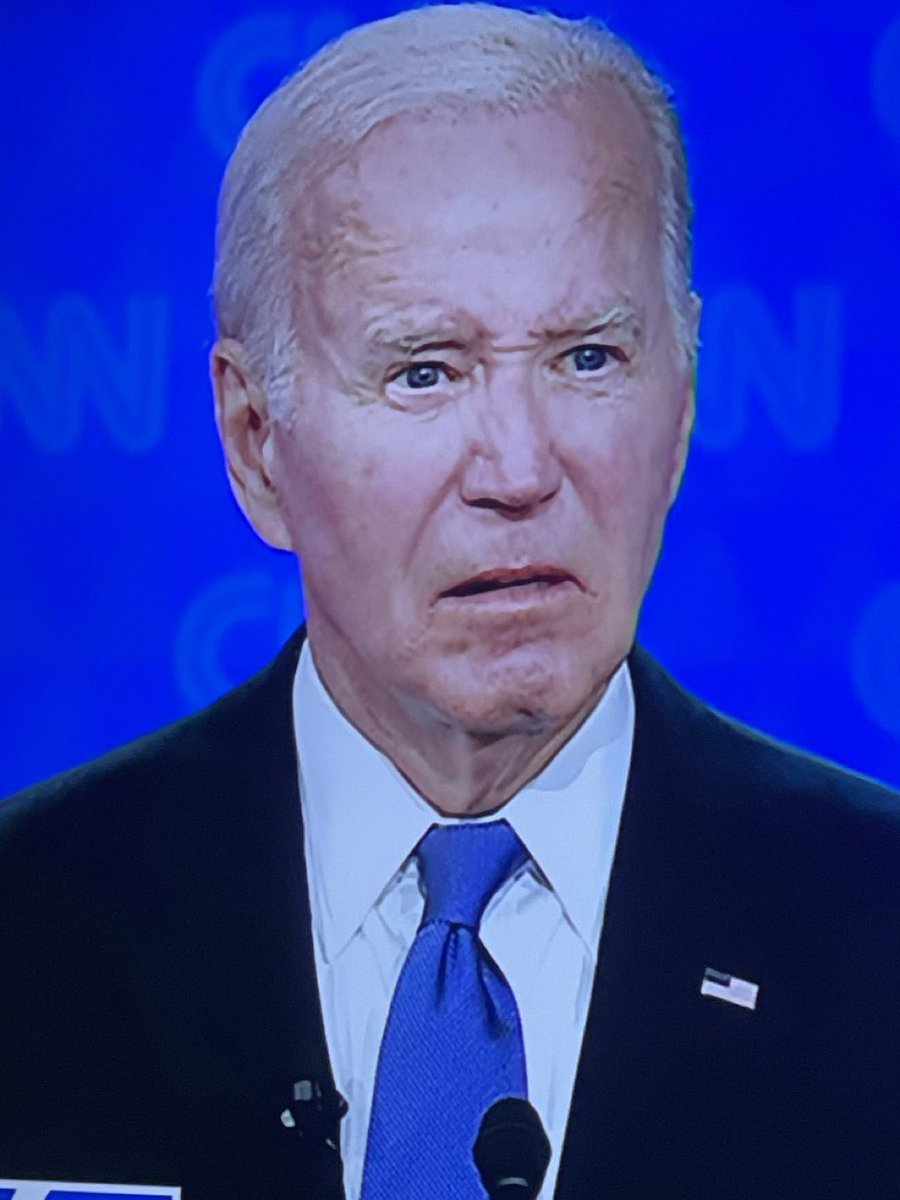
And then I will work to make sure this kind of bullshit stops. Once and for all.

No more malarkey.

More Like POO-Preme Court, Amirite?

Ha! POO-Preme.

Neener-neener-neener GIFs - Get the best GIF on GIPHY

I will definitely change that title.

But there’s nothing I can do to change the Supreme Court.

Let me start with the reasons why the Supreme Court should be changed.

First and foremost, it has been captured by one political party, in defiance of all of the ideas they claim to hold dear: in defiance of democracy, in defiance of the ideals in the Constitution and the will of the Founders, in defiance of our nation’s proud traditions.

Should I use the word “captured?” Yes: if it wouldn’t be better to use the word “corrupted.”

Captured because Mitch “Fucking Turtle-Necked Chinless Redneck Powerhungry Asshole” McConnell (Am I the only one who uses that nickname for him? I shouldn’t be.) delayed a Supreme Court nomination for a damn year, after Antonin Scalia died in 2015, with some absolute bullshit about how it wasn’t appropriate to name a new Justice during an election year — and then he turned right around and named a new Justice during an election year, only a month before the Presidential election, when Ruth Bader Ginsburg died in 2020. What McConnell did wasn’t illegal, which is why those two Justices he stole for the GOP — or to be fair, one or the other of them was stolen: if we want to accept that Justices shouldn’t be named in an election year, then Neil Gorsuch’s nomination was legit and Amy Coney-Barrett’s was not; if we think the Justices should be named whenever the seat is empty, then Barrett is legit and Gorsuch is not — are both still Justices on the Court, making bullshit decisions according to their political ideology; but it’s clear that what McConnell and the GOP did was in defiance of all honor and decency, and intended only to swing the nation’s highest court over to their side so they could achieve their ideological goals. He did the same thing with the lower courts, holding up nominations through Obama’s second term in hopes of getting a Republican President to go with his Senate majority: which of course he did, and that’s why hundreds of federal judges were named by Trump instead of Obama. Which is bullshit — but it’s bullshit as usual. The Supreme Court nominations were not. That was blowing through precedent and decency for political gain. That, along with a hundred other examples of same, are why I will never accept criticism from the Republicans about Democrats playing politics. You don’t get to criticize when you do worse shit with more terrible consequences.

But hey, let’s pretend that all is fair in politics. (It’s not, as all is not fair in love nor war, whatever the old cliches say.) Because I certainly won’t pretend that the GOP’s justification for all of their shenanigans — that they are protecting the country from Marxism — has any merit at all, whatsoever. But sure, let’s pretend that as long as it’s legal to pull BS, you can go ahead and pull it. So then the 6-3 Conservative majority is permissible, even if it’s shitty.

So now let’s talk about corruption.

Let’s talk about Clarence Thomas accepting hundreds of thousands of dollars in gifts from a Republican mega-donor with interest in cases before the Court, from which Thomas never recused himself. Nor did he report the gifts on his disclosure forms. Also never disclosed that Crow paid his great-nephew’s tuition in expensive private schools. Or that Crow bought Thomas’s mother’s house. (My favorite counter-example, by the way, is that Justice Elena Kagan turned down a gift basket of bagels and lox from old high school friends because she wasn’t certain how it would look in terms of the ethics of accepting gifts.)

Let’s talk about Samuel Alito doing the same thing — accepting lavish vacation “gifts” from a conservative billionaire with cases before the Court.

Let’s talk about Neil Gorsuch selling a house to a law firm that has had several cases decided by the Supreme Court, from which Gorsuch never recused himself.

Let’s talk about Chief Justice John Roberts’s wife, who recruits lawyers for high-end firms that are frequently before the Supreme Court, making $10 million in commissions, which Justice Roberts described as “salary” on his disclosure forms. Also never recused himself.

Makes Kavanaugh and Coney-Barrett seem almost righteous.

I mean, unless you believe Christine Blasey Ford. Which of course I do. So that makes four conservative justices guilty of some questionable connections to wealthy Republicans with business before the court — and one credibly accused of sexual assault.

Wait, no, sorry — two. Because I fucking well believe Anita Hill, too.

And while we’re at it, let’s give that crapstack Thomas the trifecta, and include his wife, Ginni Thomas, who has frequently been closely connected to cases before the Court, from which her arrogant asshole of a husband has never recused himself. Not to mention her involvement in the Insurrection of January 6, 2021.

That’s the majority on the Court. To be fair, all of the Justices, including the liberal ones, accept travel as gifts from donors; mostly it is for appearances and speeches and so on, but sometimes it is for vacations. It’s just that they declare those vacations.

So yes: I consider the Court to be captured. To be corrupted. And that’s without even talking about the questionable decisions they have made over the last decade — going back to the Citizens United and Shelby County decisions, whose implications are still affecting us and our election processes, most intensely.

So let’s talk about those decisions.

First of all, as background, we should discuss the doctrine of originalism, which is a crock of fewmets to begin with. Created most actively by Robert Bork (80s kids will remember) as a reaction to the Warren court, which ended segregation, to the chagrin and outrage of every White supremacist then and since, originalism is the doctrine that the Constitution should be interpreted according to the original intent of the Framers who wrote it, and not adapted to meet the changing needs of the society they tried to shape into a democracy — pardon me, a Constitutionally limited Republic; Lord knows I don’t want to be accused of using the wrong term to describe this country, and therefore not knowing what the hell I’m talking about.

(Also, “AR” in “AR-15” doesn’t stand for “Assault Rifle.” It stands for “Armalite Rifle.” Don’t let anybody mock you for that one, which is quite literally the stupidest argument in the history of the gun control debate.)

There are several problems with originalism. For one, it’s impossible to know for sure what the Framers intended. We have their language in the actual Constitution, and we have in some cases writings they left behind explaining their intent. But — and please, take it from me, since this is literally all I do — all writing requires interpretation. And no author’s intent is purely apparent from their writing. Please see my last post for more on this.

Now, it’s fine to interpret the wording of the Constitution; that’s what the Supreme Court is for. The problem with originalism is they claim there is only one legitimate way to interpret that wording, and it’s their way. Why does one interpretive model always win when another must always be wrong? Go ahead, you try and justify it; I can’t. The objection against the more liberal decisions of the Supreme Court is that they interpreted the Constitution instead of following what it says; but since everybody interprets the Constitution, as everybody interprets all language and communication, it’s simply absurd to claim that THE OTHER GUYS are interpreting, and you’re going straight to the true essence. It’s bullshit.

The second problem with originalism is that, even when you get it right, the Framers were a bunch of racist sexist elitist shitheads. Sure, they had some incredible progressive ideas, especially for their time; and they had incredible intellects and great powers of reasoning, remarkable political acumen and voluminous knowledge of history and philosophy and so on, and, yes, wonderful rhetorical skill: but they still thought that only White men of means should be in control of this “free” nation they were creating. So it seems to me like their intent is not always the best guiding light for this modern nation descended from theirs. It is also ridiculous, by the way, to claim that this nation’s success is itself proof that the Framers had everything exactly right: that would require that everything in this nation’s history happened exactly as the Framers intended, and surely that whole Civil-War-Emancipation thing, not to mention women’s suffrage, was definitely not their intent.

Third problem with originalism: just like the Framers’ intent, the application of originalist doctrine is — malleable. It’s reasonable to interpret the Framers’ intent with firearms; while the form and function of firearms has changed in several ways, the essential concept of guns then and now is the same: it is a force multiplier that gives one person the ability to kill another from a distance with minimal risk to the shooter. So if we think that all of the Framers’ thoughts on guns were the best ever (and they probably weren’t — but actually, I think the problem is that we misinterpret the Second Amendment, not that the Second Amendment is a terrible piece of law), we can maybe apply those thoughts to modern gun control laws. Probably not a good idea still, but not absurd. But to say that “free speech” and “free press” and “free assembly” actually define the internet is to misunderstand the internet entirely. There is not any way you could print a thing, in any sense of “print,” that could reach 5 billion people around the world in mere seconds; but the internet can do that, in theory. There is no speech that could ever reach 5 billion people, period; but one YouTube video can. There is no sense of assembly that includes the ability to link FIVE BILLION PEOPLE in real time, but in different locations — but the internet can do that. The internet is a new thing. It is not a thing the Framers could have predicted, and therefore it is not a thing for which we can find the Framers’ intent. We have to make that shit up. Which means that, according to originalist doctrine, there should be no regulation of the internet at the federal level at all, because the Tenth Amendment reserves that power to the states. The same as the bullshit justification for the Dobbs decision overturning Roe v. Wade. Yet, strangely, the originalists do not claim that all internet regulation in any form should be done at the state level. Why? Because originalism is not a solid doctrine, it is all and only interpretation — opinion. It just has a particularly convincing, albeit specious, justification for why this opinion is better than other opinions.

The fourth problem with originalism (What, did you think three was enough? You thought I was done? AU CONTRAIRE, MON FRERE.) is, following the same logic, we should examine the intent of the original framers of the doctrine of originalism, Robert Bork being the main one. Robert Bork was an asshole. He was also one of the most influential people behind movement conservatism and trickle-down economics, which means we can also blame this crapstack for income inequality and our current plutocracy. It makes perfect sense that Bork would create originalism, and look to the 18th century Framers for guidance: he, like them, was a sexist, racist, elitist shithead. Which means that his doctrine should also not be a guiding light for a modern enlightened society.

The fifth and final problem with originalism? There are five originalist justices on the Supreme Court. Want to guess which five? Well, the easier way is to guess the one who isn’t: it’s Roberts, who strongly believes in stare decisis and respect for precedent. Roberts was the one who agreed with the Dobbs decision in favor of the state of Mississippi’s specific statute limiting abortion access; Roberts did not agree that Roe should be overturned. Because Roberts, while a conservative, is not an originalist. Alito, Barrett, Gorsuch, Kavanaugh, and Thomas are, and those five votes overturned 50 years of precedent, and removed a Constitutionally protected right from American citizens.

And then, when they struck down affirmative action, and the right for LGBTQ people to receive equal treatment in the free marketplace, they did it again — overturning 50 years of precedent in the affirmative action case, and removing Constitutional protections of the rights of Americans in the 303 Creative case, the decision that gave a Colorado web designer the right to refuse her services to (hypothetical) gay clients, as it would somehow violate her First Amendment rights. This time with Roberts joining in. Because he’s still a prick.

Okay: I was going to go through the decisions that I think the Court has decided wrongly, but I think this thing has gotten too long already; turns out I have a lot of beefs with the current Supreme Court. This is a good list from Truthdig of the bad decisions of the Roberts court; it doesn’t include the most recent ones.

YARN | I got a lot of problems with you people... | Seinfeld (1993) -  S09E10 The Strike | Video clips by quotes | 0f8e26b9 | 紗

Okay. So we all agree the current Supreme Court sucks. (MY title, by the way, was inspired by a Tweet I saw that called it the SUCK-preme Court. And mine’s better than that. But I will change it before I post this, I promise.) What do we do about it?

No, we can’t expand the court. Sure, it’s tempting, and there are both precedents and logical reasons for doing it — the best I’ve heard is that there are 13 Appeals Courts (12 districts and the Federal Appellate Court) and so there should be one Supreme Court justice per Appellate court, which would allow Biden and the current Democratic Senate to name four new justices and win a 7-6 majority going forward — but that only starts a game of back and forth: if the conservatives get a majority after liberals expand the court and add four seats, then the Republicans would add at least another two seats and take the majority back. And so on.

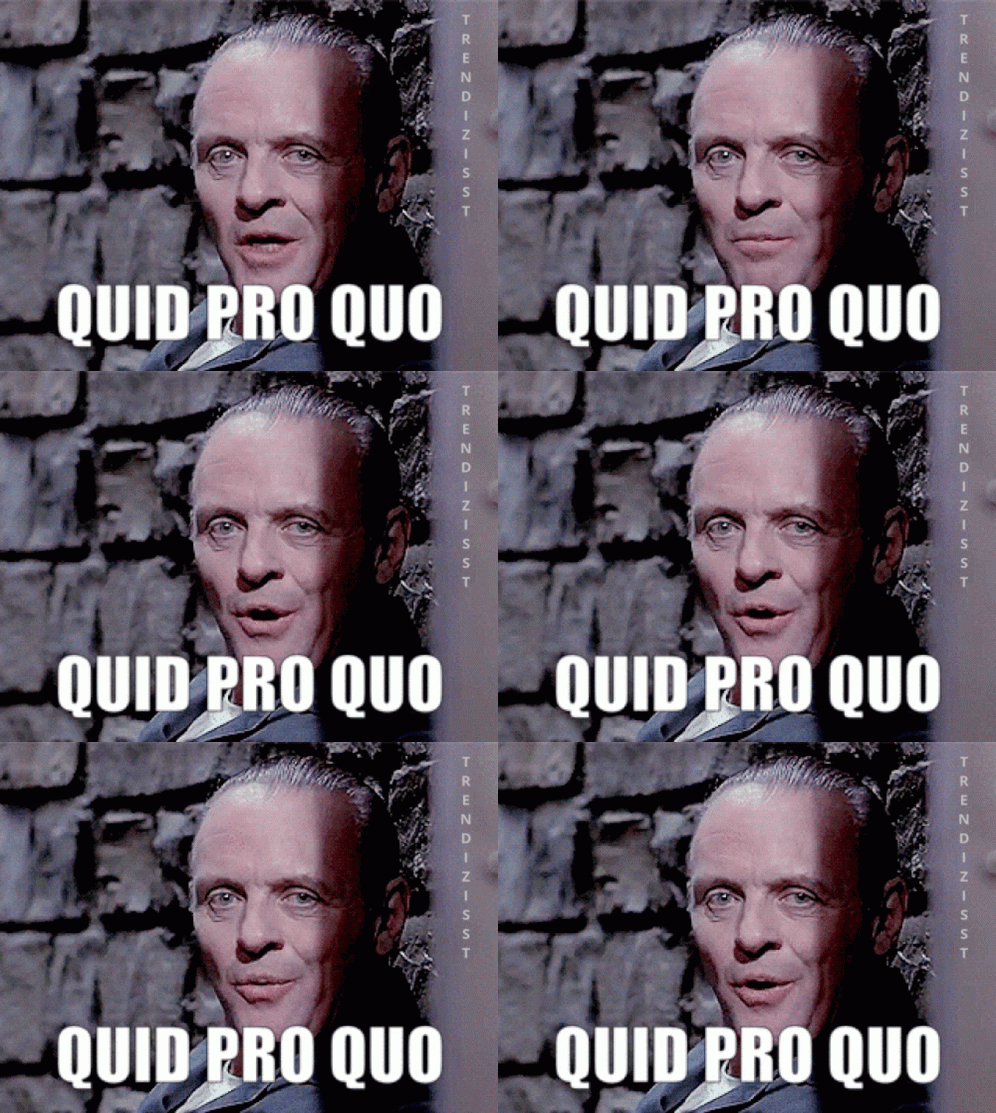
By the same token, we can’t impeach all the Justices. They haven’t committed high crimes and misdemeanors. (Thomas probably has.) They did say under oath that they would hold to established law in regards to abortion rights, but it’s not perjury if you changed your mind after you answered the question; and who could prove that the Justices were lying when they said something that wasn’t true? The free gifts from Republican donors, and the money taken in by Roberts’s wife, did not provably change a decision made by the Court; the law firm that bought Gorsuch’s house, for instance, received his vote eight times, but he voted against them four times — and honestly, it’s a pretty good bet that Gorsuch would agree with a conservative law firm two times out of three without anyone buying a log cabin. As we all learned with that other corrupt piece of shit Trump, it’s about the quid pro quo.

Though I learned it from Hannibal Lector.

Quid Pro Quo Qpq GIF - Quid Pro Quo Qpq Hannibal Lecter - Discover & Share  GIFs

No, the truth is, there isn’t anything we can do about this current court, except suffer.

But there is something we can do about the situation in this country, which the Supreme Court is making worse.

We can pass laws.

We can elect Democrats who can win a majority in both houses of Congress, and win the White House. It wouldn’t even be that hard, honestly, because so much of the country is blue; I know we’re fighting GOP gerrymandering and election tampering, but surprisingly, those were two of the decisions the Court made that went the right way, so neener neener.

neener Neener* GIF | Gfycat

But really: the Court can only toss out legal protections if they are not enshrined in law. They can toss Biden’s student debt relief plan (EVEN THOUGH THE PLAINTIFF HAD NO STANDING, GODDAMMIT), but they can’t tell Congress not to cancel student debt.

And the better we do at electing Democrats, the better off we will be in terms of election maps and rules going forward: and that will snowball in the future — until we can properly nominate new Justices to replace these assholes.

This court’s biggest mistake is in overturning precedent in order to appease their personal biases. We should not make the same mistake, and so compound the problem, by expanding the court or by impeaching Justices for being assholes. Not to be morbid or anything, but Clarence Thomas is 75 and Samuel Alito is 73; I think we can expect to name two new Justices in the next ten years — and so if the Democrats can maintain control of the White House and the Senate, or at least one or the other, then those can be liberal nominees, and that will swing the Court back to a better balance.

And then the liberal justices can just overturn all of the fucked up decisions that this court is making. Which is what happens when you throw out precedent: the next guy also gets to throw out your precedent, and reverse all of your decisions.

You know who pointed that out to me? My dad.

And that’s how we come full circle and start this blog off the right way.

Much better than that awful title.

I promise I’ll change that.

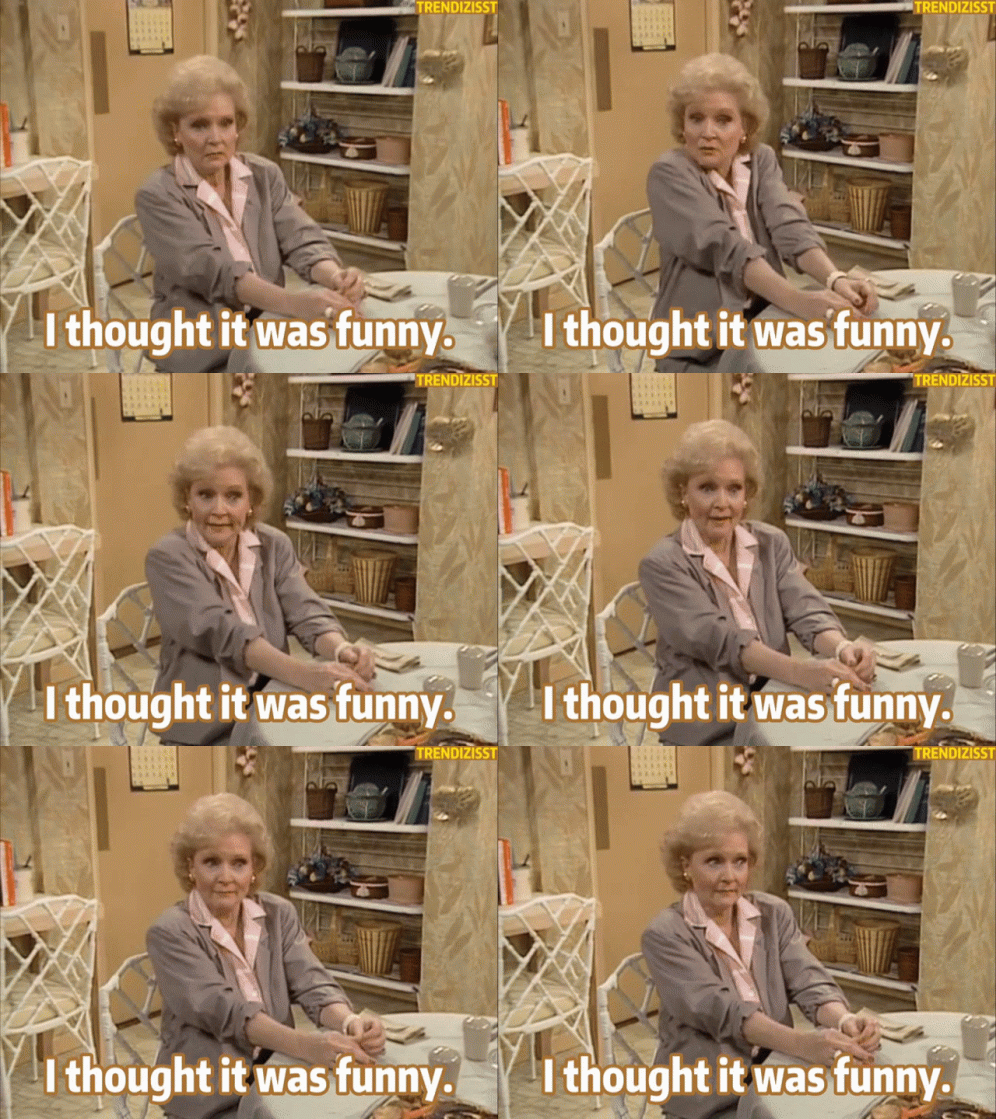
Okay, no I won’t.

I Thought It Was Funny GIFs | Tenor

Happy 4th of July, everyone.

The Party’s Over

“Your guilty conscience may force you to vote Democratic, but deep down inside you secretly long for a cold-hearted Republican to lower taxes, brutalize criminals, and rule you like a king. That’s why I did this: to protect you from yourselves. –Sideshow Bob, “Sideshow Bob Roberts”

(This is the third installment of my political corruption series, and the last. For now.)

Let’s be clear (If you read my stuff, it’s probably already clear): I am a lifelong Democrat. I am the child of two lifelong Democrats: my parents voted for John F. Kennedy, for William McGovern, for Walter Mondale, for Michael Dukakis; I voted for Clinton, for Gore, for Kerry, and for Barack Obama, twice. I don’t understand why people can vote Republican: the wealthy, for whom it makes personal sense, have to be callous, I feel, in order to refuse to maintain the social safety net for those less fortunate than they, or unbelievably greedy in order to agree to destroy the regulatory state so that they can make even more money at the expense of our very world; the poor and middle class are voting for social causes, not for personal gain (Unless they believe in trickle-down economics, but in that case they are deluded), but I see two problems with that: first, they are on the wrong side of most social issues – anti-choice, anti-equality, xenophobic, and parochial – and their candidates don’t ever deliver on their promises. So if you’re wealthy, how can you stand to vote Republican? And if you’re not, why would you ever think to vote Republican?

I read an excellent book by Thomas Frank, What’s the Matter With Kansas, in which Frank examines how Kansas, his home state and, through the 1800’s and early 1900’s, one of the most radical and progressive states, became so very staunchly, unflaggingly, self-destructively conservative. What happened was that Republican candidates around the early 90’s started pushing a pro-life agenda as the only issue that mattered – you know, the usual “40,000,000 murders,” “Culture of life” stuff – and when elected, every Republican proceeded to lower taxes, kill social services, remove regulations on business, make sweetheart deals with corporations, and basically ruin life for the average person; and then go back to election yelling “We have to end the scourge of abortion!” Which got them re-elected, into majority after majority — and yet they continued to fail to do anything about abortion, simply pushing their pro-business agenda on the state to its steadily growing detriment. But the pro-life agenda, whipped into a frenzy every new election cycle, was so compelling that nothing else seemed to matter to the voters, who kept voting Republican until it put their state where it is now – essentially hollowed out, unable to provide even the most basic elements we expect of our governments, like schools – not that Kansas schools teach anything other than creationism and abstinence, according to the campaign promises of the Republican candidates.

That’s how I see Republicans: selfish, deluded, misguided, and absurdly optimistic– or, less kindly, willfully blind to the fact that their politicians don’t ever deliver on the things they promise that won their constituents’ votes: on the national scene, we still have Obamacare, we are still giving foreign aid to dozens of other countries, our veterans are still dying on the streets, abortion is still legal, gay marriage is now legal as well, and there still isn’t a wall between the US and Mexico. So why would anyone vote Republican?

Here’s the thing, though: why do I continue to vote Democratic? It was Clinton who ended the Glass-Steagall Act, which, more than anything else, precipitated the economic crash that happened ten years later, under George Bush but not – I repeat, not — because of him. It was Bush’s fault that our government wasn’t in a better position to help after the crash, because he gave away Clinton’s surplus in tax breaks and war spending; but the crash was because of the Democrats. Democrats who I voted for. And of all of my other causes, the most important to me is the reduction of violence and misery, and the improvement of equal opportunity for everyone; the largest obstacle to all of that is income inequality. Which Democrats conveniently ignore, not wishing to appear – gasp – Socialist. (I know, I know – Bernie Sanders. But he’s also pro-gun.) We have Obamacare, but without the public option, it is more of a burden than anything useful; my costs for health care are still going up, every year, while my wages are going down: I make less now than I did ten years ago. Unions are still dying, and women still don’t make the same wages that men do, and Guantanamo is still open and still incarcerating prisoners of war who have never been to trial, and guns remain unregulated, and schools remain unfunded, and everyone is still driving Hummers while we drill for oil in the Gulf of Mexico.

So who’s really the fool, here?

I think the answer’s pretty obvious: we all are. We have all been sold a bill of goods that doesn’t match what the grinning faces behind the counter are putting into our baskets.

This is the last form of political corruption I want to write about, and that I think I have a solution for: this one is the corruption of the entire system, through partisanship and self-serving deception. This political corruption is the two-party system.

I would love to go back now to when the two-party system made sense and worked well for Americans; but in all honesty, the two-party system has always been about helping itself. Having a clearly defined and well-known political party makes it easier for candidates affiliated with that party to get elected: the party label offers a certain legitimacy, and even loyalty, in that people often vote the “straight ticket,” picking the candidates affiliated with their party without knowing anything about them. The party also offers a political apparatus that makes it easier to get heard and therefore elected; you need staff, you need volunteers, you need access to media and to debates and the like, you need a platform that people can hear and understand and support. The political party that exists before and beyond one’s own candidacy offers all of that; unless you’re a billionaire loon like H. Ross Perot, bless his wrinkly, big-eared heart, you wouldn’t want to form your own party just for your candidacy, and you almost certainly couldn’t afford to. So political parties are useful, and they aren’t going away – more’s the pity; because by far the easiest solution here is just to ban them entirely. But then it would be too hard for anyone not an incumbent to mount a national political campaign, or even a serious state-wide one, and that would not be any better, as those in power – who already have political staff, legitimacy, and access to media – would get re-elected even more often than they do now. So okay, we’ll keep political parties.

Now, if that party represents a certain set of values that the voter supports, then well and good: but because there are only two parties with any real legitimacy in this country, those two parties become too large and unwieldy, their umbrellas too wide and encompassing such extremes, that voting for the party doesn’t really mean supporting one’s specific causes: is this Republican candidate an evangelical Christian who wants to put the Ten Commandments on the American flag and mandate both creationism and prayer in schools? Or is he a Libertarian seeking the end of the income tax and government reduced to only two services, international commerce and the military? Is this Democrat in favor of a path to citizenship, but also supports private prisons, or is she looking to legalize marijuana and strengthen the Second Amendment at the same time? We can’t tell based on party affiliation.

Now, the two-party system theoretically serves the middle: because the two parties have to have such broad appeal, they tend towards the center. And thirty or forty years ago, I think that was probably true: but it isn’t now. And before that – say, eighty or a hundred years ago – it also wasn’t true. Way back when it was formed, the Republican party was single-mindedly abolitionist, which was an extreme (albeit correct) position; the Democratic party, in response, was for decades staunchly segregationist and pro-states’-rights. Also not moderate positions. Today, we have one party – I’ll let the reader guess which one – that has discovered that it can motivate its base through extreme and inflexible positions on social issues; in other words, the more extreme and zealous and inflammatory the party gets, the more votes they turn out. The entire party is moving away from the center, and at the same time, becoming more successful, because of it. More successful, that is, at winning elections: they are certainly not more successful at governing, a profession they seem to have cast aside in favor of demogoguery. Meanwhile, the opposition party is trying to maintain its foothold in the middle; but as the other party keeps going farther and farther to one side, the middle drags in that direction – and rather than hold their ground and make the extremists come back, the moderate party is moving with them, and thus also becoming less moderate: while surrendering entirely the side of the political spectrum they were supposed to be watching. I feel like, any minute now, the Democrats are going to turn around and see that a Republican has captured their flag while they were all on the other side, trying to keep an eye on the Republican team – who were having a dance party around their own flag, completely ignoring the Democrats and the entire game, but subtly distracting their whole team so that no one was left to play defense. And somehow, Vince Lombardi was behind it all. Or Ronald Reagan.

The two-party system is also supposed to provide stability: because the parties are predictable, and centrist, and inclusive, and effectively share the electorate, they are forced to compromise, which isn’t terribly hard because their positions aren’t far apart, and so they can respect and agree with each other on most things; any one politician also realizes that his opposition is not going away, and so he has to work with them. Except our parties aren’t providing that, either: instead we get hatred and bile and petty partisanship that blocks everything useful, even stuff that shouldn’t ever be a question, like raising the debt ceiling, or providing for the 9/11 First Responders. Honestly, any government that can’t give those guys health care and a pension that would choke a horse is no kind of government at all.

So that’s what we have: no kind of government at all. The parties have lost their way: rather than improving our democracy, they are hurting it; because their goal is no longer to represent the will of the people, but rather to maintain and expand the power of their party. As long as their party wins, nothing else matters. Politics is become a team sport. The propagandists (You know – the cheerleaders. Though I can’t think of anyone on this Earth who looks less like a cheerleader than Rush Limbaugh and Karl Rove.) have taken over, and they have realized that they don’t need to steer their parties towards what the people want; they can make the tail wag the dog, and the party can tell the people what they want. As long as they say they are in favor of what the people are in favor of – this side will ban abortion, that side will close Guantanamo and ensure that women make equal pay for equal work – they don’t actually have to do those things in order to maintain power. And as long as the person says they are a Democrat or a Republican, that’s a win, even if they don’t actually act like it: and so the Republican party will support Donald Trump if he wins the nomination, and the Democratic party will support Bernie Sanders, even though he is a Socialist independent.

I don’t even have to argue that the political system is broken: the race for President – which has already been going on for a full year – will likely come down to Hillary Clinton and Donald Trump or Ted Cruz. Bernie Sanders will likely not be in the running. (And I have to say: in that scenario, I almost wish that Ted Cruz would win, so that Mitch McConnell could stand up in the Senate and say that his first goal is to ensure that Ted Cruz is a one-term president. I want to see how well Mr. Cruz can do when he can’t blame things on Obama. Although of course he’d keep blaming Obama for everything, anyway.) If the system worked, then Sanders would run as a Socialist, Trump as the head of the shiny new Trump-Solid-Gold Party, Hillary Clinton as a Democrat, Ted Cruz as a member of the Inquisition, and probably Marco Rubio as the Republican. And then we’d have a race, by God. You’d have two actual centrists, Rubio and Clinton, one on the left in Sanders, one on the far right in Cruz, and Trump off on a tangent, somewhere far out in Nutsville.

So how do we change things to achieve that glorious outcome in the future? Well, there are a couple of ways. The first thing is we can bring back the Fairness Doctrine, which required opposing viewpoints to be presented on any television station that aired political views; that, with a certain minimum percentage of votes – say, 5% of the popular vote in any one election cycle – required to gain status as an opposing viewpoint, would allow alternate parties to gain media access, publicity, and a voice in the system. That would be the best thing: allow parties a chance to gain their own foothold, and stop this nonsense where everyone other than a Democrat or Republican is a “third-party candidate,” which is seen almost universally as a wasted vote.

We could also eliminate the one-winner-takes-all election system, and the single-representative system with it. Depending on whether we want more representatives in Congress, it could look like this: the Congress members from a certain state would all run in one general election, with up to as many candidates as there are seats from each party – so in a state with ten Congress seats, there would be ten Republicans, ten Democrats, ten Socialists, etc. – and the popular vote would be divided by percentage. So if 50% of the state voted Republican, 30% Democrat and 20% Socialist, then the state would get five Republican congresspeople, three Democrats, and two Socialists; you could either have the parties choose their reps by caucus, or have a run-off within the party for which candidates get the slots. Alternately, you could run the same system but with multiple candidates from the various parties winning a single “seat,” that is made up of several actual members; though that would greatly increase the number of Congresspeople, and still allow for districts to be gerrymandered. I like the state-by-state bloc voting, personally.

And one other thing is critical: term limits. It is absurd that we don’t already have these in Congress when we have them almost everywhere else, including the Presidency. I’d suggest about a decade for each seat: four two-year terms in Congress, two six-year terms in the Senate. Maximum twenty years in the legislature. And anyone currently past that is out at the next election.

All of us are unhappy with the partisan politics. I have seen this meme several times of late, and I expect to see it even more between now and November.

Screw  the Demopublicrats

We need to fix the system, because the people who are breaking it aren’t going to turn around and fix it, and breaking it even further is not going to magically bring it back around to a good place. Too be specific: Donald Trump will not make America great again. No Republican and no Democrat will.

We the people can. We will. We just have to do it. Now, please.

How do you shut a revolving door?

ANSWER: With a door-stop made of JUSTICE!

(This is the second in a series about politics that’s looking like it will be three essays long. Once again, if you’re not interested – no, you know what? You should all read this. And share it so that other people can read it too. Because – damn.)

And speaking of corruption in politics . . . two words: regulatory capture.

Two more words: revolving door.

And the final five: Lobbying in the United States.

You know that there’s a real problem when the corruption has become so common, and so tightly bound into the fabric of government, that there is a Wikipedia article about it. There are three, actually, which I’d suggest as reading – they are all linked above. And it is amazing that this is such a common and accepted situation that the articles talk about recent events, about people whose names we know – this isn’t the Teapot Dome scandal, or the robber barons of centuries past; this is Eric Holder, who left after six years as Attorney General to return to his partnership position at a law firm that represents Wall Street banks (Now you understand why no bankers have been prosecuted for the financial collapse?); this is Deepwater Horizon and the oil companies that got new permits to drill in the Gulf of Mexico only weeks after the worst ecological disaster in history; this is the very internet I am using, and SOPA, et al. This is our world, us, right now.

Regulatory capture is when a government regulatory body – like the FCC, or the SEC, or the Department of the Interior or Agriculture – is controlled by the industry it is intended to regulate. The fox not only gets into the henhouse, he puts on a red comb and declares himself the rooster. Then he puts in place a new Hen Resources policy whereby every hen must have a one-on-one meeting with the new CER(F) [Chief Executive Rooster (Fox)], out back in the woods, at night; and the hens have to bathe in barbecue sauce beforehand.

Think I’m exaggerating? Allow me to quote from the Wikipedia article on this subject:

Commodity Futures Trading Commission

In October 2010, George H. Painter, one of the two Commodity Futures Trading Commission (CFTC) administrative law judges, retired, and in the process requested that his cases not be assigned to the other judge, Bruce C. Levine.Painter wrote, “On Judge Levine’s first week on the job, nearly twenty years ago, he came into my office and stated that he had promised Wendy Gramm, then Chairwoman of the Commission, that we would never rule in a complainant’s favor,” Painter wrote. “A review of his rulings will confirm that he fulfilled his vow.” In further explaining his request, he wrote, “Judge Levine, in the cynical guise of enforcing the rules, forces pro se complainants to run a hostile procedural gauntlet until they lose hope, and either withdraw their complaint or settle for a pittance, regardless of the merits of the case.” Gramm, wife of former Senator Phil Gramm, was accused of helping Goldman Sachs, Enron and other large firms gain influence over the commodity markets. After leaving the CFTC, Wendy Gramm joined the board of Enron.


That’s right: the wife of a senator running a regulatory agency, corrupting a judge, and then taking a seat on the board of the company she was supposed to be regulating. There are more examples, too. Many. How about this one:

Federal Aviation Administration

The Federal Aviation Administration (FAA) has a dual-mandate both to promote aviation and to regulate its safety. A report by the Department of Transportation that found FAA managers had allowed Southwest Airlines to fly 46 airplanes in 2006 and 2007 that were overdue for safety inspections, ignoring concerns raised by inspectors. Audits of other airlines resulted in two airlines grounding hundreds of planes, causing thousands of flight cancellations. The House Transportation and Infrastructure Committee investigated the matter after two FAA whistleblowers, inspectors Charalambe “Bobby” Boutris and Douglas E. Peters, contacted them. Boutris said he attempted to ground Southwest after finding cracks in the fuselage, but was prevented by supervisors he said were friendly with the airline. The committee subsequently held hearings in April 2008. James Oberstar, former chairman of the committee said its investigation uncovered a pattern of regulatory abuse and widespread regulatory lapses, allowing 117 aircraft to be operated commercially although not in compliance with FAA safety rules. Oberstar said there was a “culture of coziness” between senior FAA officials and the airlines and “a systematic breakdown” in the FAA’s culture that resulted in “malfeasance, bordering on corruption.”


So glad I flew Southwest when I traveled this past Christmas. Or maybe you’re concerned with nuclear power? Here, this is a peach:

The NRC [Nuclear Regulatory Commission] has given a license to “every single reactor requesting one”, according to Greenpeace USA nuclear policy analyst Jim Riccio to refer to the agency approval process as a “rubber stamp”. In Vermont, ten days after the 2011 Tōhoku earthquake and tsunami that damaged Japan’s Daiichi plant in Fukushima, the NRC approved a 20-year extension for the license of Vermont Yankee Nuclear Power Plant, although the Vermont state legislature had voted overwhelmingly to deny such an extension. The Vermont plant uses the same GE Mark 1 reactor design as the Fukushima Daiichi plant. The plant had been found to be leaking radioactive materials through a network of underground pipes, which Entergy, the company running the plant, had denied under oath even existed. Representative Tony Klein, who chaired the Vermont House Natural Resources and Energy Committee, said that when he asked the NRC about the pipes at a hearing in 2009, the NRC didn’t know about their existence, much less that they were leaking. On March 17, 2011, the Union of Concerned Scientists (UCS) released a study critical of the NRC’s 2010 performance as a regulator. The UCS said that through the years, it had found the NRC’s enforcement of safety rules has not been “timely, consistent, or effective” and it cited 14 “near-misses” at U.S. plants in 2010 alone. Tyson Slocum, an energy expert at Public Citizen said the nuclear industry has “embedded itself in the political establishment” through “reliable friends from George Bush to Barack Obama”, that the government “has really just become cheerleaders for the industry.”


There’s more, too. And again, let me note: this is from a Wikipedia article. This is not, by any stretch of the imagination, anything like whistle blowing or investigative journalism; this is common knowledge, stuff that is all over the news, all over the web. I got to all of this with exactly two clicks: one from my Google search to Wikipedia, and one from my first article (on “revolving door”) to the link that said “See also: regulatory capture.” These examples I have cited are just a few from the section headed “United States Examples.” (If it makes you feel better, there is also one Canadian example, two Japanese examples, and one international example. To balance the twenty-plus American examples. USA! USA!)

And speaking of the revolving door: this is the name we apply to the practice of private professionals becoming government officials, generally with power over those same industries that employed them prior to election or appointment, and government officials becoming private professionals in the industries they oversaw. This is the kind of thing where members of Congress block a bill regulating, say, Wall Street, and then leave office to get a lucrative job as an advisor on Wall Street. The most famous example is probably Dick Cheney, who “left” Halliburton to become Vice President (Got a “severance” package of $20 million, too) and then spent much of his vice presidency creating new business opportunities for Halliburton (the company builds oil fields and refineries), particularly in Iraq. But there are others: Dick (Two corrupt men named Dick? COINCIDENCE?!?) Gephardt, who was a Congressman (And a Democrat, lest anyone think I am bashing on the GOP, or everyone named Dick.) for years, is now a lobbyist; the FCC commissioner who approved the NBC/Comcast merger left the FCC four months later for a position at Comcast; the use of bovine growth hormone was approved by three employees of the Food and Drug Administration with ties to Monsanto.

Again, not investigative journalism: I Googled “Government officials from the industries they regulate” and clicked on the first link, which was to the “revolving door” article on Wikipedia.

It shocks me, to some extent, to think that anyone believes it a good idea to hire government regulators with ties to the industries they are supposed to regulate. But I get it: those people understand the industry, have ties and connections to the corporations involved; they could be very good at administering the people’s interests. And, to some extent, the interests of the industries need to be protected from heavy-handed government intervention; if they put me in charge, for instance, I’d just eliminate half a dozen major corporations entirely, which would, I guess, be bad for the economy.

Though considering what those same corporations did to the economy, and how much it affected me personally, I’m kind of willing to make that sacrifice. Then again: even if I crushed Halliburton and Monsanto and Enron and Goldman-Sachs and Exxon-Mobil and Wal-Mart beneath the heel of my jackboot, I know perfectly well that other companies would simply rise up and take their place. The lobbyists wouldn’t even be replaced: they’d just change a number in their speed-dial.

But I do get the need for a voice from the industry in the regulatory agencies. In my own small world, I think it is always best (and only rarely true) that school administrators be former teachers, with more than a couple of years of experience, in subjects more demanding than P.E. Those people understand what teachers go through, understand that the ever-increasing burden of unnecessary and even counter-productive requirements – for testing, for accountability, for record-keeping, for committee membership and meeting after meeting after meeting – is what keeps teachers from actually doing our job. It’s funny to say that government intervention is the biggest problem facing teachers in schools, but it’s true.

On the other hand: my motive for doing my job is not profit. I want to do my job well. I want administrators who understand my job not because I want their approval of my new untested pharmaceutical to go straight to market, sacrificing public safety in order to increase my bottom line; I want understanding administrators so that I can teach To Kill a Mockingbird and Romeo and Juliet. And my influence over those administrators, those government officials who regulate my industry, is based on exactly one thing: my status as a citizen and a teacher. That status allows me to, maybe, get a chance to speak my mind on this issue, provided I go through the efforts to put myself in front of those officials. I can, perhaps, use my eloquence, what I have of it; my reputation, if people actually like what I do; and even my soapbox, this here blog. What I can’t use is billions of dollars and a quid-pro-quo offer of a position after retirement.

Though that’s a great image. Hey, Congress, I got a deal for you: you eliminate the requirements for standardized testing in public schools, and I’ll hook you up with a position as a Teacher’s Aide in a special needs classroom. Or I can try to swing a spot as a fill-in janitor. Huh? Huh? Tempting! Tell you what: I’ll sweeten the deal with, say, $20. Which is about all I could afford in bribes. Hang on, let me see if I can do a DonorsChoose . . .

Now the question is, what do we do about this? We can’t simply ban lobbying, as tempting as that is; citizens have the right to “free speech” (Sarcastoquotes brought to you by the Citizens United decision: claiming that money is speech from sea to shining sea, and conveniently forgetting that most speech can not be used by the audience/recipients to buy yachts, and that this somewhat changes the equation. [Imagine how many readers I could get if you could trade my words for yachts?!? I would sleep on a keyboard so that when I rolled over I could make $50 from whatever words I randomly typed.]) and the right to petition their government for redress of grievances; again, my personal prejudices aside, corporations have the right to have their interests represented by the government that seeks to regulate them.

But the difference is: the companies don’t need to have their employees hired by the regulators. That is not part of “petitioning the government.” When I wanted to argue against the decisions of my local school board, I didn’t get myself appointed to that school board; I went to a public meeting and spoke in front of them. (Guess what? It didn’t work. Well, it kind of worked: they grew to fear me. The last time I spoke at a school board meeting in Oregon, they pushed me to the end of the line, allowing every other person with an opinion to speak before me. Which just gave me the headlining spot. But you know what else? It didn’t work: they didn’t change the policy.) They are welcome to speak to the regulators, they can even “speak” to them using money and hired lobbyists. There is an argument made in the Lobbying article on Wikipedia which claims that the solution to the problem is to increase lobbying competition: to have more non-profits, more public interest groups work the lobbying system as well, to balance the private corporations; I can see the value in that.

But we need to close the revolving door. The regulators should not be hired from the industries they regulate. It may make their jobs harder if they don’t have ties to the industries, don’t have those handy insider contacts; good. Jobs should be hard. That’s why we get paid to do them. I can see industry people as advisors, as resources, as witnesses testifying in front of committees; not as the ones holding the gavel, the ones actually in charge. You might ask your kids what they want for dinner, but you don’t let them cook it. You can poll inmates in a prison as to what improvements they would like to see, but you don’t let them make the decisions: “I’d like to see the bars and fences and walls removed, and all inmates put on the honor system.” As ridiculous as this is, this is what we’re doing with Monsanto and Halliburton and Wall Street.

At the same time, it is absurd that government officials can leave office and then go to work for those companies they “regulated” while in office. Direct bribes are already illegal, and I have already argued against the use of campaign funds as indirect bribes. So the next step in ending corruption should be this; and in this case, it’s a pretty simple law, and it’s a law that could be passed, I think, with our current legislators – the majority of whom are not part of corruption quite this brazen. I may not like most of the people in office, but they’re not Dick Cheney. (Did you know that the EPA can’t regulate fracking because of the “Halliburton loophole,” a clause added to a 2005 energy bill by Dick freaking Cheney when he was Vice President? Suddenly I feel like he shot me in the face. Or rather, the entire country.) If we the people apply a modicum of pressure to our elected officials, we may be able to get a simple delay put in place: a government official cannot work for an industry that benefited materially from that official’s votes or committee membership for a period of ______ years after leaving office. Let’s say five. After five years out of office, the official’s ties and contacts would be out of date and useless; and five years out of office and working at a normal human’s job is too long a delay: I don’t think most people would accept the offer of a lucrative job as a bribe if they had to wait five years to cash in. Not even the corrupt ones.

So here’s what we do: agitate for this law. There are already laws in place regarding the connections between lobbyists and officials, and ex-officials turned lobbyists, and lobbyists turned regulators; even Dick Cheney had to “retire” before he could be “elected.” (This latter set of Sarcastoquotes brought to you by the Supreme Court decision to end the recount in Florida, which handed an election actually won by Al Gore and Joe Lieberman over to Bush and Cheney, who actually lost. And so did the country.) All we need to add is a law mandating a delay between leaving office and becoming a lobbyist or consultant. Then we set up a committee (or give the responsibility to an agency already in place, like the FBI or the Federal Election Commission) to oversee what federal officials do after they leave office, correlate that with their votes for or against any industry that subsequently hires them, and bring charges if they break the waiting period.

And oh yes: the people on that committee can’t be lobbyists.

Citizens: Unite!

(I’m going to do a few posts on politics and money. So if that annoys you, come back in a week or so.)

Donald Trump is not the problem.

(He’s a problem, as you can see from this article about a man who live-Twittered a Trump rally. But the problem of Donald Trump is self-correcting: the Twitters make it clear that the audience is small, and almost entirely white, angry, and incoherent. People with that voting base do not win Presidential elections, witness Newt Gingrich, Pat Robertson, David Duke, and of course, H. Ross Perot, the other angry, incoherent billionaire who ran for President. Trump will, eventually, go away.)

The problem is money. And the first thing we need to do, before we worry about getting rid of this politician or that politician, before we worry about legislation on this issue or that issue – the first thing we need to do, right now, is separate money from politics.

There’s no way to separate them completely, of course. We live in a capitalist society, and money is in everything. Money can buy everything (Other than love.), and so money can represent, can serve as a stand-in, for everything – which means that, on some abstract level, money is everything. Government is largely powered by its ability to control money: through taxation, through regulation, through allocation. Politicians have to be able to spend money, in quantities that are inconceivably vast. I have found myself lately unimpressed by “billions.” I hear that this industry earns profits of $3 billion a year, $5 billion a year, and I always think, “Is that it?” It’s because I pay attention to politics, where the numbers are hundreds of times, thousands of times greater than that. Trillions impress me. Politicians have to spend trillions, and take in trillions, every year. Politicians also have to get paid, and while I sort of like the Founding Fathers’ system of part-time legislators who had to have full-time jobs because they didn’t get a salary for government office, I do know that politics today are much larger and more complicated than 200 years ago, and so I think it should be a full-time job. Therefore they need to get paid.

Maybe less than they do now, though. President Obama made a comment in the State of the Union about how the only people who have been able to keep the same job for thirty years and build up a good retirement were in the Chamber. And they laughed. And I thought, “That’s not a fucking joke, you asshats.” Forgive the rancor, but as someone who has not been able to keep the same job even for fifteen years, and who has a retirement account balance of “We’re still hoping to save something someday,” I find the President’s comment telling. Almost makes me want to go into politics.

But that’s just it: people want to go into politics for personal gain. Because politics is a profitable industry. Of course it is: politics is about power, the wielding of power over hundreds of millions of people, in nearly all aspects of their lives; and money is transferable. Those two facts make some corruption inevitable. Of course people are going to offer money in exchange for favors – meaning the application of power – and of course politicians are going to take money in exchange for favors. But as the people who are manipulated for that money, but don’t get any of that money, it is incumbent on us to try to limit that process, to protect ourselves from being shut out of control over our own lives. We can’t eliminate it: power corrupts, and money is the tool of corruption, and in a capitalist society with a government of any kind, there will be corruption.

There should be less of it, though.

So where do we start?

Fortunately, the most obvious form of corruption, the direct peddling of influence, is already illegal. I suppose, if we believe it still happens too often, that we could strengthen the law enforcement system that investigates this – the FBI, I believe. But I don’t think the issue is a weak FBI. I think it is a weak media. But I’ll come back to that.

The first issue is the second most obvious form of corruption: campaign contributions. These are limited to spending for re-election, and thus are not simple profit for the politicians who take them – but since money buys elections in this country, because money buys advertising and publicity, and advertising and publicity are more reliable ways to get one’s name into the voters’ heads than the media is, campaign contributions are a way to buy the politician’s influence through offering a chance for the politician to retain and expand that influence. It’s sort of an interesting loop, because the money is buying the application of power through the offer of more power; so it’s a power-for-power deal.

But it’s still corrupt. And it’s actually a really, really simple fix, though admittedly not easy to put in place, because the people who want the system to continue as-is are the ones who currently have the money and the power, and therefore the control.

The fix is this: we make it illegal to spend money in a political campaign.

I’m not the first to think of this; several other countries have political finance laws that limit spending in various ways: the UK doesn’t allow television advertising; France and Germany don’t allow contributions from corporations or unions or government bodies; Australia limits the length of campaigns to six weeks. (Wikipedia) It is only in the U.S. that a Presidential campaign can cost $2 billion, as the race between Obama and Romney did in 2012. (Those billions impress me.) Because our system is the most ridiculous, I would call for the most definite limits: limits on overall spending, limits on campaign contributions (I’d like to see that limit be “$0,” but I’ll take something small like $100 and no contributions from organizations.), a complete ban on buying television and radio advertising. Restrictive? Yes. Now let’s talk about why it is needed, and justified, despite being restrictive.

First, let’s point out that the Citizens United decision was incorrect: while spending may be considered free speech – I just argued that money is in some way everything, so I can’t now say that it isn’t speech, as much as I would like to – the Court’s decision ignored the idea that buying political ads in support of a candidate could be a path to corruption because it can buy political access and a more generous consideration from that candidate; they took direct quid pro quo as their only definition of corruption. This is absurd. When someone gives me a gift, I think of them more kindly afterward. When someone gives me a gift and asks me to think kindly of their cause, I will spend more time thinking about that cause, in addition to thinking kindly about the person who gave me the gift and brought the cause too my attention. When that gift is a million dollars, which allows me to keep my lucrative job for another two to six years, I am going to be especially generous to that cause and the side of the giver, in the hopes that I will get another similar gift later on. And that’s corruption: it’s the purchase of influence, if not actual quid pro quo purchases of votes, and it locks those without millions of dollars to spend out of the equation: but not out of the consequences of the decision. This is why we have right to limit this “speech” – because its free exercise limits our own freedoms, and your rights stop where mine begin.

Along with that, the idea that money may be considered a form of speech doesn’t mean that we are free to speak in any way we like: if the “speech” is something like, “Hey, Doug Ducey [Governor of Arizona, for those who don’t already know the Deuce], we’ll give you millions of dollars to run your campaign, in exchange for you representing the interests of large corporations over the needs of your citizens. Love, the Koch brothers,” then we should not consider that speech free. You might as well tell Hired Goons, Inc., that its standard, “Hey, nice blog you got there. Be a shame if something was to happen to it…” sales pitch was protected free speech, or a conversation between terrorists planning a bombing is First-Amendment-sanctioned free assembly.

You can’t use the First Amendment to protect your ability to do harm to others. Even if your ostensible intention is to help yourself.

If we limit campaign contributions to $100 per person or so, then candidates could still be supported by individuals; and if corporations wanted to support candidates with more than a personal contribution, they could use their ability to gather together many individuals – the whole idea of “incorporation,” taking several separate pieces and forming one “body” from them – and convince them that this candidate was better for the corporation’s collective interests than that candidate. You know, political campaigning. The way unions used to do it, before they got lazy and then corrupt themselves. (Don’t get me wrong: I support unions wholeheartedly. But the disconnect between union leadership and its members has led to the same problems that such distance between head and base always creates: members who are not represented by the body they expect to represent them. Though in the case of unions, it’s not because of campaign contributions and monetary corruption so much, but rather because of inertia and apathy on the part of the majority of the workers. Says the former local union leader. Anyway: different topic.) A CEO with 10,000 employees could, even without threats or coercion, help to swing a $1,000,000 campaign contribution. Even without corruption, that’s power. But it’s the right kind of power: because an elected official should listen to the wishes of 10,000 of his or her constituents. And please, let’s not assume that a CEO just naturally represents the wishes of his or her employees; do you think the Waltons speak for the political will of the nation’s Wal-Mart greeters? Neither do I. But the Waltons do have an easy audience in those workers, and they could try to convince them to support the same political causes and candidates. You, know, legally. With actual free speech.

If we limit campaign spending, we will achieve something even more important than limiting campaign contributions; because with the current system of limited personal contributions (Though the current cap is much higher than I would like it to be) and unlimited spending, all that happens is: Trump and Ted Cruz. Trump can swing an election because he can pay for it himself, and outspend any normal opponent; I am using Cruz here to represent politicians who stop doing their actual jobs in order to spend all of their time soliciting campaign contributions, and who are little more than empty shells echoing the sound of the ocean – in this case, whatever is the absurdity most likely to please the people who continue to give him money. If he can raise enough of a “war chest” (And isn’t it indicative of the trouble in this scenario that we use that phrase? Really? The funding used to conquer a people – or maybe the tribute extracted from the conquered. That’s swell, America. Why don’t we ever pay attention to our own words?) then he can win an election; but it takes a huge amount of work, and an even huger amount of bullshit, to raise that much money, and so that’s what we get: politicians who are full of shit, and who spend no time doing anything other than fundraising. So what we do is put a cap on the amount that can be spent on a campaign, with larger caps for larger offices, and/or larger numbers of voters in the campaign. We should also make TV advertising for politics either illegal, or free for all recognized candidates on an equal-time basis. Advertising is the largest expense by far (Though there are others – travel and staff payroll are two expenses I can’t really quibble with; I think it’s good for politicians to get on a bus and travel through the country and meet the people they want to represent. I think it’s good that voters get to hear speeches from their would-be representatives, in person. And I think politicians need good aides and assistants, since I doubt anyone could fully grasp all of the issues a politician will be expected to deal with.), and if we limit that, then the rest of campaign spending could be counted in realistic numbers – millions or tens of millions, rather than hundreds of millions and even billions. You could raise millions in $100-increments if there were enough constitutents pulling for you. At the least, you could pay for your bus and your staff, and sandwiches for everyone.

Now, I’d like there to be only public funding of elections; if we raised a small tax, we could put some millions of dollars aside for elections, and pay for all campaigns without any personal influence at all; but there are ways for that to be corrupted, as well, and so it may not be a necessary step. Still: I think we should reach the point where we agree that money as free speech should be severely curtailed, and political campaigns are a good place to start.

So okay, Humphrey – how do we achieve all of this? It took years for the McCain-Feingold campaign finance bill to become law, and even then it was first watered down and then overturned by Citizens United. The people who make the laws are the very ones you’re looking to limit. So what’s the plan?

But lucky for us, we do still live in a democracy, and there are still ways that the will of the people can override even the most intransigent resistance from the current political and economic powers. One of the ways – the best way, because it can’t be changed by anything but the will of the people – is a Constitutional Amendment. And I would argue that this problem is so widespread, and so pervasive through different levels of government, and so damaging to our national interest, that a Constitutional Amendment is called for. That Amendment could set limits on donations, on spending, on advertising; even if they were basic, it could be enough to swing politics back to what it should be: public service, rather than private enterprise.

Let’s show the government, and those who corrupt it, what citizens united can really do. So that government of the people, by the people, and for the people, shall not vanish from this Earth.