More Like POO-Preme Court, Amirite?

Ha! POO-Preme.

Neener-neener-neener GIFs - Get the best GIF on GIPHY

I will definitely change that title.

But there’s nothing I can do to change the Supreme Court.

Let me start with the reasons why the Supreme Court should be changed.

First and foremost, it has been captured by one political party, in defiance of all of the ideas they claim to hold dear: in defiance of democracy, in defiance of the ideals in the Constitution and the will of the Founders, in defiance of our nation’s proud traditions.

Should I use the word “captured?” Yes: if it wouldn’t be better to use the word “corrupted.”

Captured because Mitch “Fucking Turtle-Necked Chinless Redneck Powerhungry Asshole” McConnell (Am I the only one who uses that nickname for him? I shouldn’t be.) delayed a Supreme Court nomination for a damn year, after Antonin Scalia died in 2015, with some absolute bullshit about how it wasn’t appropriate to name a new Justice during an election year — and then he turned right around and named a new Justice during an election year, only a month before the Presidential election, when Ruth Bader Ginsburg died in 2020. What McConnell did wasn’t illegal, which is why those two Justices he stole for the GOP — or to be fair, one or the other of them was stolen: if we want to accept that Justices shouldn’t be named in an election year, then Neil Gorsuch’s nomination was legit and Amy Coney-Barrett’s was not; if we think the Justices should be named whenever the seat is empty, then Barrett is legit and Gorsuch is not — are both still Justices on the Court, making bullshit decisions according to their political ideology; but it’s clear that what McConnell and the GOP did was in defiance of all honor and decency, and intended only to swing the nation’s highest court over to their side so they could achieve their ideological goals. He did the same thing with the lower courts, holding up nominations through Obama’s second term in hopes of getting a Republican President to go with his Senate majority: which of course he did, and that’s why hundreds of federal judges were named by Trump instead of Obama. Which is bullshit — but it’s bullshit as usual. The Supreme Court nominations were not. That was blowing through precedent and decency for political gain. That, along with a hundred other examples of same, are why I will never accept criticism from the Republicans about Democrats playing politics. You don’t get to criticize when you do worse shit with more terrible consequences.

But hey, let’s pretend that all is fair in politics. (It’s not, as all is not fair in love nor war, whatever the old cliches say.) Because I certainly won’t pretend that the GOP’s justification for all of their shenanigans — that they are protecting the country from Marxism — has any merit at all, whatsoever. But sure, let’s pretend that as long as it’s legal to pull BS, you can go ahead and pull it. So then the 6-3 Conservative majority is permissible, even if it’s shitty.

So now let’s talk about corruption.

Let’s talk about Clarence Thomas accepting hundreds of thousands of dollars in gifts from a Republican mega-donor with interest in cases before the Court, from which Thomas never recused himself. Nor did he report the gifts on his disclosure forms. Also never disclosed that Crow paid his great-nephew’s tuition in expensive private schools. Or that Crow bought Thomas’s mother’s house. (My favorite counter-example, by the way, is that Justice Elena Kagan turned down a gift basket of bagels and lox from old high school friends because she wasn’t certain how it would look in terms of the ethics of accepting gifts.)

Let’s talk about Samuel Alito doing the same thing — accepting lavish vacation “gifts” from a conservative billionaire with cases before the Court.

Let’s talk about Neil Gorsuch selling a house to a law firm that has had several cases decided by the Supreme Court, from which Gorsuch never recused himself.

Let’s talk about Chief Justice John Roberts’s wife, who recruits lawyers for high-end firms that are frequently before the Supreme Court, making $10 million in commissions, which Justice Roberts described as “salary” on his disclosure forms. Also never recused himself.

Makes Kavanaugh and Coney-Barrett seem almost righteous.

I mean, unless you believe Christine Blasey Ford. Which of course I do. So that makes four conservative justices guilty of some questionable connections to wealthy Republicans with business before the court — and one credibly accused of sexual assault.

Wait, no, sorry — two. Because I fucking well believe Anita Hill, too.

And while we’re at it, let’s give that crapstack Thomas the trifecta, and include his wife, Ginni Thomas, who has frequently been closely connected to cases before the Court, from which her arrogant asshole of a husband has never recused himself. Not to mention her involvement in the Insurrection of January 6, 2021.

That’s the majority on the Court. To be fair, all of the Justices, including the liberal ones, accept travel as gifts from donors; mostly it is for appearances and speeches and so on, but sometimes it is for vacations. It’s just that they declare those vacations.

So yes: I consider the Court to be captured. To be corrupted. And that’s without even talking about the questionable decisions they have made over the last decade — going back to the Citizens United and Shelby County decisions, whose implications are still affecting us and our election processes, most intensely.

So let’s talk about those decisions.

First of all, as background, we should discuss the doctrine of originalism, which is a crock of fewmets to begin with. Created most actively by Robert Bork (80s kids will remember) as a reaction to the Warren court, which ended segregation, to the chagrin and outrage of every White supremacist then and since, originalism is the doctrine that the Constitution should be interpreted according to the original intent of the Framers who wrote it, and not adapted to meet the changing needs of the society they tried to shape into a democracy — pardon me, a Constitutionally limited Republic; Lord knows I don’t want to be accused of using the wrong term to describe this country, and therefore not knowing what the hell I’m talking about.

(Also, “AR” in “AR-15” doesn’t stand for “Assault Rifle.” It stands for “Armalite Rifle.” Don’t let anybody mock you for that one, which is quite literally the stupidest argument in the history of the gun control debate.)

There are several problems with originalism. For one, it’s impossible to know for sure what the Framers intended. We have their language in the actual Constitution, and we have in some cases writings they left behind explaining their intent. But — and please, take it from me, since this is literally all I do — all writing requires interpretation. And no author’s intent is purely apparent from their writing. Please see my last post for more on this.

Now, it’s fine to interpret the wording of the Constitution; that’s what the Supreme Court is for. The problem with originalism is they claim there is only one legitimate way to interpret that wording, and it’s their way. Why does one interpretive model always win when another must always be wrong? Go ahead, you try and justify it; I can’t. The objection against the more liberal decisions of the Supreme Court is that they interpreted the Constitution instead of following what it says; but since everybody interprets the Constitution, as everybody interprets all language and communication, it’s simply absurd to claim that THE OTHER GUYS are interpreting, and you’re going straight to the true essence. It’s bullshit.

The second problem with originalism is that, even when you get it right, the Framers were a bunch of racist sexist elitist shitheads. Sure, they had some incredible progressive ideas, especially for their time; and they had incredible intellects and great powers of reasoning, remarkable political acumen and voluminous knowledge of history and philosophy and so on, and, yes, wonderful rhetorical skill: but they still thought that only White men of means should be in control of this “free” nation they were creating. So it seems to me like their intent is not always the best guiding light for this modern nation descended from theirs. It is also ridiculous, by the way, to claim that this nation’s success is itself proof that the Framers had everything exactly right: that would require that everything in this nation’s history happened exactly as the Framers intended, and surely that whole Civil-War-Emancipation thing, not to mention women’s suffrage, was definitely not their intent.

Third problem with originalism: just like the Framers’ intent, the application of originalist doctrine is — malleable. It’s reasonable to interpret the Framers’ intent with firearms; while the form and function of firearms has changed in several ways, the essential concept of guns then and now is the same: it is a force multiplier that gives one person the ability to kill another from a distance with minimal risk to the shooter. So if we think that all of the Framers’ thoughts on guns were the best ever (and they probably weren’t — but actually, I think the problem is that we misinterpret the Second Amendment, not that the Second Amendment is a terrible piece of law), we can maybe apply those thoughts to modern gun control laws. Probably not a good idea still, but not absurd. But to say that “free speech” and “free press” and “free assembly” actually define the internet is to misunderstand the internet entirely. There is not any way you could print a thing, in any sense of “print,” that could reach 5 billion people around the world in mere seconds; but the internet can do that, in theory. There is no speech that could ever reach 5 billion people, period; but one YouTube video can. There is no sense of assembly that includes the ability to link FIVE BILLION PEOPLE in real time, but in different locations — but the internet can do that. The internet is a new thing. It is not a thing the Framers could have predicted, and therefore it is not a thing for which we can find the Framers’ intent. We have to make that shit up. Which means that, according to originalist doctrine, there should be no regulation of the internet at the federal level at all, because the Tenth Amendment reserves that power to the states. The same as the bullshit justification for the Dobbs decision overturning Roe v. Wade. Yet, strangely, the originalists do not claim that all internet regulation in any form should be done at the state level. Why? Because originalism is not a solid doctrine, it is all and only interpretation — opinion. It just has a particularly convincing, albeit specious, justification for why this opinion is better than other opinions.

The fourth problem with originalism (What, did you think three was enough? You thought I was done? AU CONTRAIRE, MON FRERE.) is, following the same logic, we should examine the intent of the original framers of the doctrine of originalism, Robert Bork being the main one. Robert Bork was an asshole. He was also one of the most influential people behind movement conservatism and trickle-down economics, which means we can also blame this crapstack for income inequality and our current plutocracy. It makes perfect sense that Bork would create originalism, and look to the 18th century Framers for guidance: he, like them, was a sexist, racist, elitist shithead. Which means that his doctrine should also not be a guiding light for a modern enlightened society.

The fifth and final problem with originalism? There are five originalist justices on the Supreme Court. Want to guess which five? Well, the easier way is to guess the one who isn’t: it’s Roberts, who strongly believes in stare decisis and respect for precedent. Roberts was the one who agreed with the Dobbs decision in favor of the state of Mississippi’s specific statute limiting abortion access; Roberts did not agree that Roe should be overturned. Because Roberts, while a conservative, is not an originalist. Alito, Barrett, Gorsuch, Kavanaugh, and Thomas are, and those five votes overturned 50 years of precedent, and removed a Constitutionally protected right from American citizens.

And then, when they struck down affirmative action, and the right for LGBTQ people to receive equal treatment in the free marketplace, they did it again — overturning 50 years of precedent in the affirmative action case, and removing Constitutional protections of the rights of Americans in the 303 Creative case, the decision that gave a Colorado web designer the right to refuse her services to (hypothetical) gay clients, as it would somehow violate her First Amendment rights. This time with Roberts joining in. Because he’s still a prick.

Okay: I was going to go through the decisions that I think the Court has decided wrongly, but I think this thing has gotten too long already; turns out I have a lot of beefs with the current Supreme Court. This is a good list from Truthdig of the bad decisions of the Roberts court; it doesn’t include the most recent ones.

YARN | I got a lot of problems with you people... | Seinfeld (1993) -  S09E10 The Strike | Video clips by quotes | 0f8e26b9 | 紗

Okay. So we all agree the current Supreme Court sucks. (MY title, by the way, was inspired by a Tweet I saw that called it the SUCK-preme Court. And mine’s better than that. But I will change it before I post this, I promise.) What do we do about it?

No, we can’t expand the court. Sure, it’s tempting, and there are both precedents and logical reasons for doing it — the best I’ve heard is that there are 13 Appeals Courts (12 districts and the Federal Appellate Court) and so there should be one Supreme Court justice per Appellate court, which would allow Biden and the current Democratic Senate to name four new justices and win a 7-6 majority going forward — but that only starts a game of back and forth: if the conservatives get a majority after liberals expand the court and add four seats, then the Republicans would add at least another two seats and take the majority back. And so on.

By the same token, we can’t impeach all the Justices. They haven’t committed high crimes and misdemeanors. (Thomas probably has.) They did say under oath that they would hold to established law in regards to abortion rights, but it’s not perjury if you changed your mind after you answered the question; and who could prove that the Justices were lying when they said something that wasn’t true? The free gifts from Republican donors, and the money taken in by Roberts’s wife, did not provably change a decision made by the Court; the law firm that bought Gorsuch’s house, for instance, received his vote eight times, but he voted against them four times — and honestly, it’s a pretty good bet that Gorsuch would agree with a conservative law firm two times out of three without anyone buying a log cabin. As we all learned with that other corrupt piece of shit Trump, it’s about the quid pro quo.

Though I learned it from Hannibal Lector.
Quid Pro Quo Qpq GIF - Quid Pro Quo Qpq Hannibal Lecter - Discover & Share  GIFs

No, the truth is, there isn’t anything we can do about this current court, except suffer.

But there is something we can do about the situation in this country, which the Supreme Court is making worse.

We can pass laws.

We can elect Democrats who can win a majority in both houses of Congress, and win the White House. It wouldn’t even be that hard, honestly, because so much of the country is blue; I know we’re fighting GOP gerrymandering and election tampering, but surprisingly, those were two of the decisions the Court made that went the right way, so neener neener.

neener Neener* GIF | Gfycat

But really: the Court can only toss out legal protections if they are not enshrined in law. They can toss Biden’s student debt relief plan (EVEN THOUGH THE PLAINTIFF HAD NO STANDING, GODDAMMIT), but they can’t tell Congress not to cancel student debt.

And the better we do at electing Democrats, the better off we will be in terms of election maps and rules going forward: and that will snowball in the future — until we can properly nominate new Justices to replace these assholes.

This court’s biggest mistake is in overturning precedent in order to appease their personal biases. We should not make the same mistake, and so compound the problem, by expanding the court or by impeaching Justices for being assholes. Not to be morbid or anything, but Clarence Thomas is 75 and Samuel Alito is 73; I think we can expect to name two new Justices in the next ten years — and so if the Democrats can maintain control of the White House and the Senate, or at least one or the other, then those can be liberal nominees, and that will swing the Court back to a better balance.

And then the liberal justices can just overturn all of the fucked up decisions that this court is making. Which is what happens when you throw out precedent: the next guy also gets to throw out your precedent, and reverse all of your decisions.

You know who pointed that out to me? My dad.

And that’s how we come full circle and start this blog off the right way.

Much better than that awful title.

I promise I’ll change that.

Okay, no I won’t.
I Thought It Was Funny GIFs | Tenor

Happy 4th of July, everyone.

What are we fighting for?

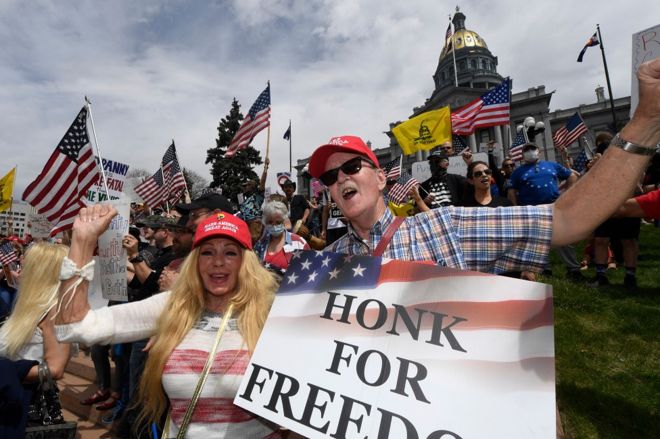
HONK FER FREEDUM

Coronavirus: the US resistance to a continued lockdown

I want to understand the argument.

I don’t. And it’s vital that we understand the argument, even if we don’t agree with it; agreement is not necessary, compromise can be reached, solutions can be found even if we don’t agree.

But if we don’t understand? Then what do we do?

“We believe that the state governor has gone beyond his constitutional authority in shutting down businesses and ordering people to stay at home,” organiser Tyler Miller tells me from the grounds of the state capitol.

In mid-March Washington Governor Jay Inslee announced an emergency proclamation mirroring many issued around the world; closing restaurants and bars and banning large gatherings.

But protestors say that was unconstitutional.

“The state constitution says that the right of the people to peaceably assemble shall never be abridged. We believe that the (emergency coronavirus) proclamations that the governor here ordered violate that,” Mr Miller says.

Mr Miller said he was not protesting against the recommendations from the public health bodies and respected the need to ‘flatten the curve’.

“I even self-quarantined for 14 days back at the very beginning of this myself, when I had an illness that mirrored some of the symptoms,” he says.

“The fact I am protesting does not mean I think it is a good idea to have gatherings, I just believe that the government has no authority to prohibit them.”

Throughout the crisis, Mr Miller has also been able to continue his work as an engineering technician with the navy.

He says the thing that has angered him is what he feels it is an un-American overreach of power by the Democratic governor of Washington.

I don’t understand that argument.

There is a simpler argument, which is just that people are getting desperate: the country has been shut down in places for more than a month now, and people are facing another rent payment, another car payment, on May 1st, this coming Friday. I understand that desperation, that anxiety; I understand and (mainly) support the desire to let government officials know that you need and demand action. I think it’s a mistake to violate social distancing guidelines, and there are people in the article above and others I have seen who say things like “I have a strong immune system, I take care of myself,” who I think are somewhere between ignorant and idiotic: ignorant if they don’t know that Covid-19 has killed young and healthy people as well as older, sicker people; idiotic if they believe unfounded statements (Mostly from conservative “news” sources) that the novel coronavirus is no worse than the flu.

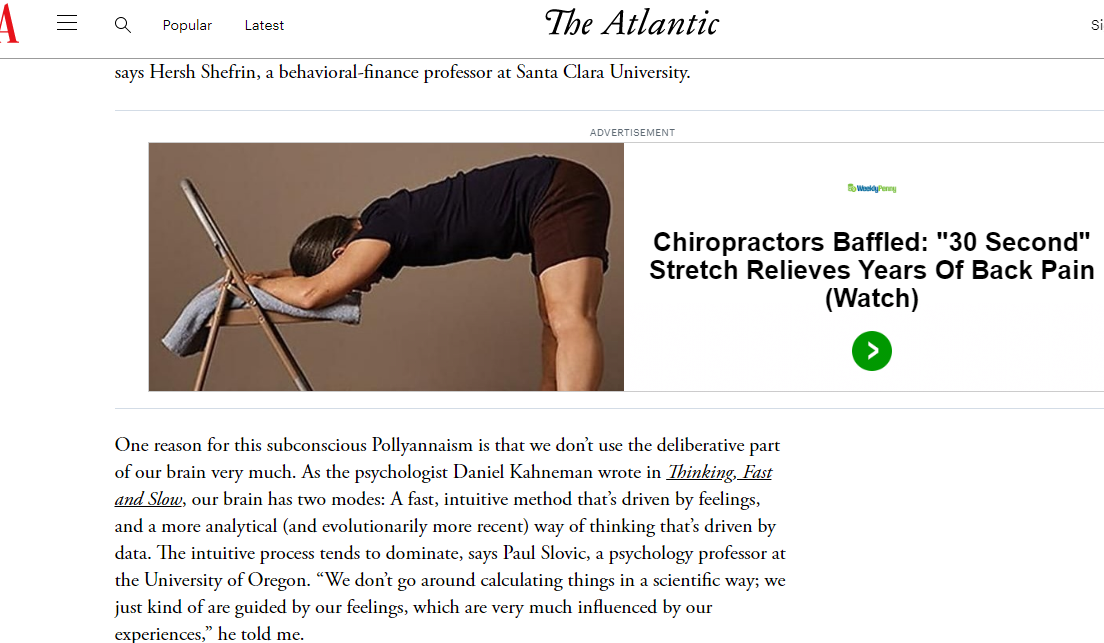
(This may be too harsh: this is an interesting article about how we are wired to be intuitive, and so underestimate the evidence that comes from outside our experience. I know I was telling my students in March that any shutdown of schools would only last a couple of weeks and would certainly not affect their graduation. On the other hand, I am not saying the same thing now, because I have learned better; I’m not sure why these people haven’t, but my two options above are certainly possibilities.

(Also, this ad popped up in that same article about people being too optimistic. Lol.

Screenshot (6)

(If you believe not only that a miracle stretch relieves years of back pain, but also that chiropractors are stunned by it, AND that chiropractors are the authority whose stunning represents a medical breakthrough, then you are unquestionably in this overly-optimistic bunch.)

But while I understand and sympathize with people who are desperate to get back to work and pay their bills, and I believe (and am infuriated) that the federal government has once again bailed out large corporations with deep political donation pockets and left average citizens to twist in the wind, I don’t understand the other argument. The freedom argument.

I don’t think it’s a reasonable argument.

Listen. I worry about government overreach. I won’t say I’m learned in history, but I know about the Japanese internment camps during World War II, and I know some things about the rise of the various authoritarian dictatorships that plagued the 20th century. I have hated the USA PATRIOT Act since it was imposed on us, during the paranoid jingoist nationalist fervor that swept the country after 9/11 and swept us into a neverending war. I know that it gets renewed every time it comes up because the government doesn’t like to give away power that it has seized. Because of that experience, I have been pointing out to my friends who argue against the lockdowns that the thing we need to worry about is the powers the government arrogates to itself after the crisis: the new regulations and limitations, and invasions of citizens’ rights, that follow a partial return to normalcy, and that are intended to prevent this kind of thing from ever happening again. We have to watch out for the permanent changes, or for the attempts, often subtle and underhanded, to make temporary changes permanent.

I don’t doubt those will happen. I think the first attempt will be by President Trump, when he decides to make his temporary limit on immigration permanent.

But see, I think that because Mr. Trump has a long history of a clearly established position to end immigration. I think that because I have read reports that Trump’s anti-immigration advisors have talked about this pause into something more long lasting. Because this article quotes DHS acting secretary, Chad Wolf, as saying to Fox News that

his agency will soon recommend a move to limit temporary work visas as well.

“That is something that the department has been looking at for the past several months, so we are well underway and look forward to presenting to the President those recommendations for additional steps,” said Wolf.

So there’s your government overreach, as part of an established pattern of behavior, aiming at known long-term targets. After the fact. Once the danger has passed. The current actions are not government overreach: they are government responding as government should to a crisis. The stay-at-home orders were issued during a crisis, and in line with scientific facts and the advice of experts. This is exactly when, and exactly why, people’s rights can and should be limited. We have the right to protest, but if you decided to walk into a burning building in order to protest the fire, people would stop you: and they would be right to. We have the right to freedom of speech, and of assembly, but you cannot gather with an army and plan the destruction of the United States: the right is to peaceably assemble, and free speech does not include sedition or criminal conspiracy. Individual rights are not limitless, not under any circumstances; even the most libertarian of us would state clearly that one person’s rights cannot be permitted to infringe on another’s, that your right to swing your fist stops where my nose begins. And of course individual rights are limited in an emergency, because the free exercise of one’s rights puts others into danger.

This is what government is for: to protect people from danger. Now, if you want to argue that the coronavirus is not that dangerous, then you’re in the wrong place. Start with this.

Then read this.

Then read this.

Then read this. 

(Especially that last one; it’s about the infectiousness of the coronavirus. And lest you think that the infectiousness of Covid-19 is lower than SARS or MERS, both of which caused fewer problems and killed fewer people, go back and read those other articles again, and then also pay attention to this quote from that last article:

“An R0 value of 1 means the average person who gets that disease will transmit it to one other person; in that case, the disease is spreading at a stable rate. An R0 of more than 1 means the disease spreads exponentially.”

And then read this essay about exponential growth.

Okay? Okay.

As I said, the government has the right and the responsibility to limit individual freedoms in response to a crisis, in order to protect the people from that crisis. (I’m aware that some people don’t agree with this: some because they don’t think the coronavirus is a crisis, and if you still think that, go back and read the above articles, but this time with your eyes open; and some because they think that nothing should ever limit individual rights under any circumstances: my above examples of protesting inside a burning building, or convening an army to overthrow the US government, are just fine, for them. I will be writing another blog about that. I’ll let you know when it’s done. The important thing is that, while I don’t agree with that argument, I understand it.) I think, though, that the basic argument behind the protests, the reason that President Trump tweeted support for people trying to “liberate” the states that have both lockdown orders and Democratic governors, is that the government is not trying to protect people from the crisis: the government is trying to control people. To take away their freedom. that’s the argument I don’t understand.

(I am also not going to write here about the elephant in the room, namely the upcoming election and the similarities — remarked on in the BBC article I linked first — between the anti-lockdown protests and Trump rallies. People who are going to the rallies just to support President Trump are certainly not reading this, and are not worth the time to put forward an argument. President Trump is probably trying to use the rallies as a way to hype his base up for the election, but he also said that he thinks Georgia Governor Brian Kemp is opening his state too soon, so I’m not going to jump on Trump today. We’ll see what happens tomorrow. Also: I understand this argument.)

But here’s the thing with tyranny: it makes sense. There is reason behind it.

That’s what’s missing from the freedom argument of the protests.

Break it down. Think it through. Okay, the government — pardon me, the govment (Read this article that I wish I wrote) — limits people’s rights to assemble and move freely, to run a business and participate in the free market economy. Because they want to establish tyrannical control over the free people of these United States.

Why?

I understand that the government has taken on, for most of the people who support these protests, the aura of Darth Sidious and the Sith: evil just for the sake of evil; power hungry just for the sake of power. But, see, that’s a character from a movie franchise, and it’s not a realistic one. I admit, if the Democratic governors were trying to raise a clone army from a mysterious source; or they were trying to corrupt a Jedi knight with incredible power but terrible self-control, then I would see the danger.

Why would the Democrats, or the government in general, want to lock people inside? I saw someone argue that the Democrats exaggerated the danger of Covid-19 in order to justify the lockdown expressly so they could destroy Trump’s economy, because that’s the only way they could beat him in the next election.

Come on.

(An argument I have seen but will not be rebutting is that Andrew Cuomo of New York exaggerated the need for ventilators so he could get…a huge excess of ventilators. Sure. As you do. He’s going to put them in one huge room and then go swimming in them like Scrooge McDuck. Swimming through the ventilators.)

First of all, there’s no way that an economy ruined by Democrats would be pinned on Trump. Trump is already positioning himself to argue that it was the Democrats who did the harm in this crisis. (Elephant in the room…) If this is provably true, if Covid-19 is really not that bad and the Democrats have exaggerated the danger, we’ll know it before November, and this Dem gambit will fail. Secondly, and more important, if they ruin the economy, they not only have no hope of winning the next election, but they lose access to the money. If  the Democrats, or the government in general, are corrupt,  they want money. Money does not come from enforcing a stay-at-home order. We are all losing money, including the government. I know they are flinging money around like it’s meaningless paper (…), but there is a limit to that because at some point the economy will actually collapse, and the more they spend now the closer that outcome gets: and why would anyone in power want that? To destroy the economy that underpins the entire system they are ostensibly seeking to control? Nonsense. There are people who want the government and the entire society to collapse, but they are not the ones in power: they are the ones without power. That’s why they want the system to collapse, because they don’t currently gain from it. The ones in the system, the Democrats in Washington and the state capitals, very much want this current system to survive, even if they are corrupt, because this system is how those corrupt people get what they want. The corrupt actions the Democrats take (And yes, many Democrats are corrupt; not all of them or only them, but yes they are.) are clearly intended to increase their wealth and their ability to stay in their current positions so they can continue increasing their wealth. That’s why we still don’t have term limits or meaningful campaign finance reform. Nobody wants to make the money go away, least of all corrupt Washington politicians.

So what’s the reasoning? Because the Democrats are secretly anti-American communists? Okay, let me try to address the idea of Dems seeking power for power’s sake; I still think that sounds like the Sith, but sure, let’s imagine that they are simply evil and that’s their reasoning. Communists, or anyone trying to overthrow the government, would be trying to seize the reins of power. They would be going after the sources of power, trying to control those so they could then get the next source of power, and so on; it’s like Risk. You conquer territory that lets you conquer more territory. You don’t just act arbitrarily, you seek the means of control. In this country, the means of control are (in no particular order): violence and force; the ballot; information; and money.

Which of those things are the Sith-Democrats gaining through the lockdown? Not money; I already talked about that. (Sure, the government is giving money to corporations, who paid the politicians. But those corporations make more money in an open economy. The same goes for people arguing that the government is trying to make people dependent on government handouts rather than their own paychecks: the money will run out if the economy doesn’t open. then the system collapses and the people in power lose.) Greater control over information? If there are secret things going on that we can’t see because we’re all staying home, then I take all of this back and apologize; let me know if the clone army executes order 66, or the Final Order fleet rises from Exegol. Otherwise the press has not seemed limited by the lockdown, and I don’t really see how it would be; limiting reporters’ physical movements seems a loser’s gamble in a world of the Internet and drones with cameras. The ballot? I mean, we’ll see when the election comes, but at the moment, the lockdown seems to play more into Republican hands because it limits voters’ access to the ballot box, which tends to favor conservative politicians.

Does the lockdown give the government more ability to commit violence, more ability to use force against the people? I honestly can’t see how. I mean, I guess they could be trying to force us to obey so we get more used to obeying, so that the next time they give us an irrational and arbitrary order, we’ll obey just because that’s what we do now. But if that were the case, they wouldn’t be using Covid-19 as their cover. Because that gives us a reason, and that means they’ll need to have another reason, as good as this one, to support their next attempt to tell us to stay home: that progression only works with weaker and weaker justifications. Using a global pandemic is not a weak justification; quite the opposite. (And notice that even this one isn’t working…)  Read 1984: O’Brien wants Winston to not only tell him he sees five fingers, he wants him to actually see five fingers; and that’s the only reason Winston gets for the months of torture he undergoes. He is very intentionally not given a reason to obey Big Brother: he just has to do it, or else he suffers. In this case, if we don’t obey, it’s not that we suffer the wrath of the government — it’s that we get sick. (And this is true.) If you want to create a totalitarian state, you need to create loyalty to the state without reason: loyalty to the state based on an emergency doesn’t cut it. Because the loyalty ends when the emergency does.

Now: if this lockdown turns out to continue past when the virus disappears. Or if the virus doesn’t disappear, either because the press is controlled and doesn’t report the true numbers of the disease (And I know people think that is happening, but I’m talking about the press saying there are thousands of cases when there are none, not the medical authorities miscounting the thousands of cases that are in existence; if anything we are undercounting the actual cases, and we all know it.), or because the government takes actions that continue the spread of the coronavirus (I mean, maybe tweeting support for protests that seem to be increasing the chances of the disease spreading would qualify as that?). Then I will agree that this is an attempt to establish tyranny. But you see what the actually despotic actions are there? Enforcing control over freedom of movement when there is no crisis. Controlling the press. Actually using biological warfare, directly or indirectly, against the people. Those are tyrannical actions.

Asking people to stay home is not tyranny. It’s concern. Even if you think it is unfounded concern, I don’t see any reasonable way to argue that it is anything other than concern.

But you know what really concerns me?

People are acting based on this argument. This argument that doesn’t seem to have any real rational basis. It honestly seems to be just “You can’t tell us what to do. Not even if it’s in my best interest.” Rebellion for rebellion’s sake. Cowboy shit. Cowboy shit that has no particular goal, no particular target; it’s just people wanting to act like cowboys. Rebels. March and wave flags. That doesn’t make any sense: but people are still doing it.

The fact that I can’t figure out the argument doesn’t concern me as much as the fact that people seem willing to act even though they don’t understand why they are acting. That’s irrational.

I don’t know how to argue with irrational people.

Even worse, I don’t know how to live in the same country with them.

People say this country is founded on the rule of law, or on the Constitution, or even on the will of God; none of that is true. It was founded on reason. The argument for the Constitution and the rule of law is reasonable, it is rational; it makes sense. The way the Constitution sets up our government is rational, every aspect of it. Hundreds of reasonable people argued — argued! Gave reasons and explanations! Appealing to the intellect of their opponents! — for years to write it. Some of the arguments were wrong, and some of the beliefs were wrong; the people making the Constitution were imperfect, and had some bad reasons, which should give way to better reasons over time — but that’s the system they set up, one in which better arguments, better reasons, will win out over worse ones. It’s all founded on reason.

The country can live through any danger, even the coronavirus. But it can’t live through the death of reason.

That’s what scares me. That’s why I want to understand, because if I can understand, I know that my opponents, even if they are wrong, are still listening to reason, and that means there’s hope.

I hope I can understand.

This Morning

This morning I’m thinking about the Constitution. About the Second Amendment.

“A well regulated Militia, being necessary to the security of a free State, the right of the people to keep and bear Arms, shall not be infringed.”

I have thought about this particular sentence quite a lot over the years. I’ve shifted my position on this several times, generally in the same direction; not because the side I’ve shifted towards is entirely right (Though it is the right-wing position, the conservative position, that doesn’t make it the right-minded position), but because I came into this debate with a pretty extreme view.

See, I was raised to hate firearms. Violence of all types, certainly, but firearms in particular. My mother, a nurse and a pacifist and the kindest person I have ever known, never even let me have a BB gun, no matter how many times I watched “A Christmas Story.” There was one occasion when I was about 8 or so when our family went over to visit friends for dinner; my mom and dad liked this couple quite a lot: he was a computer guy who worked with my dad, and she was a ceramic artist. They all got along great — until Ben, the husband, showed my brother Marvin and I his pistol. I have a clear recollection of the gun — a revolver — being entirely unloaded, the cylinder open with no shells in it; I remember him letting us hold it. And I remember my mother coming in the room and finding us there holding a gun.

We never saw them again. Not only didn’t go over to their house, but we never saw the Kirchners again. I think my mom saw Mrs. Kirchner at some point, because we had a number of mugs that she made; but we never saw Ben after that.

So I’ve never been in a fight, and I’ve never gone hunting, and I’ve never killed an animal larger than a mouse, and I’ve never fired nor even held a gun past that one time when I was eight. I remember being in an online debate when I started taking this topic on, and my opponent accused me (as online debaters — read “assholes,” including myself when I debated online — are wont to do) of being a hoplophobe, someone who is irrationally afraid of firearms (Please note that this is just a politically charged insult recently coined, like “snowflake” or “soyboy” or that kind of bullshit.). And my response, which stunned the asshole who threw the word at me, was, “Yes. Yes, I am.” I did add the clarifications that I was afraid of people wielding firearms, not of the weapons themselves, and that this fear was not in fact irrational.

The response was basically that I should get a gun and learn to defend myself like a man.

This is a bullshit argument.

But it’s not actually the argument behind the Second Amendment.

Let’s be clear: the Second Amendment has been misinterpreted (in my opinion) by the courts, and even more by the general populace. It does not define the right to self-defense: there is no need to define and protect the natural right to self-defense, because self-defense is never a crime. But I don’t believe there is a guarantee in the Second Amendment that an individual has a right to, needs to, or even should, have a gun for self-defense.

The Second Amendment is also not in any way a defense of hunting or target shooting or collecting firearms to display in your home. None of those are rights. They’re amusements, hobbies; you have no right to a hobby. “But Dusty, what about people who hunt for food?” Well actually, you don’t have a right to food, either. People should have food, and it makes sense for us as a country to ensure that people have food and the ability to get food; but we do it because it makes sense, not because it’s a right. If it stops being sensible to provide food — let’s say we all voluntarily go into the Matrix, and survive on pink goo pumped directly into our gastrointestinal systems — then the provision of food will stop, without any violation of rights.

Let me explain a bit before I go too far into the weeds. The Second Amendment states that the people — not a person — have the right to keep and bear arms, in order to defend the security of a free State. The implication is that the main threats to a free State are external: I think that’s the “security” line. If it was primarily about the defense of a free people from the state, then it would say something more like “to ensure the integrity and continuation of a free State.” But I don’t mean to be one of those people who parse every word of the law in order to determine what the point is: I don’t actually idolize the Founding Fathers, and don’t think that their intentions should be the deciding consideration when trying to interpret the Constitution. I think we should look at what the document is really supposed to do, not necessarily what the men who wrote it wanted it to do.

The Constitution is intended to create and preserve a nation based on the rule of law, and not the whims of men. Laws need to be interpreted and executed by people, so our opinions have some importance; but the defining, essential purpose of the Constitution and the Founding Fathers was to escape and prevent the tyranny of powerful men.

You know how you escape the tyranny of powerful men? You spread power out as much as humanly possible. You create separate but equal branches of government, with checks and balances. You ensure that, as much as possible, the people who run that government are beholden to the masses, through the power of the ballot. (It’s probably a good idea to ensure that the people who are in charge of the actual laws are not quite so beholden to the people, but rather to the law itself — but that’s a different topic.) And because physical force is a source of power, you spread out the physical force as widely as possible: you don’t allow it to concentrate in the hand of a few, or even, if you can manage it, in the hands of many: you put it in the hands of all. That’s what the Second Amendment does, and what it does is right to do: the wider the dispersal of power, the less likely power is to be abused.

I do think the Second Amendment is intended partly to ensure that the people stay free and are able to defend that freedom against a rising tyranny in their own government. But it’s not that specific: it’s intended to create resistance to any gathering of power. The Ku Klux Klan have less power when the Black Panthers have rifles: it’s really as simple as that.

That means that we need to have the right to own firearms, as firearms are the most powerful individual force-multiplier we people can own. Tanks would be better, and an entire air force or navy owned by each individual WAY better; but that’s not feasible.  Anyone can own a gun, and a person with a gun is more deadly than one without. That’s why the Amendment defends the right to keep and bear arms. That does also imply that we should have the right to defend ourselves from personal harm using firearms. It makes sense: the point of maintaining a free State is so we free individuals can have a place to live; therefore the purpose of defending a free state also encompasses defending a free individual. Also, not to get too silly, but you can’t defend the state if you get killed by an intruder in your home.

But here’s the thing: there’s nothing in the Amendment, neither the wording nor the logic, that implies that we should not require background checks on every single purchase of a firearm. And a national gun registry of every owned or manufactured firearm. And red flag laws that allow the removal of firearms from dangerous individuals. And mandatory firearms training and testing, just like we have for motor vehicles. And limits on types of firearms (To some extent — there should be a limit on the limits so that the limits do not become a de facto ban), and on magazine capacity, and on everything else that we see fit to regulate. See, the goal here is to ensure that power is spread out: not that power has to be granted and defended for every halfwit who can pull a damn trigger. Not that the power has to allow one sovereign citizen to take on the military, or even the police, and win. The arguments against regulation are all predicated on the (rather paranoid) idea that the main purpose of the Amendment is to limit the ability of the federal government to control people, and that’s just not the case. Anyone who is a threat to us needs to be controlled, primarily by the limiting of power in the hands of those who are a threat. Note that: if we fear the rising power of the Federal government, then clearly the answer given by the Constitution is to limit that power, not to rise up against it. The worst case scenario is that the people will need to overthrow their own government, but the Amendment isn’t the plan for that; the Amendment is part of the plan for preventing that.

Our ability to own firearms is one thing that helps keep the government from the most simple and brutal sort of tyranny (And it really does do that, and I think I’ll have to talk about that at greater length on another day; the topic is too complex for a single post); but to keep us from turning our power on each other (And to keep the citizens from turning their power on the government for corrupt reasons, too; let’s not forget that. Let’s not imagine that most revolutions are idealistic and freedom-loving.), well — that’s why it says “Well-regulated.” Right there in the front of the Amendment. Even before the “keep and bear arms” part.


I think this will have to be continued.