Tread All The F$%^ Over This

(To Secretary DeVos, Part II. Part I Here.)

It starts with the tests. It always starts with the tests. But really, it isn’t just the tests: it is the very concept of “accountability.” Accountability says that we need to have paperwork — data — that shows that our schools are accomplishing what they are supposed to accomplish, and that the teachers are doing what they are supposed to be doing, and not something else. Accountability is founded on the idea that we don’t trust teachers. We think — because sometimes it’s true — that teachers are in it only for the paycheck, that they don’t care at all about the students who pass anonymously through their room.

We all have that story, right? Of the teacher that taught exclusively through movies and worksheets? I’ve known several (Though honestly, I never had one when I was in public school.) at the various schools where I’ve taught: there was the health teacher whose entire curriculum was canned, who showed his students videos four days a week and then tested them on the videos on the fifth. There was the math teacher who, every single week, Xeroxed the next chapter out of his textbook and handed it to his students while he sat at his desk and read the newspaper. Yeah, I’ve known those teachers. And I think those teachers should be gently pushed out of the profession. Or maybe not that gently: because the harm they have caused to my profession is entirely out of proportion to their actual sins.

They brought the idea of accountability to the fore. From lazy bastards like that, we got the idea that there are many teachers who don’t work very hard. And in order to satisfy those who insisted that this was a serious threat to our children’s futures, lots and lots of people agreed to ensure — ACCOUNTABILITY.

And so we get testing. And it’s funny, because everybody hates testing — students hate it, parents hate it, teachers fucking loathe it: but everyone likes, or at least accepts, the idea of accountability which drives that need for testing.

I had a meeting last week. An all day meeting, with all of the English teachers in my — my company, I guess it is; it’s a group of charter schools here in Arizona, some in Tucson and some in Phoenix. It’s a private corporation that runs these schools, though they are public schools, so yeah: my company. (Which means, of course, that I and my fellows are precisely what DeVos wants teachers and schools to look like; except that we collect our money from the state, instead of from tuition or tax vouchers. Down, Voucher, down! Gooood Charter.) And in this meeting, the biggest complaint was about our current testing system. We bitched about it for hours. Literally. Killed the whole meeting agenda. Hey — English teachers, we got a lot to say. Especially about standardized testing. And don’t get me wrong, it’s a stupid testing system, no question. And the consensus was that we should get rid of the clunky thing.

But.

All of them wanted to replace it. With a different system, that would work better. One that would allow more essay tests, for instance, and that would follow our curriculum more closely. (Even though the curriculum is shitty. Know what the selling point for this curriculum was? It was made by other teachers. So it must be good. But it’s not. It’s shitty. But it’s ours, and we plan to follow it. And find a testing system that will align more closely to it. More on why the curriculum is shitty below.)

I don’t know if I was the only one who thought this, or if everybody else was just saying what they were supposed to say, but: I kept thinking — why do we even have a testing system at all? Why do we need to assess student learning? I mean, in theory we’re supposed to do it so as to make teaching more efficient: we learn what students know, and then we know what students need to learn, and then we teach that. That and, of course, accountability: because while the teachers are figuring out what the students know, the administrators and the politicians are using what the students know to determine how well the teachers are teaching.

Except that never works. Tests don’t show everything a student knows. The various members of any given class never know the same things, never need to learn the same things. In theory I’m supposed to differentiate instruction so that each student learns only and precisely what he or she needs, but of course that’s a joke: that flies in the face of public schooling, which is built around the idea of efficiency through mass instruction: I teach 100 students so that we don’t need 100 teachers. But that only works if I can teach 100 students basically the same thing. And I can’t even do that, because not all of the students care, or are interested, or see the value in it; not all of them like me and want to work with me; not all of them are present regularly, and not all of them are sober when they are present, or when they take the tests. And it’s even more skewed because they are sick, to death, of testing. I give them a test to find out what they know, and what I find out is: they know they hate tests. They stop trying about halfway through, and start guessing — if they didn’t start guessing from the outset. And there is nothing I can say that will change that. Somewhere, many years ago, a student guessed on a test and got an A, and every student who doesn’t care has been trying to replicate that feat. And not caring when it doesn’t work, because at least they didn’t put in much time or effort. And if they get a failing grade because of the test (Which is actually a bad idea, the administrator in my meeting told us: because the tests are designed to assess growth, and growth can’t be given a letter grade because letter grades show achievement, not growth [Example: I know everything my 10th graders need to know. If I take the test at the beginning of the year, I will score 100% achievement. When I take another test at the end of the year, I will show 0% growth — because I’ll score another 100%, because I already knew everything. So what’s my grade, the 0% the test says? Or an A+ based on my knowledge of the concepts?]. Which is funny, kinda, because my school administrators told me to make the test score a grade in the class, in an effort to get students to take the test more seriously. Didn’t work. Because:), they don’t really care because they’ll make up for the grade somewhere else, or else they’ll just live with a C as their final grade in English this year. Who cares? Not them.

So then you want accountability, right (Well, not you, but somebody sure does)? So how well am I teaching? Let’s say — because this actually happens a whole hell of a lot — students like my class, and they learn a lot from me; but they’re not too concerned with grades, and they hate standardized tests. So they intentionally blow it off as something of a protest, and shrug when I give them a bad grade — and then go right back to really learning, really thinking, really getting everything I’m trying to help them achieve. What’s my accountability score? Am I a rocking teacher for getting kids who don’t really care about school to pay attention and learn? Or am I a shit teacher for not getting good test scores out of them?

My answer is different from my school’s answer.

So there’s the thing, the main thing, that I am willing to see destroyed by Secretary DeVos if she manages to pull down the public education edifices in this country. If she wipes out standardized testing and the need for multiple layers of accountability, I will be ecstatic. I would like my school to know what I teach, how well I teach it, because they come and watch me teach. Frequently. Because they read my students’ papers, and see the comments I put on them. Because they talk to my students about what they learn, and their parents about what their kids have talked about this school year. On all of those measures, I’m a goddamn rock star. I would love it if DeVos pulls down the enormous wall of tests and lets people see what I can actually do. I would much, much rather be transparent, than accountable.

There’s more, too. The desire to make sure every school teaches the same thing, to ensure that every kid has the same access to the same learning, that everything bloody “aligns,” is a liberal obsession. It leads us to the Common Core, and standards-based education. Which is a goddamn joke, almost on the same scale as testing. Because here’s the thing (And it’s also a large part of the issue with standardized tests): who decides what the students need to learn? That’s the critical question about standards, and it never, never gets asked. But it has to be asked, because the ends determine the means: if I have to teach critical thinking, it’s going to mean a different class than if I have to teach grammar, which will be a different class from the one I teach to create cultural literacy.

So who decides? If it’s teachers, then you can expect to never actually get a working document: because every single person who teaches — who really teaches — a subject is going to have different ideas about the best way to do it, and the precise goals one should be aiming at when teaching that subject. Me, for instance: every English student needs to read Fahrenheit 451, and understand tone and symbolism in poetry. They have to do independent reading, and they need to write personal essays. They don’t ever need to study grammar or read any Victorian literature. There, see? I just caused every English teacher reading this to roll their eyes, and/or drop their jaws in shock. And when they come back and say every student simply MUST read Dostoevsky and the Brontes and diagram sentences, I’m going to puke black bile and India ink, just for them. No, that’s too gross. I’m just going to say No. Not in my class. Not ever.

So who decides? Easy: businesspeople decide. The ones with the money. They hire think tanks, who hire ex-teachers, who say whatever the businesspeople want to hear about what schools can do and what they should do. Because they are ex-teachers. What they hell do they care about what bullshit teachers have to put up with? They got out of the game already! Then those businesspeople bring their information to politicians and say, “This is what the business community thinks their next generation of workers should know. Don’t worry — we asked teachers, and they said all this was solid gold!” And the politicians, hungry for campaign contributions (“Did someone say gold?!?”) and eager to say they helped kids be ready for gainful employment, mandate that all schools in the district/state/country have to teach this vital information. And then maybe — maybe — some teachers sit down and talk about how they could teach that stuff. And they promptly disagree about everything, at which point the school district/state/federal government hires consultants: the ex-teachers who work for the think tanks. And they come and tell us, “It should be done this way.” And the teachers either think, because they’re like me, “All right, bro, but I’m still going to teach Fahrenheit 451 and tone and symbolism in poetry.” Or if they’re like most teachers, who were A+ students and still want to get gold stars, they think, “Okay, well I’ll try that and see if it works. I want to do what’s best for my students.” And there are the consultants, patting them on the shoulder and saying, “Trust me: this is what’s best for students.”

The first part of this process, up through the politicians, creates the Common Core. The second part, with the teachers, creates Engage NY. And the politicians love Engage NY and the Common Core because they make the businesspeople happy, and they mandate that all schools have to teach using that curriculum (or something just like it with a different name), and teach those standards (Or the same standards with a different name — like, say, the Arizona College and Career Readiness Standards, or AZCCRS.). Then they buy a testing system that aligns with those standards and that curriculum (And any liberals involved say, “Well, good, at least every student is getting exactly the same education and the same set of standards! That’s fair!”), and mandate that schools must achieve high scores or the state will impose sanctions. And then the Galileo company comes along and says “Use our test for practice, because then your students will get higher test scores on that state test!” And the administrators, who also have no idea of nor interest in what gets taught and how, buy the Galileo testing system because it’s cheap, and then they tell teachers that they have to do whatever it takes to raise student test scores on Galileo, because, they imagine, that will get students to do better on state tests (Because it aligns! IT ALL ALIGNS!), which will please the politicians, because it pleases the businesspeople. And so teachers — give up. And teach to the test. Because we can’t change the damn system, and we can’t escape it, and we might as well earn a decent paycheck, for once.

But we don’t, because the businesspeople also got the politicians to cut their taxes and cut spending, which means there’s less money for schools; and then they break teachers’ unions, and there’s nobody asking for more money for teachers, or trying to shift the focus off of testing and the Common Core.

All of that, Secretary DeVos. Kill the Common Core and all standards-based curricula, and let me decide, based on what I know and what my students want to know and need to know, what I should teach. Wipe out standardized testing, because if I want to know what my students know, I will assess their knowledge and ability in some way that makes sense: I will assign an essay, and I will read it. And you all can read them, too, if you want; (But only if Mrs. DeVos kills FERPA, the law that prevents teachers from allowing students names and grades to be public information, and which therefore keeps us from publishing student samples — even though one of the very best ways to learn is to read what other people just like you have written.. Please kill FERPA, Mrs. DeVos.) or you can ask me how they’re doing, and I’ll tell you. Because I will know. That’s actually my job, you know. And while you’re at it, lay off 2/3 of the administrators, from assistant principals to superintendents: at least 2/3 of all of the administrators that I have ever known have been even more incompetent and unqualified to run a school than — well, than you, Secretary DeVos. And that’s saying something. The other 1/3 have been outstanding: I would be happy with just those outstanding people running the school. And if you got rid of common curriculum, standards-based learning, standardized testing, and FERPA, then 2/3 of the school’s paperwork would disappear, and we wouldn’t need nearly as much middle management to handle it. Oh — and wipe out 504 plans and IEPs, would you? I have never yet had one of those things actually change the way I teach. Because if a student of mine has a learning disability or a challenge of some kind and they need extra time or extra help or a different standard of achievement, you know what I say? I don’t say, “Where’s your documentation, buster?”

I say “How can I help?”

Because I’m a teacher. Because I’m a good teacher.

So keep me, Mrs. DeVos. And if my colleagues are not good teachers, you can find out by talking to their students and parents, and watching them teach and talking to them about what they’re teaching; and then, by all means, fire them. Go out and find better teachers. Shit, if I’m wrong and I’m actually a terrible teacher, who’s been able to hide in the chaos and paper-smothered madness of modern education, then fire me, too. Find new people with new ideas and interesting subject matter. Let them make up classes — why does it always have to be math and science, history and English? Why can’t there be a class on video games? If it teaches critical thinking, analysis, problem solving, and good communication, who cares if it’s never been done before? Who cares if there isn’t a test for it? Let’s see if it works!

It certainly can’t be worse than the system we have now. Which, as long as you do it carefully and thoughtfully, feel free to break into smithereens. I’ll help.
Caveat

*world's


Caveat Emptor, they say. Let the buyer beware.

I want to add a caveat: Caveat Magister. Let the teacher beware.

There are a lot of problems and difficulties, even hazards, in being a teacher; someday I’ll write about all of them, and why people should — or, more likely, why you should not — go into teaching. But right now, I want to focus on only one problem. It’s tempting to say it’s the worst or the most serious, but it may not be; what it is, though, is the source of a great number of difficulties that teachers face, on a great number of fronts.

It is this: very few people understand what we do.

Please don’t add a new misunderstanding: I am not complaining “Nobody unnerSTANDS me!”; I am not feeling a black, absinthe-scented drizzle of angst slipping icily down my spine; I am not currently pouting. (All right, I’m pouting a little. But it’s because I’m hungry and yet I have to wait for my lunch to cook. Where the hell is my Star Trek replicator? Or maybe those instant food-pills they had on the Jetsons? Hell, right now I’d take the fat-making shakes from Wall-E.) The issue is not that being misunderstood makes us sad. The issue is that being misunderstood, because of the way we are misunderstood, means that our job, the task of teaching, becomes impossible, if one means to do it in any meaningful way.

The issue is this: at some point in the past fifty years (I’m looking at you, 1980’s) this country decided that all that mattered in life was income. Now, we are a democracy and a capitalist society, which means that we have always focused on money as motive: because in a free society, anyone can improve their lot in life; and in a capitalist society, one rises through wealth. Put these together, and you have a country where cash is the key to the kingdom, and here we are: in a world where we teach our children that they can be anything they want to be — and what they want to be, we tell them, is rich. But looking at our social institutions, particularly education, one sees the pervasive and controlling belief that education was good for people: good for the mind, good for the soul; not just good for the wallet. People used to fight for education; now they just fight it. College cost less, and taught more; K-12 schooling was more difficult, more challenging, more effective, more reasonable. Teachers were more respected, seen as experts, because what they offered was valuable in a larger, holistic sense — the way that religious leaders are respected, the way that doctors and law enforcement and firefighters are respected, because they offer something more than a simple exchange of goods and services for money: they give something that means something. Teachers used to be seen that way, I would argue. It is possible I am wearing rose-colored glasses.

But we certainly don’t think that way now. The predominant (though not the only) view of school is as a means to one very specific end. The progression goes like this: elementary school gets you ready for high school; high school gets you ready for college; college gets you a job. The goal is the job. We have a somewhat broader view of that end, because we want our children to have a job that is satisfying, and valuable, in addition to financially rewarding; but the crux of the biscuit is the number of zeroes in front of the decimal point at the end of the year.

My students think this, universally and uncritically. Whenever I ask them, “Why are you here?”, which I do with some regularity (Because I am fascinated by this and terrified, too), they joke that they’re here because they are forced to be (They’re not joking.). But then the serious answer, the one they think I want to hear and the one they parrot with eerily similar language, year after year, is this one. High school gets you ready for college, college gets you a job. They even have a similar cutoff of the pragmatic value of education: they all tell me that you learn skills and knowledge that are directly applicable and necessary in life until around 8th grade; then, once you know all the math and literacy you will need to get through your day, it’s all about the college-job-paycheck.

They think this because their parents think this. Their parents want them to do well, but mainly, they want them to be made ready for college, and to get into a good college, because a good college means you get a good job — a mediocre college means you get a mediocre job. Or at least, a good college means a better job.

And because the parents think this — or perhaps this is the reason the parents think this — the administration and the political system behind schools all think this. Our success is determined by our graduation rate, and inasmuch as we can follow it, the rate at which our students go on to successful (meaning well-paid) careers.

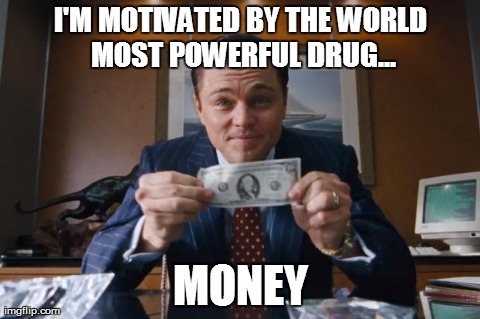
These aren’t bad goals, of course. The job you do matters, both to you and to society; and in this society, money talks. I do this job because I get paid to do it, and though there are times when I wish I could leave it, I don’t because I don’t know what I would do that I would enjoy more and get paid as much. And college was a prerequisite for doing this job. I even agree that most people get by on what they learned before 9th grade. That’s why they have so many problems spelling text messages. (Please note the meme above.)

But there’s a problem when you focus on the financial side to the exclusion of all else. When money is the only thing that talks. We see that in our national politics these days, when the wealthy get elected to represent the interests of the wealthy, and the rest of us just shuffle along behind hoping we don’t get trampled on by the sudden changes in direction. The problem in the predominance of money in education is this: when we keep our eyes on that particular prize, we blind ourselves to all else.

When elementary school is only intended to prepare one for high school, then all that matters is promotion through the grades. Parents pressure administrators, administrators pressure teachers, and students who aren’t ready get promoted, when twenty years ago, they would have been held back until they learned what they needed to learn — back when the goal was education and improvement, a goal that takes some people longer than others. Parents don’t care now if their kid is learning everything; they care if their kid gets promoted. Because elementary school isn’t what matters: high school matters. Because high school gets you into college and college gets you a good job, and nowhere in that equation does a child need to master the multiplication table. If a kid has trouble with math, well, he’ll go into a career that doesn’t need math. He’ll be a lawyer. He likes to argue. Besides, his brother is good at math. Can’t read, but he’s good at math. That one’s going to be an engineer. Probably with computers. Computers magically make something a good job, did you know? Yes: that’s why we have to have computers in school, now. Because kids need to learn the skills that are necessary in today’s economy. That’s why they’re in school.

So the children are promoted to high school. Now it’s time to get serious. Serious about grades, that is. Because the purpose of high school is to get into a good college, and so all that matters is the GPA. Sure, sure, they need to learn how to do the things they’ll do in college — and that’s the magical argument, by the way, which we all use, including me: they need to read this book because it’s the sort of thing they will do in college — but really, the focus is the grades. We trust the grades to tell us that the child is progressing properly, learning what he needs to succeed: the grades are all we need to worry about. And the same thing for the administration and the politicians, except you can replace “grades” with “test scores.”

I’ve never taught at the college level, but I have no doubt it is the same thing there: the second a child is accepted to a school, he is expected to know what his career after graduation will be — preferably down to the exact position he wants and the exact company where he wants that position, but at the least, a field of endeavor and a job class. And I am sure that everyone grumbles about the classes they are forced to take but don’t need for their career, just like they did in high school, just like they do in elementary school about the stuff they won’t need in high school or college, like learning cursive. And I am sure this myopic view of college as nothing but a series of hoops to jump through until you make lots of money has all the same deleterious effects as it does in K-12.

And what are those, exactly? What are the problems with focusing on promotion — grades — career? Only this: you learn what you set out to learn, gain what you intend to gain, from everything in life. And if all you mean to gain from school is getting out of school — then that’s all you get. I know: that’s what I got from high school. All I wanted was to be left alone. So I was left alone. It was college where I found that learning could expand my mind and make me into a person I liked more with every new thing I learned. College made me who I am. High school didn’t even make me ready for college, because I didn’t try to make it do that for me. I had friends who went to the same high school I did, who went on to far more intellectually challenging college experiences than mine, and into more — well, maybe not “challenging,” but I think probably more cognitively difficult careers than mine, and I’m sure that our high school prepared them better than it did me. Because they went there trying to do that. They focused on learning, and they learned. Garbage in, garbage out: and so with nothing.

There are other problems. The focus on promotion — grades — career moves resources and support into those areas, and not into others. If we need our students to learn more math in order to increase promotion rates, then we will focus on math, and drop art and music. Because after all, they don’t need art and music to succeed in high school or in college or in their careers. If students are having trouble in high school English, then we don’t add classes or more teachers to reduce class size: we dumb down the curriculum, restrict it to basic skill drilling. It doesn’t matter if they learn less, because as long as the curriculum focuses on easily mastered skills, they will inevitably get good grades, and that means they will get into college and we win. And thus we have Common Core, where the focus is on easily mastered skills, and which has been and continues to be pushed onto teachers so that students can get good grades and good test scores, and our graduation rates go up and our college attendance rates go up. Sure, our college graduation rates suffer; but that doesn’t matter to us here at the high school level, just as high school failure based on students coming in with below-grade reading skills doesn’t matter to the elementary schools that focused on promoting students no matter what the cost, because that is the only thing that matters to the administrators, because it is the only thing that matters to the parents, because all that matters in life is a good job with a big paycheck.

It’s not true. Of course future failure bothers teachers, but we have little control over this. I am, for the first time in sixteen years, teaching Common Core this year. Because that is what my administration told me to do, and because I now work in a school that has no tenure — because teacher’s unions are essentially non-existent in this Republican-controlled Right-to-Work state (A state of affairs that exists largely because teachers are not respected like they used to be, because all we do is give kids good grades and get them ready for college so they can get a good job, and then, when the child does eventually fail, because the entire system is broken, teachers make a handy scapegoat. And if it doesn’t sit right with your conscience to talk about teachers like they are all incompetent pinko hellspawn, because you remember your own teachers being good to you, well, you can always blame the teachers’ unions.) — and therefore I have to do what I am told if I want to continue earning a living. And so because my school focuses on grades and test scores and graduation and college acceptance to the exclusion of all else, I am told to teach a canned curriculum that focuses on improving basic skills in order to improve grades and test scores and graduation rates and college acceptance. And I do it.

And here’s what gets lost: novels. There aren’t any in my Common Core curriculum. Because the focus is on easily mastered skills, and because the tests that create the test scores do not require the completion of any full-length texts, just comprehension of short passages. Unless I change the curriculum in some way, I will not teach any full-length novels to my classes this year. No Shakespeare plays, except in excerpts. These students will not have the patience or the perseverance to finish anything that can’t be finished in one setting. I hope that they will learn it somewhere else, because they won’t learn it from me. But I know they won’t. (One quick note: I am allowed to change the curriculum. They will by god read To Kill a Mockingbird. And all of one Shakespeare play. But if I wasn’t the age that I am, with the experience that I have, and the curmudgeonly attitude, I wouldn’t change that curriculum. So what happens when a kid who wasn’t raised reading novels takes my place?)

Here’s what gets lost: our culture. I know it seems like America doesn’t have any beyond Disney and organized sports and bacon, but we do: we have Mark Twain and John Steinbeck and Emily Dickinson and Robert Frost and Toni Morrison and Maya Angelou and Ernest Hemingway and F. Scott Fitzgerald. People in this country read To Kill a Mockingbird and Catcher in the Rye and The Call of the Wild. Our schools have always taught those works, and that gives us something important, along with all of the wonderful gifts that come from making literature like that a part of you: it gives us something in common. It’s books like these, learned in school, for no other reason than because they are worth learning, that make us who we are and that keep us as human as we are, because they are the ones that teach us it’s a sin to kill something that doesn’t do any harm to us, and that we should stand on the edge of the cliff and catch those kids running through the rye, and that every life counts, even a dog’s. And I’m only focusing on the literature because it’s what I know, but you could do the same thing with art, with Norman Rockwell and Andy Warhol and Jackson Pollock and Frederick Sackrider Remington (No — I’m not making up that middle name.); you could easily do the same thing with music, or with film.

None of these things are part of the promotion — grades — career path. All of them are our culture. And if we don’t teach any of these things in school — and we don’t, because they don’t relate to our one overriding purpose for education — then we’ll have no culture left except for organized sports and bacon. And perpetual war, of course.

Toni and I just watched The Wolf of Wall Street last night. It’s about a guy who cared about nothing but money, and did whatever it took to get as much of it as possible, and then went about living the most worthless, hollow excuse for a human life I can think of outside of serial killers and the Inquisition. And the movie focused on that, for three hours, in excruciating detail. I have never seen that many scenes with hookers in my life. It’s a true story, based on an autobiography of the same name; the reviews online of the book (which I will not be reading myself) make the guy sound just as he was portrayed in the movie: as a guy who would lie and cheat and steal as much as he had to just to get more money to put on the pile, so that he could spend it on drugs and prostitutes and midget-throwing parties at work. (Not making that up, by the way.) Who would not regret anything in his life, because, in my opinion, he lacked sufficient humanity to know regret. All he knew was money. All he cared about was money. Now, because the movie was made by Martin Scorsese, it was not actually a celebratory movie: it was an expose of the emptiness of this kind of existence. And I have never felt happier about my life and my choices than I felt while I was watching this epic debauch. I am so proud of myself and everyone who helped me to become what I am — my parents, my wife, my teachers, my culture — that I care about things other than money, that I see money only as a means of survival and not of any source of self-worth or identity definition. I am so happy to be me instead of that shit-heel who called himself “Wolf.” I hope that was Scorsese’s intent, because if so, it was a masterful piece of work that was completely successful.

But I couldn’t help but think: if my students watched this movie, they would want to be this guy. Because he made money. And if I asked them, the next day, why they were in school, they would tell me “Because I want to be like the Wolf of Wall Street.” (I’ve heard similar sentiments in the past, but using Hugh Hefner as an example, or Bill Gates.) And that scares the hell out of me.

Caveat Populus. Let all of us beware.