The Rest of the Words

I keep not doing this: but I need to do this. Now, because there are always other things which I can write about, which I want to write about; this week I got into an incredibly stupid argument on Twitter, which is crying out for me to write a full-length takedown of my opponent; also, we had parent conferences, which opens up a couple of good discussions about students in general; also, I agreed to go to an AVID conference this summer, which means I can talk about AVID and conferences and so on; also, we had to pay money in taxes this year AND IT’S MY SCHOOL’S FAULT —

So there’s a lot I could write about.

But I need to write about this.

I already wrote about the beginning of Dr. Martin Luther King Jr.’s “Letter from Birmingham Jail,” but I didn’t write about the whole piece. Intentionally, because my essay was already too long, and the place where I stopped is important enough and valuable enough to receive the final emphasis of closing that piece with it; but now we need to talk about the rest of the piece, not least because it is still brilliant, nor only because it is still relevant to our society today, and the discourses we have around race and prejudice and equality and so on. Also because I said I would do this: and I need to keep my word.

So here we go again.

(One quick note: I have put some jokes in here, particularly in a couple of the links; I hope that doesn’t come across as too irreverent. Dr. King is and will always be one of my most idolized heroes. I just think that a little humor helps to get through an essay this long, with this much heavy subject matter. But I do apologize if any of the jokes hit a sour note.)

The First Essay

So the section I covered there goes to the end of the second page; I wonder how much of that length is intentional in that it seems like a piece that long and no longer could easily be reprinted in newspapers, but I don’t know. It also builds beautifully as an argument, leading to that conclusion. In any case, the next paragraph opens a new line of argument — though it is related, of course. This link shows another iteration of the letter, this one with a clear transition at this point, which I like.

YOU express a great deal of anxiety over our willingness to break laws. This is certainly a legitimate concern. Since we so diligently urge people to obey the Supreme Court’s decision of 1954 outlawing segregation in the public schools, it is rather strange and paradoxical to find us consciously breaking laws. One may well ask, “How can you advocate breaking some laws and obeying others?” The answer is found in the fact that there are two types of laws: there are just laws, and there are unjust laws. I would agree with St. Augustine that “An unjust law is no law at all.”

Notice that Dr. King continues the same tone and structure of argument, even after he has had this incredible cri de coeur about the African-American experience in the U.S.: he states their objection, and then turns it around on them. Willingness to break laws is a concern, you say? By gum, you’re right! You all should obey the Supreme Court’s decision to desegregate schools, shouldn’t you? But again, he offers this point about their hypocrisy in the politest possible way: by saying that it might be strange to see the civil rights activists doing the same apparently hypocritical thing, defending the law while breaking the law. But then he explains why the civil rights activists are not, in fact, doing anything hypocritical — and note that he uses “paradoxical” rather than the term “hypocritical:” because a paradox is only seemingly contradictory, generally from one perspective; there is another perspective by which it makes perfect sense (For instance, the paradox “To preserve peace, you must prepare for war.” It only seems like a contradiction; it actually makes perfect sense in a world where not everyone shares a desire for peace.): because there are two types of laws. King separates here the concept of “legal” from the concept of “just” — a distinction we point out again and again in our society.
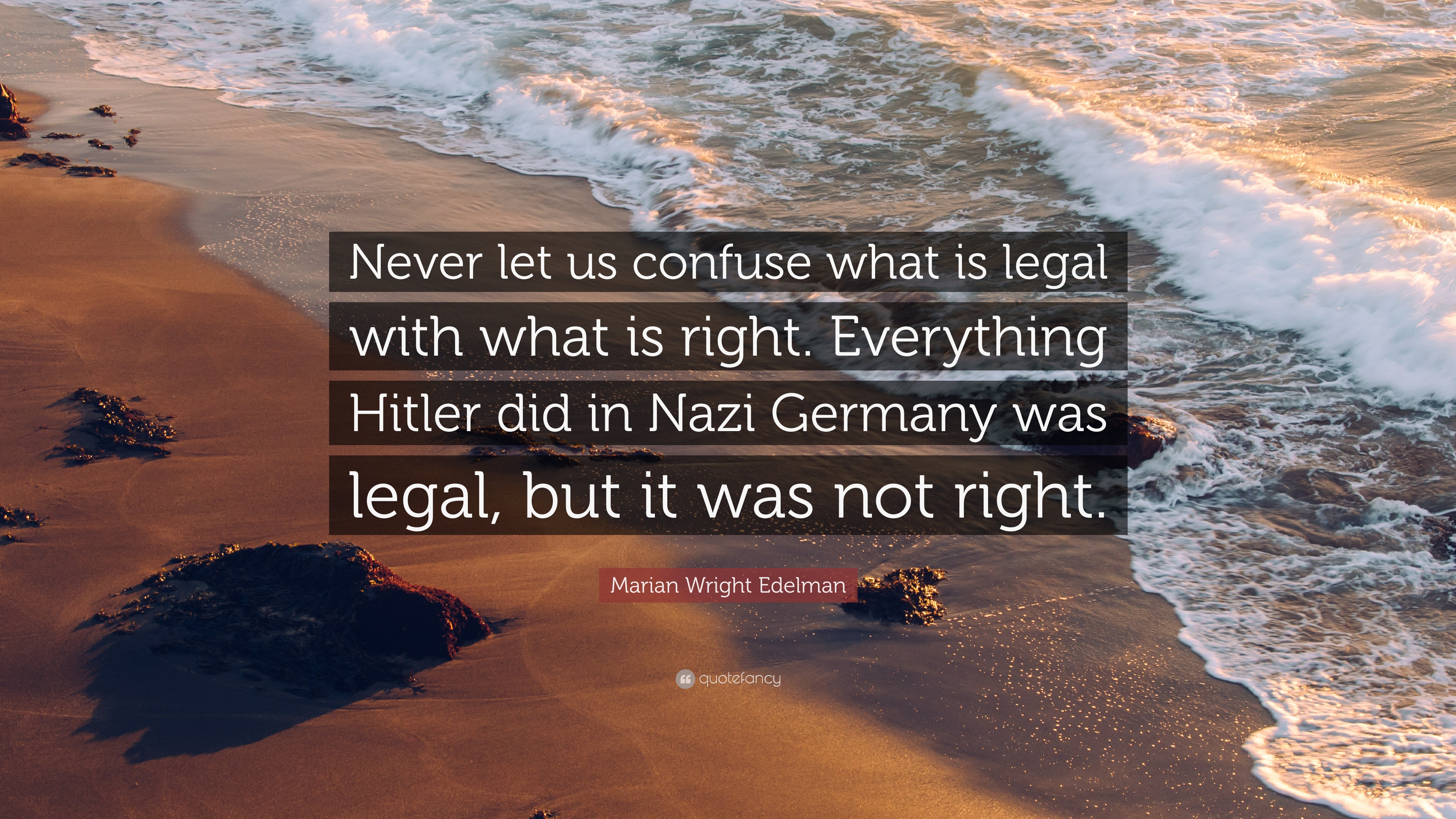
Marian Wright Edelman Quote: “Never let us confuse what is legal with what  is right. Everything Hitler did in Nazi Germany was legal, but it was not  r...”
By the way: Mrs. Edelman was referring to Dr. King’s Letter when she said this. It’s on p. 8 of this speech, for one example.

And where does Dr. King get the justification for his distinction? Why from Saint Augustine: one of the most important and influential of all Christian thinkers. How you like them apples, Clergymen?

Continuing his explanation of the distinction between law and justice, Dr. King refers to the other most influential and important Christian thinker, St. Thomas Aquinas:

Now, what is the difference between the two? How does one determine when a law is just or unjust? A just law is a man-made code that squares with the moral law, or the law of God. An unjust law is a code that is out of harmony with the moral law. To put it in the terms of St. Thomas Aquinas, an unjust law is a human law that is not rooted in eternal and natural law. Any law that uplifts human personality is just. Any law that degrades human personality is unjust. All segregation statutes are unjust because segregation distorts the soul and damages the personality. It gives the segregator a false sense of superiority and the segregated a false sense of inferiority. To use the words of Martin Buber, the great Jewish philosopher, segregation substitutes an “I – it” relationship for the “I – thou” relationship and ends up relegating persons to the status of things. So segregation is not only politically, economically, and sociologically unsound, but it is morally wrong and sinful. Paul Tillich has said that sin is separation. Isn’t segregation an existential expression of man’s tragic separation, an expression of his awful estrangement, his terrible sinfulness? So I can urge men to obey the 1954 decision of the Supreme Court because it is morally right, and I can urge them to disobey segregation ordinances because they are morally wrong.

And yes: he also referred to Paul Tillich, one of the most influential Christian philosophers of the 20th century; and to Martin Buber, “the great Jewish philosopher.” (How you like them apples, Rabbi?) Let me emphasize here, if I didn’t do it enough before, that Dr. King wrote this letter in jail: without reference materials. He just knew all this stuff. (I mean, he did have a doctorate in systematic theology; and his dissertation was partly about Tillich’s work, so.) The only way to improve an ethos argument this strong, with references to authorities this relevant to both your point and your audience, is to show that you yourself are an authority to be reckoned with.

The argument itself is remarkable. He provides three different definitions of his distinction between just and unjust laws: first, a religious one — just laws square with the law of God (and note he includes non-religious people by also calling it “the moral law”, and then brings it back to religion and Aquinas by referring to the idea of laws “not rooted in eternal and natural law”); second, a psychological definition, saying that just laws uplift human personality and unjust laws degrade it; and third, Buber’s philosophical concept of the “I-it” relationship replacing the “I-thou” relationship, turning people into objects. Into things. And look at the use of parallelism here: three reasons why segregation is unsound, followed by another way that it is wrong (and adding the idea that segregation is sinful”; three different ways that segregation is an expression of man’s evil; and a juxtaposition of two antithetical examples that match King’s categories: one just law, and one unjust law.

Then, if that isn’t enough ways to help his audience understand this concept , King gives us this next paragraph:

Let us turn to a more concrete example of just and unjust laws. An unjust law is a code that a majority inflicts on a minority that is not binding on itself. This is difference made legal. On the other hand, a just law is a code that a majority compels a minority to follow, and that it is willing to follow itself. This is sameness made legal.

That’s right, a more concrete definition, with another simple summative way to understand it: difference made legal, and sameness made legal. He’s right: this is more concrete, and has none of the religious overtones of the last paragraph — but it makes just as much sense, and is just as sound. Have we got enough ways to understand this now? Of course we do.

And then he adds another one:

Let me give another explanation. An unjust law is a code inflicted upon a minority which that minority had no part in enacting or creating because it did not have the unhampered right to vote. Who can say that the legislature of Alabama which set up the segregation laws was democratically elected? Throughout the state of Alabama all types of conniving methods are used to prevent Negroes from becoming registered voters, and there are some counties without a single Negro registered to vote, despite the fact that the Negroes constitute a majority of the population. Can any law set up in such a state be considered democratically structured?

Here Dr. King brings in another issue: voting rights. How can a law be democratic when the people were not capable of opposing nor supporting its passage, because of the suppression of their rights and their franchise? The argument is so plain and irrefutable that he doesn’t even bother to answer his rhetorical question. Instead, perhaps feeling understandably bitter as he sits in a jail cell writing about justice and injustice, Dr. King moves to one other complexity in the distinction between legal and just: when the application of a law makes it unjust. And I say he might have been bitter because his example is once again his own, talking about the city of Birmingham’s use of a parade permit ordinance to remove the civil rights activists’ First Amendment rights.

These are just a few examples of unjust and just laws. There are some instances when a law is just on its face and unjust in its application. For instance, I was arrested Friday on a charge of parading without a permit. Now, there is nothing wrong with an ordinance which requires a permit for a parade, but when the ordinance is used to preserve segregation and to deny citizens the First Amendment privilege of peaceful assembly and peaceful protest, then it becomes unjust.

Then he goes on to compare Birmingham first to three villains from history, and himself and his allies to the heroes who were suppressed by the villains — and then Dr. King confirms Godwin’s Law (Within a different context), while breaking the corollary to Godwin’s Law. Because Dr. King brings up Adolf Hitler. And THEN he throws in Stalin and Communism: it’s like the perfect American argument, here. Note that the three villains and heroes he mentions before going to the Nazis are both religious and political: Nebuchadnezzar, the Babylonian king who tried to kill the three Jewish prophets Shadrach, Meshach, and Abednego (I’M SORRY DR. KING I HAVE TO) in the Old Testament; the Romans, who tried to suppress Christianity with various atrocities; and the elite of Athens, who executed Socrates for teaching the truth. Note also that all three villains lost these fights.

Which side is Dr. King’s? Which side would you rather be on?

Of course, there is nothing new about this kind of civil disobedience. It was seen sublimely in the refusal of Shadrach, Meshach, and Abednego to obey the laws of Nebuchadnezzar because a higher moral law was involved. It was practiced superbly by the early Christians, who were willing to face hungry lions and the excruciating pain of chopping blocks before submitting to certain unjust laws of the Roman Empire. To a degree, academic freedom is a reality today because Socrates practiced civil disobedience.


We can never forget that everything Hitler did in Germany was “legal” and everything the Hungarian freedom fighters did in Hungary was “illegal.” It was “illegal” to aid and comfort a Jew in Hitler’s Germany. But I am sure that if I had lived in Germany during that time, I would have aided and comforted my Jewish brothers even though it was illegal. If I lived in a Communist country today where certain principles dear to the Christian faith are suppressed, I believe I would openly advocate disobeying these anti-religious laws.

Once again, Dr. King has made an argument so strong, so irrefutable at this point, after he has given so many different ways to understand it, and so many different reasons to accept it, that I really can’t fathom why people still don’t agree with this argument. Except for those who haven’t read it, of course.

The next part of King’s letter brings up the element that my brother, when I mentioned that I had written an essay about Dr. King, used to identify the Letter from Birmingham Jail as distinct from Dr. King’s other masterworks: “Ohhh,” he said to me on the phone when I was trying to tell him which piece I had analyzed, “is that the one with the white moderates?”

Yes it is.

I MUST make two honest confessions to you, my Christian and Jewish brothers. First, I must confess that over the last few years I have been gravely disappointed with the white moderate. I have almost reached the regrettable conclusion that the Negro’s great stumbling block in the stride toward freedom is not the White Citizens Councillor or the Ku Klux Klanner but the white moderate who is more devoted to order than to justice; who prefers a negative peace which is the absence of tension to a positive peace which is the presence of justice; who constantly says, “I agree with you in the goal you seek, but I can’t agree with your methods of direct action”; who paternalistically feels that he can set the timetable for another man’s freedom; who lives by the myth of time; and who constantly advises the Negro to wait until a “more convenient season.” Shallow understanding from people of good will is more frustrating than absolute misunderstanding from people of ill will. Lukewarm acceptance is much more bewildering than outright rejection.

He confesses: and then he destroys us with his disappointment. This part of the essay I have trouble reading and teaching; not because it’s too complicated, or too upsetting in its language and images (as some of my students find the Perfect Sentence I wrote about in the first post) — but because it’s true, and it’s me. I am a White moderate. I mean, I’m pretty goddamn liberal — but also, I don’t act in order to achieve a more just society; I simply support the cause. It’s not entirely me, because I don’t object to the methods used by those who are more active in pursuing our common goal; but it’s me because I don’t participate in those methods.

King here juxtaposes this critique of people who support the cause but not enough, with those who oppose the cause though they claim to be understanding of it: the Clergymen. No White moderates, those Alabamians; they seem like pretty rock-ribbed conservatives, fitting perfectly into the mold of paternalistic White leaders whom King refers to above, as they compliment “their” [“our”] Negro community for keeping the peace, which is exactly what King is taking issue with. But he does it in such an incredible way:

In your statement you asserted that our actions, even though peaceful, must be condemned because they precipitate violence. But can this assertion be logically made? Isn’t this like condemning the robbed man because his possession of money precipitated the evil act of robbery? Isn’t this like condemning Socrates because his unswerving commitment to truth and his philosophical delvings precipitated the misguided popular mind to make him drink the hemlock? Isn’t this like condemning Jesus because His unique God-consciousness and never-ceasing devotion to His will precipitated the evil act of crucifixion? We must come to see, as federal courts have consistently affirmed, that it is immoral to urge an individual to withdraw his efforts to gain his basic constitutional rights because the quest precipitates violence. Society must protect the robbed and punish the robber.

That’s right: not only does King compare himself, for the third time, to Socrates — now he actually compares himself to Jesus. And, of course, he’s right: blaming the victims of oppression for inciting the violence of the oppressors is precisely like blaming Jesus for making the Romans crucify him. And who does that in the story of the Passion?

Why, this guy, of course.

(I know, this is probably the wrong thing to use for this reference. But I love rock opera. Please ignore the ridiculous whiteness of the Jews in the crowd, and especially of Jesus — but DON’T ignore the AMAZING homoeroticism of the flogging performed by what appears to be The Village People, while a sunburned Disco hedonist looks on and cackles.)

In the next paragraph, King jumps back to the White moderates, connecting the two not only with their half-hearted support or opposition to King’s cause, but with a parallel to the teachings and goals of the Church:

I had also hoped that the white moderate would reject the myth of time. I received a letter this morning from a white brother in Texas which said, “All Christians know that the colored people will receive equal rights eventually, but is it possible that you are in too great of a religious hurry? It has taken Christianity almost 2000 years to accomplish what it has. The teachings of Christ take time to come to earth.” All that is said here grows out of a tragic misconception of time. It is the strangely irrational notion that there is something in the very flow of time that will inevitably cure all ills. Actually, time is neutral. It can be used either destructively or constructively. I am coming to feel that the people of ill will have used time much more effectively than the people of good will. We will have to repent in this generation not merely for the vitriolic words and actions of the bad people but for the appalling silence of the good people. We must come to see that human progress never rolls in on wheels of inevitability. It comes through the tireless efforts and persistent work of men willing to be coworkers with God, and without this hard work time itself becomes an ally of the forces of social stagnation.

By putting these two groups, White moderates who say they support civil rights but oppose the methods used by the activists, and the Alabama clergymen who say they understand the desires of African-Americans for freedom but show they really would rather maintain the status quo of segregation and oppression, in such close parallel, switching back and forth with what almost seems a complete lack of connecting transitions between subjects, King achieves his goal: he shows that these groups are essentially the same. There is what they say, and then there is what they do: and their actions speak louder than their words. He is thus chastising both groups, by comparison to each other: the clergymen are no better than Northern White moderates, synonymous in the South with lying hypocrisy; and the White moderates are no better than White Southerners: synonymous with racist oppressors. Neither group is willing to be coworkers with God: they are the forces of social stagnation which the coworkers with God oppose.

(Okay, I don’t think that’s me any more. Though I still worry that I would disappoint Dr. King.)

Dr. King’s next argument has to do with “extremism.”

YOU spoke of our activity in Birmingham as extreme. At first I was rather disappointed that fellow clergymen would see my nonviolent efforts as those of an extremist. I started thinking about the fact that I stand in the middle of two opposing forces in the Negro community. One is a force of complacency made up of Negroes who, as a result of long years of oppression, have been so completely drained of self-respect and a sense of “somebodyness” that they have adjusted to segregation, and, on the other hand, of a few Negroes in the middle class who, because of a degree of academic and economic security and because at points they profit by segregation, have unconsciously become insensitive to the problems of the masses. The other force is one of bitterness and hatred and comes perilously close to advocating violence. It is expressed in the various black nationalist groups that are springing up over the nation, the largest and best known being Elijah Muhammad’s Muslim movement. This movement is nourished by the contemporary frustration over the continued existence of racial discrimination. It is made up of people who have lost faith in America, who have absolutely repudiated Christianity, and who have concluded that the white man is an incurable devil. I have tried to stand between these two forces, saying that we need not follow the do-nothingism of the complacent or the hatred and despair of the black nationalist. There is a more excellent way, of love and nonviolent protest. I’m grateful to God that, through the Negro church, the dimension of nonviolence entered our struggle. If this philosophy had not emerged, I am convinced that by now many streets of the South would be flowing with floods of blood. And I am further convinced that if our white brothers dismiss as “rabble-rousers” and “outside agitators” those of us who are working through the channels of nonviolent direct action and refuse to support our nonviolent efforts, millions of Negroes, out of frustration and despair, will seek solace and security in black nationalist ideologies, a development that will lead inevitably to a frightening racial nightmare.

Specifically, King is replying to this sentence in the Statement: “We do not believe that these days of new hope are days when extreme measures are justified in Birmingham.” (Blogger’s Note: Since I did that to them, I’m going to do this to Dr. King’s words: “We must come to see that human progress never rolls in on wheels of inevitability.“) This line clearly pissed King off: but more important, it’s an idea that he can’t allow to shape the narrative. So as he does with so many other parts of the Statement’s argument, he smashes this again, and again, and again. He shows the two extremes in the African-American community: one extreme is those African-Americans who have been worn down by the oppression that has defined their lives; and the other is — Malcolm X. King doesn’t name the other man, with whom he was so often presented in juxtaposition as two opposites, the moderate and the extremist; but he doesn’t have to. Elijah Muhammad (Himself no moderate) and his Nation of Islam are synonymous with Malcolm X, and though King and X were a hell of a lot closer in a lot of ways than most people thought or said, it is exactly these kinds of people, these southern Clergymen, who would have used King as an example of a better leader, a more reasonable leader, than X, because King used non-violence while Malcolm X talked about violence. I suspect this comparison and the implication that King was softer and more accommodating to the oppressors’ status quo, made the man angry: and so the description at the end of this paragraph — a fine example of Dr. King showing that he did not believe that non-violence was the only way to achieve freedom: just that it was the best way, as it would not lead to “floods of blood.” If the warning is not clear, he reiterates it in the next paragraph:

Oppressed people cannot remain oppressed forever. The urge for freedom will eventually come. This is what has happened to the American Negro. Something within has reminded him of his birthright of freedom; something without has reminded him that he can gain it. Consciously and unconsciously, he has been swept in by what the Germans call the Zeitgeist, and with his black brothers of Africa and his brown and yellow brothers of Asia, South America, and the Caribbean, he is moving with a sense of cosmic urgency toward the promised land of racial justice. Recognizing this vital urge that has engulfed the Negro community, one should readily understand public demonstrations. The Negro has many pent-up resentments and latent frustrations. He has to get them out. So let him march sometime; let him have his prayer pilgrimages to the city hall; understand why he must have sit-ins and freedom rides. If his repressed emotions do not come out in these nonviolent ways, they will come out in ominous expressions of violence. This is not a threat; it is a fact of history. So I have not said to my people, “Get rid of your discontent.” But I have tried to say that this normal and healthy discontent can be channeled through the creative outlet of nonviolent direct action. Now this approach is being dismissed as extremist. I must admit that I was initially disappointed in being so categorized.

But as I continued to think about the matter, I gradually gained a bit of satisfaction from being considered an extremist. Was not Jesus an extremist in love? — “Love your enemies, bless them that curse you, pray for them that despitefully use you.” Was not Amos an extremist for justice? — “Let justice roll down like waters and righteousness like a mighty stream.” Was not Paul an extremist for the gospel of Jesus Christ? — “I bear in my body the marks of the Lord Jesus.” Was not Martin Luther an extremist?– “Here I stand; I can do no other so help me God.” Was not John Bunyan an extremist? — “I will stay in jail to the end of my days before I make a mockery of my conscience.” Was not Abraham Lincoln an extremist? — “This nation cannot survive half slave and half free.” Was not Thomas Jefferson an extremist? — “We hold these truths to be self-evident, that all men are created equal.” So the question is not whether we will be extremist, but what kind of extremists we will be. Will we be extremists for hate, or will we be extremists for love? Will we be extremists for the preservation of injustice, or will we be extremists for the cause of justice?

(Note on the text: the iteration of the Letter I have been pulling from separates this into two paragraphs. This one doesn’t. I think it should be one paragraph.)

This is another of my favorite arguments, and not least because King again compares himself to Jesus Christ — and also to Abraham Lincoln and Thomas Jefferson, along with the Jewish and Christian luminaries Amos, St. Paul, Martin Luther, and John Bunyan. (Also I love that he drops his namesake in there without even batting an eye — and don’t forget that the vast majority of Southern White Christian racists were of Protestant denominations). I also love the rapid-fire call-and-response of rhetorical questions with direct quotations that serve both as answers and as proof, while making use of all of the poetry in these various wonderful statements, and also showing off, again, King’s own erudition and understanding of the power of the right word at the right time for the right reason. And then those final rhetorical questions, with the explicit use of “we” inviting the audience — the White moderate, the White Southern clergyman, and every single person who ever reads this letter, including me and including you — to come up with our own perfect words, our own response to this call. What will we do? What kind of extremist will we be?

After this King closes his criticism of White moderates with the most terrible form of the guilt-imposing “I’m not mad, I’m just disappointed” position that he is using here: the “Maybe I expected too much of you.”

I had hoped that the white moderate would see this. Maybe I was too optimistic. Maybe I expected too much. I guess I should have realized that few members of a race that has oppressed another race can understand or appreciate the deep groans and passionate yearnings of those that have been oppressed, and still fewer have the vision to see that injustice must be rooted out by strong, persistent, and determined action.

Look at that. Look at it! “I guess I should have realized?” GodDAMN, sir. I would like to personally apologize for everyone and everything, ever. He does lighten the load slightly by naming a number of White activists, primarily reporters who had given fair or even favorable coverage to the Civil Rights movement, and thanking them for their contribution. Which makes me feel a tiny bit better because I’m writing this. But I’m still sorry, sir. I have eaten the plums that were in the icebox, the ones you were saving.

This next part, though? I got nothing but smiles for this. Because then he goes after the church.

Honestly, I’m going to skip over this, because this is not my area. I have not attended church since around about 1986, and my personal animus for religion would color my analysis of this too much. I want to pick out every single detail where King tells his fellow clergymen that the White church has let him down, and highlight every one, like some kind of manic hybrid of a mother-in-law and Vanna White, finding every single possible fault and holding it up for the audience to observe, while I smile from ear to ear. But I won’t do that. I will just point out that he specifically mentions one of the Eight Clergymen, Reverend Earl Stallings, for his action in allowing Black worshippers into his church without segregating them; this seems to me like a direct response and even challenge to the passive aggressive way the Clergymen never name Dr. King, even though EVERYBODY FUCKING KNOWS THAT’S WHO THEY MEANT. “Outside agitators,” my ass. I still recommend reading the entire letter, including this section; but here I’m just going to post his conclusion, because it’s so damn beautiful.

I hope the church as a whole will meet the challenge of this decisive hour. But even if the church does not come to the aid of justice, I have no despair about the future. I have no fear about the outcome of our struggle in Birmingham, even if our motives are presently misunderstood. We will reach the goal of freedom in Birmingham and all over the nation, because the goal of America is freedom. Abused and scorned though we may be, our destiny is tied up with the destiny of America. Before the Pilgrims landed at Plymouth, we were here. Before the pen of Jefferson scratched across the pages of history the majestic word of the Declaration of Independence, we were here. For more than two centuries our foreparents labored here without wages; they made cotton king; and they built the homes of their masters in the midst of brutal injustice and shameful humiliation — and yet out of a bottomless vitality our people continue to thrive and develop. If the inexpressible cruelties of slavery could not stop us, the opposition we now face will surely fail. We will win our freedom because the sacred heritage of our nation and the eternal will of God are embodied in our echoing demands.

“We were here.” I love that. “Our destiny is tied up with the destiny of America.” Just incredible.

At this point, having made all of his arguments, he’s almost — no, wait, he’s not done. He has one more thing to say.

I must close now. But before closing I am impelled to mention one other point in your statement that troubled me profoundly. You warmly commended the Birmingham police force for keeping “order” and “preventing violence.” I don’t believe you would have so warmly commended the police force if you had seen its angry violent dogs literally biting six unarmed, nonviolent Negroes. I don’t believe you would so quickly commend the policemen if you would observe their ugly and inhuman treatment of Negroes here in the city jail; if you would watch them push and curse old Negro women and young Negro girls; if you would see them slap and kick old Negro men and young boys, if you would observe them, as they did on two occasions, refusing to give us food because we wanted to sing our grace together. I’m sorry that I can’t join you in your praise for the police department. It is true that they have been rather disciplined in their public handling of the demonstrators. In this sense they have been publicly “nonviolent.” But for what purpose? To preserve the evil system of segregation. Over the last few years I have consistently preached that nonviolence demands that the means we use must be as pure as the ends we seek. So I have tried to make it clear that it is wrong to use immoral means to attain moral ends. But now I must affirm that it is just as wrong, or even more, to use moral means to preserve immoral ends.


I wish you had commended the Negro demonstrators of Birmingham for their sublime courage, their willingness to suffer, and their amazing discipline in the midst of the most inhuman provocation. One day the South will recognize its real heroes. They will be the James Merediths, courageously and with a majestic sense of purpose facing jeering and hostile mobs and the agonizing loneliness that characterizes the life of the pioneer. They will be old, oppressed, battered Negro women, symbolized in a seventy-two-year-old woman of Montgomery, Alabama, who rose up with a sense of dignity and with her people decided not to ride the segregated buses, and responded to one who inquired about her tiredness with ungrammatical profundity, “My feets is tired, but my soul is rested.” They will be young high school and college students, young ministers of the gospel and a host of their elders courageously and nonviolently sitting in at lunch counters and willingly going to jail for conscience’s sake. One day the South will know that when these disinherited children of God sat down at lunch counters they were in reality standing up for the best in the American dream and the most sacred values in our Judeo-Christian heritage.

He leaves this until the end. He knows that this is the one part of this letter most likely to anger his readers, because he is here criticizing the police — and even now, 60 years later (And please note that this April will be the 60th anniversary of this whole ordeal), I think we all know what happens to people who criticize the police. But he can’t not say this. He doesn’t have proof, not that the Clergymen or the White readership at large will accept — it is only the word of the arrested activists; nobody was there with a cell phone to record this scene — and you can see his bitter acknowledgement of the superficial truth of what the Clergymen said, that the police have been “rather disciplined in their public handling of the demonstrators.” Though even there, look at the use of the phrase “rather disciplined,” instead of the words “calm” and “restraint” which the Clergymen used. Notice the emphasis on “public,” immediately contradicted by the word “handling,” with its implication of manhandling, echoed in the word “disciplined,” with its sense of harsh control and even physical punishment. But of course, because he is Dr. Martin Luther King, he immediately shows how this example is the precise opposite of the “nonviolent” label the police might claim: because they are pursuing immoral ends. And they are contrasted against the truly nonviolent protestors and pioneers, who use genuine nonviolence to promote moral ends of justice — “the best in the American dream and the most sacred values in our Judeo-Christian heritage.” And since this comes here, at the very end, it has extra weight — I do think the overall length of this letter does make this seem more like a postscript than a strong conclusion; I think the passage I quoted above, at the end of the section about the church, is the real conclusion — but this is one final blow that is impossible to ignore. But of course, the police do not get the last word: that goes to the real heroes of the South, James Meredith, and Rosa Parks, and all of the people who fought alongside Dr. King for freedom. I, for one, would like to thank them all for their courage and their honor and their sacrifice.

Speaking of postscripts — and of too-lengthy writings, which need to finally be brought to a close — let me just end with the saltiest “Yours truly” in the history of letters:

If I have said anything in this letter that is an understatement of the truth and is indicative of an unreasonable impatience, I beg you to forgive me. If I have said anything in this letter that is an overstatement of the truth and is indicative of my having a patience that makes me patient with anything less than brotherhood, I beg God to forgive me.

Because in the end, even though the accusation that the civil rights movement and Dr. King were “impatient,” were “unwise and untimely,” was entirely false and absurd — it would be much, much worse if Dr. King were too patient.

And now, Dr. King’s actual “Yours truly,” which I would humbly like to echo myself, to everyone who reads this.

Yours for the cause of Peace and Brotherhood
Wallingford prepares for MLK Day ceremony

The Greatest Words

I just realized that I’ve never written about Dr. Martin Luther King, Jr.

This weekend seems the right time to fill that gap.

I haven’t written about the man for obvious reasons: I am not qualified to do it. I don’t know enough about his legacy or his impact on the US or on the fight for civil rights; I know what everybody else knows, and not much more. I don’t know enough of his philosophy or his writing to speak informatively and usefully about either; I know something, but not enough — and there are books out there about all of this, so I have not enough to add to that.

But there is one thing I can write about (and therefore should: because all that any of us can do is add our own unique perspectives on things to the conversation. Even if my insights are not the greatest insights, still they are mine; bringing them up can help inform or influence other people, or inform or influence the conversation, in positive ways. If we want people to stop talking about nonsense like which kind of stove we are allowed to use, then we need to make an effort to shift the conversation away from nonsense, and onto things that matter more.): and that is Dr. King’s rhetoric. (I should maybe make this a podcast episode. I don’t know if I’m ever going to continue my podcast, or if I should, but if I do, this would be a good subject.)

I don’t know that I studied his rhetoric very carefully in high school. I remember hearing the “I Have a Dream” speech. I remember that my high school choir sang what our director told us was Dr. King’s favorite spiritual, “Precious Lord.” (Can’t do it better than Mahalia Jackson.) I remember being shocked when I heard that the state where I currently live — which thought never not once crossed my mind, that I would eventually become a goddamn high school teacher in Arizona — was the only one in the country not to recognize Dr. King’s birthday as a national holiday. (Can’t do it better than Public Enemy.) I mean, who would refuse a Monday off? And who wouldn’t want to celebrate the life and work of Dr. King? But I don’t remember reading “Letter from Birmingham Jail.” Not until I got to Arizona, and found out it was part of the standard curriculum at my school, and also that an excerpt from it was in the packet on syntax as a rhetorical strategy which I got as part of my training to become an AP English teacher.

So now I’ve been teaching the Letter from Birmingham Jail as part of two of my classes, Sophomore English, when we study argument, and AP Language, when we study rhetoric — specifically, syntax, the arrangement of words into sentences and sentences into paragraphs, and how that arrangement affects meaning. And as with everything I teach, the more I teach it, the more I learn about it: and in the case of Dr. King’s essay, the more I grow to revere the man who was capable of writing it.

So let me explain why.

First: context. This is the information I give to my students when we study the piece. There is some historical information; then two pieces written by white clergymen in Birmingham in the 1960s: “An Appeal for Law and Order and Common Sense,” which I include because the open letter written by the eight clergymen references it — and because it is a fascinating piece — and then the Public Statement by Eight Alabama Clergymen, which was the precipitating event for Dr. King’s masterwork, as the background explains. Remember that, although the Public Statement doesn’t name Dr. King, he is the target of it: he is that “outside agitator” they mention.

BACKGROUND INFORMATION FOR “LETTER FROM BIRMINGHAM JAIL” BY THE REVEREND DR. MARTIN LUTHER KING, JR.

King’s Letter from Birmingham Jail, 50 Years Later

APR 16, 2013

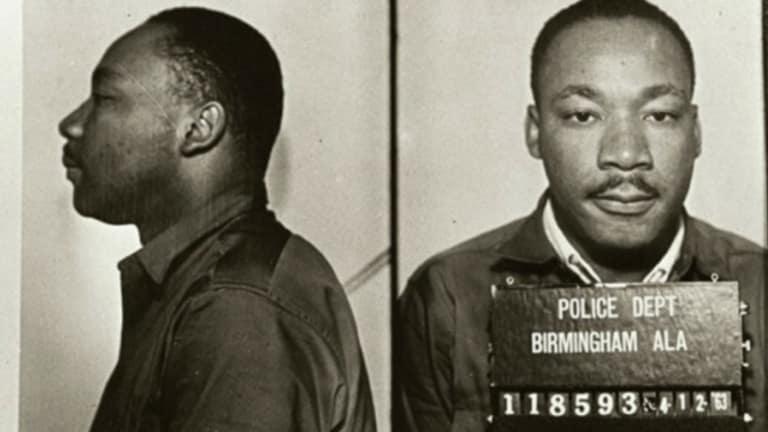
On its 50th anniversary, take a look back at a seminal text On April 12, King and nearly 50 other protestors and civil rights leaders (including Ralph Abernathy and Fred Shuttlesworth) had been arrested after leading a Good Friday demonstration as part of the Birmingham Campaign, designed to bring national attention to the brutal, racist treatment suffered by blacks in one of the most segregated cities in America—Birmingham, Alabama. For months, an organized boycott of the city’s white-owned-and-operated businesses had failed to achieve any substantive results, leaving King and others convinced they had no other options but more direct actions, ignoring a recently passed ordinance that prohibited public gathering without an official permit. For King, this arrest—his 13th—would become one of the most important of his career. Thrown into solitary confinement, King was initially denied access to his lawyers or allowed to contact his wife, until President John F. Kennedy was urged to intervene on his behalf. As previously agreed upon, King was not immediately bailed out of jail by his supporters, having instead agreed to a longer stay in jail to draw additional attention to the plight of black Americans.

Shortly after King’s arrest, a friend smuggled in a copy of an April 12 Birmingham newspaper which included an open letter, written by eight local Christian and Jewish religious leaders, which criticized both the demonstrations and King himself, whom they considered an outside agitator. Isolated in his cell, King began working on a response. Without notes or research materials, King drafted an impassioned defense of his use of nonviolent, but direct, actions. Over the course of the letter’s 7,000 words, he turned the criticism back upon both the nation’s religious leaders and more moderate-minded white Americans, castigating them for sitting passively on the sidelines while King and others risked everything agitating for change. King drew inspiration for his words from a long line of religious and political philosophers, quoting everyone from St. Augustine and Socrates to Thomas Jefferson and then-Chief Justice of the United States Earl Warren, who had overseen the Supreme Court’s landmark civil rights ruling in Brown v. Board of Education. For those, including the Birmingham religious leaders, who urged caution and remained convinced that time would solve the country’s racial issues, King reminded them of Warren’s own words on the need for desegregation, “justice too long delayed is justice denied.” And for those who thought the Atlanta-based King had no right to interfere with issues in Alabama, King argued, in one of his most famous phrases, that he could not sit “idly by in Atlanta” because “injustice anywhere is a threat to justice everywhere.” Without writing papers, King initially began by jotting down notes in the margin of the newspaper itself, before writing out portions of the work on scraps of paper he gave his attorneys, allowing a King ally, Wyatt Walker, to begin compiling the letter, which eventually ran to 21 double-spaced, typed pages. Curiously, King never sent a copy to any of the eight Birmingham clergy who he had “responded” to, leaving many to believe that he had intended it to have a much broader, national, audience all along.

King was finally released from jail on April 20, four days after penning the letter. Despite the harsh treatment he and his fellow protestors had received, King’s work in Birmingham continued. Just two weeks later, more than 1,000 schoolchildren took part in the famed “Children’s Crusade,” skipping school to march through the city streets advocating for integration and racial equality. Birmingham’s Commissioner of Public Safety Eugene “Bull” Connor, who King had repeatedly criticized in his letter for his harsh treatment, ordered fire hoses and police dogs be turned on the young protestors; more than 600 of them were jailed on the first day alone. The brutal and cruel police tactics on display in Alabama were broadcast on televisions around the world, horrifying many Americans. With Birmingham in chaos and businesses shuttered, local officials were forced to meet with King and agree to some, but not all, of his demands. On June 11, with the horrific events in Birmingham still seared on the American consciousness, and following Governor George Wallace’s refusal to integrate the University of Alabama until the arrival of the U.S. National Guard, President Kennedy addressed the nation, announcing his plans to present sweeping civil rights legislation to the U.S. Congress. Kennedy’s announcement, however, did little to quell the unrest in Birmingham and on September 15, 1963, a Ku Klux Klan bombing at the Sixteenth Street Baptist Church left four young African-American girls dead.

By this time, King’s Letter from Birmingham Jail had begun to appear in publications across the country. Months earlier, Harvey Shapiro, an editor at The New York Times, had urged King to use his frequent jailing as an opportunity to write a longer defense of his use of nonviolent tactics, and though King did so, The New York Times chose not to publish it. Others did, including the Atlantic Monthly and The Christian Century, one of the most prominent Protestant magazines in the nation. In the weeks leading up to the March on Washington, King’s Southern Christian Leadership Conference used the letter as part of its fundraising efforts, and King himself used it as a basis for a book, “Why We Can’t Wait,” which looked back upon the successes and failures of the Birmingham Campaign. The book was released in July 1964, the same month that the landmark Civil Rights Act was signed into law by President Lyndon Johnson.

Today, 50 years after it was written, King’s powerful message continues to resonate around the world–the letter is part of many American school curriculums, has been included in more than 50 published anthologies and has been translated into more than 40 languages. In April 2013, a group of Protestant clergy released an official—albeit considerably delayed—response to King’s letter. Published in The Christian Century, one of the first publications to carry King’s own words, the letter continues King’s call to religious leaders around the world to intervene in matters of racial, social and economic justice.

An Appeal for Law and Order and Common Sense

In these times of tremendous tensions, and change in cherished patterns of life in our beloved Southland, it is essential that men who occupy places of responsibility and leadership shall speak concerning their honest convictions.

We the undersigned clergymen have been chosen to carry heavy responsibility in our religious groups. We speak in a spirit of humility, and only for ourselves. We do not pretend to know all the answers, for the issues are not simple. Nevertheless, we believe our people expect and deserve leadership from us, and we speak with firm conviction for we do know the ultimate spirit in which all problems of human relations must be solved.

It is clear that a series of court decisions will soon bring about desegregation of certain schools and colleges in Alabama. Many sincere people oppose this change and are deeply troubled by it. As southerners, we understand this. We nevertheless feel that defiance is neither the right answer nor the solution. And we feel that inflammatory and rebellious statements can lead only to violence, discord, confusion, and disgrace for our beloved state.

We therefore affirm, and commend to our people:
1. That hatred and violence have no sanction in our religious and political traditions.
2. That there may be disagreement concerning laws and social change without advocating defiance, anarchy, and subversion.
3. That laws may be tested in courts or changed by legislatures, but not ignored by whims of individuals.
4. That constitutions may be amended or judges impeached by proper action, but our American way of life depends upon obedience to the decisions of courts of competent jurisdiction in the meantime.
5. That no person’s freedom is safe unless every person’s freedom is equally protected.
6. That freedom of speech must at all costs be preserved and exercised without fear of recrimination or harassment.
7. That every human being is created in the image of God and is entitled to respect as a fellow human being with all basic rights, privileges, and responsibilities which belong to humanity.

We respectfully urge those who strongly oppose desegregation to pursue their convictions in the courts, and in the meantime peacefully to abide by the decisions of those same courts. We recognize that our problems cannot be solved in our strength or on the basis of human wisdom alone. The situation that confronts us calls for earnest prayer, for clear thought, for understanding love, and For courageous action. Thus we call on all people of goodwill to join us in seeking divine guidance as we make our appeal for law and order and common sense.

PUBLIC STATEMENT BY EIGHT ALABAMA CLERGYMEN

April 12, 1963

We the undersigned clergymen are among those who, in January, issued “An Appeal for Law and Order and Common Sense,” in dealing with racial problems in Alabama. We expressed understanding that honest convictions in racial matters could properly be pursued in the courts, but urged that decisions of those courts should in the meantime be peacefully obeyed.

Since that time there had been some evidence of increased forbearance and a willingness to face facts. Responsible citizens have undertaken to work on various problems which cause racial friction and unrest. In Birmingham, recent public events have given indication that we all have opportunity for a new constructive and realistic approach to racial problems.

However, we are now confronted by a series of demonstrations by some of our Negro citizens, directed and led in part by outsiders. We recognize the natural impatience of people who feel that their hopes are slow in being realized. But we are convinced that these demonstrations are unwise and untimely.

We agree rather with certain local Negro leadership which has called for honest and open negotiation of racial issues in our area. And we believe this kind of facing of issues can best be accomplished by citizens of our own metropolitan area, white and Negro, meeting with their knowledge and experience of the local situation. All of us need to face that responsibility and find proper channels for its accomplishment.

Just as we formerly pointed out that “hatred and violence have no sanction in our religious and political traditions,” we also point out that such actions as incite to hatred and violence, however technically peaceful those actions may be, have not contributed to the resolution of our local problems. We do not believe that these days of new hope are days when extreme measures are justified in Birmingham.

We commend the community as a whole, and the local news media and law enforcement in particular, on the calm manner in which these demonstrations have been handled. We urge the public to continue to show restraint should the demonstrations continue, and the law enforcement official to remain calm and continue to protect our city from violence.

We further strongly urge our own Negro community to withdraw support from these demonstrations, and to unite locally in working peacefully for a better Birmingham. When rights are consistently denied, a cause should be pressed in the courts and in negotiations among local leaders, and not in the streets. We appeal to both our white and Negro citizenry to observe the principles of law and order and common sense.

C. C. J. Carpenter, D.D., LL.D. Bishop of Alabama

Joseph A. Durick, D.D., Auxiliary Bishop, Diocese of Mobile, Birmingham

Rabbi Hilton L. Grafman, Temple Emanu-El, Birmingham, Alabama

Bishop Paul Hardin, Bishop of the Alabama-West Florida Conference

Bishop Nolan B. Harmon, Bishop of the North Alabama Conference of the Methodist Church

George M. Murray, D.D., LL.D., Bishop Coadjutor, Episcopal Diocese of Alabama

Edward V. Ramage, Moderator, Synod of the Alabama Presbyterian Church in the United States

Earl Stallings, Pastor, First Baptist Church, Birmingham, Alabama

So that’s why Dr. King wrote the letter. And I appreciate the irritation that made him do it — even though, as was described above, he had been looking for an opportunity to explain his understanding of his actions more fully; still, the decision to do this while he was in jail was surely due to his irritation at this particular statement by these particular men, because this would have been much easier to do when he was at his home, in his office, where he was comfortable writing. (Though he was probably able to focus better while he was in jail; similar to Malcolm X, who was able to teach himself to read and write and think while in prison because he had nothing else to do — I think I’ve said before that boredom can be useful) The fact that he was capable of producing this incredible work while in a jail cell says, better than any words I could come up with, how amazing Dr. King was.

Let me show you.

(I’m not going through the whole letter: it’s almost 20 pages long. I struggle with the decision to read the whole thing in class; I know the students completely lose focus before the end of it, but it’s just so damn good, I hate to stop reading it before the finish. Generally I read the whole thing and then only teach to a certain point: I’ll cover the same section now. And put a link to the whole letter, if anyone wants to read that. It is all good.)

Letter From Birmingham Jail

Here’s how he starts:

My Dear Fellow Clergymen:
While confined here in the Birmingham city jail, I came across your recent statement calling my present activities “unwise and untimely.” Seldom do I pause to answer criticism of my work and ideas. If I sought to answer all the criticisms that cross my desk, my secretaries would have little time for anything other than such correspondence in the course of the day, and I would have no time for constructive work. But since I feel that you are men of genuine good will and that your criticisms are sincerely set forth, I want to try to answer your statement in what I hope will be patient and reasonable terms.

See why I say he was driven to write this because of irritation? Look at the subtle shade he throws here: starting with the matter-of-fact description of coming across the Public Statement while he happened to be in jail, which conflicts with the address to My Dear Fellow Clergymen, the contrast showing the difference between them, that though they are all clergymen, only one of them is in jail; then the not-very-subtle flex about how he seldom answers criticism: because of course he gets more criticism than these men could even dream of, and theirs is hardly the worst or the most significant of Dr. King’s critiques; he is a national figure, after all. And then the comment about his secretaries, plural, who would not have time to do constructive work — clearly putting this whole exchange into the realm of non-constructive work, along with showing how much more busy and important Dr. King is, with his large staff and his extensive constructive correspondence: all of which has come to a halt because he is currently confined in jail. So, hey, why not write back to these gentlemen? Who, he feels (but does not know, because it is not clear that they are, based on the two statements essentially in support of segregation and racism) are sincere men of goodwill? So he will try to show that he can be “patient and reasonable,” a direct reply to their criticism which he quoted, calling his actions “unwise and untimely.” And what follows is a perfectly crafted, 7,000-word shellacking of these jerks, their state, their government, their churches, their very souls, published only a week after their shallow little gripe.

So he begins:

I think I should indicate why I am here in Birmingham, since you have been influenced by the view which argues against “outsiders coming in.” I have the honor of serving as president of the Southern Christian Leadership Conference, an organization operating in every southern state, with headquarters in Atlanta, Georgia. We have some eighty five affiliated organizations across the South, and one of them is the Alabama Christian Movement for Human Rights. Frequently we share staff, educational and financial resources with our affiliates. Several months ago the affiliate here in Birmingham asked us to be on call to engage in a nonviolent direct action program if such were deemed necessary. We readily consented, and when the hour came we lived up to our promise. So I, along with several members of my staff, am here because I was invited here. I am here because I have organizational ties here.

Notice the polite way he pretends that their argument is not their thought, but only that they were influenced by others who held the view that he is an outsider. Notice also how he quotes that phrase, in order to refuse it legitimacy; these aren’t his words, these are the words that were thrown at him, and which these good men have unfortunately repeated. Why is here, in Birmingham? (And though he doesn’t say it, the corollary “Why am I in your jail?” echoes through this entire section, leaving them to answer that question themselves) Because he was invited here by members of his larger organization; the very same people they addressed in their own letter to the people of Birmingham, the “Negro community” and its leadership.

And that’s enough reason, of course. Hard to call someone an outsider when they were invited by insiders. And let’s note, as Dr. King points out, that his organization is headquartered in Atlanta, Georgia. Which is in the next state. It’s 147 miles away. Google Maps says the drive would take about two hours. Boston to NYC is 211 miles. San Francisco to LA (both in the same state) is 383.

But Dr. King doesn’t stop there: having made a reasonable response to the accusation — which is lame, anyway; calling Dr. King an outsider in order to delegitimize his argument is a logical fallacy called Poisoning the Well; the source of the argument is bad, so the argument must be bad, which of course doesn’t follow, because the dumbest person in the world can say the smartest thing — he makes a second rebuttal to the claim, one that is more directed at his specific opponents here:

But more basically, I am in Birmingham because injustice is here. Just as the prophets of the eighth century B.C. left their villages and carried their “thus saith the Lord” far beyond the boundaries of their home towns, and just as the Apostle Paul left his village of Tarsus and carried the gospel of Jesus Christ to the far corners of the Greco Roman world, so am I compelled to carry the gospel of freedom beyond my own home town. Like Paul, I must constantly respond to the Macedonian call for aid.

This is a more abstract argument, because the first is very plain and straightforward; this one uses a religious allusion to make an analogy. It’s a damn fine religious allusion — and actually, it’s two, because one of the eight clergymen who signed the Public Statement was a rabbi, so first he refers to the Jewish prophets of the Old Testament, and then he refers to the Apostle Paul, for the seven Christian ministers who signed the statement: but in both cases, he equates himself with the carriers of the Gospel, those spreading the word of God: which would make those who oppose him the Babylonians, or the Romans: basically the enemies of God. Neither is a good association for a clergyman to accept. But if you accept that there is injustice in Birmingham, then his intent to oppose the injustice has to be seen as a good thing, which obviously has to put him in line with the will of God. What clergyman could oppose the “gospel of freedom?”

This should be enough to shut them up — and it might have been; I don’t know how much the eight clergymen shrunk when they read Dr. King’s letter. (Imagine that, though. If a nationally recognized figure wrote directly to you. To tell you why you’re wrong. For almost 20 pages.) But he’s STILL not done. Think about that. Think about how hard it is to come up with one good response to an argument that somebody makes to you. Think how much we all struggle in forming actual, reasonable replies, particularly to unreasonable people, who do stupid things like call us carpetbaggers, which is the association the Birmingham clergymen were probably trying to make in calling Dr. King an “outside agitator.” Just one clapback is really all we can ask of ourselves. But Dr. King? He has three.

Moreover, I am cognizant of the interrelatedness of all communities and states. I cannot sit idly by in Atlanta and not be concerned about what happens in Birmingham. Injustice anywhere is a threat to justice everywhere. We are caught in an inescapable network of mutuality, tied in a single garment of destiny. Whatever affects one directly, affects all indirectly. Never again can we afford to live with the narrow, provincial “outside agitator” idea. Anyone who lives inside the United States can never be considered an outsider anywhere within its bounds.

I mean, “moreover” is just kinda mean. How do you argue with people who talk like that, and do it right? “I am cognizant” implies both that you are not, and that you should be. And then Dr. King shows that he was one of the greatest wordsmiths since Abraham Lincoln: he creates not one, not two, but three different phrases that became legendary: “Injustice anywhere is a threat to justice everywhere.” “We are caught in an inescapable network of mutuality, tied in a single garment of destiny.” “Whatever affects one directly, affects all indirectly.”

They’re all beautiful phrases: two of them perfect examples of parallel structure, putting similar phrases next to each other in order to create echoes and emphasis through repetition, combined with discernible differences made clearer by the juxtaposition; and in between a beautiful and powerful metaphor that makes clear an abstract but inspiring idea of humanity, a vast network of mutuality. It’s amazing writing. And while King’s opponents are reeling from that — again, imagine if a national figure, an international figure to be if he wasn’t yet (this was all prior to the March on Washington, but King was certainly already extremely well known; let me point out that the goddamn president of the United States intervened on King’s behalf to get him access to his attorneys while he was in jail) — he closes down the argument, by pointing out that we are all Americans, and the idea of an “outside agitator” from the same country is narrow, provincial thinking (read: stupid) that just doesn’t make any sense.

All right: having trashed the eight clergymen’s first claim, King moves on to his main argument: that his actions were neither “unwise” nor “untimely.” He introduces his argument here:

You deplore the demonstrations taking place in Birmingham. But your statement, I am sorry to say, fails to express a similar concern for the conditions that brought about the demonstrations. I am sure that none of you would want to rest content with the superficial kind of social analysis that deals merely with effects and does not grapple with underlying causes. It is unfortunate that demonstrations are taking place in Birmingham, but it is even more unfortunate that the city’s white power structure left the Negro community with no alternative.

Look at how polite he is: he is disappointed that they failed to recognize the real problem, which is the root cause of the demonstrations rather than the demonstrations themselves — but he doesn’t say he’s disappointed in the clergymen; it’s only their statement that “fails.” He is sure that none of those good, sincere men would be satisfied with “the superficial kind of social analysis” that doesn’t focus on root causes. He knows, as they know, as we all know, that they are indeed focused only on the superficial symptoms of the problem rather than the root causes; their entire argument is that everyone should calm down, not that anyone should try to solve the problem. And then he imitates their passive voice, their passive-aggressive tone, by stating “it is unfortunate” that bad things are happening — but it’s much worse (sorry, “even more unfortunate”) that the white people caused those bad things. Isn’t it?

Of course it is.

So then King gives the description of the four steps of a nonviolent campaign: “collection of the facts to determine whether injustices exist; negotiation; self purification; and direct action.” And then slowly, painstakingly, he goes through all of these steps in the letter. He refers to the city’s history of not only segregation but also violence — which his opponents have to stipulate, since that same violence was the root cause of their statements, and their first statement clearly asks the white people of Birmingham to stop causing problems and let the issues be worked out by the courts. (And please note that all of this exchange happened before the Children’s Crusade, which led to the famous and terrible footage of the Birmingham police using firehoses and police dogs to attack children peacefully protesting, and also before the KKK bombing of the Sixteenth Street Baptist Church which murdered four young girls. So yes, I think we can fucking well stipulate that Birmingham was a violent and racist place.) He then explains how the local community tried to negotiate, and the white people in Birmingham were the reason the negotiations failed. He talks about their attempts at self purification, and then he talks about their decision to move to direct action.

Then he talks about how the delayed their direct action. For the mayoral election. Which, one would think, would be a perfect opportunity for an agitator — perhaps a secret Communist, as King was absurdly accused of being several times — to cause as much disruption as possible, and have a large impact on the community. But they didn’t do that. And then when there was a runoff — even though one of the candidates in the runoff was Eugene “Bull” Connor, the Commissioner of Public Safety who would later order the firehoses turned on children — they delayed their protest march again.

What were those guys saying about “unwise and untimely?”

Right.

He ends this portion of the argument following the same pattern he established in the beginning, with the rebuttal of the “outside agitator” accusation: first a straightforward, concrete refutation based on facts (“I was invited here,” in that first instance), and then he expands the discussion into larger, more abstract, but also more important ideas. (“Injustice anywhere is a threat to justice everywhere.”) In this case he says this:

You may well ask: “Why direct action? Why sit ins, marches and so forth? Isn’t negotiation a better path?” You are quite right in calling for negotiation. Indeed, this is the very purpose of direct action. Nonviolent direct action seeks to create such a crisis and foster such a tension that a community which has constantly refused to negotiate is forced to confront the issue. It seeks so to dramatize the issue that it can no longer be ignored. My citing the creation of tension as part of the work of the nonviolent resister may sound rather shocking. But I must confess that I am not afraid of the word “tension.” I have earnestly opposed violent tension, but there is a type of constructive, nonviolent tension which is necessary for growth. Just as Socrates felt that it was necessary to create a tension in the mind so that individuals could rise from the bondage of myths and half truths to the unfettered realm of creative analysis and objective appraisal, so must we see the need for nonviolent gadflies to create the kind of tension in society that will help men rise from the dark depths of prejudice and racism to the majestic heights of understanding and brotherhood.

I love this because he points out the hypocrisy of the White community in Birmingham asking for peaceful negotiations, and thus turns the argument around on them. It’s like he’s saying, “Negotiation? We would love to negotiate! Let’s negotiate!” And by so doing he calls their bluff, because of course, it is not the Black community that refused to talk about these issues. And then he gives us this amazing, dry, sarcastic discussion of “tension,” which I love because I love knowing that Dr. Martin Luther King, Jr., was a smartass: “I confess that I am not afraid of the word ‘tension.'” The idea that he is confessing to something that should be plainly, easily, universally true: because what the hell is scary about the word “tension?” In fact, “tension” is necessary and important for change; and he then refers to Socrates, equating himself to the father of philosophy, the man famously convicted wrongly by his city’s establishment, and executed when he had committed no real crime other than creating “tension.” And his magnificent gift with words shows in the ultimate goal of that creation of tension: “the kind of tension in society that will help men rise from the dark depths of prejudice and racism to the majestic heights of understanding and brotherhood.” Beautiful. And, what, are you saying you would be against that? You wouldn’t want that? Because you’re afraid of tension?

Eye Loewe GIFs - Get the best GIF on GIPHY

Not satisfied with simply having shown that the protestors were not impatient or “untimely” in their marching, King takes this chance to explain to everyone everywhere why the civil rights movement isn’t willing to wait. And this is where my AP Lang class picks up this thread. First, King says this:

We know through painful experience that freedom is never voluntarily given by the oppressor; it must be demanded by the oppressed. Frankly, I have yet to engage in a direct action campaign that was “well timed” in the view of those who have not suffered unduly from the disease of segregation. For years now I have heard the word “Wait!” It rings in the ear of every Negro with piercing familiarity. This “Wait” has almost always meant “Never.” We must come to see, with one of our distinguished jurists, that “justice too long delayed is justice denied.”

Here King is not speaking to the clergymen. The language is too aggressive: oppressor and oppressed, while absolutely the accurate terms here, are not words that will appeal to the nice churchmen who want peace and quiet. Here King is speaking to everyone who has said the civil rights movement is pushing too hard, and going too fast; and the man is tired of talking about this. And again, he makes the same point successfully, several times, which just shows the pathetic weakness of the initial claim, that the civil rights movement is going too fast and should instead just wait for things to work out. His first statement makes an entirely valid point: oppressors do not give away power, they do not simply let people go. Which makes the claim ridiculous, because why wait for something that will never happen on its own? Then his second comment, starting with “Frankly,” in which you can hear his irritation with this whole discussion, points out that people who stand to lose power are not the ones who should get to decide when the oppressed should demand their freedom. Then he raises this to an eternal, universal experience that every oppressed African-American in the US has had to deal with, has been pierced by the ring of, this word “Wait.” And he refers to Supreme Court Chief Justice Earl Warren, writing in the Brown v. Board of Education decision, that “justice too long delayed is justice denied,” the Chief Justice’s own poetic truism.

That’s three reasons why “Wait” is a stupid argument to apply to the civil rights movement. But then, King does this:

We have waited for more than 340 years for our constitutional and God given rights. The nations of Asia and Africa are moving with jetlike speed toward gaining political independence, but we still creep at horse and buggy pace toward gaining a cup of coffee at a lunch counter. Perhaps it is easy for those who have never felt the stinging darts of segregation to say, “Wait.” But when you have seen vicious mobs lynch your mothers and fathers at will and drown your sisters and brothers at whim; when you have seen hate filled policemen curse, kick and even kill your black brothers and sisters; when you see the vast majority of your twenty million Negro brothers smothering in an airtight cage of poverty in the midst of an affluent society; when you suddenly find your tongue twisted and your speech stammering as you seek to explain to your six year old daughter why she can’t go to the public amusement park that has just been advertised on television, and see tears welling up in her eyes when she is told that Funtown is closed to colored children, and see ominous clouds of inferiority beginning to form in her little mental sky, and see her beginning to distort her personality by developing an unconscious bitterness toward white people; when you have to concoct an answer for a five year old son who is asking: “Daddy, why do white people treat colored people so mean?”; when you take a cross county drive and find it necessary to sleep night after night in the uncomfortable corners of your automobile because no motel will accept you; when you are humiliated day in and day out by nagging signs reading “white” and “colored”; when your first name becomes “nigger,” your middle name becomes “boy” (however old you are) and your last name becomes “John,” and your wife and mother are never given the respected title “Mrs.”; when you are harried by day and haunted by night by the fact that you are a Negro, living constantly at tiptoe stance, never quite knowing what to expect next, and are plagued with inner fears and outer resentments; when you are forever fighting a degenerating sense of “nobodiness”–then you will understand why we find it difficult to wait. There comes a time when the cup of endurance runs over, and men are no longer willing to be plunged into the abyss of despair. I hope, sirs, you can understand our legitimate and unavoidable impatience.

He puts a number on it, to show that people have waited long enough for justice: 340 years, which hearkens back to the founding of the European colonies at Jamestown and Plymouth: in other words, the very beginning of what the US claims as its history as a nation. It has always been like this here. He makes a comparison between countries the US considers both less developed, and less dedicated to the ideals of freedom and equality, the nations in the “Third World” that were at this time throwing off their colonizers and beginning to build new nations, with varying degrees of success — but all with a faster pace of change than the US, for all of our vaunted modern innovative, creative spirit and love of freedom, and he uses a fantastic metaphor to show how sad and simple this all is, that African-Americans have to fight this hard just to get a goddamn cup of goddamn coffee (Cusswords added for emphasis, because Dr. King was much too polite to say it himself).

And then Dr. King writes what may be the best sentence I’ve ever read.

Do you see that? It’s all one sentence, from after “Perhaps it is easy for those who have never felt the stinging darts of segregation to say, “Wait.” up until he says, “then you will understand why we find it difficult to wait.” He uses full sentences inside it, when he quotes his son asking why white people are so mean; but it’s still only one sentence. 316 words.

And it’s unbelievable: everything in it, from the way he describes the different experiences of African-Americans in the US, to the way he starts with the most active and deadliest threats, and then ends with the most personally and emotionally troubling and dehumanizing, going through all the different ways one is affected, in every single aspect of one’s life, through all of one’s identities, not only as a civil rights leader and a member of an oppressed people, but also as a husband, as a father, and as a man; everything he does in this sentence is amazing. The way he uses the second person “you” to include his — mostly White — audience, so that maybe the White people can understand some of what King and every other African-American understands, and uses “father,” “mother,” “brother,” “sister,” and every other family relationship to show that everyone, every human, are our brothers and sisters, our family. The way he names lynching and murder, and equates violent mobs with policemen, as both groups have savagely brutalized African-Americans in this country. The way he appeals to parents by including not one but two heartbreaking scenes with a father having to explain to his children why they must suffer in an oppressive and unjust society. The incredible metaphor he uses, about the people smothering in an airtight cage of poverty, in the midst of an affluent society: because the airtight cage is a paradox, a cage is only bars, so it should not be able to smother anyone; just as poverty should not be suffocating people in this society: and it in the midst of this society, because affluent people are all around those who are suffering and dying, are watching them die, and doing nothing about it. The cage itself makes this seem like a zoo: an exhibition put on for the amusement of the crowd. The poetic way he uses phrases like “your tongue twisted and your speech stammering,” and then throws the harsh, crude word “n*gger” at us as it has been thrown at him, casually, frequently, like it’s his first name.

The way this periodic sentence — a term for a sentence that has the main clause, the most important subject and verb, closer to the end than the beginning of the sentence — ends with the final statement, “then you will understand why we find it difficult to wait.” Making the audience wait, through 316 words, for that final statement of the sentence’s purpose. Ending with the word “wait,” that same word that set all of this off. With the incredible understatement of “we find it difficult to wait,” through lynching, through drowning, through beating, through suffocating, through the tears of children, through one’s own dehumanization: it would indeed be difficult. But it is cause and effect, if-then: when we have gone through what King and other African-Americans have gone through in this country, then we will understand. And the corollary, of course, that until we have gone through it, we cannot understand it: but at least now we have a description of it.

It’s the most amazing single sentence I know. It’s one of the best arguments I’ve ever read, in a piece that continues after this to build up his argument for another 30 paragraphs, point by point explaining why the actions of the protestors in Birmingham, and King’s movement’s actions more generally, are right and good, and should get the support that the White community denies them. I have never been capable of teaching it fully to my students: I can’t make them understand how remarkable King’s achievement is in this essay, because it’s so far beyond their usual argument that it’s like another language. I doubt I’ve done it justice here today; but I felt like I had to try.

Happy Birthday, sir. And thank you for all that you gave this society.

Home | Martin Luther King Jr: An extraordinary life

Contempt and Hate

I don’t think most of us understand hate.

I know I don’t. I don’t think I’ve ever actually felt it.

We use the word often; I use it all the time. I hate voluntary ignorance; I hate violence and war; I hate BBQ potato chips. But we also say “love” more than, I think, we mean it: I love my dog and I love my wife, but I also say I love Ren and Stimpy (Ren more than Stimpy – though I still love Stimpy, the big goof!), and I love Cheez-Its. Obviously, the feelings aren’t the same, aren’t even similar, and I have written before about the absurdity of this language, with its incredible vocabulary and the multiple nuances and shades of meaning available in the specific words and the specific uses we can put them to, having only one or two words for a positive feeling – I “like” this, and I “love” that. Now, that actually isn’t true, we have a ton of words to describe good feelings; and it would make me ecstatic if we could start saying adore and cherish and esteem – I am fond of funny T-shirts! I hold napping in high regard! – but that’s probably not going to happen.

Considering, however, all of the talk that has been flying about regarding hate “lately,” with Charlottesville, and with the alt-right administration currently abandoning the White House like lice fleeing the comb, I think this particular word requires some serious attention. I fear we are misusing it, and therefore making a mistake in how we handle the people, the groups, and the actions to whom we apply it.

Now, as I am unsure that I’ve ever genuinely experienced the feeling of hate (which doubt makes me think that I can actually be sure that I have not, because I think if I had, I would know it), it would seem that I could not write about it; but I can speak from observation, and also from the similar emotions I have felt, as hate is on one end of a spectrum, and all of us have been somewhere on that spectrum. I also have expert testimony to draw from: because I talked to my wife about this subject, and I asked her, “Do you think you’ve ever experienced real hate?” She said “Yes” before I could even finish the question. Without hesitation, without equivocation. I don’t intend to air her dirty laundry here, but suffice to say that one of her parents is one of the best people I’ve ever known, and the other one is very much the opposite of that. (For those reading this who may actually know my wife and her family, be aware that you have never met the shitty parent; you know her step-parent, who is a fine person as well.)

Here is how she describes what she feels for that parent. Every time she thinks of this person, it makes her angry. Angry enough to do harm: to punch, to kick, to attack. Every single time. It follows her around, she said, this anger; it is a part of her, and it never goes away. This is partly due to the fact that the object of her hatred, as one of her biological parents, is also a part of her; she knows this, and she hates that it is so. Everything that she hates about this person, reflects in some way on her, either because of their connection, or because of how it makes her feel. Which just makes her angrier.

That is hate. Hate is anger that lasts, and that never goes away. Violent, intense anger, anger that taints everything around it, including one’s own self: to have something or someone in your life that you hate would make you upset with yourself for feeling this way, particularly in this culture that teaches forgiveness and resolution and closure. My wife cannot force this to heal, cannot close this wound; and so it festers and aches and weeps. This, of course, intensifies her negative feelings, because then she feels saddened that she has to continue dealing with this, that she can’t find a way to get over it or get past it; and then she naturally blames the source of that hate for bringing these other terrible feelings on her, as well, for being so hate-worthy that now she has to carry all the rest of it along with the hate.

(A final note: she is right. That parent is worthy of hate. It’s the closest that I feel to hate, as well, because of what my wife has had to suffer, and continues to suffer. The cultural trope that my wife should forgive and forget is nothing but nonsense. That person does not deserve forgiveness. Those of you who may feel the urge to say that she should turn the other cheek, that her feelings are only hurting her and will go away if she forgives: shut up. You don’t know what you’re talking about.)

I have felt anger that made me want to do violence. I have felt it several times for a single person or event, so I think I have felt some level of hate; but my hate, my anger, has always faded, and I’ve always been able to feel better afterwards. That fact has enabled me to call myself a pacifist, to say that I oppose violence in all forms at all times. Because I have always been able to escape my desire to do violence, so I have the luxury of thinking that people can always do that, can always turn the other cheek and just – calm down. (Also, I have never had to fight for my safety or my life, and so I can think that people never really need to do that.) This has made me incapable of understanding people who are members of what we blithely call hate groups: why, I think, can’t they just calm down?

There’s two answers, there, because I think there is more than one type of member in a hate group. Probably there is a spectrum as broad as the number of people in the group, but there are two categories at least we can put them into, and should. One is the group that is actually, genuinely filled with hate: every time they encounter the object of their hatred – let’s say, every time a Neo-Nazi encounters a Jewish person, or every time a Klansman meets an African-American – they are filled with a rage that brings them to violence. That rage never fades; they carry it with them, everywhere, always. It is a part of them. It is possible that they are upset with themselves, and saddened, as my wife is, that they cannot simply let that rage go; I would wager that if they lose loved ones, family members or friends that turn a cold shoulder because of the Klansman’s/Neo-Nazi’s hate, that they wish that they could just let the hate go. But they can’t: and every negative feeling that gets piled on someone who hates, gets added to the list of reasons to hate. The object of the hate receives the full blame for all of the consequences of hate. The Klansman thinks, “If those [African-Americans] wouldn’t be so awful, then my life wouldn’t be so terrible. I hate them even more for making me hate them, and for screwing up my life with that hate.”

This kind of conflict cannot be reasoned with. It cannot be cajoled away. I don’t know that it always lasts for everyone who feels it; surely some people change. But I don’t think there is a pattern to that, not a process that can be prescribed to end real, violent, hate. I think the only thing that can be done about it is my wife’s solution: separation. She never sees the person she hates, and never intends to. It doesn’t make her feel better, it doesn’t make the hate go away; but it keeps her from becoming violent. It minimizes the occasions when she has to think about it. (And I have to say: as important as I think this topic is, I feel terrible that writing this is going to drag my wife back down into everything she feels about her family. I really am sorry. She will of course read this before it is published and so it is possible, if she wishes it, that no one else will ever read it.) That’s the best we can do with the people who feel genuine hatred.

But for the rest of them – probably, I think, the majority of them – what they feel is not hatred. For them, it’s more like me saying I hate when my students ask me the same question three times in a row (“When is this due?” “Friday. It says it on the board.” “Wait – when is it due?” “Friday.” “What’s due on Friday?” “I hate you.”). That does drive me crazy; but it doesn’t make me feel violent, and it doesn’t make me feel sad. I don’t even know that it makes me angry, as such.

I think the word for what I feel at those times is: contempt. Maybe disgust, but I think disgust has a visceral, nauseous element; disgust turns one’s stomach. Students not paying attention doesn’t turn my stomach. What it does do is make me smirk at them, and think mean things about how dumb they are – after all, why can’t they read the due date on the board, right over there? Why weren’t they listening when I explained this to them not thirty seconds ago? They must be idiots. They’re not, not really: I’ve been a teacher for 17 years, and I don’t think I’ve ever had a student that I would call an actual idiot; every single one of them was either capable of doing what I asked, or had a reason (such as autism or developmental disabilities) why they couldn’t do it. The majority of them have not done the majority of what I have asked, but not because they were idiots. When I think that, it is a dismissal, a belittling, created from my contempt.

That, I think, is what most members of hate groups actually feel for the object of their “hate.” Contempt. I think their ideas are about as valid as my contempt for my students when they don’t listen, and I’d guess that every instance of contempt is similarly unfounded; it may be that their contempt is, like mine, largely projected: I get mad at my students for not listening at least in part because I know full well that I never really listened to my teachers when I was in high school. My irritation with them is certainly some irritation with my past teenaged self, seen reflected in their slack jaws and dull eyes, so like my own. It’s also true that they are most distracted when my class is most boring, and I know that when it is boring, it is mostly my fault, not theirs (though I will note that often the boring things I teach are unavoidable: somebody has to explain commas and apostrophes and the passive voice); when I taught John Knowles’s terrible novel A Separate Peace, boredom was the appropriate response. Maybe even contempt.

But I’m not all that interested in trying to understand why Neo-Nazis feel what they feel, whether it is contempt or it is hatred; I don’t really care. There isn’t a way to feel hatred for an entire race that is justified the way my wife’s hatred is justified, because an entire race of people cannot be guilty of heinous acts towards a single person. Contempt for an entire race is also moronic, as my contempt for my students would be if it lasted more than a few seconds; but after they all know what the due date is, we go back to discussion of George Orwell, and they have intelligent and interesting things to say, and I realize they’re not at all idiots, and I was being a jerk when I thought they were. I don’t understand why Neo-Nazis and Klansmen don’t have that same realization. I kinda think they’re idiots. That is the biggest difference: my contempt is only momentary, and never very serious; a Neo-Nazi feels a long-term, maybe even a permanent contempt for the contemptuous object. Enough to make him willing to join the swastika crowd. The Neo-Nazis that aren’t idiots – and of course there are some such – either feel hate, or they are those who can be turned away from their hate groups, those people who make a friend of a different race and realize they maybe shouldn’t be marching in the hate parade.

Here’s what matters. Contempt can frequently be dismissed as unimportant, because it does not incite violence. Nobody wants to hit someone they feel contempt for; the object of contempt is too pathetic, too insignificant, to go through all that trouble. You might shove them out of your way, but you would never pursue them and beat them; you would never run them down with your car, or hang them from the nearest tree. Those are acts of hate. Hate, obviously, should not be dismissed as harmless. That is not to say that everyone who hates is violent or murderous; but the emotion creates the chance of violence, where contempt does not.

I think a lot of our treatment of Neo-Nazis and Klansmen and other white supremacists is contemptuous. We make fun of them, we belittle them, we dismiss them. We feel contempt for them, because we think that all they feel for their victims is also contempt, so we don’t really worry about them doing harm. (Also: they’re idiots. I think.) By contrast, our treatment of terrorists is fearful: because we know that they feel hate, and therefore are they very dangerous. People who would set off a bomb in a crowded place are full of hate. People who would drive a car, or a plane, into innocents, are full of hate. And if and when we see white supremacists marching, at night, carrying torches, chanting “BLOOD AND SOIL!” we recognize that as more than contempt: that is hate. You watch video of police officers setting attack dogs on civil rights protesters, it is clear: that is hate. Hate, genuine hate, must be treated as something dangerous, because it is. Treating a person filled with hate as if they only felt contempt would make us vulnerable; we can turn our backs on people who feel contempt. We can get up in their faces during a rally, we can yell at them, we can follow them playing “Ride of the Valkyries” on a tuba. We can laugh at people who feel contempt. It is dangerous to treat those who hate as if they only feel contempt. That is the first mistake we have made in the past, and hopefully, the events of Charlottesville will remind us that ignoring, dismissing, belittling those who actually hate is never going to make them go away. For them, we must make them go away: we must enforce separation. Which probably means law enforcement.

But here’s the thing. When we treat those who only feel contempt as if they actually feel hate, that is ineffective, too. Because it isn’t justified: a guy who makes racist jokes doesn’t need to be on an FBI terror watch list. Some putz who hangs a Nazi flag on his house, or a Confederate flag on his truck, doesn’t need to be treated as if he is about to explode into violence. And if you confront that person and say, “You’re full of hate!” in whatever way you say that, they will say, “No, I’m not. I don’t hate anybody. I just think racist jokes are funny, and the Confederacy fought for Southern pride and state’s rights.” They may say, “I have plenty of [black/Jewish/female] friends.” And maybe they do, though I think it is hard to be friendly with someone for whom you also feel contempt. But regardless, they do not feel hate. They can reasonably deny any label that they are members of a hate group, or that they are a violent threat to a civil society. If you try to force that label on them, they can turn it around and call you intolerant, and a bigot; they can call you Communist or antifa or the alt-left. They can claim that you are limiting their freedom of speech by keeping them from speaking on your college campus. They can take the moral high ground. Then they can argue for greater freedom for their groups and their causes – and then that means greater freedom for the members of those groups and causes who actually feel hate, who are genuinely dangerous.

Then you get Charlottesville.

So the issue is, we have to make a distinction between those who feel contempt, and those who feel hate. And we have to treat them differently. The hateful must be watched, and prevented from doing harm; the contemptuous we should ignore.

Unfortunately, that’s as far as I’ve gotten in my plans for how to fix all of this. I do not know how to discern hate from contempt; they probably blend together for the observer, they may both be present in the same person. No reason why a Neo-Nazi couldn’t feel contemptuous of Jews and hate African-Americans, for instance. Or feel contempt for African-Americans and hate black policemen, specifically. A contemptuous person may get angry and sound just like someone full of hate, even if that feeling fades quickly, where it wouldn’t in someone who genuinely hates. But I do think that we will make more progress, and have better results, if we treat the two categories differently when it is clear which is which. That crying Nazi who got banned from OKCupid, for instance? That dude is not full of hate. A man who hated non-whites would hate them more after they got him banned from Tinder. He might lie about it, of course; but I think he probably would not cry.

Though maybe that thought is coming from my own contempt.

I hate that.