
Books With Pictures:
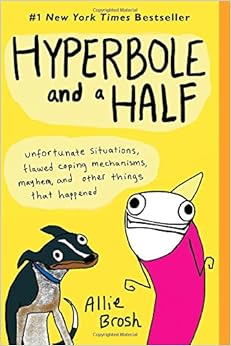
Hyperbole and a Half by Allie Brosh
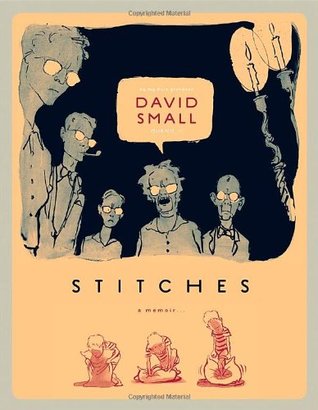
Stitches by David Small
So I’m a word guy, right? I love books, love reading; I enjoy movies and TV, but not the same way. I teach Fahrenheit 451 pretty much every year; in fact, I’m teaching it now. We’re at the point when Captain Beatty is explaining why the firemen are a good thing, because books, he claims, are a bad thing. He says, along with a mess of other interesting statements, that things started changing when photography came into its own, followed by motion pictures, radio, and TV – and, though Ray Bradbury didn’t predict it, the internet, YouTube, memes, GIFs, et cetera. Beatty says that things got simpler because they had mass: because a picture of a face is more solid than the face that one might imagine given a description. Guy Montag, the hero of the novel, is described as 30 years old, having a thin face, black hair, heavy eyebrows, and a “blue steel shaved-but-unshaved look.” So which is more solid, the face you’re imagining after reading those words, or this:

(By the way: took me twenty minutes looking through Google image search to come up with that. Searching for the description got me page after page after page of male models with swirly/spiky hair on top that was shaved on the sides. I mean, this dude

is not Guy Montag.
(Also by the way: I had to go back and re-do this search because my GODDAMN MS-WORD CLONE CAN’T SAVE PICTURES AND THEN UPLOAD THEM TO MY BLOG AND WHENEVER I TRY IT CRASHES THE THING AND THEN THE WHOLE POST IS BLANK AAARRRRRGGGGH Okay, I’m fine now. This is also why I like words more than pictures.)
Now, Beatty is the bad guy in the book, and if he is for it, I’m pretty much against it, including replacing books with visual mediums like film and television and the interwebs. But as Professor Faber (he is the Yoda to Montag’s Luke Skywalker) explains later, it is possible for books and movies and TV to all accomplish the same good things – the same things that music, and art, and conversations with good friends can all accomplish.
I think these two books, even though they are as visual and pictorial as they are literary – as many pictures as words, and the pictures essentially communicate as much as the words do – do the right things in the right way. That’s why I’m putting them together in this review. That, and the fact that both, despite the largely light-hearted genres they ostensibly belong to (Stitches is a graphic novel and Hyperbole and a Half a web comic), are actually quite somber and poignant and sad.
Hyperbole and a Half is a web comic that I discovered, as I think a lot of people did, because the author, Allie Brosh, wrote about the Alot. I hate that word; I love that comic. So I got the book that Brosh published, and read it. It’s a collection of her comics, which are about herself and her life: and though they are frequently stunningly funny, they are also profoundly sad and poignant to read. Brosh lives with fairly severe depression, according to what she depicts here, and she pulls absolutely no punches in describing what that life is like, and also allowing that condition, those feelings, to bleed into her other comics, as it no doubt bleeds into all parts of her life. Realizing how much she struggles with this turns even the more conventionally funny and wacky comics a bit more serious; because the strangeness that at first was just amusing now seems another piece of Brosh’s lifelong alienation.
But as hard as that is at times to read, it is also, simply, brilliant. I have rarely read something so honest and perceptive and brave, something that so perfectly shows a unique mind both in turmoil and in triumph.
Oh hey – know when else I read something that showed the same sort of genius and pain at once? Why, it was when I read Stitches, by David Small.
This one is a more traditional graphic novel; as such, it is in a more familiar storyboard format, and the art looks more like comic art; Small is an excellent illustrator, where Brosh’s art is intentionally simple and childish (Though still effective, and amusing as hell where it isn’t heartbreaking.). This is also a single story, told in words and images, rather than a series of shorts and vignettes like Hyperbole and a Half. It is the story of David Small’s family, particularly his violently abusive mother. The title comes from Small’s experience with cancer as a child: he had an undiagnosed tumor in his throat, which eventually led to the removal of one of his vocal chords, leaving him essentially mute, and also with a Frankensteinian line of stitches across his neck. This one is an even more terrible story. It’s maybe a little easier to live with, because it has villains and therefore heroes; Small should be considered heroic simply for surviving and growing up and getting his freedom, and then finding the strength to write this book – but the fact of his heroism makes the villains that much more terrible, and the story that much harder to get through.
But like Hyperbole and a Half, it is worth getting through. And in both of these cases – despite what Captain Beatty might think – the images don’t make the story easier to read, though I do think they give the stories mass. Almost too much of it, in fact.
I hope I haven’t made these books seem too dark or painful to read; they are both hard to read, but both are wonderfully realized, and really more moving than anything else. They are both genuine and honest memoirs written by intelligent and creative people, and I recommend them both.
Just – don’t read them one after the other. Put something more cheerful in the middle, there.
 Just Dusty