That Costs HOW MUCH??

A Twitterer (Tweeter? Just Twit?) I follow posted an observation about English:

“Price” and “Worth” mean the same thing, yet “Priceless” and “Worthless” are opposites.

They followed this with the usual metatags, you know, #DeepThought, #Philosophizin, #MindBlown, the identifiers that are much more “tag” than “meta,” in the sense that they are markers used to track things, clunky lumps sutured to one’s ear out in the wild; or perhaps they are a children’s game that seems designed to frustrate all the players but one. But just as those tags are really more prosaic, more obvious, and more concrete and direct than they are meta, so this conundrum of English is not that difficult to untangle: it’s a paradox like any other in English, meaning it is only contradictory, only interesting, if seen from one particular angle. Change the angle and it becomes clear. The answer, I posted in a reply to this Twitterer, is that “price” and “worth” are not actually the same thing at all: “worth” is something’s inherent value, its qualities that make it precious and/or coveted; and “price” is a measurement of what someone is willing to pay to acquire that value. So “worth” is set by the thing itself, and by the perceptions of the owner or coveter; “price” is set by the market, and determined much more by one’s available assets and one’s eagerness to possess: the depth of one’s coveting, that is. “Worth” is internal (though externally perceived), and “Price” is external (Though to some extent internally determined). In recognition of this, we use the antonyms, priceless and worthless, to name two different qualities: one describes an object you would never sell, and the other describes an object you would never buy.

This is why I don’t have more followers on Twitter. Because my posts, while free for all, are not valued by many, and are not coveted by any. So I don’t earn much of the modern currency of social media: attention. I could, of course; I could post nothing but #HotTakes, and maybe some #FunnyJokes, and throw some #Shade at some #Influencer; that would earn me more currency, more attention, and that could eventually translate into value for me: especially insofar as I would be able to sell copies of my books, and raise my #Profile by #EngagementFarming — and I don’t mean to mock or belittle the people who do that, because they do, as I said, find value in it: usually through price, because they market their products successfully to their circle of engaged followers, but sometimes through genuine connections made with people who reach out to them personally and build relationships, which I would consider worthwhile. Either way, more power to them, whether they draw in attention currency through the worth of what they create, or through using the market to raise the price (The key to engagement farming is not only to capture attention, it is too demand attention and receive it; since attention is the currency of the social media market, when an engagement farmer [If you’re unfamiliar with the term, this means one of those accounts that posts things intentionally for likes and follows and responses of any kind: either platitudes or intentional irritation are the most common paths] demands more of your attention and receives it, they are raising the price of their product, and you, the consumer, are paying it.) of what they offer. Either way, it is creating value, and it’s a fine thing.

But it’s not my thing. I’m bad at price. You can tell because I am a fantasy author, married to an artist, and both of us are public school teachers: nowhere in there did we find a way to get rich. And we’re not, subsequently. The things I do with my time have a low price: at least partly because I love doing them. But that doesn’t mean, at all, that they have a low worth: my writing, my wife’s art, and both of our teaching, are extremely worthy pursuits, and ones that are generally valued in our society: just not by the market. This is because markets value scarcity, not worth. Which is why, again, the comparison of “price” and “worth” is not good: not only are they not equal, but they are almost unrelated in the modern world.

Not entirely: I make a living, a decent living, through teaching, and I have for more than 20 years; this last week, I went to speak to my principal about something, and as I was leaving after saying my piece, he stopped me because he wanted to ask why I hadn’t signed my contract for next year: he wanted to know if there was a problem, or if, in the worst case scenario for him, I hadn’t signed it because I was leaving. I am not leaving, I assured him: I had actually just signed the contract the day before, he just hadn’t seen the notice yet. (I hadn’t signed it earlier not because I refused to sign it, but because when I looked at the online document awaiting my signature, it said that the contract start date was — my salary. I don’t know when “63,810” is, but I’m pretty sure it’s not this coming August, which is when I have to start teaching, so I thought I should double check that the contract was correct before I signed it. But when I went back to check again, it had resolved, and the correct start date was there, so I signed it. Or at least I typed my name into the text box and clicked on the blue button, a process that will never not be weird to me. At any rate, on hearing that I had signed and would be returning, my principal literally did this:

Phew GIFs - Get the best gif on GIFER

So that tells me my work has worth. Last week I Twitterered that I was struggling, on evening; I felt like my students didn’t value my teaching, and I didn’t want to stand in front of them and be ignored; it feels not only like a waste of my time and a waste of their opportunity, but also, it’s just damn insulting: first because my teaching is valuable, whether students recognize it or not; and second because their idea of value is so skewed that they would rather watch a video of someone falling down than listen to me teach them about reading and writing and literature. But one of my former students replied that I was her favorite teacher, the one who had the greatest impact on her; that I was damn good at teaching and she would always be grateful that she had been in my class. That, even more than my principal, tells me that my work has worth.

But it is not valued in our society as much as it is worth: and that is why my price is low, compared to, say, an engineer or a doctor or a professional athlete. When people talk about the teacher shortage, and how to fix it, this is how: we have to value teachers according to their worth; not according to their price. Teachers should not be paid at what the market will bear: partly because the market has intentionally been jiggered to keep all wages artificially low; and partly because teachers are generally passionate about our work, and therefore we are willing to do more work than we are paid to do. So we get exploited as workers, and we get exploited as people who care about children.

And then they call us indoctrinators. And fucking groomers.

And you wonder why there’s a teacher shortage.

There’s another issue going on today in our society regarding a disparity between value and worth; it’s inflation. Actually, it’s consumerism in general, but we’re seeing the making of the sausage right now, in a way we haven’t really seen for a long time: there’s been inflation, but not this much and not this quickly.

Inflation occurs when the worth of something is greater than its price: sometimes because of supply and demand, sometimes because of changes and innovation, but for whatever reason, if something is worth more than we are paying for it, as sure as sunshine in summer, that price is going to go up, until the price is equal to the value: which is generally above the worth. (By the way: I’m definitely not using the economics terms for these things correctly; but then, I’m not a trained economist. You can tell because I’m not evil.[#FMF]) It’s above the worth because we have always equated price with value: whenever something is expensive, we think it is a good thing, surely a better thing that that cheap knockoff, or that discount brand, or — God forbid — that used version. And so because expensive things automatically have more value, in order to increase both sales and profits, we mark up the high price even more: that draws more people in, and more people want to pay more for something they have to pay more for, even though it has no more value than it would if it were priced more reasonably. This is why there is premium gasoline. Or gasoline at all, for that matter.

The problem with inflation right now is that it is no longer being driven by the worth of the products being more than their price. It was initially: because during the pandemic, people needed something that could cheer us up. We also needed to adapt to our new circumstances. And we needed to stop putting things off for later, because we didn’t know if we would have a later. All of these things increased demand, which also increases the worth of something: if I need it more now than I would have last year, because I’m having an ongoing existential crisis right now, then the thing that will cheer my up out of my crisis is more valuable now than it would have been before, because it will have a better and more powerful impact on me. The same with equipment that will allow me to work from home, in a time when people are losing their jobs and their businesses left and right: I am more desperate to keep my job, and so I am more desperate for what I need to do my job in these trying times. In addition, as people lost jobs and businesses closed, the supply chain for our goods and services simply disintegrated. Which increased the scarcity of things we wanted just as we started really desperately wanting them. And although scarcity doesn’t actually increase worth, it does increase price, because people grow more desperate to get something they want when that thing is hard to get. (I suppose in some way it increases worth because if we want something very rare and we get it, then our satisfaction is greater than what we feel getting something common: but also, a root beer and a good tuna sandwich would make me happier than a limited edition copy of a novel by my favorite author.)

So when inflation started, it was because of that: people really, really wanted to buy stuff, and there was less stuff to buy: so prices went up. No, it was not the government giveaway of money: because prices went up around the world, and the US government only gave money to American households. U.S. inflation increased fourfold between 2020 and 2021, which put us — 19th out of the 44 most industrialized economies.

The problem since then has been that inflation has continued to rise: and there are two reasons for that. One is that the people who sell things to us very quickly realized that our desperation to buy things meant that they could charge us more, while the supply chain issues and the fanatical belief propelled by neoliberal economists that increases in the monetary supply are the only and inevitable cause of inflation (I mean, other than the many, many times this government has increased the money supply without affecting inflation; but those other times don’t count. This time was the one that proved their thesis. Certainly not the first stimulus checks that came to us in the middle of the quarantine shutdown, which affected inflation not at all. It was the other ones. You know: the Democrat ones. Damn those tax and spend Democrats. Totally their fault that a change in the monetary supply had a greater effect than any other similar change in the last four decades. Totally not other causes.) gave those companies cover. Because normally, if a company just raises prices because they can, there is a backlash: people get pissed that the stuff they want is more expensive now, and so they don’t buy it. This is why I don’t go to Starbucks any more, because their coffee is too damned expensive, without giving me any greater happiness from buying it.

But if companies are raising prices because they’re struggling, too, then it’s not their fault: and we grumble — but then we pay the higher prices. And somehow, we ignore the unbelievable increases in corporate profits for the last two years: and we just get madder and madder at — Joe Biden. (Please follow that link: not only is it a very reasonable explanation of what has actually driven inflation, but also it includes this AMAZING statement: “It is unlikely that either the extent of corporate greed or even the power of corporations generally has increased during the past two years. Instead, the already-excessive power of corporations has been channeled into raising prices rather than the more traditional form it has taken in recent decades: suppressing wages.” #DAMN.) So now, the price of goods and services is higher than the value we gain from them, and MUCH higher than the actual worth of those goods and services: which I’m going to say is lower than the value because the things we buy make us happy, which we need, but they aren’t actually making our lives better, which should be part of calculating something’s worth. Because the corporations and megacorporations that make the world economy move find value and worth in only one thing: money.

Money Gif - IceGif

So okay: here we are, watching prices go up and up, and still paying them, partly because we are still in need of comfort (And it’s getting even worse as our financial positions get harder thanks to how expensive everything is now! DAMN JOE BIDEN!), and partly because we don’t want to deal with the difficulties that would arise if we went looking for alternatives. I’m not sure I want to encourage everyone to look for alternatives: because that seems to me like accepting the prices and the inflation and the reasons for the prices and inflation. That is what the Fed is doing: having accepted without comment that corporations had started gouging Americans, the Fed did the only thing they can do: raise interest rates, fuck up the economy, and throw people out of work. If enough people are poor enough, they stop buying things, and that should make prices stop going up. But since the prices are going up out of alignment with the actual situation, simply because corporations decided to take all the money they could, it’s nearly impossible to say when enough will be enough, and people will stop buying things. Take cars, for instance. At what price point do people stop buying cars? New car prices will easily drive people to buy used cars, of course; but when used car prices are nearly at new car prices? Will people stop driving?

Of course not: not only are cars necessary for productive work across this bigass car-centric nation, but we see our car as part of our identity: it’s not even about buying a car to make ourselves happy, it’s about being utterly miserable without one. Nobody could abide that. My students still see getting a license and a car as more important than getting an education, which is why they let their work and grades slip so they can get an afterschool job: so they can buy a car. And they, and their families, will go into deeper and deeper debt in order to get a car. And then, if the Fed keeps raising interest rates, those car loans will become unsustainable: and they will lose their cars, and have to buy older used cars, which they will still be barely able to afford, but won’t be able to live without. So they’ll have to cut back on other things, or they’ll have to get a second job in order to afford their car in order to get to their first job — and probably their second job.

Hey, isn’t it a blessing that we’ve moved into a gig economy? It’s so much easier to get a second job!

So Easy GIFs | Tenor

Now let’s talk about rent, shall we? It’s the same thing, but worse: at what point can people stop paying rent? They can’t. They have to get second jobs. They have to cut back on everything else. Or else they have to live on the street. Which, of course, people are doing. In record numbers. (That is to say: people are struggling with rent more, not necessarily becoming homeless more often. This report gives the current state of affairs, which isn’t all bad — veteran homelessness, teen homelessness, and family homelessness are all down. But the most chilling bullet point here? This one:

This stability belies more serious issues among those most at risk of falling into homelessness, at
the time of the 2022 PIT Count roughly 50% of renters making less than $25,000 a year reported
being behind on rent.

So what do we do?

Honestly, I came into this intending to say that we should stop trying to find comfort in the act of purchasing material things. And I do believe that: I want to encourage more people to read, because reading is comparatively free and can take up literally every free hour of your life. The same with taking walks, or playing games with friends and family. I think there are wonderful things we can all do that will make us happier, and which don’t cost money; and I think that our society would be better off if we did more of those things. Not only because we’d be happier — and for a longer time because the joy we get from shopping is ephemeral and superficial — but also because it would be better for our planet to stop consuming everything available, and better for our economy to simply stop paying the prices that corporations are demanding of us: because if we stop buying, they won’t stop selling: they’ll start selling for less. It will happen, it will work; the Fed is doing the same thing, just by coercion and with a whole lot less choice and a whole lot more pain in the bargain.

But. I don’t mean to sound like a Boomer telling millennials to stop buying lattes and avocado toast, because the real problem is the system, specifically the way it is intended and designed to reward greed. The whole point is to push the exploitation of the masses as far as they possibly can, because that is how they extract wealth from us. That’s how it is supposed to work: and it does. Here we are, being pushed farther than ever before, while the wealthy capitalists get richer faster than ever before. I think we should try to escape consumerist culture for our own well-being and the well-being of the planet: but for the plutocrats who are destroying not only our world, but also us, in their pursuit of ever greater wealth? The ones who would drive people to live on the streets? Who would exploit people’s joy, and expand and then exploit people’s suffering, for the sake of profits?

I have a different answer. And I think it will certainly improve our moods — and probably help to bring prices down, pretty damn quickly. Because it will increase the cost to those who would increase the prices without increasing the value: and who would discard our worth as human beings in the process. Because whatever worth we can find in consumer goods, and whatever worth we can find in non-consumer goods, and whatever value our exploiters find in the wealth they hoard, it is nothing to the worth of people, nothing compared to the cost of people suffering so that other people can have money.

Here it is. Ready?

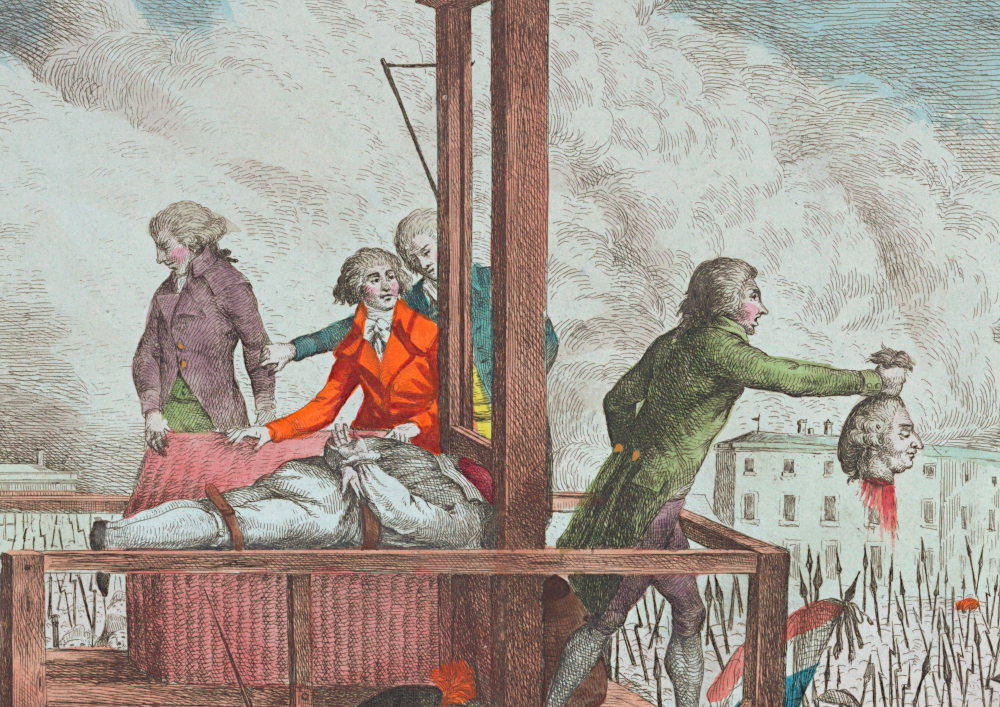
A Slight Freshness on the Neck”: Prints Depicting the Execution of Louis  XVI (ca. 1793) – The Public Domain Review
Please be aware: this video is good because it shows the lyrics of the (honestly terrible) audio of this unfinished recording, but it also shows EXTREMELY graphic footage of protests, specifically suicidal self-immolations, in Vietnam and in Czechoslovakia.

This Morning

This morning I’m thinking, Well! That’s quite a line you’re following, there, Dusty! First you rail against science, and then you complain about the foundation of American exceptionalism, capitalism and the profit motive? Why don’t you go for the trifecta?

This morning, I say to my sardonic self (Who uses sarcasm to conceal the quiver in his lip): all righty then.

Capitalism and the profit motive have helped make this country the absolute powerhouse that it is militarily, culturally, and especially economically. The drive to succeed, to win, to gain the maximum benefit for one’s self from one’s labor, have been a powerful motivator for as long as this country has told us we can pull ourselves up by our bootstraps; though profit and competition haven’t made that particular impossible feat possible, they have allowed us to turn a thousand other impossible things into realities: they helped us get to the moon (because we had to beat the Commies there) and they helped us invent the first atomic bomb (because we had to beat the Nazis) and they helped us lead the way in the information revolution of the 1980’s (because Apple had to beat Microsoft, and Microsoft had to beat Apple). Our continuous growth, our continuous progress, have been driven largely by exactly this: by money, by profit, by competition for limited resources, whether those resources are time or money or fame or love or just food.

I can’t argue with that. I hate competition, hate the very idea of fighting other people in order to gain greater profit; but I can’t deny the results. America is an exceptional place, and our incredible speed forward has been increased again, and again, and again, by this essential underlying system: the one in front, the one on top, gets what he wants, and other people have to make do with what’s left over, with what’s left behind. Our system of government, our great and wonderful freedoms —  and they are great, and they are wonderful — are predicated on that idea, with this addition: anyone, in theory, can be the one on top, the one who gets all the stuff first. In practice it can’t be anyone, and it’s almost  always been the same type of people — mostly white Christian men — but in theory, it could be anyone, and our ability to pretend that that is true, and our desire to push for greater rights for other people mainly because we think those opportunities will reflect some benefit back on us, are what has allowed us as a society to spread those freedoms to more people, in more situations.

Just as long as we can pretend the people gaining the freedoms are like us. When they’re not like us, when they live on the other side of the world and speak a different language and live a different way, well. Then it’s probably all right if they have less freedom. Particularly if we profit thereby, with, say, cheap consumer goods.

Am I being too cynical? Look: the slaves were freed because it served the purpose of the white men who freed them. Woodrow Wilson changed his stance on women’s suffrage from opposition to support because he needed women to continue supporting the American effort in World War I. At least part of Lyndon Johnson’s intention in signing the Civil Rights Act of 1964 was to ensure the Democratic party would not fracture along racial lines — and that all of them would support his bid for election in November. And so on, so on. I do agree with Dr. Martin Luther King that those in power do not give up their power voluntarily, only when there is sufficient pressure on them to do so; I know that some of the progress we have made towards greater freedom has been because of grass roots movements and political and social pressure. The will of the people does sometimes prevail. Maybe even often.

But far more often, money talks, and people bend and crawl. And that’s capitalism.

Technology, meanwhile, has often been touted as a means of making life easier for the common man; but all too often, it has in fact made life harder. We have more technology, and we work longer hours and suffer more stress. We have longer life spans, now, that much is certainly true; but more of our lives is spent in misery, and often in ill health. We’ve gotten more quantity of life, but not more quality. And even more true is this: when progress has been made, it pushes us forward  —  off of another cliff. The Green Revolution of the mid-20th century, led by Norman Borlaug, saved at least a billion people from starving to death in Asia. A magnificent success, and a great leap forward.

How many billions are going to die now because of climate change? How much of that climate change was driven by the increase in human population made possible by the Green Revolution?

I don’t mean to say it was a bad thing. Lives were saved, and I am in favor of humans, and of living humans over dead humans. The same thing is true of our longer life spans: what I said about quantity but not quality is true, but also, the rise of lingering and terrible diseases that afflict us as we age has come at least partly because we are now still alive to age. We die of cancer now because we don’t die of sepsis like we used to. We have Alzheimer’s now because we’re not all dead at 65-70 from heart disease. Do you realize how many of the world’s greatest authors, along with millions of others, literally drank themselves to death before they were 50? Do you realize how much of that is attributable to a lack of understanding of and treatment for alcoholism? How much was, quite simply, due to the inability of medical science to perform a liver transplant? Medical advancements just mean we die in different ways, and after longer lives — and as a person who would like to live a good, long time before he dies, I see that as entirely positive.

But the problem is, the problem with all of this is, that we think of our temporary fixes, our incremental advances  — our progress– as a solution to the problem. But it never is. All we’ve been doing since the Industrial Revolution if not before, is treating the symptoms and not the real underlying problem. We are better at waging war: but we haven’t figured out how to stop fighting. We live longer lives: but not better ones. We make more profits: but we don’t get greater rewards. We live in a magnificent country: but it survives by exploiting and destroying other countries, other people, and it always has.

Progress is not our salvation. Progress is our drug. We’re not making real progress in our real problems — not much, and not quickly, and too often the real progress is swallowed up by backsliding; we have actually gotten more empathetic and more aware, and the backlash from that is the alt-right and Donald Trump. Which is making us less empathetic and less aware, as we draw deeper into our shells to avoid looking at the shit that is piling up outside. And I am entirely guilty of this, don’t think I’m not: I have stopped listening to or reading the news because I feel powerless to do anything about it. I’m not: I have as much power as any person, and more than most because I am a white Christian man, to help make the world a better place, and instead, I’ve done — well, nothing useful. I’ve probably made some progress. But I haven’t solved anything.


I don’t think I’ve been clear enough in this blog. I’ve been having trouble lately making my point clear; and this one is a tough one to get across. Let me boil it down and then I will see if I can explain it at greater length in future posts.

What we call progress, in technology, in the growth of our economy, in the expansion of this nation’s military and political power, are rarely if ever actual progress towards a useful goal, a valuable purpose. Almost always the goal is — motion. Like football: you try to get the first down, you try to move the chains. You hunker down and focus on the immediate task, convincing yourself that that one task, that one all-consuming goal, is a good thing. And in the immediate sense, in a single, narrow context, it is good: football players are successful when they get first downs. Soldiers are successful when they carry out assigned missions. Workers are successful when they bring home a paycheck. Scientists are successful when they complete an experiment as it was intended  — say, by injecting human brain DNA into macaques. We see immediate success as progress, especially when it is followed by another success. We’ve taken another step along the path.

But we rarely, if ever, think about where the path is leading. And too often, the successes right now cause even greater problems down the line.

That doesn’t mean we should ignore the problems, nor that we should try not to solve them; winning World War II was the right thing to do, even if it did start the Cold War and the nuclear arms race and so on. Norman Borlaug absolutely should have saved billions from starving, and Alexander Fleming absolutely should have deciphered penicillin, and Dr. King absolutely should have fought for civil rights.

But we need to stop thinking that progress, movement forward, is the answer, is the solution, is the goal. Movement for the sake of movement will not ever get you to where you need to go, to where you should be. Only purposeful, intentional movement can do that. A plan. Understanding.

So maybe, instead of bulling ahead ever farther, ever faster, ever harder, we should– slow down. And think. Even if it means we don’t solve the problems we’re dealing with right now. Maybe it will help us find a real solution, instead of a solution right now that leads to another problem tomorrow.

Getting Deeper into Atlas Shrugged

This is the first of what may be a new category of post on this blog. As you’ve probably noticed if you’re a follower, I’ve been moving away from the usual ranting essay type of post and more into book reviews; this is intentional. But sometimes, I have more to say about a book, and when I do, I will write one of these. I’m going to call them DustNotes. (Maybe HumpNotes? No. Definitely DustNotes.)

I will also say that this one comes from requests that I got from friends, several of whom said they were glad that I had read this book because now they didn’t have to. This gave me an idea: I have plenty of TBR books of my own, of course — too many, really — but I would be willing to take requests, if there are any books that someone wants to get my opinion on. That includes new and unpublished authors, by the way; I’m willing to read and review pretty much anything you want my take on. You can email me at writeth@tonidebiasi.com if you’re interested.

For now, here are my DustNotes.


Book: Ayn Rand’s Atlas Shrugged

Concept: While the book was being written, the working title was The Strike; that is the concept. (Gotta say: Atlas Shrugged is actually an excellent title, and a clever way to describe the theme. Godlike being holding up the world, and the weight grows too much for him, so he – shrugs it off.) The Prime Movers (as Rand referred to them in her notes, though not in the novel), the most valuable members of society, withdraw from society – they go on strike – and society collapses without them. In general, these people are the Men (and the book is bloody sexist, though maybe a reflection of the times, as it was written between about 1946 and 1957) of the Mind; most of them are industrialists – an oil man, a steel man, a copper man, a man who makes cars and another who builds airplanes. Though there is also a physicist and a philosopher, a banker, and a token few artists. They are the Men of the Mind because they are extremely intelligent, extremely capable, extremely strong-willed; they are perfect rational beings, which Rand saw as the human ideal.

The reason the Men of the Mind go on strike is because they recognize that society only exists because of their contributions, but that society gives them nothing in return for what they provide to their fellow men. We need them, but they don’t need us. Not that people couldn’t live without them at all, but rather, without the Men of the Mind to prop up the society we have built which relies on them so heavily, will inevitably and rapidly destroy itself. According to this book, the Men of the Mind are good in all ways, and the rest of society are weak and lazy, incapable and, as Rand frequently states unequivocally, evil. Intentionally, utterly evil. Why? Because we don’t produce, we simply take what the Men of the Mind produce. We are looters.

Rather than get into a specific synopsis – which, considering how excessively long this book is, would be too dull to read – I’m going to break down the ideas in the book into the ones that are Interesting, those that are Silly, and those that are worth More Thought. I will probably not explain these too well; partly that’s because I’m trying to be brief about some complicated things, some of which I still need to think more about in order to understand and agree with or critique; partly it’s because the explication of these ideas came in the form of a novel that was too long by a factor of ten. I got tired of trying to understand, and Rand’s writing doesn’t make it easier. I will try to present them anyway. Here we go.

Interesting idea: man is a rational animal; a creature of “volitional consciousness.” The means of our survival is our reason, which is our ability to perceive reality and then act upon it and shape it through the application of our intellect. The “volitional” part is where Rand states that we must choose to use our rational faculty; if we do not choose to do so, then we are not human, or not good. It is interesting to state that our purpose is to think, and that thinking defines us; so many of our definitions have to do with chosen associations like nationality or religion or politics, or accidental ones like race or bloodline or family name. I like this idea.

Idea that needs more thought: the realization of man’s rational faculty is – production. Rand is very clear about this: because production is the means of our physical survival, it is the natural and correct result of our reason – which is the means of our survival, remember, so by using our reason, we produce, generally concrete value, preferably in the form of steel or coal or oil or a railroad. The pinnacle of our society, she says, our greatest accomplishment as a race—is New York City. This is also why the industrialists are the pinnacle of human achievement, because they are the most productive. I am not sure that everything that humans do qualifies as productive – if a scientific theory doesn’t lead to better steel or a faster car, is it productive? If not, does that make it evil or a waste of time? What about art? – and I am not sure that our purpose is to continue surviving through concrete productivity. More thought on this one, for me.

Silly idea: The United States of America is the greatest country in the history of the world because it was the only country founded on the idea that men should be free to use their reason and be independent individuals; all other countries are founded on random chance and evil institutions. Okay, sure, the Constitution is a genuinely special document, and the Founding Fathers were, in my opinion, some of the greatest political geniuses who ever lived, and we are the recipients of their genius; but that really doesn’t mean that every other country is a pile of shit, which is essentially what Rand says. Particularly not now, when a large number of modern nations have exactly the social and political structure that Rand claims is the only moral one – that is, capitalism (though of course, she wants it laissez-faire – but hell, America ain’t that, either.) and a foundation of individual rights. It’s American exceptionalism taken to an extreme, and it ignores both the flaws in this idealized nation and the successes of other nations. It’s silly. Though I guarantee that this is one of the reasons this book is so very popular among Americans. I should note that the book was written during the height of the Cold War, and Rand herself lived through the rise of the Soviet Union and suffered because of it; she was virulently anti-Socialist, and in the book, every other nation on Earth is socialist, and all of them are propped up by goods provided by the United States. So she might have been picking a very specific bone in a specific context; given the world of 2017, she might pick out a couple of other nations that are acceptable, the UK or Australia or Germany or South Korea or Japan.

Interesting idea: industrialists are the greatest contributors to our modern productivity. Through innovation and economic leadership, they add more to our productive capacity than anyone else, and therefore create more wealth and save more time, through freeing up people from menial labor, than anyone else in history. For this we should be grateful; instead we tend to castigate them as greedy, soulless robber barons. I hadn’t thought of industrialists this way, and I think there is validity to it (Note that you have to agree that the purpose of humanity is production to accept the full conclusion that Rand gets to, which is that the industrialist is the ideal human being, just as NYC is the ultimate achievement. I’m not there, but I can appreciate the things that industry has done for us. I’m glad I don’t have to spend my life behind a plow.). I know I have been hard on capitalists and industrialists and corporate men in the past, and this has made me realize I shouldn’t have been. Sure, of course some of them have been and are vile people; but just the fact of being a successful industrialist isn’t a crime, and shouldn’t be seen as morally reprehensible.

Needs more thought: the individual is better, in all ways, than the collective; altruism, which for Rand means sacrificing something of value for the sake of another person, is evil. This is the fundamental piece of the book’s philosophy that I have the most trouble with. The leader of the Men of the Mind has them all take an oath: “I swear that I will never live for the sake of another man, nor ask another man to live for mine.” The book argues that any gift is a sin, that the only moral interaction between people is voluntary trade, with value given for value and the consent of both parties. It is very clear that charity is evil: not only for those who ask for help, but also for those who grant help, unless it is part of a trade. Rand has to do some fancy stepping to make things like love and family fit into this ideal; she claims towards the end that giving aid to someone you deem worthy is a trade, because you as the giver gain the value of supporting someone you think worth supporting; this strikes me as a real stretch. She grants marriage the status of a trade largely because of sex; she says nothing about raising children. I don’t see how raising children can be anything but a gift from parent to child; I know I certainly can’t repay my parents for what they gave me. I suppose the possibility that I will care for them in their old age as they cared for me in my youth, but what if that doesn’t happen? Certainly it isn’t a debt that can be called in except under specific circumstances, and if it isn’t called in – isn’t that a gift?

Rand is also clear that only the person who owns a thing, a thought, an invention, a piece of property, should be permitted to judge what to do with it. Having any form of government or social control over an individual’s property is always theft. Only an individual can decide what to do with his mind, or the product of his mind; any attempt to coerce that individual is a denial of that individual’s rights, and also, interestingly, a denial of the coercer’s basic humanity: because when I claim that I need someone else to do something for me, to make a decision for me, then I am saying that I can’t make the decision for myself. I am denying my own rational capacity, which is, Rand says, what makes me human. (One of the unfortunate corollaries of this in the book is the idea that anyone who supports charity is actually a murderous, larcenous, amoral villain; everyone who isn’t a Man of the Mind in the book is essentially a caricature of a cackling mustache-twisting criminal. It gets a little tired.) The Men of the Mind in this book are always absolutely sure of their own individual decisions; everyone else can’t make a decision even when their lives depend on it. This theme is repeated so often that it turns first into a parody, and then into just repetitious drudgery. After 1070 pages of the non-awesome-people saying, “I don’t know what to do! I can’t decide! You decide for me!” and the awesome people lifting their mighty chins and saying, “No,” I wanted to freaking decide for them just to shut them up.

Point is: the idea that I have to choose what I do, that only I can choose for myself, that I must trust my own judgment over all others’; interesting idea. The argument that taxes, therefore, for any purpose other than police or courts or national defense are only theft of an individual’s property at the barrel of a gun – the libertarian ideal – still needs more thought for me, though this book did make me move a bit more libertarian and a bit less liberal, at least at the moment. The idea that this also means that I can’t ever give anything to anyone, that altruism is suicide, that EVERYTHING must be traded value for value – pretty freaking questionable.

Silly idea: All of the Men of the Mind are tall. All of them are slender, and all are white except for one Argentinian. Who’s pretty danged white, since he only speaks English, never spends time with anyone who isn’t a white American (Not when he’s in the actual narration. He does go back to Argentina, where he talks, presumably, to other Argentinians, but we never follow him there.), and has blue eyes. All of the Men of the Mind have light-colored eyes, blue or gray or green. A lot of ’em are blonde, though they are mostly tan, so not all white. But that doesn’t matter; we’re concerned with their abilities and their actions, not their appearance. Still, the book talks a whole lot about the good people being slender and the evil ones all being either pudgy or scrawny; the pattern is too consistent to be accidental, or anything other than specific intentional symbolism. And as a member of the House of Pudge, I found it annoying and distracting. Though I will note that Rand would have thought me evil. So maybe she was onto something.

Interesting idea: Happiness is the moral purpose of life. Our purpose in existing is to experience joy, the complete, fulfilling, guilt-free joy that comes with actually doing what we are meant to do. Now, this gets a little tangled around the idea of “purpose.” Our purpose as living things is to keep living, but that’s not enough for happiness; our means of living as humans is reason, but just thinking isn’t enough for happiness; our purpose in living is happiness. I’m not really sure how to parse those all out, but I like the idea that we exist to be joyful. Rand claims that our joy comes from the realization of our individual values, which I find more questionable – because in Rand’s eyes, we all have the same values, namely that we are all happiest when we are being productive, and I question that because Jeffrey Dahmer was happiest when he was murdering and eating people – but still: joy good. Rather than “sacrifice to a greater good” being our source of true fulfillment, or a specific thing like raising a family, living a good Christian life, whatever – we should live to be happy. There are interesting implications of the idea, but mainly, I just like it.

Needs more thought: Existence exists, reality is real, A is A. This comes apparently from Aristotle, so isn’t properly Rand’s thought; but it is a major theme of this book, because the book claims repeatedly (exhaustingly, just like everything else in this book) that contradictions cannot exist, that when we think we see a contradiction, we are mistaken in one of our premises – and I am very glad that I don’t have to read, again, about the Men of the Mind emitting some manly condescending chuckle and saying, “Check your premises.” Buncha know-it-all smug-butts. Apart from that, though, this is the foundation of Rand’s epistemology, and apparently has a lot to do with her criticism of modern society. It seems we make shit up a lot, and act as though it is real; in so doing, we create contradictions, and then either ignore them even as they break down our ability to progress, or use the contradiction we have created as evidence that there is nothing absolute in life, that everything is relative, which leads eventually to nihilism.

It isn’t so much that I question this tenet. It’s more that I question the converse which Rand is criticizing. It turns out a lot of this book is, for me, a straw man argument: a whole lot of the immoral collectivist thought that damages and imprisons the Men of the Mind is actually Christian thought – the idea of Original Sin, the doctrine that knowledge of good and evil led to man’s fall from paradise, the idea that suffering in life leads to bliss in the afterlife, and the basic sundering of spirit from body – and I don’t agree with any of that. So for a thousand pages, I was told that I’m an evil man who’s destroying what humanity could and should be – because of my Christian dogma. And, well: nope. I’m not a nihilist, either, so all the declarations that reality is knowable and that we can act based on our knowledge weren’t challenging for me. So I don’t know how much this philosophy changes my paradigm, and therefore how much it matters to me.

I also question the idea that there can’t be contradictions. I think maybe there can be. I get the idea that it is probably because of a mistaken assumption; when I teach paradox, I generally point out that most paradoxes rely on a specific perspective, and if you change the perspective you eliminate the paradox, which is that “Check your premises” shtick. But there are contradictions that, even if we know it is a mistake in perspective, we can’t resolve. Modern physics, for instance: Schrodinger’s cat leaps to mind. Telling me to check my premises isn’t going to fix that problem. So this one needs more thought.

Silly idea: all smart people think alike. Okay: Rand was trying to make a philosophical point about the ideal Man. Her ideal Man is an industrialist, an extremely productive person. Okay, sure. The thing is: none of the Men of the Mind are drunks. None of them are teetotalers. All of them smoke. (There is a TON of smoking in this book. Pretty funny, really.) None of them are bipolar, or manic-depressive, or have traumatic pasts. None of them are cantankerous, or impolite, or smelly; none of them habitually refuse to wear pants or eat nothing but cornbread. None of them are even gay, which would seem like the simplest way to have some variety in the characters, if you don’t go for the equally obvious choice of having a couple of them not be honkies. They all love classical music – not a jazz fan, or a blues fan, or a country and western fan in the bunch. They all believe in the value of money, and in the essential goodness of capitalism, and of productivity. They are all rationalists. When the leader tells them his secret, none of them disagree, or refuse to join the strike. (I should say: one of the real main characters, probably the most important character in the book, does refuse to join the strike. But she does it while agreeing with everything the strikers believe. Even she doesn’t think differently; she’s just more optimistic, or less beaten up by the world, than the rest of them. She’s also pretty much the only woman. Coincidence?!?) None of them are vegetarians. None of them have pets. All of them are open-minded about the same things. All of them feel the same way about everything. Now, that level of conformity follows logically from an ideal based only on a couple of very simple tenets – A is A, man is rational, only trading can be moral – but it really undercuts the message of individualism. I think it’s pretty well exemplified by the fact that at least four of the Men of the Mind are all in love with the same woman, the one female main character, the railroad tycoon Dagny Taggart. (By the way: Rand has some spectacular character names, particularly among the bad guys; but a lot of her heroes have really dumb names. Midas Mulligan is one of the dumbest. Ragnar Danneskjold and Francisco d’Anconia are fine, but a bit of a mouthful. Ellis Wyatt and John Galt are good. But Dagny Taggart? Yick.) And even though she chooses only one of them in the end, they are all perfectly happy for her, and perfectly at peace with all of their rivals for her affection. Come on: not one of them is petty? I mean, we’re all rational beings, sure, but we’re still human.

Idea that I want to label as silly but Rand seems really damn sure of it so maybe it needs more thought: compromise is evil. When John Galt speaks at the end of the book and reveals an encapsulated version of Rand’s philosophy which this book is supposed to represent, he talks about morality and right and wrong. And he says that the people in the middle of a moral argument are the worst people, the greatest evil. Someone who takes the wrong side is at least taking a side, even if they are wrong about it; people who want to compromise are the real villains. So for me, this is complete bullshit; compromise is how humans build society and survive with each other. But this book is one large slippery-slope argument; the looters – like me, with my support for taxes and public welfare – have survived as long as we have while leeching off of the Men of the Mind because the M.o.t.M. are willing to compromise with us. They give us a little; then we ask for a little more. They give us more; we ask for the rest. They give us the rest; we ask for their lives. The book depicts this as inevitable, and the only solution is what the M.o.t.M. do in this book: they stop it dead, they walk away, they say “No more!” and go on strike. Leaving all of us looters to die in chaos and bloodshed, whining pathetically that it’s all their fault.

Now, as a public school teacher, I understand the danger of a slippery slope. My school is always asking me for a little bit more, and a little bit more, and a little bit more. It does seem as though taxes just keep going up and up; the American Revolution was fought over a tax burden of about 1-3% of total income. But the fact that compromise shifts you off of your extreme position doesn’t mean that you can no longer make a stand: it means you have to select a new position somewhere more towards the middle, and stand there. Whether you stand on the far side or three steps in from the edge makes no difference; in either case, the strength of your stance is the same, whatever determination you can muster to maintaining that position. The difference is that a position somewhere in the middle acknowledges that other people have minds, as well, and probably have a point in their argument; believing Rand’s argument that I must trust my judgment above anyone else’s doesn’t mean I never listen to anything anyone else says, ever. And it doesn’t mean that I shouldn’t try to get along with other humans, which requires compromise. Rand seems to believe that life should be a constant competition, and if you aren’t the winner, then you should get the hell out of the way. Personally I think that damns the vast majority of humanity to essential worthlessness, which seems bad. But then, I don’t really like the majority of humans very much, so maybe there’s something to it.

Since I have to take an extreme position, though, I’m going to call this idea silly.


In the end I think there are better ways to get the same set of ideas, rather than reading this book. Then again, the book is still selling, still being read; maybe this really is the best form of the argument. Maybe there’s something good here that I missed, or didn’t appreciate. I will note that if you happen to be a tall, thin, money-loving independent American businessman, then accepting the ideas in this book would make you the pinnacle of humanity and the source of all good things in the world: that is a very attractive reason to think Rand has a point. If you are one of those.

But as a liberal, moderate, government employee, and member of the unproductive bourgeois, I guess I’m not one of the Men of the Mind. That’s okay: I don’t want to die, as every other character in the book does when society collapses and returns to the Dark Ages; but I also wouldn’t want to hang out with those people. They don’t read enough. And clearly, I read too much.


COROLLARY  DISCUSSION:

After I posted a link to this on Facebook, a friend and former teaching colleague of mine, who has spent far more time reading and thinking about Rand’s work than I have, commented on that link about this review/explanation of Atlas Shrugged. Her comments came in two parts because of the permissible size of Facebook comments (I had to do the same thing in my reply to her); I responded to the first half but not the second, and then she replied to me. All of that discussion is below; I’m appending it because her explanations of Rand’s thoughts and the corrections she made to my above explanations are both important and useful. There are still some things I disagree with, and still things that require more thought; the second half of her initial response requires more reading of Rand’s non-fiction, which I plan to get to eventually, and until I do there’s no point in continuing our discussion of compromise — but it’s going to end up being a sticking point, I think. At any rate, if you read this post, please do go on and read this discussion: it is very helpful. Any further discussion is entirely welcome in the comments.

The only formatting change I’m going to make is to mark quotations we both used. All her quotations are from me; I quoted myself and her response, and marked it as such. The name-links lead to our respective Facebook pages.


Jessica Porter Dusty, I enjoyed reading your take on Atlas Shrugged. Your review is more thoughtful than many I have read. I first read Atlas Shrugged about three years ago and have spent a considerable amount of time since then mulling things over and sorting through the different pieces of Rand’s philosophy to see if they stand. Your review is fair in some areas but off in others. There are several places in particular where the book’s big ideas are not quite accurately represented—and since many people are never actually going to read Atlas Shrugged but will look to reviews like this for a summary instead, I think it’s only fair to push back on a few things.
__________________


“The reason the Men of the Mind go on strike is because they recognize that society only exists because of their contributions, but that society gives them nothing in return for what they provide to their fellow men…. According to this book, the Men of the Mind are good in all ways, and the rest of society are weak and lazy, incapable and, as Rand frequently states unequivocally, evil. Intentionally, utterly evil. Why? Because we don’t produce, we simply take what the Men of the Mind produce. We are looters.”

-This summation is incorrect. It’s not that the producers are upset that society merely provides nothing in return for their contributions; it’s that what society does provide in return is contempt, derision, and threats. “Society” also steals from the producers, taking values through violence that were not offered freely, value-for-value. For the producers, this is a matter of justice. The framing of their motives is important, and your framing obscures the injustice that underlies the trade imbalance between the producers and the consumers. Your summary frames everyone who is not a producer as being a looter worthy of total contempt. For Rand, though, the label of evil is for the James Taggarts of the world: those whose entire mode of operation is looting and non-thought. Not all lesser-producers are this way in Atlas Shrugged, and Rand does not condemn all of the non-industrialists as she condemns James Taggart. What distinguishes good people from bad people, in Rand’s view, is essentially: are you trying to focus and think, or are you purposefully trying to do the opposite? Taggart seeks non-thought and non-production and is entirely happy to mooch off of others. A person could be weak, lazy, and incapable but yet still be seeking rationality, pursuing the full achievement of their values, and trying to be better. I think Rand would, in that case, not categorize that person as evil at all but as a person who is at least making a noble attempt.

“Note that you have to agree that the purpose of humanity is production to accept the full conclusion that Rand gets to, which is that the industrialist is the ideal human being.”

-This is not the case. First of all, I don’t think that Rand would even agree that there is a “purpose of humanity” at all. Individuals have purposes. Humanity as a collective does not. For each individual, though, Rand’s take is that each person’s purpose is not production, but rather the achievement of their personal happiness (which you discuss later in your post). Production of some sort is necessary for the achievement of values, but Rand is in no way stating or suggesting that industrial production is the purpose that every individual should pursue. She is also not suggesting that those who do not pursue industry are any less noble or valuable as human beings than those that do. Also, for Rand, the ideal human being is John Galt (and all of the characteristics that define him), not the “industrialist” in a disembodied, abstract sense. Galt’s skill set includes innovator, inventor, and philosopher. He is a man of thought and action, moral and practical. He is not a stand-in for Bill Gates or Elon Musk. Among other things, I think Atlas Shrugged was a thank you note from Rand to the industrialists who made the Western world great, and this is why many of the heroes in this book happen to be industrialists. In The Fountainhead, by contrast, Rand’s hero is a starving artist.

“The book argues that any gift is a sin.”

-No, the book does not argue that any gift is a sin. Rather, any sacrifice is a sin. A sacrifice, according to Rand, is “the surrender of a greater value for the sake of a lesser one or of a non-value.” For example, in the book, when Hank Reardon tolerates his wife’s denigration of his life and his values, he makes a sacrifice. Hank is giving up the full expression of his own pride and accomplishments for the sake of getting along with a wife who is an awful person. He does this merely because he assumes without giving it much thought that this is expected of him. Hank gives up (until he meets Dagny) the opportunity to be with people who actually value him for who he really is and respect him for what he values for the sake of keeping up appearances and doing what society expects a person to do. Rand would agree that sacrificial charity is evil, but she would not agree that all charity or gifts are evil.

“Rand has to do some fancy stepping to make things like love and family fit into this ideal [of love as being selfish rather than altruistic]; she claims towards the end that giving aid to someone you deem worthy is a trade, because you as the giver gain the value of supporting someone you think worth supporting; this strikes me as a real stretch.”

-It sounds like your trouble with this is that you don’t see how a love-based relationship like marriage or parenting could be fundamentally selfish and not altruistic. Ask a parent: Is your life richer for having had children? If their answer is no, then their experience of parenting would fit your framing and would be considered altruism. If their answer is yes, however, then the act of parenting, even though it takes a huge amount of work, also brings huge rewards. For many people, choosing to parent is a choice that is made in order to bring joy and fulfillment to life. By Rand’s definition, this is selfishness, not altruism. Your analysis neglects the fact that relationships do bring enormous values to many people. Watching a child you love grow up and experience the world, for example, is worth more than what it costs to be a parent for many people (which is not to say that being a parent doesn’t cost something). Same with marriage. Does marriage have a cost? Absolutely. But many people choose marriage because the rewards it brings outweigh the costs. This is not altruistic. For Rand, love is 100% a selfish act, according to her definition of selfishness, which may be worth looking into further.

“Anyone who supports charity is actually a murderous, larcenous, amoral villain; everyone who isn’t a Man of the Mind in the book is essentially a caricature of a cackling mustache-twisting criminal.”

-Be careful not to equivocate on the concept of charity as it is used in the book. If a person supports forced, sacrificial charity, then according to Rand, yes, that is bad. But if a person supports the trading of value for value, which includes non-sacrificial charity, then that is great. Also, Eddie Willers is not one of the leading industrialists but is also not characterized as a mustache-twisting criminal. What is different about Eddie that causes Rand to frame him in noble terms even though he is not in the ranks of Galt, etc? This matters. If you perceive one of Rand’s points as being that if a person is not a super star Superman industrialist, they are an evil, pathetic loser, you may be reading your own concerns into the book.

Jessica Porter

“Because in Rand’s eyes, we all have the same values, namely that we are all happiest when we are being productive, and I question that because Jeffrey Dahmer was happiest when he was murdering and eating people “

-A valid question, yet this overlooks the fact that rationality and reason are absolute requirements for true happiness. Galt sums it up well when he says, “Happiness is not to be achieved at the command of emotional whims. Happiness is not the satisfaction of whatever irrational wishes you might blindly attempt to indulge. Happiness is a state of non-contradictory joy—a joy without penalty or guilt, a joy that does not clash with any of your values and does not work for your own destruction, not the joy of escaping from your mind, but of using your mind’s fullest power, not the joy of faking reality, but of achieving values that are real, not the joy of a drunkard, but of a producer.” I am no expert on Jeffrey Dahmer, but I doubt very much that Dahmer’s actions fall into the category of non-contradictory, non-destructive joy. I suspect one would find a great number of contradictions in Dahmer’s personal philosophy.

“It turns out a lot of this book is, for me, a straw man argument: a whole lot of the immoral collectivist thought that damages and imprisons the Men of the Mind is actually Christian thought …. So for a thousand pages, I was told that I’m an evil man who’s destroying what humanity could and should be – because of my Christian dogma. And, well: nope. I’m not a nihilist, either, so all the declarations that reality is knowable and that we can act based on our knowledge weren’t challenging for me. So I don’t know how much this philosophy changes my paradigm, and therefore how much it matters to me.”

-If you don’t think that Rand’s label of evil applies to you, then why are you sure that throughout the entire book, she is saying you are a horrible person? I don’t think Rand’s criticism is so much against Christianity as it is against the altruist morality, which is 100% not exclusive to Christianity. Rand’s background was an atheist dictatorship rather than a Christian one, and as far as I know, she reviled and wanted to destroy socialism much more so than she did Christianity (although she hated Christianity as well). What makes you think that her philosophical criticisms are targeted primarily at Christian dogma?

“Compromise is how humans build society and survive with each other.”

-I recommend that you read the essay, “The Anatomy of Compromise” by Rand.

“Rand seems to believe that life should be a constant competition, and if you aren’t the winner, then you should get the hell out of the way. Personally I think that damns the vast majority of humanity to essential worthlessness, which seems bad. But then, I don’t really like the majority of humans very much, so maybe there’s something to it.”

-Where does Rand say that life should be a constant competition and that if you aren’t a winner, you should get the hell out of the way? That is not an idea I have encountered in my readings of Rand. Where are you getting this? She definitely does not shy away from judging people, but nowhere does she advise against thinking through other people’s ideas, having friends, acknowledging that other people have minds, and pursuing the values that are unique to you personally (not everyone is a steel magnate). You frame this as if Rand is some sort of non-human Nazi with a riding crop incapable of living any sort of thoughtful life with other human beings. That, I think, is a bit of a caricature. You have to take the whole of Rand’s philosophy into account, where there is plenty of room for love, connection, and thought. Compromise, not so much, but again, you should read “The Anatomy of Compromise” for more details.


Theoden Humphrey

Me in blog:'”The reason the Men of the Mind go on strike is because they recognize that society only exists because of their contributions, but that society gives them nothing in return for what they provide to their fellow men…. According to this book, the Men of the Mind are good in all ways, and the rest of society are weak and lazy, incapable and, as Rand frequently states unequivocally, evil. Intentionally, utterly evil. Why? Because we don’t produce, we simply take what the Men of the Mind produce. We are looters.”‘

You: -This summation is incorrect. It’s not that the producers are upset that society merely provides nothing in return for their contributions; it’s that what society does provide in return is contempt, derision, and threats. “Society” also steals from the producers, taking values through violence that were not offered freely, value-for-value. For the producers, this is a matter of justice. The framing of their motives is important, and your framing obscures the injustice that underlies the trade imbalance between the producers and the consumers. Your summary frames everyone who is not a producer as being a looter worthy of total contempt. For Rand, though, the label of evil is for the James Taggarts of the world: those whose entire mode of operation is looting and non-thought. Not all lesser-producers are this way in Atlas Shrugged, and Rand does not condemn all of the non-industrialists as she condemns James Taggart. What distinguishes good people from bad people, in Rand’s view, is essentially: are you trying to focus and think, or are you purposefully trying to do the opposite? Taggart seeks non-thought and non-production and is entirely happy to mooch off of others. A person could be weak, lazy, and incapable but yet still be seeking rationality, pursuing the full achievement of their values, and trying to be better. I think Rand would, in that case, not categorize that person as evil at all but as a person who is at least making a noble attempt.

Me now: You’re right, I should have included the concept of justice and injustice; it is critical to Rand’s explanation of this situation. I don’t know that I agree with her description of society’s treatment of producers, that the injustice of a trade imbalance, as you describe it, leads to contempt, derision, and threats; I suppose that is the distinction, that it is evildoers like Taggart who take us from – can I say “mere injustice?” I don’t mean to belittle the problem, but I do see a distinction between the injustice involved in taking the production of people, and doubling down on that injustice by offering them contempt, derision and threats. Taggart and his ilk take it to that point. Society – “only” – steals from the producers. I should have talked about the theft.

I don’t know that I saw that critical distinction about thought and focus being enough to earn Rand’s approbation. Yes, Taggart seeks non-thought, I saw that; but I’m not sure I agree that this book depicts a world where a lazy, weak, incapable person, who is seeking to get better, is valuable. There is a set of evildoers who are the real villains – but the workers at the 20th Century Plant, and the citizens of Starnesville who return to savagery as a result of what Jed Starnes’s heirs do, are not good. They are not as villainous as those heirs, and the guy at the end, the drifter with the clean collar – is it Jeff Allen? – whom Dagny gives a job to, is clearly one of those people who has done wrong by participating in the corruption of the 20th Century plant, but is trying to do better now, and he receives positive treatment from Dagny and from Rand. So I see what you’re saying. But he seemed the exception. I felt like the book was tremendously critical of everyone who was not on board with Galt’s ideas, in general. It seemed like ignorance was not much of an excuse. Maybe I was misreading suffering for villainy, since the villains suffer as well.

Me in blog: “Note that you have to agree that the purpose of humanity is production to accept the full conclusion that Rand gets to, which is that the industrialist is the ideal human being.”

You: -This is not the case. First of all, I don’t think that Rand would even agree that there is a “purpose of humanity” at all. Individuals have purposes. Humanity as a collective does not. For each individual, though, Rand’s take is that each person’s purpose is not production, but rather the achievement of their personal happiness (which you discuss later in your post). Production of some sort is necessary for the achievement of values, but Rand is in no way stating or suggesting that industrial production is the purpose that every individual should pursue. She is also not suggesting that those who do not pursue industry are any less noble or valuable as human beings than those that do. Also, for Rand, the ideal human being is John Galt (and all of the characteristics that define him), not the “industrialist” in a disembodied, abstract sense. Galt’s skill set includes innovator, inventor, and philosopher. He is a man of thought and action, moral and practical. He is not a stand-in for Bill Gates or Elon Musk. Among other things, I think Atlas Shrugged was a thank you note from Rand to the industrialists who made the Western world great, and this is why many of the heroes in this book happen to be industrialists. In The Fountainhead, by contrast, Rand’s hero is a starving artist.

Me now: I was confused by the idea of purpose in this book. The achievement of personal happiness comes from achievement of values, which requires some form of production; doesn’t that mean that productivity is, if not THE purpose of a human life, a critical element of it? I got lost in the idea of what is good and what is purposeful and what is valuable. I’m not explaining my confusion well, I know. I do understand that industrial production is not the key, but it is telling to me that the focus of much of Rand’s praise is related to industrial production. She talks about how innovators and inventors and industrialists have saved us time, and therefore life, along with providing the means of sustaining life, through increasing our productivity; she doesn’t say as much about the value of, say, medicine as a means of saving lives, or the value of producing art. She has a doctor character in Galt’s Gulch, so it isn’t that industrialists are the only good men – but it seemed like they were the best men. I see your point about Galt’s various qualities, but there is also the point that he specifically avoids academia to go work for a commercial, industrial concern; isn’t there a higher value, then, placed on that sphere of activity? You say it, too: “the industrialists who made the Western world great.” Did they? Is that who did it? Then doesn’t that mean that there is indeed a bias towards industrialists?

Theoden Humphrey Me in blog: “The book argues that any gift is a sin.”

You: -No, the book does not argue that any gift is a sin. Rather, any sacrifice is a sin. A sacrifice, according to Rand, is “the surrender of a greater value for the sake of a lesser one or of a non-value.” For example, in the book, when Hank Reardon tolerates his wife’s denigration of his life and his values, he makes a sacrifice. Hank is giving up the full expression of his own pride and accomplishments for the sake of getting along with a wife who is an awful person. He does this merely because he assumes without giving it much thought that this is expected of him. Hank gives up (until he meets Dagny) the opportunity to be with people who actually value him for who he really is and respect him for what he values for the sake of keeping up appearances and doing what society expects a person to do. Rand would agree that sacrificial charity is evil, but she would not agree that all charity or gifts are evil.

Me now: Okay, yes, but if a gift comes with a reward in return, then it isn’t a gift. If it is better for me to use the word “sacrifice,” so as not to taint the idea of gift-giving, then sure; I’m not trying to critique Rand by saying “She’s against BIRTHDAY PRESENTS!” I have an issue with the idea that all sacrifice is a sin, and I used the word “gift” to signify a sacrifice of value that doesn’t come with an equal return of value.

Me in blog: “Rand has to do some fancy stepping to make things like love and family fit into this ideal [of love as being selfish rather than altruistic]; she claims towards the end that giving aid to someone you deem worthy is a trade, because you as the giver gain the value of supporting someone you think worth supporting; this strikes me as a real stretch.”

You: -It sounds like your trouble with this is that you don’t see how a love-based relationship like marriage or parenting could be fundamentally selfish and not altruistic. Ask a parent: Is your life richer for having had children? If their answer is no, then their experience of parenting would fit your framing and would be considered altruism. If their answer is yes, however, then the act of parenting, even though it takes a huge amount of work, also brings huge rewards. For many people, choosing to parent is a choice that is made in order to bring joy and fulfillment to life. By Rand’s definition, this is selfishness, not altruism. Your analysis neglects the fact that relationships do bring enormous values to many people. Watching a child you love grow up and experience the world, for example, is worth more than what it costs to be a parent for many people (which is not to say that being a parent doesn’t cost something). Same with marriage. Does marriage have a cost? Absolutely. But many people choose marriage because the rewards it brings outweigh the costs. This is not altruistic. For Rand, love is 100% a selfish act, according to her definition of selfishness, which may be worth looking into further.

Me now: Correct, I don’t see how a love-based relationship can be fundamentally selfish and not altruistic. I suppose again I’m considering altruism as something other than sacrifice; I think of it as meaning “kindness.” Totally selfless kindness, if that is the definition (and according to Google it is, so I suppose I’m wrong on this), is not what I think of in regards to love-based relationships; I agree that we enter into those relationships because we gain rewards from them. I don’t think anyone thinks differently: I didn’t see Lillian Rearden as a realistic character. Is she? Is that really how people are in a marriage, demanding that the other person destroy themselves? So is there a marriage that isn’t the pure trading of value between Galt and Dagny, but isn’t the abusive marriage of the Reardens?

I think I’m having trouble understanding the distinction between trading value for value, and acting in a kind way in order to receive emotional rewards – or rather, I think there’s a distinction there that Rand maybe wouldn’t make. Maybe it is the harsh criticism of acting on feelings that runs throughout the book; I know that’s because the non-rational characters use “feelings” as an excuse for their irrational behavior, but it was hard – it is hard – not to feel incorrect whenever I talk about feelings. Like that last sentence: I see it as wrong because I said “to feel incorrect.” I know, happiness is the goal, and so if parenting brings true happiness, then that is value returned for the sacrifice (But it isn’t a sacrifice if it makes me happy. Still confused about which word to use.). But it doesn’t come from the kid, it comes from the existence of the kid; the kid doesn’t return value specifically. It’s not a trade. I think I see your point, but it is confusing.

Me in blog: “Anyone who supports charity is actually a murderous, larcenous, amoral villain; everyone who isn’t a Man of the Mind in the book is essentially a caricature of a cackling mustache-twisting criminal.”

You: -Be careful not to equivocate on the concept of charity as it is used in the book. If a person supports forced, sacrificial charity, then according to Rand, yes, that is bad. But if a person supports the trading of value for value, which includes non-sacrificial charity, then that is great. Also, Eddie Willers is not one of the leading industrialists but is also not characterized as a mustache-twisting criminal. What is different about Eddie that causes Rand to frame him in noble terms even though he is not in the ranks of Galt, etc? This matters. If you perceive one of Rand’s points as being that if a person is not a super star Superman industrialist, they are an evil, pathetic loser, you may be reading your own concerns into the book.

Me now: What exactly is non-sacrificial charity?

You’re right about Eddie Willers, and Cherryl Taggart is another one. I do not think that it is simply a dichotomy of John Galt and James Taggart. But Eddie and Cherryl both die when everything falls apart, so I dunno – didn’t seem like they were all that positive as role models for the reader. I had trouble discerning where the criticism of the looters ended and the – what, the pity? – for the regular folks who weren’t either the villains or the victims began. I wasn’t sure how much the regular folks should have been working to avoid the villainy of the looters. Are they villains to some extent because they allow the looters to control the government? Because they vote for the government officials, because they believe the propaganda, and they are not always properly grateful to the men of the mind? Because they don’t understand what the men of the mind understand?

And of course I’m reading my own concerns into the book; am I not supposed to? Am I not supposed to see how this relates to me, how I fit into this worldview? Was I supposed to read this book just as an escape, a pastime? Maybe I’m misunderstanding your comment. Are you saying that I am feeling my own guilt for my own actions and seeing Rand’s criticism of regular folk too harshly, is that it? I have no idea how to answer that, in any case. Don’t know how to step out of my own perceptions and critique them. I will say I have no idea how Rand would have seen me (I’m pretty sure I’m not a villain, but I am not a hero. I do not know if Rand would have seen me as rational. Please don’t answer that for me; I am going to continue reading Rand and figure it out for myself.), and that probably contributes to my overall confusion here. I did say a lot of this needs more thought.

Jessica Porter

1. “I’m not sure I agree that this book depicts a world where a lazy, weak, incapable person, who is seeking to get better, is valuable…. I felt like the book was tremendously critical of everyone who was not on board with Galt’s ideas, in general….Maybe I was misreading suffering for villainy, since the villains suffer as well.”

I agree with you that the book is not centered around lazy, weak, incapable people seeking to be better who are painted as noble. You are right about that. But Rand’s book is primarily a novel with a plot, and just because she doesn’t place many characters like that within this particular plot, that doesn’t mean anything in any moral sense about those characters. Atlas Shrugged is first and foremost a novel; it doesn’t seek to answer every question of Objectivism, cross every T, and refute every objection that could ever exist. There is much that goes unaddressed. Weak people trying to be better would be one of those things that Rand does not focus on in this book, although she addresses moral questions related to that in her other writings. But mostly, my point here is that just because Rand’s world in this particular novel does not include a specific thing that you are interested in or an idea that you want to see doesn’t mean that her philosophy rejects that thing. You probably wouldn’t write a pirate novel, for example, with large chapters focused on the pirate captain’s many children growing up alone without a father on an exotic island somewhere if their story didn’t contribute to the book you were trying to write. As a side note, Rand expressed in her theory of aesthetics that in any work of art, absolutely every element is and must be essential. And this, I think, is why weak yet noble characters are de-emphasized in A.S. They are just not relevant to the story Rand wanted to write, and I don’t think it’s useful to draw moral conclusions from their absence.

Also, you are right that characters like Eddie, the train hobo, and Cherryl are exceptions and that Rand expresses general criticism toward most of the Joe Schmos in the book. I think this is because Rand’s view of the average person is that most people just kind of go with the flow while the leaders set the tone for a society. Rand thought that most folks take their philosophical and political cues from the leaders and repeat whatever the leaders emit. But if the moral leaders of the day are James Taggart and his ilk and are setting the tone for the millions under them, people will likely behave badly. But that is more a tragedy of circumstance than it is a moral failing, I think. To what extent it is a moral failing, though—that is not addressed in A.S. as far as I can remember. I think the resentment you are reading in Rand’s tone has more to do with the worldview the common people have accepted from their leaders than with the fact that they are not industrialists or producers like Galt. There are two classes of people that I think you might be conflating: actual looters (people who actively contribute to and participate in stealing from the producers and create moral justification for doing so) and low-level producers (who don’t participate in politics and just do their low level jobs every day). It’s the first group, the people who forward along the looting meme, that Rand really has a hard time with.

And finally: “Maybe I was misreading suffering for villainy.” In Rand’s universe, unlike in the Christian moral universe, for example, people don’t necessarily get what’s coming to them in the moral sense. There is no karma (although her heroes always win—but that’s a different topic, I think). Rand’s point is not that what happens to people is what is just. I think her point is more that what happens to people is a combination of their personal effort, luck, their environmental circumstances, and the kind of society that they live in. So, when good people like Eddie suffer and die, Eddie doesn’t suffer because he is ignoble, he suffers because the society of Atlas Shrugged is impossible to live in.

2. “Doesn’t that mean that productivity is, if not THE purpose of a human life, a critical element of it?”

Well, yes. It is. I thought that you were trying to say that industrial production in a sterile, pre-selected, universal sense, is the collective purpose of humanity, and that industrialists are morally superior to every other kind of person in Rand’s view. I guess it really just depends on what you mean by production, and I was not sure what you meant. For Rand, production really just means, “the application of reason to the problem of survival.” Or, to quote her further (this is one of my favorite quotes on this subject), “Whether it’s a symphony or a coal mine, all work is an act of creating and comes from the same source: from an inviolate capacity to see through one’s own eyes—which means: the capacity to perform a rational identification—which means: the capacity to see, to connect and to make what had not been seen, connected and made before.“ So, yes. Production in this sense would be a necessary component of any full, human life.

3. “It is telling to me that the focus of much of Rand’s praise is related to industrial production. She talks about how innovators and inventors and industrialists have saved us time, and therefore life, along with providing the means of sustaining life, through increasing our productivity; she doesn’t say as much about the value of, say, medicine as a means of saving lives, or the value of producing art…..You say it, too: “the industrialists who made the Western world great.” Did they? Is that who did it? Then doesn’t that mean that there is indeed a bias towards industrialists?””

Rand’s point in A.S. is not that industrialists as human beings are morally superior to doctors and artists; rather, her point is that society does not recognize the enormous value that innovators have added to the world. In Rand’s view, all rational people are equally moral, but in a purely quantitative sense (entirely removed from the realm of morality) industrialists and innovators have been humanity’s greatest benefactors (after philosophers and perhaps artists). But people already know that philosophers and artists provide us with great ideas and inspiring works. Philosophers and artists are much less controversial than industrialists, who are painted as greedy, exploitative, unfeeling robber barons who love to watch children go hungry if it pads their wallets. Because of the efforts of a few great innovators (great in the sense that what they did was extraordinarily helpful to the lives of others, not great in the sense that they are more moral than any other rational person), the world is exponentially easier and more pleasant to live in. This is just a matter of economic fact, and it is a fact that was particularly important to Rand, as she saw society as completely overlooking this. Take for example, the person who invented modern agronomy: Norman Borlaug. Borlaug’s contributions, and others made billions of lives possible at the most basic level: he made it possible for them to eat. In Atlas Shrugged, Rand is trying to dramatize the millions of people starving that we in our non-Atlas Shrugged world didn’t have to see because of contributions like Norman Borlaug’s. So, yes, she does elevate industrialists, but she does so in order to reveal them as benefactors, not to christen them as the moral gods of humanity. And she does this because people do not commonly see it.

Jessica Porter

4. “But if a gift comes with a reward in return, then it isn’t a gift…. I have an issue with the idea that all sacrifice is a sin, and I used the word “gift” to signify a sacrifice of value that doesn’t come with an equal return of value.”

Really? Then is it not a gift if I treat my mom to a tour of the Japanese Gardens on Mother’s Day and then give her a gift card to the gardening store? I get a huge return of value from that—I love to see my mom feel loved and happy. Creating a situation where I get to make my mom’s life a little happier brings a lot of value to me because a world where my mom is happy is a world I want to be in. If I hated my mom, though, and if I bought her flowers for Mother’s Day even though I resent her for every moment of my childhood, would that be a proper gift according to your definition? If I were to take my mom to the Japanese Gardens and then say, “But you have to pay for lunch so that we are even,” then I would agree with you that that is not a gift. But in Rand’s world, it’s not that there is some God of Value-for-Value Payments hanging out in the sky calculating who owes what to whom. It’s more that each individual should act for her own benefit. She should do things that make the world more like a place she wants to live. If giving a gift to someone makes the world better for you, then giving that gift is not a sacrifice. It doesn’t matter where the “payback” comes from or what sort of currency it’s in. All that matters is that you receive some value from giving the thing and that you aren’t trading a higher value away to the universe for a lesser one. It does not matter where the value comes from (whether it comes from the exact person you gave the gift to or not).

5. “Correct, I don’t see how a love-based relationship can be fundamentally selfish and not altruistic. I suppose again I’m considering altruism as something other than sacrifice; I think of it as meaning “kindness.” Totally selfless kindness, if that is the definition (and according to Google it is, so I suppose I’m wrong on this), is not what I think of in regards to love-based relationships; I agree that we enter into those relationships because we gain rewards from them. I don’t think anyone thinks differently: I didn’t see Lillian Rearden as a realistic character. Is she? Is that really how people are in a marriage, demanding that the other person destroy themselves? So is there a marriage that isn’t the pure trading of value between Galt and Dagny, but isn’t the abusive marriage of the Reardens?”

I am a bit confused by your confusion. First you say that you don’t see how love-based relationships can be fundamentally selfish rather than altruistic. But then you say that you disagree with the definition of altruism in the dictionary, and you think of altruism as meaning something other than what Rand is saying that it means. (“Kindness” is not at all what Rand is talking about when she talks about altruism, just like a stingy lack of regard for others is not what she means when she talks about selfishness.) And then you say that people do enter into relationships because people gain rewards from relationships. And then you ask whether Lillian Rearden is a realistic character. I am not quite following. Rand is pretty clear about what she means by altruism and what she means by selfishness. And if people enter into love relationships because they gain rewards and they want to be kind to their loved one….then isn’t that an internally consistent way of framing selfishness? Why would the existence of a non-abusive, non-value-for-value marriage be relevant here?

6. “Maybe it is the harsh criticism of acting on feelings that runs throughout the book; I know that’s because the non-rational characters use “feelings” as an excuse for their irrational behavior, but it was hard – it is hard – not to feel incorrect whenever I talk about feelings.”

It’s not acting on feelings that Rand condemns, but acting on feelings as a primary. Emotions are supposed to be the shortcut to knowing how to respond to the world; there’s supposed to be reasoned-out values bolstering them from below. Rand condemns those who respond to the world from feelings that they themselves do not understand and do not want to understand. Feelings themselves are not being criticized. What’s being criticized is irrational action based on unexamined emotion.

7. “What exactly is non-sacrificial charity?”

Non-sacrificial charity would be the same thing as taking your mom to the Japanese Gardens and paying for lunch because her happiness makes you happy. Or giving money to a cause you believe in because doing so contributes to the world becoming more of the place you want it to be. It is giving away a value in order to receive an equal or greater value without expecting something in trade from the person who receives the gift.

8. “And of course I’m reading my own concerns into the book; am I not supposed to? Am I not supposed to see how this relates to me, how I fit into this worldview? Was I supposed to read this book just as an escape, a pastime? Maybe I’m misunderstanding your comment. Are you saying that I am feeling my own guilt for my own actions and seeing Rand’s criticism of regular folk too harshly, is that it?”

I don’t mean that you should not read the book with your concerns and worldview in mind, and I especially don’t mean to say that you must be expressing your own feelings of guilt. Not at all. I do mean that the concerns you (or anyone) brings to a book this challenging can obscure what Rand is actually getting at. If we take for granted, for example, that altruism is just kindness based on a sort of vague, culturally absorbed definition, then Rand’s treatment of altruism will probably seem contradictory or bizarre, but it isn’t either of those things. But it can be difficult to see what Rand is talking about at times if a person is not able to set aside the culturally-absorbed definition of altruism, for example. I say this after having personally struggled a lot with my own concerns clouding my ability to really follow some of Rand’s ideas all the way to the end at first. So, I did not mean any insult. If I offended, it was not intended.


This is a test. It is only a test.

(How perfectly ironic is it that the above clip was preceded by an advertisement by HP that runs on the tagline “Every student learns differently.” Now let me talk about standardized testing of those different-learning individuals, shall I?)


It’s testing season again.

If only that meant we could shoot them.

I have been reluctant to write about testing from a teacher’s perspective, because it feels so obvious: of course we hate tests. Of course we do. Everybody knows it, right?

But in the last week I’ve been asked by two different people – one a current high school student, not one of mine but one who presumably knew I’d be good for a rant; the other an auditor for the state of Oregon, who sent me (and presumably thousands of others – but wouldn’t it be funny if it was just me? If some random number generator landed on my Roulette-wheel slot, and my answers were the only ones that mattered?) a link to a survey looking for feedback – about standardized testing. And I’ve had to give standardized tests to my students, and I am working to prepare my AP students for standardized tests that are coming up soon and that are freaking them out; and in my discussions of those tests with those students, I have been sending mixed messages. And presumably thousands of other teachers have done exactly the same.

So there is a reason to write about this. Because maybe it’s not so obvious that teachers hate standardized tests.

But it should be.

I know I’ve written about standardized tests before in terms of grades and evaluation, and that criticism holds true: we put too much weight on test scores only because they are easy to understand. We feel like knowing that someone scored a 1500 on their SATs, and a 142 on their IQ test, tells us something about that person’s capacity and ability and potential. But think of it this way: if I tell you that I scored a 92 on my driver’s test, does that tell you how well I drive? Of course not: it tells you how well I drive when there’s a DMV employee with a clipboard in the car watching my every move. The situation is artificial, and therefore the results are not representative of my genuine abilities or normal performance. And the testing people would say yes: we create a situation of artificial intensity in order to put someone to the test; that’s what a test is, a crucible that melts away the impurities and discovers someone’s purest essence, so to speak. My driving abilities under pressure should represent my best driving abilities, right?

But they’re not, are they? As I drive around town, I will not be driving the same way I did when I drove for the clipboard-man. I will not be as alert, and I will not be as cautious, and I will not be as scrupulous in following the rules. And because of that, I will not drive as well. I will not be using my full driving capacity because I won’t feel the pressure. And so which is my purest essence: the things I can do in an artificial high-pressure situation, or the things I do on a daily basis? Which is my verbal language ability: the 720 I scored on my SATs, or the successes and failures in my day-to-day reading and writing, my failure to comprehend reading material that I didn’t pay much attention to, my failure to make someone else understand my point in an email or a letter or a memo? Wouldn’t it be the latter? Will Durant wrote, “We are what we repeatedly do.” (Often attributed to Aristotle, because Durant was writing about and paraphrasing Aristotle when he wrote it. But Durant was the one who actually said that.) So I would argue that it is our daily practice that shows our actual skill level, not the level we can force ourselves to when put on the spot: that reveals much more about our ability to handle pressure. Even that is flawed: because test pressure is different from actual crisis pressure, because tests are expected and planned, and we can prepare for them, study hard, psych ourselves up, have a good breakfast, bring extra #2 pencils; whereas crises happen without foreknowledge and with infinitely more chaos. What does my ability to handle clipboard-man pressure reveal about my ability to drive in a haboob?

(Note to non-Arizonans: a haboob is a sudden and intense sandstorm or duststorm. It is one of the hazards that Arizona drivers face. But I only included that because I wanted to write “haboob.”)

Nothing at all. And that’s what tests give us in terms of useful information: nothing at all. The nice thing, I suppose, is that now the test companies aren’t even pretending to give useful information; because teachers don’t get to see the test questions.

That’s right. Standardized tests are, like all tests, supposed to tell us how well a student is doing, right? To show us where the student is struggling, so we can focus our instruction on that area and help the student improve? Right: except standardized tests don’t do that any more, because they don’t reveal their questions, nor do they show a student’s right and wrong answers. The scores on standardized tests are also becoming more obtuse: test companies wish to preserve their market, and so they make their score reports esoteric, in order to ensure that people require the company’s services to interpret the test scores. Students don’t get a 70%, a 95%, or an A; they get a number without any context at all. Either a percentile rank, which tells you how well you did in comparison with other students, or you get a raw score that means essentially nothing. When I taught in Oregon and pushed my students through the proprietary Oregon reading test, the OAKS (Oregon Assessment of Knowledge and Skills, isn’t that clever; if test companies and others who sell education materials excel at anything, it is generating semi-clever acronyms.), they got their score automatically at the end of the 54-question multiple choice test. The highest score I ever saw was a 274. The lowest score I ever saw was a 206. So you tell me what that means. Sure, 274 is higher than 206. But does the 206 mean that the student got nothing right? Did the 274 student get everything right? Does that mean the 274 needs no further instruction in reading? Does the 206 kid go back to elementary school? Who knows: the range of scores is wider than the number of questions on the test. It’s not even a matter of multiple points, or partial credit; it’s a multiple choice test. And even if I could know how many questions a student got right or wrong, I don’t get to see the questions, because of fears about test security, because the testing company doesn’t want to have to create entirely new tests every year because that’s expensive. So all I as the teacher know is: the student got a low score on the reading test. Tell me how I plan instruction to help that student improve.

Which brings us, I suppose, to the real problem with standardized tests: students don’t care. It was extremely rare for the students who got the lowest scores to be the ones who actually have the most trouble with reading. Those students, aware of their troubles with the subject, tried harder than anyone else, because they wanted to do well, they wanted to improve, they wanted to succeed. In almost every case, the lowest scores came from those who simply didn’t try on the test, who clicked through the screens guessing randomly rather than paying attention to the (hideously boring) reading passages, because they didn’t think the tests mattered. And they were right: even when I attached a grade in my class to the test scores, it was only one grade, and it didn’t ever change much in the grand scheme of things. Besides, how many of my students really cared about their grades? Cared so much, that is, that they would take two hours to complete a test they could zip through in about twelve minutes? The students who did well were those who wanted to do well on the test; the students who scored the highest generally weren’t my very best students in terms of language ability, but rather my very best students in terms of diligence. What a shock: standardized tests reveal the best standardized students, the ones who respond best to the usual motivators, the ones who can put forth the most consistent effort on the most tedious tasks. The ones who can work without passion and never feel the lack. Essentially, the ones who are the best at not caring: because they can not care, and still complete the task.

Tests do not find the smartest people; they find the best cubicle monkeys, the best worker drones. And perhaps that’s what schools are for: we have surrendered the idea that education builds a meritocracy, that the cream rises to the top, that the very best students at the very best schools are the ones who should be in charge or our companies or our country; no, we’d rather have the guy who swills beer and watches football, the guy who goes to church, the regular Joe as our president, and we’d rather have the guy who shows results in charge of the company – tangible results. Increased profits. Higher test scores.

This is the real value of standardized tests. They allow people who profit thereby to manipulate the system. The new politician, the new superintendent, the new principal, they come in, they point to the low test scores; because no matter how successful a school is, there will be low test scores. Especially when test scores are reported as percentile ranks; because that means there has to be a bottom rank as well as a top rank – even if everyone who took the test scored 95% and above, percentile ranks simply compare those students to each other, so the ones who scored the 95% now get placed in the bottom rank of students, because other students scored 96% and above. So the new hired gun points at the low test score and says, “This is unacceptable. I will change this.” Then they do a few obvious things: maybe they dedicate more computer labs to the tests, or longer testing periods. Maybe they offer prizes, like pizza parties, to the students if they do well. Maybe they force the teachers to provide free after-school tutoring to students who are struggling. Maybe they buy a test-prep program – conveniently provided by the same company who runs the testing, because why wouldn’t you use them? They make the tests, of course they can tell you how to pass the tests! And then the scores go up. The new principal or superintendent or politician points to that raised score, they claim success, they collect huzzahs; then they parlay that result into a better position, moving higher up the ladder, lifted skyward by their new reputation as an Education Reformer.

Tests are very good at that. They are also very good at making profits for the companies that make the tests – mostly the College Board, which runs the SATs and the AP and ACT tests, and Pearson Testing, which makes pretty much every state assessment for public schools – who make billions off of their purported ability to reveal important information about a student’s learning, and about a school’s success in teaching, when they actually reveal nothing of the kind. At least the College Board releases their test questions after the fact. But they take a three-hour test, following a year’s intensive study, and boil it down to a number between 1 and 5. Then they return their test scores attached to advertisements for products, books and seminars and training and websites, that will absolutely no question guaranteed raise those 1’s to 3’s, and those 3’s to 5’s.

Teach those students more? Help them to learn? Pssh. Why would we do that? We can raise their scores. What else matters?

This matters: every minute, every consultant, every dollar dedicated to test prep is time and money and effort and people taken away from actual education. When students are learning how to succeed on tests, they are not learning how to read and write and think and calculate and plan and analyze and evaluate and hypothesize and create. They’re not even learning how to play dodgeball.

I’d rather they spent the same amount of time playing dodgeball. At least they’d have some fun and get some exercise. And when it’s a question of my tax dollars going to buy tests, or going to buy those big red rubber balls, I’d rather subsidize Wham-o than Pearson any day.

It’s just like health care, and the military. We spend more money on education than most other countries, and yet we don’t get good results.

In 2011, the United States spent $11,841 per full-time-equivalent (FTE) student on elementary and secondary education, an amount 35 percent higher than the OECD average of $8,789. At the postsecondary level, U.S. expenditures per FTE student were $26,021, almost twice as high as the OECD average of $13,619. Source

Why? Because this is capitalism. Our money funds profit. It funds profit for the companies that make the tests, and for the administrators and politicians who come in, raise scores, and then move on, without having actually improved anything, without having had any effect on education itself. I have no doubt there are teachers who do the same thing: who swoop in to low-performing schools, teach their students a good trick or two, bribe them with donuts on test day, and then reap benefits in the form of a reputation as a reformer, and maybe even merit pay bonuses. I myself have profited from my predecessor’s low test scores, because the fact that mine (and when I say “mine,” I mean “The scores earned by students I’ve taught”) are higher helps to ensure my job security. But the difference is, I actually teach. And I’ve never earned merit pay.

But I have helped to create this problem. I have told my students, in all sincerity, taking advantage of my reputation as a trustworthy authority figure with their best interests in mind, that tests are important and they should try their hardest. I have attached grades in my class to test scores that I can’t predict, that I can’t really improve, and that I can’t even see, in some cases; I have given students grades in my class based on their effort on the state tests, based largely on how long they took to complete it while I watched. I have shook my head and gotten annoyed, and I have even lectured my students, when they blow off the tests as unimportant. Right now I have students who are paying almost $100 apiece and who knows how much in stress and anxiety to take the AP test simply because I have decided that those who take the AP test get an automatic 100% on the final exam in my class – and some of them have told me straight out that they’re doing it to buy the grade from me. I have taken money to fix grades, and I haven’t even gotten the profit myself. I should ask College Board for a bonus.

I have told parents that test scores matter. I have offered ways for students to improve their test scores. I have even given out those atrocious, terrible test prep books from Princeton Review and Kaplan and the like, and told people they can use them for practice in order to master the tests. Not the material: the tests. I have sat through meetings about test scores and discussed the reasons why they’re low, and ways to raise them. So has every other teacher I know, and presumably every teacher across this country.

When put to the test, the real test of understanding and caring about education, I and my fellow teachers have failed.

In his Letter From Birmingham Jail, Martin Luther King, Jr., said this:

“[T]here are two types of laws: just and unjust. I would be the first to advocate obeying just laws. One has not only a legal but a moral responsibility to obey just laws. Conversely, one has a moral responsibility to disobey unjust laws.”

“Now, what is the difference between the two? […] Any law that uplifts human personality is just. Any law that degrades human personality is unjust. All segregation statutes are unjust because segregation distorts the soul and damages the personality. It gives the segregator a false sense of superiority and the segregated a false sense of inferiority.”

Is there any better description of how test scores make us feel? A false sense of superiority and inferiority? A segregation between the haves and the have-nots?

“Let us consider a more concrete example of just and unjust laws. An unjust law is a code that a numerical or power majority group compels a minority group to obey but does not make binding on itself. This is difference made legal. By the same token, a just law is a code that a majority compels a minority to follow and that it is willing to follow itself. This is sameness made legal. Let me give another explanation. A law is unjust if it is inflicted on a minority that, as a result of being denied the right to vote, had no part in enacting or devising the law.”

So: students. Who, when it comes to having any real say in their own education, have been left behind.


I agree with Dr. King’s argument. I think he’s right, that we have a moral obligation to disobey unjust laws – and unjust policies – when we know them for what they are. And so I would like to call on my fellow educators to join me in finding ways to resist, non-violently, of course, the invasion of standardized testing in American schools. Let me quote Dr. King again:

“I hope you are able to see the distinction I am trying to point out. In no sense do I advocate evading or defying the law, as would the rabid segregationist. That would lead to anarchy. One who breaks an unjust law must do so openly, lovingly, and with a willingness to accept the penalty. I submit that an individual who breaks a law that conscience tells him is unjust, and who willingly accepts the penalty of imprisonment in order to arouse the conscience of the community over its injustice, is in reality expressing the highest respect for law.”

Or, in this case, the highest respect for actual education. I believe that we must defend education against the tests: we should begin simply, by telling the truth, by calling the tests what they are: a sham and a fraud. Useless. A waste of time and money and resources. A drain on students and teachers and schools and the entire country, perpetuated only for the profit of a select few. Say it. Say it in public, say it to your students, say it to their parents, say it to administrators, say it to your fellow teachers, and help them to start saying it, too.

We are teachers: we must be the leaders in this fight. We won’t have to risk jail, not for refusing to pretend the tests have value. We may risk our jobs, but there are ways to counter that, particularly if we are good enough teachers to help students learn and therefore improve, with or without test scores.

If I may end by quoting a less august source, but one no less poetic and no less accurate than Dr. King:

It has to start somewhere.

It has to start sometime.

What better place than here?

What better time than now?

All Hell can’t stop us now.


Marketing lol

“You’re not marketers,” she said. You’re right. I’m not.

So why have I been in a training about marketing all afternoon? (Especially on Monday?? After a four-day weekend???)

“It is not your responsibility to recruit.” Right again.

So why are we discussing the best ways to recruit new students?

“What sells this school, what brings new students here, is two things: the rigorous academics, and the familial atmosphere.” Makes sense to me; that’s what brought me back to this school for my second year.

So why, rather than spending these same 90 minutes working on my rigorous academic curriculum, am I being told how to bring strangers into the school family? Why am I being treated in this rather condescending way, which somehow assumes that I don’t represent the school well? Why do you feel you have to tell me that I should speak well of the place where I work, and that I should do my job well in order to turn people into positive voices for the school rather than negative ones? Do you think I don’t know that? More importantly: do you think I do my job well so that the school can have good PR?

Hi! In case we haven’t met, let me introduce myself. I’m Dusty. I’m a high school English teacher. I work at a public charter school. If you’re not familiar with charter schools, they are just like other schools, except rather than an elected school board making decisions, there is a private entity – in this case, it is a board of directors for the corporation that runs about ten different schools in this state – and the students are drawn from all over, rather than a specific geographic area. We are non-profit, tuition-free, state-funded, and we teach the same basic curriculum, with the same accountability, as do other schools. I teach five English classes, two of them Advanced Placement, and I run a creative writing club. My students like and respect me, and so do their parents, as far as I can tell. I work very hard at what I consider the most important aspects of my job: I create a comfortable atmosphere, where students feel like they can say whatever they need to say; I drive my students to think critically and dig deeper, both into the content I teach and into their own thinking and assumptions; and I try to make language arts a vital and useful part of my students’ lives, by showing the beauty and power of great writing, and the importance of reading and thinking. And I am good at what I do.

Now let me tell you what I’m not.

I am not a salesman. Despite what the marketing consultant hired by my school said to us in that afternoon workshop, that’s what the school wants us to be. She even said why: because the charter school market in this state is flooded, is one of the most competitive in the country, because Arizona turned to “school choice” as a priority earlier than most other states that have since followed suit; the school where I work has a 15-year history, which is lengthy for a charter school. But you see, despite the belief that competition brings out the best in everyone and everything, that the free market inevitably produces the best possible results, competition between charter schools to recruit students has quite the opposite effect: rather than encourage schools to be the best schools and get more students that way, it asks teachers to become marketers – because advertising is cheaper, easier, and let’s be honest, more effective than simple excellence. Just ask Donald Trump. As part of my regular job – which is apparently at least part marketing executive – I am required to staff open houses, where I give tours to prospective student families; I am frequently asked to volunteer at community events, to hand out fliers, to put those doorknob-hangers on the houses in my neighborhood. I am asked to encourage parents to post positive reviews of the school on Yelp and GooglePlus and the like.

But I am not a salesman. I do not consider my students to be either clients or customers: that’s why I call them students. Their parents are also not clients or customers: they are the parents of my students.

I am not a parent. I do not consider my students my family, nor my fellow teachers and staff members. I like them, both students and staff, and I do what I can to help and support them as I would any group of students or staff. But I do not staff sleepovers (Seriously: my school has sleepovers. Where students stay the night at the school, with teachers supervising them. I suppose I should mention that the school is K-12, and the sleepovers tend towards the younger end of the range than the elder.), and I don’t do home visits and have dinner with students’ families, and I would not describe the school to others as having a familial atmosphere. Even though the marketing consultant wishes me to say that, and what’s more, wishes me to draw other people – she calls them “prospective clients” – into that familial atmosphere, to show them how wonderful the school is so that they will want to be a part of it, will want to join my family.

But I can’t help but wonder: at what point does it cease to be a familial atmosphere? Do people recruit strangers for their families? I suppose if I were a medieval baronet looking to arrange marriages for my offspring, then sure; but I’m not. I think the answer probably is: it ceases to be a familial atmosphere when my bosses ask me to go out and bring strangers into our family so that my family can secure more funding. I think that’s the point that I no longer feel valued for my own contributions to the family.

Now all I can think of is The Godfather. Forgive me, my Don, for speaking against the family.

I am not competitive. I do not care if the school is the besterest in the whole wide world. I do not care if the school’s reputation is shinier than anyone else’s. I don’t care at all how the school is perceived, other than I want that perception to be accurate. I do want the school to be an effective place of learning, and a safe place for our students and staff; and if other people want to know about that, then well and good. But school pride makes no sense to me, any more than does patriotism: my country didn’t make me, didn’t raise me, didn’t teach me; people did that. Those people shared a national identity with me, but they also shared a generally symmetrical and bipedal form, two ears, two eyes, and a chin, and I don’t feel any special loyalty to that, either. (Yay for chins! Chinned people unite! See how ridiculous that sounds? Now replace “chin” with “America.”) So talking up the school? Trying to enter competitions so that the school can add awards? Creating special events so that we can brag about the awesome stuff we’re doing there? Nah, and double nah. If I do awesome stuff, if I encourage my students to enter competitions or help them win the ones they enter, it is for the sake of the awesome stuff, or for the sake of the students; I couldn’t care less about whether the school’s reputation benefits.

My essential point is that I am not a capitalist. I do not believe the profit motive is actually a good way to bring out the best in people; I do not think the free market produces the best possible goods and services. I teach as well as I can, and work as hard as I can, because I believe in what I do. I believe that art is the soul of humanity, and language is our church. I believe that young people should have help to become better adults (Though I also believe that help should be offered but not imposed, and the young people have to want it and take it from me.). I believe that I can help them, and that I do a good thing when I do it. That’s why I work hard. I require a wage for my work, because I require subsistence, and my work deserves reward; but I do not work harder and improve my craft in the hope of more money; I do it in the hope of better results. I teach as well as I can because I teach: and that is important to me.

I am not a data collector. More, I am not a data masseuse. I will not put my time and effort into squeezing a few more points out of my students. The school would like me to, as they would like me to actively market the school (And please note, in terms of capitalism: they are not paying me more for my marketing, not even if I bring in new students. And that’s why the free market doesn’t produce the best possible product: because sometimes you can get results without improving your product, especially if you can get your employees to work harder for nothing.). The number-one way that the school earns its reputation, and therefore increases its recruitment numbers, is academics. And rightfully so: I’d rather be at a school known for its education than one known for its football program; there’s a reason I don’t live in Texas. But there is a right way and a wrong way to show academic success: the right way is to hire good teachers and provide them the time and support they need to teach well; to provide many opportunities for your students to succeed in various academic endeavors; and to help your students achieve academic success in their chosen endeavor. If you then want to brag about that stuff, go nuts: I’ll even join in. And in those things, my school has done a good job: the graduating class earned an average of $25,000 in scholarships last year, we had two National Merit semi-finalists this year; we have an award-winning robotics program along with award-winning essayists, artists, and a poetry recital contestant going to the state finals.

The wrong way to go about it is to have high test scores and high grades. Because the more you focus on those aspects as the means to a better reputation, the more you force teachers and students to focus on superficial data, rather than actual education. The reputation based on test scores becomes advertising, intended largely to increase our funding; and like any other advertising, it takes on the shade of propaganda: in other words, it becomes a lie. We have all of those award winning students because they were not forced to focus solely on raising their test scores. I will not participate in that superficial, specious, insidious nonsense called “teaching to the test.” I will not recommend certain of my students for the AP exams and discourage others; when asked which of my students are ready to try the AP exam, my answer is, “All of them. And all of the other students, too. And how about some people walking down the street? And their dog? And that lizard basking in the sun over there?” Because why not? Other than the hefty test fee, why shouldn’t everyone give it a shot, if they want to? What does it matter if they fail? It’s only a test, after all.

I like the school where I work. I am proud to be associated with the staff there, and happy to work with the students there. It’s the best school I’ve worked at in sixteen years as a teacher, in three states. But I wish they had a better idea of who I am, and what I do. I wish they understood me.

Isn’t that what family is for?

No Sale

This week started with professional development: an inservice for the teachers in my charter district, designed to help us improve our ability to teach students by using assessment results (read: “test scores”) to inform our instruction – data-driven instruction was the eduspeak buzzterm used.

But though we teachers made up the majority of the audience, we weren’t actually the target demographic. You could tell from the handouts, and the PowerPoint presentation. Because one of the slides looked like this:

Highlight added

Highlight added

Now, I’m generally pretty forgiving about typos, honestly. I’ve been a writer for a long time, and I have made my share of mistakes; I like to think that those mistakes do not represent my intelligence nor my writing ability, and I like to think that my audience doesn’t think less of me for them. In pursuit of that ideal, I try not to freak out about other people’s mistakes.

But come on. Tranining? When you’re going to present to a room full of teachers? Who are, generally speaking, the nitpickiest, judgmentalest, eye-rollingest crowd (Other than our students, of course.) that you will ever speak in front of? And to make matters worse, that wasn’t the only typo. Names used in examples changed – Courtney became Cortney, Redick became Riddick. (And because teachers are never allowed to make the filthy jokes that come to our minds as often as anyone else’s – you wouldn’t believe how hard it is for me to hold back the “Yo mama” type responses that constantly flash through my brain while I am talking to my students, not to mention the That’s what she said cracks I think up all the time – the name Redick, pronounced Re-Dick, was the source of many suppressed giggles at my table. Yeah, that’s right – we’re goddamn professionals. Just like your mom.), and Buddy left to find a new “hoe.” (Also the source of some giggles.) Most bothersome for me personally was this first question about Macbeth:

Fruitless, indeed.

Fruitless, indeed.

You’d think it was all the typos in the quotation, wouldn’t you? Nope. (But also, yup.) See, the four options given in our handout for the first question there – “What does it mean that Macbeth has a ‘fruitless crown’?” – were something like A) He will be an unsuccessful ruler, B) He will die soon, C) The country will not thrive under him, D) He will not have the crown for long. My problem? NONE OF THOSE OPTIONS IS THE CORRECT ANSWER. The “fruitless crown” is a reference to Macbeth’s vision, which predicts that his children (“No sin of mine” in a lovely Freudian slip that I wish Macbeth actually used) will not follow him on the throne, that the crown will revert to Banquo’s descendants, and go down through Banquo’s line (Which, supposedly, Shakespeare included as a bit of flattery for the new king, James I, who was descended from the historical Banquo and would have enjoyed seeing his family revealed as the legitimate rulers of Scotland) rather than Macbeth’s line. That’s why his crown will be “fruitless,” because he will have no fruit – you know, “Be fruitful and multiply,” which is from some famous book or other – to pass the crown on to. And though I know this because I know the play, it is also pretty damned apparent from the quotation they used in the question itself – though apparently, not apparent enough to the two dudes who came to teach all the English teachers how to teach English, and the math teachers how to teach math.

But you see, this failure to prepare their presentation in such a way that it might actually please teachers – it didn’t matter. Because while we were the bulk of the audience, we were not the actual target demographic.

Because teachers aren’t in charge of the money. We can’t order repeat presentations, or follow-up conferences; we can’t order books or computer programs or mailing lists produced by those yutzes who couldn’t even spell “training” or format fractions correctly (One of the other questions featured two answers that looked like this: 512/3. Because they couldn’t make their program say 51⅔. Which took me about a minute and a half to figure out, even though I’ve never done it before.). Administrators do that. Administrators control the purse strings at schools, and so this presentation, like most that I have seen, was largely a sales pitch aimed at administrators.

And it hit the mark. After the presentation Monday, the teachers at my school will be setting aside some of our planning time in order to implement the proposals outlined in the sales pitch – which also included a rather transparent statement to the effect that a school that wants to foster this culture of data-driven instruction needs to do it over a long period of time, and will need guidance of some sort (“LIKE MAYBE TWO GUYS WHO MAKE A LIVING OFF OF THIS IDEA, AND WHO ARE AVAILABLE AS CONSULTANTS” screamed the subtext). We will also have a new committee to suggest protocols so that can let the data drive our instruction more readily. The committee idea is amusing (and exasperating) particularly because my admin’s proposed name for it, the “Good to Great” committee, came from Monday’s presentation – but it came from the “case study” that was used to start the discussion, in which a principal tried to implement a data-driven culture, and did it wrong. Did everything wrong. Failed to get the teachers to agree, had to use threats to force the issue, didn’t actually use the suggestions from those few teachers who were involved, did most of the work herself, and got mediocre results because of all this. Apparently my admin saw this as inspiring, and so we will be emulating – that. Though not the part where she paid her teachers to create curriculum over the summer, instead of taking away some of their work time during the school year. I intend to imitate the teacher in that case study who complained about putting test prep into her curriculum in place of her “friendship unit.” Because I can’t give up my Friendship Unit. (That’s what she said.) The committee is also amusing (and exasperating) because on Wednesday, my admin, when proposing the committee, asked for volunteers; by Friday there had been only one volunteer. So the request was repeated. I can’t believe the administration thinks that teachers will volunteer for a committee like this. I really can’t believe that one of us actually did.

My point with all of this is that marketing and sales is a very different kettle of fish from education. Salesmen tailor their pitch towards their one specific goal – sales. Everything serves that, and anything that doesn’t serve that is wasted effort. So time spent on correcting your typos and bad answer-options is wasted time: because correct grammar doesn’t sell presentations. Catchy slogans and fun graphics sell presentations. Clips from the Brad Pitt movie Moneyball, in which a single hardass administrator – played by Brad Pitt, whom some people also find to be attractive – saves a poor and poorly run organization simply through the strength and clarity of his vision: those sell presentations. These guys sold presentations, and the system that goes with them. They made their quota.

Education, on the other hand, has as its goal the improvement of the entire society, and all of the people in it. We can argue about what would best do that – I’d argue that it would be lots of books and reading, where other people might think computers had a role (Probably it’s both) – but that is the goal: improvement of society as a whole. Because of that, educators strive to reach their entire audience. I don’t agree with the actual proposals in the No Child Left Behind law, but it’s hard to argue with the name, or the moral that name represents. Education is the clearest path to equality and equal opportunity for all people; it is the great leveler of an unbalanced society. Though I don’t believe that all of my students learn everything I teach, my goal is always to teach every single one of them as much as I possibly can. This is why education goes on for so many years, and has so many different forms and systems: because that is the best way to reach the maximum number of people with the maximum amount of information. Sales pitches are short and simple, and repeated ad nauseam: because you don’t need to reach every person listening. You just need to reach enough to sell your product. You just need to reach your target audience. That’s it.

And yet despite these fundamental differences, somehow the consumer model has crept into educational philosophy over the last thirty years or so. Now we seem to be under the impression that our schools are commercial endeavors: that we are selling a product, rather than providing a service necessary to the proper functioning of our society, and therefore our goal should be to please our customers – rather than to do what is best for everyone. This detracts from the effectiveness of education, because it leads to resources going to make schools more shiny, rather than more effective: we buy new computers rather than new books, and new sports equipment rather than lab equipment; because those are the things that impress our customers. We listen to complaints from our customers, and adjust our practices to please them, rather than doing what is most likely to achieve our goals and improve our society. And so when someone objects to The Adventures of Huckleberry Finn, we remove the book from our curriculum. Not because the book harms our society: simply because our clients don’t like it. We are reaching the point now where books are vanishing entirely from the curriculum: because our students find them too long and boring and hard to focus on; and therefore they are removed. Because anything that doesn’t help sell the product is wasted effort.

But education is not sales. What is the product we are selling, exactly? It isn’t education. Is it attendance? Conformity? Diplomas? Great expanses of time reduced to pleasant emptiness, without effort, without stress? What?

Just as important: who are we selling it to? This is a question that I don’t think anyone has a definite answer for. Sometimes schools cater to the desires of students – my school has a dress code, for example, which three years ago was extremely strict: uniform polo shirts in school colors, khaki pants or skirts, and black shoes. That was all that was allowed. Now, students are still required to wear a uniform shirt – but they may also wear shirts that come from an extracurricular program connected to the school, so if a club or a sports team makes t-shirts for its members, that t-shirt becomes acceptable under the dress code. And now students can wear jackets over their shirts, as well, and shorts, and black pants of any style, and blue jeans, and any shoes they wish. And they get free dress days as rewards for good behavior, and for high test scores, and for good grades, and on their birthdays. The dress code has grown so relaxed simply because the students don’t like it, and fight against it, and the school doesn’t want to fight them.

After all, they’re our customers. Right?

But they’re not: because the students don’t make the decision about where they go to school. Their parents do. And so the school bends over backwards to please the parents. Teachers are expected to make time to meet with parents regardless of what else we have to do. Any dispute – over grades, over policies – is inevitably decided in favor of the parents. We had one parent complain about the weight of a child’s bookbag, and now all teachers are required to list and coordinate with each other the materials and supplies they ask students to carry, so they don’t have to carry too much weight. We had one parent complain about too many big projects being due at the same time, and now we have to coordinate our schedules with each other so that we stagger our due dates. Doesn’t matter that teachers complained – several teachers, several times, in both instances – that these things are a waste of time, that any student who has a problem with too much weight or too many projects due at once could come talk to a teacher individually and have the problem immediately solved; the parent complaints made the decision. Because they’re the customers.

I would argue that the reason for the push towards greater accountability and readily interpreted data – test scores and letter grades, rather than the old style report cards that described one’s “social skills” as “satisfactory” – is largely so that parents can decide if this school is a “good” one for their children to attend. My school, because it is part of a charter program, represents one of several options that parents in the area can choose; so we have open houses that try to draw new students to attend our school. At those open houses, we talk about the school’s past performance in easily digestible chunks: these are the test scores of our students; this is the total dollar value of the scholarships won by our students; this is the percentage of our students who go on to higher education (in these readily-marketable areas). But we don’t talk about what students actually study, what they learn, what they do. The parents do not meet and get to know the teachers, see if we are competent, see if we are personable. That would be wasted time and wasted effort: affable, erudite teachers don’t sell schools. Test scores do. And the various promises of constant and detailed communication, about every facet of school, to parents: we have all of our assignments online, and all of our teachers available through e-mail, and an auto-dialer that calls all of the parents with any school news (Remember when we used to get up early and watch the news to see if there was a snow day? Not any more.), and an online database of behavior that sends parents e-mails whenever their child is punished or rewarded, by any teacher, for any reason. Those sell the school, because parents want to know how their child is doing; and so those are the priority. But nobody asks how long I’ve been teaching, or how much education I have, what experience, what knowledge. Nobody cares. That doesn’t sell the school to the parents, and so it doesn’t matter. Thus, my performance evaluation is largely based on the test scores earned by my students. And also on the results of a survey given to parents and students about how much they enjoy my class, and how well I communicate with parents.

Oh yes – and the open houses feature a PowerPoint presentation. With many slogans and graphics. No clip from Moneyball, though. We should work on that.

When the goal of the organization becomes sales, then inevitably, the resources are dedicated to identifying what will sell and who will buy, and then providing that product to that consumer. Everything else falls away. Capitalist endeavors have only one purpose, no matter how our politicians crow about capitalism being the engine of innovation and the key to a perfect society: that one purpose is profit. Maybe Bill Gates uses his profits to benefit society; but that isn’t why he built and ran Microsoft.

Education is not a product. Students are not consumers nor customers of education; nor are parents; nor is society. Education builds society, it is not consumed by anyone. Teachers are not salespeople. Schools cannot be effectively run like a business. The presentation I saw on Monday is the antithesis of good education: there was nothing in it that could benefit anyone other than the two guys who were selling it and hoping to make money from it; indeed, there were a number of things in it that were essentially harmful. Money was spent on that presentation that was not spent on materials or staff or facilities. The teachers who were required to attend lost time that could have been spent preparing actual education for actual students: we could have been making our society better, instead of being tranined. And my brain was, I think, actually damaged by reading sentences like this:

Screenshot (4)

I don’t buy it.

Caveat

*world's


Caveat Emptor, they say. Let the buyer beware.

I want to add a caveat: Caveat Magister. Let the teacher beware.

There are a lot of problems and difficulties, even hazards, in being a teacher; someday I’ll write about all of them, and why people should — or, more likely, why you should not — go into teaching. But right now, I want to focus on only one problem. It’s tempting to say it’s the worst or the most serious, but it may not be; what it is, though, is the source of a great number of difficulties that teachers face, on a great number of fronts.

It is this: very few people understand what we do.

Please don’t add a new misunderstanding: I am not complaining “Nobody unnerSTANDS me!”; I am not feeling a black, absinthe-scented drizzle of angst slipping icily down my spine; I am not currently pouting. (All right, I’m pouting a little. But it’s because I’m hungry and yet I have to wait for my lunch to cook. Where the hell is my Star Trek replicator? Or maybe those instant food-pills they had on the Jetsons? Hell, right now I’d take the fat-making shakes from Wall-E.) The issue is not that being misunderstood makes us sad. The issue is that being misunderstood, because of the way we are misunderstood, means that our job, the task of teaching, becomes impossible, if one means to do it in any meaningful way.

The issue is this: at some point in the past fifty years (I’m looking at you, 1980’s) this country decided that all that mattered in life was income. Now, we are a democracy and a capitalist society, which means that we have always focused on money as motive: because in a free society, anyone can improve their lot in life; and in a capitalist society, one rises through wealth. Put these together, and you have a country where cash is the key to the kingdom, and here we are: in a world where we teach our children that they can be anything they want to be — and what they want to be, we tell them, is rich. But looking at our social institutions, particularly education, one sees the pervasive and controlling belief that education was good for people: good for the mind, good for the soul; not just good for the wallet. People used to fight for education; now they just fight it. College cost less, and taught more; K-12 schooling was more difficult, more challenging, more effective, more reasonable. Teachers were more respected, seen as experts, because what they offered was valuable in a larger, holistic sense — the way that religious leaders are respected, the way that doctors and law enforcement and firefighters are respected, because they offer something more than a simple exchange of goods and services for money: they give something that means something. Teachers used to be seen that way, I would argue. It is possible I am wearing rose-colored glasses.

But we certainly don’t think that way now. The predominant (though not the only) view of school is as a means to one very specific end. The progression goes like this: elementary school gets you ready for high school; high school gets you ready for college; college gets you a job. The goal is the job. We have a somewhat broader view of that end, because we want our children to have a job that is satisfying, and valuable, in addition to financially rewarding; but the crux of the biscuit is the number of zeroes in front of the decimal point at the end of the year.

My students think this, universally and uncritically. Whenever I ask them, “Why are you here?”, which I do with some regularity (Because I am fascinated by this and terrified, too), they joke that they’re here because they are forced to be (They’re not joking.). But then the serious answer, the one they think I want to hear and the one they parrot with eerily similar language, year after year, is this one. High school gets you ready for college, college gets you a job. They even have a similar cutoff of the pragmatic value of education: they all tell me that you learn skills and knowledge that are directly applicable and necessary in life until around 8th grade; then, once you know all the math and literacy you will need to get through your day, it’s all about the college-job-paycheck.

They think this because their parents think this. Their parents want them to do well, but mainly, they want them to be made ready for college, and to get into a good college, because a good college means you get a good job — a mediocre college means you get a mediocre job. Or at least, a good college means a better job.

And because the parents think this — or perhaps this is the reason the parents think this — the administration and the political system behind schools all think this. Our success is determined by our graduation rate, and inasmuch as we can follow it, the rate at which our students go on to successful (meaning well-paid) careers.

These aren’t bad goals, of course. The job you do matters, both to you and to society; and in this society, money talks. I do this job because I get paid to do it, and though there are times when I wish I could leave it, I don’t because I don’t know what I would do that I would enjoy more and get paid as much. And college was a prerequisite for doing this job. I even agree that most people get by on what they learned before 9th grade. That’s why they have so many problems spelling text messages. (Please note the meme above.)

But there’s a problem when you focus on the financial side to the exclusion of all else. When money is the only thing that talks. We see that in our national politics these days, when the wealthy get elected to represent the interests of the wealthy, and the rest of us just shuffle along behind hoping we don’t get trampled on by the sudden changes in direction. The problem in the predominance of money in education is this: when we keep our eyes on that particular prize, we blind ourselves to all else.

When elementary school is only intended to prepare one for high school, then all that matters is promotion through the grades. Parents pressure administrators, administrators pressure teachers, and students who aren’t ready get promoted, when twenty years ago, they would have been held back until they learned what they needed to learn — back when the goal was education and improvement, a goal that takes some people longer than others. Parents don’t care now if their kid is learning everything; they care if their kid gets promoted. Because elementary school isn’t what matters: high school matters. Because high school gets you into college and college gets you a good job, and nowhere in that equation does a child need to master the multiplication table. If a kid has trouble with math, well, he’ll go into a career that doesn’t need math. He’ll be a lawyer. He likes to argue. Besides, his brother is good at math. Can’t read, but he’s good at math. That one’s going to be an engineer. Probably with computers. Computers magically make something a good job, did you know? Yes: that’s why we have to have computers in school, now. Because kids need to learn the skills that are necessary in today’s economy. That’s why they’re in school.

So the children are promoted to high school. Now it’s time to get serious. Serious about grades, that is. Because the purpose of high school is to get into a good college, and so all that matters is the GPA. Sure, sure, they need to learn how to do the things they’ll do in college — and that’s the magical argument, by the way, which we all use, including me: they need to read this book because it’s the sort of thing they will do in college — but really, the focus is the grades. We trust the grades to tell us that the child is progressing properly, learning what he needs to succeed: the grades are all we need to worry about. And the same thing for the administration and the politicians, except you can replace “grades” with “test scores.”

I’ve never taught at the college level, but I have no doubt it is the same thing there: the second a child is accepted to a school, he is expected to know what his career after graduation will be — preferably down to the exact position he wants and the exact company where he wants that position, but at the least, a field of endeavor and a job class. And I am sure that everyone grumbles about the classes they are forced to take but don’t need for their career, just like they did in high school, just like they do in elementary school about the stuff they won’t need in high school or college, like learning cursive. And I am sure this myopic view of college as nothing but a series of hoops to jump through until you make lots of money has all the same deleterious effects as it does in K-12.

And what are those, exactly? What are the problems with focusing on promotion — grades — career? Only this: you learn what you set out to learn, gain what you intend to gain, from everything in life. And if all you mean to gain from school is getting out of school — then that’s all you get. I know: that’s what I got from high school. All I wanted was to be left alone. So I was left alone. It was college where I found that learning could expand my mind and make me into a person I liked more with every new thing I learned. College made me who I am. High school didn’t even make me ready for college, because I didn’t try to make it do that for me. I had friends who went to the same high school I did, who went on to far more intellectually challenging college experiences than mine, and into more — well, maybe not “challenging,” but I think probably more cognitively difficult careers than mine, and I’m sure that our high school prepared them better than it did me. Because they went there trying to do that. They focused on learning, and they learned. Garbage in, garbage out: and so with nothing.

There are other problems. The focus on promotion — grades — career moves resources and support into those areas, and not into others. If we need our students to learn more math in order to increase promotion rates, then we will focus on math, and drop art and music. Because after all, they don’t need art and music to succeed in high school or in college or in their careers. If students are having trouble in high school English, then we don’t add classes or more teachers to reduce class size: we dumb down the curriculum, restrict it to basic skill drilling. It doesn’t matter if they learn less, because as long as the curriculum focuses on easily mastered skills, they will inevitably get good grades, and that means they will get into college and we win. And thus we have Common Core, where the focus is on easily mastered skills, and which has been and continues to be pushed onto teachers so that students can get good grades and good test scores, and our graduation rates go up and our college attendance rates go up. Sure, our college graduation rates suffer; but that doesn’t matter to us here at the high school level, just as high school failure based on students coming in with below-grade reading skills doesn’t matter to the elementary schools that focused on promoting students no matter what the cost, because that is the only thing that matters to the administrators, because it is the only thing that matters to the parents, because all that matters in life is a good job with a big paycheck.

It’s not true. Of course future failure bothers teachers, but we have little control over this. I am, for the first time in sixteen years, teaching Common Core this year. Because that is what my administration told me to do, and because I now work in a school that has no tenure — because teacher’s unions are essentially non-existent in this Republican-controlled Right-to-Work state (A state of affairs that exists largely because teachers are not respected like they used to be, because all we do is give kids good grades and get them ready for college so they can get a good job, and then, when the child does eventually fail, because the entire system is broken, teachers make a handy scapegoat. And if it doesn’t sit right with your conscience to talk about teachers like they are all incompetent pinko hellspawn, because you remember your own teachers being good to you, well, you can always blame the teachers’ unions.) — and therefore I have to do what I am told if I want to continue earning a living. And so because my school focuses on grades and test scores and graduation and college acceptance to the exclusion of all else, I am told to teach a canned curriculum that focuses on improving basic skills in order to improve grades and test scores and graduation rates and college acceptance. And I do it.

And here’s what gets lost: novels. There aren’t any in my Common Core curriculum. Because the focus is on easily mastered skills, and because the tests that create the test scores do not require the completion of any full-length texts, just comprehension of short passages. Unless I change the curriculum in some way, I will not teach any full-length novels to my classes this year. No Shakespeare plays, except in excerpts. These students will not have the patience or the perseverance to finish anything that can’t be finished in one setting. I hope that they will learn it somewhere else, because they won’t learn it from me. But I know they won’t. (One quick note: I am allowed to change the curriculum. They will by god read To Kill a Mockingbird. And all of one Shakespeare play. But if I wasn’t the age that I am, with the experience that I have, and the curmudgeonly attitude, I wouldn’t change that curriculum. So what happens when a kid who wasn’t raised reading novels takes my place?)

Here’s what gets lost: our culture. I know it seems like America doesn’t have any beyond Disney and organized sports and bacon, but we do: we have Mark Twain and John Steinbeck and Emily Dickinson and Robert Frost and Toni Morrison and Maya Angelou and Ernest Hemingway and F. Scott Fitzgerald. People in this country read To Kill a Mockingbird and Catcher in the Rye and The Call of the Wild. Our schools have always taught those works, and that gives us something important, along with all of the wonderful gifts that come from making literature like that a part of you: it gives us something in common. It’s books like these, learned in school, for no other reason than because they are worth learning, that make us who we are and that keep us as human as we are, because they are the ones that teach us it’s a sin to kill something that doesn’t do any harm to us, and that we should stand on the edge of the cliff and catch those kids running through the rye, and that every life counts, even a dog’s. And I’m only focusing on the literature because it’s what I know, but you could do the same thing with art, with Norman Rockwell and Andy Warhol and Jackson Pollock and Frederick Sackrider Remington (No — I’m not making up that middle name.); you could easily do the same thing with music, or with film.

None of these things are part of the promotion — grades — career path. All of them are our culture. And if we don’t teach any of these things in school — and we don’t, because they don’t relate to our one overriding purpose for education — then we’ll have no culture left except for organized sports and bacon. And perpetual war, of course.

Toni and I just watched The Wolf of Wall Street last night. It’s about a guy who cared about nothing but money, and did whatever it took to get as much of it as possible, and then went about living the most worthless, hollow excuse for a human life I can think of outside of serial killers and the Inquisition. And the movie focused on that, for three hours, in excruciating detail. I have never seen that many scenes with hookers in my life. It’s a true story, based on an autobiography of the same name; the reviews online of the book (which I will not be reading myself) make the guy sound just as he was portrayed in the movie: as a guy who would lie and cheat and steal as much as he had to just to get more money to put on the pile, so that he could spend it on drugs and prostitutes and midget-throwing parties at work. (Not making that up, by the way.) Who would not regret anything in his life, because, in my opinion, he lacked sufficient humanity to know regret. All he knew was money. All he cared about was money. Now, because the movie was made by Martin Scorsese, it was not actually a celebratory movie: it was an expose of the emptiness of this kind of existence. And I have never felt happier about my life and my choices than I felt while I was watching this epic debauch. I am so proud of myself and everyone who helped me to become what I am — my parents, my wife, my teachers, my culture — that I care about things other than money, that I see money only as a means of survival and not of any source of self-worth or identity definition. I am so happy to be me instead of that shit-heel who called himself “Wolf.” I hope that was Scorsese’s intent, because if so, it was a masterful piece of work that was completely successful.

But I couldn’t help but think: if my students watched this movie, they would want to be this guy. Because he made money. And if I asked them, the next day, why they were in school, they would tell me “Because I want to be like the Wolf of Wall Street.” (I’ve heard similar sentiments in the past, but using Hugh Hefner as an example, or Bill Gates.) And that scares the hell out of me.

Caveat Populus. Let all of us beware.