This morning I understand why people talk about God.
Not why they believe in a god; that is, I think, an entirely personal choice, based on individual feelings, and it’s a choice I haven’t made and feelings I haven’t felt.
But I think I see why people use God in arguments, why they rely on God as an explanation, why they write books and sermons and songs that describe God as the answer. It’s because doing so is comforting. I don’t think it’s easy, because relying on God as the answer means you have to accept some stupid and disturbing answers — like killing is bad unless God does it, war is hell unless it is a holy war in God’s name, the suffering of innocents helps others to recognize the horror of sin — that’s a lot to swallow right there, and you need a whole lot of soul butter to get it down.
Okay, I only said that last metaphor so I could use the phrase “soul butter.” One of my absolute favorite phrases. Mark Twain. So good. Really, though, it takes a lot of faith to accept those answers, and faith is generally hard to maintain. So I don’t think that God as an answer is easy. But I do think it’s comforting.
The world is large. It is large, and it is inevitable: things happen that are terrible, and they keep happening, and will always keep happening, because even if we conquer the world, the universe is larger still. Disease and disaster and death, disappointment and despair and devastation. And the worst part of all of this is that the world is not only large, but it comes into our small lives and crushes us and those around us intently, intensely, instantly. It would be one thing if the profound absurdity that is the U.S. government affected only those in Washington, only those who wanted to be movers and shakers; I could sit here in my living room, with my dogs beside me and my wife sleeping in the next room, and write my tiny blogs for my few dozen readers (if that), and work with my teacher-friends at my little school teaching literature to my young students, and everything would be fine. But it’s not like that: the government in Washington has a direct and substantial impact on me personally, on my wife, on my friends, on my students. Hell, it has an impact on my dogs: it has an impact on my literature. I keep seeing references to our current political situation in things I read; last night I was re-reading The Eye of the World by Robert Jordan, one of my absolute favorite fantasy epics, and I got to the chapter about Aridhol, the city that had been great, one of the allied nations that fought back the tide of evil, until they grew too desperate, and a man came who whispered poison in the ear of the king, and the city grew dark and evil, paranoid and cold and harsh, until the people turned in on themselves and destroyed themselves out of fear and anger and mistrust, and now the city was Shadar Logoth, Where the Shadow Waits, and the evil is palpable and visible and able to kill anyone who comes inside its borders; and if that isn’t precisely what is happening in this country, right now, then I’m a devout Christian and a Republican.
The world is large, and because it is large, the things that happen are beyond our control: we can’t stop the world from turning, I can’t stop famine and cancer and drug addiction and rape and death. But those things affect me and those around me directly, all the time. Even when I am insulated from the worst suffering because I am a white middle-class American. Famine, along with other terrible travails in Central America, makes people come to this country; the government cracks down, and one of my students loses his mother because she is deported. Another of my students, one of the smartest kids at the school, can’t get his visa for a month because he needs to be extremely vetted. Cancer and drug addiction are in my family. Rape culture and the violence in our society means that people cannot be vulnerable, they must be on guard at all times — and even then we are not safe from violation, from degradation. And death? How do we deal with death?
How do I tell my wife that things will be all right? How do I tell my students that their lives won’t be devastated by circumstances beyond their control? How do I tell myself those things?
That’s why it must be comforting to be able to say, in all of those difficulties: “God.” God is the answer. God is the reason, and God has a plan. It doesn’t change those terrible things, but it means you at least don’t have to think about them. God is a replacement for thinking, and though that clearly isn’t a good thing, it does sound relaxing, particularly when all the thinking in the world isn’t going to change the fact that we’re all going to die, and we’re not going to die at the same time, and that means all of us will be devastated by loss, one by one, until we are lost ourselves.
And wouldn’t it be nice to think that there is another place where we all get to go hang out together, forever, where everything is nice and nothing is inevitable because nothing changes.
Yes. I understand.
You know what, though? I still don’t wish I believed.
So I’m a word guy, right? I love books, love reading; I enjoy movies and TV, but not the same way. I teach Fahrenheit 451 pretty much every year; in fact, I’m teaching it now. We’re at the point when Captain Beatty is explaining why the firemen are a good thing, because books, he claims, are a bad thing. He says, along with a mess of other interesting statements, that things started changing when photography came into its own, followed by motion pictures, radio, and TV – and, though Ray Bradbury didn’t predict it, the internet, YouTube, memes, GIFs, et cetera. Beatty says that things got simpler because they had mass: because a picture of a face is more solid than the face that one might imagine given a description. Guy Montag, the hero of the novel, is described as 30 years old, having a thin face, black hair, heavy eyebrows, and a “blue steel shaved-but-unshaved look.” So which is more solid, the face you’re imagining after reading those words, or this:
(By the way: took me twenty minutes looking through Google image search to come up with that. Searching for the description got me page after page after page of male models with swirly/spiky hair on top that was shaved on the sides. I mean, this dude
is not Guy Montag.
(Also by the way: I had to go back and re-do this search because my GODDAMN MS-WORD CLONE CAN’T SAVE PICTURES AND THEN UPLOAD THEM TO MY BLOG AND WHENEVER I TRY IT CRASHES THE THING AND THEN THE WHOLE POST IS BLANK AAARRRRRGGGGH Okay, I’m fine now. This is also why I like words more than pictures.)
Now, Beatty is the bad guy in the book, and if he is for it, I’m pretty much against it, including replacing books with visual mediums like film and television and the interwebs. But as Professor Faber (he is the Yoda to Montag’s Luke Skywalker) explains later, it is possible for books and movies and TV to all accomplish the same good things – the same things that music, and art, and conversations with good friends can all accomplish.
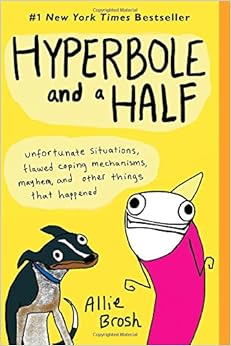
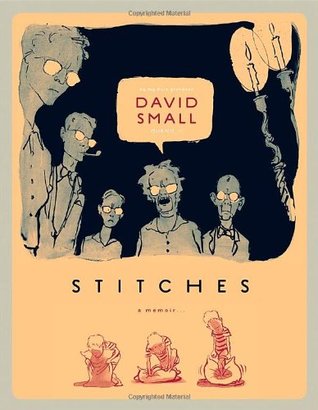
I think these two books, even though they are as visual and pictorial as they are literary – as many pictures as words, and the pictures essentially communicate as much as the words do – do the right things in the right way. That’s why I’m putting them together in this review. That, and the fact that both, despite the largely light-hearted genres they ostensibly belong to (Stitches is a graphic novel and Hyperbole and a Half a web comic), are actually quite somber and poignant and sad.
Hyperbole and a Half is a web comic that I discovered, as I think a lot of people did, because the author, Allie Brosh, wrote about the Alot. I hate that word; I love that comic. So I got the book that Brosh published, and read it. It’s a collection of her comics, which are about herself and her life: and though they are frequently stunningly funny, they are also profoundly sad and poignant to read. Brosh lives with fairly severe depression, according to what she depicts here, and she pulls absolutely no punches in describing what that life is like, and also allowing that condition, those feelings, to bleed into her other comics, as it no doubt bleeds into all parts of her life. Realizing how much she struggles with this turns even the more conventionally funny and wacky comics a bit more serious; because the strangeness that at first was just amusing now seems another piece of Brosh’s lifelong alienation.
But as hard as that is at times to read, it is also, simply, brilliant. I have rarely read something so honest and perceptive and brave, something that so perfectly shows a unique mind both in turmoil and in triumph.
Oh hey – know when else I read something that showed the same sort of genius and pain at once? Why, it was when I read Stitches, by David Small.
This one is a more traditional graphic novel; as such, it is in a more familiar storyboard format, and the art looks more like comic art; Small is an excellent illustrator, where Brosh’s art is intentionally simple and childish (Though still effective, and amusing as hell where it isn’t heartbreaking.). This is also a single story, told in words and images, rather than a series of shorts and vignettes like Hyperbole and a Half. It is the story of David Small’s family, particularly his violently abusive mother. The title comes from Small’s experience with cancer as a child: he had an undiagnosed tumor in his throat, which eventually led to the removal of one of his vocal chords, leaving him essentially mute, and also with a Frankensteinian line of stitches across his neck. This one is an even more terrible story. It’s maybe a little easier to live with, because it has villains and therefore heroes; Small should be considered heroic simply for surviving and growing up and getting his freedom, and then finding the strength to write this book – but the fact of his heroism makes the villains that much more terrible, and the story that much harder to get through.
But like Hyperbole and a Half, it is worth getting through. And in both of these cases – despite what Captain Beatty might think – the images don’t make the story easier to read, though I do think they give the stories mass. Almost too much of it, in fact.
I hope I haven’t made these books seem too dark or painful to read; they are both hard to read, but both are wonderfully realized, and really more moving than anything else. They are both genuine and honest memoirs written by intelligent and creative people, and I recommend them both.
Just – don’t read them one after the other. Put something more cheerful in the middle, there.
This morning, when I put cream into my coffee, I managed to get in just the right amount so that, when I stirred it, none slopped over the side. I’ve been failing at that recently. So this success must be a good sign of more success to come.
When I opened my laptop, there were cookie crumbs inside. Definitely a good omen. Cookies make everything better, and clearly, my laptop held onto that tiny bit of cookie just to make me smile, to remind me that there is humor everywhere, and sometimes, I get to see it. When I’m lucky.
We just moved into our new house, and while we were still in the preparation stage, we were coming over here every day after work, dropping off some things because this house is quite close to the school where we teach, and also watering the new sod we put in as a food source for our tortoise Neo. And there was a dove that had a nest in the eaves of our carport. At first, we weren’t sure she was alive, because she didn’t move much and never flew away when we drove in with our noisy people-carrying-machine; but we did see her little head tilt this way and turn that way, and so we realized that this was, in fact, a real dove that lived in our new carport. This is, for us, a lovely thing (even though – or perhaps partly because – my father’s response was “Hm. Doves’re dirty birds.” So sad.) because we cherish life, and want to keep others’ lives safe and comfortable whenever we can. So we greeted the dove every time we came, and tried not to move too quickly or make too much noise.
And then, the morning after the first night we stayed here, we heard a terrible thump. We ran to the back door and looked out, and indeed, the dove had flown into the window. We have no idea why: the window is small, and was covered with blinds on the inside, and the carport is completely open on one side. Perhaps the dove was scared by something coming into the carport and tried to escape; perhaps she had been sitting so still in her nest in the first place because she was hurt and trying to recover, and her first attempt at flight was ruinously bad. Maybe she just got caught in a bad crosswind that came up at just the wrong moment: just bad luck. All we knew was, there she lay, twitching and bleeding on the ground. Her head seemed twisted to the side, the blood coming from the top of her wing. We went away, unable to watch her suffering; I came back and checked, and she was lying still but for the tip of her tail, which still drifted up and down gently, like a leaf in the wind, like the line of light on an EKG as it shows the last beats of a dying heart. I walked away again, hoping she would die soon.
Trying not to think of this as an omen. But how could I not? Here we were moving into a new house, and the original resident was dying on the concrete in front of me. Surely we had somehow disturbed her. Maybe she was trying to escape the fate of losing her private nesting ground to loud, obnoxious humans. Maybe Nature was trying to tell us something.
But then, Toni came to me. “The dove’s still alive. She’s sitting up.” “What?!” I jumped up, went to the window — and indeed, the dove was now sitting upright, head on straight, looking around, still with blood on her wing. We put a towel into a box and I got some gloves, so we could pick her up and make her comfortable, at least; we had to do what we could for our neighbor. We went out the door, moving quickly but gently, trying not to scare her.
She took off. Flew around the carport, and then off into the bushes nearby. Later that day, she returned to her nest in the eaves; we put out some food and water, and left the towel in the box in case she needed it. But we were happy: because now it was a good omen. She was the dove that lived. So that must mean our new house was willing to accept us.
The dove left, a day or two later. Hasn’t come back.
What kind of omen is that?
Last night, a week after moving in, we were coming back from a celebratory dinner – celebratory because yesterday we finally finished moving out of and cleaning up our old rental – and as we turned into the driveway, I saw something perched on one of the rocks at the end of the driveway. As we drove by, it took off and flew. But it wasn’t the dove: it was an owl. A large and magnificent owl. It flew to our mailbox and perched there, not moving, for the next half hour, at least.
So is that an omen?
Did that owl eat the dove?
So are we welcome here, or not? Teiresias, the blind prophet from Sophocles’s Oedipus cycle, reads the actions of birds in order to know the future (He has a servant describe them to him; one of the earliest examples of an author making a great symbolic statement and then having to come up with some ridiculous bullshit to make it work. “You say he watches the birds to see the omens? But I thought he was blind, and could only see the future clearly.” “Uhhhh – there’s a servant who describes them. Yeah, that’s it. A servant. So anyway…”); what would he make of this chain of events?
We had Chinese food for that celebratory dinner, and of course I had a fortune cookie. My fortune said, “Next week, green will be a lucky color for you.” Okay. Thanks. Though I’m not sure what that signifies. Is it about money? Should I wear green? Will that create good luck for me? Should I look for things that are green, that I can take as signs, so I can find luck?
And is it going to be good luck, or bad luck?
I wanted to write that I don’t believe in luck. That’s what I meant to say. I was trying to think of a good insight for this blog, something about how luck is mostly a misunderstanding of probability, that we underestimate the chances of certain events happening, and overestimate the chances of others; that confirmation bias makes us believe we are seeing a correlation when really we’re just noticing things that fit into our beliefs (“Every time I see something green, something lucky happens!” Right: because you’re looking for green things, and when you see one, you look around for something lucky. And it’s most likely something like “Hey, I didn’t trip and fall into that cactus patch! Thanks, Good Green Luck!”). I was going to write something about the multiverse, about the infinity of possibilities that we live in, and how the particular reality we are in doesn’t show great good luck: it’s just one of uncountable alternatives, most of which are not lucky at all. There’s a great short story that I am currently hurting my students’ brains with, called “The Garden of Forking Paths,” by Jorge Luis Borges, about how reality forks as it moves into the future, creating alternate realities where things are different, sometimes coming back together as two different causes have identical effects; in the story, when this truth is pointed out the main character imagines a forest of ghosts: versions of himself and his interlocutor, living slightly different lives, some where they are friends, some where they never meet. Then the protagonist goes on with the reality he is currently living, and he shoots the other man dead. It’s a story about coincidences, and how there really aren’t any; it’s just that in the infinity of possibilities, some of the forking paths into the future seem highly unlikely, only because we don’t see the others. The chances of this one thing happening may be a million to one: but if slightly different versions of you are walking on all million-and-one paths, one of those versions will seem incredibly lucky. The others? Probably won’t even notice. I mean, do you know how many chances you have had to win the lottery? How many times you could have played and the machine would have spat out a winning ticket, just for you? Somewhere in the multiverse, that’s happened.
That’s luck. So I believe. It’s only a lack of awareness of the other instances.
Good. That feels insightful. Certainly more so than freaking astrology, which I learned was bullshit when I was told that my star sign (The uncomfortably named Cancer, which I can’t believe is still accepted blithely; because the people who follow astrology believe in signs and omens, right? SO WHY THE HELL DO THEY NOT INSIST THEIR STAR SIGN NOT BE NAMED AFTER THE MOST DEADLY DISEASE OF OUR AGE? Can you imagine if one of the signs was named “Gangrene?” Or “Sucking Chest Wound?” [To be fair, they did try to change the name at one point, but they tried to change it to “Moonchildren.” Oh, please. That’s the worst King Crimson song. Should have gone with Crimson Kings.]) showed that I was a romantic introvert, a person with overpowering emotions, who therefore drew into his “shell” to protect himself from the harshness of the world. Sure, kind of accurate. Except my brother is also a Cancer, and he is logical, extroverted, and entirely free of romanticism. So apparently Cancers are romantic introverts except when they’re not. Very handy.
So I’ll write about that. About how luck is simply one possibility that occurs, and we attach more meaning to it than we should. We almost won the lottery once, you know. Picked five of six numbers, and the sixth was – no joke – one off, a 2 when I picked a 3. If I had picked a 2, we’d have won $42 million. Since I picked 3, we won $1300. Was that good luck? Or bad luck? I know which it felt like, which it still feels like. Feels like the universe was screwing with me. Like I’m doomed to come close, but never quite reach the ultimate success.
But at the same time, I feel very lucky. Because there is one way that I feel like I have achieved the greatest of glories: in my marriage. A long series of unlikely events led me to a specific place and time where I met my wife. Who is my perfection. She is my ideal beauty, my ideal partner, my better half, my best friend, my soulmate. She is all those things, and somehow I was lucky enough to find her and capture her attention, because somehow, against all odds, I am all those things to her. (Okay, maybe not ideal beauty: she swoons whenever she sees old pictures of Chris Cornell. And rightly so. But I’m close to ideal, and that’s good enough. Still lucky.) And our paths happened to cross, and we were both single at the time, even though she had just before sworn off of long-term relationships. Lucky. And because despite my star sign, I have not yet developed a fatal cancer. (You want me to knock on wood right now, don’t you? Admit it.) Because I have been able to find my way through life to where I am right now, in this lovely new house, typing on my trusty laptop, while my dearly beloved dog dozes beside me. (Pause for petting.) I don’t think I live in the greatest country in the world, but it is a good country. And I don’t think I live in the best time in history, but it is a good time. I’m a lucky man, living a lucky life. Except for that whole Can’t-get-my-books-published-and-so-my-life’s-dream-remains-unrealized thing. But hey, at least I have this blog, right? And some people read it, and even like it. I’m very lucky.
I can’t escape that feeling, or using that word for it. Because really, luck is just a name for something we notice, but can’t explain. We like to think we can control it, summon the good kind when we need it and banish the bad kind to some dark dimension or shadow realm where it oozes around looking for someone on whom it can inflict suffering – just so long as it isn’t me! – but the truth is, we just notice it sometimes but not others. I notice my luck in discovering my life’s love; maybe I don’t notice my luck in avoiding a serial killer who almost chose me but not quite. Or, more realistically, I don’t notice my luck in being the inheritor of a planet, set in the Goldilocks orbit where liquid water and a stable atmosphere are possible, where the dominant species was wiped out by an asteroid impact that was just large enough to kill them but not large enough to kill my ancestors or to scour the Earth free of life. Still there; still lucky; but we don’t notice.
I only notice how lucky I am that I can listen to my wife’s heart beating.
If I was a religious man, I would call it a blessing; if I was more prosaic I would call it coincidence; I think I may actually prefer the term “luck.” It’s just a word, after all. What matters is the noticing.
The noticing is always what matters.
Then, this morning, even though my love told me I should write, I read instead, because I wasn’t sure how I wanted to end this particular ramble. And then my book – the good and fascinating Toru: Wayfarer Returns by Stephanie R. Sorensen (Review forthcoming) – gave me this, as the epigram to one chapter:
“To a brave man, good and bad luck
are like his right and left hand.
He uses both.”
– St. Catherine of Siena
Yes. Luck may be luck or fortune or fate or chance or a forking path or an iteration in the multiverse or a glitch in the Matrix; or it may be nothing at all.



 Just Dusty