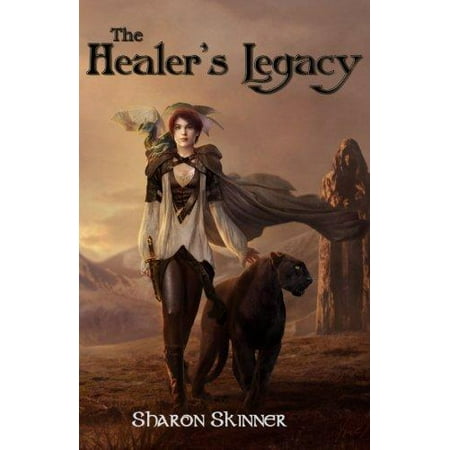
Book Review: The Healer’s Legacy

Image result for the healer's legacy

The Healer’s Legacy

by Sharon Skinner


So I bought four books at the Tucson Festival of Books. All independently published, all of them bought directly from the authors (And all the authors signed their books for me, which is excellent.). Unfortunately, two of those books were not very good, and I didn’t finish reading them.

But two of those books were excellent. And interestingly, they were both from the same publishing house, Brick Cave Media. I think those folks have their act together. The first good one was Platinum Magic by Bruce Davis; the second is this one, The Healer’s Legacy by Sharon Skinner.

It’s a high fantasy, swords and sorcery, magical beasts and inhuman races; but like all good fantasy, the setting and the world is only that: the setting. The story is about Kira. And sure, Kira has a psychic connection with a moon cat (Essentially a black panther) and a wyvern (a tiny dragon), and she has training in herbalism and the healing arts; but the main thing is that she is an orphan who was taken in by a healer who made her an apprentice, and when Kira reached her adolescence, she quite naturally rebelled, and ran away from home after an argument; she then met a man. A strong, handsome, dashing man, who swept the young woman off of her feet and made her a princess – because this man is the Warlord, the leader of a mercenary company that fought off an invasion and saved all of the people of the countryside.

But this man is also abusive, violent, unstable, and obsessed with Kira. And that, more than anything else, is the story of this book. Kira manages to escape in the beginning chapters, and then she nearly kills herself throwing off pursuit, because the warlord’s men do not give up, as they know their master will not give up. But Kira does manage to give them the slip, and then, for a while, she finds peace, and what may be a new home – maybe even a new family.

Until the Warlord finds her again. Then she has to decide whether she will run away, or try to stand and fight: the second option is her only hope for a lasting freedom from her abuser, but it is immeasurably more dangerous for her and for the people she’s grown to care about.

And of course I won’t spoil which option she chooses. I will add that there is an additional reason for Kira to be traveling: she isn’t just running away from something terrible, she is also running towards something – the hope that she can find out something about her mother’s people, which is where she got her red hair and green eyes, and might be where she got her psychic ability, as well. And the place where she stays, and where she might decide to make a stand, is not filled only with welcoming kind-hearted folk; she has enemies there, enemies that might even be more dangerous to her than is the warlord himself.

The characters are really good: deep and complex, well-realized and genuine despite being characters in a fantasy novel. There are all the elements of a good story here, and that story dominates, complemented by the fantasy world and the political intrigues and the rest of it. The fantasy world is also good, with an interesting depiction of feudalism and a good use of Kira’s healer training, one which made both the character and the world more relatable and realistic.

It’s a good book. I will be reading the sequel. And also checking out more stuff from Brick Cave Media.

Book Review: Platinum Magic by Bruce Davis

Davis Platinum 150

Platinum Magic

by Bruce Davis


I recently bought four small-press novels at the Tucson Festival of Books; I’ve read three of them so far, and though I don’t want to throw anyone under the bus, I have to say: I’m one for three. Two of those books are clearly self-published, because no publishing house, agent, or editor would take these books on: the writing isn’t good, the stories aren’t very good, the characters are terrible.

This one, however, is the good one.

All of those elements are, in this book, well done. The writing is quite good, the story is a lot of fun, the characters are excellent if a bit cliché. The best part of this book, actually, is the world-building: that’s often a sort of weak praise, as many authors – of all levels, professional, amateur, self-published or NYT bestsellers – specialize in the world-building more than the writing. I understand; the world-building is the fun part: you get to make stuff up, fix the problems you see in our world, add interesting things. It’s great, and a lot of authors let their imaginations run wild, usually without considering whether or not the world they create is at all realistic or plausible, or a good place to put a story – the Eragon series is a prime example of this, I think. Christopher Paolini wrote the first book when he was a teenager, and it reads like it: dragons are cool! Magic is cool! Sword-fighting is cool! And the hero (a teenaged boy – weird how that works) masters all three things in short order, and then flies off on his dragon to kick the world’s ass. Cool!

But also, lame.

Anyway, enough of other, worse books: Davis has done an excellent job with this world he’s created. He’s turned our world into a magic world – or perhaps a magic world into our world. The main characters are cops, investigating a murder case that has larger implications; and while those cops are dwarves and half-elves, and they use repeating crossbows rather than firearms, they still function like cops, in a world with precinct politics and public pressures and corruption and everything else that cops actually deal with. In some ways, this reads like a police procedural, just in a fantasy world. It reminded me quite a bit of Glen Cook’s Garret, P.I., series, in that the familiar tropes are put into an unfamiliar situation, and bring those old cliches to new life by doing so.

And just like the Cook series, this book has deep roots: there are political implications to the case these cops are investigating, and the political tensions between races and nations are built on a long history which slowly unfolds over the course of the book, just as it would in a novel with a real-world setting; that was well done. Though I will say that this element was also the source of my one complaint: though I appreciated Davis’s ability to avoid pages and pages of explication of his world’s history and politics, I was also quite confused early on in the story, as there were references made to old political alliances and upheavals that had strong implications in the story’s present, and I didn’t know what the hell the characters were talking about, which was annoying for a while. But it did all become clear in the end, so it was only a temporary annoyance.

I liked the mystery, particularly the twist Davis puts on it – no spoilers, but the perpetrators were involved with interdimensional travel and smuggling, which allowed Davis to step outside his own world, and gave a great surprise in the final conflict – and I really liked the characters, especially the main two cops, Simon Buckley and Haldron Stonebender. I thought the romance was a little too pat, a little too cliché, but it was sweetly written, nonetheless; Davis makes a nice point about love between different races which I liked. And I loved the use of orcs in this as second-class citizens, despised by the more powerful races, treated with deep suspicion and contempt by the cops, forced into ghettoes and menial labor and crime. Davis does what good fantasy should do: make a point about our world through the use of a fantasy lens that focuses our attention in a way that a more familiar setting might not be able to. He does it well, without making his allegory too on-the-nose; he just writes a good story, with some themes that should ring true even to those of us who aren’t part elven.

This book alone was worth the purchase of all four. I would definitely recommend it.


(The book is available here, if you’re interested; since this is the publisher, I expect the author gets the biggest return from this site’s sales.)