Day of Hope

Yesterday was my birthday. I had a great day: my wife and I went out for an incredible brunch at a restaurant in Tucson called Blue Willow – HIGHLY recommend the breakfast burrito, if you go – and then went home and had presents – I got two awesome t-shirts and a video game, Skyrim for my Nintendo Switch, which is a lovely thing mainly because Skyrim was one of those games I avoided when it was new, since I knew it was exactly the kind of video game I love most (sandbox swords and sorcery) and would therefore consume all of my waking hours once I opened Pandora’s Box and started playing it, and as I told all of my students at the time when they asked if I was going to play Skyrim, I have a job; which means that now I have been given permission to go ahead and let my free time be consumed, partly because I deserve and need nice things, and partly because the truth is that I will not actually allow ALL of my free time to be consumed, that I can be trusted to do what is necessary even if I would rather just dive back into the video game (Hold on, the t-shirts reminded me: I need to cull my collection. Be right back. [Got rid of seven shirts. Good progress.]) – and then we went to an arcade with friends, where I got to play pinball and a car racing game and a pirate shooting game and the BIGGEST SPACE INVADERS IN NORTH AMERICA, and then we came home and ordered Chinese food in and then had huge slices of an AMAZING cake. It was a great day.

Yesterday in Washington D.C., the Republican party passed Donald Trump’s “Death to the Poors” bill (I will neither call it the B.B.B. as that shitmouth named it – though honestly I appreciate the bald hypocrisy of that, coming from the party that has been loudly and repeatedly criticizing large omnibus bills for years if not decades, until said omnibus comes from President Turdtongue – nor talk about it as a tax cut bill as the news outlets insist on calling it, while they also name it as a Asslips’s “most significant accomplishment,” which is a wild phrase: just imagine talking that way about, say, Auschwitz, or the Night of the Long Knives, or the invasion of Poland, as Hitler’s “biggest achievements” to date. I will come back to hypocrisy.), which Pres. Butt-Teeth will be signing today, in a continuation of his efforts to taint and corrupt every single piece of American culture so that nobody can ever enjoy anything ever again in this country.

Not that this is my favorite holiday: I’m a vegetarian, and I live in Tucson, Arizona, so barbecues at the park are out on both meat-related and heat-related grounds; plus my dog is terrified of fireworks, and I personally dislike the strong possibility of wildfires being started by an idiot with a bottle rocket and a match. But there are, nonetheless, reasons why I want to celebrate this holiday, and hold onto it in the face of ol’ Colon-Throat’s attempted appropriation. And I want to write about it today because I realized that the reasons for me, for us, to hold tight to the Fourth of July are the very same ideas that I want and need to write about.

I wasn’t sure what I wanted to write about. Part of me doesn’t want to write at all: I just want to curl up on my couch, pet my dog, and play video games. (And not only because I just got Skyrim, though that is definitely part of the draw… I can hear it calling to me right now… No, wait, that’s my cockatiel Duncan screaming because he’s upset about something.) And while I want to rant about Donald Trump, and the Supreme Court, and the Congress, because all three branches of government have been captured by the proto-fascists who want to turn America into a white Christian ethnostate with a patriarchal dictatorship that is decidedly unChristian, I don’t know what the value would be in ranting: the people who would read it already agree with me, and it would just make them sadder than they already are because the horror is relentless and it’s hard to remain so ourselves; and the people who might read it who don’t agree would find it tiresome to just hear more ranting; and the people who are on the opposite side of these issues (who don’t read, but just hypothetically) would be giddy with Schadenfreudish glee, cackling about how angry I am and signing up for WordPress accounts just so they can comment “Cry more!” and throw down some of the memes I’ve been getting hit with because I have (foolishly) been commenting on news stories on Facebook. And I don’t want to create any of those responses.

I recognize that the most important thing we can do is spread good information, and so that makes me want to become a journalist, and share correct information, and – I mean, maybe I should do that. But I already have a job. And it’s a hard job, and I work hard at it. And I have a family which I love, but which, like all families, requires a lot of time and energy – and not that I begrudge that, I do not, I would spend all of my time and energy on my family if I didn’t have to work, and I look forward to the day when that happens; I’m just saying that I will not take time and energy away from my family in order to become a journalist. There are already better journalists, trained and professional journalists, out there doing that work, so I shouldn’t have to. Clearly my fight against misinformation is in my teaching, and I will continue to do my very best there, in every way I can.

But that leaves me with nothing to write about.

It is summer, and so that makes me want to write, because over the school year I am often too tired and burnt out and frustrated to write; but I have been facing this conundrum about what to write about, and I haven’t been writing much. (Also my summer has not been all that restful, but it’s mostly been family stuff, so I don’t resent it.) As I haven’t been writing, however, I have been trying to get back into my other great passion that I haven’t been able to spend enough time on: I’ve been reading. And one of the things I’ve been reading has been these:
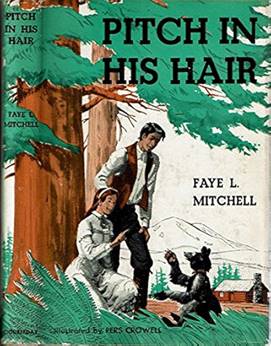
These are my great-grandmother’s novels, published in the late 50s, when she had retired from teaching. (Have I mentioned that I come from a line of teachers and writers on  my mother’s side? This is part of that line.) I’ve never read them before, partly because I never knew my great-grandmother; for most of my life I didn’t even know that she had written books or published them or that we had copies. So I’m reading them now, and they have shown me a couple of things. First, because these are young adult books, and historical/regional fiction (They are all set in western Washington, where the Mitchells lived and where both my grandmother and then my mother were born and raised, during the frontier times between about 1970 and 1890, when the Mitchells did not live there – Faye and her husband Burt emigrated from Kansas), they are not great literature in a canonical sense: but they are good stories. And this helps to settle in me something I have always struggled with, because I am not a writer of great literature, and though I don’t want to be, I always think I should be; but I think that in truth I am, like my great-grandmother, a storyteller, not a literary giant. And I would rather be that. Second, these books, because they are set where they are and because the main character, Abby Conner, is a young woman who wants to become a teacher and a writer and who talks about what it means to be a teacher and a writer, are helping me to be prouder of the teacher and the writer that I am, because I think that my great-grandmother would probably be proud of me, and I like that – and my Nonna, whom I loved and respected but who passed before I had even decided to become a teacher, would definitely be proud of me, and I love that. And third, because my great-grandmother clearly wrote about what he knew, I have been thinking about how I need to do that. Not with my novels, which are almost certainly going to stay fantastic and more about vampires and time-traveling pirates and magical dreams that change reality; but with these blogs, and with the things that I write every day: I need to write about what I know.

So this is what I’m going to do: I’m going to write about what I know.

So. What the hell do I know?

I used to be optimistic.

My wife talks about it, about how I used to be much more cheerful, and much more calm, and much more positive. She doesn’t make it sound as bad as I just did: she doesn’t say all those things at once, and she doesn’t say it with any kind of accusation or disappointment or anything – never “You used to be a lot more fun!” or anything like that. She has taken note of it out of concern for me: because my general demeanor has become darker and angrier over the last decade or so. And it’s coming out in ways and in places that I don’t like: I have had a hard time keeping myself from losing my temper with my students, and I have failed at that, and lost my temper, several times in the last few years, sometimes to my real regret. I am also having a hard time keeping my spirits up in order to push back against my wife’s occasional depressing outlook, which is sometimes something she needs me to do (Don’t we all?), and which I have not been doing as well as I used to.

I suspect this happens to a lot of people, if not to all of us. We lose our idealism, and our hopefulness – those of us who ever had it, that is, which is not everyone. But I think as time goes on, and life gets harder, and as people just keep on disappointing us, over and over again – say, by re-electing an orange-tinted fascist would-be dictator even after he tried to overthrow our government the first time: it’s hard to look down the road and think that it actually goes to a better place. And while Trump certainly wasn’t inevitable, the difficult and sad things that happen as we get older are inevitable: we lose people we love, and eventually we lose ourselves, and there is often a great deal of suffering on the way to that. As that happens to us more, and as we are shielded from it less, our lives become sadder in many ways, and it makes sense that we would do the same.

I do also think the last few years have been rough on people in this country. Trump’s two electoral wins and two administrations, the pandemic, the various economic and global crises: it’s been tough to keep looking on the bright side of this pile of shit. I certainly haven’t been immune to that. In fact, it has been directly detrimental to my optimism: because I keep thinking, and saying, and arguing, and preaching, that things are going to work out the right way: and I keep being wrong. I said that Trump was going to lose in 2016, both in the primary and then in the election, and I thought that he would go to trial for his crimes and that he would get convicted, and I thought he would lose in 2024. Wrong, every time. (Okay, he was convicted, but only of the least important one, and it didn’t affect his political ambitions in any way at all, which I also thought it would. Still: he is a fucking convicted felon, and anyone who claims it was only a politically motivated prosecution, you’re goddamn right, and it was a successful one, and it should have kept people from voting for him, and it was therefore the right thing to do – but I think we can see that, even though it was a politically motivated prosecution, that didn’t affect the general populace very much: the election is evidence that the jury was honest and sincere.) That record makes me not want to keep my hopes up: not mainly because I hate being wrong and looking dumb (though I do, both), but mainly because I don’t want to give people false hope and then have them fall farther and harder when my false hope is proven wrong. Again.

But okay: now let’s talk about the Fourth of July. (See, this is why I’m so goddamn wordy and circuitous in my writing, even though the only way to write great literature is to keep it short and simple, as much as possible, to edit even more than you write: because I’m not a great literary mastermind, I’m a storyteller, and this is how stories get told. Thanks, Great-grandmother. Actually, since I called her daughter Nonna, I’m just gonna call Mrs. Mitchell Grandnonna. I hope she would like that. And let me note that, as wordy and circuitous as I am, I get back to where I want to go. Eventually.)

The Fourth of July is a convergence of three of my heroes. Three of the greatest writers in American history, because all three were three of the greatest thinkers and idealists in American history. Not all the best people, but I generally think the art, and the truth, can transcend the people who discover it or create it. If you look at science, for instance, there is not and never has been a scientist who was worthy of the power of what they discovered: not Newton, not Darwin, not Einstein… maybe Carl Sagan. I don’t know if Galileo was a good man, honestly, but how could he possibly be good enough to live up to what he did for our understanding of the universe, for what he made possible? He couldn’t. The same with great artists: the people who affect the lives of millions and even billions of other humans in positive ways couldn’t possibly be good enough in and of themselves to really be seen as deserving of the praise that their impact deserves. Martin Luther King, Jr., could not possibly be good enough as a person to actually deserve the honor that he rightfully gets as the civil rights leader and genius communicator that he was, even if he hadn’t been an egotist who cheated on his wife. But his impact, his positive impact on the world, is beyond measuring: is beyond what one person could contain. So I am willing to praise the work, and the words, and the ideas, even if the person who created those things was worse than their impact.

This does not excuse J.K. Rowling, by the way, though I do also think the criticism of Harry Potter is lazy and vicious and incorrect; but Rowling is, it turns out, a terrible person who should absolutely be canceled entirely. While we all keep reading Harry Potter. Don’t worry, it will get easier when she is dead.

So: the three people who are connected by the Fourth of July and whom I find inspiring are Thomas Jefferson, Frederick Douglass, and Abraham Lincoln. (See what I mean about not the best people? Douglass was a saint, but I only say that because I don’t know enough about him to know the bad stuff; Lincoln was a racist egotist, and Jefferson owned his own children. But the point here is that we need to look at the work, and the ideas, and the words.) Thomas Jefferson, of course, wrote this:

When in the Course of human events, it becomes necessary for one people to dissolve the political bands which have connected them with another, and to assume among the powers of the earth, the separate and equal station to which the Laws of Nature and of Nature’s God entitle them, a decent respect to the opinions of mankind requires that they should declare the causes which impel them to the separation.

We hold these truths to be self-evident, that all men are created equal, that they are endowed by their Creator with certain unalienable Rights, that among these are Life, Liberty and the pursuit of Happiness.–That to secure these rights, Governments are instituted among Men, deriving their just powers from the consent of the governed, –That whenever any Form of Government becomes destructive of these ends, it is the Right of the People to alter or to abolish it, and to institute new Government, laying its foundation on such principles and organizing its powers in such form, as to them shall seem most likely to effect their Safety and Happiness. Prudence, indeed, will dictate that Governments long established should not be changed for light and transient causes; and accordingly all experience hath shewn, that mankind are more disposed to suffer, while evils are sufferable, than to right themselves by abolishing the forms to which they are accustomed. But when a long train of abuses and usurpations, pursuing invariably the same Object evinces a design to reduce them under absolute Despotism, it is their right, it is their duty, to throw off such Government, and to provide new Guards for their future security.–Such has been the patient sufferance of these Colonies; and such is now the necessity which constrains them to alter their former Systems of Government. The history of the present King of Great Britain is a history of repeated injuries and usurpations, all having in direct object the establishment of an absolute Tyranny over these States. To prove this, let Facts be submitted to a candid world.

Those two paragraphs might be the best argument ever written: because the words are perfect, the logic is perfect, and the idea was so much better than the people who formulated it that it has led to better outcomes and a better world for hundreds of millions of people, for two and a half centuries. We hold these truths to be self-evident.

All men are created equal.

(Which also means that we all suck. Just sayin’.)

And I think we know why this idea, these words, and this man are connected to this day, for me. For all of us.

Lincoln, on the Fourth of July in 1863, said this:

Four score and seven years ago our fathers brought forth on this continent, a new nation, conceived in Liberty, and dedicated to the proposition that all men are created equal.

Now we are engaged in a great civil war, testing whether that nation, or any nation so conceived and so dedicated, can long endure. We are met on a great battle-field of that war. We have come to dedicate a portion of that field, as a final resting place for those who here gave their lives that that nation might live. It is altogether fitting and proper that we should do this.

But, in a larger sense, we can not dedicate — we can not consecrate — we can not hallow — this ground. The brave men, living and dead, who struggled here, have consecrated it, far above our poor power to add or detract. The world will little note, nor long remember what we say here, but it can never forget what they did here. It is for us the living, rather, to be dedicated here to the unfinished work which they who fought here have thus far so nobly advanced. It is rather for us to be here dedicated to the great task remaining before us — that from these honored dead we take increased devotion to that cause for which they gave the last full measure of devotion — that we here highly resolve that these dead shall not have died in vain — that this nation, under God, shall have a new birth of freedom — and that government of the people, by the people, for the people, shall not perish from the earth.

This is sometimes described as the perfect speech – partly because it is so short, and therefore nothing that I ever could have produced – and there’s an argument to be made for that. I find it inspiring because I think it translates some of Jefferson’s ideals, which were intentionally more universal, into something more personal, more grounded: this is how the idea that all men are created equal comes to be an American ideal instead of a human one – though it is still, and always should be, a human ideal. Still, Lincoln and this address are why we as Americans should consider this to be something personal, something we own, not simply a truth that exists in the world. Jefferson and the Founding Fathers are part of that as well, because the Declaration of Independence was not just a statement of ideals, but also a political and pragmatic document (which is why I include the first paragraph in the quotation from it, and in what I describe as the perfect argument: that sets the purpose for the second paragraph, where all the intellectual brilliance is. But as a rhetoric teacher, purpose matters, so the first paragraph is part of that, and part of what Jefferson and the rest of them were committed to, like Lincoln.); but because the Founding Fathers were patriarchal slaveowners who didn’t want to pay taxes, their purpose doesn’t rise to the level of their ideals. Which makes them fascinating, really, because slaveowners who didn’t want to pay taxes somehow managed to formulate and then enact one of the greatest ideals in human history, that all men are created equal and that government should be based on that fact and all of the logical consequences of that fact, such as the necessity of consent; but Lincoln’s purpose in saying his words was, first, to honor the sacrifice of people who died for those ideals, which is one of the most important and perhaps most abused elements of recognizing the worth of all humans (and not something expressly focused on in the Declaration, not even in its lists of abuses and usurpations), and second, to maintain the existence of the nation based on that fact, and to help bring it closer to being a nation that lives up to its own purpose, a nation governed by a system based on the fact that all men are created equal. Those purposes are worthy of those words, of the ideas they express, as the words and the ideas are worthy of the purpose. Probably not so with Jefferson.

And then Douglass. I wish I could have heard Douglass speak, because unlike the other two, Douglass was a great speaker as well as a great writer; but at least we have the words he wrote down, and the story he told with them, the story of his own life. And if you don’t know why Frederick Douglass is connected to the Fourth of July, it’s because of this:

(1852) Frederick Douglass, “What, To The Slave, Is The Fourth Of July”

Frederick Douglass

Daguerreotype photo by Samuel J. Miller

That whole speech is worth reading. But let me focus on this:

Fellow-citizens, pardon me, allow me to ask, why am I called upon to speak here to-day? What have I, or those I represent, to do with your national independence? Are the great principles of political freedom and of natural justice, embodied in that Declaration of Independence, extended to us? and am I, therefore, called upon to bring our humble offering to the national altar, and to confess the benefits and express devout gratitude for the blessings resulting from your independence to us?

Would to God, both for your sakes and ours, that an affirmative answer could be truthfully returned to these questions! Then would my task be light, and my burden easy and delightful. For who is there so cold, that a nation’s sympathy could not warm him? Who so obdurate and dead to the claims of gratitude, that would not thankfully acknowledge such priceless benefits? Who so stolid and selfish, that would not give his voice to swell the hallelujahs of a nation’s jubilee, when the chains of servitude had been tom from his limbs? I am not that man. In a case like that, the dumb might eloquently speak, and the “lame man leap as an hart.”

But, such is not the state of the case. I say it with a sad sense of the disparity between us. I am not included within the pale of this glorious anniversary! Your high independence only reveals the immeasurable distance between us. The blessings in which you, this day, rejoice, are not enjoyed in common. The rich inheritance of justice, liberty, prosperity and independence, bequeathed by your fathers, is shared by you, not by me. The sunlight that brought life and healing to you, has brought stripes and death to me. This Fourth of July is yours, not mine. You may rejoice, I must mourn. To drag a man in fetters into the grand illuminated temple of liberty, and call upon him to join you in joyous anthems, were inhuman mockery and sacrilegious irony.

Here we see Douglass’s purpose, and the reason he also needs to be included in this list of great writers connected to the Fourth of July: because Douglass held this country to account for its hypocrisy. (Told you I’d come back to it.) Douglass showed, more clearly than anyone else, that the United States has never lived up to its ideals.

He said this:

I remember also that as a people Americans are remarkably familiar with all facts which make in their own favor. This is esteemed by some as a national trait—perhaps a national weakness. It is a fact, that whatever makes for the wealth or for the reputation of Americans, and can be had cheap will be found by Americans. I shall not be charged with slandering Americans if I say I think the American side of any question may be safely left in American hands.

I leave, therefore, the great deeds of your fathers to other gentlemen whose claim to have been regularly descended will be less likely to be disputed than mine!

My business, if I have any here to-day, is with the present. The accepted time with God and his cause is the ever-living now.

Trust no future, however pleasant, Let the dead past bury its dead; Act, act in the living present, Heart within, and God overhead.

We have to do with the past only as we can make it useful to the present and to the future. To all inspiring motives, to noble deeds which can be gained from the past, we are welcome. But now is the time, the important time. Your fathers have lived, died, and have done their work, and have done much of it well. You live and must die, and you must do your work. You have no right to enjoy a child’s share in the labor of your fathers, unless your children are to be blest by your labors. You have no right to wear out and waste the hard-earned fame of your fathers to cover your indolence. Sydney Smith tells us that men seldom eulogize the wisdom and virtues of their fathers, but to excuse some folly or wickedness of their own. This truth is not a doubtful one. There are illustrations of it near and remote, ancient and modern. It was fashionable, hundreds of years ago, for the children of Jacob to boast, we have “Abraham to our father,” when they had long lost Abraham’s faith and spirit. That people contented themselves under the shadow of Abraham’s great name, while they repudiated the deeds which made his name great. Need I remind you that a similar thing is being done all over this country to-day? Need I tell you that the Jews are not the only people who built the tombs of the prophets, and garnished the sepulchres of the righteous? Washington could not die till he had broken the chains of his slaves. Yet his monument is built up by the price of human blood, and the traders in the bodies and souls of men, shout —”We have Washington to our father.”—Alas! that it should be so; yet so it is.

The evil that men do, lives after them, The good is oft’ interred with their bones.

And this:

At a time like this, scorching irony, not convincing argument, is needed. O! had I the ability, and could I reach the nation’s ear, I would, to-day, pour out a fiery stream of biting ridicule, blasting reproach, withering sarcasm, and stern rebuke. For it is not light that is needed, but fire; it is not the gentle shower, but thunder. We need the storm, the whirlwind, and the earthquake. The feeling of the nation must be quickened; the conscience of the nation must be roused; the propriety of the nation must be startled; the hypocrisy of the nation must be exposed; and its crimes against God and man must be proclaimed and denounced.

What, to the American slave, is your Fourth of July? I answer: a day that reveals to him, more than all other days in the year, the gross injustice and cruelly to which he is the constant victim. To him, your celebration is a sham; your boasted liberty, an unholy license; your national greatness, swelling vanity; your sounds of rejoicing are empty and heartless; your denunciations of tyrants, brass fronted impudence; your shouts of liberty and equality, hollow mockery; your prayers and hymns, your sermons and thanksgivings, with all your religious parade, and solemnity, are, to him, mere bombast, fraud, deception, impiety, and hypocrisy—a thin veil to cover up crimes which would disgrace a nation of savages. There is not a nation on the earth guilty of practices, more shocking and bloody, than are the people of these United States, at this very hour.

Douglass said a lot that could apply to us today, which is why it is worth reading the whole speech. (And I’m thinking now I may teach it next year. We’ll see.)

But, since I have now gone on for far too long (Not gonna feel bad. Storyteller. Also, I was quoting.), let me get to my purpose: the reason why I wanted to talk about these three men and their writings on this day, the Fourth of July.

Because all three of these men represent hope.

If they did not believe that this nation could exist in its ideal state, or at least that it could come closer and that approaching that ideal would be better than moving away from it, they would never have said what they did. None of them lived in this nation in its ideal state, and probably none of them thought they ever would live in that nation: but they all believed it (or something close to it) could exist, and that that wonderful reality was worth fighting for. I know because all three fought to achieve it, for essentially all of their adult lives, with all of the considerable powers at their disposal. They fought, for years, for decades, in the face of insurmountable odds, of endless trudging through swamps of opposition, the stinking mud sticking to them and tainting everything they did and everything they saw, making absolutely no progress, for longer than some people have to live their whole lives.

But they kept fighting. Because they believed they could succeed. They did not give up. No matter what.

That’s what optimism is. It’s determination, and belief. It is hope. It doesn’t have to be based on reality and an understanding of the truth and the terrible odds stacked against us: but when it is based on that, it is that much stronger, that much more potent. That much more indomitable.

I don’t know if I’m indomitable. But I do know I’m stubborn as fuck. And maybe that’s the same thing.

I don’t know if I have that kind of optimism. But I hope I do: and so I’m going to keep fighting, and keep trying, and keep writing. Because I think that my purpose, and my ideals, are worth all of that effort, and all of that fight, and all of that struggle. And because I believe that the world I dream of is possible. Even if I never see it.

But I hope I do. And I hope you will, too.

Happy Independence Day.

What A Piece Of Work

Meeting Alien Astronaut On Mysterious Planet Stock Illustration 1796849164  | Shutterstock

So every year, I teach a class called College Readiness. It is intended, among other things, to help students apply to college and win admission; since I am an English teacher, that means helping them write application essays. I generally use the Common App prompts — which I recommend, if you’re looking for college admission essay topics — and they write several drafts over the year, with revisions and feedback about how to make their essays more interesting and more effective.

And then, for their last essay draft of the year, I have them pick one of the topics from the University of Chicago’s list of topics. They have two essay questions for their applicants: the first is a very standard, straightforward essay, about why you want to attend UChicago and what you are looking for there; and then the second — well.

They asked prior students and graduates for ideas for essay topics. And those students and alumni delivered.

You should go take a look at them — but here are some highlights.

Essay Option 1

Exponents and square roots, pencils and erasers, beta decay and electron capture. Name two things that undo each other and explain why both are necessary.
– Inspired by Emmett Cho, Class of 2027

Essay Option 2

“Where have all the flowers gone?” – Pete Seeger. Pick a question from a song title or lyric and give it your best answer.
– Inspired by Ryan Murphy, AB’21

Essay Option 3

“Vlog,” “Labradoodle,” and “Fauxmage.” Language is filled with portmanteaus. Create a new portmanteau and explain why those two things are a “patch” (perfect match).
– Inspired by Garrett Chalfin, Class of 2027

Essay Option 4

A jellyfish is not a fish. Cat burglars don’t burgle cats. Rhode Island is not an island. Write an essay about some other misnomer, and either come up with and defend a new name for it or explain why its inaccurate name should be kept.
– Inspired by Sonia Chang, Class of 2025, and Mirabella Blair, Class of 2027

Essay Option 5

Despite their origins in the Gupta Empire of India or Ancient Egypt, games like chess or bowling remain widely enjoyed today. What modern game do you believe will withstand the test of time, and why?
– Inspired by Adam Heiba, Class of 2027

Essay Option 6

There are unwritten rules that everyone follows or has heard at least once in their life. But of course, some rules should be broken or updated. What is an unwritten rule that you wish didn’t exist? (Our custom is to have five new prompts each year, but this year we decided to break with tradition. Enjoy!)
– Inspired by Maryam Abdella, Class of 2026

Essay Option 7

And, as always… the classic choose your own adventure option! In the spirit of adventurous inquiry, choose one of our past prompts (or create a question of your own). Be original, creative, thought provoking. Draw on your best qualities as a writer, thinker, visionary, social critic, sage, citizen of the world, or future citizen of the University of Chicago; take a little risk, and have fun!

So I require my students to choose one of the topics — there are over 40 others after these six — and write an essay on it. And I ask them if there is one topic they would like me to write an essay about.

This was their choice for this year:

You are on an expedition to found a colony on Mars, when from a nearby crater, a group of Martians suddenly emerges. They seem eager to communicate, but they’re the impatient kind and demand you represent the human race in one song, image, memory, proof, or other idea. What do you share with them to show that humanity is worth their time?

And here is my response.

Okay look. There are a bunch of assumptions in this question. First it assumes that I want to communicate with the Martians, when in reality I might just want to atomize them with my Blastotron 5,000,0000X Destructothunderation Disintegratorianator. And that does seem like a poor assumption since I am an American, after all. When have we ever talked first and slaughtered after? Then it assumes – even more strangely – that the Martians have the same senses we do, and would be able to appreciate something I could present to them at all, let alone having the same aesthetic senses or interest in what I would have to present. It assumes that I would have this thing on me at the moment I met them, or access to it (which probably shows an assumption based on the existence and ubiquity of smartphones, which is fine, I would no doubt have my phone with me on the Martian surface – but also, I bet the wifi signal there sucks.), and that I wouldn’t just be limited to what I would normally be able to produce on the spot – which now relies on my performance skills. (Which are, I grant, stellar. Out of this world, even. Especially my punnery.)

And worst of all: the question assumes I believe humanity is worth the Martians’ time. 

So, considering all these considerations, I have several answers, the specific choice between being reliant on the specific situation. 

First, I would not immediately blast the Martians, because of course it would be better to lull them into complacency and then carry out a sneak attack later, preferably on their home territory; that’s the proper American way.

Second, we’ll take it as a given that the Martians would have at least similar senses to mine – though I will say, if they do have a different set of senses, I would absolutely play to that, because a society focused on smell would be far more impressed by our greatest olfactory achievements than any symphony or art work or whatever I could present. (And in that case, the smell would be a Thanksgiving feast: the scents of turkey and gravy, fresh bread, and apple pie, with a delicate touch of the smell of candle wax burning, hickory wood burning in the fireplace, and a whiff of my wife’s perfume.) But for the sake of argument, we’ll accept that they would use primarily sight and sound to interact with their environment, otherwise they wouldn’t be able to communicate their intentions to me, and if they just came at me waving their tentacles or whatever, it’s Blastotron time. On sight.

So what would I show them to prove that humanity is worthwhile – or, in a more moralistic sense, that we are good? See, now we get into questions of aesthetics, for art, or into questions of values in general, and it becomes almost impossible to answer. I recognize that the goal of the prompt is to examine my aesthetics, my values, to find out what I think is the highest achievement of humanity; but since my area of interest and expertise is actually rhetoric, and that means I choose my communication with my audience in mind, I know better than to decide something like this only using my own criteria and nothing else. If you seriously just want me to pick the best thing in the world according to me with no other considerations at all, I’m going to go with the poetry of ee cummings, particularly “anyone lived in a pretty how town.” But see, much of the beauty in that poem comes from understanding both human society and the history of human poetry, and it wouldn’t translate quickly enough to the Martians; so that can’t be my answer.

If we imagine that the Martians have been watching us through Martioscopes for centuries – and why wouldn’t they? Don’t we watch fail videos constantly on YouTube? And what is human history if not one giant fail video? – then the background knowledge necessary to understand the context could actually be assumed; and in that case, I might go with something like cummings’s poetry. Or for visual art, I would probably select Michelangelo’s Pieta, or the Sistine Chapel ceiling. Or, for the sake of including multiple senses in my appeal for the value of humanity, I might go with a performance of an opera or a musical, because that can include singing, dancing, music and literature, all at once. In that case I would pick Hamilton, which I think is utterly brilliant  dramatically, musically, and poetically — though that thought process does lead me to consider movies as a way to include visual and auditory art, and to include many different kinds of aesthetic appeal: and in that case I would choose either Pleasantville, partly because it includes quite a bit of very beautiful art; or Fantasia, because it includes so much beautiful music.

But this all assumes that art is the highest achievement of humanity. I think there is an argument for that, because what is important for humanity, specifically, has to be the things that are unique to humanity; and the only things I believe are unique to humanity are the search for truth, and the creation of beauty, both for no reason apart from the intrinsic value of truth, and of beauty. Other creatures seek and discover truth – the best way to pull termites out of a mound, for instance – but they do it in pursuit of survival, not for the joy of discovery and the goal of understanding. Not that survival is less valuable than art for art’s sake and truth for understanding’s sake; but survival for survival’s sake is less human. So I do think that beauty is one of the crowning achievements of humanity: but I would have a much more difficult time arguing that it is the only, or the best, achievement of humanity, rather than truth.

So I have to also consider: what is our greatest truth?

Is it science? Perhaps; but the creation of the scientific method as a formula is pretty well associated with only one man – and I have a hard time accepting that a dude who died trying to freeze chicken is literally the one best person in the history of humanity. Especially when his name was Francis Bacon. But then, if it’s not science, what is it? What is the one greatest truth that humanity has ever known, which I could then speak to an alien race and show them what we have accomplished?

I can’t think of one. (Take it as a given that it is not math.) Mainly because so much of our truth-seeking has to do with ourselves: and we still don’t know jack about ourselves, not really. I could go with “The only thing that I know is that I know nothing,” from Socrates, or “Existence is suffering, and suffering is caused by desire” from the Buddha; but honestly, I think “All you need is love” by Sir Paul McCartney is just about as profound and valuable as either of those. 

That’s why I turn to art. But that’s not fair: because I’m biased. So my biased answer suits the intent of the essay prompt, as my choice says something about me; but it wouldn’t actually present the pinnacle of human achievement unless I assume that I am qualified to judge that – which implies that I am the pinnacle of human judgment. And I’m not: I ate Peeps dipped in salsa. That was not sound judgment on my part. This, of course, also implies that I should not be choosing the pinnacle of human artistic achievement (though I sure did that without hesitation, didn’t I?), as that too requires judgment.

So I think the best answer is this: I would not choose.

Because I know nothing, because I have great respect for humanity (And much respect for myself, don’t get me wrong; but more for humanity), and because I don’t actually accept the premise of this question, I think that what I would choose to present to show the worth of humanity is – humanity. 

All of it. All of us. Because part of the glory of humanity is how incredibly different we all are, how various, how multifarious; and yet at the same time, how similar: because my mom is nothing like your mom, and yet somehow, the way my mother used to kiss my head when she tucked me in is exactly how your mother kissed you when she tucked you in. Or maybe how your father did, or your grandparent. The way I look up into warm raindrops and smile is exactly the same way you do it, when we are dancing in the rain. The incredible pride I feel when I finish the project I’ve been working on – whether it’s a novel about vampires or pirates, or a bookshelf I built, or the successful sale of my mother-in-law’s house after her husband died – is the same as the incredible pride you feel when you finish what you’ve been working on, whether that is a sales presentation, a complete re-watch of every episode of Supernatural, or helping your child master their dance for the Christmas recital. And yet how much does your child’s dance recital routine resemble my pirate novel?

It depends: does your kid dance the hornpipe?

If I want to show humanity’s greatest achievement, I think I have to show humanity’s greatest strength: our diversity, our individuality, and our unique and personal ability to take almost anything and turn it into a work of art, a magnificent accomplishment, just because one human being – and often, no one else on the whole damn planet – saw that activity, that pursuit, that project, that idea, as worth all of one human being’s time and energy and focus: and thus that one human being accomplished something incredible.

Now, this would likely encounter some resistance from the Martians. Because, as the prompt says, these beings are impatient: they are the ones who asked me for one single piece of work to present to them to represent all of humanity.

But really? That’s just a request for a sales pitch. They’re asking me to convince them that one thing is the best thing in all of human history. (I would prove this by asking them to show me, first, the one thing that represents all of Martian culture. And by the way, if they could do so, then I would have an excellent idea of what their aesthetics or values are, and I could think of one wonderful example to show them in return. But I bet I’m right: because this seems like an absurd request with any race. I mean, show me the best cat of all time. The best horse. The greatest star. You see? There are too many criteria, too many options, in almost any collection of items as large as everything accomplished in an entire race’s history.) So I would first show them this:

And then express that here we have an example of nearly perfect writing, combined with – I wouldn’t necessarily call it nearly perfect acting, because I don’t want to judge; but it’s not only one artist, you see? The words have to be brought to life by the actor, and the end result – is that the accomplishment of one human? Or two? Or many, since directors and acting coaches and everyone else who contributed to these performances also participated in the creation of this moment. And since there are so many interpretations and versions of this particular speech written by William Shakespeare, it’s hard to say if this one is the best version of it – or maybe this one.

Or this one.

Or no. It’s this one.

(Actually, I can’t find a clip of my favorite version of this speech, which was my first encounter with it: when Nick Nolte gives the monologue in the movie Down and Out in Beverly Hills. Other than that one, I think I actually like Cumberbatch the best out of these.)

But the point is, I would argue, that because of the individual ability of humans to interpret reality, and to translate it, inculcating our own ideas and feelings into what we take in, blending what we learn with what we are – to understand one great accomplishment of one human, one also has to appreciate the other versions of the same idea, the same art, the same achievement. When I was young, I was deeply impressed by Thomas Edison – and then when I learned about Nikola Tesla, I was even more impressed by him, because of what I had felt about Edison; and then, honestly, I was once again impressed by Edison (Though I know that isn’t the popular interpretation, as the memes nowadays would have us believe that Tesla was all of the genius and Edison only stole it: but no, Edison was more than that. But this isn’t the argument I want to have with these Martians.).

If I got them listening with my versions of this speech as presented by different actors, I would then point out that every one of Shakespeare’s plays was based on a story written by someone else. That the Bard himself, whom I still consider the greatest wordsmith in the history of the English language, wrote adapted rather than original screenplays – and who knows, maybe the Boccaccio version was better. 

(Okay, that pun might be the greatest accomplishment of humanity. But probably not.)

So then, once I had them on the hook with this idea that different humans can create different versions of the same masterpiece and make it into entirely new and different masterpieces – then I would show them all of humanity that they could ever want to see.

I would show them the internet.

I would hand over my phone, and starting with the items that I have mentioned here – the poetry of ee cummings, and the art of Michelangelo, and the work of Shakespeare and of Lin-Manuel Miranda, and of Pleasantville and Fantasia, and also Mozart’s Requiem and the album In the Court of the Crimson King and Tolkien’s The Lord of the Rings and Arundhati Roy’s The God of Small Things and everything else that is perfect – I would show them everything that can be found on the internet that shows what humanity is and what humanity can do.

Including the wars. And the genocides. The atrocities and the errors and the destructions. The atomic bombs. The Holocaust. The history of holy wars around the world. Because those, the perfect masterpieces of evil that we have created: those are humanity too.

And the Martians should have some warning, at least.

And then, once they were all completely riveted by what they saw on the screen?

Blastotron.

What a Weekend!

WOW! That was… amazing.

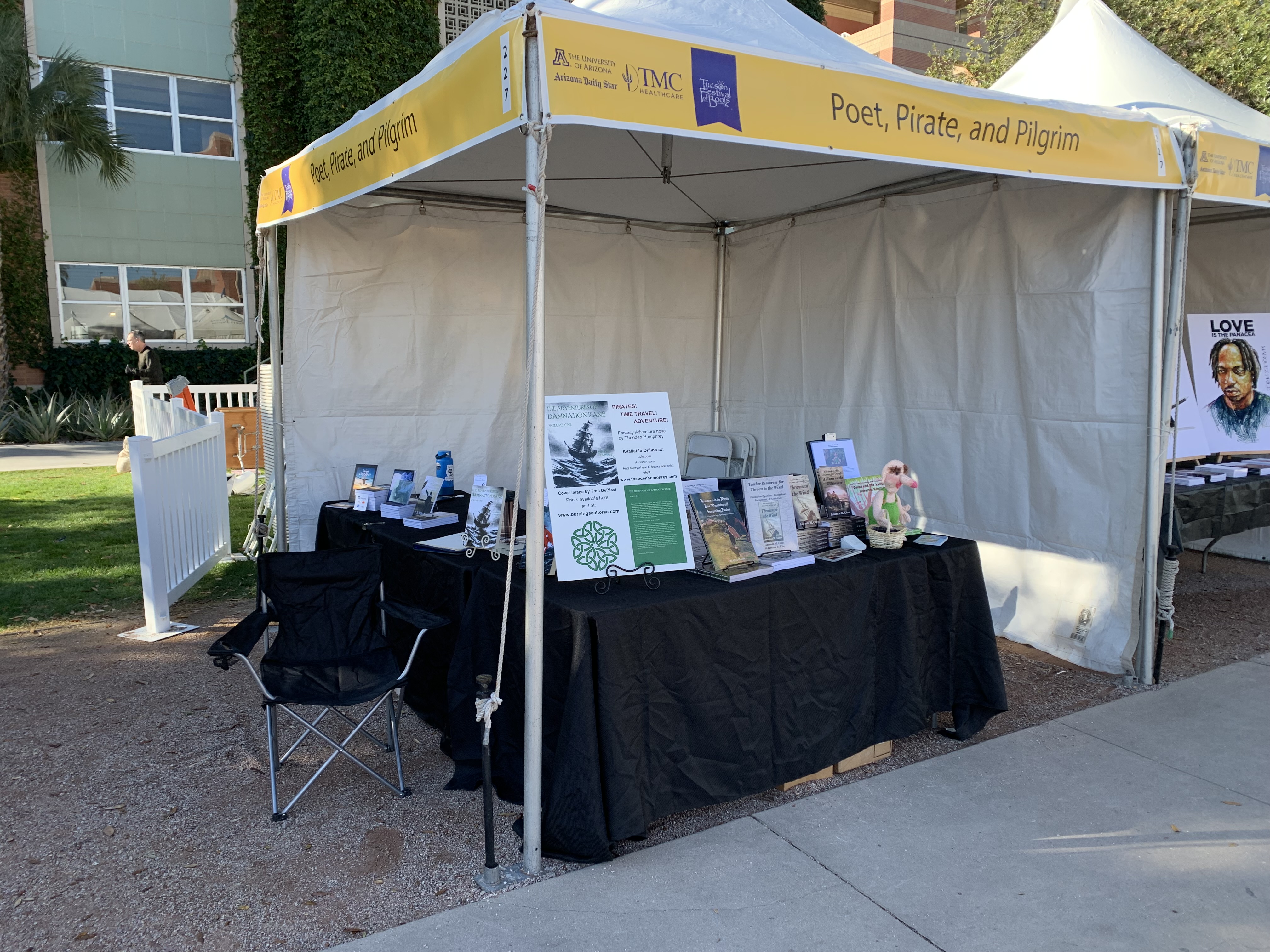
This last weekend was the Tucson Festival of Books. And for the fourth year, I had a booth, and I offered my pirate books, the three volumes of The Adventures of Damnation Kane, for sale to anyone who: 1) Saw my tri-corner hat and pirate-themed shirt; 2) Noticed the name of the booth, or 3) Paused to look at the INCREDIBLE art that my wife Toni DeBiasi created for all three Volumes of the series.

And that was a LOT of people.

I went there with, I think, about 65 books.

The first day, Saturday, I sold 42 of them. (The Answer to Life, the Universe, and Everything!) I sold every copy of Volume I I had with me. I went home, got the four other copies of Volume I at my house, also grabbed my VERY FIRST copy, the first printed copy of any book I have ever written, and brought that on Sunday. I used the very first copy (which was NOT for sale) as a display copy.

I sold the other four. And six more copies of Volume II and Volume III. And I unfortunately had to turn away a few other people because I didn’t have a copy of Volume I to sell them, at the end of the day, or else I would have had at least two or three more sales.

I now have 13 copies left of the 69 copies I brought with me to the Festival.

I have never done that well. The Festival has always been pretty good to me: I have a good book (Three of them, I think), I have a good hook — “Can I tell you about my time-traveling Irish pirate?” — and the aforementioned three attention-grabbers (sign, cover art, and stylish chapeau) brings people close enough to get drawn in by my elevator pitch. But my previous record was, if I remember right, 29 books sold. So I almost doubled that.

Thank you, thank you, thank you, to everyone who came and bought my books. I am honored beyond belief. And now I am anxious as hell that you all won’t like the books, or that you won’t like the third book, or — I dunno, something. So if you could see your way clear to tell me if you do like the books: go to the Contact link at the top of the page (Under the three lines, on mobile), or click on the Feedback link that should be floating in the bottom left corner of the page, and send me a message. Send me a Facebook message or Instagram message — @TheodenHumphrey, in both cases. (Also the same handle on X, if you are a glutton for punishment — or Threads, if you’re a glutton for social media.) Or if you’re really feeling good about my work, post a review somewhere — Amazon, or Goodreads, or Lulu.com where the books are produced — and then let me know that you did so. Thank you.

Thank you, as well, to my fantastic booth partner Amanda Cetas, who stood with me on a patch of sole-stabbing gravel for eighteen hours over two days, who covered me when I wanted to take a break (And made sales for me, too), who directed people to my side of the booth when they seemed more interested in fantasy than in historical fiction, and who stayed positive and energetic all the way through. Thank you, also, to all the people who bought Amanda’s books — she said she did better this year than she has before, too, so it wasn’t just the Pirate who made out like a bandit.

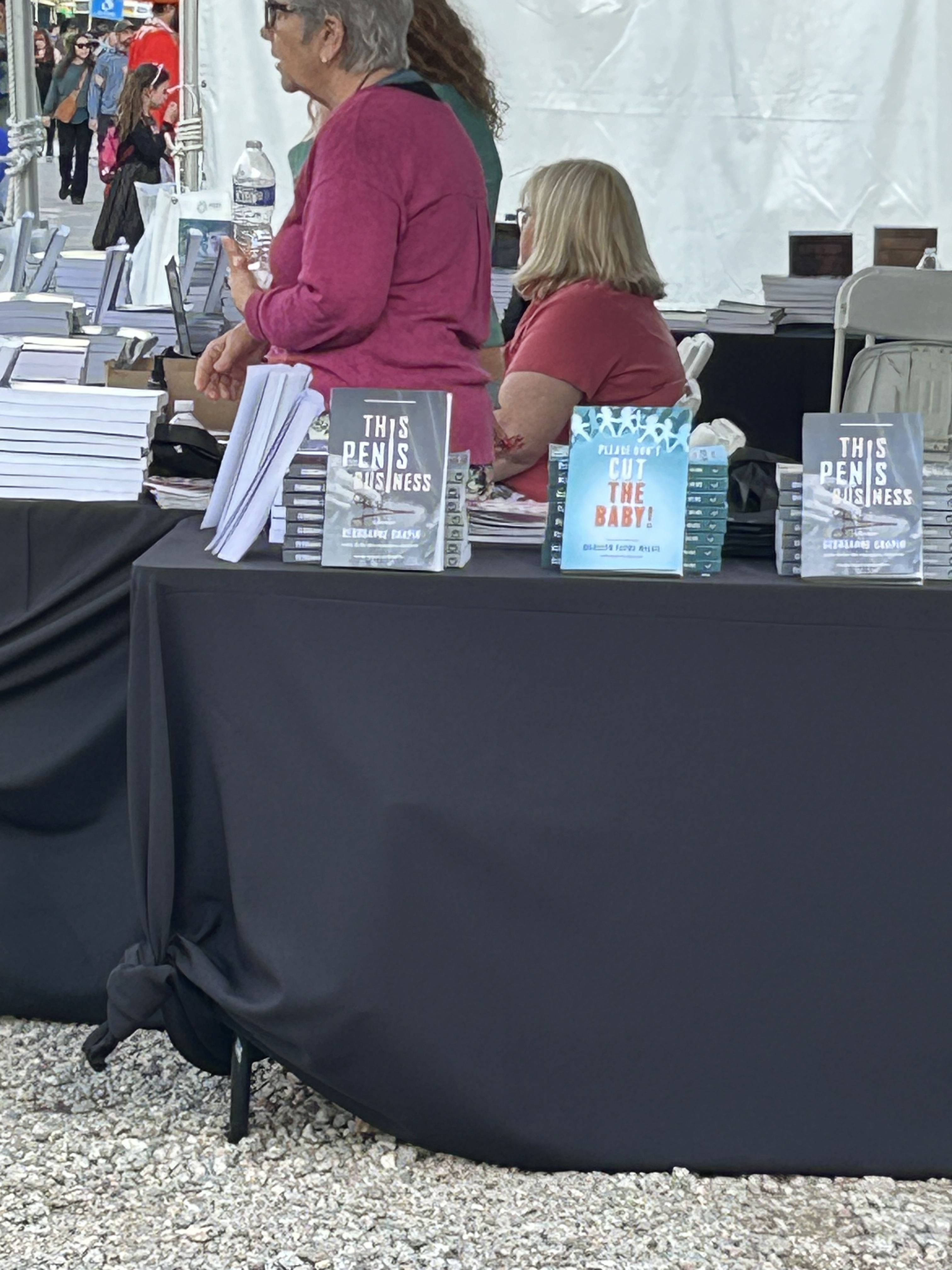
Amanda also shared my confusion over our nearest neighbors, who were… intactivists. Anti-circumcision activists. With whole books. About… circumcision. Now, I actually know the arguments against circumcision, and — how do you fill an entire book with them? Let alone TWO?!?

Needless to say, they did not send many customers over our way, and we didn’t send any their way, either. I didn’t have any people come to my booth and say, “Pirates, huh? You wouldn’t have anything about foreskins, by any chance?”

(I would have sent them over if they did. But they didn’t. The people over there still had people at their booth all weekend, so I think they did fine, too.)

If you didn’t get the book or books you wanted, or you now want more books, then please use the links on this page to Contact me or to order yourself a copy from Lulu.com. (If you Contact me, I will sign the book for you before I ship it.) If you didn’t make it to the Festival this year, then come to next year’s — Amanda and I will be there (Hopefully with our partner, the Poet, Lisa Watson, who wasn’t well enough to attend this year), and I will have all of the Adventures and at least one new book, as well. Amanda will probably have nine new projects, all of them as wonderful as the ones she has right now.

And if you bought books, two things: thank you for reading. You, along with the rest of the literate people, are the bulwark holding back the tide of Fahrenheit 451. You are giving my world meaning. You are joining me in this weird sort of slow-motion conversation that is a novel.

And also: get off the internet and go read. Like I’m about to do.

(If you’re wondering, I only bought two books this year. But that’s because this is my TBR pile.

No, I’m not kidding.)

Here are the two books, anyway.

Happy Reading, all.

The Festival of Books

I meant to do this sometime over this past week, but honestly? I was EXHAUSTED.

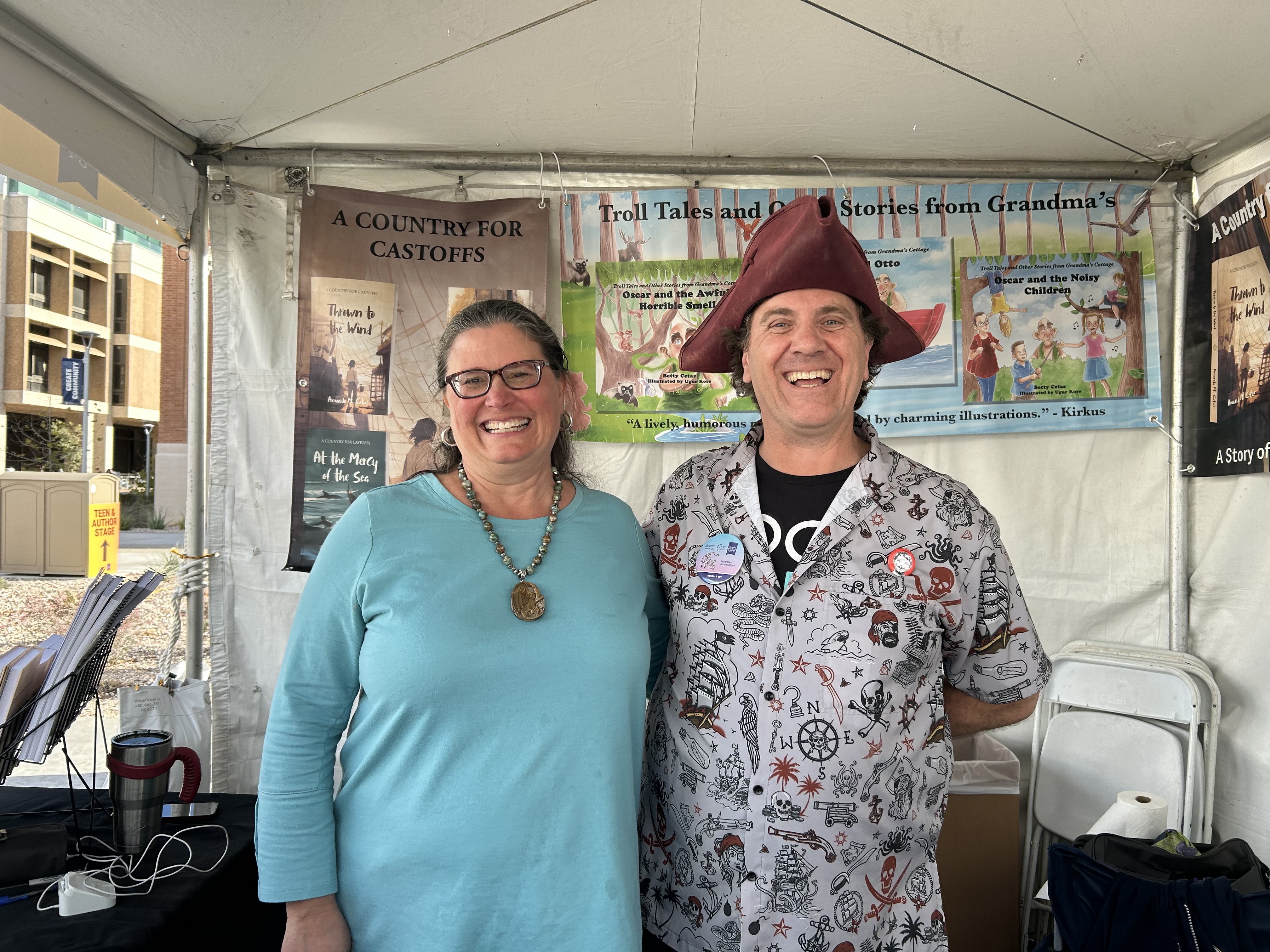
The Festival of Books was last weekend. I had a booth with my two wonderful partners and fellow authors, Lisa S. Watson and Amanda M. Cetas. Together we are:

This is our second year all together; Lisa and I shared a booth in 2019, as well, with the amazing book editor/writing coach Adriana King. This year, like last year, we had the very same booth, in the same spot (which is not really a corner, though we got a corner booth; but it’s okay, because the two open sides give all three of us room to display — and as you can see, Amanda has a LOT of stuff to show: two young adult historical novels, a teaching guide for them, an RPG sourcebook, and a fantastic illustrated children’s book about a troll who smells a bad smell. That’s a handmade knitted version of the troll, standing on the right side of Amanda’s display. Lisa’s display of poetry, short fiction, and one of her novels is visible in the group shot, on the left side of the table), and this year, like last year, went pretty damn well.

This year, like last year, was pretty anxiety-inducing, especially since I only sold nine books the first day. Nine books is wonderful, and I’m extremely happy when anyone just stops by the booth and lets me talk about Damnation Kane; but the booth and everything is pretty expensive, and nine books was not going to cover the cost. Fortunately I did better the second day — twice as well, in fact — and so the Festival was, once again, a success. Even if I hadn’t sold any books, it would be joyful to see so very many people who love books, all in one place; and the fact that I got to reconnect with a few people who had bought my books in the past — and one fellow pirate afficionado, the remarkable Jack McDowell, who created and personifies Captain Rat (Who will someday cross paths with Damnation Kane, I have no doubt) — and got to see friends and colleagues and students, both present and past, makes the whole thing an absolute blast.

But it’s tiring.

It started early, the wearing out: not least because this whole two-plus months of 2023 has been tough. But also, I tried to finish my third Damnation Kane book for this Festival, and didn’t get it done; and then I tried to publish my vampire novel Brute, and didn’t get that done either. And then I went to get bookmarks printed, with my name and website address on them, but when I went to pick them up Friday afternoon, the shop was closed. Turns out the hours posted on the web are not their actual hours. AND I tried to get my personal domain, theodenhumphrey.com, to point to this site, since this is going to be my main online hub for the foreseeable future — but doing so killed my email, which is hosted by the same company. So there was a bunch of crap to deal with before the Festival even started.

And then there was the Festival itself: standing by the booth all day, for eight hours a day, is not easy. (Also my pirate hat does not shield me from the sun: I got sunburned on both ears. On my ears! Ridiculous. And itchy.) Greeting people who approach, and trying to keep my energy up and be positive with them, even though my inner introvert is screaming the whole time, is even more not easy. (By the way: after three years of selling a pirate book at this Festival, I have learned this: older Caucasian men who approach because they see the cover image of the ship, and who take a minute to read my sign, do not want my book. They are often military veterans, and almost invariably looking for accurate historical maritime fiction. As soon as they see “Fantasy” and “Time travel” they walk away. No big deal, of course, but I don’t even try to talk to them beyond a polite greeting. [There are exceptions, which is always nice; I like people who like my story idea, whoever they are.]) Doing all this on a weekend in between two weeks of teaching?

Oof.

So while I meant to post this on Sunday last week, and then told myself to do it every day of the last seven days, I’m doing it now.

On the plus side, this is now Spring Break at my school, and so I plan to add another post over the week sometime, with a proper essay — and then another one next Sunday, so I can keep up with my posting rate, if not exactly my schedule.

Also, thanks to my incredible wife’s brilliant idea, I set out a mailing list signup, and I got people who signed up — which means as soon as I post this, I’m going to send out my very first author’s newsletter. If you are interested in receiving the newsletter, please use the Contact link on this page, at the top just under Home and About. I’ll be happy to put your name on the list.

I will also state here, categorically, that Brute will be published soon; and that the third volume of The Adventures of Damnation Kane will be published as well, before another year passes. I swear it.

Thank you to everyone who bought a book, everyone who signed up for the mailing list, everyone who stopped to talk to me and complimented the idea of a time-traveling Irish pirate — and thank you to everyone who came out to celebrate books. And the biggest thank you of all to Lisa, the Poet, and Amanda, the Pilgrim, for sharing this whole experience with me.

See you next year!

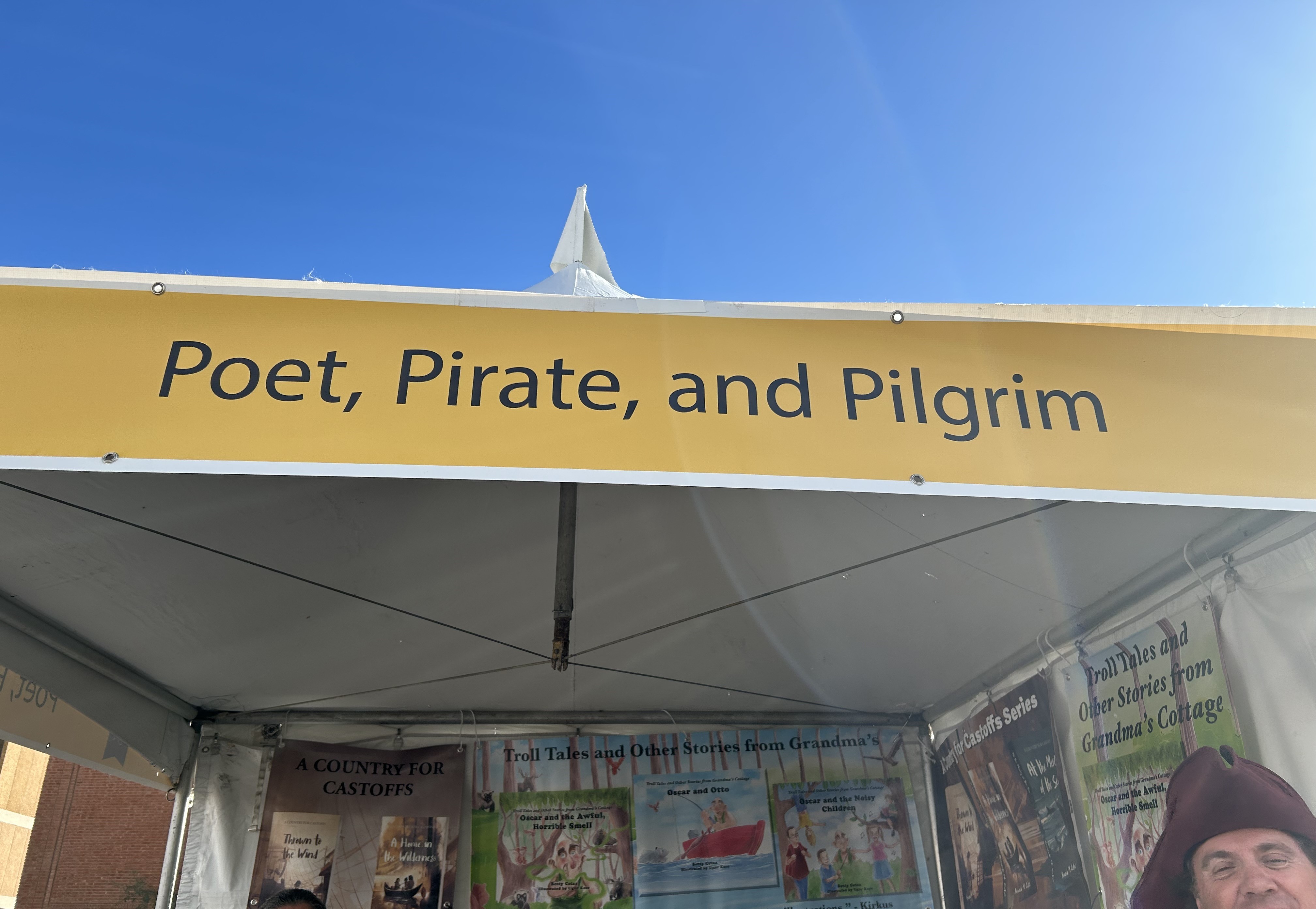
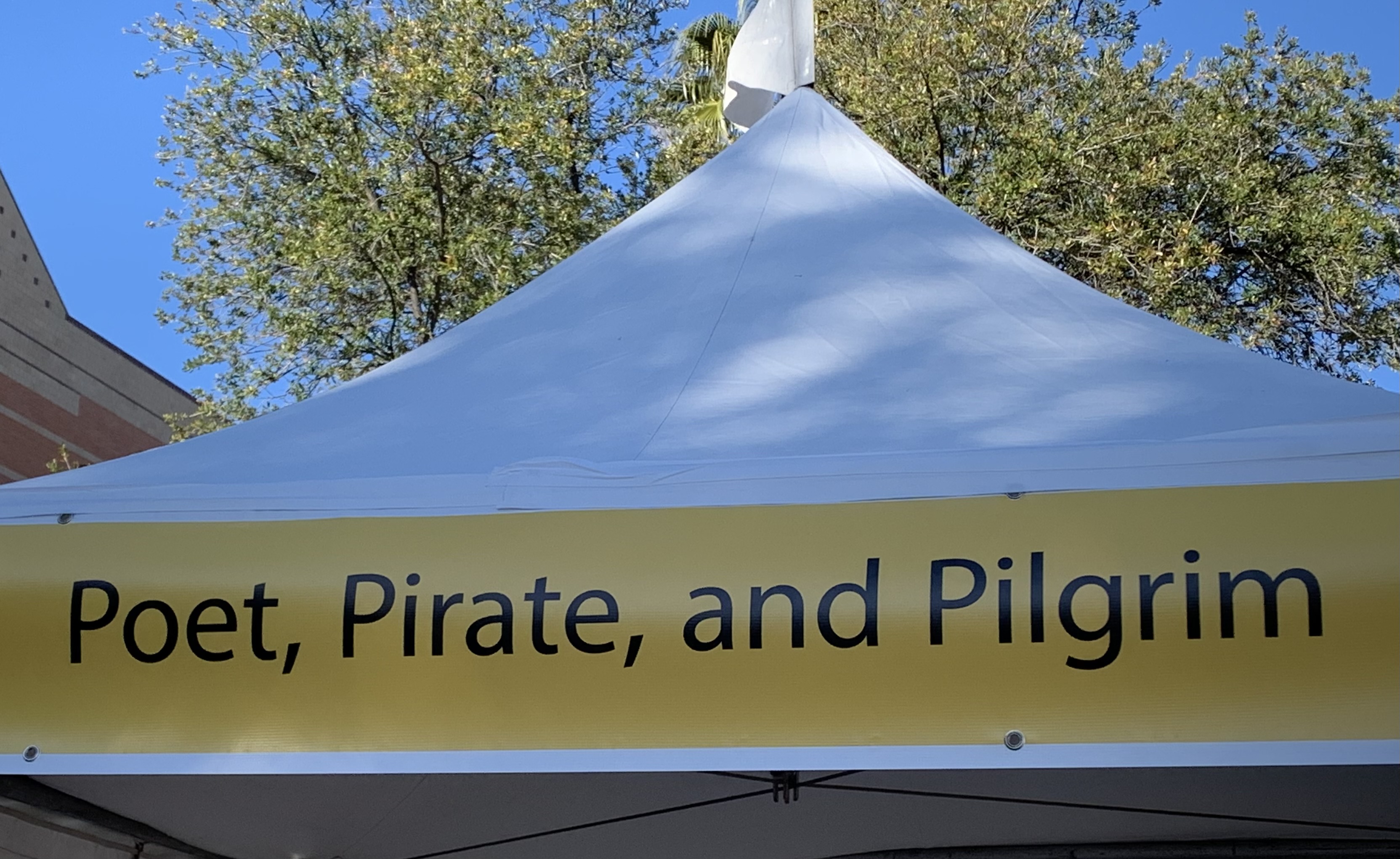
We’re out of order: this is, from left to right, the Pirate, the Poet, and the Pilgrim.

Please check out Amanda’s books and website here: https://www.amandamcetas.com/

You can find Lisa’s work here: and all of it is fantastic. Lisa S. Watson

This Morning

This morning, I’m thinking about Game of Thrones.

Image result for game of thrones

I haven’t watched it.

YEAH, THAT’S RIGHT, I HAVEN’T WATCHED IT. YOU GOT SOMETHING TO SAY ABOUT IT? COME SAY THAT TO MY FACE,WHY DON’T YOU?

Okay, that’s probably angrier than the situation warrants. But I know there are people who reacted to this with that level of shock that approaches anger, when the raised  voice of surprise turns into a shout, a roar, of outrage. (Or at least there are people who would. I think all of my readers are calm, contemplative, rational types. But then, maybe those aren’t the descriptors for the average Game of Thrones fan.)

I have been surprised to see the response that this show has gotten, especially these last three weeks as the final season has slouched towards Bethlehem to be born, so to speak. And honestly, it has made me regret not watching the show; I mean, this is high fantasy, this is my kind of stuff: this is the thing that I should have been on board with right from the start, and I should be reveling in this rare moment when fantasy captures center stage, when the imaginations of millions are fired up, all at once, by swords and sorcery. It’s a beautiful thing. I wish I was part of it.

I’m not.

I blame George R. R. Martin.

That’s the problem, you see. Because I didn’t need to watch the first few seasons of this show: I read the books. I started reading The Song of Ice and Fire in 2003, when the third book had just come out in paperback. One of my favorite students from my first school — great guy, smart and funny as hell, the son of one of my fellow English teachers; he was repeating a class in summer school that he had had no business failing over the regular school  year, but it worked out for me, because he had no problem doing anything I asked, and also made the class fun for everyone in it, made the discussions better, told fun stories, asked good questions, everything you want from a student — he recommended the books to me, and I took him up on it. And I was hooked: those are outstanding books, with a level of action and raw blood-curdling savagery that you don’t normally see in high fantasy, which tends much more towards Tolkien and his magical floating elves and roly-poly hobbits. (Not that there’s anything wrong with that, but can you imagine a sex scene in Tolkien? I really, really hope your answer was no.) I burned right straight through the first three books in the series, and gushed about them with Danny, the guy who got me to read them. I excitedly told him that the fourth book was slated to come out soon. And he warned me: Martin doesn’t make deadlines. The third book had apparently been delayed two or three times before being published, so I shouldn’t expect the fourth book to come out as scheduled.

Danny was right. The fourth book was delayed, and then delayed again; it was finally released in — I think it was 2005? (Wikipedia confirms.) I remember buying it in Portland, at Powell’s City of Books, because we moved to Oregon in 2004. But I bought it, in hardback, and read it excitedly, too; and it was great — but it was incomplete.

If you don’t know, the series goes  through probably twenty different point of view characters, switching between them every chapter. Some of the story lines are wildly separated; part of the interest was in seeing how Martin was going to draw all these threads together into a single web. It was fascinating. But the fourth book, A Feast for Crows, was only half of the storylines. What gives? I thought, angrily, because several of my favorite characters hadn’t made an appearance at all (And I already got burned on this in The Wheel of Time, when a wall collapsed on Mat at the end of one book AND THEN HE WASN’T MENTIONED EVEN ONCE IN THE NEXT BOOK. If you’ve read the series, then you know my pain; if you haven’t, don’t worry about it.) and I wanted to know what was going to happen to them. But at the end of the book, there was an author’s note: Mr. Martin said, “I know, this is only half the story. But don’t worry! It was only because there was too much to put in one volume, so we split it into two books, both covering the same time span, but with different main characters. That other book is almost done; it’ll be out any day now.”

That’s what he said, in essence.

He lied.

It took SIX YEARS.

2011 was when that book, Book Five, was published.

Know when Book Six was published?

Yeah: we all want to  know that. Because it hasn’t been.

A Song of Ice and Fire was projected as a seven-book series. The book that was “almost done” took six years to finish, and the next book is going on eight years. The last book? Well: George R. R. Martin is 70 years old now. And not in the best of health.

Like I said, I got burned by The Wheel of Time. That was my favorite series: and though Robert Jordan, the brilliant author, was in no way at fault for this, he died before he could finish the series; he was diagnosed with a rare blood disease that killed him at just 59. I don’t mean to put too much weight on a set of fantasy books, but those books are a great gift, and it is a terrible loss that Mr. Jordan wasn’t given the time to finish them.

George R. R. Martin has had the time. He just hasn’t done it.

And in the meantime, he started making this TV show.

I’m bitter about it. Unreasonably so, I fully admit. I’m actually extremely glad that Game of Thrones has been so hugely successful; it’s nothing but a bright moment for fantasy, and something that can only help the genre, and would-be fantasy authors like me. I’m grateful to Mr. Martin for penning the series, and for getting it on TV, and for helping to make it so good that it has become a cultural phenomenon.

I’ll watch the show eventually. I’m curious, my wife is curious; I want to see it. I need to get over this grudge against Martin. I realize that. And the show isn’t only his, and I have nothing against the other excellent people who have done, it seems, an amazing job of storytelling.

But no matter how good it is, no matter how well the show has done, and no matter how unfair it is of me to berate an author for not writing fast enough (and worse, hypocritical, because my first novel was published in 2009, and was the first in a trilogy — but I haven’t written the second book yet), I still can’t help but be bitter about Martin taking so goddamn long, and letting himself get distracted by television when he should be first dedicated to writing the books, and finishing the story for his first fans, his readers.

Know why?

Because Danny’s never going to get to read the end of the series.

Danny died of leukemia. He never even got to read Book Five.

It’s stupid to put these things together like this; Danny’s loss would have been tragic any time, and there are a million things he never got to do, and reading these books was not the top of that list, not the saddest nor the most important. But I talked to him, near the end, on the phone, and you know what we talked about? Books. Fantasy books. So yeah, I put them together. And I blame George R. R. Martin for not writing those books fast enough for my friend to get to read them all. And I blame the show for being the final distraction that now likely means the book series will never be finished. And I don’t give a shit if none of this is reasonable.

I hope you all enjoy the show, I really do. And I’ll watch them eventually.

But right now, I’m not watching Game of Thrones.

This Morning

This morning, I am thinking about books.

I have too many books. I have too many books and I don’t read enough. I have a hard and demanding and time-consuming job, one that is important to me to do well, and so that takes up a ton of time and energy; maybe the worst thing about it is that my most-free time is late at night before I go to bed — but I can’t read then because it puts me to sleep. Which sucks because I want to read! And it also makes me feel like a lame-o who doesn’t care enough about reading, I mean, if I loved reading enough, I wouldn’t fall asleep doing it. But that’s dumb, because reading relaxes me, and I’m tired, et voila. Nodding off mid-page and dropping the book, which I do all the time. Scares my dogs. Though fortunately I rarely hit myself in the face. Not never; but rarely.

I also have this second job where I’m trying to write books. That also is draining and difficult and time- and energy-consuming, and so the two things together leave very little time for reading. This one gives me a strange feedback loop, too, because while I want to read as much as possible, as it gives me inspiration and fodder for writing, that means that when I read, it makes me want to write, so if the reading is going well that’s generally when I stop reading to write. Conversely, if the writing is not going well, it makes me want to read more, but then I also feel bad for not getting my writing done, because as much as I want to read, that is still my avocation, my hobby, my peaceful relaxing thing; it’s not my job. I don’t have goals and ambitions as a reader, but I do as a writer, so when I’m reading with the intention of getting back to writing, I am more focused on the getting back to writing, which makes me not enjoy the reading as much.

But I love reading. I love getting lost in a book. I love finding a new hidden thing, or a lovely turn of phrase. I love arguing with the author, or questioning why they did a thing — and I adore when I realize later in the book exactly why they did that thing. I love getting to know and understand characters, and I love seeing how things unfold in their lives. I love seeing how authors begin a story, and how they end one. I love reading detailed descriptions, and perfect metaphors, and ideas that I’ve never thought of before but that resonate with me down to the iron strings inside that Emerson talked about in “On Self-Reliance.” I love doing that, too, thinking of things I’ve read while I’m out in the world, and realizing that the book has had an influence on me, that it matters outside of the time I spend between the covers, wandering across the pages.

I love long books and short books, fiction books and fact books, children’s books and adult books, fantasy and science fiction and horror and romance and everything in between. There is no genre I won’t read, and no subject I won’t at least read about, though of course I have my preferences. Bookstores are dangerous for me, because every time I stop and notice something, I want to buy it. Even knowing that I have too many books at home and I don’t know if or when I’ll ever get to read that new book, I still want to buy it. I want it to be mine. I want to have the opportunity to pick that one right off my shelf, and then dive in and start reading it. When I travel, I pack extra books, because I don’t know when I’m packing which book I will want to read next, and I want that first moment of opening a book to be exciting and welcome, not feel onerous or like it’s just the best I can do. I don’t mind too much having too many books, because I just read that Umberto Eco had a personal library of 30,000 volumes, which he never could have read, but that it’s good to have more books than you can read because then you have to choose, which makes you more invested in the book and gives you the chance to learn new things throughout your life. I like that. I want to die with books unread: but not as many as  books read. That’s my goal.

I don’t ever want to be without books.

This Morning

This morning I am thinking about words.

I’ve written about 700,000 words worth of books, over five (longish) novels. I’ve no doubt I’ve written twice that in blogs and essays and book reviews, and probably its equal again in journals and diaries, notes and letters and the various ephemeral thoughts that find their way onto paper. That means I’ve written somewhere above 3,000,000 words in my lifetime.

How many of them were the right word? The best word? Twain said that the difference between the right word and the almost-right word is the difference between lightning and a lightning-bug, and nobody has said it better. Not all of mine are the best words, not by any stretch; but I think some of them have been. Sometimes. and even where they weren’t the perfect word, the best word, quite a few of them have been good words. And when the total is 3,000,000 words, “quite a few” — well, that’s something. It’s something.

I wonder how many people have read my words. I’ve read my essays to students for as long as I’ve been teaching, and sometimes my short stories or even an excerpt from one of my books; that’s around 3,000 students over the last twenty years. Three thousand people. And of course, I’ve written notes and comments and such on their work, and answered their questions and concerns in emails now to the tune of thousands of words, tens of thousands of words. I’ve never sold a lot of books, but I have sold some, and I’ve had blogs, with some number of readers, for more than a decade.

How many times have my words made people smile? Made them widen their eyes? Made them feel angry, or sad, or touched? How many times have my thoughts made someone else think something truly powerful, a sky-shattering inspiration, a ground-shaking memory, a tidal wave of thoughts?

I think those things have already happened. I think I’ve done them several times. I have. With my words.

This morning, I’m proud of that.

This morning, I hope I get to do it more, and more, and more.

A Letter to My Readers

Okay so here’s the thing.

I’ve been having something of a crisis of confidence. Maybe not a crisis, actually, because it’s been going on for quite a while; I’m still not out of it, in fact. But I’m realizing that it is probably more important than I’ve been giving it credit for being, and it almost certainly has to do with this blog, and what has happened to the kinds of things I post on here. I think this is the reason why I’ve reduced myself to posting only book reviews (Not that there’s anything wrong with that), and why all of my intentions to post frequently have fallen by the wayside, so that now I’m lucky if I get one post a week on here.

What happened is that I found out that I’m not actually very good at arguing. I think quickly, but I think shallowly; I tend not to do much research, I don’t argue about things that I have spent years learning; I jump in with both feet and start slinging opinions around everywhere. Then I get angry, and I start insulting my opponents – sometimes subtly, sometimes not so much – and when they insult me back, then I get huffy and leave the argument on my high horse. Though frequently, I say I’m leaving the argument but then I don’t; I just take a little longer to think up my next response, or I let other people talk for a while and then I wade back in. Basically, I’m really, really annoying, and the main reason why I always thought I was good at arguing was because I surrounded myself with people who agreed with me, and who therefore complimented me on my ability to take down my opponents. I don’t think I actually took them down very often; I just needled them into shutting up, or else I made wittier fun of them than they made of me, and so my audience applauded.

I don’t like this, but it’s true. It may be a little too harsh; I have had many arguments, and some have gone well, and sometimes I do know what I’m talking about. But ever since I found this out, I’ve noticed how often I talk without thinking, how often I ignore the need for facts to support my arguments, relying on words and, y’know, “logic.” Meaning explaining my thoughts and expecting other people to agree with my thoughts, which is mostly what we mean by logic. I have noticed how often I get angry and then say something shitty. And so I’ve started deleting those nasty comments, and more importantly, I’ve started avoiding arguments. Which I think is a good thing.
Along with that, however, I’ve stopped thinking that I should be ranting about the state of the world, and then sharing those rants with the world. I no longer see myself as a natural authority on truth, justice, and the American way, because my reason for thinking that was mostly that I could win arguments, which I thought made me right. It doesn’t. And if I’m not right, what exactly am I bringing to the table when I post about politics or the state of the world?

Not much, as it turns out. I don’t have a whole lot to offer society as a whole. So I’ve stopped wanting to offer it.

But there’s good news. I still think I write well. I think I have good stories that I’ve written, that I am writing. I think I do a decent book review, though there are certainly others who do more thorough assessments of their books, and who give more useful information; but I think mine are okay, so I’ve kept writing them. But that isn’t the exciting part. The exciting part is that I have kept writing fiction, and other than the fact that I have to spend much too much of my time working and also living my life, I have been writing fiction the whole time I have been pulling away from blogging and ranting and arguing. Which, yeah, that’s good news. Because I write well.

And then this last week sometime – the days all blend together, it seems – I had another realization. While I’m going through this fiction-writing adventure: why the hell am I not blogging about it? I mean, sure, it’s a change from what I’ve done in the past, but if that stuff was not very good, maybe this is a good change. Maybe I should stop ranting for a while, and instead keep this blog as, y’know, a blog, a weblog, an online journal detailing what I’m living through right now.

So to that end, I plan to start keeping a record, as often as I can manage, about this new thing I’m doing. I may still rant sometimes (I certainly will have some ranting to do about school and the world of education, I have no doubt) and I’ll keep up with the book reviews as much as I can; but otherwise, this will be the subject of this blog. Rather than trying to be Just Dusty, I’m going to make this – just Dusty.

Oh right. So what am I going through, you ask? Those of you who are still reading this, that is? Both of you?

I’m publishing my book.

I did this before, but I did it in such a terrible way that I don’t even count it. I wrote a book, completed it in 2006, and then when it wasn’t picked up by an agency or a publishing house after fifteen or twenty query letters (I think; I don’t even remember at this point how often I sent it out, though I do remember buying at least three Writer’s Markets to look for leads), I decided to self-publish it as an ebook. I joined Amazon.com’s Kindle publishing program, followed their instructions, and uploaded my book to the Kindle Store. I made an author profile, and – that’s about it. I didn’t really edit the book — still had more than a dozen simple typos, and I don’t know how many clunky passages, because I didn’t go through and smooth them out. It didn’t have a cover; I found a pattern image on my cheap-ass graphics program, slapped the title and my name on the front, and called it good. Here, this is it:


The Dreamer Wakes (The Dreamer's Tale Book 1) by [Humphrey, Theoden]

Yeesh.


My plan was actually to include a plug for my book in all of my Amazon reviews, because at the time, I had something like 100 book reviews on the site which had garnered some thousands of positive votes; seemed like a good opportunity to say, at the end of my long and detailed reviews, “Hey, maybe you should go check out my book, too.” But when I added a line at the end of my reviews, Amazon pulled them from the site. Because you can’t advertise for a book in the reviews of a different book. And of course I get that – but also, why the hell not? The whole page is designed to get customers to look at other books, other books by the author, other books that people bought after looking at this book, other books that Amazon thinks are related to the one you’re checking out. My review plug clearly wasn’t Amazon’s choice for readers, only mine, so I didn’t see why they got pissy about it. Anyway, I pulled the plugs out of the reviews, and then I did nothing at all to promote the book. It’s still there, still for sale, but in the two years – three years? – that I’ve had this particular blog, I don’t believe I’ve ever mentioned it before.

Turns out I’m not only bad at arguing, I’m also bad at advertising.

But it’s okay! I’m really not trying to denigrate myself. It’s still a good book. (Though the larger problem now is that it is actually the first book in an intended trilogy or tetralogy, and I’ve never written the other books. Which is vile and wrong of me, and considering how much crap I’ve talked about George R. R. Martin for never finishing the Song of Ice and Fire series of books before he turned into a TV mogul, it’s really pretty appalling that my only work available for sale is an unfinished series.) It’s just not the story I’ve been writing.

The story I’ve been writing, which I have brought back for its second go-round as a serial blog, is The Adventures of Damnation Kane. It’s the story of an Irish pirate from the 17th century who finds himself, with his ship and his crew, in 2011. I started this story in 2013, kept it as a serial blog for about a year, and then stopped. But I love this story, and I want to finish it all the way to the end; and this time, while I’m writing it, I also want to publish it. This time, I have a real plan. This time, I’m going to do it right.

And that includes trying to talk up the book wherever and whenever I can. I want people to be as excited about the book as I am.

Which means that I should be talking about it – here. Among other places, of course, but certainly, at the least, in this space, which is supposed to be a collection of my thoughts, of the things I believe are important. If I don’t put my own book into this space, what the heck am I doing? If my own work isn’t important to me, then what is?

So here’s the deal, you two people who stuck it out through all this navel-gazing: The Adventures of Damnation Kane are currently available, from the beginning, on my other blog. But only until I get the book published, and then the chapters will come down; I will keep up a couple of the first chapters so a new reader could get an idea of what it’s all about; and I will keep posting new chapters every Saturday as I’ve been doing for ten months, now. The first volume of the Adventures will be available in trade paperback form, and also as a series of four short ebooks; my readers on this blog who review books, I will be asking you all to write me a review, if you would be so kind. And in the meantime, while I am working on getting these books out into the world, I will be writing about the process and the experience of writing and publishing books.

I hope and believe that this time, I’m on the right path. Thanks for coming along with me this far.

Yours,

Dusty Humphrey

Books vs. Movies Part III: Everybody Wins!

Bro, Do You Even Read?

I’ve now written about movies over books. It felt false; I had to work too hard to convince myself that movies were actually better than books. I’ve been telling my students for years that they should try arguing from the opposite side, as a way to gain depth to their perspective, to understand their opponent – and therefore defeat him more easily – but I guess I haven’t done it myself, not often enough. I’m not sure if that says something about our society, that we have trouble stepping out of our comfortable ruts and visiting ruts on the other side of the road (which is certainly true) or if it says something about me, about my arrogance, telling people what to do when I never do it myself. It’s probably the second one. I’d like it to be the first.

I wrote, as well, about why books are better than movies; or to be more precise, why people who watch movies but do not read books are destroying our society. It didn’t feel false: I believe that. I’ve read Fahrenheit 451, and I’ve seen how close Ray Bradbury got to what is actually happening in our world; people who don’t read at all, and thereby don’t gain the necessary skills that reading can give, are a genuine threat to us all. They lack imagination, and they lack empathy; but they don’t lack power, or influence, or a voice. And thus are they very dangerous.

But while that essay didn’t feel false, it did make me both angry and sad; and I’d rather not feel that way. So I find myself seeking a middle ground: something that will be true to what I really think, but will also be fair to the other side, and won’t make me feel like I’m pointing fingers at those I damn to perdition, sentencing them to burn at a stake, flames rising from burning books (Because zealots always destroy what they love, along with what they hate) to purify their corruption. Arguing for destruction is no way to accomplish anything but destruction; if I imagine my angry essay becoming influential, all it leads to is a witch hunt for the non-reader, and protestations of devout readerlihood. I would, for the first time, expect the Spanish Inquisition.

So the middle ground is this: I am currently reading a difficult book, Ralph Ellison’s Invisible Man. And it’s fascinating, really; it challenges me to find hidden meaning, it makes me think things I’ve never thought before, it gives me insight and inspiration. But it’s hard. I can’t read it for long, especially not after a day of teaching and/or reading essays. So when I get home, in the late afternoon or early evening after I’ve relaxed post-work for an hour or two, I may read it, for an hour.

Then I watch TV. Or play mindless video games, things like Mah Jongg or Candy Crush or Guitar Hero. Then, when it’s time for bed, I read again (because screens disrupt our sleeping patterns) – but then I read Harry Potter and the Chamber of Secrets. Because it’s relaxing.

I don’t watch very many movies, specifically, but it’s a fool’s game to try to build a distinction between movies and television; television breaks up a story into chapters, or it tells several related stories – a literary model followed by the best-selling novel of all time, Miguel de Cervantes’s Don Quixote. Right now my wife and I are watching Dexter, at a rate of about one episode per night; a single season, twelve episodes, is indistinguishable from a long movie – like, say, The Lord of the Rings, which is nearly twelve hours total in the extended editions, just like a dozen episodes about my favorite serial killer. My wife joins me for the TV show, and then she goes to her studio and draws and paints; she hasn’t read a book in months. She feels guilty about it, and I know that’s because of me and my ire about non-readers; but I don’t consider her a non-reader, just a person with a very difficult and trying job who prefers art as a means of relaxing at the end of the day. How can I criticize that? Is art any less valuable than reading? Of course not.

But how can I let people – specifically my students – think it’s okay to watch movies and TV? Just because I try to find the middle ground, enjoying both books and television, that doesn’t mean that my audience will join me there. I know how it works: when I tell students that the first draft doesn’t have to be complete or polished, you don’t give me something rough; you give me one paragraph that’s mostly typos. When I tell you the book report doesn’t have to cover the entire work, you give me something that only covers three chapters. When you realize I’m lax about deadlines, you simply stop turning things in until I actually give you zeroes and your grade drops. When I say once that grades do matter, everything else I ever say about grades not mattering is gone forever – I confirmed your preferences, your prejudices; now you’re done listening.

You really are good Americans.

So if I say that movies are entertaining, and are important as a source of relaxing entertainment, how do I convince you that you also need to read, to do the work, to make your mind tired before you get to the relaxing part?

Here goes. Reading is like working out. If you’re really dedicated, if you truly love it or it suits your ambition, then you can do it every single day, for hours at a time – but then mentally you’re the equivalent of this guy:

And nobody wants that.

For most people, who just want to be healthy and happy, you should work out a few times a week, on a regular basis. Read something challenging. Of course it doesn’t have to be a book, specifically, and it doesn’t have to be fiction; it just has to be reading, and it has to be challenging. This is where you strain, and work until you fail; this is where you build strength. Then, on other days, do something like cardio or abs: read something easy, something you could keep reading for a while without hurting yourself. The key there is to keep at it, to not give up.

Once you have done your workout, then it’s time to relax: do something easy, something that doesn’t tax your brain at all; watch a movie, watch a TV show, play a video game (And please don’t tell me that video games are mentally challenging. I play them, too. They’re not. If figuring out how to finish that mission on Grand Theft Auto is mentally challenging, then your brain is out of shape, is a couch potato of the first order. You need to read more.), have a conversation, take a walk, take a nap. Take it easy.

But for the sake of your mind, don’t just skip straight to the nap. Americans already do that with exercise, which is why the nation is unhealthy and out of shape; our brains are moving that way, as well, as we spend more and more of our time taking it easy, and not enough of it working out. You also don’t want your brain to look like this guy:

464621041_1601057ada_m

Moderation is the key. A little of this, a little of that; a little reading, then a little Netflix.

Now: as a student, you get a pass, like my wife does; you are involved in a mentally taxing endeavor, one that takes up all of your time and mental energy. So your free time should be spent relaxing and recovering. Until you reach the point where you aren’t having to work very hard mentally: summer time, or senior year, when you have two academic classes and nine TA/free periods. Then you need to work out. Then you need to read.

It’s important. It’s necessary. And because our society is based on information, which is still transmitted through the written word, then the mental exercise you must master, and then continually practice, is reading. Challenging reading. Depending on what else you want to do with your life, other mental exercises may be necessary for you, as well: math, science, art, engineering, music, what have you. Perhaps making movies will be your mental challenge, and if so, carry on: it is a difficult thing to do well, as shown by the number of people who do it badly. Movies are fun, but they aren’t necessary: except inasmuch as relaxation is necessary. As to the question of whether watching movies is a necessary means of relaxation in our culture, if you must watch certain movies or television shows in order to understand how our culture works and to participate in it, I leave that argument for another day.

Right now, my brain is too tired. What time are those sports games on?

Books vs. Movies Part II: Books

Here is the second essay: here is the one I wrote because I felt  dirty after writing the first one. Because I don’t actually think movies are better than  books; not at all, not in any way. In fact, I think the preference for movies over books is extremely harmful to our society.

So I wrote this one. Please note: it is directed at my students, who are as I describe them here. I expect that people who read this blog are not the non-readers I describe. Though the ending call to action still applies, to all of us who haven’t given up hope.

Not sure if I have given up or not, yet. But this essay is pretty clearly on the side of despair.

Enjoy!

Everything Is Terrible And We’re All Going To Die

I’m not like you.

I’m sure that’s not a surprise.

Unlike most teachers, I think, and say, that grades don’t matter and test scores don’t matter. Because all that matters is learning, and grades and tests don’t measure that; they may test what you know, in terms so specific that they become useless, but that doesn’t say what you will do with that so-specific knowledge: will you forget it the minute the test is over, the grade is filed? Will you be inspired by that knowledge?  Affected by it, changed by it? Tests can never measure that, and grades can never rate that. That change, that inspiration, is the purpose and value of education. That’s what matters.

Unlike most of America, and presumably the rest of the world, I don’t like money. I like a few of the things it can buy me, like a comfortable home, food, electricity, pirate outfits, Converse, books, coffee; but money itself is a trap. It leads us down a very specific path, a path that we must not deviate from, or else we don’t get the money; the problem is, that once we reach the end of that path, we find that the money isn’t what we want. What we want is freedom from the money, or more precisely, from the need to continue procuring the money. But the more money we make, the more stuff we buy, and the longer we have to keep getting money to pay for the new stuff. It’s a trap. I don’t like it. That’s the rest of the reason why I don’t believe in the value of grades: because every argument for grades comes back to money.

I’ve already lost you, haven’t I? Sure: you don’t care about me, or about what I believe; if what I have to say has some interest or benefit for you, you’ll read it – but if not, then you won’t. And me preaching at you doesn’t interest you or benefit you: it doesn’t entertain you, doesn’t dispel the cloud of melancholy that darkens most of your days, and which you are constantly seeking to escape through whatever momentary distraction you can find; and it doesn’t earn you money. Why would you read this, just for the sake of reading? Please.

Because unlike me, you don’t read.

DISCLAIMER: Yes, I know there are exceptions. I know there are people reading this who are readers. But I also know there aren’t very many. (Let’s be clear: “reading” Facebook or Twitter or Reddit is not reading. Reading here means books. E-books count, but memes and BuzzFeed and the captions on YouTube videos do not.) Most people read when they are forced to, by English teachers like me; most people will read something if there is “buzz” about it. (Meaning: if it is exciting.) But most people would rather wait for the movie. Even with assigned reading, the majority of people don’t read the whole book; they read enough to know they don’t want to read any more, and then they look at the SparkNotes, or they get their friend who is a reader to tell them about the rest of it, or they just fake it on the test – because the reading doesn’t matter, what matters is the grade, which gets you into the college, which gets you the job, which gets you the money.

Allow me to quote from a book that most of you haven’t read, or if you have, you didn’t pay enough attention to.

“Picture it. Nineteenth-century man with his horses, dogs, carts, slow motion. Then, in the twentieth century, speed up your camera. Books cut shorter. Condensations, Digests. Tabloids. Everything boils down to the gag, the snap ending…Classics cut to fit fifteen-minute radio shows, then cut again to fill a two-minute book column, winding up at last as a ten- or twelve-line dictionary resume. I exaggerate, of course. The dictionaries were for reference. But many were those whose sole knowledge of Hamlet (you know the title certainly, Montag; it is probably only a faint rumour of a title to you, Mrs. Montag) whose sole knowledge, as I say, of Hamlet was a one-page digest in a book that claimed: ‘Now at last you can read all the classics; keep up with your neighbours.’ Do you see? Out of the nursery into the college and back to the nursery; there’s your intellectual pattern for the past five centuries or more.

“Speed up the film, Montag, quick…Digest-digests, digest-digest-digests. Politics? One column, two sentences, a headline! Then, in mid-air, all vanishes! Whirl man’s mind around about so fast under the pumping hands of publishers, exploiters, broadcasters, that the centrifuge flings off all unnecessary, time-wasting thought!

“School is shortened, discipline relaxed, philosophies, histories, languages dropped, English and spelling gradually gradually neglected, finally almost completely ignored. Life is immediate, the job counts, pleasure lies all about after work. Why learn anything save pressing buttons, pulling switches, fitting nuts and bolts?”

That is from Fahrenheit 451 by Ray Bradbury.

And it’s you. You only read to get to the ending; once you know the ending, you stop reading –  and for the same reason, you never re-read. If you know enough to answer questions about a book – or about anything, really – you don’t see any need to keep learning about it; you can already answer the questions. You don’t see the need to learn anything other than what you will need to earn money, hopefully lots of money; and the purpose of earning that money is – pleasure.

The movie-vs.-book argument is built on a flawed foundation, the same flawed foundation that the dystopian society in Bradbury’s novel is based on: the idea of happiness.  Captain Beatty, the same evil clown who explains to the protagonist Montag how our society turned into theirs, also says this: “Ask yourself, What do we want in this country, above all? People want to be happy, isn’t that right? Haven’t you heard it all your life? I want to be happy, people say. Well, aren’t they? Don’t we keep them moving, don’t we give them fun? That’s all we live for, isn’t it? For pleasure, for titillation? And you must admit our culture provides plenty of these.”

When we try to decide whether movies or books are better based on the idea of which is more entertaining, the argument is immediately flawed: not only is entertainment transitory and essentially meaningless, but it is also too subjective to offer any coherent judgment: this fellow says he likes books more because they are more entertaining; this chap says he likes movies more for the same reason; and neither can be wrong, and neither can be right. We must turn to Bradbury – a novelist, of course – for a reasonable determination of value. If we believe that human society is valuable and worth preserving, then books offer a better opportunity for the continuation of the species than do movies. If, on the other hand, human culture is nothing more than what Beatty describes – something that exists only to provide its constituents with pleasure, with titillation –  then it doesn’t matter whether books or movies are better; at that point, humanity doesn’t matter, because something that exists only to please itself is too insular, short-sighted and pathetic to survive.

In that case, movies can be better. You can just keep watching Netflix until the ice caps melt and the water supply vanishes and the food supply follows; maybe you can watch The Road to get some pointers on what comes next. I’d tell you to read the novel by Cormac McCarthy, but – well. Don’t worry: the movie has Viggo Mortensen.

Bradbury shows in his book – and any observant student of humanity can confirm –  that books stimulate thought, and that novels promote empathy. Books of any stripe can provide evidence, rational argument, and conclusions about any subject; following the path of reason improves one’s ability to do the same. Novels create characters, who then give the reader a glimpse into their lives and psyches; understanding those people, assuming one can suspend disbelief enough to see the characters in a novel as people, at least potential people, improves our ability to understand actual people. Movies do neither of those things. Bradbury, who loved movies and television, has his Wise Old Man character offer the possibility that movies and television could offer the same thing that books do  – the same argument I’ve been hearing for years from my students when they try to explain to me why they don’t need to read, not really – but in my opinion, Bradbury was wrong about that. I don’t think movies and television can help, not at all.

The key, I think, is imagination. Imagination is the survival skill that enabled humanity to rise to the top of the food chain; because we could imagine what would happen when the mammoth came by, or when the saber-toothed cat jumped out of those bushes, we were able to plan for the possibility; that advance preparation made up for our total lack of physical prowess compared to other species. Imagination gave us the chance to survive long enough to build a civilization; imagination, in the form of ambition and aspirations, gave us a reason to build a civilization and allowed us to build civilization into what it is today; imagination would allow us to solve the problems we face that threaten our survival in the future.

If we still had imagination, that is. But you see, imagination requires a human intellect to create: to fill in blanks, to build images and scenes based only on hints. The kinds of things we do when we read, where even the best authors can only tell, never show. The kinds of things we never do when we watch movies or television, because they show: the images are created for us, the characters are presented to us, a fait accompli, without any need for our participation, for our imagination. The most we can do with a movie is decide if we like the image as presented to us; decide if it is entertaining or not.

Now, someone with imagination can watch a movie or a television show and have a new idea; they can think of what could have happened if the characters had encountered a different situation, or had different traits, or different resources; a person with an imagination could think of how a situation they watched on Netflix could parallel one in real life, and how the Netflix situation could lead to a real-life solution.

But you don’t get imagination from watching movies. You get it from reading books.

There is some good news. Our technology already exists, as does our science; and the lucky thing is, one person with imagination can keep a hundred engineers working, a thousand, more –  just ask Nikola Tesla. So as long as there are a few readers, a few thinkers, those people may be able to keep us afloat, in terms of problem-solving and innovation, for a few generations more; but that’s where we hit the empathy snag. You see, the notable problem in the society of Fahrenheit 451 (By the way: are you tired of me talking about a fictional society instead of the real world? Yeah. Check your phone: maybe there’s something more interesting to watch on YouTube. People falling down, or something. “Life becomes one big pratfall, Montag; everything bang, boff, and wow!” What am I saying? You’re not still reading this.) isn’t a lack of technology; their technology is more advanced than ours. The problem is that they don’t care about each other, and thus they don’t care about themselves. They run each other down in cars for fun. They commit suicide at an absurd rate – and they don’t care. They go to war, and nobody really pays any attention until the bombs actually drop on their heads: and even then, they only notice when the television screen goes blank, in the split second before it all turns to ash and dust and nothing.

You’re heading that way, now. People don’t care about each other the way they used to. Oh, some still do; most still care to a certain extent – but a lesser extent than in the past.  I can tell because look at your politics: not that you elected Mr. Trump, but the reason why you did – because you got tired of caring about other people’s problems. You don’t want to worry about refugees, or about problems in other nations, or the reasons why people do things we don’t understand, like carry out terrorist attacks in the name of an ideal; you don’t want to think about long-term issues like climate change, and you don’t want to pay taxes that don’t help you directly – don’t want to pay for other people who can’t find jobs, or who get hooked on drugs. You want to keep your money for yourself, not spend it on other people. Just like you don’t want to learn things that don’t directly increase your chances of finding a job that will earn you more money. Those other things don’t matter. Those other people don’t matter.

In Fahrenheit 451, when Montag goes looking for a way to solve the problem – he can’t possibly think of a solution himself, never having used his imagination and barely his intellect in his bookless life – he finds an old English professor, a man named Faber. He asks Faber what they can do, and Faber doesn’t give Montag much hope.

“The whole culture’s shot through. The skeleton needs melting and re-shaping. Good God, it isn’t as simple as just picking up a book you laid down half a century ago. Remember, the firemen are rarely necessary. The public itself stopped reading of its own accord. You firemen [In the novel, the firemen burn banned books, and the houses where they are hidden. And sometimes the people who hid them.] provide a circus now and then at which buildings are set off and crowds gather for the pretty blaze, but it’s a small sideshow indeed, and hardly necessary to keep things in line. So few want to be rebels any more. And out of those few, most, like myself, scare easily. Can you dance faster than the White Clown, shout louder than `Mr. Gimmick’ and the [television]`families’? If you can, you’ll win your way, Montag. In any event, you’re a fool. People are having fun.”

“Committing suicide! Murdering!”

A bomber flight had been moving east all the time they talked, and only now did the two men stop and listen, feeling the great jet sound tremble inside themselves.

“Patience, Montag. Let the war turn off the families. Our civilization is flinging itself to pieces. Stand back from the centrifuge.”

“There has to be someone ready when it blows up.”

“What? Men quoting Milton? Saying, I remember Sophocles? Reminding the survivors that man has his good side, too? They will only gather up their stones to hurl at each other. Montag, go home. Go to bed. Why waste your final hours racing about your cage denying you’re a squirrel?”

“Then you don’t care any more?”

“I care so much I’m sick.”

“And you won’t help me?”

“Good night, good night.”

On the off-chance that you don’t like what I’ve said here, and you care enough to do something about it, the solution is simple: read. Read for real, read for your mind and your imagination; read for your future. It doesn’t matter what you read: it only matters how, and how much. Read with your mind, and read as much as you can. If you ever have younger people you can influence, as a teacher or a parent or a mentor of any kind, try to get them to read, too. It doesn’t take everyone: it just takes some. More than a few, if we can.

I hope for your sake that you do. As for me, I’ll be dead by the time the world falls apart. I’d like to think that the books I write will outlive me.

But I doubt it.

Good night, good night.