Book Review: The Devil’s Highway

Related image

The Devil’s Highway

by Luis Alberto Urrea


In May, 2001, 26 men tried to cross the border from Mexico into the United States. Three of them were paid guides – coyotes; the others were poor workers, mostly from the southern part of Mexico, all looking for work, hoping to make some money. They tried to walk through some of the ugliest, cruelest, deadliest desert in the world.

Twelve of them survived.

This was a rough book to read. Urrea does an incredible job of showing these people for who they were; even the coyotes, who weren’t bad people – they weren’t the heads of the ring, just flunkies; the one who led the trip, who took the wrong turn and got them lost, was a 19-year-old kid who couldn’t make enough money working in a factory that made roofing tiles, so he took on this job, instead. The men who paid for the trip were husbands and fathers; none of them wanted to emigrate, just to get a job, earn some money, and pay for something back home. Mostly they wanted to buy or build a better house for their wives and sweethearts and children and mothers. Urrea explains all of it: how the men (Plenty of these walking trips through the desert include women and children, but this particular group happened to be all men, ranging in age from 16 to 56) got approached by a friendly coyote, a fixer, someone who made all the arrangements, who talked to the poor coffee farmers, the broke factory workers, about how much money they could make in the North. Urrea talks about how Mexico, unlike the US, stretches now east-west, but north-south; El Norte is to the poor of Mexico’s southern states what the western frontier was to Huckleberry Finn and the 49ers: opportunity. But this opportunity costs money – an average of $1700 per person, not counting expenses on the way; how are these dirt-poor men supposed to pay for that? Easy, says the fixer; my boss, the head of the ring, can guarantee a loan to cover the whole amount. You can pay it off out of all that money you’ll make working in the citrus fields of Florida, or the slaughterhouses of Oklahoma. Only 15% interest. No need for collateral: miss a payment – we kill your family.

So these men took a chance. And then their lead guide, the one who really knew the route, took a powder: he vanished the day before the group was supposed to board their final bus, for the last leg before their long walk. No problem: the ring sent two more guides, to back up the second-in-command, the 19-year-old.

And then they took a wrong turn.

They spent four days in the Arizona desert, in an area known as the Devil’s Highway. Complete desolation, stuck between a national park, a reservation, and an enormous military base. Sand, rocks, cacti, unclimbable mountains; nothing else. Not a hundred miles from where I’m sitting, right now, in air-conditioned comfort, which made reading this book a bizarre experience: as Urrea went on and on about the harsh conditions, the terrors of the cacti, the rough, jagged, broken terrain, the unbelievable heat (There was a heat wave when those men went: it hit 108 degrees one day. At night it never got below 85.), I couldn’t fathom that the place where I live could be so deadly. I mean, sure, it’s too hot in the summertime, but – deadly? The book describes others who got stuck out in the desert and succumbed to the heat, tourists and daytrippers; they died in mere hours.

And I walk my dog in that heat. I mean, early in the morning, of course – but still, in July, it’s probably 80-90 when we walk. Thinking about people dying in those conditions was bizarre. Though not as bizarre, I’m sure, as actually going through it.

Urrea brings it to life. He talks extensively about what the heat of the desert does to you, which was a particularly brutal chapter to read, coming as it did in between the stories of the men walking, and then the description of those same men dying. He talks almost as much about the Border Patrol, who they are and what they do; though at first Urrea is not terribly flattering – just honest – by the end, when the story becomes just a rescue attempt, those BP agents become heroes. They saved lives by risking their own, and it was quite inspiring to read.

It’s a good book. The writing is remarkable, and it gives a far better and clearer picture of immigration and the border than anything else I’ve encountered. Highly recommended, even if you don’t live in the desert.

Book Review: How to Ruin Everything

How to Ruin Everything

by George Watsky


Well, I hate to say this, because I liked this book, but it’s a lie. Watsky completely deceived me.

This didn’t show me how to ruin everything.

It did show me that George Watsky is a remarkable essayist. He is a humorist in pieces like Tusk, about smuggling a narwhal’s tusk into the U.S. from Canada (I don’t know why we’re building a wall along the Mexican border when there are over 5,000 miles of Canadian border that someone can just walk right through carrying a narwhal tusk! Sad!), and the excellent Good Hook, in which he compares a fly-fishing trip to watching a middle-aged man try to join the Mile-High club with a pneumatically pulchritudinous seatmate who is not his wife. Watsky is profoundly personal, almost uncomfortably so, when he writes about his experiences with a seizure disorder in What Year Is It? and about his father’s connection to the San Francisco Giants in Crying & Baseball. And then, in essays like Three Stories, about the run-down house where he lived with oft-appalling roommates during college, and with Concert Tickets, about tripping on mushrooms, Watsky is me.

Except he’s a better writer.

Honestly, I don’t know how to feel about this book. It’s not perfect: there were some essays I really didn’t see the point of; which may have been the point, of course, but that still left me shrugging my shoulders and souring my mouth, thinking, “Well, what now?” When the same book has these great insights and fascinating stories, why exactly am I reading about Pauly Shore? But then, Watsky is not me: my ideas of what an essay should look like or be about are not his. But the writing is so very good, and the essays that did work for me worked so astonishingly well, that the ones that didn’t work for me generally had me questioning, not what was wrong with the essay or the author, but what was wrong with me. But I’m almost certainly overthinking it.

I guess that’s how to ruin everything.

It’s a fun book, with some ice-water revelations and eye-melting poignant moments, and really splendid writing, detailed and smooth and casually lyrical. I’m going to add Watsky to my list of essayists whose work I will always check for when I hit the bookstores. Since my list includes two men who are no longer in this world (David Rakoff and David Foster Wallace), I’m happy to get a new guy into the rotation.

Batter up!

On the Third Day of Blogging, Just Dusty Blogged for Me — A Book Review of Maguire,Gregoryyyyy!

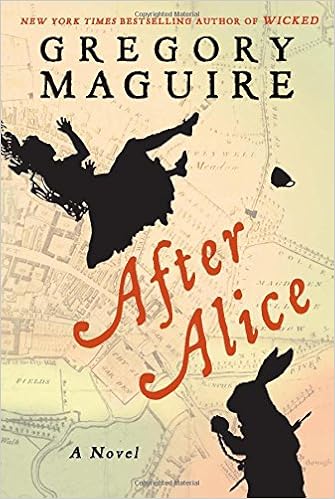
After Alice

by Gregory Maguire


(If you don’t know: Gregory Maguire writes new novels set in classic fantasy worlds — Oz, mostly, but this one is in Lewis Carroll’s Wonderland.)

So the thing with Gregory Maguire seems to be: you have to absolutely love the original.

The man writes an excellent homage. I’ve read Alice in Wonderland and Through the Looking Glass, and the style and feel of this book is remarkably similar. He has the same imaginative twists (though not as many), the same absurdist humor mixed with Victorian understatement, the same satire of upper class manners and fashions, and of everything else that the author can think of. The writer’s voice is an excellent imitation, and I mean that as sincere flattery.

But I don’t love Lewis Carroll. I think the man was brilliant, and what he wrote was a watershed that led to Douglas Adams and Monty Python and Mel Brooks and Christopher Moore, all of whom I love or have loved – honestly, more than Carroll. So while I’m grateful for the existence of an Anglican mathematician with more imagination than either of those descriptors would imply, a whole world of imagination, I’d rather read (or watch) the others than him.

Consequently, I’d rather read them than Gregory Maguire.

I think this book also suffered for being too much outside of Wonderland. I mean, really: that’s the point of Carroll’s books. That’s why they’ve survived and are still beloved enough for Maguire to turn his hand to them. And half of this book by the chapters, and more than half of it by the pages, is set in Oxfordshire in 1861, following around Alice’s and Ada’s families as they search for the missing girls: and though Darwin is present, no time at all is spent with him; all that happens is that his old man’s needs – for help to the privy, to leave early – screw the day up for everyone else. Everyone else is just as annoying: it made me understand completely why Alice would want to follow a white rabbit down a hole, and why the heroine of this book,Alice’s friend Ada, would want to do the same.

If the book was just Ada in Wonderland, maybe finding new places and people rather than just following in Alice’s footsteps, I think I would have liked it more. But the Wonderland stuff was less about imagination and more about following a path, and that made it less interesting than the original. As I said, if I dearly, deeply loved the original, I’d probably like this book just for the sake of going back there again; but I didn’t love the original, and so I didn’t really like this book.

Well done, just not interesting.

Review: Clarence Olgibee

Clarence Olgibee

by Alan Kessler


I was asked to review this book and given a free Kindle copy in order to do so; I wish I hadn’t been. Because if this hadn’t been part of an agreement, I never would have finished this book.

This is not a good book. (If it is too presumptuous of me to actually pass judgment, then it is my opinion that this is not a good book.) The plotline makes no sense. It is purported to be a sprawling epic, and I suppose in that it covers about forty or fifty years and a dozen individual lives, it is. The problem is that there is no reason to connect all of those lives. You start with the title character, Clarence; he has a high school chum named Todd; Todd grows up to work for a man named Walters. So why do we need to hear about Walters? Or Walters’s son, Donald? Walters and Donald are certainly connected to Todd, but they are not in any way associated with Clarence – and the book is called Clarence Olgibee, not Todd Munson. Or perhaps this book is an examination of racism: then why do we spend a full third of the book watching Clarence duck his mother and try to get laid? What has that to do with racism? It seems to me that the author could not decide what his story was really about, and so he included everything that he thought of in relation to it, background material, character development, everything.

Don’t get me wrong: some of it is interesting. The part when Clarence is in the Navy was quite well done, overall, particularly the chapters in the Philippines. The author has a way with description, and also with dialogue, particularly hate speech, which enables him to create some very distasteful villains – and yeah, it was fun to see some of them get their comeuppance. But much of that is ruined by one simple fact: I can’t stand Clarence. He’s a jerk: he uses everyone around him, resents everyone, envies everyone, and complains constantly that he can’t do what he wants – when what he wants to do is nothing. As he gets older, it makes more sense, as people actually treat him badly; but for the first half of the book, when Clarence is a teenager and his only problem is that his mother wants him to do his chores and homework, and the girl he’s lusting after is a shallow, dim-witted bimbo, it’s hard to feel sympathetic as Clarence lies and cheats and manipulates the good people around him – both of his parents (because I agree with his mother) along with his friends Willard and Todd – simply because Clarence’s only influence is a cousin that crashed at his house for a few months. Now maybe that would happen, a teenager deciding to admire Cousin Ortis instead of his mother or father or friends or anyone else; but it’s hard to like him for it.

What drives me crazy, though, is the fact that the author uses this. The story is of Clarence’s redemption. He decides, at a very few times in his otherwise worthless life, to do the right thing; and when he does, it is – well, nice. I appreciated it. I thought, “Good for you, Clarence.” And then I watched him go right back into being a putz. At least when Huck Finn realizes he cares more about Jim than about his reputation, he goes about trying to free Jim. He learns his lesson. What’s the point of a redemption that doesn’t actually redeem the person? And again, if the point was that Clarence was broken by his ill-treatment in a racist society, why is the first half of the book about the villains Doing Your Chores and She Doesn’t Want To Have Sex With You? Any chance of redemption was shot for me in Clarence’s last scene with his parents. I just had to hate him after that. Because I really liked his dad. You putz.

I wasn’t going to give this book that low a rating, because I do definitely see some good things, and I think the author has potential. He needs to work on telling one story that makes sense; this book should either be about racism, or about Clarence. He also needs to work on editing: because I can overlook a lot of things, but the main character’s name is spelled at least four different ways in this book, and that’s just ridiculous. The first chapter comes back around at the end of the book, yes, but only because the first chapter is an entirely artificial situation: the protagonist at that point, Jimmy, has literally no reason to commit the crime that he does. So it’s not a mind-bending use of irony, it’s a stretch, it’s a moment that strains the reader’s suspension of disbelief. And when the ending comes back around to that beginning point, the book should end. I hit that point and my Kindle said 94%. And everything that happens after that, I found just ridiculous and maddening, in the way it completely changed the narrative and asked me to go places I neither expected nor wanted to go, and tried to redeem Clarence when it was much too late to do that. That guy, and this book, were already lost.

Book Review: MacHugh and the Faithless Pirate


MacHugh and the Faithless Pirate
by William S. Schaill


First, let me say something about the publisher: because this book is from Fireship Press, (Website is here) a small independent press here in Arizona that specializes in nautical and historical fiction. I found this press, and this book, at the Tucson Festival of Books, a glorious local event that celebrates the printed word, and because I am a pirate fanatic, this book jumped out at me immediately. But Fireship has a number of authors, with a number of titles, and the books themselves are top notch, good printing, good binding, good cover art. The copy editing was imperfect — but honestly, I just read another book published by Bantam Spectra which had as many typos if not more, so I won’t split hairs. This is a good press that makes good books.

And this is a good book. It’s not a great book, I’ll say that; the characters are a little too simply drawn, and the main character annoyed me a little at certain places (Largely because he thinks of younger women as romantic interests, which was entirely accurate for the time period, but still a little weird to read — a grown man going over to the home of a friend and checking out his daughter is just too funky for me.) and I wish the Faithless Pirate could have been more than just a villain, because I do love pirate narratives.

But this is, bar none, the best nautical action/adventure I’ve read, in terms of its accuracy and its verisimilitude and its author’s encyclopedic knowledge of the sea and tall ships and marine combat. Reading about these men struggling with this ships on these seas, fighting weather and currents and politics, searching for pirates, finding them, fighting them, winning and losing various battles in various ways — it was just great fun to read. The suspense is excellent, the action is exciting, and the historical and nautical details are as accurate as any I’ve known. For the sake of enjoyment, and for the sake of reading about cannons blasting and cutlasses slashing and blood spurting and everything else, this book was excellent. I hope the author continues to write MacHugh stories — because whenever he isn’t creeping on 18-year-olds, I thought this Scottish wine merchant/privateer was a great character (Though he did seem to have a whole lot of “In his younger days” adventures that made me wonder: just when did this guy start living this life of adventure? And did he ever, I don’t know, take a week or two off?) and I’d love to read more.

Book Review: The Fallen Country

The Fallen Country

by Somtow Sucharitkul

I think I may have learned a lesson from this book. Actually, two.

You see, I read this book when it was new, in 1986, when I was an angry twelve-year-old boy. I was angry for the usual twelve-year-old reasons, and to the usual twelve-year-old degree – for both, the answer is “Not much” – and reading this novel, about a boy who escapes his truly awful life of neglect and abuse through his neverending rage, which takes him into a world of snow and ice, where the cold deadens the pain and his white-hot anger is a great and powerful weapon, may have helped me realize that I didn’t really have much to be angry about, and really, I wasn’t all that angry. Not angry like this character is. There’s a scene in the book where his friends accompany him to this world, the Fallen Country, and in order to take them there he asks them to think of all of the injustices they have suffered, all the torments they have endured, and focus all of their anger into helping him reach this other place; afterwards, they confess that they were thinking about – getting grounded. Or failing Algebra. Or being jealous when their crush was smiling at another boy. Only the main character is angry about the years of systematic, violent beatings he has suffered every night from his adoptive father, or the way his adoptive mother ignores this terrible abuse, along with everyone else he has ever known, who have all been unable to help him in his war against the Ringmaster, the evil god who enslaves and tortures all of the inhabitants of this magical realm.

I think now that this book may have helped me realize that I was more like the friends, and less like the main character. And that that was okay: because while his anger gives him great strength, and the Fallen Country sounds like a wonderful place to escape to – he rides a dragon and rescues princesses, slaying hydras with his ice-sword of rage – the point of the book is that this is not a good way to live. And it makes that abundantly clear: you do not want to be like this kid. Harry Potter does the same thing, shows that while it’s awesome to be a wizard in a magical world, really, it’s probably better to have parents that weren’t murdered when you were an infant. Same thing here, only more so, because the beatings that Sucharitkul described are truly terrible.

And now that I have gone back and re-read it, here’s the second lesson I learned: books I loved in my youth should, sometimes, stay there. You see, this isn’t that great a book. There are some good things about it: the characters of the friends are nicely drawn, good renditions of Average-teenage-kid; the Fallen Country is incredible, both enchanting and terrifying, poetic and with the ring of truth; the plot and the final resolution between the main character and the Ringmaster are nicely done. But the way that the abused child is rescued by the people around him, after not having been rescued in the past, is cheesy in the extreme, and very hard to believe – nobody has cared before, even though he shows up to school daily with bruises and cuts and welts; then these characters decide to care, and lo, he is saved by their caring – and the adult characters are all awful. Not terrible morally, though the abusive parents certainly are; but just unrealistic and superficial. There’s a school counselor who doesn’t realize that her job is to report the abuse until she is talked into it by one of the teenagers. Whom she also flirts with. Yikes. It feels like the author was trying to simplify, as this is intended as a young adult book, but honestly, it my be a little too dark for that; and the result is a good book, based on a good idea, that isn’t written very carefully, or very well. Sucharitkul underestimates his audience, assuming they will believe the cardboard characters, or at least not care that they are cardboard; and the same for the weak points in the plot.

You know, I wonder if the reason I liked this author so much was because none of my fantasy/sci-fi friends had ever heard of him; I discovered this book, and I was the only one who read Sucharitkul. I also remember being enchanted by the foreignness of his name; I remember memorizing the way it was spelled, and practicing what I assumed was the correct pronunciation (Since I was never exposed to any other Thai names at the time, I was probably wrong.), and thinking how cool it was that he was also an accomplished composer of classical music.

Dammit. I was a teenaged hipster. Yeah: some things should definitely stay buried in the past.

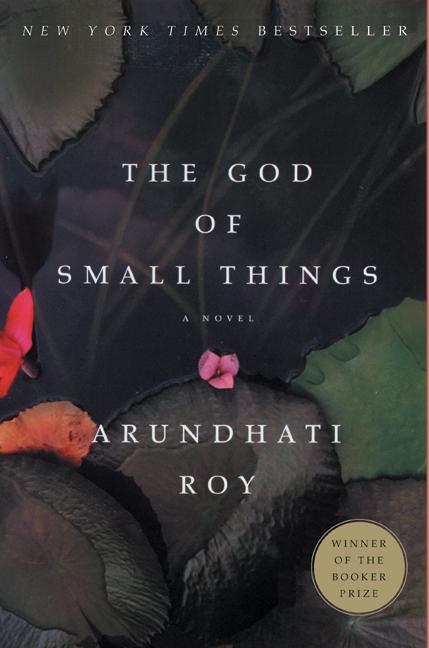
Book Review: The God of Small Things

The God of Small Things
by Arundhati Roy

I don’t know what I can say about this book that hasn’t already been said. It’s a prize winner, an internationally acclaimed best seller, and has been for twenty years. But I read it for the first time in 2014, when I moved to Arizona and started a new teaching position with new materials, including this book; I liked it then, liked the style of it, liked the way Roy wrote and the things she had to say, but it was one of several books that I read in an awful hurry, and with a whole lot on my mind at the time.

I read it again, this past two weeks, just finishing it this morning. And this time, because I am encouraging my AP Literature students to read books actively, that is, with a pen in hand and the margins of the book’s own pages as their paper, to comment and question and interact with the text, I did just that: I used my new purple ball point (Which may be the best thing about the gym that my wife and I joined last October: it has good equipment, but not great, and it had been fairly uncrowded until our last work out when a visiting college baseball team came in en masse and inundated us in jockery: but at least they give away ballpoint pens with purple ink!) so that the ink would stand out against the black typeface, and I underlined and I arrowed and I added everything I thought that I thought was worth thinking and adding to the text.

I read it more, this time. More carefully, more attentively, more thoughtfully. I was invested in the text, this time.

And this time, I didn’t just like the book. I loved it.

I was actually enlightened by it. Roy made me think about my own society, and particularly my own family, in a way that I never had before. She crystallized some thoughts for me that might never otherwise have come clear. She also showed me an elegance and a musical grace in words that I never would have seen: words written backwards, and words broken up in new ways — there is a Bar Nowl that lives in the warehouse and hunts mice on silent wings — and a poetry that I don’t ever see in prose. She showed a depth of perception, both in descriptions of environment and of character and of humanity as a whole that I don’t know that I’ve ever seen done better. And she wrote this book on the other side of the world. In her second language. I don’t know if that shows the grandiosity of her genius or if it reveals the power of an outsider’s perception, both hers of my mother tongue and mine of her world and how it parallels my own; I think perhaps she was writing about what she knows, and I see the same things in what I know because people are people all around the globe — but regardless, this book is magic. It is going up on my Very Top Shelf, with Fahrenheit 451 and To Kill a Mockingbird and Of Mice and Men and Shakespeare and ee cummings.

And that’s what I have to say about this book.

DOUBLE REVIEW! SO MUCH SCIENCE!

Death from The Skies by Philip Plait
Guns, Germs, and Steel by Jared Diamond


I normally don’t review two books at once. There are reasons not to do it now: these two books have more in contrast than they do in common, and my reading of both was quite different: Death From the Skies I read over the course of a couple of months, a little here and a little there; Guns, Germs and Steel I tried to read straight through, and failed to complete — at least partly because that is not, for me, the best way to read popular science.

But these books do have some important things in common: they are both popular science non-fiction, DFTS in the hard science of astronomy, GGAS from the social science of anthropology. Both are about death, destruction and the end of civilization as we know it. I finished one only a few days before I gave up on the other, which proximity promptly juxtaposed them in my mind (YES! Been waiting for a chance to say “juxtaposed.” That alone is enough reason to review them both together.). Both have, for me, an interesting premise. Neither includes zombies.

Now let’s get to the more extensive and interesting list of the differences. DFTS is about future death and destruction: the book is a list of all of the ways that the universe could wipe out all life on Earth: asteroid impact, massive solar flare, black hole fly-by, gamma ray burst, supernova, even alien invasion. GGAS is about the death and destruction that has happened in the past, specifically to the human race, caused by the rest of the human race. It asks one essential question: why is it that some civilizations have been able to thrive and grow, and others have not? And when civilizations come into contact with each other, and one or the other is destroyed or subsumed, what determines which civilization survives and which dies?

It’s an interesting subject, I think. Diamond takes as his prime example the conquest of the Incan empire by the conquistador Francisco Pizarro. Why was it that the Spanish empire managed to overcome the Incan empire? Why wasn’t it the other way around — Incan ships crossing the Atlantic, Incan soldiers wiping out hordes of Spanish troops, and an Incan general capturing the Spanish king, demanding an entire room full of gold for ransom, and then executing the king anyway, as Pizarro did to Atahualpa, the Incan emperor? Or why couldn’t the Incas fight off the Spanish, and establish their own hegemony over the Americas? Diamond examines this and every other contact between civilizations that he can, and in exhaustive — and I mean exhaustive, fatiguing, meticulous, infinite as well as infinitesimal, and finally brain-numbing — detail, he explains.

Here’s the spoiler: it’s the title. The Spanish conquest of the Incas was accomplished not by Pizarro, but by smallpox, which had been dropped off on the coast of Mesoamerica ten years before, by Hernan Cortes and his troops in Mexico, along with the various explorers and traders who followed Columbus’s lead to the New World. Atahualpa wasn’t even supposed to be the Emperor of the Incas: the emperor of the Incas for thirty years before Pizarro’s attack was Huayna Capac, who led the empire to the height of its size and power — until he died of a fever, probably either smallpox or measles. Along with his successor, his eldest son Ninan Cuyochi. The empire was the divided between Atahualpa and his brother Huascar, who proceeded to wage a civil war for control which Atahualpa won after several years of fighting — right before he was captured by Pizarro. The battles that did occur between the Spanish and the Incas were won by the use of guns, steel weapons and armor, and mounted cavalry, none of which the Incas had.

Diamond actually explains every reason why the Incas didn’t have cavalry, why the Europeans had the deadlier diseases, why they had better weapons, why they had guns, why they had better ships, why they had writing; it has everything to do with the ecology, the geography, and the histories of the two areas of the world, the Americas and Eurasia. And honestly, it’s pretty interesting.

The problem is that Diamond writes sometimes like a popular science writer, but much more often like a scientist, which he is. And that’s fine. But like all scientists writing treatises about their research, his goal is to be meticulous and scrupulous in explaining how he came to his conclusions, rather than to make the book interesting. And I think he succeeds in that: because I felt like he asked the same question ten or twelve times, from different angles — why didn’t the Incas have cavalry horses? Why didn’t they have large domesticated mammals? Why didn’t they have the same agricultural productivity? Why didn’t they have the same population? Why didn’t they have the same specialization of professions within society? Why didn’t they have writing? — and every time gave a complete answer, but every time it was the same answer: geography, ecology, and history. Over and over and over again.

And then he moved on to Australia. And then Africa. And at that point, I just couldn’t take it any more, and I stopped reading it.

Now Phillip Plait: that man knows how to make a popular science book interesting for the average reader. Every chapter describes a new way that the universe could kill us all. Each chapter begins with a hypothetical description of that death, how it would arrive, how it would progress, and specifically how it would kill us (Generally speaking, Robert Frost was right: fire, or ice.); then the chapter describes the science behind the cataclysmic event; then it describes the probability of that event happening, based on our knowledge of the universe. He goes from the most concrete elements to the most abstract, and because of that, by the time you get to the abstract stuff, you’re ready for it, and you understand what he’s talking about, and you want to know more — generally because the description of the deaths is pretty horrific, but the probability of any of them happening is “Pretty danged small,” or else it’s a certainty — but not for billions of years. Like when the sun dies. Definitely going to happen; definitely going to kill us; definitely not due for about 7 billion years. It’s comforting, really.

(Not all of it. The first chapter, on asteroid impact, is actually pretty scary, as is the second, about massive solar flares wiping out our power and communications. The solar flares couldn’t kill us directly — but I’ve read enough post-apocalyptic fiction to know that if the power and communications go, Road Warrior and cannibalism are not far behind. And I would not do well in that world. The alien invasion one is much more speculative — but it’s creepy as hell. Robot spiders. That’s all I’m going to say.)

And here’s how Plait handles the science: he makes jokes — good ones, including a Spinal Tap reference. He explains the science, but he also makes it clear why we should or should not know the details. An example: before Plait gets into the chapter about the end of the universe, he takes a few pages to discuss scientific notation (And I apologize for the formatting — the exponents were superscript in my draft, I swear. Don’t know how to make it happen on WordPress.) — our planet is 4×10^9 years old, the universe 1.3×10^10. The end of the universe will come sometime around 10^70 years from now. And Plait was smart enough to know that people would think, “Wow — that’s sixty times the current age of the universe. That’s a really long time.” But the thing is, it’s not. 10^15 years is not six times as long as 10^9 years: it’s 1,000,000 times as long. That’s the age of the Earth lived over again one million times. And I’m thinking about my summer break in four months, and it seems a long way off. 10^70 years is so absurdly far into the future we can’t even fathom it. And Plait explained that, in a way I could understand. It helped.

Plus he explains all the awesome stuff about the universe. I feel like I understand black holes better now — just in time for me to watch Interstellar on Hulu. And now I know that spaghettification is a thing. My new favorite thing, in fact.

So here’s the point: I’m glad I read part of GGAS. I’m glad I didn’t spend any more time reading the rest. If you are terribly interested in prehistory and the rise and fall of civilizations, you may want to read it — it is very clear and easy to understand, and yep, it’s thorough. But for me, I’d rather read about the Milky Way colliding with Andromeda in a few tens of billions of years. GGAS just made me want to play Civilization on my computer.

Which I may just go do now.