Helma: Tros Book II

Image result for helma talbot mundy

Helma (Tros Book II)

by Talbot Mundy

**Spoilers for the first book here**

The sequel to the epic historical fantasy TROS! OF! SAMOTHRACE! (Emphasis added, but, I think, implied.) is a good book: except it has completely the wrong title.

One nice thing is that this one picks up directly after the first one leaves off; like only minutes have gone by since last we left Tros, sailing back to England from Gaul, having managed to get his father away from Caesar’s legions. He arrives back near Lunden (Don’t judge me, that’s how they spell it) with his men ferociously mutinous because several of them were killed by Romans, and yet they came away with no plunder at all, and therefore no glory, which is the only reason they went on the voyage in the first place. Now they arrive back home, and find that Norsemen have come to raid England, and they see their opportunity to fight for glory and plunder. Tros has a hell of a time trying to fight them and keep them in line; he is only moderately successful, and finally his ship joins the combat against the Viking raiders. Tros, being Tros – or, pardon me, I mean TROS! OF! SAMOTHRACE! – wins his battle, and in the process, wins possession of a troop of Viking warriors when he defeats their leader in single combat. He also takes one of their longships as his own new vessel, the tub he sailed to Gaul having given up the ghost in the fight.

Why am I telling you all of this? Because, you see, the sister of that Viking war leader is – Helma. Over time, the Vikings come to serve Tros willingly, and he puts them in charge of building his new ship, his dream ship; Helma, he marries.

I feel I can spoil this because – there’s no point to it. At all. The romance is awkward and barely present at all in this story; Helma is a decent character, but really she’s a means to an end: the Northmen can’t speak Tros’s language, and Helma is the go-between for Tros and her brother. I suppose we are to see her as the perfect loyal woman, but there’s a much better example in this story: Fflur.

The main plot of this one has little to do with Caesar, though he is the snake in the grass behind most of the intrigue, the prime mover of the betrayals and infighting that fill this book. Caesar has sent agents to corrupt and break apart the British tribesmen, and they are, sadly, very effective; this book made me dislike several of the British tribesmen I got to like in the first book, as well as Conops, Tros’s main lackey, who disapproves of Tros’s marriage to the blonde Valkyrie. The worst casualty here is Caswallon, the king of the British tribe that Tros is allied with; he is a hero in the first book, and nearly Tros’s equal in importance and coolness, but in this book, he’s just a pain in the ass. His wife, Fflur, still rocks, and that’s why I don’t think Helma was necessary; she doesn’t add anything to the story that Fflur hadn’t already brought, other than she is married to Tros, instead of Caswallon.

Overall, the action in this one was still great, but the intrigues and the plot and the character development weren’t as interesting. I really want Tros to finish his ship and just sail the hell away from Caesar and all of this; I know Caesar is going to conquer Britain (Because that’s what happened, and Mundy was trying to stick to history with the Romans), and so I want Tros to try to circumnavigate the world, the goal he expresses in this book. I didn’t see the point of Helma, really didn’t see why Mundy named the book for her; this makes me both eager to read the third book, and also leery – as it is named for another new female character. Well, we’ll have to see, won’t we?

Pirate Book Review: Silver

Silver

by Edward Chupack

I’m not sure why I didn’t like this book more.

I love pirate stories (I mean, I LOVE them. I am writing a pirate story that is most of the way through its second book now. I dress as a pirate every Halloween, and talk like a pirate every Septembarrrr 19th, which is International Talk Like a Pirate Day. Some of my favorite authors, my favorite books, are pirate stories.). I love villains, especially when they are the protagonist. I love riddles and puzzles and the very idea of treasure maps. So I should have loved this book: which is about Long John Silver, who is a villain of the first order, a pirate, and the protagonist; and he also spends most of the book talking about riddles that point the way to buried treasure. When he’s not talking about killing people, that is, which he does quite a lot.

But I didn’t love this book.

Part of it is that I am not a serious fan of Treasure Island, the story that spawned Long John himself; I have read it once, in the last couple of years, but never as a kid, when the story really could have captured my imagination. Thus the references in this book didn’t really have much of an impact on me. I recognized some, missed others, and didn’t really care about any of them. Part of it is that the author makes a strange choice to have the entire story be a flashback, which is fine – but Long John is flashing back on his life from his current situation, which is imprisoned in the Captain’s cabin on his own ship, which has been taken from him, and he is being held until he gives up the location of his treasure. It was a letdown that Long John starts off the book having lost. There are some great moments when Silver makes fun of the cabin boy who is constantly bringing him food, which Silver refuses, presuming it is poisoned; and the life he flashes back on was fascinating and supremely piratey; but I hated that he was getting weaker and weaker, starving to death and suffering from a fever the whole time.

I was also disturbed that I couldn’t solve the riddles that led the way to the treasure. There are many hints dropped, and eventually the secret is revealed – or at least, one of them is – but not everything is explained, and I couldn’t get the clues by myself. There’s this one image that is reprinted at least six or seven times, which is supposed to be this fascinating clue that unlocks the secret path to the big treasure: but the whole time, other than the small details that Silver explains, which were pretty apparent from looking at the thing, I got nothing from it. And it is also true that the big treasure was not terribly interesting to me, even though it has some historical accuracy, which is great; but I kind of didn’t care about this one.

Overall, I think it was a good book, and well-written; I think it was just a little off the mark for me. I think someone else who loves pirates – especially someone with a particular love for Robert Louis Stevenson – would really enjoy this one. Though I will note that the Goodreads reviews of this book say that the connection between this book and Treasure Island is tenuous at best, and a shallow marketing scheme at worst, so maybe that wasn’t the problem; maybe it really just isn’t that good a story. I’m going to recommend giving this one a miss. Try Jeffrey Farnol: now that man could write a pirate story!

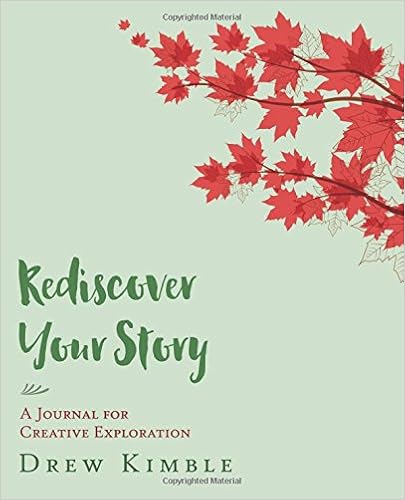
Book Review: Rediscover Your Story by Drew Kimble

Rediscover Your Story: A Journal for Creative Exploration

by Drew Kimble


I’m going to have to make this quick; because I have writing to do.

I have writing to do because this book inspired me to do it.

I am a writer, both a blog/ranter and a novelist; I am also a full-time high school teacher, because my vocation doesn’t make me money. I struggle, constantly and consistently, with keeping my passion and focus as a writer, because it is so easy to let the writing slide off to the side, to tell myself that I “need” to do work for my job, that my job is “important” and “valuable” and “worth spending time on.” It is even easier to find things that are related to writing, but not actually writing, and do those things in my free time; that way I can tell myself that I am writing, without actually doing too much of it. And of course I have to put aside the actual writing until later; I am too busy, and too tired. I don’t have time.

I’m not going to say that this book changed my life, because I’m not done working with it: I haven’t written out all the prompts, haven’t answered all the questions, haven’t examined and reflected and interacted with all of the inspirations inside. (There is one that I immediately want to turn into a piece of art – which I will do myself, though that scares me – and hang on my wall. It is “The unfed mind devours itself.” Page 134. Though in looking back through the book to find that one, I saw three or four others that I want to give the same treatment – “Do not dare not to dare,” and “Great things are done by a series of small things brought together” leap out at me. It may not sound that impressive that I want to make art of these quotes, but you have to understand: I have never been a visual artist, never made anything other than words on a page – and I’m married to a prodigiously talented illustrator. The bar is high, and I have never jumped. But I will try.) I don’t know that the book will change my life when I’m done interacting with it, though I think it likely if I can focus on small changes, planted seeds, an idea of old habits I would like to replace with new habits. That change, I think is pretty likely.

Because Mr. Kimble knows how to do this. The prompts are varied in style, ranging from internet quiz-style questions (Don’t scoff; we all take them.) to soul-searching checklists and life inventories. The types of prompts run the gamut, and the depth as well; I think that everyone will be able to find something useful in here. The quotations which appear in between each prompt-page are fascinating, also showing a wide range of focus and depth, some about the slow march of particulars, some about leaping to the stars. The book could easily be written in, or one could take the prompts and re-write them and one’s responses in a journal, which is what I will be doing; not that there is anything wrong with writing in a book, but I have all of these excellent journals. Though maybe I’m wrong: maybe I should do something different from my usual habit. Maybe I should write in this book.

I think I will.

One last comment: as a teacher, I could definitely use these as journal-writing prompts for my students. Particularly the prompts that push one to search for and define one’s self, one’s identity – and the ones that get you thinking about your future, too. Those would be good for my high school English classes.

This is a good journal. If you’re looking for one, this is a good choice.

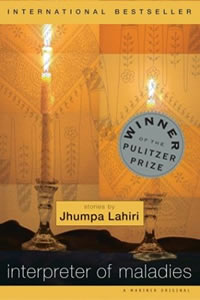
Book Review: Interpreter of Maladies


Interpreter of Maladies

by Jhumpa Lahiri

I didn’t love this book.

Some of the stories were beautiful. All of the writing was lovely, but some of the stories didn’t sing to me, where some did. I was a little disappointed that the title story was definitely not the best; it’s about a man who interprets for a living, who takes a group of American tourists (of Indian heritage) around on a tour of his hometown, which they visit every year or so from their home in New Jersey. The tourists are pretty delightfully obnoxious, and the ending of the story when one of them gets an Indian comeuppance, is delightful; but the major action involves this interpreter (who also works in a doctor’s office, translating people’s symptoms to the doctor – hence the title) developing a crush on the tourist woman. Which was pretty disappointing, really.

I did like about half of the stories. A Temporary Matter, the first one, was maybe the most touching; it’s about a couple trying to find their way after a stillbirth; they are mostly estranged and alienated, until the power company turns off all of the lights in the neighborhood around dinner time, and then these two people find that they can talk in the darkness in a way they can’t when the lights are on. The story doesn’t have a happy ending, which was also a letdown, though it did make sense. It was good, but not my favorite. The second story, When Mr. Pirzada Came to Dine, is pretty much the typical story for the collection: it features a mix of Indian culture and Western, which creates discomfort and conflict; the characters are interesting, the descriptions are lovely – and the story goes freaking nowhere. Ditto for A Real Durwan, Sexy, and The Treatment of Bibi Haldar (The first and last only differ in that they are purely Indian, and so have at least some appeal in showing something of the culture; Sexy is the only story in the collection with a Western main character, and she’s a dud, as is the story.), and, sadly, the title story. Which at least does have the best title, which is, I suppose, why Lahiri picked it for the collection. The other three I’ve listed here were all a little too strange, and a lot too dull: nothing really happens, nothing gets resolved, nobody goes anywhere. I’m sure that was the point, an attempt to show the futility and emptiness of modern life, but — whatever.

The good stories were The Third and Final Continent, This Blessed House, and especially Mrs. Sen’s, which was my favorite. They showed relationships that were fraught, but not doomed; the couple in The Third and Final Continent actually work out quite well, as does the most significant relationship in the story, between the Indian main character and his American landlady, who is 103 years old and is splendid. Say it! Say “Splendid!”

This Blessed House has the most interesting character, in the woman named Twinkle, who reminded me of the classic vivacious hostess, the sort of Katherine Hepburn energetic wit with grace and style who isn’t afraid to get her hands dirty; she was contrasted nicely with her dud of a husband, though I do have to say that, as an introvert, I was kind of on his side: he just wants a quiet house to come home to after work, and his wife keeps throwing parties and doing things. I have never been so glad to be married to a woman even more introverted than me.

Mrs. Sen’s was the sweetest story. It’s about an American boy who spends his afternoons at the home of his babysitter, the titular Mrs. Sen; seeing her through his eyes made her interesting but never offputting – other than the damned knife in the beginning of the story, which I could not for the life of me imagine; it’s apparently an Indian cooking tool, a blade fixed to the cutting board, and you move the vegetables over the knife to chop them. It’s a nice piece of Indian culture, but I just couldn’t grasp it. Still can’t. But I love how Mrs. Sen is so eager to get news from home, and I was heartbroken with her when the news is bad; I thought it was very sweet how she tries to learn to drive, and I actually liked her husband, which made this one of the few relationships in the book that isn’t depressing or disappointing. Plus, I used to have to go to my babysitter’s after school — Mrs. Bergstrom’s —  and so I bonded with the narrator right away, and I sort of wish that Mrs. B. had only had me to watch, instead of the five or six kids she took care of at once. I would have liked to get to know her the way we get to know Mrs. Sen in this story.

Overall, I don’t think it was really worth it; even the good stories aren’t among my favorites, really. If you are in the mood for a sort of gentle alienation, like looking through a soft veil at a surrealist painting, then go for it; if you feel like reading about romances that don’t have a whole lot of closeness in them, as well, then this one is right up your alley. I think it missed my alley.

Mattimeo: Redwall Book III

Mattimeo

by Brian Jacques


The third book in the Redwall series – and I’m a little concerned. Because this was the first book of the three that started to feel formulaic.

It wasn’t, not entirely; Jacques was wonderful at creating characters, and he introduces half a dozen new ones – a young otter who was hilarious, a heroic badger whom I enjoyed very much, a kite that had a wonderful alien feel to him, as well as a new generation of Redwallers and, of course, new villains. The first book focused on the battle for Redwall, the second on the battle that led to the rise of Redwall; this one goes outside of Redwall for its main conflict, though there is a second conflict that happens within the Abbey walls. The combination was effective, because it made it easier to maintain suspense for the entire book in both plotlines, and that was good. I also have to compliment Jacques for being unafraid to kill off his characters: there was a whole group of Redwall creatures who were wiped out in this book, and though I hated that it happened – this group were some of my favorites – it does show that the characters we enjoy aren’t safe, and I think that is a necessary tension in a long-running series.

But: Matthias is essentially indistinguishable from Martin the Warrior, and so for all three books now, we’ve had a heroic mouse swinging a big sword to save the day. His son, Mattimeo, becomes more like his father over the course of the book, so I worry that the trend will continue. The old abbot is the same, as well, as is the mighty and cantankerous badger; Jacques even added a second badger (though I liked the new guy – he carries a giant battle-axe) so there could be a badger in both plotlines. The villains are stoats and weasels and rats, and they are exactly alike in every way; Basil Stag Hare, though I love his character, changes not a whit from the first book to this one. You have the fight for control of the Abbey, and the quest outside of the Abbey for the key that will win the main fight – a plot that also happened in the second book, as Martin went off in search of the great sword so he could win the battle against the cat queen. There’s a lot of talk about food, and a lot of mooning over adorable baby animals (Not that I’m against baby animals, but I prefer actual fuzzy puppies in front of me rather than narration and description.), and a secret within the Abbey that tells the animals what they need to know, all of which happened in the first and second books. So it made me a little wary.

Now, the villains in this were great: the fox who leads the raid on Redwall and kidnaps all the younguns for enslavement was a good character, as was the corrupt and decadent despot who plans to buy the slaves. The final battle scene regarding those slavers was truly epic. The assault on Redwall was honestly a little more annoying, but the villains there were new and more interesting, with different strengths and weaknesses than the usual weasels and rats; and the twist that made a Redwall victory possible was really neat. Reminded me of Hagrid’s brother Grawp from the last three Harry Potter books.

Overall, there were enough new things, and enough things that Jacques has done well for all three books, to make me enjoy this book; I did, quite a lot. I will definitely read the next book, as well. I’m just – a little concerned for the series as a whole, that’s all.

Book Review: Dracula

Dig the cover for two reasons: it’s Boris Vallejo, and my copy says “Basis for a major motion picture.” No shit.


Dracula

by Bram Stoker


Since this past week was Mr. Stoker’s birthday – and according to some people, also Vlad Tepes the Impaler’s – it seemed appropriate to finally write up his famous book, which I have at long last read to its completion.

I know, I know; I read fantasy and horror both, I have written a book about vampires – how could I have never read Dracula? I can’t really say. I tried reading it once, several years ago, and stopped because it got boring; I’ve never been very good at reading classics, having avoided most difficult work in high school and nearly all of the classic canon in college. It has only been in the last couple of years, with my discovery of Jeffrey Farnol’s magnificent pirate books and his excellent Regency romances, and then my becoming an AP English teacher, who must teach his students more of the classics of British and American literature than I have hitherto, that I have started going back and actually working my way through Bronte, and Dickens, and suchlike.

And now, Dracula.

I will say that Stoker didn’t really do himself many favors, in the eyes of the modern reader. He had this wonderful idea, and a real gift for both action scenes and wonderful atmosphere, and what is three-quarters of this book? Victorian manners and stupid people fluttering about wringing their hands. Several of the characters are great, at least in concept: the Count himself is wonderful, as are his three ladies of the night, and Renfield is one of the most interesting people in the book. The concept of eating life, of capturing flies and feeding them to spiders, and then feeding the spiders to birds, and then eating the birds – that is fantastic. It’s one of those things that a madman would think, but it makes so damn much sense that it gives we sane folk (I flatter myself, of course, and probably you, too, if you’re reading this review of mine) pause. Van Helsing is a great character in theory, though in his actual words and deeds, he is much more annoying than I wanted him to be. But everyone else is boring and stupid and obnoxious, more often than not.

And then there is the vampire. The Count is good as a character, particularly the contrast between the dignified nobleman and the lizard-crawling wolf-summoning bat-transforming blood-drinking monster; but just the idea of it is so magnificent, that even if the book was total trash – and it isn’t – the way that Stoker brought this idea to life and into the modern world (at the time), and the legacy he built, would be enough to justify his fame. The man must have known he had lightning in a jar, when he thought of this one. The creature that lives among its prey; the creature that once was one of its own prey, and became a predator; the creature that turns humanity, the most destructive and murderous of the animals, into victims, a solid step down from the top of the food chain – the dead that eats life to live – that is an amazing thing. No wonder we just keep writing about it and talking about it.

As for the book, the beginning is boring. Jonathan Harker goes to Dracula’s castle, and it’s creepy there, but nothing actually happens. When Stoker wrote it, I’m sure people were swooning over the Count and his evil magic, but now that we all know what vampires are and what Count Dracula was, it just drags on until Harker finally escapes. And then we get to the most annoying part of the book: Mina Murray fretting over the slow decline of her friend Lucy. Again, when the idea was new, it might have held more suspense; but even then it must have been difficult for a reader to sustain interest when Mina is such. An. Idiot. “Oh me, my dear friend is pale and weak, as if she has lost much blood; she has holes in her neck; and that strange man was bent over her on the bench with his face right by her throat. I WONDER WHAT EVER COULD BE THE MATTER?!?!?!?” Good grief, woman. The only saving grace in this part was Renfield. It also made it much more difficult to be on board with the gentlemen who team up to fight Dracula, as they swear their undying devotion to Mina, whom they will give their very lives and their Christian souls to save, for she is so good and pure and perfect, and I’m like, “Don’t give your life for that moron. Let Dracula have her: she might be more interesting once she’s dead. (Lucy was: I like that she went straight to eating children. Reminded me of Angel on BTVS.) Find yourself a smart girl.” It took something away from their heroism that it was dedicated to a dolt. But then, it also took something away from their heroism that they just kept swearing their dedication to their task, which they seemed to do every chapter, every conversation, and that they had so damn much trouble accomplishing it. Ask me, they were all idiots.

So for the book overall, the beginning is boring, the characters are idiots, and the Victorian writing drags sometimes – the fact that Stoker wrote it as diary entries and letters works well for the most part, but he actually included the correspondence from the guys who drove the cart that carried Dracula’s boxes of dirt, for the love of God; and the gentlemen all see this as a chance to praise Mina for her wondrous abilities, which did kind of crack me up. “My God! A Victorian woman who can type as well as swoon? What a goddess! I pledge my life to save her!” – but none of that matters. Because it’s Dracula. It’s vampires. It’s wonderful. I’m sorry I didn’t read it sooner, but I’m glad I read it now.

Book Review: The Mighty Swordsmen

Isn’t that beautiful? Interesting how the men are in greater detail than the women, who are graphic and one-dimensional. Maybe there’s a reason for that . . .


The Mighty Swordsmen

Edited by Hans Stefan Santesson


A collection of Mighty Warrior swords-and-sorcery stories, this was like most of its kind: a couple of good ones, some that were okay, and a couple of stinkers.

The stinkers were “Break the Door of Hell” by John Brunner and especially “The Keeper of the Emerald Flame” by Lin Carter. The Carter story was too painfully derivative of Conan stories to be worth reading – though I admit I like the name Thongor – as well as too long and plodding, and the bad guy at the end was completely lame. The John Brunner story had some good bits: the concept is Ahura Mazda, the evil deity of Zoroastrianism, wandering Earth and granting people their wishes – which immediately makes those people regret their wishes. Some of those evil wish-grantings were great. The main city that Mazda goes to torment – and he sees himself as merely acceding to people’s wishes, not in any way working evil, and he’s probably right – has a great number of noblemen who would be sorcerers; they start casting their mojo, and even though they don’t really know what they’re doing, Mazda makes it so that their spells actually work: to their unspeakable regret and torment. That part was pretty fun, but also a bit repetitive; and at the end, the twist just irritated me. Bad story, overall.

The mediocre ones were the Elric of Melnibone story, “The Flame-Bringers,” and one of the two Conan stories, “The People of the Summit” by Bjorn Nyberg. The Elric story was actually fine, but exactly like every other Elric story I’ve ever read: he goes questing with Moonglum, brings out Stormbringer even though he doesn’t want to, chops up some enemies and eats some souls, and then calls out the damn dragons to save his bacon at the end. The one Conan story was also fine – better than Thongor – but it was overshadowed by the one that finished up the collection.

That last one, “Beyond the Black River,” along with the Roger Zelazny story “The Bells of Shoredan,” was by far the best. The Zelazny story was about his Dilvish the Damned character, who’s cool to begin with, and this was, for once, a self-contained story, with a good twist, and Zelazny’s usual beautiful prose and wonderful atmosphere. The last story was Conan as written by Robert E. Howard, and seeing that story along with a Conan by a different author, and the cruddy Thongor knock-off, really drove one point home: Robert E. Howard was a hell of a writer. That last story is the longest in the collection, but also the most exciting; Conan is the ultimate badass, and yet he is the most human and believable hero in the bunch. If you can find this collection – unlikely, as I picked up a faded copy with the cover falling off at a Goodwill in town – then it’s worth getting just for the Howard story. And the sweet 1970 pulp fantasy cover art. Good stuff.

Book Review: Gone Girl

Gone Girl

Gillian Flynn


I was undecided about this book. I’m not generally a mystery/thriller fan, though I have read and enjoyed several of them in the past, and this one was so popular, and so well-received, that I figured it was a good risk. I have not seen the movie, and I did not know anything about the book’s plot before I started, so I was in the perfect position to enjoy it as much as it could be enjoyed.

But I wasn’t enjoying it. The writing was quite good, and the plot was interesting; but – just like the last two books I’ve written reviews for, sadly – I did not like the characters. So I asked friends: should I continue reading this book? Is it worth it? Do the characters get better? I got a fair number of the responses you would expect from a question like that: a few people said absolutely yes, a few absolutely no; a few said “Why not?” and a few said “If you want to.” A former librarian friend said, “When in doubt, read your age: read as many pages as you have years, and then decide.”

And one friend said, “Yes. You won’t like the characters any more than you do now, but the book is worth it.” She said the characters are intentionally unlikable. She said that she believed the book will become know as a modern classic, and as an expert in literature, Gone Girl is a book I should read.

Well. She was right about the unlikable characters. (Not to be snobbish, but: based on what I have learned about fancy-pants literature as an Advanced Placement teacher, Gone Girl, like most popular fiction, will not in fact ever be considered a classic, as it isn’t complicated enough. The AP program describes their acceptable literature as those works which reward re-reading, meaning that reading the work again gives you new insights, new ideas, that you could not have grasped the first time through. And Gone Girl doesn’t have those hidden depths. Everything’s up front. Which I generally prefer, anyway, because my friend was also wrong to call me a literary expert. I’m not. I enjoyed the flattery, though.) She was also right that the book was worth putting up with the people in it, and also that the characters are intended to be unlikable.

So the basic story is about a married couple, Amy and Nick Dunne; and in the first chapter of the book, on their fifth wedding anniversary, Amy goes missing. (She’s the Gone Girl.) The question is, what happened to her? At first, you get an impression of both of these people, Amy and Nick, and one of them doesn’t come off too well. (I won’t say which one so as not to spoil it.)

But then something happens. That impression changes. You learn a few more things, and suddenly, the other one doesn’t seem too good a person, where the person you didn’t like turns out to be not that bad. That’s about where I asked about continuing, because my reaction was, The hell with both of these people.

Here’s the thing, though. That shift in allegiance for the reader: that’s Gillian Flynn’s intention. That’s the point.

The book isn’t really a mystery. There are mysterious elements, but between a third and halfway through the book, Part One ends, and when Part Two begins, the mystery is revealed. And at that point, the person you’ve been liking more turns out to be MUCH worse than the person you’ve been disliking – though that person, the not-as-bad one, is still pretty obnoxious. What the book’s really about is two things: one is the way that married couples can really destroy each other, and themselves, over the course of a marriage; and the other is the incredible way we can manipulate public opinion. Because this turns into a criminal case, related to Amy’s disappearance, and the apparent guilt is essentially worked out in the court of public opinion. It’s all about who can manipulate the public best; that is the person who will – win, I suppose, though really, you don’t want either side to win, because the entire fight is just despicable. Back to that thing I said about married couples destroying each other. It’s all ugly, it’s all bad, and nobody wins. The same for lying and manipulating appearances in order to seem more righteous: it’s all ugly. It’s all bad.

You do end up rooting for some of the characters, mostly because you want the badness to end; there are some moments of satisfying karmic justice for the ugliness. Mostly, though, my friend was right:  even though I never liked the main characters, the book was worth reading. We’re not supposed to really like them or sympathize with them: Flynn set this up to sway our allegiance back and forth, to show us, I think, that we determine our opinions too quickly on the smallest, most subjective piece of evidence; and because they are so shallow, our opinions can change completely when new information comes to light. It reminds me very much of Shakespeare’s The Tragedy of Julius Caesar, a play I’ve taught dozens of times, because that play shows the Roman public for the fickle mush-heads (Props to Diamond Joe Quimby for the phrase, because the Simpsons have also done this topic) they are: first they love Caesar, then they love Brutus, then they love Mark Antony. And I have always believed that Shakespeare isn’t really talking about the Romans: he’s talking about his own audience, the English theater crowd, the ones whose favor could be won and lost in an instant. I think Gillian Flynn is doing the same thing: she’s using this book, with its masterful manipulations, to show us how wrong we generally are when we choose sides based on what we see on TV, and what we hear from the grapevine, and especially what we all “know” to be true – like how the husband always did it; or once a liar, always a liar; or that pretty people are more trustworthy.

I don’t want to think those things are true of me, too. But I’ve spent almost a thousand words now, talking about how quickly my allegiance to these characters changed: because I made snap judgments based on poor information, and never once questioned whether I should believe what I was being told. Not even when it didn’t make sense, when I had conflicting information about the same character; I never questioned whether something was credible. It was simply that the more recent piece of information had more influence on me; I tended to believe the new information was true, and therefore I should take it more to heart.

So what have we learned? I, too, like most other people, am a fickle mush-head, and I should not credit my knee-jerk opinions about public figures or controversial issues. I should think more. Gillian Flynn is a talented writer who set out to manipulate her audience into liking a character, and then hating that character, and then going back to liking the character, before drifting somewhere into a general distaste for everyone involved — including, for me, the author, who messed with me so much. We’ve learned that this is a well-done book, and people who are interested should read it. And I’m not going to read it a second time. I do not think it will reward re-reading. And I really don’t like these people.

Book Review: The Purple Cloud

The Purple Cloud

by M.P. Shiel


I hated this book.

I did not hate everything about it, which is why I finished reading it; but while I liked the concept and the writing, I have rarely loathed a protagonist more than I hated this freaking guy. Since I recently read a trio of adventure novels by H. Rider Haggard, in which I also grew to hate the Great White Hunters who slaughter elephants for fun and mock the savage Africans, this was familiar but annoying territory. (Since I just, the same day I am writing this review, finished reading Gillian Flynn’s novel Gone Girl, in which I once more hated all of the main characters, I think I need to focus on books about likeable people for a while.)

Adam Jeffson is his name. Dr. Jeffson – for he is a medical doctor – begins the book married to a social climbing gold-digging beauty, who wishes her husband to become fabulously wealthy so that she may look down her nose at all of humanity. She pushes him to join an expedition to reach the North Pole, which no person has yet reached at the time of the story. It is unclear when the book is set; somewhere in the late 19th century, it seems, but the setting is unclear because Shiel insisted on using the now-familiar frame for science fiction stories around this time (Originally published in 1901 — H.G. Wells lauded it as brilliant!) namely that the manuscript was left mysteriously to Our Correspondent (also known as the author); this particular manuscript was created under the influence of that Mystery Science known as Mesmerism! Yes! A woman, under the influence of hypnosis, wrote out various strange manuscripts, one of which was this story. Is it true? A communication from another world? Who can say?!? The upshot of all of this humbuggery is that the book is an alternate universe story of the end of the world, which we living people can know about because of the mysterious transmission of the story, which can therefore also be a first person narrative told by someone who isn’t actually the author. But since it takes place in a world that is not quite ours, it is not clear what the timeline is, though the geopolitical world is the same as our own. Anyway.

Dr. Jeffson wishes to join the expedition to the Pole, at his wife’s behest, because there is a cash prize, an incredibly large cash prize, to be awarded to the person who first sets actual foot upon the top of the world. Unfortunately, the expedition already has a doctor signed up to go. Fortunately for Jeffson, and unfortunately for the other doctor, Jeffson’s wife – who has the absurd but suitably hideous name of Clodagh – isn’t above murder, and in fact, she poisons the other doctor (Whose name is Peter Peters. Yup.) so that Jeffson can take his place. Apparently so we can really enjoy our hatred for this couple, she does it slowly, pretending to nurse the sick man while actually dosing him with atropine. So Dr. Peters dies, Jeffson goes on the journey; but along the way, he is both frustrated and unpopular, because the ship is going to be stopped by the polar ice cap, and Jeffson is not intended to go on the final leg of the journey over the ice by dogsled; at the same time, he and his wife are suspected of putting an end to poor Pete Peters. Somehow, Jeffson is all freaking outraged by the accusations that finally get voiced, even though everyone involved knows they are true; he ultimately goes out to have a duel with one of the other members of the expedition, and even though the other guy is a better man and a better shot – and he’s right about Jeffson and Clodagh – Jeffson wins and kills the other guy, and takes his place on the final leg. So now I’m pissed that this ass is going to win the money and make his wife happy.

But wait, there’s more. The dogsled portion arrives, and the three men going don’t plan to bring enough food for the dogs. Why? Because THEY PLAN TO FEED THE DOGS TO EACH OTHER ON THE WAY. That’s right: not only does the dog die, but FORTY dogs are going to die, and be forced into cannibalism, all so these three pricks don’t have to bring more food. (Should I mention here that they originally meant to use reindeer to pull the sleds, but they didn’t bring enough fodder for the reindeer and all of them starved to death while still on the ship? Nah, I’ll leave that out.) This is all three of them, so we can’t blame Jeffson for that, but we can certainly blame Jeffson for this: he leaves the other two men to die of exposure, leaving camp early with extra supplies and dogs so that he can be the first to the Pole and claim the prize.

He makes it there first, indeed, but then a strange thing happens. How strange, we don’t yet know, but it is the titular Purple Cloud, so we know it’s got to be a big deal. Anyway, Jeffson heads back across the ice once more, and, because we don’t hate him enough, he makes it all the way back to the edge of the ice with only one surviving dog, his favorite: which he then FUCKING KILLS JUST BECAUSE HE DOESN’T WANT TO DEAL WITH GETTING THE DOG ON HIS KAYAK.

Stephen King once wrote that the fastest way to get an audience to hate a character was to have him hurt a dog. And this guy now, in my mind, has the blame for the deaths of forty dogs, a herd of starving reindeer, and several humans, as well. That’s why I hated him, and the lack of sufficient suffering in retribution is why I hated this book. Because no matter what else happens, Jeffson doesn’t die.

But here’s the thing: none of this is the actual story. The story began with the purple cloud: which was poisonous, and has killed all of humanity and pretty much all large animals. The bulk of the book is Jeffson realizing he is the last man alive on Earth. That’s right: none of this evil involved in the Polar expedition was actually the point; it was just intended to get Jeffson to be the only one alive at the north pole when the cloud hit – which, it turns out, is what saved his worthless dog-killing ass.

I won’t spoil the rest of the book, which is better than this beginning portion, though I will say that Jeffson continues to be a shithead: for the next twenty years (The book covers quite a number of years), whenever Jeffson gets bored or angsty, he goes to one of the great cities of the world, and burns it. To the ground. The whole city. (When he burns Paris, he takes 20 paintings out of the Louvre, and burns the rest.) Just for the hell of it. Just to make us hate him a little more.

The intended theme at the end of the novel is about good and evil, and how good will eventually win out in the end; in that struggle, Jeffson is the evil. And boy, is he evil. I’m not really sure why Shiel wrote it all this way, when there surely had to be an easier way to make his point. But considering his writing style, he is not a fan of making a quick and simple point. Here’s a sample sentence – one sentence.

Now I would not trudge back to the ship, but struck a match, and went lighting up girandoles, cressets, candelabra, into a confusion of lights among a multitude of pale-tinted pillars, rose and azure, with verd-antique, olive, and Portoro marble, and serpentine; the mansion large; I having to traverse a desert of brocade-hangings, slim pillars, Broussa silks, before I spied a doorway behind a Smyrna portiere at a staircase-foot, went up, and roamed some time about the house – windows with gilt grills, little furniture, but palatial spaces, hermit pieces of faience, huge, antique, and arms, my footfalls muted in the Persian carpeting; till I passed along a gallery having only one window-grating that overlooked an inner court, and by this gallery entered the harem, which declared itself by a headier luxury, bric-a-bracerie, and baroqueness of manner; from which, descending a little stair behind a portiere, I came into a species of larder paved with marble, in which grinned a negress in indigo garb, her hair still adhering, and here an infinite supply of sweetmeats, French preserved-foods, sherbets, wines, and so on: so I put a number of things into a pannier, passed up again, found in the cavity of a garnet some of those pale cigarettes which drunken, then a jewelled chibouque two yards long, and tembaki; with all I descended by another stair, deposited them on the steps of a kiosk of olive-marble in a corner of the court, passed up again, and brought down a yatag to recline on: and there by the kiosk-steps I ate and passed the night, smoking for hours in a state of lassitude, eying where, at the court’s center, the alabaster of a square well blinks out white through a rankness of wild vine, weeds, acacias in flower, jasmines, roses, which overgrow both it and the kiosk and the whole court, raging too far over the four-square arcade of Moorish arches round the court, under one of which I had hung a lantern of crimson silk; and near two in the morning I dropped to sleep, a deeper peace of gloom now brooding where so long the hobgoblin Mogul of the moon had governed.

All in all, I’d recommend reading The Stand. Randall Flagg is a lot more fun to hate. And he didn’t kill forty dogs.

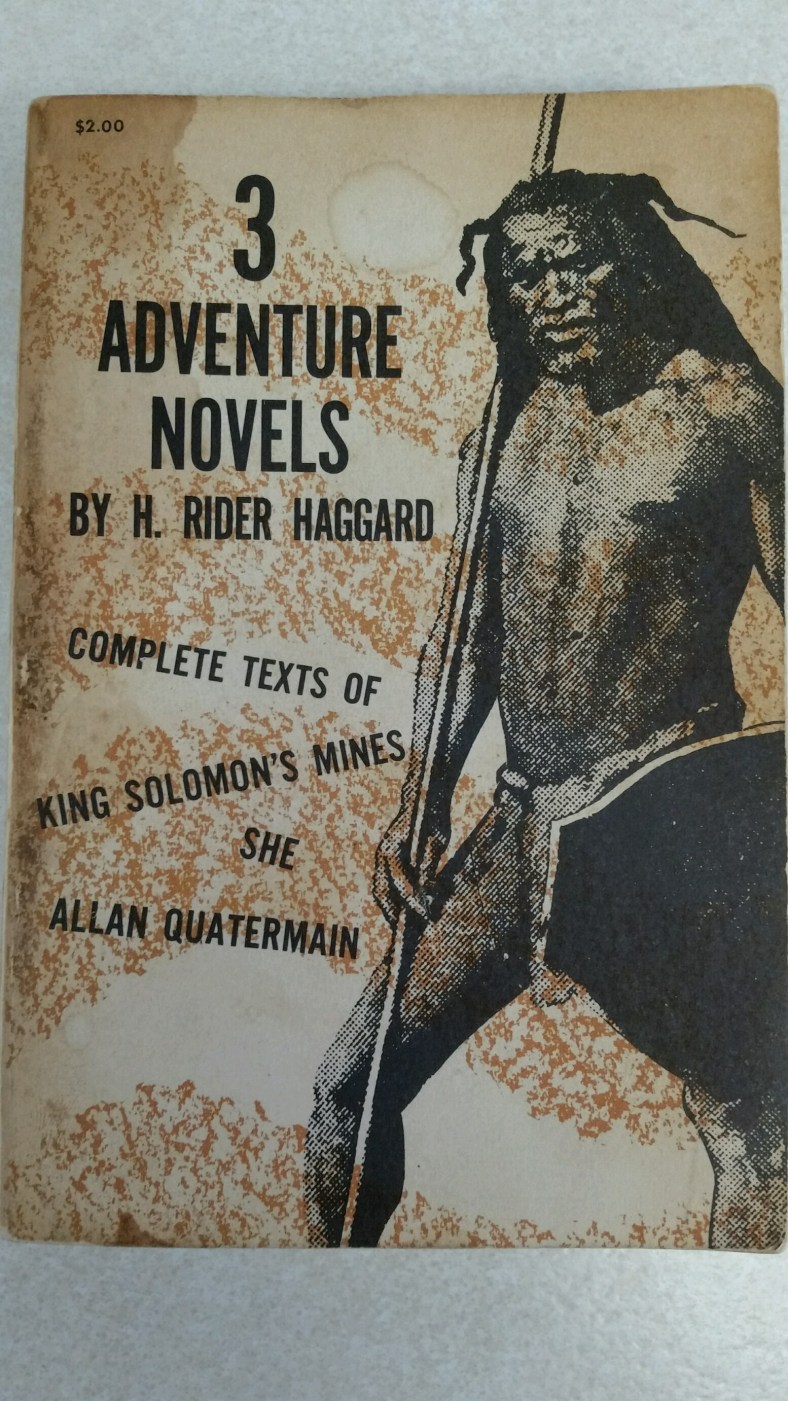
Triple Review: The Great White Hunters

20171028_085108

Three Novels by H. Rider Haggard:

She

Allan Quatermain

King Solomon’s Mines


These books made me feel bad.

First, I had some serious white guilt issues. I don’t go in for that normally; I have read Mark Twain’s Huck Finn several times, and Ralph Ellison’s Invisible Man, as well, not to mention the uncomfortable To Kill a Mockingbird. I read them, all three of those and others, out loud to my students. I admit I skip over the N-word: because I am of the opinion that, while an ideal world would lack any racial terms, or would at least have removed from the terms all power to hurt, we don’t live in that ideal world, and that word coming out of my white face as I stand at the front of the classroom with power over my students – that is not a powerless word, that is not a word that I can be sure won’t hurt anyone. But otherwise, I don’t mind reading either the silly caricatures of minorities, or the swaggering white titans (Whitans? Or all three words, and make it Swhitans?) who bestride the world like a colossus. While I want to include people of color in the authors my students read and that I read, I am not against reading a dozen great novels by dead white men. I am comfortable with being a honky.

But this book (It was all three novels in a single collection) made me uncomfortable. It was more to do with the unquestioned superiority of the white men than the savagery of the Africans; sure, the Africans were savages, described as ignorant, violent, often childish, having outlandish costumes and going in for cannibalism (With the completely absurd description in She of the tribe’s use of a heated metal pot, clapped over the head of the intended victim who is thus both tortured and killed, and then turned into stew. And they called it the Hotpot. And the goofy white character, the servant guy who played the role of Stan Laurel or Lou Costello or Kramer or Chris Farley – the guy who panics all the time – was constantly terrified of the Hotpot. “Don’t leave me alone with the savages! They will give me the Hotpot!” How do you say that with terror in your voice? I just couldn’t take it seriously.), but the bigger problem was the way the white men took over the ancient African societies they came across, simply assuming they had greater ability to lead. And not even for the usual reason of needing to bring Jesus to the heathens; no, this was usually because they had greater knowledge of guns and of how to win a battle. Which I think is, first, no good reason to assume power, and second, nonsense, at least in terms of battle: modern warfare uses modern weapons, and when you take away said modern weapons, the idea that a group of honkies who have never been in the area could lead their men to victory simply by virtue of their whiteness is absurd. Yet that is exactly what happens in both Allan Quatermain books (and it annoys me every time I see that name, because there should be another “r”), particularly King Solomon’s Mines, where the battle includes tens of thousands of African soldiers. Led by the white men to victory, just because they were white men – because the battle plan is “Get the high ground and send our best troops against their weakest.” Boy, thank god the crackers were there to explain that! No way that African civilizations that have existed for millennia could have figured that out without help. And guess who the mightiest single warrior is: well, there is much made of a particularly hardcore Zulu chieftain who travels with them; but right by his side is the biggest, strongest white man, who is better in hand-to-hand combat than people who have spent their lives doing just that – but, after all, he is British.

And then there was the penis factor. Not only did the whites win because they were whites – and in both She and Allan Quatermain, the rulers of the hidden African kingdoms were white people, mysteriously existing in the heart of Africa – but the men were worshiped as masters of all things because they were men. In King Solomon’s Mines, the rival rulers were men, so this was less of an issue; but in Allan Quatermain, there is a pair of sisters who are co-rulers of an ancient kingdom of great wealth and sophistication; and the minute that the Englishmen get there, the two queens both fall in love with the hunkiest of the three Great White Hunters; he chooses the whiter queen – the blonde one, of course; the one with the darker hair is both sluttier and witchier than the gooder, purer, whiter sister – and she not only marries him, she immediately swears to obey him in all things, stating categorically that he is her lord and he makes her feel safe and taken care of by his mighty manly parts. The queen, this is. Lifelong ruler of a hereditary monarchy, a completely self-sufficient kingdom that has been cut off entirely from the modern world. And she’s freaking swooning and mincing and clinging. Pathetic. Meanwhile, her badass witchy sister – also clearly the sexy one, though Haggard assiduously avoids even the hint of sex in all three books – denied the personal domination of the hunky honky, settles for the other white dude (Quatermain himself is somewhere around 70 in this book, and though there’s no particular reason Haggard couldn’t give him the virility claimed by all old white dudes who pretend they can have a real relationship with a hot wife half their age [TOTALLY NOT DIRECTED AT THE PRESIDENT OF THE UNITED STATES], I thought it a sign of marginally good taste that Quatermain is never considered a love interest.) who is fat and too old for her and entirely unattractive, not to mention annoying; but hey, he’s a white Englishman, so clearly a catch, right? Even for a queen? Sure, I guess so. She dies (Sorry for the spoiler – but you knew she couldn’t win; she’s the bad sister. The not-blonde one.) impaled on a ceremonial spear, which is totally not phallic. Totally not.

I have to say, I did like She. The goddess in that book is a genuinely strong female character. There is too much focus on her love life, as she chose immortality so that she could survive to see her true love reborn, which happens after a mere 10,000 years or so; but the goddess-queen character (Named She by her subjects, essentially like She Who Must Not Be Named, out of a perfect sense of awe) is the most interesting person in the story and, I thought, the most sympathetic, as the dude who is her love reborn has some ridiculous fling where he “falls in love” with a woman who nurses him when he is sick, even though he can’t communicate with her: she is humble and subservient and loyal to him, whom she loves because, errrrrrrm, because he’s a very handsome man, I guess, and so she becomes his ideal woman and he loves her. Sure, whatever. I thought he should have gone with She, who wielded power and wrath and majesty, along with being so achingly beautiful that the misogynistic protagonist falls in love with her after a single sight of her without her usual veils on, which led to a nice conflict between the white characters. I also liked the ending, and the strong implication that human power is nothing in the face of the mysteries of the universe. And there is this unbelievably warped element: the society exists inside a mountain that was hollowed out by an Atlantean-style vanished race of supermen; they still exist inside the mountain, because they had complicated and extensive burial preparations for their dead, which included a perfect form of embalming that leaves their bodies in perfect condition apparently forever: but it also makes them highly flammable. And She, the immortal goddess-queen who inherited and still rules their kingdom – uses them as torches. Their body parts. Regularly. It was gloriously twisted.

Overall, I see the draw of Haggard’s books; he wrote outstanding adventure and action scenes, from battle scenes to suspenseful travels through mysterious caves and rivers and jungles. The characters do at least inspire a response, even when it’s irritation or outright hatred. He had some really cool ideas, and amazing descriptions; I liked reading his words, which were interesting and often lovely. But seriously: tone down the Great White Hunters, like, ten notches, okay? Sheeesh.