What a Weekend!

WOW! That was… amazing.

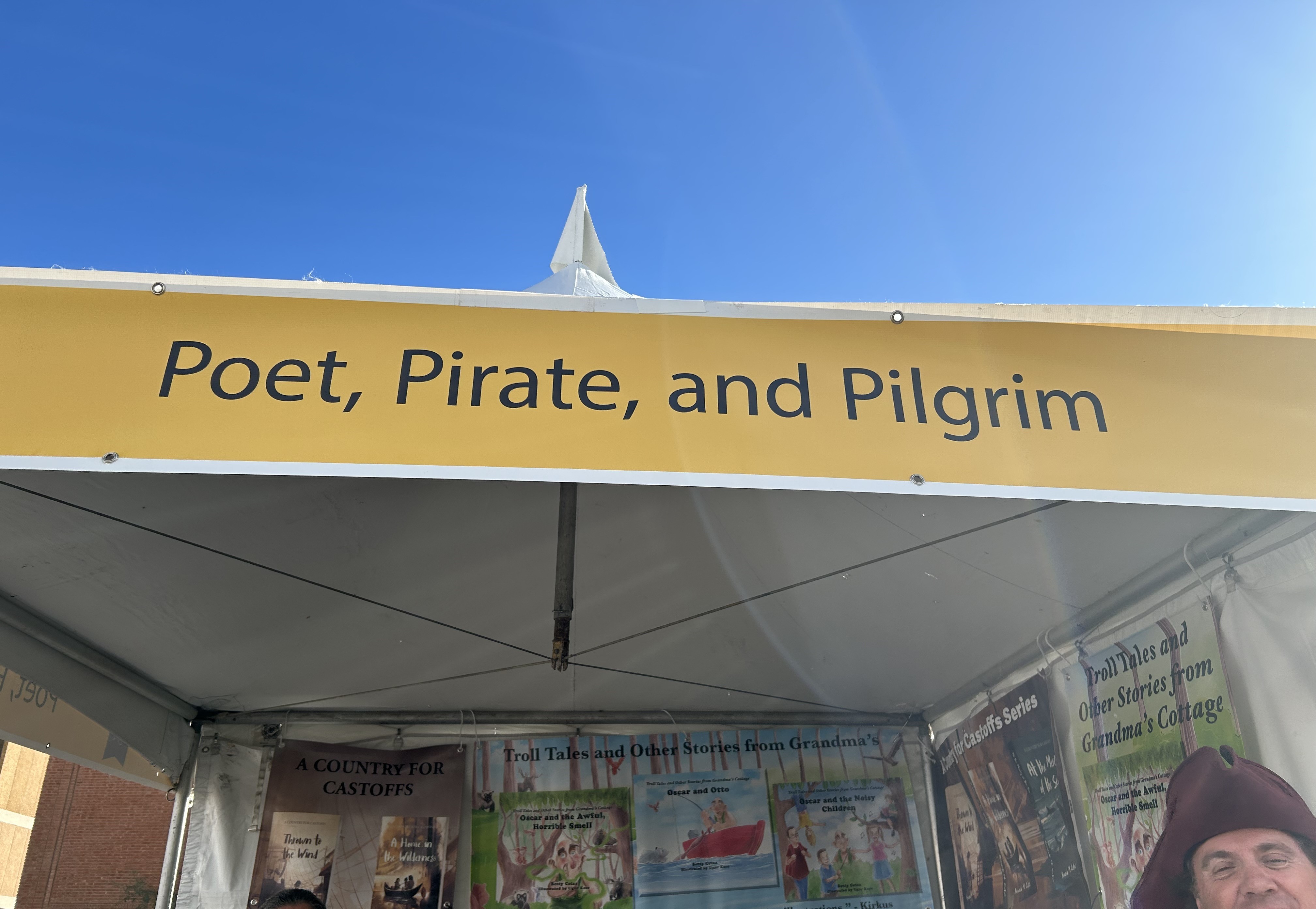
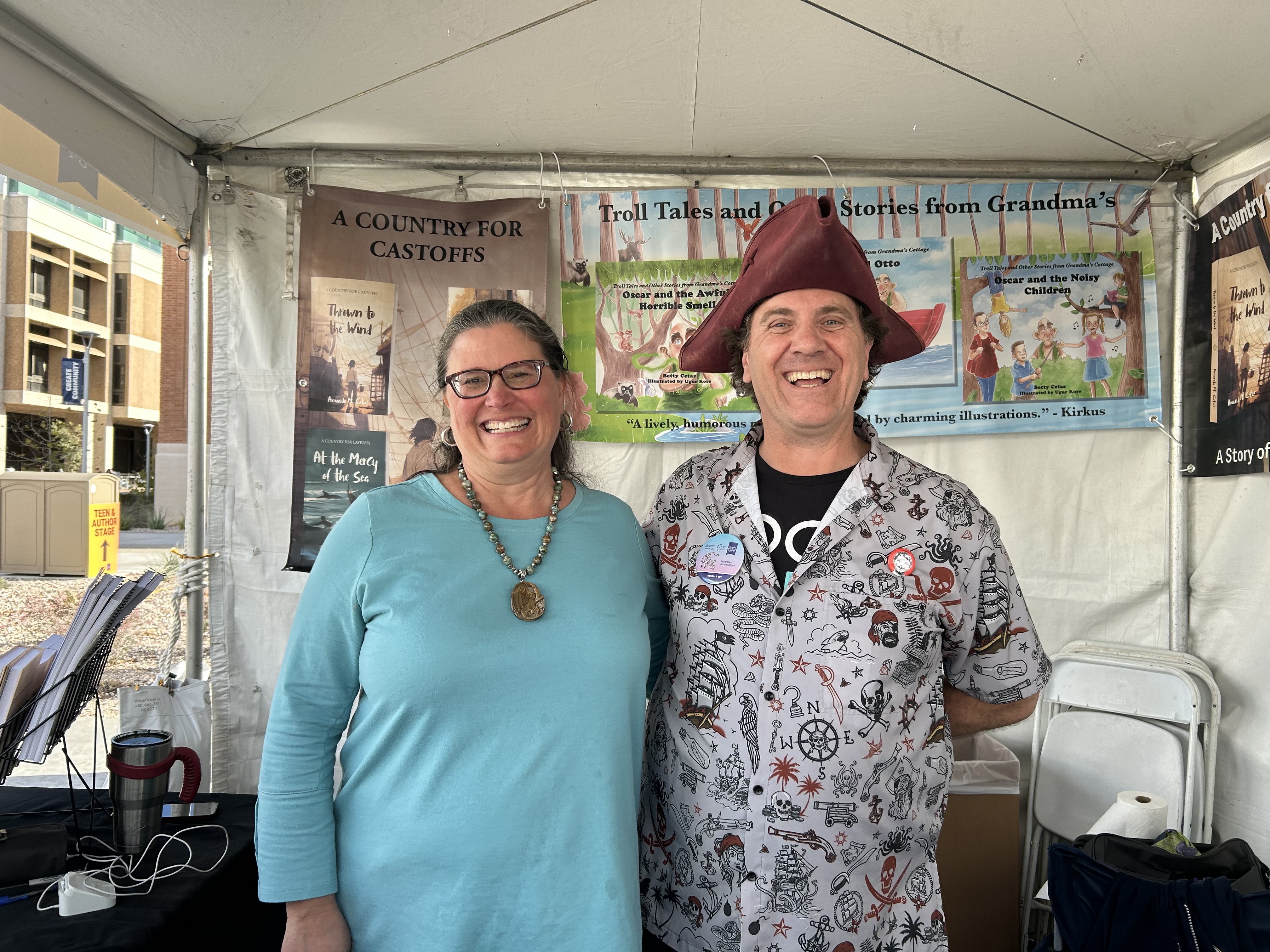
This last weekend was the Tucson Festival of Books. And for the fourth year, I had a booth, and I offered my pirate books, the three volumes of The Adventures of Damnation Kane, for sale to anyone who: 1) Saw my tri-corner hat and pirate-themed shirt; 2) Noticed the name of the booth, or 3) Paused to look at the INCREDIBLE art that my wife Toni DeBiasi created for all three Volumes of the series.

And that was a LOT of people.

I went there with, I think, about 65 books.

The first day, Saturday, I sold 42 of them. (The Answer to Life, the Universe, and Everything!) I sold every copy of Volume I I had with me. I went home, got the four other copies of Volume I at my house, also grabbed my VERY FIRST copy, the first printed copy of any book I have ever written, and brought that on Sunday. I used the very first copy (which was NOT for sale) as a display copy.

I sold the other four. And six more copies of Volume II and Volume III. And I unfortunately had to turn away a few other people because I didn’t have a copy of Volume I to sell them, at the end of the day, or else I would have had at least two or three more sales.

I now have 13 copies left of the 69 copies I brought with me to the Festival.

I have never done that well. The Festival has always been pretty good to me: I have a good book (Three of them, I think), I have a good hook — “Can I tell you about my time-traveling Irish pirate?” — and the aforementioned three attention-grabbers (sign, cover art, and stylish chapeau) brings people close enough to get drawn in by my elevator pitch. But my previous record was, if I remember right, 29 books sold. So I almost doubled that.

Thank you, thank you, thank you, to everyone who came and bought my books. I am honored beyond belief. And now I am anxious as hell that you all won’t like the books, or that you won’t like the third book, or — I dunno, something. So if you could see your way clear to tell me if you do like the books: go to the Contact link at the top of the page (Under the three lines, on mobile), or click on the Feedback link that should be floating in the bottom left corner of the page, and send me a message. Send me a Facebook message or Instagram message — @TheodenHumphrey, in both cases. (Also the same handle on X, if you are a glutton for punishment — or Threads, if you’re a glutton for social media.) Or if you’re really feeling good about my work, post a review somewhere — Amazon, or Goodreads, or Lulu.com where the books are produced — and then let me know that you did so. Thank you.

Thank you, as well, to my fantastic booth partner Amanda Cetas, who stood with me on a patch of sole-stabbing gravel for eighteen hours over two days, who covered me when I wanted to take a break (And made sales for me, too), who directed people to my side of the booth when they seemed more interested in fantasy than in historical fiction, and who stayed positive and energetic all the way through. Thank you, also, to all the people who bought Amanda’s books — she said she did better this year than she has before, too, so it wasn’t just the Pirate who made out like a bandit.

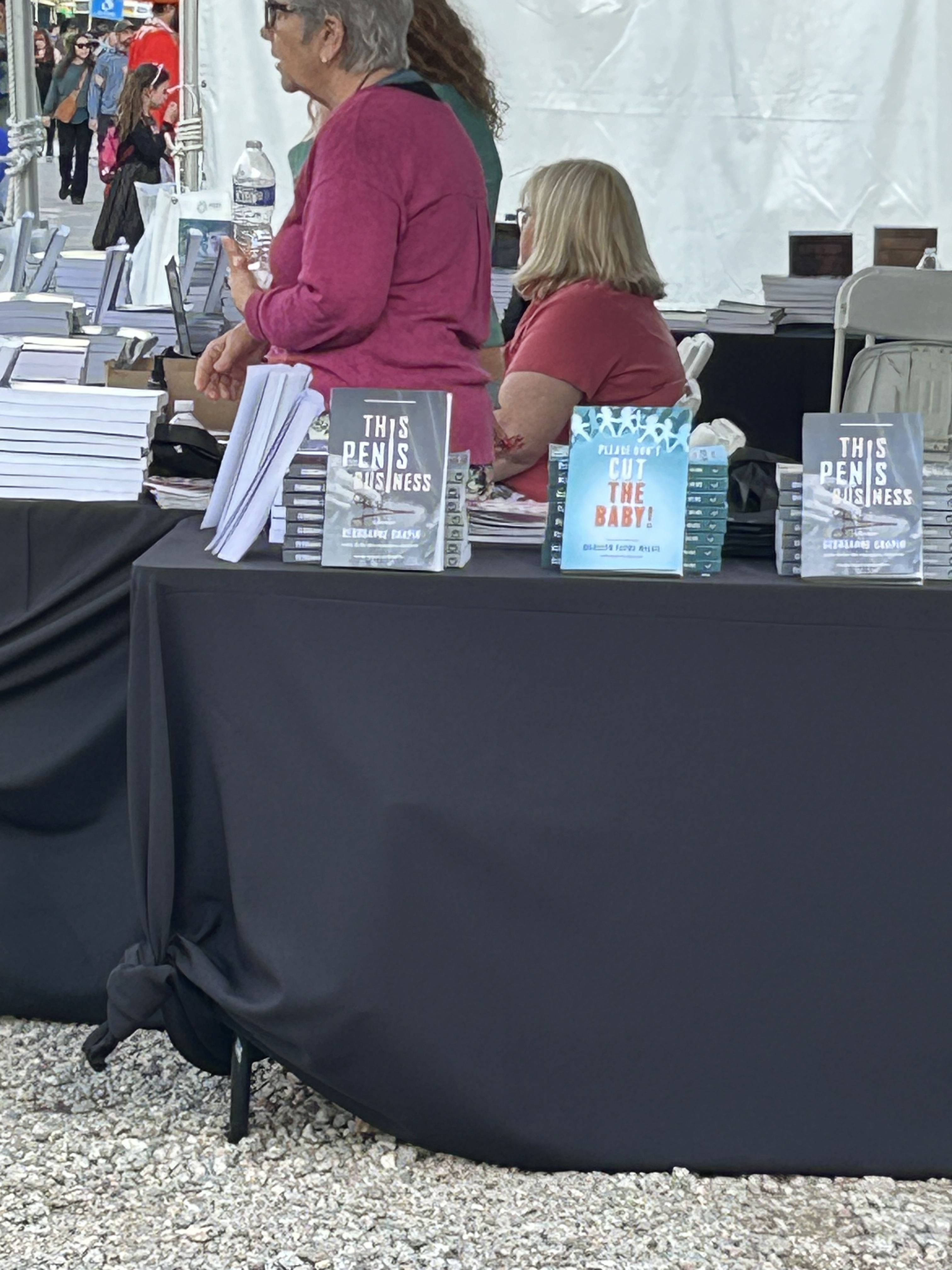
Amanda also shared my confusion over our nearest neighbors, who were… intactivists. Anti-circumcision activists. With whole books. About… circumcision. Now, I actually know the arguments against circumcision, and — how do you fill an entire book with them? Let alone TWO?!?

Needless to say, they did not send many customers over our way, and we didn’t send any their way, either. I didn’t have any people come to my booth and say, “Pirates, huh? You wouldn’t have anything about foreskins, by any chance?”

(I would have sent them over if they did. But they didn’t. The people over there still had people at their booth all weekend, so I think they did fine, too.)

If you didn’t get the book or books you wanted, or you now want more books, then please use the links on this page to Contact me or to order yourself a copy from Lulu.com. (If you Contact me, I will sign the book for you before I ship it.) If you didn’t make it to the Festival this year, then come to next year’s — Amanda and I will be there (Hopefully with our partner, the Poet, Lisa Watson, who wasn’t well enough to attend this year), and I will have all of the Adventures and at least one new book, as well. Amanda will probably have nine new projects, all of them as wonderful as the ones she has right now.

And if you bought books, two things: thank you for reading. You, along with the rest of the literate people, are the bulwark holding back the tide of Fahrenheit 451. You are giving my world meaning. You are joining me in this weird sort of slow-motion conversation that is a novel.

And also: get off the internet and go read. Like I’m about to do.

(If you’re wondering, I only bought two books this year. But that’s because this is my TBR pile.

No, I’m not kidding.)

Here are the two books, anyway.

Happy Reading, all.

“Adventures” with My “Pets”

I enjoy frequenting thrift stores — as who doesn’t? — and one of my favorite things to do is peruse the books, especially the older ones. This is not my wife’s favorite thing for me to do, so usually while I am geeking out over some 100-year-old grammar textbook (I swear one of these days I’m going to teach my class out of one of those and then WATCH OUT), she comes up behind me and says, “Are you ready?”

I am not. I am never ready to leave the books. I always want to spend more time looking at them. It’s a little frustrating because I don’t always want to spend as much time READING them, so they tend to pile up. (Another reason why my wife interrupts me, and she’s right to do it.) But my wife is right to interrupt me, so I say I am ready, and I leave. Usually without any books. Which is probably good, as they are often more curiosities than books I want to actually read and own.

But sometimes, when I am quick and lucky, I get to find something genuinely awesome. I have a collection of hundred-year-old romances by my favorite pirate author, Jeffery Farnol, some acquired at thrift stores and library book sales, which I am very proud of and love reading.

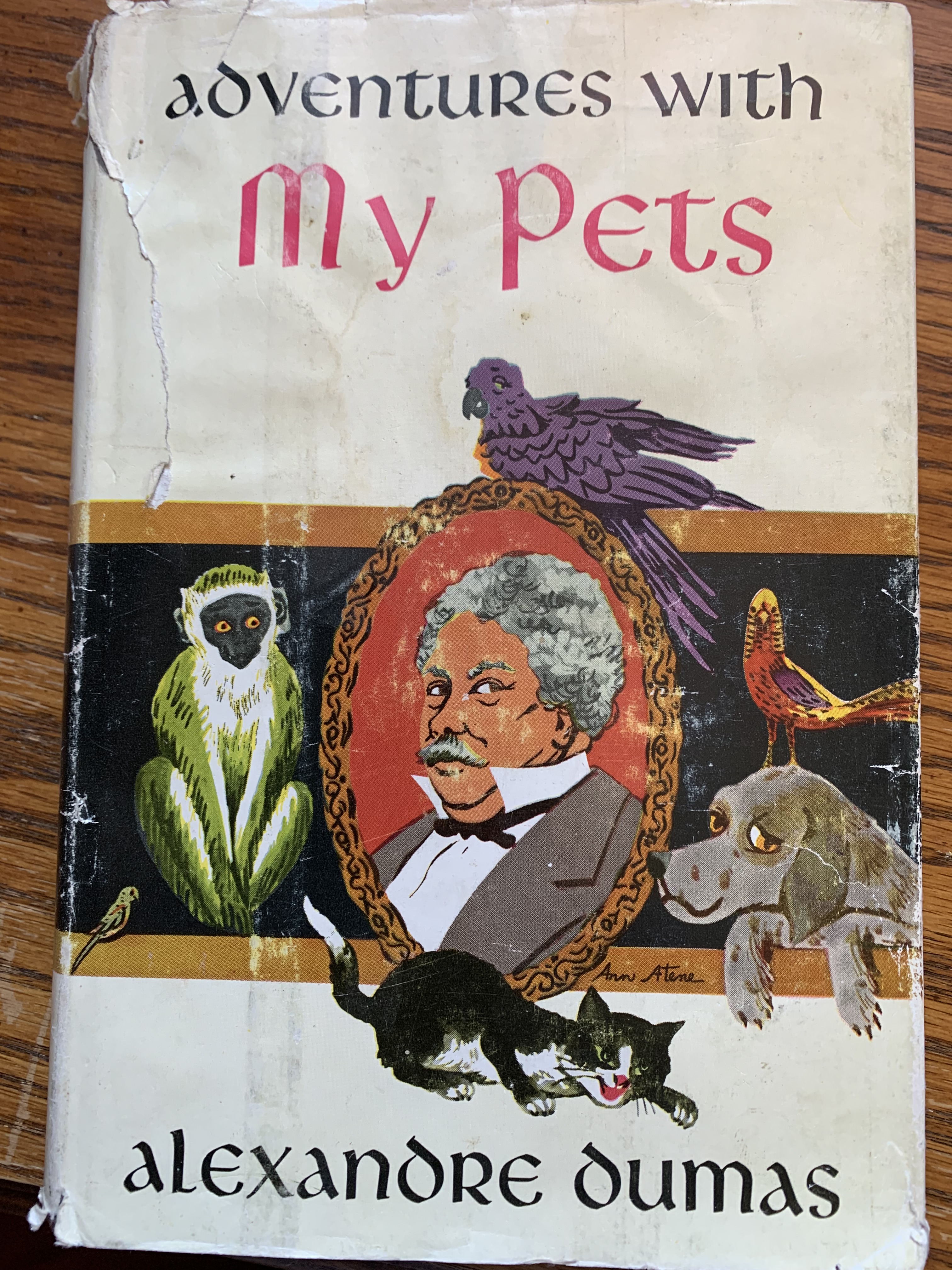
And a few months ago, at the local Human Society thrift store here in Tucson, I found — this.

Doesn’t the picture of Dumas look a little like this cat? Or maybe this picture is the one that looks like the cat…

This is a memoir written by the author of The Three Musketeers and The Count of Monte Cristo. Now, Dumas was a badass, particularly as a writer. I’ve read Monte Cristo, and it’s bloody brilliant; and pets are absolutely my thing — so I had to get this. Plus it was only $5.

Unfortunately, as Dumas lived in the 19th century, the times they have been a-changin’: and Dumas did not think of pets the same way that I do — and neither, honestly, did he think of adventures in the same way I do. I was hoping for, I dunno, hiking in beautiful mountains with dogs, who run off the trail and then make friends with an elk and bring it back to get a scratch behind the ear and take a treat from Dumas’s hand; that would be an adventure! With a pet!

Instead I got a whoooooooole lot of hunting. Dumas surely did like to shoot him some animals. Particularly rabbits and birds. The title, you see, comes from the fact that one of the main characters in the memoir is Dumas’s hunting dog, his English pointer Pritchard. And if you count all the times Dumas blasted a bunch of small helpless creatures with a shotgun while Pritchard pointed at them, then you betcha, there were plenty of adventures with his pets. But as you can probably tell, it was not my cup of tea.

It was interesting. Dumas was still a hell of a writer, and he does manage to make a lot of the little anecdotes come to life. Some of them were even fun: the man had a lot of pets, some of which he treated well; while many of Pritchard’s stories are about hunting, there is also one about how Pritchard often brought home many other dogs from the neighborhood to share in his lunch, because Dumas spoiled his animals and therefore Pritchard’s friends wanted the same good food he provided his dog. There are many conversations between people, often but not always about the animals, which were interesting and amusing. There’s a great secondary character, Michel, who was Dumas’s groundskeeper/animal expert, and he is interesting and amusing; Dumas presents a bunch of ridiculous folklore legends as coming from this guy, and clearly we’re supposed to laugh at them (there’s a chapter where Michel asserts that frogs act as midwives to other pregnant frogs, and so either frogs must have taught this to OBGYNs, or OBGYNs must have taught this to frogs — and as a fan of frogs, I’m good either way), but Dumas never makes Michel seem like a fool or a doofus, which I enjoyed. I appreciate that Dumas was, as he was described in one chapter, one of the most arrogant and self-centered of men (Which, not to be stereotypical, but I feel like saying that about a Frenchman is saying something) — but also one of the most generous and compassionate. He is completely ridiculous about handing out money left and right, usually, in this book, to acquire more animals, and I like that. I love the chapter where Dumas is described: because he reprinted a letter from a friend of his who defended him in Parisian social circles, with a letter to the local newspaper, which is fantastic; the letter basically says, Yes, he is arrogant, but also generous — and the real difference is, he’s arrogant because he actually is the greatest author in France, and that makes him a better person than all the rest of us.

I loved that.

But I did not enjoy all the killing of animals. I liked the cat Mysouff, but not when Mysouff killed all the pet birds. I liked the dog Mouton, but not when Dumas kicked Mouton in the rear, as hard as he could, for digging up his garden, and Mouton bit the crap out of Dumas’s hand — and the point of the story was that Dumas therefore had trouble writing for a while, because it was his right hand. I liked Pritchard, but not when Pritchard went hunting, or just killing and eating animals for fun — and especially not when Pritchard gets hurt and Dumas plays it basically for laughs: the dog gets shot by a hunter friend of Dumas’s, and the joke is that the pellets hit Pritchard in the testicles — but not to worry, one of the testicles is still functional! So all is well! And I was just like, “MOTHERFUCKER, SOMEONE SHOT YOUR FUCKING DOG, GO KILL HIS ASS!”

Plus: the dog dies in the end. And not of old age, surrounded by the family that loves him.

So nope: this was definitely not the book I was hoping for, and I would generally not recommend it. If you are a huge fan of Dumas, then you might enjoy it; it gives more insight into him and his lifestyle than it does into his pets or his attitudes towards his pets — but if you, like me, are a pet person, give this one a pass.

No Pizza For You

One of the best things about being a teacher who is really a writer is this: my students and my school and my profession frequently inspire me to write. Usually essays. Usually angry.

This is one of those essays.

Some background on this one: my AP Language class studies argument, and the project that culminates that unit is a class display of dueling arguments. A student volunteers to write an argument, which is due the next day, on any topic they want (that is school appropriate, of course); I project it on the board, read it aloud, and then we critique the argument as a class. Then someone volunteers to argue back, taking a different side of the same topic, with their essay due the next day, and going through the same process. Then if someone wants to argue a third perspective on the same topic, they may; if not, someone volunteers to start a new pair of arguments the next day. Everyone who completes the essay gets a 100% grade; if anyone volunteers to write an essay, but doesn’t turn it in, then the whole class takes a test — that way the peer pressure will overcome the nerves, and I know I’ll get the essays: so long as I can get them to volunteer. If someone starts an argument on a bad topic and nobody wants to argue back, then the first student has to write the second essay, as well, taking a different perspective snd arguing against themself. If no one wants to argue and it’s a good topic, then usually I will argue back against them.

This year I have had some trouble with all this. Students are not interested in volunteering. I got the first four essays, two pairs, all from the students who generally speak up most in class discussions; then I had to struggle to get the next essay. Finally I got one student to volunteer to write about corporal punishment: but then he decided not to argue that. He didn’t want to sound weird, for arguing that kids should be spanked, and so on. This student generally has strong political opinions, so much so that other students roll their eyes when he starts in on them; but he didn’t write about politics, either. No, for this project, he chose to write about — pineapple pizza. He argued that pineapple is just fine on pizza. He wrote a good essay; he just picked a terrible topic, because he didn’t want to be too controversial or weird. Which then required someone else to argue that pineapple does not belong on pizza. Unsurprisingly, nobody did it, so he reluctantly argued back against himself.

That was the essay we got yesterday. it was much too short, because he’d already written a full essay so this one didn’t matter; but it was long enough to show that even with a bad topic, one can write a good essay, or at least an amusing one.

Then I asked for volunteers to write for the next day. I got nothing.

So I read them this.

“Speak what you think to-day in words as hard as cannon balls, and to-morrow speak what tomorrow thinks in hard words again, though it contradict every thing you said to-day.”

–Ralph Waldo Emerson

Okay, here’s the truth. Pineapple on pizza is amazing. If you’ve had it, and you have taste buds with even a minimum of function, then you know. If you’ve never had it, you’re missing out. But in either case, you should never get to have it again. 

Because you don’t deserve it. 

You don’t want pineapple on pizza? That’s fine, to each their own. You’re wrong, but you’re welcome to feel that way.

But you don’t deserve your preferred pizza, either. None of you are pizzaworthy.

Because you won’t fight for it. 

This doesn’t apply to some of you – though I am tempted to use this to label your entire generation, the No Pizza Generation, because Lord knows I have enough students in other classes to whom this does apply, in addition to most of you – because some of you are willing to fight. More specifically, you are willing to argue. You have the courage of your convictions, and sufficient passion to draw the words from within you. Believe me, I know how hard that is, especially now: I haven’t written a word worth reading in a month, and barely any real words this entire school year. But I think I’ve done enough in the past to give me the standing to write this to all of you who have not tried to put down your real feelings, to say what you really believe.

Until you stand up and speak, you’re a coward. A chicken. A lily-livered milquetoast. Heartless. Gutless.

And you don’t deserve pizza.

If you want good things in life, whether it is pineapple on pizza, good grades, the respect of your peers, or a country that isn’t a burning dumpster fire sinking slowly into the rising oceans, then you have to fight for it. And no, I’m not talking about fighting with guns and bombs and sticks and stones: I’m talking about real fighting, the kind that makes a difference, that changes things because it changes minds: fighting with words. Arguing. People talk about democracy, about the value of freedom and equality, of a state where everyone has a voice, where everyone can be heard – and rightfully so; history overflows with the stories of tyrants and megalomaniacs whose voices drowned out, and eventually smothered entirely, the voices of millions of people: people who had something to say, people whose words could have affected someone, people who could have won the argument. But they weren’t allowed to make it. They were not allowed to speak. And they died silent. And the world went on, a little bit worse for the loss of the person, a little bit worse for the loss of their ideas. Want to know how we got to this place, where everything is screwed up? Because too many people have not been permitted to say something that could have made the world a little bit better. We lost too many good ideas because people were not allowed to talk, to speak their truth. To argue. To fight.

But you all are not only allowed to speak your truth, you’re not only encouraged to speak your truth, you are required to speak your truth. But you won’t. It doesn’t even have to be your deepest truth, you are welcome to write about something ridiculous like pineapple on pizza; that was a pretty good argument we saw yesterday. 

But you won’t even do that. 

Democracy only works when people talk. When people argue. Argument is inevitable when people talk, because no two people see the world the same way. Ever. Hell, even one person doesn’t see the world the same way as themselves: sometimes I hate pineapple on pizza. Sometimes the taste of that sickly-sweet/sharply-acidic fruit is overwhelming, and I can’t taste the rest of the pizza, and that sucks. 

That’s what happens when one voice dominates the room. Even a sweet voice. Even my voice: when I’m the only one talking, the sense of my words, my voice, my understanding, my truth, overwhelms the senses of everyone else, the truths of everyone else. It ruins the flavor. It ruins the pizza. 

Most of the time, that doesn’t happen here: but also, most of the time, the other flavors that appear on this AP Lang pizza, the other voices that speak up in this room – they’re the same voices. Over and over again. The same ones who have already spoken, for the most part, on this assignment. I know some of you are working on your arguments, are preparing your truths to share, and good for you, please continue doing that. I’m not speaking to you: there’s nothing wrong with trying to take your time and do a good job, with trying to find the energy, at the end of this very long school year, to say what you really want to say in words that are worthy of your feelings. I have no problem with that: in fact, I appreciate it. I applaud it.

It’s the rest of you I’m speaking to. The ones who just keep saying “Nah. I don’t wanna.” 

The ones who can’t be bothered.

The ones who are too bored, who think that everything, everywhere, always, is too boring. Not because the world is boring: but because you don’t want to deal with it. Having an opinion means being willing to defend that opinion, and sometimes, that’s hard: so you’d rather just not do it. Even if it means you suffer through things you don’t like. You’re the ones I’m speaking to.

The ones who don’t like pineapple on pizza not because you don’t like pineapple, or because you don’t like how the taste overwhelms: but only because you don’t want to deal with it. Don’t want to speak up and say what you like on pizza. The ones whose vocabulary starts and ends with “I don’t know, whatever.” 

The ones who are hoping for a way out of this assignment, as you hope for a way out of everything challenging. Who will let opportunities pass you by simply because catching them is too much work, and you’re busy looking at your phone. Not looking at anything in particular, of course; just scrolling mindlessly, laughing at people being lame. Isn’t it nice? How there are so many losers on the internet? People who you can feel better than? It’s hard, sometimes, to feel good about yourself when you don’t do anything worth feeling good about, because you avoid all challenges, avoid all risks, when you can’t be bothered to care about anything. And because those people snoring loudly on TikTok are so ridiculous, so terribly pathetic, you don’t even have to do — anything. You just get to laugh at them. And do nothing. Or if not that, you can play video games endlessly: because there, you can win, without even trying. No challenge, no risk – just “winning.” It’s so easy to feel good about yourself when you don’t have to put out any effort, when you don’t have to take any risks, but you can still win. Isn’t it?

“What do you want for dinner?” “I don’t know, whatever.” 

“What do you want to do this weekend?” “I don’t know, whatever.” 

“Does anyone want to present the next argument for the class?”

“Does anyone have a topic they want to argue about?”

“Does anyone have any opinions?”

“Does anyone care about anything?”

That’s the last place where you hide: behind opinions. It feels magnanimous, it feels open-minded, to say that people can have their own opinions, and that’s fine. To say, “Well, you said how you feel, but I feel how I feel, so we’ll just agree to disagree.” To use that cliche in all situations: because that way, you can avoid argument. It feels smart to avoid the difficult subjects, to talk about how politics are boring, or how stupid it is that people get all upset about things; it doesn’t matter, you say, Who cares anyway, it’s not like anything’s going to change. I don’t know. Whatever.

That’s not magnanimous. That’s not smart. It’s cowardly. Chicken. Gutless.

That’s how we end up with two days of arguments about pineapple on pizza. It’s how we ended up with a half-dead stooge in the White House. It’s how we will act as we watch all of humanity slide slowly into a grave we are digging for ourselves. Without speaking up. Without arguing. Without fighting.

“It doesn’t matter, nobody ever wins arguments anyway.” 

Have you ever tried?

“Nobody can change anyone’s mind.”

Have you ever changed yours? Then why would you think that nobody’s mind can change? And if you’ve never seriously tried, how do you know you can’t?

Do you agree with everything other people – people in this classroom – with everything they do? With everything they think? Do you think everyone here is right, except you? If any of us are wrong about something: why aren’t you telling us? Why aren’t you calling us out on it?

It’s entirely possible that you all are burning with topics, absolutely bursting with words, that you have a thousand things you want to say, shout, scream at us, or at the world. All I know is that when I ask for volunteers, I get crickets. I get people avoiding eye contact. But why? Are you afraid that you’ll fail? Literally, with this assignment, that will only happen if you don’t try. Are you afraid that people will mock you? Maybe you didn’t notice (maybe you were too wrapped up in video games or TikTok), but we had an argument about pineapple on pizza: and yet no one made fun of that essay. Nobody said it was garbage. It helped that it was well-written, but still, it was about pineapple on pizza. And yet, nobody insulted the author. As far as I know, none of you thought less of him. And let me point out that you all mock and insult and criticize each other all the time: why is this any different? 

People asked the author why he didn’t talk about something he was passionate about, why he didn’t talk about politics. Maybe it was because all the rest of you not only fail to meet his enthusiasm about politics, but you mock him for it. Because it’s easier to mock someone else’s passion than it is to share your own. Isn’t it?

“I don’t know. Whatever.”

Maybe you’re afraid that you’ll do a bad job. I understand that. But I’ve read all of your writing. All of you, everyone in this class: you all write well. More important, you all think well. The only thing missing is the passion to say what you really think, and the single moment of courage to say “I’ll go.” 

That’s all it takes. Making a decision, having an opinion, being willing to fight.

If you aren’t going to take advantage of this opportunity, to argue about essentially anything you want, in this class where everyone is respectful and generous in their critiques: when will it be better? When will it be easier?

Never? 

Are you really never going to fight for anything? Even something small? Even something silly, but that matters to you?

Then it means that you will never get anything that matters to you. Because unless you fight for it, you’ll never get it.

Unless you fight, you don’t deserve pizza.

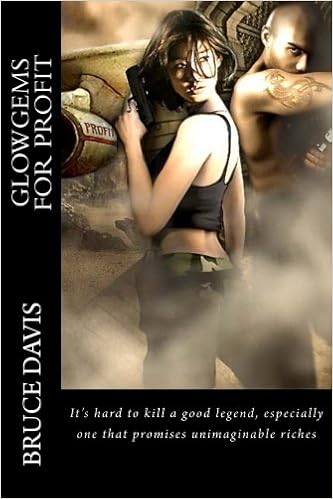
Book Review: GlowGems for Profit

GlowGems for Profit

by Bruce Davis


Okay, it’s kind of a funky title. Sounds like one of those get-rich-quick seminars you see signs for on the side of the road. Thing is, there’s a pun in there that you don’t recognize: the Profit is actually the name of the spaceship that carries our hero through the solar system; Davis is creating a series of adventures about the Profit and her crew and this is only the first – all of them (presumably) will have Profit in the title. So that’s part of the reason: and also, of course, the question of profit is one that runs through the book. The idea of a get-rich-quick scheme, especially one that isn’t really what it seems, is exactly what this book is about, and greed warring with caution is another theme that runs through the book.

And this book runs. That’s the first thing you should know: this is action from start to finish. Davis spends the first two chapters giving us enough exposition to understand who these characters are – and then starting with Chapter Three, the guns start blazing and the blood starts flowing, and it doesn’t really stop until the end. It’s got everything: hand to hand combat, gun battles, chase scenes, ship-to-ship space combat, locked door murder mysteries, betrayal, secrets – everything; and all of it is wonderfully well-done. I don’t know if it was hard to put down because I never really tried: I didn’t want to put it down, I wanted to keep reading, wanted to get to the next scene, the next fight, the next sticky situation, to see how the heroes could fight their way out of it.

That’s the next thing you should know: these are great heroes. Davis has created a fantastic hard-boiled sci-fi hero in Zack Mbele. He’s got a complicated past, remarkable abilities, good friends for whom he has fierce loyalty, a deep cynicism and an inability to trust strangers, and a lone wolf streak a mile wide: he’s Sam Spade and Harry Dresden and Simon Green’s John Taylor and all the rest of those kinds of guys. But he’s also thoroughly himself: I had no feeling at all that this was an imitation of any other author’s work; this world and this hero are entirely original.

In addition to the main character (I admit I didn’t like the other characters as much, apart from Deuce, who’s awesome – but then, I’m not supposed to.) and the action-packed plot, the intricacies of both the world Davis built and the intrigues that the characters get involved with were remarkable. Mbele is a disillusioned former revolutionary, and the way his past keeps rearing its head no matter how hard he tries to escape it was fascinating. And the characters and their complex, difficult motivations, all of them deciphered over the course of the novel by Mbele’s dogged investigating, was perfectly human and completely fascinating to me. You have no idea who’s telling the truth or why people are doing what they’re doing until Zack knows the truth, and you learn it along with him – it was excellent.

This was great stuff, an excellent sci-fi thriller/mystery – the sci-fi, too, by the way, was well done, just enough advanced tech to make the story complex and interesting, not so much that you get confused – and I highly recommend it.

Book Review: The Matriarch’s Devise

This one’s been a bit of a long time coming; I got this book  from the author herself at the Tucson Festival of Books, where Brick Cave Media had a booth just two down from mine. I meant to read it right away, but of course — school. And then moving. Now I’ve read it, and I’m glad.

The Matriarch's Devise (The Healer's Trilogy Book 2) by [Skinner, Sharon]

The Matriarch’s Devise

by Sharon Skinner


This is the second book I’ve read by Sharon Skinner – this is the sequel to the first book of hers which I read, The Healer’s Legacy – and like the first, this one’s going on the Keep Forever shelf. Maybe partly because Ms. Skinner signed it for me when I bought it from her at the Tucson Festival of Books, but that’s not the main reason: the main reason is that this is a book I needed to read.

In some ways it’s a second book in a series: the characters are already established, and of course I already had my favorites (Those who know me will be entirely unsurprised to hear it is the animals even more than the people, though I like the two main human characters quite a lot, especially Kira), and so I admit to some disappointment when my favorites were not the stars of this book; the animals and Kira are separated fairly early on, and the wyvern Vaith and the hunting cat Kelmir come back into the story later, but never play a major role. The plot picks up at the very second (almost) the last one left off, and after Skinner places the characters where she wants them, the book – ends. Something of a cliffhanger, though it does wrap up the story from this book (and MOST satisfactorily, I have to say), but yes, it leaves you wanting more. Perfectly normal, there’s plenty of development in this novel to satisfy, we’ve seen our people go through a lot; now I have to get the third book, and I have no problem at all with that.

In some ways, though? This is an entirely new story. The twist regarding Kira’s identity – by the end of the book you know who her parents were, what happened to them and to her, and also, how she has the ability to bond with her animal companions – is not something one could possibly see coming, aand the world she is thrown into because of it is fantastic and imaginative and basically entirely unlike the world of the first book. It’s like reading, say, a Tamora Pierce novel, and then the sequel to that suddenly moves the characters into a Rick Riordan novel – like the second book starts with, “Oh, didn’t you know? You’re also an Olympian demigod. Let’s deal with this, now!” Skinner shows a range of writing and world-building that I have not often seen. Let me also say that the change is not jarring: the stories do fit together, and there is more than enough consistency between the worlds and the characters to make it simply fascinating, to watch these characters jump into an entirely new situation.

No spoilers, but: I liked the new world and the people, and the depiction of their magical powers was super cool, especially the defense that keeps their land safe; the villain was extremely villainous, which made it a little frustrating (in a good way) that the villainy kept happening and I wanted to yell, “Why are you not figuring that out?!? IT’S THE BAD PERSON! GO GET THE BAD PERSON!” I was a little bummed that the final conflict sort of borrowed the bad guys from the first book; that did feel slightly out of place – but I loved how the book ended, and as I said, I love the characters and the ways they’ve developed over this book.

I also have to say that I am very pleased that Skinner has written a high fantasy book which not only has a female main character, who is involved with but in no way overshadowed by her romantic interest, but this book also has an absolutely lovely depiction of a long-term lesbian couple done in exactly the right way: like real people in a real relationship, without anything strange or remarkable about their love for each other. The two women are powerful and respected leaders in their country, interesting and sympathetic characters in the story, clearly in love but also with friction between them – it was wonderfully done. This element, though it doesn’t predominate in the story, was another reason why I needed to read this book.

Now I need to read the sequel. I can’t wait.

Book Review: The War of Art

Image result for the war of art

The War of Art

by Steven Pressfield

In retrospect, I should have known from the foreword that this was the wrong book for me: Robert McKee talks about art like it’s a war that Pressfield will help me to win; and while I think art is a struggle, I really don’t think it’s a war; indeed, as I am a pacifist, couching things in warrior’s terms is just going to push me away. He also references golf as evidence that Pressfield is a consummate professional (Pressfield wrote The Legend of Bagger Vance, which I have neither read nor seen; I guess it’s about golf? I guess Pressfield likes the game? But he writes anyway instead of playing, which – I guess is impressive?), and there’s the second best way to alienate me. He talks about tearing up over the Spartans’ death at Thermopylae, which was the subject of Pressfield’s other big book, Gates of Fire, which I did read, and did like quite a lot – but it didn’t make me weepy, and I don’t know what it has to do with inspiration to make art. So I’m really having trouble relating to this foreword author – and then he ends his intro with this:

“When inspiration touches talent, she gives birth to truth and beauty. And when Steven Pressfield was writing The War of Art, she had her hands all over him.”

Creepy sexual metaphors, especially about things that are not remotely sexual – like the act of putting words on a page – that is the number one way to make me say “Nope.” So I should have known.

Let me say this, though: this is a book intended to inspire artists, to help people break through creative blocks and create art they can be proud of. I can’t think of many more noble things to try to do, and I appreciate Pressfield’s earnest and genuine attempt to give people tools to do what they should be doing. So: if you do appreciate sports metaphors, and war metaphors, and you like a good, strong pep talk – or as the cover blurb calls it “A vital gem… a kick in the ass,” (which also should have been a warning sign for me) – then please ignore this review, and go get this book. I hope it helps.

It didn’t help me.

There are moments when I agree with Pressfield. He talks about questioning his writing, and feeling hopeless, and the strength and stamina it requires to push through all that and just keep working. He calls it work, and talks about how important it is to just keep putting in the hours, to keep trying, to keep seeking to hone your craft and do the best you can – but first and foremost, to just put the goddamn letters on the goddamn page, and to never give up. And I agree with that entirely. He talks about how he was in his 40’s before he found success, and how it came from an entirely unlikely source, which was, logical or not, simply the book he had to write at the time; and as a 44-year-old writer who is working on his second novel about a time-traveling Irish pirate, I appreciate everything about that.

But then there are the places where he talks about being a Marine, and how other servicemen in other branches are weaker than Marines because Marines love being miserable (This is a metaphor for how artists should be: willing to suffer and be miserable. I kind of see that. This whole Marines-have-bigger-dicks-than-other-soldiers? Nah.) and the other services are soft. Where he talks about writing and art like it is a war to be fought and won; or an animal to be hunted and then eaten; or a football game where you have to “leave everything on the field.” And I hate all of that. He talks about the urges and habits that get in the way of art as Resistance, and that’s pretty good, but he also talks about how like not cleaning your room is a way to lose to Resistance, and – what? And how golf is an art, and Tiger Woods is the greatest artist of all because he can be interrupted mid-swing, stop his swing, and then refocus and hit a golf ball really hard and – I fail to see the art in that. And he says that mental illness, depression and anxiety, are not real, but only a failure to combat resistance, which can be overcome by determination and the earnest pursuit of one’s true calling, and hey, fuck you, Pressfield.

He’s got a strange (And contradictory) section where he tries to talk about thinking territorially instead of hierarchically, and basically he means you should do what you think is right rather than worry about what other people think is right, and okay, sure – but first, he says elsewhere in the book that he knows he’s written well when his family is pleased and proud of him, which is hierarchical thinking by his own definition and explanation, so either he’s a REALLY bad editor who missed that continuity break, or he’s full of crap in one of these places; and second, his example of someone thinking territorially is Arnold Schwarzenegger going to the gym. Which is both weird and not at all artistically inspiring. It gets really weird in the third section, where the devout Christian Pressfield (Though he also admires the ancient Greeks so damn much that he seems to kinda want to worship Zeus and Apollo. I can’t really disagree with that, though I wouldn’t pick the same gods.) talks about angels who help inspire artists to work, because God wants us to create beautiful things for Him to admire, and how everything an artist is comes from God and we should understand that we contribute nothing, that we are only the vessel through which the divine will is worked. I mean, when we’re not being hardcore fucking Marines. Or hitting 310 yards off the tee. Otherwise, though, we should be all humble before God. It is not quite this Christian – he really does admire and know a lot about the Greeks – but it does read that way, as a repudiation of human accomplishment and a glorification of the eternal Whatever. And as an atheist and a part-time humanist, I am not at all down with that.

This thing reads exactly like what it is: a privileged Baby Boomer looking down on everyone else who doesn’t have all of his privileges; and by the way, he says some interesting and intelligent things that show me he really is an artist like me. Just way more of a shmuck. Hoo rah.

This Morning (Book Review: Everything Box)

This morning I don’t know if this is a good idea? I wrote a book review, which I want to post; I don’t want to interrupt this stream of This Morning blogs, so I thought I would use the book review for This Morning. Opinions? Is this a copout? Just the wrong sort of thing for me to do, because This Morning is about my thoughts and feelings? I dunno.

I can make book reviews a part of this streak, or I can make separate posts.

Leave a comment and let me know what you think, if you have thoughts.


The Everything Box

by Richard Kadrey

I’ve read three Sandman Slim novels (And if you haven’t, you should – dark horror/fantasy with a punk edge and a great sense of humor), so I had some idea of what to expect with this book; but I didn’t expect this book.

It’s a caper story, a one-off novel with no connection to other Kadrey books (And I just found out this second that there are sequels) about a professional thief who gets hired to steal the wrong thing, and even though he manages to do it, he gets sold out on the job by a fellow thief, who, predictably, has no honor. Coop (Charlie Cooper, though no one calls him that) gets sent to a special prison for the next few years, before he is sprung, by the same guy who put him away, and for the opposite reason: this time the guy, Morty, needs Coop’s help.

He needs Coop’s help specifically for the same reason that Coop was in a special jail: because Coop is not a normal thief. He is a magical thief, who steals mystical and mysterious items for mystical and mysterious people who can pay him in cold, hard cash.

That’s the setup (And forgive me for spoiling the first two chapters), and it’s a good one. The opening scene when Coop is on the job is a lot of fun, and the subsequent caper action is just as good, all the way through. The book does start a little slow, as Kadrey has a pretty broad cast of characters; there’s a madcap element to this, as it ends up with one of those Mad Mad Mad Mad World scenarios, with everyone running around looking for the same thing – the Everything Box of the title – and so getting all of those characters with their disparate personalities and motivations into the reader’s mind is a challenge. Kadrey does it as well as any, I think, but simply because it’s a single book, he has to fall back on some fairly generic tropes and character types. He does at least one wonderful thing, though, which is to completely flip some of those tropes: there are two different demon-worshipping doomsday cults involved, one led by a High Dark Magister (Or is it Dark High Magister?) with a bad back whose throne is a Barcalounger, and the other led by a very traditional suburban family who hold bake sales to raise funds for their dark rituals. (The bake sale scene is one of the funniest things in the book, and one of the funniest scenes I’ve read in a long while.) But there are some confusing moments: there was one character who I actually thought was a different character until they met each other, and I got lost in the earlier chapters and had to slog a bit. But it picks up, and the last 100 pages whiz by; the ending is great.

Apart from the caper action – which takes more than enough twists to keep you guessing; I honestly kept thinking, “That’s it? That can’t be it. Oh wait – that’s not it!” – the book does one other thing remarkably well, which is make you like the characters. Almost all of them are generally likable and amusing, including the ones opposed to our hero Coop, who is an excellent sort of everyman guy who just happens to be a thief. But both because they are a bit one-dimensional, and also because they are pretty goofy, you don’t mind too much when bad things happen to them – and like all of Kadrey’s books in my experience, a lot of bad things happen to a lot of people.

And I liked it.

Book Review: The Unnoticeables

Image result for the unnoticeables

The Unnoticeables

by Robert Brockway


This is a badass book.

First, I mean that quite literally: it’s a punk book, with a punk character, written by a guy who wrote in his dedication that this should show all those people who said he was wasting his time going to all those punk rock shows – so I’m guessing he’s a punk author.

It reads like it. Carey, one of the main characters (There are two, as the book has two settings about 25 years apart) sounds spot on to what I imagine a punk in 70’s New York City to be: angry when he’s not indifferent, violent when he’s not wasted, wasted when he’s not broke. Always going to shows, always spending time with his friends, and criticizing and attacking every single element of his life and world, always trying to peel away the artifice and reveal the truth beneath, even when – especially when – that truth is ugly. As Carey himself often is. But he’s also a hell of a lot of fun to read.

The other main character, Kaitlyn, is also a badass, because she’s a stuntwoman, with the attendant skills, interests, and adrenaline addiction. Her story is set in 2010-ish, in LA, of course. Her story has a strong feel of peeking behind the curtain, as she is not, and does not want to be, an actress: she’s one of those rare people who really wants to be behind the scenes, essentially, at least not with her name in lights. She wants thrills, not celebrity; for the most part she’d be happy with steady work so she can quit waitressing.

The second reason this is a badass book is because Brockway has created a set of supernatural creatures that are thoroughly badass, in more than one way. Mainly, they are absurdly difficult to fight, because they are essentially unbeatable, unbreakable, and entirely deadly; you can win a fight against them, but they’ll just come right back the next day. And since they can make more of themselves, there’s really not much hope for humanity.

They’re also badass because they aren’t anything I’ve ever read before: Brockway created them. He calls them angels, because one of their forms is a geometric shape made of light; but they’re neither heavenly nor beneficent. Another of their forms is a human, but only on the outside; on the inside is –something else. Something deeply disturbing. Their third form is made by these disturbing creatures: it is a human, but one without a soul; at least, that’s the easiest way to describe it. That’s not how Brockway describes it. His way of talking about this group of enemies is interesting: they are forgettable. When you see them, your instinct is to look away, to forget you ever saw that person. These are the namesakes of the book, as there is something about these people that makes them impossible to remember; you can meet one, touch it, talk to it, even think it’s hot – but you can’t describe it. It is Unnoticeable.

Their final form? (Unintentional reference. Also, I have gone down in power, not up. The angels are the most dangerous and the hardest to deal with. But still, these are rough.) A giant man-sized mound of goo, which dissolves anything human it touches, like a walking (Well, oozing) acid bath. Those are the ones that Carey figures out how to kill, actually. The other ones he can’t kill, or at least so it seems. Doesn’t stop him from fighting them, though. And maybe – maybe – he can win. Sometimes. A little.

The absolute best part of this book, for me, was the motivation of the creatures, their reason for doing what they do. It’s just so goddamn clever, and poetic, and beautifully chilling. It’s one of those ideas I wish I had had, but since I didn’t, I will gladly go on reading Brockway’s story about them, and also, anything else of his I can find.

Because this is a badass book.

Highly recommended.

Book Review: Time and Again

(Sorry about this; I know it’s been a month, and this is lame, but I wanted to make sure I posted something in the month of August. I’m teaching now, so therefore not doing enough of what I should be doing, reading and writing. I’ll try to get something better up soon. For now, here’s this.)

Image result for time and again jack finney

Time and Again

by Jack Finney

I bought this because Jack Finney wrote Invasion of the Body Snatchers, which is a science fiction classic, and one of my all-time favorite short stories, Contents of the Dead Man’s Pockets, which is just brilliant. Also, my copy of this is from the Fantasy Masterworks series; and, last but not least, it’s about time travel. I wrote a book – two, now – about time travel. Clearly I need to read this fantasy masterpiece by an excellent author about a theme similar to mine.

Now I’ve read it; I’m not sure I really needed to read it.

The book is the story of a government project to realize time travel. The concept is deceptively simple: based on Einstein’s theories that time is similar to space in that it is a dimension of the space-time continuum, which means it has an axis, and therefore just as you could move in either direction along one axis in space (up-down, right-left, forward-back), you should be able to move in both directions in time. I don’t want to get too far into it, but the government project is, I think, quite well done: they do things the government would do, in the way that government would do them. The main character is a graphic designer and illustrator living in New York City in the 1960’s or so (The actual date of the modern era is left vague), who eventually attempts to travel back in time to 1882. The key is to find a space that can be isolated from the modern era completely: in this case (though there are several different attempts going on at once), the central element is the Dakota, a residential apartment building/hotel in New York City that has remained unchanged from the 1800’s until now. It’s a clever idea, honestly, and Finney does it really well.

There are some things about this book that are incredible. The level of detail that Finney was able to summon and wield in order to capture the time frames, both the character’s starting point and the destination, is amazing. The world he describes is lovely, but not actually idealized – one of the very best scenes is a conversation the hero has with a wagon driver in 1882 who describes what absolute hell it is to have his job in the New York winters, and it’s a brilliantly dark moment – which just made its loveliness more impressive; reading the book feels like being nostalgic for an era that I never knew, and a city I have visited but never cared too much about. As much as anything else, this book is a love letter to New York City: the comparison between the Big Apple of the past and the modern one makes both cities seem glorious, from Central Park to St. Patrick’s cathedral to Madison Square, from the Museum of Natural History to the Dakota building to the Statue of Liberty. It’s all wonderful. The descriptions are specific and detailed and interesting, and Finney made liberal use of original photographs and drawings from 1882 New York, making his main character into an artist as a means of drawing the actual historical art into the narrative. Some of the reproductions in this paperback edition were a bit sketchy or blurry, but it did certainly bring the setting to life, and I loved that.

You know what I didn’t like, though? The characters. Not a one of them. The main character, Simon Morley, struck me as an arrogant putz, and they went downhill from there. The best people are the cast of characters in the past, but several of them are, as you might expect, a little too alien for me to relate to very well; I suppose I can appreciate gathering with the other roomers in my boarding house to sing songs together in the drawing room, but I can’t help but think it strange, too.

You know what else I didn’t like? The plot. The major conflict is resolved in the first 150 pages (of 400) when – spoiler – time travel works. After that it’s Simon Morley putzing around, making bad decisions and then following them up with worse decisions; it does, I admit, make him realistic, because I think most people would do a lot of the things he did – but they were stupid things to do, so I can’t like him for it. I do like his final decision, which I will not spoil here but which did surprise me; unfortunately, it made reference to an earlier detail that I had forgotten entirely, so the poetic denouement was lost on me. Part of that is because the book took me a long time to read: a slow plot and annoying characters, combined with the start of the new school year, dragged this one out for a couple of weeks, which is a long time for me.

Don’t let me ruin this one, though. The time travel idea is interesting, if in some ways far fetched (Yes, as compared to the far more realistic means of time travel from other books – like mine, where it is, y’know, magic. Reality squared, that’s what that is), the writing and the descriptions really are remarkable, along with the photos and the historical details. It’s a good book. I just wish Finney had written a better hero.

Book Review: 19 Varieties of Gazelle

(In honor of the sad fact that I start teaching next week, here is a book I got from school. Fortunately, it’s a lovely book.)

Image result for 19 varieties of gazelle

19 Varieties of Gazelle: Poems of the Middle East

by Naomi Shihab Nye

I don’t read enough poetry; most of what I do, I encounter at school, while teaching literature to my high school students. That’s where I’ve read Naomi Shihab Nye’s poetry before, as she is often collected in literature textbooks (Particularly in the last twenty years, as the call has gone out for diversity among authors, seeking more women and people of color to break up the Great Wall of Dead White Dudes), and it’s where I got this book. Teachers, take note: the teacher who was in your classroom before you probably had some neat stuff, especially books. Check your shelves and cabinets and desk drawers. Trust me.

I’m very glad I found this, and very glad I read it. It’s a beautiful book. Nye has the gift of using few words to say many things, and to create strong and tangible, poignant moods. I feel like I know her father from her poem about him and his fig tree, and what’s more, I feel like I know more about figs, and also about her because she grew up with that father and those figs. She has captured a clear and powerful picture of the Middle East, particularly Lebanon and Israel and the life of Palestinians, as the book’s poems are largely from the 90’s and early 2000’s. She has also shown what it’s like to be Arab-American, and to feel both connected and separated from life in the Middle East: she has this remarkable view, like an outsider with just enough of a connection through culture and heritage and language to see inside more clearly than an outsider normally can; just clearly enough for it to hurt, mostly, though she is also in awe of the people she feels she can almost, but not quite, understand. And then her ability to write poetry allows me to feel the same thing about her, and about her subjects at that additional remove; I feel for her feeling for them.

It’s an experience. These are beautiful words, and a good book. And, as always, it’s timely, even fifteen years later, because it seems the Middle East never changes.