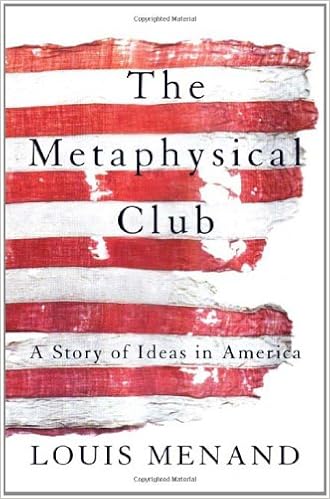
Book Review: The Metaphysical Club

Image result for the metaphysical club

The Metaphysical Club

by Louis Menand

I’m not smart enough for this book.

But I want to be, and I think that means I have to keep trying to read books like this, and think about what they say while I’m reading them.

So this book traces the influence of four American intellectuals on the general mindset of the United States. The four are Oliver Wendell Holmes, Jr., the Supreme Court Justice; William James, philosopher and psychologist (And older brother of the writer Henry James); Charles S. Peirce, whom nobody has heard of but was an influential thinker and writer; and John Dewey, the philosopher who had more influence on American education than anyone else. The wonderful thing about the book is that the sheer volume of information is staggering, and yet it is told in a generally simple and straightforward narrative style, well-written, and with a deft human touch; Menand delves into the men’s youth, their childhoods and upbringings, their parents, particularly their fathers, and the influence those men had on these four men, and builds a fuller picture than I have seen in most histories – and he does it for all four of them, while also pursuing a history of a set of ideas. So for instance, we read about Charles S. Peirce, whose father, Benjamin Peirce, was a mathematician, author, and Harvard professor; we see how the elder Peirce’s ideas reflected and interwove with the dominant ideas of the time – since the book focuses on men who came of age in America in the second half of the 19th century, the most important event was the Civil War and the most important idea Darwin’s theory of evolution through natural selection – and how his father’s ideas influenced Charles’s thinking, and how Charles’s thinking was affected by Darwin and by the Civil War; and then lastly, how Charles’s thought influenced and was influenced by the thought of the other three men. Along with the philosophy of Emerson and Kant and Hegel and umpteen other pieces that go into an exploration of a whole set of ideas.

It’s a complicated web. That’s why I’m not smart enough: because I knew none of this, knew nothing about these men – had never heard of two of them, and could never remember whether Holmes Jr. or Sr. was the jurist – I could not keep all of the facts and names and such straight. By the end of the book I was having to look back to the beginning of the book to remember who people were; this was made easier by the extensive index in the back, but still, that’s not my favorite way to read. And while I enjoyed the book, it was hard enough to get through that I don’t want to read it again, which is obviously the best way to handle this much information.

But: while the book is a history of four important men (The details of whose lives, while interesting, are not things I really need to retain), it is more an exploration of a set of ideas. And those, I found fascinating, and do want to spend more time thinking about. The basic ideas that stuck with me, after this first reading and without doing more research and thought (I just finished the book fifteen minutes ago), are: truth is socially constructed. We don’t know if what we know corresponds in any way to an external reality, but we can know if it corresponds with what other people know – which, unless we are born with certain ideas already implanted in our brains and our DNA, is the only way we can learn anything. Identity also may be socially constructed, meaning that we only learn who we are in relation to who other people are, and thus who we are not. Conflict is always and only the result of a misunderstanding, which, depending on how optimistic one is, may naturally get worked out on the way to a common understanding. There are no rules that can be formulated that can trump the specific context of an individual case (though I’m probably misstating or overstating that one), meaning that the historicity and specific application of an idea are necessary parts of understanding it.

That’s where this book really shines. Because Menand gives context. To everything. Everything he talks about is grounded in the specific events of the day and of these men’s lives. He has a wonderful habit, too, of giving brief synopses of the end of the story; Charles Peirce divorced his first wife as part of a large scandal in the late 1800’s that cost him his academic career, and before this book is over, we know not only what happened to Charles afterwards, but also what happened to both his first wife and the woman he left her for. It’s great. Even somewhat minor characters, people that move quickly in and out of the lives of the four main subjects, get parenthetical descriptions, like, “Joe Smith (who would go on to international fame as the Ambassador-at-large for chickens), had an encounter that struck our hero in an interesting way.” That was my favorite part of the book as history.

My favorite part of the book as philosophy and thought-provocation? I’ll let you know when I’m done thinking about it.
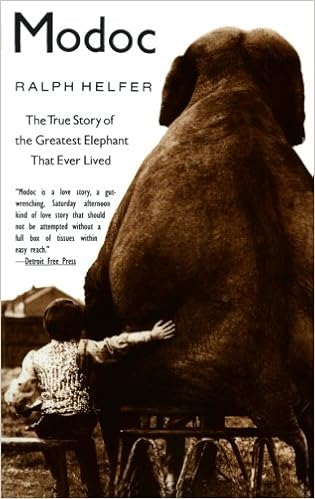
Book Review: Modoc

Modoc: The True Story of the Greatest Elephant That Ever Lived

by Ralph Helfer


This is a very sweet book, an amazing story about a remarkable elephant. It is also unbelievably cheesy.

That doesn’t have to be a problem, of course. Most love stories are cheesy to one extent or another, and this is, most definitely, a love story. It’s a story about a man named Bram Gunterstein and the three loves of his life: the two women he loved, Sian and Gerdie, and the elephant, a female Indian pachyderm named Modoc. He called her Mo. Mosie.

Mo and Bram were born on the same day, in the same hour, on the farm owned by Bram’s elephant-trainer father, near the Black Forest in Germany. The two grew up together, and the pastoral idyll of this portion of the book is almost painfully innocent and sweet – it did, for me, get a bit saccharine, especially when Gerdie comes into the picture and she, Bram, and Mo spend summertime frolicking through the hedgerows and splish-splashing in the lakes. Ah, Youth. But then reality catches up and the owner of the circus where Modoc performs with her elephant family sells everything to an American circus owner. Bram is to be left behind as Modoc and the other animals are moved to America.

But Bram can’t leave Mo. So instead, he leaves Gerdie – and as sad as it is, it is clearly the right choice.

Unfortunately, when Bram and Modoc leave the pastoral perfection of their childhood, frankly, the shit hits the fan. A whole lot of shit hits a whole lot of fans, and spreads far and wide. The two have incredible adventures, most of them in some way terrible. There is suffering, war and blood and death, disease and starvation and fire and misery. There is also a tremendous amount of love, and quite a lot of spirituality; Bram believed that the way to God was through communion with nature, particularly through close bonds with specific animals as he had with Modoc. If he was right, then he no doubt found his way to God, because I can’t imagine a closer bond than his with this elephant.

In the end, I liked the book. It was absolutely riveting at times, and heartbreaking at others; though the author, Helfer, who knew Bram and Modoc both towards the ends of their lives, tends heavily towards the cheese, I would say it’s because he’s an animal trainer, not an author. I will also say he’s a much better poet: there is a memorial poem he wrote included at the end of the book which is by far the best moment of writing. But even if he was a terrible writer – which he is not – this book would be worth reading just for the story, and the characters. Definitely recommended.

Malala

I Am Malala
by Malala Yousafzai and Patricia McCormick


I saw Malala on The Daily Show, after hearing about her, of course, when the shooting happened and she became the international cause celebre; I was impressed by her poise and her humility, as well as her courage and her dedication to her cause.

I had no idea.

After reading this book, I am more than impressed: I am amazed. Because she just doesn’t make that much of it. She talks mostly about her family and her homeland and her childhood: about fighting with her brothers, about gossiping with her best friends at school, about how disappointed she was when she didn’t win first place in her class. She talks about how close her relationship is with her parents, and her parents’ different roles in the family: her father, the idealist, pushing for change, trying to do what he thought was right; her mother the steady one, the rock that the family held onto and held itself together. She herself comes of as very much an ordinary girl: when the Taliban began invading her homeland, the Swat River valley in Pakistan, she doesn’t even mention at first when she began giving interviews and talking to community leaders about the importance of education; at one point she just says, “I had already appeared on television a few times talking about these matters.” This when she was eleven.

The shooting itself, she doesn’t remember. Understandable, considering that she got shot in the left temple, and bone splinters stabbed into her brain, and an infection led to emergency surgery that removed part of her skull, which was eventually replaced with a titanium plate. But still: her main concern when she awakes several days later in a hospital in Birmingham, England, is: How is my family going to pay for this?

It’s remarkable, really, how this young woman manages to be so incredibly courageous and dedicated, and yet see herself as nothing special. She’s just doing what she feels she has to do, what she believes God requires of us all: to speak the truth and let falsehoods wither in the face of it.

It’s an interesting story, because it shows the slow progression of the Taliban’s invasion of the Swat valley, how it began with a radio show that called for the rejection of Westernization and “modern” ideas like allowing girls to be educated. Malala’s father had founded a school, which taught both boys and girls from primary through secondary grades; so he, of course, held on to his passion for education and tried to bring attention to the plight of the area as the Taliban grew more and more powerful, first through influence and propaganda, and then through violence and terrorism. Meanwhile, beginning about age eleven, Malala took up her father’s cause, as well, keeping a diary for the BBC that showed the daily life of a Pakistani schoolgirl under the Taliban’s rule, and then giving more and more interviews and speeches fighting for the right to an education for everyone, especially young women. Until, of course, she gained the attention of the Taliban, and they tried to silence her.

Boy, did that not work.

I would highly recommend this book for everyone, but most especially for young people — of course for young women. It’s a lot like Anne Frank’s diary in that Malala really does seem like a regular school girl; she worries about her appearance, she constantly fights and makes up with her best friend; and — oh yeah, incidentally, she fights for her right to learn against violent madmen. She is both relatable and a wonderful role model, and her story should be an inspiration to all of us to focus on what is actually important, in this violent world we are all trying to live in.

Excellent book. Read it, and give it to your daughters, and your sons.