The Price

I saw an opinion piece which stated that schools today don’t teach enough economics.

Fair enough. I don’t think that’s the biggest problem – I will argue, probably in future posts, that the lack of humanities education is at least partly responsible for the loss of empathy which is at least partly responsible for the rise of Trump – but it’s certainly true that schools don’t teach a whole lot of economics.

But you know what? Even though I didn’t learn economics in school – not one jot, not one tittle; I knew nothing whatsoever about macro or microeconomics by the time I finished my compulsory education – I did learn how to learn: and I have learned some of the basics of economics on my own.

I have learned enough now to correct the mistaken argument I accepted from my students in Oregon over a decade ago, which was part of the impetus for me to learn some economics, because I hate losing arguments, and I hate feeling stupid, and I thought, back then, that my students had won an argument and made me look stupid in the process. They were saying that immigration caused inflation, which I thought (without any strong factual basis, just vibes) was false; they said, “But immigration means more people buying things, which raises demand.”

“Right,” I said, waiting for them to get to the point.

“Raising demand raises prices,” they said.

“Right,” I said, still waiting for them to get to the point.

“…That’s inflation!” they said, and then chortled when I turned red and flapped my open mouth uselessly, unable to reply. I felt dumb. They won that argument.

Well, kids, it’s not that simple, and I know it now. Now I would say, “Increases in demand only raise prices when there is a restriction in supply; once the supply increases to match demand, that should level out prices unless there is some other upward pressure on the prices. So if immigration is slow over time, and spread out over an area as large as the US, it probably wouldn’t change prices at all: it might lead to a temporary spike in any given location, but once the supply chain adjusted, then all that would happen is a greater volume of sales, spurred by more customers, who also enter the supply side of the chain by getting jobs and adding to the aggregate productivity – and we call that growth. Not inflation.”

What’s that? You say the actual information, the specific content, which I gained during my primary education wasn’t nearly as useful as the skills I gained??

BUT ANYWAY.

(I don’t doubt, by the way, that I have made some errors in the above long-awaited rebuttal to students who couldn’t possibly remember the original argument; none of them will even see this post, I’m sure. My economics understanding is far from complete. But it still feels good to say that, so I’m going to leave it there.)

Here’s something I do understand, and would like to discuss now that we have some better idea of what the numbers are: the costs, and the benefits. We’re looking for a balance: and preferably greater benefits than costs. Right?

So what has Trump cost us? Compared to how we have benefitted from his election?

When Trump got into office, and I learned from at least one friend on Facebook that their vote had gone to Trump in hopes that he would bring down grocery prices and restore the (apparently) wonderful economy that we had in his first term, I decided I would keep track of the prices people wanted to elect this man for. Because I understand: I have spent most of my adult life not making quite enough to be comfortable, not enough to have it easy; things like price hikes and tax increases and wage freezes, furlough days and interest rates and insurance – I have been pinched by all of them, and slammed by some – have all caused pain and worry. Not to mention what I’ve had to go through with student debt, house debt, deferred maintenance costs, and medical bills – including medical bills for my pets. I get it, I really do, I understand why kitchen table concerns override most ideals, no matter how important those ideals may be. I understand that people are hurting: believe me, my family is too. We have debt. We have a mortgage. We have family medical costs, now. My mother, who will turn 81 this summer, is working, full time, to pay off her mortgage and her back tax bills. (I will mitigate that last one slightly by saying that my mom is a nurse, absolutely loves being a nurse, and the work she is doing now is in-home hospice care, mostly things like keeping an eye on someone overnight or while family caretakers are away. It is not heavy work, and she likes doing it. But she’s fucking 81, and she is still working. Full time.)

But now that we are two months in, almost two-thirds of the way through that “First 100 Days” marker that we like to make so much of, I think it is time to look at different prices. To be specific, I think it’s time we looked at the price we are paying for Trump: what it is costing us to have Donald J. Trump as our president, this second time around.

Ready?

First, gas and eggs:

As you can see, they have not gone down. Egg prices shot up because there has been an outbreak of avian flu, and millions of chickens have died or been put down to prevent further infection; eggs are in comparatively short supply right now. They will remain in relatively short supply until the chickens can be replaced: which means that even more of the eggs that might go to market will instead have to be used to hatch new egg layers (Not directly, of course, because the eggs we eat aren’t fertilized: but some clutches, some hens, some broods, however the egg farmers arrange and measure this, will need to lay fertilized eggs instead of unfertilized eggs, and that means fewer eggs produced for sale. And we are talking a LOT of chickens, and thus a LOT of eggs.), and then we’ll have to wait until those new chicks get big enough to lay eggs themselves. So it will be a while. And all of that assumes the bird flu which caused the problem gets resolved, the chances of which don’t look great right now. But while we are waiting on our egg prices to drop, it is also true that grocery prices in general have not dropped. Grocery price tracker: Inflation trends for eggs, bread and more during the Trump administration

It is to be expected that, assuming that some (or all) of the tariffs remain in place, prices will go up, which will include grocery prices. Trump Tariffs: The Economic Impact of the Trump Trade War

It is to be noted that Trump’s constant promises to lower grocery prices starting on day one appear to have been lies: this has not been his focus since taking office.

Gas prices have also not gone down, because again Trump has done nothing to lower them. “Drill baby drill” means nothing if you are looking to drill within the continental US; our oil is the wrong kind to make gas. And Trump has proposed a 10% tariff on Canadian energy – which is where we get most of the crude oil we turn into gasoline.

Why Trump’s fix for gas prices won’t work | CNN

“Why don’t we just start using American crude oil? Champagne oil sounds so nice!” Because oil refineries are set up to handle certain products, and changing them to other products is either too expensive, too slow, or just impossible. I mean, in theory the federal government could step in and use tax dollars to make the changes or subsidize private refineries so they could make the changes…

But that would require actual reliance on, and responsible management from, the federal government.

So: gas prices are not going down, probably will go up. Egg prices are not coming down for a long time, months if not years before all of the supply chains are back to where they were before the avian flu (and that also assumes there won’t be any other price shocks in the egg industry, or the grocery industry, or anything else – like changes in interstate commerce, or retaliatory tariffs, or hell I don’t know, a nuclear war with Russia).

How else are we paying for Mr. Trump’s return to power?

Well there’s the stock market.

United States Stock Market Index – Quote – Chart – Historical Data – News

You can go look at the graph. The stock market jumped up right when Trump was inaugurated, and climbed slowly upward to a new high a month in, on February 19th – and then, tariffs. And the Dow Jones took a dive. It’s coming back up, the last couple of days, because the Fed announced they still plan to lower interest rates this year, because the overall economy is still strong and improving; but the temporary stays and exemptions Trump put on his own tariffs expire in two weeks.

So we’ll see.

The stock market is not the economy, and the market is volatile, so I don’t intend to use this as the only or even the main measurement of the cost of Trump; but it’s surely been a jolt to people with retirement savings in mutual funds.

I wonder how many of them voted for Trump?

So what else is there?

Well, there are all the people who have lost their jobs. And while I’m sure that hardcore Trump supporters will argue that these are actually benefits to the American people, because we are saving money by cutting these people off the government payroll, I’m going to look at the other side: we are losing their services.

DOGE Cuts Update Today: Social Security Changes, Pentagon Slashes Jobs – Newsweek

Let’s see: the Pentagon is cutting 60,000 jobs, which is actually fine with me in terms of our military budget and activities; I would like both to be curtailed. But that sure is a lot of people to put out of work. I’d really rather see those people still working, and maybe a couple fewer aircraft carriers and whatnot.

The EPA is cutting 1,000 scientists. The Department of Education is laying off 1,300 employees – and now Trump has issued an illegal order to shut down the department entirely. 24,000 probationary employees were fired; several of them will go back to work because the administration lied about having fired them for cause – but also, by the time the cases work through the courts and these people are allowed to go back to their jobs, many of them will have found other jobs, because who wants to wait several weeks or months to go back to work for somebody who fired you with a goddamn email from Elon fucking Musk?

The IRS is cutting 20% of its workforce, 18,000 jobs – which is great if we don’t want to find waste, fraud, and abuse among billionaire tax cheats and corporations contorting through loopholes and government contracts – and the USPS is cutting 10,000 people, which is great if we don’t want to, you know, communicate and stuff. But that’s fine: nobody even wants to know what’s happening now. We don’t want to watch this shit show.

The Veterans’ Administration is cutting 80,000 workers. I have no jokes at all to make about that. I have spent the last year and a half, with my wife, trying to work a claim for her mother, who is the widow of a veteran, through the VA’s system. I tried to do it myself. I couldn’t do it: after thirteen months of trying to make it work on my own, I finally got help from a VA counselor whose expertise is in helping people finish their claims. He got it done for us in two months. Now my mother-in-law is receiving the widow’s benefit she deserves, and needs.

Was that guy cut?

He is a veteran himself, and now he helps fellow veterans and their family members get into and through the system. He is kind, and professional, and very easy to work with and to talk to. He helped us.

So you tell me: if he was cut (and I honestly don’t know if he was, but 80,000 is a big fucking number, and I have no idea how many of these counselors and account managers are going to be cut in the future even if they weren’t thrown out in this first round), was that a benefit to our country? Or a cost?

How about the Social Security Administration? There are cuts coming: they are closing regional offices, and they are reducing workforce – firing people, that is. Oh, and also they are making it impossible to verify your identity over the phone, which means people who need to talk to the SSA will have to actually go into an office and talk to someone to get help with their account.

Right when they close offices and cut the number of workers available to help people.

How about that one? Cost, or benefit?

How are those eggs looking now?

My problem with all of this, of course, is that I don’t see any benefits: I only see costs. I see our economy getting battered, and people being callously thrown out of work, and services that I know directly are incredibly important to the point of life an death being cut. I guess people who hate the government are happy, but as I understand it, people hate the government mainly because it doesn’t help people: and while I’m sure that is the experience some people have, it is not the experience that others have; and surely, we can see that ripping the whole system into tatters is not going to help people more. Trump claims that there will be benefits in the future, but Trump is a known liar; and to my knowledge, he has never explained clearly what benefits will come from all of this, or exactly how they are supposed to arrive. Are we really supposed to believe the same old trickle down economics lies? That if we cut taxes for the richest 1% then the rest of us will be better off? It didn’t work the first time Trump did it, or when George W. Bush did it, or – EVER. So I’m not going to accept it now.

So if anyone actually knows what benefits there are to all of this to offset these costs, please, write me and let me know. I would really like to know what the upside is.

I would love to learn.
Really Really

Last week I wrote that the education system, for all of its flaws and issues, is necessary.

But is it really?

Really really?

Really Donkey GIF - Really Donkey Ahhh GIFs

I think that I am not sure. I want to say, without the shadow of a doubt, that it is: because education is necessary (That, I am sure of), and because there are so many people in the world who need education, there’s no way to tear down the structure we have now and build a new one — or even live without one entirely, and let people learn on their own — without losing a whole generation in the transition.

But that seems to me like an extraordinary statement: that we would lose a generation. We wouldn’t: they’d still be there, still be alive. I mean that they would lose their opportunity to gain the same education that every generation has had for the last 150 years in this country, and would lose, therefore, their ability to thrive in this culture and in this economy. But look at how much of that statement relies on the assumption that everyone should be like me, should be educated like me, that everyone should be like everyone else. I assume that the generation who would not get the current education from the system would suffer, as I know people suffer who do not succeed in education: they have to work harder, and they earn less, and they miss out on opportunities to experience life more fully: they don’t appreciate art, they are less aware of the wider world and what it has to offer, and are therefore more likely to be xenophobic and afraid of change and new experiences and ideas. But I also know that all of those things can be gained on one’s own, with travel and experience and exposure to other cultures and ideas and people.

When I say we would lose a generation, I mean that we would be saddled with people who wouldn’t be as productive, who would struggle more and need more help, and who would tend to resist and slow down our forward progress, and would certainly not contribute to it. We’d lose a generation of more of — us. People like us, like you and me. That’s what I imagine would happen if we stopped educating people. I assume they would gain the basic skills, from their parents and from educational games and Sesame Street and whatnot; and then I assume they would know little else other than entertainment, at least until they learned things the hard way, through experience, through life.

But.

That’s a lot of assumptions. And a whole lot of what I can’t describe as other than elitist bullshit. Because the core argument there is, without the system that made me, there would be people who would not be like me. Which assumes that I am how people should be. That being unlike me would be bad.

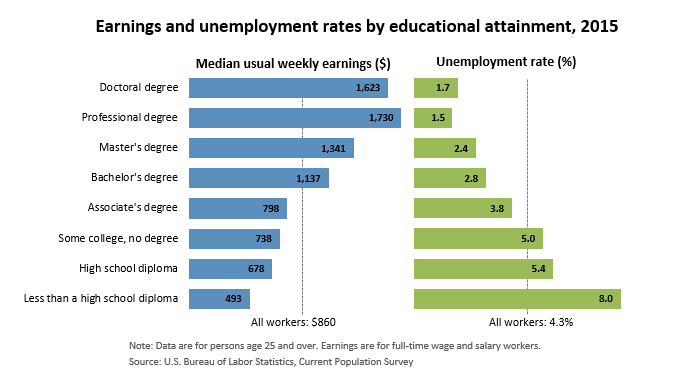
I don’t like it. I don’t like thinking that way, that my assumption of the necessity of education is just that, an assumption, and one based on elitism. Don’t get me wrong: there is evidence for it. Scads of evidence. Oodles. There are countless statistics which show the benefits of education:

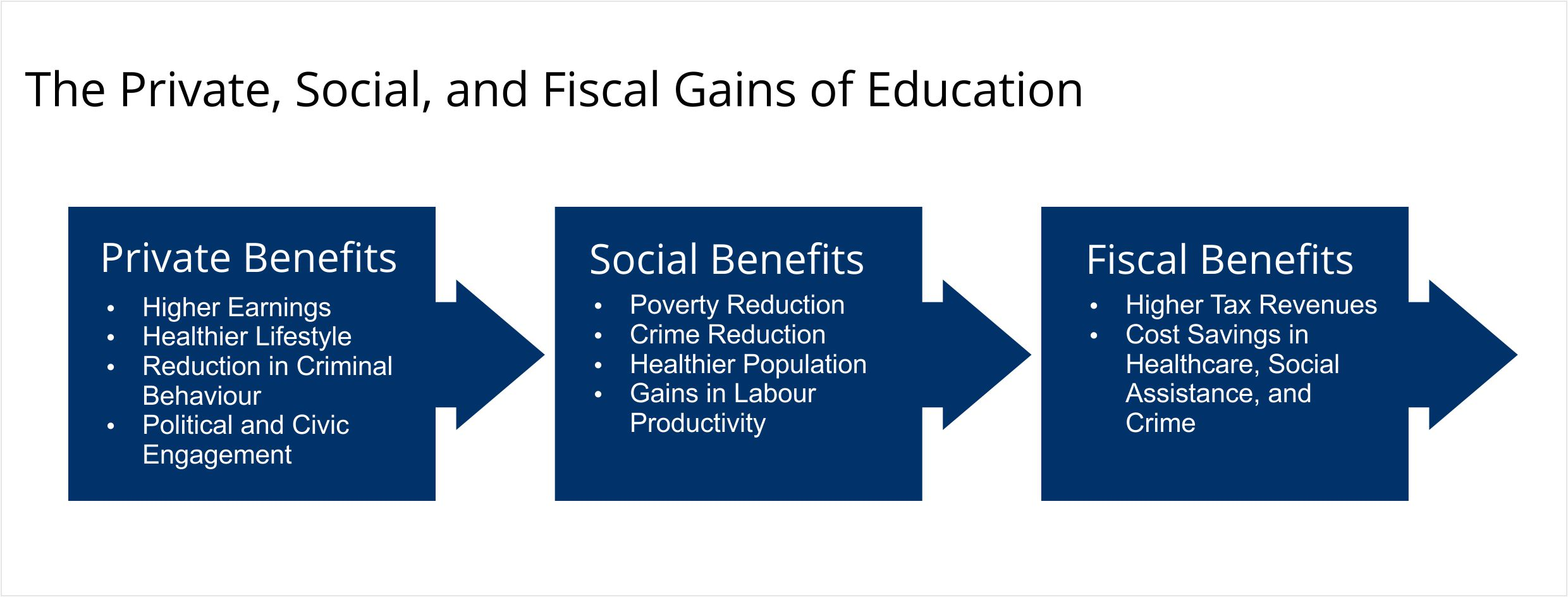
Though now that I have looked at the Google search results, I see that the only statistics they show for “benefits of education,” other than benefits for certain kinds of education within the system such as the benefits of arts education or of inclusive education for students with disabilities, is exactly that one: that more education leads to more money. Which is not the most interesting argument for me, because I do not believe that life revolves around either career, or money; so using that as the sole focus for a discussion of education is obnoxious: I want to know what benefits there are, in addition to income, for the people who go through the school system. There are other benefits: primarily that more educated people have better health, more stability, and commit less crime. Here, this infographic lists several of them. (I was not trying to make a point about the total focus of education on earning money, but I guess that point is unavoidable, isn’t it? Hold onto that for a moment. Let me make this point, which is broader.)

That’s what I was talking about, that there are a number of benefits of education. (Here, this article from UMass [Woo! Home state comin’ through! Wait — what the heck is “UMass Global?] lays out the facts I have seen referenced before, with links to further resources to support the asserted health benefits associated with highly educated people, which are: 1. They’re likely to live longer, 2. They probably won’t experience as much economic or occupational stress, 3. They’re less likely to smoke, 4. They’re less likely to experience common illnesses, 5. They have fewer reported cases of mental health struggles, 6. They tend to eat better and maintain regular exercise habits, and 7. They’re more likely to have health insurance. I presume all the other benefits in the infographic are also supported by studies and statistics.) I have used these arguments in the past, in my own head if nowhere else (And 99% of the arguments I have in life are only in my own head. Since I teach argument, write arguments, and argue online on both Twitter and Facebook, that should give you an idea of how much of my usual headspace is filled with argument. [Jesus, I need to relax. No wonder my blood pressure has been going up.]), and I have heard them and seen them used many times to support the argument for education.

But here’s the thing. And again, I hate this — as you can tell by my obvious reluctance to actually make this point, and most of my arguments with myself over the past week have been between the part of me that wants to face this and the part that wants to hide from it — but I do believe that honesty is not only the best policy, it is the foundation of all other communication: so I need to say it.

None of those benefits are necessarily caused by education. All of them are only correlated. There is no reason, in most cases, to assume that the education itself caused the benefit.

People with more education earn more money in our society, yes. (Though of course, there are exceptions.) But is that because the education — the actual knowledge, not simply the achievement of a degree or certification– is necessary to earn the money? In some cases, most obviously doctors and lawyers and scientists and the like, the answer is emphatically yes, of course; but in many, many cases, the reason the higher income is correlated with the higher educational attainment is because those jobs insist on those degrees.

And I hope we all know that a degree is not necessarily because of actual education. I would make more as a college professor than I do as a high school teacher (Though really, not much more, unless I reached the most elite heights), and even though I guarantee that I could teach a college course better than many current professors, I can’t have that job because I don’t have the degree for it. I have the knowledge and skills and experience; and in my case, since continuing education is a requirement for recertification as a teacher, I have something like two to three times the post-graduate credits for a Master’s degree; but I don’t actually have the degree, so I can’t have the job.

For most of the rest, the correlation is far more connected to two other factors, which are certainly causative in our society: class, and race. Wealthier people have better health outcomes; and whiter people have better health outcomes. Primarily because health in this country costs money, and secondarily because the system is racist. Wealthier people commit less crime; whiter people commit less crime (Though that one is fraught for a bunch of reasons, because people of color are overpoliced and underpoliced simultaneously, so are more likely to be caught, arrested, convicted, and imprisoned for crime; in actuality, in this country, whiter people do commit more crime because all racial groups commit crime at about the same rates, and there are still more white people in this country than any other racial group. Most importantly, all crime rates are heavily dependent on socioeconomic factors, and those favor white people in the US — so again, the correlation is not causation in this instance. But to my point, it still ain’t because of education.) Wealthier people (Also older people) have greater civic and political engagement; whiter people have greater civic and political engagement.

Both of these factors, socioeconomic class and race, are also closely connected to — and causative of — educational attainment. Wealthier people have more education, because they can afford it and because they have more opportunity to pursue it: they don’t need after school jobs, or just to drop out and work; they don’t have to commute (or if they do, it’s in comfort); they don’t have to struggle for resources and materials like books and computers and access to libraries and so on. If they have kids (Statistically less often when young) while they are seeking education, they have greater access to childcare; ditto for providing care to older or disabled family members. People get more education when it’s easier to get, and when you feel rewarded for your successes in it, so this feedback loop is self-amplifying. White people — and again, this is largely because white people in this country are more often wealthier people — have all the same advantages. So this is mainly why educational attainment and these positive outcomes are correlated: because both are influenced causatively by class, and by race.

And then, as I noted briefly above, I have to also point out that many of the benefits overall are benefits economically: notice the “social benefits” in the infographic include “Gains in labour productivity.” And that whole third arrow section is about how all of society benefits when all of us make more stuff and make more money. I love the one one there about how society saves costs when individual citizens commit less crime and have better health. Maybe we should make motivational posters based on that. “Don’t do drugs, kids, or else you’ll become a drain on society’s resources.” So for all of those, the issue here is, there may be benefits of greater education — but for whom? In this society, where 90% of the wealth is held by 10% of the people, and almost all the gains in the past 50 years have gone specifically to that same 10% of the people, almost all the benefits correlated with education do not accrue to those who go through the system.

Leslie Nielsen Naked GIF - Leslie Nielsen Naked Gun GIFs
Sorry, but I can’t not use Leslie Nielsen. Consider it a spoonful of sugar to make the medicine go down.

So. That’s the truth. The education system creates some positive outcomes directly: I do think that greater civic engagement is good for the people who involve themselves, and I certainly think that greater awareness and understanding of the system and how it works and what is going on helps to create that engagement. But I think we can clearly see from Donald Trump and the MAGA movement that strong civic engagement does not come only from people who are the product of the educational system. And there are, as I said, a number of professions which require education; and those are important both for society and for individuals who wish to pursue them, and so those opportunities coming from education are good.

But that’s where it starts to break down for me, again: because do people who study law, and medicine, and science, really need to go through the education system? For most of them, it works, and so it isn’t an obstacle to positive outcomes; but is it necessary? Are there people who would make excellent doctors even without education? What about lawyers?

That’s not the right question, though: of course people need education to be able to pursue those occupations. The question is: do people need to be educated by a system? Can they be self-taught, and successful?

And the answer is: Malcolm X. Who had an 8th grade education. Who taught himself in prison. And who then could do this. (That last one is an hour-long speech he gave. Without a teleprompter. Compare it to any politician you can think of, both in terms of content and presentation.)

He’s not the only example, of course. There are countless others, countless because we don’t usually keep track of people who are well-educated outside of the formal system, unless they do something we laud, such as earn billions of dollars or something similar. But Malcolm X was so incredibly intelligent, so incredibly capable, so incredibly knowledgeable — just so incredible — and only and entirely because of himself, with some influence and then support from others, including his family and his faith community. But never, in any way, was he supported by the system: and yet, what he could do, and what he did, is amazing. Simply amazing.

So the truth is, the education system is not necessary. It works, for the most part, for millions of people, and that’s good; but the existence of millions of people for whom it does not work, and the existence of countless people who don’t need the system to succeed, forces me to ask the question: is the system necessary even for those millions of people for whom it works?

And the answer is, I don’t know. None of us do. We have no way to compare: education is only one path, and there is no way to come back and choose a different path in the same life, to determine what would have happened because of that other choice. (Yes, that’s a Robert Frost reference. But did you need to understand the allusion to get my point? [I think your experience is richer if you did understand it, or if you click the link, read the poem, and figure it out. I’ll get to that.]) We can look at people with education who succeed, and people without education who struggle, and we can assume that education was important for them. But in both cases, we’re cherry-picking both the examples, and the definitions of “succeed” and “struggle.” By other definitions, and in other examples, education is irrelevant where it isn’t harmful.

So last week, when I wrote that the Labyrinth was necessary and important to contain the monster, I could only make it make good sense by joking about it: because otherwise the children are the only Minotaur, the purpose and reason for the construction of the Labyrinth, the thing at the heart of the edifice; and children are not a monster who must be contained. It’s pretty upsetting to think of them that way, and to think of school as a way to contain them — quite literally putting them in the box and making them stay there, without letting them out of it. I don’t want to be that teacher, or that person, who really thinks that. I don’t believe in my usual practice that I am that teacher; there are very few instances where I insist that a student conform to my rules or expectations. But I made the joke. And when I was thinking for this week about wanting to explain and justify that joke, by explaining how the education system is necessary and important, even if the Labyrinth isn’t a good or appropriate analogy for it (In terms of the Minotaur aspect; in terms of the inescapably complex maze, it is a perfect analogy. But if you don’t need the maze, if the purpose of the maze is not valid, there’s no reason to maintain the maze.) I sat down several times intending to look up the facts to support that argument.

But I always hit this wall. I know the reasons people argue for education. And I don’t believe them.

There is the aspect I mentioned at the beginning of this, and reference with my overwrought allusions. Education expands the mind, and expands the world. Even apart from the professions that require extensive specific knowledge — and ignoring the toxic narrow-minded view that education is intended primarily to promote economic outcomes — education gives people the ability to create and apply creativity; to identify, measure, and solve problems; to connect different ideas and areas of knowledge in order to gain new insight or create new things; to communicate and empathize with others; to dream and achieve those dreams. Without education, art becomes pale and shallow, and that’s a truly terrible loss. Without education, scientific and technological progress becomes impossible, and that’s — not necessarily all bad, but it does create the possibility for great suffering, if we don’t keep changing to match our changing world. Education is necessary for many people, for many reasons: and I don’t believe education itself is ever harmful.

But education is not the education system.

I do think the Minotaur/Labyrinth analogy is perfect from one perspective: mine. And those of people like me. Because like Minos, and unlike the Minotaur, we need the Labyrinth. I am a good teacher: largely because I work well within, and slightly in opposition to, the educational system. I make the classroom a comfortable place, I make it easier for my students to come to school and succeed and feel valued there. And that’s a good thing. I also teach literature and reading and writing and thinking well, and that’s a better thing. But the things that I teach don’t need to be taught within the system: I have thought often of how much I would love to be like Socrates, or one of the other ancient philosophers, simply declaiming and discussing in the public square, teaching anyone who wanted to learn. That would be so much better than requiring a classroom full of 15-year-olds to write a five-paragraph essay. But you see, I couldn’t make a living doing that. To make a living, I need the system. My other gifts as a teacher, the way I help my students survive through the trials and tribulations of the system — not only do I not need the system to provide support to people who might be struggling, but without the system, those people would not need me. To be meaningful, I need the system.

Basically, to deal with my own problems, I need to make sure other people have problems, too. And that’s Minos and the Minotaur and the Labyrinth. Let’s take note that, not only was the Minotaur captive in the Labyrinth, but Daedalus, the artificer who designed it, was also held captive by Minos; and the tribute of 14 youths who were fed to the Minotaur every year were sent by Athens because Minos defeated them in a war. None of those problems would have existed if Minos hadn’t created them.

And the same goes for the education system. I, like Minos, could make different choices, and live a different life; I don’t believe that teaching is literally the only thing I could do — for one thing, I’d make a hell of a therapist. So I don’t literally need the educational system, I simply benefit from its existence. Minos didn’t need the Labyrinth: he could (in theory) have made better choices in the first place, and never had the existence of the Minotaur to burden him; but if he did end up with the Minotaur, I bet there could be other solutions to the problem. First and foremost, the man lived on an island: surely there were other, smaller, islands nearby. Maybe he could have built a lovely little home for his man-eating stepson, far away from the people of Minos’s kingdom; finding food might still be an issue — but presumably the Minotaur didn’t have to kill what he ate, and dead people are not terribly hard to find. Within the context of an ancient civilization, the Minotaur would be a hell of a capital punishment for Minos to inflict on Cretan criminals.

So the truth is, we may not need the education system at all, other than as a way to maintain the lifestyles of people who are part of the system: and even as one of those people, I don’t believe that justifies the Labyrinth. It is unquestionably valuable and effective for millions of people, as I said; that may be enough benefit to make it worth keeping and trying to fix the flaws and failures that make it useless and even damaging to millions of others, and ideally to make it relevant to the countless people in the third group who just don’t need it. Education is good for all, and harmful for none; maybe we can make the system reflect that. But it is also possible that a wholly new system, or no system at all, in this age of available information and crowd-sourced instruction available to anyone with broadband, would work better for more people.

I’m going to endeavor to figure it out. That’s the long term goal of this series, of this blog. To decide whether or not we need the education system (And if we do, how to fix it), and whether or not we need to replace it.

Shrek Really Really GIF - Shrek Really Really Seriously GIFs

This Morning

This morning, I don’t get paid enough.

I know that’s not a complaint unique to me, and it’s not one unique to teachers. But it’s the truth: I don’t get paid enough. The job is appallingly stressful, and also poorly paid compared to other careers with similar requirements as to education and credentials. 11.1% less than comparable careers, according to this article. In the past, this was compensated for by the benefits, which were better than most other careers offered; now, of course, that is no longer true. Teacher benefits are not any better than most other careers, or not much; and it still doesn’t make up for the pay  gap — that article actually shows that teacher pay is 18.7% less than other careers; the 7% boost in benefits that teachers average is what brings us to almost ten percent lower pay.

Almost.

But none of this is news, neither to you nor to me.

What was news, though, was this. Turns out, I’m paid WAY better than I thought.

I got this — letter — in the mail. It describes my compensation.

This is strange for a few reasons.

First, because why is this in the mail? Why wouldn’t it be an email?

Second, because — I already know my compensation? I signed a contract for the year with a number on it; that number doesn’t change. It’s a year-long contract. That’s what I get paid. There isn’t any change to my compensation in the letter. (There is a single notification that they will be increasing their 401k contribution. But that’s buried in the 5th paragraph, and doesn’t apply to me since I don’t donate to a 401k so they don’t match.) So why send it?

The letter says (And I would include a picture, but I don’t actually want to throw the school I work for under the bus; even for those who know what school I work for, this post should not and will not have their name on it, so as not to make this inappropriate for an employee to post. I thought about redacting names and addresses and such and then posting an image, but the company logo is in the background of the compensation chart. Is that why they used letterhead? To prevent me from doing exactly this? Whatever: the letter is addressed to me, it’s my property; I’m going to share its contents, at least in  part. Consider it part of my compensation.) “The leadership is pleased to provide you with your annual, personalized total compensation statement.”

Notice it doesn’t say why they’re pleased to share this with me. I’ve worked there for five years, my wife has worked for the same school for three years; we’ve never gotten these letters until this year, when we both got one.

It goes on to say that my compensation package includes a benefit program “designed to furnish you with protection against financial devastation due to illness, disability, loss of work, retirement, or death.” As a rhetoric teacher, I find the order of the items on that list fascinating. The letter also says that my compensation package includes the contributions made directly by my employer. A strange statement: contributions to me? Of course. Contributions to a third party? How is that my compensation? Is this like one of those deals where you donate to a charity in someone’s name and call it a Christmas gift?

The letter says that some of these benefits are mandated by state and federal law, but “most” are provided by the company because “your wellbeing is important to us.” Then they encourage me to review the statement and share it with my family, so that they are aware of the benefits that apply to them. Seriously? You think my family doesn’t know what benefits I have? You think if my family doesn’t know, it’s because I forgot to tell them? They do, actually, because it says, “Often our day-to-day responsibilities distract us from truly knowing and understanding what protections we have and the value of that protection for our loved ones.”

So they think I don’t actually know what my compensation is. Not my TOTAL compensation. Including contributions made by the company. Well, let’s turn this bad boy over and look at the graph on the back!

Here’s what we see: a header that reads “Cash Compensation and Benefits Summary,” over a passage that reads: “The amount of your total compensation is much more than what is indicated in your yearly earnings statement. In addition to direct pay, your total compensation includes the value of your health care insurance, disability, life insurance, retirement benefits, and government mandated benefits.”

Oh it does, does it?  See, I was under the impression that my compensation was what you paid me. Money that goes to the government doesn’t seem like my money, somehow. I also like how they’re taking credit for what the government mandates. “And also, we didn’t murder you. Not once. That’s 365 days  of no murder, every year. You’re welcome.”

Regardless, here’s where the breakdown starts. And it’s immediately weird, because it has my salary (That would be the “direct pay,” which all other compensation is in addition to) as $48,585. Then it adds the $2,200 I earned for being Highly Effective on my last evaluation, to hit $50,785. But the odd thing is, my contract salary is actually $46,785. And that includes the $2200.

Well, they must be including some of the value of my insurance and so on.

But no, because the next row is where we hit the insurance: my contribution ($6,557.98 annually for employee+spouse for medical, $609.96 for dental, $67.08 for vision) next to the company contribution, which is $7,386.02, apparently. Now interestingly, when you add up my three contributions,  which this form does not do, you get $7235.02. That is a lot closer to their number than the single number that theirs is listed next to, which is just my medical contribution. Why, if I were the suspicious sort, I might think they intentionally put their largest possible number next to a number that is not as large as it could be, so that  their number seems relatively higher.

Good thing I’m not the suspicious sort.

We drop down a few rows of zeroes, because I don’t have life insurance listed on here (Which is also odd, because in fact, I do have life insurance  through the company, as does my wife. Maybe the value of that explains the discrepancy in my salary. But you’d think that value would go here, and also, since the life insurance policy is, if I recall correctly, for $50,000, I’d think they’d stack all $50K onto my total compensation. Maybe they could offer a murder program so I could collect on those benefits. Anyhoo.) or long term disability or HSA contributions. Then we hit the Social Security and Medicare contributions. Mine are $3885.05, and the company’s are the same.

See, here’s that Charitable-Gift-In-Your-Name thing. It’s real nice that the company gives money to the government — also known as “taxes” — but I don’t see how that’s my compensation. It’s not money that I owed the government. I paid the government what I owed them. You could argue that I will get that money back from the government in my SS and Medicare benefits, but we all know that’s not necessarily true. So I question this being part of my “total compensation.”

Hey — it must because this is a government of the people, for the people, and by the people, so really, the taxes the government collects? That’s my money. My compensation.

Then we hit a subtotal line, where they put my contributions at $11,120.07, and my employer’s at $11,271.07. (I’m really just curious now about that extra $151.) And then comes the final math and the grand total. Ready?

“Cash compensation,” $50,785. Benefits, $11,271.07. Total, $62,056.07.

Hold on. So not only are we including the company’s contributions to Medicare and Social Security — you know, paying their own payroll taxes — but also, we are NOT subtracting MY contributions to the same government funds? Nor my payments for my medical insurance? So the money I pay to the government, and to the insurance company, which I never get to spend, is somehow still my money? And the money the company pays to the government, which I also never get to spend, is also my money?

Here’s what I really want to know. I want to know why the administration can’t comprehend debits and credits, first of all; but really, I want to know why they sent me this paper. To make me think that they pay me better than they do? Even though I see what’s on my check and what’s in my bank account? Is this so that if anyone questions their budget numbers, they can claim this is what they actually pay me — are they hiding money somewhere, and using this letter to blur the numbers? Is this so that teachers will think that we already get a big enough piece of the pie, and thus we won’t demand more money? Because they’ve magicked another $15,000 into my compensation? I can accept their contribution to my medical insurance as my compensation; I gain a benefit from that, namely medical insurance. But that still only puts me at $54,171.02 (The actual $46,785 on the contract I signed plus their somewhat dubious number for company contribution to my medical insurance).Where’s my other eight grand, homey? DUSTY NEEDS A NEW PAIR OF SHOES.

This upsets me. Partly because they think I’ll believe this nonsense. Partly because they seem to be imagining me not only buying this wholesale, but then proudly sitting down to share this with my family so they can see just how much bacon Daddy brings home. Partly because this is the kind of shit that gets out into the world and gives dumbass anti-teacher conservatives their ridiculous arguments about how well-compensated teachers are. “Hey, I wish I made $60,000 a year!!!” I’m just surprised this paper doesn’t also say, “And look, you get summers off! And you only work until 3 in the afternoon, and most of your job is just playing with kids, right? Am I right?”

No. You’re not right.  You already pay me less than what I’m worth: don’t try to dazzle me with this malarkey. It just gives you one more reason why you should be apologizing to me.

You already have enough of those.