What A Piece Of Work

Meeting Alien Astronaut On Mysterious Planet Stock Illustration 1796849164  | Shutterstock

So every year, I teach a class called College Readiness. It is intended, among other things, to help students apply to college and win admission; since I am an English teacher, that means helping them write application essays. I generally use the Common App prompts — which I recommend, if you’re looking for college admission essay topics — and they write several drafts over the year, with revisions and feedback about how to make their essays more interesting and more effective.

And then, for their last essay draft of the year, I have them pick one of the topics from the University of Chicago’s list of topics. They have two essay questions for their applicants: the first is a very standard, straightforward essay, about why you want to attend UChicago and what you are looking for there; and then the second — well.

They asked prior students and graduates for ideas for essay topics. And those students and alumni delivered.

You should go take a look at them — but here are some highlights.

Essay Option 1

Exponents and square roots, pencils and erasers, beta decay and electron capture. Name two things that undo each other and explain why both are necessary.
– Inspired by Emmett Cho, Class of 2027

Essay Option 2

“Where have all the flowers gone?” – Pete Seeger. Pick a question from a song title or lyric and give it your best answer.
– Inspired by Ryan Murphy, AB’21

Essay Option 3

“Vlog,” “Labradoodle,” and “Fauxmage.” Language is filled with portmanteaus. Create a new portmanteau and explain why those two things are a “patch” (perfect match).
– Inspired by Garrett Chalfin, Class of 2027

Essay Option 4

A jellyfish is not a fish. Cat burglars don’t burgle cats. Rhode Island is not an island. Write an essay about some other misnomer, and either come up with and defend a new name for it or explain why its inaccurate name should be kept.
– Inspired by Sonia Chang, Class of 2025, and Mirabella Blair, Class of 2027

Essay Option 5

Despite their origins in the Gupta Empire of India or Ancient Egypt, games like chess or bowling remain widely enjoyed today. What modern game do you believe will withstand the test of time, and why?
– Inspired by Adam Heiba, Class of 2027

Essay Option 6

There are unwritten rules that everyone follows or has heard at least once in their life. But of course, some rules should be broken or updated. What is an unwritten rule that you wish didn’t exist? (Our custom is to have five new prompts each year, but this year we decided to break with tradition. Enjoy!)
– Inspired by Maryam Abdella, Class of 2026

Essay Option 7

And, as always… the classic choose your own adventure option! In the spirit of adventurous inquiry, choose one of our past prompts (or create a question of your own). Be original, creative, thought provoking. Draw on your best qualities as a writer, thinker, visionary, social critic, sage, citizen of the world, or future citizen of the University of Chicago; take a little risk, and have fun!

So I require my students to choose one of the topics — there are over 40 others after these six — and write an essay on it. And I ask them if there is one topic they would like me to write an essay about.

This was their choice for this year:

You are on an expedition to found a colony on Mars, when from a nearby crater, a group of Martians suddenly emerges. They seem eager to communicate, but they’re the impatient kind and demand you represent the human race in one song, image, memory, proof, or other idea. What do you share with them to show that humanity is worth their time?

And here is my response.

Okay look. There are a bunch of assumptions in this question. First it assumes that I want to communicate with the Martians, when in reality I might just want to atomize them with my Blastotron 5,000,0000X Destructothunderation Disintegratorianator. And that does seem like a poor assumption since I am an American, after all. When have we ever talked first and slaughtered after? Then it assumes – even more strangely – that the Martians have the same senses we do, and would be able to appreciate something I could present to them at all, let alone having the same aesthetic senses or interest in what I would have to present. It assumes that I would have this thing on me at the moment I met them, or access to it (which probably shows an assumption based on the existence and ubiquity of smartphones, which is fine, I would no doubt have my phone with me on the Martian surface – but also, I bet the wifi signal there sucks.), and that I wouldn’t just be limited to what I would normally be able to produce on the spot – which now relies on my performance skills. (Which are, I grant, stellar. Out of this world, even. Especially my punnery.)

And worst of all: the question assumes I believe humanity is worth the Martians’ time. 

So, considering all these considerations, I have several answers, the specific choice between being reliant on the specific situation. 

First, I would not immediately blast the Martians, because of course it would be better to lull them into complacency and then carry out a sneak attack later, preferably on their home territory; that’s the proper American way.

Second, we’ll take it as a given that the Martians would have at least similar senses to mine – though I will say, if they do have a different set of senses, I would absolutely play to that, because a society focused on smell would be far more impressed by our greatest olfactory achievements than any symphony or art work or whatever I could present. (And in that case, the smell would be a Thanksgiving feast: the scents of turkey and gravy, fresh bread, and apple pie, with a delicate touch of the smell of candle wax burning, hickory wood burning in the fireplace, and a whiff of my wife’s perfume.) But for the sake of argument, we’ll accept that they would use primarily sight and sound to interact with their environment, otherwise they wouldn’t be able to communicate their intentions to me, and if they just came at me waving their tentacles or whatever, it’s Blastotron time. On sight.

So what would I show them to prove that humanity is worthwhile – or, in a more moralistic sense, that we are good? See, now we get into questions of aesthetics, for art, or into questions of values in general, and it becomes almost impossible to answer. I recognize that the goal of the prompt is to examine my aesthetics, my values, to find out what I think is the highest achievement of humanity; but since my area of interest and expertise is actually rhetoric, and that means I choose my communication with my audience in mind, I know better than to decide something like this only using my own criteria and nothing else. If you seriously just want me to pick the best thing in the world according to me with no other considerations at all, I’m going to go with the poetry of ee cummings, particularly “anyone lived in a pretty how town.” But see, much of the beauty in that poem comes from understanding both human society and the history of human poetry, and it wouldn’t translate quickly enough to the Martians; so that can’t be my answer.

If we imagine that the Martians have been watching us through Martioscopes for centuries – and why wouldn’t they? Don’t we watch fail videos constantly on YouTube? And what is human history if not one giant fail video? – then the background knowledge necessary to understand the context could actually be assumed; and in that case, I might go with something like cummings’s poetry. Or for visual art, I would probably select Michelangelo’s Pieta, or the Sistine Chapel ceiling. Or, for the sake of including multiple senses in my appeal for the value of humanity, I might go with a performance of an opera or a musical, because that can include singing, dancing, music and literature, all at once. In that case I would pick Hamilton, which I think is utterly brilliant  dramatically, musically, and poetically — though that thought process does lead me to consider movies as a way to include visual and auditory art, and to include many different kinds of aesthetic appeal: and in that case I would choose either Pleasantville, partly because it includes quite a bit of very beautiful art; or Fantasia, because it includes so much beautiful music.

But this all assumes that art is the highest achievement of humanity. I think there is an argument for that, because what is important for humanity, specifically, has to be the things that are unique to humanity; and the only things I believe are unique to humanity are the search for truth, and the creation of beauty, both for no reason apart from the intrinsic value of truth, and of beauty. Other creatures seek and discover truth – the best way to pull termites out of a mound, for instance – but they do it in pursuit of survival, not for the joy of discovery and the goal of understanding. Not that survival is less valuable than art for art’s sake and truth for understanding’s sake; but survival for survival’s sake is less human. So I do think that beauty is one of the crowning achievements of humanity: but I would have a much more difficult time arguing that it is the only, or the best, achievement of humanity, rather than truth.

So I have to also consider: what is our greatest truth?

Is it science? Perhaps; but the creation of the scientific method as a formula is pretty well associated with only one man – and I have a hard time accepting that a dude who died trying to freeze chicken is literally the one best person in the history of humanity. Especially when his name was Francis Bacon. But then, if it’s not science, what is it? What is the one greatest truth that humanity has ever known, which I could then speak to an alien race and show them what we have accomplished?

I can’t think of one. (Take it as a given that it is not math.) Mainly because so much of our truth-seeking has to do with ourselves: and we still don’t know jack about ourselves, not really. I could go with “The only thing that I know is that I know nothing,” from Socrates, or “Existence is suffering, and suffering is caused by desire” from the Buddha; but honestly, I think “All you need is love” by Sir Paul McCartney is just about as profound and valuable as either of those. 

That’s why I turn to art. But that’s not fair: because I’m biased. So my biased answer suits the intent of the essay prompt, as my choice says something about me; but it wouldn’t actually present the pinnacle of human achievement unless I assume that I am qualified to judge that – which implies that I am the pinnacle of human judgment. And I’m not: I ate Peeps dipped in salsa. That was not sound judgment on my part. This, of course, also implies that I should not be choosing the pinnacle of human artistic achievement (though I sure did that without hesitation, didn’t I?), as that too requires judgment.

So I think the best answer is this: I would not choose.

Because I know nothing, because I have great respect for humanity (And much respect for myself, don’t get me wrong; but more for humanity), and because I don’t actually accept the premise of this question, I think that what I would choose to present to show the worth of humanity is – humanity. 

All of it. All of us. Because part of the glory of humanity is how incredibly different we all are, how various, how multifarious; and yet at the same time, how similar: because my mom is nothing like your mom, and yet somehow, the way my mother used to kiss my head when she tucked me in is exactly how your mother kissed you when she tucked you in. Or maybe how your father did, or your grandparent. The way I look up into warm raindrops and smile is exactly the same way you do it, when we are dancing in the rain. The incredible pride I feel when I finish the project I’ve been working on – whether it’s a novel about vampires or pirates, or a bookshelf I built, or the successful sale of my mother-in-law’s house after her husband died – is the same as the incredible pride you feel when you finish what you’ve been working on, whether that is a sales presentation, a complete re-watch of every episode of Supernatural, or helping your child master their dance for the Christmas recital. And yet how much does your child’s dance recital routine resemble my pirate novel?

It depends: does your kid dance the hornpipe?

If I want to show humanity’s greatest achievement, I think I have to show humanity’s greatest strength: our diversity, our individuality, and our unique and personal ability to take almost anything and turn it into a work of art, a magnificent accomplishment, just because one human being – and often, no one else on the whole damn planet – saw that activity, that pursuit, that project, that idea, as worth all of one human being’s time and energy and focus: and thus that one human being accomplished something incredible.

Now, this would likely encounter some resistance from the Martians. Because, as the prompt says, these beings are impatient: they are the ones who asked me for one single piece of work to present to them to represent all of humanity.

But really? That’s just a request for a sales pitch. They’re asking me to convince them that one thing is the best thing in all of human history. (I would prove this by asking them to show me, first, the one thing that represents all of Martian culture. And by the way, if they could do so, then I would have an excellent idea of what their aesthetics or values are, and I could think of one wonderful example to show them in return. But I bet I’m right: because this seems like an absurd request with any race. I mean, show me the best cat of all time. The best horse. The greatest star. You see? There are too many criteria, too many options, in almost any collection of items as large as everything accomplished in an entire race’s history.) So I would first show them this:

And then express that here we have an example of nearly perfect writing, combined with – I wouldn’t necessarily call it nearly perfect acting, because I don’t want to judge; but it’s not only one artist, you see? The words have to be brought to life by the actor, and the end result – is that the accomplishment of one human? Or two? Or many, since directors and acting coaches and everyone else who contributed to these performances also participated in the creation of this moment. And since there are so many interpretations and versions of this particular speech written by William Shakespeare, it’s hard to say if this one is the best version of it – or maybe this one.

Or this one.

Or no. It’s this one.

(Actually, I can’t find a clip of my favorite version of this speech, which was my first encounter with it: when Nick Nolte gives the monologue in the movie Down and Out in Beverly Hills. Other than that one, I think I actually like Cumberbatch the best out of these.)

But the point is, I would argue, that because of the individual ability of humans to interpret reality, and to translate it, inculcating our own ideas and feelings into what we take in, blending what we learn with what we are – to understand one great accomplishment of one human, one also has to appreciate the other versions of the same idea, the same art, the same achievement. When I was young, I was deeply impressed by Thomas Edison – and then when I learned about Nikola Tesla, I was even more impressed by him, because of what I had felt about Edison; and then, honestly, I was once again impressed by Edison (Though I know that isn’t the popular interpretation, as the memes nowadays would have us believe that Tesla was all of the genius and Edison only stole it: but no, Edison was more than that. But this isn’t the argument I want to have with these Martians.).

If I got them listening with my versions of this speech as presented by different actors, I would then point out that every one of Shakespeare’s plays was based on a story written by someone else. That the Bard himself, whom I still consider the greatest wordsmith in the history of the English language, wrote adapted rather than original screenplays – and who knows, maybe the Boccaccio version was better. 

(Okay, that pun might be the greatest accomplishment of humanity. But probably not.)

So then, once I had them on the hook with this idea that different humans can create different versions of the same masterpiece and make it into entirely new and different masterpieces – then I would show them all of humanity that they could ever want to see.

I would show them the internet.

I would hand over my phone, and starting with the items that I have mentioned here – the poetry of ee cummings, and the art of Michelangelo, and the work of Shakespeare and of Lin-Manuel Miranda, and of Pleasantville and Fantasia, and also Mozart’s Requiem and the album In the Court of the Crimson King and Tolkien’s The Lord of the Rings and Arundhati Roy’s The God of Small Things and everything else that is perfect – I would show them everything that can be found on the internet that shows what humanity is and what humanity can do.

Including the wars. And the genocides. The atrocities and the errors and the destructions. The atomic bombs. The Holocaust. The history of holy wars around the world. Because those, the perfect masterpieces of evil that we have created: those are humanity too.

And the Martians should have some warning, at least.

And then, once they were all completely riveted by what they saw on the screen?

Blastotron.

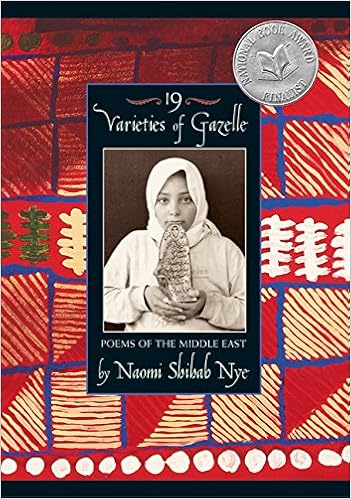
Book Review: 19 Varieties of Gazelle

(In honor of the sad fact that I start teaching next week, here is a book I got from school. Fortunately, it’s a lovely book.)

Image result for 19 varieties of gazelle

19 Varieties of Gazelle: Poems of the Middle East

by Naomi Shihab Nye

I don’t read enough poetry; most of what I do, I encounter at school, while teaching literature to my high school students. That’s where I’ve read Naomi Shihab Nye’s poetry before, as she is often collected in literature textbooks (Particularly in the last twenty years, as the call has gone out for diversity among authors, seeking more women and people of color to break up the Great Wall of Dead White Dudes), and it’s where I got this book. Teachers, take note: the teacher who was in your classroom before you probably had some neat stuff, especially books. Check your shelves and cabinets and desk drawers. Trust me.

I’m very glad I found this, and very glad I read it. It’s a beautiful book. Nye has the gift of using few words to say many things, and to create strong and tangible, poignant moods. I feel like I know her father from her poem about him and his fig tree, and what’s more, I feel like I know more about figs, and also about her because she grew up with that father and those figs. She has captured a clear and powerful picture of the Middle East, particularly Lebanon and Israel and the life of Palestinians, as the book’s poems are largely from the 90’s and early 2000’s. She has also shown what it’s like to be Arab-American, and to feel both connected and separated from life in the Middle East: she has this remarkable view, like an outsider with just enough of a connection through culture and heritage and language to see inside more clearly than an outsider normally can; just clearly enough for it to hurt, mostly, though she is also in awe of the people she feels she can almost, but not quite, understand. And then her ability to write poetry allows me to feel the same thing about her, and about her subjects at that additional remove; I feel for her feeling for them.

It’s an experience. These are beautiful words, and a good book. And, as always, it’s timely, even fifteen years later, because it seems the Middle East never changes.

Beautiful

With all of these arguments — and the end of the school year, when students’behavior gets uglier and uglier with each passing day — I haven’t been writing about beauty. I haven’t been writing enough period, and it’s starting to tell on me; fortunately, the school year ends in five days. I feel like I haven’t  been seeing anything beautiful for weeks, now: I feel like I’ve been sinking down to the bottom of the ocean, everything getting darker and heavier and colder. I hit bottom (Somewhere around where my students in my Lit class told me they’d rather do nothing than read for the sake of reading, and that their grades were all that mattered to them), and now I’m coming up, and now, right now, I can see the light playing on the surface  of the water. I couldn’t do that a few days ago, a few heartbeats ago. Now I can. Now I can see something beautiful.

Last week I got up early enough (My desperate times always bring insomnia with them, which for me is waking up early and immediately starting to think about things other than sleeping) to see something extraordinary, something I have never seen before: the sun was rising, the night just breaking up, the sky still dark, and the full moon was in the sky. It was brighter than I have ever seen a moon before, a shining liquid golden color. But the extraordinary thing was that it was actually behind clouds when I first looked out at the sky, while my dog nosed about the ground in the backyard, and as I watched, the clouds parted and the moon slowly grew in the sky, from a sliver to a slice to a disk, over the course of a time that was just long enough to fall in love. Solid gold emerging in a dark grey-black sky. It was amazing, like the moon was creating itself, appearing from nothing, and made of pure solidified sunlight, even in the pre-dawn darkness, the moon as dream-catcher, flying high above and taking in the sun’s rays as they flew above the Earth, above me. The moon brought them to me as a gift, a gift that (early mornings only having the one advantage, the feeling of absolute solitude, the only existence awake in the world) was only for me. I had never seen the moon that way.

It was the most beautiful thing I’ve seen in quite a while, and coming as it did in the middle of a time without beauty, it was wondrous. The universe, it turns out, can still surprise you.

But then this past Friday, my wife and I went to the graduation at the high school where we both teach. And my wife dressed up for the occasion.

I tried to take a video on my phone of the moon; but it didn’t look like anything but a glowing glob hanging in the sky. Beautiless. Only the moon itself could catch that light, and, luckily, my eyes, as well.

I didn’t even try to take a picture of my wife, because no camera could have caught that light. And there’s nothing I can say to describe how she looked, except to say: she outshone the moon. Golden, extraordinary, appearing out of darkness, made of solid light.

She’s the most beautiful woman I’ve ever seen, and she is a gift just for me, even in a building filled with graduates and families and well-wishers; because she catches all the rays of my love and admiration, and she collects them into herself, and then shines them down on me. Only me. Even in the darkness, she is glowing gold by my side. My love. My light.

My beauty.

Image result for but soft what light through yonder window breaks it is the east and juliet is the sun

I Hear You.

Hear Me Now: This is What I've Always Wanted to Say Poetry by [Watson, Lisa]

Hear Me Now: This Is What I’ve Always Wanted to Say Poetry

by L.S. Watson


I’ve always been amazed by poetry. (Well, once I started understanding it, that is.) I have no ability to write it, at all. For me, words come in sentences and paragraphs, not lines and stanzas; and what’s worse, they come in enormous torrents: I never use just one word when twenty or fifty will do the same job.

So when I find a poet, like L.S. Watson, who has a remarkable ability to use one word to say many things, I have to just stop and admire. And in that momentary pause, I hear what she says.

I do wish there were more words in one way: this little book, Hear Me Now, is too short. I enjoyed it and I wanted it to keep going. It hooked me right from the start; the first two poems, “Ashes” and “Dancing with Raindrops,” are on facing pages, and show two opposite sides: “Ashes” is about the ugliest side of humanity, our penchant for mindless destruction; and “Dancing with Raindrops” is about the indescribable beauty of short, sudden moments, like bursts of wonder, that come at us sometimes when we’re not expecting them and we need to pay attention, or we miss them. Putting these two against each other heightens the impact of each, as the beauty of nature makes it sadder that men destroy it – but that just means we have to look even harder for the beauty.

The book is like that: I have read it twice, and I expect to read it more, particularly “To Whom It May Concern,” “A Thought,” “The Fight,” and “America, the Free.” There are also several poems about heartbreak that I could not relate to quite as closely, and three that showed me the impact of loss on the poet, “Freddie,” “Mother and Father” and my favorite of these, “Share a Memory.” But my favorite poem in the book is “Imperfections.” I love the message and I love the last two lines especially.

The ending lines are frequently used to maximum impact. Watson’s poems are fairly short, usually one stanza, though that stanza often fills the page and runs over onto the next; the lines are short, often just one or two words. She uses rhyme frequently – which, if there is anything that I didn’t love about this book, it was that; I am less fond of rhyming couplets than Watson – and the short lines and the rhyme force maximum attention onto the specific words used, particularly at the end of the poem, which sometimes – as in “Share a Memory” – falls like a hammer, like a thunderbolt. Or like a dancing raindrop.

Suffice it to say, this is a good book of poems; short, like the poems, but strong, like the poems. I recommend it.

The Truth About Beauty

[V]erse is ‘made.’ But the word ‘make’ is unsufficient for a true poem. ‘Create’ is unsufficient. All words are insufficient. Because of this. The poem exists before it is written.

That, I didn’t get. “Where?”

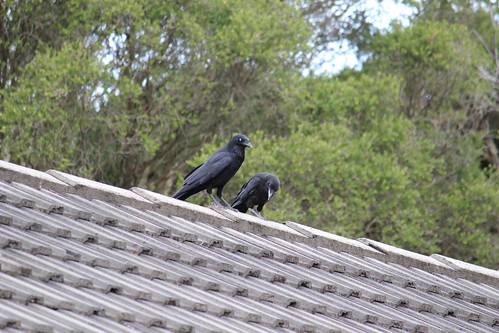
T.S. Eliot expresses it so – the poem is a raid on the inarticulate. I, Eva van Outryve de Crommelynck, agree with him. Poems who are not written yet, or not written ever, exists here. The realm of the inarticulate. Art” – she put another cigarette in her mouth, and this time I was ready with her dragon lighter – “fabricated of the inarticulate is beauty. Even if its themes is ugly. Silver moons, thundering seas, clichés of cheese, poison beauty. The amateur thinks his words, his paints, his notes, makes the beauty. But the master knows his words is just the vehicle in who beauty sits. The master knows he does not know what beauty is. Test this. Attempt a definition now. What is beauty?”

(From Black Swan Green, by David Mitchell)

I read this to my class the other day. And then I stopped and challenged them as Madame Crommelynck, the aged Belgian artiste, challenges her protegé Jason, the 13-year-old would-be poet: define beauty.

Here’s how I picture Madame.

My students couldn’t do it either. They did try, and they were annoyed with me when I disagreed with their assertions, but their answers didn’t work, not entirely. One said, “Every thing is beautiful,” because someone, somewhere, perceives it as such. I asked her if murder could be beautiful, and she said it could, to someone. But I beg to differ: I think anyone who considers murder “beautiful” is also murdering the word “beauty,” making it entirely meaningless. The same goes for any other extreme example: if we broaden the meaning of the word so much that it includes everything, then it means nothing. One argued that beauty is the “absorption of enjoyment.” I took that, like the previous attempt, to be too broad, too all-inclusive; I said, “Have you ever REALLY had to pee? When you finally get to go, isn’t that experience enjoyable?” He nodded. “But it isn’t beautiful,” I argued, though he continued to defend his definition, using enjoyable now as a synonym.

There’s nothing beautiful about that.

He was smart: he used a turkey sandwich as his example, saying that eating a turkey sandwich when you were craving one is a beautiful experience; in the right moment – around 1:00 in the afternoon on the Saturday after Thanksgiving when you have leftover turkey and some good bread – I would indeed take that as proof, and have my answer. But I don’t believe enjoyable is the same thing as beautiful. Enjoyment is too simple to include all of beauty; it’s like saying that life is breathing. Sure, that’s part of it, and an important part; but it is unsufficient.

turkey-sandwich

I give you the ‘Murrican turkey sandwich.


Several of my students gave some permutation of Beauty is in the eye of the beholder, arguing that there is no intrinsic quality of beauty, but only what we construct through our individual subjective perceptions. I agree with that, but it is also true that there are certain sights, certain experiences, that are considered beautiful by many people, even people that have otherwise nothing at all in common: the night sky, a lullaby, love. There is such a thing as beauty, and we respond to it not as individuals with unique subjective perceptions, but as human beings with a shared consciousness and universal experiences: because we are all alive in the same sense, with the same five senses in the same universe. Madame Crommelynck agrees:

When beauty is present, you know. Winter sunrise in dirty Toronto, one’s new lover in an old cafe, sinister magpies on a roof. But is the beauty of these made? No. Beauty is here, that is all. Beauty is.”

Beautiful?

But Madame and I differ on this: she also tells Jason that beauty is immune to definition. I disagree. She gets into Platonic forms, saying that the potter that has made a beautiful vase has made the vase where beauty resides, but not the beauty itself; that’s true, but unfair, because the beautiful object has captured beauty, it reflects and contains beauty, and that is as much as human creation can ever do. It’s not our fault that the universe existed before us, and so too did whatever ideal that we call beauty. When we make a piece of beauty, something that echoes in its limited physical or experiential form the immortal beauty that resides in the inarticulate – the beauty that is – then our efforts, too, echo the first creation of existence, the coming into being of beauty as a potential quality. It is fair to say that we have made beauty if it is fair to say we make anything.

Our disagreement on this is easy to explain, though: she is speaking to a student. Teachers have to lie to students. When my math teacher told me that you can’t take a big number away from a small number, she was lying, because it wasn’t time for us to study negative numbers yet. When teachers tell students they cannot use the word “I” in a formal essay, it isn’t actually because one cannot use the word “I” in a formal essay, it is because there are various bad habits that writers have (The tendency to rely too much on subjective opinion rather than on evidence, for example; something that I do all the time. But it’s much harder to say “This is true because I think it is” when one cannot say “I;” the line “This is true because one thinks it is” or “Some people believe this is true” doesn’t have nearly the same pizzazz. Not nearly the same beauty.) that can frequently be eliminated by this rule; and if teachers set the rule like the word from on high, carved in stone by a burning bush, then they don’t have to get into the explanations about the bad habits. It’s simpler and keeps the teacher from losing too much time arguing with the students. Madame Crommelynck wants Jason to stop trying so hard to make his poems beautiful; she tells him, “A touch of beauty enhances a dish, but you throw a hill of it into the pot! No, the palate becomes nauseous.” And then, more beautifully put, “You belief a poem must be beautiful, or it can have no excellence. […] Beauty is not excellence. Beauty is distraction, beauty is cosmetics, beauty is ultimately fatigue.” She doesn’t want to explain precisely what beauty is, how we can identify it, what it means; she just wants him to stop thinking about it. So she tells him an absolute rule: beauty cannot be defined.

Well, Madame, I don’t believe in absolute rules (Except when I do.). I tell my students they can use “I” in an essay, and they can start sentences with “and” and “but” and “because,” and they can take big numbers away from small numbers, dammit!

And we can define beauty. Even if the words may be unsufficient.

Here we go.

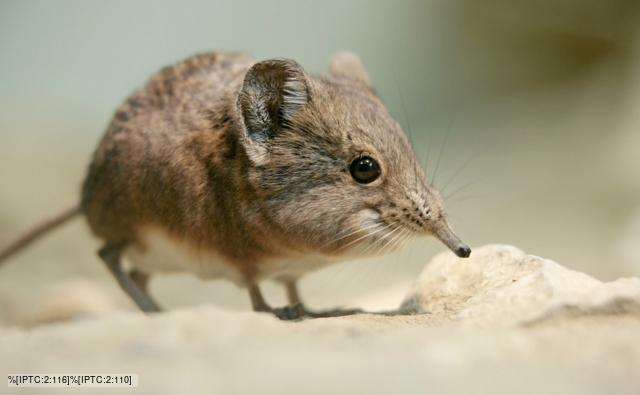
Let’s start with basic principles. Beauty is abstract, but like love and unlike cliche, it can be experienced concretely: it is detected by the senses, most frequently but not exclusively sight for we humans. This means there is a biological, physical element to it. Just as love is, on some level, a chemical reaction in the brain that offers a survival advantage, so is beauty, at least when applied to another of one’s own species. A beautiful shrew, to another shrew, is one that represents a survival advantage; it is an advantage for the survival of one’s genes, not one’s own precious self, but the instincts are all about that DNA.

Now that’s a beautiful shrew.

So beauty in a Darwinian sense is a list of physical attributes (physical because concrete, detectable by senses) that represent a good breeding partner: symmetry of form and features, traits that connote health, traits that represent child-rearing strengths. Marilyn Monroe was beautiful because she was symmetrical, had healthy skin and hair and teeth and eyes, and had curves that showed good baby-making potential.

Plus, if I may quote Christopher Moore’s A Dirty Job: “I mean, [she] got the badonkadonk out back and some fine bajoopbadangs up front, know what I’m sayin’, dog? Buss a rock wid a playa?” Word, Mr. Moore. Word.

See? Look how symmetrical.

Beauty is more than that, though. Because sunsets and symphonies and the smell of rain have nothing to do with child-rearing.

I’m going to take this as the point where humans and animals diverge. Not because I can say with any surety that animals don’t enjoy the sunset for the sake of the colors and the patterns in the sky, but because without language, I can’t be sure that they do, nor why they do. My dog loves to chase the innumerable tiny lizards that scatter across the desert where we live, but is he appreciating their coloration, the quickness and grace of their movements? Or is he thinking about how good they’d taste on a cracker?

And if he is, is that not beauty? The turkey sandwich argument speaks to this: deliciousness is a form of beauty detected by taste rather than sight, isn’t it? So there must be some element of beauty in a turkey sandwich, in a delicious lizard-on-Ritz hors d’oeuvre?

I would say so, but again, I think that it is the simple, animal form of beauty, the survival beauty, in most cases. I’ve eaten a lot of turkey sandwiches, and generally speaking, they are more often satisfying than beautiful. The potential for beauty-beyond-survival is there, certainly, but in the sense I want to explore now, it usually is not.

The abstraction of beauty is, so far as we can know, an exclusively human concept. It is difficult, because we are merely bald apes, to mark clearly the line between humans and animals, but one of the best lines is abstraction. Animals tend not to imagine things separate from their immediate circumstances (though some of them do, it seems) and humans do. The reasons why we do can be simple survival strategies; because imagination makes humans better hunters and gatherers than other animals, thereby justifying our oversized noggins and the weak, ungainly bodies attached to them. But to create abstract ideas, for abstract reasons? That, so far as we can know, is uniquely human.

For years now, I have associated this activity of abstraction for the sake of abstraction with two names: truth and beauty. Humans, I have said, are the only living things that seek truth and beauty for their own sake. We wish to discover new truths, not because they offer a practical survival advantage, but simply because we wish to know truth; we create beautiful things, and seek beautiful experiences, simply for the desire to experience them. I think of this as art, because I am an artist married to an artist, though others may call it science or faith or love or whatever entirely human abstraction you wish; there are many other ways to name the pursuit of abstraction. Regardless, I would argue – I have argued – they all come back to truth and beauty. Those are our defining ideals, we humans.

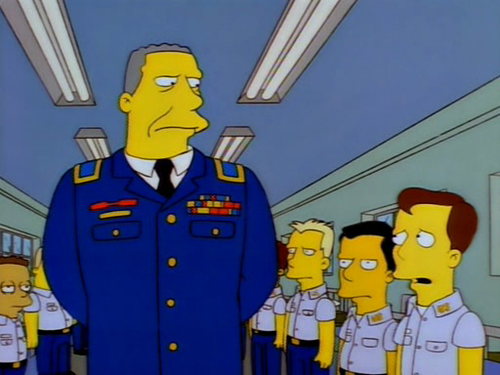
But now I think that these two ideals are really one and the same. “‘Beauty is truth, truth beauty,’ – that is all / Ye know on earth, and all ye need to know,” as Keats said to his Grecian urn. (And now I have to include the Simpsons reference: when the family goes to visit the military academy where they will be sending Bart for disciplinary reasons, Lisa observes a cadet in a class reciting that line as if responding to a drill sergeant – “BEAUTY IS TRUTH, AND TRUTH BEAUTY, SIR!” She gasps in joy at the thought of actually discussing poetry, something that never happens back at ol’ Springfield Elementary; but then the instructor, sounding and looking just like a drill sergeant, shouts in the cadet’s face, “But sometimes the truth can be harsh and disturbing! How can THAT be beautiful?!?” After which Marge comments, “Well, he sucked the life right out of that.”)

“Gentlemen, welcome to flavor country.”

The two ideas, truth and beauty, have always been closely linked. In science and math, a good solution, a true theorem, must have elegance to be considered worthwhile; in art, a beautiful piece must have some reflection of truth, of reality, of genuine human experience. This is because they are, I would argue, one and the same experience; two sides of the same coin, with the only distinction being how they are taken into the soul.

Ralph Waldo Emerson, in his “On Self-Reliance,” described the experience of truth as “that gleam of light which flashes across his mind from within.” He described a sensation of instant awareness of genuine truth, the vibrating of a heart to an iron string. He was talking about epiphany, the moment of clarity, what teachers (rather unfortunately) call the “Aha! moment.” There is a sense of rightness about truth that marks it as such, because a truth is echoed and repeated in everyone’s human experience, and all the truth does is give a name to what we already know. Home is where the heart is. The love of money is the root of all evil. Haters gonna hate. These truths don’t need to come with examples, because every single one of us can supply them from our own memories. That is the ring of truth, the gleam of light that Emerson talks about: when we make a connection between the statement of truth and our own personal subjective knowledge, and recognize both that the thoughts and experiences of others are actually relevant to our own lives, despite the appearance of perfect isolation that comes with being a human soul trapped inside a cage of flesh and bone, and also that our lives make sense, have reason and symmetry to them: that we are as true to life as others are to us. There is a greater world, and we are part of it; that is the truth, and what we recognize when we come across actual truth, and know it for what it is.

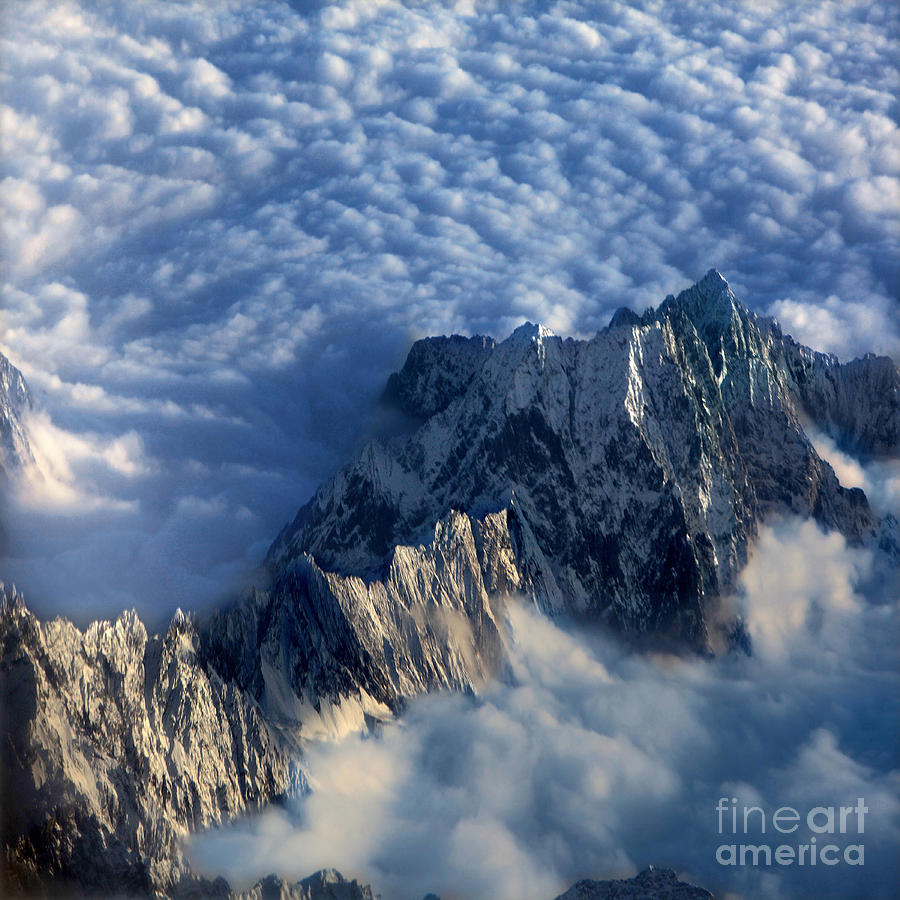
But here’s the thing: that’s what beauty is, too. That same ring, that same jolt, that moment of clarity and recognition, that awe: that is the experience of beauty. Think of what you felt when you first looked out of an airplane window and saw a mountain wreathed in clouds.

Think of what you felt when you first heard Pachelbel’s Canon.

When you smelled your favorite perfume, or let fine chocolate melt down your tongue. Think of a time when you genuinely hugged or kissed someone you love. This is what beauty feels like: when you feel your connection to the greater world, to all of the people before you who felt what you feel right now. You feel as big as the sky, as ancient as the stars: you can feel your heart expand to contain all of the other hearts that have felt what you feel, that are feeling what you feel, across all of time and space. You know that what you are feeling is right, and that it makes sense: you know that this feeling is true.

I would put it like this: truth is an intellectual recognition of one’s place in the order of existence; beauty is the emotional recognition of the same. Beauty is the truth of the heart.