Book Review: Mortal Engines, Hungry City Chronicles #1

Image result for mortal engines

(Also, see that hot air balloon on the cover, with the tiny gondola the two characters are in? Not at all how the airships are described.)


Mortal Engines (Book One of the Hungry City Chronicles)

by Philip Reeve


I kind of hated this book.

Not everything about it. Some things in here are wonderful. The concept is fantastic: a future world where cities are mobile, enormous steampunk structures on wheels, rolling around in the wasteland that is all that remains of our world, destroyed (of course) by World War III and hyper-advanced war machines. These cities follow a philosophy of “municipal Darwinism” (great name), which teaches that the largest, strongest city will devour the smaller cities. It’s a “town eat town” world, and the mobile towns do exactly that: they capture the smaller, slower towns, swallow them, tear them apart and use their raw materials as fuel and building materials to maintain and expand the larger town.

That’s a cool idea.

The main town in the story is London, and London is now governed by four Guilds: the Historians, the Navigators, the Merchants, and the Engineers. The Historians, who comprise both doddering old museum relics and Indiana Jones-style explorers who search through the wreckage of ancient civilizations to find useful artifacts from the time before the wars that ended everything (This is our time, of course, and the Frankenstein We-let-our-technology-advance-too-far-and-it-destroyed-us theme is vigorous in this book), are sort of the main protagonists, and the Engineers, who care about nothing but power and control, as those engineers would, are the antagonists. There is also the Anti-Traction League (the moving cities are called “traction cities”), which have settled in parts of the world not dominated by moving towns nor devastated by ancient wars, and they oppose the traction cities as a whole.

This is fine and good. I was a bit annoyed by the stereotypes of the heartless engineer and the hapless-but-wise-and-kind historian, but I like the plotline that involves the Lord Mayor of London and his megalomaniacal schemes, and the discovery of a new doomsday weapon that allows his city to destroy any other; the weapon is actually a rediscovery from the ancient times, and I thought the book handled that well, particularly at the end. (Though there are some pretty severe plot holes, especially regarding the time lapse between the ancients and the traction city era:  it’s been like two thousand years. So really, the ancient technology? It just wouldn’t work. At all.) I like the Anti-Traction League, and I particularly like the subset of non-city-dwellers who live in the air: this being a proper steampunk novel, there are airships galore, and even a flying city, and those parts were great.

No: I hated the characters. The specific characters who play the roles of hero in this book are half crappy, and by the end, half dead. I won’t say which group is which so as not to spoil, especially since this book is now being made into a movie by Peter Jackson, who probably won’t be able to save this thing, in my opinion. However, since the book won oodles of awards, I suppose most people liked the characters a whole lot more than I did. But really, they aren’t good characters: there’s one who should hate everything London is doing and all that it stands for, but at a crucial moment, this character freaks out on those who want to stop London from destroying everything good with its doomsday device; and then later the character realizes, “Hey, wait – London sucks! I should do something about that!” But this epiphany comes at an entirely random time, and is annoying because of that; I would think that the betrayal by a Londoner whom the character worships would have changed the character’s mind, or maybe when the two main characters are tricked and enslaved by a traction city; or maybe when they are captured and abused and threatened and nearly killed by a bunch of half-insane traction city pirates. No: it’s while the character is – climbing stairs. It’s ridiculous.

The other big problem for me was the writing. Half of the characters, good and bad, are entirely unbelievable; their emotions and motivations don’t make a lot of sense. There are a ton of cliches and platitudes, and some of the descriptions and action sequences are just not well done.

And then, at the end – he killed the fucking dog. That’s right: Philip Reeve kills the dog. No reason, either; we already hate the people who do it, and the character who I suppose is intended to be inspired to murderous vengeful rage by the death of the dog WAS ALREADY AT THE POINT OF VENGEFUL RAGE. It’s an entirely gratuitous dog-killing. And I don’t mean to overstate how much this bothered me, because I was already annoyed by the plot holes and the poor characterization and the mediocre writing – but really, that moment just took the cake. And then for the next thirty pages until the very end (when almost every other sympathetic character dies, too), Reeve kept mentioning the dead dog: the dog’s owner kept looking around for the dog, kept expecting to hear the dog’s footsteps, but no, because the dog was dead.

Screw you, Reeve. Dog killing crap writer.

No, that’s too strong. But really, I didn’t think much of the book. I wish someone else had thought of this idea and done a better job writing it. I hope the movie is better, but I won’t be watching it: because they’ll probably kill the dog.
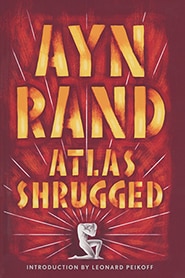
Book Review: Atlas Shrugged

Atlas Shrugged

by Ayn Rand


My god.

Now: I’m a word guy, a writer and a literature teacher, so I read quickly. I enjoy it, so I dedicate a lot of my free time to it. I’m a high school teacher and it’s summertime, so I have a lot of free time. I’ve been averaging about a book a day since school ended.

Until I hit this one.

1070 pages of some of the smallest print I’ve seen outside of User Agreements. 562,000 words, according to the Indefeasible blog. For scale, that is 25,000 words less than War and Peace by Tolstoy, and 400,000 words more than The Grapes of Wrath, the longest book I’ve ever tried to teach. It is equivalent to 12.186 Fahrenheit 451s.

This took me eight days to read. I spend at least 3-4 hours a day reading, too. It was a tough slog, too; because it is a philosophical treatise as much as it is a novel, I had to concentrate on the ideas harder than I would on, say, a book from The Wheel of Time or Harry Potter. I did it because the book was recommended as an important first step in understanding a former colleague and debate opponent’s worldview, which he describes as Aristotelian and bears a lot of resemblance to Rand’s philosophy, which she called Objectivism. I wanted to understand his worldview because his ideas are different from mine, and he is very, very sure of his positions and opinions; so I wanted to know from whence came his surety, and if I could and should be thinking along the same lines. So I read the book.

It made me think lots of interesting things. It really did: it made me realize that there are some things that I have done (like mock and castigate industrialists – in my case my favorite target was Bill Gates) that I shouldn’t have done, some things that I do that I shouldn’t do (like use words ambiguously, or symbolically, with little concern for their actual meaning), and some things that I haven’t done that I should do (like think about what my purpose in life really is, and why). There are some parts of the philosophy espoused and exemplified that I find interesting, and that I plan to investigate further and perhaps even adopt, if I can verify that they work for me.

However: reading this book was not worth it. Even with my personal interest in knowing what it has to say, I got so bloody tired of reading it that for the last three days, I had to work twice as hard to pay attention – and since I had to work twice as hard as normal to pay attention in the first place, this has been a mentally draining task. I did it, though, and now I’m here to tell you: don’t do it.

Rand was not a good writer. I’ve read three of her books now, and while this one was leagues better than Anthem, that’s like saying that shaving with a chipped-flint spearhead is better than shaving with sandpaper: you still wouldn’t want to do it. I read The Fountainhead in high school, so I don’t remember it well; once I’ve recovered sufficiently from this one, I may read that one. I dunno, though. It’s only 311,000 words, but that’s still two Grapes of Wrath.

That’s the biggest problem. She used too many words. And I say that as a wordy writer, which I am; my first book was 200,000 words. But she repeats things too many times, unnecessarily, as though using five words to describe something makes up for the fact that she is telling and not showing; and when she explains them, she uses too many synonyms and appositives. As a random sample from a page I just flipped to:

The scream of an alarm siren shattered the space beyond the window and shot like a rocket in a long, thin line to the sky. It held for an instant, then fell, then went on in rising, falling spirals of sound, as if fighting for breath against terror to scream louder. It was the shriek of agony, the call for help, the voice of the mills as of a wounded body crying to hold its soul.

So there was an alarm, then. You know, just the word “alarm” implies that it was bad, and “scream” implies fear; you could basically say this same paragraph in three words:

An alarm screamed.

Now of course repetition creates emphasis, which is presumably the point of the extended description; but there doesn’t seem to be anything in this book that Rand doesn’t want to emphasize – which means, of course, that nothing is really emphasized, because all of it seems almost like – well, like a screaming alarm siren fighting for breath, crying to hold its soul. By the end of this book I was very tired of being yelled at. I can’t imagine how fatiguing a conversation with this woman must have been.

In addition, the level of rage leveled at people like me – political liberals, that is, which means Rand saw me as a looter, a moocher, a liar, a coward, a fool, a murderer, a thug, and the destruction of humanity – was just as exhausting. I knew going in that there was a critical speech at the end, when John Galt speaks (No spoilers – that’s the name of the chapter, “This is John Galt speaking.”), which explained the whole worldview being dramatized in this book; but the problem was that most of what Galt says had already been said by the narrator or one of the other characters. I probably could have just read Galt’s speech and skipped the rest of the book. I would have been happier, too, because Galt carries the deepest anger, the most righteous condemnation of anyone who would support, you know, taxes and welfare and stuff. So I had to read that after reading another 900 pages of pretty much the same stuff, just not quite as angry as when Galt says it. I got really tired of being insulted so many times, and with such bile.

I will also say that, while the story itself is interesting (though much too long) and, I think, disturbingly realistic, the characters are not. Not that I think Rand’s idealized hero-industrialists are absurd; I mean, they are, but they are absurd the same way that Tom Brady or Michael Jordan is absurd, or William Shakespeare, or Isaac Newton, or Michelangelo or Mozart: nobody should be that good at what they do. But as all those names (Just the first few to come to mind. Of course there are many more examples.) show, people really are that good at what they do. It is possible. No, these characters are unrealistic in the way they read each others’ expressions. Like this:

The suggestion of a smile on Mrs. Hastings’ face held sadness, but the face had no imprint of tragedy, only a grave look of firmness, acceptance and quiet serenity.

Picture that face, that smile, in your mind. Okay, that’s good, just the suggestion of a smile . . . No! No imprint of tragedy. That’s better – but it needs a little more firmness in that look of quiet serenity. Got it, now? Or this:

There was the faintest coating of mockery spread, like shellac, over the smooth notes of her voice.

I mean, I like that, it’s a nice phrase – but what the hell does that sound like? And how would someone pick up on it?

These aren’t the best examples, the best examples are when someone heroic looks into the face of one of the villains and sees what they intend to show, along with what they’re hiding, and also what they are unaware they are really feeling; but I didn’t want to spend the time looking through the book to find one. It took me long enough to find these examples.

There are thoughts worth thinking in this book. I intend to spend more time thinking about those ideas. But good grief: I have already spent enough time reading this book. No more.