Book Review: The War of Art

Image result for the war of art

The War of Art

by Steven Pressfield

In retrospect, I should have known from the foreword that this was the wrong book for me: Robert McKee talks about art like it’s a war that Pressfield will help me to win; and while I think art is a struggle, I really don’t think it’s a war; indeed, as I am a pacifist, couching things in warrior’s terms is just going to push me away. He also references golf as evidence that Pressfield is a consummate professional (Pressfield wrote The Legend of Bagger Vance, which I have neither read nor seen; I guess it’s about golf? I guess Pressfield likes the game? But he writes anyway instead of playing, which – I guess is impressive?), and there’s the second best way to alienate me. He talks about tearing up over the Spartans’ death at Thermopylae, which was the subject of Pressfield’s other big book, Gates of Fire, which I did read, and did like quite a lot – but it didn’t make me weepy, and I don’t know what it has to do with inspiration to make art. So I’m really having trouble relating to this foreword author – and then he ends his intro with this:

“When inspiration touches talent, she gives birth to truth and beauty. And when Steven Pressfield was writing The War of Art, she had her hands all over him.”

Creepy sexual metaphors, especially about things that are not remotely sexual – like the act of putting words on a page – that is the number one way to make me say “Nope.” So I should have known.

Let me say this, though: this is a book intended to inspire artists, to help people break through creative blocks and create art they can be proud of. I can’t think of many more noble things to try to do, and I appreciate Pressfield’s earnest and genuine attempt to give people tools to do what they should be doing. So: if you do appreciate sports metaphors, and war metaphors, and you like a good, strong pep talk – or as the cover blurb calls it “A vital gem… a kick in the ass,” (which also should have been a warning sign for me) – then please ignore this review, and go get this book. I hope it helps.

It didn’t help me.

There are moments when I agree with Pressfield. He talks about questioning his writing, and feeling hopeless, and the strength and stamina it requires to push through all that and just keep working. He calls it work, and talks about how important it is to just keep putting in the hours, to keep trying, to keep seeking to hone your craft and do the best you can – but first and foremost, to just put the goddamn letters on the goddamn page, and to never give up. And I agree with that entirely. He talks about how he was in his 40’s before he found success, and how it came from an entirely unlikely source, which was, logical or not, simply the book he had to write at the time; and as a 44-year-old writer who is working on his second novel about a time-traveling Irish pirate, I appreciate everything about that.

But then there are the places where he talks about being a Marine, and how other servicemen in other branches are weaker than Marines because Marines love being miserable (This is a metaphor for how artists should be: willing to suffer and be miserable. I kind of see that. This whole Marines-have-bigger-dicks-than-other-soldiers? Nah.) and the other services are soft. Where he talks about writing and art like it is a war to be fought and won; or an animal to be hunted and then eaten; or a football game where you have to “leave everything on the field.” And I hate all of that. He talks about the urges and habits that get in the way of art as Resistance, and that’s pretty good, but he also talks about how like not cleaning your room is a way to lose to Resistance, and – what? And how golf is an art, and Tiger Woods is the greatest artist of all because he can be interrupted mid-swing, stop his swing, and then refocus and hit a golf ball really hard and – I fail to see the art in that. And he says that mental illness, depression and anxiety, are not real, but only a failure to combat resistance, which can be overcome by determination and the earnest pursuit of one’s true calling, and hey, fuck you, Pressfield.

He’s got a strange (And contradictory) section where he tries to talk about thinking territorially instead of hierarchically, and basically he means you should do what you think is right rather than worry about what other people think is right, and okay, sure – but first, he says elsewhere in the book that he knows he’s written well when his family is pleased and proud of him, which is hierarchical thinking by his own definition and explanation, so either he’s a REALLY bad editor who missed that continuity break, or he’s full of crap in one of these places; and second, his example of someone thinking territorially is Arnold Schwarzenegger going to the gym. Which is both weird and not at all artistically inspiring. It gets really weird in the third section, where the devout Christian Pressfield (Though he also admires the ancient Greeks so damn much that he seems to kinda want to worship Zeus and Apollo. I can’t really disagree with that, though I wouldn’t pick the same gods.) talks about angels who help inspire artists to work, because God wants us to create beautiful things for Him to admire, and how everything an artist is comes from God and we should understand that we contribute nothing, that we are only the vessel through which the divine will is worked. I mean, when we’re not being hardcore fucking Marines. Or hitting 310 yards off the tee. Otherwise, though, we should be all humble before God. It is not quite this Christian – he really does admire and know a lot about the Greeks – but it does read that way, as a repudiation of human accomplishment and a glorification of the eternal Whatever. And as an atheist and a part-time humanist, I am not at all down with that.

This thing reads exactly like what it is: a privileged Baby Boomer looking down on everyone else who doesn’t have all of his privileges; and by the way, he says some interesting and intelligent things that show me he really is an artist like me. Just way more of a shmuck. Hoo rah.
Book Review: Christopher Moore’s (Alas!) Bad Book

Image result for the griff

The Griff

by Christopher Moore and Ian Corson


I hate this. I hate it!

I love Christopher Moore. He is one of my all-time favorite authors, one of my heroes. I’ve read everything he’s written, and I’ve loved everything he’s written.

Except this.

This is a crappy book.

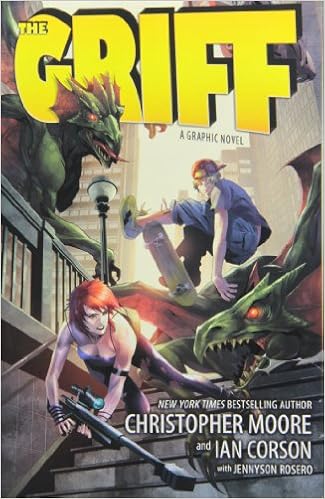
Well, I suppose it had to happen sometime; there have been some of his books (Island of the Sequined Love Nun, Lust Lizard of Melancholy Cove) that I haven’t liked nearly as much as his best works, like Lamb and Fool and Sacre Bleu. It’s reasonable to think that one of them could sink down low enough to actually be unenjoyable. It is not surprising to me that the one that did so was a collaboration, which none of his novels are; and that it was a graphic novel, which is not Moore’s usual medium. I would guess that Moore had little to do with the actual illustrations – which, unless I’m reading the credits in the book wrongly, seem to have been sort of mass-produced? They are all owned by Harper-Collins, and though a half-dozen people are thanked, no one is listed as the actual artist, other than the person who did the cover, Jennyson Rosero – and the illustrations are a fair piece of the problem with this. But really, there isn’t much here that’s good, so I can’t cover Moore on this one. He made a stinker.

All right: details. So this is an apocalypse story. The Griff are, quite literally, monsters from outer space. They are called The Griff because they look something like griffins: four legged beasts with claws, wings, and lizard/dragon like heads with sharp beaks. They arrive in large space ships, much like Independence Day, and immediately fall to wiping out humanity. (Reminded me of Footfall, if any of you are as deep into sci-fi nerdery as I am. Also, they seem to be summoned by an accidental signal sent into space by guys who uncover a mysterious artifact from the sea-bottom, which made me think of Star Trek IV. Woo! Nerdiverse!) So far so good: but that’s where the first problem appears. The design of the book is so poor that there are a couple of pages that literally can’t be deciphered; the rapid transitions between scenes of slaughter and ineffective human resistance to the invasion are just a jumbled mess. But that doesn’t really matter, because the majority of this story is about the survivors of the initial onslaught.

Which is where the larger problems come in.

First, the character development and much of the plot leans heavily on people being comic book hot, and endlessly horny. Now, Moore uses a lot of humor around sex; but this isn’t funny, this is just lame. The two female characters are in absurdly revealing outfits – one woman wears a wetsuit for the entire story, which seems to be the only reason she is a trainer at SeaWorld – and the male characters do nothing but make horndog remarks, which the women shoot down. Then the one woman – not the one in the wetsuit, the one with absurdly large breasts in a skin-tight spaghetti-strap crop-top, which is generally what one wears as the world ends – has a ridiculous sexualized response to finding a BFG, a Big Fucking Gun, with which she’s gonna go Griff-hunting. Because that woman is a gamer, a master programmer and a genius; therefore, somehow, she is capable of using an actual .50-caliber military rifle, since she’s used them in video games. Suuuuuure. I mean, she’s played all the video games, even created some of them, so she’s badass, right? But hey, none of that matters: what matters is that she’s hot. And, as the book goes on, horny. Her character is mostly depicted as a pinup. Who does finally sleep with the goofy nerd horndog who’s been coming on to her, because comics are all about nerd wish fulfillment.

Image result for the griff graphic novel

Then, at the end of the story, though there is a good twist regarding the Griff, it turns out that the Griff are the minions of – the little gray men. Yes, them. Scrawny bodies, large heads, huge featureless black eyes. Them. Just like every other alien story for the last 20 goddamn years. And the humans finally win, because that’s what humans do: we fight, and we kill, and we win. WOO! USA! USA! I mean – Earth! Earth! Earth!

Anyway. Characters are lame, design is poor, the art is too CGI-crisp for my taste (though to each their own) and the climax and ending of the plot were cliché and anti-climactic and annoying.

I hate that Christopher Moore wrote this, but not that much; everyone throws out a pile of crud every once in a while. Much more than that, I hated this book. Do not recommend.

Two Books by John Wyndham

Image result for rebirth john wyndhamImage result for the secret people john wyndham

Two by John Wyndham: Re-Birth and The Secret People

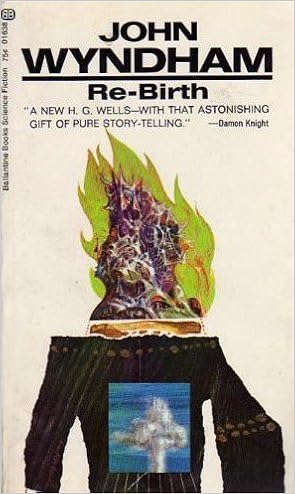
I’ve gone up and down with John Wyndham. A couple of his books – The Midwich Cuckoos and Day of the Triffids – are outstanding; Chocky was just okay. Generally I like his storytelling, and his ideas are wonderful; but they can’t all be gems, no matter who the author is. No problem. Really, this fits in nicely to the Golden Age of Science Fiction, where Wyndham deserves a place, since even Heinlein and Asimov wrote some stinkers. I like Wyndham, though, and I like that I keep finding his books in cheap paperback editions from the 60’s and 70’s with interesting cover art. That cover art was what made me pick both of these.

So I had two of his novels to read, and once I read them, well – to be honest, my opinion of Wyndham went down. This has been mitigated now by the fact that one of these two, The Secret People, was one of his earliest works, written in 1935; my first book isn’t very good, either. But that’s not enough: because this book wasn’t just “not very good.” It’s a stack of crap in a cover.

We’ll start with the good one, though. (Warning: Spoilers ahead.) Re-Birth, from 1955, (Published in Wyndham’s native UK as The Chrysalids, which is a way better title but I assumed they changed it because the American public’s response was overwhelmingly, “Wut’s in tarnation’s a chrysalid?”) is a great book in two ways: it has a post-apocalyptic setting fully as interesting and disturbing as A Handmaid’s Tale, with the same kind of theocratic hypocrisy in full bloom. Told from the point of view of a young boy whose father is a pillar of the community, it has that excellent innocent perspective that makes social commentary novels genuinely effective, from The Giver to To Kill a Mockingbird. We learn how screwed up the society is as the protagonist does, and it works extremely well. There’s a nice twist, too: because we find out that the main character, David, is actually one of the forbidden people, one of the untouchables, as it were, but in a way that enables him to hide it. So we get the view of the society from both a child’s perspective and an outsider’s perspective, and it’s very well done.

The society is an agrarian theocracy after the world-shattering nuclear war; it is probably somewhere in Greenland, though that isn’t entirely clear. (That may be my poor grasp on world geography – or, honestly, it’s been a couple of months since I read it; I may just not remember.) The society has an absolute rule against genetic mutations, which are more common because of the radiation; anyone who is born with any kind of imperfection is essentially exposed to the elements. (Turns out they don’t always die, but that’s not for the society’s lack of trying.) David is a genetic mutation, but not with any physical alteration, and so he slips through the net, and eventually finds several others who are like him.

I don’t want to spoil it any more than that, because it is essentially worth reading. I didn’t really like the ending, though. We get two glimpses into other societies, one of the outcast genetic mutations who have survived on the fringes of the theocratic society, and one highly advanced society from another part of the world; and frankly, both suck. The book as a whole just made me dislike people. Which, I mean, that’s fair, but it’s not always the kind of book I want to read; I also felt that this one didn’t hold out any real hope for a better world or better people. I guess there’s a small chance that David and his friends are the hope, but they continue to be a part of the crappy societies, so I don’t really see it.

But I did like the characters a lot, and I thought the society and the central conflict over genetic “perfection,” with the underlying theme of questioning that very concept – what exactly is the “correct” genotype? Or more importantly, the correct phenotype? At what point does variation become too far from the “norm?” – all that was great. If you’re a Wyndham fan, go ahead and read this one.

Don’t read The Secret People. Not anyone, not for any reason – not even for that epically bizarre cover. Because the cover is a lie! There aren’t any weird dirt-people with mushroom horns! They’re just short! I wanted freaky gnomes and dwarves and stuff, but what I got was – crap. Racist crap.

So The Secret People, originally published in 1935, is a lot like an H. Rider Haggard novel, except Wyndham wasn’t as good a writer. And they both had crap ideas. This book starts with a couple of poorly explained technological advances to get us in the sci-fi mood; the main character is an international playboy with his own jet plane – and I mean, it’s a rocket ship with a cabin and everything, that flies in atmosphere – and at one point, he picks up his newest Bond Girl and flies over the inland sea that is being made where the Sahara used to be. Sadly, they crash into the water, and through a series of mishaps, they find themselves in an underground world peopled by strange beings! Living under the Sahara! SO WEIRD!

Except they’re not. They’re Pygmies, from Africa, who apparently wandered into underground caves centuries ago, and just kept wandering. And just like Haggard, who had a serious case of TheWhiteManIsTheRightMan-itis, Wyndham describes these “secret people” as essentially savages who have been unable to advance their civilization in any way past their original stone-tool-and-superstition society. The modern Eurotrash heroes get chucked into a prison cavern with all the other surface dwellers who have found their way underground now that the inland-sea-over-the-Sahara project has compromised the Secret People’s secrecy, and then they have to find their way out and back to the jet plane, which is their only hope of surviving. Because, you see, the inland sea has started leaking into this vast underground cavern world, and the whole place is going to drown.

But that doesn’t matter! What matters is who gets to the plane first: the heroes, our playboy and his Bond Girl, or the sinister criminal element, who were already in the cavern when our heroes arrive, and who are both rapey and swarthy – an unforgivable combination. But that’s okay, because they’re also stupid and cowardly and everything else you would expect from a swarthy criminal type, and so yes, our heroes are the ones who make it out alive before all of the Secret People drown. Which, y’know, is a happy ending.

Terrible book. Don’t read it. Go for Re-Birth/The Chrysalids – or even better, read The Midwich Cuckoos.

Book Review: Mortal Engines, Hungry City Chronicles #1

Image result for mortal engines

(Also, see that hot air balloon on the cover, with the tiny gondola the two characters are in? Not at all how the airships are described.)


Mortal Engines (Book One of the Hungry City Chronicles)

by Philip Reeve


I kind of hated this book.

Not everything about it. Some things in here are wonderful. The concept is fantastic: a future world where cities are mobile, enormous steampunk structures on wheels, rolling around in the wasteland that is all that remains of our world, destroyed (of course) by World War III and hyper-advanced war machines. These cities follow a philosophy of “municipal Darwinism” (great name), which teaches that the largest, strongest city will devour the smaller cities. It’s a “town eat town” world, and the mobile towns do exactly that: they capture the smaller, slower towns, swallow them, tear them apart and use their raw materials as fuel and building materials to maintain and expand the larger town.

That’s a cool idea.

The main town in the story is London, and London is now governed by four Guilds: the Historians, the Navigators, the Merchants, and the Engineers. The Historians, who comprise both doddering old museum relics and Indiana Jones-style explorers who search through the wreckage of ancient civilizations to find useful artifacts from the time before the wars that ended everything (This is our time, of course, and the Frankenstein We-let-our-technology-advance-too-far-and-it-destroyed-us theme is vigorous in this book), are sort of the main protagonists, and the Engineers, who care about nothing but power and control, as those engineers would, are the antagonists. There is also the Anti-Traction League (the moving cities are called “traction cities”), which have settled in parts of the world not dominated by moving towns nor devastated by ancient wars, and they oppose the traction cities as a whole.

This is fine and good. I was a bit annoyed by the stereotypes of the heartless engineer and the hapless-but-wise-and-kind historian, but I like the plotline that involves the Lord Mayor of London and his megalomaniacal schemes, and the discovery of a new doomsday weapon that allows his city to destroy any other; the weapon is actually a rediscovery from the ancient times, and I thought the book handled that well, particularly at the end. (Though there are some pretty severe plot holes, especially regarding the time lapse between the ancients and the traction city era:  it’s been like two thousand years. So really, the ancient technology? It just wouldn’t work. At all.) I like the Anti-Traction League, and I particularly like the subset of non-city-dwellers who live in the air: this being a proper steampunk novel, there are airships galore, and even a flying city, and those parts were great.

No: I hated the characters. The specific characters who play the roles of hero in this book are half crappy, and by the end, half dead. I won’t say which group is which so as not to spoil, especially since this book is now being made into a movie by Peter Jackson, who probably won’t be able to save this thing, in my opinion. However, since the book won oodles of awards, I suppose most people liked the characters a whole lot more than I did. But really, they aren’t good characters: there’s one who should hate everything London is doing and all that it stands for, but at a crucial moment, this character freaks out on those who want to stop London from destroying everything good with its doomsday device; and then later the character realizes, “Hey, wait – London sucks! I should do something about that!” But this epiphany comes at an entirely random time, and is annoying because of that; I would think that the betrayal by a Londoner whom the character worships would have changed the character’s mind, or maybe when the two main characters are tricked and enslaved by a traction city; or maybe when they are captured and abused and threatened and nearly killed by a bunch of half-insane traction city pirates. No: it’s while the character is – climbing stairs. It’s ridiculous.

The other big problem for me was the writing. Half of the characters, good and bad, are entirely unbelievable; their emotions and motivations don’t make a lot of sense. There are a ton of cliches and platitudes, and some of the descriptions and action sequences are just not well done.

And then, at the end – he killed the fucking dog. That’s right: Philip Reeve kills the dog. No reason, either; we already hate the people who do it, and the character who I suppose is intended to be inspired to murderous vengeful rage by the death of the dog WAS ALREADY AT THE POINT OF VENGEFUL RAGE. It’s an entirely gratuitous dog-killing. And I don’t mean to overstate how much this bothered me, because I was already annoyed by the plot holes and the poor characterization and the mediocre writing – but really, that moment just took the cake. And then for the next thirty pages until the very end (when almost every other sympathetic character dies, too), Reeve kept mentioning the dead dog: the dog’s owner kept looking around for the dog, kept expecting to hear the dog’s footsteps, but no, because the dog was dead.

Screw you, Reeve. Dog killing crap writer.

No, that’s too strong. But really, I didn’t think much of the book. I wish someone else had thought of this idea and done a better job writing it. I hope the movie is better, but I won’t be watching it: because they’ll probably kill the dog.

Book Review: The Purple Cloud

The Purple Cloud

by M.P. Shiel


I hated this book.

I did not hate everything about it, which is why I finished reading it; but while I liked the concept and the writing, I have rarely loathed a protagonist more than I hated this freaking guy. Since I recently read a trio of adventure novels by H. Rider Haggard, in which I also grew to hate the Great White Hunters who slaughter elephants for fun and mock the savage Africans, this was familiar but annoying territory. (Since I just, the same day I am writing this review, finished reading Gillian Flynn’s novel Gone Girl, in which I once more hated all of the main characters, I think I need to focus on books about likeable people for a while.)

Adam Jeffson is his name. Dr. Jeffson – for he is a medical doctor – begins the book married to a social climbing gold-digging beauty, who wishes her husband to become fabulously wealthy so that she may look down her nose at all of humanity. She pushes him to join an expedition to reach the North Pole, which no person has yet reached at the time of the story. It is unclear when the book is set; somewhere in the late 19th century, it seems, but the setting is unclear because Shiel insisted on using the now-familiar frame for science fiction stories around this time (Originally published in 1901 — H.G. Wells lauded it as brilliant!) namely that the manuscript was left mysteriously to Our Correspondent (also known as the author); this particular manuscript was created under the influence of that Mystery Science known as Mesmerism! Yes! A woman, under the influence of hypnosis, wrote out various strange manuscripts, one of which was this story. Is it true? A communication from another world? Who can say?!? The upshot of all of this humbuggery is that the book is an alternate universe story of the end of the world, which we living people can know about because of the mysterious transmission of the story, which can therefore also be a first person narrative told by someone who isn’t actually the author. But since it takes place in a world that is not quite ours, it is not clear what the timeline is, though the geopolitical world is the same as our own. Anyway.

Dr. Jeffson wishes to join the expedition to the Pole, at his wife’s behest, because there is a cash prize, an incredibly large cash prize, to be awarded to the person who first sets actual foot upon the top of the world. Unfortunately, the expedition already has a doctor signed up to go. Fortunately for Jeffson, and unfortunately for the other doctor, Jeffson’s wife – who has the absurd but suitably hideous name of Clodagh – isn’t above murder, and in fact, she poisons the other doctor (Whose name is Peter Peters. Yup.) so that Jeffson can take his place. Apparently so we can really enjoy our hatred for this couple, she does it slowly, pretending to nurse the sick man while actually dosing him with atropine. So Dr. Peters dies, Jeffson goes on the journey; but along the way, he is both frustrated and unpopular, because the ship is going to be stopped by the polar ice cap, and Jeffson is not intended to go on the final leg of the journey over the ice by dogsled; at the same time, he and his wife are suspected of putting an end to poor Pete Peters. Somehow, Jeffson is all freaking outraged by the accusations that finally get voiced, even though everyone involved knows they are true; he ultimately goes out to have a duel with one of the other members of the expedition, and even though the other guy is a better man and a better shot – and he’s right about Jeffson and Clodagh – Jeffson wins and kills the other guy, and takes his place on the final leg. So now I’m pissed that this ass is going to win the money and make his wife happy.

But wait, there’s more. The dogsled portion arrives, and the three men going don’t plan to bring enough food for the dogs. Why? Because THEY PLAN TO FEED THE DOGS TO EACH OTHER ON THE WAY. That’s right: not only does the dog die, but FORTY dogs are going to die, and be forced into cannibalism, all so these three pricks don’t have to bring more food. (Should I mention here that they originally meant to use reindeer to pull the sleds, but they didn’t bring enough fodder for the reindeer and all of them starved to death while still on the ship? Nah, I’ll leave that out.) This is all three of them, so we can’t blame Jeffson for that, but we can certainly blame Jeffson for this: he leaves the other two men to die of exposure, leaving camp early with extra supplies and dogs so that he can be the first to the Pole and claim the prize.

He makes it there first, indeed, but then a strange thing happens. How strange, we don’t yet know, but it is the titular Purple Cloud, so we know it’s got to be a big deal. Anyway, Jeffson heads back across the ice once more, and, because we don’t hate him enough, he makes it all the way back to the edge of the ice with only one surviving dog, his favorite: which he then FUCKING KILLS JUST BECAUSE HE DOESN’T WANT TO DEAL WITH GETTING THE DOG ON HIS KAYAK.

Stephen King once wrote that the fastest way to get an audience to hate a character was to have him hurt a dog. And this guy now, in my mind, has the blame for the deaths of forty dogs, a herd of starving reindeer, and several humans, as well. That’s why I hated him, and the lack of sufficient suffering in retribution is why I hated this book. Because no matter what else happens, Jeffson doesn’t die.

But here’s the thing: none of this is the actual story. The story began with the purple cloud: which was poisonous, and has killed all of humanity and pretty much all large animals. The bulk of the book is Jeffson realizing he is the last man alive on Earth. That’s right: none of this evil involved in the Polar expedition was actually the point; it was just intended to get Jeffson to be the only one alive at the north pole when the cloud hit – which, it turns out, is what saved his worthless dog-killing ass.

I won’t spoil the rest of the book, which is better than this beginning portion, though I will say that Jeffson continues to be a shithead: for the next twenty years (The book covers quite a number of years), whenever Jeffson gets bored or angsty, he goes to one of the great cities of the world, and burns it. To the ground. The whole city. (When he burns Paris, he takes 20 paintings out of the Louvre, and burns the rest.) Just for the hell of it. Just to make us hate him a little more.

The intended theme at the end of the novel is about good and evil, and how good will eventually win out in the end; in that struggle, Jeffson is the evil. And boy, is he evil. I’m not really sure why Shiel wrote it all this way, when there surely had to be an easier way to make his point. But considering his writing style, he is not a fan of making a quick and simple point. Here’s a sample sentence – one sentence.

Now I would not trudge back to the ship, but struck a match, and went lighting up girandoles, cressets, candelabra, into a confusion of lights among a multitude of pale-tinted pillars, rose and azure, with verd-antique, olive, and Portoro marble, and serpentine; the mansion large; I having to traverse a desert of brocade-hangings, slim pillars, Broussa silks, before I spied a doorway behind a Smyrna portiere at a staircase-foot, went up, and roamed some time about the house – windows with gilt grills, little furniture, but palatial spaces, hermit pieces of faience, huge, antique, and arms, my footfalls muted in the Persian carpeting; till I passed along a gallery having only one window-grating that overlooked an inner court, and by this gallery entered the harem, which declared itself by a headier luxury, bric-a-bracerie, and baroqueness of manner; from which, descending a little stair behind a portiere, I came into a species of larder paved with marble, in which grinned a negress in indigo garb, her hair still adhering, and here an infinite supply of sweetmeats, French preserved-foods, sherbets, wines, and so on: so I put a number of things into a pannier, passed up again, found in the cavity of a garnet some of those pale cigarettes which drunken, then a jewelled chibouque two yards long, and tembaki; with all I descended by another stair, deposited them on the steps of a kiosk of olive-marble in a corner of the court, passed up again, and brought down a yatag to recline on: and there by the kiosk-steps I ate and passed the night, smoking for hours in a state of lassitude, eying where, at the court’s center, the alabaster of a square well blinks out white through a rankness of wild vine, weeds, acacias in flower, jasmines, roses, which overgrow both it and the kiosk and the whole court, raging too far over the four-square arcade of Moorish arches round the court, under one of which I had hung a lantern of crimson silk; and near two in the morning I dropped to sleep, a deeper peace of gloom now brooding where so long the hobgoblin Mogul of the moon had governed.

All in all, I’d recommend reading The Stand. Randall Flagg is a lot more fun to hate. And he didn’t kill forty dogs.

The Maze Runner

The Maze Runner
by James Dashner


So I picked this book up because my students kept reading it for book projects, and I wanted to see what all the fuss was about –and not just from my students; there’s a list of accolades the book and series have earned right inside the front cover. Unfortunately, this may be the book that makes me lose faith in — no, wait. It was a NYT bestseller, but I already knew those weren’t all good . . . it was made into a successful movie, but that says nothing about the book . . . it was named a Best Teen Book, but by Kirkus Reviews, which I already lost faith in . . . and I already knew my students have frequently bad taste in books — okay, never mind; I haven’t lost any faith. I just need to read the blurbs and awards a little more carefully. I thought reliable people were of the opinion that this is a good book.

It isn’t.

It’s not terrible; the idea is interesting, the action is pretty good. But the writing is mediocre, the interesting idea requires far too many shortcuts and McGuffin miracles (That’s when a fantasy/sci-fi story has an insoluble problem, and they find a thing that simply solves the problem; that thing is the McGuffin. Star Trek does it almost every episode.), and the ending is a deep cliffhanger. It reminds me quite a lot of Hugh Howey’s Wool, which was pretty much the same, and which had equivalent commercial success despite its flaws; it makes me wonder if this is the new trend in science fiction, to world-build with more imagination than logic.

So you have these kids who are stuck in this maze. The maze has these monsters in it, that come out mostly at night; also at night, the center of the maze, where the kids are, is safely locked away from the maze. So every day these kids go out and run through the maze, trying to find a path to safety, a solution to the maze, a way out of the whole ordeal. Maze runners. Meanwhile, in the safe place in the center of the maze, the kids are proving that The Lord of the Flies wasn’t always right: they have created a highly organized and successful society, populated only by 17-and-under boys, in which pretty much everyone follows the rules, has a job, does their job, and is satisfied with their lot in life. It’s almost Utopian. Of course, the kids want to get out of the maze, but they’re not really sure why: because they don’t have many memories from before they got into the maze. They have some — they know their names, for instance — but not many.

Two years after these kids start trying to escape the maze, Thomas arrives. Thomas remembers a few more things than the other kids. Thomas is followed quickly by a girl — the only girl, named Teresa — who remembers a few more things than Thomas. It seems the people who put the kids in the maze, and who wipe their memories in this very specific and precise way before depositing them in the maze, want to change the situation. But only a little. And so Thomas, who spends most of his time being angry with everything around him, manages to change the society that has been so carefully and successfully created, and tries to lead the kids out of the maze.

How does it end? Why were they in the maze in the first place? Why does the situation change, but only enough to send Thomas and Teresa with a couple of clues, rather than just opening a door out of the maze? Who are these kids, and where do they come from? Believe me: you really honestly don’t want to know. Whatever enjoyment I got out of the book was pretty much ruined by the revelations at the end.

I would not recommend this book. And I’m going to stop letting my students read it for class. There are too many good books out there to waste time on this one.

Two Bad Books In One!

Dark Planet
by John Rackham

The Herod Men
by Nick Kamin
I picked this up on a whim at Powell’s Books in Portland; it’s one of those Ace Double books, where there are two short novels in one paperback, with one printed from the front and one from the back — so you flip the book over, and it’s the front cover of the other book; the printing of each is upside down to the other. I also grabbed this one because I like the idea of The Herod Men, which teases with the line “Planned death vs. unwanted birth in the Overpop Era,” which sounded pretty sweet. And the Dark Planet cover features a terrible 70’s pulp illustration of a giant alien worm thing chasing a scared woman and a ragged man through a kaleidoscopic jungle. Good stuff.

But then I tried reading it, and I understood why I’d never heard of either of these writers before. Because they both suck.

I read Dark Planet first, actually figuring I was saving the best for last; Dark Planet was vaguely interesting in that it had a neat idea for an alien planet, and a great explanation as to why humans couldn’t colonize it and hadn’t found the alien race living there, despite having a manned military base on the planet’s surface: the atmosphere is dense clouds, and is filled with bacteria that devour anything that isn’t actually alive — metal, plastic, cloth, everything. The base is made out of a super-plastic alloy that can survive; everything else has to get in and get out quickly, or else start dissolving. But a rocket carrying Our Intrepid Hero crashlands in the miasma, and soon finds that though his equipment, clothes, and his ship all dissolve, he himself is perfectly healthy. He meets the alien races, and discovers that the planet has quite a lot to offer.

That’s all the good stuff. The bad is that the book is written in the late-Robert-Heinlein pulp mode, with the surly alpha male hero and the buxom helpless female who has no choice but to cling desperately to his arm in between screams, and who of course sleeps with her rescuer, as is only appropriate when everyone is necessarily naked on this planet that dissolves all clothing. The aliens, a la Edgar Rice Burroughs’s John Carter books, are inexplicably human, so human that they actually have sex with all of the human humans. There’s quite a long part where the enlightened angelic overlords of the alien races preach free love while having lots of sex with Our Intrepid Hero, and then he is reunited with the buxom scream queen, who even though she has been mated with an alien/human guy, is of course swooningly happy to run into Our Intrepid Hero again and clutches his mighty thews to her heaving bosom and — you get the picture. Basically it’s a story by a lonely nerd with Captain Kirk fantasies, a good concept for a planet, and not much talent.

And The Herod Men? Not only did it follow the same basic theme — surly alpha male who seduces all of the ladies in between killing bad things; lots of Free Love stuff (though that was almost cleverly done, put into context of a bizarre Catholic cult-like church that preached maximum fertility for all humans, and had priests sleeping with the novice nuns in an attempt to impregnate them); pretty good basic concept in this overpopulated post-global-climate-change Earth — but it added a whole new dimension: violent homophobia, as there is a gay character who comes on to Our Intrepid Hero, is rejected (Because our dude only likes chicks, bro. Don’t call him gay, bro. He’ll kick your ass, bro!), and then becomes a bitchy caricature that O.I.H. dreams of killing violently. It’s the second time I’ve seen this weird angry anti-homosexual theme in a book — the first time was in the Shaft novel, where pretty much exactly the same thing happens (Something about hotel clerks coming on to men? Was that a thing in the 70’s? Dunno.); but that book was surprisingly well written.

This one was not. This one, I didn’t finish reading.

Not recommended.

Review: Clarence Olgibee

Clarence Olgibee

by Alan Kessler


I was asked to review this book and given a free Kindle copy in order to do so; I wish I hadn’t been. Because if this hadn’t been part of an agreement, I never would have finished this book.

This is not a good book. (If it is too presumptuous of me to actually pass judgment, then it is my opinion that this is not a good book.) The plotline makes no sense. It is purported to be a sprawling epic, and I suppose in that it covers about forty or fifty years and a dozen individual lives, it is. The problem is that there is no reason to connect all of those lives. You start with the title character, Clarence; he has a high school chum named Todd; Todd grows up to work for a man named Walters. So why do we need to hear about Walters? Or Walters’s son, Donald? Walters and Donald are certainly connected to Todd, but they are not in any way associated with Clarence – and the book is called Clarence Olgibee, not Todd Munson. Or perhaps this book is an examination of racism: then why do we spend a full third of the book watching Clarence duck his mother and try to get laid? What has that to do with racism? It seems to me that the author could not decide what his story was really about, and so he included everything that he thought of in relation to it, background material, character development, everything.

Don’t get me wrong: some of it is interesting. The part when Clarence is in the Navy was quite well done, overall, particularly the chapters in the Philippines. The author has a way with description, and also with dialogue, particularly hate speech, which enables him to create some very distasteful villains – and yeah, it was fun to see some of them get their comeuppance. But much of that is ruined by one simple fact: I can’t stand Clarence. He’s a jerk: he uses everyone around him, resents everyone, envies everyone, and complains constantly that he can’t do what he wants – when what he wants to do is nothing. As he gets older, it makes more sense, as people actually treat him badly; but for the first half of the book, when Clarence is a teenager and his only problem is that his mother wants him to do his chores and homework, and the girl he’s lusting after is a shallow, dim-witted bimbo, it’s hard to feel sympathetic as Clarence lies and cheats and manipulates the good people around him – both of his parents (because I agree with his mother) along with his friends Willard and Todd – simply because Clarence’s only influence is a cousin that crashed at his house for a few months. Now maybe that would happen, a teenager deciding to admire Cousin Ortis instead of his mother or father or friends or anyone else; but it’s hard to like him for it.

What drives me crazy, though, is the fact that the author uses this. The story is of Clarence’s redemption. He decides, at a very few times in his otherwise worthless life, to do the right thing; and when he does, it is – well, nice. I appreciated it. I thought, “Good for you, Clarence.” And then I watched him go right back into being a putz. At least when Huck Finn realizes he cares more about Jim than about his reputation, he goes about trying to free Jim. He learns his lesson. What’s the point of a redemption that doesn’t actually redeem the person? And again, if the point was that Clarence was broken by his ill-treatment in a racist society, why is the first half of the book about the villains Doing Your Chores and She Doesn’t Want To Have Sex With You? Any chance of redemption was shot for me in Clarence’s last scene with his parents. I just had to hate him after that. Because I really liked his dad. You putz.

I wasn’t going to give this book that low a rating, because I do definitely see some good things, and I think the author has potential. He needs to work on telling one story that makes sense; this book should either be about racism, or about Clarence. He also needs to work on editing: because I can overlook a lot of things, but the main character’s name is spelled at least four different ways in this book, and that’s just ridiculous. The first chapter comes back around at the end of the book, yes, but only because the first chapter is an entirely artificial situation: the protagonist at that point, Jimmy, has literally no reason to commit the crime that he does. So it’s not a mind-bending use of irony, it’s a stretch, it’s a moment that strains the reader’s suspension of disbelief. And when the ending comes back around to that beginning point, the book should end. I hit that point and my Kindle said 94%. And everything that happens after that, I found just ridiculous and maddening, in the way it completely changed the narrative and asked me to go places I neither expected nor wanted to go, and tried to redeem Clarence when it was much too late to do that. That guy, and this book, were already lost.

Book Review Request: The Nth Day

27815772

The Nth Day

by Jonathan Huls

I was given a free copy of this e-book and asked to provide an honest review; so here goes.

This is a terrible book.

There is almost nothing good about it. The writing is bad on every level, from grammar to logic to elegance. I have taught many teenagers who have a better grasp of English than this book shows. The mechanics are poor, making it hard to read; the overly long sentences wind and twist clumsily before snapping from the strain, making the reading even harder; and several times, the wrong word is used – “seized” instead of “ceased,” for instance, or “communal” instead of “tribunal.” This book need more than an editor: this book needs a writer.

The plot doesn’t make much sense. The basic idea is that God is born into modern times, and His coming brings mayhem and destruction; not immediately, however, as the child first must grow up like a reasonably normal human being, though his youth is filled with strange events and miracles. Around the age of ten, his father – well, his stepfather, really, as the child was born of an immaculate conception – tries to discipline the boy, for the first time, over a temper tantrum during a board game; and the young God, in a moment of even more petulant wrath, destroys his parents with a sudden tornado. He then strikes out walking across the country, leaving more destruction and inexplicable occurrences in his wake, until he reaches his destination. Unfortunately, the book ends without any actual resolution: he reaches his destination, causes some more destruction, and then vanishes. That’s it. No explanation for the journey, no reason for the mayhem he caused, no actual point to the book.

The only thing Huls does with any style is disgust the reader: the lengthy, detailed descriptions of vomit and excrement and blood and rot are the most vivid moments in the book. There are a lot of them, and they made me more nauseated than any other reading experience I can think of. And although there isn’t a lot of it, this author also made sex more distasteful than any other author I can remember reading. The sweet moments – and there are actually a few, including a loving union between two of the characters, and a father-child relationship that was somewhat heart-warming – are surrounded by so much putrescence that there was just no way to enjoy them. The father-child relationship, for instance, begins with the child saving the father-figure from choking on his own vomit in a drunken stupor; said puddle of vomit figures prominently in the next dozen pages, before the two share a laugh over a raucous belch. Hard to see a Zuzu’s petals-moment there.

If I had to give a reason for the creation of this book, I would guess that the author hates humanity. The people are almost entirely horrible, representing every deadly sin with their every word and deed; the heroes, if that word can apply to the point-of-view characters, are better, but they are also generally victimized by events, and since there is no final resolution, there seems to be no reason for their suffering other than “Life is awful, and so are human beings.” By the end of the book I was rooting for an apocalypse, but even that opportunity was missed, as the young God apparently decides to let the world continue. Until the next time someone beats him at Connect Four, that is – and then watch out.