Sure.

Tired Teacher GIFs | Tenor
Australian Teachers Share The Frustrating Reality Of Their Jobs

It’s been quite a week.

A few of the highlights:

*Two of my classes are reading To Kill a Mockingbird, and this week we read one of my favorite sections, the two chapters when Scout goes to first grade for the very first time, and meets her new teacher, Miss Caroline. These chapters are the first which show the novel’s dominant theme, the idea of empathy, that you don’t understand someone until you see events from their perspective; Miss Caroline, seen from Scout’s perspective, is a terrible person who treats Scout badly, shames a poor farm boy named Walter Cunningham, and has no idea how to teach or manage a class. But when you see these chapters from Miss Caroline’s point of view — she is a 21-year-old woman, this is her very first day teaching, and in addition to several other problems, one of her sweet lil angels calls her a snot-nosed slut. First graders, man. Freaking savages. — you recognize that this teacher has had the very worst day ever. I explain the chapters from Miss Caroline’s point of view, which I understand as a teacher, and I show students how she is not bad, she’s just having a bad day. A lot of times in the past, when I’ve taught this, they get it; my students understand how frustrating and soul-searing Miss Caroline’s day is, and they realize she shouldn’t be blamed or hated for her choices, even when she screws up, as she does a few times. 

Part of Miss Caroline’s bad day is that she reads her favorite children’s story to the class — and they don’t react at all, because they are, as Scout puts it, “immune to imaginative literature.” And I look out at my class, half of whom are looking at phones or computers, another third of whom are chatting or spacing out while I talk about this novel, which I have told them is one of my very favorite works of literature, and I say, “Can you imagine what that’s like, to share one of your favorite stories with a class full of students who just don’t care? Who aren’t paying attention? To whom the story makes no difference at all? Can you imagine what that would feel like?”

They couldn’t.
Falling Asleep In Class GIFs | Tenor

*Yesterday a student climbed up onto a metal stool in my room in order to unplug another student’s Chromebook, which was plugged into an outlet that for no good reason is about seven feet off the floor, near my whiteboard. The student then called out “CANNONBALL!”, jumped off the stool, kicking it out sideways, landing awkwardly as the stool shot out and crashed into a bookcase.
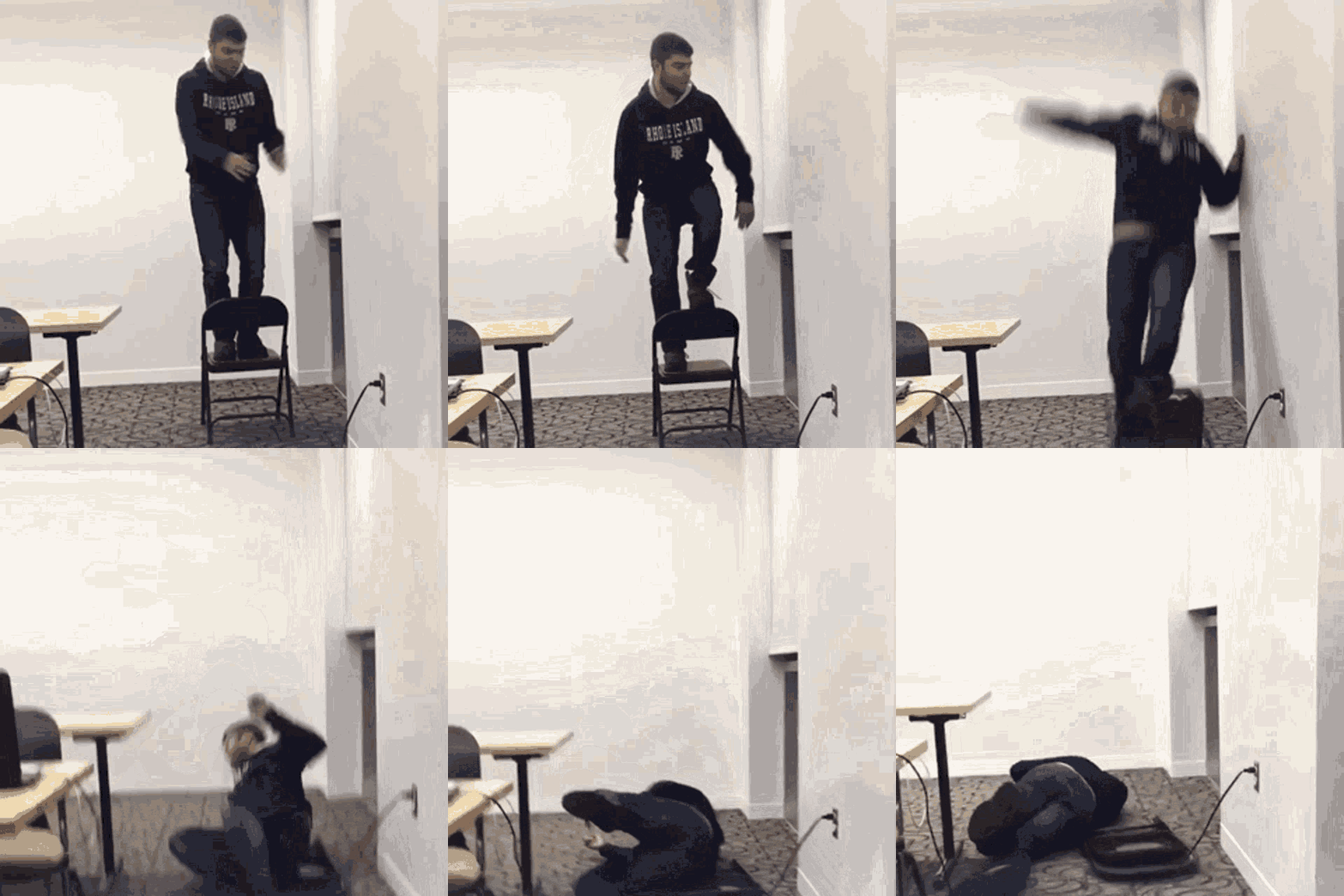
Falling Chair GIF - Falling Chair Man - Discover & Share GIFs

*One of my other classes, in reading through a passage from the novel Maud Martha, by Gwendolyn Brooks, commented “I didn’t think these characters were African-American. They don’t have African-American names.” The names in question were Maud Martha, and Helen. One student pointed out that Helen is a Greek name, as a way of proving to me that these were clearly not African-American names. (I refrained from pointing out that the student’s name is Roman in origin, though the student in question is Southeast Asian.) Another student told me that the activities the family pursue in the passage are rural, country kinds of activities — specifically gathering wood for a fire — and that made them think the characters were White. To which I responded “Because rural areas are only White? And African-Americans don’t gather firewood?”

Did I mention that my principal was observing me that class? He was. His comment later was that I had had “several teachable moments” in the period. (He also said I handled it well, so that was okay.)

*Today one of my students came back from the restroom, started talking to the other students about something (This was, by the way, while I was talking about Miss Caroline and how it feels when students don’t listen to your favorite story), and at some point I realized that what they were saying was that this student, on the way across the hall to the restroom, had seen someone they didn’t recognize outside the school door (Which is mostly glass and is at the end of the hall near my classroom — who needs that “security” stuff?), that my student had let them in, and that the person in question, referred to both as “kid” and “guy,” was wearing a mask, carrying a backpack, and was currently in the bathroom. Refraining from asking the student why IN THE NAME OF ALL THAT IS GOOD AND HOLY they had let some literal masked stranger into the school, I went to the bathroom to see who was in there. There was someone in the stall, but I could only see shoes. So I quickly went to get an administrator to check on the bathroom, and then I went back to my class — where I received the clarification that the student had not let the person in, a teacher had, which almost certainly moved this from “Possible crisis precipitated by a student who lacks critical thinking skills” to “A student went out to a car, with permission from a teacher, came back in, and my student didn’t recognize them.” And the second option is what it was, and a few seconds later the administrator gave me a thumb’s-up on the way back from identifying the person in the restroom as one of our students. 

But it was a fun five minutes.
Loosing-my-mind GIFs - Get the best GIF on GIPHY

None of this is what I wanted to write about tonight, however. (Actually I wanted to write about it last night, but another thing that happened this week is my phone stopped working, so I spent last night ordering a new phone.) What I wanted to write about tonight was the worst thing I’ve dealt with in the last week. One of the worst things I’ve had to deal with all year.

Data Day.

Last Friday was our first Data Day. And the big problem with this particular occasion was that it was our very first Data Day at this school. At least the first one involving my department. To be sure, we have looked at data before: data is inescapable in public schools today. We start every school year with a brief overview of the school’s test data from the year before. Which is all about students who have already left the classes in which the data was collected, which might seem to some people as though it reduces the value of the data.

Some people.

Anyway, we look at data all the time. But I work for a small charter school, which has a hell of a lot of turnover in the staff and the administration, and every year things get a bit discombobulated and confusticated and lost in the shuffle; and so we have never done a Data Day like this Data Day. Unfortunately, those in charge of Data Day thought we had all surely done Data Days before, and so didn’t think we would need specific instructions about how one carries out a Data Day. But since we have never had a Data Day before, we did need those instructions, and we didn’t get them, and so the day was — awkward.

But hold on. Before we even get to the awkwardness of the actual day, I can hear you asking “Wait — what even is a Data Day?” 

A Data Day is when teachers get together in groups and look at the data for our students — in other words, their test scores. This Data Day was scheduled after we gave our first major standardized test this year, a practice ACT. The ACT, a sort of West-Coast cousin of the SAT, has four parts: Reading, English (grammar, that is), Math, and Science. Now, as I assume that all my readers are among the most astute people in the population, so I assume you have noticed that this selection of tests leaves out a few of the usual departments in a high school: Art, PE, foreign language, computer science, ESS (or SPED) — and, of course, history and social studies.

But that’s fine! Even if not all teachers have data and so can participate in Data
Day, the thing to focus on is the subjects which do have data. And lucky for me, English has double the data! And EXTRA lucky for me, this is my first year as head of the English department. So not only do I have double the data — but I get to run the meeting!

Did I mention that my principal was observing my meeting? He was. He did not tell me that I handled this one well. I think I did okay. We had several teachable moments.

But we didn’t have everything. We should have had our individual class data, from the shorter single-subject quizzes we’ve been giving over the course of the semester; we should have all been looking at our individual laptops and comparing our individual data to the school wide data, so we could find where our specific classes were different from the school population as a whole — that is, what are my 10th grade students failing to learn in my class, which the school as a whole is mastering? Those are the areas where I can make changes in my class in order to improve the instruction and the learning in specific skills and knowledges, to help my students catch up. And that was where we were supposed to develop our Action Plan, building SMART goals (Specific, Measurable, Achievable, Relevant, and Time-bound) so that, when we have our next round of ACT practice tests in December, we can move straight into our second Data Day, and we can see what areas have improved and where we need to keep working, maybe finding new strategies that can make a difference in the scores. That is the goal of a Data Day.

I ran the meeting. Completely making it up as I went along, because I have never done a full Data Day. I didn’t tell everyone they needed to bring their laptops and individual classroom data. I didn’t have my individual classroom data. I had not examined the school wide data previously, and so while I pointed out a couple of obvious things — our students did better on reading and English than they did on math and science (I work at a STEM school, if you didn’t know.), better on English than on reading (which mystified me because they mostly can’t answer a single grammar question correctly — but I guess they can correct grammar on a multiple choice test?), and in some cases better, in others worse, when compared grade to grade. But everything I said was obvious. I didn’t know that we were supposed to create a SMART goal, or how to do that, and I didn’t take notes or guide the discussion or watch the time — or delegate any of those tasks. I did a bad job with the meeting. It was uncomfortable. That was my first Data Day.

So.

You all know that whole thing is a pile of horsepucky, right?

I knew you were all astute.

Okay, let me be clear: the basic idea of examining what my students know and what they don’t know, identifying areas where they have mastered the class content and where they still need work, and then strategizing methods to improve their learning? All of that is fine. None of that is horsepucky. We can get general ideas about how things are going, and we can find some ways to maybe make them better; that’s fine. It is a lot of work, for a questionable reward, and since I am already obscenely overworked, and still behind where I should be, I question whether or not this is the best way for me to spend my time; since I have 300 ungraded assignments turned in on my online education platform, I have a better idea of how I could spend a good couple of hours on a Friday afternoon.

Yup. Drinking.

I grade on Sundays. I shouldn’t. But I don’t have any other option. I’m not kidding about the 300 ungraded assignments, and that’s after I spend at least a few hours working every Sunday, and have done since the school year started August 1. A couple of hours on Friday afternoon, even if I hadn’t used that time as I deserve and gone drinking, would have helped make a dent in that pile — though of course it wouldn’t have eliminated the pile. But Data Day didn’t help at all. In fact it stressed me out so much that I didn’t even get my other tasks finished on Friday: I went home and collapsed uselessly on my couch. I did play some Minecraft, so that’s a win, I guess.

But let’s imagine that I did have some extra time, a couple of spare hours that I didn’t have to spend teaching class or working with students or grading essays. I could have done Data Day. I could have compared the results of a test which the students didn’t care about and didn’t try their hardest on, because they knew perfectly well they weren’t going to get graded on it, and that it wasn’t the official ACT, and therefore this test didn’t give them a chance to get a high score they could use to get into college or win scholarships; to the results of a series of short, five-question multiple choice assessments I give in my class, one for each standard they are supposed to master this school year. Those, also, the students didn’t care about and so didn’t try on. But hey, that makes the comparison more valid, right? The students taking it didn’t care, in both cases! Matching apathy! Also, neither set of tests was designed by me, or related directly to the content I used to teach the standards — none of them are on To Kill a Mockingbird, for instance. Oh, and also, the ACT is not broken down by standard, so I’m comparing a five-question multiple choice quiz on a single standard to a 40-question reading test and a 75-question English language test, on all of the standards taught in all four years of high school, and also quite a few that come up in middle school and a couple that are only used in college or adult life. Because one aspect of the ACT is that it is designed to be too hard, in parts, for any student to get a 100% on. Because the goal is to find the extent of a student’s knowledge and ability, right? If I give you a quiz on what you know, and you get 100%, I have not found the extent of your knowledge: those questions might cover every single thing you know on the subject — or they might only scratch the surface of your galactic levels of knowledge. To find out for sure, I have to make the questions get progressively harder until you cannot answer them correctly. That’s where I can assume your knowledge ends, when you can’t answer the questions any more. Which means the ACT tests, like all similar tests, is intended to get progressively harder until it becomes impossible for any high school student to answer the questions. 

Which means, of course, that there will always be gaps and areas for improvement, no matter how spectacularly I teach and the students learn, because of the way the test is designed. So if I take this concept seriously, that I need to teach my students enough for them to be able to score 100% on the test, I can never be complacent. Ever. I will always have more to teach. But of course, my students will move on out of my class before I finish teaching them; but that’s fine, they can learn the rest of everything in their next class.Right?

Sure.

More to the point, did you catch where I described how different the two tests are? Five questions on a single standard, compared to 115 on the general areas of reading and writing. Also, the standardized tests are given in very short timeframes, because the ACT’s base assumption is that the more you know about a subject, the faster you can answer the questions. An assumption that is so deeply flawed that it casts doubt on all of the ACT results — because of course speed has little if anything to do with knowledge or skill. A genius with bad eyesight or dyslexia or a headache the day of the test will not be able to answer all the questions within the time limit, which is 35 minutes for the 40 reading questions (which are about four different reading passages, with 10 questions each), and 45 minutes for the 75 grammar questions, which is just cruel. Oh wait, sorry: that’s only for the 11th graders. The 10th graders took shorter tests in shorter time limits — 24 reading questions in 30 minutes, and so on. But that’s fine, I’m sure we can compare the two classes and get some kind of useful idea of how much students know. Right?

Right?

Sure.

Here’s the part that killed me. Right at the start, when I’m trying to fumble my way through the schoolwide data we have about the ACT and Pre-ACT tests, and the middle school results from an entirely different assessment which the 6th-8th graders took, we were told to ignore the gaps in the test results that were caused by students who were having a bad day, or who had a headache the day of the test, or who didn’t care and so didn’t try. Because we can’t control those things. We need to focus on the places where we can have an impact, where we can raise those scores. 

Uhh — excuse me? How can we know which areas are lacking because of a flaw in the program, and which are lacking because students didn’t feel like trying their hardest? That’s right: we can’t. Just like we can’t see the specific standards for the questions on the ACT (I don’t think; there might be a way to break it down like that, but I didn’t know it, so.), and we can’t know if the five-question multiple choice quizzes give us good information, either, because in addition to being skewed by student apathy and also student humanity, five questions won’t do a good job of determining what the student knows and what they don’t. You can randomly guess on five multiple choice questions and have a not-insignificant chance of getting them all correct even if you couldn’t read at all. And also, let’s not forget that if a student learns all the material, but then fails the assessment because of a non-academic reason like a disability or an illness or a lack of motivation or a grudge against the school or the teacher or a bad testing environment or a bad breakup or a bad bit of potato they ate the night before which gave them vivid dreams in which they were visited by three different spirits of Christmas — that student did not succeed. They do not pass Go, they do not collect $200, because our system is based largely on high-stakes tests and the ability to pass them. And it doesn’t matter what I teach or how well I teach if a student who fails the assessment, despite knowing everything about my subject, is considered a failure. All of the things that I was told to ignore, because they are out of my control, are the entire reason why that hypothetical student could fail my class. 

But guess who would still get at least some of the blame for that student’s failure. And who would have to make SMART goals to try to improve that student’s test results. And who would have to examine that student’s data, again and again, to find the reason why the student was unsuccessful. But please, keep ignoring the aspects we can’t control, like a lack of motivation.

Right.

Sure.

And while we’re at it: who the hell told educators that we could control anything? Listen, you don’t know how hard I tried today, to make my students learn the lesson of Miss Caroline. And instead they were distracted by the possibility that someone had let in a school shooter — which was exactly where all their thoughts went when they heard that there was a possible stranger in the school, in a mask and carrying a backpack. Because of course that’s what they thought. And I’m supposed to teach those kids? To control their learning? To specifically assess the lessons that worked and the ones that didn’t, and to make adjustments which will ensure all the learning happens exactly as we want it to, which will then be shown clearly on the test?

Let me also say: if I go back tomorrow and try again to teach the same lesson, my students will say “We already went over this yesterday.” And if I say “Right, but you didn’t learn it as well as you should have, because you were distracted,” they will then reply, “That’s okay, we learned enough. We should move on.” And it wont matter how much I try to teach the lesson, how hard I want to reteach it, or whether I know exactly how to make that lesson more effective: it was ineffective because of events outside of my control. The opportunity was lost. We did not have a teachable moment today.

Here’s the truth. That neat, data-driven ideal, where teachers do the math and find the perfect way to help students reach mastery? School doesn’t work that way. Students don’t work that way, learning doesn’t work that way, even tests don’t work that way. None of it is scientific. None of it is precise. There are real benefits to teachers getting together and talking about what works and what doesn’t, and trading ideas and strategies; to that extent, Data Day was a real success. But otherwise? There is no data. Not anything real, not anything reliable. It’s all guesstimates, all gray area. Teachers do things that seem like they work, that seemed like they’ve worked in the past; students seem to learn things, and seem to get grades that reflect their learning. Somewhere in there, real learning happens, and part of it is probably because of what teachers do. But not all of it. And none of it for certain. Data Day is an attempt to pretend otherwise, to pretend that we can capture a mathematic truth about human beings, who are not by our nature quantifiable. And it just doesn’t work.

But hey, maybe that was just this time. All those things about human nature and whatnot? All out of our control. Let’s try to focus on what we can control, and we’ll circle back around in a few months and see what the data tells us.

Can’t wait.

Watch This

(Actual footage of me trying to keep up with grading.)

I work a lot.

My work day runs from 7:45 to 4:20; just about an 8-hour day if I got a half hour for lunch. I don’t, of course; my lunchtime is spent supervising and often talking to students, or else grading and planning. I do sometimes manage about 20-30 minutes for eating and something mindless like scrolling through social media or playing Minesweeper; but as there are almost always students in the room while I’m doing it, it isn’t duty-free: I would still need to intervene if one of them punched another, or if they said something that required action on my part, like “I’m going to cheat on my math test next period” or “I’m going to blow up the school” or “Clearly trickle-down economics are the key to prosperity, and also donuts taste terrible.”

And of course, my work day doesn’t actually end at 4:20. (No comments, please, about how the administration at my school decided to let teachers go PRECISELY at the Smoking Hour; it’s a coincidence of scheduling, not evidence that one of the superintendents is Snoop Dogg. Though that would be badass. “Hell yeah, you can teach that CRT shit, yo. Load them lil homies up wit dat GANGSTA truth, fo shizzle! CRT from tha LBC, and the D-O-Double-G!) I commute, which certainly should be considered part of the work day; that adds an hour or so total. But even without that, I frequently have meetings and so on which run past 4:20; 5:00 is more accurate at least two days a week. Most teachers go home every night and plan for the next day; I’ve been teaching my classes long enough that I don’t need to do that any more — but I do work on the weekends, every week, for between four and eight hours; sometimes more. It’s the only way I can keep up with the essays I have to assign, and the kind of feedback I want to give on my students’ writing. I also read extensively for my classes: finding new material, refreshing my memory of old material, and so on; all told, my work week is closer to 50 hours than 40, and often beyond that mark.

This is not intended to complain — though I will certainly use this, as all of my fellow teachers do, to rebut the absurd claims of those who hate education and educators and argue that teaching is an easy job because we have summers off: even apart from the truth about teachers in summer time, which is that we are still working on planning and researching and completing professional development, and often working our second jobs required to make ends meet; when teachers work approximately 50 hours a week during the 36-38 week school year, those extra ten hours every week add up to almost 400 extra hours, which is — yup, just about ten weeks of a regular 40-hour-a-week job. Or the length of summer.

But no: my point with this summation of my work schedule is this: if I work something like 50 hours a week, for the 38 weeks of my school year — why is my performance evaluation based on one or two formal observations, which total less than two hours’ worth of watching me teach?

The observation and evaluation system in education is well-known among teachers and students, and pretty roundly derided as a ridiculous means of assessing a teacher’s ability or worth. First, the criteria for success are unbelievable: my school uses the Charlotte Danielson method. Here it is.

Seems reasonable, right?

Most formal observations are planned and scheduled, which means, as we all could guess and teachers talk about frequently, that we just trot out the dog-and-pony show for the administrators. (By the way: has anyone ever actually seen a dog and pony show? If you haven’t, watch this. The video quality is pretty choppy and annoying, but the dogs and the pony are very cute.) Stories abound of teachers who feed their students the correct answers to questions before the observation so the students can give all the right answers while the administrators are watching; my favorite is the urban legend of the teacher (Which I know has been actually imitated more than once, but I suspect the original story is apocryphal) who told the students that, when the teacher asked a question, if they knew the answer, they should raise their right hand, and if they didn’t know, they should raise their left; that way the teacher could pick from a sea of raised hands, and every time, the student would give the right answer. Genius.

Whether that clever story is apocryphal or not, the dog-and-pony show definitely is not: I’ve done it myself several times. My very first observation, I tried to work out a complicated group work system called “jigsaw” groups, to show off that I did indeed know how to run a group lesson; unfortunately, several students were absent that day (Maybe because they didn’t want to perform for the admin?) and that screwed up my groups, so the whole lesson bombed; that taught me the folly of trying too hard for an evaluator’s observation. But at my current school, when my administrators had observed me half a dozen times, always telling me I needed more group work and universal student participation — suggesting, every single time, that I both call on students (which I refuse to do, having been a dreamy introvert and therefore understanding how terrible it is to be snapped out of a reverie to suddenly have to admit you don’t know the answer, and frankly I’d rather let them daydream and miss part of the lesson) and use exit tickets (which I don’t refuse to do, but — my God, what a pain in the ass those things are) — I did indeed create a group lesson specifically for the next observation, and ran it when the admin came even though it was out of sequence with what the class was working on every other day that week. And I got my most glowing review to date. And then the next day I went right back to what I had been teaching before the interruption of an observation.

So beyond question, the system of scheduled formal observations does not give good information about what a teacher’s classroom is like on a day-to-day basis. But it’s more than that: even surprise observations, which I’ve had every year for the last eight years I’ve been at my current school, and will have again within the next month or so when observation season starts, don’t give the observers a good idea of what the classroom is like every day: because on a normal day, there aren’t a handful of school administrators looking uncomfortable in student desks during the class. Does anyone imagine that students are unaware of administrators in the room? When these are the people who most frequently enforce school discipline, and impose consequences on the students who break the rules? And there they are, just staring at the students?

Let me ask it this way: when you see a cop car driving down the road near you, do you slow down and make sure you don’t pick up your phone for any reason? Me too. And so with students while an administrator is observing the class: it’s called the Hawthorne Effect, after a study of productivity in a factory called the Hawthorne Works. When management changed conditions for the workers, productivity improved every time, even when the change was to go back to the former conditions. Because the workers knew: when something changed, the bosses were watching. So they worked harder, for a short period of time. I can never get a class to behave nearly as well as any class being observed. Though at the same time, the discussions that are the standard operating procedure in my literature classes are much more stilted and uncomfortable, because normally I and the students both crack jokes all the time, and go off on tangents into different subjects that I or they or both find interesting; none of that stuff happens during an observation — which means the observers get to see precisely what they want, which is an orderly, focused classroom; and not what my class actually is, which is an environment where a whole group of people can feel comfortable sharing ideas and discussing literature.

But even without that, formal observation is a terrible system: because it’s just not enough time. I work hard to ignore the observers when they come in. I actively make jokes and go off on tangents (I didn’t always, please note, but I am now one of the more senior and one of the more respected teachers at my school, and there’s little chance that I’m ever getting fired, and no chance that I’ll ever get fired for incompetence or irreverence during an observation; for God’s sake, I dress up like a pirate every Halloween and teach my classes in my Hector-Barbossa-like pirate accent. Irreverence is a given. Also, I am a highly competent English teacher.) and encourage students who do the same. So while observed lessons are better behaved, still, the discussion actually isn’t all that different; it does in fact give a pretty good view of my regular class, if still an unusually well-behaved one. But the other problem remains: the observers are only seeing one class, on one day. They’re not seeing the procession of students through my room. They’re not seeing how different it is to have a class in the morning versus the afternoon, to have one on a Monday versus a Friday, versus the last day before a vacation, versus a test day, or the day before a test day. They’re not seeing the same class when THAT ONE KID is present, or if they are, they don’t see what a difference it makes when THAT ONE KID is absent. And of course, they’re not seeing the work: they don’t read the essays, don’t look at the quickwrites or the annotations or the graphic organizers. They don’t read the emails apologizing for that bad day I had the other day, Mr. Humphrey, but I promise I’ll do better. They don’t read the emails from parents asking for some leniency because they had a family emergency and their child hasn’t been able to sleep for a week.

They don’t know what I do as a teacher. They can’t see what I do in just a single hour. They can’t see what I do unless they watch ALL of what I do; and of course they can’t do that. There are so many incredibly different elements that go into teaching, so many different skills and tasks that all must be completed for a single effective lesson, as part of a single effective class. There’s just no way to observe it all for every member of a school faculty. And of course, it changes every year, as students change and class dynamics change and class assignments change for teachers, as curriculum changes, as new ideas occur to us and we replace things that didn’t work last time — and so on, so on.

When I worked as a janitor, my performance evaluations were both easy, and fair. There were a set of assigned tasks that had clear outcomes: if I was told to mop the upper corridors, then my boss could go look at the floor and see the job I had done. If the floor was clean, I had done my job; if not, not. My boss was generally at work with me every shift: she could see how long it took me to complete a task, how efficient I was. She could see if I had initiative to take on a different task if I finished my assigned duties, or if I just sat around like a lump. She could hear me interact with my coworkers (Not to mention she herself interacted with me every day, pretty much) and with the clients and the general public, because she was there when I was working, and we were working in pretty much the same place, all the time. Once I’d worked there for two or three years, I was given more independence and responsibility, which meant I worked unsupervised more often; but still, my boss could look at the windows the next day to see if I had actually washed them like I was supposed to. So those performance evaluations were a breeze, and I never felt like they were unfair.

Now? I don’t feel like I could possibly get an evaluation that could be fair. I generally get sterling evaluations: I really am a good teacher, and a popular one, and the school both recognizes that and recognizes that they should probably keep me happy, because it would hurt the school to some extent if I quit. (The school would remain, don’t get me wrong; but here in Arizona, where School Choice is such a strong part of the education environment, you can bet your sweet bippy that some students would leave the school if I did. It’s happened several times in the past when popular and successful teachers have moved on.) But even though the evaluations I get are good, and I get an amount of “merit pay” as a reward for my good ratings, I still get a little offended by the evaluations. Because those people don’t have any idea what I do. Not really. So who the hell are they to judge me?

The irony, of course, is that so much of school these days (And maybe always) is about judgment. Assessment. Evaluation. Accountability. It seems like that’s all anyone in authority can talk about — though my colleagues and I have noticed that they have stopped using a phrase that was all the rage ten or twenty years ago: authentic assessment. Authentic assessment was the idea that some evaluations of a student’s learning would be more genuine and more effective if they were attached to a task that was, first, genuinely part of a class, rather than an externally created and scored standardized test, and second, similar in some way to something the student would actually do with the skill in question: so, for instance, testing a student’s writing ability with a resume and a cover letter seeking a job, if a class has been studying resumes and cover letters, would be an authentic assessment. We don’t talk about that any more. Probably because standardized tests are still the only thing that higher-ups pay attention to, a problem that has only gotten worse in the last decade; but maybe also because they became aware that their own assessment of teachers was anything but authentic, no matter how it had the trappings of authenticity. It seems clear to me, at least, that the idea of having the appearance of authenticity is self-contradictory: and so with formal classroom observations.

I’m talking about this this week for two reasons, even though it doesn’t necessarily fit in with my planned course of investigation and explication of the state of education in the US today; certainly this is a part of the world of education, and inasmuch as observations and evaluations have some impact on teacher retention and so on, this subject isn’t far away from what I’ve been speaking about. But if I had been going straight ahead with my intended subject, this week would have been about school as an entity: the purpose and value of actual schools with actual classrooms where students sit in actual desks, as contrasted by virtual classrooms or homeschooling. Hopefully I’ll take that on next week; unless I find something else that takes my focus, as has happened this week.

The first reason for this semi-tangent is my wife. My wife taught art full-time for three years, and then quit three years ago, because she is first and foremost an artist in her own right (And an incredible one) and teaching full-time took too much time and energy away from her art. But while she was working there, she got observed — by administrators who do not know the first thing about art. They told her, directly, that they hadn’t understood what she had been talking about in class while they observed her — “But the students seem to get it, so good job!” In truth, past administrators who have performed my evaluations haven’t understood my subject terribly well; some of them haven’t even understood teaching in general, and their comments and critiques relied on what they had gleaned from professional development and teaching manuals and so on. Not terribly helpful, but they seemed satisfied when I would nod, say, “Okay, that makes sense, I’ll try to do more of that” — and then go straight back to teaching the way I always have. Because I do understand teaching, and my subject, and because the way I teach is effective. It is not effective with every class and every student: but that’s part of the conversation about schools, which I will come back to next week.

The second reason I wanted to talk about this subject for this post is because this last week, I was observed. Not by my school-level administrators, and not to evaluate my teaching: this time it was district personnel come to check my compliance with the new systems that have been put in place this year. As with every year (And this is the other contender for next week’s subject matter: the way every new year brings new systems and new demands and new policies, and the old ones are sometimes superseded but never simply taken away, until we end up with something like a multi-layer shit sandwich — or perhaps a shit tiramisu would be the better metaphor. I’ll consider.), and despite the last two years being maddeningly difficult and exhausting years because of the pandemic and the quarantines, we have a new system in place, implemented by the district without any consultation with the teachers (and apparently over the objections of school-level administrators, though that is only scuttlebutt), which has to do with the curriculum. Not a change in curriculum: only a change in pacing, and in — you guessed it, if you have any experience working in education — assessment. So two district administrators made the first of what will be several monthly visits to the school, to step into various classrooms and examine how well the teachers are implementing the new system.

And if you have any experience with me and my teaching, you already know what they found: nothing. I’m not complying with the new system, precisely because it doesn’t mandate any change in curriculum; and I’m not going to change my teaching methods unless somebody gives me a good idea. They didn’t. So they saw what every other administrator has seen when they come into my classroom: a discussion — lively, in the case of the class they came into, one of my more active groups — with a fairly intense focus on specific details that show characterization and theme, in a complex piece of literature, in this case the brilliant short story “Valedictorian” by the incredible N.K. Jemisin, a piece I have picked up in the last three years because I’m trying to include more modern writers, more women writers, and more writers of color, and Jemisin is all three in addition to being incredible. And I hope they liked what they saw, even if I’m not in compliance with their system: because if their job is to improve education, then what they saw was reflective of their goal, if not of their methods.

But I don’t really care what they saw: what I care about is what they did. These two men, complete strangers to most of my students (One of them used to work at my school site, but was largely invisible in the lives of students, particularly these students, because they have often been online for the last two years and so don’t know any school personnel other than their teachers, and us only as faces on Zoom until this year, in some cases), came into class, opening the locked room door with a master key, in the middle of said lively discussion. They had emailed me that they were coming (I had warned the students they might come in, but I had no idea what period or what time they might come into my classroom) and told me not to make a fuss, so I didn’t acknowledge them; but I’m sure I did exactly what I saw the students do: they got quiet, they subtly hid away their phones and headphones and so on, and sat up more straight, their eyes darting to the men and away. Passing by the comfortable chair I had set up front in case one of them wanted to sit there, and ignoring my desk chair, which was also open, they went and sat amongst the students: one in an unoccupied student desk, and one standing awkwardly in the corner of the room, right behind a female student who spent the next fifteen minutes deeply uncomfortable with the close presence of a strange man right behind her. They stayed there for a quarter of an hour, saying nothing, while my students gallantly and honorably maintained their composure and actually had a pretty damn good discussion of the story; and then they left. And, I’m sure, promptly invaded another classroom, and made another group of kids vastly uncomfortable.

This is not a good system. If they wanted to see if I am in compliance with their system, they should have asked me. I would have told them I’m not. I might have done it sheepishly and said I would try to comply in the future; but I wouldn’t have pretended to be doing what I’m not. They could have looked at my online records to see whether or not I was completing the tasks they wanted me to; it should be immediately clear that I’m not (To be fair, I’m doing a couple of the things they want. And also, I already achieve what they’re hoping to achieve: one of those same administrators gave me an award at the beginning of this year for my students’ achievement last year. But I’m not in full compliance, and they could know it without even setting foot in my room.). If they wanted to know if I’m writing what they want me to write on my board every day (Standards and objectives in “student-friendly language,” and no, I’m not — that’s another post I’ll write, about the appalling lie that is standards-based education), they could have come in at the end of the day: no teacher on Earth erases the board at the end of the day, except those who then go ahead and fill it up again with the needed information for the next day; if I was writing standards, they’d see one or the other, the past day’s or the next day’s.

All of that evaluation could be done without disturbing my class. Without making my students — and me, but that’s not important — uncomfortable when we should be working, trying to achieve the very thing they are trying to see if we’re achieving. And if they’d stayed away, we could have made more progress towards that goal of actual learning. Not much more progress; they weren’t in there long, and it didn’t mess the discussion up too much — but it did get in the way. It was a problem. And for what? So they could leave some boxes unchecked. If you’re thinking they came back to talk to me later, to let me know I was out of compliance and that was an issue, or to share with me their observations, perhaps even to offer helpful or at least well-meaning advice, well — you’ve never worked in education. School administrators sometimes do that. District and above? Never.

The last reason I’m writing about this, the part that upset me most, was this: the observation made one of my students, as they told me the next day, feel as though they weren’t being treated as a person, but rather just some data point to be measured. It made that student mad, and it should have. And it made me mad, because I have worked very hard to make this student feel as though they belong in my classroom and at this school. And they do. It’s the administrators who don’t. And let me just note: you people put cameras in every classroom, over the objections of the majority of the students and staff. Use them. Observe me through the lens. Stay the hell out of the room unless there’s a problem you’ve come to fix, instead of cause.

One part of my job which I hate, but which I take very seriously, is assessment. My students want to know how they’re doing; the community, everyone from the school administrators to the students’ parents to their future employers and college admissions officers, all want to know how they’re doing. So even though I hate and despise grades and grading, I do it. I do it as well as I know how, and I spend appalling amounts of time doing it. And one thing that is critical to the process is: time. Time, and multiple measures. No one thinks that we can know all about a student’s knowledge or ability or especially their progress based on a single assessment, a single observed moment, no matter how rigorous that assessment may be, no matter how reliable or valid is the data that comes from it. If nothing else, all of the education system these days is focused on growth over time: and of course growth can’t be tested in a single instance, because you need two points to make a line and find the rate of change for that line over time. So I guess it’s good that the administrators are going to come back to observe again — but it’s absurd and terrible that they’re just going to do the same thing over again, with the same problems and flaws and negative consequences of their actions, many of which will invalidate their data. Again.

If I graded my students this way, those same administrators would fire me.

If they had any idea what I was doing.

This Morning

This morning I am thinking about appreciation.

Yesterday I tried to recognize the teachers and educators I have worked with (And I still forgot a few — so thank you, Mary Wells, for all that you do, and thank you, Nora Caragan, for being the best paraprofessional in the history of paraprofessionals), and I got a grateful and heartwarming response. Teachers loved hearing what I had to say.

But there’s a problem there: I had to say it.

One of the things I object to, even though I participate in, is the support network that teachers provide for each other. It is a staggeringly wonderful thing: these people, who are already working so hard, and who are already giving so much, turn and without hesitation give even more to each other. I can’t tell you how many times I’ve seen it: teachers go into each others’ rooms all the time, and frequently the visitor comes in mad or frustrated or down — until they see the face of the person they are visiting, and see that that person is feeling even worse. Suddenly, whatever the teacher came in to complain about or vent or even ask for help with is gone: frustration vanishes in concern, and the visitor says, “What’s wrong?” Prepared, in an instant, to take more burdens onto shoulders already weighed down with overwork and the emotional strain of seeing up close and personal the struggles and sufferings of children (And also with the strain of struggling through the suffering caused by children — and the worst is that it is often the same children, that those who are neediest and most desperate are the most obnoxious people we see. Which is saying something.), not because we don’t need help any more, but simply because a friend, a fellow teacher, needs help more, or even just needs help too: and so we help.

It’s amazing and inspiring. I will say, without any humility, that I participate in this, that I support my fellow teachers at all times and in whatever way they may need, and that I rarely ask for help myself because  I don’t want to trouble them.  I’ve even seen this go too far, when I was part of my union’s negotiating team and we were  fighting for better compensation and working conditions; trying to get teachers to actually stop working, to stop sacrificing, to start asking for something for themselves — and not luxuries, but a living wage and necessary health care and the like —  was nearly impossible. They wanted to give up whatever they had to give up in order to make everyone else happy. The magnificent bastards.

But here’s the thing: we shouldn’t have to do that. Of all the people who should be sacrificing in order to keep teachers sane and healthy, IT SHOULD NOT BE TEACHERS WHO DO IT. That makes no sense. It defeats the purpose. We not only put on someone else’s oxygen mask first, we take ours off and strap it on top of that person’s own oxygen mask just so they can be twice as safe while they watch us suffocate.

If it’s not clear already, this drives me nuts, that teachers do this. I don’t like that I do it, either, but it is without doubt who we are as people, and what the culture of teachers encourages in us. This is why we spend our own goddamn money on school supplies for our students, despite how little we are paid. And perhaps the worst part, though this is not the place to get into this, is that we are therefore propping up a system that is in many ways a terrible system: not terrible for us, though it is that, but terrible for the students, and terrible for the country. Yesterday I bought donuts for all of my students taking the AP Literature test. I encouraged and helped students to “succeed” on a high-stakes test run by a private corporation with disproportionate influence on college admissions. I structure the whole class around that damn test: a test I should be opposing with every fiber of my being. But I bought them donuts.

So here’y my request, for those who want to appreciate teachers — REALLY appreciate us, not simply nod in our direction while we lie bruised and bleeding in a ditch. (I know, it’s hyperbolic, but it’s also the end of the year, and it feels like that. I feel bruised. I feel sick because I haven’t been sleeping, and I feel sore because my body has been too tense for too long: my shoulders honestly ache right now.) Ready?

Make it so we don’t have to hold each other up.

Give us enough support, and take away enough of our burden of responsibility, that a single person can do a teacher’s job alone, or at least can handle the pressure alone.

Specifically, that means essentially three things: money, time, and trust. In the first years of a teacher’s career, there is a fourth, which is: help.

I don’t want as much money as I want, if I can be permitted that sentence. I want as much money as is needed so that I don’t have to worry about it. That’s all. I’ve been a teacher for twenty years, and I still don’t earn enough to own a home, and I don’t have any retirement savings, and I still have debt that I haven’t been able to get rid of.  I want to make enough money to take care of those problems. I don’t need enough to pay for vacations or jet skis or that diamond-encrusted pirate hat I’ve had my eye on; just enough so that I don’t have to suffer from money stress. I want to be middle class. I aspire to the bourgeoisie.

I want enough time in my school day to get my work done in my school day. I don’t mind planning lessons from home; it’s kind of fun sometimes. But I don’t want to have to spend one more weekend grading, not one more evening filling out paperwork. I already work 40 hours a week at school; why is it that I am expected and required to add another 10-20 hours on top of that, every week? It’s because I have too many students, and too many requirements for teaching those students. Too many things I have to cover, too many things I have to compensate for, and too many people I need to report to and satisfy in order to show that I did my job. You know what should be the only evidence needed that I did my job? That my student can read a book, write an essay, discuss a poem. That’s it. Don’t ask me to prove that I did my job: ask the kid. See what he can do. And ask him, honestly, if I helped him do that. Make it his responsibility to prove that I did my job. He is the product, after all. (Please note: this is not a serious suggestion for assessment of teachers. Students shouldn’t have to have that burden either, and too many of them are not reliable witnesses nor reliable learners. All I’m saying is that I don’t want to do it, to prove to all and sundry that I did my own job.)

And anyone who thought “But you get summers off!” just know: I am currently mentally punching you in the brain. Hard. Kicking, too.

The last thing I need is trust. I have proven that I am a good teacher. I’ve won awards, I’ve won accolades, I don’t have anyone who disagrees with that basic premise: not students, not students’ families, not other educators. Of course not everyone likes me or likes my class: but I don’t believe there’s a single person who could genuinely say that I teach badly. So please, I beg you. BACK OFF AND LET ME TEACH. Don’t try to improve my curriculum for me, or my methods. If you’ve got suggestions, I’ll listen, of course; but don’t tell me what to do, especially if you’re not versed in my subject or my profession. Stop assessing me: my driver’s license is valid for 25 MORE YEARS: and that’s based on a single test I took more than 20 years ago. Yet my teaching license expires every three to six years, and requires hundreds of hours spent on learning to be a better teacher. I get observed every year, often twice a year, and have multi-page evaluations, every year. How much proof do you need that I can do this job? The answer is that there will never be enough proof that I can do it, because I will never be trusted to do it. That has nothing to do with me and everything to do with our culture and our system, but I don’t care why it is that way: I just want it to stop.

I already care about my profession, and about my students, and about my subject. I care about my fellow teachers and educators. Please, stop making me also care about and for myself: let someone else do it. Give me some real appreciation.

And don’t let it come from other teachers.