Tell me about the rabbits again, George.

I’ve decided I want to be stupid.

If I were stupid, I couldn’t be a teacher. No, that’s not true: I couldn’t be a good teacher, but we all know there are plenty of bad teachers out there. So I wouldn’t be a good teacher any more, which is sad; but I wouldn’t know it, so there wouldn’t be any problem. What’s more, I wouldn’t ever worry about being a good teacher. I’d never have to worry about whether my students were really understanding the point I was trying to make, because I’d never have a point. I wouldn’t have to read their essays any more, and write comments on them trying to make them better, and feel the frustration when they don’t pay any attention to those comments but go right on making the same mistakes; I could start grading essays according to how many words they are and whether they follow MLA format perfectly and how many words over three syllables they use. I wouldn’t realize the damage that standardized testing does to students, and to education, because I wouldn’t understand the purpose or the power of education, and I wouldn’t know what an opportunity is lost when students are beaten down with tests; I’d just do what I was told, and teach to the test, and threaten my students with bad grades if they don’t pass. So I’d never have to worry about lesson plans ever again. I would swallow all of the snake oil that gets sold to teachers, and I’d believe everything the salesmen said about it, so I could change entirely my policies and lesson plans and teaching methods every three or four years; so I wouldn’t even get bored. Every day would be a PowerPoint presentation and a jigsaw lesson, followed by a standardized test. And you know what? I bet my students would love me. Because they’d never have to think, either.

If I were stupid, I couldn’t be a writer. But wait: that isn’t true, either. It just means I couldn’t write well. But – assuming I still wanted to be a writer, which I probably wouldn’t because I wouldn’t be able to see the world the way I do now and I wouldn’t care about what I couldn’t see; I wouldn’t believe that art could help make the world a better place, as well as making me a better person; I wouldn’t even believe that writing was an art, because I’d think that art was only painting pictures. So if I were a stupid writer, that would work out great: because my books wouldn’t take so long to complete, and I wouldn’t have to work so hard to write them well. I could just vomit out whatever drivel I wished about super-powered vampire werewolves who drive around at night in Lamborghinis (which I’d always call a “Lambo” because I couldn’t spell the full name) –

Dear God, I wouldn’t have to worry about spelling any more.

– fighting demons with their super-powered vampire werewolf kung fu and having sex with hot chicks at the same time. Then I could self-publish my e-books on the internet.

I bet they would sell a million goddamn copies.

I could stop reading challenging books: right now I am reading Arundhati Roy’s The God of Small Things because I will be teaching it to my AP class, and I am also reading Bertrand Russell’s Wisdom of the West (a condensed version of his three-volume A History of Western Thought) because I admire the hell out of Bertrand Russell and I am thirsty for more understanding of philosophy. But fuck that – sorry, screw that (if I were stupid, I’d believe that cursing is bad, especially the F-word): if I were stupid, I wouldn’t be teaching that strange and wonderful and ethereal and challenging novel; it’s got weird sexy stuff in it, and I’d know that was wrong to show to little kids like the high school juniors in my AP class. Plus I wouldn’t understand it because the story jumps around a lot and the plot is hard to follow. Plus I wouldn’t like it because it isn’t set in America and there aren’t any super vampire werewolves in it. Plus my class wouldn’t teach any full novels, because that takes too long and isn’t necessary to pass a standardized test that only asks you to read short passages and excerpts. And there’s no way I’d read philosophy, especially not a survey of philosophy starting in ancient Greece; I’d think the Greeks were homos and philosophy is gay. I’d get rid of every book like that and just read James Patterson. And books about sports. Though I’d prefer the audio books, because it’s easier and faster and not as boring.

Speaking of sports, I could watch football instead of spending my Sundays doing school work or reading or writing, and go to bars at night with my buddies and drink beer (and I’d just drink cheap American beer, instead of having to take the time to peruse the menu looking for good beer) and watch more sports and yell real loud when my favorite sports-squadron scored a goal-unit-basket. And I could wish that I had been good enough at sports to go pro, but known deep inside that it would never have happened, because I’m white and black people are better at sports. Which is why I would like baseball and hockey and NASCAR so much, because lots of white people are good at those sports. Though not hockey as much because they’re all Canucks and Russkies. Though watching the fights would be fun. And I could watch MMA and laugh when Kimbo Slice (That’d be a great name for one of my super vampire werewolves! Maybe I could change it to Jimbo, and then he wouldn’t sue me. Then I could make him white, too.) challenges his opponent to actually compare testicle size during a pre-fight interview.

Though I would have to worry about the size of my genitalia. And whether the size of my hands and feet gave an accurate representation of that size.

Speaking of hand and genital size, if I were stupid, I wouldn’t have to argue and debate and worry about politics: I could just vote for Donald Trump to make America great again, and go back to watching football. And then I could watch Fox News and never have to worry about reading or thinking about what is going on in the world: I could just be sure that America is the best country, that we have to have a strong enough military to keep everyone from invading us, but that if they did invade us, I’d be ready with all of my guns to fight them back, just like in Red Dawn, which would be one of my favorite movies. And maybe I’d have to worry about that socialist Bernie Sanders getting voted in, but I’d be pretty sure, in my heart of hearts, that America would never let that happen: I’d probably secretly believe that the Statue of Liberty and the statue of Rocky Balboa would come to life and drag Sanders down into New York harbor. And I’d never worry about that broad Hillary getting elected over The Donald: no way would America pick a woman over a man. We all know you can’t trust a woman with power – what happens when she has her period? She’d fire the nukes if she didn’t get enough chocolate ice cream! (I would have written Haagen-Dazs, but I can’t spell that, either. And Ben and Jerry are socialist hippies.)

I would believe that a wall on the border could keep out Mexican illegal immigrants. I’d believe that immigrants are bad. I could ignore uncomfortable irony like the history of my own family’s immigration to this country. Because I’m white.

I could chant “USA! USA!” without irony. And tear up when a small child or a crippled person sings the Star-Spangled Banner at my ballgames. And secretly hate that Beyonce sings better than anyone in country and western.

I could listen to country and western music. I wouldn’t have to change radio stations any more, because there’s only one country station here and I’d love every song because they all sound the same. I wouldn’t have to listen to challenging or depressing lyrics, or admire musical talent or songwriting ability; I’d just like the ones who say America is great and talk about drinking American beer and driving around in trucks. Which is all of them.

I could stop taking criticism to heart. I would think I was great because I am American, and a white male, and therefore I am the best people in the world, and everyone else is just jealous of what I have. Except for that genital thing. But I’m sure I could convince myself that there was no problem there. My hands are pretty big, after all. And it wouldn’t matter to me if people thought my writing was bad, or my teaching, or that I was behaving in any way wrongly: because I’d think they were haters, and Taylor Swift (who I would totally listen to, and try not to think about how hot I’d think she is because she’d be too young for me, but I’d know in my heart of hearts that she would totally have sex with me if I ever met her in a bar, because I am an American white male with not-too-small hands.) would have told me that haters gonna hate, hate, hate, and I just needed to shake it off. Man, that song is just so catchy! And that Kanye West guy is a racist. Though his wife is hot. And of course she married a black guy, because she’s got a huge butt and black guys like big butts. Sir Mix-A-Lot told us that.

If I were stupid, I would think that “were” sounds weird: because I wouldn’t know about the subjunctive mood and statements that are contrary to reality requiring a different verb; so I’d just say “was.”

If I was stupid, I wouldn’t worry about my diet. I wouldn’t care if animals suffered in factory farms, because they’re just animals and they don’t feel pain, plus the Bible says they’re here to serve us. I’d love bacon more than anything except steak, and best of all would be steak wrapped in bacon and topped with lobster. Wrapped in bacon. Maybe with a bacon milkshake on the side. I wouldn’t care about my cholesterol, because I’d know that America has the greatest health care system in the world and I could have all the triple and quadruple bypasses I needed when my ticker started giving out. And I wouldn’t care about my weight, because I’d lift weights – that is to say, I’d do it differently than I do now, because I would do bench presses and curls and maybe five sit-ups a week and call it good – because as long as my pecs and arms were big, I’d think I was hot, because check out these guns! Plus women don’t think the same way about appearance. Men are visual, they need chicks to be hot; but women just need them to be manly, so they feel protected and safe. And I’ve got all the guns I need. Get it? Get it? Because I meant my biceps AND the Glock on my nightstand!


Yes. I want this. Last night I went to see Of Mice and Men on stage, and it was lovely and heart-wrenching; but if I was stupid, I never would have gone to see it, and it wouldn’t have made me sad. And then afterwards, I spent a fair while writing an irritated response to a comment on Facebook from a woman who didn’t understand everything I was saying in my argument, but she was pretty sure I was a socialist and wanted to take tax money away from hard-working Americans to give to the junkies on welfare. But then I had to delete my reply. Because reasoned discourse is no longer acceptable in this country: all we care about is if people agree with us, and if they don’t agree with us, there must be something wrong with them; and if they tell us we are wrong, then we get offended. I had to delete the comment because I am a teacher, and teachers are not allowed – ever – to be offensive, even if the only reason we are offensive is because other people don’t like our arguments.

I had to delete my comment because six years ago, an offended woman on Facebook nearly got me fired and banned from teaching in Oregon by complaining about a comment I made, which led my employer to my blog, where I had written things that were true, but not polite, and not acceptable coming from someone who was supposed to love and protect and coddle all of the children while preparing them for the tests and cheering for them at football games, which is, I think, how most political entities view ideal teachers. I was called “morally reprehensible” for what I said. And the worst thing is this: that I have had to think about that, and whether it is true, and decide that to some extent it is, and then I have had to feel both shame and doubt because of it.

And last night, I realized: as long as I am a teacher in America, I will never be able to say exactly what I think, and I will never be able to argue, especially not about controversial issues like politics and guns and war and racism and religion and education, because telling someone that they are wrong, especially when they are, is offensive, and particularly for me because of my history, offending anyone, anyplace, anytime, could very easily get me fired. This means not only that I will always have to worry about what I write and post online, but also that I cannot use my abilities, my greatest assets – my intellect and my words – to do what I think is right, to try to make the world a better place through critical thought and reasoned argument, because I will never be able to argue, not as long as I teach. And probably not after that, because I’d like to be either a professional writer or own a small business, but if I make people mad at me by taking their bad arguments apart online, they will give me bad publicity, which will hurt my career, whatever career it is. I will always have to worry about what someone else will do to me if I tell them they are wrong. Because reasoned discourse is dead. We prefer circuses.

And I decided that I don’t want to worry about anything any more. I just want to do what I’m told and work hard and do the things that make me feel good.

I’d rather be Lennie than George. All the way to the end.

The First Step

You almost got me. Almost.

I came this close to throwing in the towel: I actually posted a blog entitled “I Surrender.” And in it, I did so. I said there was no hope, no chance, no point. I accepted defeat. I ceded the field of battle to the enemy. I walked away.

But then I thought about it. I thought about how, even in my acceptance of defeat, I acknowledged that I have had some success in this fight. I thought about how important this argument is: quite literally, it is about life and death. I thought about how the last piece I wrote focused on the importance of never giving up: never give up your dreams, I said. Try, try again, I said.

I took down the white-flag-blog-post. I thought about this argument, and I realized, first, there is another aspect of it that should be examined, which I could examine, so that I wouldn’t just be saying the same old things over again, and expecting different results. I realized, second, that even if I don’t have anything new to say, I should still say the same things, say them again and again, say them loudly and repeatedly and, above all, reasonably; make it harder for the other side to shout me down with their inanities and their absurdities and their lies. Maybe it won’t work. But I should try.

And I thought: the hell with it. No retreat, no surrender. You can have my argument when you pry it from my cold, dead fingers.

So, once more, no matter how futile it may feel at times, because it is a fight worth fighting, because it is as important as life and death, let’s talk about guns.

First: for all of the people who, after this latest tragedy (If you’ve already lost track, or if there has been another shooting that I have not heard about yet, I am speaking about the ten deaths in Roseburg, Oregon.), are claiming that we should be talking about anything other than guns, you’re wrong. You’re just feeling what I was feeling, that there is no way to get this country free from its addiction to guns. But doing anything other than confronting the problem head-on is just enabling the continued destructive behavior. Praying for those who lost their lives, while admirable and surely comforting, does nothing to prevent the next atrocity. Focusing on mental health is ineffective, partly because those who commit atrocities are not consistently identifiable as mentally or emotionally unstable beforehand (though they surely are identifiable after the fact, which is what makes this such an effective distraction from the underlying issue), and partly because the key to changing the effectiveness of mental health treatment in this country is to stop thinking of mental illness as an illness, which goal will not be achieved through looking at mental health through the lens of atrocity. Examining the underlying callousness, or lack of empathy, or unconcern for human life, that plays a part in atrocities, although it certainly is a reasonable target at which to aim, is not a short-term solution, and so shouldn’t be the only target. While we are considering what may cause a man’s indifference to the suffering of his fellow man, let’s also do the obvious: let’s make sure that those who are indifferent to the suffering of their fellow men cannot shoot those men.

All right: one thing at a time. Let’s look first at my description of this country’s attitude about guns as an addiction. Definition, please, O Almighty Google?

“Addiction is characterized by inability to consistently abstain, impairment in behavioral control, craving, diminished recognition of significant problems with one’s behaviors and interpersonal relationships, and a dysfunctional emotional response. Like other chronic diseases, addiction often involves cycles of relapse and remission. Without treatment or engagement in recovery activities, addiction is progressive and can result in disability or premature death.”

From the American Society of Addiction Medicine

That sounds about right. Our country is unable to consistently abstain from guns: no matter how many atrocities, no matter how many data sets show that guns are not safe to own, we still own more than any other country, per capita and total. We show impairment in behavioral control — certainly true; between accident, intentional homicide, and suicide, guns caused almost 34,000 deaths in 2013 alone. Craving? 300 million guns are owned by about 50 million households. When you already have a gun for each hand, a gun for each foot, and one for your mouth, and you think, “I should really have one more,” that’s a craving. Diminished recognition of significant problems with one’s behaviors and interpersonal relationships? And does this behavior result in disability or premature death? Of course it does. That’s the point.
How does one deal with addiction? First, we have to recognize the problem. We need to talk about it, and keep talking about it. We have to keep paying attention to gun deaths, both in specific and in general. We have to confront gun owners with statistics and facts. We have to treat guns as what they are: murder machines. We can’t shy away from it, we can’t ignore it and hope it goes away — and we can never give up. I will try to remember that.

We do also need to examine the underlying factors that cause the problem. In this case, here in America, I think the reason for gun ownership is fear. We fear our government, and we fear crime. It would be great if we could address the causes of that fear — eliminate crime through drug legalization and the reduction of income equality; reduce the fear of government through reducing the military, increasing government transparency, and improving political education — but what we need to do first is recognize our fear, and recognize that our reaction to it is irrational and harmful. Just as alcohol doesn’t fix the problems that drive people to drink, guns do not fix the problems that drive people to shoot. Good people with guns do not stop bad people with guns. Columbine had armed law enforcement personnel on campus. The Navy Yard shooting and the Fort Hood shooting were both on military bases. There were armed civilians at Umpqua College, and yet they did not stop the atrocity — and neither, for all of his genuinely admirable heroism, did the army veteran who tried to stop the shooter. Chris Mintz was shot seven times trying to keep the killer out of the classroom, and yet the killer got past him into the classroom, and murdered several other people inside. Is there a better argument for the particular deadliness of firearms than this?  People say that, if guns were banned, killers would use knives. Do you think a murderer with a knife would have gotten past that guy? Neither do I. The shooter did, because guns are murder machines, and they are very efficient and effective. That’s why people use them. It stands to reason, then, that removing those murder machines would make murder less efficient and less effective, and therefore rarer. Isn’t that a good thing? Isn’t that the goal of everyone, including, in theory, those who want everyone to carry guns everywhere? Isn’t the argument against “Gun Free Zones” exactly this, that those places increase the likelihood of murder? So how can the removal of the murder machines do anything other than reduce murder? I know, I know: if we ban guns, only criminals would have guns, and if a criminal wants a gun, he’s going to get a gun. Gun bans in other countries have proven both of these tropes to be false. People make the same claim about easy access to illegal drugs, but that isn’t true either: right now, sitting here, I have no idea where I could safely buy crack. I know exactly where I can buy a firearm. The same goes for 99% of the population of this country. As sincerely as I oppose the war on drugs, I have to admit that it has made it harder to get those drugs than it would be if they were legal; can’t gun owners admit the same thing about a comprehensive ban on firearms? Just so we know we’re all on the same page, thinking rationally, and dealing with reality? Here, I will concede this: a comprehensive ban on firearms would violate the Constitution as it has been interpreted by the Supreme Court, and it would infringe on the rights of responsible, law-abiding gun owners. I’m not suggesting a comprehensive gun ban for those reasons. Can’t we all admit that, even if it is illegal and probably immoral, a ban on firearms would at least be effective in making guns harder to get, regardless of what other problems it would cause? Let’s at least face reality, okay?

Here’s some more reality people don’t want to face: even apart from atrocities, people do not use firearms to protect themselves from crime. Every claim of how often they do is based on one — one — thoroughly discredited random phone survey, performed by Gary Kleck and Marc Gertz. (See here) It’s exactly like the link between vaccinations and autism, except the people who accept pseudoscience as reality in this case are more numerous. And armed.


Here’s the thing I’d like to address. It’s this notion of self-defense. I want to know what, exactly, gives someone the right to kill another human being. Why do we have the right, morally and legally, to use lethal force in the name of preventing the use of lethal force? Or even worse, the right to use lethal force to prevent non-lethal force? Even to prevent property crimes? I can legally shoot someone who is breaking into my house in order to steal my stapler. Can anyone defend that rationally?

I recognize that we have the right to defend ourselves, or another human being. But do we have the right to kill? If I can stop someone from killing me without killing them, isn’t that the extent of my right? Even if murder is necessary to prevent murder, how do we know that someone is intending our death? How can it be that I have the right to shoot someone simply because he breaks into my house? Someone breaking a lock or prying open a window does not put my life in danger. Even someone attacking me does not necessarily put my life in danger. People do not want to take the chance that an intruder is not an attacker, or that an attacker is not intending to kill; but that is a matter of convenience and egotism: it is only more convenient to assume that an attacker is intending lethal harm and therefore lethal force should be applied in stopping him; and it is mere egotism to say that my life is more important than an attacker’s just because he’s the attacker. I mean, seriously? Our moral argument is “He started it?”

Someone intending harm should be prevented from doing harm. But it seems to me that using lethal force to prevent that harm is, quite literally, overkill. If there are non-lethal means of preventing harm, aren’t those means the extent of what is justified? As soon as the attacker is no longer intending to kill me, I am no longer defending myself. Right? So if I punch him in the face, and he decides, “Never mind, I don’t want to kill this guy,” I am done defending myself. And if I punch him again, now I am the attacker. Now he should have the right to defend himself against me. The scenario as I describe it is absurd, yes — but how absurd is it to assume that anyone who breaks into my house is intending to inflict lethal harm on me? And without that intent, what is the justification for using lethal force to stop him?

The fact that I have a gun shouldn’t mean I am right in using it when I could use a Taser just as easily. Aren’t non-lethal means of prevention of harm available to citizens? Things like good locks, alarm systems, access to police? Self-defense weapons like pepper spray and stunguns? Martial arts training? Guard dogs? Neighborhood watch? How about a bat?

As far as I know, the only argument against these things is that they are less effective and/or less efficient (meaning “slower”) than guns in stopping an attacker. No: I suppose there is also the argument that “bad guys” deserve death. We Americans relish playing Dirty Harry and Wyatt Earp, blowing away the “bad guys,” thus making the world safer by ensuring that they won’t attack anyone else ever again, and putting a notch in our gunbelts. But apart from our comic-book-vigilante fetish, it is just this point: stunguns and pepper spray are not as effective as guns, partly because they require someone to get close enough for the attacker to fight back, and they do not cause as much harm as quickly as does a gun, and so the attacker may still harm the defender.

I refuse to accept that someone threatening me, or even worse, threatening to take my stuff, is deserving of the death penalty. If we believe that, why don’t we kill everyone who commits any crime? The best indicator of future crime is past crime; the best indicator of future violence is past violence. Shouldn’t we be lining schoolyard bullies up against the wall and putting a bullet in the back of every head? Ditto for every kid who shoplifts, or tags a wall, or smokes a joint? I also refuse to accept that the simple fact that I own a gun, but not an effective non-lethal means of self-defense, justifies my using the gun; when my explanation is “Well, it’s what I had in my hand,” I lose the argument. “Honey, why did you give me a ball of pocket lint and a used wad of gum for an anniversary present?” “Well, it wasn’t like I could just go to the store and buy flowers! You said, ‘Happy Anniversary,’ and I had to react in a split-second!” Or maybe this: “Sir, I’m afraid I’m going to have to insist you pay for your purchases with actual money, not this piece of paper with your grocery list written on it.” “Hey, man — you can’t expect me to get out my wallet, find the money, pull it out, count it, and then reach all the way over there to hand it to you! You could have given away my purchases half a dozen times by then!”

Self-defense should be limited to what is required to end the threat. Not the easiest means of ending the threat, not the fastest, not the most viscerally satisfying of my bloodlust; only what is necessary. Anything beyond what is necessary now makes me a greater threat to my attacker than he is to me. If I shoot an unarmed man, or even a man armed with a weapon less dangerous than my gun, then I am become the attacker, not the defender. Anyone who uses a gun to kill when it is not necessary is a murderer; isn’t that the standard we use for police? Aren’t we enraged to the point of riot when that standard is not upheld? And yet we think nothing of a homeowner with a gun safe full of weapons unloading on an unarmed burglar who was trying to score drug money?

Of course, those who own the guns almost certainly disagree with me; they probably think that police are justified and right in killing unarmed civilians who merely seem to pose a threat. (Though those gun owners should consider this issue when arguing that our government is a threat, as well; isn’t it this very standard that allows them to be such a threat? Maybe there is a solution to both problems . . . ) But here’s the thing I have to keep in mind: I have to remember that argument, particularly in a debate like this one, is not simply intended to sway the zealots of the opposition. It is intended to provide points of consideration for the rational, regardless of their initial position in the debate. So for those of you who are rational, consider this. How much offense is necessary for defense? How much harm can one do in the name of preventing harm?

How much harm must we do to each other, and ourselves, for the sake of clinging to our prejudices? How many people have to die before we recognize that we have a problem, and we need to deal with it?

Addicts must change their lives: they have to change their way of thinking, their understanding of themselves and their behavior, their concept of their addiction and what it does for them. They must avoid the people and the places and the activities that served in the past as triggers for their addictions. They need to work, and keep working; they can never ease up, not ever. We are addicted to guns. There are a lot of things that need to change before we can quit the guns; we can’t go cold turkey, that I will concede. But just because it’s hard to accomplish doesn’t mean it isn’t the right thing to do, nor that it shouldn’t be attempted. 34,000 deaths a year beg us to do what must be done. Think of how many people you know. Think how much it hurts when one of them dies. Recognize how many orders of magnitude that is away from 34,000 deaths. Recognize that that number occurs in this country every year.

Let’s take the first step: admit that we have a problem. And let’s do the work.

Gun Is God

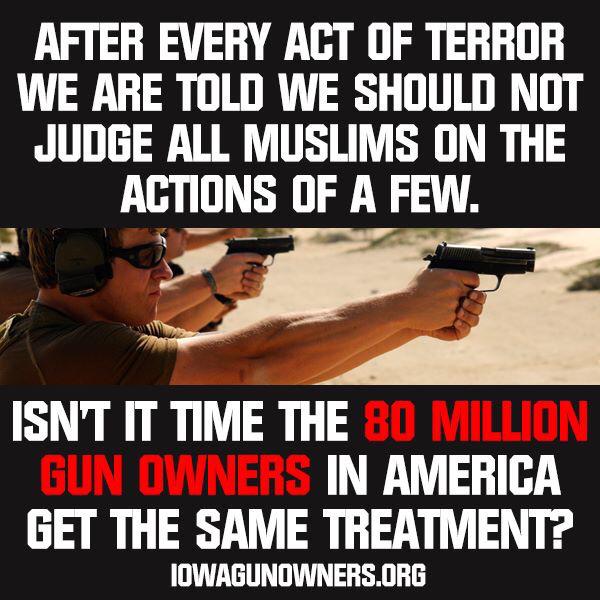
I saw this on Facebook today. And my immediate reaction was to attack: Well but that isn’t the same thing at all — people have an inherent right to freedom of religion, which is codified in (though not granted by) the U.S. Constitution’s Bill of Rights. And religion isn’t used to kill people. And pssh — Iowa. Come on. Like anything intelligent ever came out of Iowa.

Then I immediately thought: but the right to bear arms is also in the Bill of Rights. Even if I think it shouldn’t be. The Second Amendment does represent a natural right, the right of self-defense. Even if I think there are better ways to go about defending one’s self.

And as for religion: seriously, Dusty? It isn’t used to kill people? Even apart from the indisputable facts that have led to the prejudice represented here (more on the prejudice later), namely the sheer number of Islamic terrorists and war-mongers of the last — what, sixty years? — religion is behind most of the wars of human history, or has at least been used as the justification for them, as well as countless atrocities — the Inquisition, the witch-burnings, the Holocaust, the pogroms, chattel slavery, colonialism — Jesus, do I need to go on?

Absurd of me even to take up this argument, if this is all I have.

But that third one — that’s kind of right. Tom Arnold is from Iowa. So is Michele Bachmann. And Steve King, of course  (The moronic Congressman, not the author.). Ashton Kutcher. Charles Osborne, the guy with the world record for the longest lasting case of hiccups. Sure, there are a couple of scientists and mathematicians on the list of Iowans, several astronauts, and a few authors I like — Bill Bryson, especially — but you don’t get away from Michele Bachmann that easily. Not even with the Ringling Brothers.

So what does this mean? I’ve been arguing against guns for years and years now, and here I find myself stymied. Does it mean I should be changing my stance on gun control? Have I been unfairly critical of gun owners? Has this meme changed my argument? DID IOWA JUST WIN THE GUN FIGHT?!?

Well, no. It didn’t. The problem with this argument is that it equates religion and gun ownership, claiming that a prejudice against one is as morally and intellectually bankrupt as a prejudice against the other. This much is true: prejudice is always morally and intellectually bankrupt. It is also always instinctive for humans because we evolved to be hunter-gatherers and our minds are evolved to discover patterns, so we see them everywhere, and frequently use them as a basis for action and reaction; when we eat  the red berries and they are tasty, then the next time we see red berries, we assume they’ll be tasty. And sometimes they are tasty, and the prejudice is therefore efficient; and sometimes they are toxic and we die, and the prejudice is inefficient. Evolution argues that it is more frequently efficient than inefficient when used as a survival strategy — but that has no bearing whatsoever on the value of prejudice in society. There, the value is almost always outweighed by the costs.

But that doesn’t mean either that gun ownership is equivalent to religion, nor that the argument against gun ownership is equivalent to the argument against Muslims.

First: religion and gun ownership. Sure, both are personal rights enshrined in the Bill of Rights. Both are defended fanatically on the Fox network. Both are, theoretically, under attack by liberals with an agenda — and neither actually are. And yes, both often catch the blame for atrocities carried out by terrorists.

But religion, however it may have been used in the past, whatever people may think of it, is not a weapon intended to do harm. The goal of religion is truth, and subsequent salvation. The question of relative harm as it is created by religious tenets, as in, “If I allow you to die unshriven, you will burn in Hell forever; therefore I should torture you until you confess your heresy and renounce your beliefs– and then you’ll go to Heaven!” is certainly a troubling one, as religion here grants people a moral justification for doing harm; but that is an application of a specific religious principle, carried out by the person — it is not the intention of the religion as an entity.  Christianity was not founded in order to justify torture or slavery or war. I won’t say that those things are a misuse, as that implies that the actual intended purpose is a correct and proper usage of the religion, and as an atheist I don’t accept that; but I think there can be no argument that religion was not and never has been created intentionally to do harm.

Firearms, on the other hand, were invented, produced, and evolved over time intentionally and specifically to harm others. They exist for that reason. The possession of firearms is considered a right, both a natural right and a right in the Constitution, because of that reason; people may own firearms simply for amusement, but that is not why they feel a right to own them — if so, we’d all have the right to a Playstation 4, and I would currently be suing Sony. We have the right to bear arms because arms are the most effective way to harm others so that those others cannot harm us: the ability of firearms to do harm A)rapidly to multiple targets, B) from a distance that keeps the bearer safe from retaliation, and C) without physical strength, dexterity, or training, is unmatched in the world of weapons. This is why people use the Second Amendment to protect guns, rather than, say, swords and spears and personally owned stealth bombers. It is a disingenuous argument to claim that any weapon could be used to kill another person — and therefore the government can’t take away my gun. There is a reason why guns are the focus of the argument: because they are the most effective and efficient killing machine on the planet. The millions — billions? — who have been shot since the invention of firearms show this.

So we should not make analogies between religion and firearms, not even in criticizing anti-religious prejudice with anti-firearm prejudice. And let me just add: why would you want to do that? When I used to debate online against guns, I was frequently dismissed as a hoplophobe, one who suffers from a morbid and irrational fear of guns; the classic, er, “argument” that goes “Guns don’t kill people, people kill people” is based on the same objective understanding of firearms as inanimate objects, incapable of independent action, and therefore the incorrect focus for the fear felt by those who promote gun control. But this emotionless, objective, apparently logical stance is lost if one makes the comparison between gun owners and devotees of a religion; now those who own firearms are — true believers. Members of the faith. Followers of their prophet/messiahs, Smith and Wesson and Remington and Colt. This is not an opening which gun rights advocates want to give us hoplophobes.

But the real problem with this meme? It’s a meme.  The concept of the meme was created by Richard Dawkins, the British evolutionary biologist; Dawkins described the meme as the modern version of genes, now that mankind survives through social adaptation to environmental pressure, rather than biological adaptation. That is, rather than better genes propagating more than worse genes through reproduction and natural selection, we make adjustments for “bad” genes through our society: we take care of people who can’t survive on their own; we use medicine to give those with “bad” genes a full life; we create niches for those with differing strengths, so both the man with the strong back and the man with the strong mind can survive and thrive. The ideas that create those situations, the belief that family members should take care of those who cannot take care of themselves, for instance, are spread through our culture, and help that culture survive, along with the people who spread it. Our modern human culture is our survival strategy: we live and reproduce because our culture protects us far more than our bodies do.  Because of that, although we are continuously evolving as a species, today, our genes do not change very much; rather, our memes do.

The purpose of a meme, like the purpose of a gene, is not to create the perfect being, or the perfect argument: it is to reproduce. That means it has the qualities that will make it most likely to spread and multiply, not necessarily the best qualities. Blonde hair and blue eyes do not make someone a better human being — but if they make that person more likely to reproduce and spread those genes, then those genes will survive and thrive. Watch Idiocracy: there’s a meme, a reproducible bit of culture, that shows why neither genes nor memes need to be the best to be the most successful. It shows, in fact, how memes are become more powerful than genes in human evolution: successful memes actually make people’s genes worse, and the people themselves less biologically adapted to survive.

So this:

is not the best thought, not the best argument, but it is likely to be reproduced and propagated; therefore, it is a successful meme.

What internet memes do — what the meme that started this blog did — is oversimplify, because on the internet, simplicity is king. That’s why so many memes are crude line drawings, or this sort of simple joke. They use the same photos again and again, and the same font, and the same sentence structures and joke patterns because those things have been selected, have proven successful in the past, have been propagated and reproduced.

And all of that’s fine. Memes are jokes, and plenty of them are funny — this one cracks me up:

And this one is not only funny but true:

But none of the things that make these successful memes make them good thoughts or good arguments. Just — good at grabbing people’s attention so they click “Share.”

So for that, this meme

is successful, because it has an interesting enough idea, formulated in an eye-catching way — with a picture that is both relatable and idealized, because that guy looks ordinary and also badass; and using the all-caps font with red for a highlight; short words, simple sentences, rhetorical question — and so it was shared. And it is also successful in that it provokes thought: it took me some time to work my way through the meme’s rhetorical question and come to my answer. Time spent thinking is always good.

The answer is: no. It is not time the 80 million gun owners in America get the same treatment. First because gun ownership is not a religion, and the analogy doesn’t work. Second because although there is a right to self-defense, it should not be realized through firearms, which are unnecessarily deadly even when used to protect one’s self. The Second Amendment is wrong: arms should be regulated, for the safety of all, because private gun ownership creates as much danger as it eliminates, and generally more; the presence of weapons creates a feeling of safety far more often than it creates actual safety, and yet those weapons are most often used to do more harm than could be done without them. We could certainly get into a debate about personal liberty versus safety — so long as nobody quotes the Benjamin Franklin meme. Which oversimplifies and relies entirely on the persuasive power of the author’s name.

Lastly, the answer is No because, simply put, gun owners have never been treated the way that Muslims have. Yes, massacres that have been carried out with firearms have led to calls for gun control — but thanks to the Second Amendment, they have never led to even the beginning of a discussion of banning guns. Armed police and military are expected and appreciated. The only gun law that was passed using a mass shooting as impetus, the Brady Bill’s ban on assault weapons, was allowed to expire, because gun owners and manufacturers made it pointless. We can still buy extended clips like Jared Lee Loughner used in Tucson when he shot Gabrielle Giffords and 18 others — without reloading — and we can still buy weapons online as James Holmes did before he shot 82 people in Aurora. People speak out against guns, as they do against Muslims (And let me note the prejudice inherent within the meme itself, when it claims that every terrorist attack is related to Islam — only days after Dylann Roof killed nine people in a church in South Carolina. With a gun given to him for a birthday present, and therefore requiring no background check. He could also have done what Adam Lanza did, and used his parents’ guns.), but no laws ever pass, no action is ever taken. No innocent gun owners are beaten in the streets as happened after 9/11; no gun owners are unfairly targeted in airport searches; nothing has been done that is analogous to the Bible Belt states’ bans on Sharia law. No Baptist preachers are burning Guns & Ammo.

We have not yet invaded Austria to eliminate the Glock company.


In summation, all I have to say to this meme is this:

The Right Idea

I had an idea.

I received an essay from a student arguing that the drinking age should be lowered to 18. I have seen this argument before, and believe me, this was not the cleverest attempt; this student failed to offer even the traditional outrage over the idea that one could join the military and fight and die for one’s country, but not even buy a beer! I mean, come on!

I’ve been looking for the just-right response to that particular “argument” for years. I’m trying to choose between, “If you cut off your left hand, you can’t cut off your right. Is that fair?” or “You’re right. And you know what else? Boko Haram lets their soldiers drink.” or “I heard you can make a lovely Cosmopolitan out of the blood of a slain enemy and just a little wasabi. I bet the Army lets them drink THAT.”

Although I did not have the opportunity to appreciate, again, the absurdity of being allowed to shoot people and not be drunk while doing it, I did get to enjoy my very favorite class of argument: the “Everyone on Earth thinks like a perverse, obnoxious adolescent” argument. In this instance, it goes something like this: People think drinking is cool because it is against the law, and teenagers want to be rebellious. Teenagers do things for no other reason than because people tell them not to do those things. Therefore, if the drinking age were lowered and kids had access to alcohol, it wouldn’t seem so tempting and dangerous, and therefore fun and cool and stick-it-to-the-man-y, and so they wouldn’t do it as much.

Ah, yes. Many times I have thought, “You know what would be cool? Building an addition without a permit. That would really impress my biker buddies.” Whenever I need street cred — and I can’t count the times I have needed to cash in on my street cred — I just fail to report an accident, or I make a fake 911 call. Because I’m a thug, and thug life means jaywalking, yo. I’ve always been a rebel: I remember back in high school, one morning I told my bathroom mirror, “I’m going to falsify legal documents. Yeah: then the head cheerleader will notice me!”

It worked, too.

But while I was reading this particular essay, and trying to think of the best way to point out how absurd is the argument that laws against certain behaviors actually make those behaviors more attractive and therefore more common (I usually ask if the student thinks that murder would become less common if the laws against it were eliminated. Just picture all those murderers thinking, “Yeah, sure, I could go out and kill someone tonight. But where’s the spice, without running from the cops? Unless I’m risking jail time, there just doesn’t seem any reason to kill people. Sigh. I miss the good ol’ days.”), I got to the conclusion, which argued that things would be a whole lot better for everyone if drinking were considered an individual right, not a fascinating vice.

That’s when it hit me.

That student was absolutely right.

The key is not making things legal: the key is making something a right. That’s how you get people to walk away from it.

Just think: our forefathers fought for the right to build a government based on the rule of law and the basic principle of democracy, a government of the people, by the people, and for the people. And they won that right, too. Then it only took us 200 years or so to tear the whole thing down and replace it with Citizens United, and the repeal of the Glass-Steagall Act, and the Wall Street bailout, and the Keystone Pipeline: a government that represents money and power, and nothing else. A government of the rich (or at least only interested in the rich), by their puppets, for the profit margin.

Know why they do that? Because we’ve been told for years that greed and corruption are wrong. That makes them cool. (I can’t tell you how tempted I am right now to turn this whole thing against God and the Ten Commandments. But the problem with that is the Bible actually supports the claim that I’m currently mocking: after all, God told Adam and Eve not to eat the apple, and they did exactly that, and lost Paradise for us all.

Come to think of it, this bullshit really is the Bible’s fault.)

Then for decades, people fought against slavery, fought for the freedom not to be treated as a commodity. They won that, too, after struggle and war and destruction. And now we happily enslave ourselves: we work harder and for less reward than any other people of any other civilized nation. We do whatever the boss says, whenever the boss says it — you’ll never see a better example of this than teachers. “Why are we giving up the things we know are right for our students, like actual literature and field trips and creative endeavors? Because the boss says we have to raise test scores. Well, then, I guess we have to do it. Somebody pass me that stack of Scantrons.” We all happily give up our free will, duck our heads, bow and scrape, and do what we are told. Some of us even become Ditto-heads, and Moonies, and Beliebers; we “Let go, and let God.”

We have the right to vote: we don’t do it. We have the right to speak freely: we are silent. We have the right to a free press: we stopped reading the ones that spoke the truth, and now we have Fox News and CNN. We have the right to peaceably assemble, and we stay at home and tag each other on Facebook. We have the right to petition the government for redress of grievances, and instead we simply grieve.

It’s true: make something a right, and we can’t run away from it fast enough.

Therefore, I am advocating for the right to murder, the right to hate, and the right to celebrate and enforce ignorance. I believe all Americans should have the right to exploit each other, the right to feel no compassion for any other living thing, and the right to pervert and corrupt every goodness on Earth for the sake of instant gratification and petty, spiteful vengeance. Screw that life, liberty, and the pursuit of happiness stuff; we need to have those rights taken away. Life and liberty — and happiness — should be outlawed. Then they’ll be cool.

Then we’ll want them. Like everything else we can’t have.

So I hereby stand corrected in my basic intent as a blogger: we do not need to fight for the natural rights of man, we do not need to fight for justice, nor peace, nor love.

We need to fight for the right to treat each other, and ourselves, like dirt. The right to drink beer. And bacon: definitely the right to bacon.